




Abstract
The decoding process of emojis is automatic. Therefore, complexity increases when emojis are combined with language that requires cognitive interpretation, which can negatively affect interactions through emojis. This study aimed to investigate whether the emotional commitment process induced by emojis varied depending on their application to sentences. Building on previous research regarding emotional commitment through emojis, this study used inner imitation, which refers to the act of imitating the expression or behavior of another person or object, as the independent variable. Emotional empathy served as the mediating variable, and emotional commitment was the dependent variable. The study hypothesized that the emotional commitment process would be moderated by the way emojis are applied to sentences. Specifically, it was expected that the way emojis are applied would affect the path directly reaching emotional commitment (inner imitation → emotional commitment) as the receiver is deeply immersed, rather than the mediating path. The results showed that the relationship between inner imitation and emotional commitment was stronger when emojis were presented separately, rather than when they were inserted into the sentence. This is because emphasizing emojis individually enhances the recipient’s immersion without inducing cognitive complexity, reinforcing inner imitation on a subconscious level.
Plain Language Summary
Our latest study on emojis and emotional commitment reveals that the way emojis are applied to sentences affects the emotional commitment process. In other words, we found that the relationship between inner imitation and emotional commitment was stronger when emojis were presented separately, rather than when they were inserted into sentences. The decoding process of emojis is automatic. Thus, the complexity increases when emojis are combined with language that requires cognitive interpretation. This cognitive complexity can negatively affect interactions through emojis. In particular, it is known that emotional commitment induced by emojis occurs mainly by internally imitating emotional expressions conveyed by emojis. Here, inner imitation corresponds to the human’s instinctive and automatic response. Therefore, emphasizing emojis individually rather than inserting them into sentences can enhance inner imitation by increasing the receiver’s immersion without causing cognitive complexity.
Introduction
Whether Emotional Commitment Through Inner Imitation is Stronger When Emojis are Emphasized Separately Rather Than Inserted in Sentences
We often insert emojis into sentences to enhance communication and build relationships. However, since the decoding process of emojis is automatic, complexity increases in the process of recognizing emojis when they are combined with language that requires cognitive interpretation. This suggests that communication results may vary depending on how emojis are used in sentences. In order to confirm this, this study analyzed whether the emotional commitment process induced by emojis varies depending on the way emojis are applied to sentences.
Previous studies suggest that combining sentences with emojis requires more complex recognition than when only sentences are used, as emojis have different information processing methods than does language (Chatzichristos et al., 2020; Tang et al., 2020, 2021). While language requires cognitive interpretation, emoticons or smiley emojis are interpreted in a manner similar to facial expressions and involve an automatic interpretation process (Churches et al., 2014; Comesaña et al., 2013; Gantiva et al., 2020; Jolij & Lamme, 2005; White, 1995; Yuasa et al., 2006); face-based emotion recognition is described as an automatic process that does not require accessing knowledge or information stored in long-term memory (Goldman, 2006). Thus, when emojis, which are processed automatically at a lower level of consciousness, are presented alongside language that is interpreted at a higher level of consciousness, such as mentalization, cognitive complexity increases.
These findings suggest that care should be taken to prevent recognition complexity if one wants to increase interaction through emojis. This is because information processing complexity can have a negative effect on communication results (Bashirzadeh et al., 2022). In addition, from this perspective, it is possible that the outcome of an interaction varies depending on the way emojis are applied to sentences.
In other words, emojis can be used in two ways: emphasized separately from the text or inserted into a sentence along with the text (Ai et al., 2017; Donato & Paggio, 2017). However, inserting emojis into sentences increases cognitive processing complexity as it combines two factors with different information processing methods. Moreover, in such instances, since emojis are typically displayed in a smaller size within the sentence, it is disadvantageous in terms of ease of information processing related to gaze concentration. When emojis are emphasized separately from sentences rather than placed within them, the interaction between communicators can be further strengthened by facilitating information processing while preventing cognitive complexity. However, this is still an unexplored topic.
Hence, to confirm this theory, this study analyzed whether the emotional commitment process by inner imitation varies depending on the way emojis are applied to sentences (in-sentence insertion type, out-of-sentence emphasis type). This was based on previous research, which stated that emotional commitment (attachment) induced by emojis (expression of emotion) in interpersonal relationships has a strong correlation with inner imitation corresponding to the simulation method of mind-reading (Jeon, 2020).
Emotional Commitment Path by Inner Imitation
In general, it is well-established that directly imitating another person’s facial expressions leads to emotional empathy (Sonnby-Borgström, 2002) by enabling the individual to experience similar emotions (emotional contagion) (Lischetzke et al., 2020; Olszanowski et al., 2020; Prochazkova & Kret, 2017). In addition, inner imitation can induce not only emotional empathy but also emotional commitment. Inner imitation refers to simulating the expression or behavior of another person within one’s mind, including the internal impulse to imitate (Lipps, 1903).
Lipps (1909, 1923) explained that individuals comprehend and share the emotions and states of consciousness of others by internally imitating their expressive movements through instinctual processes. Additionally, Choi et al. (2012) and Yoon (2012) explained that as individuals immerse themselves in the emotions of others through identification, it triggers empathetic responses, fostering both commitment and attachment. These insights suggest that inner imitation not only gives rise to emotional empathy but can also facilitate emotional commitment and attachment through this empathy. Inner imitation occurs when the recipient identifies with the subject and becomes emotionally immersed (Lipps, 1923).
Moreover, if the recipient’s immersion is strengthened (H.-S. Lee & Kang, 2012), emotional commitment (attachment) can occur without emotional empathy acting as a mediator, owing to relationship feelings being strengthened. In other words, when the recipient is fully immersed, the information is processed by emotional factors without going through cognitive processing, resulting in a strengthened emotional connection (Bless et al., 1996). In addition, the stronger the identification with the object, the more emotional relationships are formed, leading to stronger bonds (C. T. Allen et al., 1992). This suggests that sufficient emotional commitment (attachment) can only occur with the emotions generated by internally imitating the emotional expression of the object when the receiver is deeply immersed and identification with the object is strengthened.
The occurrence of emotional commitment by inner imitation was reportedly confirmed in the recipient’s response to emojis in a mobile messenger. According to Jeon (2020), the recipient internally imitated the emotional expression of the emoji. This led to emotional commitment through emotional empathy. It’s noteworthy that the emotional commitment induced by emojis in interpersonal relationships showed a positive (+) correlation with “perspective taking” (theory-theory method) and “inner imitation” (simulation theory method), which correspond to two methods of mind-reading. Importantly, the correlation with inner imitation was stronger (Jeon, 2020). Furthermore, emotional commitment was achieved through inner imitation alone without the mediation of emotional empathy. The former pathway (inner imitation → emotional empathy → emotional commitment) corresponds to the sequential transition of consciousness, progressing in the order of cognition, emotion, and behavioral response. Meanwhile, the latter pathway (inner imitation → emotional commitment) involves direct behavioral responses originating from cognition as the recipient becomes emotionally immersed.
Moderating Effect According to the Way Emojis are Applied to Sentences
In general, facial imitation usually occurs unconsciously (occurring in a state of consciousness but without awareness because it is automatic) and automatically (Chartrand & Lakin, 2013; Hatfield et al., 1993; Hoffman, 1984; Lipps, 1907). Additionally, the process of emotional empathy following facial imitation involves an automatic and spontaneous response that depends on primary memory, rather than a product of cognitive interpretation (Sonnby-Borgström, 2002). Therefore, cognitive load or cognitive complexity in this conscious process is considered responsible for the decrease in emotional response as it inhibits automatic imitation responses; as cognitive load increases, the recipient’s emotional contagion toward happy expressions decreases (Kelly et al., 2016). Additionally, the inner imitation that occurs when recognizing emojis and the resulting emotional empathy process are considered to occur at a low level of consciousness (Jeon, 2022). These results indicate that the emotional commitment process according to inner imitation may vary depending on the way emojis are used in sentences.
When an emoji is inserted into a sentence, the cognitive complexity in processing increases (Chatzichristos et al., 2020; Tang et al., 2020, 2021). This occurs because the emoji, which is automatically interpreted (Comesaña et al., 2013; Jolij & Lamme, 2005; White, 1995), is presented alongside text that also demands cognitive interpretation. This cognitive complexity may be the cause of a decrease in emotional empathy and emotional commitment, as it reduces inner imitation as an automatic response. However, if the emoji is applied separately from the sentence, the decrease in inner imitation and emotional response owing to cognitive complexity can be prevented.
In addition, the size of the emoji, which varies depending on the way the emoji is applied to a sentence, can affect information processing. When an emoji is added to a sentence in a mobile messenger, it appears small and fits within the paragraph. However, when used outside the sentence, it is emphasized as an independent image. Here, the size of the emoji can affect the ease of information processing since it is correlated with the degree of gaze attention (Y. J. Lee, 2012). Studies indicate that larger fonts or logos make information processing easier (Moriarty, 1986; Mueller et al., 2014; C. S. Smith, 1973). This ease of information processing helps consumers immediately empathize with the brand (A. Y. Lee & Labroo, 2004) and also increases favorable attitudes toward the brand (Dogerlioglu-Demir et al., 2017; Schwarz, 2004) and advertising effectiveness (An et al., 2020; Y. Kim & Kim, 2020). These results suggest that even in interpersonal relationships, the outcomes of interactions may vary depending on the ease of information processing, which is influenced by the size of the emoji.
In particular, the impact of these factors is expected to be more significant in a pathway directly reaching emotional commitment from inner imitation than in one where the transition of consciousness occurs sequentially in the order of cognition, emotion, and behavioral response. When individuals are deeply immersed, their actions and consciousness merge (Csikszentmihalyi, 1975), leading to a shorter thinking process. If one experiences positive emotions in this state of immersion, they can reach emotional commitment without going through thought processing. In particular, people with high levels of mirroring or empathy automatically imitate emotional expressions in less than a second, and emotional contagion is considered to occur immediately (Dimberg & Thunberg, 2012; Sonnby-Borgström, 2002). In light of these points, it is speculated that the process of reaching emotional commitment directly from inner imitation can occur at a similar level. Therefore, cognitive complexity in this conscious process can be a factor in reducing the receiver’s immersion. This decrease in immersion can be a decisive factor in weakening the process of emotional commitment in inner imitation, which involves achieving emotional commitment without going through thinking. Based on this, the present study developed the following hypothesis:
Hypothesis 1. The relationship between inner imitation and emotional commitment will vary depending on the way emojis are applied to sentences (in-sentence insertion type, out-of-sentence emphasis type).
Methodology
Study Model
In this study, to determine whether a difference exists in the emotional commitment process induced by the way emojis are applied to sentences, based on the study by Jeon (2020), inner imitation was set as the independent variable, emotional empathy as the mediating variable, and emotional commitment as the dependent variable. In addition, to verify the moderating effect of the way emojis are applied to sentences on the relationship between inner imitation and emotional commitment, the PROCESS macro model 5 (Hayes, 2012) was applied, and the following research model was established (Figure 1).
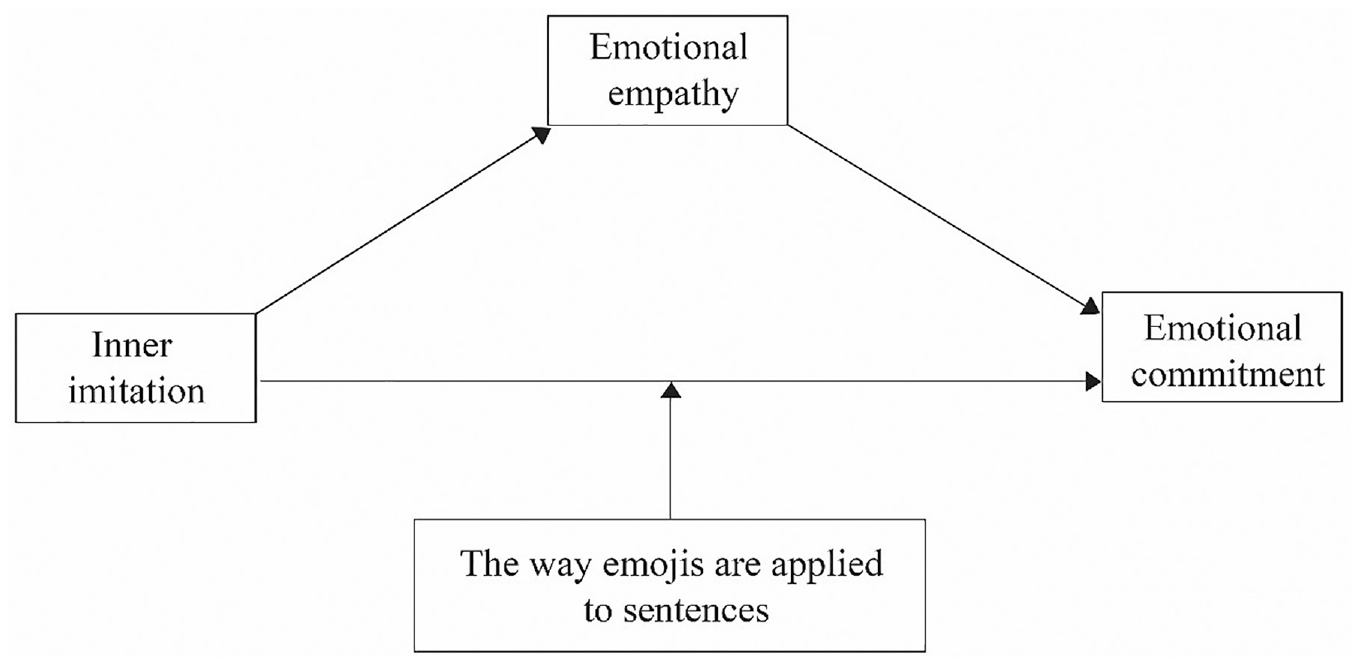
Model of the moderating effect of the way emojis are applied to sentences in inner imitation, emotional empathy, and emotional commitment.
Measurement Instruments
All major variables were measured using a five-point Likert scale. To measure inner imitation, this study used Lim’s (2003) questionnaire on imitative behavior owing to identification with media figures, and Song (2009) and H.-S. Kim’s (1995) questionnaire on the imitative impulse caused by violent media. The four questions were modified to suit this study. Cronbach’s α was .946, which was satisfactory. Emotional empathy was measured using Shen’s (2010) questionnaire comprising four items. Cronbach’s α was satisfactory at .679. Emotional commitment was measured by applying six items among the measures of emotional commitment by N. J. Allen and Meyer (1990). Cronbach’s α was satisfactory at .864. The way emojis are applied to sentences was used as a control variable and coded as 0 for in-sentence insertion type and 1 for out-of-sentence emphasis type.
The Way Emojis are Applied to Sentences
In this study, the method of applying emojis to sentences was divided into in-sentence insertion type (serial combination, small emoji) (Figure 2A) and out-of-sentence emphasis type (parallel combination, big emoji) (Figure 2B). These categories were based on two representative methods of using emojis in mobile messengers. For the in-sentence insertion type, text and emoji were combined in parallel by inserting an emoji into the sentence, and a small-sized emoji was applied. In contrast, for the out-of-sentence emphasis type, sentences and emojis were separated and arranged in parallel, and the emoji size was greatly emphasized.
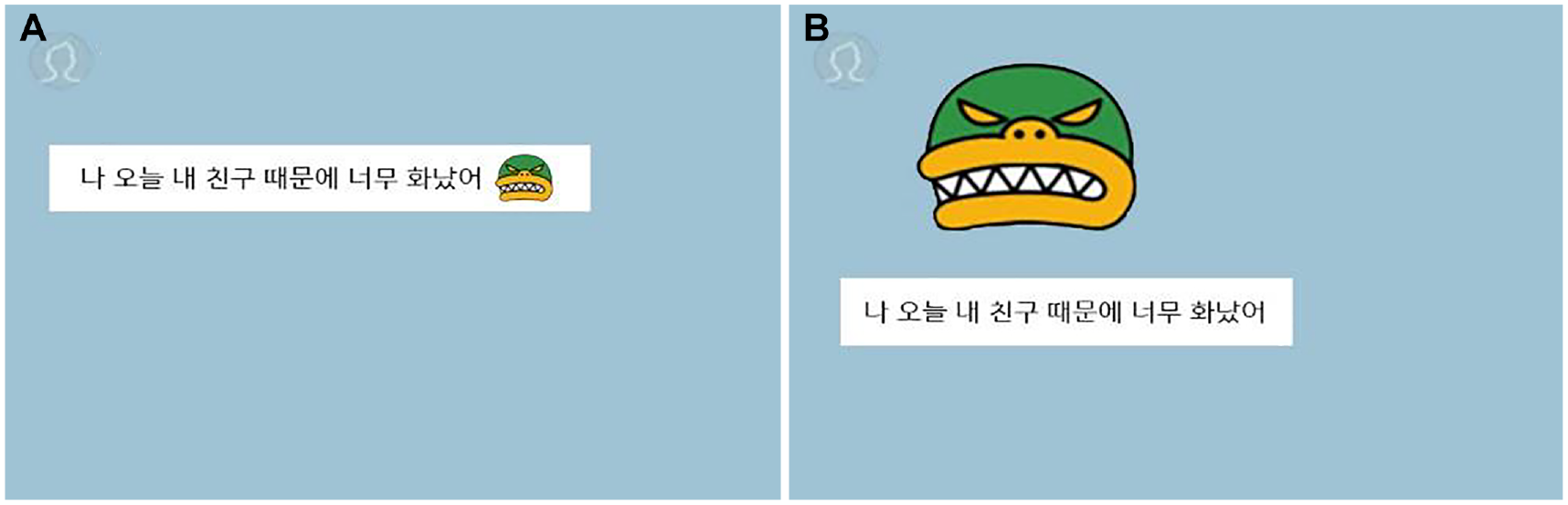
Examples of the way emojis are applied to sentences: (a) in-sentence insertion type and (b) out-of-sentence emphasis type.
The sentence combined with the emoji was: “Today I am so mad because of my friend.” The emotional expression was applied in the static form of an angry face emoji. This was established to exclude other factors besides the moderating variable and to check whether emotional commitment occurs through inner imitation in antisocial emotions, unlike Jeon’s (2020) study, which set the stimulus as a condition in which inner imitation can be reinforced; the auto-mimicking effect occurs more in response to pro-social words than to anti-social words (Leighton et al., 2010). Additionally, in everyday life, people imitate smiles more than they do frowns (Hinsz & Tomhave, 1991).
Participants and Stimulus
The study sample consisted of individuals in their 20s who used KakaoTalk, Korea’s representative mobile messenger. According to the 2017 Internet Usage Summary Report, 99.4% of Koreans use KakaoTalk, and most mobile messenger users are in their 20s (Ministry of Science and ICT, 2017). The stimulus was limited to the “Tube” character emoji among Kakao Friends, KakaoTalk’s own set of emoji characters. Kakao Friends had the highest purchase rate in the questionnaire survey on domestic smartphone emoji character preferences (S. H. Kim, 2015). Moreover, to provide the participants with a feeling similar to receiving an emoji on a mobile messenger, manipulated stimuli (active KakaoTalk chat window) were applied to the mobile phone liquid crystal image and presented (Figure 3).

Example of stimulus.
Experimental Method
The experimental method was conducted using a self-report questionnaire. Based on microgenetic theory, this study considered that even if inner imitation occurs at an unconscious or automatic level, it can be confirmed in the conscious state as it continues and evolves. In the microgenetic theory, mental phenomena are described as appearing in the conscious state as they evolve through qualitatively different stages of processing (Breitmeyer & Öğmen, 2006; Brown, 1985; Hanlon, 1991; Hman, 1993; Leventhal, 1984; G. J. W. Smith, 1991). This is supported by the fact that, in a facial electromyography (fEMG) study, participants reported recognizing and feeling emotions consistent with facial imitation in self-reported measures, taken immediately after viewing the stimuli, at the subconscious or automatic level.
After informing the participants that the collected data will be used for emoticon research and obtaining written consent, we conducted an online survey through a personal computer. This study did not involve any potentially harmful procedures or invasive measures. Thus, it was deemed low-risk and did not require ethical review by an institutional review board. In addition, to protect the privacy of participants, the survey was conducted anonymously. The participants were instructed on the scenario of receiving a message from a friend. After seeing the emojis presented in the KakaoTalk chat window, they were asked to answer a question about their feelings. To avoid learning effects, the order of the questions was randomized. We also employed the following system to prevent unreliable responses. First, we added one question instructing participants to enter a specific answer (“very no”) during the survey to exclude respondents who tended to randomly select answers. Second, to induce respondents to read and answer each question thoroughly, the survey was designed in such a manner that questions were presented sequentially after the stimulus was presented; that is, to expose the next question after answering the previous question.
Data Collection and Analysis Method
In this study, a pilot test was conducted from July 2 to 3, 2021, and the actual data collection was conducted online from July 6 to 12, 2021. Data were collected from 489 respondents who met the pre-screening criteria. Among this group, 428 respondents passed the sincerity response test and were selected as the final sample.
The following statistical analysis was performed on the data from this study using SPSS 22.0. First, exploratory factor analysis was performed to analyze the validity of the measurement tool. The reliability of the factors was analyzed using Cronbach’s alpha coefficient. Second, a frequency analysis was performed to determine the general characteristics of the research participants, and descriptive statistical analysis was performed to determine the level of research variables. Third, Pearson’s correlation analysis was performed to examine the correlations between the study variables. Fourth, the mediating effect model (Model 4) and moderating effect model (Model 5) were analyzed using SPSS Process Macro (IBM Corp., Armonk, NY, USA) to verify the main research hypothesis. The significance of the mediating and moderating effects was confirmed through bootstrapping (Sample = 5,000). Statistical significance was determined at a significance level of 5%.
Results
Validity and Reliability Verification
Exploratory factor analysis and Cronbach’s alpha values were examined to verify the validity and reliability of the variables used in this study. Principal component analysis and varimax rotation were used for the exploratory factor analysis. Factors were classified as relevant when the factor loading exceeded 0.40. The analysis results indicated that the criteria for factor analysis of inner imitation (KMO = 0.870, χ2 = 1635.040***, DF = 6, cumulative % = 86.158), emotional empathy (KMO = 0.662, χ2 = 289.505***, DF = 6, Cumulative % = 50.989), and emotional commitment (KMO = 0.887, χ2 = 1122.137***, DF = 15, cumulative % = 60.412) were met, and the factor loading value of all items exceeded 0.4, thus ensuring validity. The Cronbach’s alpha value of all scales exceeded .6, confirming good reliability (Hair et al., 1998). Table 1 shows the detailed results of the exploratory factor and reliability analyses.
Exploratory Factor and Reliability Analyses.

Demographic Characteristics of Study Participants
The results of the frequency analysis to confirm the demographic characteristics of the participants are shown in Table 2.
Demographic Characteristics of Study Participants.

In-sentence insertion type (serial combination, small emoji); Out-of-sentence emphasis type (parallel combination, big emoji).
Descriptive Statistics
The results of the descriptive statistical analysis to confirm the characteristics of the major variables are shown in Table 3. The averages of inner imitation, emotional empathy, and emotional commitment were 2.661, 3.504, and 3.142, respectively. In addition, to determine the normality of each variable, skewness, and kurtosis were examined. The absolute values of all skewness and kurtosis were less than 3 and 10, respectively, confirming a normal distribution (Kline, 2005).
Descriptive Statistics.

Correlation Analysis
Pearson’s correlation analysis was conducted to identify the correlation between variables in this study. Inner imitation had a positive (+) significant relationship with emotional empathy and emotional commitment, and emotional empathy had a positive (+) significant relationship with emotional commitment. Table 4 provides detailed results of the correlation analysis.
Correlation Analysis.

p < .001.
Mediating Effect of Emotional Empathy
To confirm the mediating role of emotional empathy in the relationship between inner imitation of emojis and emotional commitment, we conducted an analysis using Hayes (2012) PROCESS Macro model No. 4. Control variables included gender and age, and the results are presented in Table 5.
Mediating Effect of Emotional Empathy in the Relationship Between Inner Imitation and Emotional Commitment.

Model 1 verifies the impact of inner imitation as the independent variable on emotional empathy as the mediating variable. The model exhibited a significant F-value, indicating suitability (F = 36.284, p < .001), with a model explanatory power of 20.4%. The analysis revealed a significant positive (+) effect of inner imitation on emotional empathy (β = .433, p < .001).
Model 2 examines the combined effects of inner imitation as the independent variable and emotional empathy as the mediating variable on emotional commitment. This model also demonstrated a significant F-value (F = 98.783, p < .001) and had a high explanatory power of 48.3%. Both inner imitation (β = .263, p < .001) and emotional empathy (β = .541, p < .001) had a significant positive (+) effect on emotional commitment.
Model 3 analyzes the direct relationship between inner imitation as the independent variable and emotional commitment as the dependent variable. The model fit was good, indicated by a significant F-value (F = 47.247, p < .001) and an explanatory power of 25.1%. Similar to the model involving the mediating variable, inner imitation had a significant effect on emotional commitment (β = .497, p < .001).
Furthermore, through bootstrap testing (Sample = 5,000), we confirmed the significance of the mediating effect. It was found that the effect of inner imitation on emotional commitment through emotional empathy was positive (+) (see Table 6), and this effect was statistically significant as the confidence interval did not include 0.
Bootstrapping for Mediating Effects (Sample = 5,000).

Verification of Moderating Effect According to the Way Emojis are Applied to Sentences
The PROCESS macro model No. 5 was analyzed to verify the moderating effect of the way emojis are applied to sentences on the relationship between inner imitation and emotional commitment. Table 7 presents the results of this analysis.
The moderating effect of the way emojis are applied to sentences on the relationship between inner imitation and emotional commitment.
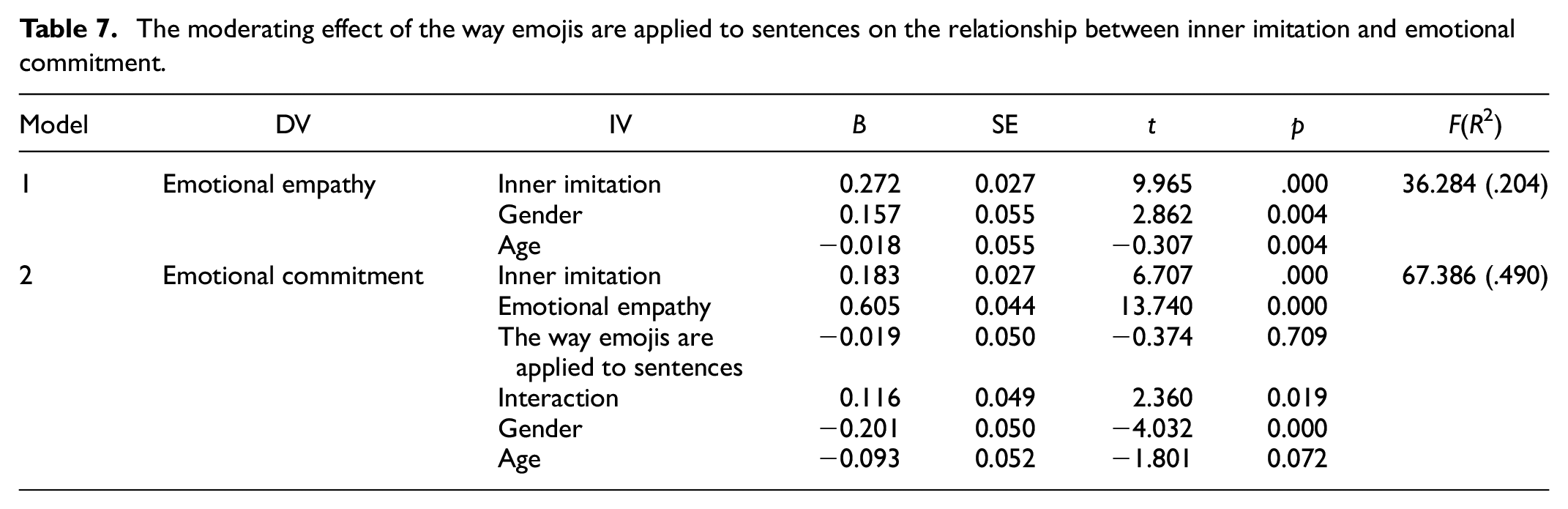
First, Model 1 analyzed the relationship between inner imitation and emotional empathy by controlling for gender and age. The F-value was significant, indicating that the model was suitable (F = 36.283, p < .001). The explanatory power was 20.4%, and inner imitation had a significant positive (+) effect on emotional empathy (B = 0.272, p < .001).
Model 2 verified the moderating effect, and showed the influence of independent, mediating, moderating, and interaction variables (inner imitation × the way emojis are applied to sentences) on emotional commitment. In this model, the F-value was also significant (F = 67.386, p < .001), and the explanatory power was 49%. The analysis revealed that the interaction effect of the way emojis was applied to sentences was positively significant in the relationship between inner imitation and emotional commitment (B = 0.116, p < .05). That is, the positive (+) relationship between inner imitation and emotional commitment was stronger when the emoji was separated and emphasized outside the sentence. Therefore, Hypothesis 1 was supported.
Examining the difference in the conditional effect on this (Table 8) showed that each effect was significant when an emoji was inserted into a sentence and when it was emphasized separately; the coefficient size was 0.125 when an emoji was inserted into a sentence and 0.2409 when it was emphasized separately. In other words, when an emoji was emphasized separately from the text, the influence of inner imitation on emotional commitment was greater than when it was inserted into a sentence.
Conditional Indirect Effect by the Way Emojis are Applied to Sentences.

In-sentence insertion type (serial combination, small emoji); Out-of-sentence emphasis type (parallel combination, big emoji).
Discussion and Conclusion
This study aimed to investigate whether the emotional commitment process is affected by the use of emojis in different ways. Our analysis confirmed that inner imitation, emotional empathy, and emotional commitment are interrelated variables, which is consistent with Jeon’s (2020) research. In addition, our findings suggest that inner imitation is a significant factor in developing emotional empathy and emotional commitment. This is in line with previous studies indicating that the internal (mental) representations of objects have a positive effect on empathy (Niec & Russ, 2002), and that people can internally experience similar emotions by being together, even if they do not imitate others’ expressive movements externally (Lipps, 1907, 1909).
Moreover, our study confirms that emotional commitment occurs through emotional empathy in inner imitation, while also occurring directly in inner imitation, similar to Jeon’s (2020) results. This supports previous studies showing that empathy generated by immersion in emotion and identification with others induces commitment and attachment (Choi et al., 2012; Yoon, 2012). Furthermore, emotional commitment (attachment) can occur directly in inner imitation without the mediating effect of emotional empathy, when the recipient is emotionally immersed (H.-S. Lee & Kang, 2012) in the emoji recognition process. Notably, these results appeared despite the exclusion of the inner imitation reinforcement condition, using antisocial emotion (angry expression) in a static state without movement as a stimulus. This indicates that a strong tendency of inner imitation exists within individuals.
Second, we confirmed that the relationship between inner imitation and emotional commitment is moderated by the way emojis are applied to sentences. Specifically, we found that the relationship was stronger when the emoji was emphasized separately from the sentence compared to when it was inserted into the sentence. This suggests that the combined state of text and emojis and the size of emojis can affect communication results. We believe this is because emojis emphasized separately from sentences facilitate the process of perceiving and recognizing them, unlike emojis inserted in a small size within sentences.
It is worth noting that language and emotional recognition operate at different levels of consciousness. While language is processed through conscious processes at a higher level, emotional recognition of emojis proceeds automatically at a lower level of consciousness (Comesaña et al., 2013; Jolij & Lamme, 2005; White, 1995). Thus, when these two elements are presented together by inserting an emoji into a sentence, it increases cognitive complexity during processing (Tang et al., 2020, 2021); the combination of words and emoticons induces more complex brain activation patterns than do words alone (Chatzichristos et al., 2020). This cognitive complexity can inhibit inner imitation, an unconscious and automatic-reflexive phenomenon, which can lead to a reduction in emotional empathy and emotional commitment. When the cognitive load increases, the autonomous response of facial imitation is suppressed, resulting in a decrease in emotional contagion (Kelly et al., 2016).
However, this cognitive complexity can be avoided if emojis are separated from sentences and given emphasis. This study induced the sequential expansion of consciousness from a low to high level by placing emojis in front of sentences. This approach has a positive effect on reinforcing inner imitation that occurs automatically at lower levels of consciousness, while preventing a decline in the receiver’s immersion by reducing the energy required to process different information simultaneously.
Additionally, just like a larger font or logo size makes information easier to process (Moriarty, 1986; Mueller et al., 2014; C. S. Smith, 1973), emphasizing the size of an emoji facilitates emotional processing by increasing attention concentration. Moreover, a greatly emphasized emoji can strengthen identification with the object by enhancing social presence (Y. J. Lee, 2014) in the non-face-to-face environment. Here, identification is a factor that affects psychological attachment and commitment (Yun et al., 2015), as well as inner imitation, which is the act of internally experiencing the emotions of an object by identifying with it.
In particular, these factors, which vary depending on the way emojis are applied to sentences, can have a greater impact on the process of reaching emotional commitment with only positive emotions experienced through inner imitation, when the receiver is deeply immersed. In other words, individuals with high empathy experience emotional contagion by mimicking other people’s emotional expressions in less than a second (Dimberg & Thunberg, 2012; Sonnby-Borgström, 2002). Based on this, it is highly likely that the process through which emotional commitment directly occurs in inner imitation will similarly occur at an almost automatic level. In these conscious processes, cognitive complexity and ease of information processing are decisive factors that affect the recipient’s immersion and inner imitation. Here, the receiver’s immersion is a precondition for processing information only with emotional factors without going through the process of thinking as behavior and consciousness become one. Inner imitation is the key to forming emotional bonds and attachments with others. Thus, in these conscious processes, the degree of the receiver’s immersion and inner imitation are ultimately directly connected to emotional commitment. Hence, this study concludes that the relationship between inner imitation and emotional commitment was stronger when the emoji was emphasized separately from the sentence than when it was inserted into the sentence.
Implications and Future Research
The study confirmed that understanding how recipients recognize emojis and considering the way they are applied to sentences is crucial to strengthen emotional commitment induced by emojis. Our findings shed light on the impact of emojis on interpersonal communication and suggest strategies for the effective use of emojis in different contexts. However, since the method of applying emojis in this study involved inserting them into sentences in a mobile messenger and emphasizing them separately, the effects of combining text and emojis and the size of the emojis on the study’s results remain unclear. Further research is needed to determine which factor had a greater influence.
Moreover, it is important to examine whether a difference exists in communication depending on the way emojis are applied to sentences, even for emojis that do not require inner imitation, such as artifacts. As seen from Jeon’s (2020) results, emojis that express emotions are more likely to be processed through an automatic mirroring reaction at a low level of consciousness. However, in the case of emojis such as artifacts or symbols, it is highly likely that they will be interpreted through a method such as perspective-taking rather than inner imitation, which is a human instinctive response. Here, perspective-taking corresponds to a cognitive process that occurs through high-level mentalization based on the theory of mind. Therefore, when the receiver cognitively interprets emojis at a high level of consciousness, it may be less affected by cognitive complexity or ease of information processing caused by the size of emojis and whether text and emojis are combined or not.
Furthermore, as this effect is stronger when the recipient has high emotional immersion while recognizing emojis, a study is required to understand this emotionally immersed group. In addition, women have been found to empathize more through mirroring and simulation than men (Cheng et al., 2008; Jabbi et al., 2007; Yang et al., 2009), and their empathy process occurs more automatically than for men (Jie et al., 2019). Hence, women may be the representative group for this conscious process. More research is needed to assess this gender difference.
Research Data
sj-xlsx-1-sgo-10.1177_21582440241239804 – for Is Emotional Commitment Through Inner Imitation Stronger When Emojis are Emphasized Separately Rather Than Inserted in Sentences?
sj-xlsx-1-sgo-10.1177_21582440241239804 for Is Emotional Commitment Through Inner Imitation Stronger When Emojis are Emphasized Separately Rather Than Inserted in Sentences? by Hye-Jin Jeon in SAGE Open
Footnotes
Acknowledgements
None.
Declaration of Conflicting Interests
The author declared no potential conflicts of interest with respect to the research, authorship, and/or publication of this article.
Funding
The author received no financial support for the research, authorship, and/or publication of this article.

Data Availability Statement
The data underlying this article are available in the article and in its online supplementary material.
References
Supplementary Material
Please find the following supplemental material available below.
For Open Access articles published under a Creative Commons License, all supplemental material carries the same license as the article it is associated with.
For non-Open Access articles published, all supplemental material carries a non-exclusive license, and permission requests for re-use of supplemental material or any part of supplemental material shall be sent directly to the copyright owner as specified in the copyright notice associated with the article.
