



Abstract
English language teaching methods have been transforming to improve learners’ English language proficiency. Currently, effective teaching methods are essential for enhancing learners’ academic achievement. Despite the recognition of collaborative learning as a beneficial approach, research specifically investigating its effects on writing performance remains limited. Therefore, this study aimed to investigate the effects of collaborative writing on Ethiopian English as a Foreign Language students’ writing accuracy, fluency, and complexity performance; it is a crucial area in language pedagogy that has not been extensively examined. Employing a quasi-experimental design, the study selected a total of 86 students, with 43 participants from each of two grade 10 classes. One class was assigned to the experimental group, where students participated in collaborative writing activities. The other class served as the control group, receiving conventional writing instruction. The intervention was implemented over a 12-week period. Data were collected through pre- and post-writing tests, and the results of the pre and post writing performance tests were analyzed using descriptive statistics, an independent-samples t test, and ANCOVA. The results revealed a statistically significant difference between the experimental and control groups in writing accuracy and fluency. However, there was no statistically significant difference between the two groups in terms of writing complexity performance. The findings indicate some theoretical and pedagogical implications to enhance advancements in writing proficiency, and overall, the study concludes by offering suggestions for future research.
Plain Language Summary
This study tested whether writing together in groups helps high school students in Ethiopia improve their English writing skills. The researchers compared two classes of Grade 10 students. One class learned by writing together, while the other class learned by writing alone, which was the usual teaching method. After twelve weeks, the students who wrote together wrote paragraph more fluently and made fewer mistakes than the students who worked alone. However, both groups were equally good at writing complex sentences. These results show that collaborative writing is a good way to help students write more fluently and accurately. But to help them write more complex sentences, teachers might need to use other methods. This study gives teachers useful ideas and suggests what researchers should study next to improve students’ writing skills.
Introduction
Effective English language teaching method includes various approaches designed to improve language learning and academic achievement. A key goal of these approaches is to develop communication skills in an international context. As a global lingua franca, English requires teaching methods that accommodate varied learning styles and cultural backgrounds. This inclusive approach not only enhances learning but also promotes multilingualism and the use of Global English (Galloway & Numajiri, 2020; Rose & Galloway, 2019). Furthermore, by validating learners’ linguistic identities, these methods empower students to confidently navigate multicultural environments and engage in international contexts (Cheung, 2016). The ultimate goal is to foster competent communicators who can thrive in our interconnected world.
Ethiopian education system has experienced numerous changes and reforms since its inception. For example, modern education was introduced in Ethiopia in the early 20th century (Gemechu et al., 2017). Alongside this, English language teaching (ELT) began. Since then, it has undergone various curricular and methodological developments. After the introduction of the Education and Training Policy in 1994, the teaching method, in general, and English language teaching method, in particular, shifted from a teacher-centered to communicative approach, and the ELT syllabuses were designed with a communicative orientation. Despite these reforms, learners’ knowledge remains inadequate, and the effectiveness of ELT is still questionable (Girma & Sarangi, 2019; Ministry of Education, 2018). According to Dinsa (2023), the utilization of unsuitable teaching method is one of the factors responsible for the deterioration of the quality of English language education.
In order to reform the education sector in line with national vision and development goals, a new general education curriculum was developed in 2021 based on the Ethiopian Education Development Roadmap. The new English language curriculum specifically aims to enable students to communicate in English, explore technological and scientific endeavors, acquire new knowledge and skills, share cultural, linguistic, and social experiences, and facilitate working, traveling, and studying in other countries (Ministry of Education, 2021). However, as the present researchers noted that, the new 2021 general education English language curriculum did not emphasize collaborative learning (CL). In particular, collaborative writing was not explicitly incorporated into the syllabus and textbook.
In Ethiopian secondary schools, collaborative writing has not been effectively implemented, despite its recognized benefits for fostering meaningful interaction (Ministry of Education, 2018). Research confirms that the practice of collaborative learning in teaching English writing is minimal (Anshu & Yesuf, 2022). Instead, individualistic writing remains the predominant and frequently utilized teaching writing method. At the secondary level, the majority of writing tasks are carried out independently (Abeti & Beriso, 2021; Anshu & Yesuf, 2022; Wondwosen, 2016). This is compounded by the fact that students are not adequately informed about the significance of CL (Terfa, 2020), leading to a lack of adherence to its principles. Furthermore, an evaluation of previous grade 10 English textbooks reveals a lack of tasks conducive to collaborative writing, with the emphasis instead placed on individual writing. Most critically this deficiency persists in the newly introduced grade 10 English language syllabus and textbooks, which also fail to adequately address collaborative writing.
This lack of focus on collaborative writing in the curriculum likely contributes to the poor writing proficiency observed among Ethiopian secondary and tertiary students. Evidence suggests that Ethiopian secondary and tertiary students struggle to construct syntactically complex, accurate, and fluent sentences. This deficiency is evidenced by local studies indicating that many secondary school students fail to produce written work meeting the expected standards for their grade level (Abeti & Beriso, 2021; Anshu & Yesuf, 2022; Wondwosen, 2016). From the researchers’ experience it was also noticed that when tasked with developing term papers, assignments, and other written discourse, students often struggle to produce grammatically accurate and complex texts within the allotted time frame. Scholars directly link such difficulties to instructional methods, noting that inadequate teaching practices can impede writing proficiency (Shruthi et al., 2024), whereas structured instructional methods effectively cultivate the necessary competencies (Al Fraidan, 2025). Given this clear link between instructional method and student outcome, the present study is motivated to investigate the impact of collaborative writing on enhancing writing accuracy, fluency, and complexity.
Studies have highlighted the beneficial impact of collaborative writing on the writing performance of EFL learners (Helaluddin et al., 2022; Mei et al., 2025). This approach not only enhances the quality of students’ writing but also increases motivation and self-efficacy (Li, 2023). Empirical investigations have indicated that collaborative writing enhances both writing accuracy (Jafari & Ansari, 2015; Shahrokhi & Haji Jalili, 2017; Wang et al., 2024), and fluency (Lopres et al., 2023; Pham, 2021; Wang et al., 2024). Furthermore, collaborative writing fosters critical and creative thinking, thereby improving overall writing quality (Chelghoum & Grine, 2018; Jafari & Ansari, 2015).
However, the findings regarding complexity are less consistent. Certain studies, including those conducted by Shahrokhi and Haji Jalili (2017) and Wang et al. (2024) did not find significant effects on writing complexity. This limitation may be explained by several challenges associated with the approach. Collaborative writing can increase cognitive demands as students manage group interactions and share ideas. This added pressure may hinder their ability to focus on writing complexity, often leading to simpler sentence structures (Janssen & Kirschner, 2020; Rahimi & Noroozisiam, 2013). Additionally, differing writing styles and preferences can create disagreements during collaboration. These disagreements may result in compromises that reduce the final product instead of enhancing its complexity (Blewett et al., 2021). Moreover, it is often viewed as more time-consuming than individual writing (Shahrokhi & Haji Jalili, 2017), and many students encounter difficulties in generating complex ideas (Sundari et al., 2021). Therefore, while collaboration has its benefits, it can also limit the development of writing complexity.
Further complementing the aforementioned studies, some local researchers such as Abeti and Beriso (2021) have delved into the impact of CL on writing performance. Their research findings emphasized that organization, a fundamental aspect of writing skill, experienced the most significant benefits from the collaborative learning approach. Anshu and Yesuf (2022) conducted an investigation into the impact of collaborative writing on the paragraph writing performance of EFL students, with a particular emphasis on content and coherence. The results indicated that students engaging in collaborative writing tasks demonstrated more improvements in both the content and coherence of the paragraphs they produced following the training, in contrast to students who completed the writing tasks independently.
Despite these findings, research on the effects of collaborative writing on writing accuracy, fluency, and complexity is still limited and yields inconclusive results. Additionally, many local studies tend to focus on specific elements of writing such as grammar, content, vocabulary, and organization while neglecting broader aspects like accuracy, fluency, and complexity. This indicates a gap in the literature regarding the broader spectrum of writing skills addressed by CL. Moreover, within the context of the present study, there has been no similar research conducted, highlighting a need for further investigation. Furthermore, the new 2021 general education English language curriculum and textbooks have not been subjected to research scrutiny, leaving an additional gap in understanding how collaborative writing aligns with these educational materials.
Consequently, these gaps have motivated researchers to undertake a study aimed at examining the impact of collaborative writing on students’ writing accuracy, fluency, and complexity. Therefore this study contributes to understanding how collaborative writing can enhance learners’ writing skills by improving their accuracy, fluency, and complexity. This aspect is especially pertinent within EFL environments, where proficient communication is of paramount importance. Overall, the research holds considerable significance due to its capacity to improve writing instruction and contribute to overarching educational practices.
Writing Skills
Writing is one of the four macro language skills and is often considered the most complex. It is an active, productive process of conveying messages through written symbols and is a fundamental component of English language courses Asio et al. (2023). Writing in a foreign language is particularly challenging, as it requires the writer to generate ideas, decide how to express them effectively, and organize them coherently for a reader. Good writing demands more than just grammatical knowledge; it also requires a command of lexical devices, logical connectors, and a variety of syntactic patterns (Al Fraidan, 2025; Shruthi et al., 2024). Ultimately, as (Koay, 2017) notes, writing is a thinking process. It involves generating ideas, composing them into structured text, and revising the work. Given this complexity, writing skills must be developed gradually in the classroom through effective and appropriate teaching methods.
Successful writing cannot be defined by a single set of fixed characteristics; rather, it encompasses a variety of profiles that are dependent upon context and purpose (Hoque et al., 2024). Successful writing has fewer grammatical, spelling, and punctuation errors. Other successful writing has more syntactically complex sentences and was written in a short period of time. Fluency, complexity and accuracy are essential measures for assessing a learner’s proficiency in a second/foreign language writing (Samoudi & Modirkhamene, 2020).
Fluency relates to the smoothness, speed, and ease of both speech and writing (Sahin Kizil, 2024). It indicates how much control and how quickly the learner can access language knowledge. Its role is critical in writing; especially under time constraints like exams. A fluent writer possesses a comprehensive grasp of grammar, punctuation, spelling, and vocabulary, enabling seamless expression. Researchers have defined this concept in various, complementary ways. Wolfaardt and Leung (2023) characterize fluency as the rapid production of L2 English with minimal disruptions, while Pham (2021) quantifies it as the ratio of words produced to time spent writing. Other definitions expand on its qualitative aspects. Luo (2016), for instance, delineates four dimensions: rapid production, coherence, appropriateness, and creativity. Similarly, Wolfe-Quintero et al. (1998) elucidate fluency as the skill to produce written language not only swiftly but also accurately, coherently, and clearly by accessing a wide range of words and structures. Conversely, a lack of fluency results in restricted access to language, leading to sparse output. Synthesizing these views, it is clear that fluency in writing fundamentally entails the ability to produce a greater volume of words and more complex structures within a constrained timeframe.
Accuracy is a crucial component of second language proficiency, serving as a key measure of a learner’s linguistic progress (Sahin Kizil, 2024). It is generally characterized as adherence to established grammatical and structural standards, resulting in language production that is free of errors (Foster & Wigglesworth, 2016). This concept reflects the degree of a learner’s internalized language knowledge and their ability to produce target-like usage. Central to this is the ability to communicate without errors in both written and spoken language (Skehan et al., 2024; Wolfe-Quintero et al., 1998). In the context of writing, accuracy entails producing well-organized, error-free text that aligns with the target language’s standards (Luo, 2016; Samoudi & Modirkhamene, 2020; Wolfaardt & Leung, 2023). The overarching aim is therefore to minimize errors and achieve precision through strict adherence to linguistic norms.
Complexity is the dimension that distinguishes proficient language use from merely accurate and fluent use of simple forms. It is broadly understood as the capacity for linguistic elaboration and the expansion of syntactic variety (Sahin Kizil, 2024). This manifests as an extensive range of both basic and advanced structures, moving beyond a limited repertoire (Wolfe-Quintero et al., 1998). The research literature reveals two primary approaches to conceptualizing and measuring this construct. One strand focuses on syntactic complexity, often quantified through the ratio of clauses to T-units (Samoudi & Modirkhamene, 2020) or the percentage of dependent clauses within a text (Wolfe-Quintero et al., 1998), reflecting the ability to form sophisticated sentence structures like dependent clauses and clausal modifiers (Biber et al., 2016). A complementary strand investigates lexical and phrasal complexity, which involves the quantitative density of sophisticated verbs, nouns, adjectives, and adverbs within clauses (Wolfaardt & Leung, 2023). Synthesizing these perspectives, writing complexity can be defined as a learner’s ability to utilize a wide range of elaborated syntactic structures and sophisticated lexical items, which together reflect an advanced and versatile command of the target language.
Collaborative Learning
Collaborative learning is a pedagogical approach where students work in small groups to achieve shared learning objectives (Johnson & Johnson, 1999). It is structured through sequential processes and varied activities that require students to construct, analyze, and apply concepts, thereby deepening their understanding of a subject (Kagan & Kagan, 2009). This process fosters mutual engagement and the exchange of information, creating a supportive environment for collective learning (Storch, 2019). Collaborative learning exerts a powerful influence by enhancing critical thinking, self-efficacy, and interpersonal skills (Nazeef et al., 2024). Its inclusive nature allows even academically challenged students to excel, as it promotes a sense of accountability where students feel responsible for each other’s success. Ultimately, by working collaboratively, students increase their learning interest, achievement, and motivation (Sitompul & Anditasari, 2022), maximizing both individual and group outcomes.
Collaborative writing is a process where two or more learners work together to produce a single text, with contributions from all members (Storch, 2019). This approach serves as a powerful pedagogical tool that enhances writing performance and skill development. Research consistently demonstrates that it leads to higher quality writing than individual tasks (Wigglesworth & Storch, 2009) and is particularly effective at improving the complexity, accuracy, and fluency of students’ writing (Kagan & High, 2002). The benefits of collaborative writing are multifaceted. The process of generating ideas and constructing sentences together enables knowledge construction through diverse perspectives and discussion. Furthermore, learners perceive it as highly beneficial for receiving immediate peer feedback, which helps them modify ineffective writing practices, build vocabulary, and gain a more holistic understanding of the subject matter (Khodabakhshzadeh & Samadi, 2018). This collaborative environment also fosters crucial non-cognitive skills, promoting greater motivation, more positive attitudes toward writing, and a stronger sense of student responsibility (Storch, 2019). By incorporating peer interaction, collaborative writing not only improves writing achievement but also creates a supportive and positive learning environment (Mei et al., 2025).
This study is grounded in Vygotsky’s sociocultural theory, which posits that cognitive development is a social process mediated by interaction with others and cultural tools. A central concept is the zone of proximal development (ZPD), which highlights the role of peer collaboration and teacher scaffolding in advancing a learner’s skills (Vygotsky, 1986). From this perspective, writing is not an isolated act but a collaborative and mediated process. It is distributed, involving various forms of co-authorship and division of labor (Prior, 2006), and is shaped by learners’ interactions with peers and teachers (Chairinkam & Yawiloeng, 2021). Furthermore, the process is mediated by external tools and cultural artifacts. Therefore, this framework provides the central lens for this investigation, with key concepts including the ZPD, scaffolding, social interaction, and mediated learning guiding the analysis of how collaborative writing impacts development.
Research Questions
The purpose of this study was to investigate the effect of collaborative writing on the writing performance of Ethiopian EFL learners at secondary school. The main focus was students’ writing development in the case of accuracy, fluency, and complexity. To this end, this study addressed the following research questions.
Is there any difference between students who are taught writing through CL and those not taught writing through CL regarding accuracy of their paragraph?
Is there any difference between students who are taught writing through CL and those not taught writing through CL regarding fluency of their paragraph?
Is there any difference between students who are taught writing through CL and those not taught writing through CL regarding complexity of their paragraph?
Methods
Design
In order to achieve the objectives of the study a quasi-experimental design and pre- and post-test experimental research type were employed within authentic educational classroom settings. Quasi-experimental design was chosen for its practicality and ethical suitability, especially in environments where random assignment is not feasible (Abo et al., 2025). Additionally, quasi-experimental design offers a more time- and cost-efficient alternative to randomized controlled trials, providing meaningful insights into educational programs with fewer resources (Abari & Akinyemi, 2023). The study utilized two intact groups from different classrooms. This approach preserves the natural learning environment while enabling the exploration of cause-and-effect relationships.
Participants
The participants of the study were grade 10 students from Hawas Secondary school. The school is located in the Oromia Region of Ethiopia. Two classrooms of students, section “A” and section “C,” with a total of 86 selected from eight classes (N = 352) to partake in the study. Among the participants there were 44 males, 42 females, with a mean age of 17.383 years. The students were comparable in their characteristics. Before assigning students to experimental and control groups, it was confirmed that there were no significant differences in pre-test writing performance between the two classrooms, as indicated by independent samples t-test results (p = .354 for writing accuracy, p = .166 for fluency, and p = .700 for complexity). Subsequently, section “C” was designated as the control group (N = 43), while section “A” was selected as the experimental group (N = 43) using lottery method. Then, three teachers were purposely chosen to partake in the study. One teacher was designated for the purpose of teaching the subject. The remaining two teachers were selected for evaluating writing performance. The selection criteria prioritized experienced teachers, as they possess a wealth of knowledge and proficiency in classroom management.
Teaching Materials
The experiment spanned duration of 12 weeks in 2023/2024 academic year. The grade 10 English language textbook was modified for the experimental group by integrating collaborative learning methods. Specifically, the Kagan and Kagan (2009) collaborative learning model served as the framework for adapting the course material. This model revolves around the concept and implementation of various techniques or structures designed to foster collaborative learning environments. These structures encompass a range of activities such as group discussions, round table discussions, rally coaching, think-pair-share, paired heads together, timed-pair-share, team interviews, and three-step interviews. By incorporating these collaborative learning structures into the material, the experimental group was provided with opportunities for interactive and collaborative learning experiences, aimed at enhancing their writing skills.
The instructional material emphasized the teaching of writing skills and tasks utilizing collaborative learning method. While the content of the material remained consistent across both groups, the instructional material provided to the control group did not integrate collaborative learning techniques. Conversely, the instructional materials for the experimental group comprised a series of writing activities infused with collaborative learning techniques. The collaborative learning techniques were seamlessly integrated into various tasks of the instructional material designed for the experimental group.
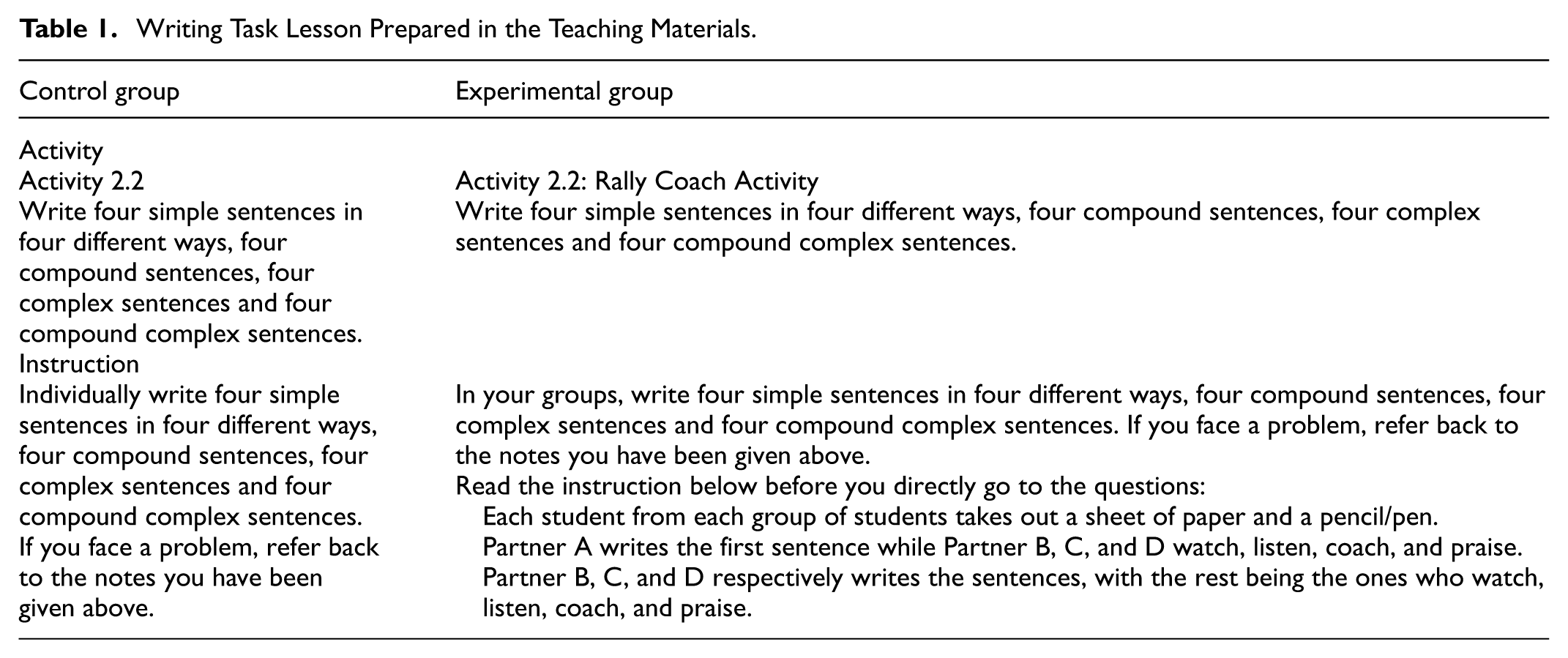
The instructional materials encompassed a total of 10 distinct tasks. An example of the types of tasks featured in the teaching materials include: constructing sentences with accurate punctuation, identifying and composing various types of sentences (simple sentence, compound sentence, compound-complex sentence, and complex sentence), summarizing texts, writing an outline, writing a topic sentence along with supporting details, ensuring subject-verb agreement within sentences, describing people, and writing a descriptive paragraph. Table 1 illustrates an example of writing task lesson practiced in both experimental and control groups.
Writing Task Lesson Prepared in the Teaching Materials.
Instruments
Two writing tests (pre and post) were prepared based on the objectives formulated in Grade 10 English Language Syllabus and Curriculum referencing the third unit of their textbook. The two writing tests were administered to students of both groups before and after learning the writing skills through two different methods. Prior to the treatment, a pretest on “descriptive paragraph writing” was administered for two classrooms of grade 10 students before they were divided into the experimental and control groups. The pretest was conducted to see whether the writing skills of the two groups were comparable or not based on the result. In addition, it used to see the writing skills of the learners in both groups before the intervention and to see the later improvements. After the teaching was end, the writing task post-test was administered to both groups. The post test was used in order to see the effect of treatments on the learners’ writing fluency, complexity, and accuracy improvements. Learners were given a post-test of “writing descriptive paragraph.”
To ensure validity and reliability, some measures were taken. The students were assessed by the instructors who were assessed their writing performances in the pretest. The grade 10 English text-book served as the basis for the writing paragraph test. The tests were reviewed by colleagues, experts, and advisers. Based on their feedback and suggestions, some changes were made before the tests were presented to the participants. For example, the instructions were clarified for better understanding. On the other hand, the measurements of accuracy and fluency followed the guidelines proposed by Foster and Wigglesworth (2016), Samoudi and Modirkhamene (2020) and Skehan et al. (2024). Additionally, complexity was measured by the guidelines proposed by Samoudi and Modirkhamene (2020) and Wolfe-Quintero et al. (1998). Furthermore, training was offered to the selected examiners on how to assess the students’ writing accuracy, fluency, and complexity in both pre- and post-tests. For both tests scores Pearson r was computed to see the correlations of the marks given by the raters concerning the performance of the students in the experimental and the control groups during the pre and post-test.
In the pre-test, the correlation coefficient of the experimental group writing accuracy, complexity, and fluency are depicted as .882, .997, and .995 respectively and the correlation coefficient of the control group writing accuracy, complexity, and fluency are .769, .996, and .999 respectively. In the post-test, the correlation coefficient of the experimental group writing accuracy, complexity, and fluency are depicted as .882, .993, and .995 respectively and the correlation coefficient of the control group writing accuracy, complexity, and fluency are .866, .996, and .999 respectively which are closer to 1.000. These values indicated a strong agreement among the raters.
Measures of Accuracy, Fluency, and Complexity
T-units or terminable units are defined as an independent clause along with any associated dependent clauses, serve as fundamental units of CAF measures. Numerous studies have demonstrated the effectiveness of t-units in measuring language development. For example, Casal and Lee (2019) indicate that the analysis of t-units serves as a reliable metric for assessing the quality of writing, especially within academic environments. Studies conducted by Xu (2023) further corroborate this assertion, demonstrating that t-units can proficiently measure linguistic complexity among both native and non-native language users. T-units enable consistent comparisons across various texts or speakers, aiding in the identification of linguistic patterns and variations. As noted by Wolfe-Quintero et al. (1998), the use of t-units allows researchers to track changes in language use over time.
The measures of accuracy and fluency in the current investigation adhered to the guidelines established by Foster and Wigglesworth (2016), Samoudi and Modirkhamene (2020) and Skehan et al. (2024). The accuracy of the participants’ written output was measured by computing the number of error-free t-units to the total number of t-units (EFT/T). To evaluate fluency, the average number of words produced per minute was calculated. Specifically, the total number of words produced by each learner in the writing task was divided by the total number of minutes spent for writing by each participant on the same writing task. Complexity was evaluated through the ratio of clauses to T-units. A criteria adapted from Samoudi and Modirkhamene (2020) and Wolfe-Quintero et al. (1998) were employed to assess the degree of dependent clause integration within a text by calculating the percentage of dependent clauses to all clauses. These guidelines are widely used due to their simplicity and ease of application (Sahin Kizil, 2024).
Procedures
In this study, a total of 86 participants were assigned to two groups with 43 participants in each. Before beginning the experiment, a pretest was administered to both sections of Grade 10 students at the school. The pretest centered on writing a descriptive paragraph with the topic “Describing a Person.” Students were instructed to compose a paragraph based on this given topic. Subsequently, two instructors evaluated the pretest responses and assigned scores. Following the pretest evaluation, both sections were chosen as samples for the study. One section of students (section A) was then designated as the experimental group, while the other section (section C) served as the control group. This division enabled the comparison of writing performance between students exposed to collaborative learning methods (experimental group) and those taught using conventional methods (control group).
Following the selection process, the chosen teacher took 4-hr training on the principles of utilizing collaborative writing teaching EFL writing skills. In addition, information about how to group students and assign tasks and procedures for each activity were explained in detail. Moreover, the teacher received training on techniques for evaluating students’ writing performance with a focus on accuracy, fluency, and complexity. Besides, the teacher was trained to actively support the experimental group students practice writing collaboratively at every stage of the writing process and the control group practice writing individually.
The experimental group of students participated in a structured collaborative writing exercise over a 12-week teaching period, attending 40-min lessons three times a week. During these sessions, students collaborated on various writing tasks, which encouraged peer interaction and facilitated peer feedback. In contrast, the control group engaged in individual writing practice without any collaborative activities throughout the same 12 weeks. Informed consent was obtained from all participants prior to the study, ensuring they fully understood the purpose and procedures involved. At the end, both groups underwent a posttest, which consisted of a paragraph writing task on the same topic used in the pretest: “Describing a Person.” The same to pre-test, 60 min was given for the post test to write the paragraph.
Data Analysis
Initially, the scores assigned by two raters were averaged for each participant in both the pre- and post-tests to establish writing accuracy, fluency, and complexity scores. Inter-rater reliability was assessed to ensure consistency. The pre-test result was analyzed using an independent samples t-test to determine whether the writing performance of the two groups was comparable. Descriptive statistics (mean and standard deviation) were used to compare the experimental and control groups’ writing performance in terms of accuracy, fluency, and complexity. Subsequently, a one-way analysis of covariance (ANCOVA) was conducted to compare the experimental and control groups’ writing performance, using the pre-test scores as a covariate. Each dependent variable (writing accuracy, fluency, and complexity) had different pre-test scores or covariates. As a result, separate ANCOVAs were conducted for each dependent variable to ensure a more accurate analysis. Before performing the analysis, we ensured that the necessary assumptions were met. The partial eta-squared (
Ethical Consideration of the Study
This study examines the effects of collaborative learning on students’ writing accuracy, fluency, and complexity using a quasi-experimental design with two groups: a collaborative learning group and a control group. This design minimized potential stress among participants by ensuring familiarity with the learning environment and instructional methods. Students were encouraged to express any concerns during the study, with support readily available to address any issues. The potential benefits of this research include improved writing performance and enhanced collaborative skills. Engaging in collaborative learning fosters writing abilities. The findings are expected to inform educators about effective teaching methods, ultimately benefiting the broader educational community.
The study adhered to ethical guidelines and received approval from the Institutional Review Board of Hawassa University College of Social Sciences and Humanities under reference number (CSSH/54/2023) on October 5, 2023. An ethical approval certificate was obtained to protect the rights of participants. Additionally, a letter of support from the Department of English Language and Literature was secured to facilitate the research process.
Informed consent was obtained from the district education office, the school principal, and participating students. This process involved providing comprehensive information regarding the study’s purpose, procedures, and potential risks and benefits to all stakeholders. The purpose of the study was clearly explained before the intervention and data collection began. Participants were informed that the study was for educational purposes and that their cooperation was required. Consent forms outlined participants’ rights, including the right to withdraw from the study at any time without facing negative consequences. To preserve the integrity of confidentiality, all data that were collected underwent a process of anonymization, and any personal identifiers were systematically removed. After obtaining approval, the researchers met with the English language teacher to discuss the study’s objectives and confirm pseudonyms to safeguard participant confidentiality. This approach ensured ethical compliance and participant autonomy.
Results
Participants’ Demographic and Educational Information
Table 2 compares experimental and control groups across various demographic and educational metrics. The experimental group consists of 43 participants, with a balanced gender distribution of 23 males and 20 females and also the control group has 43 participants, including 21 males and 22 females. Both groups have similar mean ages, with the experimental group averaging 17.44 years and the control group at 17.33 years, indicating that age is not a confounding factor in this study. The standard deviations for age are also comparable, at 1.06 for the experimental group and 1.04 for the control group, suggesting consistent age distributions within both samples. In terms of educational context, participants in both groups have been exposed to English as a subject from grades 1 to 8 and transition to using English as an instructional medium starting from Grade 9. This common educational background reinforces the reliability of the comparison between the two groups. In summary, both groups exhibit comparable features in terms of age, gender, and educational background.
Participants’ Demographic and Educational Information.

Results of the Writing Accuracy Test
Descriptive Statistics
According to Table 3, the experimental group’s mean score is 4.7674, while the control group’s mean score is 4.6058. The experimental group’s calculated standard deviation is 0.75355, while the control group’s standard deviation is 0.85015 in the pre-test. In the post test, the mean score for composing paragraphs with grammatically accurate sentences in the experimental group is 5.3453, compared to 4.7628 in the control group. Additionally, the standard deviations for the experimental and control groups are 0.93661 and 0.87356, respectively.
Descriptive Statistics of Pre and Post Writing Accuracy Test.

ANCOVA Results of Writing Accuracy
As demonstrated in Table 4, a one-way ANCOVA was conducted to determine a statistically significant difference between experimental and control groups on writing accuracy after controlling the pre-test result. The statistical analysis for writing accuracy yielded a p-value of .000. This result indicates a statistically significant difference in writing accuracy between the experimental and control groups, suggesting that the intervention had a meaningful impact on participants’ writing accuracy performance. In conclusion, these results signify a statistically significant difference in the writing accuracy between the experimental and control groups.
The ANCOVA Result for Writing Accuracy Test (Using Pre-Test as a Covariate).

Results of the Writing Fluency Test
Descriptive Statistics
As depicted in Table 5, the mean score for the experimental group is 1.0708, while the mean score for the control group is 1.1495. The calculated standard deviation for the experimental group is 0.23934, and for the control group, it is 0.28091 in the pre-test. On the other hand, the mean score for writing fluency in the experimental group is 1.1780 whereas in the control group, it is 1.1673. The standard deviation for the experimental and control groups is 0.28698 and 0.28755, respectively in the post test.
Descriptive Statistics of Pre and Post Writing Fluency Test.

ANCOVA Results of Writing Fluency
As delineated in Table 6, the analysis for writing fluency yielded a p-value of .000. These results demonstrate that there is a statistically significant difference between the experimental and control groups regarding paragraph writing fluency, further supporting the effectiveness of collaborative writing in enhancing writing skills. Participants in the experimental group demonstrated a greater ability to generate ideas quickly, resulting in more cohesive paragraphs. This significant result suggests that the collaborative approach had a positive impact on students’ ability to produce written content more rapidly and with greater ease.
The ANCOVA Result for Writing Fluency Test (Using Pre-Test as a Covariate).

Results of the Writing Complexity Test
Descriptive Statistics
Table 7 illustrates that the experimental group attained a mean score of 0.4128, compared to 0.3430 for the control group. The experimental group exhibited a calculated standard deviation of 0.87947, while the control group had a standard deviation of 0.79061 in the pre-test. Moreover, the mean score for the experimental group in writing paragraphs incorporating different types of sentences is 0.5944, while for the control group, it is 0.4914. The standard deviation for the experimental group is 0.99175, and for the control group, it is 0.92011 in the post test.
Descriptive Statistics of Pre and Post Writing Complexity Test.

ANCOVA Results of Writing Complexity
As indicated in Table 8, the statistical analysis for writing complexity yielded a p-value of .745. These results indicate that there is no statistically significant difference between the experimental and control groups regarding their proficiency in composing paragraphs through the integration of various sentence types. There may be several reasons for the lack of improvement in writing complexity through collaborative writing. EFL students often focus on sentence-level problems rather than overall ideas and organization, possibly due to limited experience with effective writing strategies (Storch, 2019). This focus may hinder their ability to engage with more complex writing elements.
The ANCOVA Result for Writing Complexity Test (Using Pre-Test as a Covariate).

In summary, the result reveals that there is statistically significant difference observed in writing accuracy and fluency between the experimental and control groups in the post-test. However, a statistically significant difference is not noted between the experimental and control groups concerning writing complexity.
Discussion
The main objective of this study was to examine the effects of collaborative writing on EFL learners’ writing accuracy, fluency, and complexity. The findings revealed a statistically significant difference in writing accuracy between the experimental and control groups in the post-test assessment. This result aligns with previous studies, such as Wang et al. (2024), Shahrokhi and Haji Jalili (2017), and Jafari and Ansari (2015), which found that collaborative writing improves accuracy. This improvement also corresponds with sociocultural theory (Donato & Mccormick, 1994; Vygotsky, 1986), which emphasizes that peer interaction during collaborative writing facilitates scaffolding within the learners’ zone of proximal development. Through collaborative interaction, more competent peers assist in detecting, reformulating, and negotiating linguistic forms, while less skilled participants internalize these through dialogically mediated interaction. Students collaboratively produced ideas, provided feedback and constructed sentences. This collaborative method promotes the production of accurate written works. The enhanced accuracy noted among collaborative writing groups stem from the revision process. Consequently, learners were actively engaged in a multi-revision procedure that ultimately resulted in more accurate texts (Jafari & Ansari, 2015).
The results in terms of the fluency showed a statistically significant difference between the experimental and control groups. This result is consistent with the findings of Pham (2021) and Lopres et al. (2023) who confirmed that collaborative writing improved students’ writing fluency in terms of word count and content elaboration. Sociocultural theory explains this by positing that when learners share cognitive load, for example, one writer helps another in idea generation or syntactic formulation, this shared mediation supports continuous writing (Prior, 2006). This is also confirmed by Chairinkam and Yawiloeng (2021), who stated that peer scaffolding becomes a mediating tool that sustains fluency.
With respect to writing complexity, there existed no statistically significant difference between the experimental and the control group. The absence of a statistically significant advantage for the collaborative group in complexity is aligns with prior investigations (Shahrokhi & Haji Jalili, 2017; Wang et al., 2024). Several factors may explain this outcome. First, producing syntactically complex structures demands high cognitive effort, which may be hindered when learners simultaneously negotiate contributions, manage consensus, and monitor group dynamics. Second, in group negotiation, participants might gravitate toward safer, more familiar constructions, leading to simplified collective decisions (Blewett et al., 2021). Third, without explicit scaffolding toward advanced structures, the default peer scaffolding may insufficiently support deeper syntactic experimentation. This is consistent with the findings of Rahimi and Noroozisiam (2013), who showed that sociocultural strategy-based instruction was necessary to see larger gains in complex sentence construction. Finally, time constraints may push groups to prioritize clarity and correctness over structural novelty. Overall, while collaborative writing supports improvements in writing accuracy and fluency, gains in writing complexity may require additional instructional scaffolding and extended time for exploration and revision.
Implications
These findings carry both theoretical and pedagogical implications. Theoretically, this study reinforces sociocultural theory’s central proposition that learning, including writing, is socially mediated and that cognitive development arises from interaction. It also suggests the need for more nuanced theoretical models that distinguish between types of linguistic features. Writing accuracy and fluency appear more sensitive to peer mediation under standard collaborative settings, whereas writing complexity likely requires additional scaffolding. Pedagogically, teachers should consider integrating collaborative writing as a fundamental component of instruction when the objective is to enhance accuracy and fluency. However, to foster complexity, task design should include explicit scaffolding that enhances the quality of peer interaction. Beyond classroom benefits, collaborative writing supports long-term academic performance by improving critical thinking, organization, and vocabulary development.
In real-world scenarios, the capability to collaborate effectively on writing tasks reflects the collaborative nature prevalent in numerous professional settings. Employers are increasingly prioritizing communication skills, which include the ability to work cooperatively on written materials such as reports, proposals, and emails. By cultivating these competencies through collaborative writing in educational settings, learners are better equipped to meet the demands of contemporary workplaces. Furthermore, the confidence acquired through collaborative writing can mitigate writing anxiety and bolster overall communication efficacy. Thus, the incorporation of collaborative writing into EFL instruction not only advances immediate language proficiency but also furnishes learners with vital skills for academic achievement and professional success.
Limitations and Implication for Future Research
The current investigation possesses certain limitations that present avenues for further investigation. First, a 12-week intervention, while substantial, may still be too short to observe significant development in writing complexity. Second, the study employed only quantitative outcome measures, the micro-processes of collaboration, such as negotiation, feedback exchanges, and revision paths remained unobserved. Incorporating qualitative data could elucidate the perceptions of participants concerning an intervention. Third, the focus on descriptive paragraphs limits generalizability across writing genres such as narrative, expository, and argumentative texts. Fourth, the participant sample represents a specific proficiency level and educational context, which may reduce broader applicability.
Future research should address these limitations. Longitudinal and repeated-measures designs over semesters or academic years would help trace developmental trajectories, particularly for writing complexity. Mixed-methods studies that combine quantitative outcome data with qualitative data would better reveal how collaborative writing achieves its effects. It would also be valuable to investigate writing across multiple genres and extended multi-paragraph tasks to test genre effects.
Recommendations
Based on the findings of this study, several practical suggestions are made. First, using a multi-draft approach over a long period of time allows learners to engage in iterative revision, experimentation, and refinement of their writing. This process mirrors the sociocultural view of learning as a dynamic and evolving process, where repeated engagement and feedback lead to the internalization of more complex linguistic forms. Second, the implementation of pre-task scaffolding is recommended to familiarize learners with advanced syntactic structures. Providing model texts and engaging in collaborative analysis can serve as a foundation for learners to experiment with complex forms in their writing. This approach aligns with Vygotsky’s concept of the zone of proximal development, where learners benefit from guided interaction with more knowledgeable peers or instructors. Lastly, to effectively implement collaborative writing in Ethiopia, professional development for instructors is crucial. Equipping educators with the skills to design collaborative writing activities, oversee peer interactions, and facilitate metalinguistic discussions empowers them to help learners attain writing accuracy, fluency, and complexity. Such professional development ensures that instructors are well-prepared to implement strategies that align with sociocultural principles, fostering an environment conducive to the development of complex writing skills.
Conclusions
This study employed a quasi-experimental design with pre- and post-tests to investigate the effects of collaborative writing on EFL writing development. The results demonstrated that collaborative writing significantly enhanced learners’ writing accuracy and fluency, underscoring its practical value as an instructional approach. These findings align with sociocultural theory, which posits that peer interaction provides the scaffolding necessary for linguistic development. However, the lack of significant gains in syntactic complexity suggests that this aspect of language may be more resilient to change and might require longer intervention periods or more focused, cognitively demanding tasks to develop. Therefore, while collaborative learning is a powerful tool for building foundational writing skills, educators should complement it with targeted instruction to foster more complex syntactic structures.
Footnotes
Acknowledgements
We would like to express our sincere gratitude to Hawassa University for its support of this research. Our heartfelt thanks also go to the principal, teachers and student participants from Hawas Secondary School for their willingness to engage in this study and for providing the essential data.

Ethical Considerations
The process of data collection for this research conformed to the ethical standards delineated in the Ethical Guidelines for Human Subjects established by Hawassa University. The Hawassa University, College of Social Science and Humanities, Research and Technology Transfer Associate Dean Research Ethics Review Committee provided ethical approval for the conduct of this study (approval no. CSSH/54/2023) on October 5, 2023. Informed consent was obtained from all participants prior to enrollment in the study. They received detailed information about the study’s nature, purpose and potential implications of the study.
Consent to Participate
Written informed consent was obtained from all participants in the study, ensuring that each individual fully understood the research process. This consent included detailed information about the study’s objectives, procedures, potential risks, and benefits. By securing this consent, we aimed to promote transparency and respect for the participants’ autonomy, allowing them to make informed decisions about their involvement in the research.
Author Contributions
All authors contributed to the conception and design of this study. Meseret Teshome Abdeta, the first author, led the writing of the initial draft of the manuscript and was responsible for preparing materials, collecting data, and conducting the analysis. All authors then participated in reviewing, editing, and refining the final manuscript prior to submission.
Funding
The authors received no financial support for the research, authorship, and/or publication of this article.
Declaration of Conflicting Interests
The authors declared no potential conflicts of interest with respect to the research, authorship, and/or publication of this article.
Data Availability Statement
The corresponding author can provide the data used in this study upon reasonable request.