




Abstract
Collaborative writing is widely researched for its effects on students’ writing accuracy; however, previous research studies fail to prove its effects on students’ writing fluency. Also, none of the previous studies have investigated the framework for students to compose argumentative essays collaboratively. The purpose of this article is to fill these gaps. Sixty-two sophomore English-major students at a university in Ho Chi Minh city, Vietnam, participated in the study. One difference in the treatment between the two groups was the composing stage. Twenty-seven students from the control group composed essays individually after they worked together for idea development to make an outline, whereas 35 students from the experimental group composed essays collaboratively. Data collection was from students’ pretests, posttests of both individually and collaboratively written papers, and from the semi-structured interviews. The study reveals that collaborative writing had great effects on students’ writing fluency in both collaboratively written papers and individually written papers. Also, the study invented an efficient framework for collaborative writing activities so that writing instructors could employ to their writing classrooms if they wish to.
Keywords
Introduction
Collaborative or cooperative learning is usually considered an important activity for the students at the tertiary level. Since the 1970s, when the communicative language teaching approach was introduced to English language learning, the instructors often employed pair-work or group-work to help students practice the language together as well as learn the language from each other. This helped move the teacher-centered to student-centered approach and brought many benefits to the language learners. Vygotsky (1978) claimed that language acquisition is a social process and development. The Zone of Proximal Development for the students who learn a language depends much on the interactions among peers and their learning environment. Foley and Thompson (2003) also assert that collaborative learning is an important activity in language classrooms to help students develop their language skills. Bremner (2010) states that instructors frequently employed collaborative learning at universities to help students conduct projects together and share work together. Each person is in charge of one part of the project to be completed faster with better results.
Specifically, in the academic writing classrooms, the instructors/researchers usually employed collaborative/cooperative learning activities to help students work together to brainstorm ideas and create an outline to help each other conduct their writing. Besides, peer feedback for writing revision was also employed to help learners learn from each other and improve their writing quality (Harmer, 2007; Hyland, 2003; Nation, 2009; Pham, 2019; Pham et al., 2020; Pham & Nguyen, 2020). To take advantage of collaborative learning, some academic writing instructors had students compose essays collaboratively with the hope of having better writing products (Pham, 2013).
Collaborative writing is seen as an effective teaching method and is highly recommended to be implemented in the writing classrooms by many researchers worldwide (Dobao, 2012; Storch, 2011). Collaborative writing can be defined as a written product composed of pair or a group of students who work together to produce one common product (Inglehart et al., 2003). Similarly, Storch (2019) defined collaborative writing as an activity that two or more writers work together to produce a single text. According to Lowry et al. (2004), collaborative writing is a social process in which the group members focus on a common goal, negotiate, collaborate, and discuss while creating a common text. According to Dobao and Blum (2013), Watanabe and Swain (2007), and Kim (2008), when the students discuss during the collaborative writing activities, they learn a lot from each other and gain better results in their final products. This study aimed to explore the framework that the students construct to conduct their collaborative writing and see if the collaborative writing has any impact on students’ writing fluency.
Literature Reviews
Collaborative writing was appealing to many researchers worldwide to investigate whether the collaboratively written products were better than the individually written products. Storch (2002) found that the students who engaged in collaborative writing could generate better ideas, enjoy collaborative writing activities, and enhance their vocabulary and accuracy than other learners who worked individually. Dobao and Blum (2013) and Watanabe and Swain (2007) confirmed that during the discussion session, when students composed essays together, students learned a lot from each other, and the results of the posttests gained better. Kim (2008) compared collaboratively written papers to individually written papers and found that none of the two writing conditions were different. However, vocabulary uses in collaboratively written papers were found better in the posttests. Storch (2011) suggested that as lecturers of academic writing, collaborative writing activities would provide a wonderful learning environment for students to enhance their academic writing quality in case of careful training designs.
Dobao and Blum (2013) explored students’ attitudes and perceptions toward collaborative writing in dyads and small groups, and no individual writing group was adopted. The study found that student-writers who produced papers in dyads preferred working in this kind of activity because it provided them more chances to participate in their learning process. Those who composed texts in groups revealed that they created more ideas and knowledge to share when working together. Hence, they improved their language performances. Most students also improved both the grammatical and lexical accuracy of their collaborative written texts.
Zabihi and Rezazadeh (2013) conducted a study on 92 university students in Iran. Thirty-two students were assigned to the control group to write an essay individually, and 60 were in the experimental group to compose an essay collaboratively. They composed a narrative essay in 45 min for about 250 words in length. The results revealed that though the collaboratively written papers gained more accuracy, the writing fluency was not as good as the individually written papers.
Biria and Jafari (2013) investigated the effects of collaborative writing on writing fluency. Ninety students from a university in Iran participated in the study. Thirty students from the control group wrote the essays individually. Sixty students from the experimental group composed essays in pairs. Similar to what Zabihi and Rezazadeh (2013) found, the study showed that the fluency in the collaboratively written papers was not significantly improved than those written individually.
Ansarimoghaddam et al. (2017) conducted a case study to explore the differences in students’ interaction between Wiki and face-to-face when they collaboratively produced an argumentative essay. Thirty-two university students from an intact class participated in the study. One group discussed and wrote essays on the wiki platform, while the other composed argumentative essays face-to-face in the classroom. The study revealed that the interaction among group members in collaborative writing provided social interaction that motivated students to work together and learn from each other. Moreover, Wiki was more effective for drafting and revising stages, and face-to-face interaction was easier for the planning stages.
Elola (2010) conducted a study to measure the writing accuracy and fluency of individual and collaborative writing of eight students from a mid-sized East Coast university in the United States. Each student composed two argumentative essays, individually and collaboratively. This study’s findings indicated that the students’ writing fluency was not different either it was written individually or collaboratively. In terms of accuracy, collaboratively written papers were greater than those written individually. However, the students who composed essays individually increased their writing quality significantly from draft 1 to draft 2, whereas there were no significant different changes from draft 1 to 2 in the collaboratively written papers. This study was limited to the scope that collaborative writing was conducted in pairs, and writing accuracy was measured by students’ written errors.
Bikowski and Vithanage (2016) investigated the effect of collaborative writing on individual writing quality. Fifty-two L2 writers from a writing class at a U.S. university participated in the study. The study indicated that both control and experimental groups improved their writing quality either through individual or collaborative writing. Particularly, the experimental group students were found significantly improved in their individual written products compared with those in the control group. This study did not investigate whether collaborative writing affected writing fluency.
Talib and Cheung (2017) have reviewed 68 articles from 15 Social Science Citation Index (SSCI) journals published between 2006 and 2016 on collaborative writing and revealed that collaborative writing activities motivated students’ learning engagement because it helped improve their writing competencies over the past 10 years. Moreover, when working collaboratively, students composed shorter texts, but the grammatical accuracy and vocabulary acquisition were better. Peer feedback activities during collaborative learning helped increase student interaction and negotiation in the writing process.
Recently, Villarreal and Gil-Sarratea (2019) conducted a study to see whether collaborative writing could help students compose better argumentative essays. Consistent with previous research, this study found that collaboratively written papers were shorter but more accurate and more lexically and grammatically complex than those composed individually. Also, the collaborative written papers’ content, structure, and organization were much better. Collaborative writing activities provided students opportunities to generate ideas for writing, provide feedback, which helps improve students’ writing skills.
Although previous studies succeeded in improving students’ writing quality in terms of collaborative writing (Aminloo, 2013; Biria & Jafari, 2013; Shehadeh, 2011; Storch, 2005; Sutherland & Topping, 1999; Zabihi & Rezazadeh, 2013), the writing fluency in collaborative writing was still in debate. Many research studies such as Kim (2008), Zabihi and Rezazadeh (2013), Biria and Jafari (2013), and Storch (2005) claimed that collaborative writing did not enhance students’ writing fluency when they composed essay either collaboratively or individually. Furthermore, one big gap in research about collaborative writing was that none of the previous studies explored the efficient framework when the students conducted writing collaboratively, how they could handle the writing jobs for each person in the group to do. Therefore, this study aims to respond to the two following research questions:
Method
Participants
This study was conducted at the faculty of foreign languages at a University in Ho Chi Minh City, Vietnam. Sixty-two second-year students of English major from the two intact classes participated in the study. Thirty-five students were selected for the experimental class and 27 for the control class. Their ages ranged from 19 to 21. These students enrolled to take the Writing-3 to learn how to compose an argumentative essay. Prior to this study, the students in both groups were trained on writing academic paragraphs and essays as they enrolled in Writing-1 and Writing-2 as compulsories of the curriculum. The course book used to train the students in this course was “Academic Writing Skills—Student’s Book 3” by Chin et al. (2013), published by Cambridge University Press.
One staff lecturer who had good academic writing experience volunteered to participate in the study. She had more than 10 years of teaching academic writing experience. She was chosen to train students in both groups.
Before the training took place, the researcher and the lecturer met to discuss the purpose of the study and the teaching methods and activities for the two groups. The students in both groups were assigned to different smaller groups of three or four students to work together during the courses. The lecturer was told to treat the two groups equally with great care. Most of the two groups’ teaching and learning activities were not much different except for the stage of composing essays; the control group wrote essays individually while the experimental group composed them collaboratively.
Procedures
One week before the semester began, another meeting occurred between the researcher and the lecturer to reconfirm and discuss most of the activities that would be employed to train the students in the two classes. Accordingly, all the possible writing topics for pretests versus posttests for the two groups were discussed and adjusted to make sure that they were equivalent in terms of difficulties and appropriate for students’ proficiency levels. Before the training, the researcher conducted pretests for both groups to ensure that their writing fluency was not significantly different (see Table 1). The allocated time for each writing was 120-min long. Besides, during the training processes, the researcher often met with the lecturer at the university’s canteen at break time to discuss any difficulties and other essential things to do to make sure that everything went on the right track. In other words, the purpose of the meetings was to make sure that every step of the training was controllable to avoid any unexpected variables.
Comparison of the Students’ Writing Fluency in the Pretest.

Note. Independent samples t-test.
The t and df were adjusted because variances were not equal.
The purpose of the study was also explicitly explained to the students of each group so that they could know what they were expected to do during academic writing classes. During the course, the students from two groups composed four different writing essays, one paper for the pretest, two writing assignments during the training as a normal curriculum, and one paper for the posttest. Unlike the control group, the experimental group was assigned to write two more collaborative writing papers for the pretest and posttest for the purpose of this study. The allocated time for each writing was 120-min long. The students were not counseled to write lengthy essays, but it was long enough to convince the readers because it was an argumentative essay. The following were the topics for the pretest versus posttest:
Pretest: Do you agree or disagree with the following statement: “After graduating from high school, students should have a year off before going to higher education.” Write an essay using facts, explanations, or personal experiences to support your opinion. Do not forget to include counterarguments and refutation in your essay.
Pretest (collaborative writing): Do you agree or disagree with the following statement: “Students need time to relax after the first and the second semester. They should not be forced to take other courses during their summer vacation.” Write an essay using specific reasons, examples, and personal experience to explain your answer. Don’t forget to include a counterargument and refutation.
Posttest: Do you think it is necessary to take an entrance examination to enter a university or college? Write an opinion essay using specific reasons and examples to support your answer. Do not forget to include a counterargument and refutation.
Posttest (collaborative writing): Some people believe that college or university education should be available to all students. Others believe that higher education should be available only to top students. What is your opinion? Use specific reasons and examples to support your answer. Don’t forget to include a counterargument and refutation.
Instruction
The instructors used the writing process approach to teach students in both classes. Most of the teaching and writing activities were similar, but the composing stages. First, the teacher and students selected the topic together. Then, the students of the two classes worked together to brainstorm the ideas and created the essays’ outline. At this stage, the students and the teachers provided feedback to the outlines. Second, the students composed the argumentative essays in the classrooms based on the outlines. At this stage, the writing activities were different between the two classes. The control group was assigned to write individually while the experimental class was assigned to compose the argumentative essays collaboratively; three or four students made it together. Third, after completing the essays, the students worked together to provide comments to their peers’ papers. The control class students exchanged the papers among themselves individually, whereas the students in the experimental class conducted via groups. Finally, after receiving comments from other peers or peer groups, the students revised their papers to hand them to the teachers for grading. All the written papers were conducted in-class with their hand-written styles. This was to make sure that students conducted their writing activities with the lecturer’s control. Figure 1 presents the design of the study.

Research design.
Data Collection and Analysis
All students’ written papers were collected for data analysis, including the pretests and posttests of the two groups and the collaboratively written papers of the experimental group’s pretests and posttests. In terms of measuring writing fluency, previous researchers (Biria & Jafari, 2013; Elola, 2010; Zabihi & Rezazadeh, 2013) defined writing fluency as the total number of words or sentences written within a given allocated time, and they measured writing fluency by numbers of words or length of a text. In this study, the students were given 120 min to compose their argumentative essays, and the length of the essays (word counts) was analyzed. All the students’ written papers were tallied for word counts to respond to the first research question. Ten students randomly selected from the experimental group, one from each smaller group, participated in the semi-structured interviews to respond to the second research question.
Results/Finding and Discussion
Totally, 144 argumentative essays were collected from both control and experimental groups to analyze in this study. The control group had 27 pretest and 27 posttest papers, while the experimental group had 35 versus 35 pretest and posttest papers and 20 collaborative written papers, 10 from pretest and 10 from posttest.
Students’ Writing Fluency Before the Intervention
The purpose of this study was to investigate whether the collaborative writing activities had any effects on students’ writing fluency in terms of the number of words written in the argumentative essay. The students of two groups were given a topic to compose an argumentative essay in the pretest for 120 min. Twenty-seven pretest papers of the control group were compared with 35 pretest papers of the experimental group by the independent samples t-test of SPSS versus 22 to see if there were any differences between students’ number of words before the treatment. Table 1 presents students’ writing fluency in both groups composed in the pretests.
Table 1 shows the students’ writing fluency in terms of the number of words in the two groups’ pretests. On average, 27 argumentative essays from 27 students in the control group composed 391 words (M = 390.80; SD = 130.80) per essay in the pretests, while 35 argumentative essays from 35 students in the experimental group wrote 359 words (M = 358.70; SD = 73.50). There seemed to be that the students in the control group produced more words per essay than those students from the experimental group (391 vs. 359). However, the results of the independent samples t-test with the p-value, t(38.5) = −1.14; p = .26; p > .05, indicate that there was no statistically significant difference between the students’ writing fluency of the two groups. In other words, before the intervention of the collaborative writing activities in the classrooms, the students’ writing fluency in terms of the number of words was not different. The null hypothesis was not rejected.
Research Question 1: Does Collaborative Writing Activities Have Any Effects on Student Individuals’ Writing Fluency?
The purpose of this research question is to measure the effects of collaborative writing activities on students’ writing fluency in terms of the number of words produced in argumentative essays. To respond to this question, first, the mean scores of the number of words in 35 pretest papers written in 120 min were compared with those 35 written in the posttests. Second, the correlation and multiple regression of different variables were run to measure the extent to which the students’ writing fluency was affected.
First, the number of words of the argumentative essays in the pretest of the control group was compared with those in the posttest to investigate whether the students of the control group, after the treatment employing process approach which was similar to that of the experimental group, except the final stage of composing, improved their writing fluency.
As shown in Table 2, the writing process had no significant effects on the students’ writing fluency in terms of the number of words written in the argumentative essays during the course. On average, the mean score of 27 argumentative essays of the pretest of the control group was 391 words (M = 390.80; SD = 130.80), and the mean score of the posttest was 417 words (M = 417.20; SD = 149.50). It seemed that the number of words of the posttest was higher than those of the pretests (417 vs. 391) as the mean difference was 26. Nevertheless, the results of the paired-samples t-test with t(26) = −1.25, p = .22 (p > .05) indicate that there was no statistically significant difference between the pretest versus posttest. The null hypothesis was not rejected. That is, the students’ writing fluency in terms of the number of words was not significantly improved after the process approach intervention was employed to train the students in the control group to write argumentative essays.
Comparison of Students’ Writing Fluency Between the Pretest Versus Posttest of the Control Group.

Note. Paired-samples t-test.
The next section presents the students’ writing fluency of the experimental group after employing the collaborative writing activities, in addition to the process approach, to train the students on how to compose argumentative essays. During the course of academic writing essays, 35 students in the experimental group composed 35 argumentative essays in the pretest versus posttest. In addition, they composed 10 collaborative essays in the pretest and 10 essays in the posttest. Table 3 presents the comparison of students’ writing fluency between the individual writing of the pretest versus posttest.
Comparison of the Individual Writing Fluency in the Pretest Versus Posttest of the Experimental Group.

Note. Paired-samples t-test.
Table 3 reveals the difference in the students’ writing fluency between the pretest versus posttest when students composed essays individually. On average, each paper out of 35 individual writing papers of the pretest of the experimental group obtained 359 words (M = 358.70; SD = 73.50), while the number of words written in the posttest increased remarkably. On average, in each argumentative essay of the posttest, students composed 417 words (M = 417.10; SD = 80.40) to provide reasons, explanations, or facts to argue for their stance. The mean difference between these two tests was 58. It was more explicit about the enhancement of the students’ writing fluency as the results of the paired-samples t-test with t(34) = −4.41, p = .000 (p > .01) showed that there was a statistically significant difference between the pretest versus posttest. The null hypothesis was rejected. It indicates that the number of words written by the students individually in the posttest was more than those composed in the pretest. In other words, the students’ writing skills were more fluent when they were trained with collaborative writing activities, in addition to the process approach. Table 4 presents the comparison between the experimental groups’ collaboratively written papers.
Comparison of the Collaborative Writing Fluency Between the Pretest Versus Posttest.

Note. Paired-samples t-test.
Table 4 compared the number of words between the pretest versus posttest when students collaboratively composed the argumentative essays. The number of words written collaboratively in the pretest was compared with those written in the posttest. As can be seen, each collaboratively written paper of the pretest had, on average, 360 words (M = 360.40; SD = 58.60). Remarkably, the number of words written collaboratively in the posttest of the experimental group increased to 425 words per argumentative essay (M = 425.10; SD = 75.30). The mean difference between these two tests was 65 words. The mean difference of the collaboratively written papers seemed to be higher than that of the individual written paper (65 vs. 58). In other words, the number of words written collaboratively was higher than those composed individually. The p-value of the paired-samples t-test, t(34) = −5.23, p = .00 (p < .01), indicates that the number of words written collaboratively in the posttest was far higher than those composed in the pretest. This indicates that collaborative writing activities greatly affected students’ writing fluency in collaborative and individually written papers.
The following section would present the intercorrelation of variables to investigate the predictor variables that correlate to the students’ writing fluency in terms of the number of words.
Table 5 shows the intercorrelation of variables, including the posttest of the individually written papers, pretest of individually written papers, pretest of collaboratively written papers, and posttest of collaboratively written papers, which could be used to predict the variables that correlate to the increase of the students’ writing fluency. The purpose of this test was to see whether there was any correlation between these variables. As revealed in Table 5, the number of words written individually in the posttest significantly correlated with the other three variables, such as the pretest of individual writing, the pretest, and the posttest of collaborative writing papers. This indicates that those students whose writing skills were fluent in the pretest of individual writing or pretest and posttest of collaborative writing also obtained fluent writing skills in the posttest of individual writing papers. Next, I would investigate whether these variables directly affect the students’ writing fluency in the posttest of individual writing papers. Table 6 presents the regression of variables to the posttest of individual writing papers. The posttest of individual writing papers was seen as the dependent variable in this table while the others were the independent variables.
The Intercorrelation of 4 Variables.

p < .05. **p < .01.
The Multiple Regression of Independent Variables to the Posttest of Individual Writing (n = 35).

Note. R2 = .372; F (3, 31) = 6.12, p < .01; SEB = standard error for the unstandardized beta.
p < .05. **p < .01.
The multiple regression was run to investigate the predictor variables which affected most on the increase of the number of words written in the posttest of individual writing papers. As revealed in Table 6, it was found that the independent variables of pretest of individual writing and the pretest and posttest of collaborative writing skills significantly contributed to the increase of students’ writing fluency in the posttest of individual writing papers, F(3, 31) = 6.12, p < .01. The β presented in Table 6 indicates that the pretest variables of individual writing and the posttest of collaborative writing activities were the two most affected factors on the students’ writing fluency skills. The adjusted R2 was .311 and indicates that 31% of the increase in students’ writing fluency skills was affected by those variables.
The findings of this study were inventing compared to previous research studies. Zabihi and Rezazadeh’s (2013) findings claimed that collaborative writing had no effect on the students’ writing fluency in terms of an increase in the number of words. On the contrary, individual writing helped students become more creative and more fluent in writing skills. In addition, Storch (2005) asserted that though the collaborative writing papers were more accurate and obtained better grammatical structures, the number of words was less compared to those papers written collaboratively. Similarly, Biria and Jafari (2013) also found that the collaboratively written papers were not as fluent as those papers written individually in terms of the number of words. Besides, Storch (2001) claimed that collaborative peers could produce more coherent texts and obtained better results than those who conducted writing individually. In some sense, the findings of this study contributed to the body of knowledge in research and changed educators’ perceptions of collaborative writing activities applied in the writing classrooms. It was affirmed that collaborative writing activities had great effects on the students’ writing fluency skills.
Research Question 2: To What Extent Do the Students Create an Efficient Framework for Collaborative Writing and Perceive This Kind of Collaborative Activity?
To respond to the second research question, data from the semi-structured interviews were analyzed to explore to what extent the students managed themselves and organized to conduct collaborative writing. In addition, the qualitative data were analyzed to see how the students evaluated collaborative writing activities in both positive and negative aspects of the phenomena. Implementing collaborative writing activities in the writing classrooms had certain benefits as well as limitations. Difficulties in communication were unavoidable issues.
Framework for collaborative writing activities
The sample for the semi-structured interviews was randomly selected from 10 small groups, one from each group, of the experimental class. In terms of working collaboratively, four interviewees stated that their groups worked together to brainstorm ideas for the topics, make outlines for essays, and negotiate for agreement between group members. In terms of composing essays collaboratively, the students in each small group “divided parts (paragraphs) of an argumentative essay to each group member to write based on the given outline they created together. After that, they all combined their paragraph writings to form a complete essay.” Then they all read the essays and provide feedback for better revision.
Similarly, the other six interviewees added that at the beginning, they assigned part of the essay to each person which depended on his or her strength about that aspect. When they all completed their own work, the group member combined all parts/paragraphs together to form an essay. That is, everybody contributed their efforts equally for their products.
That the division of each paragraph to each group member to compose writing depending on his or her strength could be interpreted that during the brainstorming activities, the one who obtained beautiful idea or main idea to develop the outline of the essay should be in charge of that main point to develop that paragraph. However, when they all completed their parts, they put all paragraphs together and negotiated or provided feedback among themselves for writing cohesion and unity of ideas. This indicated that the experimental group students knew how to share work equally and effectively among their group members. Therefore, the group members cooperated sufficiently to compose a good essay. The findings of this study seemed to contradict those of previous studies. Ajmi and Ali (2014) claim that the students in their study failed to share work equally among group members. Figure 2 presents the framework for collaborative writing.
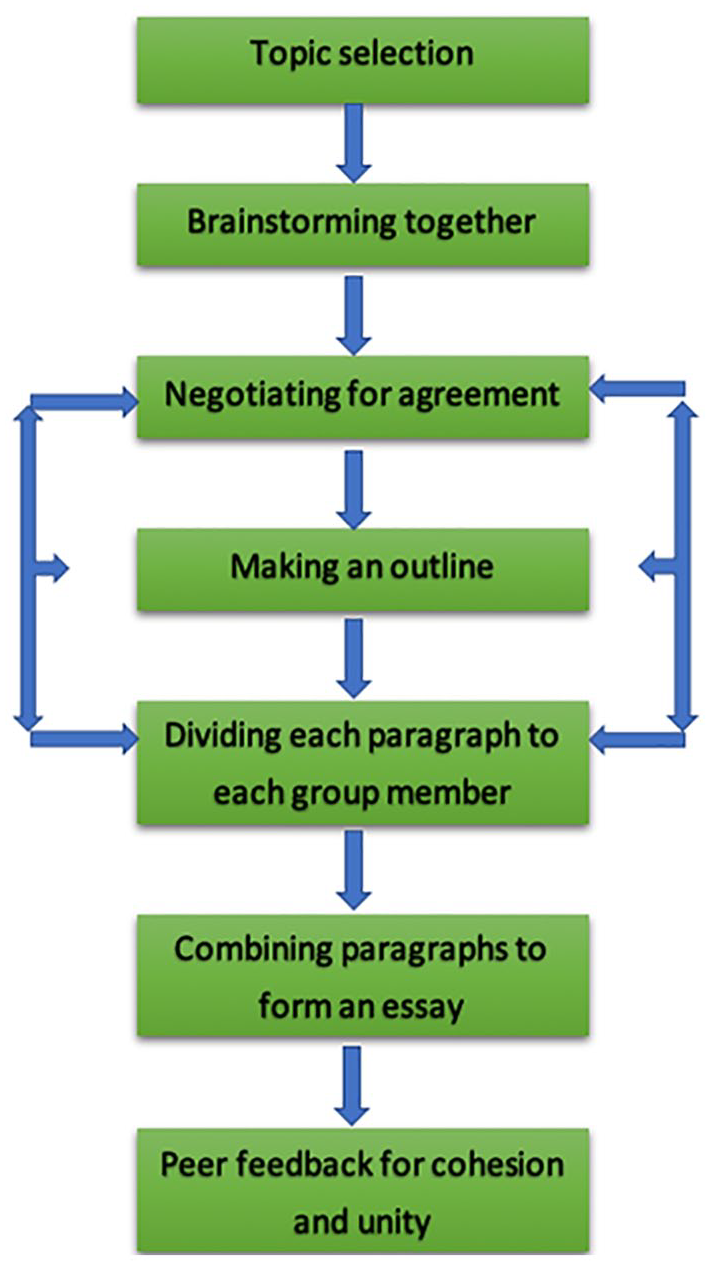
Framework for collaborative writing.
Students’ expressions on the collaborative writing activities
Nine per 10 students confirmed that they preferred collaborative writing to individual writing because collaborative writing seemed more effective. “Collaboratively written papers had contributions of group members, so it was much better than individually written papers.” “The group members supported each other during the composing stage.” When “I [a group member] had no idea to write, the other group members could suggest more ideas to get the writing flow.” This indicated that the group members positively worked together, helped each other overcome difficulties in writing, and helped make the written papers improved when they conducted collaborative writing activities.
This finding corresponded to Dobao and Blum (2013), as they claimed that most of their students preferred collaborative writing activities. Erkens et al. (2005) suggested that students learn to support each other, search for information, share data, and cooperate to reach the common goal, improving their writing quality. However, these findings contradicted those of Ajmi and Ali (2014), who found that their students did not collaborate positively in writing, and they used to have conflicts when they worked together in writing activities.
All 10 interviewees (10/10) agreed that the collaboratively written products had more advantages compared with individually written products because “collaboratively written papers obtained various ideas, and the ideas were more interesting.” And “the collaboratively written papers were much better than the individually written papers because four heads were better than one head; when the group members agreed to work together, the written products could be better.” This finding bolstered Storch’s (2005) and Shehadeh’s (2011) findings.
In addition, apart from the advantages that collaborative writing activities had more ideas from the group members to make it better, eight per 10 interviewees confirmed that “the sentence structures and grammatical structures were much better,” and “the vocabulary usages in the written papers were various and better.” Furthermore, when writing collaboratively, the group members could learn how to work together and improve teamwork spirit. This result corresponded to Dobao and Blum (2013), who found that collaborative writing greatly impacted their grammatical and lexical accuracy.
With regard to peer feedback and revisions, all 10 interviewees (10/10) claimed that “collaborative writing gained more advantageous than individual writing because more people worked more effectively than one. One person wrote a section, three group members proofread. It had to be better.” The students stated that “some simple errors such as sentence structures or grammar were able to be self-corrected by the student writers. But some mistakes relating to content or idea organizations were not self-corrected, but need the group members to help.” All 10 interviewees posited that the student writers were not easy to recognize their mistakes, but the group members, “I felt hard to see my mistakes, but my friends could do it.” This finding corresponded to the previous study of Pham and Usaha (2016), who found that the student writers could fix the surface errors by themselves, whereas they needed help from their peers to clarify mistakes relating to the content, idea development, and writing organizations. Also, Ansarimoghaddam et al. (2017) stated that their group members’ feedback in the collaborative writing stage was effective and resulted in better learning.
Besides, most of the interviewees (8/10) agreed that they could “learn many different writing styles, word usages and sentence structures from their group members” thanks to the collaborative writing activities and peer feedback. This finding was consistent with Pham and Usaha’s (2016) that when students worked together to compose writing, they could learn from one another about idea development, writing styles, vocabulary, and sentence structures. Dobao and Blum (2013) and Watanabe and Swain (2007) also found that when students discussed or brainstormed ideas together to compose collaborative writing, they could learn many things from each other. The survey results of Ajmi and Ali (2014) also indicated that collaborative writing activities helped create opportunities for students to share skills and experiences with each other so that they could learn a lot from one another thanks to this kind of collaborative writing activity. Yong (2011) found that weaker students could learn from other peers about idea generation, sentence structures, and word uses from more capable peers when conducting collaborative writing.
One more interesting finding from this study was that eight out of 10 interviewees claimed that collaborative writing activities motivated students in the learning processes, “the writing classroom was more motivating, the writing activities were more active. It was not boring and no longer tense.” This seemed to be a dream for many writing instructors because most of the writing classrooms were not exciting, and the students were not motivated to learn (Pham, 2013), when compared to other skills in learning English. Similarly, Ajmi and Ali (2014) also found that collaborative writing activities could make the writing classrooms become interesting. The students felt motivated in the collaborative writing activities. Moreover, Ajmi and Ali added that collaborative writing activities could help save a lot of time when several students conducted a written work together. Storch (2002) also found that the students enjoyed collaborative writing activities and produced a better piece of paper.
Some obstacles that the students faced when they conducted collaborative writing
Apart from the benefits that the students gained in collaborative writing, some inevitable issues were as follows. First, all the 10 interviewees (10/10) reported that “though they were pleased with the collaborative writing activities employed in the writing classroom, they sometimes had to dispute and explained to each other to come to a consensus; and sometimes it was not easy to gain this consensus.” Sometimes the group members did not reach a consensus because “their ideas were conflicted”; then “they had to conduct voting for majority agreement,” or they had to “asked the lecturer for a solution.”
Relating to these issues, Ajmi and Ali (2014) found similar problems as some group members showed up to overwhelm other members when they worked in a group to compose writing. Ansarimoghaddam et al. (2017) also found that when the students conducted collaborative writing, they often had problems about disagreement among the group members. For this issue, one interviewee (1/10) claimed that “when conducted individual writing, I could write whatever I wanted, but not in collaborative writing.” One concern here was that the lecturer should provide some guidelines or explain clearly to the students to make them understood the benefits of collaborative writing and teamwork values; accordingly, the skills for teamwork should be instructed to the students. Relating to this issue, Handayani (2012) suggested that when working together for collaborative writing, all group members had to try efforts to brainstorm ideas and use their own talent to negotiate and communicate their own ideas to all other group members to gain agreements.
Besides, nine per 10 interviewees claimed that when conducting collaborative writing, the group members agued a lot for each “full stop,” “comma” for a consensus. Sometimes they had to claim to the lecturer, or look up the dictionary, or check-up in the grammar book for the right answers because peers could be wrong.
A similar problem was found in the study by Ansarimoghaddam et al. (2017), who claimed that students often had different viewpoints about some issues in collaborative writing, and it was unavoidable.
This result somehow indicated that employing collaborative writing in the writing classroom was very effective because it provided students a forum to argue for ideas, negotiate for consensus, even though they had to prove that “a picture is worth a thousand words” to convince their group members. In this situation, the students learned how to prove themselves, and they learned from other peers to become more independent learners. Storch (2001) found that collaborative writing activities encouraged students to engage in social interaction for common goals and negotiate for meanings and mutual assistance. Erkens et al. (2005) authenticated that conflicts that occurred when working in a group were inevitable. Hence, during the discussion, the lecturer should pay attention to each group and try to provide appropriate measures to harmonize each individual’s ideas in the group.
Eight per 10 interviewees reported that the argument among members of a group made noise in the classroom, and this noise annoyed other groups for concentration, “the tension of the argument to protect one’s idea made noise, and it’s hard to focus.” Another difficulty in the collaborative writing activities was that (8/10) “they sometimes failed to understand the content/ideas and sentence structures that their peers used which led to disputing in the comments because of misunderstanding.” This indicated that this seemed to be the difficulty under the learners’ eyes. However, under the eyes of the educators, this issue was wonderful because this activity reinforced the student-centered approach in the classroom. The knowledge that the students argued for and reached the agreement among themselves to come to a consensus would increase the students’ long-term memory.
Conclusion
This study attempted to seek responses to the research questions about whether collaborative writing had any effects on students’ writing fluency and how they created an efficient framework for collaborative writing, including their expressions on this activity. Although the students were not counseling to write lengthily, they were encouraged to write enough to convince the readers in 120 min in the argumentative essay genre. The results of this study indicated that collaborative writing helped enhance the students’ writing fluency in terms of the number of words in both collaboratively written papers and individually written papers. The findings of this article contradicted previous studies such as Ansarimoghaddam et al. (2017), Storch (2005), Biria and Jafari (2013), and Zabihi and Rezazadeh (2013) when these studies found that the collaboratively written papers were more accurate, better word uses, but less fluent than those of the individually written papers. This was confirmed by Storch (2019) that writing has been recently conducted by a group of students rather than individually in many contexts.
Regarding RQ2 for the efficient framework for collaborative writing, the students reported that after getting the topic for writing, they brainstormed together, made an outline for the essay together, and negotiated for agreement among the group members. Then they divided the essay into subsections (paragraph) for each group member to compose, which depended on each member’s strength (the person who contributed that main idea). When they all finished their parts, they gathered to combine the paragraphs to form a complete essay. Before they handed it to the lecturer, the group members read the essay together to provide feedback for improvement in terms of cohesion and unity of ideas (see Figure 1). This finding was seen as an invention to fix the research gap from previous studies. It helped writing instructors with a framework to employ collaborative writing in their classrooms.
Finally, the students expressed positive attitudes toward collaborative writing because they benefited from these collaborative activities. They contributed more good ideas for the essay; they could learn the writing styles from each other, making their writing better. Furthermore, collaborative writing could help make the writing classroom more motivating. These findings were considered positive advantages that most writing lecturers wish to have. When a teaching method employed in the classroom reached a positive consensus from the learners, it could be sure to gain the learners’ collaboration during the learning processes, and it could easily obtain the most optimal results.
Footnotes
Appendix
Declaration of Conflicting Interests
The author(s) declared no potential conflicts of interest with respect to the research, authorship, and/or publication of this article.
Funding
The author(s) received no financial support for the research, authorship, and/or publication of this article.
