




Abstract
In the Taiwan EFL context particularly, little attention has been given to investigating the effects of wikis on EFL writing performance. Therefore, this study suggests a wiki-based collaborative writing activity in the writing process of creative English writing. In addition, the students’ perceptions of wiki collaborative writing were also measured. In this one-group pretest-post-test study, 32 learners at a public university in central Taiwan were invited to participate. The participants were selected using convenience sampling, a non-probability sampling technique. Instruments used to collect the data were online student background questionnaires, writing pre- and post-tests, and a student online questionnaire on wiki collaborative writing. The data from the wiki collaborative writing questionnaire were analyzed using descriptive statistics. The result of the study is expected to be able to enhance students’ writing performance and to encourage them to have strong motivation and good attitudes toward English writing. The students enjoyed being involved in online collaborative writing and learned to give comments and receive feedback in groups. It is thought to be a useful practice to enable students to socially interact to gain more knowledge, insights, and experience.
Introduction
EFL students frequently face a variety of difficulties in acquiring the specialized writing of their academic participants. Many college graduates in Taiwan still struggle to write English in a variety of settings (Wang, 2015). To enhance students’ language learning abilities and motivation, a devoted instructor needs to adopt educational activities and tools as aids in teaching to make courses more engaging and successful. Collaborative writing is one of the ways that is thought to be a useful activity to enhance students’ writing ability (Khatib & Meihami, 2015; Shehadeh, 2011; Storch, 2005; Storch & Wigglesworth, 2007; Yamashita, 2021) and perceptions (Fernández Dobao & Blum, 2013; Khatib & Meihami, 2015; Lin & Maarof, 2013; Shehadeh, 2011; Storch, 2005; Storch & Wigglesworth, 2007). Collaborative writing is defined as an activity that involves two or more writers co-authoring texts (Storch, 2013). It is basically used to describe those written projects which involve multiple writers participating together to complete the work. They may work together to produce a single task or more than one task (Lowry et al., 2004).
Collaborative writing is often combined with process writing to encourage students to write, and it is regarded to be an important mechanism for student writing development. It is said to be helpful in producing higher-quality writing and improving pupils’ writing abilities (Shehadeh, 2011). As a result, the writing skills of students increase. Furthermore, collaborative writing has been adopted as a way to stimulate and assist knowledge co-construction, as a method that promotes deep learning, and as a communication channel that promotes creativity and idea growth (Fernández Dobao & Blum, 2013). Such collaborative writing activities, which can best occur in a student-centered learning environment, help students identify and address gaps in their writing performance and co-construct their writing drafts. To this aim, instructors need to play the role of facilitators and more capable others in the classroom and provide comments and feedback on students’ writings, and students need to take more responsibilities for their collaborative or interactive writing tasks and provide their peers with assistance and guidance whenever necessary. Due to time and space limitations, instructors and educators have found it difficult to provide such learning conditions in a student-centered learning environment and collaborative learning activities compared to lecture-based classes (Rahimi & Fathi, 2021).
With the advances in the development of technological devices and the Internet, a growing number of scholars have integrated collaborative writing with computer mediated communication tools. In this study, the educational tool that is used as the collaborative platform is the wiki. Wikis’ fundamental capabilities provide students with numerous chances to interact, share information, present materials, modify files, and work on papers in a collaborative environment (Boulos et al., 2006). Wiki software also enables several useful writing characteristics, such as collaboration, ongoing revision, and the development of common knowledge (Bradley et al., 2010; Lundin, 2008). Although the influence of wiki on EFL writing has been examined in previous research (Hsu, 2019; Li & Chu, 2018; Ma, 2020; Stoddart et al., 2016), it is still an under-researched factor in EFL context.
The purposes of this study were two-fold: (1) to determine whether collaborative writing through a wiki has an effect on students’ writing performance in terms of content, organization, grammar, vocabulary, and mechanics and (2) to examine how the students perceived collaborative writing through a wiki. The research questions are listed as follows:
Does collaborative writing through a wiki have any effect on students’ writing performance?
What are the students’ perceptions of collaborative writing through a wiki?
Literature Review
From Process Writing to Collaborative Writing
Process writing is a method of writing that focuses on the procedures of the various stages of the writing process, such as prewriting, drafting, editing, revising, and publishing. Writers are more absorbed in activities than in writing during the writing process (Nunan, 2015). Process writing with its stages has been thought of as an approach that is beneficial to helping students learn how to write, and based on the studies that have been conducted, the process writing approach is useful for improving students’ writing quality (Alodwan & Ibnian, 2014; Ghoorchaei et al., 2010; Pour-Mohammadi et al., 2012; Timothy Kolade, 2012) because it can increase their engagement in producing more ideas, sharing information, and having more opportunities to practice.
From the studies above it can be implied that the process writing approach has successfully helped students enhance their writing skills and participation, since they are engaged in some stages of activities to practice writing. Owing to the effectiveness of the process writing approach, some scholars (i.e., Chao & Lo, 2011; Li & Zhu, 2017; Wang, 2015) have integrated the approach into collaborative writing. Lowry et al. (2004) defined collaborative writing as a process of creating a common document by people working in a group where they are engaged with iterant negotiation, coordination, and social communication while participating in writing and completing the work. They defined collaborative writing terms and also built a taxonomy called collaborative writing activities. The activities reorganized from several authors (Galegher & Kraut, 1994; Horton et al., 1991; Posner & Baecker, 1992) are brainstorming, outlining, drafting, reviewing, revising, and copy editing.
In language learning, collaborative writing entails learners interacting about writing tasks, either in pairs or in groups. Collaborative writing has been used by certain studies and has proven to be beneficial to pupils. Students’ writing achievement in terms of content and organization can be improved through participation in collaborative writing exercises (Khatib & Meihami, 2015; Shehadeh, 2011), grammatical accuracy (Storch, 2005; Storch & Wigglesworth, 2007), vocabulary (Shehadeh, 2011), mechanics (Khatib & Meihami, 2015), task fulfilment, and complexity (Storch, 2005).
Furthermore, it has been discovered that students value collaborative writing. Involving students in collaborative writing tasks also benefits them by giving them more opportunities to share linguistic resources for language use (Fernández Dobao & Blum, 2013; Khatib & Meihami, 2015; Storch, 2005), allowing them to integrate ideas and feedback sharing (Fernández Dobao & Blum, 2013; Storch, 2005; Storch & Wigglesworth, 2007), and boosting self-confidence (Fernández Dobao & Blum, 2013; Lin & Maarof, 2013; Shehadeh, 2011).
Wiki Collaborative Writing
Wikis, one of the computer-mediated tools created by Cunningham, aim to supply a fast software platform where users have a chance to easily and freely modify content by creating, editing, uploading, and building web content (Celik & Aydin, 2016). Some scholars have integrated both process writing and collaborative writing with wiki technology for EFL/ESL learners (Chao & Lo, 2011; Hsu, 2019; Hsu & Lo, 2018; Lee, 2010; Li & Zhu, 2017; Vurdien, 2017; Wang, 2015; Wang et al., 2017). The nature of the students’ qualitative data such as collaborative dialog that occurred during wiki collaborative writing, interviews, and observation diaries were further explored in some studies (i.e., Alghasab & Handley, 2017; Hsu, 2019; Wang et al., 2017).
For example, Hsu (2019) used wikis to investigate EFL students’ collaborative writing. The EFL students exchanged ideas and received feedback on the content, organization, and language use of their writing tasks throughout wiki collaborative writing sessions. Hsu discovered that wiki collaborative writing improved EFL students’ created language episodes in writing, followed by writing content and organization, in a significant and beneficial way. Similarly, Hsu and Lo (2018) found that wiki-mediated collaborative writing contributed significantly to EFL students’ writing content and linguistic accuracy when they looked at the impact of wiki-mediated collaborative writing on EFL writing performance in terms of writing content and organization, as well as linguistic complexity and accuracy. Ma (2020) also suggested that online peer feedback via wikis can help EFL students improve their writing skills. When delivering online peer feedback in the wiki space, he found EFL students to be more supportive and friendly. Furthermore, the students primarily commented on the content of the writing rather than the manner. In a similar line, Li (2020), who investigated three groups of EFL students’ collaborative wiki-based writing tasks, discovered that the students predominantly contributed and received comments relating to language form, followed by mechanics and discourse of writing. When students participate in wiki-mediated collaborative writing tasks online, they may be able to better regulate their cognition, mood, motivation, and behavior, as well as increase their self-efficacy. That is, when students participate in wiki-mediated collaborative writing activities, their writing self-regulation and self-efficacy may improve, perhaps improving their writing performance in online environments (Alberth, 2019; Boykin et al., 2019; Wang, 2022).
Wang (2015), Hsu (2019), and Hsu and Lo (2018) assessed students’ writing using a rubric with criteria such as format, purpose, content and style, organization, and structure and grammar. The results of the study showed that students involved in the collaborative writing tasks gained greater improvement on purpose, content and style, organization, and structure and grammar. While exploring the students’ perceptions regarding learning vocabulary from their smartphone followed by the use of wikis to improve their writing skills, Vurdien (2017) found the peer editing and feedback can help students toward grammar and vocabulary accuracy with a view to enhancing their writing skills. In a study conducted by Li and Zhu (2017) in a second language context, the researchers investigated the wiki collaborative writing process by examining the quality of the wiki group writing products by means of rhetorical structure, coherence, and accuracy. The findings of the study revealed that the group which worked collaboratively produced better writing quality. They obtained high scores in the three aspects of the writing products. Other researchers have looked into collaborative writing using wikis and discovered that it is worthwhile since it is practical and beneficial for students’ writing achievement in terms of in terms of content, grammar, structure of sentences (Aydin & Yildiz, 2014; Wang, 2015), organization, purpose, and style (Wang, 2015). This strategy can also boost students’ positive perceptions in terms of motivation (Chao & Lo, 2011; Chen et al., 2015), students’satisfaction (Chao & Lo, 2011; Lin & Yang, 2011), and social interaction (Lin & Yang, 2011).
In addition to enhancing students’ writing achievement and quality, wiki collaborative writing has also been perceived positively by many students (Chao & Lo, 2011; Chen et al., 2015; Lin & Yang, 2011). As examined by Chao and Lo (2011), the use of the wiki in collaborative writing approach which was able to elevate students’ positive perceptions. In other words, they felt satisfied about the wiki collaborative writing and the stages implemented in the study. Similar findings were made by Lin and Yang (2011) and Chen et al. (2015). They agreed that employing wikis for EFL learners implied that the use of wikis to facilitate collaboration was worthwhile to boost students’ satisfaction in writing and to raise social interaction among peers (Ginting, 2019).
Many Taiwanese colleges and universities are continually looking for innovative approaches to help students improve their English skills. This battle explains why there is an urgent need in Taiwan to employ new and developing technology to improve students’ English learning ability and motivation. More research is needed to investigate the effects of wikis on the writing abilities of EFL students. Alghasab and Handley (2017) discussed the posts and editing acts are not considered in tandem, analyses may overlook a number of non-collaborative (e.g., refusing to accept one another’s edits) as well as collaborative behaviors (e.g., willingness to accept edits). Some students combined the discussion and edit modes to engage in collaborative discourse and reply to criticism in the edit mode rather than continue the topic in the forum, as well as to alert other group members about wiki text modifications they had already made. Examining either conversation or writing habits in isolation, as has been done in the past, would result in an underestimate of the degree of cooperation in which these students were involved.
Methodology
Participants
The participants involved in this research were 32 English-major freshmen who were enrolled in one English composition class at a public university in central Taiwan. The ages of the participants ranged primarily from 18 to 20 years old, with 20 female students and 12 males. For this student-centered writing activity, they formed a group of four to five members, elected one to be the group leader, and made a group Wiki for the project.
Before embarking upon the study, the researcher/instructor had some previous experience of running writing courses in online environments; however, the students had not experienced any online writing courses. To ensure that the participating EFL students were at the same level in terms of English language proficiency, Test of English for International Communication (TOEIC) was adopted. According to the Common European Framework of Reference for Languages (2022) standard English language levels description, the participants can produce simple connected text on topics which are familiar or of personal interest. They also can describe experiences and events, ambitions and briefly give reasons and explanations for opinions and plans.
Instruments
Picture card writing pretest and posttest
The researchers asked participants to compose a short tale based on an image-driven post with images using a “picture prompts” exercise. The images used in the writing pretest were taken from the Dixit card game. Roubira and Cardouat created Dixit, a board game marketed by Roubira (2008) The Dixit cards are surreal in design and illustration. It gives the cards a distinct, vibrant, and distinct appearance from other images. These cards were chosen for the writing pretest and posttest due to their appealing properties.
Before and after the five-stage collaborative writing activity, the students were given brief instructions and explanations on how to write a tale using a picture card. Each participant received a separate picture card for the pretest and posttest, implying that each participant received a different picture card for the pretest and posttest. The pretest and posttest both had a 90-minute time limit. The pretest and posttest data were compared to evaluate if the wiki-based collaborative writing treatment had any effect or made a meaningful difference.
Five-stage collaborative writing activity treatment
The goal of this study’s five-stage collaborative writing activity was to give students a chance to experience the writing process, peer reaction, feedback, and collaborative learning via wiki. This activity was carried out for 5 weeks with one activity per week. The students were asked to complete the five tasks in the group. The five stages that students followed were the collaborative planning, individual drafting, peer revision, peer editing, and individual publishing. To provide a clear picture of the five-stage collaborative writing activity, the details are illustrated below (Ginting, 2019, p. 22).
Stage 1-Collaborative planning: In this stage, the students were given two pictures in their wiki group. Each team member in each group worked together to determine which one they would choose to make up a short story. After they selected the appropriate picture, they had to give some reasons why they chose it on a wiki page. Furthermore, they were encouraged to explore ideas for what they intended to write, such as the title, tale characters, setting, and so on. They were required to write out their reasons and ideas on a wiki page in their own group.
Stage 2-Individual drafting: The students next created their own short story based on the photo that each group had picked and the concepts that the team members had already pondered in the second stage. Each student was given the opportunity to make some revisions to their collaborative planning decisions. This was done to allow children to use their imagination and exhibit their originality in their stories. Students had 2 hours to write their stories. Each student was then required to upload their narrative to their wiki group.
Stage 3-Peer revision for organization and content: Each team member was needed to edit the tale of their team members in their group based on the established criteria, which included the story’s organization and content. Students were expected to add and remove content from their group’s members. They also provided some feedback or remarks to the discussion column below the wiki page. The pupils here were more concerned with the appropriate arrangement and content than with grammatical faults.
Stage 4-Peer editing for accuracy: At this point, each team member was responsible for editing the accuracy of their teammates’ stories in their group. Vocabulary, grammar, and mechanics are all examples of accuracy. Each group member was asked to provide feedback to their peers based on the criteria outlined above. Words, punctuation, and other elements had to be added and removed. The main purpose was for students to assist and learn from one another in order to correct grammatical problems and reduce them in their writing. In addition, the students were expected to provide criticism in the comment section.
Stage 5-Individual publishing: Each student had to recheck their own tale after obtaining some adjustments and editing from their colleagues. For the final version, they updated and changed their own plot. To put it another way, they were granted the authority to act as principal editors of their own work. The students then posted their final work to the wiki group.
Short story writing rubric
The widely used writing scale that was originally developed by Jacobs et al. (1981) and adapted by Shehadeh (2011) was used to rate students’ collaborative writing in a second language to determine the difference in performance between the pretest and posttest. The scale defines the following five component areas on a 0 to 100 point scale:
Content: knowledge of subject; development of thesis; coverage of topic; relevance of details; substance; quantity of details.
Organization: fluency of expression; clarity in the statement of ideas; support; organization of ideas; sequencing and development of ideas.
Grammar: use of sentence structures and constructions; accuracy and correctness in the use of agreement, number, tense, word order, articles, pronouns, prepositions, negation.
Vocabulary: range; accuracy of word/idiom choice; mastery of word forms; appropriateness of register; effectiveness in the transmission of meaning.
Mechanics of writing: conventions of spelling, punctuation, capitalization, paragraph indentation, etc.
Student perception questionnaire
This 10-item, 5-point Likert scale questionnaire was used to measure students’ experience, attitudes toward, and perceptions of collaborative writing through a wiki platform. It was adopted from Wang (2015) and was revised to suit this study. It was expected that it will be able to provide information and pedagogical support for collaborative writing activities via wikis. The Cronbach’s alpha value of the questionnaire was .97.
Wiki selection and design
PBworks is a commercial real-time collaborative editing (PBworks, 2005). The wiki hosted by PBworks is a platform that has many advantages for language learning, especially for collaborative writing activities. It fosters the students’ online collaboration with asynchronous dialog capability. Students can log in, create a page and work on it, edit the work, and respond to it when they have free time anywhere and anytime. The created page usually has two tabs which are the view and edit tab that are considered the most important tabs in the wiki. The view tab enables users to see all the content, and the edit tab enables the users to revise and edit the content in the wiki, as shown in Figure 1 below. In addition, PBWorks tracks changes to every page and displays them in one list on a “history” page (see Figure 2). If contributors enter a description each time they make a change, this description is listed along with the date and the contributor’s name. Users can also compare revisions to get a detailed account of what was added d and deleted.

Each PBWorks wiki has a FrontPage that participants can just click on the Edit button for editing.

Wiki page history (adopted from Ginting, 2019, p. 27).
Procedure
As mentioned above in the section on wiki selection and design, the PBworks wiki was chosen as the study’s collaborative platform since it is easy to use and cost-free. Nine weeks were spent on this project, and there were several weekly activities (see Table 1). A picture card writing pretest was given to all participants at the start of the trial. Then, in week 2, the researcher and the teacher circulated an online survey asking students about their demographics. In week three, the researcher and teacher gave the students instructions on how to utilize and practice wikis. Each group member was welcomed to the PBworks platform in order to introduce the students to wiki collaborative learning. The pupils were further split up into seven wiki groups with three to four individuals each.
Wiki Collaborative Writing Procedure (adopted from Ginting, 2019, p. 28).
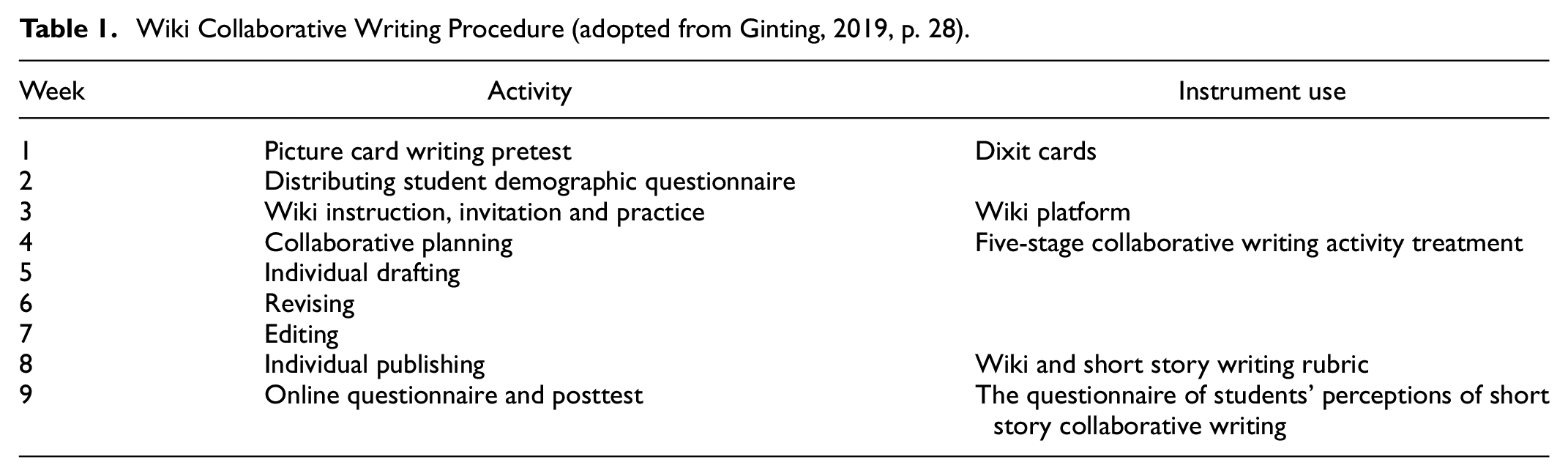
Weeks 4 to 8 were covered by the five-stage collaborative writing activity therapy. The students were required to participate in group planning, individual writing, peer revision, peer editing, and individual publication during the course of the 5-week program. The five-stage exercise required the students to collaborate while simultaneously being instructed and coached by the researcher and the instructor. The students took the writing posttest following the therapy. An online survey was sent out in week nine, the final week of the trial. The purpose of the survey was to learn how the students felt about using wikis for collaborative writing. The detailed procedure of this study is illustrated in Table 1 below.
Results
The Collaborative Writing Through Wikis had a Positive Effect on Students’ Writing Performance in Content, Organization, Grammar, Vocabulary, and Mechanics
In all, the participants took the pre-writing test for understanding their writing ability before the treatment, and then took part in the wiki collaborative writing activity. The activity was divided into five stages: collaborative planning, individual drafting, peer editing, peer revising, and individual publishing. After that, students took a posttest and completed an online survey regarding their perceptions of wiki collaborative writing. In this study, the students handed in four writing tasks which were the pretest at the beginning, individual drafting, individual publishing, and the posttest.
Because the sample size was small, to determine whether the students improved significantly in their performance of the four writing tasks, the pretest, individual drafting, individual publishing, and posttest mean scores were compared by means of the Friedman test: a nonparametric alternative for a repeated measure ANOVA (Table 2). A Friedman test indicated that the four writing tasks were rated differently, χ2(3) = 45.07, p = .00. The results showed that the students improved significantly in their writing abilities.
Mean Scores on the Pretest, Individual Drafting, Individual Publishing, and Posttest for Friedman Test Comparison.

Note. Significant at the .05 level (*p < .05). MR = Mean Rank.
The nonparametric Wilcoxon Signed-rank Test pairwise comparison was used to determine the mean differences of the four writing tasks’ scores (pretest, individual drafting, individual publishing, and posttest) (Table 3). The participants revealed significantly more improvement from the pretest to the posttest (MD = −21.24, p = .00). The participants also showed higher gain from the pretest to individual publishing (MD = −13.71, p = .00) than the gain from the pretest to individual drafting (MD = −9.89, p = .00). However, there was no significant difference between participants’ individual drafting and individual publishing (MD = −3.82, p = .48).
Pairwise Comparisons.

Note. Significant at .05 level (*p < .05).
The fact that the students taking part in this study had received instruction in the five-stage collaborative writing exercise may help to explain the substantial outcome obtained from the pretest to the posttest. Additionally, the duration of the study’s execution period may also be to blame for this. The students’ participation in group planning and receipt of peer criticism throughout the activity may have contributed to the second-highest gain from the pretest to individual publication. The collaborative planning the students conducted in their groups before to conducting the individual drafting may have contributed to their third-highest score on the pretest for individual drafting. However, there was no discernible difference between individual drafting and individual publishing. This could be explained by the fact that the students in their group did not significantly contribute to their peers’ work, either by making direct revisions in the text or by providing comments (suggestion, alteration, evaluation, or clarification), or they could have felt hesitant and insecure about editing and revising their peers’ writing.
Because the participants revealed significantly more improvement from the pretest to the posttest (MD = −21.24, p = .00), to further explore the positive effects of the wiki collaborative writing activity, it was examined whether there was a significant improvement in the students’ writing performance regarding the five grading criteria. Table 4 displays that the participants improved significantly in all aspects of the writing rubric.
Mean Score Comparisons on the Pretest and Posttest of the Short Story Writing Criteria.

Note. Significant at .05 level (*p < .05)
The results exhibit that the five grading criteria improved significantly (p = .00) and the results were similar to previous resecrhers’ finding (i.e., Aydin & Yildiz, 2014; Hsu, 2019; Hsu & Lo, 2018; Li & Zhu, 2017; Vurdien, 2017; Wang, 2015). This might be due to the fact that the students had done the collaborative writing activity that also consisted of peer revising (content and organization-based feedback) and peer editing (language accuracy-based feedback) aside from collaborative planning, individual drafting and publishing. Furthermore, the students had undergone a period of time from the pretest to the posttest. Thus, they made a significant improvement in the five criteria.
Although there was no significant difference between participants’ individual drafting and individual publishing (MD = −3.82, p = .12), Table 5 reveals that the three criteria related to language accuracy, that is, grammar (Z = −2.38, p = .02), vocabulary (Z = −2.86, p = .00), and mechanics (Z = −3.36, p = .00), improved significantly. Nevertheless, no statistically significant difference was found for the two criteria, namely content (Z = −0.53, p = .60) and organization (Z = −0.06, p = .95).
Mean Score Comparisons on the Individual Drafting and Individual Publishing of the Short Story Writing Criteria.

Note. Significant at .05 level (*p < .05).
Students’ Perceptions of Collaborative Writing were Positive
In this study, an online survey that comprised 10 items with a 5-point Likert scale questionnaire and two open questions was administered to all participants in the class. The participants filled out the survey after the five-stage collaborative activities and were asked to express their perceptions of learning through wikis. Table 6 provides the means and standard deviations of the 10 questions. Table 6 reveals that the overall perceptions of students pertaining to this learning activity were positive (M = 3.62). The result finding were corresponding to the previous studies, that this strategy can also boost students’ positive perceptions in terms of motivation (Chao & Lo, 2011; Chen et al., 2015; Lin & Yang, 2011).
Means and Standard Deviations of the Likert-scale Questions in the Survey (Wichadee, 2010).

With regard to each item in the survey, the highest mean score was elicited from Q1: The wiki learning platform enabled me to develop collaboration skills and take charge of my own learning (M = 3.74), followed by Q5, Q9, and Q10 respectively—Q5: I gained more confidence through collaborative learning (M = 3.57), Q9: My experience of using wikis to collaborate on written assignments was positive, (M = 3.56) and Q10: Using wikis increased my performance in English writing (M = 3.55).
Q2: Feedback from peers helped me improve my writing skills (M = 3.49) comes after the four questions above, while the item with the lowest mean score was Q8: Wikis allowed me to contribute from a place that I prefer and on my own time, (M = 3.19). The results of the survey in detail can be seen in Table 6.
Discussion and conclusions
The researchers discovered that process writing combined with the collaborative method was effective for improving students’ writing skills and boosting their engagement in prior studies (Celik & Aydin, 2016; Li & Zhu, 2017; Li, 2020; Wang, 2015). This study’s findings are consistent with earlier research, which found that wiki collaborative process writing increased students’ writing success in areas such as content and organization (Aydin & Yildiz, 2014; Wang, 2015), grammar, vocabulary, and mechanics (Aydin & Yildiz, 2014; Wang, 2015). Additionally, this is in line with the findings of Storch (2005), Storch and Wigglesworth (2007), and Shehadeh (2011), who hypothesized that participation in collaborative writing exercises could increase students’ writing achievement in terms of content, organization, grammatical elements, and vocabulary as well as foster their interest in the craft.
The Strategy Provides Students with a Procedural Instructional Scaffold to Follow
It is customary for teachers to provide pupils with examples to follow in order for them to produce high-quality work that is extremely comparable to model texts. However, it stops the children’ ability to express their originality. Process writing is a method that primarily concentrates on the steps involved in writing. The five stages of writing (prewriting, drafting, editing, revising, and publishing) occupy writers’ time more than the actual writing itself (Nunan, 2015). The five steps of process writing, which give pupils procedural instructional scaffolding experience, may contribute to the progress of the students.
The term “instructional scaffolding” describes a method that gradually reduces outside assistance while still allowing pupils to complete tasks and attain goals. Manage the suitable and transparent method to encourage students to be involved in order to make the scaffolding function effectively (Chao & Lo, 2011). The five steps of the collaborative writing process are well described and organized in this study. Every stage contains clear actions to take and a goal to achieve, which directs the pupils to be conscious of the activities. The students had a clear understanding of the tasks during the phases, which may have also lessened the workload and confusion during the writing process.
Pea (2004) using procedural scaffolding is possible to sustain the online learning environment, keep students on the right path for learning, and maybe lead to effective assignment completion. The teacher and researcher encouraged the pupils to share their creativity and thoughts during the writing process while yet guiding them in the right direction. It is clear that when they were able to manage a dynamic sequence of tasks that successfully guided the students without stifling their originality, it may also serve to increase students’ writing achievement.
The Strategy Enables Students to have more Chances to Practice and Collaborate for Perfection
Students are given helpful tasks that allow them to practice and improve their writing skills when they engage in process writing with its five stages. This five-stage writing exercise is an independent learning task for students with a greater emphasis on involvement and participation. On a wiki page, the participants in this study actively brainstormed a variety of concepts and ideas. They got a chance to learn from others and from their own experiences after having several drafts. Additionally, they may switch positions as they were penning their essay.
Furthermore, PBworks wiki has supportive affordances such as discussion posts, page history, and page and edit tabs to support the activities. Mak and Coniam (2008) indicated that wikis are a suitable interface for brainstorming ideas and synthesizing group reflection. In this study, the five aspects of content, organization, grammar, vocabulary, and mechanics measured in the students’ writing all had significant improvement. In this study, there was a considerable improvement in all five writing-related metrics: Content, organization, grammar, vocabulary, and mechanics. The students had the chance to converse, bargain, and negotiate with their peers during this wiki collaborative writing project. They also had the chance to generate ideas and concepts in their groups and hone their writing abilities. It is consistent with the idea put out by socio-cultural theory that knowledge is socially produced and that learning occurs as a result of interactions with other people (Vygotsky, 1978).
According to the findings of this study, wikis are a highly valuable medium for promoting both communicative and process approaches to short story writing performance while integrating Lowry et al.’s (2004) five-stage collaborative writing activity. The five stages that students followed were the collaborative planning, individual drafting, peer revision, peer editing, and individual publishing. Using wikis in the writing process not only improves students’ proficiency in grammar, vocabulary, and mechanics and structure but also enables them to enhance the content and organization of their writing. The revision and editing process after individual drafting of writing activity helped students detect faults and remedy them as a part of peer learning. The students enjoy being involved in online collaborative writing and learn to give comments and receive feedback in groups. It is thought to be a useful practice to enable students to socially interact to gain more knowledge, insights, and experience. Besides, it also encourages them to share ideas to help their peers. Furthermore, the students can be more active, creative, and independent, rather than completely relying on the teacher. What is more, the students are able to use the technological tools to support their learning process and development.
Despite the positive results elicited from the current study, there are also some limitations that should be noted. The first is the lack of a control group. A control group is needed to see the obvious differences when a treatment is given. The second is the fact that only a small number of students participated in the study. The third is that even though a survey is a general instrument to collect data to ascertain students’ perceptions, it might be more suitable if accompanied by interviews because interviews are able to delve into students views more deeply and more comprehensively. Without qualitative data such as interview data, the finding and discussion are weak. The last is that the time span of the wiki-based collaborative writing activities might have been too brief.
This study is important for teachers and course designers in other non-English-speaking countries because it is an attempt to overcome barriers in teaching English by providing activities based on the use of wikis in a writing classroom. The benefit for incorporating peer revision and peer editing into course frameworks are strong and clear, particularly when students can learn from assessing peers’ work. With careful attention to design and implementation, the “learning from assessing” that results will make up for the efforts made and problems encountered. Students are encouraged to incorporate peer assessment for revising the writing task, and include the perspectives of the students involved. It might also spark the creation of new learning activities for teaching English writing. While the results of this study show that utilizing wikis for English cooperative learning is useful, additional research with other samples is needed to provide more solid proof.
For future research, it is suggested that the study can involve more participants along with more instruments. Besides, this study only focused on analyzing the peer review comments. The revision process, which is also indispensable in wiki collaborative learning, is also worth detailed investigation. Moreover, the stages of process writing in collaborative writing can also be examined to find out more about the obvious benefits to students. Finally, as students have different performance during the writing process, peer reaction, feedback, and collaborative learning via wiki, exploring the influence of wiki-mediated collaborative writing while considering the effects on facilitating or hampering the processes of wiki-mediated collaborative writing might broaden our understanding of a better wiki-mediated collaborative writing instruction.
Footnotes
Declaration of Conflicting Interests
The author(s) declared no potential conflicts of interest with respect to the research, authorship, and/or publication of this article.
Funding
The author(s) received no financial support for the research, authorship, and/or publication of this article.
