



Abstract
This study aimed at evaluating the explanatory value of basic psychological needs (BPN) for foreign language-related motivation and activities in a sample of higher education students and volunteers abroad. According to the self-determination theory, satisfaction of the BPN facilitates forms of motivational regulation and in turn promotes foreign language activities. In a structural equation modeling with N = 435 participants (n = 193 German volunteers during their time abroad and n = 277 German higher education students residing in Germany) external regulation and intrinsic motivation explained receptive (reading, listening) and productive activities (speaking, writing). Moreover, competence satisfaction as well as relatedness satisfaction proved to be significant predictors of external and intrinsic motivation. Generalizability of results regarding students versus volunteers and with respect to the language learned is discussed, as are starting points for future interventions in the setting of foreign language learning outside the classroom.
Keywords
Introduction
The use of foreign languages enables communication between people of different nationalities and facilitates access to education and participation in cultural, political, and social life (United Nations Educational, Scientific and Cultural Organization, 2006). Therefore, it is a political goal of the European Union (EU) that every EU citizen should master two other EU foreign languages beyond the native language (Council of the European Union, 2002).
While foreign language learning often starts at school, it might take place at any age in higher education or less formal settings. However, there are some stages where it is especially plausible and supported by society. Such a stage is the emerging adulthood (Arnett, 2007). It is characterized by involving important steps in the development of identity, attitudes, and interests (Swanson, 2016). During emerging adulthood, students often set their own priorities. This may also include learning a (new) foreign language or engaging in other foreign language-related activities: Some young adults volunteer abroad after high school, others enter the higher education system where they may enroll in language courses, meet language exchange partners or watch TV series in a foreign language in their leisure time. Others would do none of the above.
Based on the eminence of foreign language practice and the emerging adulthood as a “window of opportunity,” the question arises: What motivates young people to use foreign languages in emerging adulthood (Dixon et al., 2012; Lin, 2025)? And is it possible to explain how motivation evolves and to shed light on the choices of young people regarding the use of foreign languages? To this end, the present paper draws on the various forms of motivational regulation proposed in the self-determination theory (SDT) to explain different types of foreign language-related (FLR) activities.
Literature Review
Theoretical Understanding of Basic Psychological Needs and Motivation
As in many domains, there is a plethora of research on the broad dichotomy between intrinsic motivation (doing something for reasons that lie in the action itself) and extrinsic motivation (doing something because of external consequences) regarding foreign language learning. Differentiating these forms is crucial as they lead to different levels of engagement. One contribution of the SDT (Deci & Ryan, 2000a) is the further differentiation of extrinsic motivation into externalized, introjected, and identified regulation (Vallerand et al., 1992). These forms (or “types,”Howard et al., 2020, p. 846) are measured by items representing specific factors (Howard et al., 2020) and may be ordered by an increasing degree of perceived self-determination and integration into the self-concept in order of mention (Deci & Ryan, 2000a; Urhahne & Wijnia, 2023): Externalized regulation refers to learning a language in order to obtain external rewards or to avoid external punishment. With introjected regulation, these consequences are internalized. For instance, under conditions of introjected motivation, someone might learn vocabulary because otherwise he or she would feel guilty about insufficient skills. With identified regulation, an action is tied to larger, self-selected goals related to identity. For example, under conditions of identified regulation, someone might learn the vocabulary because it is a prerequisite for the identity-related goal of becoming an English teacher.
According to SDT, more internalized forms of motivational regulation develop when basic psychological needs (BPN) of competence, autonomy, and social relatedness are satisfied (Deci & Ryan, 2000b). Autonomy occurs when the need to make own decisions and to choose personally relevant activities is satisfied, for example, by reading books according to one’s interests. Competence is perceived when the need to feel capable of successfully pursuing an activity is satisfied, for example, by talking to a stranger in a foreign language. Relatedness is the result of satisfying the need to feel connected to others and to experience a sense of belonging as well as meaningful relationships, for example, while learning a foreign language with others or talking to people in that language.
Theoretical Underpinnings for FLR Activities
In the long run, experiencing autonomy, competence and social relatedness contributes to the development of intrinsic motivation. The latter, in turn, is an important explanatory variable for foreign language activities in non-formal and informal settings. Such activities can be understood as “informal language learning [that] refers to any activities taken consciously or unconsciously by a learner outside of formal instruction that lead to an increase in the learner’s ability to communicate in a second (or other, non-native) language” (Dressman & Sadler, 2020, p. 4; see also Benson & Reinders, 2011; Reinders et al., 2022). They may take place in many non-educational contexts, such as playing computer games, reading posts on social media, or watching videos. Researchers differentiate between receptive (reading and listening) and productive activities (speaking and writing; Birnbaum & Kröner, 2022; Lee & Drajati, 2019; Lee & Dressman, 2018; Sundqvist, 2009). FLR activities provide an easy and authentic access to a foreign language and are, in many cases, a prerequisite for acquiring fluency in a foreign language (De Wilde et al., 2022).
Research Concerning BPN and Motivation
While the relationships between BPN, forms of motivational regulation, and FLR activities are theoretically well-founded, they also require empirical validation. The following sections will elaborate on this evidence.
Departing from the theoretical importance of motivation for foreign language learning (Dixon et al., 2012; X. Zhang, 2020), there has been a plethora of empirical studies on motivational regulation as a predictor of persistence, success or the development of competencies (Alamer & Alrabai, 2023; Noels et al., 2000). Here, identified and intrinsic regulation,in particular,turned out to be linked to positive long-term developments: For instance, recent studies have shown that intrinsic motivation explains success (Alamer & Lee, 2019; Howard et al., 2021; Noels et al., 2000), engagement (Takahashi & Im, 2020), persistence (Davis, 2022; Noels et al., 2000), and competency development (Alamer & Alrabai, 2023; Alamer & Lee, 2019; Wu et al., 2022). The relevance of forms of motivational regulation in the realm of foreign language acquisition has been further substantiated by an extensive body of research across diverse contexts (De Smedt et al., 2020; Lamb et al., 2019) and has been synthesized in a recent review (Vonkova et al., 2021) and a meta-analysis of Al-Hoorie (2018).
Research on BPN as antecedents of motivation beyond language learning has been reviewed in various domains, including health (Heissel et al., 2018), sports (Chatzisarantis & Hagger, 2009), and education (Bartholomew et al., 2018), with medium effect sizes for each of the three BPN (Stanley et al., 2021). The concept of BPN has also been applied in studies on formal language learning (Al-Hoorie et al., 2025; Oga-Baldwin et al., 2017). Consistent with the SDT, fulfilment of BPN has been linked to increased foreign language learning motivation (Agawa & Takeuchi, 2016; Alamer & Lee, 2019; Dincer et al., 2019; McEown, Noels, & Saumure, 2014; Noels et al., 1999; Noels, Lou et al., 2019; Oga-Baldwin et al., 2017). Specifically, autonomy and competence explain the occurrence of internalized motivational regulation (Alamer & Lee, 2019; Noels et al., 1999; Wu, 2003), effects of social relatedness have been shown in a study by Alamer and Lee (2019). To summarize, BPN may explain forms of motivational regulation in formal contexts such as language classrooms, while forms of motivational regulation predict a number of positive outcomes related to language learning.
While the relationships between BPN and forms of motivational regulation are well established in formal contexts, such as school or university language courses, further research is needed to understand whether they can be transferred to informal settings (Birnbaum et al., 2020). A study regarding BPN in an informal language learning context could be a first step for explaining language motivation and FLR activities outside the classroom. This may help in creating interventions for fostering FLR activities through BPN and forms of motivational regulation in more informal settings.
Research Regarding Motivational Regulation in English vs. Other Foreign Languages
Forms of motivational regulation may also be associated withthe language learned: Learners from countries with other languages than English tend to learn and use English for extrinsic reasons (Dörnyei & Al-Hoorie, 2017; Meißner et al., 2008). This may be different for languages other than English (LOTE). In some contexts, they may be associated with the desire to communicate in a language that is connected to one’s family history, a so-called heritage language (Dörnyei & Al-Hoorie, 2017). In other contexts, motivational beliefs regarding learning LOTE may be rooted in the desire to broaden one’s language repertoire (Zheng et al., 2019) or from expectations of a pleasant learning experience (Huang, 2019). Given that a quarter of 12- to 19-year-olds in Germany watch series in English at least once a week (Medienpädagogischer Forschungsverbund Südwest, 2017), it is plausible that differences between English and LOTE also apply to FLR activities. By and large, however, various studies suggest differences in forms of motivational regulation and FLR activities based on whether the target language is English orLOTE. Thus, this study aims at exploring differences in forms of motivational regulation and FLR activities related to the language learned.
Research Regarding FLR Activities at Home and Abroad
While differences in motivation for FLR activities based on the target language (English vs. LOTE) are well established, empirical evidence on further affective explanatory variables for FLR activities remains scarce (R. Zhang et al., 2021). On a surface level, the context in which FLR activities occur might play an important role for motivational processes. Among the existing studies on domestic FLR activities, Lee and Drajati (2019) and Saito et al. (2018) demonstrated that foreign language learning motivation is related to actively engaging in foreign language leisure activities, such as playing computer or internet games (Lee & Drajati, 2019; Saito et al., 2018). FLR activities in these studies refer to informal digital learning of English (Lee & Drajati, 2019) and the amount of English used outside the classroom (Saito et al., 2018). However, non-digital FLR activities were not included in these studies. One obvious non-digital variable that might affect FLR activities is whether FLR activities are practiced in one’s home country or undertaken abroad.
Although studying abroad seems to be a well-suited opportunity to improve language skills, relatively few studies have specifically examined FLR activities during residence abroad and how they may be determined by affective variables (Allen, 2010; Isabelli-García, 2006; Kinginger, 2009). Here, it became evident that a stay abroad does not automatically lead to frequent L2 contacts. Rather, even while abroad, some students use their L1 more than their L2. However, the results of these studies have to be taken with a grain of salt as they typically involve so-called language contact profiles as assessment instruments. While capturing a wide range of FLR activities and their determinants, they do not comprehensively scrutinize students’ home FLR activities.
Voluntary services are a specific form of stays abroad that might lead to FLR activities and their natural integration into daily life. In the EU, these stays are intended as developmental opportunities during emerging adulthood and to foster European integration. They usually occur after school and before further vocational or academic training and they are funded, for instance, by the European Union (EU; European Youth Portal, 2025). Volunteering abroad may include working at an organization, in a social institution or a historical museum. Volunteers usually delve into a new language and culture without an accompanying formal education program such as university students usually do if they attend classes abroad. Even when compared to stays abroad in connection with studies, these characteristics make volunteering abroad a stronger motivational contrast to foreign language activities at home.
Considering the annual number of volunteers in the EU (more than 25,000 volunteers in 2023; European Commission, Directorate-General for Education, Youth, Sport, & Culture, 2024), it is important to understand the motivational dynamics underlying language learning. Since volunteers are living abroad, it is likely that they report a higher amount of FLR activities as compared to students in domestic formal language learning settings. Furthermore, volunteers deliberately choose to go abroad, knowing that this may include learning and using a (new) foreign language in daily conversations with native speakers. Therefore, volunteering may come with higher identified or intrinsic regulation. Domestic students, in contrast, often face the necessity of learning a language as part of their studies and for their future careers. While this may nudge them to engage in FLR activities, it may come with more external and introjected regulation. However, they may also choose to learn a foreign language on a voluntary basis independent of their studies, implying a high level of identified and intrinsic regulation. Taken together, these examples illustrate that while students and volunteers may differ regarding their forms of motivational regulation and FLR activities, the exact nature of these differences in motivational terms is not straightforward.
Given the marked differences in the foreign language learning environment at home and during volunteering abroad, the present study aims to explore the differences in determinants of FLR activities between domestic higher education students in Germany and volunteers abroad. This will contribute to the question whether research findings from students in formal learning environments may be generalized to volunteers. Since research regarding motivational regulation and its explanatory value for FLR activities in students at home versus volunteers abroad is scarce, we will explore this issue rather than testing specific hypotheses.
Research Questions and Hypotheses
We want to gain a deeper understanding of the interplay of BPN, forms of motivational regulation and FLR activities generally, as well as specifically regarding the different language learning contexts of higher education students at home and volunteers abroad. Based on the previous considerations, we aim at answering the following research questions: How do BPN, forms of motivational regulation, and FLR activities relate in nonformal contexts? Are there differences in forms of motivational regulation and FLR activities among learners of different languages? Are there differences in forms of motivational regulation and FLR activities between higher education students and volunteers?
Based on the available research, we tested the following hypotheses:
Emerging adolescents are more intrinsically motivated to practice FLR activities if they perceive their BPN as being satisfied.
The FLR activities can be explained by the different forms of motivational regulation, which in turn are explained by the perceived satisfaction of the BPN.
Both motivational regulation and FLR activities may be explained by the foreign language learned.
Forms of motivational regulation and FLR activities differ between the groups of students versus volunteers.
Hypotheses 1 to 3 are language-wise improved versions of those that have been preregistered prior to data collection together with all questionnaire items and methods for data analysis (Uhing, 2022). Hypothesis 4 has been added after preregistration, but before data collection and analysis.
Methods
Participants
Participants were approached through the language centers and teaching staff of several German universities. Here, mailing lists were used and the first author contacted the language center of her former university in southern Germany. Volunteers abroad were contacted through their sending organization in Germany. For this, through an internet search, we compiled a list with organizations sending out at least 50 volunteers yearly. Thus, the sample constitutes an ad-hoc sample. In the present study, N = 470 young adults participated on a voluntary basis. Thereof, n = 193 people were German volunteers abroad (Mage volunteers (vol) = 19.57, SD = 1.68) and n = 277 students in Germany (Mage students (stud) = 23.1, SD = 3.4). The languages that were mostly indicated in the questionnaire were English (nvol = 35; nstud = 102), French (nvol = 52; nstud = 48) and Spanish (nvol = 28; nstud = 24). Moreover, 35 other languages were also indicated in the questionnaire. Volunteers abroad had been learning the language on average at the time of the survey for 4.77 (SD = 4.13) years and students for 6.55 (SD = 4.76) years.
Instruments
In the present study, for all constructs, we used or adapted scales that have previously been used in other studies. This applies to scales for the BPN (Heissel et al., 2018), forms of motivational regulation (Noels, Vargas Lascano, & Saumure, 2019) and FLR activities (Birnbaum et al., 2019; Wendt et al., 2016), as well as for demographic background variables. Initially, participants were asked to choose the language they most intensively used or, in case they were volunteers, to choose the language that is mostly used in the country of their stay abroad. In order to accommodate various languages in the questionnaire, a place holder was introduced in the online questionnaire via Unipark (Tivian XI GmbH, 2023). The codebook containing all items can be found on OSF (https://osf.io/fw5gj/?view_only=fdcbfe38d83a4eb9b440141d918d3d18).
Basic Psychological Needs
The BPN were measured by the German Basic Psychological Need Satisfaction and Frustration Scale (BPNSFS; Heissel et al., 2018). Since the original version was created for measuring BPN in the sports domain, minor adaptations were made. These included changing the introductory sentence from “When doing sports and moving…” into “When I deal with [language] …” The BPNSFS consists of 12 items measuring autonomy, relatedness and competence satisfaction. Response options ranged from 1 (completely untrue) to 5 (completely true). Since a validated German version was available, the BPNSFS was chosen.
Motivational Regulation
To assess the four forms of motivational regulation according to SDT, a translated German version of the Language Learning Orientations Scale (LLOS) by Noels, Vargas Lascano, and Saumure (2019) was used. External regulation, introjected regulation, identified regulation, and intrinsic motivation were measured using 16 items. Response options ranged from 1 (does not correspond at all) to 7 (corresponds exactly). Since the items were in English, they had to be translated. For translations we followed the recommendations formulated by Dörnyei and Taguchi (2010): The items were translated from English into German using Deepl.com (Kutylowski, 2022). Subsequently, they were proofread, discussed, and improved. This was followed by a back-translation, which was compared with the initial version again and the translated items were revised a second time if necessary. Furthermore, the questionnaire was reviewed with five individuals as part of a think-aloud pretest study (Weichbold, 2014) to address comprehension problems.
FLR Activities
Language activities were assessed using an existing instrument available in German that has been used for reading and writing activities with elementary school children (Birnbaum et al., 2019; Wendt et al., 2016). Participants were asked how often they usually pursue different activities in the fields of reading, writing, listening, and speaking. Furthermore, an open-ended question asked for further activities that were not included in the items. Response options included never, less than every fourth week, every 3 to 4 weeks, every second week, every week, 2 to 3 times a week, more than 3 times a week. Please note that the original items and response options were in German and can be found in the codebook.
Data Analysis
The statistical analyses reported were conducted with R using the packages “base” (descriptive statistics; R Core Team, 2023), “car” (variable creation and recoding; Fox & Weisberg, 2019), “foreign” (reading the data file; R Core Team, 2019), “graphics” (histograms; R Core Team, 2023), “Hmisc” (calculating p-values for correlations; Harrell, 2021), “moments” (skewness and kurtosis; Komsta & Novomestky, 2022), “lavaan” (confirmatory factor analysis and structural equation modeling; Rosseel, 2012), “psych” (Cronbach’s Alpha; Revelle, 2023), “SemTools” (McDonald’s Omega; Jorgensen et al. 2013),“stats” (correlations; R Core Team, 2023), and “vcmeta” (standard errors for the correlations; Bonett, 2022). Since the data turned out to be non-normally distributed, the MLR-estimator, which is robust to non-normal distribution, was used as recommended by Brown (2015). Missing values were handled with the full information maximum likelihood approach (FIML). The significance level was set to p = .05. For estimating model fit, we used thresholds proposed by Hu and Bentler (1999: CFI and TLI > 0.95; RMSEA < 0.06; SRMR < 0.08).
Preliminary Analyses for Estimating the Factorial Structure of BPN, Motivation, and FLR Activities
Before structural equation analyses could be conducted, we scrutinized the factorial structure of the constructs BPN, motivation, and FLR activities by means of confirmatory factor analyses (CFA). In order to check the factor structure of the BPN scales, we calculated a three-factor model (autonomy, competence, and relatedness; Table 1), which provided good fit values and which concurred with past research (Heissel et al., 2018).
Comparison of Tested Models for Basic Psychological Needs.
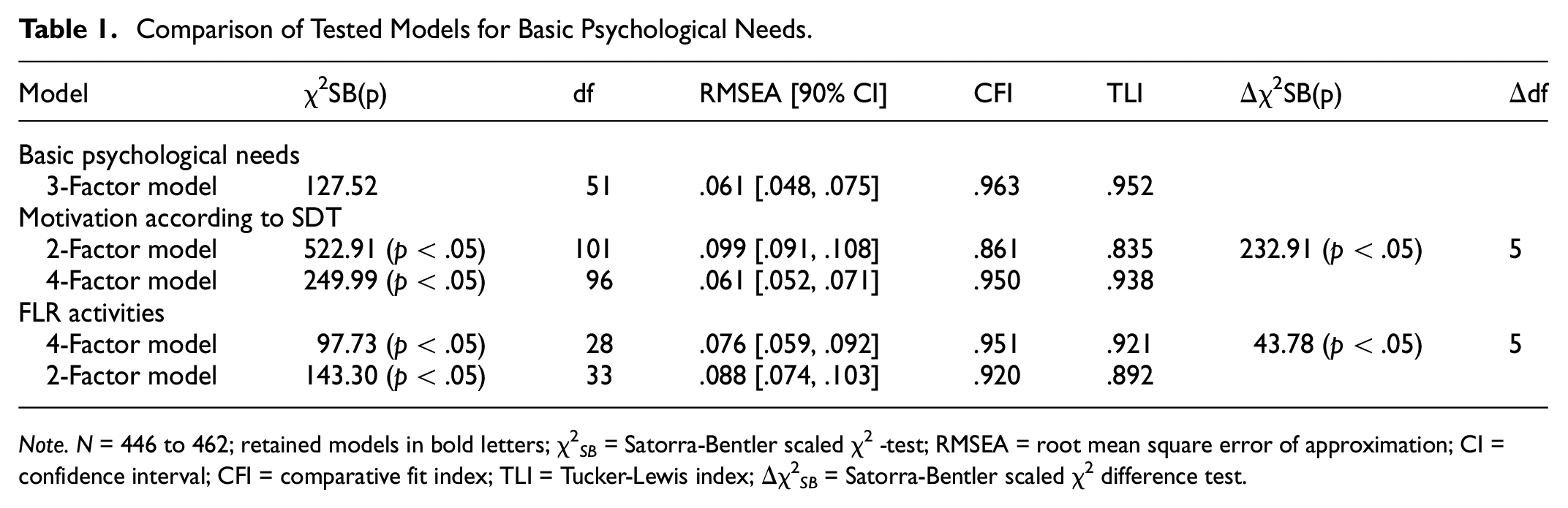
Note. N = 446 to 462; retained models in bold letters; χ2 SB = Satorra-Bentler scaled χ2-test; RMSEA = root mean square error of approximation; CI = confidence interval; CFI = comparative fit index; TLI = Tucker-Lewis index; Δχ2 SB = Satorra-Bentler scaled χ2 difference test.
For the forms of motivational regulation, we compared a two-factor model with autonomous and controlled motivation following De Smedt et al. (2020) with a four-factor model with external, introjected, identified, and intrinsic regulation following Noels, Vargas Lascano, and Saumure (2019; Table 1). These analyses yielded a four-factor structure for forms of motivational regulation and concurred with past research results (Noels, Vargas Lascano, & Saumure, 2019).
To investigate the factor structure for FLR activities, we evaluated a two-factor model: Receptive (reading and listening) vs. productive (speaking and writing; Birnbaum & Kröner (2022); Lee & Drajati (2019); Lee & Dressman (2018); Sundqvist (2009)). Since literacy activities are often considered separately (e.g., reading; Pietilä & Merikivi, 2014), we compared the two-factor model to a four-factor model (reading, writing, speaking, listening; Table 1). All models were finally compared with the Satorra-Bentler χ2-difference test (Δχ2 SB ). While the Satorra-Bentler χ2-difference test for the differentiation of the FLR activities favored the four-factor model as compared to the two-factor model, the factor correlations of writing and speaking as well as listening and reading turned out to be very high (> .90) and the factor loadings for two of three items for writing turned out to be low (λ≤ .55). Thus, the two-factor model, which also resulted in good fit, was adopted (ΔSRMR < .030, ΔRMSEA < .015, ΔCFI < .010; F. F. Chen, 2007).
Structural Equation Models (SEM)
For the analyses regarding hypotheses 1 to 4, we applied structural equation modeling (SEM). In this model, BPN explained forms of motivational regulation and forms of motivational regulation explained FLR activities. Model fit indices, path coefficients and R2 were considered for evaluating the results of the SEM. Due to modification indices nine residual correlations were allowed.
For testing Hypotheses 3 and 4 we used multiple indicator multiple causes models (MIMIC models). In each case, languages other than English (1, vs. English, 0) and being a volunteer (1, vs. being a student, 0) were added as covariates to the SEM following Brown (2015). MIMIC models are particularly recommended for smaller samples to test for measurement invariance (Brown, 2015). Therefore, both covariates were included together in the overall model with BPN, forms of motivational regulation, and foreign language activities.
Results
Table 2 displays means, standard deviations and correlations as well as Cronbach’s alpha for reliability.
Descriptive Statistics and Correlations.

Note. Lower triangular correlation matrix: volunteers, upper triangular correlation matrix: students; competence, autonomy and relatedness; response options: 1 (completely untrue), to 5 (completely true); forms of motivational regulation: response options: 1 (does not correspond at all) to 6 (corresponds exactly); receptive FLR activities, productive FLR activities: response options: 0 (Never), 1 (less than every fourth week), 2 (every 3–4 weeks), 3 (every second week), 4 (once a week), 5 (two to three times a week), 6 (more than three times a week); nstud = 274 to 277; nvol = 187 to 193; correlation matrix shows Spearman’s rho and standard errors
SEM for Evaluating the Explanatory Value of (a) BPN for Forms of Motivational Regulation and (b) of Forms of Motivational Regulation for FLR Activities
For hypothesis 1, which postulated that higher satisfaction of the BPN is associated with higher intrinsic motivation of volunteers and students, BPN were integrated as predictors and forms of motivational regulation as criterion variables in the SEM. For testing hypothesis 2, which postulated that forms of motivational regulation explain FLR activities, FLR were further integrated. The paths of all BPN on all forms of motivational regulation and of all forms of motivational regulation on FLR activities were freely estimated. Model fit was acceptable, χ2SB(687) = 1426.026, p < .001, RMSEA = .049 [90% CI = .045, .053], CFI = .914, TLI = .902. The final model is depicted in Figure 1.
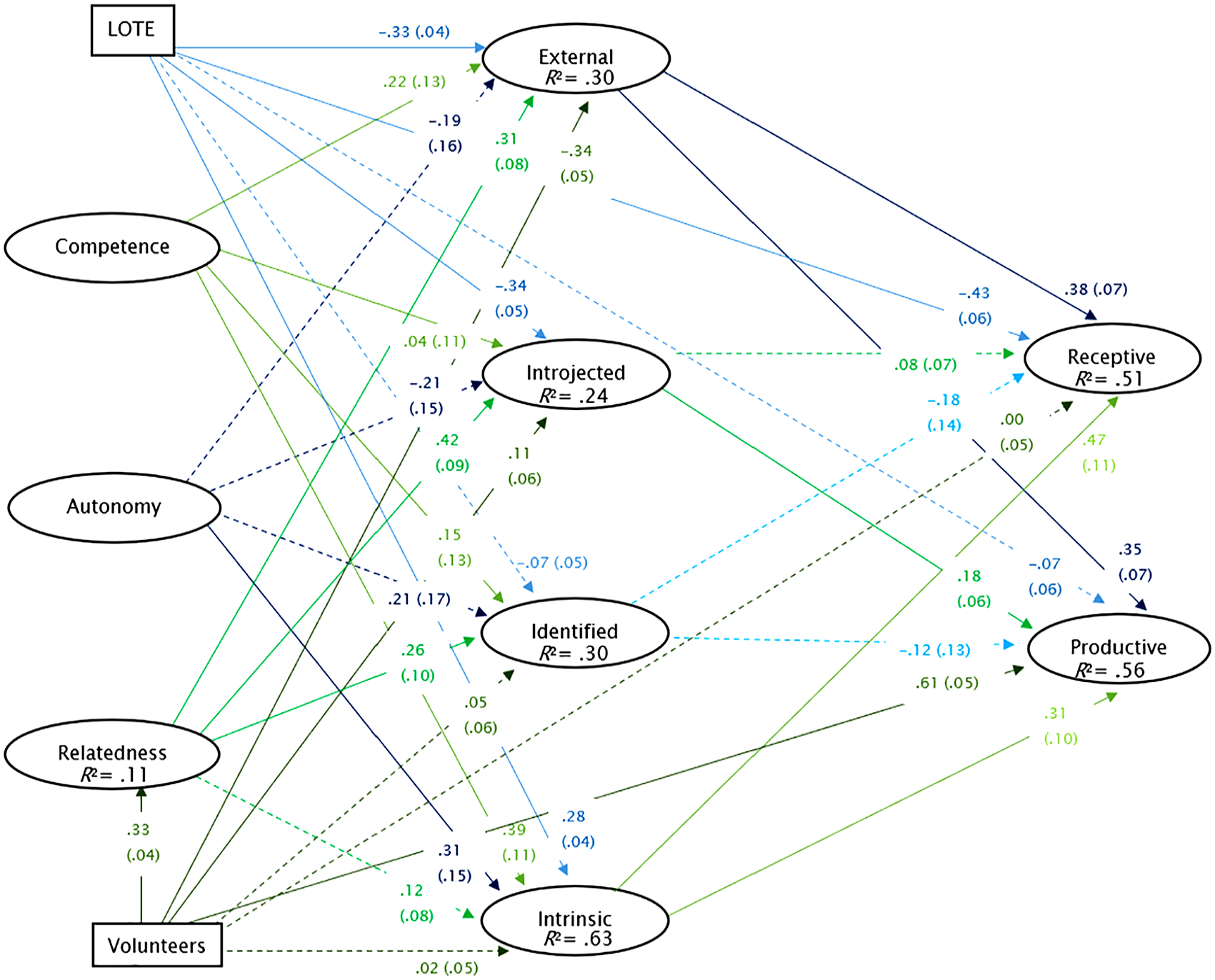
Structural Equation Model of Basic Psychological Needs, Forms of Motivational Regulation and Foreign Language-Related Activities. N = 435; χ2SB(687) = 1426.026, p < .001, CFI = .914, TLI = .902, RMSEA = .049, CI = [.045; .053]; SRMR = .063.
At the latent variable level, the effects between BPN and forms of motivational regulation were as follows: Competence and autonomy satisfaction provided substantial explanatory value for intrinsic motivation (R2 = .63), while its effects on the other forms of motivational regulation were not statistically significant. Relatedness satisfaction provided substantial explanatory value for all forms of motivational regulation except for intrinsic motivation, including external regulation (R2 = .30), introjected regulation (R2 = .24), identified regulation (R2 = .30). Thus, in accordance with hypothesis 1, competence and autonomy satisfaction explained intrinsic motivation. However, relatedness satisfaction did not.
Structural regression paths regarding explanation of FLR activities by forms of motivational regulation, were as follows: External and intrinsic regulation explained receptive activities (R2 = .51) and external, introjected, and intrinsic regulation explained productive activities (R2 = .56), while identified regulation explained no substantial variance in receptive or productive FLR activities. In accordance with hypothesis 2, all forms of motivational regulation except for identified regulation explained receptive and productive activities.
Explanatory Value of Being a Volunteer and Engaging in LOTE on the Relations of BPN, Motivation and FLR Activities
Hypothesis 3 postulated differences in forms of motivational regulation and FLR activities depending on the language learned (English vs. LOTE) and hypothesis 4 postulated differences between volunteers and students in forms of motivational regulation and FLR activities. Paths from both covariates (language (English vs. LOTE) and group membership (students vs. volunteers)) to all latent variables of motivational regulation as well as FLR activities were estimated (Figure 1). Furthermore, modification indices indicated a significant path from being a volunteer onto relatedness satisfaction.
On item level, the item referring to speaking in the work context was regressed onto group and the item indicating the frequency of watching ovies or videos in the foreign language onto English, after reviewing the modification indices. Furthermore, it is likely that volunteers speak the target language more in the context of work and that English learners watch more movies and videos in English.
Regarding the covariates, there were direct negative effects from LOTE on receptive FLR activities (β = −.43, p < .001), external regulation (β = −.33, p < .001), and introjected regulation (β = −.34, p < .001). On the other side, there were positive direct effects of LOTE on intrinsic motivation (β = .28, p < .001) and non-significant direct effects of LOTE on identified regulation (β = −.07, p = .167) and productive FLR activities (β = −.07, p = .261). On indicator level, LOTE learners scored lower than English learners on the item indicating the frequency of watching movies or videos in the foreign language (β = −.26, p < .001). Also, the total effects of LOTE were negative for both productive FLR activities (β = −.15, p = .002) and receptive FLR activities (β = −.43, p < .001). Hypothesis 3, postulating a difference in forms of motivational regulation and FLR activities regarding the language, can be confirmed with exception of identified regulation.
Concerning the role of being a volunteer, analyses showed that this had a direct positive effect on productive FLR activities (β = .61, p < .001), introjected regulation (β = .11, p = .049) and relatedness satisfaction (β = .33, p < .001). Furthermore, there was a negative direct effect of being a volunteer on external regulation (β = −.34, p < .001). No significant direct effects were found for being a volunteer on receptive FLR activities (β = .00, p = .947), identified regulation (β = .05, p = .412), and intrinsic regulation (β = .02, p = .664). On item level, volunteers scored higher on the item referring to speaking in the work context (β = .44, p < .001). Also, the total effects of being a volunteer were positive for productive FLR activities (β = .58, p < .001) and non-significant for receptive FLR activities (β = −.06, p = .202). Thus, we found differences in forms of motivational regulation and FLR activities between students and volunteers, particularly regarding external and introjected regulation as well as productive FLR activities. These findings support hypothesis 4.
Discussion
The Role of BPN for Motivation
The major goal of this study was to assess how satisfaction of the BPN of autonomy, competence and social relatedness explains different forms of FLR motivation and how these in turn explain receptive and productive FLR activities. Moreover, we wanted to explore how these results generalize depending on whether the language learned is English versus LOTE and across the populations of domestic students versus volunteers abroad.
Overall, BPN explained the different forms of motivational regulation, which, in turn, explained FLR activities. The only form of motivational regulation that did not explain any FLR activities was identified regulation. Thus, hypotheses 1 and 2 could be confirmed. Being a volunteer or learning a LOTE also explained differences in the means of the different forms of motivational regulation and FLR activities, confirming hypotheses 3 and 4.
Of all the relationships between BPN satisfaction and intrinsic motivation (hypothesis 1), competence satisfaction showed the largest nominal effect on intrinsic motivation, which is in line with previous findings emphasizing the particular importance of competence (Stanley et al., 2021). Also consistent with previous research, autonomy satisfaction explained intrinsic motivation, too (Alamer & Lee, 2019; Wu, 2003).
Relatedness satisfaction explained external, introjected and identified regulation, with the path coefficient for introjected regulation being the strongest (Figure 1). The more connected learners feel to people when they engage with the language, the stronger their feelings of shame and guilt are likely to be when they fail to do so. The data also show that relatedness satisfaction is more strongly related to identified regulation than to intrinsic motivation. This is consistent with SDT, which states that relatedness is more important to the internalization process and therefore more strongly related to identified regulation than to intrinsic motivation (Ryan & Deci, 2017).
The Role of Motivation for FLR Activities
As previous studies have seldom focused on the relationship between motivational variables and FLR activities (R. Zhang et al., 2021), the aim of this study was to scrutinize this relationship. As stated in hypothesis 2, we had expected forms of motivational regulation to explain FLR activities. In the present study, intrinsic regulation explained FLR activities, which is consistent with the results of other studies on the relationship between intrinsic motivation and engagement in leisure activities (Birnbaum et al., 2019; Kröner & Dickhäuser, 2009; Takahashi & Im, 2020). Moreover, given the utility of FLR activities for language acquisition, we had expected similar explanatory value of external regulation for productive and receptive FLR activities. Meeting our expectations, we found a positive relationship of external regulation and FLR activities. This seems plausible given the informal context under scrutiny: While avoiding poor grades or passing exams may not be a salient concern, finding a good job may be a salient concern. Given the mixed results regarding the role of external regulation in the extant literature (Y. L. E. Chen & Kraklow, 2015; Howard et al., 2021; McEown, Noels, & Chaffee, 2014), this result, however, warrants further scrutiny.
Previous studies have shown that introjected regulation is positively related to engagement, effort and intention (Howard et al., 2021) and identified motivation is positively related to perseverance and engagement or activities (Howard et al., 2021; Noels, Vargas Lascano, & Saumure, 2019). In our study, in contrast, introjected regulation merely explained productive FLR activities, and identified regulation did not explain any FLR activities at all. This may be explained by the translated scale to assess motivation regulation used in our study. For future studies, its German wording might be revised and its homogeneity ensured again.
The Role of Learning English versus LOTE
When analyzing the data, some differences between English learners versus LOTE learners became apparent, supporting hypothesis 3: English learners exhibited higher external and introjected regulation and less intrinsic regulation than LOTE-learners and engaged in significantly more receptive activities than those learning LOTE. Furthermore, the total effects of learning LOTE on both facets of FLR activities were negative, which means that English learners displayed higher levels of productive and receptive FLR activities. This supports the assumption that mastering English is considered a “basic requirement” (Dörnyei & Al-Hoorie, 2017, p. 462) the fulfillment of which is beneficial for everyone’s job prospects. Thus, English is a mandatory subject in German schools, making external regulation more likely for English learners than for often more leisure-oriented LOTE learners. Along the same lines, the opposite is true for intrinsic motivation, which is less pronounced for English learners than for LOTE (Dörnyei et al., 2006; Dörnyei & Al-Hoorie, 2017). Furthermore, English media, such as films and literature, are increasingly prevalent in leisure activities of German adolescents. Hence, it is not surprising that receptive and productive FLR activities were more prevalent in English learners than in those focusing on LOTE.
The Role of Being a Higher Education Student versus Being a Volunteer for Motivation and FLR Activities
Based on hypothesis 4, we explored differences in forms of motivational regulation and FLR activities between students and volunteers: The findings indicated that volunteers exhibited higher levels of introjected regulation and engaged in more productive activities compared to students in their home country. Conversely, they exhibited lower levels of extrinsic regulation. Regarding intrinsic motivation, the two groups did not differ significantly.
While one might have expected higher levels of intrinsic motivation in the volunteer group, they may have been blurred due to self-selection for participation, with primarily intrinsically motivated students opting to participate in the voluntary online survey.
The higher level of introjected regulation observed among volunteers in comparison to students can be attributed to their distinct circumstances: Volunteers work for a year abroad, fostering intensive interaction with the local people. Concurrently, host-country language proficiency is linked to the effectiveness of international voluntary services (Lough et al., 2011). Lacking proficiency and effort to learn the language is likely to result in impediments within the professional sphere. Moreover, interviews with young adults interested in international volunteering suggest that language acquisition is a by-product of volunteering (Rehberg, 2005). Thus, volunteers may feel greater shame if they did not learn the language, leading to higher levels of introjected regulation. When interpreting these effects, however, it is important to consider the exploratory nature of our analyses. This is especially true for the effect of group membership on introjected regulation. While it was statistically significant at p = .05 level in our study, it is the only effect in our study that does not stand a correction procedure to account for multiple comparisons (Cribbie, 2007). Thus, effects of group membership on introjected regulation should be further scrutinized in future studies.
Finally, group differences in forms of regulation should be addressed, particularly the higher external regulation among higher education students compared to volunteers. They are plausible, as students are already engaged in academic pursuits and thus should have a clear understanding of FLR activities’ relevance to their professional goals. Conversely, volunteers are still shaping their interests and aspirations, rendering external motives less influential in their commitment to FLR activities.
Differences between higher education students and volunteers abroad emerged not only for forms of regulation, but also for FLR activities: Volunteers had a higher level of productive activities: Living in a different country, volunteers may have more opportunities to engage in productive activities than students. Conversely, the total effect on receptive activities was non-significant, meaning that being a higher education student vs. a volunteer did not have any effect on receptive activities. This finding is plausible and may be attributed to volunteers’ limited command of the respective language or their inability to identify receptive activities that align with their proficiency level.
Interestingly, we also found that volunteers displayed higher levels of relatedness satisfaction as compared to higher education students. A possible explanation for this finding could be the difference in living conditions between volunteers and students: While volunteers reside in the host country, students do not. If their volunteering experience is positive, volunteers are likely to establish meaningful connections with people in their host country, which may contribute to higher levels of relatedness satisfaction. As this effect was observed ex-post, it should be scrutinized in future preregistered studies.
Limitations
In the present study, we put great emphasis on using scales that had already been applied previously. Nevertheless, with regard to the scales, some limitations should be noted. The items for BPN were adapted from the fields of sports activities, changing the item stem from “When doing sports and moving…” to “When I deal with [language] …” In future studies, it should be scrutinized whether this could have impaired intelligibility and validity of the scale. Moreover, the motivational regulation scales have been translated for the present study. Although we adhered to the recommendations formulated by Dörnyei and Taguchi (2010), some minor differences between the original and the translated version may have evolved. Future studies should scrutinize whether translation issues might have impaired reliability and validity of the identified regulation scale resulting in a failure to explain FLR activities.
We assessed factorial validity looking at whether the utilized scales can be distinguished from each other (e.g., no jingle-jangle between BPN and motivational regulation). Building on this, subsequent studies might employ multiple different scales for testing of convergent and discriminant validity (Sudina, 2021).
The fit indices for our model were slightly below the thresholds proposed by Hu and Bentler (1999). Specifically, while the RMSEA and SRMR fell within acceptable ranges, the CFI and TLI values were marginally below the recommended cutoff. This suggests some leeway for further model improvement. Even based on the data from our ad-hoc sample, useful suggestions for the design of further studies with larger samples representative for the population of LOTE users in emerging adulthood can be derived.
Regarding the assessment of FLR activities, further systematic development of broader scales might be helpful. For example, analogous to Birnbaum et al. (2019), one could conduct an elicitation study regarding the activities with the target group to develop additional items. First suggestions for additional items result from an open-ended question aimed at eliciting further language activities to be included in our study.Here, mostly listening to music or using language learning apps such as Duolingo were mentioned. Moreover, future studies on FLR activities might include a scale measuring involvement in gaming as a FLR activity. Here, especially multi-player games involving English communication appear to be relevant (Sundqvist & Sylvén, 2014).
Conclusion and Implications
The present study is among the first to examine relationships between BPN, motivation, and FLR activities for both higher education students and volunteers. Follow-up study with a randomized controlled sample building on this study may scrutinize the replicability of our findings as well as the generalizability to the respective population. If this is ensured, interventions aimed at fostering informal FLR activities could derive from the starting points discussed in the subsequent paragraphs.
Fostering competence satisfaction may be beneficial to enhance students’ and volunteers’ engagement in FLR activities via their motivational regulation. Along the same lines, studies from sports research suggest that through positive feedback competence satisfaction may be fostered (Mouratidis et al., 2008). Moreover, self-regulation and depicting one’s learning goals have been identified as possible starting points for interventions aiming at language learning motivation (Magid & Chan, 2012; Pawlak et al., 2020). Since these interventions require relatively short durations, they may be implemented in preparing young people for going abroad. From a scholarly perspective, it may be interesting to investigate whether these interventions work differently for higher education students and volunteers.
Another important factor point of departure for the development of interventions may be fostering relatedness satisfaction via near-peer role modeling (Hooper et al., 2025). This includes sharing experiences with other people similar in terms of age, ethnicity, and gender.
Based on the present findings, the question arises as to how well language learners in LOTE are informed about media (movies, series, books, etc.), since they had lower levels in receptive activities than English language learners. This is where language teachers, language apps as well as volunteer service organizations could come in and provide learners with suitable media. A key research implication of this question is identifying effective methods for introducing authentic foreign language media to young adults in both formal and non-formal learning contexts.
While the pedagogical implications outlined in the previous section are conditional on future replications of our results, they might nevertheless provide some first ideas on how to better prepare volunteers for their service abroad—especially with regard to strengthening beneficial forms of self-regulation regarding language learning.
Footnotes
Acknowledgements
We acknowledge Kathrin Nicolay for supporting data collection.

Ethical Considerations
Ethical approval was not required for this study.
Author Contributions
Uhing Sophie: conceptualization; data curation; formal analysis; investigation; methodology; visualization; writing – original draft; writing – review & editing. Birnbaum Lisa: conceptualization; formal analysis; methodology; project administration; writing – original draft; writing – review & editing. Kröner Stephan: conceptualization; methodology; writing – original draft; writing – review & editing.
Declaration of Conflicting Interests
The author(s) declared no potential conflicts of interest with respect to the research, authorship, and/or publication of this article.
Funding
The author(s) received no financial support for the research, authorship, and/or publication of this article.
Data Availability Statement
Informed Consent
Informed consent was obtained from all participants involved.
Supplemental Material
Supplemental material for this article is available online.