




Abstract
The global economy is accelerating its transformation from an industrial economy to a digital economy, and the digital transformation of the manufacturing industry has become an important trend worldwide. Based on China’s provincial panel data from 2004 to 2020, this study uses a dynamic panel model to investigate the role of digitization in the transformation and upgrading of the manufacturing industry. The empirical results show that digitalization has significantly improved the green total factor productivity (GTFP) of the manufacturing industry, while it has significantly inhibited investment in fixed assets. The analysis of regional heterogeneity shows that in areas with scarce labor, abundant human capital, and areas with high innovation investment, digitalization has a larger effect on promoting productivity and inhibiting the expansion of investment scale. In the regions with more outward foreign direct investment, the effect of digitalization on improving productivity is insignificant, and the effect on inhibiting the expansion of investment scale is larger, implying that there is a risk of industrial hollowing out. Further analysis finds that digitalization improves the GTFP of regional manufacturing through mechanisms such as enhancing innovation capabilities, promoting industrial upgrading, and improving investment efficiency, and reduces manufacturing fixed asset investment through channels such as human capital upgrades and rising labor costs.
Plain language summary
The global economy is accelerating its transformation from an industrial economy to a digital economy, and the digital transformation of the manufacturing industry has become an important trend worldwide. Based on China’s provincial panel data from 2004 to 2020, this study uses a dynamic panel model to investigate the role of digitization in the transformation and upgrading of the manufacturing industry. The empirical results show that digitalization has significantly improved the green total factor productivity of the manufacturing industry, while it has significantly inhibited investment in fixed assets. The analysis of regional heterogeneity shows that in areas with scarce labor, abundant human capital, and areas with high innovation investment, digitalization has a larger effect on promoting productivity and inhibiting the expansion of investment scale. In the regions with more outward foreign direct investment, the effect of digitalization on improving productivity is insignificant, and the effect on inhibiting the expansion of investment scale is larger, implying that there is a risk of industrial hollowing out. Further analysis finds that digitalization improves the green total factor productivity of regional manufacturing through mechanisms such as enhancing innovation capabilities, promoting industrial upgrading, and improving investment efficiency, and reduces manufacturing fixed asset investment through channels such as human capital upgrades and rising labor costs.
Keywords
Introduction
As a vital component of economic activities, the manufacturing industry has always been considered one of the key drivers of economic development (Duraivelu, 2022). With the deepening of the new round of industrial revolution, to take the initiative in future development, developed countries are relying on technological innovation to move towards a new way to revitalize the manufacturing industry. Hence, developing countries urgently need to adapt to international competition and change the development mode of the traditional manufacturing industry. Manufacturing can promote economic growth and create employment opportunities, so using foreign resources for industrial transfer is not a good option (Pisano & Shih, 2009; Wen, Wen et al., 2022), which may also lead to hollow risks in the reduction of manufacturing production scale. In the context of increasing pressure on reindustrialization and sustainable development, the manufacturing industry in developing countries is in urgent need of restructuring and upgrading. It requires measures to promote the transformation and upgrading of the manufacturing industry, to achieve a better and more strategic competitive path (Steenhuis & Prettorius, 2017), which is also an inevitable choice for high-quality industrial development.
China is a large developing country, and manufacturing is the main driving force of its economic development (Zeng & Li, 2018). However, China’s manufacturing industry has been guided by low-end exports for a long time, while the export proportion of high-tech products is relatively low, and the independent research and development capacity is relatively weak (Hu et al., 2019). In addition, the gradual fading of the demographic dividend makes it difficult for China’s manufacturing industry to continue to maintain the advantage of low factor cost (Jing et al., 2021), and the resulting rise in labor costs also easily leads to industrial transfer, thus causing the risk of manufacturing hollowing out. As digital technology is widely embedded in the industrial economy, Europe and the United States and other developed countries have implemented the digital transformation strategy of the manufacturing industry (F. Yang et al., 2021). Digitalization has reshaped the leading position of manufacturing in the global value chain in developed countries, making it even more urgent for developing countries to promote the transformation and upgrading of their manufacturing industry. However, whether digitalization will positively impact the transformation and upgrading of China’s manufacturing industry and through what channels are still questions that need to be studied in depth and answered.
The integration and development of new-generation information technology and the manufacturing industry is an important measure for China’s manufacturing industry to achieve intelligent transformation and upgrading. It is also the key to promoting the transformation of population dividends into efficiency dividends. The Chinese government also attaches great importance to the opportunities brought by digital transformation. In the development strategy of Made in China 2025, China proposes to promote the integration of new-generation information technology and manufacturing technology, and take intelligent manufacturing as the main direction of in-depth integration of informatization and industrialization. It is of great significance for China to cultivate new drivers of economic growth and achieve the transformation of its manufacturing industry towards the mid to high-end. Digitalization provides strong technical support for the manufacturing industry and transforms it in all aspects and throughout the entire chain, thereby promoting the intelligent, efficient and green development of the manufacturing industry (Deng et al., 2022). The purpose of this study is to clarify the theoretical logic and specific effects of digitalization on the transformation and upgrading of China’s manufacturing industry, and to provide reference for other developing countries to seize digital opportunities to promote high-quality development of the manufacturing industry.
Digitalization is the process of applying digital technology to industrial production and operation, and digital technology is often used in manufacturing (Wen et al., 2021). Digital technology integrates new-generation information technologies such as artificial intelligence and 5G to help manufacturing enterprises iteratively update production equipment and upgrade production technology (Škare & Soriano, 2021). According to the theory of digital transformation, on the one hand, the manufacturing industry can achieve efficient division of labor and optimized integration of the manufacturing process through digital technology, and on the other hand, it can reduce the market uncertainty and risks it faces through big data information (Gao et al., 2023b). The potential impact of digitization on the manufacturing industry has been discussed by many scholars. Digital technology can help the manufacturing industry achieve a more flexible and personalized production model, which helps the manufacturing industry to enhance its competitive advantage (Ma & Gao, 2021). In addition, the application and development of digital technology in the manufacturing industry can also help reduce environmental pollution and increase employment demand (Autor, 2015; Wen et al., 2021). There is also literature showing that digitalization can promote the servitization of the manufacturing industry, which broadens the market scope and increases trading opportunities for the manufacturing industry (Matthess & Kunkel, 2020).
The debate on how digitalization affects the transformation and upgrading of the manufacturing industry has not yet been unified. According to value chain theory, digitization enables real-time collection and analysis of supply chain data, reducing product development cycles and costs, achieving intelligent and efficient after-sales service, and thus promoting the improvement of total factor productivity in enterprises (Shahatha Al-Mashhadani et al., 2021). Digitalization has improved the flexibility of the supply chain and the flexibility of product production, which has reduced the demand for fixed assets investment such as storage facilities, logistics equipment, and large-scale production equipment in the manufacturing industry. Digitalization enables the efficient circulation of information resources and increases information transparency, which helps reduce information asymmetry in the manufacturing industry (Deng et al., 2022). According to the theory of new structural economics, digitalization provides a new technological and economic paradigm for the manufacturing industry, which helps developing countries break through the low-end lock in the global value chain (Wen, Wen et al., 2022). In addition, digitalization can promote innovation, optimize resource allocation and technology penetration, and cause fundamental changes in all links of the industrial chain, thereby promoting the transformation and upgrading of the manufacturing industry (Fu, 2022; F. Zhou et al., 2022).
In summary, previous studies have mostly focused on the impact of regional digital economy development on the manufacturing industry or analyzed the role of digitalization at the micro level of manufacturing enterprises. However, there is little literature examining the effects of digital transformation and upgrading of the manufacturing industry from a macro perspective in developing countries. This study utilizes provincial-level panel data from China from 2004 to 2020 to investigate the effects and impact mechanisms of digitalization on the transformation and upgrading of the manufacturing industry. This study has theoretical and practical significance for the study of digitization and the transformation and upgrading of the manufacturing industry. Firstly, this study provides a theoretical analysis framework on how digitalization plays a role in the manufacturing industry in developing countries, and provides a theoretical basis for analyzing and explaining these changes. Second, unlike previous research on the digital transformation of the manufacturing industry, this study focuses on the digital transformation of the manufacturing industry rather than the development of the regional digital economy, which helps clarify the real impact of digital transformation on the manufacturing sector. Thirdly, this study investigates the efficiency and scale of the manufacturing industry, which is conducive to a comprehensive understanding of the impact of digitalization on the transformation and upgrading of the manufacturing industry.
The rest of the paper is structured as follows. Section “Literature Review and Research Hypothesis” reviews the literature and proposes theoretical hypotheses. Section “Methodology and Data” introduces the research methods and data. Section “Empirical Result and Analysis” analyzes the empirical results. Section “Discussion” discusses the research results. The last section contains conclusions, policy implications and limitations.
Literature Review and Research Hypothesis
Literature Review
Transformation and upgrading mean that the industrial development mode is changed, the industrial technical structure, organizational structure, and spatial structure are improved, and the industrial structure is optimized and upgraded as a whole (S. Lin et al., 2019). Transformation and upgrading help the manufacturing industry to establish innovative advantages, improve product quality (Yu & Wang, 2021), enable the manufacturing industry to achieve continuous upgrading, and climb its position in the global value chain. The continuous development of industrialization and urbanization has increased the environmental pressure faced by developing countries (Liang et al., 2021). However, industrial transformation and upgrading not only promote the high-quality development of the economy and society, but also make an important contribution to the coordination of sustainable economic development and environmental protection (Zhu et al., 2019). Some scholars pointed out that the optimization and upgrading of industrial structures not only improved production efficiency but also promoted technological progress in energy conservation and emission reduction in the production process (Brock & Taylor, 2005). The transformation of industrial structure from resource-consuming to knowledge-intensive and technology-intensive can reduce environmental pollution and promote the improvement of ecological efficiency (Dinda, 2004).
Based on different perspectives, many scholars have adopted different methods to measure transformation and upgrading. The position of industry in the global value chain reflects its competitive advantage, so some scholars define industrial transformation and upgrading from the perspective of the global value chain (Gereffi, 1999). From the perspective of industrial structure, transformation and upgrading can be divided into rationalization and upgrading of industrial structure, respectively representing the degree of coordination between industries and the evolution of industrial structure levels (B. Lin & Zhou, 2021). Therefore, from the perspective of industrial structure adjustment, some scholars use labor productivity and total factor productivity to measure the level of industrial transformation and upgrading (Brandt et al., 2017). Considering the relationship between industrial upgrading and environmental pollution, some scholars have adopted indicators such as environmental efficiency and green productivity to measure industrial transformation and upgrading from the perspective of environmental performance (Chen & Golley, 2014; Miao et al., 2019). These measures for industrial transformation and upgrading not only consider technological factors but also consider the impact of industrial transformation and upgrading on the environment.
There are many factors affecting industrial transformation and upgrading. Technological innovation is an important factor driving the development of the high-tech manufacturing industry. It not only ensures the growth of productivity but also has a strong role in promoting the transformation and upgrading of the manufacturing industry (Wu & Liu, 2021). Foreign direct investment can improve the technology level of the manufacturing industry through the technology spillover effect, and then improve the total productivity of the manufacturing industry (Anwar & Sun, 2018; Orlic et al., 2018). The appropriate improvement of the level of environmental regulation can promote the upgrading of the manufacturing industry by stimulating technological innovation in the manufacturing industry (Porter & Linde, 1995), and can limit the development of low-end manufacturing industry with high pollution and high energy consumption (Wang et al., 2017). Industrial agglomeration can reduce the risks and costs of industrial transformation by improving the allocation efficiency of industrial resources (Fang et al., 2020). Some government systems may have adverse effects on industrial transformation and upgrading. For example, fiscal decentralization makes local governments more inclined to invest resources in productive expenditure, which affects the upgrading of industrial structure (Que et al., 2018). Local government intervention in labor, capital, and energy markets will affect the balance of factor prices, which will lead to distortion of industrial structure (Shen & Lin, 2021). The fiscal imbalance will limit the local government’s investment in promoting technological progress, and then inhibit the progress of industrial structure (Lin & Zhou, 2021).
The development of the digital economy has accelerated the flow of data elements, promoted the rational allocation of resources, and improved the efficiency of matching supply and demand. From the perspective of digital technology, digital transformation can be defined as the process of enterprises applying digital technology to business activities to improve business performance (Pînzaru et al., 2022). From the perspective of digital services, digital transformation can be defined as the process of enterprises using new digital technologies to connect all business links (Ismail et al., 2017). At the micro level, digitalization has brought digital technology and data resources to traditional enterprises, not only improving the technical level of enterprises but also optimizing and reforming the enterprise structure and workflow (Vial, 2019). At the macro level, digitalization can enable the government to open new technology markets, realize digital innovation and intelligent governance, and help the government formulate effective sustainable development strategies (ElMassah & Mohieldin, 2020). In the era of the digital economy, digital transformation and upgrading are important ways for traditional industries to regain competitive advantages (Singh et al., 2021).
In recent years, digital technology has been embedded in all aspects of production activities and has become an important driving force for the transformation and upgrading of the manufacturing industry. Therefore, many literatures have discussed the relationship between digitization and the transformation and upgrading of the manufacturing industry. Digitalization improves information transparency and cross-border collaboration capabilities, reduces information processing costs (Gao et al., 2023b), and increases the intellectual capital and social capital of enterprises. The improvement of intellectual capital and social capital is crucial for the innovation performance of enterprises (Salehi et al., 2022). In addition, the application of digital technology has changed the production mode and product value chain of the manufacturing industry, which is conducive to enhancing the competitive advantage of the manufacturing industry (Gao et al., 2023a; Ma & Gao, 2021). In terms of the environment, the traditional manufacturing industry has aggravated industrial pollution, making the environmental pollution problem increasingly prominent, which restricts the development of the transformation and upgrading of the manufacturing industry (Y. Zhou et al., 2018). However, digitalization brings clean and energy-saving production technology, which is not only conducive to the green and sustainable development of the manufacturing industry but also reduces energy consumption and environmental pollution (Wen et al., 2021). In terms of employment, most scholars believe that digital technology progress can improve the level of manufacturing productivity, increase the demand for highly skilled labor, improve the quality of employment, and increase overall income (Autor, 2015).
The existing literature has studied the influencing factors of transformation and upgrading and the relationship between digitalization and manufacturing from different perspectives, and has provided rich theoretical insights. However, few literatures have studied the digital transformation and upgrading of the manufacturing industry in developing countries from a macro perspective. Especially for a large developing country like China, which has relied on factor advantages for a long time to develop its manufacturing industry, it is necessary to study the effect of digitalization on the transformation and upgrading of its manufacturing industry.
Research Hypothesis
As the core sector of the real economy, manufacturing can use data elements and digital technology to achieve quality and efficiency changes in the competition facing the digital economy era. According to the value chain theory, digitalization improves the transparency and response speed of the supply chain, reduces product development cycles and costs, and realizes the intelligence and efficiency of after-sales service (Shahatha Al-Mashhadani et al., 2021). Digitization expands the scope and efficiency of information acquisition, which reduces information asymmetry. The efficient transfer of information promotes knowledge sharing of professional skills and R&D technologies, which is crucial to the innovation ability of enterprises (Shafeeq Nimr Al-Maliki et al., 2023; Salehi & Sadeq Alanbari, 2023). According to the resource allocation theory, manufacturing enterprises can accurately evaluate and allocate resources by using big data analysis and intelligent algorithms, which avoids the waste of resources and inefficient investment. Therefore, digitization helps the manufacturing industry improve management and production efficiency, create greater economic benefits, and thereby improve investment efficiency. Based on the theory of new structural economics, digitalization has brought new technological and economic paradigms to the manufacturing industry (Wen, Zhong, et al., 2022). This helps the manufacturing industry to achieve more efficient, precise, and flexible production processes and management methods, which improves output efficiency and promotes industrial upgrading. Therefore, digital transformation has brought benefits to the manufacturing industry in terms of technological innovation, industrial upgrading, and resource allocation, and eliminated the inefficiency of factor resource allocation and the decline in efficiency indicators. In summary, the following hypotheses are put forward.
Traditional manufacturing industries often require a large amount of fixed assets to meet production needs. Digitization can make the production process of the manufacturing industry more flexible, improve the efficiency of resource utilization (Gao et al., 2023b), and thus reduce the dependence on fixed assets investment. According to the theory of diminishing marginal utility, investment in fixed assets has diminishing marginal utility to a certain extent, which means that every additional unit of investment in fixed assets brings diminishing returns. Digitization can improve production efficiency, reduce resource waste and optimize supply chains (Gao et al., 2023a), which reduces the need for fixed asset investment per unit of output. Based on the perspective of the capital substitution effect, digital technology enables manufacturing enterprises to effectively utilize existing fixed asset equipment and introduce new automation equipment, which replaces some traditional fixed asset equipment and avoids excessive investment. The R&D and promotion of digital technology have improved the production efficiency of manufacturing enterprises, and improved the remuneration of workers through the productivity effect, but also increased the labor factor cost of manufacturing enterprises. With the deep integration of digital technology and manufacturing, the demand for human resources in manufacturing has gradually shifted from quantity to quality. Advanced digital technology needs to match more high-end skilled talents, and enterprises also pursue the allocation of highly skilled human capital. Therefore, the digital transformation has increased the labor cost and human capital of the manufacturing industry and squeezed out fixed assets investment, which is reflected in the hollowing out phenomenon of the manufacturing industry at the scale level caused by the digital transformation. Hence, the following hypothesis is proposed.
Methodology and Data
Data Collection
Based on the provincial panel data of China from 2004 to 2020, this paper constructs a dynamic panel model and uses the system GMM model to empirically examine the impact of digital transformation on the transformation and upgrading of the manufacturing industry. The data involved in this study are mainly from the China Statistical Yearbook, the China Industrial Statistical Yearbook, the China Science and Technology Statistical Yearbook, the China Foreign Direct Investment Statistical Bulletin, and the local statistical yearbooks of various provinces in China. The macro data on the manufacturing industry mainly comes from the China Industrial Statistical Yearbook. The data on R&D and innovation come from the China Statistical Yearbook of Science and Technology. The data on foreign direct investment come from the Statistical Bulletin of China’s foreign direct investment. Control variables and other macro data come from the China Statistical Yearbook and local statistical yearbooks of each province in China. The Tibet Autonomous Region was eliminated due to serious data missing, and the individual missing values of variables in other provinces were interpolated. In addition, all continuous variables are shrunk at 1% and 99% quantiles to avoid the impact of outliers.
Model Specification
The transformation and upgrading of the manufacturing industry is a gradual and long-term dynamic process. Therefore, considering the autocorrelation of possible periods of transformation and upgrading, this article adds a first-order lag term of the dependent variable to the model to prevent bias caused by missing variables. In addition, a dynamic panel system GMM model is used to overcome the endogenous problem caused by the presence of dependent variable lag terms in the independent variables. The system GMM method estimates both the original level model and the differential transformation model simultaneously, which can correct unobserved heteroscedasticity issues, missing variable deviations, and potential endogenous issues. The model design is as follows:
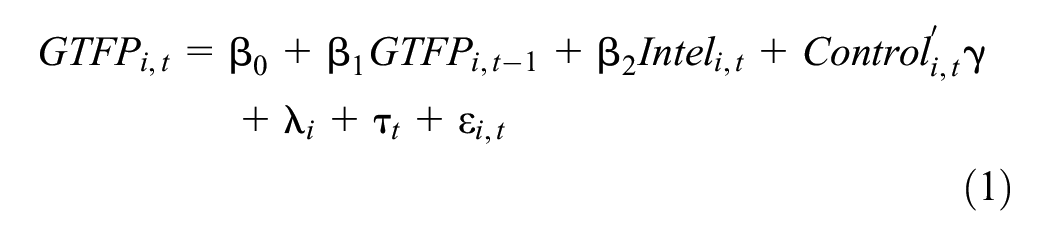

The subscript i represents each province, and t represents the year. GTFP is the green total factor productivity of the manufacturing industry, Scale is the fixed assets investment scale of the manufacturing industry, Intel represents the digital level of the manufacturing industry, and
To further investigate the impact mechanism of digitalization on GTFP and investment scale in the manufacturing industry, this study constructed the following mediation effect model based on Model (1) and Model (2):



In the model,

Mediating effect model.
Variables Definitions
Dependent Variable
According to the existing literature, the transformation and upgrading of the manufacturing industry can be measured by the level of technology, scale, growth, and other aspects of the manufacturing industry. This paper selects two proxy indicators, namely, green total factor productivity (GTFP) and fixed assets investment scale (Scale).
The variable GTFP is measured by industrial GTFP. Based on the Data Envelopment Analysis (DEA) method and using the SBM-DDF method, the expected output is the gross industrial output value, which is deflated to a constant price in 2004 using the GDP deflator. Unexpected outputs include industrial wastewater emissions, sulfur dioxide emissions, and industrial smoke (powder) dust emissions. The input indicators are industrial employment, industrial fixed assets, and total energy consumption. Industrial fixed assets are measured by the perpetual inventory method and adjusted to a comparable price series with the fixed assets investment index as the base period in 2004. Industrial energy consumption is converted into ten thousand tons of standard coal by conversion coefficient. The larger the GTFP, the more significant the transformation and upgrading effect of the manufacturing industry is.
The variable Scale uses the proportion of each province’s manufacturing fixed asset investment to the province’s total fixed asset investment. The larger the Scale is, the larger the scale of fixed assets investment in the manufacturing industry is and the smaller the hollowing degree on the scale level is.
Core Explanatory Variable
The core explanatory variable of this paper is the digitization level of the manufacturing industry (Intel). This article selects 10 detailed indicators such as software popularization and application, intelligent manufacturing industry, and industrial enterprise innovation capabilities, covering three aspects: infrastructure construction, production application, and competitiveness benefits. The principal component analysis method is used to calculate comprehensive scores to measure the relative degree of manufacturing digitization in various provinces in China from 2004 to 2020.
The following are the specific definitions of 10 detailed indicators: (a) Software popularization and application, measured by using the ratio of product revenue from basic software, embedded software, and other products in various provinces to industrial main business revenue. (b) Intelligent equipment investment, measured by the ratio of the import volume of intelligent equipment such as computers and instruments in various provinces to the income of industrial main businesses. (c) Information resource collection, using the ratio of the number of users aged 15 to 64 in each province who are online to the population of that age group. (d) Data processing and storage, is measured using the ratio of data processing and storage service revenue to industrial main business revenue in each province. (e) Intelligent manufacturing enterprises, is measured by the proportion of the operating revenue of intelligent manufacturing owners in each province to the national operating revenue of intelligent manufacturing owners. (f) Production of new products adopts the ratio of the sales revenue of new industrial products to the main industrial business revenue of each province is used. (g) Platform operation and maintenance, is measured by the proportion of platform operation and maintenance revenue to industrial main business revenue in each province. (h) Innovative ability, is measured by the ratio of the national patent application authorization volume of industrial enterprises in each province to the full-time equivalent of R&D personnel is used to measure. (i) Economic benefits, is measured by the total asset contribution rate and cost-profit rate of each province. (j) Social benefits, is measured by the electricity consumption per unit of GDP of each province.
Control Variables
Referring to the relevant literature on the transformation and upgrading of the manufacturing industry, the following provincial-level control variables are selected. Population density (lnPop) is expressed as the logarithm of the population per square kilometer of each province. Financial deepening (Fin) uses the ratio of the annual loan balance of financial institutions in each province to the province’s GDP. Government expenditure (Gov) is measured by the proportion of fiscal expenditure in the public budget of each province’s government to the province’s GDP. Marketization degree (Mark) is expressed by the proportion of fixed assets investment of non-state-owned enterprises in each province in the total fixed assets investment of the province. Openness (Open) is measured by the proportion of the total import and export volume of each province divided by domestic destination and source of goods to GDP. GDP per capita (lnRGDP) is measured as the logarithm of the ratio of the GDP of each province to the total population of that province. Research and development investment (lnRD) is measured using the logarithm of research and development expenditure in each province. Environmental regulation (Envir) is measured by the amount of industrial pollution control investment per thousand yuan of industrial added value in each province. Outward foreign direct investment (OFDI) is measured by data on the stock of OFDI by province (Teng et al., 2023).
Descriptive Statistics
Descriptive statistics of the main variables and control variables are shown in Table 1. GTFP is the GTFP of the manufacturing industry, and Scale refers to the scale of fixed asset investment in the manufacturing industry. According to the data, there are large differences in the degree of transformation and upgrading of the manufacturing industry and the scale of fixed asset investment in various provinces. Intel represents the degree of digitalization of the manufacturing industry. According to the data, there are significant differences in the digital transformation of the manufacturing industry in various provinces in China. In general, the growth rate of the digitalization process of the manufacturing industry has been relatively large in recent years, indicating that the strategy of promoting the digital transformation of the manufacturing industry has been relatively successful.
Descriptive Statistics of Variables.

Empirical Result and Analysis
Analysis of Benchmark Regression Results
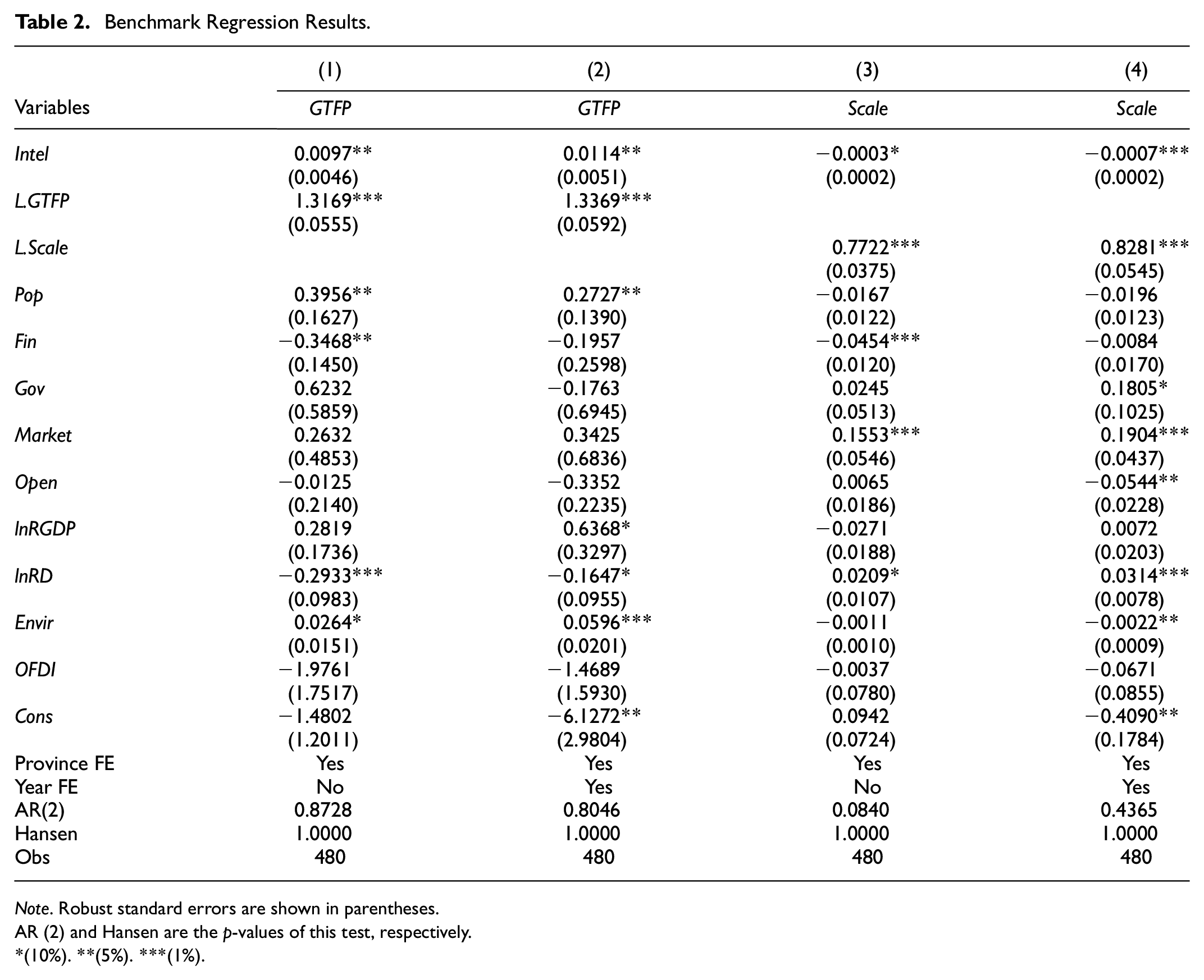
Table 2 shows the benchmark regression results of digital transformation on manufacturing GTFP and fixed assets investment scale. Among them, columns (1) and (2) are the regression results of GTFP as the dependent variable. Column (1) controls the provincial fixed effect, and the coefficient of Intel is significantly positive at the level of 5%. In column (2), the bidirectional fixed effect between year and province is controlled, and the coefficient of Intel is still significantly positive at the 5% level. Therefore, research hypothesis 1 is valid. Columns (3) and (4) are the regression results when the dependent variable is the scale of manufacturing fixed assets investment. Column (3) controls the provincial fixed effect, and the coefficient of Intel is significantly negative at the level of 10%. Column (4) Controls the bidirectional fixed effect between year and province, and the coefficient of Intel is negative and significant at the 1% level. This shows that digital transformation will inhibit the expansion of the fixed assets investment scale in the manufacturing industry, and there is a risk that it will lead to the hollowing out of the manufacturing scale. Therefore, the research hypothesis 3 has been verified.
Benchmark Regression Results.
Note. Robust standard errors are shown in parentheses.
AR (2) and Hansen are the p-values of this test, respectively.
(10%). **(5%). ***(1%).
In addition, the lag coefficient of the benchmark regression is significant at the level of 1%, which indicates that the GTFP and fixed assets investment scale of the manufacturing industry have the characteristics of dynamic evolution, and it is reasonable to use the dynamic panel model. To ensure that the estimated results of the system GMM model are consistent and valid, the Arellano Bond test and Hansen test are performed. In columns (1), (2), and (4), the P value of the AR (2) test is greater than 0.1, indicating that the original assumption that there is no second-order autocorrelation in the residual term is accepted. Although the p-value of the AR (2) test in column (3) is less than 0.1 but greater than 0.05, it indicates that the original assumption that there is no second-order autocorrelation in the residual term is accepted at a 5% significance level. Therefore, according to the results of the Arellano Bond test, the system GMM model better overcomes the endogenous problem. The P-values of the Hansen test are all greater than .1, indicating that the null hypothesis that there is no overidentification of instrumental variables is accepted. The benchmark regression has passed the Arellano-Bond test and Hansen test, so the estimation coefficients of the system GMM model are consistent and valid.
Robustness Checks
Endogeneity Issues
Considering that the core explanatory variable of this study may have a reverse causal relationship with the dependent variable, which may lead to endogeneity bias. Therefore, this study draws on the practice of Topalova and Khandelwal (2011) to test whether the core explanatory variable Intel has the endogenous problem of reverse causality. Specifically, the core explanatory variable (Intel) is used as the dependent variable to regress green total factor productivity (GTFP) and fixed asset investment (Scale), as well as provincial economic development (lnRGDP), provincial R&D investment (lnRD), provincial technology introduction (FDI), and provincial investment in machinery and equipment (Mq). Technology introduction (FDI) is measured by the proportion of actual FDI from each province to regional GDP. The investment in machinery and equipment (Mq) is measured by the ratio of the investment in urban equipment and tools to the investment in fixed assets investment. The empirical results in Table 3 indicate that there is a significant correlation between Intel and lnRDGP to a certain extent, but the coefficients of GTFP and Scale are not significant. Therefore, the test results rule out the possibility that the core explanatory variable has reverse causality to a certain extent. Based on the endogenous test results, this study included economic development variables and R&D input variables as control variables, which alleviated the endogenous impact of omitted variables to a certain extent. Therefore, after considering the problems of reverse causality and omitted variables, the estimated results of the model are still robust.
Model Endogeneity Test Results.

Note. Robust standard errors are shown in parentheses.
(10%). **(5%). ***(1%).
Other Robustness Checks
This study also added other robustness check methods to verify the robustness of benchmark regression results. Considering that the economic development, technological level, and policies of the municipalities are different from those of the general provinces, which may affect the estimation results. Therefore, this study excluded four municipalities directly under the central government of Beijing, Tianjin, Shanghai, and Chongqing to increase the homogeneity and comparability of the data. The empirical results are shown in columns (1) and (2) of Table 4. The coefficients of Intel are all significant at the 5% level, and the signs are consistent with the benchmark regression results. This indicates that even after excluding more specific samples, the regression results still support the core conclusion of this study. Considering the hysteresis of the impact of digitalization and potential endogenous problems, this study uses the core explanatory variables lagging one period for regression. From columns (3) and (4) of Table 4, the coefficients of digitization with a lag of one period are significant at least at the 5% level, and the symbols of the coefficients are consistent with the benchmark regression results. This further verifies the robustness of the benchmark regression results.
Other Robustness Check Results.

Note: Robust standard errors are shown in parentheses.
(1%), **(5%), and *(10%). AR (2) and Hansen are the p-values of this test, respectively.
Heterogeneity Analysis
From the results of benchmark regression, digital transformation has a causal effect on GTFP and fixed assets investment scale of the manufacturing industry. To explore the heterogeneity of these two effects, this paper intends to start from the perspectives of labor resources, human capital, R&D input, and foreign direct investment (OFDI). Specifically, the samples were divided according to the labor participation rate, average years of schooling, R&D investment, and OFDI level in turn. Then, the group regression method is used to study the cross-sectional differences of GTFP and fixed assets investment scale changes caused by digital transformation.
Heterogeneity Analysis Based on Labor and Human Capital
Table 5 reports the results of the heterogeneity analysis based on labor and human capital. The empirical results show that in regions where labor is scarce and human capital is abundant, the effect of digital transformation on improving GTFP and reducing fixed assets investment is more significant.
Results of heterogeneity analysis based on labor and human capital.

Note. Robust standard errors are shown in parentheses. AR (2) and Hansen are the p-values of this test, respectively.
(10%). **(5%). ***(1%).
Among them, the dependent variable in columns (1) to (4) is GTFP. Columns (1) and (2) show that the coefficient of Intel in labor-scarce regions is significantly positive at the 1% level, and the coefficient of Intel in labor-abundant regions is significantly positive and smaller at the 10% level.
According to factor endowment theory, digital transformation provides new digital technical resources for the manufacturing industry to improve productivity. For provinces with relatively scarce labor factors, such important technical resources have a stronger marginal effect on improving manufacturing productivity. Columns (3) and (4) in Table 5 show that the coefficient of Intel in regions with strong human capital is significantly positive, while the coefficient of Intel in regions with weak human capital is negative but not significant. Human capital is the carrier of technological improvement and innovation. A manufacturing industry with a higher level of human capital can promote the use of digital technology resources, thereby improving GTFP.
The dependent variable in columns (5) to (8) of Table 5 is Scale. Columns (5) and (6) indicate that the coefficient of Intel in labor-scarce regions is significantly negative, while the coefficient of Intel in labor-abundant regions is negative and not significant. An adequate labor force is an important reason for the rapid development of the manufacturing industry, while the lack of a labor force will lead to the reduction of the production scale matching the labor force in the manufacturing industry and fixed assets investment will also be correspondingly reduced. Columns (7) and (8) in Table 5 show that the coefficient of Intel for regions with weak human capital is insignificant and negative, while the coefficient of Intel for regions with strong human capital is significantly negative. Digital transformation inevitably requires a higher level of human capital to match, and knowledge and skills are the core forces driving the high-quality development of the manufacturing industry. Compared to physical capital and other factors invested in the production process, human capital can create benefits that exceed its value many times. Therefore, in the process of digital transformation, the manufacturing industry has a higher demand for human capital, which will squeeze out the investment of physical capital.
Heterogeneity Analysis Based on R&D Investment and OFDI
Table 6 shows the results of heterogeneity analysis based on R&D investment and OFDI. The empirical results show that the effect of digital transformation in regions with high R&D investment on improving total factor productivity of the manufacturing industry and reducing fixed assets investment is more significant. In addition, in regions with low OFDI levels, the role of digital transformation in improving manufacturing total factor productivity is more significant. However, in regions with high OFDI levels, digital transformation plays a more significant role in reducing fixed assets investment in the manufacturing industry.
Heterogeneity Analysis Results Based on R&D Investment and OFDI.

Note. Robust standard errors are shown in parentheses. AR (2) and Hansen are the p-values of this test, respectively.
(10%). **(5%). ***(1%).
In Table 6, columns (1) to (4) are the results of heterogeneity grouping regression with the dependent variable GTFP. Columns (1) and (2) indicate that the coefficient of Intel in regions with low R&D investment is negative but not significant, while the coefficient of Intel in regions with high R&D investment is significantly positive. R&D investment can improve the innovation ability and technological level of manufacturing enterprises, reduce production costs, and output innovative results that lead to improved production efficiency, thereby improving the GTFP of the manufacturing industry. Columns (3) and (4) in Table 6 illustrate that the coefficient of Intel in provinces with low OFDI levels is significantly positive, while the coefficient of Intel in provinces with high OFDI levels is not significantly positive and has a smaller coefficient. The negative impacts of OFDI mainly include the loss of industrial capital, the loss of skilled workers, the foreign trade deficit, and the imbalance in industrial organization relations. These will lead to a decline in the investment scale and productivity of the manufacturing industry, leading to hollowing out of the manufacturing industry.
Columns (5) to (8) in Table 6 show the heterogeneous grouping regression results of the fixed asset investment scale as the dependent variable. The regression results in columns (5) and (6) show that the coefficient of Intel in provinces with high R&D investment is significantly negative, while the coefficient of Intel in provinces with low R&D investment is negative but not significant. Traditional resource-based enterprises usually pursue scale effect and reduce production and operating costs by expanding scale, while manufacturing enterprises in provinces with high R&D investment invest more in product innovation and R&D. Therefore, manufacturing enterprises will pay more attention to the technological innovation and product quality advantages brought about by digitalization, and will appropriately reduce the investment scale in the process of digital transformation. The regression results in columns (7) and (8) of Table 6 show that the coefficient of Intel in high OFDI provinces is significantly negative, while the coefficient of Intel in low OFDI provinces is negative but not significant. This is consistent with the regression results in columns (3) and (4) of Table 6, indicating that large-scale outflows of industrial capital are prone to have negative effects on domestic production and investment. This will mainly lead to chain reactions such as reduced production efficiency and shrinking investment scale in the manufacturing industry, exacerbating the hollowing out of the manufacturing industry.
Mechanism Analysis
Research on the Path of Digital Transformation Affecting GTFP
Digital technology resources brought by digitalization have updated the traditional elements of the manufacturing industry and accelerated the flow and sharing of elements between industries, which can effectively improve the productivity of the manufacturing industry. According to the analysis of the research hypothesis, in order to test the channels for digitalization to improve the GTFP of the manufacturing industry, this paper uses the ratio of patent applications to employees to measure R&D innovation capabilities (Inno), uses the labor productivity of the manufacturing industry weighted by production value to measure the upgrading of the manufacturing industry (Ind_up), and uses the ratio of sales output value to total fixed assets to measure investment efficiency (Capital_out). Table 7 shows the results of the research on the mechanism of the impact of digital transformation on GTFP in manufacturing.
The path of digital transformation affecting GTFP.

Note. Robust standard errors are shown in parentheses. AR (2) and Hansen are the p-values of this test, respectively.
(10%). **(5%). ***(1%), and.
The empirical results show that digital transformation can improve GTFP in manufacturing through mechanisms such as enhancing innovation capabilities, promoting industrial upgrading, and improving investment efficiency. Column (1) shows that the coefficient of Intel is significantly, and column (2) shows that the coefficient of Inno is also significantly positive, which indicates that digitization can restrain the efficiency hollowing out of the manufacturing industry by improving the innovation capability. In the context of the rise and rapid development of digital technologies such as artificial intelligence and cloud computing, the manufacturing industry grasping the opportunities for innovation driven by digital technology can help consolidate the dominant position of the real economy in economic and social development.
Column (3) shows that when the dependent variable is industrial upgrading, the coefficient of Intel is significantly positive. Column (4) shows that when the dependent variable is GTFP, the coefficient of Ind_up is significantly positive, indicating that digital transformation can achieve an increase in manufacturing total factor productivity by promoting industrial upgrading. With the deepening application of digital technology in the manufacturing industry, the ability of enterprises to rapidly create value based on technology and information is also constantly improving. Digital transformation improves the quality and efficiency of the traditional manufacturing industry, promotes industrial transformation and upgrading, and creates new advantages of quality and efficiency. Column (5) shows that when the dependent variable is investment efficiency, the coefficient of Intel is significantly positive. Column (6) shows that when the dependent variable is GTFP, the investment efficiency coefficient is not significant but positive, consistent with the expected direction, indicating that digitization can have a positive effect on manufacturing total factor productivity by improving investment efficiency. As the new generation of information technology accelerates its penetration into the manufacturing industry, grasping the opportunities of digital transformation and using data elements to improve investment efficiency are important ways for the manufacturing industry to enhance market competitiveness and achieve total factor productivity improvement. In summary, the research hypothesis 2 holds.
Research on the Path of Digital Transformation Affecting Investment Scale
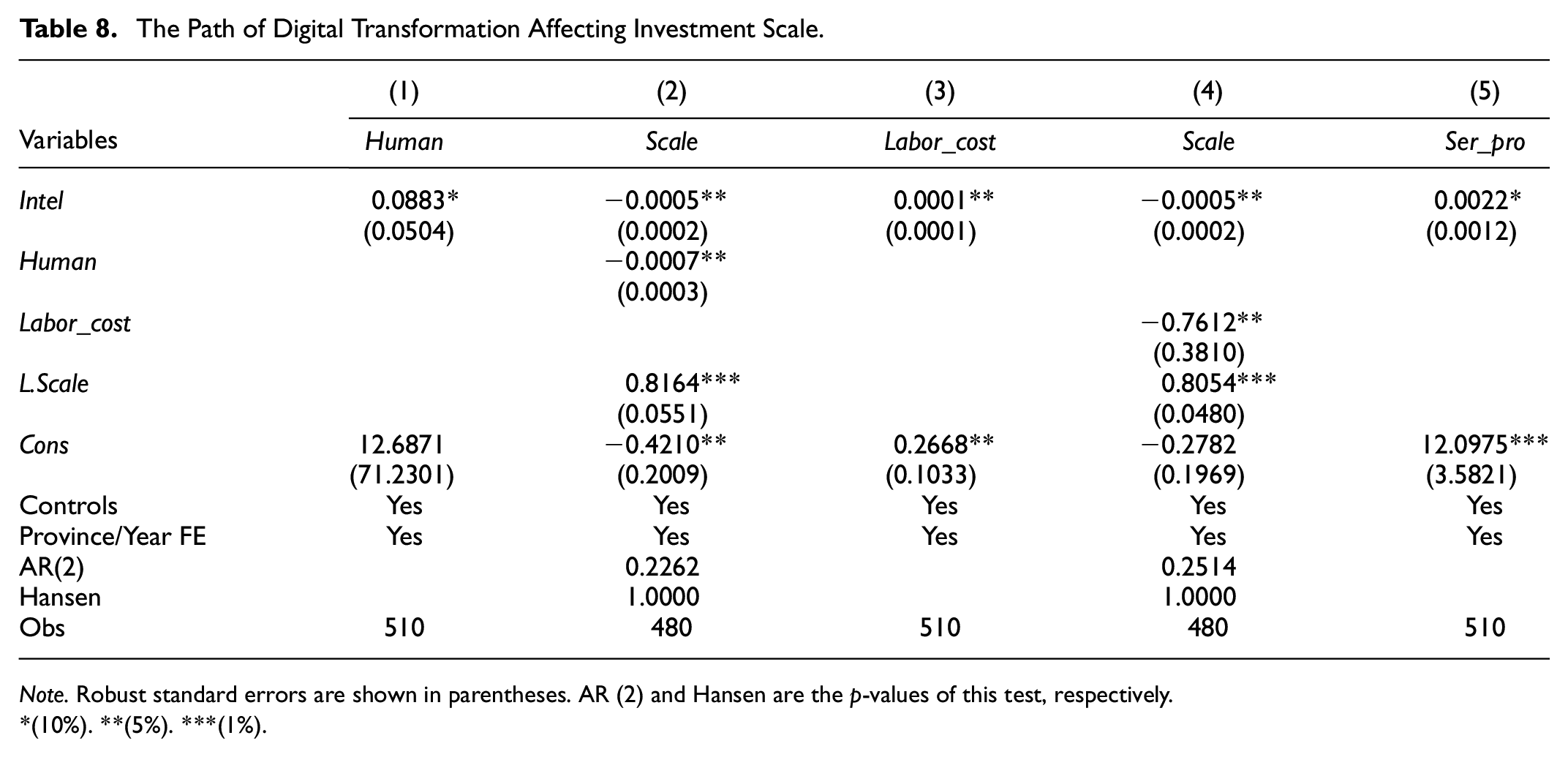
Digital technology makes the trend of machines replacing manual work and algorithms replacing manpower more obvious. As one of the three typical factor inputs, changes in the cost of labor will undoubtedly have a significant impact on the scale of investment in the manufacturing industry. Therefore, this paper uses the number of R&D personnel per thousand employees to measure the human capital level (Human), and uses the ratio of wages and operating income of manufacturing workers to measure the labor cost (Labor_cost), to explore the channels for the digital transformation of manufacturing industry to affect fixed assets investment. Table 8 shows the research results of the mechanism of digital transformation affecting fixed assets investment in the manufacturing industry.
The Path of Digital Transformation Affecting Investment Scale.
Note. Robust standard errors are shown in parentheses. AR (2) and Hansen are the p-values of this test, respectively.
(10%). **(5%). ***(1%).
The empirical results show that digital transformation will reduce fixed assets investment in manufacturing by promoting human capital upgrading and increasing labor costs. Column (1) shows that when the dependent variable is the level of human capital, the coefficient of Intel is significantly positive. Column (2) shows that when the dependent variable is scale hollowing, the coefficient of Human is significantly negative, which indicates that digitalization can reduce the scale of fixed assets investment in manufacturing by promoting the upgrading of human capital. The digital economy takes data as the key factor of production, and the industries in digital transformation put forward certain requirements on the level of human capital. Many knowledge and skill-intensive tasks need talents with digital knowledge, information network, and communication technology skills. Properly reducing the proportion of fixed assets investment and improving the level of human capital is conducive to the transformation of manufacturing development from scale expansion to quality and efficiency improvement.
Column (3) shows that when the dependent variable is labor cost, the coefficient of Intel is significantly positive, indicating that digital transformation will significantly increase labor costs in the manufacturing industry. Column (4) shows that when the dependent variable is the scale of manufacturing investment, the coefficient of Intel is significantly negative, which indicates that digital transformation can reduce the scale of manufacturing investment by increasing labor costs. In the era of the digital economy, digital transformation not only promotes the traditional manufacturing industry to move towards the mid to high-end but also promotes the further integration and development of the manufacturing and service industries. This has promoted the upgrading of the traditional service industry to the modern service industry and realized the improvement of production efficiency of the service industry. As a result, wages in the service industry have increased, and due to structural inflation, labor costs in the manufacturing industry will also be driven up by rising wages in the service industry.
To verify the effect of digital transformation in manufacturing on productivity improvement in the service industry, this paper uses service industry labor productivity (Ser_pro) as a dependent variable to regress Intel. The regression results are shown in column (5). The coefficient of Intel is significantly positive, indicating that the digital transformation of the manufacturing industry can significantly improve the labor productivity of the service industry. Digital transformation drives up labor costs in the manufacturing industry through structural inflation caused by rising wages in the service industry. This will lead to a corresponding reduction in the scale of fixed assets investment in the manufacturing industry, resulting in hollowing out of scale. In summary, the research hypothesis 4 is valid.
Discussion
Emerging digital technologies are leading a new round of global industrial restructuring. Digital transformation can enhance the competitiveness of the manufacturing industry and promote high-quality development of the manufacturing industry. This study uses China’s provincial panel data from 2004 to 2020 to investigate the impact of digital transformation on GTFP and fixed assets investment scale of the manufacturing industry, and then investigate the role of digitalization in the transformation and upgrading of the manufacturing industry. The empirical results indicate that digital transformation can significantly improve GTFP and inhibit the expansion of investment scale, posing a certain risk of scale hollowing out. Consistent with Deng et al.’s research, the application of digital technology contributes to the growth of GTFP in China’s manufacturing industry (Deng et al., 2022). Digitization helps increase innovation capabilities and improve resource allocation efficiency, and these views have also been confirmed by other researchers (Gao et al., 2023; Liu et al., 2022; Usai et al., 2021). This study further verifies that digitalization can increase the GTFP of the manufacturing industry by increasing innovation capabilities, promoting industrial upgrading, and improving investment efficiency.
The empirical results of this study also indicate that digitization will inhibit the expansion of investment scale in the manufacturing industry. Based on the perspective of scale effect, Zhang (2021) confirmed that the rapid expansion of the digital trade scale will inhibit the growth of GTFP, thus suggesting promoting the transformation of digital trade from scale to quality. This is to some extent beneficial for understanding the conclusion of this study that digitalization reduces the scale of manufacturing and improves efficiency. Previous literature has shown that skill reserves and technical knowledge are crucial for the success of digital transformation (Nguyen et al., 2015). In the digital transformation of the manufacturing industry, human capital upgrading has become a more important investment direction compared to traditional equipment and facility investment. Digitalization has brought about an increase in productivity (Zhao et al., 2021), which has correspondingly increased labor costs in the manufacturing industry.
The conclusions of this study further verify that digitalization will reduce fixed assets investment through upgrading human capital and increasing labor costs.
Existing research has shown that human capital and R&D investment are important factors in digital development (Li et al., 2023; Nguyen et al., 2015). The more abundant these elements are, the more knowledgeable and skilled talents manufacturing enterprises can acquire, and it is also more conducive to the development and application of digital technology (Fu, 2022). This is beneficial for improving the utilization efficiency of fixed asset equipment and reducing the scale of fixed assets. In areas where labor is scarce, the digital manufacturing industry has stronger marginal benefits of labor, but at the same time, the manufacturing industry will correspondingly reduce the use of fixed asset equipment. The heterogeneity research results of this paper provide some support for these views, that is, in provinces with scarce labor, abundant human capital, and high levels of R&D investment, digital transformation has a stronger effect on improving manufacturing productivity and reducing investment scale. Previous studies have shown that outward direct investment exacerbates the hollowing out of industries and is not conducive to enhancing industrial competitiveness (Huijie, 2018; T. H. Yang & Liao, 2007). Consistent with the conclusion of this study, that is, in regions with high foreign direct investment, the productivity of the manufacturing industry has not been significantly improved due to digitalization. Moreover, digitalization has significantly inhibited the expansion of the investment scale, and there is a certain risk of hollowing out the scale.
This paper has made theoretical contributions to the research on digitization and the transformation and upgrading of the manufacturing industry. Firstly, this study provides a theoretical framework on how digitization works and impacts the manufacturing industry, and provides some theoretical basis for analyzing and explaining these changes. Secondly, this study analyzed two aspects of GTFP and investment scale in the manufacturing industry, revealing the specific role and impact mechanism of digitalization in these two aspects, which improved the limitations of previous studies on the impact of single-level manufacturing transformation and upgrading. Finally, considering the dynamic interdependence of productivity and investment, this study investigates the impact of digitization on productivity and investment based on the dynamic panel system GMM model, which improves the accuracy and scientificity of the research results.
Conclusion, Policy Implications, and Limitations
Conclusion
This paper uses the provincial panel data of China from 2004 to 2020 to study the impact of digital transformation on the GTFP of the manufacturing industry and the scale of fixed asset investment, to investigate the role of digitalization in the transformation, upgrading and hollowing out of manufacturing industry. The empirical results show that digital transformation can significantly improve GTFP in the manufacturing industry, but it will inhibit the expansion of the investment scale of manufacturing enterprises, and there is a certain risk of scale hollowing out. Overall, digitalization is conducive to the transformation of the manufacturing industry from scale expansion to improving quality and efficiency. Heterogeneity analysis shows that in provinces with scarce labor, abundant human capital, and high levels of R&D investment, digital transformation has a stronger effect on improving manufacturing productivity and reducing investment scale. In provinces with high OFDI levels, the effect of digitalization on improving manufacturing productivity is not significant, while the effect on restraining manufacturing investment scale is significant, and there is a significant risk of industrial hollowing out. Mechanism analysis shows that digital transformation improves GTFP through mechanisms that enhance innovation capabilities, promote industrial upgrading, and improve investment efficiency, and reduces manufacturing investment through channels such as upgrading human capital and rising labor costs.
Policy Implications
Our research results provide some inspiration for using digitalization to promote the transformation and upgrading of the manufacturing industry and prevent industry hollowing out. For large manufacturing countries, it is even more necessary to accelerate the digital transformation of the manufacturing industry, using digital technology to transform the manufacturing industry in an all-round and full-chain manner, to improve the quality and efficiency of the manufacturing industry. Manufacturing enterprises should accelerate the introduction and cultivation of high-level and versatile talents required for digital transformation, improve innovation capabilities and human capital levels, and optimize the allocation of human and material capital elements. Manufacturing enterprises need to use digital technology resources to improve their labor productivity and management capabilities, improve the technological content and added value of products, and alleviate the cost pressure of production factors. The coordination between various departments in economic development policies and management needs to be further strengthened, to create a better environment for investment and entrepreneurship of manufacturing enterprises, protect the enthusiasm of real investment, and enable capital to voluntarily return to the real economy.
Limitations and Future Research
This study has certain limitations and shortcomings. There may be large regional differences between provinces in developing countries, including economic level, industrial structure, and development policies, which need to be further reflected in the research. Future research may need to consider these heterogeneities and make appropriate comparisons and distinctions during analysis. This study did not further investigate the sub-sectors of the manufacturing industry, so the accuracy and generalizability of the research results are affected to a certain extent. Future research can further consider the differences in factors such as technology application and market demand in subdivided manufacturing industries, which will help to more accurately evaluate the impact of digital transformation on different manufacturing industries. Some areas in developing countries have inadequate infrastructure conditions and have implemented many policies to promote the application of digital technology. Future research can further investigate how these policies have an impact on the digital and manufacturing industries, which is beneficial for developing countries to reform their manufacturing industries.
Footnotes
Declaration of Conflicting Interests
The author(s) declared no potential conflicts of interest with respect to the research, authorship, and/or publication of this article.
Funding
The author(s) disclosed receipt of the following financial support for the research, authorship, and/or publication of this article: This research was funded by the Management Science Program of the Natural Science Foundation of Jiangxi Province of China (Grant No. 20232BAA10040) and the Humanities and Social Sciences Key Research Base Bidding Project of Jiangxi Universities and Colleges (No. JD21001).

Data Availability Statement
Data will be provided upon reasonable request to the corresponding author.