




Abstract
Space syntax offers powerful tools for analyzing tourism-related spatial configuration. Tourism, in turn, provides distinctive contexts that can extend the scope of the theory. However, its application in tourism research remains fragmented, calling for a systematic review to consolidate findings and identify research priorities. This study conducts a scoping review of 104 studies published between 1999 and 2024. Using a structured charting process, we examined their research characteristics, including spatial scales, metrics, and analytical techniques. The review identifies four major themes: research on spatial structures examines how spatial forms and functions are organized within destinations; studies on visitor behavior analyze tourists’ flows, wayfinding, and experiential outcomes; work on visitor–host interactions explore co-presence, encounters, and conflicts; and research on locality and alienation investigates how tourism-induced spatial segregation contributes to marginalization and exclusion. Across these themes, persistent inconsistencies remain, such as the divide between macro- and micro-scale analyses, contrasting views on separating or integrating visitor-host spaces, mismatches between spatial metrics and tourists’ spatial cognition, and divergent interpretations of whether space syntax metrics serve as predictive or diagnostic tools. Taken together, the review not only consolidates scattered findings but also clarifies how these themes align with core propositions of space syntax—phenotype, natural movement, movement economies, co-presence, and spatial segregation. In doing so, it highlights how tourism contexts can inform the refinement of space syntax theory and outlines priorities for future research.
Keywords
Introduction
Space plays a fundamental role in tourism, influencing how destinations develop and shaping tourists’ experiences. From building interiors to entire destinations, architectural structures, pathways, attractions, and the movements of tourists, residents, and service providers collectively form complex spatial relations. Although tourism researchers increasingly recognize the importance of space, its active role in shaping tourism phenomena remains insufficiently theorized and empirically explored (Hall, 2012). A central challenge lies in understanding space not as a mere backdrop but as an autonomous factor that actively influences tourist behavior and destination dynamics.
Space syntax theory offers a robust framework for addressing this challenge by focusing on the concept of “spatial configuration”—the relational patterns among spatial elements within a whole (Hillier, 2007). Rather than viewing spatial layouts as passive results of social or environmental factors, space syntax posits that spatial configurations have their own agency, shaping patterns of movement, social interaction, and even the formation of social structures (Askarizad et al., 2024; Netto, 2016). Key constructs such as “genotype,”“movement economies,” and “partitioning” provide theoretical tools to analyze how spatial structures influence human activities systematically (Hillier, 2007). These concepts, if applied systematically, can enrich our understanding of how spatial configurations shape tourism destinations and experiences.
Beyond theory, space syntax also provides a suite of analytic techniques for capturing and quantifying spatial configurations. Through tools such as axial maps, segment maps, and associated indicators, researchers can quantitatively analyze how spatial layouts relate to movement patterns and behavioral outcomes (Xiao, 2017). These indicators enable tourism researchers to explore how spatial layouts influence tourist flows, accessibility, and behavioral patterns with empirical precision.
In recent decades, these analytical and theoretical advantages have attracted the attention of tourism researchers. Space syntax has been applied across diverse topics, including visitor movement analysis, destination design, heritage site management, and urban tourism planning. However, existing studies remain scattered across different spatial scales, methodological approaches, and topics. No systematic effort has been made to consolidate this growing body of knowledge, which limits theoretical accumulation and methodological transferability in the field.
In addition to this lack of systematic synthesis, there is also a need to clarify how tourism as a research domain may refine or extend the propositions of space syntax theory. This need arises because tourism typically unfolds in unfamiliar environments and involves distinctive patterns of interaction—not only between visitors and residents, but also between visitors and the resources and environment of the destination. Analyzing these features highlights aspects of spatial configuration that are especially salient in tourism contexts and can contribute to further theoretical development.
For example, the mismatch between space syntax indicators and tourists’ spatial cognition raises the question of whether these metrics function more effectively as predictive tools or as diagnostic indicators in unfamiliar spatial configuration (Lin et al., 2023; Zou et al., 2022). Similarly, patterns of visitor–host encounters point to the need to revisit concepts such as co-presence and spatial segregation (C. Wu & Chen, 2021; Zheng et al., 2022). Taken together, these issues highlight an opportunity to extend space syntax theory by exploring how it can capture the transient, experiential, and interactional dimensions of tourism spaces.
This study addresses these gaps through a scoping review of tourism research that applies space syntax theory. The central review question is: How has space syntax theory been integrated into tourism research, and what insights have been generated? Specifically, the study aims to: (a) describe the research characteristics, including spatial scales, configurational metrics, and methodological approaches; (b) map key research themes and topics; and (c) identify conceptual and methodological gaps in the existing literature. A scoping review is particularly appropriate for this purpose, as it allows for the comprehensive mapping of an emerging interdisciplinary field and the identification of research priorities (Peters et al., 2020).
This review not only consolidates fragmented knowledge but also highlights how tourism-specific contexts—characterized by unfamiliar environments and distinctive visitor–host–resource interactions—can inform the further refinement of space syntax theory. Overall, this review has three main theoretical contributions:
First, this review reveals how the core propositions of space syntax theory relate to key themes in tourism research. It highlights areas where findings in tourism studies either align with or diverge from the theoretical propositions.
Second, the review underscores the unique contribution of tourism as an unconventional environment to the development of space syntax theory. By focusing on the distinctive characteristics of tourism spaces, it illustrates how these contexts can contribute to the application and further refinement of space syntax theory.
Third, this review synthesizes inconsistencies found in previous research, identifies gaps in the application of space syntax theory to tourism studies, and proposes future research directions, thereby contributing to the further development of the theory within the context of tourism.
The article proceeds by outlining the theoretical foundations of space syntax and the scoping review methodology. It then presents the findings on research characteristics and thematic areas, followed by a discussion of the implications, knowledge gaps, and directions for future research on the spatial configuration of tourism.
Theoretical Framework: Space Syntax Theory
To address the shortcomings of earlier spatial studies—such as viewing space merely as a passive backdrop, overemphasizing functionality and aesthetics, lacking quantitative tools, neglecting the interaction between space and society, and failing to understand spatial systems as a whole (Hillier & Hanson, 1984)—space syntax theory was developed, bringing the concept of “spatial configuration” to the forefront (Hillier, 2007). Two aspects of this theory are developed and refined by follow-up studies.
First, various morphological representations and corresponding metrics were introduced to measure spatial configurations. Each metric captures a distinct aspect of spatial relationships. For example, integration measures accessibility, while choice reflects the likelihood of a space being used as a pathway (Yamu et al., 2021). These metrics are typically derived through axial analysis and visualized using tools such as DepthmapX or ArcGIS/QGIS plugins.
Second, several propositions were formulated to address the reciprocal relationship between society and space (Hillier, 2007). For instance, (a) Natural Movement posits that spatial configurations govern movement flows within an environment. This is demonstrated by the strong correlation between spatial integration and observed pedestrian and vehicular movement (Sharmin & Kamruzzaman, 2018). This concept is linked to the proposition of (b) Movement Economies, which suggests that certain spatial configurations, by attracting higher pedestrian flows, promote the development of commercial and social hubs through increased accessibility and interaction opportunities, as evident in studies of shopping malls (Andi et al., 2021).
Conversely, (c) spatial configurations with poor integration may exclude certain groups, leading to spatial and social segregation (Vaughan, 2007). Enhancing sociability within space has also gained significant attention (Askarizad et al., 2024). Within this line of inquiry, the co-presence and co-awareness concept highlights how spatial structures generate opportunities for encounters and mutual visibility, which are central to the interaction between visitors and inhabitants (Hillier, 2007; Hillier & Hanson, 1984). Thus, (d) space syntax theory proposes that understanding the essence of spatial configuration reveals the underlying structure of social and cultural phenomena, with the propositions of “phenotype” and “social logic of space” introduced to describe the manifestation of these spatial configurations in social behavior (Hillier & Hanson, 1984). Furthermore, (e) the development of visibility maps and related metrics (Turner et al., 2001) has led to research exploring how visual fields within a spatial configuration shape visitors’ spatial cognition (Lee et al., 2023).
The space syntax metrics and propositions outlined above suggest that space syntax theory may inspire diverse research interests in tourism studies, particularly in understanding the tourism experience and destination development from the spatial configuration perspective. This review aims to provide a comprehensive overview of the application of space syntax theory in tourism studies, identifying key themes, methodologies, and research gaps.
Methodology
This study views spatial configuration as an active structure that both shapes and is shaped by tourism phenomena, rather than a passive backdrop. To explore this relationship, we use a literature review to bring together existing studies and trace how spatial forms influence tourism dynamics. In doing so, the study not only refines theoretical understanding but also offers guidance for destination planning, visitor experience, and sustainable development.
Traditional literature reviews and systematic reviews are widely used types of literature reviews in current research. If viewed on a spectrum ranging from qualitative to quantitative approaches, traditional literature reviews lean more toward a qualitative orientation, while systematic reviews are more quantitatively focused. Scoping reviews occupy a middle ground between these two approaches. Scoping review focuses on delineating and outlining the scope or range of a body of literature in a given field. It aims to clarify the key concepts, related characteristics, and factors, as well as examining the methodologies used in the research (Munn et al., 2018). Therefore, aligned with the objectives of this study, a scoping review approach has been adopted (Peters et al., 2020).
To balance the principle of capturing a broad range of relevant literature with the feasibility of rigorous analysis, this review focused on English-language publications and was further supplemented with Chinese literature. Literature in other languages was not included in this review to ensure that all included studies could be analyzed with sufficient rigor and accuracy. Scopus was chosen as the primary source for English-language literature because it is a widely recognized international database and comprehensively covers journals indexed in citation standards (AHCI, SSCI, SCI, and ESCI), allowing to retrieve high-quality international research. CNKI was selected for Chinese-language literature, focusing on journals indexed in CSSCI, PKU, and CSCD to ensure quality and relevance. (CNKI, 2024; Scopus, 2024).
The search process was conducted in multiple stages. Initially, keyword of “space syntax” and “tourism” were performed in CNKI and Scopus and the search terms were iteratively expanded based on the articles retrieved in each round until no new relevant articles emerged. Table 1 summarize the search syntax and results for both databases (Table 1). The literature search was conducted on October 2, 2024. The search in Scopus initially yielded 321 articles, while CNKI returned 88 articles. The exclusion criteria were: (a) studies not focused on tourism, (b) studies unrelated to space syntax theory, and (c) studies not published in journals indexed in the specified databases. The level of inter-rater agreement during the screening process was assessed using Cohen’s Kappa, which showed substantial agreement (k = 0.72). Any discrepancies were resolved through discussion with a third researcher, resulting in 104 relevant articles for analysis (Figure 1).
Search Syntax.


Review flowchart.
Definitions and classification criteria were developed iteratively during the data charting process. Where methodological details and terminology were ambiguous, classification decisions were made based on dominant interpretations in the field and discussed among the research team to minimize subjectivity. The following variables were charted from each included study: (a) Publication details (year, journal); (b) Research objectives and thematic focus; (c) Spatial scale of analysis (destination, attraction, building interior); (d) Morphological representation types used (e.g., axial map, segment map, convex map, visibility graph, justified plan); (e) Space syntax metrics applied (e.g., integration, choice, connectivity, depth, intelligibility); (f) Analytical approaches (descriptive analysis, spatial overlap, statistical testing, modeling); (g) Tourism-related variables examined (e.g., visitor movement, attraction distribution, tourist experience, host-guest interaction); (h) Key findings relevant to the integration of space syntax in tourism research. Data synthesis was primarily descriptive, utilizing frequency counts and visual mapping (e.g., Sankey diagrams, heatmaps) to summarize patterns across studies.
Results and Discussion
Publication Characteristics
Within the final dataset, the earliest article applying space syntax to tourism research was published in 1999, over two decades after the theory of space syntax was introduced in the late 1970s (Hillier & Hanson, 1984). Since 2009, the number of annual publications grew gradually at a relatively slow pace until a significant boost in 2018. Prior to 2021, publications in Chinese and English journals exhibited a similar trend. However, after 2021, the number of articles in Chinese journals declined, while publications in English journals saw a sharp increase (see Figure 2). This trend can be attributed to the rise in publications by Chinese scholars in international journals during this period.
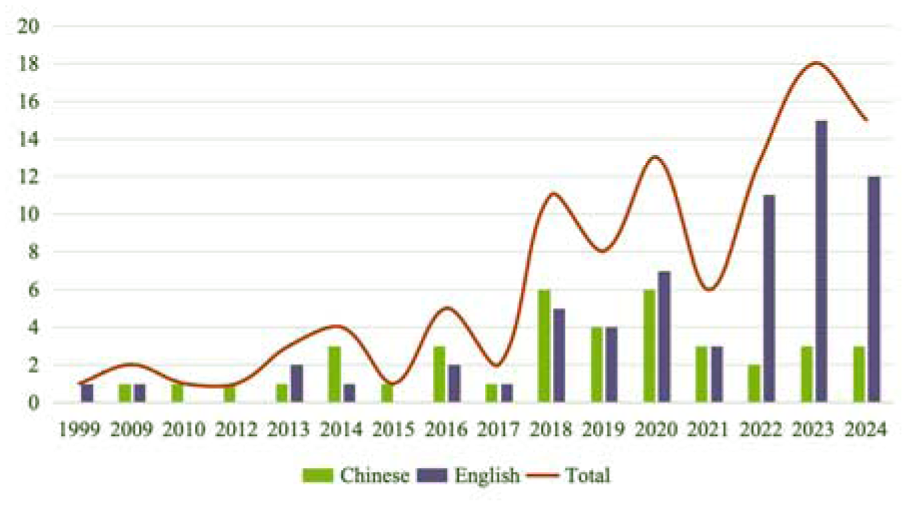
Publication timeline.
The final dataset includes 57 journals, exhibiting a long-tail distribution in terms of the number of publications. A complete list of the journals and their publication counts is provided in Figure A1. The top three journals with the most publications in this research topic are Sustainability (14.4%), Buildings (7.7%), and the Journal of Asian Architecture and Building Engineering (4.8%), which fall under the categories of environmental sciences and building technology. Only eight journals (12.5%) fall under the Tourism and Hospitality category, indicating that space syntax theory has not yet garnered significant attention in tourism scholarship.
Spatial Scales, Morphological Representations, and Metrics
Based on the literature, this study categorizes the spatial scale of research into three levels: destination, tourist attraction, and building interior. Studies at the destination level typically focus on cities or villages (X. Li et al., 2020). As shown in Figure 3, this spatial scale is the most extensively examined when applying space syntax theory, accounting for 59% of the research (61 articles). Following this, studies at the tourist attraction level represent 31% (32 articles), focusing on areas such as heritage sites, business districts, and parks (Şahin Körmeçli, 2024). Building interiors have received relatively little attention in tourism studies, comprising only 10% of the research (11 articles). Current studies at this level primarily use space syntax techniques to analyze the interiors of museums, cruises, and hotels (Lyu et al., 2023).

Percentage of morphological representations within and across spatial scales. The x- and y-axes indicate spatial scale and morphological representation categories, respectively, with axis labels displaying the percentage of each category relative to the total. Cell color intensity of Heatmap represents the proportion of each morphological representation within a given spatial scale, with lighter colors indicating lower proportions and darker colors indicating higher proportions.
Space syntax theory offers various types of morphological representations, each reflecting different aspects of spatial configuration. In tourism researches, five primary types of maps have been utilized (Figure 3), and researchers often employ multiple types within a single study. The axial map (47%, 63 times) and its advanced version, the segment map (22%, 29 times; Hillier & Iida, 2005), are among the most commonly used types of representations. Both types emphasize the network system and connectivity of space. In contrast, the convex map (4%, six times) and visibility map (24%, 32 times) focus more on the characteristics of two-dimensional regions. The latter has received relatively more attention in tourism studies, offering a range of techniques—such as Isovist, Visual Graph Analysis, and Agent Simulation—to analyze visual experiences (Benedikt, 1979; Hillier & Iida, 2005). The Justified plan map (Ostwald, 2011), which emphasizes the structural sequence and depth of two-dimensional spaces, has been largely overlooked in tourism research, appearing in only 3% (four times) of the studies.
This study further compares the differences in spatial scale levels across various morphological representations. As illustrated in the heatmap (Figure 3), studies at the macro-scale, such as destination level, focused more on spatial connectivity and network systems, often using axial or segment maps. In contrast, studies at the micro-scale focused more on the morphology of two-dimensional regions and its visual perceptions within the space. In summary, this feature reflects a prevailing research tradition in the choice of analytical methods across different spatial scales. Such a research tradition may implicitly suggest different emphases across scales, but these assumptions have not been explicitly articulated in existing studies and thus require further discussion and validation in the tourism context. Given the unique nature of tourism, where tourists often navigate unfamiliar environments, it is particularly important to examine whether such a research tradition aligns with the tourism context, as tourists’ spatial behaviors may diverge from those observed in more familiar settings. Overall, current studies suggest that space syntax technique provides a multilevel framework for analyzing space in tourism context.
Based on morphological representations, a suite of spatial metrics has been developed. As shown in the Sankey Diagram (Figure 4), Integration (115 times), Connectivity (51 times), and Depth (38 times) are the most frequently adopted metrics across various map types in current studies, which reflects scholars’ emphasis on accessibility and centrality of spatial configuration in the context of tourism.
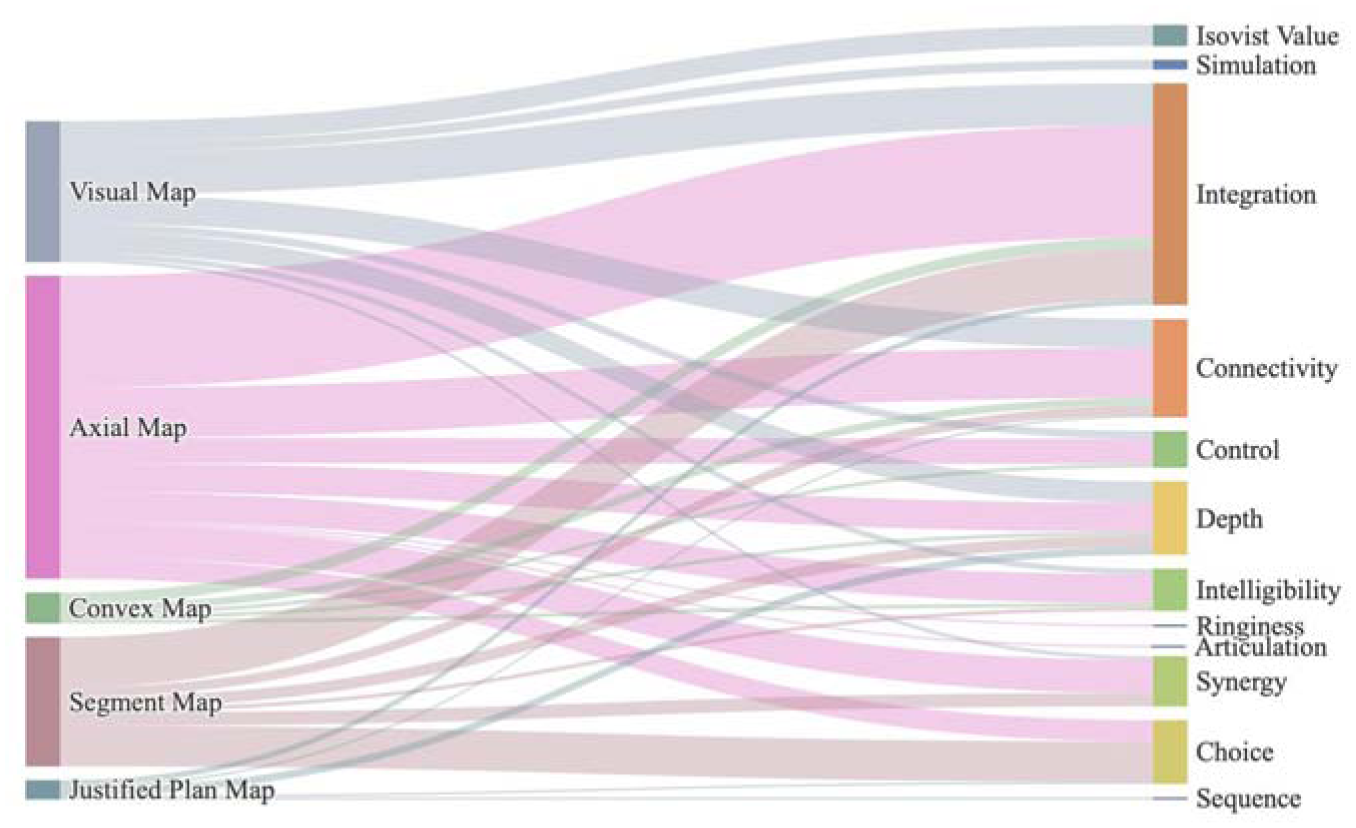
Flow diagram of morphological representations and metric. The diagram depicts the flow and relationships between different spatial analysis maps and various spatial metrics. The width of the bands indicates the magnitude of the flow between the categories.
The fourth metric, Choice (33 times), is applied in map types that emphasize network systems, such as axial maps, segment maps, and justified plan maps. This metric captures a space’s attraction to movement and its influence on path selection. The absence of this metric in visibility analysis suggests that current tourism researchers may overlooked the role of visual experience in path selection (Wong, 2012). In contrast, Control (19 times), a metric reflecting a space’s local control within the spatial configuration, has received attention from both network structure maps and two-dimensional space maps.
While these metrics primarily measure spatial structure, Intelligibility (22 times) and Synergy (26 times), which assess individual spatial comprehensibility, have also been highlighted in tourism research. It appears that current studies prioritize network structure comprehensibility (e.g., axial maps) over visual comprehensibility. Lastly, several metrics associated with specific maps, such as Isovist, Agent Simulation, Ringiness, Articulation, and Sequence, have been applied sparingly in analysis.
Analysis Techniques of Space Syntax Metrics
In tourism studies, while some research directly applies space syntax metrics to describe specific locations (W. Li et al., 2024; Şahin Körmeçli, 2024), the most commonly used methods involve morphological analysis or overlap analysis of space syntax metrics. As illustrated in the right side of Figure 5, these methods primarily aim to uncover the spatial relationships between space syntax metrics and variables of interest, such as pedestrian flow, behavior, or the distribution of attractions and service providers (Jamhawi et al., 2023; Saraoui et al., 2024).
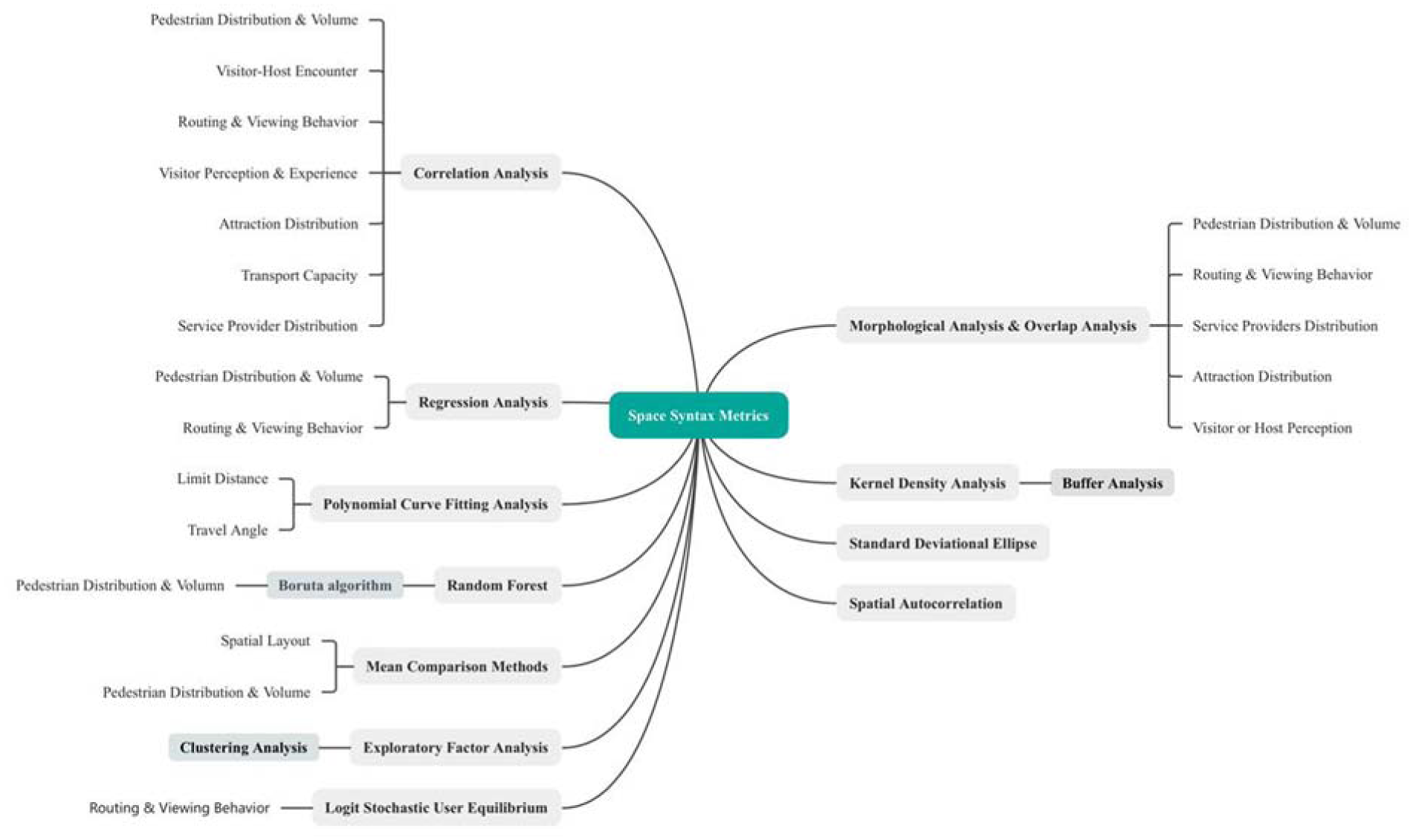
Analysis techniques of space syntax metrics. This map outlines various analytical methods and their applications, clarifying the relationships between space syntax metrics and either tourist behavior or destination spatial characteristics.
Building upon the overlap analysis method, two key advancements have emerged in the literature. First, although overlap analyses are useful for identifying relationships, they often overlook the spatial relationships among space syntax metrics themselves. To address this, several studies have integrated spatial analysis and modeling techniques—such as kernel density, standard deviational ellipse, and spatial autocorrelation—with space syntax metrics to explore the interrelationships within certain metric, which are then incorporated into overlap analysis (Q. Zhang et al., 2015).
Second, overlap analysis is a relatively qualitative approach for revealing spatial relationships. To overcome this flaw, as illustrated on the left side of Figure 5, numerous studies have employed quantitative methodologies, including advanced multivariate statistical analyses and machine learning techniques. These methods, such as bivariate correlation, multivariate regression, and MANOVA, have been utilized to rigorously validate the relationships under investigation. These methods are particularly effective in assessing the impact or significance of space syntax metrics on variables of interest (Dash et al., 2024; Lu & Peponis, 2014; Nubani et al., 2018; C. Wu & Chen, 2021). Additionally, space syntax metrics like integration have been combined with statistical models in other research fields, such as the logit stochastic user equilibrium model (Cao, 2023; Dong et al., 2020; Jin et al., 2019).
Research Theme and Topics
To summarize the research content, four overarching themes were identified from the literature, each aligning with key propositions of space syntax theory and collectively highlighting its potential for analyzing the tourist–destination system (see Figure 6).

Connections between the core propositions of space syntax theory and research themes in tourism. The diagram illustrates how the five key propositions of space syntax theory (left) align with four overarching research themes (middle) and their associated research topics (right), showing the theoretical and empirical links between propositions and tourism studies.
First, a large body of work applies space syntax metrics to examine the spatial structures of tourism-related places (55 articles). This theme resonates with the “social logic” and “phenotype” proposition, which conceptualizes spatial forms as identifiable types within cultural context, and the “movement economies” proposition, which links these forms to the distribution of functions and facilities.
Second, studies investigate how spatial configurations shape visitor flows and experiences (39 articles), corresponding to the “natural movement” proposition. These studies extend the idea that spatial structures naturally generate movement patterns by further showing how such movement-space interactions influence tourists’ perceptual, affective, and experiential dimensions.
Third, a smaller stream of research examines interactions between visitors and local inhabitants (six articles), linking to the “co-presence/co-awareness” proposition. These studies highlight how spatial arrangements structure control, conflicts, encounters, and patterns of co-presence in tourism contexts.
Finally, research has addressed locality and alienation (four articles), corresponding to the “spatial segregation” proposition. This line of inquiry demonstrates how specific spatial configurations contribute to socio-spatial marginalization and exclusion within tourist destinations.
Spatial Structures
Spatial Configuration of Tourism Area
Among the studies examining spatial structures, nearly half of employed space syntax metrics to analyze the spatial configurations of tourism area. The emphasis and approaches to analyzing these configurations varied. Some studies interpreted the spatial configurations of specific place types, guided by the concept of phenotype as a theoretical lens within space syntax theory (Hillier & Hanson, 1984). This lens highlights how understanding the essence of spatial configurations can reveal underlying social and cultural structures. By considering common features of place types, such as tourist towns and national traditional villages, these studies further explore how these configurations relate to local tourism development (K. Chen & Pan, 2014).
In contrast to comparative studies, some researches focused on quantifying spatial configurations that reflect specific cultural contexts and exploring their connections to tourism development. According to the proposition of the social logic of space, space syntax theory posits that spatial configuration is both an expression of culture and society, and also influences social development (Hillier, 2007). This body of research implicitly supports this proposition, with scholars arguing that spatial configurations are integral to local culture and society. Consequently, in terms of spatial expression, studies have quantified specific spaces to deepen the understanding of local culture, with the uncovered configurations contributing to sustainable tourism planning. Researches have explored how local elements, such as the farming culture of ancient towns or daylighting in historical habitats, reflect on space (Saraoui et al., 2024). Regarding the impact of spatial configuration, studies have explored the connections between traditional spatial layouts—such as the central axis structure in Confucian temple—and local tourism development (R. Wu et al., 2014). Given the unique nature of tourism, some studies have explored how specific spatial configurations, like the open-enclosed spaces in private gardens or the layout of heritage precincts, contribute to creating distinctive visitor experiences (Liang & Zhang, 2017).
The third group of studies analyzing spatial configurations focuses on proposing optimization strategies to enhance visitor experiences, support preservation efforts, and facilitate the renewal of tourist sites. Many scholars have utilized space syntax metrics to assess specific constructs, such as accessibility and safety, as a basis for spatial optimization. These studies often aim to improve the design of tourist spaces by enhancing accessibility and managing spatial safety (Yuo et al., 2023). In terms of visitor experience, space syntax metrics are seen as valuable tools for capturing visitors’ behaviors and experiences, allowing for the optimization of spatial layouts to improve spatial cognition and the overall experience (Lyu et al., 2023; Xu et al., 2020). Other studies treat space syntax metrics as factors influencing broader outcomes, such as population vitality and the resilience of commercial spaces (Sun et al., 2024), and propose strategies that integrate these metrics with key targets in urban tourism planning.
Attraction Distribution
The proposition of “Movement Economies” in space syntax theory suggests that spatial configurations create high-traffic areas that often evolve into hubs for commercial and economic activities. These activities, in turn, enhance the area’s ability to attract more people, establishing a positive feedback loop between space and economy (Hillier, 2007). Building on this proposition, over half of the studies within the research theme of spatial structures examining spatial structures focus on the relationships between spatial configurations and the distribution of tourist attractions.
Most of these studies aim to uncover distribution patterns of tourist-related features, such as service facilities and scenic spots, in relation to specific space syntax metrics. The findings highlight the heterogeneity in distribution patterns across different types of attractions (Hsu et al., 2024) as well as among different levels or modes of the same type of attractions (Fan et al., 2024). The above studies, either implicitly or explicitly, emphasize the dependency of attraction distributions on spatial configurations, treating these distributions as the inherent spatial rules governing certain types of attractions (Şahin Körmeçli, 2024). Building on this idea, some studies further employ space syntax metrics to evaluate cultural routes and heritage corridors, using them to indicate attractivity and to classify corridor systems (Hassanshahi et al., 2023; Yue et al., 2023).
In contrast, rather than viewing attraction distribution patterns as inherent rules determined by spatial configurations, others see them as temporary states that can be optimized to meet specific planning objectives, such as minimizing supply-demand imbalances (Liu et al., 2019) and improving accessibility (Q. Zhang et al., 2015).
Additionally, from the perspective of dynamic transformation, some studies have analyzed how spatial configurations drive the functional evolution of destinations (H. Wang et al., 2014), while others have explored the influence of tourism industries and related resources on the spatial morphology of tourism destinations (W. Li et al., 2024). The spatial transformations that occur during the process of tourismification have also attracted considerable attention within this line of research (Qin et al., 2023). This body of work aligns closely with the concept of the “feedback loop between space and economy” as outlined in the proposition of “Movement Economies.”
Visitor Behavior
Visitor Distribution
In space syntax theory, a proposition related to “Movement Economies” is “Natural Movement,” which emphasizes that space itself can naturally attract pedestrian and vehicle flows through its spatial configuration, independent of external attractions (Hillier, 2007). This idea underpins studies exploring the relationship between spatial configurations of tourist sites and visitor flows. Some of these studies specifically identify spatial characteristics that draw high visitor density, offering insights for optimizing spatial planning (Dash et al., 2024). Positive correlations between metrics, such as axial and visual integration, have been confirmed (Y. Li et al., 2016), along with factors such as attractions, built environments, natural environments, and online attention (J. Chen & Hu, 2020; W. Li et al., 2020). Additionally, some studies explore visitors’ wayfinding routes and behaviors, such as viewing abandonment, average time or speed of sightseeing (T. Zhang et al., 2019; T. Zhang et al., 2020), and their relationship with spatial configurations (Jamhawi et al., 2023; S. Wang et al., 2024). Based on these analyses, studies suggest that optimal sighting routes can be proposed (Baiz & Atakara, 2023; Jouibari et al., 2021), which may assist in crowd management (Karthika et al., 2022).
In contrast to these studies that primarily test the relationships between spatial configurations and tourist distributions, another line of research draws on the “Natural Movement” proposition by simulating visitor flows or developing broader evaluation frameworks. For instance, several studies have employed the logit stochastic user equilibrium model, based on integration values, to simulate visitor flows and assess path resistance disturbance (Cao, 2023; Dong et al., 2020; Jin et al., 2019). Other studies embed space syntax metrics into multi-dimensional frameworks of accessibility, such as environmental accessibility and scenic spot accessibility, thereby extending the proposition from single-metric associations to more comprehensive evaluations of accessibility (Setola et al., 2018; Xie et al., 2019).
Visitor Experience
Building on the “Natural Movement” proposition, which demonstrates that spatial configurations shape patterns of movement and behavior, research on visitor experience provides a deeper perspective by explaining these influences at the psychological level. Rather than focusing solely on flows and distributions, this line of inquiry investigates how spatial form interacts with perception, meaning-making, and affective responses, thereby offering insight into the experiential processes through which space influences tourist behavior.
Although visitor experience is a critical area of research in tourism studies, the role of space syntax in this domain has been relatively underexplored compared to its application in other areas. Some studies investigate how spatial configurations shape visitors’ experiences, emphasizing that meaning and affective experiences emerge not only from textual interpretation but also from the interaction between bodily movement and spatial form (Tzortzi, 2016; Wong, 2012). Rather than treating space solely as the medium for attractions, several studies recognize that space is an integral component of the attraction experience, such as in opera performance and narrative content (H. Chen & Yang, 2023; Z. Gu & Zhang, 2020). Visual exposures, such as visual integration and the covisibility of attractions, are considered vital spatial elements in shaping visitors’ engagement with and recognition of attractions (Lu & Peponis, 2014; Nubani et al., 2018). Additionally, the impact of spatial configurations on visitors’ physical experience, such as thermal comfort, has been confirmed (Xiao et al., 2023).
In contrast to this strand of research, several studies adopt a theory-testing approach to examine how space syntax metrics can reflect visitors’ spatial recognition or perceptions. Generally, findings suggest that, compared to residents, visitors’ spatial cognition often does not align with the metrics derived from space syntax theory (Lin et al., 2023; Zou et al., 2022). Such a discrepancy highlights the distinct role of spatial configurations in shaping tourists’ experiences and reveals a contradiction with studies that use space syntax metrics to optimize spatial planning and reflect visitors’ experiences. This finding indicates a need for dedicated investigation into the mechanisms through which spatial configuration, as reflected by specific space syntax metrics, shape tourists’ spatial cognitions. Understanding these mechanisms could provide more concrete guidance for the design and planning of tourist spaces, ensuring that spatial configurations align with visitors’ experiential needs.
Visitor-Host Interactions
Grounded in the co-presence and co-awareness proposition, space syntax theory argues that spatial structure fundamentally shapes social behavior by generating patterns of encounter and mutual visibility between inhabitants and visitors (Hillier, 2007). This relationship centers on issues of spatial accessibility and control, where inhabitants typically exert greater control over space, while visitors are often required to follow established rules. This dynamic illustrates how spatial design influences social interactions (Hillier & Hanson, 1984). In tourism studies, space syntax has been employed to examine how spatial configurations contribute to conflicts between visitors and residents. By analyzing differences in pedestrian movement patterns and preferences for convex spaces between the two groups using space syntax metrics, researchers aim to optimize sightseeing routes and spatial planning (C. Wu & Chen, 2021; Zheng et al., 2022).
Additionally, beyond viewing residents solely as hosts, studies have explored how spatial configurations shape social interactions between visitors and service providers. In the hospitality context, spatial structures have been found to create an imbalanced power dynamic, prioritizing visitor experience while simultaneously regulating employee behaviors (H. Gu & Tao, 2021). Currently, the most overlooked topic under this research theme is how spatial configuration affects reciprocal social visibility among tourists and how to enhance this experience (Choi, 1999).
Locality and Alienation
The authenticity-alienation perspective has gained significant attention in tourism studies, as tourism often leads to the commodification and marginalization of local cultures. Building on the proposed relationship between spatial configuration and social segregation (Hillier, 2007; Vaughan, 2007), several studies have employed space syntax theory as a framework to analyze locality and community alienation (Tao & Cheng, 2013). Corresponding to this perspective, two primary interpretations of the role of spatial configurations have emerged. On one hand, studies have found that spatial segregation created by certain spatial configurations leads to the social marginalization of residents and the commodification of traditional towns (H. Wang et al., 2014). On the other hand, spatial configurations are used to examine how community alienation and the loss of locality are reflected spatially (M. Chen & Li, 2018). With the growth of tourism, changes in spatial structure and functional transformations have become increasingly pronounced (Cai et al., 2022). Overall, the aforementioned studies indicate the potential of space syntax theory for advancing theories of authenticity and alienation.
Conclusion
Overall, this review offers three theoretical contributions that advance the integration of space syntax theory into tourism research. First, it systematically maps the relationships between five core propositions of space syntax and four major themes in tourism studies, clarifying how spatial configuration concepts intersect with empirical findings across diverse tourism contexts. Second, it underscores the unique characteristics of tourism spaces—such as destination phenotypes, tourist cognition, market-driven spatial patterns, and visitor-host interactions—as valuable empirical grounds for refining and developing space syntax theory beyond conventional environments. Third, it identifies critical research gaps and theoretical inconsistencies in the current literature, including the limited exploration of spatial phenotypes, underdeveloped models of spatial competition, and the overlooked role of spatial configuration in shaping tourist experiences. By synthesizing these insights, the review provides future research directions that deepens the explanatory power of space syntax theory within the field of tourism.
Research Trend
Previous studies applying space syntax theory in tourism research exhibit several key characteristics: (a) Publication trends: Few studies appear in tourism-specific journals, with most contributions from other disciplines. (b) Scale: Research focuses on macro-level cases, like destination layouts, with limited attention to micro-level analyses, such as building interiors. (c) Morphological representations: Network structures are analyzed more often than visual or two-dimensional spatial patterns. (d) Metrics: Spatial integration dominates, while control, choice, intelligibility, and simulations are underutilized. (e) Research Methods and Themes: Studies mainly adopt quantitative methods, exploring spatial configurations and their links to attraction and tourist distribution, but insufficiently address aspects like tourist experiences, host-guest dynamics, as well as destination locality and alienation.
Insights From Space Syntax Theory and Tourism Studies
In the application of space syntax theory, some of the particularities of the tourism field have been reflected in previous studies. (a) Prior research has acknowledged that spatial phenotype is an important dimension of destination characteristics, and that these phenotypes may influence the development of local tourism (K. Chen & Pan, 2014). (b) Tourist attractions and the hospitality industry are uniquely influenced by their market positioning and the distribution of tourists and resources, which affects the spatial distribution within spatial configuration (Fan et al., 2024). (c) Tourists, as key subjects in tourism studies, have been shown in previous research to exhibit heterogeneity in spatial cognition compared to residents (Lin et al., 2023). This suggests the unique features of relationships between tourists’ behaviors and experiences and spatial configuration. (d) Tourism studies often address various aspects of the tourist-host relationship, including the interactions between tourists and residents, as well as tourists and service providers within specific spatial configurations (H. Gu & Tao, 2021). (e) The process of tourismification and spatial configuration are mutually influential. Spatial configuration is one of the key dimensions of community alienation (H. Wang et al., 2014).
Research Gaps, Inconsistencies, and Future Directions
Given the trends in research and the specificities of this field, two key aspects of research gaps and future directions emerge from prior studies. On the one hand, while some conclusions regarding the uniqueness of tourism-related characteristics have been identified, research in this area remains relatively limited, and the discussions are still insufficient. First, existing studies have not yet developed systematic classifications of spatial traits in tourism based on the phenotype perspective within specific socio-cultural contexts, nor compared these traits across different destinations. Consequently, there remains a lack of clear understanding regarding how variations in spatial configurations, interpreted through the lens of phenotype, may relate to tourist behavior. This represents a promising direction for future research.
Second, existing studies have highlighted that the spatial distribution of different types of hospitality businesses is shaped by specific market positioning; however, there has been little exploration of the competition in spatial configuration and dynamic evolution of spatial distribution among tourism businesses of different types. To address this gap, advanced analytical techniques can be applied. For example, evolutionary game theory can be used to formalize the strategic interactions between hospitality businesses under different market positioning scenarios, while agent-based modeling (ABM) can simulate how individual firms, guided by these strategies and constrained by space syntax metrics, adapt their locational choices over time. By integrating evolutionary game theory into ABM, future research could capture the dynamic relocation and clustering patterns of hospitality businesses, thereby offering deeper insights into the mechanisms of spatial competition and the emergent evolution of tourism business landscapes.
Third, while the heterogeneity of tourists’ spatial cognition has been explored, the impact of spatial configuration on tourist experience remains underexplored. While current tourism research places significant focus on tourist experiences, such as immersion and flow experience, as well as destination perception features like destination personality, the relationships between these experiences and spatial configuration have yet to be explored. Some emerging studies have suggested that spatial configuration is an integral component of experience, rather than merely a passive vessel (Z. Gu & Zhang, 2020); Future research can advance this area along two complementary directions. (a) Spatial configuration can be explicitly positioned within existing theories of tourist experience, thereby clarifying its role as part of the experiential structure rather than as an external background. (b) Specific types of spatial configurations can be empirically examined in relation to particular experiential outcomes such as immersion, flow, or place attachment. Taken together, these two directions form a research framework that integrates spatial structure with experiential processes, enabling a more systematic understanding of how spatial design shapes tourist experiences.
Finally, space syntax has been demonstrated as an effective tool for developing tourism alienation theory. While existing research has examined potential spatial configurations contributing to social segregation, the characteristics of spatial configurations that could foster the sustainable development of destinations still warrant further exploration. Future research should therefore build on alienation theory to establish a framework of spatial alienation, which clarifies the spatial conditions under which visitor-host relationships become fragmented or integrated. In this framework, specific space syntax metrics can be used to characterize spatial configurations, which in turn shape the frequency and quality of visitor-host interactions. These interactions may result in different outcomes, ranging from alienation (e.g., segregation, exclusion, commodification) to resonance (e.g., cultural exchange, mutual benefits, shared spaces). By systematically linking spatial configurations, interaction processes, and social outcomes, such a framework can provide a clearer theoretical and analytical basis for understanding and addressing the spatial dimensions of tourism alienation.
On the other hand, previous studies have showed several inconsistencies, indicating that future research needs to clarify or validate underlying assumptions. First, macro-scale studies often employ network-based analysis, while micro-scale studies typically use visual analysis. This distinction appears to be a research tradition, yet the rationale underlying this division should be more clearly articulated in future research. Second, in tourism planning, two contrasting perspectives exist: some argue that the overlap of tourist and host activity zones should be avoided (Zheng et al., 2022), whereas another emphasizes minimizing their isolation (H. Wang et al., 2014). However, the threshold that defines a reasonable balance between these two positions has not been clearly established. Third, interpretations of the spatial distribution findings diverge: some regard the relationships between attractions or pedestrians and spatial configuration as reflecting inherent rules of distribution patterns (Şahin Körmeçli, 2024), while others view them as indicators of a state requiring improvement (Liu et al., 2019). Fourth, whether space syntax indicators can be directly applied to planning and development remains contested. Previous studies diverge, with some suggesting that the indicators effectively predict and reflect tourist behavior (Lyu et al., 2023), whereas others highlight inconsistencies with tourists’ spatial cognition (Lin et al., 2023).
Taken together, these inconsistencies can be better understood by clarifying the functional roles of space syntax metrics—some serving primarily as predictive tools to anticipate patterns of spatial behavior, and others as diagnostic indicators to identify suboptimal spatial conditions. Future research could focus on systematically validating these roles by, for example, comparing indicator-based predictions with tourists’ actual movement patterns to assess predictive accuracy, and by triangulating indicator results with surveys, interviews, or observational data to evaluate their diagnostic validity in identifying spatial issues. To synthesize the above, Table 2 summarizes the key research gaps, inconsistencies, and future directions identified in this review.
Summary of Gaps, Inconsistencies and Future Directions.

Research Limitations
In Summary, this study aimed to describe the research characteristics, map the themes and topics, and identify research gaps in tourism literature focused on space syntax theory. The findings highlight key trends such as the predominance of network-based macro-scale studies, limited use of certain space syntax metrics, and the underexplored relationship between spatial configuration and tourist experience. While this review provides valuable insights, it is important to note several limitations. The review is based solely on English and Chinese literature, which may overlook relevant studies published in other languages, potentially narrowing the scope of the research. Additionally, the focus on space syntax theory might exclude research using alternative spatial analysis methods. Addressing these limitations in future research could enhance the comprehensiveness of our understanding of space syntax in tourism and further refine its applications in tourism studies.
Footnotes
Appendix A
Author Note
Ziye Shang, Research Interest: Alienation and Tourist Behavior; Chen Zhao, Research Interest: Sustainable Tourism; Anning Cai, Research Interest: Spatial Fragmentation; Urban Planning.

Ethical Considerations
This study did not involve human participants or personal data.
Funding
The authors disclosed receipt of the following financial support for the research, authorship, and/or publication of this article: This research was funded by Natural Science Foundation of the Jiangsu Higher Education Institutions of China, grant number 24KJB630015 and National Natural Science Foundation of China, grant number 52078237.
Declaration of Conflicting Interests
The authors declared no potential conflicts of interest with respect to the research, authorship, and/or publication of this article.
Data Availability Statement
Data sharing not applicable to this article as no datasets were generated or analyzed during the current study.