




Abstract
This research attempts to identify tourists’ shopping motives in Hainan in relation to their socio-demographic and trip characteristics in the context of Chinese domestic tourism during COVID-19. Using a motivational market segmentation approach, the study revealed three motivations: obtaining local cultural products, high quality gifts at good prices, and a diverse range of high quality products. Three distinctive groups emerged by motivational profile, namely, efficiency seekers, want-it-all shoppers, and unwilling shoppers. Significant differences in tourist shopping behavior were identified among the three groups regarding gender, age, income, region, and tourism motivation. The findings of this research will provide destination management organizations, tourism practitioners, and policy makers of both local and national governments with practical directions by which to approach the target markets, understand their needs, and understand the benefits they seek against the background of the integration of culture and tourism.
Introduction
As the largest province and only tropical island province of China, Hainan is often called the Hawaii of Asia. It is rich in tourism resources, as, in addition to its tropical climate, beaches, and landscapes, it has a natural and cultural heritage, enriched by its long history, that serves as the source of unique local experiences (P. F. Xie & Wall, 2002). Hainan’s tourism industry has developed quickly since the implementation of the international tourism island strategy for travel retail (Jiang et al., 2020). In 2011, the Hainan offshore duty-free policy was introduced to permit outlying island domestic visitors to Hainan to purchase duty-free goods at designated shops (KPMG, 2021). By 2019, Hainan’s tourism revenue accounted for about 19.92% of the area’s GDP—much higher than the global (6.61%) and national (11.05%) averages (Hainan Provincial Bureau of Statistics, 2020). During COVID-19, global travel restrictions caused a domestic tourism boom (Moon et al., 2021; J. Wang et al., 2021), as Hainan became an alternative for domestic tourist shoppers taking advantage of the tax exemption (KPMG, 2021). Consequently, despite COVID-19, over 81 million people visited Hainan in 2021, up 25.5% from the previous year, yielding a total tourism revenue of about 138.4 billion RMB ($ 21.7 billion), up 58.6% from 2020 and 30.9% from 2019 (Xinhua, 2022).
Shopping is one of the most popular activities among domestic and international tourists (Lehto et al., 2014) and can even be the primary motive for pleasure trips (Law & Au, 2000). Lehto et al. (2004) show that it plays a pivotal role in destinations’ tourist product offerings as it makes destinations more attractive and increases local revenue, often becoming the theme or focus of promotion for a specific destination. Tourists derive value from satisfaction and pleasure related to their purchases and, by extension, their experience of local culture (Baek et al., 2022;Hsieh & Chang, 2006; Lee et al., 2021; Way & Robertson, 2013; Yoo et al., 2022). Some destinations are renowned for shopping or duty-free goods, and it is usual for individuals to make special shopping trips to these destinations (Lehto et al., 2014). Destinations such as Hong Kong (Law & Au, 2000), Dubai (Peter & Anandkumar, 2016), and Singapore (Henderson et al., 2011) have successfully marketed themselves as primarily shopping tourism destinations (Law & Au, 2000).
Understanding tourists’ motivations behind particular courses of action is a proven tool for marketing promotion of tourism destinations. Motivation has been widely examined in previous studies; see Kotler (2009) for an overview. Market development and branding, be it of destinations or products, starts from ascertaining the motives behind consumer need for products and their value (Kotler, 2009). In order to approach the target markets and understand the benefits they seek, empirical research is needed to identify tourist segments in Hainan, based on motive to shop, and construct market segments to establish efficient plans and marketing strategies.
As of today, few empirical investigations exist specific to motivation-based market segmentation (E. Dong et al., 2013). Research on shopping tourism is also limited in that it is distributed highly unequally; in 2016, Choi et al. found that 70% of research on shopping tourism to date has focused on the USA and East and Southeast Asia. In tourism research on Hainan, researchers have concentrated on tourism resource development (Ma et al., 2018; Shen & Tian, 2010), tourism management (H. Dong et al., 2019; W. Hu & Wall, 2013), problems and countermeasures in tourism development (Y. Li, 2003; Q. Lin et al., 2020; Stone & Wall, 2005), and the impact of tourism development upon the economy and environment (J. Wang & Liu, 2013; Y. Wang & Wall, 2005; Wu et al., 2020).Thus, motivation-based market segmentation on shopping can contribute to the development of a new research area (Egresi, 2017).
Given the research gap, the purpose of this research is to describe the shopping motives of Chinese domestic tourists in Hainan during COVID-19 in relation to their socio-demographic and trip characteristics. The three specific objectives are to (1) identify Chinese domestic tourists’ shopping motives in Hainan during COVID-19; (2) segment the tourists based on their travel motives; and (3) describe the factors that differentiate the segments. Using a motivational market segmentation approach to identify these underlying motivational factors, this study will add to our understanding of tourists’ shopping motives and behaviors in Hainan. The findings of this research will provide destination management organizations (DMOs), tourism practitioners, and policy makers of both local and national governments with practical directions by which to approach the target markets, understand their needs, and address the benefits they seek.
Literature Review and Theoretical Background
Research Theoretical Framework
This study is couched in the theoretical framework known as the “push–pull factor” compendium theory, as explained in Dann (1977). Dann holds the push factors, the subjective internal driving forces, to be the primary motivators, causing the motivation to travel in the first place. The pull factors, which relate to the destination rather than the tourist, help explain the choice of destination. Dann found specific instantiations of push factors to correlate to certain tourist characteristics. Since then, factor cluster techniques have been used to segment the market with regard to motives (Mazanec, 1992; Peter & Anandkumar, 2016).
Tourist Motivation
Dann (1981, p. 205) defines motivation as “a meaningful state of mind which adequately disposes an actor or group of actors to travel and which is subsequently interpretable by others as a valid explanation for such a decision.” The push and pull model offers insights into the destination choice by taking into consideration both tourist-internal forces and destination attributes (Dann, 1981). Recent studies in this vein (Bashar & Abdelnaser, 2011; Choe & Schuett, 2019; Choe et al., 2017; Kim & Lee, 2002; Klenosky, 2002; Kozak, 2002; Peter & Anandkumar, 2016; Song et al., 2019) have focused on why people travel and view tourism as a means to satisfy needs and wants.
Motivation theory is important in understanding the actions of tourists and the process by which they choose their destinations (Uysal & Hagan, 1993). Prior research about motivation is based on three theories. First, Iso-Ahola’s (1988) escaping motivational theory states that motivation is the seeking of intrinsic and psychological rewards and escape from familiar or daily routines. Second, the push and pull framework is a widely used motivational model in which individuals’ travel decisions are influenced by internal and external factors. When introducing the model, Dann (1977) argued that the process of making a travel decision occurs in two stages. Initially, push factors are tourists’ internal desire to travel, and then pull factors are their external desires associated with the specific destination. Crompton (1979) further developed the push and pull framework by conceptualizing motivational factors that influence tourists’ decisions. Push factors are related to the tourist’s intrinsic socio-psychological factors such as escape from an everyday environment, self-exploration and self-evaluation, relaxation, prestige, regression, improvement in kinship relationships, and promoting social interactions (Crompton, 1979). It also includes pull factors, which have been categorized into novelty and educational factors that drive motivation due to external situations, such as the charm of the tourist destinations. The third theoretical classification is McIntosh and Goeldner’s (1984) motivations taxonomy, which comprises the four categories physical, cultural, interpersonal, and status and prestige motivators. As stated above, tourists’ motives stem from inherent social psychological driving factors, but they work in line with tangible and intangible external factors, such as destination images, facilities, tourism activities, conveniences, and constraints to travel. Thus, a call for a deeper understanding of these factors has spawned interest in research related to tourists’ motivations (Rid et al., 2014).
Tourist Shopping Motives and Behaviors
Tourists gain value from satisfaction and pleasure, in addition to the purchased products, through their shopping experience (LeHew & Wesley, 2007) and participating in the local culture of destinations (Hsieh & Chang, 2006; Way & Robertson, 2013). Previous studies have found that tourists shop for clothing, jewelry, books, arts and crafts, and electronics in addition to souvenirs (Timothy, 2005), spending approximately one-third of their total trip expenditure on shopping (Turner & Reisinger, 2001).
As the shopping tourism concept is broad and hard to define, the distinction between shopping tourism and tourism shopping is unclear. Timothy (2005) explained the difference in terms of the primary purpose of travel. The primary purpose of shopping tourism is to make purchases; accordingly, the shopping aspect constitutes the majority of the tourism experience (Timothy, 2005). Shopping tourists tend to visit the destination more frequently and spend more money on shopping (Way & Robertson, 2013), are usually characterized by a high purchasing power, and prefer fashion, craft, or design products (Zaidan, 2016). In contrast, tourism shopping is conceptualized as shopping done in conjunction with other tourist activities or as a secondary activity during a trip (Oviedo-García et al., 2016). Tourism shopping connects to the recreational activity that entails browsing, looking, touching, and purchasing (Oviedo-García et al., 2016).
Prior research on tourist shopping has concentrated on the benefits of shopping tourism to the destination (Divisekera, 2010), finding that tourists value cultural characteristics of souvenirs (i.e., local workmanship) (M. Li & Cai, 2008). Various motives have been identified for shopping while traveling (Kim et al., 2011; Moscardo, 2004), such as purchasing unique products, finding lower prices, obtaining gifts for friends and relatives, having souvenirs for travel memories, escaping from daily life, and experiencing different cultures. Further, Choi et al. (2016) explored several aspects of perceptional value of tourists during shopping tourism: emotional, social, and functional (quality or cost) values. In addition, Jansen-Verbeke (1994) categorized shopping motivation into four types: unique goods and/or bargain prices, favorable exchange rate, products representing the destination to preserve memories; and building strong family and social ties by giving gifts and souvenirs. In Singapore, Henderson et al. (2011) found that tourist shopping is motivated by multiple dimensions, such as quality, value for money, and unique souvenirs. Many Asians prefer to purchase luxury items while traveling (K. S. Park et al., 2010). Specifically, Chinese tourists prefer souvenirs with a domestic iconofetish feature (Y. Li, 2020). The most sought-after souvenirs are high-quality souvenirs that represent the destination’s cultural heritage (Wilkins, 2011).
Past literature claimed that tourists’ socio-demographic and trip characteristics, such as age, gender, education, or income, influence their motives to shop while traveling (Littrell et al., 2004). For instance, past research indicated that younger, less educated tourists are interested in shopping during traveling (Lyu & Noh, 2017), suggesting a shift in trends from the time of prior findings that older, more educated tourists are more likely to shop more while traveling (Mok & Iverson, 2000). Also, past research concluded that women are more interested in shopping and spend more than men (Oh et al., 2004) and do a majority of the craft, gift, or souvenir shopping while traveling (Anderson & Littrell, 1995). Oh et al. (2004) further found that, in addition to their socio-demographic features, tourists’ primary motive for traveling can influence their shopping choices.
Motivation-Based Market Segmentation
Smith’s (1956) theory of market segmentation is one of the most important ideas in marketing. Ultimately, market segmentation approach is applied in order to divide heterogeneous markets into more homogeneous subsets by different needs, attributes, or behaviors (Andereck & Caldwell, 1994). Numerous variables can be used as the criteria for market segmentation; however, generally, geographic, psychographic, behavioral, and demographic variables are utilized (Kotler, 2009). Psychographic and behavioral characteristics are argued to be the most important determinants of tourists behavior (Johns & Gyimóthy, 2002; McIntosh & Goeldner, 1984), while recent studies have suggested that socio-demographic characteristics have low predictive power due to an indirect relationship to purchase intention (D. B. Park & Yoon, 2009).
Various market segmentation approaches have been used in tourism research, such as factor-cluster segmentation (Dey & Sarma, 2010), criterion segmentation on the basis of particular criteria (Mok & Iverson, 2000), and neural network models (Mazanec, 1992). Previous studies have demonstrated that one of the most reliable approaches in identifying market segments is motivation-based segmentation (D. B. Weaver & Lawton, 2002). In particular, travel motivation plays a critical role in tourism destination choice and travel-activity participation (Lee et al., 2002).
Concerning segmentation of tourists’ shopping motives, specifically, research to date is sparse. However, Egresi (2017) applied motivation-based market segmentation approach to examine tourists’ shopping motivations in Istanbul and found four motives: shopping for product diversity and quality, shopping as cultural experience, shopping for gifts and souvenirs, and shopping for price and value. Five clusters emerged: product-focused shoppers, shoppers for cultural experience, reluctant shoppers, difference seekers, and total shoppers. B. Hu and Yu (2007) distinguished tourist-shoppers according to their crafted selection of souvenirs and involvement in shopping and found three clusters: shopping enthusiasts, shopping lovers, and indifferent shoppers. Similarly, Guiry et al. (2006) found a three-way segmentation of tourist-shoppers according to their shopping involvement: enthusiastic shoppers, normal shoppers and averse shoppers. In Taiwan, Chung et al. (2013) investigated air travelers’ shopping motive in an airport and discovered that motives are similar to in-store shoppers elsewhere. The authors extracted four segments: apathetic shoppers, traditional shoppers, mood shoppers, and shopping lovers.
Overall, tourists’ travel motivations have been broadly used in tourism research, and the segmentation method is powerful. From a thorough review of related literature, we confirmed that travel motives differ, instantiated in distinctive market segments. However, current research has yet to be conducted on the motivations of Hainan tourists on shopping tourism segments; thus, this study segments tourists visiting Hainan based on motive to shop.
Research Methods
Study Site
The study setting, Hainan, was selected to be China’s national pilot destination for domestic tourism development. Located approximately 25 km off the Chinese mainland’s south-western coast, Hainan had a total population of 9.45 million in 2019. Development of the “Hawaii of Asia” with a sea-sand-sun (3S) tourism industry has centered on accommodation, shopping, and attractions in Haikou and Sanya (Hou & Zheng, 2015). Pull factors in Hainan include a long history, a tropical climate, shopping, and natural resources (beaches, mountains, rural scenery, good quality air and water). Traditional Li ethnic minority lifestyles feature prominently in cultural tourism in the southwest highlands (Zhang & Ju, 2021). Government initiatives such as visa-free entry, cruises and yacht availability, and the development of uninhabited islands have all contributed to Hainan’s tourism growth (J. Lin, 2022). Tourism in Hainan increased steadily from 10 million in 2000 to 26 million in 2010, 67 million in 2017, and 84 million in 2019 (D. Weaver et al., 2023), after the implementation of the international tourism island strategy in 2009 (Jiang et al., 2020). As mentioned above, despite COVID-19, there were 81 million arrivals in 2021 (Xinhua, 2022).
According to KPMG (2021), since 2011, duty-free shopping has been the backbone of the Hainan International Tourism Island and Hainan Free Trade Port. Domestic travelers by air or sea have access to offshore duty-free shopping at Hainan Free Trade Port. A similar model has been utilized in Jeju, the South Korean island off the southern coast of the peninsula, since 2002, and since 2005, the Japanese island of Okinawa has also followed this policy. Furthermore, the Hainan Free Trade Port adopted the development of an omnichannel retail operation in 2020, allowing online and offline integration–domestic tourists to purchase products at a duty-free store or an authorized online sales site and then have the products delivered to a designated airport, railway station, or port pick-up counter.
Each year, Chinese tourists spend approximately 1.2 trillion RBM overseas, 46% of the global luxury market (J. Lin, 2022). However, since the pandemic outbreak limited outbound tourism and overseas shopping (Choe et al., 2021), Hainan has become an option for Chinese shoppers to purchase luxury goods, fashion, and cosmetic products without paying customs duty (J. Lin, 2022). In 2020, to promote tax-free shopping, Hainan increased the individual tax-free shopping quota from 30,000 to 100,000 RMB, the most generous in the world. In 2021, Hainan opened three more duty-free shops and now has 10 duty-free shops in total, hosting over 720 brands within a 220,000 m2 area (Xinhua, 2022). Hainan is featured constantly as a prominent tourism destination, and its tourism development is crucial to the tourism industry in China (Q. Lin et al., 2020). Consequently, Hainan’s tourism revenue increased from 32 billion RMB ($4.3 billion US) in 2012 to 67 billion RMB in 2016. In 2021, Hainan offshore duty-free shops produced sales of 60.17 billion RMB (US$9.47 billion), up 84% from the previous year.
Data Collection and Analysis
Items used in the operationalization of tourists’ shopping motives were adapted from Egresi’s (2017) conceptualization and measurement of tourists’ shopping motives, discussed in the previous section. On this basis, the questionnaire consisted of 21 questions divided into three parts: trip motivation and activities in Hainan; socio-demographic characteristics, and trip characteristics. Items included 5-point Likert scales ranging from (1) strongly disagree to (5) strongly agree.
Due to the movement restrictions enforced during the pandemic, an online survey was conducted between March and April 2020, using convenience sampling. Researchers sent participants a link to the online survey after obtaining their consent and explaining its purpose and precautions. Potential respondents were selected for the research if they were aged at least 18 and had visited Hainan within 5 years. Data were collected with a self-structured questionnaire using the online survey platform Sojump in China (which is similar to Google Forms). Researchers sent participants the link to the online survey through social media based on their accessibility and availability. Two hundred thirty questionnaires were distributed and 212 collected, with a response rate of 92.71%. Finally, a total of 212 questionnaires constituted the data.
The data analysis employed five stages. First, descriptive statistics were performed to analyze the socio-demographic and trip characteristics of respondents. Second, exploratory factor analysis (EFA) was used to verify the 14-item structure to identify the underlying structure of tourists’ shopping motivation in Hainan. A principal component analysis (PCA) with varimax rotation was carried out. Third, Ward’s hierarchy clustering analysis was carried out to decide the optimal number of clusters. Fourth, the K-means cluster analysis was conducted to refine initial starting points of clusters (Beh & Bruyere, 2007). Also, a discriminant analysis was used to confirm the results obtained in the cluster analysis. ANOVA tests were then utilized to explore the extracted factors distinguishing the three identified clusters. Finally, a chi-square test was done on the socio-demographic and travel-related behavioral characteristic data to profile the groups and determine statistically significant differences.
Results
Respondents’ Profile
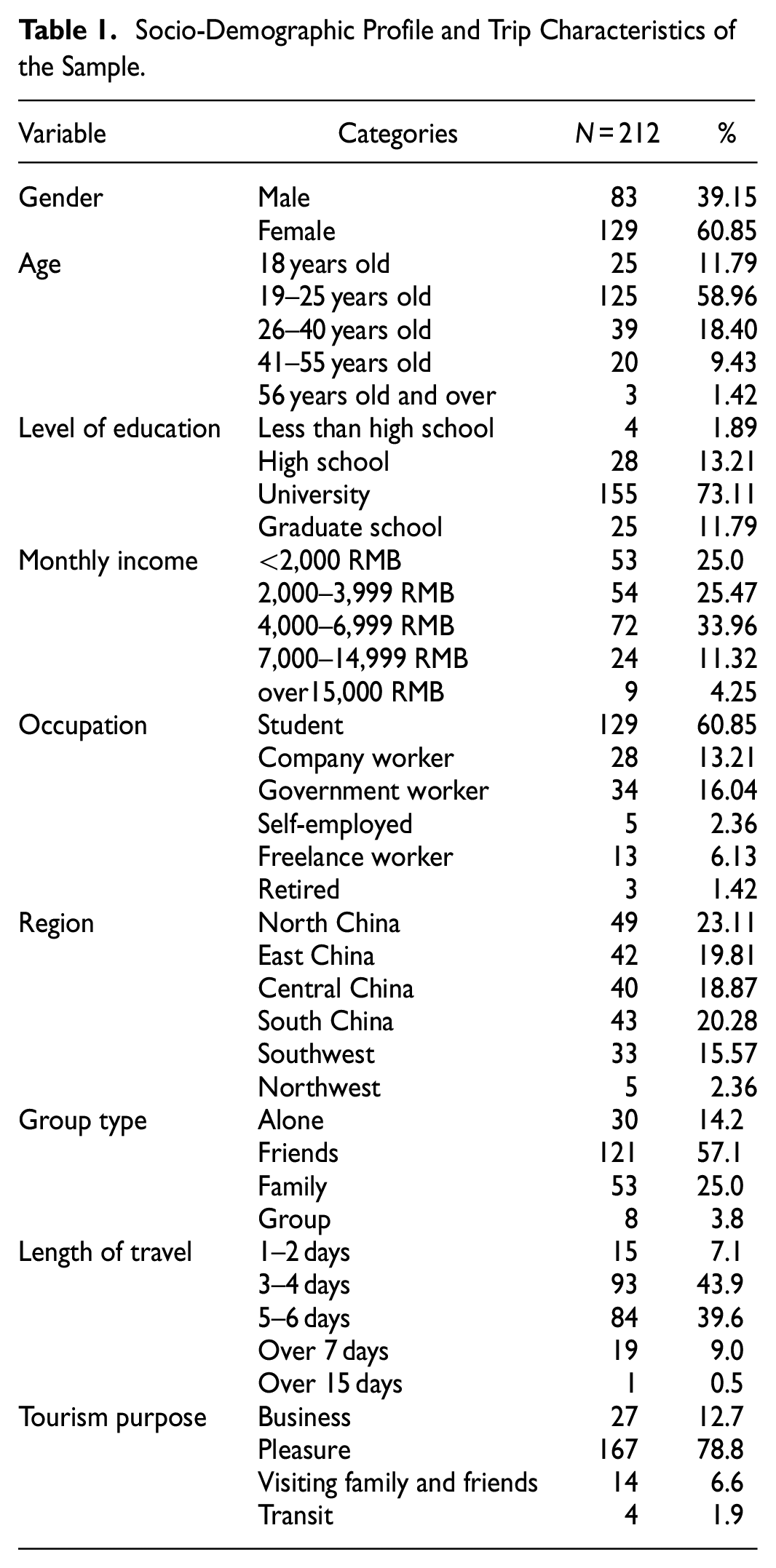
In examining the tourists’ gender profile, a 40/60 split between males and females was found. The dominant age range was 19 to 25 years old (59.0%), followed by 26 to 40 (18.4%), as shown in Table 1. The majority of respondents (84.9%) had university or graduate school degrees. 33.96% of the respondents reported that their average monthly income was4,000 to 6,999 RMB (US $1 is equivalent to RMB 6.38). As for the occupations, 60.85% of the respondents were students, followed by government employees (16.04%). The region was evenly distributed across five categories in China, including North, East, Central, South, and Southwest, but excluding Northwest. Tourists came in a variety of group types, mostly with friends (57.1%), followed by family (25%) or alone (14.2%). 78.8% of the respondents had taken pleasure vacations to Hainan. 43.9% of the respondents had 3 to 4 days travel length, followed by 5 to 6 days (39.6%).
Socio-Demographic Profile and Trip Characteristics of the Sample.
Exploratory Factor Analysis
The EFA of responses from the sample of 212 respondents was used to assess the validity and confirm the dimensionality of the tourists’ shopping motives (Table 2). The factors with Kaiser’s (1974) eigenvalue greater than 1.0 were retained. The item that cross-loaded on multiple factors with loadings higher than 0.4 (Hair et al., 2006) resulted in the elimination of one measurement item (i.e., to buy souvenirs to remind me of the trips). Cronbach’s alphas within each dimension were used to estimate the factor’s internal consistency.
Exploratory Factor Analysis of the Motivations in Hainan.

Note. Comm. = Commonalities; KMO = 0.889; Bartlett = 1,579.010; df = 78; Sig. <.001.
The Kaiser-Meyer-Olkin (KMO) was acceptable (KMO = 0.889), and Bartlett’s test of Sphericity was significant (χ2 = 1,579.010, p < .001). A PCA with varimax rotation was carried out. We organized 13 motivational items into three factors: shopping for local cultural products, shopping for price and gifts, and shopping for product diversity and quality. The cumulative variability explained by these three components was 70.15%. The Cronbach’s alpha reliability test shows a high reliability (Cronbach’s alpha = .902) and validity (CR > 0.8, AVE > 0.5) according to Nunnally and Bernstein’s (1967) criteria. Each component was named based on the item characteristics.
Factor 1 (shopping for local cultural products) contained four items related to experiencing local culture and the cultural experience. This first component had an eigenvalue of 6.02 and accounted for 24.18% of the total variance explained. Factor 2 (shopping for price and gifts) received loadings of five items concerned with seeking high quality goods and gifts at affordable prices in Hainan. This second component yielded an eigenvalue of 1.84 and accounted for 23.58% of the total variance explained. Factor 3 (shopping for product diversity and quality) was characterized by four items related to many brand stores and shops as well as a great variety of products that respondents could not find near their homes. The third component yielded an eigenvalue of 1.26 and accounted for 22.39% of the total variance explained.
Motivation-Based Market Segmentation
This research adopted the three components extracted in EFA and Ward’s hierarchy clustering analysis to determine the optimal number of clusters. The tree from Ward’s method revealed a clear three-cluster solution (Bühl & Zöfel, 2004). Next, the K-means cluster analysis was conducted to refine initial starting points of clusters regarding the distinct features of motivational profiles (Beh & Bruyere, 2007). Each cluster was named based on the item characteristics, and a discriminant analysis was used to validate the cluster solution. ANOVA tests were utilized to explore the extracted components distinguishing the three clusters. Finally, a chi-square test was done on the socio-demographic and trip data to profile the groups and determine statistically significant differences.
Cluster Analysis of Visitors’ Motives
Three distinct clusters were detected based on the cluster analysis, as illustrated in Table 3: efficiency seekers (32.5%), want-it-all shoppers (50.0%), and unwilling shoppers (17.5%). The first group, efficiency seekers (n = 69), exhibited different motivations from the two other groups due to having a high interest in price, value, and gifts. The participants in this segment particularly exhibited higher motivation for shopping for price and gifts (mean = 3.78) than those in the other two segments. When making a purchase, their interest is in souvenirs to preserve a fond memory or gifts to present to friends, family or colleagues back home, and within this frame they consider price and value of the product.
ANOVA Test for Differences of Three Clusters by Motivational Factors.

Note. Mean values were derived from a five-point Likert scale ranging from 1 (strongly disagree) to 5 (strongly agree).
Significant at p < .001.
The second cluster, want-it-all shoppers (n = 106), was the largest tourist group (50%) of the three. These tourists obtained the highest average score on all of the shopping motives in Hainan, including shopping for local cultural products (mean = 4.44), shopping for product diversity and quality (mean = 4.36), and shopping for price and gifts (mean = 4.25). The want-it-all shoppers includes tourists who shop mainly for the cultural experience.
The third segment, unwilling shoppers (n = 37), had the lowest percentage of respondents (17.5%); they were least likely be motivated to shop by any of the three facets. The respondents in this group expressed the lowest mean scores for all of the types of motivations, including shopping for price and gifts (mean = 2.75), shopping for product diversity and quality (mean = 2.67), and shopping for local cultural products (mean = 2.47), of the three groups. This group does not consider price or value of the product and has low interest in buying gifts or souvenirs; they are the least likely to perceive shopping as a cultural experience. The Scheffe’s method post hoc test showed significant differences among the three groups.
Discriminant Analysis
Two canonical discriminant functions were calculated regarding the discriminant analysis with the three motive components. Discriminant function analysis was used in determining group membership (Hair et al., 2006). As shown in Table 4, the canonical correlations were .903 and .201, demonstrating a positive relationship between the variables. The results of the chi-square statistic indicated that each discriminant function was statistically significant. With eigenvalues of 4.426 and 0.042, the first eigenvalue (4.426) explained the largest proportion of variance. Functions 1 and 2 explained 99.1% and 0.9% of the variation, respectively.
Discriminant Analysis for Validating Segments.
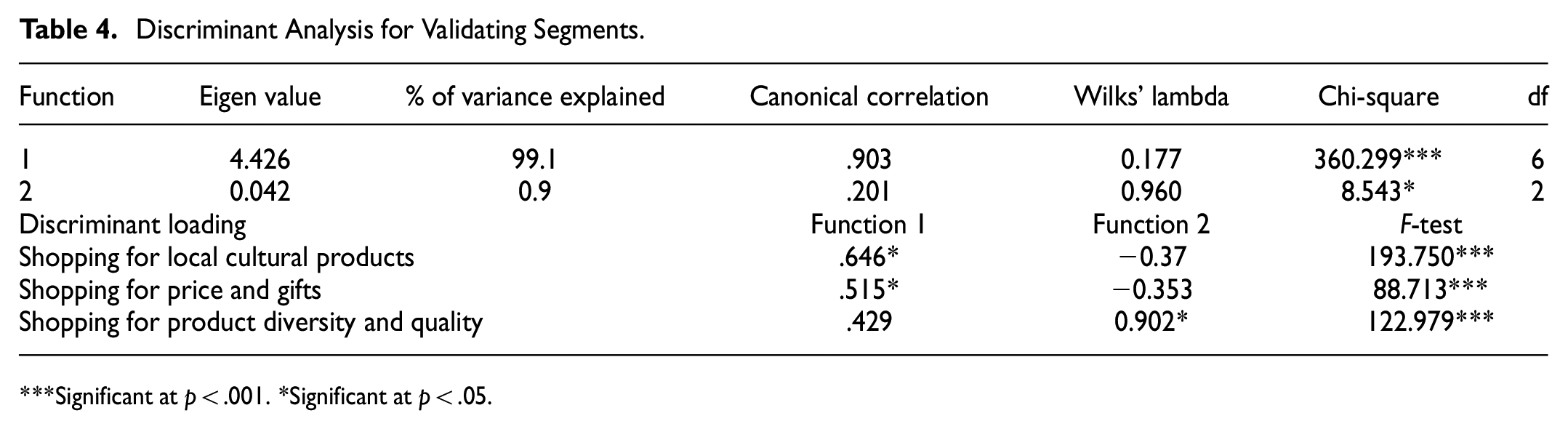
Significant at p < .001. *Significant at p < .05.
An F-test was also conducted to examine the significance of the three motive components. The results showed each discriminant function to be statistically significant. The standard coefficients showed that, in Function 1, shopping for local cultural products and shopping for price and gifts best discriminated the three groups. In Function 2, the factor was shopping for product diversity and quality. Using classification matrices, all cases (100%) of the 212 respondents were accurately categorized into their respective groups with high precision rates (Table 5).
Evaluation of the Classification Results.

Note. 100% of original grouped cases correctly classified.
Cluster Differences by Tourists’ Characteristics
A chi-square test was carried out to determine whether there were significant differences in the socio-demographic and trip characteristics (Table 6). Statistically significant differences were found among the three clusters regarding socio-demographic characteristics such as gender, age, income, and region. In examining the tourists’ gender profile, a 50/50 split between males and females was found in both want-it-all shoppers and unwilling shoppers, while three-fourths of the efficiency seeker were males. The age for want-it-all shoppers was slightly lower, with 18.9% being 18 years old, whereas 70.3% of unwilling shoppers aged 19 to 25 years old. In terms of the income levels, the want-it-all segment was slightly lower than the other segments, with 35.8% reporting income of less than2,000 RMB per month. As for the region, about half of the efficiency seekers and unwilling shoppers were from South and Southwest China, compared to about 20% of the want-it-all shoppers (19.8%), who instead tended to be from North, East, and Central China.
Socio-Demographic and Trip Characteristics of Three Clusters on Tourists’ Shopping Motives to Hainan.
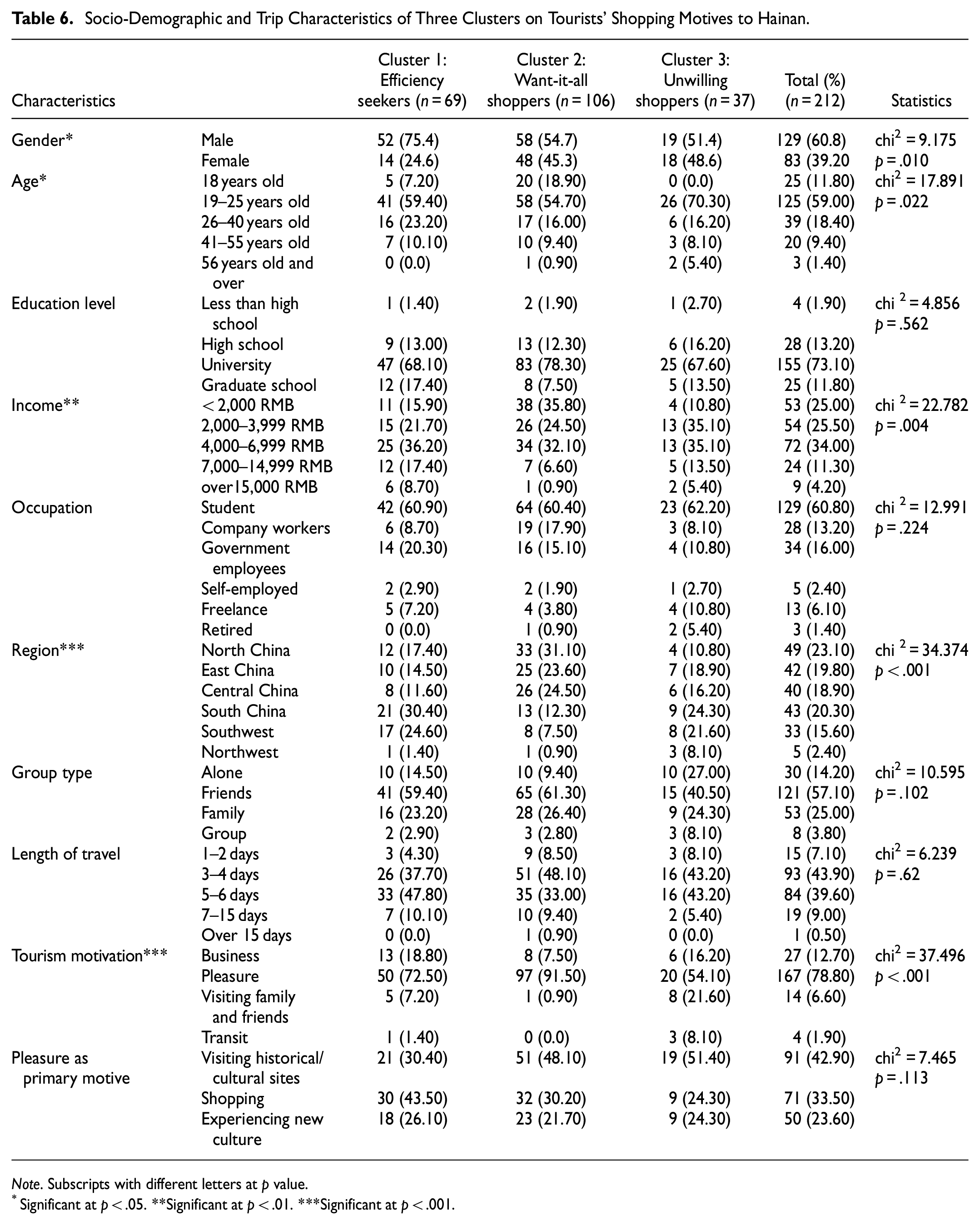
Note. Subscripts with different letters at p value.
Significant at p < .05. **Significant at p < .01. ***Significant at p < .001.
Concerning trip characteristics, there were no statistically significant differences between the three segments; however, there were significant differences regarding tourism motivation. For instance, a large majority of the want-it-all shoppers (91.5%) were on pleasure vacations, compared to only 72.5% of the efficiency seekers and 54.1% of the unwilling shoppers. Overall, 42.9% of respondents visited Hainan for visiting historical/cultural sites, 33.50% for shopping, and 23.60% for experiencing new culture.
Discussion and Conclusions
Theoretical Implications
This study’s major theoretical contributions are that it has revealed motivations for tourists to shop while traveling in Hainan during COVID-19 and extracted their shopping motives. This research is the first attempt to fill the gap concerning tourists’ shopping motivation literature in Hainan, a question that deserves particular attention during COVID-19, by offering regional and situational evidence. The results of this study show that, while tourists’ shopping motives to Hainan during COVID-19 are multidimensional, tourists’ motivational items fell into three categories: shopping for local cultural products, shopping for price and gifts, and shopping for product diversity and quality. The most salient motives were shopping for local cultural products, which is in accordance with prior research indicating that tourists’ shopping motives are associated with unique local products, folk customs, and cultural experiences in tourism destinations. This study finds that the shopping for local cultural products motives are important for tourism destinations to develop sustainable cultural heritage, in accord with earlier research (Choe et al., 2011; P. F. Xie, 2003). The shopping for price and gifts motive shows that tourists are interested in finding the best price with a good value, which is in line with Choi et al.’s (2016) study of functional value. Also, tourists also are motived by purchasing souvenirs or gifts to preserve their memories or to give family and friends back home (Y. Li, 2020). The shopping for product diversity and quality motive reflects how access to many brand stores with a great variety of high-quality products that tourists cannot find in their own towns is still valued (Kim et al., 2011; Moscardo, 2004).
A motivational market segmentation approach helps in the comprehension of tourists’ behaviors. This research established three unique segments of tourists by shopping motive in relation to their socio-demographic and trip characteristics: efficiency seekers, want-it-all shoppers, and unwilling shoppers. The efficiency seekers had a high interest in the price or value of the products in Hainan. The want-it-all shoppers expressed the highest average score on all of the shopping motives in Hainan, mainly for the cultural experience. The emergence of this group was in line with past research findings on multiple motivation groups (Henderson et al., 2011; D. B. Park & Yoon, 2009). Unwilling shoppers, the smallest segment, was characterized by tourists who were not interested in shopping, and their low consuming desires embody the idea that they are indifferent to the price, diversity or quality of various products. As such, our results confirmed the findings about tourists least likely to be motivated to shop (i.e., reluctant shoppers) found in Egresi (2017).
Motivation to shop for local cultural products contributes to the variance of 24.18% and is the largest variance contribution that motivated the tourist shoppers to Hainan during COVID-19 toward trips or activities, which further supports the ideas of Hsieh and Chang (2006) and Way and Robertson (2013) on experiencing local culture. This study also confirms that motivation-based segmentation is a useful way by which to identify different desires and needs of tourists, which can be used for destination management and marketing studies (Albayrak & Caber, 2018), supporting the travel industry and DMOs in establishing efficient plans and strategies for tourist-shoppers.
Practical Implications
Knowledge garnered from this research will help DMOs, tourism retailers/suppliers, and policy makers develop tourism destinations and establish efficient plans and marketing strategies (Choe & Schuett, 2020). The study also has implications for the competitive position of tourism shopping destinations in determining what motivated tourist shoppers to Hainan during COVID-19 toward trips or activities. An understanding of the motives would help in product development and promotion to associate recreational activities done side by side with tourist activities or as secondary/additional activities during the trip. The market segments classified in this study can provide a useful marketing tool regarding the suppliers’ role in designing targeted promotions and advertising, marketing activities, and tourism products through the understanding of different segments’ motives to shop. Interestingly, even though the Hainan market itself is a duty-free shopping island, the findings of this study showed that tourists were motivated to shop for the local cultural experience rather than for the many brands. Tourism shopping can also have important implications for retail development in the retailing provision. The market for retailing can be also segmented according to motivational factors. With vast tourism and retail resources, Hainan can be promoted to connect places where tourists can experience the local culture and identity of the destination, as well as offering brand based duty-free shopping.
Second, this finding has important implications for diversifying local products and high-quality souvenirs/gifts by integrating Hainan’s local cultural elements into tourism products. Practitioners and customer retail areas can consider the importance of diversity and quality of products and souvenirs making use of local specialties and folk customs, as Chinese tourists tend to shop for souvenirs or gifts and look for the cultural characteristics of souvenirs (M. Li & Cai, 2008). For example, coconut is a local specialty of Hainan. Using coconut, tourists can be provided with not only sustainable food experiences from home-cooked meals to cooking lessons (i.e., coconut chicken soup, coconut water, coconut milk, coconut sugar) using locally-sourced products, but also traditional and local dining experiences. Tourism practitioners can diversify local products and souvenirs/gifts (i.e., coconut skincare products, tropical bonsai plant ornaments, tropical style brooches) to attract tourists who are motivated to shop by local and cultural experience.
It is, thus, suggested that various marketing activities should be offered to the unique market segments that have specific shopping motivations to Hainan. For instance, for the efficiency seekers, as they consider price and quality of products, marketers can emphasize big sale promotions (i.e., holiday promotion, holiday gifts). The want-it-all shopper segment can be attracted by the local area and its culture, as they shop at the destination mostly for the cultural experience, which it seems is why tourists in this cluster reported the least important factor when purchasing to be price. Practitioners can establish diversified tourism promotions for unwilling shoppers by using a varied multi-media approach to publicize shopping areas and promotions, which could catch the attention of this shopping group and increase sales (Y. Xie et al., 2019).
Limitations and Future Research
Several limitations to this study need to be considered. First, the respondents in this study were mostly students 18 to 24 years old, and the current investigation was limited to the Chinese domestic tourism market to Hainan. As such, the sample may be not be generalizable to other tourists and/or destinations, so further research might include a diverse sample (i.e., international tourists) to other destinations.
Second, tourists’ choices of transportation, types of attractions, and travel destination are complicated issues involving tourists’ motivations (Kau & Lim, 2005). These multiple variables could be addressed in future studies, since extensive understanding of the various factors among the tourist motivations can be helpful in developing sustainable marketing strategies.
Finally, this research was conducted amid the ongoing COVID-19 pandemic. During COVID-19, it seems that Hainan grew into a more attractive shopping destination for domestic tourists than it was some years ago. Thus, this study’s results require caution when interpreting and applying. Although this study deals with the domestic tourism market for Chinese during the pandemic, it also contributes to understanding tourists’ shopping motives in traveling to Hainan, and research findings can serve as a benchmark to approach similar cases.
Footnotes
Acknowledgements
The data for this study came from the undergraduate thesis of “Market segmentation by motivation to shop: The case of Hainan” conducted by Rocket team in 2021. Authors would like to thank Rocket team members for their support and express additional gratitude to Rocket Team members: Qiling Chen, Xuya Fang, Xueying Dai, and Zhixiao Li.
Declaration of Conflicting Interests
The author(s) declared no potential conflicts of interest with respect to the research, authorship, and/or publication of this article.
Funding
The author(s) received no financial support for the research, authorship, and/or publication of this article.
