



Abstract
The increasing drastic competition between tourism destinations decides on only the sites with good reputation can attract more and more tourists. The tourism destination reputation will affect tourists’ choices before traveling and consumption behavior during traveling. In order to analyze tourist consumption behavior during traveling, this article initially builds a theoretical model of tourism destination reputation, tourist enjoyment, tourist memorability, and tourist consumption behavior. Then, 490 valid questionnaires are collected based on a field survey. Meanwhile, a basic sample information collection, reliability, and validity testing (confirmatory factor analysis) and testing analysis based on structural equation model are conducted on the collected data. The result of the confirmatory factor analysis shows that the tourism destination reputation is measured by five factors: catering, accommodation, landscape, culture, and recreation and entertainment; tourist enjoyment is measured by the feeling of joy and relaxation; tourist memorability is measured by emotional memory, expectation memory, benefit memory, and interest memory; tourist consumption behavior is represented by five indexes: willing consumption, urgent consumption, guided consumption, repeated consumption, and recommended consumption. The hypothesis testing shows that the heritage tourism destination reputation not only directly and positively influences tourist consumption behavior but also indirectly affects tourist consumption behavior through tourist memorability and the chain relationship between tourist enjoyment and memorability. Finally, some suggestions are put forward to improve the tourism destination reputation and tourist enjoyment and memorability.
Introduction
By 2018, 40 tourism destinations in China had been included in the World Cultural Heritage List, and world cultural heritage has increasingly become one of the most popular tourist attractions. As the crystallization of the development of human society, world cultural heritage sites are a combination of local characteristics, customs, arts, beliefs, and historic buildings. However, as the world cultural heritage tourism develops, there emerges some problems, among which the most prominent one is the over-commercialization of heritage tourism destinations (Wang & Huang, 2019). For example, South Luogu Lane in Beijing and Old Town of Lijiang in Yunan were once both suspended business for rectification due to over-commercialization. Over-commercialization will damage the external image of the world cultural heritage tourism destinations, making tourists perceive bad values and affecting their consumption behaviors. Therefore, this article studies the influences of tourism destination reputation on tourist consumption behavior with Shaolin Temple, which is one of world cultural heritage sites as an example. Known as “Center of the Heaven and Earth,” Shaolin Temple in Song Mountain has a rich culture and unduplicated unique attractiveness, is one of the top 3 tourism destinations in tourist number in Henan province, attracting a mass of tourists from home and abroad, for example, Russian President Vladimir Putin, former president Lian Zhan of Kuo Min Tang in Taiwan province, and American basketball star Shaquille O’ Neal. Therefore, Sholin Temple has relatively good representativeness in heritage sites. Through a field research on tourists’ perceived experience on world cultural heritage sites and its effect on tourist consumption behavior, this article offers some references and suggestions for the development of world cultural tourism destinations.
Explorations in this area have been made from different angles in the academic circle, and it can be reviewed from two aspects: tourism destination reputation and its influences. First, tourism destination reputation is mostly defined according to the reputation of the company and usually from the perspective of tourism destinations or tourists. The recognition to reputation of tourist destinations has gone through a process from vagueness to gradual clarity. In the early stage, the reputation of tourist destination was discussed from the perspective of characteristics, which provided the possibilities for analyzing the formation of reputation of tourist destinations and its impacts. Aula and Harmaakorpi (2008) come up with three features of the reputation of tourism destinations: communicability, which means that tourism destination reputation can be described and is always connected with communication; evaluativeness, which is that tourism destination reputation always concerns with people’s evaluation on tourism destinations; and characteristic, which refers to that the tourism destination reputation should be distinguished from other sites. Then, the evaluation subject and the evaluation basis of tourist reputation were discussed. Artigas et al. (2015) deemed that the reputation of a tourist destination was the evaluation of the customer to the past behavior and performance of the tourist destination over time. These definitions have taken into account evaluators and evaluation scope of reputation of tourist destinations, but the positioning to evaluators is still very vague and the evaluations scope is narrow. Darwish and Burns (2019) put forward that reputation of tourist destination was a subjective or objective assessment made by internal and external stakeholders according to communication ability, mood of the stakeholders, and direct experience to target destination, which included word of mouth from online and offline media such as internet, print media, digital media, and radio. This definition is more accurate, but it is still not clear what word of mouth is.
Second, the research of the influences of tourism destinations’ reputation mainly deals with its influence on the recognition of tourism destinations and tourist loyalty. Berens et al. (2005) deem that a good reputation is a good image feature and makes it easier for tourists to have a sense of recognition. Bigné et al. (2001) hold that a good reputation of tourism destinations will positively affect tourists’ perceive value and satisfaction, and furthermore, their loyalty. Through an empirical study on the tourists in Xiamen with methods of structural equation model and regression analysis. Su et al. (2020) found that the positive influence of internal tourism destination’s social responsibility motivation attribution was usually much stronger than that of external tourism destination when the tourism destination had a good reputation. Artigas et al. (2015) studied the mediating effect of familiarity between cognitive perceived, emotion assessment, and tourist destination reputation, and found that familiarity could regulate the influence of cognitive perceived and emotion assessment on destination reputation. Dorcic and Komsic (2017) proposed a concept model to measure the relationship between online reputation and destination competitiveness and found that good destination reputation has a positive effect on the loyalty of tourists and competitiveness of destination. Although these studies have explored the influence of tourism destination reputation on tourism destination identity and tourist loyalty from different perspectives, they have not clarified whether what it affects is the tourists’ decision-making during or before the trip on earth. It can be seen from these studies that the structural equation model can play a positive role in the study of the impact of tourism destination reputation, which inspires the design of research methods in this article.
Third, the research on the influence of tourism destination reputation on tourism tendency, recommendation intention and willingness to revisist tourism destination of tourists. Chatzigeorgiou and Christou (2016) analyzed the influence of tourists’ trust in the reputation of tourism destinations on their willingness to revisit tourism destination, and the results showed that tourists’ trust in the reputation of tourism destinations had a positive effect on tourists’ willingness to revisit tourism destination. Coelho and Gosling (2017) investigated the influence of the reputation of cultural heritage resort on tourists’ perceived value and online recommendation intention, and the results showed that the reputation of destination could affect tourists’ perceived attraction and intention of recommending destination on the internet and social media. Foroudi, Cuomo, Foroudi, et al. (2019) found that the reputation and the image of heritage characteristics in tourism destination could improve the attraction to tourists and intensify their tourism intention of tourists. Perles-Ribes et al. (2019) analyzed the relationship between online reputation and tourism competitiveness of Spanish coastal tourism destinations based on tourists’ comments on social media and found that good online reputation of tourism destinations had a positive effect on tourists’ tourism tendency and helped to improve the competitiveness of tourism destinations. These studies mainly focus on the analysis of the impact of the reputation of the tourism destination on the posttourism but do not analyze the impact on the decision-making of tourists in the tourism.
Therefore, it can be seen that scholars at home and aboard have defined tourism destination reputation from different perspectives and discussed the evaluation on the reputation in views of tourism destinations and stakeholders, centering around analyzing the relation between tourism destination reputation and tourist loyalty, as well as the spread of the reputation with methods of structural equation model and other empirical approaches. However, most scholars’ researches focus on tourism destination reputation after traveling, while as a dynamic concept, tourism destination reputation have different influences in different traveling stages. Hence, based on previous studies, this article mainly analyzes the influences of world heritage tourism destinations on tourists’ behaviors after they arrive at the sites, in which this article is different from the previous studies.
Theoretical Model
Research Hypothesis
Research hypothesis on tourism destination reputation and tourist consumption behavior
As the variety of goods or services continuously increases, people no longer only pay attention to the price of goods or services but start to care about their quality. As a result, more and more consumers begin to take reputation, image, brand, and public praise into consideration when buying goods or services. Thus, tourism destination reputation becomes the most important factor which affects tourists’ consumptions for world cultural heritages with a profound cultural background and special attractions. At present, studies on the influence of tourism destination reputation on tourist consumption behavior are rather few, especially world cultural heritage sites, and most studies concern with the influence of normal tourism destinations’ social responsibility on tourist consumption behavior. The reputation of world cultural heritages will greatly affect stakeholders’ evaluation on tourism destinations, and this evaluation will directly or indirectly influence tourist consumption behavior. When traveling to a tourism site, tourists will spend money on a series of goods and services, ranging from catering, accommodation and traffic to shopping, entertainment and amusement, whether tourists will spend and how much they will spend are largely decided by the reputation of goods or services in this site. Fakeye and Crompton (1991) divide the image of the tourism site in the whole traveling process into organic image, induced image, and complex image. Under this theory, tourists’ comprehensive evaluation on the tourism site based on their recognition, previous experiences and understanding about this site is named complex reputation. According to this, the following hypothesis about the relationship between tourism destination reputation and tourist consumption behavior is proposed:
Research hypothesis on tourism destination reputation and tourist enjoyment
The tourist enjoyment is the sensual satisfaction gained by tourists during traveling (Huta & Waterman, 2014). Lee and Jeong (2021) believed that tourists’ hedonic experience is related to their positive effect, negative emotion, carefreeness and hedonic enjoyment, and the hedonic experience can enhance satisfaction of tourists. However, these studies fail to clarify the relationship between tourism destination reputation and tourist enjoyment. In a study of the moderating effect of social responsibility of tourism destination on tourists’ trust and willingness to visit through tourism destination reputation, Su et al. (2020) proved that when a destination has a good reputation, the positive influence of the internal social responsibility is stronger than the external attributes, suggesting that the tourism destination reputation has an impact on tourist experience. Therefore, it can be considered that the tourism destination reputation is consistent with the evaluation of this place. That is to say, when the evaluation of the tourist destination is positive, the tourism destination reputation is positive, otherwise, the tourism destination reputation will be negative. When traveling to a destination with a good reputation, tourists’ enjoyment can be increased, otherwise, their enjoyment will be decreased. So, the following assumption can be made:
Research hypothesis on tourist enjoyment and tourist consumption behavior
Researches on the relationship between tourist enjoyment and tourist consumption behavior are still rare; therefore, no definite conclusions can be drawn from the existing literature. Most studies focus on the relationship between tourists’ perceived value and their consumption behaviors, holding that tourists’ perceived value will affect their consumption tendency. With mobile phones as the research object, Pan et al. (2009) investigated the relationship between customers’ lifestyle, perceived value, and purchasing behavior, finding that consumers’ lifestyle directly influences their consumption behavior and indirectly influences their consumption behavior through their perceived value. Some other researchers put forward clearly that the perceived value has a positive impact on consumer behavior. Jiang (2010) also found that the consumers’ perceived value has a positive promoting effect on their behavioral tendency (purchasing intention, recommending intention, etc.). Similar evidences of such positive effects also exist in the field of tourism. When discussing the influence of tourists’ perceived value during their traveling on recommending intention, Petrick (2004) found there is a positive relation between the two. The tourist enjoyment is also a dimension of tourist perceived value; therefore, based on the above theoretical analysis, the following hypotheses about the relationship between tourist enjoyment and tourist consumption behavior can be proposed:
Research hypothesis on the intermediary effect of tourist enjoyment
The tourist-perceived value plays an intermediary role in the relationship between tourists and tourism destinations. When studying the impact of tourism destination image on tourists’ destination choosing intention, Yao (2014) discovered that the perceived value and level of satisfaction perform a mediating function between the destination image and tourists’ destination choosing intention. In the study of the influencing factors of destination choosing intention made by Ge (2012), the perceived value and perceived cost have a mediating effect on the relation between the tourism destination image and tourists’ choice of destinations. Since enjoyment belongs to one dimension of the perceived value, the following hypotheses about the mediating effect of tourist enjoyment can be proposed based on the above theoretical analysis:
Research hypothesis on tourism destination reputation and tourist memorability
Memorability is one kind of traveling memory, reflecting a deep memory formed by tourists’ experience of the landscape, culture, transportation, and food in the tourism destination. Marschall (2012) maintained that the most obvious melting point between tourism and memory is located in the historical sites, and the research in this field is interdisciplinary, so the research in this field is not deep enough. The research of Tang et al. (2021) on the revolution tourism in Jinggangshan mountain showed that the cultural atmosphere of the revolution tourism has no significant influence on tourist’ red memory. Sterchele (2020) pointed out that the pretraveling expectation and traveling experience interact with each other, and the traveling experience will become memorable through the interaction of shared memories and meanings after traveling and further influence future behaviors and decisions. The reputation of tourism destination can bring pretraveling expectation, and this pretraveling expectation and traveling feeling can corroborate each other to form or influence memorability. Therefore, the following research hypothesis is brought up:
Research hypothesis on tourist memorability and tourist consumption behavior
There are two opposing views concerning the relationship between tourists’ memorability and their consumption behavior. One view holds that tourists will experience such emotional changes as pleasure, surprise, and disappointment during consumption, and these consumption emotions will promote individual memory (D. Li, 2020). Another one is that environmental memory has a remarkable positive effect on the intention of tourist consumption (Xie & Lv, 2017). Memorability is generated from every stage of traveling and is continuously strengthened or weakened. The memorability in the early stage will affect the tourist consumption behavior in the later stage. Therefore, the following hypothesis is given:
Research hypothesis on the intermediary effect of tourist memorability
Since the tourism destination reputation can influence the tourist memorability which can affect tourist consumption behavior, tourist memorability may have a mediating effect between tourism destination reputation and tourist consumption behavior. Y. Y. Li and M. Li (2021), when studying the effect of tourist information on the unforgettable experience of cultural heritage tourism, proposed that the unforgettable experience would play a mediating role on tourists’ behavioral intention and revisiting intention and verified that the unforgettable experience of traveling performs a fully mediating function in the influence of the attraction of heritage sites on tourists’ revisiting intention. Therefore, we come up with the following hypothesis:
Research hypothesis on tourist enjoyment and tourist memorability
There are few studies on the relationship between tourist enjoyment and tourist memorability, but some relationship may exist between the two. The enjoyment is the condition to achieve memorability. Tourists’ satisfaction from traveling will form their time and spatial memory of the tourism destination. Song et al. (2020) indicated that the process of traveling experience includes the emotional desire and physical challenge in the entering process, physical pain, and emotional enjoyment in the immersing process, and physical adaptation and emotional sublimation in the withdrawing process. Enjoyment is gained after physical sufferings; therefore, it must be unforgettable for tourists. According to Kim et al. (2019), enjoyment has an important influence on both the bonding social capital and bridging social capital. And tourists’ share of their enjoyment fully reflects their memorability. Thus, the following hypothesis is brought up:
Research hypothesis on the chain mediating effect of tourist enjoyment and tourist memorability
Due to the mediating effect of tourist enjoyment and memorability on tourism destination reputation and tourist consumption behavior, and the influence of tourist enjoyment on tourist memorability, the following hypothesis is made:
Conceptual Model
The conceptual formed based on the above hypotheses is shown in Figure 1. In this model, the tourism destination reputation is taken as an independent variable and tourist consumption behavior as a dependent variable to investigate the influence of tourism destination reputation on tourist consumption behavior. Meanwhile, tourist enjoyment and tourist memorability are seen as mediating variables to study whether there exists a mediating effect in the process of the influence of tourism destination reputation on tourist consumption behavior.

Conceptual model of the influence of tourism destination reputation on tourist consumption behavior.
Structural model
In combination with the conceptual model and research hypotheses proposed above, in order to study the impact of tourism destination reputation on tourist consumption behavior, a structural model is given in Figure 2. In this model, the regression equation among tourism destination reputation, tourist enjoyment, tourist memorability, and tourist consumption behavior is shown as follows:

Among which,

Research model of the influence of tourism destination reputation on tourist consumption behavior.
Variable measurement
Measurement of tourism destination reputation
The measurement of the reputation of different tourism destinations are different for domestic and foreign researchers and is largely related to the selected places. According to Pearce (1997), a tourism destination is a regional aggregation of tourism service facilities, infrastructure, and tourism attractions in a certain area. Different tourism places offer different tourism facilities and services. One of the features of tourism destination reputation mentioned by Aula and Harmaakorpi (2008) is distinctiveness, that is, tourism destination reputation can distinguish this place from other places. Therefore, this article takes world cultural heritage Shaolin Temple in Dengfeng as the research area, combines with the actual situations of this tourism site, and designs the measurement scale of the reputation of the world cultural heritage site with reference to the views of Pearce (1997), as shown in Table 1.
Measurement Scale of World Cultural Heritage Reputation.

Source. Designed according to Pearce (1997).
Measurement of Tourist Enjoyment
Tourist enjoyment is a direct feeling that tourists obtained through food, accommodation, landscape, culture, recreation and entertainment, and so on. Huta and Waterman (2014) regarded tourist enjoyment as a feeling gained by tourists during traveling. Mitas and Bastiaansen (2018) took enjoyment as a positive emotion which can be mediated by novelty. While Lee and Jeong (2021) maintained that enjoyment can be reflected by emotions, carefreeness, and hedonic enjoyment. T. Li and Chen (2019) held that the effect of enjoyment of virtual reality is moderated by the expected enjoyment of destination. Therefore, this article designs the measurement scale of tourist enjoyment from tourists’ sense of joy and relaxation based on the above studies (Table 2).
Measurement Scale of Tourist Enjoyment.

Source. Designed according to Huta and Waterman (2014) and Lee and Jeong (2021).
Measurement of Tourist Memorability
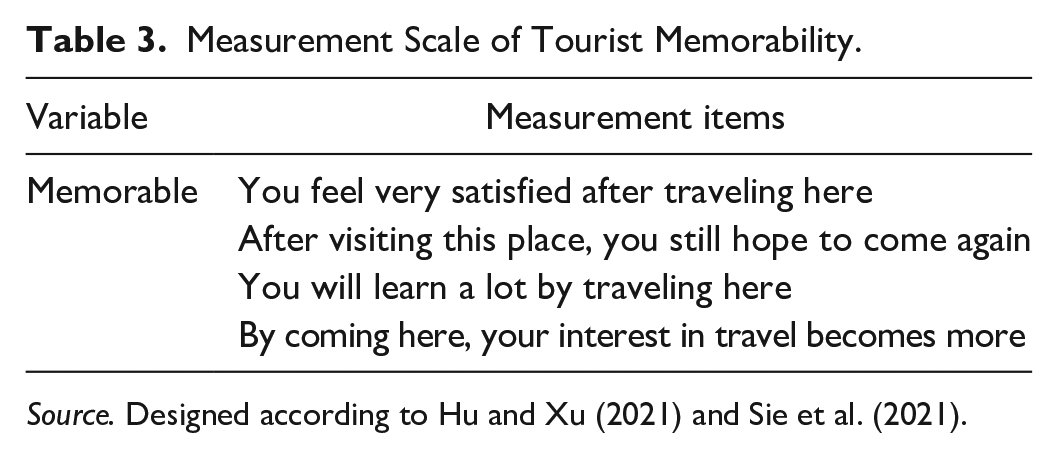
Tourist memorability is a kind of memory of the tourism destination that tourists obtain through traveling and is reflected in tourists’ emotion, expectation, harvest, interest, and so on. Emotional memory is the emotional satisfaction that tourists get when they travel; expectation memory refers to the satisfaction that tourists get after the expectation is met during traveling; harvest memory is the tourists’ satisfaction left after comparing expenditure and benefit, while interest memory is a kind of increment of tourists’ traveling interest. Hu and Xu (2021) verified the positive influence of the memorability of traveling experience on revisiting intention. Sie et al. (2021) argued that the recollection of travel experiences is critical to memorable experiences which ultimately influence perceived benefits and life satisfaction. Williams et al. (2020) insisted that although unforgettable experiences can result in unique brand, monetary premium, and other corporate revenue, relying on unforgettable experiences are also risky for enterprises. Thus, this article attempts to design a scale for the measurement of memorability, as shown in Table 3.
Measurement Scale of Tourist Memorability.
Source. Designed according to Hu and Xu (2021) and Sie et al. (2021).
Measurement of Tourist Consumption Behavior
Tourist consumption behavior is the consumption of goods or services carried out by tourists to meet their own needs, not only involving the consumption in tourism destinations during traveling, but also concerning tourists’ evaluation on tourism destinations after traveling (such as revisiting, recommending, etc.). And this article mainly studies tourists’ consumption in tourism sites. The measurement scale designed by Ning (2014) when studying the influence mechanism of tourism destinations’ social responsibility on tourist consumption behavior focuses on tourists’ consuming intention during traveling and their attitude after traveling. Adam (2021) believed that the negative tourist-to-tourist interactions would weaken tourists’ consumption intention. Karl et al. (2020) proposed the concept of impulsive purchase in tourism, which refers to individuals who have no intention to purchase specific items but have the motivation to do so. While repeat purchase behavior is influenced by brand loyalty (Bulkley, 1992; Dawes et al., 2015), price flexibility (Sibly, 2001), and so on. Therefore, combined with the characteristics of tourist consumption behavior in the selected tourism site, the following table of the measurement of tourist consumption behavior is designed (Table 4).
Measurement Scale of Tourist Consumption Behavior.

Source. Designed according to Ning (2014) and Karl et al. (2020).
Research Hypothesis Testing
Research Design
Questionnaire design
The questionnaire falls into four parts: the first part is the basic features of the sample, such as gender, age, education background, monthly income, and the reason of visiting here. The next is the reputation of world cultural heritage tourism sites, including five dimensions of catering quality, accommodation condition, landscape environment, cultural attraction, and recreation and entertainment activities. The third deals with the traveling experience which includes six items. And the last part is the tourists’ consumption decision-making behavior and consists of seven items. With a Likert-type 5-point scale, each question of the questionnaire is given a quantitative score from 1 to 5, and tourists score every question based on their own true feelings, 1 stands for strongly disagree, 2 represent disagree, 3 means neutral, 4 refers to agree and 5 indicates strongly agree.
Data collection
This survey takes place in Shaolin Temple with a questionnaire form, and the respondents are tourists in this world cultural heritage. In order to ensure the authenticity and reliability of the obtained data in the survey, the following principles are followed: (a) asking tourists’ complete consent; (b) selecting samples randomly; and (c) identifying the authenticity and integrity of the obtained sample data.
A total of 500 questionnaires are released in this survey, 490 are recovered, and the recovery rate is 98%. After excluding the 33 invalid questionnaires which are incomplete or same, there remains 457 valid questionnaires, and the effective recovery rate is 91.4%.
Basic information of the sample
The basic information the sample consists of tourists’ gender, age, educational background, monthly income and reason of visiting, and the detailed distribution is displayed in Table 5.
Distribution of the Basic Information of the Sample.

Source. Author’s calculation.
It can be seen from Table 5 that the survey covers 240 male tourists (52.52%) and 217 female tourists (47.48%). In terms of age, most respondents are between 18 and 24 years old; tourists who are between 25 and 34 account for 23.19% and ranks the second; the number of tourists above 60 are the smallest with a proportion 4.60%. As for educational background, almost half of the surveyed tourists are undergraduates; graduates and above are of the minimum and make up 5.69%. In the aspect of monthly income, people with a monthly salary of 2,000 Yuan and below cover the largest part with a portion of 34.14%, and the number of the surveyed tourists with a monthly income above 10,000 Yuan only occupies 12.25% and is the smallest. These suggest that people who travel to Shaolin Temple are most middle-income group and students, and high-income people are fewer. Besides, the reasons of visiting are complicated, the majority choose “others” with a percentage of 51.02% followed by “Friend recommendation” of 24.73%.
Reliability and Validity Analysis of the Measurement
Reliability analysis
A reliability analysis on the data from the questionnaires is conducted by SPSS 23.0 in this article. Cronbach’s α, which is the most commonly used index for reliability, is adopted, and the higher the value, the better the reliability of the measurement scale. Table 6 shows that the Cronbach’s α values of tourism destination reputation, traveling enjoyment and memorability and tourist consumption behavior are 0.85, 0.84, and 0.85 respectively, which means the reliability of these variables are rather good. The overall value is 0.92, indicating that there exists a rather good consistency, stability, and dependability inside these variables’ measurement scale.
Reliability Analysis of Each Variable.

Source. Author’s drawing.
Note. According to Nunnally (1978), if the value of Cronbach’s α is between 0.65 and 0.7, then the measurement scale is acceptable, 0.7–0.8 = good reliability, and 0.8–0.9 = great reliability.
Confirmatory Factor Analysis
The confirmatory factor analysis (CFA) is mainly to validate whether the experimental result of the correlations between factors and the corresponding scale items fits in well with theoretical relations predesigned by the researchers. The conceptual model constructed in this article includes four latent variables such as tourist destination reputation, tourist enjoyment, tourist memorability, and tourist consumer behavior, coupled with five, two, four, and five designed items, respectively. The CFA is hereby applied to validate whether the scale items are of the capability to measure the corresponding latent variables. The main measures includes χ2/df (chi-square to degree-of-freedom ratio), GFI (goodness of fit index), AGFI (adjusted goodness of fit index), CFI (comparative fit index), IFI (incremental fit index), RMSEA (root mean square error of approximation), CR (composite reliability), and AVE (average variance extracted).
Tourist destination reputation
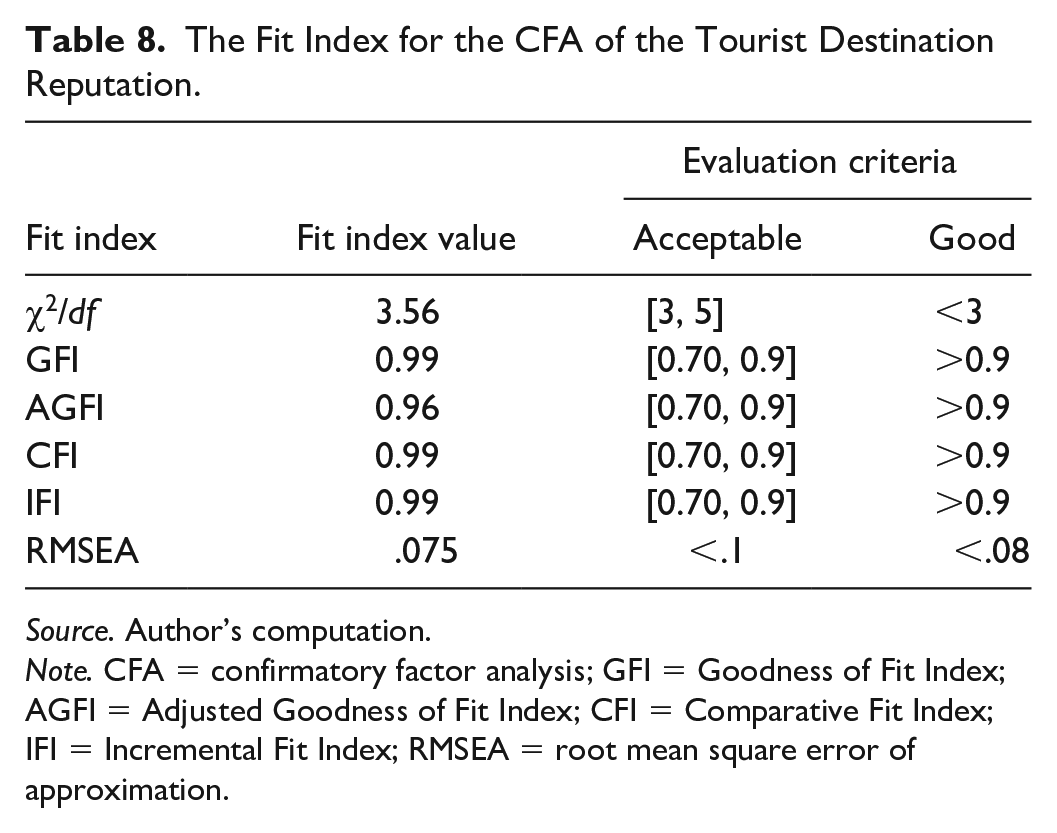
The model validating tourist destination reputation involved five major items, including the catering services, accommodation conditions, landscape environment, and recreation and entertainment facilities of the tourism site. The results in Tables 7 and 8 were obtained on the basis of fitting calculation with Amos 23.0. Table 7 revealed that the minimum value of the standardized path coefficient of the tourist destination reputation to each item was 0.60 and the maximum value was 0.83, reaching the significant level of .001. In addition, the CR of catering services, accommodation conditions, landscape environment, and cultural attractiveness were 11.43, 11.81, 14.00, and 13.95, respectively, all greater than 0.6 and meeting the evaluation criteria of CR. The AVE was 0.504, greater than 0.5 and meeting the evaluation criterion of AVE. It was concluded that the measurement model in relation to tourist destination reputation performs good convergent validity. From Table 8, χ2/df was 3.56, less than 5; GFI, AGFI, CFI, and IFI were 0.99, 0.96, 0.99, and 0.99, respectively, all greater than 0.9; and RMSEA was 0.075, less than 0.08. The above data indicated that the overall fit of the model is ideal, and the data of the scale tourist destination reputation fit the model well. In summary, each scale item in the test is capable of well reflecting the latent variable of tourist destination reputation.
Estimated Parameters of the Measurement Model of Tourist Destination Reputation.

Source. Author’s computation.
Note. ← represents the path relation among variables; *** means being significant at .001 level; and paths without specific values in the table are those with non-standardized path coefficient of 1. CR = composite reliability; AVE = average variance extracted.
The Fit Index for the CFA of the Tourist Destination Reputation.
Source. Author’s computation.
Note. CFA = confirmatory factor analysis; GFI = Goodness of Fit Index; AGFI = Adjusted Goodness of Fit Index; CFI = Comparative Fit Index; IFI = Incremental Fit Index; RMSEA = root mean square error of approximation.
Tourist enjoyment and tourist memorability
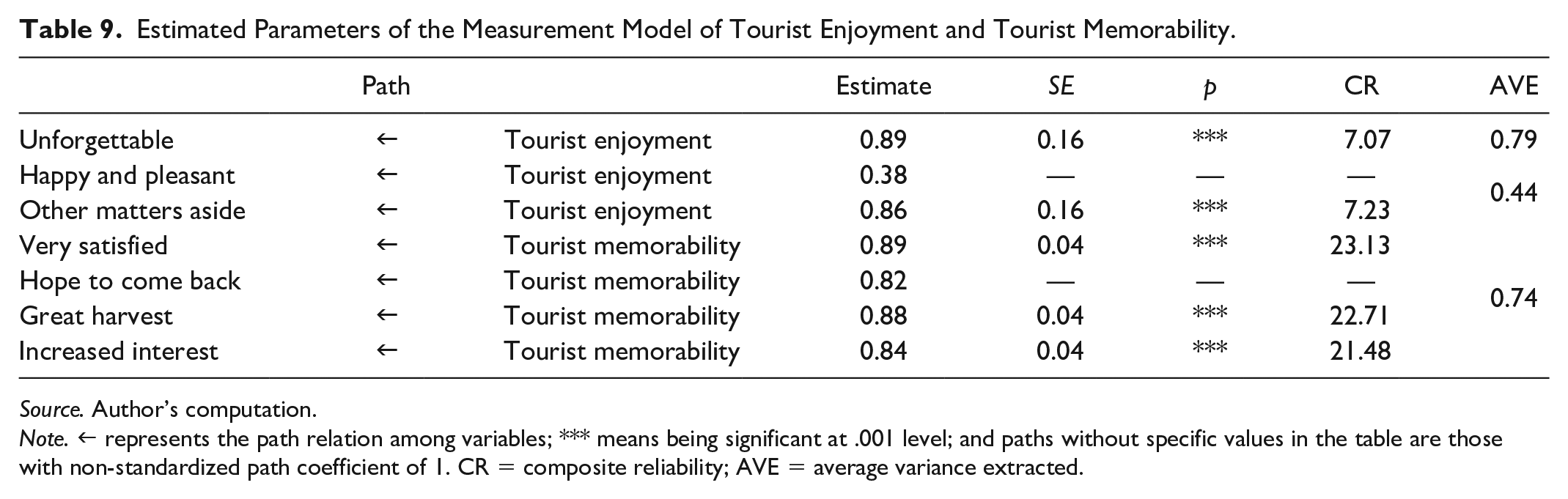
The validation model of the tourism experience involves two major latent variables, tourist enjoyment and tourist memorability. There are six corresponding scale items, namely, whether the tourist is happy and enjoyable, whether the tourist can leave other matters behind for a short period of time, whether the tourist feels very satisfied, whether the tourist looks forward to visit here again, whether the tourist gains a lot, and whether the tourist’s interest in travel increases. Theoretically and empirically, there may be a chain relationship between tourist enjoyment and tourist memorability, i.e., a tourist’s enjoyment experience leads to a memorable experience. Therefore, a path is required to be constructed between the two latent variables. The results in Tables 9 and 10 were obtained after fitting calculation with Amos 23.0.
Estimated Parameters of the Measurement Model of Tourist Enjoyment and Tourist Memorability.
Source. Author’s computation.
Note. ← represents the path relation among variables; *** means being significant at .001 level; and paths without specific values in the table are those with non-standardized path coefficient of 1. CR = composite reliability; AVE = average variance extracted.
The Fit Index for the CFA of Tourist Enjoyment and Tourist Memorability.

Source. Author’s computation.
Note. CFA = confirmatory factor analysis; GFI = Goodness of Fit Index; AGFI = Adjusted Goodness of Fit Index; CFI = Comparative Fit Index; IFI = Incremental Fit Index; RMSEA = root mean square error of approximation.
As seen in Table 9, the standardized path coefficient for tourist enjoyment to tourist memorability was 0.89 and was significant at the level of 0.001. Therefore, there was a chain relationship between the two. Besides, the standardized path coefficient of tourist enjoyment to happy and pleasant is 0.38, which is a small path value, and this path should be deleted under normal circumstances. However, considering that the key measure of whether travelers enjoy the travel process should be the mood of travelers, and there are more reasons for the small path value, such as the small sample size; therefore, the path of tourist enjoyment to happy and pleasant is retained. In the other cases, the standardized path coefficients of the latent variable to each test item were greater than 0.8, reaching a significant level of 0.001. The CR was greater than 0.6, and the AVE was greater than 0.5 (except for the AVE of the tourist enjoyment latent variable). Therefore, the travel experience measurement model has good convergent validity. From Table 10, χ2/df was 3.78, less than 5; GFI, AGFI, CFI, and IFI were 0.98, 0.95, 0.99, and 0.99, respectively, all greater than 0.9; and RMSEA is 0.078, less than 0.08. This indicates that the data of the tourism experience scale fit the model relatively well. In conclusion, the scale items in the test can reflect the two latent variables of tourist enjoyment and tourist memorability well.
Tourist consumer behavior
There are five scale items of tourist consumer behavior, namely willingness to consume, urgency to consume, consumption due to the tour guide, repeated consumption, and recommended consumption. Among them, the first three measures focus on consumers’ willingness to purchase, and the last two measures focus on consumers’ willingness to repeat purchase. After the fitting calculation by Amos 23.0, it was found that the RMSEA index value exceeded 0.08 and χ2/df also exceeded 3, and thus the model did not reach the optimum performance. Therefore, the model requires to be revised. Considering that there are still many travel agencies in the Chinese tourism market that solicit tourists on the strength of “low prices” and make profits through “forced sales,” the correlation between the residual terms of the “consumption due to the tour guide” item and the “recommended consumption” items was established, and the results in Tables 11 and 12 were finally obtained.
Estimated Parameters of the Measurement Model of Tourist Consumer Behavior.

Source. Author’s computation.
Note. ← path relation among variables; *** significant at .001 level; and paths without specific values in the table are those with non-standardized path coefficient of 1. CR = composite reliability; AVE = average variance extracted.
The Fit Index for the CFA of Tourist Consumer Behavior.

Source. Author’s computation.
Note. CFA = confirmatory factor analysis; GFI = Goodness of Fit Index; AGFI = Adjusted Goodness of Fit Index; CFI = Comparative Fit Index; IFI = Incremental Fit Index; RMSEA = root mean square error of approximation.
As can be seen from Table 11, the minimum value of the standardized path coefficient of the latent variable to each test item was 0.52 and the maximum value was .85, reaching the significant level of .001. The CR was greater than .6, and the AVE was .55, greater than .5. Therefore, the tourist consumer behavior measurement model has good convergent validity. From Table 12, χ2/df was 1.81, less than 3; GFI, AGFI, CFI, and IFI were 0.99, 0.98, 0.99, and 0.99, respectively, all greater than 0.9; RMSEA was 0.04, less than 0.08. This indicated that the data of the tourism experience scale fitted the model well. In conclusion, the tested scale items could well reflect the latent variable of tourist consumer behavior.
Hypothesis Testing
The nine research hypotheses presented above involve tests of intermediary effects, and the variables of interest are all latent variables. Therefore, the structural equation model was adopted for the study. Since the reliability and validity tests of the scales in the previous section have been confirmed, the structural equation model can be directly constructed.
Hypothesis testing of the influence of tourist destination reputation on tourist consumer behavior
The fit indexes of the structural equation model are obtained on the strength of Amos 23.0 as follows: χ2/df was 3.26, less than 5; GFI, AGFI, CFI, and IFI were 0.92, 0.89, 0.95, and 0.95, respectively. Except AGFI was slightly lower than 0.9, not reaching the ideal standard, all other indexes meet the ideal standard; RMSEA was 0.07, less than 0.08. In conclusion, the data obtained through the survey fit well with the structural equation model, and the structural equation model is acceptable. The significance level of the hypothesis test selected in this article was 0.05; if it is significant at the level of 0.05, the original hypothesis is supported, and vice versa.
The results of the hypothesis testing of the structural equation model were shown in Table 13. The path coefficient of the influence of tourist destination reputation on tourist consumer behavior was .29, and p < .001. Therefore, the influence of tourist destination reputation on tourist consumer behavior was significant at the level of .001; the hypothesis H1 holds, that is, tourist destination reputation has a positive influence on tourist consumer behavior. The path coefficient of the influence of tourist destination reputation on tourist enjoyment was .72, and p < .001. Therefore, the influence of tourist destination reputation on tourist enjoyment was significant at the level of .001 and hypothesis H2 holds, that is, tourist destination reputation has a positive effect on tourist enjoyment. The path coefficient of the influence of tourist enjoyment on tourist consumer behavior was −.25 and p was .15 > .05. Therefore, there was no significant influence of tourist enjoyment on tourist consumer behavior and hypothesis H3 does not hold. The fact that this hypothesis is not valid does not mean that there is no link between tourist enjoyment and tourist consumer behavior because the former can be linked to the latter through a chain relationship with tourist memorability. The path coefficient of the influence of tourist destination reputation on tourist memorability was .40, and p < .001. Therefore, the influence of tourist destination reputation on tourist memorability was significant at the level of .001 and hypothesis H5 is valid, that is, tourist destination reputation has a positive effect on tourist memorability. The path coefficient of the effect of tourist memorability on tourist consumer behavior was .75, and p < .001. Therefore, the effect of tourist memorability on tourist consumer behavior was significant at the level of .001 and hypothesis H6 holds, that is, tourist memorability has a positive effect on tourist consumer behavior. The path coefficient of the effect of tourist enjoyment on tourist memorability was .60, and p < .001. Therefore, the influence of tourist enjoyment on tourist memorability was significant at the level of .001 and hypothesis H8 holds, that is, tourist enjoyment has a positive influence on tourist memorability.
Hypothesis Testing Results of Structural Equation Model.

Source. Author’s computation.
Note. ← indicates the path correlation between variables; *** significant at the .001 level.
Hypothesis testing of the intermediary effect
There are many available methods to test the intermediary effect, among which the common methods are Bootstrap test, product distribution method, Monte Carlo method, Bayesian method, and so on. Pituch et al. (2006) used the above four methods to test the intermediary effect, and found that Bootstrap test is the best. Therefore, the Bootstrap test was used in this article to test whether the intermediary effect exists. The Bootstrap sampling frequency was set to 2,000, and the confidence interval was 95%. In addition, it was assumed that the path corresponding to H4 was named stdA1, which indicated the intermediary effect of tourist enjoyment. It was assumed that the path corresponding to H7 was named stdA2, which indicated the intermediary effect of tourist memorability. It was assumed that the path corresponding to H9 was named stdA3, which indicated the chain intermediary effect of tourist enjoyment and tourist memorability. The standardized estimation results were shown in Table 14.
Test Results of Intermediary Effect of Tourist Enjoyment and Tourist Memorability.

Source. Author’s computation.
Note. CI = confidence interval.
As seen from Table 14, the point estimate of stdA1 path was −.18, the p value was .07, greater than .05, and the confidence intervals of bias-corrected and percentile were [−1.66, 0.01] and [−1.51, 0.01], respectively, including 0, which showed that the hypothesis H4 is not valid, that is, tourist enjoyment has no intermediary effect between the tourist destination reputation and tourist consumer behavior. The point estimate of stdA2 path was .29, p value was less than .05, and the confidence intervals of bias-corrected and percentile were [0.07, 0.51] and [0.04, 0.48], respectively, which did not include 0. This showed that the hypothesis H7 holds, that is, tourist memorability has a intermediary effect between the tourist destination reputation and tourist consumer behavior. The point estimate of stdA3 path was .32, p value was less than .05, and the confidence intervals of bias-corrected and percentile were [0.10, 1.64] and [0.11, 1.73], respectively, which did not include 0. This showed that the hypothesis H9 holds, that is, tourist enjoyment and affliction have a chain intermediary effect between tourist destination reputation and tourist consumer behavior. The establishment of this hypothesis proves that although tourist enjoyment has no intermediary effect between tourist destination reputation and tourist consumer behavior. But tourist destination reputation can first affect tourist enjoyment and then tourist destination reputation acts on tourist memorability, and then has an impact on tourist consumer behavior.
Discussion
Shaolin Temple is recognized as an international tourism site in world cultural heritages, enjoying extremely high popularity all over the world, besides it is also a hot tourism spot in Henan Province. Therefore, the sample tourism site selected in this article is representative to a great extent. During the past years, some scholars have conducted certain researches on the tourist destination reputation, whereas this article is instinct from previous researches in terms of the research object, research methods, and also research results.
The research object selected in this article is the Shaolin Temple, a world cultural heritage site. Although there have been previous studies on Shaolin Temple, these studies did not examine the impact of the tourist destination reputation. In such context, this article investigates the influence of reputation of heritage tourism site on tourists’ consumption behavior when they are touring, so as to further define the research scope. The research subjects of Coelho and Gosling (2017) were tourists to Ouro Preto, Minas Gerais, and Brazil. What they had analyzed was about the influence of the reputation of cultural heritage tourism resorts after tourists had traveled to there on tourists’ perceived value and their willingness to recommend the resorts online. Different world cultural heritage tourism sites have different unique characteristics and cultural deposits, so it is of different research significance to explore different cultural heritage tourism sites. In different stages of tourism, the reputation of a tourism destination has different influences on the behavior of tourists. This article focuses on the influence of the reputation of a tourism destination on the consumption behavior of tourists which is different from the recommendation intention of posttravel tourists that Coelho and Gosling (2017) paid attention to.
Some researchers, such as Su et al. (2020), divide the reputation of tourist destinations into cognitive evaluation and emotional evaluation when studying the reputation of tourism destinations, while paying more attention to the influence of the reputation of tourism destinations on tourists’ decision-making before touring. This article divides the reputation of tourism destinations into catering reputation, accommodation reputation, transportation reputation, landscape reputation, shopping reputation, leisure and entertainment reputation, and analyzes the influence of the reputation of tourist destinations synthesized by these reputations on the consumption behavior of tourists. Both the division of variable dimensions and the selection of influencing variables are different from the previous studies. However, undoubtedly, the structural equation model used by scholars, such as Chatzigeorgiou and Christou (2016) and Coelho and Gosling (2017), to analyze the influence of tourism destination reputation on the willingness of tourists to revisit and recommend a destination inspires the research method of this article.
In the past, most studies considered perceived value as an intermediary variable, but perceived value was diverse and vague. On the basis of previous studies, this article puts forward that tourist enjoyment and tourist memorability are the intermediary variables of perceived experience, to study the influence of tourism destination reputation on tourists’ consumption behavior. Tourist enjoyment and tourist memorability are mentioned in the papers of different scholars, but its measurement has never been made before. From the perspective of tourists’ activities in tourist destinations, tourist enjoyment should be one of the goals pursued by tourists, and it is also an experience in the process of tourism. Tourist memorability is a kind of memory for tourists, and it is a kind of feedback based on tourism process and experience. Although the research results do not indicate that tourist enjoyment has mediating effects, it does have mediating effects, and tourist enjoyment forms chain mediating effect through tourist memorability. The conclusion of this research about the mediation effect of unforgettable is consistent with that of Y. Y. Li and M. Li (2021).
Conclusion
Main Conclusions
By establishing structural equation model, this article analyzes the influence of tourist destination reputation on tourist consumer behavior, and the intermediary role of intermediary and tourist memorability in the relationship between tourist destination reputation and tourist consumer behavior, and draws the following conclusions:
The tourist destination reputation has a significant positive impact on tourist consumer behavior. The path coefficient from tourist destination reputation to tourist destination reputation was 0.29, which showed that the direct effect of tourist destination reputation on tourist consumer behavior is 0.29, that is, the higher the tourist destination reputation, the more conducive it is to promote tourist consumer behavior. The tourist destination reputation mainly consists of catering services, accommodation conditions, landscape conditions, cultural attractiveness, and the reputation of leisure and entertainment activities. Therefore, the key to promoting tourist consumer behavior lies in whether the quality of tourists’ catering, accommodation, landscape, culture, and leisure and entertainment can be improved.
Tourist memorability has an intermediary effect between the tourist destination reputation and tourist consumer behavior. The point estimate of the mediating effect of tourist memorability was 0.29, which showed that the partial indirect effect of tourist destination reputation on tourist consumer behavior is 0.29, and it also shows that tourist memorability is the key to promote tourist consumer behavior. According to the results of CFA, tourists’ satisfaction, harvest value, and interest amount can well measure tourist memorability. Therefore, how to improve tourists’ unforgettable experience is the key to promote tourists’ consumption behavior.
Tourist enjoyment and tourist memorability have a chain intermediary effect between the reputation of tourist destination reputation and tourist consumer behavior. The point estimate of the chain mediating effect of tourist enjoyment and tourist memorability was 0.32. It showed that the indirect effect of tourist destination reputation on tourist consumer behavior was 0.32, and it also showed that tourist destination reputation can first affect tourist enjoyment, then affect tourist memorability, and finally have a positive impact on tourist consumer behavior, that is, tourist enjoyment and unforgettable play an important role in improving tourist consumer behavior.
Policy Implications
On the basis of the research conclusion of this article, the following policy suggestions are put forward:
First, it is required to take effective measures to improve the reputation of tourist destinations. In the previous research, it is found that the reputation of tourist destinations has a positive impact on tourist consumer behavior. Therefore, it is very important to improve the reputation level of tourist destinations. At the same time, the reputation of tourist destinations is measured by catering, accommodation, landscape, cultural attractions, and leisure activities. In terms of catering, we can combine local culture and famous snacks to create special recipes and dishes. In terms of accommodation, we should mainly improve the accommodation environment and enhance the comfort of accommodation by upgrading the hardware conditions. In terms of landscape, it is necessary to strengthen the management of the surrounding environment and promote the uniformity of the landscape and also promote the aesthetic feeling of landscape through landscape planning and greening. In terms of culture, we should pay attention to excavating and sorting out intangible cultural heritage projects and integrating them into Shaolin Temple scenic spots. In terms of leisure and entertainment activities, a number of participatory martial arts events can be excavated to enhance tourists’ impression of Shaolin Temple through tourists’ participation. In addition, market regulation and construction cannot be ignored. It is necessary to standardize and manage the prices of catering, accommodation, landscape, culture, and leisure and entertainment products; make profits to tourists through online platform group purchase. Through activity planning and online celebrity publicity, we will further enhance the popularity of tourist destinations and expand the scope of reputation communication of tourist destinations.
Second, it is necessary to innovate the content of tourism products to improve tourist memorability. According to the research conclusion of this article, tourist memorability is an intermediary variable between destination reputation and tourist consumer behavior, so it is very important to improve tourist memorability. Among many problems in scenic spot development, homogenization is the most prominent. Therefore, to improve tourist memorability, it is necessary to further subdivide tourists and implement differentiated development strategies. The content of the tourist destination can be further optimized from the tourists’ feeling, vision, touch, taste, and perception. For example, we can combine regional culture and customize nonstandardized tourism cultural and creative products to meet the personalized and differentiated needs of tourists. In combination with Shaolin culture, it can provide practice and viewing activities such as reading scriptures, martial arts experience, performance programs, meditation practice, meditation medicine, charity, and so on, so as to promote tourists’ perception of Shaolin Temple.
Third, it is required to design convenient, efficient, and comfortable tourism products to improve tourist enjoyment. Tourist enjoyment is a key link in the chain intermediary effect between the reputation of tourist destinations and tourist consumer behavior, so it is of great significance to enhance tourist enjoyment. With the acceleration of the pace of life, the vast majority of people are struggling to cope with various work and life pressures, leaving less time for themselves to relax, thus pursuing more convenient, efficient and comfortable travel experience. “Home economy” and Buddhist life have emerged one after another. Therefore, no matter the tangible products or intangible services of the tourist destination, it is necessary to consider the changes of life attitude and lifestyle. Shaolin Temple should also fully integrate Buddhism, Zen, and Zen medicine into its products and services with the mentality of Buddhism and extraordinary cultivation, so as to benefit all living beings.
Limitations and Prospects
Due to the limitation of time, funds, and energy, this article has some limitations. Shaolin Temple, the destination studied in this article, is a single destination, so it is impossible to compare its research results with other destinations. In the survey, some data were collected on weekends and some were collected during the May Day holiday. As most of the visitors to Shaolin Temple on weekends are the surrounding residents, and there are various types of tourists during the May Day holiday, there are some differences between the two groups of data. In addition, considering tourists’ acceptance of questionnaire survey, more attention is paid to conciseness and convenience of questionnaire design, which results in inaccurate choice of dimensions of the scale.
In view of the small number of weekend tourists, more research on holiday tourism will be done in the future. In the follow-up study, the tourists’ perception dimension will be subdivided, and the influence of the reputation of cultural heritage tourism destination on tourists’ consumption behavior will be explored from three fields, namely diet, landscape, and culture, so as to extract more explicit theoretical and policy implications.
Footnotes
Declaration of Conflicting Interests
The author(s) declared no potential conflicts of interest with respect to the research, authorship, and/or publication of this article.
Funding
The author(s) disclosed receipt of the following financial support for the research, authorship, and/or publication of this article: The paper is supported by the Humanities and Sciences of Ministry of Education Planning Fund titled Reputation Formation Mechanism in Sightseeing District and Its Impacts on Tourists Behaviors (grant no. 15YJA790062).
