




Abstract
Population aging in China presents significant economic, social, and healthcare challenges, exacerbated by cultural values and demographic policies (e.g., filial piety and one-child policy). While socially assistive robots (SARs) are increasingly recognized as promising solutions for aging-in-place, prior research has largely overlooked the unique cultural and family contexts in China, particularly intergenerational dynamics and structural differences between only-child and multi-child families. This study addresses this gap by examining the factors influencing seniors’ adoption intention toward SARs, with a focus on intergenerational differences (retired vs. unretired seniors, and seniors vs. adult children) and family structure. A self-administered online survey was conducted. Structural equation modeling (SEM) revealed that innovation characteristics like compatibility, trialability, and relative advantage positively influenced seniors’ perceived usefulness and enjoyment, while intrusiveness and social presence had negative impacts, which, in turn, influencing adoption intention. Social norms and self-efficacy also positively influenced adoption intention through perceived usefulness and perceived enjoyment. Multi-group SEM revealed significant intergenerational and family structural differences. By integrating cultural, intergenerational, and structural family perspectives into technology adoption research, this study contributes to the limited literature on aging-related technology adoption in non-Western contexts through a comprehensive view and offers managerial insights for designing and promoting SARs in China.
Keywords
Introduction
Population aging—defined as the demographic shift toward a higher proportion of older adults—has become a global trend. China, in particular, is experiencing rapid population aging. By 2050, the number of individuals aged 60 and above is projected to reach 483 million in China, representing 34% of the population and surpassing the total elderly population of the United States (Financial Times, 2023). This demographic transformation poses substantial challenges for China’s economy, healthcare system, and social structure (The Guardian, 2024).
To address these challenges, China has implemented the “9073” elderly care strategy, which reflects not only the preferences of older adults but also the influence of deeply rooted cultural values such as filial piety (Xinhua, 2024). According to this strategy, approximately 90% of Chinese seniors prefer to age in place—remaining at home either independently or with family support—while only 7% and 3% opt for community-based and institutional care, respectively (Financial Times, 2023; Xinhua, 2024). However, aging at home often strains family caregivers (e.g., adult children and spouses) who may lack time or professional skills (M. Chen et al., 2023; Kwete et al., 2024; H. Lin et al., 2024). This situation creates opportunities for technological innovations such as socially assistive robots (SARs), which integrate artificial intelligence (AI) technologies (e.g., computer vision, speech recognition, and facial recognition) into physical robotic platforms to support independent living and enhance older adults’ quality of life (Fardeau et al., 2023; H. Lin et al., 2024; Rzepka & Berger, 2018). Despite these potential benefits, the widespread adoption of SARs remains uncertain, particularly among older adults who may face cognitive, physical, or emotional barriers (Lebrasseur et al., 2008).
While existing research has explored technology acceptance among older adults, most studies focus on Western or developed countries (e.g., de Graaf et al., 2019; Giraud et al., 2020). Relatively few have examined Chinese seniors (e.g., X. Sun et al., 2024; Wang et al., 2025; M. Zhang, 2022). Among these studies, some have adopted qualitative approaches to explore the design and application of SAR (K. Chen et al., 2020), while others have used experimental methods to investigate specific robot features, such as appearance or emotional expressiveness (K. L. Huang et al., 2022; Liang et al., 2025). As such, comprehensive quantitative analyses remain scarce, particularly those addressing both external factors (e.g., innovation characteristics, social influence) and internal factors (e.g., personal attributes) affecting adoption intentions toward SARs for aging in place. Moreover, the dual role (positive and negative aspects) of SAR features in eliciting seniors’ responses has been largely overlooked. As artificial intelligence and social robots become more integrated into everyday life, it is increasingly critical to explore the mechanisms through which these factors shape both cognitive perceptions (e.g., perceived usefulness) and affective responses (e.g., perceived enjoyment), which ultimately influence adoption intentions (de Graaf et al., 2019).
Furthermore, intergenerational comparisons remain underexplored, particularly differences between older adults at different life stages (e.g., already retired vs. approaching retirement) and between seniors and their adult children. Differences in adoption intentions may arise from variations in digital literacy, cognitive ability, physical health, and life context (Zenebe et al., 2021). Retired seniors, who may face immediate challenges such as declining health, could prioritize the functional benefits of SARs. In contrast, younger seniors approaching retirement may place greater value on both functional and experiential features of these technologies (AboJabel & Ayalon, 2023). Prior research has also revealed that seniors and caregivers often hold contrasting views on adopting assistive robots for caregiving (Esmaeilzadeh & Maddah, 2024; Johansson-Pajala et al., 2020; H. Lin et al., 2024). In the Chinese context, cultural values such as collectivism, family responsibility, and filial piety may jointly shape users’ perceptions and intentions toward SARs (G. Y. Lin et al., 2024). Understanding differences between seniors and their adult children is essential, as the latter often serve as primary caregivers (Lytle et al., 2020; L. Zhang, 2025).
Additionally, family structure—particularly distinctions between only-child and multi-child households—warrants further investigation. Under China’s historical One-Child Policy, caregiving responsibilities in only-child families often fall to a single individual, potentially influencing seniors’ and family members’ attitudes toward assistive technologies (Du et al., 2024; Kwete et al., 2024). Despite its relevance, this structural factor has received limited empirical attention. Accordingly, this study aims to (1) identify the key determinants of adoption intentions among older adults; (2) examine intergenerational differences, including comparisons between retired and unretired seniors, as well as between seniors and their adult children; and (3) explore how family structure—particularly differences between only-child and multi-child families—shapes these intentions.
To achieve these aims, the following section proposes a series of hypotheses (i.e.,
Theoretical Background and Hypotheses
Technology Acceptance Model
The technology acceptance model (TAM), initially developed by Davis (1989), is one of the most influential and widely adopted frameworks for understanding user acceptance of information technologies and innovations. Among older adult populations, TAM has been empirically validated across diverse domains, including e-commerce, education, banking, and healthcare (e.g., Martín-García et al., 2022; Rahi et al., 2017; Rouidi et al., 2022; Smith, 2008). TAM provides a foundational framework for explaining the drivers of users’ technology adoption in consumer contexts. Thus, subsequent researchers have expanded TAM by integrating additional constructs to enhance its explanatory power (Rahi et al., 2017; Venkatesh et al., 2003).
According to the original TAM, an individual’s intention to use a technology is primarily determined by their perception of its perceived usefulness (see Figure 1a), which is defined as the extent to which a person believes that using the innovation will enhance their performance (Davis, 1989). However, as shown in Figure 1a, the original TAM primarily emphasizes external factors, extrinsic motivations, and focuses on its functional aspects, while neglecting internal factors, intrinsic motivations, and experiential perceptions. To address this limitation, later extensions of TAM incorporated constructs such as perceived enjoyment, defined as the extent to which using a technology is pleasurable or satisfying, independent of performance-related outcomes (Davis et al., 1992; Venkatesh, 2000). This addition acknowledges that technology acceptance is not solely based on utilitarian evaluations but also involves emotional and experiential dimensions. In the context of assistive robots for aging in place, which are designed not only to support daily activities but also to facilitate social interaction and companionship, both cognitive (e.g., usefulness) and affective (e.g., enjoyment) evaluations are essential for understanding user acceptance.

Development of the theoretical framework. (a) Technology acceptance model; (b) Innovation diffusion process; (c) Modifed theoretical framework of this study based on (a) and (b).
Furthermore, previous research has noted that the predictive accuracy of TAM can vary across different external and contextual conditions, including cultural and social influences, technological attributes, and user characteristics (McFarland & Hamilton, 2006). For example, perceived ease of use, originally defined as the degree to which a user expects a technology to be free of effort (Davis, 1989), may not fully capture the diverse features and usability concerns associated with complex innovations. Accordingly, many researchers have adapted TAM by integrating domain-specific variables, which better reflect users’ beliefs and evaluations—specifically perceived usefulness and enjoyment—and ultimately enhance both adoption rates and the successful implementation of new technologies (McFarland & Hamilton, 2006; Venkatesh et al., 2003; Won et al., 2023).
Innovation Diffusion Theory and the Innovation Adoption Process
Innovation diffusion theory (IDT), originally proposed by Rogers (1962), offers a comprehensive framework for understanding how new ideas, technologies, or practices are communicated and adopted over time within a social system. Later, Rogers (2003) refined this framework by conceptualizing innovation adoption as a five-stage process—known as the innovation adoption process (IDP)—which includes: knowledge, persuasion, decision, implementation, and confirmation (see Figure 1b). These stages illustrate how a unit of adoption (e.g., an individual or organization) progresses from initial exposure to an innovation to its eventual adoption or rejection.
According to Rogers (2003), potential adopters are introduced to the innovation and begin to understand its functionalities in the knowledge stage. Then, the persuasion stage involves forming favorable or unfavorable perceptions toward the innovation based on evaluative judgments. In the decision stage, the individual chooses whether to adopt or reject the innovation. If adopted, the implementation stage marks the beginning of actual usage. Finally, the confirmation stage involves seeking reinforcement for the decision, with continued use dependent on user experience and outcomes. Among these stages, the persuasion stage—where individuals evaluate the innovation—is particularly critical in shaping adoption intentions, especially among early adopters (Zhai et al., 2021).
As shown in Figure 1b, the persuasion stage is shaped by several factors, including users’ perceptions of innovation characteristics (e.g., compatibility, relative advantage, trialability), prior conditions (e.g., social system norms), user characteristics, and contextual variables (e.g., communication channels). Given that SARs for aging in place remains in the prototype stage and has yet to be widely commercialized, it is essential to investigate these factors in depth to better understand how users evaluate such technologies and how these evaluations affect their adoption intentions.
In the IDP framework, Rogers (2003) identifies five core attributes of innovations that influence the persuasion and decision stages: relative advantage, compatibility, complexity, trialability, and observability. Innovations perceived to offer substantial benefits, align with existing values and practices, are easy to use, allow for experimentation, and produce visible outcomes tend to diffuse more rapidly. These attributes are crucial in shaping users’ initial evaluations and eventual adoption decisions. However, Rogers’ original attributes emphasize primarily positive characteristics. For complex, interactive technologies such as SARs, it is equally important to account for negative characteristics, including the robots’ intrusiveness. Intrusiveness reflects users’ discomfort, privacy concerns, or feelings of reduced autonomy when interacting with robots, particularly in intimate, home-based settings such as aging-in-place (Fosch-Villaronga et al., 2018). Therefore, when evaluating novel technologies like SARs, it is essential to consider both positive and negative innovation attributes to comprehensively capture the factors that influence user perceptions and adoption intentions.
Furthermore, the IDP is shaped not only by innovation characteristics but also by individual readiness and contextual influences, such as self-efficacy, external pressures, and social norms (Tornatzky & Klein, 1982). These factors can significantly affect how users progress through the adoption process and determine whether an innovation is successfully integrated into daily routines and social environments. Thus, to address the limitations of TAM in capturing broader social and contextual influences, this study extends the model by integrating IDP. Specifically, it incorporates social norms (as a reflection of prior conditions), self-efficacy (as a user characteristic), and innovation attributes (both positive and negative) to represent the perceived features of assistive robots to examine their influences on perceived usefulness and perceived enjoyment of SARs, which, in turn, influence their adoption intentions. This integrated approach enhances the contextual relevance of the framework, making it more suitable for studying adoption behavior in aging-in-place scenarios (see Figure 1c and Figure 2).

Research model and hypotheses of this study.
Characteristics of Innovation
Compatibility
Compatibility—defined as the degree to which an innovation aligns with users’ values, past experiences, and needs—plays a pivotal role in reducing psychological resistance and facilitating technology adoption (Rogers, 2003). Xue et al. (2012) found that Infohealth—an intervention technology that seamlessly integrated into the daily routines of aging women—increased both their perceived benefits and intention to use the system. Similarly, F. B. Tan and Chou (2008) extended TAM by demonstrating that perceived compatibility significantly enhanced users’ sense of playfulness in mobile information and entertainment services. In assistive robotics, E. Zhou et al. (2021) found that older adults perceived low-vision support robots as more useful and enjoyable when the robots’ interactions occurred within familiar environments. Collectively, these findings provide empirical support for the claim that SARs aligning closely with older adults’ daily routines and personal preferences are more likely to enhance perceived usefulness and enjoyment. Accordingly, the following hypotheses are proposed:
Trialability
Trialability—defined as the degree to which an innovation can be tried on a limited scale (Rogers, 2003)—has been shown to reduce perceived uncertainty by allowing users to engage with the technology firsthand, thereby shaping both cognitive and affective evaluations. Providing opportunities for observation and experimentation is critical for users to assess the perceived usefulness and enjoyment of technological innovations. Khaksar et al. (2019) identified a positive relationship between the trialability of social assistive technologies and perceived usefulness from the perspective of carers in Australia. Similarly, studies have shown that broader digital service trials enhance users’ perceived usefulness and enjoyment, especially when innovations offer both functional and entertainment features through exploratory interaction prior to full adoption (Yoon & Lim, 2020). Since SARs offer functional, entertainment, and social interaction capabilities, hands-on trials enabling users to experience these features are likely to enhance older adults’ perceptions of usefulness and enjoyment in support of aging-in-place. Thus, the following hypotheses are proposed:
Relative Advantage
Relative advantage refers to the extent to which an innovation is perceived as superior to existing alternatives (Rogers, 2003; Yuen et al., 2021). It reduces uncertainty by emphasizing the improved outcomes of innovations compared to conventional options. For example, Broadbent et al. (2009) found that older adults who viewed demonstrations of healthcare robots rated them significantly higher in usefulness than traditional non-robotic aids, especially when robots performed tasks such as monitoring and reminders. Beyond practical benefits, Yoon and Lim (2020) found that innovations perceived to offer a relative advantage also elicited more positive affective responses, including higher perceived enjoyment. In the context of SARs for aging-in-place, relative advantages may include both functional gains—such as improved safety monitoring and task automation—and experiential benefits, such as enhanced autonomy and enriched social interaction without human involvement. These features distinguish SARs from traditional caregiving approaches (Al-Jabri & Sohail, 2012). Therefore, the following hypotheses are proposed:
Social Presence
Social presence, drawing on information richness theory (Daft & Lengel, 1984), is defined as the extent to which a communication medium enables users to perceive others as psychologically present (Fulk et al., 1987). In the context of SARs for aging in place, social presence can be defined as the extent to which robots are perceived as socially and emotionally engaging. Research indicates that older adults respond more positively to robots with advanced social cues and conversational abilities (i.e., warmth and competence), perceiving higher hendoic and utiliarian values (Čaić et al., 2020). Experimental studies have shown that stronger social presence in screen agents and robots leads to higher levels of perceived usefulness and enjoyment among community-dwelling seniors (Heerink et al., 2008b). A recent exploratory study further revealed that older adults emphasized the importance of balancing functionality with social presence—such as embodiment and empathetic interaction—during in-home trials, which shaped their positive perceptions of usefulness and enjoyment (Hofstede et al., 2025). Based on these findings, the following hypotheses are proposed:
Intrusiveness
Intrusiveness refers to the extent to which the SAR proactively intervenes in seniors’ personal routines, raising concerns about privacy and autonomy (Melenhorst et al., 2004). Intrusiveness has been consistently identified as a major barrier to technology adoption, particularly when innovations are perceived to collect data without explicit user consent or to observe private activities (Harrington et al., 2023; Koh et al., 2021; Schulz et al., 2018). For example, Schulz et al. (2018) found that older adults expressed significant concern when robots collected data without their knowledge, leading to reduced trust and perceived usefulness. Similarly, Harrington et al. (2023) reported that older adults in a pilot study expressed discomfort with intrusive robot behaviors, which negatively affected their enjoyment. A recent scoping review echoed these concerns, identifying security and intrusiveness as key obstacles to the adoption of social robots in dementia care, largely due to negative perceptions of usefulness (Koh et al., 2021). Based on these findings, the following hypotheses are proposed:
Social Norms
Beyond the intrinsic characteristics of an innovation, technology acceptance is also shaped by external influences, such as social norms. In this study, social norms are defined as the degree to which users believe that important referents—such as family members, friends, or peers—support the use of SARs for aging in place (Venkatesh et al., 2012). Prior research has shown that older adults frequently learn about and adopt new technologies by observing the behaviors and attitudes of those around them, particularly younger generations (Hoque & Sorwar, 2017; Hsu & Peng, 2022). In collectivistic societies such as China, individuals often place high value on the opinions of significant others when making decisions, including those related to technology adoption (S. Sun et al., 2024). Although existing studies have confirmed that social influences—including social norms—positively affect older adults’ attitudes and intentions to adopt various innovations (e.g., mobile health services and assistive robots; Hoque & Sorwar, 2017; T. Huang, 2022; S. Sun et al., 2024), few have examined the impact of social norms on users’ cognitive (e.g., perceived usefulness) and affective (e.g., perceived enjoyment) responses in the specific context of SAR for aging in place. Thus, when older adults perceive that their family and peers believe SARs can improve quality of life, they are more likely to view these technologies as both useful and enjoyable. Accordingly, the following hypotheses are proposed:
Self-efficacy
Self-efficacy, defined as an individual’s belief in their ability to use a specific technology effectively, plays a pivotal role in shaping technology adoption, particularly among older adults (Bandura, 1977). Prior research consistently shows that higher levels of self-efficacy are associated with more positive perceptions, enhanced enjoyment, and increased acceptance of technological innovations (Kim et al., 2021; Latikka et al., 2019, 2021; Luo et al., 2024; Wu et al., 2025). For instance, Kim et al. (2021) found that self-efficacy significantly influenced older adults’ intention to adopt innovative devices, as confidence in their own abilities reduced anxiety and increased enjoyment. Similarly, Latikka et al. (2021) reported that older adults with higher self-efficacy were more likely to view assistive robots as both beneficial and enjoyable, leading to stronger adoption attitudes and intentions. In the context of SARs for aging in place, higher self-efficacy reflects older adults’ belief in their ability to operate the robots effectively to support daily activities. These findings suggest that enhancing self-efficacy may be a key strategy for promoting not only the adoption of assistive robots but also more favorable cognitive and affective evaluations. Accordingly, the following hypotheses are proposed:
Perceived Usefulness and Perceived Enjoyment
Perceived usefulness and perceived enjoyment are two critical factors influencing users’ adoption intentions for innovative technologies. According to TAM, perceived usefulness is defined as the extent to which an individual believes that using a particular technology will improve their performance or quality of life (Davis, 1989). In the SAR context, this construct refers to users’ perceptions of the robot’s ability to support daily tasks, promote independence, and enhance overall well-being. For example, Cheng et al. (2024) found that perceived usefulness significantly influenced older adults’ intention to use AI-powered financial assistance services. Likewise, S. Sun et al. (2024) demonstrated that perceived usefulness strongly predicted Chinese older adults’ willingness to adopt smart healthcare devices.
Perceived enjoyment, on the other hand, refers to the extent to which using a technology is intrinsically pleasurable (Heerink et al., 2008a). While TAM was originally developed for utilitarian systems in workplace settings, SARs offer experiences that extend beyond functionality, including entertainment, companionship, and emotional engagement. van der Heijden (2004) argued that within hedonic systems, enjoyment becomes a primary driver of adoption intention. A growing body of research supports this view, showing that perceived enjoyment positively influences older adults’ acceptance of technologies, including SARs (He et al., 2023; Heerink et al., 2008a; Oliveira, 2024), new media platforms (Dogruel et al., 2015; Yu et al., 2024), and wearable devices (J. Zhou & Zhou, 2021).
These studies highlight the importance of designing assistive technologies that are not only functionally beneficial but also emotionally engaging. Therefore, to foster adoption among older adults, assistive robots should be perceived as both useful and enjoyable. Given previous research findings, the following hypotheses are proposed:
Influences of the Intergenerational Difference
Intergenerational differences can result from digital literacy, which significantly affects older adults’ adoption of innovative technologies, such as SARs (Ball et al., 2017; Yang et al., 2024). These disparities go beyond access and involve essential digital skills and the confidence required to use such technologies effectively. Many older adults face multiple digital literacy barriers, including limited exposure to digital devices, lower proficiency in their operation, and reduced confidence in navigating digital environments. These challenges contribute to a persistent digital divide, which hinders the adoption of AI-based technologies designed to support aging populations (Shandilya & Fan, 2022; Yang et al., 2024). For example, Shandilya and Fan (2022) found that older adults with lower digital literacy were less likely to engage with AI-enabled products, often perceiving them as overly complex or intimidating. Besides age-related digital literacy differences (e.g., younger vs. older seniors), life stage—such as being retired versus approaching retirement—represents a distinct and often overlooked factor that may influence intentions to adopt SARs. This perspective extends the focus beyond intergenerational differences to include intra-generational variation based on individuals’ positions in the retirement transition. Retired seniors, who are currently navigating care-related challenges while aging in place, may prioritize the functional benefits of SARs. In contrast, younger seniors nearing retirement may have higher expectations and place greater emphasis on both functional and experiential aspects of these technologies (AboJabel & Ayalon, 2023).
Beyond generational disparities, the cultural context is also critical. In China’s collectivist society, families are traditionally regarded as the primary caregivers for older adults, rooted in the Confucian value of filial piety (Du et al., 2024; Kwete et al., 2024). This cultural norm places a strong responsibility on adult children to care for aging parents, which often extends to assisting with technology adoption. Research indicates that intergenerational support and strong family ties can reduce ageist attitudes and promote older adults’ active participation in technology use (Lytle et al., 2020; L. Zhang, 2025). SARs have shown potential in alleviating the physical and emotional burden on informal caregivers, particularly adult children. By performing routine tasks and offering social interaction, such technologies help reduce caregiver fatigue and stress, especially among those balancing work and caregiving responsibilities (Jung et al., 2024; G. Y. Lin et al., 2024). As a result, assistive robots (e.g., socially assistive or humanoid robots) may be viewed favorably by both older adults and their children, particularly when they help support independent living. Older adults may consider their children’s opinions when deciding whether to adopt such technologies and may also depend on their support in learning to use them. Given these intergenerational dynamics, the following research question is proposed:
Influences of the Family Structure Difference
China’s one-child policy (OCP), implemented in 1979, has led to profound changes in family structure, particularly in the context of eldercare. The policy created a generation of only children who now face the sole responsibility of caring for aging parents (Xu et al., 2024; Zhan et al., 2013). Research has shown that the OCP has also intensified older adults’ concerns about abandonment in later life, especially in rural areas (Zhan et al., 2013). According to recent reports from the National Health Commission of China, nearly 90% of older adults prefer to age at home or within their communities, rather than in institutional settings (Wei, 2024; Xinhua, 2024). This preference, coupled with demographic shifts, highlights growing receptiveness to technological solutions that reduce caregiving burdens (Wang et al., 2025; Wu et al., 2021). Without siblings to share caregiving duties, only children often experience heightened stress and time constraints. Many find themselves part of the “sandwich generation,” simultaneously supporting aging parents and raising their own children (Kwete et al., 2024). In such cases, SARs offer a viable solution to manage competing caregiving demands. By assisting with daily activities, health monitoring, and providing companionship, these robots can help mitigate the caregiving load (G. Y. Lin et al., 2024; Wu et al., 2021).
At the same time, older adults may be hesitant to seek assistance from their children due to fears of becoming a burden. Previous studies have shown that older individuals often avoid requesting help to minimize inconvenience to family members (Cahill et al., 2009; L. Zhang, 2025). This reluctance may further increase the appeal of assistive technologies that promote autonomy and reduce dependence—particularly in households with only one adult child. Despite these insights, empirical research directly investigating the influence of family structure—particularly only-child versus multi-child households—on the adoption of SARs remains limited. Further exploration is needed to understand how variations in family composition affect older adults’ adoption intentions and to inform strategies that address the specific challenges faced by only-child families. Thus, the following research question is proposed:
Methodology
This study employed a cross-sectional survey design to examine the factors influencing seniors’ adoption intentions toward SARs, with a particular focus on intergenerational and family structural differences. The target population of this study comprised younger and older adults who are either retired or approaching retirement within 5 years, as well as their adult children. Given that SARs are not yet commercially available and that elderly care in China continues to rely heavily on filial support (Du et al., 2024; Kwete et al., 2024), investigating the perspectives of both prospective users and their adult children offers a more comprehensive understanding of the factors influencing adoption intentions.
Data Collection and Sampling Procedure
A purposive sampling method was adopted to ensure representation from both retired and unretired seniors, as well as adult children. Participants were recruited from Credamo’s panel members. Credamo (www.credamo.com), a professional and widely recognized data collection platform in China, collaborates with over 3,000 universities worldwide and is known for providing high-quality, validated data across a wide range of demographic groups, including diverse age brackets, geographic locations, and occupations (Z. Chen et al., 2024).
After obtaining ethical approval from the researchers’ institute, data were collected between August and October 2024 through a self-administered online questionnaire distributed via Credamo. After reading the information letter, participants who agreed to participate in the survey were asked to click the “Next” button to start the survey. The survey began with a series of screening questions to classify respondents into one of three groups: retired seniors, individuals approaching retirement within 5 years, and adult children of retired seniors. Respondents were first asked to indicate whether they were (1) “retired,” (2) “will retire within five years,” or (3) “none of the above.” Those who selected “none of the above” were then asked whether their parents were retired (“yes” or “no”). Respondents who answered “no” were thanked and exited the survey. Next, participants were asked to report their age.
Eligible participants proceeded to the main questionnaire, which began with a definition of AI-based SARs for aging in place (i.e., “Socially assistive robots for aging in place are autonomous robotic systems equipped with artificial intelligence capabilities. They are designed to aid older adults in performing daily tasks, monitor their health and safety, and offer social interaction, all within the comfort of their homes.”). Participants then answered questions regarding their prior knowledge and experience related to AI technologies (e.g., AI device experiences), followed by items measuring the main research constructs, including compatibility, trialability, relative advantage, social presence, intrusiveness, social norms, self-efficacy, perceived usefulness, perceived enjoyment, and adoption intentions. Finally, participants provided information about their technological background (e.g., computer competency) and demographic characteristics, including gender, education level, annual household income, and anticipated monthly expenditure on SARs.
Measurement
The survey consisted of four sections: (1) demographic information (group sample type, age, (2) innovation characteristics (compatibility, trialability, relative advantage, intrusiveness, social presence), (3) psychological constructs (self-efficacy, social norms), and (4) outcome variables (perceived usefulness, perceived enjoyment, adoption intention). All constructs were measured using validated scales adapted from existing literature. Each item was rated on a five-point Likert scale ranging from 1 (Strongly Disagree) to 5 (Strongly Agree). To ensure the reliability and attentiveness of responses, three attention-check questions were embedded in the questionnaire (e.g., “Please choose ‘Strongly Disagree/Neutral/Agree’ for this statement.”). Table 1 in the Appendix presents the measurement items and their sources. The wording of items was kept consistent across the different respondent groups, except for minor contextual adjustments. Specifically, for the adult children sample, item phrasing referred to the use of SARs by their parents (e.g., “I [My parents] would have fun using social assistive robots for aging-in-place living.”). The original questionnaire was developed in English, then translated into Chinese using the back-translation method (Brislin, 1980). Two bilingual experts independently performed the forward and backward translations. Discrepancies between the original and back-translated English versions were reviewed and resolved to ensure semantic equivalence and conceptual consistency across both languages.
Statistical Analysis
Data analysis was conducted using SPSS and AMOS. Descriptive statistics were calculated to summarize sample characteristics. Measurement model validity and reliability were assessed using confirmatory factor analysis (CFA), followed by structural equation modeling (SEM) to test the hypothesized relationships. Multi-group SEM was performed to examine intergenerational and family structural differences. A total of 1,161 valid responses were retained from the initial 1,346 collected, after removing incomplete responses from participants who voluntarily terminated the survey midway or failed the attention-check questions. This yielded a valid response rate of 86%.
Results
Sample Characteristics
Among the 1,161 valid responses, 770 seniors were seniors (404 retired and 366 approaching retirement) and 391 were adult children. To ensure an adequate sample size for the SEM analysis, we followed established methodological guidelines. Prior research suggests that a minimum of 200 cases is required to obtain stable estimates in SEM (Boomsma, 1982), while Kline (2016) recommends 10 to 20 cases per estimated parameters. Considering our multi-group comparisons and model complexity (10 latent constructs, 35 indicators, and 85 free parameters), we adopted the rule of at least 200 participants per group and 10 participants per estimated parameter, yielding minimum requirements of 600 and 850 participants, respectively. The total sample size (N = 1,161) and the group-specific samples (Nretired = 404, Nunretired = 366, Nchildren = 391) exceeded these thresholds, thereby ensuring sufficient statistical power for the analysis.
The average age of the adult children group was 34.7 years (SD = 11.47), while the senior group had an average age of 55.9 years (SD = 10.24). The senior group was further divided into 366 retired participants (Mage = 64.45 years, SD = 7.12) and 404 adults approaching retirement (Mage = 48.13 years, SD = 5.20). Detailed demographic information and respondents’ prior experience and knowledge of AI devices are presented in Table 2 (Appendix).
Measurement Validity and Reliability
CFA was conducted based on the senior samples (unretired and retired groups) using AMOS 23.0 with the maximum likelihood estimation method to assess all variables within the research model, as shown in Figure 1c. Model fit was evaluated using multiple indices, including the Comparative Fit Index (CFI), Incremental Fit Index (IFI), Tucker-Lewis Index (TLI), Root Mean Square Error of Approximation (RMSEA), and Chi-Square statistics. Results of the initial CFA model fit indices indicated a good measurement model fit (χ2 = 1013.671, df = 450, p < .001; χ2/df = 2.253; CFI = 0.972, IFI = 0.972; TLI = 0.967, and RMSEA = 0.040; n = 770).
Next, the convergent validity and discriminant validity were assessed. All standardized factor loadings were statistically significant and exceeded the threshold of 0.50 (p < .001). Further, average variance extracted (AVE) values for all constructs exceeded the 0.50 cutoff value, and composite reliability (CR) values were above 0.70, thereby establishing convergent validity (Fornell & Larcker, 1981; see Table 1). Discriminant validity was confirmed by comparing AVE values with the squared inter-construct correlations (shared variances). In all cases, the AVE values were greater than the squared correlations, satisfying Fornell and Larcker’s (1981) criteria. Additionally, the internal consistency was assured as all constructs’ Cronbach’s alpha values (Table 1 in the Appendix) were above .75 (Nunnally, 1978).
AVE Values and Discriminant Validity Results.
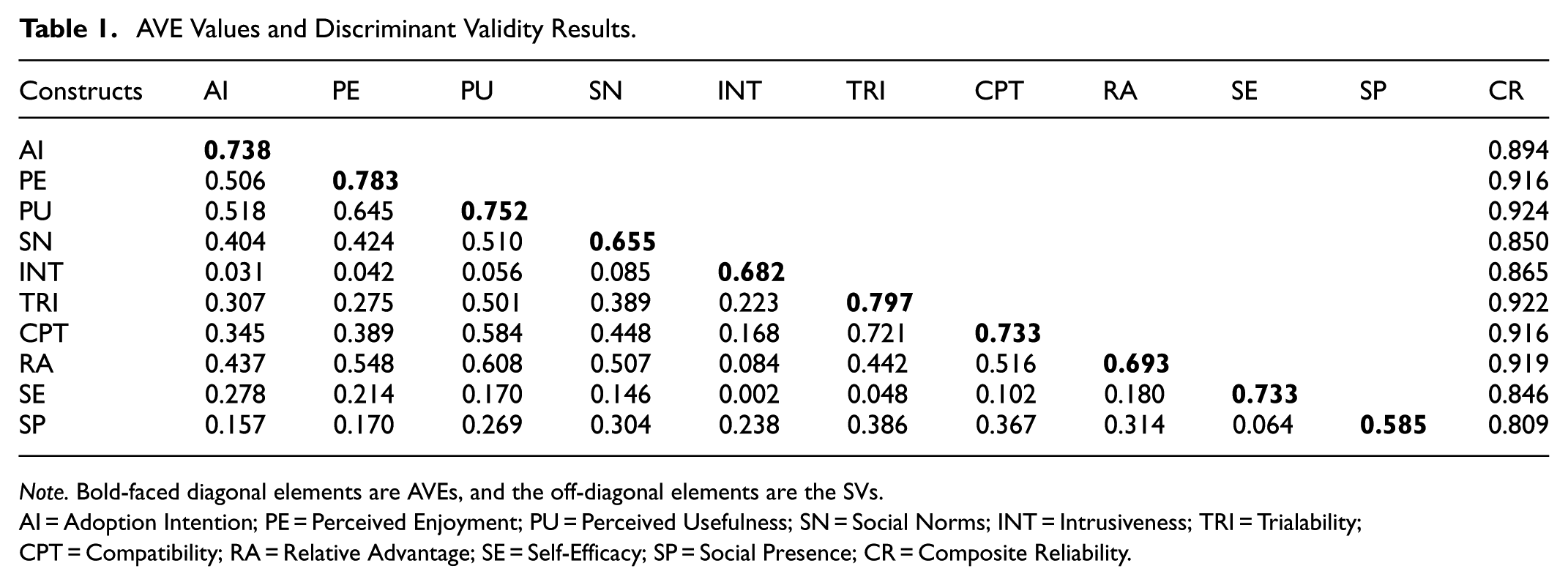
Note. Bold-faced diagonal elements are AVEs, and the off-diagonal elements are the SVs.
AI = Adoption Intention; PE = Perceived Enjoyment; PU = Perceived Usefulness; SN = Social Norms; INT = Intrusiveness; TRI = Trialability; CPT = Compatibility; RA = Relative Advantage; SE = Self-Efficacy; SP = Social Presence; CR = Composite Reliability.
Hypothesis Testing Results
Hypotheses (i.e.,
Similarly, results showed that SARs’ compatibility (β = .236, p < .001) and relative advantage (β = .479, p < .001), social norms (β = .237, p < .001), and self-efficacy (β = .162, p < .001) significantly and positively influenced seniors’ perceived enjoyment of SARs. However, SARs’ trialability (β = −.097, p = .126) and intrusiveness (β = −.008, p = .811) insignificantly influenced their perceived enjoyment of SARs for aging in place. Unexpectedly, SARs’ social presence (β = −.111, p = .011) significantly and negatively influenced perceived enjoyment. Therefore,
Finally, perceived usefulness (β = .436, p < .001) and perceived enjoyment (β = .396, p < .001) of SARs significantly and positively influenced seniors’ adoption intention. Therefore,
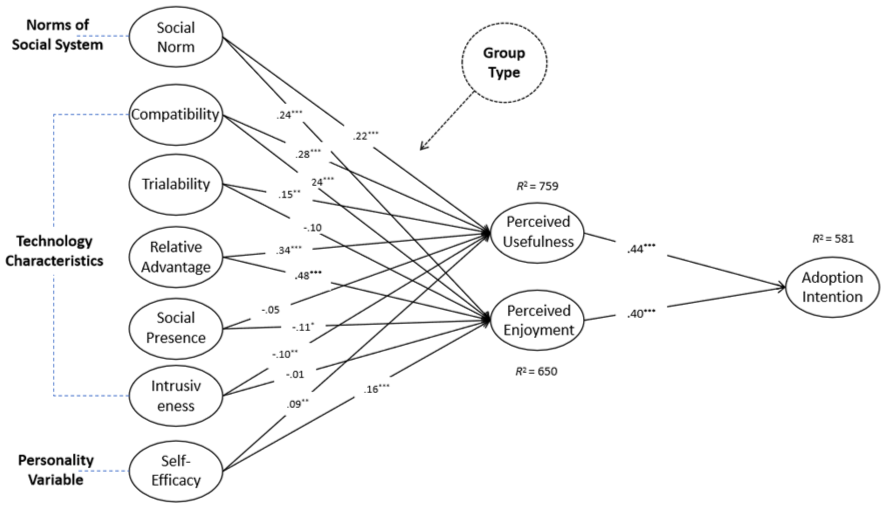
Standardized SEM results.
Results for Multi-Group Comparison
Two types of multi-group comparisons were tested to answer
SEM Comparison Results in Intergenerational Differences.

Note. SEM model fit indexes: χ2 = 3458.520, df = 1374, p = .001; χ2/df = 2.517; CFI = 0.933, IFI = 0.933; TLI = 0.922, and RMSEA = 0.036; *p < .05, **p < .01, ***p < .001.
SEM Comparison Results in Family Structural Differences.

Note. SEM model fit indexes: χ2 = 2008.395, df = 916, p < .001; χ2/df = 2.193; CFI = 0.945, IFI = 0.945; TLI = 0.936, and RMSEA = 0.040; *p < .05, **p < .01, ***p < .001; Families with no children were removed (n = 32) due to small sample size.
Comparison by Intergeneration
As shown in Table 2, SEM multi-group comparison results showed that seven out of 16 hypotheses differed significantly between retired and approaching-retirement seniors, which answered
In addition, the SEM multi-group comparison between retired seniors and their adult children revealed that five out of 16 hypothesized paths differed significantly between the groups. Specifically, the influences of trialability on perceived usefulness (z = 1.774, p < .05) was significantly stronger among adult children (βusefulness = .489) than retired seniors (βusefulness = .271). Similarly, self-efficacy had a significantly greater effect on both perceived usefulness (z = −1.667, p < .05) and perceived enjoyment (z = −1.667, p < .05) among adult children (βusefulness = .167; βenjoyment = .277) compared to retired seniors (βusefulness = −.071; βenjoyment = .128). In contrast, the influences of relative advantage on both perceived usefulness (z = −2.874, p < .01) and perceived enjoyment (z = −2.186, p < .01) were significantly stronger among retired seniors (βusefulness = .421; βenjoyment = .587) than among their children (βusefulness = .161; βenjoyment = .361).
Comparison by Family Structure
The SEM multi-group comparison based on family structure (only-child vs. multi-child families) also showed that five of the 16 hypotheses differed significantly (see Table 3), which answered
Discussion and Conclusion
General Discussion
This study integrates two theoretical frameworks—IDP and TAM—to comprehensively investigate how technological characteristics, social influences, and individual user attributes influence seniors’ intentions to adopt SARs to support aging-in-place.
First, our findings address the first aim of this study by identifying the key technological, social, and individual determinants that shape seniors’ intentions to adopt SARs. The results clarify that both cognitive (perceived usefulness) and affective (perceived enjoyment) pathways jointly drive adoption, and that specific design characteristics (e.g., compatibility, relative advantage, and reduced intrusiveness) play central roles in shaping these perceptions. Specifically, the results reveal that both perceived usefulness and perceived enjoyment significantly and comparably influence seniors’ intentions to adopt SARs, underscoring the importance of both cognitive evaluations and affective responses in technology adoption. These findings are consistent with prior studies (e.g., Chatterjee et al., 2021; H. Lin et al., 2024; S. Sun et al., 2024) and suggest that SARs designed to assist with daily tasks while also providing enjoyable experiences through social interaction can enhance adoption intentions among older adults. This dual effect highlights that practical utility alone is insufficient to drive adoption; rather, emotional engagement is equally crucial for sustaining seniors’ motivation to integrate SARs into their daily lives.
Next, among the technological attributes examined, compatibility, trialability, relative advantage, and intrusiveness significantly influenced seniors’ perceived usefulness. These results align with prior research in diverse domains (e.g., Koh et al., 2021; Yoon & Lim, 2020). Specifically, when SARs are seen as compatible with seniors’ lifestyles and needs, and when users are provided with opportunities to test their functions, their perceived utility increases. The perception of relative advantage over traditional alternatives further reinforces the functional value of SARs. Conversely, perceived intrusiveness negatively affected perceived usefulness, highlighting concerns regarding privacy, autonomy, and constant monitoring. Notably, the negative relationship between social presence and perceived usefulness diverged from earlier findings (e.g., Čaić et al., 2020; Heerink et al., 2008a), instead aligning with H. Lin et al. (2024), who found that family caregivers did not view human-like interactions as functionally valuable while performing care-related tasks. These findings suggest that older adults may regard SARs more as utilitarian tools than as social companions, particularly during early exposure phases, where familiarity and trust are still developing. Thus, these results indicate that in early adoption stages, practical design features such as compatibility, trialability, relative advantage, and intrusiveness, rather than social presence, play a decisive role in shaping seniors’ evaluations of SARs’ functional value.
In terms of perceived enjoyment, compatibility and relative advantage emerged as significant positive predictors, whereas trialability and intrusiveness showed no significant influence. These findings support prior work (e.g., Yoon & Lim, 2020), indicating that when SARs align well with seniors’ routines and offer discernible benefits, they are also more likely to be perceived as enjoyable. The lack of significance for trialability may stem from the fact that brief exposure does not necessarily foster emotional attachment or engagement, particularly among users unfamiliar with robotic technologies. Similarly, the non-significant effect of intrusiveness on enjoyment may indicate that while invasions and privacy concerns can impact perceived usefulness, they do not directly affect how pleasurable or satisfying the robot is to use, especially if users prioritize function over emotion since SARs are mainly designated to aid or improve elderly care services (Fardeau et al., 2023; H. Lin et al., 2024). Interestingly, but unexpectedly, social presence significantly decreased seniors’ perceived enjoyment of SARs. This counterintuitive result suggests that older adults may experience discomfort or unease when SARs exhibit overly human-like characteristics or attempt to simulate social interaction. Rather than enhancing engagement, a high level of social presence might trigger concerns related to privacy, artificial intimacy, or the blurring of human-machine boundaries, which could reduce the overall enjoyment of interacting with the robot. This contrasts with previous studies (e.g., Čaić et al., 2020; Heerink et al., 2008a) that emphasize the benefits of human-like interaction in technology acceptance. These results suggest that subtle, non-intrusive designs that are compatible and competitive without overstating sociability may better promote enjoyment and long-term acceptance of SARs among older adults.
Moreover, social norms and self-efficacy significantly and positively affected both perceived usefulness and perceived enjoyment, underscoring the influence of external and internal factors on technology perceptions (Rogers, 2003; Tornatzky & Klein, 1982). The role of social norms highlights how encouragement or approval from important referents—such as family members, caregivers, and peers—can enhance seniors’ evaluation of SARs. This aligns with existing research emphasizing the role of interpersonal influence in collectivistic cultures, where seniors may rely heavily on others’ opinions due to limited prior experience with emerging technologies (Hsu & Peng, 2022; S. Sun et al., 2024). Self-efficacy, as an internal driver, was also crucial. Seniors with higher confidence in their ability to understand and operate new technologies were more likely to perceive SARs as both useful and enjoyable, echoing findings from Kim et al. (2021) on the role of self-efficacy in reducing technology anxiety and fostering engagement. These findings highlight that interventions aimed at enhancing seniors’ technological confidence and fostering supportive social environments may substantially increase acceptance and sustained use of SARs.
Second, multi-group analysis results fulfill the second purpose of the study by revealing systematic differences across life stages and generations. The findings show that pre-retirement and retired seniors weigh technological attributes differently, and that adult children often place greater emphasis on trialability and self-efficacy than seniors themselves, highlighting perceptual gaps that influence adoption dynamics within families. Specifically, the multi-group analyses revealed notable differences based on life stage. Compatibility significantly influenced perceived usefulness and enjoyment among seniors approaching retirement, but not among those already retired. This suggests that individuals nearing retirement are more sensitive to how technologies align with their anticipated lifestyle changes, while retired seniors may prioritize immediate utility and performance over lifestyle fit. Additionally, trialability negatively impacted perceived enjoyment among the pre-retirement group, possibly due to heightened expectations or anxieties about transitioning into a new life phase. Social norms also had a stronger impact on pre-retirement seniors, indicating their greater receptiveness to external opinions during this transitional period. These patterns imply that strategies promoting SAR adoption should consider life-stage differences emphasizing future-oriented benefits for pre-retirement seniors and practical assistance for retired seniors.
Next, intergenerational comparisons between retired seniors and their adult children revealed further disparities. Adult children attributed greater importance to trialability and self-efficacy in shaping perceived usefulness and enjoyment than the seniors themselves. This may reflect adult children’s emphasis on building their parents’ confidence through exposure and their assumption that technological readiness is critical to acceptance. Conversely, seniors may undervalue their own self-efficacy, suggesting a perceptual gap in how capability and readiness are understood within families. This discrepancy highlights the need for intergenerational communication strategies that align expectations, ensuring that family members collectively support seniors’ confidence and comfort with SAR use.
Finally, this study addresses the third aim by demonstrating how family structure shapes seniors’ evaluations of SARs. Distinct pathways among only-child and multi-child families, particularly regarding social presence, social norms, and self-efficacy, underscore the need for family-sensitive strategies in designing and promoting SARs. In multi-child families, social presence had a stronger negative influence on both perceived usefulness and enjoyment than in only-child families. This may be due to more complex caregiving dynamics or concerns that SARs could interfere with traditional family roles, whereas seniors with a single child may experience more moments of loneliness, consequently expressing relatively less negative perceptions toward social cues. Conversely, in only-child families, social norms had a stronger influence—particularly on perceived enjoyment—possibly due to the central role of the only child in caregiving and emotional support. Additionally, seniors with multiple children showed a stronger relationship between self-efficacy and perceived usefulness, suggesting that broader social support may enhance technological confidence. Importantly, perceived usefulness had a stronger influence on adoption intention among only-child families, indicating that these seniors may prioritize practical functionality when making technology-related decisions. These findings collectively underscore that family context shapes how seniors evaluate and adopt assistive technologies, emphasizing the importance of tailoring SAR design and promotion strategies to family dynamics.
Theoretical Implications
This study offers several theoretical contributions by integrating IDT (Rogers, 1962) with TAM (Davis, 1989) to explore the psychological and contextual, internal and external determinants of SAR adoption among older adults and their families in China. First, by incorporating social norms (from IDT’s prior conditions) and technology attributes (from innovation characteristics) as external factors within TAM, and by adding self-efficacy as an internal variable, the study extends the explanatory power of both models. Moreover, the inclusion of perceived enjoyment—an affective construct not originally considered in either TAM or IDT—demonstrates the relevance of emotional and experiential factors in the adoption of socially embedded technologies. The comparable influence of perceived usefulness and perceived enjoyment highlights the need for a dual-path model that acknowledges both cognitive and affective dimensions of user evaluations.
Second, while IDT identifies five core innovation attributes (relative advantage, compatibility, complexity, trialability, and observability), this study extends the framework by incorporating negative characteristics—namely, intrusiveness and social presence. These additions provide a more nuanced understanding of how both enabling and inhibiting features shape adoption in assistive robotics.
Third, this study responds to recent scholarly calls (e.g., Mannheim et al., 2023) to explore intergenerational differences in technology adoption. By comparing both seniors in different life stages and seniors with their adult children, the study identifies distinct evaluative patterns and decision-making processes. Given the well-documented importance of intergenerational support from adult children in eldercare (Ai et al., 2022; Köttl et al., 2021), these findings contribute valuable insights to the literature on aging, family dynamics, and innovation adoption.
Finally, the study adds cultural depth by examining how family structures shaped by China’s OCP influence SAR adoption in the particular aging-in-place context. This opens new avenues for research on how policy-driven family configurations impact perceptions of emerging technologies in eldercare. Overall, these results extended both TAM and IDP by including highly relevant but neglected variables, either as antecedental determinants or moderators, to provide a comprehensive view of factors influencing seniors’ adoption intentions of SARs for aging in place.
Managerial Implications
The findings offer several practical insights for developers, service providers, and policymakers seeking to promote socially assistive robots (SARs) for aging in place. First, SAR designs should emphasize compatibility, relative advantage, trialability, and low intrusiveness to enhance both perceived usefulness and enjoyment. Aligning SAR functions with seniors’ daily routines and clearly demonstrating their practical benefits over traditional solutions can increase acceptance. Also, offering controlled, hands-on trial opportunities may further build familiarity and reduce uncertainty. In parallel, minimizing intrusive features such as constant monitoring or data collection without permission can mitigate privacy and autonomy concerns. Designers should ensure that SAR functionality integrates seamlessly into seniors’ lifestyles while clearly communicating its advantages over traditional solutions. These strategies are particularly valuable for practitioners aiming to promote assistive technologies in contexts such as healthcare, home-based care, and age-friendly living environments, where functional integration and trust are critical.
Second, the unexpected negative effects of social presence suggest that highly anthropomorphic designs may elicit discomfort and reduce utility perceptions, particularly among seniors approaching retirement or those in multi-child families. Developers should therefore prioritize functional reliability and emotional subtlety over exaggerated human-likeness. Further, carefully calibrate the social elements (e.g., facial expressions, voice tone modulation, or small talk) of SARs to be supportive but not overly intimate can prevent unease and strengthen user trust. Early-stage adoption may benefit more from gentle, respectful interaction cues rather than highly social or emotionally expressive behaviors.
Third, the significant influence of social norms and self-efficacy underscore the importance and necessity for socially reinforced and competence-building interventions. Community-based endorsements, peer influence, family involvement, and digital literacy training can reinforce both user confidence and social approval to enhance acceptance. For example, involving respected opinion leaders, local caregivers, or satisfied users in promotional efforts may increase normative pressure and facilitate adoption. Concurrently, digital literacy programs and hands-on training sessions can strengthen seniors’ confidence in operating SARs, reducing anxiety and enhancing engagement.
Finally, communication strategies and support systems should be tailored to different user segments. For seniors nearing retirement, messaging should emphasize lifestyle alignment and future planning and preparation. For retired seniors, highlighting immediate utility, reliability, and ease of use may be more persuasive. Given intergenerational differences, family-centered communication tools, such as joint information sessions or interactive guides for seniors and adult children, can bridge perception gaps and support shared decision-making.
Limitations and Future Research
Despite the theoretical and practical contributions of this study, several limitations should be acknowledged, which also provide avenues for future research. First, the study examined a limited set of variables from the IDP. Specifically, it selected one external factor (social norms), one internal personality trait (self-efficacy), and three technological characteristics (compatibility, trialability, and relative advantage) from the five innovation attributes originally proposed. Although these choices were theoretically grounded, other relevant constructs—such as complexity, observability, trust, perceived risk, or innovativeness—were not included. Future studies could expand the model by incorporating a broader range of antecedents to offer a more comprehensive understanding of SAR adoption behavior.
Second, the samples of this study have constrained its generalizability. Data were collected online via a self-administered survey, which may have led to sample bias. Senior participants in this study likely possessed relatively high levels of digital literacy, potentially excluding less tech-savvy seniors who may have more critical perspectives or different experiences with SARs. Although the educational backgrounds of the respondents were diverse, future research should aim to include broader age groups—especially seniors over 70—and individuals with lower digital competencies, possibly through face-to-face or paper-based questionnaires.
Third, while this study explored intergroup differences based on life stage, intergenerational role, and family structure, other potentially influential demographic or psychosocial variables were not considered. For instance, factors such as economic status, social class, personality traits (e.g., openness to experience), caregiving burden, or prior technology exposure may further moderate adoption intentions. Future research should explore these additional variables to refine the adoption model and enhance its predictive power across diverse user segments.
Finally, this study focused on the Chinese context, where cultural values such as filial piety, collectivism, and family-centered caregiving norms may strongly shape perceptions of assistive technologies. While these cultural characteristics are central to understanding SAR adoption in China, they may limit the applicability of the findings in other cultural or national settings. Future comparative studies across different countries or regions could illuminate how cultural contexts mediate the relationships between technology characteristics, user attributes, and adoption outcomes.
Footnotes
Appendix
Due to word limits, the appendix will be provided via a web link after the manuscript is accepted.

Ethical Considerations
This study was approved by the Research Ethics Committee at the Zhejiang Fashion Institute of Technology on May 10, 2024.
Funding
The authors disclosed receipt of the following financial support for the research, authorship, and/or publication of this article: This work was supported by the 2025 Zhejiang Provincial Philosophy and Social Sciences Planning Project [No. 25NDJC193YB].
Declaration of Conflicting Interests
The authors declared no potential conflicts of interest with respect to the research, authorship, and/or publication of this article.
Data Availability Statement
Data is available upon request.