




Abstract
This study addresses the conceptual ambiguity surrounding family policy (FP) literature, while also filling a knowledge gap related to the geographic and gender aspects of scholarly authorship. Employing a semi-systematic literature review and a mixed-methods approach, we analysed 232 peer-reviewed articles published in leading scientific journals indexed in the Web of Science – Current Contents Connect database during the period 2012 to 2022. The study applied text content analysis to examine how FP is conceptualised and to investigate who contributes to this academic field – considering authors’ gender, institutional affiliations, and the geographic scope of their research. The findings confirm the presence of significant conceptual ambiguity, reflected in a wide range of FP conceptualisation types. In addition, the study supports the hypothesis of geographic bias, with a marked predominance of authors affiliated with institutions in the United States and, unexpectedly, Sweden – a pattern that may reflect long-standing national traditions of comprehensive family and social policy. Contrary to expectations, female scholars were found to constitute a majority among authors contributing to the FP literature in the analysed sample. This study helps to address existing gaps in the literature by offering new empirical insights into the conceptual, gender and geographic landscape of FP research. Its originality lies in its interdisciplinary positioning at the intersection of conceptual analysis, gender studies, and geographic mapping. The findings also open several avenues for future research, including the exploration of conceptual linkages between FP broader social policy, and gender equality frameworks, as well as further investigation into the notable prevalence of female authors in this field.
Introduction
Family policy (FP) is relatively young policy area, and during the last decades, a great number of works contributed to knowledge in the field. Very first studies dedicated to FP appeared already since 20’s of the last century (e.g., Hoffner, 1935; Waggaman, 1924). But Gauthier and Koops (2018) track the concept of FP just to the 50’s and early 60’s, when the first academic studies focused specifically on the family issues from the whole welfare system. Later, as FP occurred more frequently in the political discourse, it also started to be observed in academic literature more often. Scope of research was influenced by the vibrant decades after world wars, war in Vietnam, in the Middle East, on Balkan, and the financial, migration and recently also the Corona crisis.
However, only little attention has been put on the conceptual ambiguity of FP, and the gender and geographic aspects of authorship of academic literature on FP. Eydal and Rostgaard (2018) outline different understandings of FP. This could determine the published knowledge in the field (see Asghar, 2018; Breuning & Sanders, 2007; Fox et al., 2018; Simon & Henrekson, 2019, etc.) and therefore, it is an intriguing issue to consider. FP as concept remains quite vague despite is used by many authors recently, which observe its cross-country changes, calculate its effects on reproductive behaviour, poverty etc. (e.g., Billingsley et al. 2022; Hart et al., 2024; Spéder et al., 2020). Mostly in developed countries, FP is often linked to fertility rate and its increase, which is a quite narrow view, but dominant in the last decades in demographic provenience (e.g., Sobotka et al., 2020). Moreover, FP is sometimes mixed with narrowly understood concepts of population and pronatalist policy. This is especially characteristic of demographic studies and studies on population control and family programs (Böger et al. 2022). The fact that the terms population and FP are used vaguely and often interchanged is evidenced, for example, by the publication May and Goldstone (2022), where some chapters have the title population policy, others family policy. There are differences in whether the research concerns developed or developing countries and whether the goal is to increase or decrease the birth rate (in poor countries). The conceptual ambiguity of FP is generally little discussed, and certainly not by semi-systematized methods.
This study partially fulfils this research gap and connects the conceptual discussion with the empirical evidence on geographic and gender aspects of authorship in contemporary academic FP literature. In the academic literature usually dominate the authors from developed countries of Global North, especially USA and UK (see e.g., Simon and Henrekson, 2019). From gender perspective male first and/or corresponding authors prevail (see e.g., Fox et al., 2018; West et al., 2013). However, gender and geographic aspects have not been studies in the field of FP literature. Our study provides a semi-systematised review of leading FP literature for the very recent decade (2012–2022) and use combined qualitative and quantitative methods to answer the following research questions: (1) How the FP is conceptualised in contemporary academic literature? (2) Authors of which country and gender dominate in FP literature? (3) What is the geographic scope of the FP literature? (4) And how the understanding of FP as concept relates to the geographic and gender aspects of authorship?
Theoretical Background
Concepts of Family Policy
Concept of family policy (FP) is used in various forms and meanings within the academic literature. The authors use either singular or plural form, use the concept of ‘family-friendly’ policy, or describe the FP ‘regimes’, ‘environments’, apply a gender or feminist perspective etc. However, there are not many pieces of literature, which discuss the actual types of conceptualisation of FP. Eydal and Rostgaard (2018) represent one of few exceptions. They differentiate between wide, middle range and narrow definitions of FP. They attached to the middle one and stated that ‘such a definition takes the family as the starting point and examines policies that are aimed at families, hence emphasising how the policy defines the nexus between state and family and between family members’ (Eydal & Rostgaard, 2018, p.2). They suggest narrowing down too broad definitions by stating the limits to the meaning of family, which is, indeed, also quite blurry and varies across the cultures.
To distinguish the narrow and the wide understanding of FP, the dichotomy by Kamerman and Kahn (1978) is useful. They differentiate between explicit and implicit FP. Later Daly’s (2020) contribution clarifies that explicit policy is directly linked to the situation of families, while the implicit ones are those, which are not primarily addressed only to families, but they have effects also on then. Similarly, Zimmerman (1995: 5) uses the dichotomy of explicit and implicit FP, but distinguishes between manifest and latent, direct and indirect, intended and unintended FP. These are related to the way of formulation and direction of the policy, yet also the effects, the consequences of FP. However, they are not discrete categories and might be combined.
Further, the conceptual meaning of FP has been affected by the changes in the union formation and structure, reproductive behaviour as well as gender roles, which have undergone vast transformation including genderisation (e.g., same-sex marriages) and feminisation (e.g., rise of female labour market participation). Consistently with these changes, the feminist and gender literature tend to reduce the concept of FP, because they put the emphasis on the interventions oriented on the individual well-being inside a family as a group of individuals (see McCannell, 2009; Williams, 2004). And we can expect also further changes in development of FP conceptually and within the policy realm. Gauthier and Koops (2018: 19) suggest that: “Promising future avenues reside in ways of more accurately capturing the actual level and diversity of support received by different types of families including due consideration to the issues of eligibility to policies and support from the workplace.”
In present study we utilise three types of conceptualisation of FP according to Eydal and Rostgaard (2018). The detailed description of the operationalisation of the three types is included in the methodological section and visualised in Figure 1. First, the narrow conceptualisation (or Daly’s (2020) explicit understanding of FP) means a single, individual policy measure or reform. It covers the leave policies, tax reliefs, early-childhood education and care policies etc. In this sense, even the plural form could be used – no single or overlapping ‘family policy’ but ‘family policies’, when listing several individual measures, or ‘policies’. In contrast, wide type of conceptualisation (or the implicit type according to Daly (2020)) then covers the opposite situation – the sum of more FP measures, the singular form (one FP which covers several measures), and combinations of different policy areas (family, labour, pension, housing policy, etc.). And finally, the middle-range conceptualisation could be found, where the narrow and wide type is mixed – when the authors use both singular and plural form, combine different policy measures within FP etc.

The operationalisation of conceptual types of family policy.
The Geographic and Gender Aspects of Authorship
Besides the actual meaning of FP within the academic literature, the question of authorship became attractive among scholars recently and authors have observed various aspects of authorship of literature from various fields. For example, Bouanani and Kassou (2014) review a considerable number of authorship analyses and identify several authorship features such as authors’ identity, type of document, language and stylometric features (lexical, syntactic, structural, and content-specific features), while distinctive methods, including text analysis or machine learning, could be used (Bouanani & Kassou, 2014). The co-authorship networks are also subjects of scholarly interest and research. Especially the institutional affiliation (university) and frequency of publishing are emphasised (T. H. Huang & M. L. Huang, 2006). Studies of this type contribute to the general overview of collaboration across academic fields but omit gender aspects of authorship.
Another huge topic is the number and order of the authors. Hundley et al. (2013) show that there are heterogenous practices across the study fields. In medicine and health science more authors use to be listed, even though each of them have only a minor contribution, what might cause so-called ‘authors inflation’ and blur the responsibility of content. The study fields differ vastly and sometimes are strict about usual and maximal number of authors in articles (Hundley et al., 2013). Regarding the order of authors, for example, in biology science, the leading author is often listed as the last one, and in literature of economic sciences authors used to be listed alphabetically (Hundley et al. 2013; Strange, 2008). In geology ‘he or she who does the most work and drives a paper forward goes first and the order there after reflects the level of contribution.’ (Smith, 2009 as cited in Hundley et al. 2013). Newly, the possibility of co-first authorship has been introduced by some journals, as the order is important, however, ‘someone always has to go first’, and some institutions do not recognise this format, what mitigate the significance of the second author (Rose-Clarke & Fellmeth, 2019). The question of authorship thus matters, and there are several aspects of authorship of academic works, which could be observed.
In the present study two aspects are paid attention to. First, the geographic aspects, on which we can look from two viewpoints: First, the geography of scholars’ affiliation (country and institution where the article was written), and second, geographic scope of the research (which countries have been studied, and which are omitted). As noted above, in studies about academic authorship the geographic aspects have been taken in consideration usually only implicitly, while the emphasis is placed on literature from certain region or state.
Only a few authors researched the geographic aspects of academic literature in comparative perspective. For example, the corresponding author in co-authorship was usually the one from an English-speaking country despite the order (Fox et al., 2018). Even though all scholars around the world publish, the actual production of scientific knowledge is cumulated in few centres – the elite universities such as Stanford, Harvard and Chicago University, and their cooperation (Jones et al., 2008). The research shows that despite the greater social and geographic distance; the elite research centres persist to lead the published academic knowledge (Jones et al., 2008). In recent years, the co-authorship particularly between USA and non-USA scholars increased (Simon and Henrekson, 2019). However, the geographic bias meaning the dominance of the USA persists as the most top-journals authors hold a PhD. from university in the USA, and most of the first listed authors come from USA (Jones et al., 2008).
Although the geographic aspects seem to play a role in the overall picture of authorship, in general less attention is put on them. Even less comparative research is done, and nearly none on the topic of FP. Currently there is no study about the geographic scope of the FP research. We thus cannot estimate, which countries are researched in the field of FP, and which are not covered yet. In this study we address this research gap.
Finally, the gender aspects: The question of gender aspects of authorship of scientific literature is tightly connected to already discussed geographic aspects. For example, gender gap favouring male authors is still a relevant in the USA and UK (Asghar, 2018; Breuning & Sanders, 2007; Jagsi et al., 2006). There is evidence of disproportionately lower representation of female first authors from low- and middle-income countries (regions of South America and Africa), while overrepresentation of them was found in the UK (Ochuko-Emore et al., 2010). Generally, women from low- income and middle- income countries were at a disadvantage in terms of the impact factor of the journals they published in and first and last authors from high- income countries were 19 times higher than authors from low- income countries (Merriman et al., 2021). The connection between gender and geographic aspects thus deserves further attention.
Quite huge body of literature is oriented on the gender gap favouring male authors in academic literature in various fields, for example, in political science (Breuning & Sanders, 2007) cardiology literature (Asghar, 2018), paediatric journals (Marrone et al, 2020), in prominent medical journals (Jagsi et al., 2006), in archaeology literature (Colwell-Chanthaphonh, 2004), ecology (Fox et al., 2018), psychiatry (Ochuko-Emore et al., 2010), etc. There is evidence that male authors dominate in certain fields as the first and last authors, and also in single-authored papers (West et al., 2013). And regardless of country, women were more likely to be first listed but not the corresponding author (Fox et al., 2018). They are more likely to publish in prominent journals (Breuning & Sanders, 2007). In certain scientific fields, the number of female authors listed as the first, and the last (meaning the senior author) has increased significantly (Jagsi et al., 2006). Although the proportion of men and women is nearly equal among medical graduates, and continually also in number of physicians and trainees in cardiology, the gender gap in academic literature in the field persists (Asghar, 2018). We can thus expect the male dominance also in FP literature across countries with a probable prevalence of authors from developed Global North countries.
Research Questions and Hypotheses
Grounded in reviewed state of the art, we aim to answer the following research questions and test related hypotheses:
RQ1 and related H1 refer to sooner discussed conceptual ambiguity of the term FP in the academic literature. In particular, we aim to observe different understandings as sooner described by for example, Eydal and Rostgaard (2018) or Zagel and Lohmann (2020).
RQ2 asks on two important sooner discussed aspects of the authorship in academic literature – geography and gender. Hypotheses assume, first the dominance of authors from developed countries of Global North, especially USA and UK (see e.g., Simon and Henrekson, 2019); second, H2 assumes prevalence of male first and/or corresponding authors (see e.g., Fox et al., 2018; West et al., 2013).
The third research question addresses the largely underexplored issue of the geographic scope within FP research. Using qualitative content analysis (as described in the following methodological section), the aim is to identify, which countries are most frequently studied in the context of FP. Given the limited existing literature and the highly exploratory nature of this question, no hypothesis is proposed. The same rationale applies to the final research question (RQ4).
Finally, we aim to synthesise the findings related to the previously formulated research questions (using quantitative methos described later in detail). Specifically, RQ4 investigates the relationships between the conceptualisation of FP, the geographic scope of contemporary FP literature, and the authorship characteristics within this literature.
Methods
This study uses combined qualitative and quantitative methods. First we describe our literature review approach and the sample collection, then the text content analysis and finally, the details of statistical analysis using OLS regression models.
Literature Review and Sample Collection
We provide a semi-systematised literature review as described by Snyder (2019). This approach ‘can be useful for detecting themes, theoretical perspectives, or common issues within a specific research discipline or methodology’ (Snyder, 2019, p.335). The approach uses mixed methods, and the result is an overview of research over time in certain scientific fields: we quantitatively chose our sample of leading literature in the field (as described below). Qualitative part rested in scanning of all included articles and the identification of key characteristics, which were further analysed.
Regarding the sampling, some of the reviews and meta-analyses focus only on the single journal (T. H. Huang & M. L. Huang, 2006) or the sample consisted of few prominent journals in the field (Breuning & Sanders, 2007; Jagsi et al., 2006; Simon & Henrekson, 2019). Another option is to study the whole database (West et al., 2013). Authors made use of Jstore (West et al., 2013) or Scopus database (Asghar, 2018). Scopus database is reviewed as having a rich volume of relevant influential literature (Kirilenko & Stepchenkova, 2018; Vuong et al., 2017). However, Web of Science (WoS) is even huger database in terms of variance in journals and research areas, it contains several tools for data selection, and it is often used for literature reviews (see e.g., Moiwo & Tao, 2013; Moreno-Guerrero et al., 2020; Persson, 2010). The availability and accessibility of this database is especially an advantage.
Using the semi-systematised literature review approach, we provided a sample selection from WoS database, particularly from the Current Contents Connect sub-database of WoS, which includes the most prominent and influential journals from most scientific fields. Snyder (2019: 338) warns that ‘limiting the sample too greatly is a warning flag, as it affects both the depth and rigorousness of research, and it can have serious effects on its results and contributions.’ Bearing this in mind, we included all articles from WoS-Current Contents Connect. The sample selection can be repeated using the below listed criteria. However, the final number of articles could be different depending on the time of searching (our sample was completed up to date 2nd of August 2023). To narrow down a huge amount of academic literature, we defined the following criteria:
‘family policy’ as a topic and as a keyword, which implies also plural (‘family policies’) automatically;
Period of 2012 to 2022;
‘article’ as a document type (excluding e.g., the books, or chapters);
Research fields limited to ‘demography’, ‘family studies’, ‘sociology’ and ‘geography’;
Exclude the preprint publications;
English language only.
Using these criteria, we manually collected 232 academic articles. Parameters of each article were manually coded into Microsoft Office 365 Excel spreadsheet. We observed following parameters:
Article and journal name;
Year of publishing;
Number of authors;
Gender of authors (number of female and male authors);
Name, gender, and country of affiliation of corresponding author;
Geographic scope of research (analysed countries).
Text Content Analysis
To research the conceptual ambiguity of family policy (FP) within the scholarly literature we use combined method of qualitative and quantitative text content analysis. Krippendorff (2004, 2018) suggests that ‘quantitative/qualitative distinction is a mistaken dichotomy’ because both approaches could bring about valuable and scientifically rigorous knowledge (2004: 87). He further underlines the satisfying reliability, validity and even replicability of the method of content analysis and describes it as a ‘research technique for making replicable and valid inferences from texts (or other meaningful matter) to the contexts of their use’ (Krippendorff, 2004) We also build on Mayring’s (2004, 2021) qualitative content analysis approach. Mayring (2004) especially highlights the need of either inductively or deductively prepared categories with codes and the process of their revision during the analysis, while this should not harm the systematic character of this method. As mentioned earlier, there is not a consistent view on the meaning of the concept of FP. Therefore, a combined method of quantitative and qualitative text content analysis is an appropriate choice to research conceptual ambiguity in academic literature.
To provide replicable and valid qualitative part of text content analysis we designed the operationalisation framework (Figure 1). The framework is based on earlier reviewed state of the art on conceptualisation of FP. As discussed earlier, based on Eydal and Rostgaard (2018) we distinguish three types of conceptualisations of FP: wide, middle-range, and narrow definition of FP. We used four indicators to distinguish them.
First, the singular or plural form of FP distinguishes whether it covers more measures and policies at once (one policy covering other, what indicates wide understanding) or it labels only a single policy and when authors mention more of them, they use the plural form (suggests the narrow understanding).
This relates to the second indicator, which goes beyond the used lexical form (singular/plural) and focuses on the content of FP– whether it is a sum of more measures (which are broadly or narrowly linked to family life) or is a single measure. Under the ‘sum of family-related policies’ typical for the middle-range definition of FP could be listed numerous and various measures like cash transfers, credits, leave policies, early childhood education and care, etc. (the most frequently covered by FP according to Daly, 2020). The FP measures included in other categories are then categorised as ‘other policy areas (labour, housing, education…)’ typical for wide understanding of FP, for example, economic and budgetary policy, health care policy, social security, education policy, etc. (see e.g., Kraft & Furlong, 2019).
The third indicator focuses on the presence of FP ‘context’, ‘environment’, ‘regimes’, and ‘family-friendly’ policy, which use to appear in academic as well as in non-academic literature (see e.g., Engster & Stensöta, 2011; Hampden-Thompson & Pong, 2005; Nordenmark, 2021; Phipps, 1999). These could cover different amounts and types of measures and could connect or even mix FP with other policy areas such as labour, migration policy. They thus suggest a wider view of FP as they propose a sum of policies.
And finally, the fourth indicator focuses on the feminisation or genderisation of FP, which reflect on the changes of unit formation, structure, gender roles, new types of families (like same-sex ones) etc. (see e.g., Arpino et al., 2015; Beaujouan, 2020; Bianchi, 2005; Gates, 2015; Zimmerman, 1995). For instance, Williams (2004) sketches a new picture of family and family life, which has serious implications to the concept of FP, its extent, and content. She addresses spread of individualism and need for institutional care, a decline of life-long marriages, a move away from ‘male breadwinner’ family model, and policies amending the caring practices between men and women. In this spirit, Evertsson et al. (2020) wrote about heteronormativity in family topic. Generally, feminisation or genderisation narrows down the concept of FP and can be found in articles focused on for example, paternity leave, father quotas, gender equality, same-sex couples’ families, queer family policy, etc.
The operationalisation framework was further used for manual qualitative text scanning and coding. Two separate rounds of coding were provided. For codes recording and visualisation of results we used Microsoft Office 365 Excel spreadsheet. Qualitative data on conceptualisation of FP and gender and geographic aspects of authorship of the sampled articles were further recoded for purposes of quantitative statistics as described below.
Statistical Analysis
To observe mutual relationship between conceptualisation of FP and the geographic and gender aspects of authorship we provided quantitative data statistics, namely OLS regression models (proceeded using R Studio software). We used our unique dataset, which includes no missing values . Number of subjects per variable is 232 (number of sampled articles), which is satisfying amount for the applied methods (see e.g, Gavilanes, 2020). We calculated several OLS regression models, and for the relevant results we performed the visualisation using sjPlots and sjStats library in R (Lüdecke et al., 2023a, 2023b).
Limits
The present study has several limitations. First, we outline the limitations connected to our sample. To narrow down a huge body of academic literature we determined four study fields in WoS to make our sample feasible for analysis, namely sociology, demography, geography and family studies. We have not taken in consideration the scientometrics and journal rankings and impact factor. This, indeed, limits the possibilities to generalise our findings to whole FP literature. But in WoS, the study fields could mutually overlap, therefore, articles from other fields can be included (e.g., economy or psychology) and the variance is thus not lost.
Second, the chosen period is another limitation. Yet, we covered the period of 2012 to 2022, when most of the articles have been published. In 2012 there was a sudden increase in FP literature in the WoS database. We chose this as a starting year and cover a decade, till the end of year 2022.
Further, the text analysis also has its limits. Even though the operationalisation framework is built on the current state of the art and it is closely linked to the current knowledge and trends in FP, we outline its weaknesses. For example, one could argue that feminist and gender perspectives could broaden the concept of FP. And the article does not untangle the conceptual ambiguity wholly; it only observes four indicators and finds out what type of conceptualisation is used by authors. Present study thus calls for follow-up research of definitions. We concentrate on FP literature, but the terms ‘population’ or ‘pro-natalist’ policy could be also used in some articles, when researching FP as mentioned above.
Finally, the synthesis of the findings is based on quantitative data analysis, which reduces the variance of qualitative data, for example, the shades of different types of conceptualisations coming from four indicators. Thus, our findings could not be generalised for whole FP literature or other fields of science.
Results and Discussion
Conceptualisation of Family Policy in Literature
First, we report the distribution of articles within different study fields, which might influence the conceptualisation of family policy (FP). Among four determined study fields sociology has the biggest share of articles – more than half of the sample (54%) – and geography (2%) the smallest one (Figure 2). The dominance of sociological over demographic journals is not a surprising finding in principle. Sociology encompasses by far the largest number of journals and studies, so it has been able to generate the largest number of studies focused on FP. Moreover, in sociological research there can often be an overlap between aspects of FP and social policy, since "both demography and sociology deal, for example, with primary social systems and with social processes" (Hoffmann-Nowotny 2000, p. 74).

The distribution of analysed articles across determined four study fields.
Focusing on the conceptualisation of FP within our sample of articles, it is quite surprising that from the whole sample (n = 232) one-third (34%) of articles included FP or plural form ‘family policies’ only as keyword without a single appearance in the body of the text or in abstract (Figure 3), which prevents further analysis according to our prepared operationalisation. Another third of sample included middle type of conceptualisation of FP. This type could be also called a ‘mixed’ one due to random use of singular and plural form, and combining of FP with other policy areas, as we discuss later. A wide conceptualisation appeared in 20% of articles, which connect FP tightly with other policy areas and focused on broader FP regimes, environments, contexts or family-friendly policy. The smallest share of articles (12%) included narrow conceptualisation, which is characterised by the focus on single policy (one measures), the use of plural form when analysing more ‘family policies’, and/or feminist and gender perspective on FP.
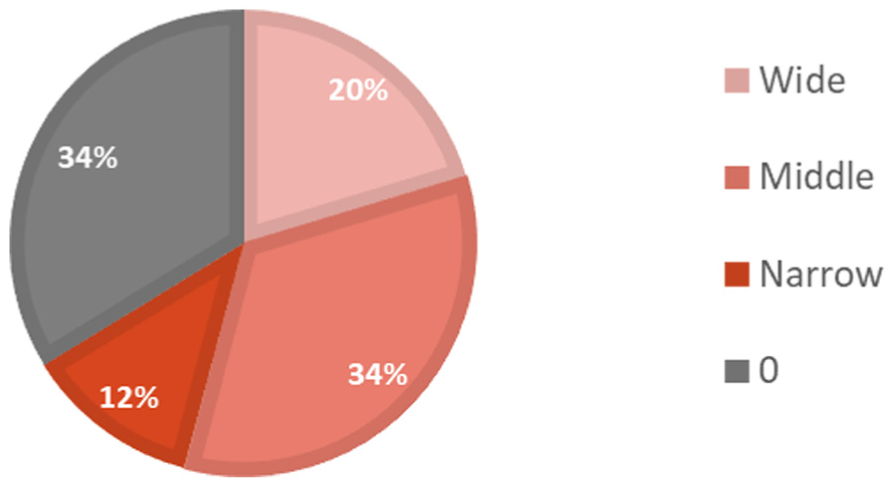
Conceptualisation of family policy in analysed articles.
A considerable temporal dynamic is evident in how FP is conceptualised in the analysed literature (Figure 4) mirroring the recent cross-country expansion of FP (Ferragina, 2019). Since approximately 2016, there has been a notable increase in articles using either a middle-range conceptualisation or no clear conceptualisation of FP. In contrast, narrow conceptualisations – typically focusing on single measures or adopting a gender/feminist lens – appear only rarely. The year 2019, previously highlighted for its sudden increase in FP publications, also marks a significant rise in articles that mention FP without offering any conceptual framework.

Conceptualisation of family policy in analysed literature over time.
Surprisingly, very few studies employed a narrow conceptualisation throughout the observed period. Rather than referring to individual policy instruments, authors tended to understand FP as a broader policy, often encompassing elements from labour, health, education, and other policy areas.
Based on our text analysis, we propose replacing the term ‘middle-range’ conceptualisation by Eydal and Rostgaard (2018) with ‘mixed’ conceptualisation. This better captures the observed tendencies: frequent and inconsistent use of both singular and plural forms of FP, blending of national and supranational perspectives, and a merging of individual measures with broader policy regimes, environments, or models.
Additionally, we noted the term ‘work-family policy/ies’ used as a keyword in approximately 30 articles, likely as a conceptual substitute for FP. This may indicate a close association between FP and labour policy. While we classified these cases under the ‘middle’ conceptualisation (given their focus on families and combination with related policy areas), this phenomenon warrants further investigation in future research.
Our findings support assumed substantial variation in how FP is conceptualised in contemporary academic literature, thereby supporting our H1 in line with for example, Zagel and Lohmann (2018). Notably, the use of a narrow conceptualisation of FP – typically focused on individual policy measures and/or grounded in feminist or gender-specific perspectives – has declined in recent years, following a period of steady increase between 2016 and 2020. Instead, scholars increasingly employ either no explicit conceptualisation or a middle-range approach. While gender and feminist perspectives may still be present, they are less frequently embedded within narrowly defined FP frameworks. Rather, they tend to emerge through the integration of labour and FP, as reflected in the frequent use of the term ‘work-family policy.’ This integrated framing – seen in the work of authors such as Matysiak and Węziak-Białowolska (2016), Matysiak (2005), and Coskun and Dalgic (2020)– appears to highlight issues such as maternal labour market participation, the gender wage gap, work-family balance, and broader gender roles within family life. These identified trends in conceptualisation of FP are recommended to be studied further as this topic is apparently dynamic in time.
Geographic Aspects of Family Policy Literature
Regarding the country affiliations of corresponding authors of FP literature, our sample covers 41 countries for a decade of 2012 to 2022 (n = 232 articles). Majority of the articles come from developed countries of the global North. It is evident that USA is an outlier as 27.29% of all articles of our sample has corresponding author with affiliation from USA (Figure 5). This agrees with earlier conclusions that (when WoS publications has been normalised with population) the number of publications per person has been much higher in USA in contrast for example, to China, what makes USA a leader (Moiwo & Tao, 2013). Further, UK and Sweden have also higher numbers of publications in FP literature. They are followed by Germany, and Spain. Interestingly, among more than 500 different collected institutional affiliations of the authors of FP literature, Swedish universities clearly lead. The most authors (30) have the affiliation of Stockholm University, and some other (12) of the Umea University. One explanation can be the fact that the Social Policy Indicator Database (SPIN, 2019) was developed at the Stockholm University, and it can attract the scholars and group them around the Stockholm University and cooperating Swedish universities. From among the developing countries, only few publications are by authors from, for example, Colombia and Argentina. The results thus support sooner conclusions (see e.g., Simon and Henrekson, 2019) as well as our hypothesis 2.1 on geographic bias in FP literature in favour of developed countries, especially the USA and UK.
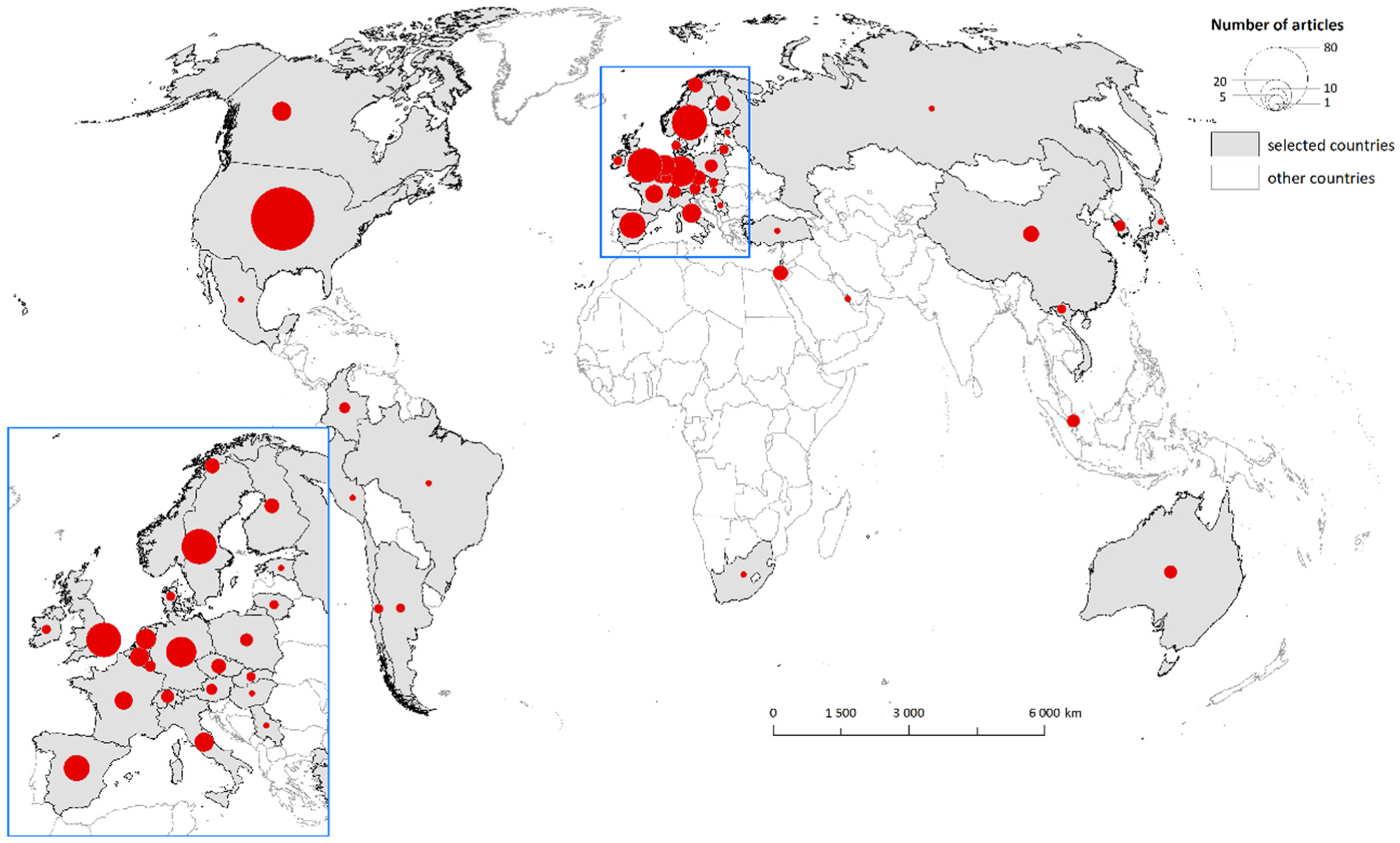
Number of articles per country (country of corresponding author) (2012–2022).
The amount of overall population of the countries could be an advantage that could increase a potential to produce the scientific articles. In this sense, the countries such as China, India, USA, Indonesia, and Pakistan are advantaged. Among the European countries, Germany, UK, and France share this advantage. And some of the listed countries truly have higher numbers. It is quite interesting that although demographic research and FP has one of the longest traditions in France (e.g., Thévenon, 2016), it did not reach the absolute top places of the rankings.
On the other hand, several highly populated countries, such as Indonesia and Pakistan, are not represented at all in our sample. Aside from the Republic of South Africa, no other African country appears in the dataset. Furthermore, some small countries – such as Serbia and Qatar – have the same level of representation (one article each) as significantly larger nations like Russia and Mexico. Interestingly, China ranks only 11th, which is surprising given the considerable scholarly attention devoted in recent years to the Chinese one-child policy and its transformations (see e.g., Feng et al., 2013; W. Huang et al., 2021). These findings also stand in contrast to claims by some authors suggesting that emerging economies such as China, India, Brazil, and South Africa are among the fastest-growing contributors to Web of Science publications (Moiwo & Tao, 2013). Such a trend is not reflected in our results.
Further, some countries could be expected to have more publication on FP due to political incentives in this area, what is, however, not confirmed in our results. For example, Visegrad countries (Czechia, Hungary, Poland, Slovakia) could be expected to produce FP literature as their governments tend to promote generous social-family policy incentives and even signed the ‘Family declaration’ recently, which states the intention to fight demographic crisis using FP measures (Ciobanu et al., 2021). Yet, they covered only 5.17% of our sample. Also, Belarus, Russia, and Ukraine have been categorised as countries with robust pronatalist FP (Frejka et al., 2016) but we found only one article from Russia, and none from Ukraine and Belarus. Political incentives and the orientation of the political landscape in the FP area do not necessarily serve as reliable predictors of the volume of academic publications on the topic within a given country.
Finally, regarding the geographic scope of the FP literature, European countries clearly dominate, while first non-European country on the list is USA at 21st position, followed by Canada and Japan at 24th and 25th place respectively. Generally, Nordic countries (Sweden, Finland, Norway, Denmark) were the most frequently observed in sampled FP literature. They are followed by Western Europe (Germany, Spain, France, Belgium). In contrast, the developing or less developed Asian and Latin American countries were the least frequently studied (e.g., Vietnam, Venezuela). Moreover, there is number of countries, which were not even once the subject of the research articles in our sample, mostly African countries. Based on these outcomes, we conclude that there is apparent research gap in the topic of FP in smaller and developing countries, especially most African countries.
In our sample there were 145 case-studies exploring one case-country, while 33 different countries were the subjects of such studies (Figure 6). The most frequently observed country as a single case was the USA (57 articles), which is followed by UK (15), Sweden (11), and Germany (8). This distribution of geographic scope mirrors both the country and institutional affiliations of authors mentioned sooner. The most articles from our sample were produced at American universities, in UK or at Swedish universities, what corresponds to the greater focus on these countries in the case-study articles. As we discuss more later, the data suggest that geography of authorship and the geographic scope of FP research are tightly connected.
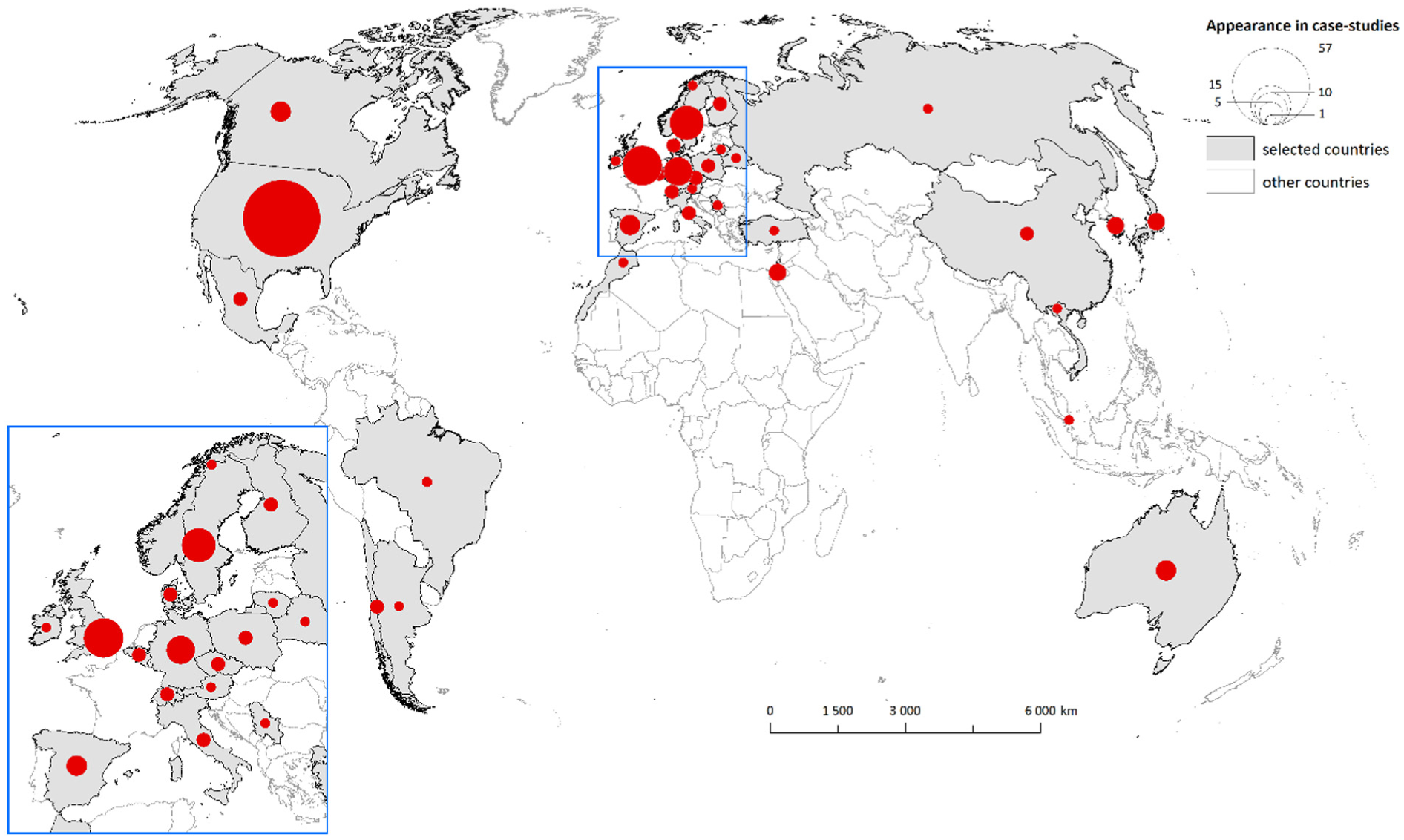
Frequency of the studied countries as the case-studies.
Gender Aspect of Family Policy Literature
Our findings about gender aspects of authorship in sampled FP literature are surprising and contrast our hypotheses 2.2 about dominance of male authors (see e.g., Fox et al., 2018; West et al., 2013). The number of female authors dominate over male authors, and the dominance is even more visible for corresponding authors (Figure 7). The average number of female corresponding authors is nearly three-times higher than of male corresponding authors. Moreover, this gender gap persists over the observed decade (Figure 8). From year 2012 the gender gap was partially mitigated, when number of articles decreased in year 2013. However, the gap appeared later again and narrowed only in year 2022. There is an interesting peak in number of articles led by male corresponding authors in year 2019. We cannot explain this situation, but we suggest that further research is needed to clarify this gender dynamic in FP literature.

Authors of FP articles according to gender.

Corresponding authors of FP articles according to gender during 2012-2022.
Associations Between Gender and Geographic Aspects and Family Policy Conceptualisation
The outcomes of our statistical analysis support some of our sooner formulated conclusions. For example, we found significant association between scope of research focused on USA and the affiliation from USA (Table 1). And similar, but a bit weaker relationship was found between scope on European countries and the affiliation from any European country. In contrast, we can see significant and negative relationship between scope of research outside Europe and USA and authorship affiliation from Europe or USA. This suggests that the authors generally prefer to write about countries of their own affiliations. Consequently, this creates a research gap in research scope, where only little attention is put on other than developed countries of Global North. This is an expected finding confirmed in other research areas and in research in general (Albanna et al., 2021; Salager-Meyer, 2008).
Regression Model of Relation Between Geographic Aspects of Affiliations and the Geographic Scope of Research.
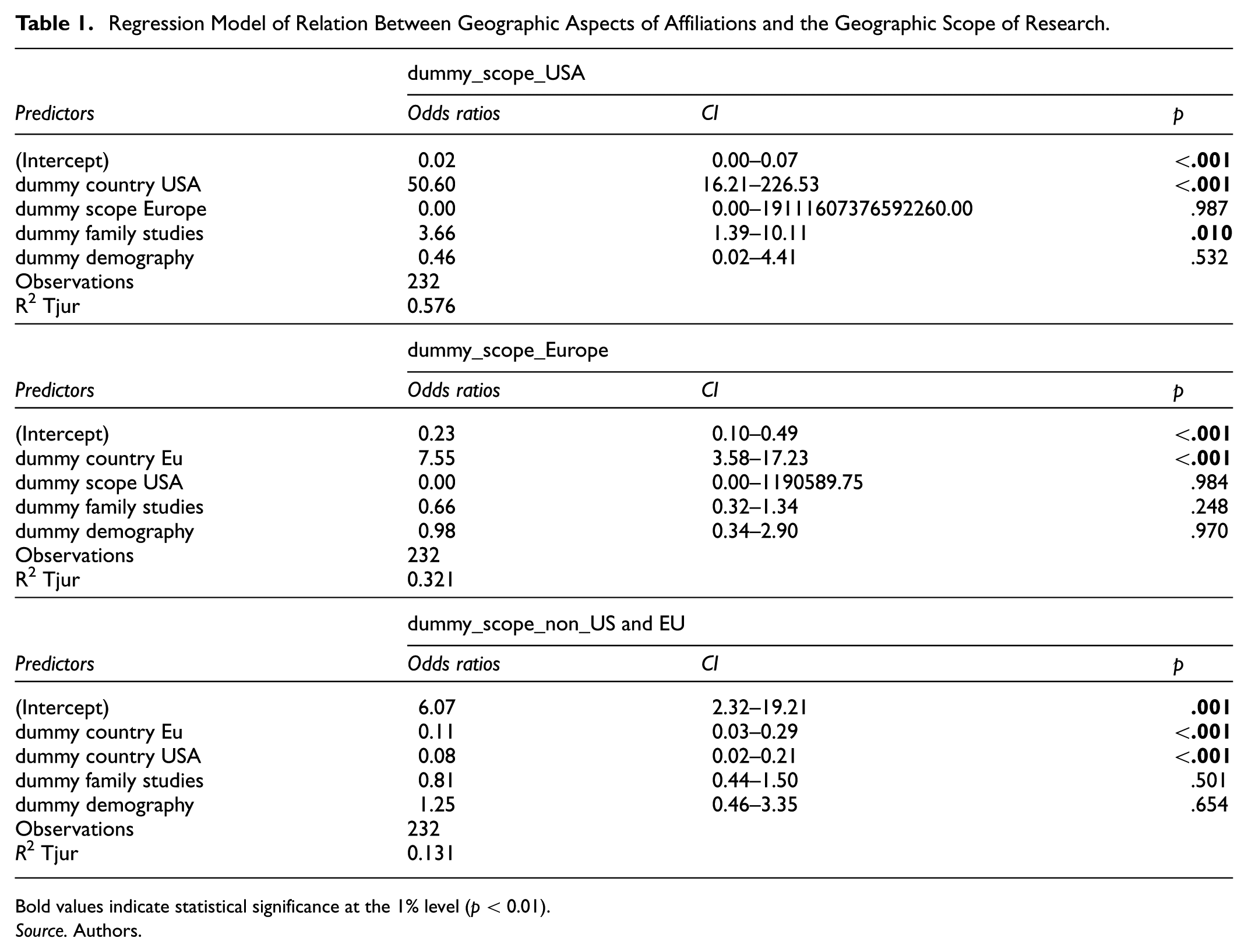
Bold values indicate statistical significance at the 1% level (p < 0.01).
Source. Authors.
Second, we observed the gender aspect of authorship in relationship to geography meaning both the country affiliation and the scope of research, yet no significant relations could be identified (Table 2). Gender aspect is thus not significantly related to geographic aspect of analysed FP literature. This is a rather original finding. Although many studies have been conducted on geographic and gender aspects in individual fields (Merriman et al. 2021), we found none that examined the potential dominance of women in a certain geographic group of countries as opposed to another group of countries.
Regression Model for Gender Aspect of Authorship (Female-Based).
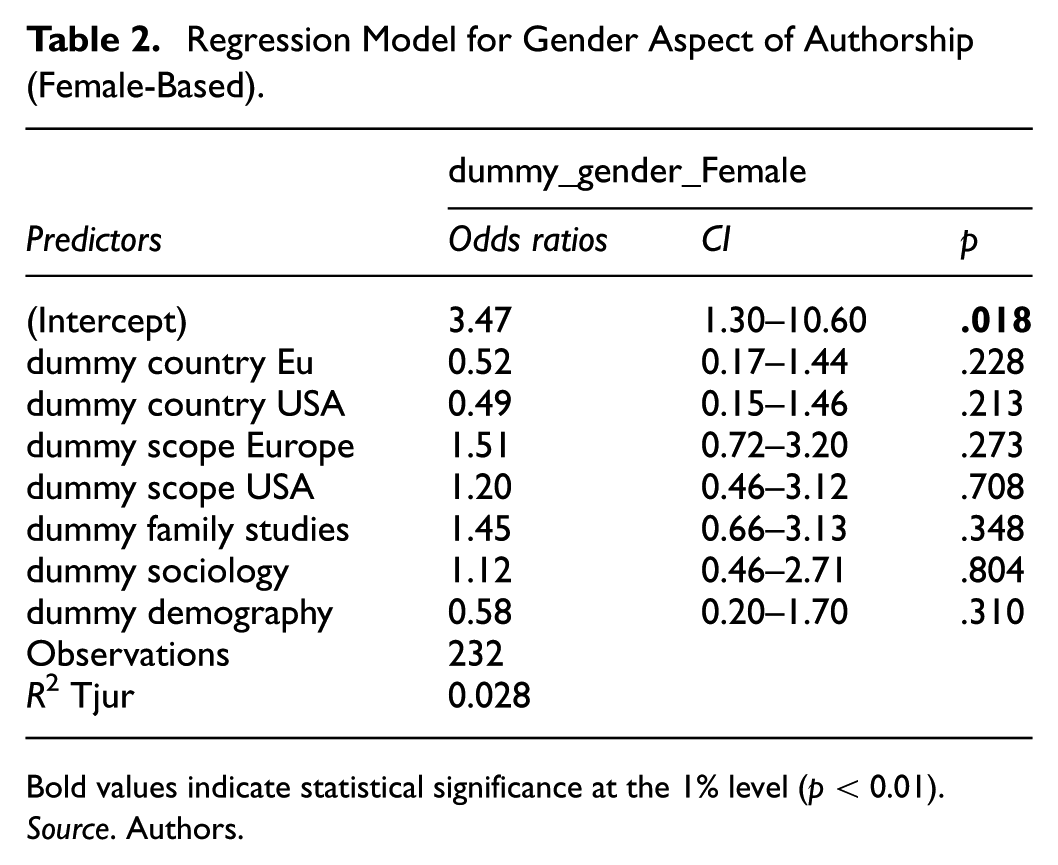
Bold values indicate statistical significance at the 1% level (p < 0.01).
Source. Authors.
Finally, calculated regression models show dubious results about associations between conceptualisations of FP and authorship aspects. The situation when FP was mentioned only as a keyword without further appearance in the article seem to be significantly and positively related with the geographic scope of the research on the USA, and with field of family studies (Table 3). Further we found significant negative association between wide conceptualisation of FP and geographic scope on European countries, and between middle-range conceptualisation and scope on USA. We thus assume that authors focusing on European countries more frequently use middle or narrow conceptualisation, while those who research USA usually do not use any. The evidence thus suggests that type of conceptualisation is in the most cases not significantly determined by gender or geographic aspects. But geography as such seem to be interesting aspect as the geography of affiliation is tightly connected to the geographic scope of research.
Regression Model for Narrow Type of FP Conceptualization.

Bold values indicate statistical significance at the 1% level (p < 0.01).
Source. Authors.
Conclusions
This study addresses the largely overlooked issue of conceptual ambiguity surrounding the increasingly prominent concept of family policy (FP). Our findings confirm the hypothesis that a wide variety of conceptualisations of FP exist in contemporary academic literature. However, we also observed a trend toward middle-range or minimal conceptual engagement. Notably, one-third of the analysed articles from leading academic journals included FP merely as a keyword, without any further elaboration or substantive discussion – an unexpected and revealing outcome.
In addition, our analysis highlights authorship trends in FP scholarship that diverge markedly from patterns typically observed in other academic fields. Contrary to our assumption, we found no evidence of male dominance in authorship. Female authors were predominant throughout the entire observed decade. On average, the number of female corresponding authors was three times higher than that of their male counterparts in the leading FP literature. This finding challenges prior studies, such as Fox et al. (2018), which reported that women were more likely to be listed as first authors but less frequently served as corresponding authors. Similarly, our results contrast with those of Asghar (2018), who documented a persistent gender gap favouring male authors in academic publishing.
On the other hand, results support our hypothesis on the geographic bias meaning the prevalence of authors from USA and UK and European institutions, while the Swedish universities appeared to be surprisingly frequent affiliation of authors of leading FP literature. Regarding the geographic scope of FP literature, we found that European countries (Nordic countries like Sweden and Finland; and Western European countries like Germany and Spain) were the most frequently researched ones in FP literature.
We also observed the relation between geographic aspects of affiliations and the geographic scope of research. Our study brings evidence about significant association between scope of research focused on USA and the affiliation from USA. And similar, but a bit weaker association was found between scope on European countries and the affiliation from any European country. Combining gender and geography, we conclude that gender aspect is not significantly related to geographic aspect in analysed FP literature.
To conclude, our research has its limitations at this stage and it sketches several avenues for further research, which could, for instance, focus on the literature from outside Europe and USA and specifically from the developing countries. Similarly, the surprising findings about prevalence of female authors in FP literature deserve attention.
Footnotes

Author Contributions
We declare that the entire study was prepared as original research, using the literature listed in the attached list of references. Dr. Šmeringaiová designed the study, managed the data, conducted the data analysis, and wrote the drafts. Prof. Bleha prepared theoretical section and wrote discussion and conclusions parts. We both incorporated feedback from the reviewers.
Funding
The authors disclosed receipt of the following financial support for the research, authorship, and/or publication of this article: The research was granted by the Slovak Research and Development Agency, Grant No. APVV-23-0062.
Declaration of Conflicting Interests
The authors declared no potential conflicts of interest with respect to the research, authorship, and/or publication of this article.
Data Availability Statement
Upon request.
Declarations
Our study was partially supported by AI-based tools, including ChatGPT and DeepL only to refine grammar and enhance language clarity. However, the entire literature review, datasets, arguments, figures and tables, citations, used codes in R software and original contributions remain solely our own work. AI-generated content has been carefully reviewed to ensure its alignment with academic standards and the integrity of scholarly research.