



Abstract
This study examines the impact of environmental leadership on psychological empowerment and its subsequent influence on Organizational Citizenship Behavior for the Environment (OCBE) in academic settings. Specifically, it investigates how environmental leadership enhances key aspects of psychological empowerment, including work meaning, autonomy, and self-efficacy. These factors, in turn, contribute to work impact and drive OCBE among faculty members. Data were collected from 410 faculty members at higher vocational institutes and universities in Guangdong Province, China, using a purposive sampling technique. Partial least squares structural equation modeling (PLS-SEM) was used to test the hypothesized relationships. The findings indicate that environmental leadership significantly strengthens psychological empowerment by positively influencing work meaning, autonomy, and self-efficacy. These factors, in turn, enhance work impact and significantly promote OCBE. The study highlights the vital role of environmental leadership in cultivating a culture of sustainability within academic institutions. It advances theoretical understanding by illustrating how environmental leadership and psychological empowerment interact to drive OCBE. It provides a robust model for examining OCBE’s antecedents and offers new insights into the mechanisms through which leadership fosters sustainability in higher education. The study highlights the need for academic institutions to adopt environmental leadership practices to cultivate a sustainability-oriented culture. It urges leaders to create meaningful work environments, grant autonomy, and enhance self-efficacy among faculty and staff. Future research should explore effective strategies for developing environmental leadership, such as training programs and mentorship opportunities, to cultivate leaders capable of driving impactful sustainability initiatives.
Plain Language Summary
This study looks at how university leaders can inspire faculty members to care more about the environment. When leaders promote sustainability, faculty members feel more motivated, independent, and confident in their ability to make a difference. This encourages them to take extra steps, beyond their normal duties, to support environmental efforts at their universities. The research focused on faculty members from universities and vocational institutes in Guangdong, China. The results show that strong environmental leadership helps faculty find meaning in their work, make decisions on their own, and believe in their ability to contribute. This leads to more voluntary actions, like organizing eco-friendly activities or reducing waste on campus. The study highlights the importance of leadership in building a culture of sustainability in higher education. Universities should encourage leaders to support environmental efforts and empower faculty members to take action. Future research should explore ways to train and mentor leaders who can drive meaningful sustainability initiatives.
Introduction
In today’s organizational landscape, the focus on environmental sustainability has become increasingly essential. Driven by growing societal demands and stricter regulatory frameworks, organizations play a crucial role in the global pursuit of sustainable development and efforts to combat climate change (Van Zanten & Van Tulder, 2018). Organizational Citizenship Behavior for the Environment (OCBE) has emerged as an important but relatively underexplored concept (Sahar et al., 2025). OCBE refers to voluntary employee actions that support organizational environmental goals beyond formal job requirements (Ciocirlan, 2017). Such behaviors can significantly reduce an organization’s ecological footprint and position employees as a vital driving force in advancing sustainability (Alt & Spitzek, 2016; Cheema et al., 2020; Mi et al., 2019).
Among the various drivers of OCBE, psychological empowerment and environmental leadership have attracted growing scholarly interest (Ying et al., 2020). Psychological empowerment reflects employees’ sense of work meaning, self-efficacy, autonomy, and perceived impact. These dimensions motivate employees to contribute voluntarily to environmental initiatives (Gurmani et al., 2021; Mi et al., 2019). Likewise, environmental leadership, which reflects leaders’ commitment to sustainability, shapes a culture that encourages employees to engage in OCBE (Priyadarshini et al., 2023). While these links are acknowledged, existing research has yet to provide a comprehensive explanation of how empowerment and leadership interact to influence OCBE.
The challenge of embedding sustainability in higher education has become increasingly urgent. Universities are expected to act as frontrunners in promoting environmental responsibility, yet evidence suggests that institutional initiatives often fall short without the voluntary commitment of faculty and staff. For example, while many institutions adopt sustainability policies, their success ultimately depends on employees’ willingness to integrate environmentally responsible practices into teaching, research, and daily operations. This highlights the problem that formal structures alone are insufficient and the active engagement of academic staff is essential.
Despite the growing urgency to promote sustainability, research on how faculty can be motivated to engage in pro-environmental behaviors remains limited. Most previous studies on OCBE have focused on corporate and service sectors, leaving higher education largely underexplored. Although psychological empowerment and environmental leadership are recognized as important drivers of OCBE, few studies have examined how these factors interact within academic settings. In many cases, empowerment is treated in a fragmented manner, and work impact, a key dimension that may stimulate voluntary environmental behavior, has received limited attention. Collectively, these gaps indicate that while the roles of leadership and empowerment are acknowledged, their combined influence on OCBE in higher education is still not well understood, creating an important theoretical and practical gap.
Addressing this gap is important for both theory and practice. From a theoretical standpoint a deeper understanding of how environmental leadership fosters psychological empowerment and OCBE enriches the literature on leadership, empowerment, and pro-environmental behaviors. From a practical perspective, universities urgently require effective frameworks to embed sustainability into teaching, research and daily operations. This study investigates how environmental leadership enhances psychological empowerment, specifically work meaning, autonomy, and self-efficacy, which in turn strengthens perceptions of work impact and drives OCBE among university faculty. While some earlier work provides anecdotal evidence or preliminary findings in this area (Anwar et al., 2020), comprehensive empirical studies remain scarce. By focusing on higher education this research provides insights into a context that has received limited empirical attention while highlighting mechanisms that can inform institutional policies and practices for advancing sustainability. Therefore, this study aims to examine the direct effects of environmental leadership on psychological empowerment and Organizational Citizenship Behavior for the Environment (OCBE) among academic staff in higher education institutions.
Literature Review
The Theoretical Underpinning
Our research is grounded in an integrative theoretical foundation that draws from Transformational Leadership Theory (Bass, 1985), Psychological Empowerment Theory (Spreitzer, 1995), Self-Determination Theory (Deci & Ryan, 1985), Social Exchange Theory (Blau, 1986), and the broader Organizational Citizenship Behavior (OCB) framework (Organ, 1988). These frameworks collectively explain how leadership behaviors inspire intrinsic motivation, empowerment and reciprocal pro-environmental actions among employees.
Transformational leadership theory posits that “leaders can motivate followers to go beyond their normal self-interest for the benefit of the team or organization and create an environment for followers to become leaders themselves” (Kasımoğlu & Ammari, 2020). When applied to environmental stewardship, this leadership approach becomes a major driving force for sustainability (Khan & Khan, 2022; Ramdan et al., 2024). Environmental leadership, in this context, involves applying transformational leadership practices to foster a culture of sustainability. It encourages staff by providing a clear, compelling vision of environmental accountability and actively involving them in the organization’s sustainability initiatives.
Psychological empowerment plays a pivotal role in this dynamic, providing a framework to understand how employees internalize and act on the environmental vision and goals set by their leaders (Farrukh et al., 2019). According to psychological empowerment theory (Spreitzer, 1995), empowerment is defined by four key dimensions: meaning, competence (or self-efficacy), autonomy, and work impact (Y. Li et al., 2015). As Lamm et al. (2015) highlight, these dimensions are essential for fostering an organizational culture where employees are genuinely motivated and equipped to engage in environmental sustainability efforts.
Self-determination theory (Deci & Ryan, 1985) complements this perspective by emphasizing intrinsic motivation. Employees are more likely to engage in environmental behaviors when their actions are meaningful, autonomous, and aligned with personal values. Meaning provides a sense of purpose, self-efficacy builds confidence to contribute, autonomy allows innovation, and work impact highlights the visible results of their efforts toward sustainability goals.
The relationship between transformational leadership and psychological empowerment thus becomes central in shaping OCBE. In line with social exchange theory (Blau, 1986), empowered employees reciprocate supportive leadership by engaging in voluntary, pro-environmental behaviors (Boiral & Paillé, 2012). When employees believe they can make a difference (self-efficacy) and are given the autonomy to be innovative, their involvement in sustainability efforts increases (Carmeli and Spreitzer, 2019; W. Jiang et al., 2017).
Collectively, these theoretical perspectives provide a cohesive and multidimensional foundation for exploring how leadership and empowerment processes foster OCBE in academic settings. This integrated approach highlights the psychological, motivational and relational mechanisms through which leadership can drive sustainability-oriented organizational development.
Organizational Citizenship Behavior for the Environment (OCBE)
From an organizational behavior perspective, OCBE refers to employees’ voluntary actions aimed at promoting environmental sustainability initiatives. These actions, which go beyond formal job requirements, stem from personal commitment to environmental responsibility. Examples include recycling, conserving energy, and advocating for eco-friendly practices (Ciocirlan, 2017) and eco-initiatives (Ju et al., 2017). The wide range of behaviors encompassed by OCBE highlights the critical role employees play in advancing their organization’s environmental goals. Research has shown that collective individual efforts can significantly impact environmental conservation (Boiral et al., 2015; Cheema et al., 2020).
While OCBE is often advocated as a means to bolster environmental sustainability within organizations and their supply chains, recent research presents a more complex picture. Azam et al. (2022) argue that although OCBE is now recognized as a critical factor in organizational sustainability efforts, its positive and consistent impact on overall sustainability performance remains unclear. In contrast, Lin et al. (2022) suggest that OCBE can significantly enhance environmental sustainability, particularly when supported by substantial and positive influences.
These divergent findings across different sectors and regions highlight OCBE’s broad relevance and adaptability in addressing specific sustainability challenges and opportunities. Furthermore, fostering an innovative learning culture could strengthen OCBE’s role by promoting environmental and social responsibility, further aligning organizational practices with sustainability goals (Huda et al., 2021). These inconsistencies in the literature emphasize the need for further research to clarify OCBE’s impact and identify strategies for its effective application across diverse organizational settings.
Environmental Leadership
Environmental leadership is a leadership style dedicated to sustainable environmental stewardship, aiming to minimize negative impacts on the environment (Ju et al., 2015; Robertson & Carleton, 2018). This approach is applied at various levels, including households (Cordeiro et al., 2020), organizations (Uhl-Bien & Arena, 2018), and governments (Wang et al., 2020), highlighting its broad applicability. As a relatively new leadership approach, environmental leadership integrates innovative resource management strategies, including advanced technologies, to support environmental sustainability (Salim et al., 2019; Singh et al., 2020). It can also motivate and support employees in adopting green behaviors that enhance both organizational performance and sustainable development (Salim et al., 2019).
However, several factors can influence the effectiveness of environmental leadership. Employee engagement plays a crucial role in embedding these practices within organizations (Oh et al., 2020). Ethical leadership is also essential to ensure that environmental initiatives respect the rights and responsibilities of all stakeholders (Vikaraman et al., 2021). Despite its benefits, some concerns exist, such as the potential trade-off between environmental and social considerations (Bennett et al., 2018) or the possibility of slower work processes due to increased caution and bureaucracy (Tosun & Howlett, 2021).
To address these challenges, environmental leadership should be integrated with elements of transformational leadership, emphasizing communication, psychological empowerment, and ethical principles to ensure a balanced and effective approach.
Psychological Empowerment
Psychological empowerment is a motivational construct that reflects an individual’s sense of control, competence and influence within their work environment (Gholami et al., 2021). It is composed of four key dimensions: meaning, competence (self-efficacy), self-determination (autonomy), and work impact. Together, these dimensions capture how employees interpret and value their work, how confident they feel in their ability to perform, the degree of freedom they perceive in decision-making and the extent to which they believe their efforts make a difference (Barattucci et al., 2025; Martela et al., 2021). In higher education institutions, psychological empowerment is particularly relevant because it explains how faculty members can internalize sustainability goals and translate them into voluntary pro-environmental behaviors, such as OCBE (Han et al., 2025).
Meaning
The dimension of meaning refers to the value individuals attach to their work, particularly when it aligns with personal beliefs and values. Employees who perceive their work as meaningful are more engaged and committed, as they view their tasks as contributing to both personal goals and broader organizational objectives (Allan et al., 2019; Martela & Pessi, 2018). In academic settings, faculty who recognize that their teaching or research supports sustainability are more likely to integrate pro-environmental content in their practices and support green initiatives (Mendes et al., 2025). By enhancing a sense of purpose, meaning serves as a critical driver of voluntary environmental contributions.
Self-Efficacy (Competence)
Self-efficacy, often referred to as competence, reflects the belief in one’s ability to perform tasks successfully and contribute effectively to organizational goals. When employees feel confident in their capabilities, they display higher levels of job performance, innovation, and resilience in facing challenges (Chughtai et al., 2024; Mumtaz & Parahoo, 2020). In the sustainability context, faculty with strong environmental self-efficacy are more willing to engage in initiatives such as resource conservation campaigns or sustainability-focused teaching (J. Zhang & Cao 2025). Competence thus reinforces proactive contributions and underpins the confidence necessary for OCBE.
Autonomy (Self-Determination)
Autonomy or self-determination, reflects the extent of discretion and control employees have in how they carry out their work. Autonomy empowers employees to make decisions, take initiative, and implement creative solutions, thereby strengthening intrinsic motivation and organizational commitment (Nili & Tasavori, 2022). In higher education, autonomy allows faculty to design eco-friendly curricula or adopt sustainable practices independently, which enhances their sense of ownership over environmental outcomes (Menon & Suresh, 2022). This discretionary space is central to fostering voluntary green behaviors that contribute to OCBE.
Work Impact
The impact dimension refers to employees’ perception that their work significantly influences organizational outcomes. When individuals believe their contributions matter, they experience greater motivation, identification with the organization, and willingness to engage in voluntary behaviors (Belwalkar et al., 2018). In academic institutions, faculty who perceive a strong work impact may feel that their environmental initiatives, such as waste reduction, policy advocacy, or integrating sustainability themes into pedagogy can shape broader institutional culture. Perceived impact thus becomes a critical driver of OCBE, since employees are motivated to continue pro-environmental behaviors when they believe their efforts lead to visible change (Cheema et al., 2020).
Hypotheses Development and Conceptual Framework
Environmental Leadership: Meaning, Autonomy, and Self-Efficacy
Environmental leadership styles are increasingly recognized for their ability to shape workplace dynamics and foster sustainable practices within organizations (Z. Li et al., 2020; Tu et al., 2023). Research suggests that environmental leadership can significantly enhance employees’ sense of work meaning. For example, studies by Robertson and Barling (2013) and Unsworth et al. (2021) show that leaders who emphasize sustainability help employees see their work as contributing to broader, socially responsible objectives, thereby increasing their sense of purpose and fulfillment.
Further evidence from Tummers et al. (2018) indicates that environmental leadership, particularly through participative decision-making, grants employees greater autonomy. This empowerment fosters a stronger sense of involvement and responsibility in achieving sustainable solutions, leading to higher job satisfaction and commitment to the organization’s environmental goals. Similarly, Mughal et al. (2022) affirm that environmental leadership plays a crucial role in enhancing self-efficacy among staff by actively involving them in sustainability initiatives and demonstrating the tangible impact of their efforts on the environment.
The existing literature highlights that leadership style plays a crucial role in shaping employees’ perceptions and behaviors, particularly in finding meaning in their work, exercising autonomy, and developing self-efficacy. Comparative analyses of different leadership styles suggest that environmental leadership, with its strong focus on sustainability, aligns organizational goals with environmental stewardship (Saeed et al., 2014). Recent research also emphasizes how sustainability can be embedded in leadership practices, not only boosting employee morale but also enhancing engagement (Dey et al., 2022; Luu, 2020). However, while significant attention has been given to the impact of environmental leadership on psychological empowerment, research remains limited on how these effects vary across different types of organizations, particularly in educational settings such as universities. This gap suggests that organizational context may significantly influence these relationships (Tang et al., 2023). Building on these insights and existing research in other organizational settings, the following hypotheses are proposed:
Meaning, Autonomy and Self-Efficacy as Predictors of Work Impact
Examining the relationship between psychological empowerment and work impact reveals a complex dynamic. Meng and Sun (2019) conducted a comprehensive study analyzing the dimensions of psychological empowerment, including work meaning, self-determination (autonomy), and competence (self-efficacy) and their influence on work engagement. Their findings indicate a small effect of work impact on work engagement but do not explore its potential antecedent effects. Drawing on empowerment theory (Spreitzer, 1995; Thomas & Velthouse, 1990) and self-determination theory (Deci & Ryan, 1985), it can be argued that the three dimensions of psychological empowerment: work meaning, autonomy, and self-efficacy act as psychological enablers that precede and enhance employees’ perceived work impact. When individuals find meaning in their work, experience autonomy in decision-making, and feel competent in their abilities, they are more likely to perceive their contributions as significant and influential within the organization (Ahearne et al., 2005; Seibert et al., 2011).This proposition aligns with broader perspectives on intrinsic motivation and perceived influence, which extend beyond traditional measures of job performance (Su et al., 2020).
Although a substantial body of research links psychological empowerment, particularly self-efficacy and autonomy to job performance (Arefin et al., 2019; Kundu et al., 2019; Malik et al., 2021), limited studies have explored how these empowerment dimensions translate into perceived work impact, which reflects employees’ belief that their actions create meaningful organizational outcomes. Most research has focused on job performance, typically measured through objective metrics and managerial evaluations (Carter et al., 2018). For example, Onn et al. (2017) found that collective efficacy influences academic achievement. However, the wider impact of employee empowerment, particularly in shaping organizational strategy, culture, and external relationships, remains underexplored. Scholars have recently emphasized that work impact represents a higher-order psychological outcome that connects empowerment to proactive and extra-role behaviors (Chughtai et al., 2024; Wen et al., 2023). Accordingly, this study conceptualizes work impact as an outcome of psychological empowerment and examines how meaning, autonomy, and self-efficacy collectively enhance employees’ perceived influence and contribution within the university context. This study addresses this gap by investigating the relationship between psychological empowerment and work impact through the following hypotheses:
Work Impact as a Predictor of OCBE
Building on social exchange theory (Blau, 1986; Cropanzano et al., 2017) and psychological ownership theory (Pierce et al., 2001; Y. Zhang & Chen, 2013), employees who perceive their work as having a meaningful impact are more likely to reciprocate through voluntary, extra-role behaviors such as OCBE. When individuals recognize that their efforts contribute to organizational sustainability goals, they develop a stronger sense of identification and obligation toward the organization (Boiral & Paillé, 2012; Kim et al., 2020). This perception of impact nurtures psychological ownership, where employees feel personally responsible for their work outcomes and consequently engage in discretionary environmental actions (Avey et al., 2009; Y. Zhang & Chen, 2013).
Recent research further suggests that perceived impact stimulates intrinsic motivation and prosocial behavior by reinforcing employees’ sense of contribution and purpose (Grant, 2008; Spreitzer et al., 2005). This intrinsic motivation leads to behaviors aligned with moral and social reciprocity principles, as discussed in modern organizational citizenship literature (Bolino & Grant, 2016; Organ, 2018). In sustainability-oriented institutions, faculty who believe their actions make a tangible difference are more likely to go beyond formal job roles in promoting eco-friendly practices, supporting environmental initiatives, and influencing peers to act responsibly (Pham et al., 2023). Collectively, these insights suggest that work impact serves as a critical psychological mechanism linking empowerment to OCBE, particularly through pathways of ownership, reciprocity, and intrinsic motivation. Employees’ perceptions of meaningful contribution not only reinforce their internal motivation but also translate into environmental citizenship behaviors as a form of moral and relational reciprocity toward their organization’s sustainability objectives.
Therefore, the following hypothesis is proposed:
Building on the hypotheses derived from previous studies, this study develops a conceptual framework to guide the investigation. Figure 1 below presents the conceptual framework.

Conceptual framework.
Research Design
Sample and Procedure
To evaluate the hypotheses, partial least squares structural equation modeling (PLS-SEM) version 4.1 was used. The data underwent a priori power analysis using G*Power software, following the methodology outlined by Faul et al. (2007). Based on a medium effect size, a significance level (α) of .05, a power of 0.80 and the number of predictors in the model, a minimum sample size of 77 participants was recommended. The study exceeded this requirement, collecting data from 410 participants.
A purposive sampling technique was employed to select academic faculty members from higher vocational institutes and universities in Guangdong Province, China. This non-probability approach was chosen because the study specifically targeted individuals with relevant experience and involvement in sustainability-related teaching, research, or administrative activities. Participants were selected based on their professional roles (teaching assistant, lecturer, associate professor, and professor) and their familiarity with environmental or institutional sustainability initiatives, ensuring that the data reflected informed perspectives on environmental leadership and empowerment practices. Surveys were distributed via the Questionnaire Star internet platform.
Before participating, academic staff provided informed consent and were briefed on the study’s objectives and the confidentiality of their responses. A total of 458 questionnaires were collected, of which 410 were deemed valid after discarding incomplete or inconsistent responses, yielding a validity rate of 89.52%. Table 1 provides a comprehensive overview of the participants. The questionnaire included separate sections for each construct, guiding respondents to evaluate their experiences with environmental leadership, psychological empowerment, work impact, and OCBE based on their daily academic practices. This structured design ensured that the relationships among the variables could be logically and consistently interpreted.
Profile of Respondents (n = 410).
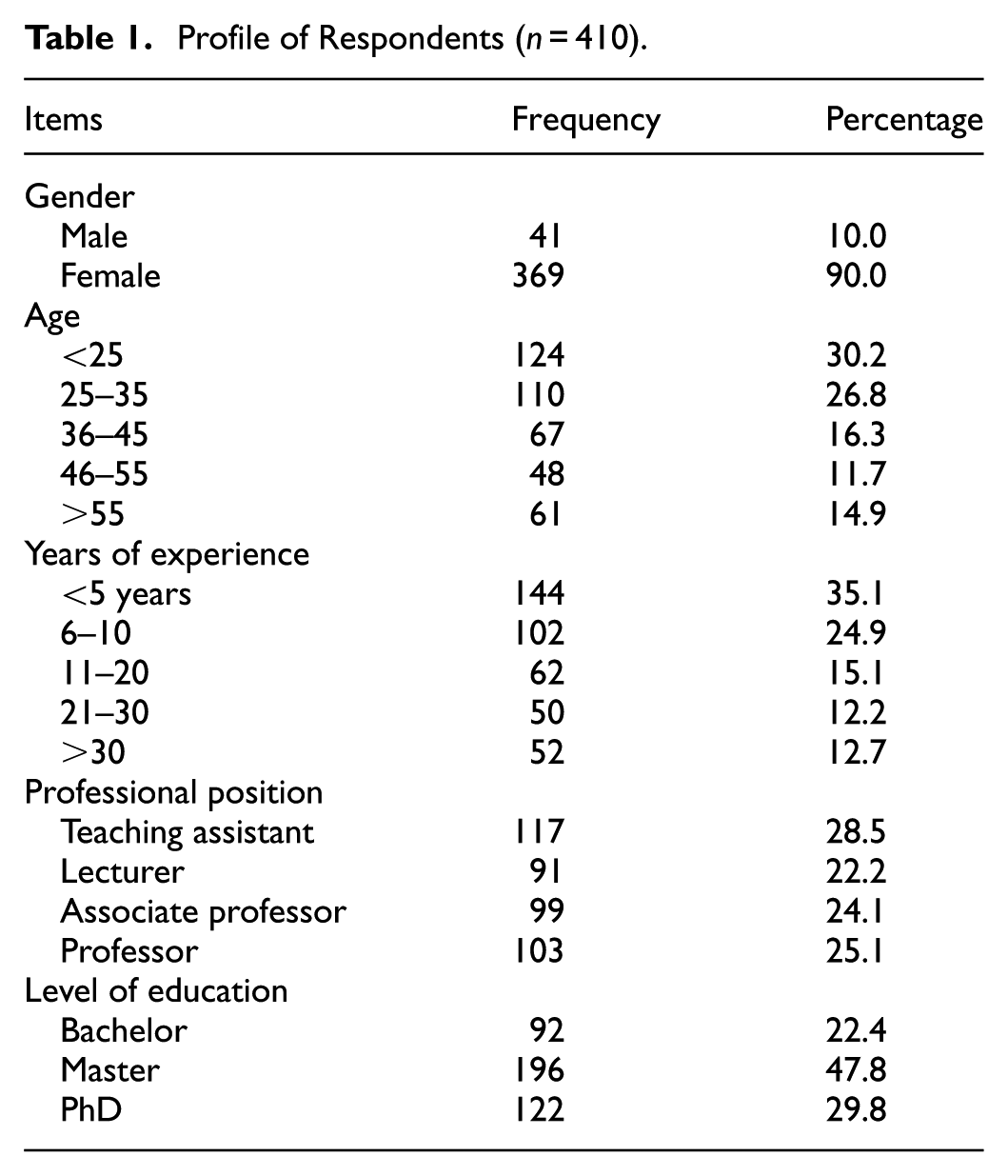
Among the valid responses, 41 participants (10.0%) were male, and 369 (90.0%) were female. This proportion reflects broader gender patterns in China’s education sector, where teaching has long been regarded as a female-dominated profession (Zhou, 2023). Studies have shown that women constitute the majority of academic and teaching staff in Chinese educational institutions across multiple levels, particularly in universities and colleges (Chen et al., 2025; J. Li et al., 2025; Zhou, 2023). Such patterns are often attributed to entrenched gender norms and occupational expectations that have shaped the teaching profession in China. Therefore, the predominance of female respondents in this study aligns with the existing demographic characteristics of the education workforce rather than indicating sampling bias. The age distribution was as follows: 30.2% (n = 124) were under 25, 26.8% (n = 110) were aged 25 to 35, 16.3% (n = 67) were aged 36 to 45, 11.7% (n = 48) were aged 46 to 55, and 14.9% (n = 61) were over 55. Teaching experience varied, with 35.1% having less than 5 years, 24.9% having 6 to 10 years, 15.1% having 11 to 20 years, 12.2% having 21 to 30 years, and 12.7% having more than 30 years.
Regarding academic positions, 28.5% (n = 117) were teaching assistants, 22.2% (n = 91) were lecturers, 24.1% (n = 99) were associate professors, and 25.1% (n = 103) were professors. The highest level of education among participants included 22.4% (n = 92) with a bachelor’s degree, 47.8% (n = 196) with a master’s degree, and 29.8% (n = 122) with a doctoral degree. These demographic insights provide a comprehensive background for evaluating and analyzing the study’s findings.
Measurement
Environmental Leadership
The environmental leadership dimension was measured using six items adapted from Blok et al. (2015). The items were contextually adapted to reflect sustainability-related practices within higher education institutions. Responses were assessed on a 5-point Likert scale, with scores summed to provide an overall measure of environmental leadership within the university. The Cronbach’s alpha (α) for this construct was .87 (Blok et al., 2015).
Psychological Empowerment Scale
The study used the internationally recognized psychological empowerment scale developed by Spreitzer et al. (2005). This scale measures three dimensions of psychological empowerment: work meaning, autonomy, and self-efficacy. Each dimension consists of three questions, totaling nine items. All items were slightly adapted to capture experiences related to academic work and sustainability engagement. The internal consistency coefficient was 0.87 for work meaning, 0.81 for self-efficacy, and 0.81 for autonomy. Responses were recorded on a 7-point Likert scale, ranging from 1 (strongly disagree) to 7 (strongly agree).
Work Impact
Work impact was measured using a scale developed by Spreitzer et al. (2005), consisting of three questions assessing an individual’s level of influence within their department. The wording was adjusted to fit the context of university settings and sustainability initiatives. The internal consistency coefficient for this dimension was 0.88. Responses were recorded on a 7-point Likert scale, ranging from 1 (strongly disagree) to 7 (strongly agree).
Organizational Citizenship Behavior for the Environment
OCBE was measured using a 10-item scale originally developed by Boiral and Paillé (2012) and later applied in China by J. L. Zhang et al. (2018). An example item from the scale is, “I encourage my colleagues to adopt more environmentally conscious behaviors.” The Cronbach’s alpha coefficient for this measure was .934, indicating high reliability. Responses were recorded on a 7-point Likert scale, ranging from 1 (strongly disagree) to 7 (strongly agree).
Data Analysis
Common Method Bias
Common method bias may be a concern in this study since both independent and dependent variables were measured using a single data source (Chang et al., 2020). To address this issue, both procedural and statistical remedies suggested by Podsakoff et al. (2012) were applied. Procedurally, a specific anchor scale was used to assess the constructs (Ajibike et al., 2021; Podsakoff et al., 2012). Independent variables were measured using a 5-point Likert scale, while dependent variables were measured using a 7-point Likert scale. Statistically, the full collinearity test developed by Kock (2015) was used to assess common method bias. Data analysis to detect common method variance (CMV) using the full collinearity approach has been employed in previous studies, such as those by N. Jiang et al. (2025) and J. Li, Ju, and Kong (2024). According to Diamantopoulos and Siguaw (2006), a variance inflation factor (VIF) value of 3.3 or lower indicates that bias from a single data source is unlikely. The study’s results showed VIF values below 3.3, confirming that common method variance was not a serious concern. Nevertheless, because all data were collected from self-reported responses of a single participant group, the potential for residual common method bias cannot be completely excluded, and this is acknowledged as a limitation of the study. Table 2 provides a detailed analysis of collinearity for each construct.
Full Covariance Test.
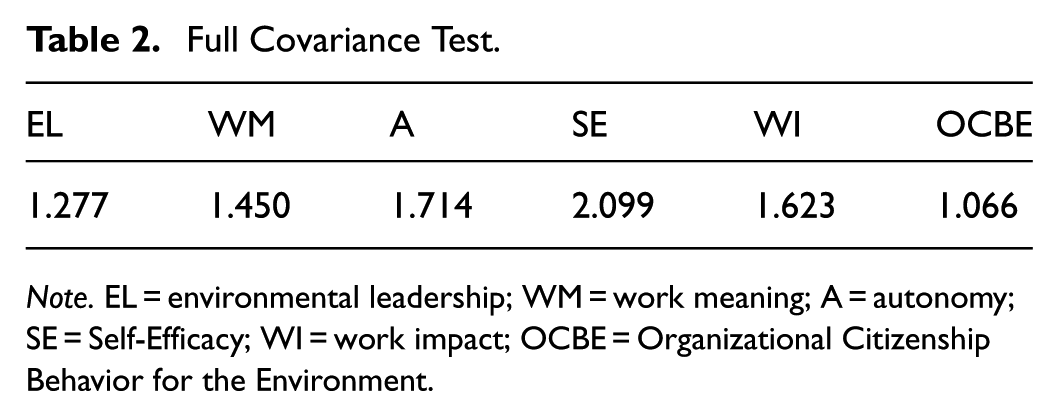
Note. EL = environmental leadership; WM = work meaning; A = autonomy; SE = Self-Efficacy; WI = work impact; OCBE = Organizational Citizenship Behavior for the Environment.
Measurement Model
This study followed Anderson and Gerbing’s (1988) two-step approach to model validation, assessing both the measurement and structural models. This involves validating the measurement model to ensure that the instruments used in this dataset are reliable and valid before proceeding with the structural model analysis in the subsequent stage (J. Li & Ju, 2023; J. Li, Ju, Zhu, et al., 2024; Ridzuan et al., 2024). Before evaluating the structural model, reliability, convergent validity, and discriminant validity of the measurement model were verified using SmartPLS 4.1 and the PLS-SEM algorithm. Factor loadings were used to assess the significance of outer loadings. According to Hair et al. (2017), a threshold of 0.708 is generally acceptable, while values above 0.5 are considered adequate. As shown in Table 3, all indicator loadings met these criteria, ranging from 0.618 to 0.904. Reliability was evaluated using Cronbach’s alpha (CA) and composite reliability (CR), with all values exceeding .7 (ranging from .798 to .917), consistent with the threshold established by Nunnally and Bernstein (1994). Convergent validity was assessed using the average variance extracted (AVE), with all constructs in Table 3 showing AVE values above 0.5 (ranging from 0.518 to 0.787), aligning with the recommendations of Hair et al. (2017).
Measurement Model for Reliability and Validity.

Note. OCBE01 and OCBE3 was deleted due to low indicator loadings. EL = environmental leadership; WM = work meaning; A = autonomy; SE = self-efficacy; WI = work impact; OCBE = Organizational Citizenship Behavior for the Environment.
After establishing factor loadings, reliability, and convergent validity, discriminant validity was assessed using the heterotrait-monotrait (HTMT) ratio. Discriminant validity, evaluated through the HTMT ratio, compares the correlation between different constructs (heterotrait) with the correlation within the same construct (monotrait). An HTMT ratio below 0.85 indicates strong discriminant validity, demonstrating clear differentiation between constructs (Henseler et al., 2015).
As shown in Table 4, HTMT values ranged from 0.389 to 0.748, all below the 0.85 threshold, confirming satisfactory discriminant validity (Henseler et al., 2015). These results provide strong evidence of suitable discriminant validity in this study.
Heterotrait-Monotrait Ratio.
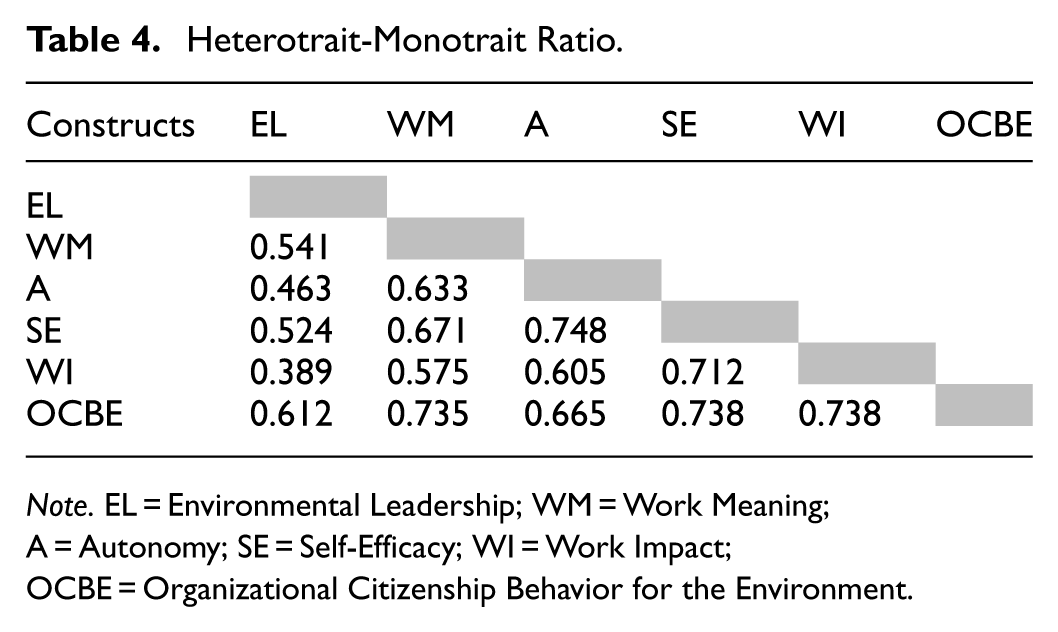
Note. EL = Environmental Leadership; WM = Work Meaning; A = Autonomy; SE = Self-Efficacy; WI = Work Impact; OCBE = Organizational Citizenship Behavior for the Environment.
Structural Model
Before analyzing the structural model, it is essential to identify and address any potential collinearity issues. Collinearity, assessed using the variance inflation factor (VIF), measures the extent to which multicollinearity increases the variance of estimated regression coefficients. A VIF score above 5 indicates substantial collinearity, which can distort regression results and reduce statistical power (Akinwande et al., 2015). As shown in Table 5, all VIF values were below the recommended threshold of 3 (Diamantopoulos & Siguaw, 2006), confirming that collinearity was not a concern in this study.
Path Coefficients for Direct Effects.
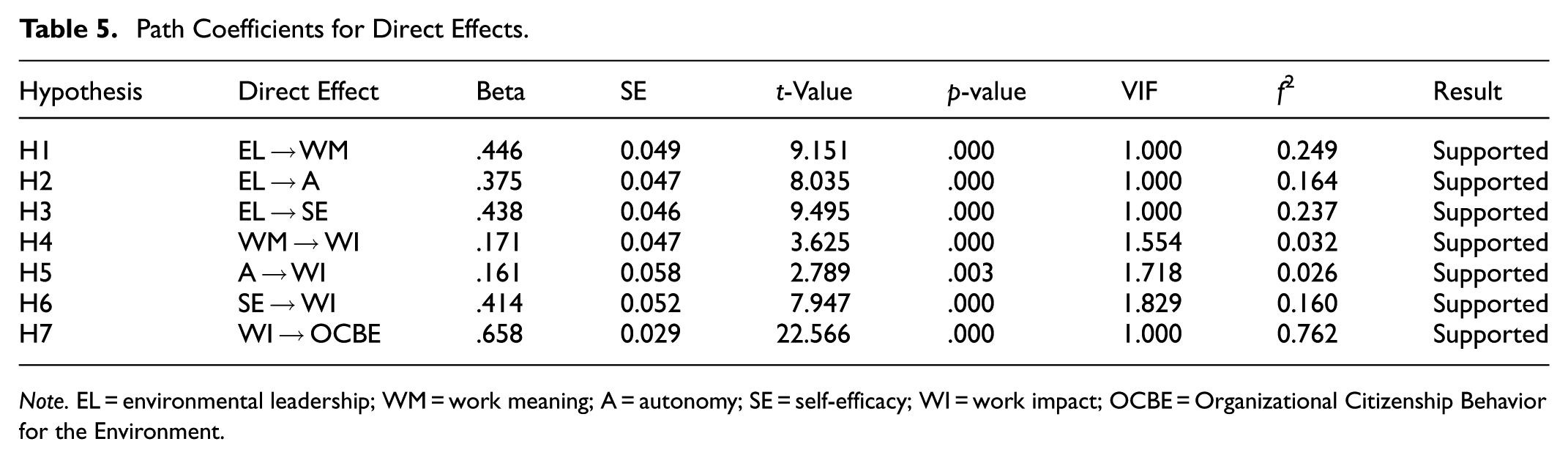
Note. EL = environmental leadership; WM = work meaning; A = autonomy; SE = self-efficacy; WI = work impact; OCBE = Organizational Citizenship Behavior for the Environment.
To evaluate the structural model, a bootstrapping method with 10,000 iterations was performed using PLS-SEM 4.1. The significance threshold was set at 0.05, and a one-tailed test was used to assess the direct effects hypothesis. Table 5 shows that environmental leadership positively and significantly influenced work meaning (β = .446, t = 9.151, p < .000), autonomy (β = .375, t = 8.035, p < .000), and self-efficacy (β = .438, t = 9.495, p < .000). Additionally, work meaning (β = .171, t = 3.625, p < .000), autonomy (β = .161, t = 2.789, p < .000), and self-efficacy (β = .414, t = 7.947, p < .000) all had significant positive effects on work impact. Finally, work impact significantly influenced OCBE (β = .658, t = 22.566, p < .000). Thus, hypotheses H1, H2, H3, H4, H5, H6, and H7 were all supported (Figure 2).

Result of PLS analysis.
Effect sizes were categorized according to Cohen (1988) as small (0.02), medium (0.15), or large (0.35). Table 5 indicates that the relationships between environmental leadership and work meaning (f2 = 0.249), autonomy (f2 = 0.164), and self-efficacy (f2 = 0.237) all had moderate effect sizes. Similarly, the relationships between work meaning and work impact (f2 = 0.032), autonomy and work impact (f2 = 0.026), and self-efficacy and work impact (f2 = 0.160) also had moderate effect sizes. The relationship between work impact and OCBE (f2 = 0.762) had a large effect size.
PLS Predict
PLS prediction operations were conducted following the methods suggested by Shmueli et al. (2016) to assess the model’s out-of-sample predictive capabilities. The root mean squared error (RMSE) was a key parameter used to evaluate prediction performance. RMSE values from the PLS analysis were compared to those from a linear model (LM; Shmueli et al., 2019). The expectation was that PLS analysis would yield lower prediction errors than the naïve benchmark (PLS-LM), indicating enhanced predictive capability. As shown in Table 6, most indicators in the PLS-SEM study had larger prediction errors than the naïve LM benchmark, suggesting a moderate level of predictive power, consistent with the findings of Hair et al. (2019) and Shmueli et al. (2019). Additionally, all Q2 values exceeded 0, confirming sufficient predictive significance.
PLS Predict.

Discussion
Our findings highlight the crucial role of environmental leadership in enhancing key aspects of psychological empowerment, including work meaning, autonomy, and self-efficacy. These factors significantly influence work impact, which in turn affects OCBE. By prioritizing ecological sustainability and climate change mitigation, environmental leadership not only boosts productivity but also integrates sustainability goals into daily operations, making work more meaningful.
For instance, leaders can demonstrate environmental leadership by adopting eco-friendly technologies, promoting paperless operations, using clean energy, and encouraging responsible consumption and production. These strategic choices reinforce a commitment to environmental stewardship as a core organizational value. This aligns with research by Salim et al. (2019) and Singh et al. (2020), which emphasizes the role of environmental leadership in rethinking resource management through technology to enhance conservation efforts.
From an autonomy perspective, environmental leadership provides staff with greater flexibility to achieve organizational goals while addressing environmental concerns. This approach is particularly effective in academic settings, where professional staff can make informed, independent decisions. By setting clear objectives and allowing autonomy, leaders encourage innovative practices that enhance productivity and sustainability. These findings align with Kim et al. (2020), who noted that support from environmental leadership fosters autonomous motivation among employees. Conversely, when environmental initiatives receive little support, employees may feel less motivated and independent. Thus, this study highlights the importance of environmental leadership in guiding academic institutions toward shared sustainability objectives.
The strength of these relationships (β = .446–.438) can be understood through the lens of transformational leadership theory (Bass, 1985), which suggests that leaders who communicate a compelling vision and embody pro-environmental values can inspire followers to internalize these values as part of their personal and professional identity. Such leadership behavior fulfills employees’ intrinsic needs for meaning, competence and autonomy, as highlighted in self-determination theory (Deci & Ryan, 1985). Together, these perspectives explain why environmental leadership exerts such a strong empowering influence within academic settings, where autonomy and value alignment are highly regarded.
In terms of self-efficacy, environmental leadership has a significant positive impact. Leaders who prioritize sustainability provide the necessary tools, training and encouragement, empowering employees to tackle environmental challenges with confidence. This support fosters a sense of competence and resilience, enabling staff to address environmental issues effectively. By embedding sustainability into the organization’s mission, employees gain a clearer sense of purpose, further strengthening their confidence and ability to contribute to sustainability initiatives. These findings are consistent with Xu et al. (2022), who found that leadership support for sustainability initiatives positively influences employees’ self-efficacy and proactive environmental behaviors. Therefore, environmental leadership plays a pivotal role in driving organizational progress toward sustainable development.
The combined influence of work meaning, autonomy, and self-efficacy significantly enhances work impact in academic settings, particularly in the context of environmental sustainability and climate change mitigation. When educators and staff perceive their roles as meaningful and aligned with both personal values and institutional sustainability goals, they become more engaged and motivated. This leads to a stronger commitment to incorporating environmental principles into teaching, research and administrative practices. Autonomy enables faculty and staff to innovate and implement sustainable practices independently, fostering ownership and encouraging the adoption of green technologies and eco-friendly curricula.
High self-efficacy enables academic professionals to engage confidently in ambitious sustainability initiatives, translating their sense of capability into tangible contributions that strengthen overall work impact. Our findings indicate that self-efficacy has a stronger influence on work impact compared to work meaning and autonomy. While all three elements of psychological empowerment are important, self-efficacy stands out with the most substantial effect on work impact, reflected by a medium effect size (f2 = 0.160, β = .414). This finding is consistent with psychological empowerment theory (Spreitzer, 1995), which posits that individuals who perceive themselves as competent are more likely to convert motivation into observable performance outcomes. In academic contexts, such confidence drives faculty and staff to design and implement sustainability-oriented programs, reinforcing their professional identity and sense of contribution. This mechanism also aligns with self-determination theory (Deci & Ryan, 1985), which emphasizes competence and mastery as key motivators of purposeful action. The strong relationship observed in this study therefore reflects both statistical robustness and the intrinsic motivational process through which confidence enhances environmental engagement (Wen et al., 2023). However, all aspects of psychological empowerment contribute to sustainability and climate change mitigation. In academic settings, adopting a holistic approach that strengthens all dimensions of psychological empowerment is essential to fostering a sustainable and environmentally conscious institution.
Finally, our study reveals that work impact significantly influences OCBE in academic settings. The results indicate that the effect size from work impact to OCBE is substantial, with f2 = 0.762 and β = .658. This strong effect suggests that employees who perceive their work as impactful are more inclined to go beyond formal job requirements and engage in voluntary environmental actions. The robustness of this relationship can be explained through social exchange theory (Blau, 1986) and the organizational citizenship behavior framework (Organ, 1988). When individuals perceive that their efforts meaningfully contribute to organizational sustainability, they experience a sense of reciprocity and moral obligation toward the institution, prompting them to exhibit pro-environmental behaviors as a form of positive exchange. When faculty and staff perceive their work as meaningful and impactful, they are more likely to engage in voluntary environmental initiatives, such as promoting green practices in classrooms and advancing sustainability research. In academic contexts, where values of contribution, knowledge sharing, and collective responsibility are deeply embedded, this reciprocal dynamic becomes even stronger. Consequently, the large coefficient (β = .658) observed in this study reflects not only statistical significance but also a strong psychological and relational mechanism through which perceived work impact cultivates OCBE and strengthens institutional commitment to sustainability.
Limitations and Future Research
This study has several limitations that should be acknowledged. First, the sample was drawn solely from academic staff in Guangdong, China. Although this focus provides valuable insight into higher education institutions, it may restrict the generalizability of the findings to other regions or occupational contexts. The cultural context of China, which emphasizes collectivist values and hierarchical organizational structures, may also influence how environmental leadership and empowerment are perceived and practiced. Employees in such settings may place greater importance on collective goals and relational harmony, which could strengthen the influence of leadership on empowerment and citizenship behavior. Future research should therefore examine whether similar dynamics occur in other cultural contexts, particularly those that emphasize individualism or more decentralized institutional structures. Researchers are encouraged to replicate this study across different geographical, institutional and cultural settings to enhance external validity.
Second, the study employed a single-source, self-report survey design. While procedural and statistical remedies were applied, including scale separation and variance inflation factor (VIF) analysis, the possibility of common method bias cannot be fully eliminated. The reliance on self-reported perceptions may also inflate the observed relationships among variables. Future studies should consider adopting multi-source or longitudinal designs that integrate data from supervisors, peers, or objective performance indicators to minimize potential bias and strengthen causal inference.
Third, the demographic composition of the sample was relatively homogeneous, consisting primarily of academic staff from similar institutional backgrounds. Future research could include more diverse participants, such as administrative personnel or staff from different types of universities, to provide a broader understanding of environmental leadership and empowerment across occupational groups. Additionally, the sample showed a gender imbalance, with female participants forming the majority. This pattern reflects the actual composition of the education workforce in China, where teaching is a female-dominated profession (Chen et al., 2025; Zhou, 2023). Nonetheless, this imbalance may limit the generalizability of the results. Future studies should strive for a more balanced or stratified sample to improve representativeness and external validity.
Finally, although the theoretical framework integrates transformational leadership, psychological empowerment and OCBE, future work could include additional mediating or contextual factors such as organizational culture, leadership climate, and environmental values. Examining these variables across different national, institutional, and disciplinary contexts may help clarify the mechanisms that drive pro-environmental behaviors and determine whether the relationships identified in this study hold across varying cultural and organizational conditions.
Conclusion and Implications
This study highlights the importance of environmental leadership in fostering psychological empowerment and environmental citizenship behavior in academic settings. By enhancing faculty and staff’s sense of work meaning, autonomy, and self-efficacy, environmental leadership promotes a greater sense of purpose and confidence. These empowered qualities amplify the perceived impact of their work, which strongly influences OCBE. As a result, faculty and staff become more motivated to participate in environmental initiatives that bring institutions closer to their sustainability goals.
Building on these findings, this study provides distinct theoretical and practical contributions aimed at advancing understanding and application of sustainability-driven leadership in higher education. Theoretically, the study integrates several established frameworks, transformational leadership theory (Bass, 1985), psychological empowerment theory (Spreitzer, 1995), self-determination theory (Deci & Ryan, 1985), and social exchange theory (Blau, 1986), to explain how environmental leadership shapes employees’ intrinsic motivation and reciprocal environmental behaviors. By linking environmental leadership, psychological empowerment and work impact as antecedents of OCBE, this study provides a cohesive theoretical model that advances understanding of pro-environmental organizational behavior in academic settings. It contributes to the literature by highlighting work impact as a key psychological mechanism through which empowered employees translate leadership influence into environmental citizenship behavior.
From a practical standpoint, the findings highlight the importance of cultivating environmental leadership to embed sustainability values within academic institutions. Leaders should enhance employees’ sense of autonomy, competence, and work meaning through participatory governance, recognition of environmental initiatives, and focused capacity-building programs. By integrating sustainability objectives into leadership development, policy frameworks and performance evaluation systems, universities can transform environmental responsibility from an individual initiative into an institutional norm. Such practices strengthen staff engagement and accelerate collective progress toward achieving institutional sustainability goals.
Given the crucial role of environmental leadership, further research is needed to explore effective strategies for developing and fostering this leadership style. Efficient training programs, mentorship initiatives and institutional policies that prioritize environmental leadership are essential. Understanding the characteristics of successful environmental leaders will help develop the skills and competencies necessary for implementing impactful sustainability projects in academic institutions. In addition, promoting environmental literacy among faculty and staff could further strengthen sustainability awareness and translate knowledge into consistent environmental action. Future initiatives in higher education should therefore incorporate environmental literacy programs as part of leadership and professional development efforts to nurture a more informed and proactive academic community.
Footnotes

Ethical Considerations
All procedures involving human participants adhered to the ethical standards of the institutional and/or national research committee, as well as the 1964 Helsinki Declaration and its later amendments.
Consent to Participate
Written informed consent was obtained from all participants. They were provided with detailed information about the study, including its purpose, procedures, potential risks and benefits, and assurances of confidentiality. Participants were also informed of their right to withdraw from the study at any time without consequences.
Funding
The authors received no financial support for the research, authorship, and/or publication of this article.
Declaration of Conflicting Interests
The authors declared no potential conflicts of interest with respect to the research, authorship, and/or publication of this article.
Data Availability Statement
To protect respondent confidentiality, the data collected for this study are not publicly available, as stated during the data collection process. However, de-identified or non-sensitive portions of the dataset may be shared upon reasonable request with the explicit permission of the authors.