




Abstract
The purpose of this article was to explore the main reasons influencing international students to study abroad. Main study abroad destinations are the United States, Australia, United Kingdom, and Canada. China is the leading sending country with 14% of the total market. This study explored the factors influencing international students to study abroad at particular higher education institutions in the United States. Data were collected through surveys in two higher education institutions in South Texas. Sequential explanatory mixed method design was used to collect and analyze the data. Their main motivation in selecting their current institution was mostly because of family and friend recommendations.
Context
The economic, social, and personal value of education has been realized as motivating factors for seeking a better education overseas by individuals. In addition, political, economic, and educational conditions of home countries affect individuals’ decisions to study abroad. Some dynamics affecting the number of students studying abroad include a flexible immigration system, better research opportunities, and support services for international students at the university level (United Nations Educational Scientific and Cultural Organization [UNESCO], 2009). Open Doors 2013 Report on International Educational Exchange, published annually by the Institute of International Education (IIE) in partnership with the U.S. Department of State’s Bureau of Educational and Cultural Affairs, reported that the number of students studying abroad is growing rapidly (IIE, 2013). According to UNESCO (2009), there were approximately 238,000 international university students worldwide, in the 1960s. This number increased to over one and a half million by 1995. In 2011, 4,300,000 higher education students were enrolled outside their countries. This represented an increase of more than 5% compared with the previous year (Organization for Economic Co-Operation and Development [OECD], 2013). The IIE reports that “819,644 international students were enrolled in colleges and universities in the United States in the 2012/13 academic year” (p. 3). The increase in the number of students studying overseas and their valuable contributions develop a strong competition among universities around the world, especially in the United States. It is important for higher education institution officials to understand the decision-making process of international students to attract them to their institutions and benefit from their presence on their campuses.
The most popular fields of study for international students have been business and management (21.8%), engineering (18.8%), and mathematics and computer sciences (9.5%). The University of Southern California was the top host institution in 2013, with 9,840 international students. The University of Illinois, Purdue University, New York University, and Columbia University rounded out the top five destinations for international students (IIE, 2013). With the increase in numbers of international students and the increased interest of higher education institutions abroad, international student mobility has become an important research topic (Chen & Barnett, 2000) and there are no specific studies exploring the reasons why and how international students select specific institutions in their target countries. Also, with the significant contributions and the roles of international students in the United States, there is an increasing need for more research on this topic (Lemke, 2011) The aim of this study was to investigate international students’ motivations and the factors influencing them to study at particular higher education institutions in the United States.
Literature Review
While these students benefit from their study abroad experiences, the institutions and the countries also benefit from this exchange in multiple ways. IIE (2012) and the OECD (2013) confirmed the increasing interest in studying abroad across the world. The U.S. Department of Commerce characterizes higher education as one of the top service sector exports in the country, as international students “provide revenue to the U.S. economy and individual host states for living expenses, including room and board, books and supplies, transportation, health insurance, support for accompanying family members, and other miscellaneous items” (IIE, 2012, p. 16).
The Open Doors 2013 report further stated that international students contribute nearly US$24 billion to the overall United States economy in tuition, living expenses, and related costs (IIE, 2013). Furthermore, they contribute to the research capacity in the United States. Many graduate programs would have suffered from a lack of “qualified students to serve as research and teaching assistants, limiting universities’ research and development capacity in science and technology” had it not been for international students (Gates, 2004, p. 7). The tuition paid by these international students allow higher education institutions to hire more qualified instructors and improve their facilities, which also benefit their domestic, in-state students (Quazi, 1999). In addition, when these international students complete their studies and return to their home countries, they provide capital gifts as alumni (Bassinger, 1999).
Contributions of international students occur at different levels: institutional, national, and international levels. Universities in Western countries such as the United States along with some other European countries depend on contributions of international students as sources of revenue, research and teaching talent, and diversity (Altbach & Knight, 2007; Bolsman & Miller, 2008; Lasanowski, 2009; Tysome, 2004). Galway (2000) reported the top three fundamental reasons for institutions to recruit international students as the opportunity to generate revenue, to increase diversity, and to grow international trade links. Verbik and Lasanowski (2007) explained that international students create gain in a short and long term for institutions and nations. In the short term they generate revenue, and in the long term they are a skilled labor force to supplement the decreasing and aging population. According to Science and Engineering Indicators 2012 report, in 2008 nearly half of the engineers, mathematicians, and computer scientists with doctorates working in the United States are foreign born. On average, 30% of the engineers, mathematicians, computer scientists, and physicists with a master’s degree working in the United States are also foreign born (National Science Foundation, 2012). Many of these individuals came to the United States as international students and upon completion of studies remained in the United States to work (Alberts & Hazen, 2005; Finn, 2007). Some of those international students have even “founded many of America’s most innovative companies, including Intel and Google” (Anderson, 2005, p. 7).
Benefits of Diversity in the United States
Higher education institutions in the United States, regardless of size and location, seek internationalization of their campuses to achieve greater diversity (Lobnibe, 2009), not only for their campuses but also for their surrounding communities (Cudmore, 2005). Higher education institutions can benefit from diversity on campus in many ways. Today’s modern world requires education systems that prepare students to function well in global environments. Having students from different countries and cultures on campuses provides them with firsthand experience to interact and work in multicultural settings. Furthermore, diversified classrooms enable students to generate ideas and opinions that increase the knowledge available in in-class discussions and group meetings (Taras & Rowney, 2007). Diverse student populations provide a social environment to raise intercultural development, reciprocal tolerance, and the development of multicultural individuals (Adler, 1974; Horne, 2003; Volet, 1999). Hamrick (1999) argued that interaction of domestic students with international students and scholars builds a sense of global community.
Motivations to Study in the United States
The literature on college choice behaviors indicated that students from different academic, socioeconomic, and ethnic backgrounds exhibit different college choice behaviors (Freeman, 1997; Hurtado, Inkelas, Briggs, & Rhee, 1997). There are several reasons for international students to go to the United States for their studies in higher education institutions (IIE, 2004; National Association of Foreign Student Advisors [NAFSA], 2005; Sandhu & Asrabadi, 1994). These include location, size, safety, financial aid, quality education, better research facilities, and ease of access.
When selecting a study abroad destination, many families are involved in students’ decision-making processes. Parents often feel more comfortable sending their children to an institution abroad where they know someone who lives nearby. Proximity of relatives to colleges and universities is seen as a benefit and a factor influencing students’ decisions. Factors in the home country include economic issues, lack of quality higher education institutions, status of living in a new country, influence of friends, political instability, and importance of studying in an English speaking country, which is desired and highly regarded in the home country (Marginson & Rhoades, 2002; Marginson & Sawir, 2005; McMahon, 1992).
High International Regard for American Higher Education Institutions
American education system is considered to be the best by many countries in the world, in terms of “quality of faculty and the quality of curriculum” (Altbach, Gumport, & Johnstone, 2001, p. 3). The U.S. higher education institutions are perceived to be better than the institutions in their home countries. A study conducted by Jacobson (2005) explained that prestige of the university, program options, and costs were significant factors in college choice behaviors.
Learning English
Fluency in English is an asset in the job market worldwide. The ability to communicate across languages is essential in interconnected and interdependent world economies. Many international students come to the United States to become fluent in English. The importance of being fluent in English is realized by students as English is the preferred language in the global economy and in the international community (Crawford, 2001; Hwang, 1998).
Issues Within the Home Country
Home country’s higher education system, prejudices, and barriers to advancement are other reasons students go to the United States to pursue a degree (Hwang, 1998). Some students choose to study in the Unites States to escape political and economic difficulties in their home country (Sandhu & Asrabadi, 1994).
Cost
The cost of attending a college is one of the main factors affecting students’ college and university choice behaviors. According to Bornsztein (1987), many international students were not able to attend the college they preferred because the colleges did not offer financial assistance and the tuition was higher than they could afford. Sandhu and Asrabadi (1994) stated that international students like to take advantage of available scholarships, grants, and other financial aid opportunities. Mazzarol and Soutar (2002) further explained that geographic proximity reduces the travel and information gathering costs and may motivate students to study in countries near their own. They use the number of Canadian and Mexican students studying in the United States as evidence.
Research Method
Most of the studies reported in the literature aim at explaining the decision-making processes of students as a set of push and pull factors that influence students’ decisions. For this study, Mazzarol and Soutar’s (2002) concept of push and pull factors was utilized. Findings of previous studies were used to create a list of factors that possibly influence the destination choice of international students. Push-Pull theory “has often been employed to facilitate an understanding or to describe the decision making process for international students” (Agarwal & Winkler, 1985, p. 5).
Mazzarol and Soutar (2002) claimed that international student mobility results from a combination of push and pull factors. The push factors occur in the sending country. These factors are the initial motivations for students to study abroad. Push factors focus on the “availability of higher education and each sending country’s economic conditions” (Loudon & Bitta, 1988, p. 2). Pull factors, on the other hand, occur within the host country and are what makes that country appealing to international students (Mazzarol & Soutar, 2002). They focus on the economic, political, and social factors of higher education in the host country.
The purpose of this study was to explore the reasons international students study at particular higher education institutions in the United States. The research method, selection of participants, data collection, and analysis techniques were determined as a result of the study’s purpose (Creswell, 2003). According to Creswell (2003), “The research problem, the personal experiences of the researcher and the audiences for whom the report will be written affect the choice of the approach that will be used” (p. 21). The research problem and personal experiences I encountered in my research were the determinants for the mixed methodology of this study.
A sequential explanatory mixed method research design was utilized. Sequential explanatory mixed method research design (Creswell, 2003, 2005, 2009) is a two-phase research design. It began with collecting quantitative data followed by the analysis of this data. A quantitative descriptive method was appropriate for this study to answer narrow and specific “what” questions (Creswell, 2009) and provided an overall understanding of the variables in the study (Merriam, 2009).
The second phase begins with qualitative interviews, informed by the quantitative data results. International students currently studying at two institutional types, a 4-year, faith-based private university and a 4-year public university, were surveyed through SurveyMonkey, a web-based data collection tool. A total of 183 international students were surveyed at the higher education in the United States. At the end of the survey, respondents were asked whether they were willing and available to meet with the researcher for an interview. Eight respondents, indicating their willingness and availability, were interviewed through open-ended interview questions. Interview questions were broad, open-ended questions, which were determined after the analysis of the quantitative data. The quantitative data were presented through descriptive and inferential statistics and then the follow-up interview transcriptions were analyzed through coding and thematic analysis. Themes were generated along with supporting information from the literature and quotations from the participants to describe concepts from their points of view. Participant’s demographic characteristics including regional culture, gender, and other related characteristics, can be linked to understand their views on how they chose the destination for their studies.
Sampling
A convenience sample was used for quantitative data collection in Phase I (Creswell, 2012). The researcher selected participants because they were “willing and available to be studied” (p. 145). This sampling involved using the people who were the most available, or the most willing to participate in the study.
Selection Criteria
The participants in this study were international students on F-1 or J-1 visas who had completed at least one semester of academic study at their respective institutions.
Criterion 1
The first criterion for participation was that the student needs to have an F-1 or J-1 student visa. These are the visa categories held by most international students.
Criterion 2
The second criterion that was used for selecting participants was that the international student must have completed at least one academic semester. This particular point was important because at this point, the students would have personal experience living and studying abroad, upon which they could be reflective of but still remember their decision-making processes.
If the selection criteria were met, participants were first asked to complete demographic information and then asked to respond to the survey with questions about the factors influencing their motivation to study at higher education institutions in the United States.
Instrument
The instrument for this study included factors that Mazzarol and Soutar (2002) identified as being significant when making a decision for a host country or host institution. I designed this survey instrument as a 5-point Likert-type scale survey after a review of the literature (in Appendices A and B). The survey consisted of four sections. The first section included criteria questions to determine whether the participant fits the definition of an international student, as operationally defined for this study. The second section was designed to collect demographic information. The third section included the survey questions to determine the push and pull factors influencing their choices for a host country or host institution. The fourth section included semistructured and open-ended questions to gather further data on their motivation to study abroad, to study in the United States, and to study at their current host institution. The final question of this section asked participants to indicate their willingness and availability to have a face-to-face interview to further expand on their responses and provide their email address or telephone number to make arrangements for the interview.
Data Collection Procedures
International student offices in each of the two institutions were contacted with a request to send the survey to their international student populations. The selection criteria questions determined if the students fit the criteria of an international student. If the students did not fit the criteria of an international student, they were not required to complete the rest of the questionnaire. At the end of the survey, they were asked whether they were willing to participate in a face-to-face interview with me to further elaborate on the responses to the quantitative survey.
Data Analysis Procedures
The quantitative data were analyzed using descriptive and inferential statistics to determine the factors that have the highest influence on international students’ choices in determining whether to study at a particular institution of higher education in the United States. Statistical Package for Social Sciences (SPSS, 19) was utilized to analyze the quantitative data. Overall responses were analyzed through frequency of the factors affecting their choices, to determine the overarching factors.
Phase II: Qualitative Data Collection
Phase II began to build a more in-depth understanding of the responses from the quantitative data. International students indicating their willingness to participate in this second phase were contacted to schedule a time and location to meet with me for a face-to-face interview.
Selection Criteria
Only criterion for the selection of participants was to ensure the diversity of the participants interviewed. The researcher ensured the diversity through selecting participants from different regional cultures, genders, and educational levels for the interviews.
Sampling
The use of purposeful sampling criteria was considered most appropriate for the qualitative research as it includes participants most relevant to the study. According to Merriam (1998), purposeful sampling is used when, “the investigator wants to discover, understand, and gain insight and, therefore, must select a sample from which the most can be learned” (p. 61).
Data Collection Procedures
Eight participants fitting the criteria of an international student, who also indicated their willingness and availability, were scheduled for 1-hr, in-depth, face-to-face interviews with me. Interviews took place at a location of each participant’s choosing, and each interview was digitally recorded. During the interview process, I had introductory, casual conversation with the participants prior to starting the actual interviews, explaining the purpose of the study, and providing them with consent forms. I continued with a set of guided interview questions and adjusted his inquiry as needed to better understand the ideas expressed by the participants and to draw out more detail in their descriptions (in Appendix C).
Data Analysis Procedures
Phase II began when students participated in face-to-face, in-depth interviews with me. After the interviews, the data was transcribed. The process of transcribing allowed “the researcher to become familiar with the data” (Riessman, 1993, p. 26). I then created Microsoft Word files and, later, Microsoft Excel files for further coding and analysis. The interview data and the notes taken after the interview were analyzed through the use the meaning of analysis context, as the unit of analysis, for coding. This means that “the data was not coded sentence by sentence or paragraph by paragraph, but coded for meaning” (Mayring, 2000, p. 43). I followed Braun and Clarke’s (2006) step-by-step guidelines. These guidelines include familiarizing oneself with the data and generating initial codes.
Role of the Researcher
Creswell (1994), Lincoln and Guba (1985), and Merriam (2002) explained that the researcher is the primary instrument for data collection and analysis in qualitative research. The researcher, as the tool, is a unique characteristic of qualitative research (Lincoln & Guba, 1985). Eisner (1997) stated that “when we are conducting qualitative research, we display our signatures” (p. 36). It is therefore important to identify the role and the background of the researcher. As a current international student, I acknowledge that I relied on my experience as a current international student to produce a deeper understanding of data and a higher level of analysis. I went through the process of studying abroad in the United States and my experiences provided me with a stronger understanding of the motivations of the international students when selecting to study at particular higher education institutions in the United States. I was able to empathize with the participants as they struggled to “make sense of their lives, experiences, and their structures of the world” (Creswell, 1994, p. 145). Furthermore, when interviewing the participants, I was able to establish rapport, which helped me to collect more in-depth data.
Limitations
This study had the following limitations:
This study only included two higher education institutions in South Texas.
The participants were international students with limited and varied English language proficiency.
Only the participants who expressed willingness and availability were interviewed.
Due to the nature of convenience sampling, the sample was not be representative of the entire population (Creswell, 2003).
Delimitations
This study was delimited to international students who have completed at least one semester in their current institution in the United States and were on F-1and J-1 student visas.
Descriptive Analysis
Phase I reports on the quantitative analysis using descriptive statistics to determine the factors that have the most significant influence on international students’ choices in determining to study at particular higher education institutions in the United States. Overall responses were analyzed through frequency of choices to determine the major factors. Frequency count is a way to compute how many people fit into a category (Fink, 2006). Open-ended questions were also included in the survey to obtain additional and possibly detailed insights about the participants and their responses.
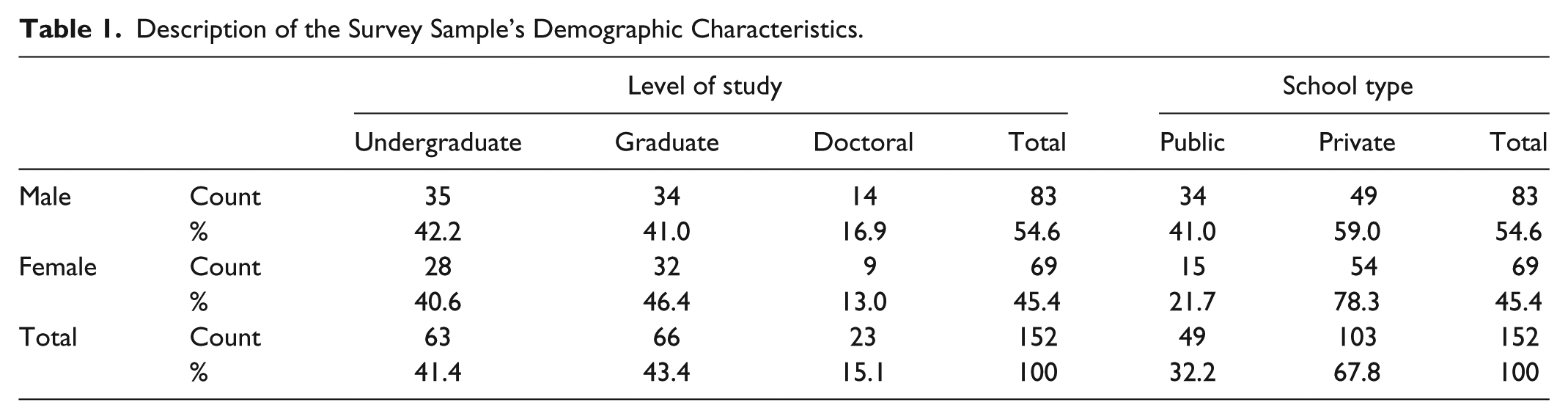
A total of 600 surveys were emailed in the spring 2013 semester to current international students who were enrolled and had completed at least one semester in their institutions. Out of the 600 emails sent, 183 responses were received, resulting in a 30.5% response rate. Of these, 152 of the participants were eligible for further analysis. Consequently, the response rate was 25.3%. Of the majority of the students who participated in this study, 139 (91.4%) held F-1 student visas. Of the 152 respondents, 83 (54.6%) were male students, and 103 (67.8%) were studying at a 4-year, private university. Nearly 42% of the participants identified themselves as undergraduate students. Table 1 displays the demographic characteristics of participants including gender, level of study, type of institution, and visa type.
Description of the Survey Sample’s Demographic Characteristics.
Findings
Inferential analysis
This section provides an overview of the responses for each question and then provides comparative data separately on gender, type of institution, and the level of study for each question. The five-level Likert-type responses were divided into the three categories of important, neutral, and less important.
The survey results indicated that variables such as strong student support service, having students from different cultures on campus, easier application process, and wide choice of academic programs were more important than variables such as sister school or exchange programs with the institution, family recommendation, having family members living in the location where the school is, cheaper tuition, scholarships and other financial aid opportunities, influence of the recruiters, and recruitment materials, on international students’ institution selection decision.
Comparison by gender
The most significant contributing factor for an international student to select an institution was the strong institutional support system and application process. For males, easier application and admission processes, international student support services, and students from different cultures were important factors when deciding among public and private institutions in the United States. For females, international student support services, having a wide choice of academic programs, and having students from different cultures at the institution played a key role in selecting the institution to attend. A chi-square test was run to determine if there were differences in importance of factors between males and females. The results indicated that there is a statistically significant difference between males and females in the proportions who reported family recommendation (p = .037) as less important. Both males and females reported that it was less important; however, the proportion of students who reported these as less important on their decision to study at their institutions was higher for males than for females. Nearly the same amount of students from both genders reported the factor as having a neutral impact on their decision.
Comparison by type of institution
Several factors, such as studying in a safer place, family recommendation, higher institutional rank, and influence of recruiters, were almost equally important for both student types in selecting their higher education institutions. However, some other factors differ based on the type of school students are from. Students from public universities reported good reputation of faculty members and good reputation of academic programs as the most important reasons for them to decide to study in their current institutions. Institutions having strong student support services and a lower cost of living are also considered important in the decision-making process. For private university students, having a strong institutional student support service was the most important factor, followed by easier application process, having students from different cultures on campus, and availability of wide choices of academic programs.
A chi-square test was run to determine if there were differences in importance of factors between institution types. The results indicated that there is a statistically significant difference between institution types in the proportions of participants who reported easier application process (p = .025), wide choices of academic programs (p = .011), good reputation of faculty members (p = .033), scholarship and financial aid opportunities (p = .039), strong alumni support (p = .039), and higher institutional reputation (p = .041) as important. The proportion of students who reported an easier application process and wide choices of academic programs as an important factor in their decision to study in their intuitions was higher for private institutions. Nearly half of the students from public institutions reported these factors as having a neutral effect on their decision. Students from both public and private institutions reported that good reputation of faculty members was important. Public university participants reported this as more important than private university participants. However, less than 40% of the private students reported this as less important in their decision. The proportion of students who reported scholarship and financial aid opportunities, strong alumni support, and higher institutional reputation as less important in their decision to study at their intuitions was higher for private institution participants. Public school students reported scholarship and financial aid opportunities as important and they reported strong alumni support, and higher institutional reputation as neutral on their decision to study in their current institutions.
Comparison by level of study
Several factors appeared to be most important for international students in terms of institution selection. For doctoral students, the most important factor was easier application process. Graduate students selected having students from different cultures on campus and having a strong institutional student support service as their most important factor, while undergraduate students ranked wide choices of academic programs as the most important factor in deciding to study at their current institution. A chi-square test was run to determine if there were differences in importance of factors between institution types. The results indicated that there is no statistically significant difference among the undergraduate, graduate, and doctoral levels of education (p > .05) in the proportion of students reporting importance of these factors in their decision to study at their institutions.
Phase II
Phase II reports on the qualitative analysis, utilizing an interview script that was generated following the analysis of the quantitative data. An open-ended, semistructured interviewing approach was used to get detailed insights about the participants’ responses.
Method
The researcher used an open-ended, semistructured approach to understand the perspectives of participants from both public and private institutions. To construct a purposeful sampling, the researcher selected the participants based on their regional culture, institution type, gender, and level of study. In this portion of the sampling process, the participants were selected based on their purposefulness to the study. The use of purposeful sampling criteria was considered most appropriate for the qualitative research, as it only includes participants most relevant to the study. Merriam (1998) explained that “the investigator wants to discover, understand, and gain insight and therefore, must select a sample from which the most can be learned” (p. 61). Using this technique, the researcher was required to select participants who had varying combinations of demographic information including regional culture, institution type, and educational level, from both genders, in an effort to get a more diverse perspective on the research problem (Creswell, 1998).
For this study, students were selected from two higher education institutions, a 4-year public and a 4-year private institution. Through the use of purposeful sampling, eight participants, four students from a public institution and four students from a private institution, were chosen from the 152 participants who took part in the quantitative phase of the study. These selected students were asked to participate in a 60-min face-to-face interview for an in-depth exploration of the reasons motivating international students to study at particular institutions of higher education in the United States.
The interview questions were open-ended and focused on the participants’ perceptions of the study abroad decision process. Each participant was interviewed, face-to-face, until theoretical saturation was achieved (Payne & Payne, 2004). The interviews had an average duration of 45 min. Several steps were then taken to enhance credibility and trustworthiness, as suggested by Guba (1981). Triangulation and member checking techniques were used to establish credibility. The interviews were audiotaped, transcribed verbatim, and analyzed using the meaning of analysis context method as described by Mayring (2000).
Interview Protocol Development
The second point of integration between the two phases was in the development of the interview protocol questions based on the quantitative data analysis. To further investigate the reasons motivating international students to study at particular higher education institutions in the United States, interview questions were developed by integrating the results from the first, quantitative phase.
Summarized Profile of Participants
There were four participants from each public and private institution. Two of the participants were female and six were male. The backgrounds of the participants varied in regional culture, gender, and level of education. Three of the participants were doctoral students from Asia and Europe, three were graduate students of whom one was from North Africa and two were from the Middle East, and two were undergraduate students from the Middle East. All participants have been studying in the United States for more than one semester. The pseudonyms of the participants were as follows: PL, PTA, PC, PTU, PP, PCH, PTU1, and PTU2.
Findings
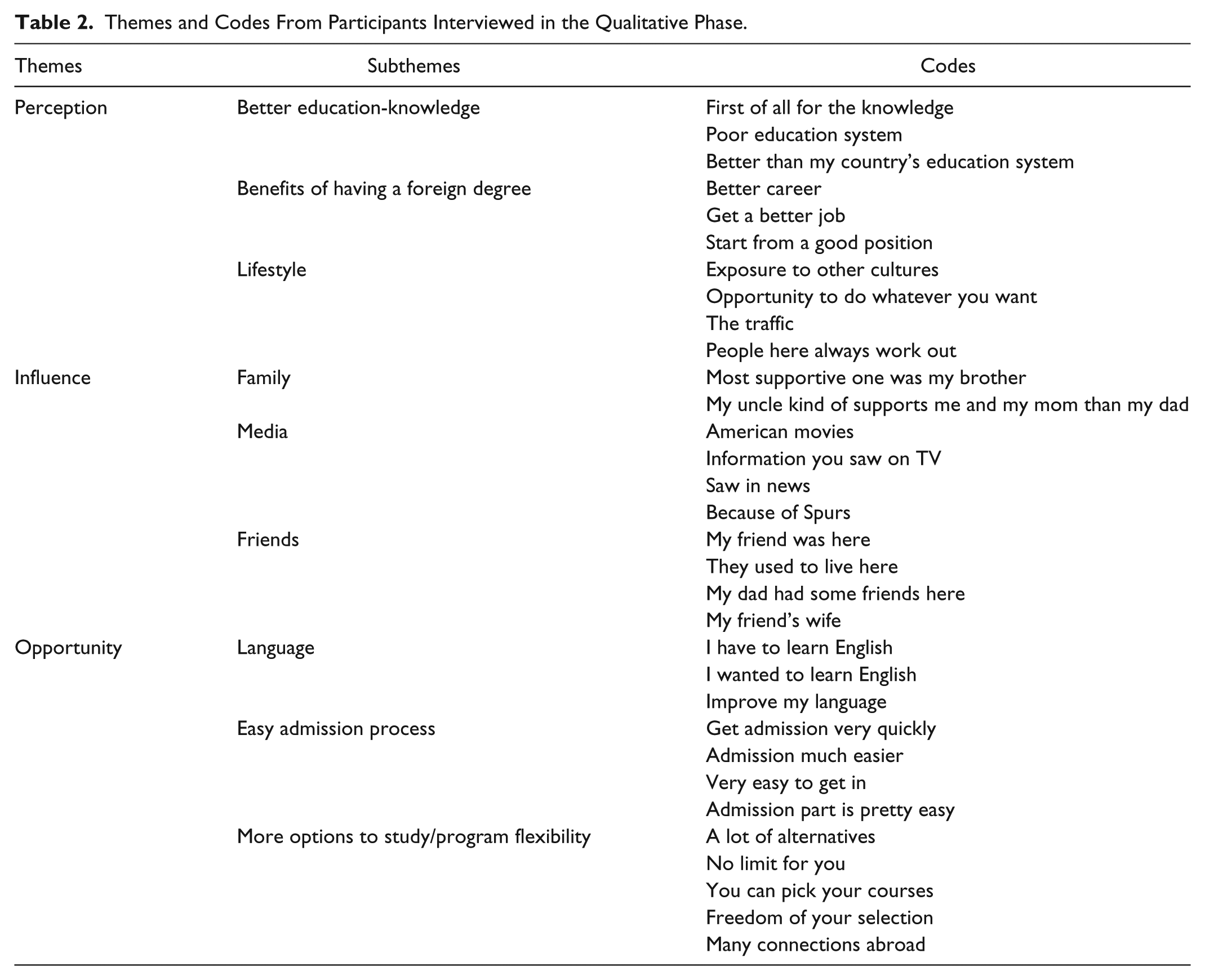
Coding was done and themes were drawn from the interviews. Three general themes emerged from the interviews: perception, influence, and opportunity. Each general theme was divided into subthemes for enhanced analysis and reporting. Perception was divided into three subthemes: better education and knowledge, benefits of having a foreign degree, and lifestyle. Influence was divided into family, media, and friends, and opportunity was divided into the three subthemes of language, easy admission process, and more options to study and program flexibility.
Perception
Perception was identified as the primary theme based on the interviewees’ statements mentioning their thoughts, feelings, and knowledge, which affected their decision to study abroad at a higher education institution in the United States. This theme included concepts such as better education and knowledge, benefits of having a foreign degree, and lifestyle.
Influence
Influence was another primary theme drawn from interviewees’ statements concerning influence of family, friend, and media on their decision to study abroad at a higher education institution in the United States.
Opportunity
Opportunity was also found to be a primary theme as interviewees’ responses included statements regarding the importance of learning language, the admission process, and the availability of academic programs on their decision to study abroad at a higher education institution in the United States. Table 2 displays the themes and codes that emerged from the interviews.
Themes and Codes From Participants Interviewed in the Qualitative Phase.
Discussion and Recommendations
This section discusses the quantitative and qualitative results, compares the findings with the literature, and connects with the theoretical framework. The qualitative findings are discussed based on the themes that emerged from the interviews.
Due to economic, political, and social conditions of the sending countries “students studying in higher education institutions outside their home countries have been growing rapidly” (Altbach et al., 2001, p. 3). As a matter of fact, higher education institutions across the world have been experiencing strong competition to attract international students. In view of the fact that the number of international students around the world has been increasing as well as the existence of a competition among study abroad destinations across the world, there is a need to understand international students’ decision-making processes in an effort to attract them to the United States. While there are many factors that influence international students’ decision, this study aimed to identify the main factors influencing international students’ decision to study abroad.
Previous literature suggested that selectivity of higher education institutions and the reputation of their faculty pull bright international students to U.S. universities (Mazzarol & Soutar, 2002) and that the international students pay extra attention to an institution’s rank (Moogan, Baron, & Harris, 1999). However, participants were not motivated by the selectivity of their current institutions, the quality of the faculty, and the institution’s rank. Their main motivation in selecting their current institution was mostly because of family and friend recommendations.
Marginson (2006) explained that students seek to study in developed and high ranked schools to embody their identity. The image of an institution—beliefs, ideas, reputations, facilities, and instructors—can have a strong influence on the student’s decision to attend an education institution (Bourke, 2000; Mazzarol, 1998; Qureshi, 1995). This was not the case. Findings indicated that international students were not currently studying at their current institutions because of the ranking but because of the ease of the admission and acceptance processes. Students believed that they could not get acceptance from a higher ranking institution and the ease of the admissions process was the second most important factor (family and friend recommendation as the most important factor) in making the decision to study at their current institution.
Even though proximity of relatives to colleges and universities is seen as a benefit and a factor influencing students’ decisions in earlier studies, “U.S. is closer to my home country” (64.4%), “My family recommended this institution” (50%), “I have/had family members/friends living in the location where my school is” (50%) are not considered as significant for international students to go to the United States for their studies.
Even though the literature suggested that the reputation of the academic programs and faculty are considered important for international students to select institutions, “the good reputation of academic programs” (46.7%), and “the good reputation of faculty members” (44.1%) were only confirmed by less than 50% of the respondents.
Other factors such as availability of employment opportunities while studying, many choices of schools and academic programs, and having students from different cultures on campus are either mentioned insignificantly or not covered at all in the available literature.
Recommendations for Future Research
This study was conducted at two higher education institutions in South Texas. Expanding the study, again through a mixed method study, to multiple institutions is certainly worth pursuing. It is important to include higher education institutions with more extensive scholarship opportunities that are also research intensive. Even though the results of this study did not indicate cost as a significant factor, it is important to understand the viewpoints of international students on scholarships.
Another recommendation is to conduct a study focusing on specific nationalities. Having different cultural, political, and economic contexts of the nations will certainly change the outcome of responses. Therefore, it is recommended that further research, focusing on international students from specific nations, be conducted to narrow the scope to have a better understanding of the motivations of the students from individual nations.
The last recommendation is to expand this study to international students studying at countries other than the United States. This would produce a more informed comparison, and analysis would be enhanced by having a better understanding of the motivations of students when deciding to study abroad and the thought processes utilized when selecting higher education institutions.
Footnotes
Appendix A
Appendix B
Appendix C
Declaration of Conflicting Interests
The author(s) declared no potential conflicts of interest with respect to the research, authorship, and/or publication of this article.
Funding
The author(s) received no financial support for the research and/or authorship of this article.