



Abstract
This study examines graduate education in the post-COVID era (2020–2025), a period marked by rapid shifts in both pedagogy and institutional management. Drawing on 384 articles, we combine systematic review, bibliometric mapping, and time-series forecasting to trace developments in the field. The analysis identifies three central research streams: project-based learning (PBL) as a pathway for professional development, process-oriented approaches that support institutional adaptability, and optimization tools such as Analytic Hierarchy Process AHP and Data Envelopment Analysis (DEA) that strengthen governance. Bibliometric evidence points to increasing collaboration between education and management sciences, while forecasting results suggest uneven trajectories. Research on PBL is projected to double within the next 5 years, whereas reliance on traditional optimization methods appears to have reached a plateau. The findings highlight how post-COVID scholarship has expanded the role of optimization in higher education but continues to treat it separately from innovative teaching models. We argue for the development of hybrid frameworks that bring together predictive tools and student-centered learning to guide the future of graduate education management.
Keywords
Introduction
Graduate education is undergoing profound transformation in response to global pressures that demand both pedagogical innovation and managerial efficiency. Universities and higher education institutions face increasing scrutiny from stakeholders, including governments, employers, and students, to demonstrate the effectiveness of graduate programs in terms of employability, research quality, and societal impact (Altbach & Salmi, 2011; Marginson, 2016). At the same time, institutions must contend with challenges such as limited funding, competition for talent, and rapid technological change (Wijaya et al., 2022). Against this backdrop, graduate education management has emerged as a crucial domain that seeks to optimize resource allocation, program design, and institutional governance while safeguarding the quality of student learning experiences (Heaton et al., 2023; Tight, 2019). Optimization approaches have become increasingly relevant in this context. Traditionally applied in fields such as engineering, operations research, and industrial management, optimization methods offer structured ways to balance multiple criteria, allocate scarce resources, and improve system efficiency (Triantaphyllou, 2000). Within higher education, tools such as the Analytic Hierarchy Process (AHP), Data Envelopment Analysis (DEA), and other multi-criteria decision-making (MCDM) techniques have been adapted to address problems including curriculum evaluation, faculty workload allocation, institutional benchmarking, and program accreditation (Johnes, 2006; Sarrico & Dyson, 2004). More recently, learning analytics, big data techniques, and predictive models have expanded the scope of optimization in education, allowing institutions to model student outcomes, predict attrition, and align teaching strategies with measurable performance indicators (Siemens, 2013). These developments signal a growing intersection between educational management and quantitative optimization science.
Parallel to the rise of data-driven optimization, pedagogical frameworks such as project-based learning (PBL) and process-oriented learning have gained prominence as strategies to enhance graduate education outcomes. PBL emphasizes experiential, student-centered approaches in which learners engage with authentic problems, develop critical thinking, and acquire transferable competencies through collaborative projects (Thomas, 2000). This approach has been widely recognized as effective in bridging the gap between theoretical knowledge and professional practice, especially in disciplines such as engineering, business, and medicine (Bell, 2010; Lasauskiene & Rauduvaite, 2015). In contrast, process-oriented learning focuses on iterative cycles of reflection, feedback, and participatory engagement to foster institutional adaptability and continuous improvement (Ukowitz, 2024). Drawing from traditions of action research and systems thinking, process-oriented approaches situate learning within broader organizational contexts, emphasizing not only outcomes but also the processes that sustain institutional transformation (Kemmis, 2009).
While both PBL and process-oriented approaches align with the goals of graduate education management, their integration with formal optimization tools remains limited. The literature often treats them as distinct domains: PBL as a pedagogical innovation and optimization as a managerial or analytical technique (Xu, 2025). Few studies have explicitly examined how optimization models can enhance PBL design, measure its outcomes more effectively, or support institutional decisions regarding its implementation (Hero & Lindfors, 2019). Similarly, process-oriented frameworks are rarely connected with data-driven optimization tools, despite the potential of such integration to strengthen reflective practices with empirical evidence (Ukowitz, 2024). This fragmentation creates a gap in both theory and practice, leaving higher education institutions without comprehensive models that unite pedagogical innovation and optimization science. Several reviews have attempted to synthesize aspects of this field, but they often remain partial in scope. For example, Zeng (2020) reviewed PBL outcomes in higher education, highlighting its benefits for cognitive and affective development but paying little attention to optimization tools. Furthermore, Alkhalil et al. (2021) and Xu and Shi (2023) applied AHP and big data analytics to design international talent training models, but such work rarely integrates PBL or process-oriented pedagogies. Reviews of optimization in higher education tend to focus on institutional efficiency and benchmarking (Johnes, 2006; Witte & López-Torres, 2017), while educational research prioritizes pedagogy and learning outcomes. The absence of integrative reviews means that knowledge development remains siloed, limiting the potential for systemic innovation in graduate education management. The rapid expansion of research in this field further underscores the need for synthesis. Bibliometric studies have shown that publications in higher education management, learning analytics, and optimization have grown significantly over the past decade, reflecting increased scholarly and policy interest (Aguillo et al., 2010; Gu et al., 2024; Zhao et al., 2020). However, without systematic analysis, it is difficult to map how topics evolve, which domains converge, and where gaps remain. Bibliometric mapping techniques, such as co-citation analysis, keyword co-occurrence, and thematic evolution, provide powerful tools to reveal the intellectual structure of a field and identify emerging areas of research (Aria & Cuccurullo, 2017; Cobo et al., 2011). Forecasting methods, particularly time-series models such as Prophet, extend this analysis by predicting future trajectories of research output, thereby informing strategic decisions for both scholars and policymakers (Taylor & Letham, 2018).
In this study, we therefore adopt a dual-track approach to address the fragmentation and growth of the field. First, we conduct a systematic review of optimization approaches in graduate education management, focusing on their intersections with project-based and process-oriented learning frameworks. Following PRISMA guidelines, we screened literature retrieved from Scopus between 2020 and 2025, applying quality, relevance, and domain-specific inclusion criteria to identify a final set of studies. This period was selected to capture researchers’ responses to the COVID-19 pandemic, which began as early as 2020. Second, we complement this review with a bibliometric mapping and forecasting analysis. Using the bibliometrix package in R, we analyze co-citation networks, keyword clusters, and thematic evolution within the field. We then employed Prophet package in R to forecast the future trajectory of publication trends, both overall and at the level of specific topics such as PBL, process-oriented learning, and optimization tools like AHP and DEA. The contribution of this paper is threefold. First, it provides the most comprehensive synthesis to date of research at the intersection of optimization, graduate education management, and pedagogical frameworks. Second, it maps the intellectual structure and thematic evolution of the field using bibliometric methods, thereby clarifying its current state. Third, it employs predictive modeling to anticipate future research directions, offering evidence-based insights into where the field is heading. Together, these contributions not only address existing gaps but also provide a foundation for the development of hybrid models that integrate optimization science with pedagogical innovation in graduate education management.
By adopting this approach, the paper seeks to advance understanding in both theoretical and practical terms. Theoretically, it contributes to the integration of managerial optimization with pedagogical design, an area often overlooked in education research. Practically, it offers higher education leaders’ evidence-based insights into emerging strategies that combine reflective, participatory, and project-based learning with structured optimization tools. Such integration has the potential to strengthen institutional adaptability, enhance student outcomes, and improve the governance of graduate education systems.
Conceptual Background
Optimization in graduate education management is increasingly recognized as a strategy to enhance both institutional efficiency and learning effectiveness. At its core, optimization refers to the systematic allocation of resources, decision-making, and process improvements that enable higher education institutions to achieve better outcomes under constraints (Sarrico & Dyson, 2004). By applying optimization techniques, universities can align academic offerings, governance, and resource distribution with the needs of students and stakeholders, thereby improving overall system performance (Johnes, 2006). PBL engages learners in authentic, real-world problem-solving, strengthening their cognitive, affective, and behavioral competencies while promoting professional readiness (Thomas, 2000; Zeng, 2020). Process-oriented approaches, in contrast, are rooted in reflective cycles, participatory practices, and iterative improvements that foster organizational learning and innovation (Ukowitz, 2023). Both frameworks contribute to educational transformation, yet their integration with structured optimization models remains limited in practice.
Recent research demonstrates that decision-support tools such as the Analytic Hierarchy Process (AHP), Data Envelopment Analysis (DEA), and multi-criteria decision-making (MCDM) methods can support program evaluation, talent development, and curriculum management in higher education (Wang, 2024). Similarly, learning analytics and predictive modeling are increasingly used to anticipate student performance, inform teaching strategies, and optimize institutional operations (Ifenthaler et al., 2019; Siemens, 2013). However, these tools are often deployed in isolation from pedagogical frameworks, resulting in a fragmented literature that separates managerial optimization from educational design. The availability of prior reviews on project-based learning (Bell, 2010; Zeng, 2020), process-oriented innovation in education (Kemmis, 2009; Torre et al., 2017; Ukowitz, 2024), and optimization in higher education (Johnes, 2006; Witte & López-Torres, 2017) provides a foundation for synthesizing existing knowledge. Yet no integrative review has systematically examined the overlap of these domains, nor have prior studies combined retrospective synthesis with predictive modeling to anticipate future developments. As Cobo et al. (2011) argue, reviewing prior reviews enables scholars to consolidate what is known while highlighting research gaps that remain unexplored. Building on this logic, the present study conceptualizes the intersection of optimization methods, project-based and process-oriented learning, and predictive analytics in graduate education management. By systematically reviewing and mapping the literature while employing forecasting tools such as Prophet (Taylor & Letham, 2018), this study aims to unpack both the historical evolution and the future trajectory of research in this domain.
Optimization in Education: As It Stands
Optimization in management education refers to the systematic use of analytical, computational, and process-driven methods to improve both pedagogical practices and institutional efficiency. Traditionally, optimization has been associated with operations research, where resource allocation and efficiency problems are solved under constraints (Triantaphyllou, 2000). In education, and specifically in graduate management programs, this concept has been adapted to curriculum design, program evaluation, and resource distribution, allowing institutions to balance multiple objectives such as academic quality, student outcomes, cost efficiency, and international competitiveness (Johnes, 2006; Sarrico & Dyson, 2004). A significant stream of research applies multi-criteria decision-making (MCDM) methods—quantitative techniques that evaluate and rank alternatives based on multiple, often conflicting criteria—to support program-level decisions. These include the Analytic Hierarchy Process (AHP) and the Technique for Order Preference by Similarity to Ideal Solution (TOPSIS) to support program-level decisions. These models help administrators rank programs, courses, or strategic initiatives by systematically weighting stakeholder preferences, thereby reducing subjective bias. Studies demonstrate their utility in prioritizing elective offerings, aligning curricula with industry expectations, and structuring international talent training programs (Moyo et al., 2020; Wang, 2024). Although widely adopted, MCDM approaches have been critiqued for their dependence on subjective weighting and their limited adaptability to dynamic contexts in which priorities evolve rapidly.
Another important body of literature draws on Data Envelopment Analysis (DEA) to benchmark the efficiency of programs and institutions. DEA compares multiple inputs (such as faculty size, infrastructure, and funding) against outputs (such as research, employability, or student satisfaction) to identify relative efficiency frontiers. Applied to management education, DEA has been used to evaluate business schools, assess the efficiency of MBA programs, and diagnose resource allocation gaps across graduate programs (Witte & López-Torres, 2017). DEA provides actionable insights into resource slacks and best practices but has been criticized for offering static snapshots, relying heavily on variable selection, and encouraging optimization toward quantifiable rather than holistic outcomes. Recent years have seen a rapid growth in learning analytics and predictive optimization in management education. These approaches leverage student data to predict attrition risks, assess skill acquisition, and allocate interventions dynamically (Siemens, 2013). In management schools, analytics has been used for assurance-of-learning frameworks, accreditation requirements, and personalized academic advising. Optimization is embedded here as decision-support for timely interventions, course sequencing, and adaptive assessment strategies. The advantage lies in capturing temporal dynamics and student heterogeneity, though concerns remain regarding algorithmic bias, transparency, and institutional readiness for data-driven governance.
Complementing these data-intensive methods are a process-oriented optimization frameworks, often grounded in quality-management philosophies such as the Plan–Do–Check–Act (PDCA) cycle a continuous improvement model involving iterative planning, implementation, evaluation, and corrective action (Ukowitz, 2023). These approaches emphasize continuous improvement, stakeholder involvement, and organizational learning, which have been applied to optimize advising processes, curriculum mapping, and capstone project pipelines. Evidence suggests that process-oriented approaches enhance institutional adaptability and buy-in from faculty and students, but they are rarely integrated with quantitative optimization tools, creating a disconnect between reflective practice and data-driven efficiency. Optimization is also increasingly visible in the design and implementation of project-based learning (PBL) in management education. PBL has become a cornerstone of graduate business programs, particularly in consulting practicums, entrepreneurship labs, and design studios (Bell, 2010; Zeng, 2020). While research confirms the value of PBL in enhancing professional competencies and engagement, optimization applications are often ad hoc and limited to local design choices rather than being embedded into institutional resource planning or decision-support frameworks. Few studies systematically link PBL to broader optimization systems, resulting in fragmented insights that limit scalability. The literature identifies three recurring targets of optimization in management education: (a) effectiveness, in terms of learning outcomes and employability; (b) efficiency, through cost reduction and resource utilization; and (c) equity, by addressing diversity and inclusion in graduate programs. Most research emphasizes effectiveness and efficiency, while equity optimization remains underexplored. Moreover, optimization in management education has largely been examined through case studies and cross-sectional analyses, with limited longitudinal or comparative evidence. There is also a notable imbalance in geographic coverage, with most studies conducted in Western institutions, leaving gaps in perspectives from emerging economies where resource constraints and institutional priorities differ (Witte & López-Torres, 2017). A recent methodological evolution is the shift from retrospective optimization (benchmarking and evaluation) to predictive orchestration, in which forecasting models are used to anticipate demand, enrollment, and research trajectories. For example, Prophet forecasting (Taylor & Letham, 2018) allows researchers and institutions to model publication growth, thematic evolution, and future topic salience. This predictive capability extends optimization beyond historical analysis to proactive decision-making, enabling business schools to prepare for shifts in research focus, curriculum needs, and resource allocation. Forecasting thus bridges the gap between bibliometric mapping of the past and strategic planning for the future.
Despite progress, several gaps remain. First, there is a lack of integration between PBL, process-oriented frameworks, and formal optimization models; most studies examine them in isolation. Second, empirical evaluation of optimized designs compared with traditional models is limited, leaving questions about long-term impact on learning quality and equity. Third, governance and adoption issues, including transparency, decision rights, and ethical safeguards, are rarely addressed in optimization studies, which hinders institutional implementation. Finally, predictive optimization remains underutilized, with only a handful of studies applying time-series forecasting to educational management research itself. In summary, the literature demonstrates that optimization has become an essential lens for improving management education, spanning pedagogical innovation, institutional efficiency, and decision-support. However, current research is fragmented and uneven, with weak integration across pedagogical and analytical approaches and limited forecasting of future trajectories. This study addresses these limitations by providing a systematic synthesis of optimization in graduate education management, mapping knowledge structures using bibliometric analysis, and applying predictive modeling to anticipate the future evolution of the field.
Methodology
This study adopted a three-stage methodological design to combine systematic rigor with analytical depth. A dual framework was employed, drawing on both the PRISMA protocol (Preferred Reporting Items for Systematic Reviews and Meta-Analyses) and the SPAR-4-SLR (Scientific Procedures and Rationales for Systematic Literature Reviews) protocol. PRISMA was applied to ensure transparency and replicability in the identification, screening, eligibility, and inclusion of studies, thereby minimizing selection bias (Moher et al., 2010). Complementing this, SPAR-4-SLR provided a structured approach for assembling, arranging, assessing, and reporting, ensuring a comprehensive and rational process for literature refinement (Ahmad & Slots, 2021). Together, these frameworks safeguarded methodological rigor and produced a high-quality, contextually relevant dataset. In the second stage, the refined corpus of studies was analyzed through bibliometric techniques using the bibliometrix package in R (Aria & Cuccurullo, 2017). Bibliometric analysis differs from systematic reviews and meta-analyses in its focus: while systematic reviews synthesize findings on specific research questions and meta-analyses integrate effect sizes across studies, bibliometric methods are more suited for mapping the intellectual, conceptual, and social structures of a field. Such approaches are particularly valuable for uncovering structural and dynamic patterns within large bodies of literature (Aria & Cuccurullo, 2017; Donthu et al., 2021). Accordingly, this study mapped co-authorship networks, keyword co-occurrence patterns, thematic clusters, and examined citation impacts, productivity trends, and the evolution of thematic domains. The final stage incorporated a forecasting dimension to anticipate temporal shifts and future research trajectories. The Prophet algorithm, a time-series forecasting model developed by Facebook, was implemented due to its ability to handle seasonality and non-linear growth patterns, making it well-suited for projecting publication dynamics in scientific domains (Taylor & Letham, 2018). By integrating predictive insights with bibliometric mapping, the study extended beyond retrospective analysis to provide a forward-looking perspective on the field.
Assembling
The assembling stage established the scope and foundations of the review following both the PRISMA protocol (Moher et al., 2009) and the SPAR-4-SLR framework (Paul et al., 2021). Research questions (RQ1–RQ4) were formulated to capture publication trends, identify influential contributors, explore thematic structures, and forecast research trajectories in optimization and graduate education management. Scopus was selected as the sole database given its breadth, reliability, and suitability for bibliometric studies. Scopus was selected as the sole database for this review because it offers the broadest multidisciplinary coverage among citation indexes and includes the majority of journals indexed in Web of Science (WOS; Mongeon & Paul-Hus, 2016). Compared with other databases, Scopus provides richer author, keyword, and citation metadata, these are elements crucial for bibliometric and network-based analyses. Furthermore, Scopus ensures compatibility with widely used bibliometric tools such as bibliometrix, Biblioshiny, and VOSviewer, facilitating reproducibility and transparent data cleaning. Prior comparative studies have confirmed that Scopus casts a wider net across education, management, and technology journals, making it particularly suitable for mapping interdisciplinary domains like graduate education optimization. Consequently, the reliance on Scopus ensures both analytical precision and comprehensive coverage within the study’s focus. The search was restricted to 2020 to 2025 to reflect contemporary developments in optimization, project-based learning, and process-oriented learning. Search strings combined keywords such as “optimization methods,”“decision support,”“AHP,”“DEA,”“project-based learning,” and “process-oriented learning.” This search initially yielded 2,573 records, forming the raw dataset for subsequent screening. To ensure replicability, the complete search strategy used in Scopus was reconstructed and is provided below. The search targeted titles, abstracts, and keywords combining terms related to optimization, education management, and pedagogical innovation. Boolean operators and truncations were applied as follows:
(“optimization” OR “efficiency analysis” OR “data envelopment analysis” OR “DEA” OR “Analytic hierarchy process” OR “AHP” OR “multi-criteria decision making” OR “MCDM” OR “Process optimization” OR “decision support system”) AND (“education management” OR “higher education” OR “graduate education” OR “University administration” OR “academic management” OR “curriculum design”) AND (“pedagogy” OR “project-based learning” OR “PBL” OR “plan-do-check-act” OR “PDCA” OR “Learning analytics”)
The search was limited to English-language journal articles and reviews between 2000 and 2025 in the subject areas of Business, Management, and Accounting; Decision Sciences; Computer Science; Social Sciences; and Education. After applying inclusion and exclusion criteria, 384 articles were retained for analysis.
Arranging
The arranging stage applied systematic filters to refine the initial pool in line with SPAR-4-SLR’s organizing procedures. Duplicate and irrelevant records were removed, and studies were organized by language, source type, and disciplinary scope. Only English-language journal articles and reviews were retained to ensure comparability and quality. The subject areas were limited to Business, Management and Accounting, and Social Sciences, while purely technical or engineering-focused papers were excluded. A temporal filter further ensured inclusion of studies from the 2020 to 2025 period. After these refinements, the dataset was reduced from 2,573 to 772 records, and subsequently to 384 studies that passed preliminary relevance checks.
Assessing
The assessing stage involved evaluating the methodological rigor, contextual relevance, and theoretical contribution of the retained studies. Each article was appraised against pre-defined inclusion and exclusion criteria. Key assessment parameters included: (a) direct relevance to graduate education management; (b) explicit use of optimization frameworks or managerial decision-support tools; and (c) incorporation or discussion of project-based or process-oriented pedagogies. Studies lacking methodological soundness, domain fit, or scholarly credibility (e.g., predatory outlets) were excluded. This stage ensured that only high-quality, contextually relevant, and credible studies advanced to the final pool.
Inclusion
The inclusion stage finalized the systematic dataset that formed the evidence base for subsequent bibliometric mapping and forecasting. After rigorous assessment, 384 studies met all quality, scope, and relevance criteria. These studies constitute the systematic review’s core dataset, serving as the empirical foundation for bibliometric analysis, co-citation and co-occurrence mapping, thematic evolution, and time-series forecasting. This dual integration of PRISMA and SPAR-4-SLR ensured transparency, replicability, and a comprehensive representation of the field.
The sequential series of steps is further provided in Figure 1.

SLR-4 and PRISMA based flowchart of data processing.
Data Analysis
Mapping Keyword to Study Research Interests
An analysis of keyword frequencies provides a clear picture of the dominant research interests in the field of optimization in graduate education management. The most frequently occurring term is “higher education,” reflecting the broad institutional and contextual focus of the literature. This prominence highlights that optimization methods are often framed within the wider discourse of higher education reform and policy, rather than being confined to micro-level pedagogical interventions. The second most common term, “data envelopment analysis (DEA),” demonstrates the importance of efficiency benchmarking as a methodological lens. DEA has been widely employed to evaluate institutional productivity, resource utilization, and comparative performance among higher education institutions. Closely linked, the keyword “efficiency” also ranks highly, reinforcing the managerial emphasis on cost-effectiveness and outcome maximization. Beyond efficiency-driven concerns, terms such as “higher education institutions,”“quality,” and “teaching-learning processes” point to a strong pedagogical dimension. These keywords indicate that researchers are not only interested in optimization for resource allocation but also in its implications for teaching quality, institutional effectiveness, and learning processes. The presence of “universities” and “resource allocation” further underlines the managerial focus on distributing resources strategically to improve educational outcomes.
Emerging research interests are also evident. Keywords such as “artificial intelligence,”“machine learning,”“big data,” and “COVID-19” illustrate a growing turn toward digital transformation and predictive technologies in educational management. These terms suggest that optimization research is beginning to intersect with advanced analytics, forecasting, and resilience-building in response to global disruptions. Similarly, the recurring mention of “analytic hierarchy process (AHP)” and “multi-criteria decision-making” reflects the application of structured decision-support models to curriculum design, program evaluation, and institutional governance. Overall, the keyword frequency distribution reveals two overlapping strands of scholarly interest:
a well-established focus on efficiency, benchmarking, and institutional management, and
an emerging orientation toward digital innovation and predictive optimization. The convergence of these strands indicates that future research will increasingly combine classical optimization tools (DEA, AHP) with data-driven analytics (AI, machine learning, big data), thereby expanding the scope of optimization in graduate education management.
The keywords are further mapped in Figure 2.
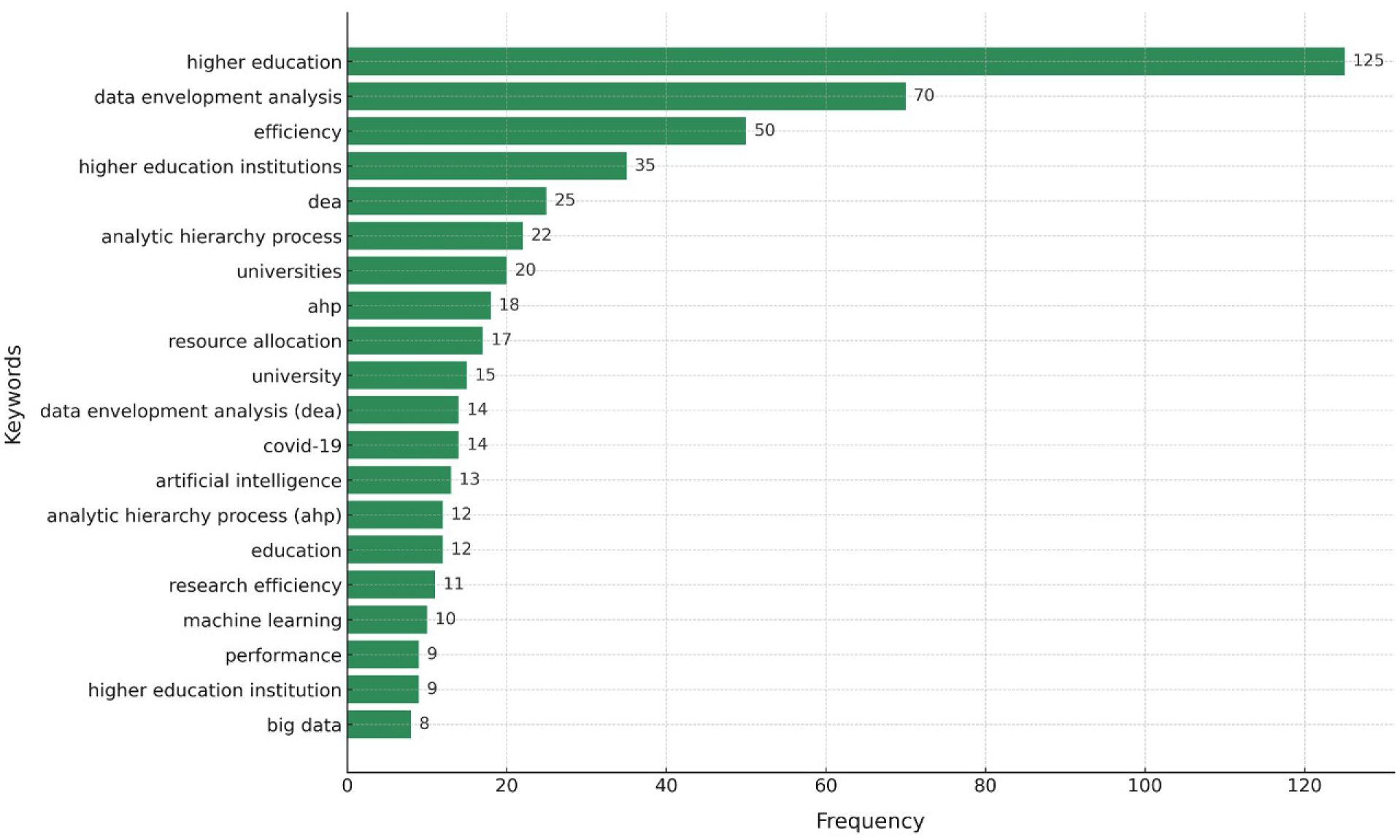
Keyword trends in the post-covid era (2020–2025).
Thematic Clusters in Educational Research
The thematic map reveals three dominant clusters that capture the evolving focus of educational research in recent years: artificial intelligence, assessment, and COVID-19. Each cluster represents a distinct yet interconnected stream of inquiry, shaped by both technological advancement and contextual challenges.
Cluster 1: Artificial Intelligence
This cluster highlights the growing prominence of artificial intelligence (AI) in education, with artificial intelligence itself and student engagement emerging as the most central concepts, reflected in their high betweenness and PageRank centralities. While AI-driven tools are increasingly applied to enhance learning outcomes, the emphasis on student engagement indicates that technology is not viewed in isolation but as a means of fostering deeper learner participation. Subthemes such as educational innovation, quality assessment, and university education suggest that research is also oriented toward systemic change, where AI supports broader educational reforms and quality assurance frameworks.
Cluster 2: Assessment
The second cluster revolves around assessment and its related practices, with strong links to evaluation, e-learning, and decision support systems. The centrality values suggest that assessment acts as a connecting node across the thematic network, linking traditional evaluation practices with emerging computational methods like fuzzy logic. The presence of stakeholders and education system as keywords reflects an institutional dimension, emphasizing that assessment is not merely a technical exercise but a socially negotiated process involving multiple actors. This cluster illustrates the dual focus on methodological innovation and the systemic implications of assessment in educational contexts.
Cluster 3: COVID-19
The largest and most dynamic cluster is centered on the COVID-19 pandemic, which reshaped the educational landscape globally. Highly central keywords such as machine learning, academic performance, and online learning indicate a strong focus on how digital technologies were leveraged to address disruptions. Subthemes such as prediction, distance learning, and educational data mining highlight the analytical turn in research, where machine learning algorithms were deployed to predict outcomes, classify learning behaviors, and support adaptive instruction. The presence of methodological terms like classification, random forest, k-means, and J48 suggests that the pandemic accelerated the adoption of advanced data-driven techniques in education research. Context-specific terms such as Latin America underscore the global but uneven nature of the pandemic’s impact on educational systems. The three clusters reveal a broader trajectory where AI and machine learning are not only shaping educational assessment but also restructuring teaching and learning practices, especially in response to global crises. While the COVID-19 cluster reflects a reactive orientation to an unprecedented disruption, the AI and assessment clusters represent longer-term structural changes that continue to influence the future of education. The thematic clusters have been given elaboratively in Table 1.
Thematic Clusters.

Note. Quantitative metrics summarizing centrality and prominence of key clusters (AI, assessment, COVID-19). Highlights the methodological transition from pandemic-driven analyses to data-driven pedagogy.
Keyword Co-Occurrence Network
The keyword co-occurrence network provides deeper insight into how research interests in optimization and graduate education management are structured (van Eck & Waltman, 2014). Two distinct clusters emerge thematically (Figure 3), reflecting different but complementary directions within the literature. The first cluster (red) is centered on terms such as higher education, universities, resource allocation, data envelopment analysis (DEA), and benchmarking. This group represents the efficiency and institutional management strand of the literature. Studies in this cluster primarily examine optimization from a managerial perspective, focusing on performance measurement, productivity, and the allocation of resources in higher education institutions. The presence of terms such as surveys and questionnaires, tertiary education, and student satisfaction indicates that this stream not only evaluates institutional efficiency but also connects managerial decision-making with learner outcomes and stakeholder perspectives. The second cluster (blue) highlights terms such as teaching, students, decision making, analytic hierarchy process (AHP), artificial intelligence, engineering education, and sustainable development. This cluster reflects the pedagogical and technology-driven strand of research. Here, optimization is tied closely to curriculum design, decision-support systems, and the integration of emerging digital technologies, including AI and e-learning platforms. The prominence of terms like academic performance and learning systems suggests that this stream is particularly concerned with linking optimization approaches to learning quality, skills development, and broader educational outcomes.

Keyword co-occurrence network.
The network underscores the dual nature of optimization research in graduate education management: one oriented toward institutional efficiency and governance, and the other toward pedagogical innovation and technological integration. The dense interconnections between the two clusters suggest that while these domains are often studied separately, they share methodological tools (e.g., AHP, DEA) and conceptual concerns (e.g., decision making, performance). The emergence of terms such as artificial intelligence and sustainable development in the pedagogical cluster further points to evolving research interests that may drive future convergence between institutional and pedagogical perspectives. The co-occurrence map reveals that optimization in higher education is not confined to resource management but is increasingly linked to teaching practices, decision-support technologies, and digital transformation. This dual structure highlights the need for integrative approaches that connect efficiency-driven models with learning-centered frameworks to strengthen graduate education management.
Thematic Evolution (2020–2025)
Thematic evolution analysis provides insights into how research priorities and intellectual structures have shifted over time. By focusing on the period 2020 to 2025, this section traces the development, transformation, and convergence of key themes within the field. It highlights emerging research fronts, the maturation of established topics, and the decline of others, thereby offering a longitudinal perspective on the discipline’s intellectual trajectory.
Understanding the Strategic Thematic Map: Centrality, Density, and Quadrants
The thematic evolution maps (Figures 4–7) are based on the strategic diagram method developed by Callon et al. (1991). Which positions themes according to two key dimensions: centrality and density. Centrality measures the degree of interaction of a theme with other themes in the network, indicating its importance or influence within the overall field. A theme with high centrality acts as a conceptual hub, linking multiple clusters of research. Density measures the internal strength and coherence of the keywords forming a theme, reflecting its developmental maturity. High-density themes exhibit strong internal ties and conceptual consistency, while low-density themes remain underdeveloped or fragmented.
The intersection of these two axes divides the diagram into four quadrants, each representing a distinct strategic significance for the field:
Upper-right (High Centrality, High Density): Motor Themes—well-developed and essential for the structure of the field; they represent mature and influential research fronts.
Upper-left (Low Centrality, High Density): Niche Themes—internally well-developed but isolated; they have specialized relevance with limited connections to other domains.
Lower-left (Low Centrality, Low Density): Emerging or Declining Themes—weakly connected and conceptually underdeveloped; they may represent emerging topics or fading areas of research.
Lower-right (High Centrality, Low Density): Basic or Transversal Themes—foundational but underdeveloped areas that support multiple domains; they often provide conceptual or methodological bases for other themes.
Interpreting the evolution of themes across these quadrants enables identification of how research areas in graduate education optimization transition over time—from emerging to motor themes or, conversely, from niche to declining relevance.

Trends in 2020.

Trends in 2021.

Trends between 2022 and 2023.
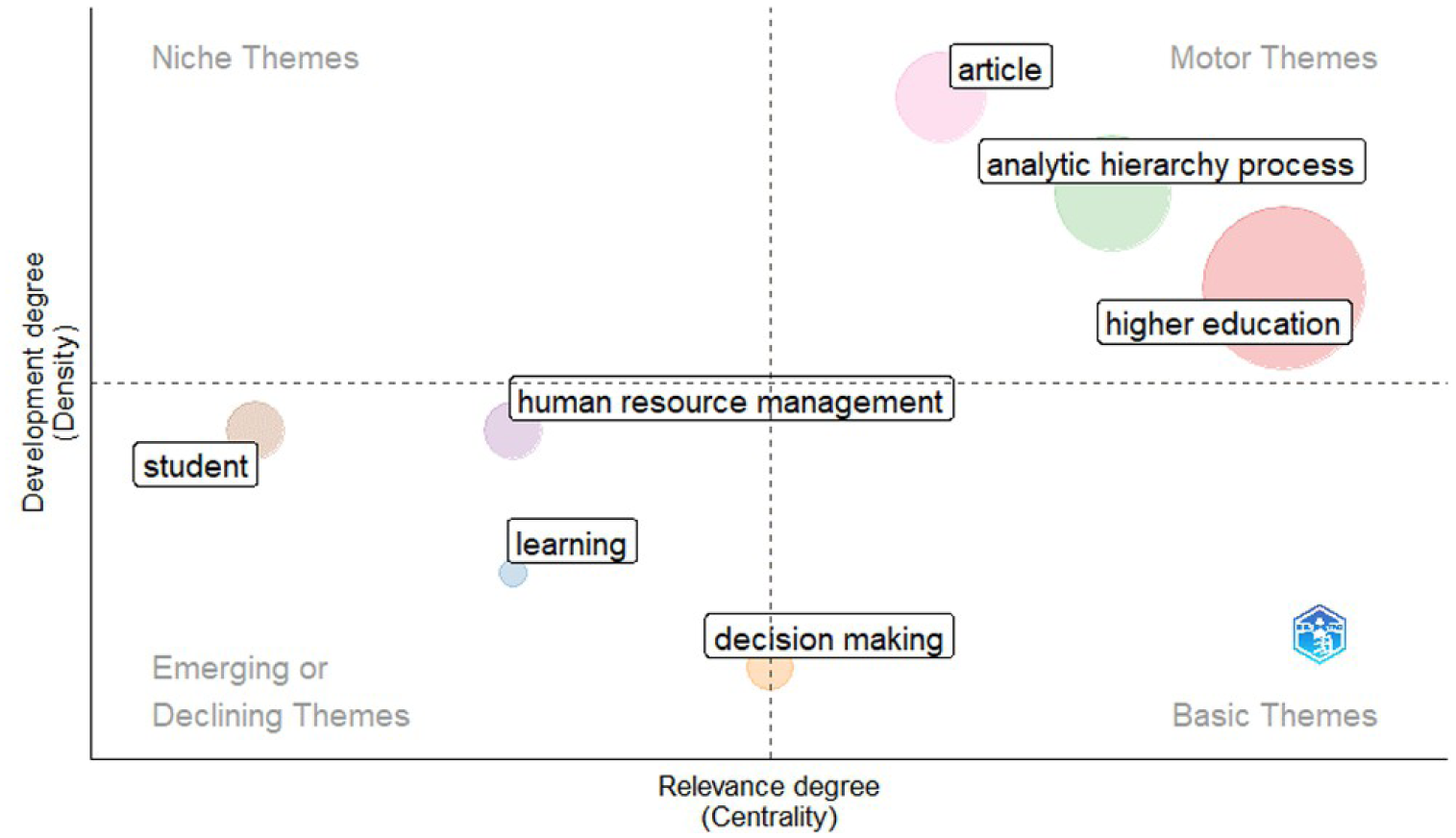
Segment 4: 2024 to 2025.
Segment 1: 2020
The initial period of analysis, beginning in 2020, reflects the foundational stage of research activity, where the themes of higher education and data envelopment analysis (DEA) were dominant. During this time, DEA emerged as a methodological anchor for evaluating institutional efficiency, particularly within the higher education sector. Alongside these established methods, themes such as “student” and “resource allocation” appeared as evolving concerns, indicating the growing interest in assessing not only institutional structures but also the experiences of learners and the ways in which resources were distributed to maximize performance. This Segment also shows the presence of sustainable development and procedural discussions, though these remained marginal and less central. Overall, 2020 can be characterized as a period in which efficiency-oriented methodologies and institutional performance metrics were being consolidated as central topics, laying the groundwork for subsequent thematic diversification. This segment in mapped in Figure 4.
Segment 2: 2021
By 2021, the thematic structure shifted to incorporate a broader policy orientation. While higher education and DEA continued to maintain relevance, the emergence of themes such as policy making, competition, and education sectors signals a greater engagement with structural and governance dimensions of education systems. This period also saw the contextual influence of the COVID-19 pandemic, reflected in themes around efficiency, quality assurance, and decision support systems. The pandemic appears to have acted as a catalyst for examining how educational institutions could adapt to crisis conditions, with efficiency analyses being extended to questions of resilience and resource management. Consequently, the thematic map of this Segment demonstrates a movement beyond purely methodological concerns into socio-political and sectoral issues, highlighting how external shocks reframed the discourse on higher education performance and management. Segment 2 is visually mapped in Figure 5.
Segment 3 (2022–2023)
The years 2022 and 2023 mark an expansion of thematic diversity with the inclusion of geographically and institutionally specific concerns. The persistence of higher education and DEA underscores their continued centrality, yet new themes such as China, enterprise resource planning (ERP), and institutional frameworks point to a stronger emphasis on comparative and system-level analyses. The thematic appearance of students, alongside education computing and research efficiency, reflects a dual focus: while the systemic and technological infrastructures of education were scrutinized, learner experiences and digital education practices also gained importance. Articles and resource allocation, positioned as motor themes, suggest that scholarly production itself and debates around institutional efficiency remained the engine of discourse. This Segment thus demonstrates a more globalized and technologically oriented trajectory, where comparative frameworks and digital tools expanded the scope of inquiry in higher education research. This segment is followed by the visual representation of themes in these years in Figure 6.
Segment 4 (2024–2025)
The most recent period, covering 2024 and 2025, illustrates a significant thematic maturation characterized by the integration of advanced decision-making methodologies and human-centered concerns. Analytic hierarchy process (AHP), higher education, and human resource management dominate as motor themes, reflecting a sophisticated orientation toward multi-criteria evaluation and organizational governance within the education sector. The inclusion of decision making, learning, and articles highlights both the methodological depth and the ongoing attention to pedagogy and knowledge dissemination. Compared to earlier Segments, there is a clear shift toward strategic management and human capital perspectives, with the themes extending from efficiency-focused analyses toward issues of workforce management, leadership, and decision-support tools. This transition signals a broader evolution of the field: from methodological consolidation in 2020, through policy and system-level analyses in 2021, to globalized and technological expansions in 2022 to 2023, culminating in a period where advanced methodologies and human-centered approaches shape the contemporary discourse. These findings are visually mapped in Figure 7.
The four strategic diagrams collectively trace the intellectual trajectory from technical efficiency (2020) toward governance and human-centered optimization (2025). Rising density of AI- and HRM-related themes suggests a theoretical broadening of optimization research from operational assessment to adaptive educational design.
Temporal Shifts in Thematic Structure
The visualization of thematic evolution across the four Segments highlights the persistence, emergence, and transformation of key research themes within the dataset spanning 2020 to 2025. The plot, which maps the presence of themes across successive time slices without connecting them, allows for a clear identification of recurring versus temporally bound areas of focus. The enduring prominence of higher education and data envelopment analysis across all Segments signals their central role as anchor concepts that consistently shaped scholarly inquiry throughout the period. In contrast, themes such as student and resource allocation appear in the earliest stage of 2020, reflecting initial concerns with learner engagement and the allocation of institutional resources, but fade out in later years as the discourse broadened. By 2021, the thematic space incorporated policy making and competition, indicating a growing interest in governance, external pressures, and systemic reform in the wake of COVID-19. The middle Segment of 2022 to 2023 reveals the diversification of focus through themes such as China, ERP, and institutional frameworks, which point to comparative perspectives and the rising importance of digital infrastructure in higher education. In the most recent period, 2024 to 2025, the emergence of analytic hierarchy process, HRM, and decision making demonstrates a shift toward advanced methodological applications and human capital management, reflecting the maturation of the field toward strategic and managerial concerns. Overall, the plot illustrates a trajectory where methodological consolidation and efficiency analysis provided the foundation for policy, digital, and managerial expansions, culminating in a research landscape that is increasingly characterized by integrative and decision-oriented themes. Figures 8 and 9 highlight the keyword shifts visually.

Evolution of keywords in the post-Covid era.

Evolution of keywords in the post-Covid era.
Predictive Publication Trends/Forecasting Cluster Trends
To assess the temporal dynamics of research attention, we applied Prophet forecasting to the two dominant clusters identified in the co-occurrence analysis: Efficiency/DEA and Pedagogy/AI. The resulting projections (Figures 10 and 11) reveal a marked divergence in trajectories between the two. The Efficiency/DEA cluster, historically the more established of the two, displays relatively high levels of publication activity throughout the early 2020s, averaging around 20 to 24 publications per year. However, the forecast indicates a gradual decline in output, with values projected to stabilize closer to 18 to 19 publications per year by 2030. This trend suggests that while DEA and related efficiency-oriented methodologies retain a stable research base, their incremental contributions may be tapering, reflecting the maturity of this stream. By contrast, the Pedagogy/AI cluster demonstrates a markedly different trajectory. From a comparatively modest base of approximately 8 to 10 publications per year at the start of the decade, the forecast predicts substantial growth, with output expected to rise steadily beyond 20 publications per year by 2030. This acceleration underscores the growing salience of artificial intelligence, digital learning, and decision-support methods in pedagogical contexts. The contrasting forecasts indicate a methodological shift in the literature. While Efficiency/DEA methods remain important, their relative prominence is likely to diminish as pedagogical and AI-driven approaches gain traction. This finding reinforces the bibliometric evidence of an evolving research frontier, where traditional efficiency analyses are increasingly complemented or even displaced by data-driven, intelligent decision-support systems in higher education and learning contexts. Table 2 presents the Prophet-based forecasts of yearly publication counts across key research streams in graduate education optimization. The data includes projections for project-based learning (PBL), artificial intelligence (AI), analytic hierarchy process (AHP), data envelopment analysis (DEA), thematic clusters (pedagogy–AI and efficiency–DEA), and overall publications during the post-COVID period (2020–2030).
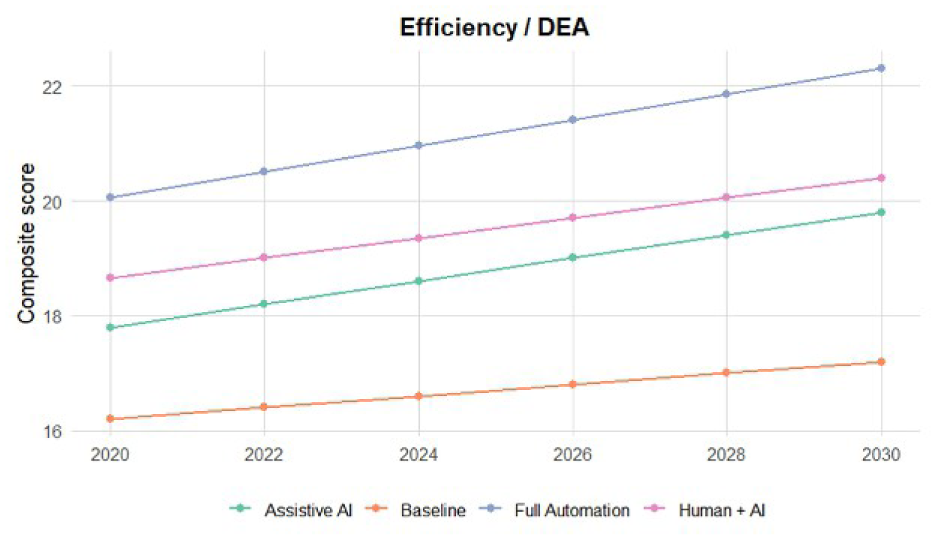
Forecasted publication trends in the Efficiency/DEA cluster (2020–2030). Prophet-based projection showing a gradual decline and stabilization in research output.

Forecasted publication trends in the Pedagogy/AI cluster (2020–2030). Prophet-based projection showing a sustained upward trajectory in research output.
Forecasted Publication Trends in Graduate Education Optimization Till 2030.

Note. For low-count streams, forecasts were produced on the log(1+y) scale and back-transformed using expm1(.). Where the back-transformed value was slightly negative due to model error, it was truncated to 0.0 to enforce the non-negativity of publication counts.
Table 2 presents the Prophet-based forecasts of yearly publication counts across key research streams in graduate education optimization, illustrating how evolving technological, policy, and societal imperatives are reshaping scholarly priorities.
Since publication counts are non-negative and some topic streams exhibit very low annual frequencies, we estimated forecasts on a transformed scale to prevent small negative artifacts. Specifically, for low-count series (e.g., PBL, AI in early years) we modeled
The contrasting growth patterns depicted in Table 2 are shaped by wider policy and technological dynamics. The forecasted decline in the Efficiency/DEA cluster parallels global shifts in higher-education governance, where emphasis is moving from cost-efficiency auditing toward outcome-based and student-centric performance models encouraged by post-COVID reforms and digital transformation policies. Conversely, the rapid rise in the Pedagogy/AI cluster reflects the expansion of national AI strategies, government-funded digital-learning initiatives, and growing societal demand for adaptive and personalized education. These policy and social drivers suggest that optimization research is increasingly influenced by technological adoption cycles and equity-driven educational agendas. For universities, the practical implication is clear: institutional leaders should integrate AI-enabled decision-support tools not merely for administrative efficiency but to enhance teaching quality, predictive student-success analytics, and data-informed governance while maintaining transparency and inclusivity.
Discussion, Future Agenda Based on Mapping and Prediction
The synthesis of bibliometric mapping and forecasting underscores that the future of optimization in graduate education management will not be defined by the survival of traditional efficiency tools alone, but by their recombination with pedagogical and digital innovations. While approaches such as Data Envelopment Analysis (DEA) and efficiency benchmarking remain foundational, their projected plateau suggests they have reached methodological saturation (Witte & López-Torres, 2017). This does not imply obsolescence; rather, these tools require repositioning within hybrid frameworks that integrate managerial optimization with project-based and process-oriented pedagogies. Future studies could, for instance, explore how DEA or Analytic Hierarchy Process (AHP) outputs can be embedded into project-based curricula where faculty and students collaboratively interpret efficiency results to refine program design (Ukowitz, 2023). Such integration would move scholarship beyond static institutional evaluations toward participatory and adaptive optimization practices. A second trajectory arises from the accelerating prominence of pedagogy- and AI-oriented clusters. The bibliometric and forecasting results suggest that artificial intelligence, machine learning, and predictive analytics will increasingly shape curriculum design, adaptive learning pathways, and institutional governance (Ifenthaler & Yau, 2020; Siemens, 2013; Zawacki-Richter et al., 2019). Yet, the current literature under-theorizes risks such as algorithmic bias, data transparency, and ethical responsibility. As Holmes et al. (2022) emphasize, optimization must be reconciled with fairness, accountability, and inclusivity if AI-driven approaches are to be educationally sustainable. Future research should thus interrogate not only the technical capabilities of AI but also its institutional adoption and ethical implications. Comparative case studies across diverse cultural and regulatory contexts could illuminate how optimization practices are interpreted differently, highlighting tensions between efficiency imperatives and educational values.
Geographic concentration represents another critical research frontier. Current scholarship remains disproportionately anchored in Western higher education contexts (Witte & López-Torres, 2017), which risks narrowing conceptualizations of optimization. In emerging economies, optimization practices are shaped by resource scarcity, governance challenges, and digital divides that differ significantly from Western institutional realities. Future work should therefore prioritize cross-cultural comparative studies, especially in regions where optimization is constrained by infrastructural limitations. Such efforts can help develop plural, situated understandings of optimization rather than exporting one-size-fits-all frameworks. Equity also remains an underexplored dimension in optimization research. While effectiveness (learning outcomes) and efficiency (resource allocation) dominate, equity concerns rarely appear as optimization targets. Integrating social justice, diversity, and inclusion into optimization frameworks aligns the field with global sustainable development goals (Lomba et al., 2023). For example, predictive analytics can be reoriented to not only flag at-risk students but also ensure equitable distribution of institutional resources across underrepresented populations. Research in this area could transform optimization from a performance-driven logic into one that simultaneously advances institutional fairness and inclusion.
Finally, the forecasting analysis highlights a methodological transition from retrospective benchmarking toward predictive orchestration. Tools such as Prophet (Taylor & Letham, 2018) allow scholars to anticipate publication growth, enrollment trends, and thematic evolution. Yet, the impact of such forecasting depends on institutional uptake. If decision-makers do not trust or operationalize predictive insights, forecasting risks remaining a scholarly exercise rather than a transformative decision-support mechanism. Future research should therefore combine bibliometric forecasting with qualitative investigations of leadership practices, organizational readiness, and cultural attitudes toward data-driven governance. In this way, optimization can evolve into an anticipatory and adaptive science, capable of balancing efficiency with equity, prediction with reflection, and global frameworks with local realities. In summary, the study not only consolidates past and present developments but also delineates future research directions by forecasting topic trajectories and identifying underexplored intersections. This forward-looking synthesis positions the SLR as a strategic guide for scholars aiming to advance integrative, ethically grounded, and adaptive models of optimization in graduate education management.
Hybridization of Classical Optimization Tools
The future of optimization in graduate education management will not be determined by the persistence of DEA, AHP, and related methods in isolation but by their integration with pedagogical innovations. As Witte and López-Torres (2017) observe, traditional efficiency benchmarking has reached methodological maturity, while Zeng (2020) and Ukowitz (2023) highlight the transformative potential of project-based and process-oriented pedagogies. Repositioning optimization tools within hybrid frameworks can transform them from static efficiency measures into participatory mechanisms for program design, where faculty and students jointly interpret outputs to refine curricula and governance. This hybridization is critical for moving beyond siloed evaluations toward adaptive and evidence-informed pedagogy. Collectively, these themes demonstrate that the evolution of optimization in graduate education management is moving toward integrative, ethically grounded, and participatory paradigms. The field is transitioning from efficiency-driven evaluation to adaptive learning ecosystems where optimization supports both institutional agility and social responsibility.
Pedagogy, Artificial Intelligence, and Ethical Implications
Artificial intelligence, machine learning, and predictive analytics are set to reshape curriculum design, adaptive learning, and governance structures. Forecasting results suggest that AI-oriented clusters are gaining prominence, echoing findings by Siemens (2013), Ifenthaler and Yau (2020), and Zawacki-Richter et al. (2019), who identify AI as a driver of systemic educational change. Yet, the rapid diffusion of AI has outpaced critical reflection on risks such as algorithmic bias, data opacity, and ethical responsibility. As Holmes et al. (2022) argue, sustainable adoption of AI requires reconciliation with fairness, accountability, and inclusivity. Future research must therefore balance technical innovation with ethical safeguards, while comparative studies across cultural and regulatory contexts can illuminate how AI-driven optimization is adopted, resisted, or adapted within diverse institutional landscapes.
Equity, Inclusion, and Social Justice
Optimization research has traditionally emphasized efficiency and effectiveness, often neglecting equity as a core target. This imbalance is well documented by Witte and López-Torres (2017), who stress that efficiency-driven frameworks risk narrowing institutional priorities. To remain relevant in the post-COVID context and align with global sustainable development goals, optimization frameworks must explicitly incorporate diversity, inclusion, and fairness. As Rosyan et al. (2025) argue, embedding social justice into educational governance is essential for sustainable transformation. Predictive analytics can be reoriented not only to flag at-risk students but also to ensure equitable distribution of institutional resources across underrepresented populations. Integrating equity into optimization is thus both a normative imperative and a pathway to expand the scope and legitimacy of optimization in higher education.
Toward a Hybrid Optimization–Pedagogy Framework
The fragmentation between optimization methodologies and pedagogical models, as identified throughout this review, underscores a persistent structural divide in the field. Optimization tools such as DEA, AHP, and MCDM have primarily informed managerial efficiency and benchmarking, whereas pedagogical approaches such as PBL, PDCA, and AI-driven adaptive learning have advanced student-centered and process-oriented improvement. However, their parallel development has limited theoretical coherence and practical translation. In response, this study advocates a Hybrid Optimization–Pedagogy Framework (HOPF) that integrates these domains within an institutional governance ecosystem. The framework conceptualizes optimization as a decision-support layer generating quantitative insights for pedagogical redesign and resource allocation, while pedagogical processes provide empirical feedback that recalibrates optimization models. Governance functions mediate this reciprocal exchange through policy, accountability, and ethical oversight. The HOPF thus positions optimization not as a managerial endpoint but as a pedagogical enabler, a mechanism for reflective learning, participatory decision-making, and adaptive improvement in higher education management. The visual representation of this integration is presented in Figure 12.

Proposed hybrid optimization–pedagogy framework (HOPF).
Conclusion
This systematic review combined bibliometric mapping and forecasting of 384 studies (2020–2025) to trace the intellectual evolution and emerging trajectories of optimization in graduate education management. The findings reveal a dual structure in the literature—one grounded in classical efficiency tools such as DEA and AHP, and another driven by pedagogical and digital innovations including AI, machine learning, and learning analytics. The study advances both theoretical and practical understanding by demonstrating how optimization can evolve from a purely managerial function into an integrative pedagogical paradigm. Theoretically, it positions optimization as a bridge between quantitative decision-support systems and reflective, process-oriented learning models. Practically, it offers higher-education leaders a predictive framework to anticipate thematic shifts and align institutional strategies with emerging trends in data-driven governance, equity, and inclusion. While the review is comprehensive, it is limited to Scopus-indexed English-language publications and may underrepresent regional or gray-literature contributions. Future research should therefore triangulate across databases, incorporate longitudinal case studies, and empirically test the hybrid frameworks proposed herein. Overall, this SLR contributes a forward-looking perspective that transforms optimization research from retrospective benchmarking toward an anticipatory and adaptive science—balancing efficiency with ethics, prediction with reflection, and global frameworks with local educational realities.
Limitations and Future Directions
While this study provides an integrated bibliometric, thematic, and forecasting perspective on optimization in graduate education management, several limitations warrant consideration. First, the analysis draws exclusively on the Scopus database, which, although comprehensive and methodologically compatible with bibliometric tools, may not fully capture region-specific or non-English publications. This reliance could limit the representation of emerging scholarship from developing educational systems. Future studies may expand coverage through multi-database integration with Web of Science, ERIC, or Dimensions to ensure a more global synthesis. Second, the selected time frame of 2020 to 2025 was intentionally focused on the post-pandemic transformation period; however, it may not reflect long-term trends beyond the recovery phase. Extending the temporal horizon or conducting longitudinal bibliometric updates could reveal whether the identified patterns—particularly the convergence of optimization and pedagogy—persist over time. Third, despite the application of normalization, synonym mapping, and forecast adjustments, bibliometric and time-series methods inherently simplify complex intellectual processes. Variations in author indexing, evolving terminology, and the unpredictable influence of policy and technology shifts may introduce minor distortions in trend trajectories. Future research could employ hybrid computational techniques—such as topic modeling, semantic clustering, or machine learning–based forecasting—to enhance interpretive precision and predictive validity. Finally, this study’s conceptual model, the Hybrid Optimization–Pedagogy Framework (HOPF), offers an initial synthesis rather than a tested causal mechanism. Empirical validation through case studies, structural modeling, or experimental designs would help substantiate how optimization tools, pedagogical strategies, and institutional governance dynamically interact in practice. Addressing these limitations will strengthen both the theoretical depth and applied relevance of future research in educational optimization.
Footnotes

Author Contributions
Ran Yang: Contribution: Proposed research ideas and designed experimental scheme. Xiaoping Yang: Contribution: Revision work of the paper.
Funding
The authors received no financial support for the research, authorship, and/or publication of this article.
Declaration of Conflicting Interests
The authors declared no potential conflicts of interest with respect to the research, authorship, and/or publication of this article.
Data Availability Statement
Research data are available on reasonable request from the corresponding author.