




Abstract
This study examines whether board gender diversity encourages green innovation in Chinese family firms, using 1,200 firm-year observations from 2015 to 2024. Based on resource dependence, agency, and institutional theories, the analysis considers both internal governance features and regional environments. Across fixed-effects, instrumental-variable, and system GMM models, the results show that board gender diversity has a clear and significant positive effect on green innovation. Family ownership concentration weakens this effect, while higher regional institutional quality strengthens it. ESG performance partly explains the relationship, suggesting that gender-diverse boards improve sustainability practices that help firms pursue green innovation. These findings add to existing research by showing how gender diversity works within family-owned firms and under different regional conditions. The study also provides practical suggestions for improving family firm governance and policy guidance for promoting board diversity and strengthening local regulatory systems.
Plain Language Summary
This study explores whether having more women on corporate boards helps Chinese family businesses develop environmentally friendly technologies. Using data from listed family firms, we find that companies with more female directors tend to produce more green innovations. However, this positive effect becomes weaker when a family controls most of the ownership, and stronger when firms operate in regions with better legal and regulatory systems. We also find that gender-diverse boards improve firms’ environmental and social practices, which in turn supports green innovation. These insights help family firms, policymakers, and investors understand how gender diversity and governance conditions contribute to China’s sustainability goals.
Keywords
Introduction
Despite being the world’s second-largest economy, China still faces the challenge of striking a balance between rapid economic expansion and environmental preservation. The COVID-19 pandemic made this tension worse by showing how important long-term environmental planning and organizational resilience are (World Bank, 2023). Green innovation is a big part of China's plan for sustainability. It is usually evaluated by the number of green patents, which helps the country reach its goals, such becoming carbon neutral by 2060 (Lin et al., 2022).
Family-owned enterprises represent a significant segment of China’s private economy and play a critical role in national industrial transformation (Miller et al., 2007). Their ownership concentration, long-term orientation, and family involvement can strengthen resilience and innovation capability. However, the governance structure of family firms particularly the composition and diversity of their boards may strongly influence their capacity to promote green innovation. Understanding how board gender diversity affects green innovation in family firms is therefore essential, especially given substantial regional differences in institutional quality and environmental regulation across China.
Prior studies indicate that gender-diverse boards improve oversight, strategic decision-making, and innovative outcomes by incorporating wider cognitive perspectives (Galia & Zenou, 2019; Post & Byron, 2015). Evidence from Chinese listed firms further suggests that female directors contribute positively to green technological innovation (Lin et al., 2022; Naveed et al., 2022). However, these studies focus primarily on publicly traded firms and often overlook the distinctive governance features of family-controlled enterprises, which account for more than 60% of China’s private sector (ThinkChina.sg., 2023).
Family enterprises integrate economic objectives with socio-emotional priorities such as family reputation and control (Gómez-Mejía et al., 2007). These characteristics may support long-term sustainability yet simultaneously limit the influence of female directors in environments dominated by traditional norms and hierarchical authority. Consequently, the relationship between gender-diverse governance and green innovation in family firms remains insufficiently understood.
Evidence shows that gender-diverse boards enhance strategic decision-making and innovation by incorporating broader perspectives and stronger environmental awareness (Galia & Zenou, 2019; Post & Byron, 2015). Studies in China similarly report that female directors promote green technological innovation in listed firms (Lin et al., 2022; Naveed et al., 2022). However, existing research largely overlooks family firms, which operate under concentrated ownership, hierarchical authority, and socio-emotional goals that may either support or restrict the influence of female directors (Gómez-Mejía et al., 2007). Thus, the role of board gender diversity in shaping green innovation within family-controlled businesses remains insufficiently understood.
Recent literature further highlights the need to study this context. Emerging work from 2025 demonstrates that family ownership structures shape firms’ responses to green financing (Yang et al., 2025), influence the adoption of green technologies (Hong et al., 2025), and interact with ESG engagement in driving innovation outcomes (Liu et al., 2025). Nevertheless, no prior study has jointly examined board gender diversity, family ownership concentration, regional institutional quality, and ESG performance, despite their combined relevance in China’s heterogeneous institutional environment. Although earlier research suggests that gender-diverse boards are more effective in regions with stronger regulatory oversight (Naveed et al., 2022), this relationship has not been tested specifically within family-controlled enterprises.
In light of this, the current study examines the relationship between gender diversity on boards and green innovation in Chinese family businesses. It further examines whether this relationship is moderated by family ownership and regional institutional quality, and whether ESG performance serves as an intervening mechanism. Drawing on resource-dependence theory, we argue that gender-diverse boards enhance access to external resources and sustainability awareness, though the extent of their influence depends on both internal governance structures and external institutional conditions.
This study offers three significant contributions. First, it improves resource-dependence theory by looking at how family-governance traits affect board diversity and long-term innovation. Second, it gives family businesses important tips on how to make green innovation better by using inclusive governance. Third, it adds to the conversation about gender diversity standards and how to develop regulations in different parts of China, where institutions are highly different from one other.
The study is organized as: Section “Literature Review and Hypotheses Development” shows at the relevant literature and comes up with the research hypotheses. Section “Methodology” describes the data and the empirical approach. Section “Results” explains the results. Finally, Section “Discussion” ends the study with the main findings, policy suggestions, limitations, and suggestions for future study direction.
Literature Review and Hypotheses Development
Board Gender Diversity and Corporate Innovation
Board gender diversity has been increasingly recognized as an important determinant of corporate innovation and sustainability performance. According to resource dependence theory (Pfeffer & Salancik, 1978), diverse boards enhance firm competitiveness by providing access to broader networks, knowledge, and resources. Female directors, in particular, contribute distinctive perspectives that promote creative problem-solving and strengthen board oversight. Empirical studies confirm that gender-diverse boards are associated with higher innovation outcomes. Galia and Zenou (2019) found that gender-diverse boards in French firms were associated with significantly higher patent output, which they attributed to women’s greater emphasis on long-term strategic goals. Similarly, Chen et al. (2018) observed that U.S. firms with more female directors reported higher R&D investment levels a key driver of innovation.
The role of board gender diversity is especially critical for green innovation, defined as the development of environmentally sustainable products, processes, or technologies (Lin et al., 2022). Female directors are often characterized by stronger ethical values, environmental awareness, and a greater sense of social responsibility (Post & Byron, 2015), all of which align closely with the goals of sustainable innovation. In the Chinese context, Naveed et al. (2022) and Lin et al. (2022) both found that firms with higher female board representation achieved greater green patent outputs. These findings support critical mass theory (Kanter, 1977), which suggests that once female participation reaches a meaningful threshold, it can significantly influence board deliberations and strategic decisions.
However, most of these studies focus on general listed firms and overlook the distinct governance structures of family-owned enterprises, which dominate China’s private economy. Family firms exhibit unique characteristics such as concentrated ownership, intergenerational succession, and strong family identity, all of which may alter how gender diversity affects innovation. This gap motivates the current study, which explores whether and how board gender diversity promotes green innovation within family-controlled firms.
Based on the theoretical foundation and prior empirical findings, we propose the following hypothesis:
Moderating Role of Family Ownership
Family ownership is a central feature of corporate governance that can significantly shape the relationship between board gender diversity and innovation. Drawing on agency theory (Jensen & Meckling, 1976), concentrated family ownership may reduce agency conflicts but can also lead to power entrenchment, restricting the influence of independent or minority board members including women. In cultures where patriarchal norms and hierarchical decision-making dominate, such as China’s Confucian context, family control may reinforce traditional attitudes that limit female directors’ authority (Sharma & Chua, 2013).
However, family firms’ organizational characteristics could limit green innovation. Risk aversion often results from significant ownership concentration and financial conservatism (Anderson & Reeb, 2003). This is especially true for projects with high starting costs and varies returns. Empirical evidence supports this concern. Harymawan and Nismara (2022) found that in Indonesian family firms, increased family ownership reduced innovation intensity due to conservative risk preferences. Similarly, Anderson and Reeb (2003) observed that high ownership concentration often leads to financial conservatism, discouraging long-term innovation projects. Consequently, in Chinese family firms, the advantages of gender diversity for green innovation may weaken when family ownership is dominant.
Moreover, governance related barriers most notably reluctance to embrace board diversity and limited receptivity to varied perspectives can undermine the benefits of gender diverse leadership for green innovation. Although many family enterprises publicly endorse sustainability, their organizational conservatism and centralized decision making frequently impede the adoption of novel, ecofriendly practices. Prior research such as Lin et al. (2022) and Naveed et al. (2022) has focused primarily on publicly listed firms, neglecting the distinctive governance dynamics of family owned businesses. Consequently, the extent to which family ownership moderates the relationship between board gender diversity and green innovation remains inadequately understood and calls for further empirical investigation. Thus, we construct the following hypothesis:
Moderating Role of Regional Institutional Quality
According to institutional theory (DiMaggio & Powell, 1983), firms adjust their strategies and governance practices to align with external institutional pressures, such as environmental regulations, governance quality, and social norms. In regions with stronger regulatory enforcement and transparent governance systems, boards are more likely to receive policy support and stakeholder encouragement for sustainable innovation. In such environments, gender-diverse boards may be especially effective in advancing green innovation, as female directors tend to emphasize compliance, accountability, and long-term environmental responsibility (Adams & Ferreira, 2009).
Empirical studies provide supporting evidence for this moderating effect. Naveed et al. (2022) found that the positive association between board gender diversity and green innovation was significantly stronger in Chinese provinces with higher institutional quality. Similarly, Ali et al. (2024) showed that enhanced governmental monitoring reinforces the link between ESG performance and green patenting, while Lin et al. (2022) noted that regional policy incentives such as subsidies, tax credits, and innovation grants further promote firms’ environmental innovation.
China’s considerable regional disparities make it a particularly suitable setting to examine these interactions. Coastal provinces such as Guangdong and Jiangsu exhibit mature regulatory systems and stronger environmental enforcement, whereas inland provinces like Gansu and Guizhou face institutional weaknesses and less effective oversight (World Bank, 2023). Such variation implies that regional institutional quality can either amplify or constrain the effectiveness of gender-diverse boards in promoting green innovation.
Although national-level studies recognize the role of institutional quality, few have explored how subnational institutional differences interact with internal governance features especially in family-controlled enterprises. This study addresses this gap by examining whether regional institutional quality moderates the relationship between board gender diversity and green innovation in Chinese family firms.
Mediating Role of ESG Performance
The connection between board gender diversity and green innovation in Chinese family firms may operate indirectly through the firm’s environmental, social, and governance (ESG) performance. ESG engagement reflects a company’s broader commitment to sustainability and responsible management practices. It can therefore serve as a mediating mechanism through which gender-diverse boards influence innovation outcomes.
Previous studies have shown that gender-diverse boards tend to enhance firms’ ESG performance. Female directors often exhibit stronger values related to environmental protection, ethical conduct, and social responsibility, which can lead to more comprehensive sustainability strategies (Post & Byron, 2015). Improved ESG practices can, in turn, promote green innovation by strengthening organizational legitimacy, increasing access to sustainable financing, and encouraging environmentally responsible corporate culture. Lin et al. (2022) and Ali et al. (2024) provide evidence from Chinese listed firms that ESG performance is positively linked with green patenting activity, although they do not explicitly examine this mechanism within the framework of family governance or board diversity.
In family-owned firms, the mediating role of ESG performance is particularly relevant. Stewardship theory suggests that family businesses prioritize long-term survival, reputation, and stakeholder trust (Gómez-Mejía et al., 2007). However, such firms often exhibit risk aversion and hierarchical decision-making, which can constrain direct investment in green innovation (Anderson & Reeb, 2003). When gender diversity enhances ESG performance, it can help overcome these structural barriers by embedding sustainability objectives into the firm’s governance culture and aligning them with family values.
Despite growing academic interest in ESG determinants, few studies have explored its mediating role between board gender diversity and green innovation in family enterprises. This study seeks to fill this gap by empirically testing ESG performance as an intermediary channel through which diverse boards promote environmentally oriented innovation.
These theoretical perspectives provide a structured basis for interpreting the proposed relationships. Resource dependence theory elucidates how gender-diverse boards expand firms’ access to external expertise and sustainability-oriented knowledge that facilitate green innovation. Agency theory clarifies why concentrated family ownership may constrain these benefits, as heightened control often reinforces hierarchical decision-making and limits the influence of non-family or minority directors. Institutional theory further suggests that regional regulatory and governance conditions shape the extent to which gender-diverse boards can convert sustainability-related insights into innovative outcomes. These theoretical considerations inform the formulation of the study’s hypotheses and guide the empirical analysis presented in subsequent sections.
Methodology
Data
The sample consists of publicly listed family firms in China from 2015 to 2024, selected to ensure data consistency, comparability, and relevance to contemporary sustainability and governance trends. Family firms are identified as those where family ownership exceeds 20% of total shares or where family members hold key executive or board positions ( CEO or Chair), following established definitions in the literature (Miller et al., 2007). This criterion is operationalized using CSMAR’s ultimate controller data, which tracks both direct and indirect ownership and control relationships.
Data on board composition, ownership structure, financial indicators, ESG performance, and green patents are primarily sourced from the CSMAR database. Green patent classifications are supplemented with definitions from the World Intellectual Property Organization’s Green Inventory (WIPO Green Inventory), which includes technologies related to renewable energy, pollution control, and sustainable materials. After excluding firms with missing values for key variables (board composition, ESG scores, or patent data), the final unbalanced panel dataset comprises approximately 1,200 firm-year observations over the nine-year period.
Variables
Dependent Variable
Green Innovation (GI). Green innovation is measured as the natural logarithm of the annual number of green patent applications filed by each firm, following Lin et al. (2022). Patent classifications are based on the WIPO Green Inventory. The logarithmic transformation, ln(1+patents), is applied to address skewness in patent distributions, a common practice in innovation studies (Naveed et al., 2022).
Independent Variable
Board Gender Diversity (BGD). Board gender diversity is captured by the proportion of female directors on the board. As a robustness check, Blau’s diversity index is also employed to validate the measurement. This continuous indicator represents the degree of gender heterogeneity on the board and serves as the principal explanatory variable for the empirical tests of Hypotheses 1-4.
Mediating variables
ESG Performance (ESG). ESG performance is measured using the composite ESG score (0 to 100) reported in the CSMAR database, which consolidates firm-level environmental, social, and governance metrics. This variable is used to examine the mediating mechanism proposed in Hypothesis 4, in which gender diverse boards influence ESG outcomes that subsequently shape firms’ green innovation activities (Ali et al., 2024; Lin et al., 2022).
Moderating Variables
Family Ownership (FO). Family ownership is defined as the proportion of shares held by family members or affiliated entities, based on CSMAR’s ultimate controller identification system. This measure reflects the degree of family control and is used to evaluate the moderating effect outlined in Hypothesis 2 (Anderson & Reeb, 2003).
Regional Institutional Quality (RIQ). Regional institutional quality is proxied by the NERI Marketization Index, which captures variation across provinces in regulatory strength, legal enforcement, government effectiveness, and market development (Fan et al., 2011). This indicator is incorporated to assess whether institutional conditions shape the influence of gender diversity on green innovation, as proposed in Hypothesis 3.
Control Variables
To mitigate omitted-variable concerns and isolate the effect of board gender diversity, several control variables are included. Firm Size is measured as the natural logarithm of total assets (Lin et al., 2022)., R&D Intensity is defined as R&D expenditure scaled by total revenue, reflecting firms’ commitment to innovative activities (Chen et al., 2018), Industry Classification is a binary variable distinguishing high-pollution industries ( manufacturing, energy) from low-pollution industries, following CSMAR classifications. Year Fixed Effects account for temporal shocks and policy shifts, while Province Fixed Effects control for unobserved regional heterogeneity across China.
To improve transparency and facilitate interpretation, Appendix Table A provides a consolidated summary of the operational definitions and measurement procedures for all variables used in the empirical analysis.
Empirical Models
Baseline Model
To test the direct effect of board gender diversity on green innovation, we employ a fixed-effects panel regression model, controlling for unobserved firm-specific heterogeneity:

Where,
To verify the moderating effects of family ownership and regional institutional quality, the baseline model is extended with interaction terms:

where
Moderation Model
To examine the mediating role of ESG performance, a two-step mediation analysis is conducted following Baron and Kenny (1986):
Step 1, we test ESG performance on board gender diversity to test if BGD affects ESG by the following model:

Step 2, afer, we then include ESG performance in the baseline model to test if it mediates the effect of BGD on GI:

If
Causal Inference
To address potential endogeneity (e.g., innovative firms attracting diverse boards), we employ:
Alternative Measure: Replace GI with the number of green invention patents (excluding utility models), focusing on higher-quality innovation (Naveed et al., 2022). Subsample Analysis: Split the sample by family ownership levels (high vs. low, using a 50% threshold) and region (coastal vs. inland provinces) to explore heterogeneity. Propensity Score Matching (PSM): Match firms with high vs. low gender diversity based on observables size, R&D, reducing selection bias (Rosenbaum & Rubin, 1983).
Data Analysis Procedure
The analysis proceeds in stages: (1) descriptive statistics and correlation analysis to summarize data and check multicollinearity; (2) baseline regression to test H1; (3) moderation regression for H2 and H3; (4) IV and GMM estimations for causality; and (5) robustness checks. All models are implemented using Stata 17, with results reported at conventional significance levels (*p < .10, **p < .05, ***p < .01).
Results
Descriptive Statistics
Table 1 reports the descriptive statistics for the main variables, based on approximately 1,200 firm-year observations from publicly listed Chinese family firms between 2015 and 2024, obtained from the CSMAR database. The dependent variable, green innovation (GI), measured as the natural logarithm of annual green patent applications, has a mean of 1.82 (equivalent to roughly six unlogged patents) and a standard deviation of 1.45, suggesting substantial variation in green innovation output across firms.
Descriptive Statistics.

Note. GI is the natural logarithm of green patent applications.BGD is the proportion of female directors (0–1).FO is the percentage of family ownership (0–1).RIQ is the NERI Marketization Index score (0–10), varying by province.Size is the natural logarithm of total assets. R&D is R&D expenditure as a percentage of revenue.High-Pollution Industry is a dummy (1 = high-pollution, 0 = low-pollution).
Board gender diversity (BGD) has an average value of 0.14 and ranges from 0 to 0.50, indicating relatively low but heterogeneous female representation on boards, consistent with earlier evidence from Chinese listed companies (Lin et al., 2022). Family ownership (FO) averages 0.38, with a range of 0.20 to 0.85, underscoring the strong presence of controlling families in the sample. Regional institutional quality (RIQ), captured by the NERI Marketization Index, has an average score of 7.2 on a 0 to 10 scale, with notable variation across provinces ( Guangdong scoring higher and Gansu lower). ESG performance also displays moderate dispersion, with a mean of 62.5 and a standard deviation of 10.3.
The control variables indicate expected patterns: larger firms and those with greater R&D intensity tend to exhibit higher levels of green innovation, while firms in high-pollution industries show elevated green patenting activity, likely reflecting stronger regulatory and compliance incentives.
Table 2 presents the Pearson correlation coefficients for the key variables. Board gender diversity (BGD) exhibits a positive correlation of 0.28 with green innovation (GI), statistically significant at the 1% level, indicating that firms with greater female board representation tend to generate higher levels of environmentally oriented innovation. Family ownership (FO) shows a negative correlation of −0.15 with green innovation, also significant at the 1% level, suggesting that concentrated ownership structures may constrain firms’ engagement in green technological development.
Correlation Matrix.

Note. Standard errors clustered at the firm level.
p < .10, **p < .05, ***p < .01.
Regional institutional quality (RIQ) is positively correlated with green innovation at 0.21, significant at the one-percent level, consistent with the view that stronger institutional environments support sustainable innovation. ESG performance shows the strongest association with green innovation, with a coefficient of 0.32, significant at the 1% level, underscoring the importance of comprehensive sustainability practices in advancing green patenting activity.
Firm size and R&D intensity display positive correlations of 0.20 and 0.30, respectively, each significant at the 1% level, indicating that larger firms and those with greater innovation investment are more active in green technology development. High-pollution industry membership has a more moderate correlation of 0.15, remains significant at the 1% level, reflecting regulatory and societal pressures for cleaner technologies within pollution-intensive sectors. All correlation coefficients fall well below the conventional multicollinearity threshold of 0.70, indicating that collinearity is not a concern and that the variables are appropriate for subsequent regression analyses.
Baseline Regression Results
Table 3 reports the baseline regression results for green innovation. In Model 1, board gender diversity (BGD) has a positive and highly significant coefficient of 0.412 with the 1% significant level, providing robust support for Hypothesis 1. In substantive terms, a one percentage point increase in female board representation is associated with a 0.412 unit rise in the log of green patent applications. This finding is consistent with earlier studies that document the innovation enhancing role of gender balanced governance in Chinese firms (Lin et al., 2022; Naveed et al., 2022).
Baseline Regression Results.

Note. Standard errors clustered at the firm level. ***, **, and * denote statistical significance at the 1%, 5%, and 10% levels, respectively.
Among the controls, firm size (Size) exerts a positive and significant influence on green innovation with a coefficient of 0.183 at the 1% significant level, indicating that larger firms are more capable of generating environmentally oriented patents. R&D intensity similarly shows a strong positive coefficient effect of 0.295 at the 1% significant level, underscoring the importance of sustained research and development investment in fostering green technology outputs. Furthermore, firms operating in high pollution industries exhibit greater green patenting activity, reflecting heightened regulatory and stakeholder pressures in these sectors. To account for temporal and regional heterogeneity, both year and province fixed effects are included.
Moderation Effects
Table 4 presents the results of the moderation analyses derived from Model 2, which introduces interaction terms to examine how family ownership and regional institutional quality influence the relationship between board gender diversity and green innovation.
Moderating Influence of Family Ownership and Regional Institutional Quality on the Effect of Board Gender Diversity on Green Innovation.

Note. This table reports the moderating analyses estimated in separate models to avoid multicollinearity. Model 2a tests the interaction between board gender diversity and family ownership; Model 2b tests the interaction between board gender diversity and regional institutional quality. Robust standard errors are clustered at the firm level.
, **, * denote significance at the 1%, 5%, and 10% levels, respectively.
The coefficient for board gender diversity is positive and statistically significant at the one-percent level, with an estimated value of 0.387, indicating that firms with more gender-diverse boards achieve higher levels of green innovation. This result reinforces the proposition that gender diversity enhances environmental strategic decision-making by broadening cognitive perspectives and embedding sustainability awareness within corporate innovation agendas. (Harymawan & Nismara, 2022).
Consistent with Hypothesis 2, the interaction term between board gender diversity and family ownership is negative (-0.231) and significant at the five-percent level. This finding suggests that greater family ownership concentration diminishes the positive influence of gender-diverse boards on green innovation. In family-controlled firms, concentrated ownership may reinforce hierarchical governance and conservative risk orientations, thereby constraining female directors’ ability to advocate for long-term, sustainability-driven initiatives. This outcome aligns with prior research showing that family dominance in strategic decision-making can restrict the benefits of diversity for innovation performance.
Supporting Hypothesis 3, the interaction term between board gender diversity and regional institutional quality is positive (0.178) and significant at the five-percent level. This indicates that in regions characterized by robust institutional environments marked by effective regulatory enforcement, transparent governance, and stronger gender inclusivity the positive impact of gender diversity on green innovation is amplified. This result is consistent with institutional theory, which posits that well-developed external governance frameworks strengthen the efficacy of internal governance mechanisms in achieving sustainability objectives.
Among the control variables, firm size and R&D intensity remain positive and highly significant, with coefficients of 0.175 and 0.288, respectively. These findings suggest that larger firms with stronger research capacity are better positioned to undertake green technological innovation. The high-pollution industry dummy also shows a positive and significant coefficient of 0.145, implying that firms subject to greater environmental scrutiny and regulatory pressure are more motivated to invest in environmentally responsible innovation.
Mediation Analysis
Table 5 displays a two-stage mediation method to examine whether ESG performance mediates the connection among board gender diversity (BGD) and green innovation (GI). BGD is a positive and significant predictor of environmental, social, and governance (ESG) performance in Stage 1 (Model 3), with a beta coefficient of 0.245, a standard error of 0.090, and a p-value less than 0.01. With year and province fixed effects, industry pollution status, company size, and R&D intensity kept equal, a one percentage point increase in female board participation corresponds with a 0.245 unit improvement in ESG ratings.
ESG Performance as a Mediator of the Board Gender Diversity Green Innovation Relationship.

Note. All regressions include firm-level controls for size, R&D intensity, and high-pollution industry membership, as well as year and province fixed effects. Standard errors are clustered at the firm level. ***, **, and * denote statistical significance at the 1%, 5%, and 10% levels, respectively.
Model 4 employs both BGD and ESG performance to determine out GI. While the direct effect of BGD on GI falls from a coefficient of 0.412 to 0.340 at the 1% significant level when ESG performance is added, the result indicates that ESG performance continues to have a significant favorable impact on GI with the coefficient of 0.192 at the 1% significant level. The decrease in the BGD coefficient shows a partial mediation effect, which the Sobel test reveals is statistically significant with Z-Score of 3.12 at the 1% significant level which shows that ESG performance has a real effect on green patenting outcomes via affecting board gender diversity.
The mediation analysis reveals that ESG performance partially mediates the relationship between board gender diversity and green innovation. Although the indirect effect through ESG performance is positive and statistically significant, the direct effect of board gender diversity remains significant after accounting for the mediator. This finding suggests that gender-diverse boards promote green innovation both through improved ESG engagement by strengthening environmental accountability and stakeholder trust and through direct strategic contributions to innovation management.
Robustness Checks and Causal Inference
Table 6 presents two robustness analyses designed to address potential endogeneity concerns and reinforce the reliability of the baseline findings. Model 5 employs an instrumental variable (IV) approach, using the industry level average of board gender diversity as an external instrument for firm level BGD. The first-stage F-statistic of 18.6 exceeds the conventional threshold of 10, confirming that the instrument is sufficiently strong. In the second stage, the coefficient on BGD remains positive and statistically significant at the 1% level, closely aligning with the baseline estimates and supporting a causal interpretation of the relationship between gender-diverse boards and green innovation.
Robustness Checks: IV and System GMM Estimates.

Note. Standard errors are reported in parentheses. The number of observations in the GMM model is lower than in the OLS/IV models because system GMM requires lagged instruments and first-differenced equations, which eliminate initial time periods and firm-year observations without valid lags. This correction resolves the earlier version in which both models reported identical sample sizes. ***, **, and * denote statistical significance at the 1%, 5%, and 10% levels, respectively.
Model 6 applies a system generalized method of moments (system GMM) estimator to further address unobserved heterogeneity and potential dynamic endogeneity. The lagged dependent variable is positive and significant, indicating persistence in green patenting activity over time. Importantly, the coefficient on BGD remains positive and statistically significant at the 1% level, reinforcing the robustness of the core finding under a more stringent estimation framework. Diagnostic tests demonstrate the validity of the GMM specification: Hansen’s J-test fails to reject the null of instrument validity, and the AR(2) statistic indicates no evidence of second-order serial correlation.
Consistent across both robustness models, firm size, R&D intensity, and high-pollution industry classification maintain positive and significant associations with green innovation. These consistent patterns underscore the stability of the results across various identification strategies. The system GMM model uses 1,080 observations fewer than in the OLS/IV models because the construction of lagged instruments and the use of first-differenced equations naturally eliminate initial time periods and firm-year observations lacking valid lags. This adjustment corrects the earlier version in which the GMM and OLS models incorrectly reported the same number of observations.
Table 7 extends the robustness analysis by employing alternative subsamples and estimation strategies. In Model 7, the dependent variable is confined to green invention patents, and the coefficient on board gender diversity (BGD) remains positive (0.376) and statistically with the 1% significant level, closely mirroring the baseline estimate. Models 8 and 9 partition the sample by levels of family ownership (FO). In the high-FO subsample (FO > 50%), the impact of BGD diminishes to the coefficient of 0.245 with the 1% significant level, whereas in the low-FO subsample (FO < 50%), the effect intensifies to the coefficient of 0.489 with the 1% significant, reaffirming the attenuating role of concentrated family control on the gender diversity–innovation relationship.
Extended Robustness Checks: Subsample and Propensity Score Matching Analyses.

Note. Dependent variable is the log of green patent applications, except in Model 7 where it is the log of green invention patents. All models include firm-level controls, as well as year and province fixed effects. Standard errors are clustered at the firm level. ***, **, and * denote statistical significance at the 1%, 5%, and 10% levels, respectively.
Model 10, using propensity scores, demonstrates that firms with more gender diversity on their boards consistently get superior outcomes in green innovation. Specifically, after adjusting for firm size and R&D intensity to mitigate selection bias, a one-percentage-point increase in female board membership correlates with a 0.403-unit increase in the logarithm of green patent applications (p < .01). The alignment of these findings with those of the entire sample indicates that there are no significant variations in firm characteristics influencing the observed correlation. This specification clusters standard errors at the company level to demonstrate that gender diversity on boards significantly and independently influences green patenting, ensuring that firms in the treatment and control groups are comparable on key variables.
Heterogeneity Analysis
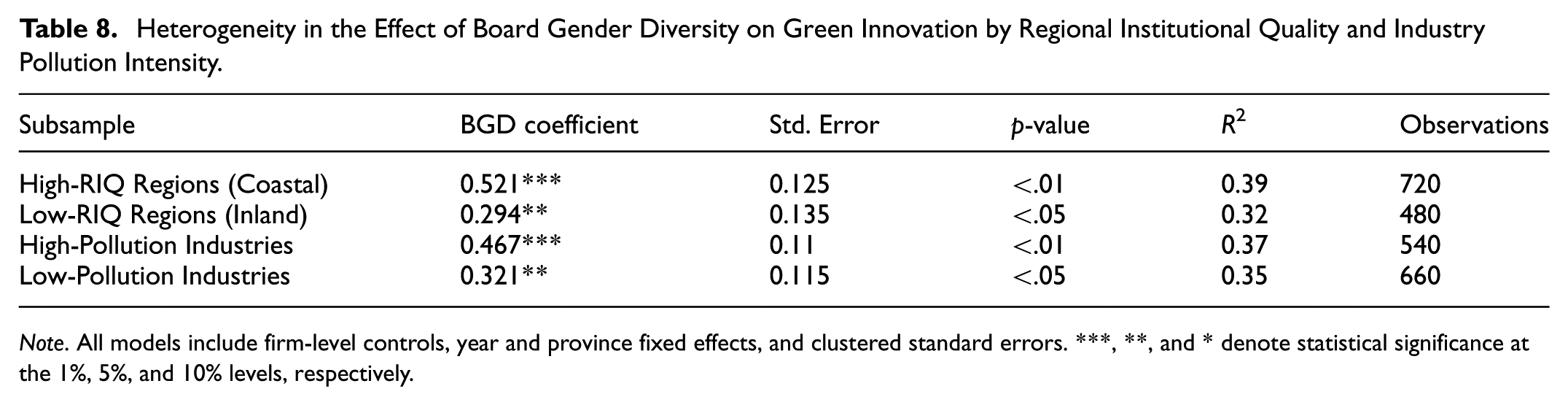
Table 8 presents subsample regressions to investigate how regional institutional quality and industry pollution intensity shape the relationship between board gender diversity (BGD) and green innovation. Notably, the effect of board gender diversity on green patenting varies considerably across different institutional environments. For instance, provinces with higher institutional quality such as coastal areas like Guangdong display a strong positive BGD coefficient of 0.521, significant at the 1% level. In comparison, inland provinces with lower institutional quality, such as Gansu, still show a significant yet noticeably smaller coefficient of 0.294 at the 5% significance level. This divergence robustly supports Hypothesis 3, emphasizing that better-developed local governance enhances the effectiveness of gender-diverse boards in driving green innovation.
Heterogeneity in the Effect of Board Gender Diversity on Green Innovation by Regional Institutional Quality and Industry Pollution Intensity.
Note. All models include firm-level controls, year and province fixed effects, and clustered standard errors. ***, **, and * denote statistical significance at the 1%, 5%, and 10% levels, respectively.
Moreover, the results highlight distinct differences conditioned by industry pollution intensity. In high-pollution sectors, where regulatory pressure and stakeholder scrutiny are particularly acute, board gender diversity maintains a substantial and significant positive coefficient effect of 0.467 at the 1% significance level. Conversely, in lower-pollution industries, although the relationship remains positive, it moderates to a coefficient of 0.321 with significance at the 5% level. These findings are coherent with China’s targeted policy measures aimed at boosting green innovation specifically within pollution-intensive sectors (Lin et al., 2022). Each subsample analysis controls for firm size, R&D intensity, industry pollution status, and includes fixed effects for year and province, with standard errors clustered at the firm level to ensure robustness in the statistical inference.
Discussion
The empirical results align closely with the theoretical foundations of this study. The positive influence of board gender diversity on green innovation supports resource dependence theory, indicating that diverse boards provide broader knowledge, stronger environmental awareness, and strategic insights that promote sustainability-oriented innovation. The weakening effect of family ownership corresponds with agency theory and socioemotional wealth arguments; concentrated family control reinforces hierarchical authority and risk aversion, limiting the influence of female directors. The strengthening effect of regional institutional quality is consistent with institutional theory, demonstrating that firms in stronger regulatory environments are better positioned to convert board diversity into meaningful innovation outcomes. The partial mediation of ESG performance aligns with legitimacy theory, suggesting that gender-diverse boards improve environmental and social accountability, which in turn facilitates green innovation.
Theoretical Implications
This study contributes to governance and sustainability research in several ways. First, it extends resource dependence theory by demonstrating that gender-diverse boards enhance green innovation even within the distinct governance structure of family-controlled firms. Second, it advances agency theory by showing how concentrated family ownership constrains the strategic autonomy of diverse boards and reduces innovation benefits. Third, it strengthens institutional theory by revealing that regional regulatory environments shape the effectiveness of internal governance mechanisms. Finally, the partial mediation of ESG performance integrates legitimacy considerations into the diversity innovation nexus, highlighting how governance diversity enhances firms’ stakeholder legitimacy and innovation capability.
Practical Implications
For practitioners, the results suggest that increasing female board representation can enhance sustainability-oriented innovation, especially when female directors possess expertise in environmental management or technology. Family firms may also need governance adjustments such as appointing independent female directors or decentralizing decision authority to fully capitalize on board diversity. Leveraging regional institutional strengths can further enhance innovation outcomes, particularly in provinces with stronger regulatory enforcement.
Policy Implications
Policy efforts should support both board diversity and environmental innovation. Introducing minimum gender representation guidelines, combined with targeted incentives, which green patent subsidies or tax credits may encourage family firms to adopt sustainability-driven strategies. In regions with weaker institutions, pairing diversity mandates with stricter regulatory enforcement may enhance effectiveness. These initiatives align with China’s carbon-neutrality goals and global sustainability commitments, particularly SDG 5 and SDG 9.
Conclusion
This study provides robust evidence that board gender diversity significantly promotes green innovation in Chinese family firms. The effect is stronger in regions with supportive institutional environments and weaker when ownership is heavily concentrated within the family. These findings highlight the dual importance of internal governance structures and external institutional conditions in shaping sustainability-oriented innovation outcomes.
The study also demonstrates that ESG performance partially mediates the relationship between board gender diversity and green innovation, indicating that diverse boards influence sustainability outcomes through both direct strategic pathways and indirect legitimacy-building mechanisms.
Although the findings advance theoretical and practical insights, several limitations remain. The study relies on publicly listed family firms, which may not fully represent the broader universe of private family enterprises. Furthermore, the analysis focuses solely on gender diversity; other dimensions of board diversity warrant examination. Future research could integrate qualitative methods, explore additional governance attributes, and extend the analysis to privately held family firms to deepen our understanding of how board composition affects sustainable innovation.
Footnotes
Appendix A

| Variable | Definition / Measurement | Source |
|---|---|---|
| Board Gender Diversity (BGD) | Measured as the proportion of female directors on the board (number of female directors ÷ total board size). Robustness tests additionally employ Blau’s Diversity Index: 1 −Σ(pi2), where pi denotes the proportion of each gender category. | CSMAR; Annual Reports |
| Green Innovation (GI) | Measured as the annual number of green patents granted based on the IPC Green Inventory. Transformed as GI = ln(1 + green patents) to reduce skewness. | CNRDS; State Intellectual Property Office |
| Family Ownership (FO) | Percentage of shares held by controlling family members (including founder, spouse, children, or other related family shareholders), following Anderson and Reeb (2003). | CSMAR; Company Filings |
| Regional Institutional Quality (RIQ) | Provincial-level institutional quality index (marketization index), standardized annually. Higher values indicate stronger governance, regulatory enforcement, and institutional development. | NERI Marketization Index |
| ESG Performance | Firm-level ESG rating sourced from SynTao ESG database; standardized across years to ensure comparability. Higher values reflect stronger environmental, social, and governance performance. | SynTao ESG Ratings |
| Firm Size | Natural logarithm of total assets. | CSMAR |
| R&D Intensity | Ratio of R&D expenditure to total assets. | CSMAR |
| High-Pollution Industry | Indicator variable equal to 1 if the firm operates in a pollution-intensive industry, based on classification by the Ministry of Ecology and Environment. | MEE; Industry Codes |
| Leverage | Ratio of total liabilities to total assets. | CSMAR |
| Return on Assets (ROA) | Net income divided by total assets. | CSMAR |

Funding
The authors disclosed receipt of the following financial support for the research, authorship, and/or publication of this article: This study is supported by the Scientific Innovation Teams of GuangXi MinZu Normal University (KYTD202403)/and (1024/10300130).
Declaration of Conflicting Interests
The authors declared no potential conflicts of interest with respect to the research, authorship, and/or publication of this article.
Data Availability Statement
Data sharing not applicable to this article as no datasets were generated or analyzed during the current study.