




Abstract
Facing the dual pressures of critical technology bottlenecks and the transformation toward high-quality development, how to effectively utilize local knowledge spillovers has become a pressing issue for Chinese firms to enhance their total factor productivity (TFP). Existing studies have predominantly focused on the macro level, while the micro-level mechanisms and boundary conditions through which knowledge spillovers affect firm TFP remain unclear. To fill this gap, this study uses data from Chinese A-share listed manufacturing firms (2010–2020) to examine knowledge spillover effects on TFP and their boundary conditions. We finds that knowledge spillovers directly drive firm TFP, with technological innovation capability as the core transmission mechanism. Furthermore, we find that when a firm’s absorptive capacity exceeds 0.045, it amplifies the positive TFP effect of knowledge spillovers, whereas a capacity below this threshold inhibits it. This is because firms with insufficient absorptive capacity cannot discern and integrate knowledge, leading to resource misallocation and R&D failures. Moreover, a firm’s digital transformation mitigates the “law of distance decay” in knowledge dissemination, enhances knowledge acquisition and application, and positively moderates the productivity-enhancing effect of knowledge spillovers. This study reveals the micro-level mechanisms through which emerging market firms use knowledge spillovers to achieve “enhancements in quality and efficiency,” enriching the firm-level foundations of endogenous growth theory and providing theoretical and practical implications for firm digital strategies and government innovation policies.
Plain Language Summary
This study looks at how Chinese manufacturing firms can use local knowledge from other companies to improve their productivity. In China, firms are facing challenges such as technology gaps and the need to develop more efficiently. While many previous studies have looked at these issues on a large scale, this research focuses on how knowledge sharing between companies directly impacts individual firm performance. The study finds that when firms share knowledge, it can lead to better overall productivity, especially when firms have strong innovation capabilities. However, firms need to be able to absorb and use this knowledge effectively. If a firm’s ability to absorb new knowledge is too low, the benefits are limited. Additionally, the research shows that when a firm goes through digital transformation, it helps reduce the barriers to knowledge sharing and improves the firm’s ability to apply new ideas, boosting their productivity even further. This research helps explain the detailed ways knowledge sharing works at the firm level and offers insights for companies and governments to better support innovation and productivity growth in the manufacturing sector.
Keywords
Introduction
Total Factor Productivity (TFP) has become a critical determinant of sustainable competitive advantage for manufacturing enterprises in emerging economies (Guo, 2025). Since the initiation of its reform and opening-up, China’s economic growth has primarily been driven by extensive factor inputs, such as capital accumulation and labor expansion (Scherngell et al., 2014). This “extensive” growth model not only confronts resource and environmental constraints but also faces a significant bottleneck from its diminishing demographic dividend. Therefore, catalyzing the shift from factor-driven to innovation-driven growth by enhancing manufacturing TFP has become the core impetus for fostering sustainable growth for the overall economy (Xin-gang & Wei, 2020). Currently, China’s manufacturing TFP faces dual internal and external challenges. Internally, enterprises grapple with multiple challenges, including an insufficient drive for innovation, a significant gap with the technological frontier, and obstructed pathways for the commercialization of research outcomes (Alnafrah, 2025). These challenges manifest as overcapacity, inconsistent product quality, and a high degree of dependence on external sources for core technologies. Externally, technological containment by Western countries restricts access to advanced knowledge, while competition from low-cost labor in other emerging Asian economies creates market pressures. These predicaments have hindered the transition from “Made in China” to “Created in China,” leading to stagnation in TFP growth among enterprises. Against this backdrop, a core research question emerges: Given the constraints on internal R&D capabilities and access to international technological knowledge, how can manufacturing firms effectively leverage domestic external knowledge resources to enhance TFP growth?
Knowledge is considered a key driver of economic growth and productivity (Ali-Yrkkö et al., 2024; Nonnis et al., 2023). Knowledge spillover refers to the uncompensated acquisition of knowledge by firms from external sources (Ramadani et al., 2017). The academic literature presents two opposing viewpoints on the relationship between knowledge spillovers and firm-level TFP. The first perspective holds that knowledge spillovers can enhance a firm’s TFP (Audretsch & Keilbach, 2007). Knowledge spillovers reduce learning costs for knowledge recipients through the “imitation effect” (Antonelli & Fusillo, 2024; Xu et al., 2022), mitigate innovation risks via the “agglomeration effect” (Howell, 2020; Pindado et al., 2023), and promote knowledge restructuring through the “mobility effect” (W. Liu et al., 2024; X. Liu et al., 2010), thereby enhancing firms’ total factor productivity. Another perspective emphasizes the negative effects of knowledge spillovers. Excessive spillovers induce free-riding behavior (Gold, 2021), thereby weakening the competitive advantage of knowledge producers (Eeckhout & Jovanovic, 2002). This, in turn, reduces firms’ motivation for independent innovation, hinders the reproduction of knowledge, and ultimately leads to productivity losses (Ning & Babich, 2018). However, existing research, which is predominantly conducted at the macro level (e.g., national, regional, and industry), largely concludes that knowledge spillovers significantly promote TFP (Döring & Schnellenbach, 2006; Madsen, 2007). At the micro-firm level, however, a critical question remains unresolved. Since knowledge spillovers entail an uncompensated transfer of knowledge from producers to recipients, whether this process disincentivizes the innovative activities of knowledge-producing firms and consequently causes productivity declines warrants further investigation.
Second, the mechanisms through which knowledge spillovers affect TFP remain underexplored. Technological innovation capability—defined as a firm’s ability to generate, acquire, and commercialize new technologies—is considered a potential mediating mechanism linking knowledge spillovers to TFP. By enhancing a firm’s capacity to absorb and apply external knowledge, technological innovation capability may serve as the critical channel through which spillovers are converted into productivity gains (Santa-Maria et al., 2022). Therefore, whether inter-firm knowledge spillovers can enhance firm TFP by fostering technological innovation capabilities is a question that warrants rigorous empirical investigation.
Third, the boundary conditions that govern the efficacy of knowledge spillovers in enhancing firm TFP have yet to be fully specified. A firm’s ability, as a micro-level agent of innovation, to effectively leverage external knowledge is contingent not only on its external environment but also critically on its internal capabilities, particularly its absorptive capacity and degree of digital transformation. Absorptive capacity refers to a firm’s ability to identify, absorb, and exploit external knowledge (Cohen & Levinthal, 1990; Todorova & Durisin, 2007). However, it does not operate as a simple linear function. Instead, it often exhibits threshold effects, suggesting that knowledge spillovers may only yield significant productivity gains once a firm’s absorptive capacity surpasses a critical minimum level (Sjödin et al., 2021). Furthermore, the ongoing digital revolution is reshaping the landscape of knowledge dissemination. A firm’s digital transformation may attenuate the traditional “tyranny of distance” in knowledge spillovers, mitigating the effects of geographical proximity by facilitating seamless remote collaboration and knowledge exchange (Appio et al., 2021). However, the precise moderating roles of absorptive capacity and digital transformation in the knowledge spillover-TFP nexus remain subjects of ongoing debate and require rigorous empirical scrutiny.
Accordingly, this study addresses three central research questions: (1) Do inter-firm knowledge spillovers enhance firm TFP? (2) Does technological innovation capability mediate the relationship between knowledge spillovers and firm TFP? (3) To what extent and in what manner do absorptive capacity and digital transformation moderate this relationship? To address these questions, this study utilizes a comprehensive panel dataset of Chinese A-share listed manufacturing firms from 2010 to 2020 to empirically investigate the mechanisms linking inter-firm knowledge spillovers to firm TFP. This study aims to make three principal contributions to the literature. First, we provide granular firm-level evidence on the spillover-TFP nexus, shifting the analytical focus from aggregate macro-level studies to the microfoundations of firm behavior in a major emerging economy. Second, by empirically validating the mediating role of technological innovation capability, we offer new insights into the long-standing debate on whether knowledge spillovers complement or substitute for a firm’s internal innovation efforts. Third, we demonstrate the non-linear, threshold-based moderating effect of absorptive capacity and concurrently examine digital transformation as a novel boundary condition. This dual analysis enriches our understanding of the complex contingency factors that determine the ultimate impact of knowledge spillovers. Collectively, our findings offer actionable insights for managers and policymakers in emerging economies, providing a clearer roadmap for leveraging external knowledge to foster productivity growth and competitive advantage.
The remainder of this paper is organized as follows. Literature Review and Hypothesis Development reviews the relevant literature and develops our research hypotheses. Research Design and Model Construction details the research design and methodology, covering the data sample, variable measurement, and model specification. Empirical Analysis and Hypothesis Testing presents the empirical results, including a series of robustness checks. Finally, Conclusions and Discussion concludes the paper by discussing the findings, outlining the theoretical and managerial implications, and suggesting avenues for future research.
Literature Review and Hypothesis Development
Literature Review
Total Factor Productivity (TFP) is commonly defined as the residual portion of output growth that cannot be explained by the accumulation of traditional inputs, such as capital and labor (Hsieh & Klenow, 2009). It thus serves as a comprehensive measure of the efficiency and technological progress in converting inputs into outputs (Solow, 1957). As a key proxy for technological progress and organizational efficiency, TFP is central to understanding the drivers of long-term economic growth and firm-level competitiveness (Pietrucha & Żelazny, 2020). The determinants of TFP in manufacturing firms are broadly classified into internal and external factors. Internally, a firm’s own R&D investments are a primary driver, enhancing TFP by fostering innovation and optimizing internal processes (Griliches, 1979; Higon, 2007; O’Mahony & Vecchi, 2009). Concurrently, the quality of human capital is critical, as it governs the firm’s capacity to assimilate and effectively leverage new technologies (Ashenfelter & Card, 2010). Moreover, structured management practices, such as performance monitoring and target setting, have been empirically shown to be strongly associated with higher TFP across firms and nations (Bloom & Van Reenen, 2010). Externally, market dynamics play a crucial role. Intense competition can bolster aggregate TFP by weeding out less productive firms and spurring innovation. Similarly, trade liberalization contributes to productivity gains through selection effects (as inefficient firms exit) and learning effects (via exposure to international technologies). Meanwhile, FDI spillovers transmit technological knowledge to domestic firms through demonstration effects, labor turnover, and supply chain interactions (Bournakis & Tsionas, 2022; Javorcik, 2004). However, empirical evidence on FDI spillover effects exhibits significant heterogeneity across different contexts, suggesting that their effectiveness is constrained by host firms’ absorptive capacity and institutional environments (Haskel et al., 2007; Meyer & Sinani, 2009).
Differences in TFP among enterprises stem from disparities in knowledge across several areas, including product technological innovation, process design, organizational structure optimization, and management skill enhancement (Park et al., 2023). This knowledge can be created by the enterprise or acquired as external information (Trantopoulos et al., 2017). The knowledge creation perspective emphasizes that internal R&D capabilities are central to enhancing TFP (Audretsch & Belitski, 2023). The international knowledge transfer perspective focuses on technology spillovers from foreign-invested enterprises, while the trade learning perspective reveals that the productivity-enhancing effect of “learning by exporting” hinges on the critical condition of firms’ absorptive capacity (C.-H. Yang, 2023). Moreover, imports of intermediate goods have been shown to embed advanced technological knowledge into domestic production systems, with this spillover effect being more pronounced in industries characterized by high product differentiation (Wang & Tao, 2019).
While extant literature has identified numerous determinants of TFP, several critical research lacunae persist. First, the literature has largely overlooked the micro-level mechanisms through which inter-firm knowledge spillovers—particularly among domestic peers—impact TFP. Second, the process by which firms convert external knowledge into tangible TFP gains remains a “black box,” and the mediating role of technological innovation capability in this transformation has not been empirically established. Third, the boundary conditions that govern the effectiveness of knowledge spillovers are under-explored; specifically, how a firm’s absorptive capacity moderates the spillover-TFP relationship remains poorly understood. This study aims to address these gaps by focusing on the impact mechanism and boundary conditions of inter-firm knowledge spillovers on TFP within China’s listed manufacturing firms, providing both theoretical and empirical evidence.
Theoretical Foundations
This study is theoretically grounded in endogenous growth theory (EGT) (Lucas, 1988). In contrast to neoclassical models where technological progress is treated as an exogenous shock, EGT posits that knowledge and technology are endogenous drivers of growth, arising from deliberate economic activities such as innovation (Mulder et al., 2001). Within this framework, firms are not passive recipients of technology; they actively generate and accumulate knowledge through mechanisms like R&D investment, learning-by-doing, and knowledge spillovers, which in turn drives TFP growth (Corrado et al., 2017). A central tenet of EGT is the concept of knowledge spillovers, which arise from the incomplete appropriability of knowledge (Arrow, 1962). As knowledge is inherently non-rivalrous and only partially excludable, other firms can access it through channels like labor mobility, reverse engineering, or supply chain interactions at a cost significantly below its initial development cost (Cooper, 2001). This “free-rider” effect not only facilitates technological catch-up for follower firms but also improves aggregate resource allocation and accelerates the overall pace of innovation within an industry (Benhabib et al., 2014). Therefore, EGT provides a robust theoretical framework for our central proposition: that inter-firm knowledge spillovers are a critical driver of TFP.
However, a critical limitation of EGT is its implicit assumption of homogeneity, suggesting that all firms benefit equally from knowledge spillovers. This premise, however, fails to account for the significant heterogeneity observed in firms’ abilities to internalize and leverage external knowledge for productivity enhancement (Gorg & Strobl, 2001). Absorptive capacity theory complements EGT by addressing this very issue. Defined as a firm’s ability to recognize the value of new, external information, assimilate it, and apply it to commercial ends, absorptive capacity is itself a function of a firm’s prior knowledge base, R&D efforts, and organizational learning routines (Cohen & Levinthal, 1990). The theory’s central premise is that learning is path-dependent: a firm’s ability to exploit external knowledge is a function of its existing stock of related knowledge (Cohen & Levinthal, 1990). This capacity is often conceptualized as having two components: potential absorptive capacity (the ability to acquire and assimilate knowledge) and realized absorptive capacity (the ability to transform and exploit it), with the firm’s performance contingent on effectively managing both (George et al., 2002). Thus, absorptive capacity theory provides the critical theoretical lens for this study, positing that the positive effects of knowledge spillovers on TFP are not automatic but are instead moderated by a firm’s internal capabilities. In essence, a firm must be prepared to learn before it can benefit from the knowledge surrounding it (Lane et al., 2006).
Our theoretical framework is grounded in endogenous growth and absorptive capacity theories. Endogenous growth theory suggests that knowledge spillovers, stemming from the non-rivalrous and partially excludable nature of knowledge, enhance a firm’s total factor productivity (TFP). Building on this, absorptive capacity theory provides the foundational lens for understanding how firms internalize these external knowledge resources to improve productive efficiency.
We extend this baseline perspective by proposing a more nuanced model that explains the heterogeneity in firms’ ability to capitalize on spillovers. Specifically, we argue that the effect of knowledge spillovers on TFP is mediated by a firm’s technological innovation capability. Furthermore, we contend that the efficacy of this knowledge conversion process is not uniform. It is contingent on a firm’s absorptive capacity, which exhibits a threshold effect, and is amplified by its level of digital transformation, which serves as a critical moderator. By integrating these mechanisms, our framework provides a systematic explanation for how and when emerging economy firms can translate external knowledge into TFP growth, thus addressing the micro-foundations of knowledge spillover effectiveness.
Hypothesis Development
Knowledge Spillovers and TFP
In the framework of endogenous growth, a firm’s TFP is primarily determined by its technological level, which in turn is a function of both its internal R&D investments and the external knowledge stock it can access (Lin, 2012). Consequently, TFP growth can be accelerated by either making internal innovation more efficient (i.e., reducing R&D costs) or by expanding the pool of available external knowledge. Knowledge spillovers represent a primary mechanism for this expansion, constituting the influx of knowledge from other economic agents through channels such as labor mobility, patent disclosures, and supply chain interactions. This process effectively broadens a firm’s accessible knowledge base (Audretsch & Feldman, 1996; Jaffe, 1986). Innovation is fundamentally a process of novel recombination: the larger and more diverse the set of available knowledge elements, the higher the probability of discovering valuable new combinations. Therefore, when a firm absorbs heterogeneous external knowledge via spillovers, this new knowledge creates synergistic complementarities with its existing internal knowledge base (Ju & Wang, 2023). This synthesis facilitates the generation of novel technological solutions and improved management practices, leading to a direct increase in TFP.
Knowledge creation involves high R&D costs but relatively low dissemination costs. For the originating firm, recouping R&D expenditures depends on appropriating the knowledge’s value. However, due to its partially non-excludable character, achieving full appropriability is often impossible (Singh, 2008). Conversely, for recipient firms, this knowledge “leakage” presents an opportunity to acquire external knowledge at a cost significantly lower than that of conducting equivalent in-house R&D. Empirical evidence underscores the magnitude of this effect: the marginal productivity impact of R&D spillovers from industry peers is often estimated to be 30% to 50% of a firm’s own R&D investment, indicating a substantial reduction in innovation costs. This cost-saving advantage is particularly pronounced for technological followers or “laggard” firms (Cai et al., 2024). By learning from and imitating the proven technologies of market pioneers, these firms can bypass the costly trial-and-error phases of exploration, thereby achieving technological catch-up more efficiently (Fotopoulos, 2023). This cost reduction, by definition, means either achieving the same output with fewer inputs or generating more output with the same inputs. Both scenarios translate directly to an increase in TFP.
Knowledge spillovers also enhance firm efficiency through indirect channels, primarily via learning and competitive effects. First, when firms observe peers implementing superior management techniques or more efficient production processes, it creates a “demonstration effect,” compelling them to improve their own operational efficiency to maintain relative standing. Second, knowledge spillovers intensify intra-industry competition. As technological diffusion narrows the capability gap between firms, it forces laggard firms to improve their performance simply to survive. This market selection pressure incentivizes firms to optimize resource allocation, phase out obsolete capacity, and refine production methods, all of which contribute to TFP growth (Chen et al., 2024). Furthermore, by reducing information asymmetries, knowledge spillovers facilitate a more efficient allocation of resources across the economy. When firms become aware of emerging technological opportunities or shifts in market demand via spillovers, they can make more informed decisions regarding R&D allocation, product portfolio adjustments, and capital investment, thus improving overall resource allocation efficiency (Bloom et al., 2013). Based on this, the following hypothesis is proposed:
The Mediating Role of Technological Innovation Capability
Technological innovation is a process of recombining and reconfiguring existing knowledge. Through knowledge spillovers, firms acquire heterogeneous external knowledge (e.g., novel technological principles, management expertise, market intelligence) that augments their internal knowledge base and broadens their innovation search space (Arora et al., 2021). This infusion of external knowledge reduces technological uncertainty and enables firms to overcome the path dependency and lock-in effects of their established technological trajectories (Arthur, 1989). Subsequently, firms leverage their absorptive capacity to selectively internalize and adapt this external knowledge, transforming it into tangible outputs such as product, process, or organizational innovations (Liu & Atuahene-Gima, 2018). Specifically, product innovation enhances market competitiveness and pricing power, allowing firms to penetrate new markets and capture emerging demand, thereby boosting revenue and market share. Meanwhile, process innovation lowers production costs and improves resource utilization efficiency. These innovations ultimately translate into improvements in the enterprise’s TFP (Siachou et al., 2021). Therefore, the pathway from external knowledge acquisition to commercialization represents a complete value-creation process, in which technological innovation capability acts as the critical conversion mechanism.
The Threshold Moderating Effect of Absorptive Capacity
A firm’s ability to convert heterogeneous external knowledge into enhanced productivity is contingent upon its absorptive capacity (Zhang et al., 2010). Absorptive capacity refers to a firm’s ability to recognize the value of, assimilate, and apply new external knowledge for commercial ends (Cohen & Levinthal, 1990). First, recognizing the value of external knowledge requires a pre-existing foundation of related knowledge (Fernald et al., 2017). Without this foundation, a large cognitive gap between the knowledge creator and the recipient firm can render the spillover inert, as the firm is unable to discern its potential value. Second, after identifying valuable knowledge, a firm must possess the internal R&D capabilities and skilled personnel to assimilate and transform it (Xiong & Bharadwaj, 2011). Firms with low absorptive capacity lack the ability to “decode” external knowledge and “re-encode” it within their own operational context, preventing its translation into tangible outputs (Ali, 2021). This implies that only when a firm’s R&D intensity surpasses a certain critical threshold can external knowledge be effectively converted into innovation. Finally, the exploitation of this newly transformed knowledge requires strong organizational and managerial capabilities. Firms must be able to integrate the new knowledge into production routines and business models to forge a competitive advantage (Fernald et al., 2017). If these organizational capabilities are deficient, even successfully internalized knowledge will fail to be effectively applied, yielding no improvement in TFP. Therefore, absorptive capacity acts as a crucial “knowledge filter”: only firms that possess it above a certain level can effectively capture and capitalize on the benefits of knowledge spillovers (Qian & Jung, 2017).
The Moderating Effect of Digital Transformation
Endogenous growth theory posits that knowledge spillovers are fundamentally processes of knowledge diffusion, which are subject to geographical distance decay (Döring & Schnellenbach, 2006; Funke & Niebuhr, 2000). This constraint arises because the diffusion of tacit knowledge, in particular, is highly dependent on face-to-face interaction and geographically embedded social networks (Audretsch & Feldman, 1996). This geographic localization of knowledge flows restricts a firm’s ability to access distant resources, often resulting in “information silos” (Gao & Yuan, 2022). However, the rise of digital technologies is fundamentally altering these traditional dissemination mechanisms. Digital transformation is a strategic process of integrating digital technologies such as big data, AI, IoT, and cloud computing to fundamentally reconfigure a firm’s business processes and models (Matzler et al., 2018). Drawing on absorptive capacity theory, we argue that digital transformation enhances a firm’s ability to capture and leverage knowledge spillovers through three key mechanisms, ultimately boosting TFP. First, digital transformation transcends the spatiotemporal constraints of knowledge diffusion. Digital platforms and cloud technologies enable the rapid, codified transmission of knowledge (Peruchi et al., 2022), allowing firms to access real-time technical information and market dynamics from geographically distant sources, thus mitigating the traditional limitations of proximity (Gao & Yuan, 2022; Plekhanov et al., 2023). Second, digital transformation improves the efficiency of knowledge search and identification. Technologies like big data analytics and AI empower firms to accurately pinpoint valuable knowledge from vast amounts of external information, thereby reducing search costs and mitigating information asymmetry (Peng & Tao, 2022). Third, digital transformation strengthens a firm’s capacity for knowledge internalization and application. By optimizing internal knowledge management systems, fostering organizational learning, and enhancing cross-departmental collaboration, digital tools improve a firm’s ability to absorb external knowledge into its own operational routines and innovate upon it (Schallmo et al., 2017). The theoretical conceptual framework is shown in Figure 1. Based on this, the following hypothesis is proposed:

Conceptual framework.
Research Design and Model Construction
Sample Selection and Data Sources
The data for this study are drawn from the CSMAR database and cover Chinese listed manufacturing firms from 2010 to 2020. We selected this sample period for two primary reasons. First, it begins in 2010, the start of China’s 12th Five-Year Plan, which marked a strategic shift from high-speed growth to high-quality development, fostering rapid technological and knowledge-based progress. Second, the quality and consistency of information disclosure for Chinese listed firms have significantly improved since 2010. The period ends in 2020, as this was the most recent year for which complete data were available during our collection phase. To ensure data quality and mitigate potential biases, we applied the following screening procedures to the initial sample:
(1) We exclude firms designated as “Special Treatment” (ST) or “*ST” (Delisting Risk Warning), as well as samples with missing data. According to CSRC regulations, these firms are in severe financial distress, and their operating and innovation activities are not representative of healthy companies. Consequently, their TFP fluctuations are more likely driven by financial distress than by knowledge spillovers. The exclusion of these firms is a standard procedure in studies using Chinese firm-level data.
(2) To mitigate the influence of outliers, we winsorize all continuous variables at the 1st and 99th percentiles.
(3) We exclude firms with a debt-to-asset ratio greater than or equal to one, as these firms are technically insolvent and their operations are not sustainable.
This screening process results in a final unbalanced panel of 13,316 firm-year observations.
Selection of Model Variables
Selection of Dependent Variable
This study uses total factor productivity (TFP) as the dependent variable (Ding et al., 2025). Knowledge spillovers primarily drive growth by enhancing technical efficiency (Solow, 1957), while TFP directly reflects technological progress and efficiency improvements, thereby accurately capturing the essential effects of knowledge spillovers (Lang, 2009; X. Yang et al., 2025).Total factor productivity (TFP), estimated through the LP method, is utilized as a proxy variable in this study, while the OP method is applied as a substitute variable for robustness checks. The production function assumed by the LP method is expressed as follows:

In the equation above,

Selection of Independent Variables
To measure knowledge spillovers, this study first employs an economic geographic spatial matrix to weight knowledge stock (Fischer et al., 2009; Kaiser, 2002). We then estimate a firm’s knowledge capital using the perpetual inventory method, where R&D investment serves as the proxy for knowledge stock (Eisfeldt & Papanikolaou, 2013; Griliches, 1979). The specific formula for a firm’s knowledge capital Rt during period is as follows:

Here,

Selection of Mediating Variable
Using patent applications as a metric for measuring technological innovation capability (Verhoeven et al., 2016). While not all innovations are patented and their economic value may not be entirely captured, the accessibility and comparability of patent data render it the optimal proxy variable for technological innovation capability. Accordingly, adopting the approach from existing literature (Archambault, 2002), this study quantifies technological innovation capability by applying the logarithm of patent applications plus one.
Selection of Moderating Variables
Absorptive Capacity
Absorptive capacity denotes the dynamic process by which a firm acquires, recognizes, transforms, and integrates knowledge through a set of organizational routines and processes. Absorptive capacity is primarily measured using two methods: the single-indicator approach and the index system construction approach, with the latter lacking consensus within the academic community. Taking into account the availability and objectivity of data, along with the specific context of the manufacturing firms analyzed, this study measures firms’ absorptive capacity through the ratio of R&D investment to operating revenue, a method adopted from prior research (Fernald et al., 2017).
Digital Transformation of Firms
Digital transformation is categorized into four dimensions: the application of digital technology, internet-driven business models, intelligent manufacturing, and modern information systems (Yu et al., 2024). The digital transformation index is developed through a combination of text analysis and expert scoring techniques. The construction process involves the following steps:
First, annual reports of listed manufacturing firms from 2010 to 2020 are collected, and textual samples are manually extracted.
Second, the sample data is processed to identify and extract vocabulary associated with digital transformation.
Third, the keyword frequency for each dimension is calculated, and a digital transformation index is constructed utilizing the entropy method.
Fourth, leveraging the keyword descriptions from annual reports, determine the intensity of firms’ digital transformation investments and compute the digital transformation index through the expert scoring method.
Fifth, the two comprehensive scores are standardized and weighted equally at 50% to derive the final composite index.
Control Variables
Building on prior research related to TFP, this study incorporates control variables such as firm size, firm growth, profitability, cash flow, market competition, asset-liability ratio, ownership concentration, firm ownership, the proportion of independent directors, CEO duality, firm age, year, and industry (C. Fan et al., 2025; Yu et al., 2024). Furthermore, this study accounts for year and industry effects. Comprehensive definitions and computational methods for the primary variables are detailed in Table 1.
Variable Measurement and Description.

Empirical Analysis and Hypothesis Testing
Baseline Regression Analysis
Figure 2 presents a heat map illustrating the Pearson correlation coefficients among the variables. A significant positive correlation is observed between total factor productivity (Tfp) and knowledge spillover (KS). Similarly, technological innovation (Inno) exhibits a positive correlation with both KS and Tfp. Tfp is influenced by KS, Inno, and absorptive capacity (AC), with most variables showing positive correlations. KS has a strong positive correlation with AC and firm size (Size), suggesting that firms must enhance their absorptive capacity and industry participation to acquire more knowledge. Profitability (ROA) demonstrates a negative correlation with leverage (Lev), signifying that firms with higher profitability are likely to maintain lower levels of leverage. Growth capability (Growth) is positively correlated with firm age (Age) and Size, highlighting the role of scale and experience in firm growth.

Heat map of Pearson correlation coefficients among variables.
H1 is tested using Model (1-1), which evaluates the influence of knowledge spillover on TFP. The empirical results are summarized in Table 2. Column (1) controls solely for year and industry effects, resulting in an adjusted R2 of .054. The coefficient of knowledge spillover (KS) on TFP is 0.055 and is statistically significant at the 1% level. Column (2) incorporates additional control variables, raising the adjusted R2 to .778. The impact of knowledge spillover remains significantly positive at the 1% level. In Column (3), eight additional control variables are introduced, yielding an adjusted R2 of .823, which indicates a high level of model fit. The coefficient of knowledge spillover is 0.0258 and remains significantly positive at the 1% level, aligning with the earlier findings (Aghion & Jaravel, 2015; Braunerhjelm et al., 2018; Chun-Chien & Chih-Hai, 2008).
The Impact of Knowledge Spillover on Total Factor Productivity.

Note. t-Statistics are in parentheses.
p < .01.
Collectively, these findings suggest that knowledge spillover serves as a significant driver of TFP. Notably, a stronger inter-firm knowledge spillover effect corresponds to a higher degree of TFP. As discussed, knowledge spillovers provide firms with valuable innovative elements and knowledge outcomes at no cost, thus reducing transaction and knowledge acquisition costs in the development process (Vujanović et al., 2022). Furthermore, technological spillovers enable lagging firms to engage in “learning by doing,” reducing the waste of innovative resources, shortening technology upgrade cycles, and promoting TFP. Therefore, H1 is supported.
Mediation Effect Test
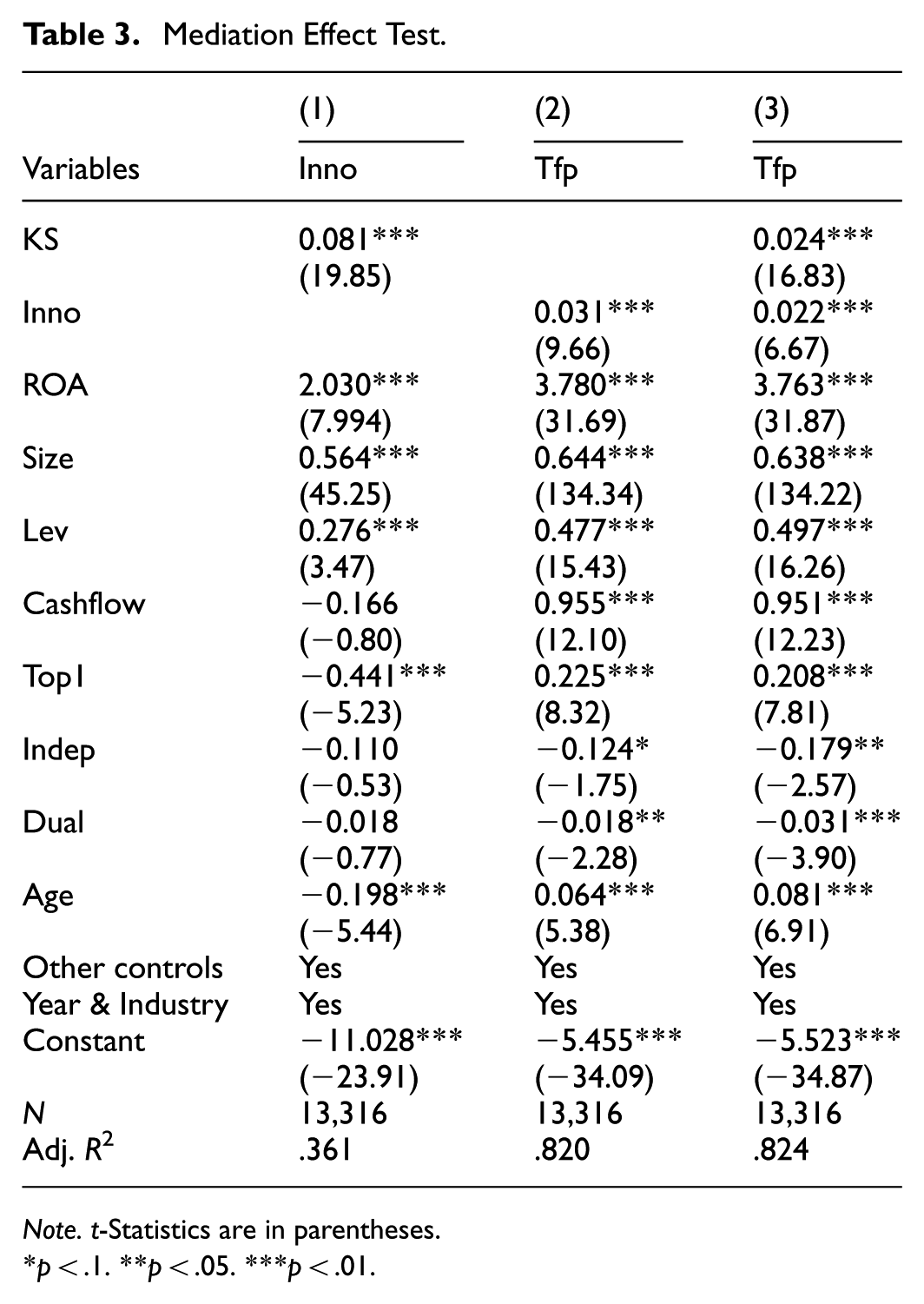
Based on Wen Zhonglin’s three-step test method (Q. Huang et al., 2023), we use a stepwise regression approach to examine the relationships among knowledge spillover (KS), technological innovation capability (Inno), and TFP (Tfp). The mediation effect test results for technological innovation capability are displayed in Columns (1) and (3) of Table 3.
Mediation Effect Test.
Note. t-Statistics are in parentheses.
p < .1. **p < .05. ***p < .01.
Column (1) results indicate that knowledge spillover exerts a significantly positive impact on technological innovation capability, with a coefficient of 0.081, significant at the 1% level. This finding demonstrates that knowledge spillover substantially enhances technological innovation capability. Consistent with the conclusions of existing literature (Aghion & Jaravel, 2015; Nieto & Quevedo, 2005). In other words, an increase in inter-firm knowledge spillover leads to stronger technological innovation capability among firms.
Column (2) reveals that technological innovation capability positively affects TFP at the 1% significance level. This suggests that technological innovation capability plays a significant role in promoting TFP. This aligns with the conclusion in existing literature that technology is the driving force behind total factor productivity (Yu et al., 2024). In particular, greater technological innovation capability correlates with an elevated degree of TFP.
The findings in Column (3) reveal coefficients of 0.024 and 0.022 for knowledge spillover and technological innovation in relation to TFP, with both values being significantly positive at the 1% level. Synthesizing the results from Columns (1) and (3) alongside Table 2, it is evident that technological innovation capability functions as a partial mediator linking knowledge spillover and TFP.
As previously discussed, inter-firm knowledge spillover encourages recipient firms to engage in technological innovation through various forms such as codification and materialization. This technological innovation leads to product and process innovations, enhances product quality and innovation efficiency, and thereby promotes TFP. Therefore, H2 is validated.
Robustness Tests
Alternative Variable Measurement
The dependent variable is substituted with total factor productivity, calculated using the Olley-Pakes (OP) method (tfp_op). Regression analyses are subsequently conducted, incorporating knowledge spillover (KS), technological innovation capability (Inno), and absorptive capacity (AC). Table 4 illustrates that knowledge spillover consistently fosters TFP, while technological innovation capability remains a partial mediator linking knowledge spillover to TFP. These results align with prior findings, affirming the robustness of the conclusions drawn.
Replacing the Dependent Variable.

Note. t-Statistics are in parentheses.
p < .05. ***p < .01.
Quantile Regression
The panel quantile regression model is applied to investigate the marginal impact of knowledge spillover on TFP across the 0.1, 0.25, 0.5, 0.75, and 0.9 quantiles. Table 5 reveals a significant positive correlation between knowledge spillover and TFP at the 1% significance level for all quantiles. Technological innovation capability continues to exhibit a significant mediating effect between knowledge spillover and TFP, consistent with our previous findings.
Quantile Regression.

Note. t-Statistics are in parentheses.
p < .01.
Regression With Modified Sample
Excluding the initial 2 years, this study utilizes data from 2012 to 2020 to assess the significance of the link between knowledge spillover and TFP. The second column of Tables 4 and 5 demonstrates that despite adjustments to the sample period, the positive relationship remains significant, with technological innovation capability sustaining its mediating role, confirming the robustness of the findings.
Instrumental Variable Method
Inter-firm knowledge spillover fosters TFP, which, in turn, enhances spillover effects. This bidirectional relationship may cause endogeneity issues stemming from reverse causality. The two-stage least squares (2SLS) method is applied to resolve this issue. A one-period lag of knowledge spillover serves as the instrumental variable for the current period. The first column of Table 6 shows first-stage F-statistics exceeding 10, confirming the suitability of the instrumental variable. The regression results for all variables are consistent with previous findings, suggesting that our core conclusions remain robust after considering endogeneity.
Instrumental Variable Method and Regression With Modified Sample.

Note. t-Statistics are in parentheses.
p < .1. ***p < .01.
Bootstrap and Sobel Tests
To further examine the mediation effect, we employ the Sobel test and the Bootstrap method. The Sobel test produces a Z-value of 2.331, surpassing the 1.96 threshold for 5% significance. Mediation contributes 3.2% to the total effect. The Bootstrap method involves 1,000 resamples within a 95% confidence interval. Table 7 reveals that the 95% Bootstrap confidence interval for the indirect effect excludes zero. Thus, both tests validate the significant mediation effect, confirming the mediating role of technological innovation capability in linking knowledge spillover to TFP.
Results of Bootstrap and Sobel Tests.

Moderating Effect Test
Asymmetric Moderating Effect of Absorptive Capacity
The threshold effect of absorptive capacity is tested to identify its type. STATA 17.0 software and 1,000 repetitions yield p-values and F-values for single, double, and triple thresholds. Detailed results are presented in Table 8. Results confirm single and double threshold effects at 1% significance, with p-values of .000. The triple threshold effect has a significance level of .620, suggesting that there is no triple threshold effect. Hence, analyses focus on single and double threshold models (Table 9).
Threshold Effect Test Results.

Note. p-Values are obtained using the Bootstrap method with 1,000 replications. These values determine the significance level at which the F-statistic passes the threshold effect test.
Threshold Value Estimation Results.

Panel threshold regression yields LR function graphs with a 95% confidence interval for threshold estimates of 0.017 and 0.045 (Figure 3). The LR statistic’s lowest point represents the true threshold value. Dashed lines mark critical values, exceeding threshold values and confirming their validity and reliability.
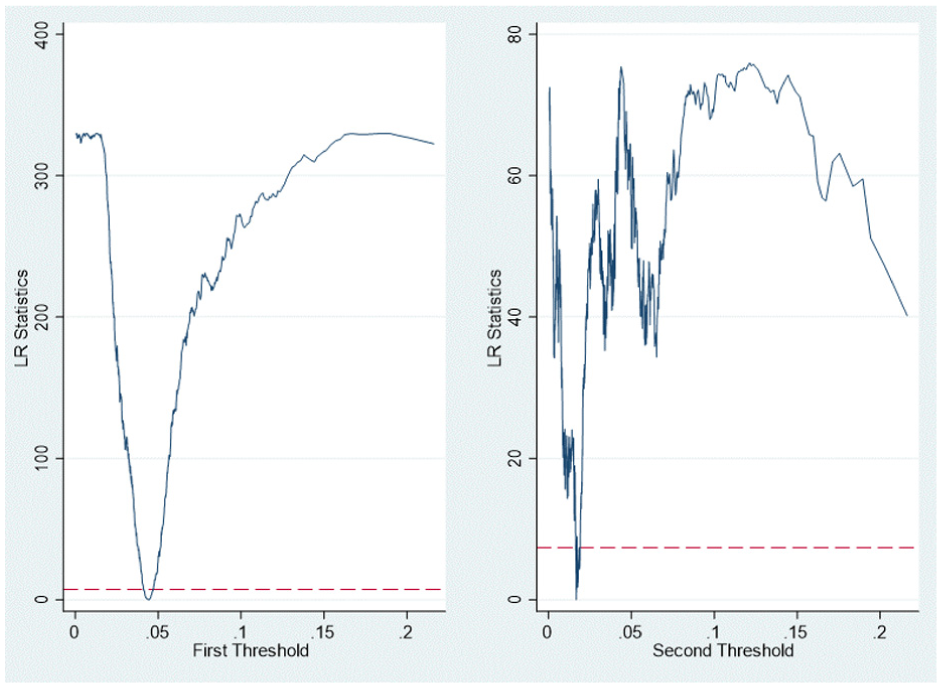
Double threshold estimation results of absorptive capacity.
Table 10 shows the impact of the interaction between knowledge spillover and absorptive capacity on TFP, with absorptive capacity as the threshold variable. For firms with low absorptive capacity (AC ≤ 0.017), the interaction term’s coefficient is −0.202, significant at the 5% level. This suggests that low absorptive capacity leads to an inhibitory effect of knowledge spillover on TFP.This is consistent with the conclusions of existing literature (Aldieri et al., 2018).
Parameter Estimation Results for the Threshold Effect of Absorptive Capacity.
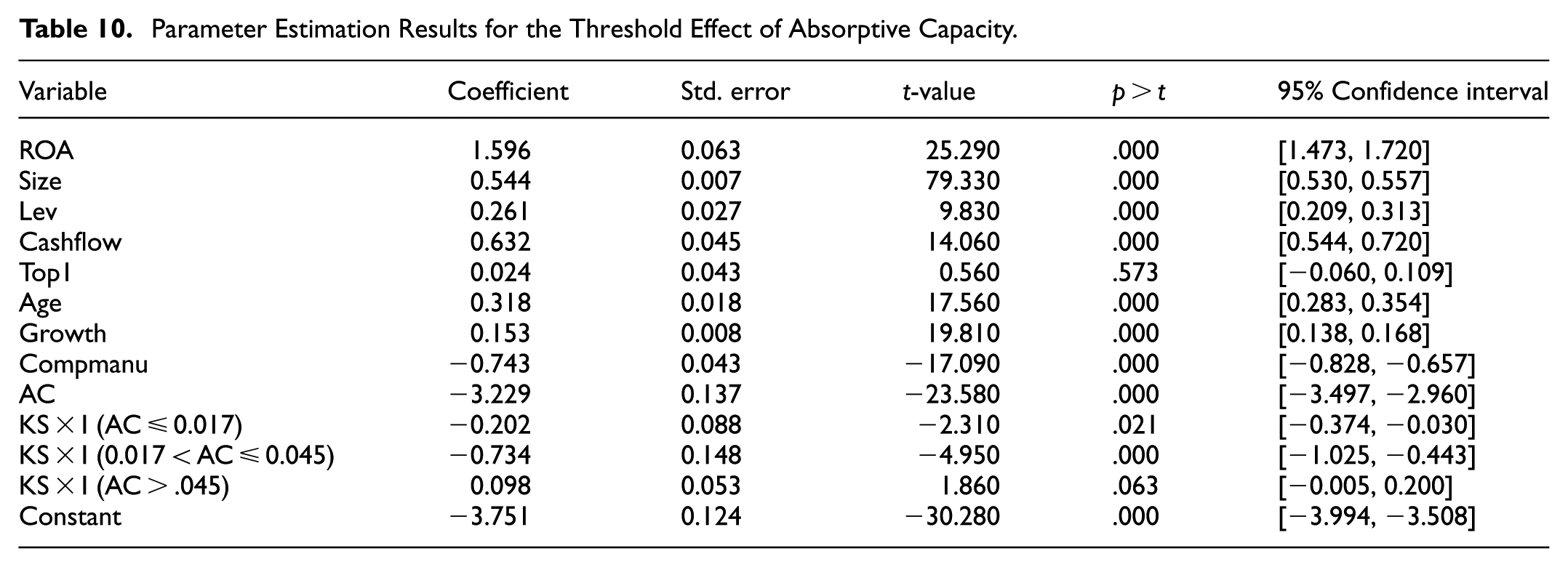
For firms with medium absorptive capacity (0.017 < AC ≤ 0.045), the interaction term shows a significant negative effect on TFP, which intensifies as absorptive capacity nears 0.045. In contrast, for firms with high absorptive capacity (AC > 0.045), knowledge spillover exerts a significant positive effect on TFP, with a parameter estimate of 0.098. This suggests that when firms have a high level of absorptive capacity, they can fully absorb knowledge spillover, thereby significantly promoting TFP.
Therefore, when firms’ absorptive capacity is below the threshold value of 0.045, even if they receive abundant external knowledge, limitations in absorptive capacity increase conversion costs, which in turn inhibit TFP. Conversely, when firms’ absorptive capacity exceeds the threshold value of 0.045, their ability to absorb external knowledge is at a high level, accelerating the process of knowledge absorption and utilization, thereby effectively promoting TFP. Thus, H3 is validated.
Moderating Effect of Digital Transformation
Table 11 presents the findings on the moderating role of corporate digital transformation. Digital transformation significantly enhances TFP. Consistent with previous research (Wu et al., 2025). The regression coefficient for the interaction between knowledge spillover and digital transformation (KS × digital) is 0.00569, demonstrating a statistically significant positive relationship at the 1% level. This indicates that knowledge spillover facilitates TFP within the framework of digital transformation.
The Synergistic Effect of Knowledge Spillover and Digital Transformation on TFP.

Note. t-Statistics are in parentheses.
p < .01.
Corporate digital transformation reduces information barriers, enabling firms to strengthen connections and collaborate on R&D through internet platforms (Niu et al., 2023). This enhances access to diverse information, accelerating the absorption and use of knowledge spillovers. Additionally, digital technologies allow lagging firms to acquire foundational knowledge—such as patents and research papers—at lower costs for innovation and efficiency improvements. By overcoming temporal and spatial constraints, digital transformation accelerates the integration of knowledge across technology, management practices, and business frameworks, thereby fostering TFP and supporting H4.
Conclusions and Discussion
The prevailing literature posits that knowledge spillovers from developed nations are a key driver of total factor productivity (TFP) growth for firms in emerging economies (Ang & Madsen, 2013). However, this traditional growth model faces significant headwinds from rising anti-globalization sentiment and geopolitical technology restrictions. Against this backdrop, examining whether knowledge spillovers among domestic firms can drive TFP growth at the micro level holds critical implications for China and other emerging economies. Using a panel dataset of 13,316 firm-year observations for Chinese A-share listed manufacturing firms from 2010 to 2020, this study empirically investigates the impact and underlying mechanisms of inter-firm knowledge spillovers on TFP. Our findings contribute to the literature in two main ways. First, they extend the application of endogenous growth theory to the micro-firm level. Second, they provide empirical evidence that, in the context of China’s “dual circulation” strategy, productivity enhancement is contingent upon the endogenous creation and diffusion of domestic knowledge.
Our research yields four main findings. First, we find that inter-firm knowledge spillovers significantly boost firm TFP, with an estimated elasticity of 0.026. This estimate is consistent with the 0.02 to 0.37 range for R&D-output elasticity reported in prior studies (Higon, 2007). This finding supports a core tenet of endogenous growth theory that the diffusion and sharing of knowledge, a quasi-public good with positive externalities, is a fundamental engine for long-term growth and productivity enhancement (Tassey, 2005). Furthermore, our study addresses the concern that knowledge spillovers might disincentivize innovation. We argue that this negative effect is mitigated because imitation is not a costless “free ride”; recipient firms must still invest significant time and R&D resources to absorb and adapt the external knowledge (Berchicci, 2013). Our findings are quantitatively consistent with Mary’s, who found that firms in knowledge-intensive environments experience productivity growth 2% to 5% higher than their counterparts (O’Mahony & Vecchi, 2009). In doing so, our study provides updated micro-econometric evidence from China that corroborates the seminal work of Jaffe (1986) and Coe and Helpman (1995).
Second, we find that technological innovation capacity acts as a partial mediator in the relationship between knowledge spillovers and TFP. Inter-firm knowledge spillovers can achieve value creation by stimulating and empowering firms’ own innovation activities. This implies that for external knowledge to be valuable, firms must possess the internal technological capacity to internalize, adapt, and ultimately leverage it for productivity improvements. This finding aligns with the theory of absorptive capacity, which posits that a firm’s ability to profit from external knowledge is contingent upon its ability to identify, assimilate, and apply it. We argue that technological innovation capability is the primary embodiment of this absorptive capacity. Thus, our research moves beyond simply confirming that knowledge externalities are a latent source of growth. Crucially, our mediation analysis reveals the mechanism: Schumpeterian innovation is the core channel through which firms convert this external potential into tangible, endogenous growth (Griffith et al., 2003).
Third, we identify a nonlinear, threshold effect in the knowledge spillover-TFP relationship. Specifically, knowledge spillovers have a significant positive impact on TFP only when a firm’s absorptive capacity surpasses a critical threshold of 0.045; below this threshold, the effect becomes detrimental. This threshold effect provides a compelling explanation for why not all firms in knowledge-intensive clusters can capitalize on spillovers. For firms with insufficient absorptive capacity, a flood of external knowledge is not an opportunity but rather “noise” that leads to strategic burdens (Aldieri et al., 2018). Our finding empirically corroborates the seminal argument of Cohen and Levinthal (1989) that absorptive capacity is a prerequisite for benefiting from spillovers. Lacking the requisite technical infrastructure and human capital to discern and integrate complex external knowledge, these low-capacity firms may blindly pursue technological trends, leading to resource misallocation, R&D failures, and ultimately, a decline in productivity. Moreover, this conclusion aligns closely with Antonelli and Fusillo (2024) research findings that reducing absorption costs can boost TFP. Taken together, these results suggest a robust conclusion: even in high-spillover environments, a minimum level of absorptive capacity is indispensable for firms to unlock the positive potential of external knowledge. This principle appears to hold true across diverse national, industrial, and institutional settings.
Fourth, we find that digital transformation positively moderates the relationship between knowledge spillovers and TFP. This finding offers a crucial insight into the evolving paradigm of knowledge diffusion in the digital age, challenging traditional assumptions about the primacy of geography. The conventional wisdom, rooted in the “law of distance decay,” posits that geographical proximity is a primary conduit for knowledge spillovers (Döring & Schnellenbach, 2006; Keller, 2002). Rodríguez-Pose and Crescenzi (2008) found that productive spillovers are largely confined to a 200-km radius and fail to generate significant returns in peripheral regions (Rodríguez-Pose & Crescenzi, 2008). In contrast, our research demonstrates that digital transformation acts as an “accelerator,” enabling firms to overcome these spatio-temporal barriers. Specifically, digital tools—such as collaborative platforms, virtual R&D systems, and advanced data analytics—create new channels for knowledge exchange that are independent of physical location. Consequently, modern technologies can now partially codify and visualize traditionally non-transferable tacit knowledge, making it accessible for absorption by geographically distant firms (P. Huang et al., 2022).
The literature has extensively examined the macroeconomic benefits of knowledge spillovers, but their impact at the firm level, specifically on TFP, remains relatively under-explored. Moreover, the existing micro-level evidence is inconclusive, with some studies suggesting that spillovers may even be detrimental to individual firm performance. This study is motivated by these conflicting findings and the scarcity of firm-level evidence on the net effects of knowledge spillovers.
Our study makes three primary contributions. First, by developing a novel micro-level measurement for knowledge spillovers, we provide new evidence on their positive effect on TFP. In doing so, we bridge a critical gap between macro theory and micro-level behavior. We empirically identify Schumpeterian innovation as the core mechanism through which firms internalize knowledge externalities, thus providing robust micro-foundations for endogenous growth theory. Second, we refine the theory of absorptive capacity (Cohen & Levinthal, 1989). We show that its effect on TFP is non-linear and subject to a “critical threshold.” This finding helps explain the observed performance heterogeneity among firms in knowledge-intensive environments and highlights the qualitative shift from merely “possessing” to “sufficiently possessing” absorptive capacity. Finally, our analysis of digital transformation as a moderator directly challenges the conventional “law of distance decay.” We find that digitalization fundamentally reshapes the geography of knowledge diffusion by reducing the importance of physical proximity. This insight contributes to a deeper understanding of how the digital economy reconfigures the spatial dynamics of innovation and alters the sources of firm-level competitive advantage.
Implications for Practice and Policy
Based on our findings, we propose the following managerial and policy implications: First, firms should proactively cultivate external knowledge networks rather than relying on a closed innovation model of independent R&D. To do so, firms can establish long-term collaborations with universities, research institutes, and industry leaders through university-industry partnerships. This enables access to cutting-edge technical knowledge via joint laboratories, technology licensing, and contract R&D. Furthermore, participation in industry alliances and standard-setting bodies—by joining trade associations and technology consortia—fosters knowledge-sharing channels with peers. Firms can also leverage supply chain relationships to acquire knowledge by forming strategic partnerships with core suppliers and key customers, thereby internalizing technical expertise and market intelligence from across the value chain. Second, firms should enhance their absorptive capacity to surpass the “threshold trap” of cross-domain knowledge spillovers. Strengthening absorptive capacity requires not only increased R&D investment and recruitment of high-tech talent but also the establishment of organizational learning mechanisms and knowledge management systems. Standardized processes for scanning, evaluating, integrating, and applying external knowledge must be implemented. Third, firms should accelerate the digital transformation of their manufacturing operations to transcend the geographical constraints on knowledge diffusion. Specifically, they should build digital infrastructure by investing in cloud computing platforms, big data analytics systems, and artificial intelligence algorithms. This infrastructure can connect upstream and downstream enterprises through industrial internet platforms. Firms should also advance smart manufacturing and digital twin technologies, using digital twins to simulate and optimize production processes for the rapid assimilation and application of external advanced manufacturing technologies.
At the government level, we propose the following policy implications: First, governments should foster an institutional environment and create public platforms to promote knowledge spillovers. They should build public technology service platforms; establish R&D centers, testing centers, and pilot production bases for small and medium-sized enterprises (SMEs); and support university-industry collaboration and technology transfer. Moreover, they should cultivate the market for technology intermediary services and support the development of intermediary organizations such as technology brokers. Second, policymakers should increase R&D subsidies to enhance the absorptive capacity of manufacturing firms and implement policies to attract and retain high-tech talent in their regions. Third, governments must accelerate the development of digital infrastructure. This includes improving industrial internet platforms and technology data platforms to provide a “digital highway” for knowledge spillovers. This requires a differentiated approach: providing robust patent protection and R&D subsidies for foundational research and frontier technologies, while offering more flexible protection measures for applied technologies and incremental innovations.
Research Limitations and Future Prospects
The primary limitation of this study lies in its sample, which consists exclusively of Chinese listed companies, thereby restricting the generalizability of our findings to unlisted firms. Additionally, despite our efforts to ensure robustness, models based on archival data may still be susceptible to potential endogeneity issues. Future research should aim to expand the sample to include other types of innovative enterprises, such as “unicorns,” and employ richer microdata for more precise measurement. Furthermore, future studies could adopt methods like quasi-natural experiments to strengthen causal identification or utilize case studies to delve deeper into the micro-foundations of knowledge conversion. To enhance the external validity of the study, future research should also consider incorporating empirical evidence from other emerging economies to test whether these findings are applicable across different economic contexts and institutional environments.
Footnotes
Acknowledgements
This research was generously supported by the Shaanxi Provincial Natural Science Basic Research Program and the Ministry of Education Humanities and Social Science Project.

Ethical Considerations
This article does not contain any studies with human participants performed by any of the authors.
Author Contributions
All authors contributed to the study conception and design. Material preparation, data collection and analysis were performed by Yangyang Yang, Yong Zhou, and Chuanjia Du. The first draft of the manuscript was written by Yangyang Yang and all authors commented on previous versions of the manuscript. All authors read and approved the final manuscript.
Funding
The authors disclosed receipt of the following financial support for the research, authorship, and/or publication of this article: This work was supported by the Shaanxi Provincial Natural Science Basic Research Program under Grant 2023-JC-YB-634; and the Ministry of Education Humanities and Social Science Project under Grant 21XJA630011.
Declaration of Conflicting Interests
The authors declared no potential conflicts of interest with respect to the research, authorship, and/or publication of this article.
Data Availability Statement
The datasets analyzed during the current study are available from the corresponding author on reasonable request.