



Abstract
The present study investigated the mediating role of communication willingness in the impact of acculturation preferences on academic adaptation among 294 Chinese international students in the United States. The results of the Structural Equation Model (SEM) indicated that adopting American culture was a positive predictor of higher academic adaptation, and maintaining Chinese culture was negatively associated with academic adaptation. The willingness to interact with strangers, friends, and acquaintances in a second language context has been found to be positively associated with adopting American culture, and negatively associated with maintaining Chinese culture, which exhibited significant differences. The mediating role of willingness to communicate underscores the importance of social interactions in the acculturation process. Willingness to communicate with strangers, friends, and acquaintances significantly mediated the relationship between adopting American culture, maintaining Chinese culture and cross-cultural academic adaptation. The findings of this study indicate that willingness to communicate exerts a significant influence on the mediation of acculturation preferences and cross-cultural academic adaptation.
Plain Language Summary
This study examined the acculturation-academic adaptation link among 294 Chinese international students in the U.S., focusing on communication willingness’s mediating role. Results revealed that stronger communication willingness predicted greater adoption of American academic culture and reduced attachment to Chinese cultural norms. Specifically, students who actively engaged in second-language interactions across social contexts (strangers, friends, acquaintances) demonstrated greater cultural flexibility in academic settings. Communication willingness emerged as a critical mediator between acculturation preferences (American culture adoption/Chinese culture maintenance) and academic adaptation outcomes. The findings highlight that proactive communication in English serves as both cultural bridge and academic adaptation mechanism, enabling students to navigate intercultural academic demands while negotiating heritage culture preservation. This underscores communication willingness as a dynamic psychosocial resource in educational acculturation processes, suggesting that fostering intercultural communication skills could enhance international students’ academic-cultural adjustment. The study advances understanding of how micro-level social interactions shape macro-level cultural adaptation trajectories in academia.
Introduction
In contrast to their local counterparts, international students encounter distinctive challenges in adapting to higher education, largely attributable to their unique cultural backgrounds. The cross-cultural adaptation of international students is predominantly characterized by its implications for cross-cultural educational adaptation, particularly in the context of academic integration (Bianchi & Martini, 2023). The challenges faced by international students in adapting to foreign educational systems, classroom cultures and educational philosophies can be attributed to their unfamiliarity with these environments (Al-Sharideh & Goe, 1998; B. Choy et al., 2021; Cruwys et al., 2020; Geeraert et al., 2019; Kumi-Yeboah et al., 2020; Lai et al., 2023; Neuliep, 2012). On the one hand, international students must learn to cope with cultural differences and culture shock independently; on the other hand, they also must deal with cross-cultural learning problems caused by changes in social and cultural environments and in educational and teaching environments.
So far, research has confirmed that the appropriate use of acculturation strategies can help individuals adapt to new cultures (Berry & Sam 1997; Cao et al., 2017; B. Choy et al., 2021; Cohen-Louck & Shechory-Bitton, 2021; Ward & Kennedy, 1994; Yang et al., 2023). However, the previous research in this field has placed greater emphasis on the cross-cultural psychological and social adaptation of international students to new cultures. With the increase of the international students studying abroad, more studies have commenced to concentrate on the challenges of academic adaptation encountered by international students (S. Choy et al., 2021; Cruwys et al., 2020; Gani, 2017; Tasneem et al., 2021). One of the major challenges confronting international students is the process of academic and social integration (Mao, 2024). Academic integration can be defined as the ability of international students to adapt to the academic standards and expectations of their host institutions (Gani, 2017), which may include mastering a new language, learning about different academic systems, and familiarizing themselves with unfamiliar teaching and assessment methods (Gani, 2017; Tasneem et al., 2021). Recently, only a few research on how acculturation strategies predict academic adaptation of international students were found (Cohen-Louck & Shechory-Bitton, 2021; Lai et al., 2023; Mao, 2024; Ng et al., 2017; Yang et al., 2023). For instance, Lai et al. (2023) surveyed 315 international Chinese students in the U.S. to understand how they adapted culturally and academically. They found that students who preferred separation and marginalization adapted better academically and psychologically, while those who integrated and assimilated performed better socially and culturally. Given the importance of academic adaptation for international students, there is an urgent need to explore the relationship between acculturation strategies and their levels of academic adjustment (Mao, 2024), as well as the role of the willingness to communicate in this process. The concept of social integration pertains to their capacity to adjust to the social and cultural norms of the host nation (Sarmiento et al., 2020; Yan & Berliner, 2009). This may encompass the development of interpersonal relationships, engagement in extracurricular activities, and interaction with the local community (Bianchi & Martini, 2023). Failure to achieve adequate academic and social integration may have an adverse effect on the academic success and overall well-being of international students. Research has indicated that international students who encounter difficulties in achieving academic and social integration are more prone to experiencing culture shock, loneliness, and depression (Singh et al., 2022). These students may encounter challenges in achieving their academic objectives and are less likely to complete their degree program (Jahan et al., 2022).
While existing research has extensively explored the psychological and social adaptation of international students (McGregor, 2021; Sheng et al., 2022; Zhang & Goodson, 2011; Zheng & Ishii, 2023), there is a notable gap in understanding how acculturation preferences influence academic adaptation and what factors might influence international students’ preferences of choosing acculturation strategies. Willingness to communicate is a critical factor in cross-cultural adaptation. According to Corlăteanu (2024), adopting American culture of a new culture depends largely on the willingness and ability of immigrants to communicate with members of the culture in accordance with its norms and practices. This process is accelerated when immigrants try to learn the local language and interact with locals regularly, thereby familiarizing themselves with their beliefs and values. Additionally, the role of willingness to communicate in mediating the effects of acculturation preferences on academic adaptation remains to be explored. Based on Berry’s theories on acculturation strategies, this study aims to contribute to the existing literature by examining the potential mediation role of international students’ willingness to interact with strangers, friends, and acquaintances in a second-language environment in mediating the influence of acculturation preferences on maintaining native culture and adopting host country culture on academic adaptation of Chinese international students in the U.S. It is imperative to comprehend these dynamics to facilitate the development of effective international student support programs. The present study aims to enhance the extant literature on acculturation adaptation, thereby contributing to a more comprehensive understanding of cross-cultural adjustment and its impact on academic success.
Literature Review and Conceptual Framework
This review is structured around the core theoretical constructs underpinning this study: the multidimensional nature of cross-cultural adaptation, the strategic approaches to acculturation, and the pivotal role of communication. We critically analyze these areas to identify a research gap and synthesize a conceptual model that examines how acculturation preferences influence academic adaptation through the mediating mechanism of willingness to communicate.
Theoretical Foundations of Cross-Cultural Adaptation
Early research on international students often subsumed their experiences under broader immigrant acculturation models. Seminal work by Ward et al. bifurcated adaptation into psychological adaptation (internal sense of well-being) and sociocultural adaptation (ability to navigate daily life in the new culture; Searle & Ward, 1990; Ward & Kennedy, 1994). While foundational, this framework has been critiqued for insufficiently addressing the unique role of international students as sojourners whose primary purpose is academic achievement (Bai & Wang, 2022; Mori, 2000). The unique status of international students, which differs from that of other immigrant groups, necessitates the adoption of various roles to address and adapt to the challenges associated with cross-cultural academic adaptation (Bai & Wang, 2022; Mori, 2000). These challenges include the socio-cultural and learning difficulties stemming from their unique cultural backgrounds as foreigners, as well as the educational adaptation and learning pressures (Bianchi & Martini, 2023).
This critique gave rise to the concept of academic adaptation, defined as “the ability to have successful interactions with the new academic environment and to cope with its academic demands” (Van Rooij et al., 2018). This dimension encompasses adapting to novel pedagogical styles, assessment methods, and faculty-student dynamics, often leading to a distinct “academic culture shock” (Gilbert, 2000). As Gilbert (2000) suggested, academic culture shock is a subset of the broader culture shock experienced by international students. It relates to the differences in academic learning environments between the students’ homes and host countries. Academic acculturation has also been proposed as an additional dimension of acculturation amid the surge in international students. Adapting to a new educational system is one of the main concerns for international students (Church, 1982). As mature and developing individuals, international students must consider their life goals, meanings, and developmental trajectories. They must also be mindful of their ethnic background and national status, in their capacity as representatives of their home countries. The processes and stages of cross-cultural adaptation experienced by international students during their study abroad are similar, nonetheless, the extent of intercultural adaptation problems and difficulties encountered by international students varies according to the proximity of cultural differences between their home country and the country in which they are studying (Lai et al., 2023). Various internal and external pressures arising from the language problem always accompany international students’ cross-cultural adaptation, such as adapting to the new education system, adapting to the second language skills in the new education, adapting to the new cultural norms and customs, coping with loneliness and loss of self-confidence, and communication with peers (Alharbi & Smith, 2018; Kumi-Yeboah et al., 2020; Li & Peng, 2019; Lou, 2021).
Tinto’s (1975) model of student integration, while developed for domestic students, provides a useful parallel by highlighting the dual importance of the academic system (performance, intellectual development) and the social system (peer/faculty interactions) for successful adaptation. A key strength of integrating these perspectives is the recognition that for international students, academic success is inextricably linked to their broader cross-cultural adjustment (Neuliep, 2012). From the perspective of cross-cultural adaptation of international students in their dual identities as “foreigners” and “students,” further suggested that cross-cultural adaptation of international students should be studied from the perspectives of psychological adjustment, socio-cultural adjustment, and academic adjustment. Neuliep (2012) also found that cross-cultural adaptation of international students is inextricably linked to their academic success and overall well-being in social life.
A prominent illustration of this challenge is the adaptation of Chinese students in Western academic contexts. Research consistently highlights a clash between the “lecture reception” model prevalent in China, which emphasizes quiet respect for the instructor, and the “discourse-based” model in the U.S., which values spontaneous questioning and critical debate (Liang & Schaller, 2023; X. Wang & Zhao, 2021). For instance, in the classroom, Chinese students have noted that the classroom atmosphere and teacher expectations in American universities differ significantly from those in China. In China, students are taught from a young age to listen to their teachers, to be quiet in class, to be used to listening attentively in class, and to be more in awe of their teachers than questioning them (Yan & Berliner, 2009). Therefore, Chinese students tend to remain quiet, listening attentively and taking notes, viewing this silence as an expression of respect for the professor’s knowledge and an intrinsic manifestation of focused learning. Presentations are typically well-considered and prepared, more likely to occur after class rather than during it (Liang & Schaller, 2023). Conversely, American teachers in these classrooms have been observed to be more concerned with “how students think” than “what students know” (X. Wang & Zhao, 2021). For example, Chen and Bird’s study (2021) interviewed 25 Chinese students over a year. Findings revealed that Chinese students recognized the American emphasis on oral participation and performance in lectures. However, many Chinese students compensated it by speaking more in group discussions while listening attentively in large lectures, and by producing high-quality written assignments. This can lead to significant anxiety, fear of losing face, and perceptions that their contributions lack depth, thereby hindering academic participation and adaptation (Chen & Bird, 2021).
The evolution from a two-dimensional (psychological, sociocultural) to a three-dimensional model (adding academic adaptation) represents a significant theoretical advancement, offering a more holistic view of the international student experience. However, a weakness in much of this literature is its often-descriptive nature, identifying challenges without fully elucidating the psychological mechanisms that translate cultural preferences into adaptive (or maladaptive) academic behaviors.
Acculturation Strategies: A Dimensional Approach
Berry’s (1997, 2005) bi-dimensional acculturation model provides a dominant theoretical lens for understanding how individuals navigate cultural contact. The model posits that individuals manage two core issues: the degree to which they wish to maintain their heritage culture and the degree to which they seek involvement with the larger host society. The intersection of these two independent dimensions yields four acculturation strategies:
Integration: High maintenance of heritage culture and high involvement with the host culture.
Assimilation: Low maintenance of heritage culture and high involvement with the host culture.
Separation: High maintenance of heritage culture and low involvement with the host culture.
Marginalization: Low maintenance of both heritage and host cultures.
A significant methodological debate surrounds the operationalization of these strategies. While some researchers treat them as four distinct categories (Berry, 2005; Navas et al., 2007), this approach has been criticized for forcing individuals into rigid typologies and losing statistical power (Rudmin, 2009). Consequently, many contemporary studies advocate for a two-dimensional approach, analyzing the independent effects of heritage and host culture orientations (Demes & Geeraert, 2014; Zheng & Ishii, 2023). This study adopts the latter approach to better capture the nuanced and independent influences of each cultural orientation.
Empirically, a host culture orientation is consistently linked to better psychological and sociocultural adaptation (Demes & Geeraert, 2014; Taušová et al., 2019). In contrast, the relationship between a heritage culture orientation and adaptation is more complex and often non-significant or even negative in some contexts (Cemalcilar et al., 2005; Ryder et al., 2000). This ambiguity suggests that the effect of maintaining one’s home culture is not direct but likely depends on intermediary factors. While “integration” is often touted as the most adaptive strategy (Grigoryev & Berry, 2017; Mao, 2024), its prevalence varies significantly across cultural groups and host countries (Cao et al., 2017; Lai et al., 2023; Lu et al., 2012), indicating that the pathway from acculturation preference to outcome requires further investigation.
Berry’s model is a robust heuristic, but its application often overlooks the process through which orientations translate into outcomes. The inconsistent findings regarding heritage culture orientation point to a “black box” problem: we know that host orientation is beneficial, but we have a less clear understanding of the behavioral and psychological variables that mediate this relationship.
Willingness to Communicate: The Behavioral Bridge
The concept of willingness to communicate in a second language, defined as “a readiness to enter into discourse at a particular time with a specific person or persons, using a L2” (MacIntyre et al., 1998, p. 547), offers a compelling mechanism to explain the acculturation-adaptation link. Cross-cultural adaptation is a dynamic process requiring active engagement with the host environment (Kim, 2008). Willingness to communicate represents the behavioral intention that is a prerequisite for such engagement.
Theoretical and empirical evidence positions willingness to communicate as a critical mediator. From a theoretical standpoint, an individual’s acculturation orientation (e.g., a strong host culture orientation) should increase their motivation to interact with host nationals. This motivation, in turn, manifests as a higher willingness to communicate, which then leads to more frequent and meaningful cross-cultural interactions. These interactions are the very experiences that facilitate academic adaptation by improving language proficiency, providing academic support, and deepening cultural understanding (He et al., 2024; Lashari et al., 2018). Conversely, a strong heritage culture orientation might reduce willingness to communicate with host nationals, limiting these adaptive opportunities and potentially reinforcing separation.
Empirical research supports this mediating role. Studies have shown that interaction with locals reduces adaptation stress, improves language skills, and increases overall satisfaction (Hendrickson et al., 2011; Zhang & Goodson, 2011). Most directly, He et al. (2024) found that willingness to communicate mediated the relationship between cultural intelligence and academic adaptation, providing a clear precedent for investigating it as a mediator within the acculturation context. Introducing willingness to communicate addresses a key weakness in the acculturation literature by specifying a tangible, measurable psychological process. It moves beyond simply correlating cultural attitudes with outcomes to explaining how those attitudes might lead to successful or unsuccessful adaptation in the academic domain.
Conceptual Framework and Research Model
Synthesizing the theories and evidence above, this study proposes a conceptual framework where the relationship between acculturation preferences (maintaining heritage culture and adopting host culture orientations) and academic adaptation is mediated by willingness to communicate in a second language. The model posits that acculturation orientations do not directly cause adaptation but instead influence a student’s readiness to engage in communication, which in turn drives the interactive experiences that foster academic adaptation.
The following path diagram, conceptualized for analysis in AMOS, illustrates this proposed model (Figure 1):

Conceptual model of the mediating role of willingness to communicate in the acculturation-academic adaptation relationship.
Construction of Hypotheses
Based on the preceding theoretical review and the conceptual framework, the following hypotheses are proposed:
As established in the literature, a strong orientation toward one’s heritage culture can be associated with separation and less engagement with the host academic environment (Demes & Geeraert, 2014). This orientation may reinforce communication styles and academic behaviors (e.g., reticence in class) that are misaligned with the participatory norms of the U.S. classroom (Chen & Bird, 2021; Liang & Schaller, 2023), thereby directly hindering successful academic adaptation. Therefore, we hypothesize (H1):
The conceptual framework posits willingness to communicate as a key behavioral mechanism. A strong heritage culture orientation is likely to reduce students’ motivation to initiate conversations with American peers and professors (Zheng & Ishii, 2023). This lower willingness to communicate limits their opportunities for the very interactions that build language fluency, clarify academic expectations, and foster a sense of classroom belonging, thus indirectly impairing their academic adaptation (He et al., 2024; McGregor, 2021). Therefore, we hypothesize (H2):
Empirical evidence consistently demonstrates that a strong host culture orientation is a robust predictor of better psychological and sociocultural adaptation (Taušová et al., 2019). Extending this to the academic domain, students with a stronger desire to engage with American culture are more likely to actively seek out and adapt to the local academic norms, such as participating in discussions and engaging with faculty, leading to more successful academic outcomes. Therefore, we hypothesize (H3):
A strong host culture orientation is theorized to increase a student’s motivation to interact with the host environment. This heightened motivation manifests as a greater willingness to communicate (MacIntyre et al., 1998). Willingness to communicate, in turn, leads to more frequent and meaningful cross-cultural interactions, which provide practical experiences (e.g., language practice, academic collaboration) that directly facilitate and improve academic adaptation (Lashari et al., 2018; Zhang & Goodson, 2011). Therefore, we hypothesize (H4):
Method
Participants
The investigation was grounded upon an empirical sample of 294 Chinese students from mainland China enrolled in universities across the United States. The participants encompassed a diverse demographic, including undergraduates and graduates. As shown in Table 1, the sample included 153 male and 141 female participants, with an age range from 17 to 32 years old (M = 24.06, SD = 3.39). 32.1% of the participants identified as undergraduate students, while 67.9% were enrolled in graduate program. The average length of stay in the United States was between 2 and 3 years (M = 2.35, SD = 1.16), with 84 students staying less than 1 year, 88 staying 1 to 2 years, 40 staying 2 to 3 years, and 82 staying more than 3 years. Regarding their academic disciplines, 43 students pursued a liberal arts major, 161 majored in science or engineering field, 67 majored in business, and 23 majored in other disciplines.
The Statistic Descriptions of the Participants’ Demographic.

Instruments
The present study utilized a questionnaire survey with the objective of investigating the cross-cultural academic adaptation of Chinese students studying in the United States. A two-pronged investigation is warranted in this instance: firstly, to examine the impact of cross-cultural adaptation strategies among Chinese international students on their cross-cultural academic adaptation, and secondly, to examine the potential mediation role of international students’ willingness to communicate with strangers, friends, and acquaintances in the United States in mediating the influence of acculturation preferences on maintaining native culture and adopting host country culture. The questionnaire consists of two parts: the first part investigates the demographic information of Chinese students studying in the United States, including gender, age, length of stay in the United States, education level, and discipline. The second part of the study investigates the cross-cultural academic adaptation status and willingness to communicate with the strangers, friends, and acquaintances in the United States and acculturation preferences of maintaining native culture and adopting host country culture.
Academic Adaptation
The Academic Adaptation questionnaire was self-administered using Kovtun’s (2010) questionnaire. The original questionnaire’s contents related to cross-cultural academic adjustment of international students, such as academic English skills, academic adjustment skills, classroom integration, and use of campus resources. The Academic Adaptation Questionnaire in this study had 10 survey items related to understanding of U.S. classroom content, classroom presentations, academic paper writing, classroom speeches, after-school reading, group work, teacher expectations, classroom culture, and use of school learning resources. The questionnaire used a 5-point scale (1 = no difficulty; 2 = somewhat difficulty; 3 = difficulty; 4 = more difficulty; 5 = great difficulty). The higher the score, the higher the learning difficulty and the weaker the ability to adapt to learning. The original Academic Adaptation Scale demonstrated high internal reliability (α = .70). This study found that Cronbach’s alpha was .84.
Acculturation Preferences
The Vancouver Cultural Adaptation Index (VIA; Ryder et al., 2000) was used to assess participants’ cultural adaptation strategies. The Vancouver Cultural Adaptation Index includes 20 items aimed at measuring cultural adaptation strategies based on the two dimensions of the cultural adaptation model proposed by Berry et al. (1989): maintaining home culture and adopting host country culture. Each dimension is measured by 10 items, with two statements for each item. In this study, the first statement was about the participants’ response to maintaining Chinese culture, while the second statement was about their response to adopting American culture. Participants were asked to rate each statement on a 5-point Likert scale, ranging from 1 point “strongly disagree” to 5 points “strongly agree.” The two independent scores from the survey assessed the level of acceptance of the home and host cultures, respectively. The hypothesis was formulated that elevated scores on the upholding Chinese culture scale would be indicative of heightened levels of recognition of Chinese culture, and that elevated scores on the embracing American culture scale would be indicative of heightened levels of recognition of American culture. The internal reliability of the two identity subscales in this study was found to be satisfactory (amaintaining Chinese culture = 0.82, aadopting American culture = 0.81).
Pilot Test and Exploratory Factor Analysis (EFA) Results
Adopting American Culture Scale: A pretest was conducted with 120 participants. The exploratory factor analysis (EFA) revealed a clear 5-factor structure (total variance explained = 78.328%, KMO = 0.935, χ2 = 3,547.823, p < .001), with all items loading >0.70 on their designated components and no significant cross-loadings. These results confirm the scale’s robust structural validity, supporting its use for formal data collection. Table 2 summarizes the EFA results.
Exploratory Factor Analysis of Adopting American Culture.

Note. Rotation converged in six iterations. Extraction method: Principal Component Analysis. Rotation method: Varimax with Kaiser Normalization.
Exploratory Factor Analysis of Maintaining Chinese Culture.

Note. Rotation converged in six iterations. Extraction method: Principal Component Analysis. Rotation method: Varimax with Kaiser Normalization.
Willingness to Communicate
The present study drew on the Willingness to Communicate Questionnaire by McCroskey and Richmond (1987) to investigate the respondents’ tendency and ability to converse with American friends, acquaintances and strangers in different cultural backgrounds. However, the present study only investigated the willingness of Chinese students to interact with American friends, acquaintances and strangers in a second language context. Consequently, subsequent revisions of this study excluded inquiries concerning Chinese students’ capacity to socialize with Americans. Instead, the study’s focal point was narrowed to encompass the willingness of Chinese students to interact with American friends, acquaintances, and strangers. The measurement scale of the questionnaire was modified to a 5-point scale (1 = very unwilling; 2 = unwilling; 3 = somewhat willing; 4 = willing; 5 = very willing), ensuring consistency with other questionnaires in this study. The internal reliability of the questionnaire in this study is satisfactory (a = 0.94) and the results of the factor analysis for the content validity indicate that the questionnaire possesses satisfactory construct validity (KMO = 0.866 > 0.5, significance level .000 < .05, with factor eigenvalues of 6.181 > 1.0, an acceptable value).
Procedure and Data Analysis
Procedure
The survey was designed and administered online via Wenjuanxing (https://www.wjx.cn/), a professional online survey platform in China. Informed consent was secured from all participants before they proceeded with the questionnaire. Data collection was conducted through two primary channels:
Firstly, official institutional partnerships were established. Prior to the survey, the researchers contacted officials from the Education Office of the Chinese Consulate in San Francisco, the International Center at the University of Florida, the International Friendship Center at the University of Florida, and the International Office at Iowa State University. The web link to the questionnaire, along with an invitation letter, was sent to these officials with a request to distribute it via email to Chinese students within their networks. This approach provided verified access to a large pool of authentic participants, as these institutions maintain official registries of international students.
Secondly, the survey was distributed through personal networks using QQ and Wechat (two popular Chinese social media). To expand the reach and diversity of the sample beyond the official channels, a snowball sampling technique was employed. This method was strategically chosen to access hard-to-reach segments of the Chinese student population in the U.S. who might not be actively engaged with formal organizations, thereby enhancing the representatives of the sample. Initial participants from the researchers’ personal contacts were asked to forward the survey link to other eligible Chinese students.
To ensure data integrity and verify participant eligibility despite the use of snowball sampling, two measures were implemented: (1) the questionnaire included a screening question at the outset to confirm the respondent’s status as a Chinese student currently studying in the U.S., and (2) responses were later screened for inconsistencies and duplicate IP addresses during data cleaning.
The questionnaire was translated from English to Chinese and proofread by two Chinese professors of English. Both are fully bilingual and demonstrate native-like competence in both Chinese and English. Their proficiency is further supported by extensive academic experience, including visiting scholar appointments at universities in the United Kingdom and the United States. The questionnaire was administered exclusively in Chinese. This decision was made to ensure precise comprehension and prevent potential misunderstandings among participants, all of whom were native Chinese speakers.
Data Analysis
This study employed quantitative, explanatory, and cross-sectional research design. This approach was selected to efficiently examine the complex interrelationships and proposed mediating mechanisms between the key variables—for example, academic adaptation, acculturation preferences, willingness to communicate—within a naturalistic setting at a single point in time.
The primary analytical framework was Structural Equation Modeling (SEM), implemented using AMOS software. We chose SEM because it is uniquely suited for testing hypotheses involving complex, multivariate relationships and for evaluating the validity of proposed mediating effects within a single, comprehensive model. This allowed us to move beyond predicting outcomes and instead focus on explaining the underlying structure and causal pathways among the variables, consistent with an explanatory design. In this study, SEM was employed to evaluate the predicted mediating role of willingness to communicate on the relationship of academic adaptation with acculturation preferences. AMOS software was used to test the mediating effects between variables, thereby unveiling potential causal pathways and associations that are consistent with the proposed theoretical model. A structural equation model was constructed, incorporating independent, mediating, and dependent variables. The relationships between these variables were then estimated and tested in detail through the path analysis function of AMOS. In this study, the independent variable was maintaining Chinese culture and adopting American culture. The mediating variable was the willingness to communicate (M1 strangers, M2 friends, and M3 acquaintances). The dependent variable was academic adaptation.
Results
Descriptive Statistics
Table 4 presents the means, standard deviations, and correlations between the primary variables employed in this study. The data demonstrated a positive correlation between adopting American culture and maintaining Chinese culture (r = .650, p < .001). Furthermore, a positive correlation was identified between adopting American culture and academic adaptation (r = .697, p < .001). Similarly, a positive correlation was observed between maintaining Chinese culture and academic adaptation (r = .691, p < .001).
Descriptive Statistics, and Correlations Among the Major Variables (N = 294).

p < .01.
Furthermore, negative correlations were found between the frequency of communication with strangers (Stranger_p), friends (Friends_p), and acquaintances (Acquaintances_p) and adopting American culture, with correlation coefficients of r = −.639, r = −.626, and r = −.574 respectively (all p < .001). Conversely, positive correlations were identified between the frequency of communication with strangers (Stranger_a), friends (Friends_a), and acquaintances (Acquaintances_a) and the acceptance of American culture, with correlation coefficients of r = .582, r = .589, and r = .532 respectively (all p < .001). These results suggested that there are complex relationships between maintaining Chinese culture, adopting American culture, academic adaptation, and communication frequencies with different groups of people.
In our preliminary analysis, we found there were no significant correlations between these known correlations with the core constructions. To maintain model parsimony and avoid overfitting non-influential variables, we excluded them from the final SEM.
Measurement Model Evaluation
The measurement model demonstrated satisfactory convergent validity, as evidenced by the composite reliability (CR) and average variance extracted (AVE) values presented in Table 5. All constructions exhibited CR values ranging from 0.874 to 0.943, substantially exceeding the recommended threshold of 0.70 (Hair & Luiz, 2019). The AVE values, which ranged from 0.524 to 0.717, complied with previous standards.
Adopting American Culture CR and AVE.

The measurement model indicated adequate discriminant validity, as shown in Table 6. The square roots of AVEs (diagonal values: 0.724–0.847) exceeded all corresponding inter-construct correlations (off-diagonal values: 0.467–0.697).
Adopting American Culture Discrimination Validity.

p < .001.
The measurement model indicated acceptable fit based on multiple goodness-of-fit indices (Table 7). The normed chi-square (χ2/df = 2.645) fell well below the threshold of 3, indicating reasonable fit. The GFI (0.916), CFI (0.908), NFI (0.916), and NNFI (0.938) all exceeded the 0.90 benchmark, demonstrating good absolute and incremental fit. The RMSEA (0.072) and RMR (0.047) values met their respective criteria (<0.08 and <0.05), suggesting acceptable approximation errors. Collectively, these indices supported the theoretical model’s adequacy in representing the observed data structure.
Adopting American Culture Model Fit.

The measurement model indicated satisfactory convergent validity, as evidenced by the composite reliability (CR) and average variance extracted (AVE) values presented in Table 8. All constructions exhibited CR values ranging from 0.806 to 0.950, substantially exceeding the recommended threshold of 0.70 (Hair & Luiz, 2019). The AVE values, which ranged from 0.524 to 0.637, complied with previous standards.
Maintaining Chinese Culture CR and AVE.

The measurement model demonstrated satisfactory discriminant validity for Chinese cultural preservation, as evidenced in Table 9. The square roots of AVEs (diagonal values: 0.723–0.798) consistently exceeded all corresponding inter-construct correlations (off-diagonal values: 0.619–0.753), satisfying the Fornell-Larcker criterion. This pattern confirmed that each construct shared more variance with its indicators than with other constructs in the model.
Maintaining Chinese Culture Discrimination Validity.

p < .001.
The measurement model for Maintaining Chinese culture demonstrated acceptable fit across multiple indices, as presented in Table 10. The normed chi-square (χ2/df = 2.63) fell below the recommended threshold of 3. The GFI (0.907), CFI (0.926), NFI (0.907), and NNFI (0.908) all exceeded the conventional 0.90 benchmark for good fit. The RMSEA (0.076) and RMR (0.048) values both met their respective criteria of <0.08 and <0.05.
Maintaining Chinese Culture Model Fit.

The Mediating Effect of Willingness to Communicate
In this study, AMOS software was utilized to carry out the work of mediation effects analysis. A structural equation model containing independent, mediating, and dependent variables was first constructed, and then the relationships between the variables were estimated and tested in detail through the path analysis function of AMOS. In this study, maintaining Chinese culture and adopting American culture were used as the independent variable X and was analyzed separately, willingness to communicate (M1 strangers, M2 friends, and M3 acquaintances) was used as the mediating variable, and academic adaptation Y was used as the dependent variable.
Prior to the construction of the model, a comprehensive analysis of the data fit was conducted using established fit indices. These indices included the commonly used Chi-Square to Degrees of Freedom Ratio (χ2/df), IFI (Incremental Fit Index), TLI (Tucker-Lewis Index), CFI (Comparative Fit Index), and RMSEA (Root Mean Square Error of Approximation). Generally speaking, the Chi-Square degrees of freedom ratio should be less than 3, the IFI, TLI, and CFI should be more than 0.9, and the RMSEA should be less than 0.08.
Mediating Effects of Willingness to Communicate in the Maintaining Chinese Culture and Academic Adaptation
In this analysis, subsequent to the implementation of correction using the correction indexes, the fit indices indicated an acceptable fit for the mediation model (χ2/df = 2.328, IFI = 0.925, TLI = 0.916, CFI = 0.924, RMSEA = 0.065), thereby indicating that the model in this study exhibits a satisfactory fit and can be further studied (See Figure 2).

Mediating analysis of willingness to communicate in the maintaining Chinese culture and academic adaptation.
A path analysis of the relationship between willingness to communicate with (strangers, friends, acquaintances) was conducted in a second language environment in terms of maintaining Chinese culture and academic adaptation. The results of the path analysis were shown in Table 11.
Path Analysis of Maintaining Chinese Culture.

p < .001.
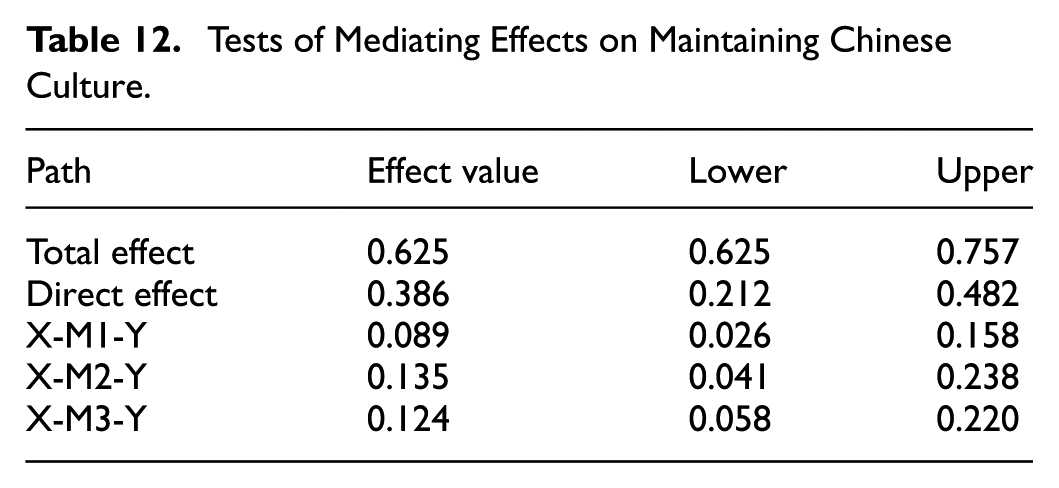
The present study employed the AMOS program for the mediation effect test, utilizing the Bootstrapping mediation effect test, which was set to 1,000 times in this study. The 95% confidence interval for the indirect effect did not contain 0, indicating that mediation has been established. Conversely, if the 95% confidence interval for the indirect effect contained 0, it would suggest that mediation has not been established.
As shown in Table 12, it was found that the 95% confidence intervals for the indirect effects of the X-M1-Y, X-M2-Y, and X-M3-Y paths did not contain 0, and the mediation effect was established for all of them. This indicates that the willingness to communicate with strangers, friends, and acquaintances in a second language context plays a mediating role in maintaining native culture and cross-cultural academic adaptation.
Tests of Mediating Effects on Maintaining Chinese Culture.
Mediating Effects of Willingness to Communicate in the Adopting American Culture and Academic Adaptation
In this analysis, subsequent to the implementation of correction using the correction indexes, the fit indices indicated an acceptable fit for the mediation model (χ2/df = 2.586, IFI = 0.915, TLI = 0.907, CFI = 0.914, RMSEA = 0.071), thereby indicating that the model in this study exhibits a satisfactory fit and can be further studied (See Figure 3).

Mediating analysis of willingness to communicate in the adopting American culture and academic adaptation.
A path analysis of the relationship between willingness to communicate with (strangers, friends, acquaintances) was conducted in a second language environment in terms of adopting American culture and academic adaptation. The results of the path analysis were shown in Table 13.
Path Analysis of Adopting American Culture.

p < .001.
As shown in Table 14, it was found that the 95% confidence intervals for the indirect effects of the X-M1-Y, X-M2-Y, and X-M3-Y paths did not contain 0, and the mediation effect was established for all of them. This indicates that the willingness to communicate with strangers, friends, and acquaintances in a second language context plays a mediating role in adopting host culture and cross-cultural academic adaptation.
Tests of Mediating Effects on Adopting American Culture.

Discussion
Main Findings and Implications
This study was designed to explore the mediating role of communication willingness in the influence of cross-cultural adaptation preferences on academic adaptation of Chinese students studying in the United States. The research findings provide valuable insights into the complex interplay between cross-cultural adaptation preferences, willingness to communicate, and academic adaptation.
Acculturation Preferences and Academic Adaptation
The findings of the present study indicate that the appropriate utilization of acculturation preferences is predominantly associated with better acculturation outcomes. Adopting American culture was a positive predictor of higher academic adaptation. These observations are consistent with previous research that examined the effects of acculturation strategies on cross-cultural sociocultural and psychological adjustment (Berry, 2005; Ryder et al., 2000; Zheng & Ishii, 2023). However, in contrast to most findings, this study extends the existing literature by including academic adaptation. The results of these studies primarily link acceptance of the host culture to an individual’s psychological and sociocultural adjustment, with successful academic adjustment, often characterized by integration into the social and academic environment, having been shown to be positively associated with improved academic outcomes (Bianchi & Martini, 2023; Grigoryev & Berry, 2017; Lai et al., 2023; Neto & Neto, 2023). Students who demonstrate effective social interaction skills and understanding of the academic environment tend to exhibit enhanced social and academic integration, resulting in improved academic performance and satisfaction. The present study also found that maintaining Chinese culture had a negative impact on academic adaptation. This finding is consistent with the conclusions of previous research, which suggests that acculturation strategies involving the maintenance of home culture (e.g., separation) may be met with academic frustration and elevated levels of stress (Bianchi & Martini, 2023; Kosic et al., 2006; Leong, 2015).
It is worth noting that the results of the present study are consistent with other studies that have identified international students’ preference for maintaining their home culture (Dey & Sitharthan, 2017; Lai et al., 2023). One potential explanation for this phenomenon is that, in contrast to migrant samples examined in previous studies, most Chinese students usually stay in the host country for a limited period to continue their studies before coming back to China (Lai et al., 2023). Moreover, cultural barriers, extensive and sustained after-school study may hinder Chinese students’ social interactions with locals, thus creating a sense of social exclusion in the host culture (Jones & Kim, 2013; Wright & Schartner, 2013).
Willingness to Communicate as a Mediator
The mediating role of communication in acculturation emphasizes the significance of social interactions. The present study hypothesized that the relationship between adopting American culture, maintaining Chinese culture and academic adaptation would be significantly mediated by communication with strangers, friends, and acquaintances. This finding aligns with previous studies (Kosic et al., 2006; Neto & Neto, 2023; Urzúa et al., 2017; Yoo, 2021). Students who demonstrate a greater willingness to communicate are more likely to build relationships with peers and tutors (Yashima et al., 2004). This improves understanding of academic expectations and available resources, positively impacting academic performance and adjustment to the academic environment (Yashima et al., 2004). Students who communicate more are more likely to participate in social activities, cultivate relationships with the host country, and engage in academic discourse. These factors contribute to enhanced academic performance and psychological well-being (Cohen-Louck & Shechory-Bitton, 2021; MacIntyre et al., 1998; Yang et al., 2023; Yashima et al., 2004). This finding extends the extant literature by demonstrating that a willingness to communicate exerts a significant effect on academic adaptation.
Practical Implications
The findings of this study have important implications for policy makers, educators, and educational institutions to develop effective aid programs and policies for international students. Educators should be aware of the different acculturation preferences that students may adopt and the role of willingness to communicate in academic adaptation. Creating inclusive learning environments that encourage communication and support the process of students’ acculturation is essential. Increasing learners’ intercultural communicative awareness and experience can develop their inclination to communicate in a second language, thus reducing communicative barriers due to cultural differences (Yashima, 2002).
Educational institutions can design programs and interventions such as targeted language and academic support programs, intercultural training programs, social integration activities, and peer mentoring programs (Bianchi & Martini, 2023) to promote positive cultural adaptation preferences and provide social support to enhance students’ intercultural adaptation. It is important for students to understand their own cultural adaptation tendencies and the importance of communication to help them make more informed decisions during intercultural academic travel.
Conclusion
The findings highlight the significant role of willingness to communicate in mediating the effects of acculturation preferences on academic adaptation. Both maintaining Chinese culture and adopting American culture influence academic adaptation, with willingness to communicate acting as a crucial mediator. These results underscore the importance of fostering willingness to communicate among international students to enhance their academic and social integration. In conclusion, acculturation and academic adaptation are complex and interrelated processes. Acculturation preferences and willingness to communicate play a crucial role in determining how students adapt to the intercultural academic environment. This study provides a foundation for understanding these important phenomena and offers insights into improving students’ educational experiences in cross-cultural settings. Future research could further explore the long-term effects of different acculturation strategies on academic performance, as well as develop interventions to promote positive acculturation and academic adjustment.
Limitations and Future Research
Despite the valuable insights provided by this study, there are some limitations that must be acknowledged. Firstly, the sample was limited to Chinese international students in the United States, which may limit the generalization of the findings to other cultural contexts or student groups. Future research should explore the mediating role of willingness to communicate in different cultural contexts to deepen the understanding of the cross-cultural adaptation process. Secondly, the study relied on self-reported adaptation measures, which may be subject to bias. In future studies, the incorporation of objective adaptation measures, such as academic achievement data or observational studies of social interactions, could enhance the robustness of the findings. Furthermore, the cross-sectional design of the present study precluded the drawing of causal inferences. The use of longitudinal studies could provide a more comprehensive understanding of the interactive relationship between willingness to communicate and acculturation preferences over time in influencing adaptation outcomes.
Footnotes

Ethical Considerations
The studies involving human participants were reviewed and approved by the University Research Committee. The ethics committee waived the requirement of written informed consent for participation.
Funding
The authors received no financial support for the research, authorship, and/or publication of this article.
Declaration of Conflicting Interests
The authors declared no potential conflicts of interest with respect to the research, authorship, and/or publication of this article.
Data Availability Statement
The raw data supporting the conclusions of this article will be made available by the authors, without undue reservation.