




Abstract
In the sphere of second or foreign language (L2) pedagogy, empirical evidence has increasingly spotlighted the role of learners’ metacognitive strategies as formidable predictors of their willingness to engage in L2 communication (WTC). Nonetheless, the interrelationship among learners’ metacognitive strategies, self-efficacy, and intrinsic motivation—as a collective force influencing WTC—has not been adequately probed. Addressing this gap, the present research determines the mediating roles of L2 self-efficacy and intrinsic motivation in bridging metacognitive strategies with WTC. The research cohort consisted of undergraduates majoring in English at leading national universities in China, with a comprehensive survey conducted among 316 respondents. The analysis unveiled two pivotal findings: (1) there exists a significant predictive relationship between students’ metacognitive strategies and their WTC in L2, and (2) students’ self-efficacy and intrinsic motivation in the L2 context mediate this relationship. This study emphasizes the importance of metacognitive strategies, self-efficacy, and intrinsic motivation in promoting L2 communication. The significance and directions for future studies are also discussed.
Keywords
Introduction
The willingness to communicate (WTC) has been a subject of immense research among scholars in recent days. WTC is also a psychological construct for L2 learners that is connected with teaching as well. Meanwhile, understanding WTC is essential for students, and it aims to improve their language acquisition and communicative competence. For example, some scholars have conducted studies investigating the correlation between L2 WTC and other constructs of L2, namely affective factors and motivation (Dewaele, 2019; Elahi Shirvan et al., 2019). Additionally, students’ L2 performance is positively associated with their WTC in the L2. Therefore, although some learners’ extrinsic motivation may influence their language learning behaviors, studies have confirmed that metacognitive strategies, intrinsic motivation, and self-efficacy are important factors affecting learners’ engagement in communication (Liu, 2020; T. Zhang, 2024). The influence mechanisms among these factors are beneficial for enhancing language learners’ WTC and help learners autonomously construct strategies for managing their learning processes.
The effective use of metacognitive strategies significantly enhances communication skills and learning outcomes in the process of learning an L2. Research showed that a positive correlation between metacognitive strategies and WTC, and these strategies play a supervisory and guiding role throughout the entire L2 process (Sato & Dussuel Lam, 2021; T. Zhang, 2024). Particularly in terms of L2 listening performance, the correlation coefficient between metacognitive awareness and L2 listening scores approaches a medium effect size, with problem-solving strategies showing the strongest correlation with L2 listening performance (Du & Man, 2022). This indicated that the ability to use metacognitive strategies can promote learners’ initiative in communicating in an L2, thereby enhancing their WTC. However, teachers should prioritize the cultivation of metacognitive strategies, helping students master effective learning strategies and improve their autonomous learning abilities.
The self-determination theory serves to enlighten us about the difference between intrinsic motivation and extrinsic motivation. One element of this distinction lies in extrinsic motivation, where an individual is prompted to act by some sort of external reward or punishment. However, intrinsic motivation drives the performance of an activity for one’s own pleasure and satisfaction. Intrinsic motivation in L2 learners is thought to be stimulated by intrinsic stimuli and to process self-rewards from the inside. Intrinsic motivation is the urgent need for L2 learners to approach learning tasks creatively and actively tackle challenges (Y. J. Lin & Wang, 2021). Additionally, L2 motivation can promote language learning, providing lasting drive and serving as an important factor in the L2 acquisition process (Dörnyei & Henry, 2022). Many empirical studies have demonstrated that academic intrinsic motivation is a major influence on students’ academic emotions and willingness to communicate in L2 learning (Cao, 2022; Joe et al., 2017). For instance, students’ motivational tendencies were directly associated with students’ WTC in class and their frequency of speaking (Aoyama & Takahashi, 2020). However, learners’ intrinsic motivation has rarely been studied in the context of L2 learning in China, especially from a positive psychology perspective. Thus, based on the above research foundation, our study needs to further test this model as the complexity of the relationship may vary depending on the language, the participants and the background.
In the studies of second language (L2) learning, the essential roles of metacognitive strategies and self-efficacy for enhancing language learning achievement have received a lot of attention. The social cognitive theory focuses on reciprocal interactions that exist between the environment, behavior, and individual cognition (Stajkovic & Sergent, 2019). Social cognitive theory has the theoretical framework for explaining the process of how L2 acquisition occurs through goal setting, observation, imitation, and self-regulation, while integrating metacognitive strategies and self-efficacy to promote WTC in an L2 (Karbakhsh & Ahmadi Safa, 2020). Meanwhile, social cognitive theory provides a framework for designing L2 teaching content to enhance learners’ metacognitive development and self-efficacy, thereby increasing their WTC (Wang et al., 2023). Self-efficacy is one of the key factors that enhance students’ outcomes in L2 learning. It not only affects the level of students’ engagement in L2 learning but also increases their confidence when they face difficulties and consequently raises L2 learning effectiveness (Alemayehu & Chen, 2023). Moreover, they were concerned with the individual influences of metacognitive strategies (Veas et al., 2019) and self-efficacy (Sun et al., 2021) or the correlation between these concepts (Gentner & Seufert, 2020). Metacognitive strategies encourage learners to reflect on their previous educational journey, instruct their L2 knowledge acquisition, and modify their research projects to align with their L2 knowledge acquisition goals (Muijs & Bokhove, 2020). However, whether metacognitive strategies and self-efficacy can interact to influence and predict aspects of L2 students’ willingness to communicate has not been adequately investigated.
Furthermore, the three components of metacognitive strategies, intrinsic motivation, and self-efficacy do not operate alone; instead, they dynamically interact to ultimately improve learners’ WTC. Prior research has shown that the use of metacognitive strategies can enhance learners’ self-efficacy and intrinsic motivation, which in turn further increases WTC (Cai et al., 2019; Wang et al., 2023). However, the investigation into the integration of metacognitive strategies, intrinsic motivation, and self-efficacy as a systematic predictor of L2 WTC is still not sufficiently thorough, particularly in the context of foreign language learning in China.
Therefore, to address this research gap, our study seeks to investigate the mediation effects of L2 learning self-efficacy and intrinsic motivation in the association between metacognitive strategies and L2 learners’ WTC in context of L2 learning in China. The significance of this study also lies in validating the interrelationship of these psychological factors and their combined influence on the language learning process of learners, particularly in the formation and development of WTC. Additionally, teachers and educators can promote learners’ WTC and language learning outcomes by designing instructional activities and strategies that enhance these psychological factors.
Literature Review
Metacognitive Strategies and L2 Willingness to Communicate
Metacognition, paralleling self-regulation, encompasses several facets, notably differentiating between metacognitive cognitive and metacognitive capabilities (Veenman et al., 2006). Positioned within the self-regulated learning (SRL) framework, metacognitive strategies represent the cognitive oversight learners apply to their academic pursuits (Pintrich, 2004). Metacognitive strategies include planning, monitoring, and evaluating. The past decades have witnessed an assimilation of the SRL concept on metacognitive strategies into L2 learning studies (L. S. Teng, 2022, 2024; Zhou & Hiver, 2022). Many researchers have observed that effective and diligent language learners deploy a broader range of learning strategies than their less successful peers (Hashempour et al., 2015; Iwai, 2016). In essence, the metacognitive strategies mentioned in this study refer to learners’ cognition and understanding of their non-native language learning process, including the application of learning strategies, the setting of learning goals, and the evaluation of learning outcomes. Meanwhile, examining the application of metacognitive strategies in teaching requires a systematic process, including the stages of preparation, presentation, practice, consolidation, and assessment (Cheng & Chan, 2021). Through these steps, students’ levels of metacognitive strategies can be effectively enhanced. Incorporating metacognitive strategy teaching methods into the instructional process can help students solve problems encountered in learning, enhance their autonomy, and improve their self-regulation abilities (Tang & Calafato, 2021). Additionally, research has confirmed that girls have a higher execution ability of metacognitive strategies compared to boys, and that metacognitive strategies are positively correlated to both electronic and print reading assessments (Wu, 2014). More importantly, other studies have demonstrated that there are significant gender differences in self-regulation abilities among learners during the process of learning an L2 (Calafato, 2020).
In general, WTC is conceptualized as a person’s tendency to initiate oral communication with others (P. D. MacIntyre & Doucette, 2010). In this sense, a student’s WTC in an L2 referred to as L2 WTC, and is related to their willingness to participate in communication with others in that language at a specific time (Wei & Xu, 2022). In this study, WTC regards to an individual’s tendency or initiative to engage in communication with others while learning L2. However, WTC can also be affected by individual and context variables. For example, prior research has shown that individual psychological characteristics and situational variables might affect learners’ WTC in an L2 (P. MacIntyre, 2020; Xie & Derakhshan, 2021).
The correlation between metacognitive strategies and WTC in L2 learners has been the focus of several studies (Teng, 2022; L. J. Zhang, 2010). However, there are different findings in this research area. For instance, the impact of metacognitive strategies upon L2 learning outcomes should be mediated through a few cognitive variables (Farzam, 2017), but some research findings show exceptions (J. Chen, 2022; Razmi et al., 2021). Iranian EFL learners demonstrated significantly improved WTC in a relevant study by Karbakhsh and Ahmadi Safa (2020) as a result of higher self-efficacy after teaching metacognitive skills. Given its potential to moderate the relationship between L2 WTC and metacognitive strategies, our suggestion is to utilize intrinsic motivation. Nevertheless, based on the above research results, they did not consider how metacognitive strategies influence L2 WTC through other psychological factors, as metacognitive strategies are crucial for understanding learners’ psychological state. Our research also contributes to clarifying the intricate linkages among the four main variables.
Intrinsic Motivation and L2 Willingness to Communicate
Motivation stands as “a dynamic force, crucial in defining the intensity, direction, and persistence with which individuals pursue their objectives” (Razak et al., 2018, p. 69). Within the realm of language education, motivation endows students with both a purpose for engaging in the arduous process of language learning and the resilience to navigate its often protracted and challenging path (Przybył & Pawlak, 2023). As delineated by Ryan and Deci (2017), the motivation driving individual language learners can be distinguished as either intrinsic or extrinsic.
Defined by Ryan and Deci (2017) as the pursuit of activities for their inherent satisfaction and enjoyment, intrinsic motivation, when contextualized within second language acquisition (SLA), pertains to learners’ decision to master a second language purely for the pleasure and interest it brings (Papi & Hiver, 2020). In the study, intrinsic motivation is characterized as L2 learning motivation driven by internal factors. Intrinsic motivation arises from the learner’s enthusiasm, curiosity, and satisfaction with the learning activity. Students motivated intrinsically are able to develop a positive attitude toward reading and achieve significant comprehension levels (Asif et al., 2020). Recent studies have shown a positive association between intrinsic motivation and WTC, and intrinsic motivation can help build confidence in L2 communication (Joe et al., 2017; Kargozari & Ashraf, 2022).
Research has confirmed a positive correlation between intrinsic motivation and students’ WTC in classroom settings (Piechurska-Kuciel & Szyszka, 2018; Ryan & Deci, 2020). Additionally, Y. T. Lin (2019) indicated the impact of academic motivation on the willingness of Taiwanese English learners to engage in L2 communication. Furthermore, some research suggested that students who persist in L2 studies driven by self-determined motivations exhibit stronger learning motivation and ultimately achieve higher levels of L2 proficiency, and intrinsic motivation is an important factor influencing learners’ individual differences and motivational behaviors (Alamer & Almulhim, 2021). However, the correlation between intrinsic motivation and L2 WTC has not been sufficiently explored in empirical research. This gap indicates a pressing need for comprehensive studies to further investigate how intrinsic motivation factors and L2 WTC interact with each other. Therefore, clarifying the direct and mediated mechanisms through which intrinsic motivation can enhance L2 communicative engagement is essential for conducting comprehensive research.
Self-Efficacy and L2 Willingness to Communicate
Bandura (1986) defines self-efficacy as “the evaluation of one’s ability to successfully orchestrate and execute the necessary actions to produce specific achievements” (p. 391). Individuals endowed with high self-efficacy harbor the conviction that they can complete tasks and are thus more inclined to undertake persistent efforts. Conversely, those with low self-efficacy may exhibit a tendency to avoid challenging endeavors (Bandura, 1982). Within the realm of educational research, this concept is further refined to academic self-efficacy, denoting students’ assurance in their proficiency to resolve academic quandaries (Kitsantas et al., 2011). Self-efficacy in the background of L2 learning specifically means to the learner’s confidence in their capability to effectively accomplish particular language activities during the language learning process.
Schunk and DiBenedetto (2021) assert that students with heightened self-efficacy are predisposed to establishing loftier objectives, engaging with more intricate challenges, dedicating increased effort, and manifesting augmented perseverance amidst difficulties. The theoretical linkage between self-efficacy and WTC receives empirical support from the inquiries conducted by Amirian et al. (2020) and P. D. MacIntyre et al. (1998). Notably, a study involving 205 Iranian EFL learners elucidated that self-efficacy in speaking is a predictive determinant of WTC, primarily through its mediation by motivational learning constructs (X. Zhang et al., 2020).
Contrariwise, disparate findings have emerged from subsequent research. Jalaluddin (2013) and Kho-yar et al. (2018) examined the WTC in 50 Malaysian undergraduate students engaged in English as a second language learning, showing a low or non-significant correlation between learners’ self-efficacy in English acquisition and their motivation to communicate. Carson’s (2020) found a weak positive correlation between students’ WTC and self-efficacy concerning learner autonomy. Based on the different research findings mentioned above, there is a need for an in-depth study on intrinsic motivation, self-efficacy, and WTC in the L2.
Self-Efficacy as a Mediator
In the context of self-regulated learning (SRL), the synergistic interaction between metacognitive strategies and self-efficacy has drawn academic attention, as it has a significant impact on enhancing students’ willingness to actively engage in communication. The study by J. H. Chen et al. (2019) suggested that self-efficacy is a key factor in regulating metacognitive techniques, which in turn are an important factor in improving oral performance.
According to Zimmerman’s (2013) three-phase cyclical model of SRL, self-efficacy plays a crucial role in the pre-contemplation stage, which is subsequent to the performance stage, which includes metacognitive supervising, and the self-evaluation stage. The pattern summarizes the relationship between self-efficacy and metacognitive strategies. These approaches have a major impact on learners’ language learning accomplishments and communication inclinations.
Furthermore, social cognitive theory suggested a mutual association between self-efficacy and the utilization of metacognitive techniques (Wang et al., 2023). This mutual relationship implies that a person’s self-efficacy in their ability to succeed might affect how frequently and successfully they employ metacognitive strategies. On the other hand, learners’ self-efficacy can be strengthened by the implementation of strong metacognitive strategies (Young Kyo, 2022). Because of this reciprocal interaction, scholars are now delving deeper into the ways that metacognitive techniques can support confidence in L2 learning contexts. Research has confirmed that metacognitive strategies mediate the association between self-efficacy and English learning outcomes (An et al., 2021; M. F. Teng & Yang, 2023). Conversely, if learners have a low level of metacognitive strategies, it can hinder their self-efficacy in learning English. Since differences in metacognitive strategies can affect learners’ self-efficacy in English learning to some extent, future research should focus more on the application of metacognitive strategies (M. F. Teng et al., 2023).
Although there is evidence that metacognitive strategies are positively correlated with self-efficacy (Hayat & Shateri, 2019; Payaprom, 2023; M. F. Teng et al., 2023), further study is necessary to determine how self-efficacy functions as a mediator in the relationship between L2 WTC and metacognitive techniques. There is a substantial gap in the literature on the examination and emphasis of this aspect of their relationship, which has not yet been achieved in the current study efforts. Further exploring this connection can provide valuable research opportunities for understanding how it shapes language learners’ WTC.
Intrinsic Motivation as a Mediator
Motivation and metacognitive strategies played an essential role in determining L2 communication willingness in L2 learning. L2 WTC is influenced by intrinsic motivation and metacognitive strategies. The empirical findings suggested a correlation between WTC and motivations in L2 learning (Lao, 2020). Additionally, longitudinal studies have shown that over time, language learning strategies do not significantly enhance learning motivation and self-efficacy (Calafato, 2023). The differences in these research findings provide a foundation for our study.
Previous studies have examined the correlation between metacognitive strategies and WTC (Munchen et al., 2021; Sato & Dussuel Lam, 2021). These results indicated that metacognitive strategies enable language learners to control and regulate their learning processes, thereby increasing their confidence and WTC in the L2. To further enhance WTC in teaching, it is essential to strengthen students’ awareness and application of metacognitive strategies. Mohammadi et al. (2020) also emphasized the importance of metacognitive strategies in predicting reading comprehension and resolving communication challenges by analyzing the relationship between self-regulated learning, reading comprehension, and communication abilities. Thus, this evidence highlights the importance of metacognitive strategies in improving the communication skills of L2 learners.
Several research has confirmed the relationship among metacognitive strategies, intrinsic motivation, and L2 WTC, providing a solid foundation for subsequent research. For example, Wang et al. (2023) argued that the mediating effect of intrinsic motivation in the association between metacognitive strategies and WTC. However, there is no evidence that learners’ intrinsic motivation for their L2 and WTC are correlated when it comes to Korean foreign language (KFL) instruction in the United States. These variations suggested that the specifics of students’ learning environments impact intrinsic motivation in their communicative behaviors. Motivation and metacognition have a well-established theoretical connection, but the domain of motivational or affective scaffolding within educational frameworks is noted to be comparatively underexplored. Therefore, enhancing the effectiveness of the motivational aspects of learning in educational contexts provides a chance for our research.
Current Study
The present study aimed to investigate five research hypotheses:
H1. There is a positive relationship between metacognitive strategies and WTC.
H2. There is a positive relationship between intrinsic motivation and WTC among L2 learners.
H3. There is a positive relationship between self-efficacy and WTC among L2 learners.
H4. Intrinsic motivation mediates the relation of metacognitive strategies to L2 learners’ WTC.
H5. Self-efficacy mediates the relation of metacognitive strategies to L2 learners’ WTC.
Method
Participants and Data Collection
The present quantitative survey design recruited undergraduate English majors from five universities in China: Sichuan University, University of Electronic Science and Technology of China, Southwest Jiaotong University, Southwestern University of Finance and Economics, and Chengdu Normal University. All English versions of the questionnaires were distributed through the “Wenjuanxing” online survey platform in China. Utilizing a stratified sampling method, the study surveyed 406 participants, encompassing both female and male students. These individuals represented a diverse range of academic disciplines: 8.23% from social sciences, 41.14% from humanities, 16.46% from natural sciences, and 34.17% from engineering. Participation was voluntary, with students completing and returning the questionnaires, thereby providing valid data for analysis.
Ethical approval for the data collection was secured from the Academic Committee of the Faculty of Educational Psychology of the authors’ university. Prior to data collection, we obtained the verbal consent of the participants to ensure the study’s strict adherence to confidentiality, the voluntary nature of their participation, and the option to request data deletion at any point. With the help of teachers, data from four questions was collected in November 2023 using the online survey platform “Wenjuanxing.”
Instruments
Metacognitive Strategies Scale
This study adopted the Metacognitive Strategy Questionnaire (MSQ), developed by Mok et al. (2006). The scale is designed to assess or self-regulate learners’ cognitive processes. The three dimensions of the MSQ scale are planning, monitoring, and evaluating. In the context of Chinese culture, our research specifically focuses on learning English as a foreign language. Therefore, the content of the topic has been appropriately adjusted. Each of the five items in each dimension. A 7-point Likert scale (1 = Strongly Disagree to 7 = Strongly Agree) was used in collecting responses. Examples of each dimension are: “Students schedule their study time for English according to their plans”; “When students encounter difficulties in English language learning, they reflect on possible mistakes they might have made”; “Upon receiving their English test papers, students make an effort to comprehend the mistakes they have made.” The subscales exhibited high internal consistency, with alpha coefficients reported as α = .799 for planning, α = .878 for monitoring, and α = .849 for evaluating.
Self-Efficacy Scale
Chao et al. (2019) developed the English Self-Efficacy Questionnaire (ESEQ). The purpose of this test is to measure students’ self-efficacy in using L2 communication. Responses on the eight-item Likert scale, which ranges from 1 (strongly disagree) to 7 (strongly agree). An example item from the ESEQ scale was, “I possess the assurance that I am capable of comprehending the fundamental principles taught in this English course.” The internal consistency is strong with an alpha coefficient of α = .946.
Intrinsic Motivation Scale
A 3-item scale developed by Noels et al. (2001) was used to measure learners’ personal satisfaction and level of engagement from participating in English communication activities inside and outside of the classroom to assess intrinsic motivation. Some examples of things from this scale include remarks such as: “Regarding the moments of pleasure that this L2 brings me.” Participants answered using a 7-point Likert scale, ranging from 1 for “strongly disagree” to 7 for “strongly agree.” The scale demonstrated a remarkably high level of reliability, as evidenced by an alpha coefficient of α = .950.
Willingness to Communicate (WTC) Scale
The measurement of participants’ WTC utilized five items from Peng and Woodrow (2010), adapted from Weaver (2005). The content of this scale is suitable for measuring WTC among Chinese university students learning an L2, primarily focusing on classroom factors. This scale assesses the propensity of individuals to engage in English speech, anchored on a 7-point Likert scale (1 = Strongly Disagree to 7 = Strongly Agree). Sample Item: “I am willing to give a short speech in English to the class.” The high level of reliability within the study, with an alpha coefficient of α = .945.
Data Analysis Procedure
Preliminary descriptive statistics were initially performed to ascertain the mean and standard deviation for each variable under study. In preparation for correlation analysis, prerequisites such as linearity and homoscedasticity of the data were thoroughly verified. The relationship among variables at the bivariate level was explored using Pearson correlation analysis, ensuring any significant demographic variables correlating with the outcome variable were identified and subsequently adjusted for further analyses.
Confirmatory factor analysis (CFA) was employed to evaluate the congruence of the collected data with the pre-established unilabiate measurement models. CFA serves to assess the alignment between observed variables and their corresponding theoretical constructs. The study enables the verification of the data’s conformity to the expected factor structure by specifying measurement models a priori, primarily aiming to confirm the data’s fit to the proposed measurement models, and to assess the fit of the measurement model.
For the evaluation of the structural model proposed in the current study, Smart PLS-SEM 4.0 software was utilized to clarify the interrelations within the model. PLS-SEM, grounded in variance-based statistical methodology, is preferred for its reliability over covariance-based SEM methods such as AMOS or LISREL, particularly its adaptability with smaller sample sizes, capability to handle non-normal distributions, and efficiency in estimating multifaceted models involving numerous relationships and both reflective and formative variables (Hair et al., 2021). This analysis software is well-suited for this research.
The examination of the 95% confidence intervals (CI) for the indirect paths assisted the assessment of the indirect effects in the model. The existence of a non-zero CI suggests a significant mediation effect, which serves as a valuable metric for effectively testing mediation. Software such as SPSS 26.0 and Smart PLS-SEM 4.0 were utilized for conducting the statistical analysis. The data analysis in the research was analyzed using the PLS-SEM analysis report and execution parameters suggested by Hair et al. (2019).
Results
Descriptive Statistics and Correlational Analysis
Through testing the skewness and kurtosis of the four scales to determine the non-normality of the data, it is appropriate to use PLS-SEM 4.0 to evaluate the model. Table 1 exhibits the matrix of correlation between them. In this study, the results indicated that metacognitive strategies were significantly and positively related to self-efficacy (r = .598, p < .01), intrinsic motivation (r = .573, p < .01), and WTC (r = .552, p < .01). Meanwhile, self-efficacy was found to be positively associated with WTC (r = .698, p < .01). Moreover, intrinsic motivation was positively related to WTC (r = .699, p < .01).
The Results of the Descriptive and Correlations.

Note. MT = metacognitive strategies; SE = self-efficacy; IM = intrinsic motivation; WTC = willingness to communicate.
p < .01.
Assessment of the Measurement Model
Convergent validity and reliability have been established for the 15-item Metacognitive Strategies Questionnaire (MSQ). Significant loadings (>0.70) were seen in the items, and the composite reliability (CR) was found to be higher than the 0.80 threshold, indicating consistent measurement across its constituent factors. A significant amount of the variability in observed variables can be attributed to their underlying latent components, according to AVE values greater than 0.50. The Fornell-Larcker criterion was used to confirm discriminant validity. The model showed distinct dimensions (planning, evaluating, and monitoring) with higher outer loadings. This confirms that the MSQ is effective in measuring metacognitive strategies as a cohesive second-order construct with excellent psychometric properties (CR = 0.956, AVE = 0.593, Cronbach’s alpha = .951).
For self-efficacy, the scale’s reliability was corroborated by high internal consistency, with composite reliability and Cronbach’s alpha coefficients ranging from .945 to .955, indicative of acceptable convergent validity with significant loadings (>.70) and an AVE of .725.
Analysis of intrinsic motivation, operationalized via a 3-item scale, revealed robust internal consistency (composite reliability α = .968, Cronbach’s α = .950), satisfactory convergent validity with significant loadings (>0.70), and AVE values surpassing 0.50, alongside acceptable discriminant validity.
The WTC scale, comprising five items, demonstrated high internal consistency (composite reliability (CR) = 0.959, Cronbach’s α = .946), significant loadings (>0.70), and AVE values above 0.50, affirming its discriminant validity. The results were synthesized and illustrated in Table 2.
The Results of the Measurement Model.

Note. MT = metacognitive strategies; SE = self-efficacy; IM = intrinsic motivation; WTC = willingness to communicate.
Structural Model Evaluation
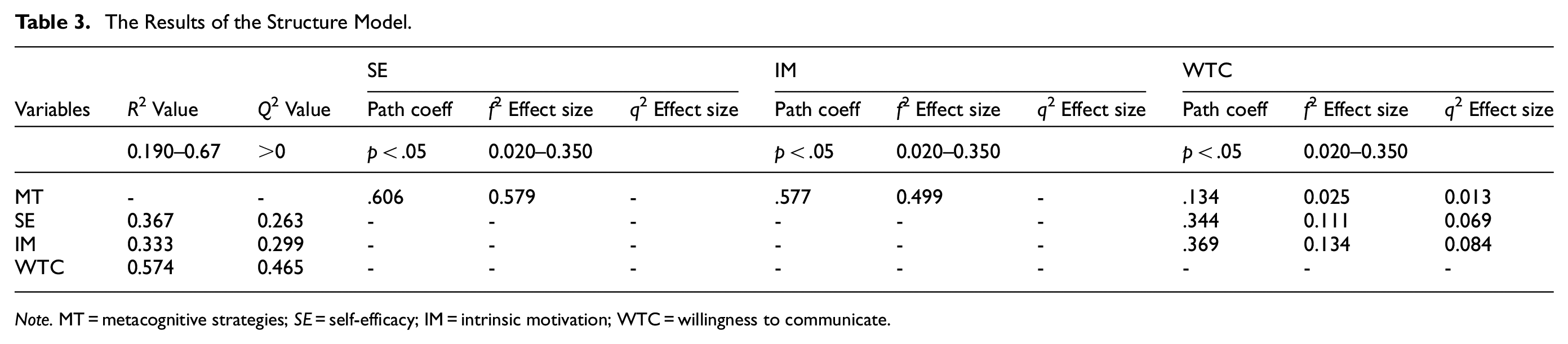
Upon the satisfactory validation of the measurement models, the study progressed to analyze the structural model. Utilizing the coefficient of determination (R2), this evaluation aimed to ascertain the collective influence of exogenous variables on specified endogenous variables. Values range from 0 to 1, with higher figures indicative of a model’s enhanced explanatory power. As delineated in Table 3, the R2 values for self-efficacy (.367), intrinsic motivation (.333), and WTC (.574) were deemed moderate, suggesting a substantial explanation of variance within these constructs.
The Results of the Structure Model.
Note. MT = metacognitive strategies; SE = self-efficacy; IM = intrinsic motivation; WTC = willingness to communicate.
Further, the effect size (f2) was estimated to measure the impact of removing a specific exogenous variable on the R2 value of an endogenous variable. Metacognitive strategies had a large effect on self-efficacy (f2 = 0.579) and intrinsic motivation (f2 = 0.499), while its effect on willingness to communicate (f2 = 0.025) was low. Additionally, the effect size of intrinsic motivation on WTC (f2 = 0.134) and self-efficacy on WTC (f2 = 0.111) were both low. The predictive relevance of the model was assessed through Q2 values, indicating medium predictive relevance for self-efficacy (0.263), intrinsic motivation (0.299), and WTC (0.465). The small effect sizes of metacognitive strategies, self-efficacy, and intrinsic motivation on WTC, as represented by Q2 values (q2 = 0.013; q2 = 0.069; q2 = 0.084), further corroborate these findings (Hair et al., 2021).
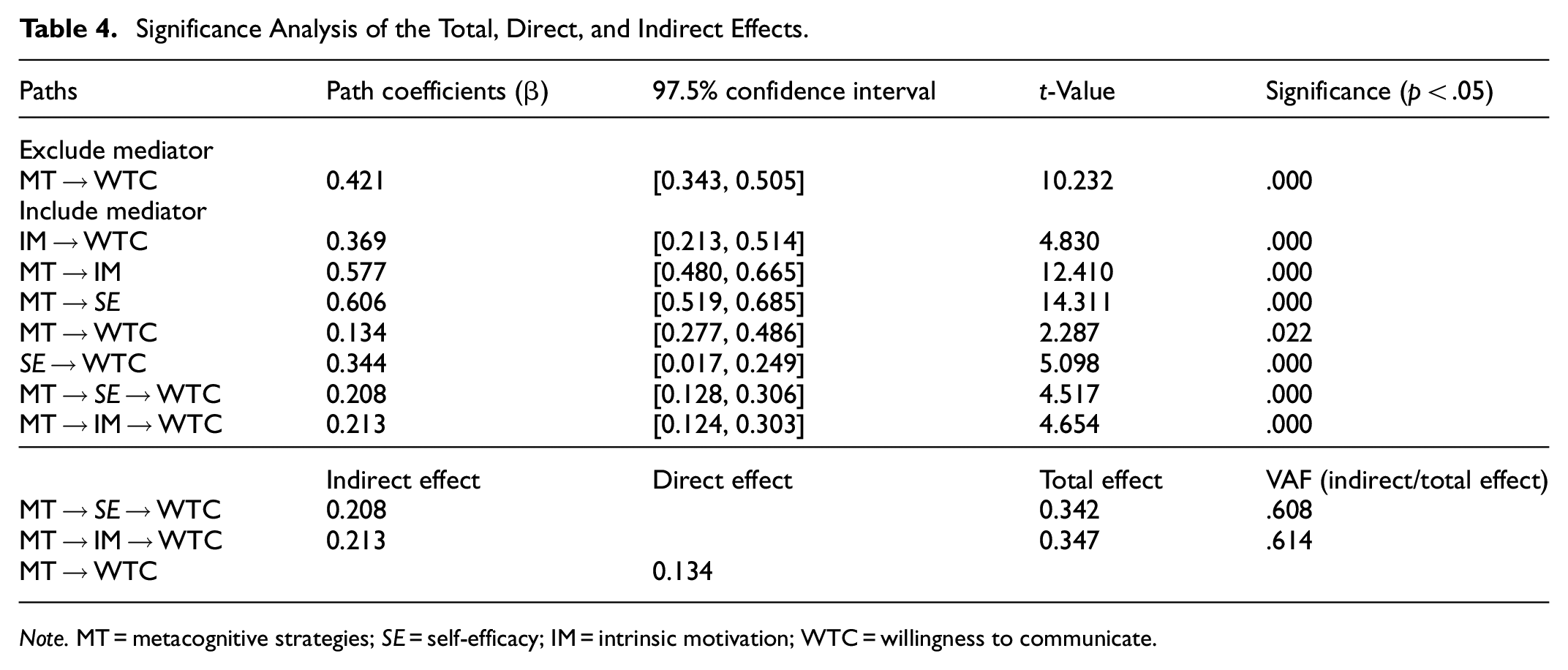
Bootstrap procedures were employed to determine the significance of the path coefficients, offering the advantage of not necessitating normality assumptions for the sample distribution. Path coefficients were deemed significant if zero did not lie within the 97.5% confidence intervals (CIs) or if the critical t-value exceeded 1.96 for a two-tailed test, indicating significance at p < .05. As illustrated in Table 4 and Figure 1, both the direct and indirect effects of metacognitive strategies on willingness to communicate, mediated by self-efficacy and intrinsic motivation, were significant (β = .208, p < .05; β = .213, p < .05), with a significant direct effect of 0.134. This supports Hypotheses 1, 2, 3, and 4.
Significance Analysis of the Total, Direct, and Indirect Effects.
Note. MT = metacognitive strategies; SE = self-efficacy; IM = intrinsic motivation; WTC = willingness to communicate.

Structural of the model.
The mediation strength was quantified using the Variance Accounted for (VAF) metric, dividing the indirect effect by the total effect. The VAF values were 0.608 and 0.614, respectively, indicating that 60.8% and 61.4% of the influence of metacognitive strategies upon WTC were mediated through self-efficacy and intrinsic motivation. Given that the VAF values are within the 20% to 80% range, this mediation is partial, with self-efficacy and intrinsic motivation as complementary mediators (Hair et al., 2021).
Discussion
Our research sought to determine the correlation between metacognitive strategies, self-efficacy, intrinsic motivation, and their joint effect on L2 WTC. The results showed that: (a) metacognitive strategies have a direct positive impact on WTC, as does self-efficacy and intrinsic motivation; (b) self-efficacy, as well as intrinsic motivation, directly enhances WTC; and (c) the relationship between metacognitive strategies and WTC is mediated by both self-efficacy and intrinsic motivation.
The Direct Influence of Metacognitive Strategies on L2 Willingness to Communicate
The findings of this study exhibit a significant positive relationship between metacognitive strategies and the WTC in L2, thus this result supports our H1. A correlation is found between this association and self-efficacy and intrinsic motivation, although it is theorized that strategic learning interventions are effective means of promoting language acquisition and communicative competencies. Similarly, supporting Farzam’s (2017) findings, our study demonstrates the importance of cognitive and metacognitive strategy training for boosting WTC in learners of English.
Furthermore, metacognitive strategies show a significant positive correlation with L2 WTC, thus echoing previous academic contributions (Karbakhsh & Ahmadi Safa, 2020; Pun et al., 2023). These research findings indicated that metacognitive strategies can assist L2 learners in identifying and regulating their learning goals, thereby enhancing their ability to design learning tasks effectively. Meanwhile, metacognitive strategies have an indirect positive correlation with L2 WTC, consistent with recent research (Salehi & Nosratinia, 2022; Wang et al., 2023) that indicated metacognitive strategies might indirectly influence WTC through self-efficacy and intrinsic motivation. It can be seen that metacognitive strategies directly influence university students’ WTC in an L2.
The findings of this study are consistent with the views of Syed and Kuzborska’s (2020), indicating that L2 WTC is affected by motivational factors, learning strategies, and communication skills. Our research findings have confirmed a significant positive connection between the use of metacognitive strategies and L2 WTC, attributed to several potential influencing mechanisms. Specifically, metacognitive strategies enhance learners’ awareness of their cognitive processes, enabling them to identify their strengths and deficiencies (Stanton et al., 2021). Self-awareness is crucial for developing self-efficacy, since learners who understand their abilities are more inclined to engage in communication (Ma, 2022). It highlights the importance of intrinsic motivation in improving WTC in an L2; however, intrinsic motivation may be affected by factors such as metacognitive strategies. It is evident that the use of metacognitive strategies has a direct impact on the language learning process.
Direct Effect of Intrinsic Motivation on L2 Willingness to Communicate
The study identified a direct and positive correlation between intrinsic motivation and WTC in L2 learning, which is consistent with previous research and serves as further validation of existing studies (Joe et al., 2017; Ryan & Deci, 2017). This result supports hypothesis 2. It is worth noting that Fekete’s (2024) research showed a negative correlation between anxiety and intrinsic motivation and WTC. Although some studies identified a beneficial effect of motivation on reading comprehension, research on the nexus among WTC, perceived competence, and comprehension remains sparse (Ahmadi, 2017; Peng, 2022). The study by Salehpour and Roohani (2020) stands out for establishing a significant link between motivation and communicative abilities. The importance of a supportive learning atmosphere, characterized by teacher warmth, care, and respect, is underscored in mitigating psychological stress and enhancing intrinsic motivation toward language learning (Ryan & Deci, 2017). Furthermore, a steadfast commitment to language learning, reflecting resilience, significantly reduces feelings of fatigue and inadequacy.
Regarding Chinese university students learning an L2, the mechanisms influencing students’ intrinsic motivation are also very important. Research indicates that cultural factors emphasizing the significance of language learning performance may enhance the effectiveness of these strategies in improving learners’ communicative competence. Additionally, it is important to analyze how teaching methods and peer collaboration affect learners’ motivation, which is related to learners’ enjoyment of the language learning process (Soulaf & Khoula, 2023). However, research specifically addressing the impact of intrinsic motivation on L2 communication skills is notably scarce, representing a fertile area for future inquiry.
Direct Effect of Self-Efficacy on L2 Willingness to Communicate
The findings of our study indicate that self-efficacy has a positive and direct impact on WTC in L2 learning, hence supporting hypothesis 3. This result highlighted the crucial role that self-efficacy in promoting language acquisition with both standardized and localized proficiency criteria. These results are consistent with previous studies on the association between self-efficacy and WTC (Amirian et al., 2020; X. Zhang et al., 2020). Fostering self-efficacy among L2 students is beneficial for enhancing the enjoyment of language learning. The finding provides new insights into addressing communication issues in L2 learning. However, It’s worth noting that self-efficacy was found to have a stronger impact on CET-6 performance than on final examination results (Cai & Zhao, 2023), suggesting that evaluation modalities are more intrinsic than extrinsic. Further in-depth research is needed to fully understand the subjectivity of self-efficacy assessment and the objective standards of formal examinations (Sun & Wang, 2020; Wang et al., 2023). However, there are still some differences in the research on language communication abilities and discipline-specific self-efficacy (Sung, 2022). The reason for this variation lies in the fact that self-efficacy refers to an individuals’ belief in their capacity to succeed in specific tasks, while language communicative competence involves an individuals’ ability to utilize language for communication. Although both are related to an individuals’ cognitive and behavioral performance, their research focuses and applications differ significantly.
The Mediating Effect of Intrinsic Motivation
This study states the mediating effect of intrinsic motivation in the relationship between using metacognitive strategies and the WTC in an L2, which supports hypothesis 4. This is consistent with previous research results (Elahi Shirvan et al., 2019; Munchen et al., 2021). It fully demonstrates that learners’ strong motivation is key to language proficiency, and metacognitive processes are a primary condition for enhancing intrinsic motivation. Metacognitive strategies can improve learners’ reflective abilities regarding their learning process through goal setting, self-regulation, and evaluation. As students develop confidence in their ability to manage their learning effectively, this reflecting ability can significantly enhance their intrinsic motivation. Meanwhile, metacognitive strategies enhance learners’ autonomy, which is an essential component of intrinsic motivation. Through effectively managing their learning processes, students are more inclined to experience personal satisfaction in L2 learning, thereby increasing their WTC in the target language. Studies indicate that learners who utilize metacognitive strategies generally exhibit higher intrinsic motivation (M. F. Teng et al., 2023). This study examines the impact of metacognitive strategies on WTC within the framework of English language acquisition in China. The findings further confirm that proficiency in these strategies enhances students’ motivation and enthusiasm for learning English, consequently improving their communication competence. Moreover, intrinsic motivation in learning is a crucial factor that engages learners in language learning by stimulating their interest and engagement. It is also a factor influencing the emotional aspects of L2 learners. Furthermore, intrinsic motivation affects the use of metacognitive strategies through several pathways, hence strengthening the expression of WTC. It can be seen as a mediating component between these two factors. The interaction of these factors promotes the effectiveness of both learning and communication. Improvement in teaching strategies for students learning English as a foreign language (EFL) might be made as a result of the finding that metacognitive strategies can increase one’s desire to communicate through developing intrinsic motivation.
The Mediating Role of Self-Efficacy
This study determined that self-efficacy mediates the relationship between metacognitive strategies and the WTC in an L2 and it supports hypothesis 5. This finding provides further evidence for the association among metacognitive strategies, self-efficacy, and L2 WTC as proposed by self-efficacy theory (Bandura, 1986). The study of the relationship among these three variables will provide university English teachers with reasonable teaching recommendations.
Extant research robustly documents the diverse origins of self-efficacy, accentuating the paramount importance of mastery experiences, as delineated by Bandura (1986). Within the context of L2 acquisition, mastery experiences typically encapsulate the successful attainment and command over both linguistic and cognitive skills (Graham, 2022). Nonetheless, it is imperative to note the scholarly tendency to prioritize linguistic proficiency as the cornerstone of self-efficacy, marginally sidelining cognitive prowess. This orientation presents a subtle discord with prevailing language assessment theories, which esteem metacognitive strategies as integral to comprehensive language proficiency. Accordingly, it becomes essential to recognize the dual influence of linguistic and cognitive proficiencies in forging self-efficacy within language education (Bachman & Adrian, 2022). The elucidated connection between metacognitive strategies and self-efficacy underscores what is needed to acknowledge metacognitive strategies to be a fundamental aspect of expertise. The correlation between metacognitive strategies and self-efficacy is mutually influential (M. F. Teng et al., 2023). When learners effectively apply metacognitive strategies, their confidence in their language abilities increase, thereby enhancing their WTC. For instance, research has found that training in metacognitive strategies significantly improve language learners’ self-efficacy, which in turn enhances their motivation to participate in communication. These findings highlight the importance of integrating metacognitive strategy instruction into language education to cultivate more engaged and confident learners.
Furthermore, concerning a mediating role of self-efficacy in relation to metacognitive strategies and the inclination to engage in L2 communication, prior discussions have established that self-efficacy influences metacognitive strategies use (Hayat & Shateri, 2019). Our findings propose that metacognitive strategies tend to exert a more direct impact on the willingness to communicate when learners exhibit elevated levels of learning self-efficacy. Conversely, within the L2 educational milieu, the efficacy of metacognitive strategies upon learning performance was probably conditioned by self-efficacy. The insights affirm a critical mediating effect for self-efficacy within the dynamic concerning the correlation between metacognitive strategies and L2 learning performance.
Conclusion
This research embarked on an exploratory journey to delineate the relationships among metacognitive strategies, self-efficacy, intrinsic motivation, and L2 willingness to communicate, paying particular attention to the intermediary roles played by self-efficacy and intrinsic motivation. The findings elucidate that: (a) metacognitive strategies, self-efficacy, and intrinsic motivation collectively had predictive effects on L2 willingness to communicate; (b) self-efficacy functions as a mediator between metacognitive strategies and L2 willingness to communicate; (c) intrinsic motivation similarly mediates the association between metacognitive strategies and L2 willingness to communicate; and (d) while self-efficacy and intrinsic motivation emerge as robust predictors of L2 willingness to communicate, metacognitive strategies exhibit a comparatively subdued influence. In essence, metacognitive strategies, self-efficacy, and intrinsic motivation each significantly contribute to predicting L2 willingness to communicate, albeit with varying pathways and degrees of influence.
Implications and Limitations
Theoretically, this investigation contributes to the sparse literature integrating metacognitive strategies, self-efficacy, intrinsic motivation, and L2 willingness to communicate, examining the mediation effects within this dynamic. The elucidation of self-efficacy’s mediating role enriches our understanding of metacognitive strategies and self-efficacy theory feedback (Bandura, 1986), and provides insights into the mechanisms of intrinsic and extrinsic motivation as outlined in self-determination theory, thereby offering pathways for L2 learners to enhance their academic outcomes (Akteruzzaman et al., 2023). Pedagogically, this study underscores the significance of addressing psychological barriers to L2 communication willingness through teacher guidance, student self-regulation, and cognitive strategy optimization. Particularly in the context of Chinese language education, where a prevalent test-oriented approach overlooks communicative competencies, this study identifies a crucial psychological impediment to communication. Despite the low frequency of L2 usage for daily communication among students and a notable communication apprehension, coupled with a deficient L2 learning and communicative environment, the positive predictive roles of metacognitive strategies, intrinsic motivation, and self-efficacy on willingness to communicate highlight important directions for enhancing L2 learners’ educational effectiveness.
The current study has several limitations that warrant consideration. First and foremost, the study’s cross-sectional design limits our capacity to infer causality or the directionality of the established relationships. Specifically, the proposed causal linkages between metacognitive strategies and self-efficacy with L2 willingness to communicate, as well as between metacognitive strategies and intrinsic motivation with L2 willingness to communicate, require further empirical validation. Utilizing either interventional or longitudinal research frameworks would prove pivotal in clarifying the causal relationships discussed. Furthermore, the reliance of this study on self-reporting tools to measure participants’ metacognitive awareness and behaviors introduces a significant limitation. While such surveys provide insightful perspectives into the learners’ self-perceived strategy usage, they fall short of capturing the full spectrum of metacognitive processes and actions, which may result in data biases and inaccuracies. To overcome this challenge and strengthen the validity of future research, the adoption of a methodological triangulation approach is recommended. This approach, which combines quantitative measurements with qualitative explorations, aims to cultivate a more detailed and comprehensive understanding of metacognition among learners, thereby enriching our insights into the factors that drive the successful acquisition of an L2.
Footnotes
Acknowledgements
We would like to thank the anonymous reviewers for their very useful comments on an earlier version of this paper.

Ethical Considerations
Research involving human participants was reviewed and approved by the Ethics Committee of the Faculty of Educational Psychology at Chengdu Normal University (Reference number: CDNU2023[12]).
Funding
The author(s) received no financial support for the research, authorship, and/or publication of this article.
Declaration of Conflicting Interests
The author(s) declared no potential conflicts of interest with respect to the research, authorship, and/or publication of this article.
Data Availability Statement
Data sharing not applicable to this article as no datasets were generated or analyzed during the current study.