




Abstract
The sustainability of cultural heritage resources is strongly linked to the effective participation of local communities in the conservation and management of these resources. This forms the basis for undertaken this project in the selected communities in Ondo and Ekiti State of Yoruba ethnic groups of South Western Nigeria. Multiple research methods were employed for this study including Key Informants Interview and administration of structured questionnaire to the purposively selected respondents. A sample of 768 respondents was selected from the total population of 895,406 using sample determination method. The selection of respondents was based on their proximity to the resources, their local knowledge, communal ownership, disposition and willingness to participate in the study. The data collected was rated on a 5 point Likert scale and then subjected to the weighted mean analysis. Spearman correlation and linear regression were used to test hypotheses in order to established relationships between sociodemographic characteristics and level of community participation. Output from this research, emphasizes the need to improve the state of heritage properties through effective conservation and sustainable management practices and increasing community involvement and participation. This will serve as a blueprint and developmental framework for policymakers in heritage resources conservation and management with the intention of linking these resources to increase direct economic benefits to local communities.
Introduction
Heritage has been largely reflected as a legacy, a symbol and representation from the past generations handed over to the present with the hope of passing it across to the future generations (Nilson & Thorell, 2018). It is an epitome of accomplishments and a valuable asset of happenings in the past that are documented and retained for the benefits of the present and future generations (Oladeji & Akinrinola, 2010; Scheld et al., 2014) and possessed both tangible and intangible attributes (Lenzerini, 2011). Cultural heritage is considered as means of communication between the historical and present generations in a particular community (ICOMOS, 2002; Nilson & Thorell, 2018).
Some researchers perceived that cultural heritage resources have been fashioned by certain communities to reflect the connectivity and interaction that exist between nature and the human environment, packaged in such a way that this could be handed over to the next generation with little or no alteration (George, 2010), while others perceived that cultural heritage resources are historic (Ezenagu, 2020), possessed economic, cultural, political, or social values (Khakzad, 2015) and they could serve as the catalyst for networking, sporting activity (Oladeji, 2021), cultural economy (Rodzi et al., 2013), and capacity creation’ (Sacco et al., 2013) and stock of assets for sustainable development across the city, region, and institutions (OECD, 2001). Similarly, cultural heritage is an important component of communities, groups, and individuals and it is the roots of development (United Nations Educational Scientific and Cultural Organization [UNESCO], 2003) that is very difficult to be disconnected from their identity in according to the principles of intergenerational and intragenerational equity.
Keitumetse (2013), noted that protection of cultural heritage resources can be achieved at the community level if people have a better understanding of their importance. This has brought the idea of social benefits or the importance of heritage resources as expressed by Dümcke and Gnedovsky (2013). These authors reviewed ample literature on the values of cultural heritage (Augusto & Associados, 2010; Dumcke & Gnedovsky, 2013; Ecorys, 2012; Thinks, 2013) and observed that in recent years the its social and economic value has been extensively under review by both different research disciplines and by different interests of international, national, and regional actors. It is against the background that the roles of cultural heritage in research economy was emphasized. Ripp (2011) earlier suggested that there is a need for revitalization to safeguard cultural heritage in historic urban areas based on their contributions to economic growth through spawning of local businesses, job creation, improved location quality and image, enhanced infrastructural development and booming creative industry enterprising. Community involvement in heritage conservation represents how groups of people are organized and interact in a given neighborhood (Crooke, 2007; Tam, 2010). In this context, the connections that people have, which are based on shared culture, history, experiences, and emotions as part of their heritage are contributory factors to the development of that locality as observed across the world (Baycan & Girard, 2011).
Action or techniques adopted to identify and incorporate stakeholders to take part in the process and influence project outcomes are regarded as participation (Bishop & Davis, 2002). Participation creates channels and offers the opportunity for people to interact, analyze and assess issues based on their subjective opinions most importantly if their social comfort is going to be affected in one form or their other (Chan, 2016). This action can be practiced in different forms, including public meetings, surveys, and open houses.
Community participation in heritage management has become a worldwide phenomenon in the last two decades, it is a bottom-up approach that has spread across the practices of heritage conservation (Ronchi, 2020; Yung & Chan, 2011). The paradigm shift in heritage conservation from place-based conservation to more people-centered conservation (i.e., from conservation of only tangible heritage to intangible cultural heritage that depicts the people) has contributed largely to this notion. United Nations Educational and Scientific Organization (UNESCO) has always been at fore front advocating for the bottom-top approach in heritage practice rather than top-down interventions by governments or specialist heritage industry (UNESCO, 2015) locally-led active participation entrenched in social connotation is a prevailing feature of the 21st century democratized cultural heritage practice (Chitty, 2017). Experience from many countries has established the assertion that cultural and social sustainability in heritage management can be achieved through the adoption of a bottom-top approach and not the other way around ( Giliberto & Labadi, 2022; Labadi, 2016; Mensah, 2019). This is simply because of the composition of locally-led active participation in heritage conservation. It is a model structure in such a way that the local communities are not disfranchised in expressing their opinions and taking decisions on issues of utmost concern to their sustenance and well-being (Chan, 2016).
Community participation in heritage management and conservation helps the communities to strengthen their intellectual capacity intricate link to communal heritage physiognomies, fostered social cohesion, inclusion, bonds, trust and linkage between the government (at the top) and other categories of people at the grassroots level (at the bottom) (Cimadomo, 2015; Labadi, 2016). Active participation of the community in heritage helps the continuity and sustenance of heritage resources (Huong, 2016; Van Empel, 2007).
Literature Review
Most researchers, academic, practitioners and relevant organizations have revealed useful information on the roles of local communities in the conservation and management of cultural heritage resources (Council of Europe, 2005; Gantait et al., 2019; ICOMOS, 1999; UNESCO, 2005; Zancheti, 2009). This information is documented and make available to the public in the form of memorandum for example, Vienna Memorandum on Management Plans for historic urban landscapes (UNESCO, 2005); recommendation for example, UNESCO recommendation on Historic Urban Landscape (UNESCO, 2011) and/or published articles in Conference proceedings or journals. In an unambiguous way, community engagement is a tool for education, empowerment, visioning, and consensus-building has been emphasized judging from the significance of age, gender, education, and religion of the local communities.
These have amplified understanding of the roles of heritage resources in the development of community and nation, in general, as the passive guardian of the past (Baycan & Girard, 2011). The authors stressed that in recent times, traditional conservation approaches have brought much-needed changes in economic and social arenas and spatial implications on the significance of heritage resources. Some of the factors identified as a possible shift in paradigm in heritage resources conservation are associated with increased knowledge on economic values of conservation of these resources (Ezenagu & Iwuagwu, 2016; Oladeji & Agbelusi, 2018,). Another contributory factor, is based on the recognition placed on culture and creative industries as being projected at the United Nations Conference on Trade and Development (UNCTAD, 2006). This conference brought together ministers in trade and development with a call on the developed countries to assist the developing nations through fostering, protecting, and promoting creative industries as the emerging and most dynamic sectors in world trade. This call is beginning to yield desire results as the positive economic impact of the arts and crafts industry has been felt in countries like the state of West Virginia, the USA (Price et al., 2008), and Nigeria (Oladeji & Adetola, 2019). Another factor that has been identified as a basis for recognition of heritage resources conservation is the rate at which cultural production has brought much-needed radical changes in the patterns of cultural consumption where cities have been transformed from functioning production to consumption that is offering big opportunities for local and regional development. One of the consumption processes is through cultural heritage tourism that provides opportunities to showcase and promote the consumption of products that are directly associated with cultural lifestyles, traditional rites, festivities, and other traditional related activities (Baycan & Girard, 2011; Ezenagu, 2020; Oladipo & Modupe, 2020; Rodzi et al., 2013).
All these aforementioned opportunities may not come into reality except people especially those that are the custodian of these resources are integrated into the conservation and management agenda right from the conception of the idea, toward planning and execution of the project. The dearth of community involvement in heritage conservation schemes has denied the people sustainable local economic benefits and other business opportunities that could serve as catalysts for development (Ronchi, 2020). There is no gain saying that conservation cultural heritage resources both tangible and intangible (UNESCO, 2011) serves as territorial capital or stock of assets for sustainable development (OECD, 2001). Conservation of heritage resources can only spur sustainable development where necessary strategies mobilized through a collective and coordinated action taken by local actors.
According to the World Bank, participation is regarded as a developmental process and a rich concept that means different things to different people in a different setting depending on the stakeholders influence (World Bank, 1996). For some, it is a matter- of principle: for others. a practice: and for still others, an end in itself. Notwithstanding, no matter the one chosen by the researcher, each one of them has merit. Further, a review of literature on this concept revealed that the three categories of community participation in heritage management include coercive, induced, and spontaneous participation relegate (Marzuki et al., 2012; Tosun, 2006). Among the three, spontaneous participation is expressed as the power of the citizen (Arnstein, 1969) to mobilize, make decisions control process of development thus it is considered as the highest level of participation. This explains the reason for given local community participation much needed international recognition as a principle in sustainable development in cultural heritage resources management (Keitumetse, 2011; UNESCO, 2003).
In the Africa context, application of participatory management in studies on cultural heritage conservation has recorded varied success depending on the context in which it has been viewed and applied (Keitumetse, 2016). Lack of understanding on the mode of application explains the reason why most of the goals, particularly those aimed at involving local communities in decision-making in heritage resources, remain unfulfilled (Chirikure & Pwiti, 2008).
Problem Statement
Cultural heritage resources are perceived as major components of the community’s survival and religious practices in terms of worship and spiritualism in Africa. The contributions of the rich diversity of African heritage to World Heritage have been recognized to be a unique wealth of immeasurable value (Adedayo, 2006). Nigeria is a multi-ethnic and multi-linguistic state in Africa (Olanrewaju et al., 2017) with unique ways of life that is being showcased through the display of unique heritage resources. This is evidence by the myriad of culture and natural resources the country is endowed (Adediran, 2008; Ezenagu, 2015, 2020). Many of these heritage resources have marveled the world with their uniqueness for centuries (Ezenagu & Olatunji, 2014b).
The country has to grapple with a multiplicity of problems and constraints in her attempt at cultural transformation particularly concerning the proper management of her abundant cultural heritage resources (Eluyemi, 2002; Ola & Adegbore, 2015). Some of these challenges as listed by these authors include the influence of modernization, civilization, commerce, change, funding, looting, and antiquarians, religious dogmatism and iconoclasm among others. In addition to these, Ekundayo (2015), observed that lack of knowledge on the values and importance of heritage resources is also a problem. The majority of the populace is uninterested in issues that have to do with the culture and this constitute a serious challenge to heritage resources conservation due to little or no input from the local communities that are custodians of these resources (Grimwade & Carter, 2000; Hodges & Watson, 2000). This supports the view of Smith et al. (2003) that difficulties are being encountered in the identification, understanding, and protection of heritage resources. Funding conservation projects is considered a limitation especially when reliance is on inter-institutional partnership and public funding especially where there are demographics, political, cultural and economic differences (Gustaffson, 2009; Mensah, 2016).
Justification for the Study
The idea of strategic resources through mobilization of territorial capital taken by the locals is consistent with the mission of UNESCO as stressed at a conference held on African World Heritage in Tanzania (UNESCO, 2016). In furtherance of the outcome of the conference held in Tanzania, a collaborative conference was held with the International Centre for the Study of the Preservation and Restoration of Cultural Property (ICCROM), The International Council on Monuments and Sites (ICOMOS), African World Heritage Fund (AWHF) and Environmental Protection Agency (EPA) with the aim of improving the state of conservation World Heritage properties in Africa through effective management strategies and community engagement (UNESCO, 2017). One other issue in the development and conservation of cultural heritage resources that have drawn global attention is the legal framework to ensure local community participation. An important aspect of the legal framework is hinged on the United Nations (UN) declaration on human rights that are centered on the indigenous communities concerning the legislation, execution and regulation at the global, regional and most especially at the local levels by the designated authorities in accordance to formalities traditional management system (UNESCO, 2011, 2017). An effective legal framework can only be achieved when there is proper documentation of traditional conservation and management practices at the community level.
Despite the call at Lausanne Charter in 1990 for active involvement of the community in economic development; Budapest Declaration in 2002 (UNESCO, 2002) and the resolution taken at the Intangible Heritage Convention in 2003 that community should involve in identification and safeguarding heritage sites and the need to synergies efforts between relevant stakeholders in managing heritage resources, it is intriguing to note that the dearth of information on the community involvement in conservation and management of heritage resources as reported in the literature (Grimwade & Carter, 2000; UNESCO, 2005) has necessitated this study. There are indications that most of the goals, particularly those aimed at involving local communities in decision making in heritage resources are still omitted (Chirikure & Pwiti, 2008).
While studies on conservation and management of heritage resources have focused on Europe (Catsadorakis, 2007); and around African countries like Kenya (Bunu et al., 2020), Zimbabwe, Egypt (Hassan et al., 2008) and South Africa, the rich cultural heritage resources of Yoruba speaking of South Western Nigeria are yet to be fully explored. Available literature in Nigeria has been skewed to the conservation of heritage sites like Osun Osogbo Sacred grove (Adedayo, 2004, 2006; Adediran, 2008; Adeniran & Akinlabi, 2011), Badagry Slave trade relics (Oladeji & Olatuyi, 2020) and Idanre Cultural Landscape (Oladeji, 2021). There is therefore a need to explore the involvement of the communities in the conservation and management of both the tangible and intangible heritage resources in selected states among the Yoruba ethnic region of Nigeria.
Aim
Intention to undertake in-depth research on the perception of people toward heritage resources conservation is considered as an approach toward achieving sustainability. This is hinged on the premise that positive perception as deduced from the residents is a clear affirmation of successful conservation of the heritage resources for a long period of time (Chirikure & Pwiti, 2008), in tandem with the view of Adeniran and Akinlabi (2011) on the success of sustainable heritage resource conservation. The authors further explained that heritage resources are better managed and conserved if the locals used and respect these resources. Also, a recent study by Lim et al. (2014), in George Town world heritage city stressed the efficacy of this assertion on the sustainability of heritage resources. The involvement of locals—in the planning and development of heritage projects is a bottom-top approach based on insights into the specific community and the context in which values exist (Pace, 2018). Adam (2012) elucidate on the basis for the dispensation of the Kenyan constitution in 2010, which was aimed at integrating and involving the local communities at the grass root levels to be part of leaders that are managing and conserving cultural heritage resources The insights into the specific community and the context make them relevant in contributing to the formulation of long-term efforts that are specifically adapted to local conditions and needs. This is reported to be yielding positive result although not substantial as expected as reported by recent study by Bunu et al. (2020). This assertion has necessitated the focus of this study on Ekiti and Ondo State of South Western Nigeria hinged on the premise that there is a need to properly assess conservation and management practices of heritage resources in the selected communities across social-demographic lines and perceived values of the respondents that belong to the custodian and end-users group. The hypotheses are formulated to establish relationship between the socio-demographic characteristics of the respondents and the level of community participation; and relationship between community participation in the management of the heritage resources and perceived values attached to these resources. This research study will provide an understanding of community participation in heritage conservation and management practices, funding and other influencing factors to such schemes across a demographic and the cultural, political and economic setting in specific communities of Ekiti and Ondo State of South Western Nigeria. This is considered as a channel for achieving sustainable local development and formulation of long-term efforts that are specifically adapted to local conditions and needs.
Objectives
Intended idea was achieved through set objectives targeted toward assessing the understanding of host community participation in the conservation and management of heritage resources, evaluate social-demographic characteristics of the respondents, their perceived values of heritage resources in terms of their significance to the communities, motivating factors, conservation and management strategies in the study area.
Study Area
This study was conducted in selected communities in Ondo and Ekiti State of South Western Nigeria. Yoruba is the major ethnic group in South Western Nigeria with another minor ethnic groups like the Owos, Akokos, Ilajes, Egbas e.t.c. Akure and Ado-Ekiti are the capitals of Ondo and Ekiti State respectively. Ekiti State is regarded as a culturally homogenous community where all the people speak the same dialect in connotation with the name of the State. This culturally homogenous nature is reflected in language, food, dressing, festival, celebration and their ways of life. The selected communities in Ekiti State are Ipole and Erinjiyan; Ewu and Ayetoro and Afao and Agbado were selected in Ekiti State (Figure 1). Given the homogeneity of Ekiti State and the proximity of the communities to notable tourist attractions, a multi-stage sampling was used to arrive at an accurate number of respondents selected for this study. In the first stage, Ekiti State was divided into three senatorial districts (Ekiti South, Ekiti Central, and Ekiti North). In the second stage, identification of ecotourism attractions in the senatorial district was carried out and on this basic, notable ecotourism attractions were purposively selected such as Ekiti South (Olosunta Hill), Ekiti Central (Arinta waterfall), and Ekiti North (Ewu Natural Lake). In the third stage, adjourning communities to the attractions were purposely selected these are Ekiti Central (Ipole Ekiti and Erinjiyan), Ekiti North (Ewu and Ayetoro), and Ekiti South (Afao and Agbado). As part of the secondary data collected from Ekiti State Ministry of Tourism, Art and Culture/Ekiti State Bureau of Statistics, it was recorded that Ekiti State has a total of 2,384, 212 people after the 2006 population and housing census exercise (National Population Commission [NPS], 2006). Out of this number, Ekiti South Senatorial districts represent 808,199, Ekiti central 933,680, Ekiti North 657,078 (Table 1). These figures were projected for the selected communities in each Senatorial district and the samples were determined (Figure 1). Likewise, secondary data collected from the Ondo State Ministry of tourism/Ondo State Bureau of Statistics revealed that the total population of Ile-Oluji/Oke-Igbo and Owo is 171,876 and 222,262 (NPS, 2006). These figures were projected to 232,000 and 300,000 respectively. The last population census was undertaken in Nigeria in 2006, thus all the figures obtained were projected to the year 2018 for the study using the population growth (annual %) of 2.5648% as reported by the World Bank historical data (World Bank, 2018).
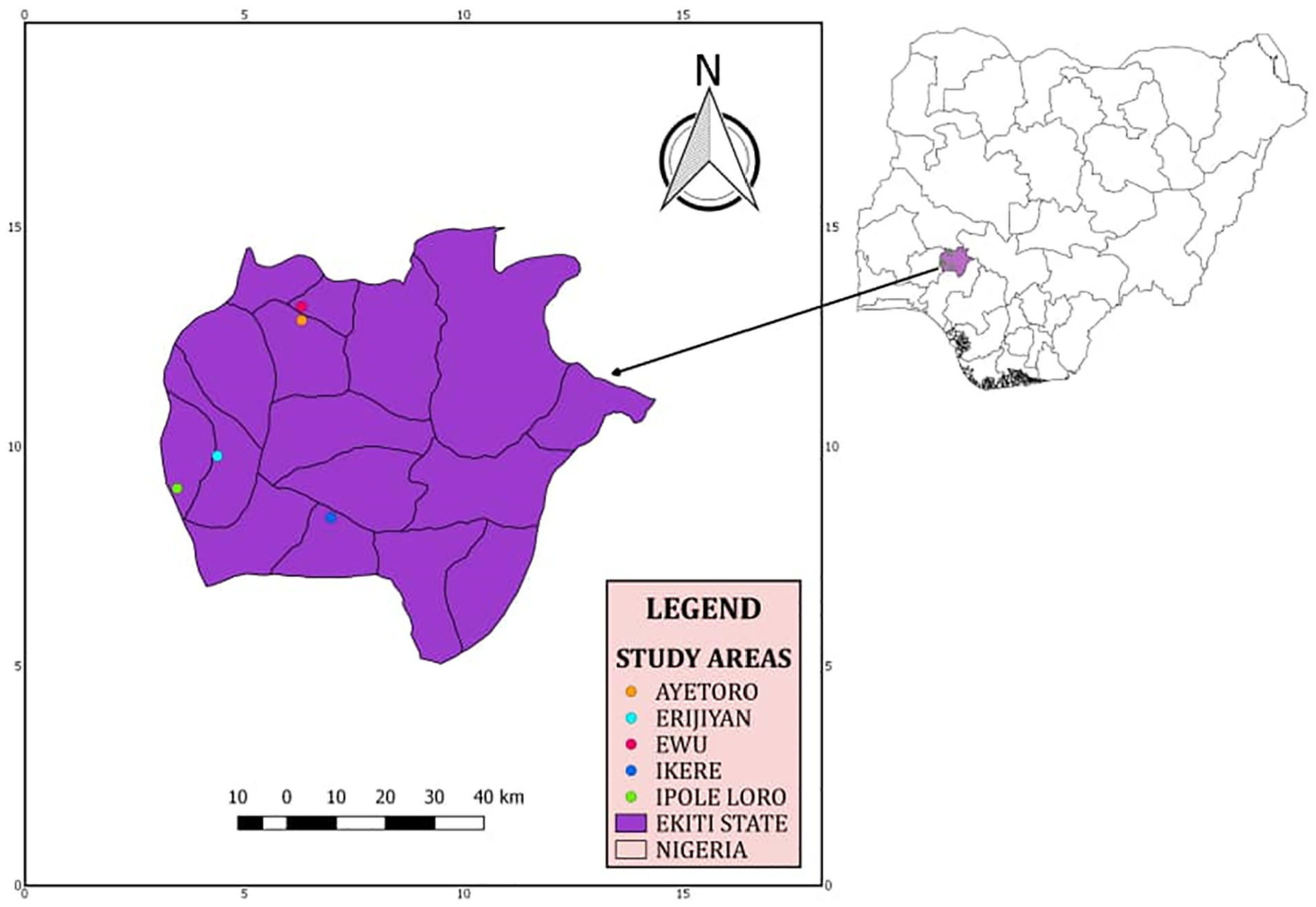
Map of Ekiti State showing the study areas.
Population Figure for the Local Government Area in Ekiti State.
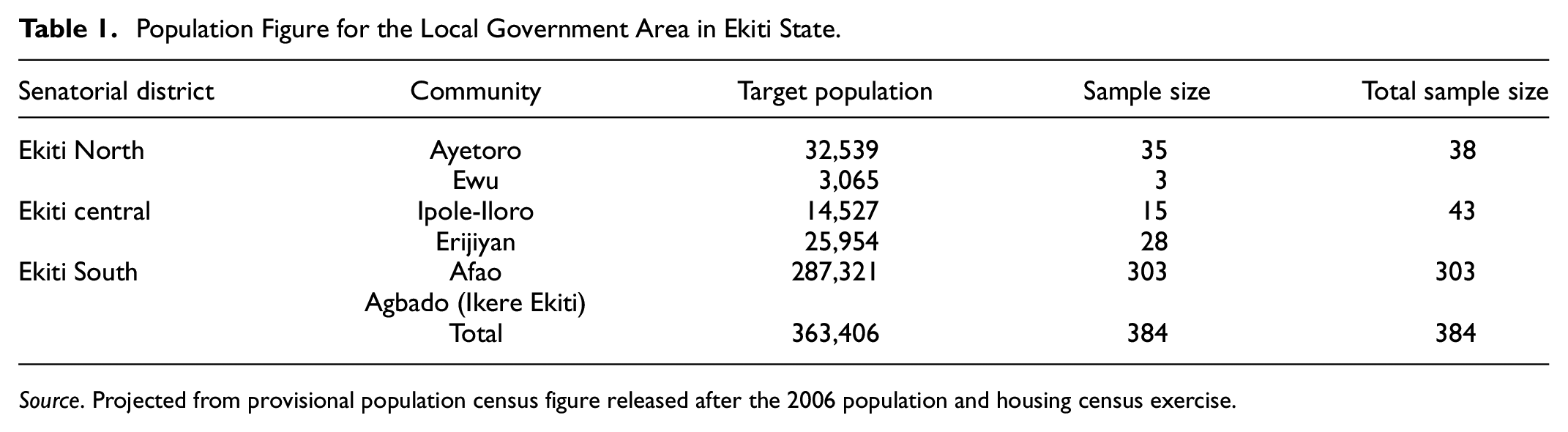
Source. Projected from provisional population census figure released after the 2006 population and housing census exercise.
The samples for the study were determined using Krejcie and Morgan (1970) method (Table 2). Owo is one of the largest indigenous towns in the present Ondo State of Nigeria (Figure 2) with a population of 276,574 people according to NPS (2006). The people of Owo were brought under the influence of the Benin kingdom by the end of the mid-15th century, introducing certain similarities with the people of Benin in their lifestyle. Apart from the proximity of Owo town to Benin City, the people of Owo shared similar cultural attributes personified in language, royal regalia, architectural design, festivals, and titles of their chiefs and naming of notable places (Aseniserare & Ononeme, 2015). Ile-Oluji is among the popular, prominent towns and one of the Local Government Councils in the Ondo State of Nigeria (Figure 3). Ile-Oluji is bounded on the South, Southwest, Northeast, East, and Western part by hills, rivers, towns, and villages with variety of landforms which can be classified into three physical units; plains, highlands, and river valleys (Olajide, 2014). Her immediate neighbors are Ondo, Oke-Igbo, Idanre, Ipetu, and Ijesha. Ile-Oluji has a. Ile-Oluji community is highly rich in Yoruba culture.
Sampling Population of the Study Areas in Ondo State.

Source. Projected from provisional population census figure released after the 2006 population and housing census exercise.

Map of Owo Local Government.

Map of Ile-Oluji Local Government.
Research Methods
A reconnaissance survey was conducted prior to the commencement of the field research work in the selected local communities. The Reconnaissance study is qualitative and has many attributes of specified survey investigation, but the distinction is in the details. It involves collection of secondary and statistical data for the initial assessment of the perception of the sampled respondents on their length of stay in the communities, demographic characteristics, conservation and management practices and their roles in the community. All these activities assisted in refining a structured set of variables whose purpose was to decide what to measure and how to measure it efficiently and sensitively while some questions that might be unnecessary and those that have the spiritual or religious inclination, such as mode of traditional worship, sacrifice to the gods and associated belief were eliminated. In line with the purpose of the reconnaissance survey, pre-testing was undertaken to measure the reaction of the sampled respondents and to assist the researchers if the designed instruments and components variables are understandable and realistic. The measures variables were subjected to extensive input and critique from the people, to identify the listed questions that are likely not to be useful in all places; rephrase questions that are likely not to be appropriate in every context, and/or to translate easily into local dialect (if necessary) and other several locally-important issues that may need to be added.
Detailed information was collected from the study site through the administration of a structured questionnaire while the Key Informant Interview provided opportunities to collect in-depth information on the primary data. The respondents for the interview were purposively selected based on the information obtained on their length of stay and the position they occupy in the community as chief, traditional head, prince, princess, or custodian (priest) of these heritage resources that are not on the population figure. A total of forty respondents were purposively selected for the Key Informants Interview with ten in Owo and eight in Ile-Oluji of Ondo State, eight in Ekiti South, seven in Ekiti Central and seven in Ekiti North of Ekiti State. The interview selection process, variables and rationales for Key Informant Interview conducted in Owo and Ile-Oluji (Ondo State); Ekiti South, Ekiti Central, and Ekiti North (Ekiti State) are as presented in Table 3. All the respondents selected for this study belong to the end-user group that possessed characteristics required for participation and involvement in conservation and management of heritage resources in the communities.
Interview Selection Process, Variable and Rationales for Key Informant Interview Conducted in Owo and Ile-Oluji (Ondo State); Ekiti South, Ekiti Central, and Ekiti North (Ekiti State).

Source. Author’s Field survey, 2018.
Also, hypothesis was tested using binary logistic regression analysis to establish level of participation of people in Ekiti State in cultural heritage conservation from the socio-demographic characteristics of the respondents. Spearman correlation analysis was used to establish the relationship between socio-demographic characteristics and level of community participation in heritage resources conservation with a statement typically in a 5-point rating Likert scale (Strongly Disagree = 1 to Strongly Agree = 5) used to present information obtained on perceived heritage values and factors influencing community participation in heritage conservation and management. While community level of participation was rated on a scale of five (Hardly Ever to Almost Always). Weighted mean scores were calculated and the upper limit of data with respect to factors influencing was fixed at 3.5 and the lower limit score <1.5.
Data Analysis
Descriptive statistics were used to express the results that are presented in form of tables on percentages, bar charts, and weighted mean.


Spearman correlation (p) is a statistical formula that measures the strength between variables and relationships, the Spearman rank test (p) is as stated below:
p = Spearman’s Rank Correlation coefficient
yi = sort the data by the second column
ci = Sort the data by the first column X I
∑I = a total number of values. The regression is a measure of a linear relationship between X and Y. The dependent variable y is called the “predict” and the independent variable “x” the predictor. The regression analysis is often stated as:

Where
Y = dependent variable
X = Independent variable
Result and Discussion
Socio-demographic Characteristics of the Respondents
Socio-demographic characteristics influence the level of community participation since different resident groups tend to have different attitudes toward heritage activities (Mensah, 2016). Community engagement is considered a tool for education, empowerment, visioning, and consensus-building judging from the significance of age, gender, education, and religion of the local communities (UNESCO, 2011). Therefore, intensive efforts were put in place to research this area of study as established in the course of this research. This could be explained further in terms of roles and attitudes of male/female, young/old, and literate/non-literate in each of the selected communities in Yoruba speaking part of the country on heritage practices. The result of the inferential statistics on the relationship between social-demographic characteristics and level of community participation in the selected communities of Ondo (Owo and Ile-Oluji) and Ekiti State (Ekiti North, Central, and South) are presented (Tables 4 and 5). The Spearman correlation analysis that delivered a correlation table is statistically significant at ≤.05 (Table 4), while Age, gender, and education are significant at Owo; education, religion, and permanent place of residence are not significant in Ile-Oluji. The reason why religion is not significant is because relatively few of them are traditionalist that feels that their Muslim or Christian religious believes permits them to participate in heritage conservation and management. A logistic regression was performed to ascertain the effects of age, gender, marital status, educational status, religion, occupation, and monthly income on the involvement of respondents in the preservation of cultural heritage resources in Ekiti State. The final model fit at 68.2% showed that there is significant relationship between socio-demographic characteristics of the respondents and involvement in the preservation of cultural heritage resources. Age (p = .024), gender (p = .046) and religion (p = .000) contribute significantly to involvement of the respondents conservation of cultural heritage resources. In fact religion ((p = .000) contributes significantly more to the model than age and gender. It was revealed that 64.7% and 64% of the respondents were male while (35.3%) and 36%) were female in Ile-Oluji and Owo respectively, likewise in Ekiti State, males show the high level of percentage among the respondents, where 61.7%, 58.1%, 52.6%) of the respondents were male and (38.3%, 41.9%, 47.4%) were females in Ekiti south, Ekiti Central and Ekiti North respectively (Table 6). There was high participation among the men than their female counterparts. This is consistent with You et al. (2014), which confirmed the fact that men have a better knowledge of heritage resources than females do and they are more likely to participate in their conservation and management. Mensah (2016) stressed that men are more inclined to participate in development than their female counterparts. Likewise, the relationship between age and community participation in heritage conservation and management revealed that those are above 50 years (elderly) in Ondo and some communities in Ekiti State participated than the younger generation. This confirms with the findings of Lim et al. (2014) that the older generations are willing to participate in heritage conservation and management than the younger generations. Finally, the result of analysis between education and level community participation in Ondo and Ekiti State showed that a greater percentage of the respondents are secondary school holders and this is consistent with Rasoolimanesh et al. (2017) that education is not an indicator of the readiness of the residents to participate in heritage conservation and management similar result was obtained on the gender (Male 51%), Age (46–55 (26.1%) and Education (secondary school (49.5%) in a study carried out on Community participation in World Heritage site conservation and tourism development in the George Town WHS, Malaysia (Rasoolimanesh et al., 2017). This is slightly different from the views of other respondents in a community in Kenya (Bunu et al., 2020). The authors observed that a greater percentage of the respondents have formal education (90%) at the primary school level (47%). Andereck et al. (2005) earlier observed that majority that is participating in the conservation of cultural heritage resources at the local community level are wealthy, worked in a professional position and with high levels of education. In the same vein, Odege (2014) opined that this influences residents’ attitudes toward participation in heritage conservation.
Relationship Between Socio-demographic Characteristics and Level of Community Participation.

Source. Author’s Field survey, 2018.
Note. S = significant; NS = not significant.
Correlation is significant at p ≤ .01, *Correlation is significant at p ≤ .05.
Binary Logistic Regression of Involvement in Cultural Heritage Preservation From the Socio-demographic Characteristics of the Respondents.

Source. Author’s Field Survey 2018.
Note. Correct prediction: 68.2%.
Final Model fit.
−2log-Likelihood: 428.062.
Nagelkerke R Square: 0.251.
Demographic Characteristics of Respondents.
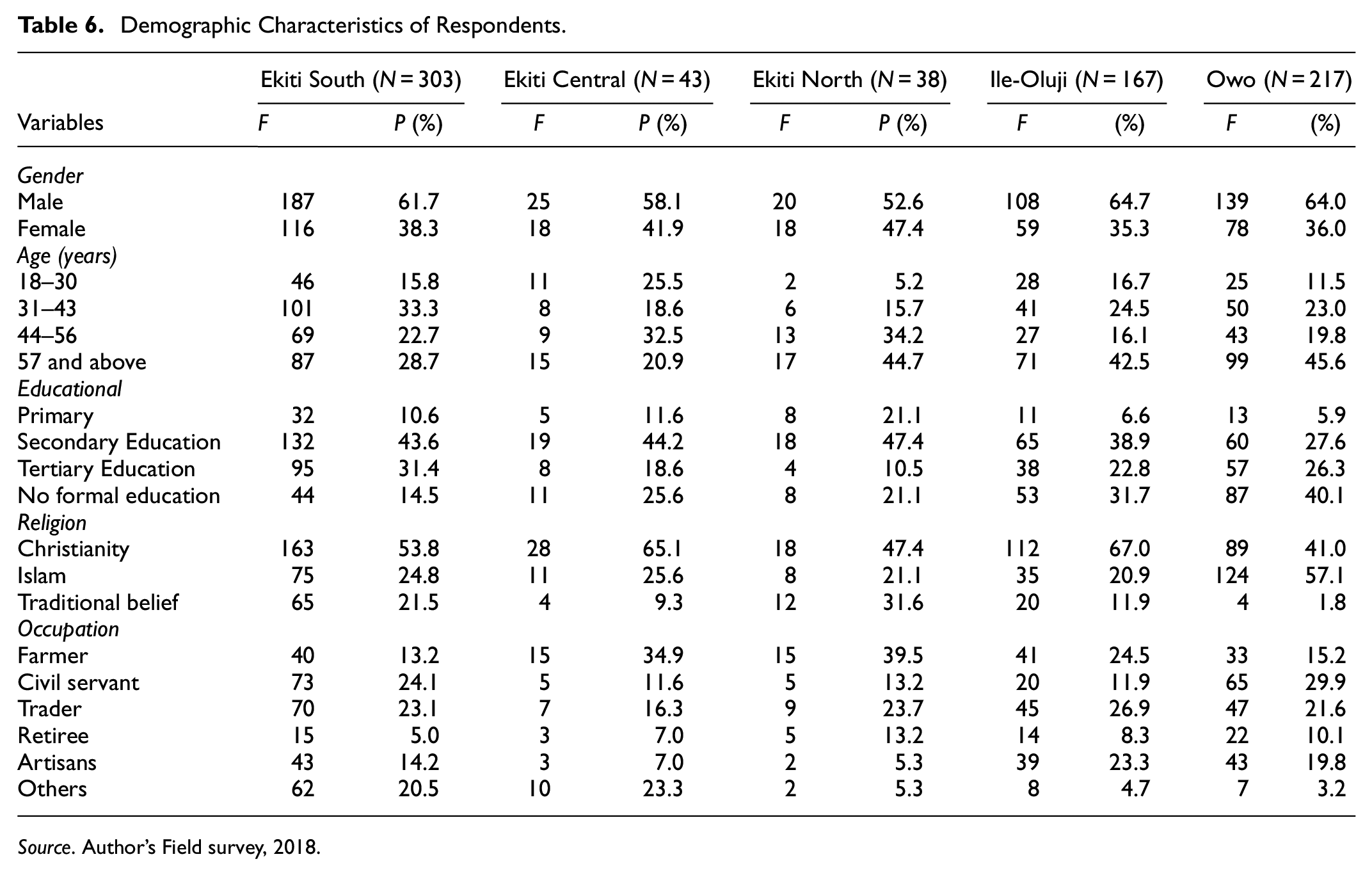
Source. Author’s Field survey, 2018.
Conservation Practices in Heritage Resources
There are other factors that influence community participation in heritage conservation and management apart from socio-demographic characteristics. This is consistent with Lee et al. (2007) who affirmed that since socio-demographic characteristics only do not show enough significant relationship to explain variations of residents’ attitudes toward participation in heritage conservation there is a need to consider other variables related to their perceptions. Keitumetse (2013) opined that research in cultural heritage resources management is better constituted within a group-collective (community) guided by both individual demography and social conceptions obliviously borrow from psychologists and sociologists dissertation. Given this assertion, the perception of residents of these communities that are considered as end-users in the conservation of the heritage resources was subjected to a Likert scale of five which varies from hardly-ever to almost always on a scale of 1 to 5. The result obtained from the respondents in the two selected communities in Ondo State (Ile-Oluji and Owo) showed a level of commitment to the conservation of heritage resources through financial donations, attendance at meetings, volunteering work, and active involvement in cultural events. For instance, the respondents sometimes donate (weighted mean- Ile-Oluji (2.60), Owo (2.89); sometimes engage in volunteering work, (weighted mean- Ile-Oluji (2.62), Owo (2.58) (Table 7), a similar result was obtained in Ekiti State the respondents sometimes participated in heritage conservation through financial support (weighted mean-Ekiti North (2.71), Ekiti Central (2.65), Ekiti South (2.93); and sometimes involve in volunteering work (weighted mean-Ekiti North (2.71), Ekiti Central (2.86), Ekiti South (2.78)), (Table 8).
Conservation Practices of the Heritage Resources in Ondo State.

Source. Author’s Field survey, 2018.
Almost always 4.4 to 5.0, Frequently = 3.5 to 4.0, Sometimes = 2.5 to 3.4, Occasionally = 1.5 to 2.4, Hardly Ever = <1.5.
Conservation Practices of the Heritage Resources in Ekiti.

Source. Authors Field Survey 2018.
Note. H.A. = hardly ever; O = occasionally; S = sometimes; F = frequently; A.A = almost always.
The result clearly shows that there is a level of commitment sometimes on the part of the people in terms of a financial donation, attending meetings and volunteering work. Whereas, this could be hindered by little or no conservation efforts by government agencies and other development partners (National Museums of Kenya [NMK], 2014). This explains the importance of investing and reinforcing social capital especially cooperative networks among local individuals, to enable local people to access and share resources and to increase social capital (United Nations, 2008). However, it is not surprising that some of the respondents hardly ever or occasionally participated in the conservation and occasionally visit heritage sites. Mydland and Grahn (2012) emphasized that participation in the preservation and conservation of heritage resources is often carried out by voluntary workers who spend their money and time on heritage belonging to the community especially when the resources are not of national interest. This agrees with Lvova (2013) that the community is ready to contribute to the preservation of important heritage resources in different ways including financial support based on perceived values and significance of these resources. This action has significantly eliminated or reduced financial limitations for conservation since reliance is not on inter-institutional partnership and public funding (Gustaffson, 2009) but rather on communal or district efforts (Canziani, 2006). The kind of participation that is existing in these communities can be categorized as either spontaneous as described by Marzuki et al. (2012), Tosun (2006) or citizen power in Arnstein’s (1969) typology, or self-mobilization in Pretty’s (1995) typology. This is because the process of development is being controlled by the locals through financial commitment, volunteering and selfless service. It is considered as the highest level of participation, a bottom-up approach that has spread across the practices of heritage conservation in recent times (Yung & Chan, 2011). It is a new ladder of citizen participation surrounded by volunteering and compassion; it is an epitome of paradigm shift in heritage conservation from place-based conservation to people-centered conservation (Chitty, 2017). The end users are composed of the locally-led active chief, traditional heads, princess, prince, the priest that are custodians of these resources. This is structured in such a way that it gives room for the transfer of knowledge from the old to the younger generations as expressed by the Key Informants as a conservation and management strategy. This is the kind of model that is structured in such a way that the local communities are not disfranchised in expressing their opinions and taking decisions on issues of utmost concern to their sustenance and well-being (Chan, 2016).
Management Practices Toward Conservation of Heritage Resources
The management practices identified in this study revolve around communal voluntary efforts guided by underlining policies and regulations which are strongly rooted in their social-cultural belief, norms, taboos and tradition. Although respondents in the study areas in Ekiti State had sometimes participated in heritage conservation in the area of financial donation and volunteering however they are frequently abiding by rules and regulations safeguarding intangible cultural resources in their communities (weighted mean -Ekiti North (3.58), Ekiti Central (3.98), Ekiti South (3.99) (Table 9). There are clear indications that the communities are properly being led by the traditional leaders and this supports the views of Yusuf et al. (2012) on the significance of the roles being played by traditional rules in the development of the communities. Bunu et al. (2020) buttressed this assertion by stressing the need for the community leaders to spearhead leadership through encouraging their members to take an active role in heritage management. The result obtained in Ondo State revealed that the respondents disagreed that their participation in the management of the heritage resources was based on their desire to seek recognition by society and obeying government policies (weighted mean- Ile-Oluji (2.37), Owo (2.16) (Table 10).
Management Practices, Perceived Values and Influencing Factors in Ekiti State.
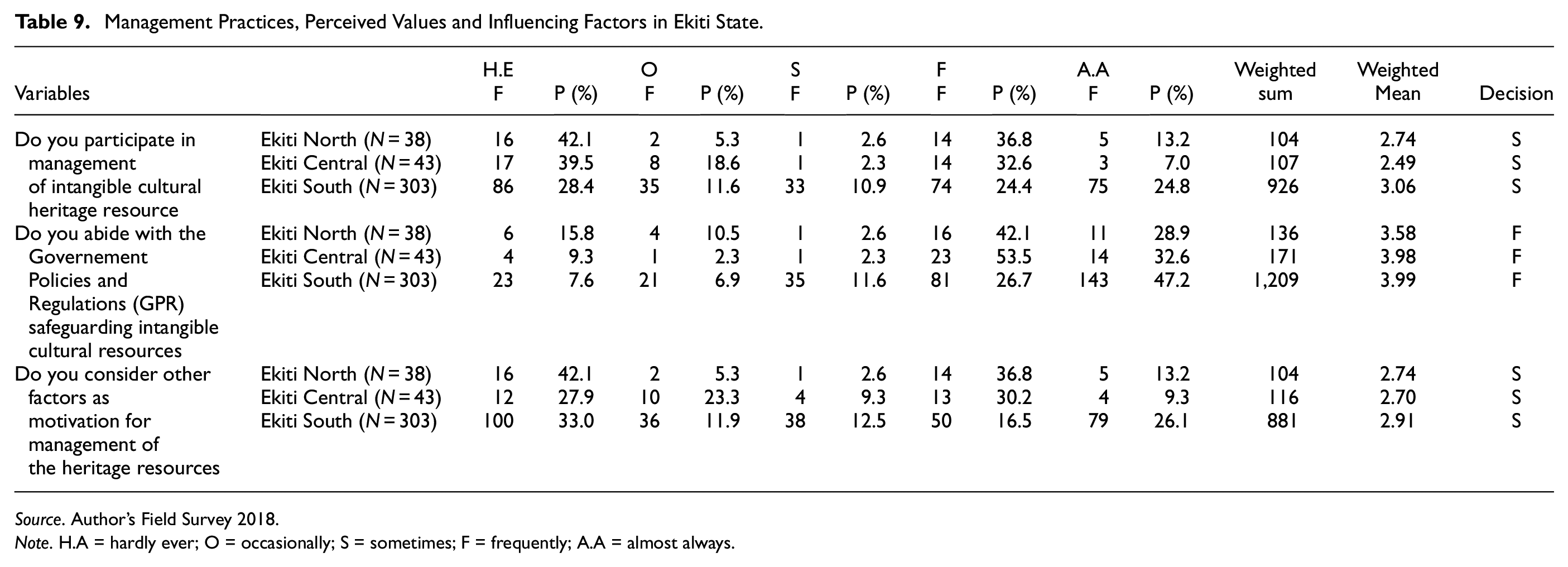
Source. Author’s Field Survey 2018.
Note. H.A = hardly ever; O = occasionally; S = sometimes; F = frequently; A.A = almost always.
Management Practices, Perceived Values and Influencing Factors of Heritage Resources in Ondo State.

Source. Author’s Field survey, 2018.
Note. SA = strongly agree; A = agree; U = undecided; D = disagree; SD = strongly disagree.
Strongly agree = 4.5 to 5.0, Agree = 3.5to 4.4, Undecided = 2.5 to 3.4, Disagree = 1.5 to 2.4, Strongly disagree = < 1.5.
This study identified a sense of belonging, link to the past, community unity, integration into society norms, interest in cultural activities abide with the rules and regulations and knowledge of the significance of the heritage as factors that influenced the contributions of the people in heritage management. Kruse and Warring (2015) stressed that a wish to share common interests and experiences by looking to history in the individualistic society of modernity is used as an approach to forging a communal identity. Management of these heritage resources through a transfer of knowledge from the young to the old as expressed by the Key Informants in the selected communities in Ondo and Ekiti States are perceived to be of significant value. Keitumetse (2013) reported that local communities have long devised strategies through which they managed cultural resources using psycho-social behavioral relationships with local indigenous systems in line with international conventions, particularly those that are connected to the UNESCO, 1972 and 2003. The authors emphasized that grass-root communities’ cultural knowledge is a conservation indicator that is used in the development of the Community-Based Cultural Heritage Resources Model (CBCHRM). Oladeji and Agbelusi (2018) recognized the efficacy of knowledge transfer from the elderly to the young ones as an effective and sustainable method of conservation, preservation and sustainable management of heritage resources.
Perceived Values of Heritage Resources
The perception of the residents of these communities on the values of their heritage resources aids their attachment and appreciation and these have invariably contributed to participation. This is evidence in the result of the thematic analysis of the qualitative data collected during the Key Informant Interview (Tables, 3, 11, and 12) and inferential statistics (Tables 13 and 14). The cultural, historical, social, esthetic and economic values have a positive significant correlation with community participation in conservation and management of the heritage resources (p ≤ .05) in Ekiti State. It means all the variables contributed positively to community participation, a positive correlation (Table 13). In Ondo State, the coefficient of determination R adjusted for Owo and Ile-Oluji were 0.634 and 0.528 respectively and were significant. This shows that the variability of the community participation in Owo and Ile-oluji could be explained by 63.4% and 52.8% of the variables respectively (Table 14). However, these variables (perceived values) have a higher impact on the participation in conservation and management of these heritage resources by the people of Owo than in Ile-Oluji. All these are in line with the findings of authors as reported in the literature on the cultural values (Baycan & Girad, 2011), social and political values (Khakzad, 2015; Sacco et al., 2013), cultural economic values (Comer, 2012), and social-economic values (tourism development ) (Oladeji & Akinrinola, 2010) and economic values (means of generating employment) (Carmona et al., 2003; Ronchi, 2020) and stock of assets for sustainable development across the city, region, and institutions (OECD, 2001). Bowits and Ibenholt (2009) earlier stressed that the direct effect of heritage to the local economy are benefits derived from tourism activities which are felt in the local-based businesses as well as employment opportunities. The perception of the respondents on the cultural values in terms of community cultural identity and pride are consistent with the view of Taylor (2004). There is every possibility that heritage resources in the study communities will be sustainably managed and conserved and this corroborates the findings of Bunu et al. (2020). The authors emphasized that lack of integration of community in decision making and formulation of ideas on their perception of heritage projects; invariably result in destruction and ruins as observed in the Kenyan heritage industry.
Summary of the Interview Conducted in Ondo State.

Summary of Interview Conducted in Ekiti State.

Relationship Between Level of Participation in Management and Value of Intangible Cultural Resources in Ekiti.

Relationship between Perceived Heritage Values and Level of Community Participation.

Dependent Variable: Level of Community Participation
Independent variables : Perceived Heritage Values
This explains the reason for inculcating the principle of local community participation into sustainable development within the concept of international cultural heritage resources management (Keitumetse, 2011; UNESCO, 2003). Stephenson et al. (2004) put forward that people are likely to protect and care for places they perceived the importance. The information acquired during the Key Informant Interview substantiated the claimed by Keitumetse (2011) and collaborated the findings during the administration of the questionnaire as obtained from the inferential statistics The perceived values as expressed by the Key Informants include added values to their culture in terms of community pride, recognition, boost image and sense of belongings. Motivating factors as indicated include interest, development of skill and expertise acquired. Similarly, the Key Informants in Ile-Oluji stated their perceived values and motivating factors. Summarily, the Key Informants in Ondo State perceived that heritage resources added values to their culture in the sense that this gives them much-needed recognition as chief, traditional heads or community leaders in their various societies. These categories of respondents are motivated by the skill and expertise they have acquired over time and their interest in cultural activities (Table 11). In Ekiti South, attending meetings, participating in cultural activities, celebrating annual festivals and volunteering work/communal efforts dominated the views of the informants while perceived added values include community pride, increasing interest in conservation and improved interest in cultural activities; and the motivating factors include aid the development of skill, expertise, and increasing interest in cultural activities (Table 12). All these are in agreement with the work of Levi and Kocher (2013) which explains the perceived importance of heritage sites as places of recreation, leisure, and venue for religious activities. Arowosafe et al. (2019) reported that social and cultural festivals play a greater role in generating awareness and mobilizing communities. Hung et al. (2011) opined that organized community capacity training will provide opportunities to improve the skills and knowledge of dwellers in heritage management. This is supported by Dümcke and Gnedovsky (2013) that knowledge and skills gained during organized community conservation education programs broadening the horizon of the people on the values of these resources to ecstatically support the idea in anticipation.
Conclusion
The poor conservation outcomes that followed decades of reduced involvement of the community in heritage management strategies and planned development have denied the people sustainable local economic benefits and other business opportunities thereby forcing policy makers, international organizations and scholars to reconsider the role of community in heritage. Anecdotal evidence suggests that Ondo and Ekiti State of South Western Nigeria are endowed with a wealth of heritage resources that are transferred from the past generations and handed over to the present with the hope of passing it across to the future generations. These resources possessed both tangible and intangible attributes that of significance cultural, economic, social, esthetic, and historical values to the host communities. This could be explained further in terms of a high level of participation of male/female, young/old, literate/non-literate, and Muslim/Christian played in this regard. Apart from the influence of socio-demographic characteristics, volunteering efforts, attendance at the meetings, annual celebration of cultural festivals and financial commitment are of interest in the conservation and management of the identified heritage resources. The financial donation is voluntary based on communal and not linked to international, national, or public funding will facilitate the sustainability of these resources. The host communities perceived the significance and values of their heritage resources and these have influenced their compliance with the rules and regulations safeguarding these resources sustained on the indigenous knowledge. Other management practices and influencing factors include obedience to policies and lay down regulations, facilitating public recognition, a sense of belonging and linkage with the pastas expressed by the respondents. Output from this research, emphasizes the need to increase the skill of the locals for effective sustainable conservation and management practices and increased community involvement. This will equally aid effective management of identified properties by proper documentation and formalizing traditional management systems and fully incorporation them into existing indigenous management mechanisms.
Footnotes
Declaration of Conflicting Interests
The author(s) declared no potential conflicts of interest with respect to the research, authorship, and/or publication of this article.
Funding
The author(s) disclosed receipt of the following financial support for the research, authorship, and/or publication of this article: The authors received funding from the Management of the National Commissions for Museums and Monuments in the form of Staff Developement.
