




Abstract
Mobile shopping (m-shopping) adoption has been significantly touted in the contemporary era; however, the adoption of m-shopping is still under shadow in many developing countries. The aim of this study is to discover the impact of device system quality on m-shopping adoption among university students with the support of UTAUT and UTAUT2 theories. The study employed PLS-SEM (symmetric) and fsQCA (asymmetric) analysis simultaneously using survey data from 530 respondents who are primarily university students. PLS-SEM results found positive significant relation between device system quality and m-shopping adoption. The study contributes with an extention of earlier studies that combine PLS-SEM (symmetric methods) and fsQCA (asymmetric methods). The study is limited among the university students that may affect the generalizability of the study. The casual recipes in this research aid policymakers to achieve their strategic objectives in implementing positive m-shopping behavior among the university students.
Plain language summary
Introduction
The advancement of mobile technology has evolved significantly in the modern era, making our daily life more convenient and handy. However, in the contemporary era, the usage of m-commerce and online m-shopping has drastically increased due to technological advancement and system Quality improvement (Chan et al., 2022; Hossain, Shan, et al., 2023). In today’s world, mobile devices are widely used for various applications, including mobile payments, m-commerce and mobile social networking. In today’s world, mobile devices are widely used for various applications, including mobile payments, m-commerce, and mobile social networking (Chan et al., 2022; Hossain, Shan, et al., 2023). According to the analysis of a merchant-savvy website (Savvy, 2020), the global increase rate of mobile commerce conditions is estimated to triple between 2016 and 2020. The emergence of mobile commerce dragged the concept of mobile shopping, which has significantly impacted business. Recent studies examined the consumer’s intention toward smartphone adoption of chatbots and AI for m-commerce (Aboulilah et al., 2022; Emmanuel et al., 2022; Hossain, Shan, et al., 2023; Kasilingam, 2020; Nadi et al., 2023).
In contrast, (Hossain, Nadi, et al., 2023; Singh & Sinha, 2020) emphasized the consumer’s intention toward mobile wallet technology and how it affected the consumer’s role. The intention to adapt to mobile shopping aligns with the actual behavior (Thakur & Srivastava, 2014). M-commerce makes it possible to buy goods via mobile devices, and the conventional method of purchasing has been transformed, having consumers experiencing a popular way of contemporary technology-based mobile platforms anytime and everywhere. Based on a survey, India has installed various shopping-related platforms on their portable devices for the 600 million distinct e-commerce and m-commerce items, which has expanded the smartphone market. (Safeena et al., 2012).
Furthermore, researchers have observed that mobile shopping apps are being used greater than any other category of smartphone applications because users consider them to be more convenient, faster and easier to search or browse. As indicated in one of the prior studies, mobile commerce is divided into two different technologies: mobile websites and mobile shopping applications (Singh & Sinha, 2020), which involve purchasing products, tracking product placement, and acquiring rewards and coupons based on purchase actions and numbers. The technology acceptance model identifies and explores the effect of intention to use these mobile shopping applications. The moderating role of income has been essential in consumption and intention to utilize this platform. Those with higher incomes are more likely to use this platform than those with lower incomes (Safeena et al., 2012). People with limited income cannot access this technology-based service via mobile applications since it requires smartphone devices. Some earlier research focused on consumers’ satisfaction with m-commerce and mobile buying behavior, and quality enhancement plays a significant influence. Customers will be more satisfied when adequate innovations and technology features are added to these platforms, making them more convenient and user accessible (Chan et al., 2022).
Nevertheless, research forecasting consumer behavior and mobile commerce acceptance during the Covid-19 crisis must be more comprehensive. Consumer behavior intentions vary depending on service quality, perceived utility, perceived enjoyment, and so on (Chan et al., 2022). Hence, the current research aimed to determine the following research questions:
Whether the consumer’s intention to adapt to mobile shopping has substantially impacted university students?
Whether mobile shopping has become more convenient to the university students and has influenced their purchasing habits?
Literature Review
Theoretical Foundation
In this research, the UTAUT and UTAUT2 theories of The Unified Theory of Acceptance and Use of Technology is used to analyze the impact of device system quality on mobile shopping adoption. The UTAUT/UTAUT2 theories directly contributed to understanding the adaptation or intention to accept technological usages; therefore, performance expectancy is highly linked with technology adoption. Adoption theory examines individuals’ decisions regarding accepting or rejecting technological breakthroughs in any field or sector. Prior researchers provided numerous models on user adoption of new technology using the notion of TAM (Technology Acceptance Model), one of the dominant frameworks. A consumer perspective on behavior examining the use of TAM has been utilized in several aspects, such as e-commerce, m-commerce, online banking, etc. Researchers have found some things that could have been improved in the TAM model that could have explained negative emotions, intrinsic motivation, and beliefs regarding ability level. Various research papers suggested to investigate similar constructs of TAM and researchers developed the UTAUT model in 2003.
The primary focus of UTAUT was on individuals’ usage and acceptance of technology in the context of an organization. It was used as a framework to describe a variety of theoretical frameworks on the usage of technology and acceptance of technology toward adaptability. This theory contains four major factors of technology usage intention: Performance Expectancy (PE), Effort Expectancy (EE), Facilitating Conditions (FC), and Social influence (SI) (Rehman et al., 2022). UTAUT and UTAUT2 have been widely utilized as a technological and acceptability approach, with numerous applications from online shopping to several other constructions. As a result, we regard it as a useful research unit in both theoretical and practical cases. The UTAUT framework was integrated with the eight well-known IT or technological Acceptance and use models. The UTAUT2 model provides us with a comprehensive understanding of mobile shopping app user behavior, as well as gender and experience, which relates to the demographic influence on app user segments. This study was later modified and became known as the UTAUT2 framework, which included three additional determinants or constructs, Habit (HA), Hedonic Motivation (HM), and Price Value (PV), in order to measure consumer behavior toward technology use and adoption. UTAUT2 explains more variance regarding behavioral intention and technological usage than the prior UTAUT model. Researchers also recommended that future research focus on enhancing the relevance of UTAUT to consumers in the context of technology use.
System Quality
Service Quality (SQ) is defined as the extent to which the difference between the consumer’s perception and their subsequent decision to utilize or use the service. It is also regarded as the technical success level of a technological system in performing tasks or daily activities (Wang & Lin, 2012). Some evidence suggests that some countries do not use mobile devices to shop. The reasons mostly relate to device service qualities, which refer to wireless internet service usage in mobile shopping. According to research, mobile shopping will account for only 1% of retail sales in South Africa by 2021 (Maduku & Thusi, 2023). It relates to the user’s perceived value of the system’s reliability, response, and personalized service as secure and credible. Mobile devices or smartphones are crucial for leading our daily lives and doing our daily activities, and their popularity and availability is also hugely increased.
Advancement of technology has played a significant role in innovating activity in selling and purchasing products both online and offline. Our conventional way of purchasing goods and services was based on the store and outlets. However, these have changed, and many convenience stores have opened their websites (Tarhini et al., 2019). Whereas these usability, quality in terms of getting information, service quality, and interaction with the websites has influenced individual purchasing decisions. One of the factors which influence hedonic motivations toward online purchases (Chan et al., 2022). This motivation refers to the person’s sense of pleasure, emotional attachment, and satisfaction toward online purchasing behaviors. Nikolopoulou et al. (2021), one of the core concepts of hedonic motivations is that it emerges from the customers’ satisfaction during online shopping. The quality of the websites ensures to what extent the customers can interact properly or not. Hedonic motivations interactive process in online shopping is browsing (Tarhini et al., 2019). The quality of the service or product provides the consumer with a better experience, which motivates them to avail of the service again. The good quality of any service and the user experience of the system quality significantly influence the adaptation or acceptance of m-shopping behavior. Any service’s perceived system quality motivates repeated consumer buying behavior (Chan et al., 2022).
Researchers provided an overview of m-commerce and the relationship between VR quality and intentions. Researchers identified a link between quality and consumer-perceived behavior. M-commerce applications are a pivotal determinant of the rise of m-commerce adaptation, where accessibility and functionality become the most vital factors. According to the findings, perceived trust in the system’s quality increased hedonic motivation and perceived enjoyment of using m-applications, resulting in higher usage of it. Researchers indicated that there is a correlation between system quality, customer experience, and particularly long-term behavioral intention consumers can purchase products and services via websites or m-applications in the context of m-commerce. The empirical study of system quality’s effectiveness indicates that it substantially affects customer intention regarding perceived ease of use (Lin et al., 2017; Wang & Lin, 2012) and the users are concerned about the service quality (SQ) of the devices.
M-commerce alternatives attempt to provide consumers with convenience and make it simple to get alternative service quality (SQ). Low-quality systems reduced adoption of SQ. However, consumer satisfaction with booking taxis via m-applications is enhanced in relation to higher SQ and user satisfaction. Consumers are more willing to purchase things if they are pleased with any business website’s SQ (Siyal et al., 2021). According to Siyal et al. (2021), mobile shopping is a SQ that people can obtain via mobile apps in terms of “anywhere” and “anytime.” It allows us to order products from online services. In m-commerce, researchers find that hedonic motivation predicts or determines behavioral intention. The use of mobile technology applications is influenced by behavioral intention. Hossain, Nadi, et al. (2023) have indicated that perceived enjoyment significantly impacted the acceptance intentions of mobile services. The individual’s engagement in a particular activity due to self-interest is perceived enjoyment. It is one of the significant determinants of behavioral intention to use the mobile application. Furthermore, these activities must be more enjoyable for the user to increase engagement and promote m-commerce services. Thus, the following hypothesis has been proposed:
H1: System Quality has a significant positive effect on hedonic motivation.
H2: System Quality has a significant positive effect on perceived enjoyment.
Hedonic Motivation
Hedonic motivation is the pleasure or fun derived from using technology like m-commerce. This enjoyment is gained from the multiple uses of the technological application that impacts the intention of the user adoption and relies on the future (Widagdo & Roz, 2021).
Hedonic motivation tends to be the prominent determinant of consumer preference for adapting technological devices (Farah et al., 2018). Consumers are more willing to adopt m-commerce if it provides additional entertainment to them (Vinerean et al., 2022). Various app-based applications are giving consumers a certain benefit, including browsing, content, sharing, etc. These features are aided in the increased rate of the m-commerce value of the entertainment, which may assist in generating customer engagement and keeping the user’s interest in m-shopping adaption (Van Droogenbroeck & Van Hove, 2021). When consumers have a positive experience with the m-commerce applications, they reuse and repurchase behavior in the future. Moreover, this hedonic motivation is driven by the consumer’s intention of the behavior to continue the further use of mobile devices for mobile shopping (Kaczmarek, 2017).
Moreover, the Covid pandemic shifted e-commerce in a large portion in 2020, more than at any other time in history. This significant increase has resulted in 149% growth in the online retail store or m-commerce market. As a result, US e-commerce sales increased to $709.78 billion in 2020 compared to $601.65 billion in 2019. In order to increase the growth rate of m-commerce, businesses are more focused on better service quality (Vinerean et al., 2022).
People participate in online shopping or purchase behavior when they are motivated enough by certain factors. This motivation is derived from the people’s willingness to fulfill their emotional needs. Online shopping is primarily divided into two kinds of motivation such as utilitarian and hedonic motivation.
Hedonic motivation is a person’s desire to fulfill the psychological or emotional needs they desire while availing of the services. Researchers reported that hedonic shopping motivation is the fulfillment of the non-functional needs of the consumer and plays a significant role in mobile shopping adaptations (Nikolopoulou et al., 2021).
Hedonic motivation plays an active role in the decision-making and adaptation of the m-shopping behavior because, when individuals love the shopping experience, it is seen that they are performing repeated online purchase behavior (Widagdo & Roz, 2021). Users adapt to continuous positive stimuli in a positive environment while performing any activity. The ultimate focus of the Hedonic motivation strategy is to enhance enjoyment in the involvement of the positive experience (Kaczmarek, 2017). If the users are unsatisfied with the services or are not fulfilling their emotional needs, that will reduce the m-commerce adaptation (Alalwan et al., 2020). Therefore, the following hypothesis is proposed:
H3: Hedonic motivation has a positive significant effect on m-shopping adoption.
Perceived Enjoyment
The degree to which users perceive enjoyment as utilizing the technology system for any impact on performance is called perceived enjoyment. The use of the technology system must be enjoyable regardless of the performance results using these m-commerce and adaptation services (Hasan et al., 2021). Moreover, Individual intrinsic motivation to utilize a particular system or application can be determined from perceived enjoyment. Customers are more willing to accept or embrace new technology if it provides inherent benefits such as pleasure or enjoyment, as per Rouibah et al. (2016). A significant relationship was discovered between perceived enjoyment and behavioral intentions toward mobile shopping adaptations via a mobile device (smartphone).
Current studies have modified the TAM to accommodate for some variables that have been utilized as predictors of the online shopping experience and intentions in the recent literature, and perceived enjoyment is one of them. This is used to forecast mobile shopping adaptation and identify consumer intentions. They also claimed that perceived enjoyment is a fundamental component of intentions to use and adopt mobile shopping experiences. Shopping is an act of enjoyment for people rather than simply purchasing goods or services. M-shopping experiences provide personalized options for a more pleasurable and useful shopping experience.
Moreover, this functionality will be crucial in increasing the acceptance of m-commerce adaptations, particularly among university students (Khoi et al., 2018). He considers that one can have preferable conditions or circumstances through mobile shopping when they are able to have fun while searching for goods or services and engaging with the mobile shopping environment’s facilities. Experiencing pleasure can be thought of as a direct sense of instant enjoyment from mobile shopping sites in terms of m-commerce. Balog and Pribeanu (2010), perceived enjoyment of shopping is one of the core influencing factors toward a positive attitude toward the adaptations, which is also addressed through comparison with the TAM theory’s variables. He mentioned that mobile shopping usage greatly impacted consumer behaviors and attitudes regarding m-shopping and having strong interactions with devices (Chin & Ahmad, 2015).
Perceived enjoyment is the user’s satisfaction with perceived performance derived from how enjoyable technology. In most cases, the application use and user behavior depend on perceived enjoyment and usefulness. However, the expectation is based on the difference between the expectation and reality of how users get the perceived enjoyment level before and after purchasing. The level of enjoyment associated with using a system is determined by the system’s performance and the use of m-commerce. It explains the pleasure and motivation of using technology-based services via mobile devices (Hasan et al., 2021). Perceived enjoyment has a positive effect on m-shopping adoption and has influenced consumer intention toward the use of m-commerce adoption. Thus, the following hypothesis has been proposed (Figure 1):
H4: Perceived enjoyment has a positive significant effect on m-shopping adoption.

The conceptual model.
Method
Procedure and Participants
The research analyzed the impact of device system quality on mobile shopping adoption among university students with empirical research method. Accordingly, data collection was based on a specific Asian territory including Bangladesh, India, Pakistan, Nepal, Bhutan and Sri Lanka with a special focus on the university students. The universities were classified into public and private. It is argued that the university students and their spending types vary significantly in terms of public and private universities. Hence, the study included both type of universities for proper assessment of the variables used in this study. The sampling frame consisted various subgroups of students; hence; stratified sampling technique was utilized in this study. The survey was administered over two and half month’s period in 2022. Survey questionnaire were distributed by using Google form and all together 530 completed questionnaire were collected.
Measures
System quality was measured with a five items scale from Lin et al. (2017). Perceived enjoyment was measured with a five items scale from Yang (2012). Example construct is, “Mobile shopping helps me to relax.” Hedonic motivation was measured with a three items scale from. Example construct is, “Using mobile shopping apps is fun.” Mobile shopping adoption was measured with a four items scale from Chopdar et al. (2018). Respondents were required to rate the items in a 7-point Likert scale which ranged from 1 (strongly disagree) to 7 (strongly agree).
Data Analysis, Findings, and Discussion
The study employed PLS-SEM (symmetric) and fsQCA (asymmetric) analysis simultaneously, as cited by the various authors (Acquah et al., 2021; Rihoux & Ragin, 2009; Woodside, 2013). The combined significance and philosophy of these two approaches have been applied by numerous scholars (Ciampi et al., 2021). Accordingly, we applied the symmetric (PLS-SEM) via SmartPLS 4 to measure the total effects (hypotheses) of hedonic motivation, perceived employment, and system quality on M-shopping adoption. The asymmetrical approach (fsQCA) integrates the proposition of both quantitative and qualitative methods that address casual configurations to identify possible outcomes (M-shopping adoption) (Crespo et al., 2019). Furthermore, fsQCA can specify asymmetrical correlations between the predictors and outcome factors, identify numerous casual configurations that employ a similar outcome (equifinality), highlight that the same causal configuration can deploy to numerous outcomes (multi-finality), and allow a recipe of conditions (predictors) to be necessary (sufficient) for an outcome rather than simple correlations between conditions (Pappas & Woodside, 2021). Therefore, we measure the relationship between antecedents and outcome variables testing of multi-model approaches (PLS-SEM and fsQCA) in nature of hypotheses and causal configurations (Woodside, 2013).
Considering age scale, 55.4% were between the age of 18–22, 39.4%, 4%, and 1.3% were within the age scales of 23–27, 28–32, and 32+, respectively. Most participants (84.2%) were into bachelor degree, while 15.6% and 0.2% were into masters and PhD. Regarding the scale of gender, 44.6% were male, while 55% and 0.4% were into female and prefer not to say. The income composed 86.4% from $ 0–1,200, 7.5%, 3%, and 3% were between the scales of $1,200–3,600, $3,600–6,000, $6,000, respectively in Table 1. Therefore, the factor loading reveals that the factors were retained after refining the cutoff output of 0.7 to extract acceptable variance from Table 2, while all the constructs exceed the threshold value (Hair et al., 2021).
Demographic Variables.

Factor/Cross Loading.

Symmetric Analysis
The measurement and structural model employed in this research used SmartPLS 4.0 software to assess the PLS-SEM approach (McLeay et al., 2022; Ringle et al., 2022). This research aims to explore the influencing constructs of the dependent construct and test these causal constructs in a reflective and formative manner using the PLS-SEM approach (Hair et al., 2020). The symmetric (PLS-SEM) analysis is particularly relevant for this research because it estimates various path correlations between one or more endogenous variables and one or more exogenous variables (Hair et al., 2021). Moreover, to meet the criteria of sample size in PLS-SEM, the threshold size should be higher than “10” times the amount of items for each construct (Hair et al., 2016). Our sample size for the symmetric analysis (PLS-SEM) met the threshold for all requirements to proceed to the next phase of analysis. Therefore, we examined the measurement model first to assess its reliability and validity, and then measured the path coefficient for the structural model.
Measurement Model
The PLS-SEM approach consists of two parts, including measurement and structural model estimation (McLeay et al., 2022). In this study, construct reliability, convergent validity, and discriminant validity were all measured by the measurement score of all latent variables. Accordingly, reliability was measured addressing Cronbach Alpha (CA) and composite reliability (CR). The convergent validity was estimated employing Average variance extracted (AVE) and factor loading. The Cronbach Alpha and composite reliability assessments of each latent variable were higher than the cutoff score of 0.7, while the average variance extracted assessments for all latent variables were higher than the cutoff value of 0.5 (Hair et al., 2020). These findings reveal that the proposed framework meets the requirements of reliability and convergent validity (Table 3). The discriminant validity was estimated using Fornell Larcker criteria (Fornell & Larcker, 1981) and the heterotrait-monotrait ratio (HTMT) (Henseler et al., 2015). The result of Fornell Larcker criterion meets the threshold value of all constructs. According to Table 3, each latent variable’s AVE (square root) is greater than the maximum coefficients of any other variables (Hair et al., 2021). Also, the HTMT results indicate that the value of each construct was less than the cutoff scale of 0.85 (Henseler et al., 2015). Therefore, regarding the requirement of discriminant validity, the two criteria can be considered to meet the proposed model.
Construct Reliability and Validity.

Structural Model
The assessments of the structural model are reported, where the path coefficient (β), the variance inflation factor (VIF), the coefficient of endogenous variables (R2), predictive relevance (Q2), p-values (significance), and t values (significance) are studied (Table 4) (Hair et al., 2021). Accordingly, the results reported that all the hypotheses were supported in the model. The hedonic motivation was indicated to positively effect on m-shopping adoption (β = .165, t = 2.583, p = .010). Perceived enjoyment was indicated to positively effect on m-shopping adoption (β = .502, t = 8.224, p = .000). System quality was reported to positively effect on hedonic motivation (β = .657, t = 19.178, p = .000). System quality was revealed to positively effect on perceived enjoyment (β = .734, t = 27.481, p = .000). However, the values of VIF scaled from 2.118 to 2.892, which was lower than the cutoff score of 5 (Hair et al., 2021). Therefore, the findings reported no collinearity issues in the proposed model.
Structural Model.
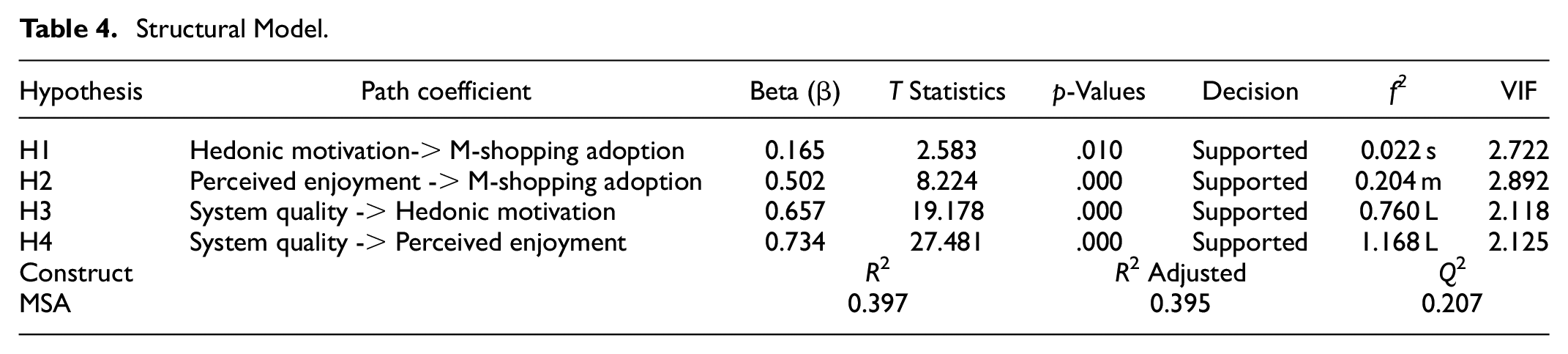
After synthesizing the significance of path coefficient, the results proceeded to assess the predictive power of the Q2, f2, and R2 assessing in-sample prediction. The structural model indicates R2 values as a variance scale of 39.7% for M-shopping adoption. This results, show a predictive accuracy of the framework of outcome construct (Hair et al., 2016). Regarding predictive relevance in structural model, the results found that M-shopping shopping adoption (Q2 = 0.207) have scales larger than threshold value below zero, reporting a significant predictive relevance (Hair et al., 2021). Also, Table 4 reports f2 value that the effect range for hedonic motivation was small, while perceived enjoyment was medium. Moreover, the effect scale for system quality was large. This results, indicate that amongst all the endogenous constructs, system quality-> perceived enjoyment (f2 = 1.168) is significant construct for predicting m-shopping adoption, included system quality-> hedonic motivation (f2 = 0.0769). Based on the above discussion of predictive power, the results indicate that the proposed framework has sufficient predictive power in the sample (Hair et al., 2020).
Asymmetric Analysis (fsQCA)
After assessing the symmetric analysis, the study reported asymmetrical (fsQCA) analysis using fsQCA software 4.0 (Ragin, 2000; Sun et al., 2023). This method assigns each case a unique configuration of particular conditions to set a possible outcome using Boolean algebra and fuzzy set logic (Ragin, 2000). Consequently, fsQCA allows the model to extract the casual conditions that ultimately achieve the best output (Woodside, 2013). Our objective was to explore how various conditions (hedonic motivation, perceived enjoyment, and system quality) combine to achieve high and low levels of m-shopping adoption. Therefore, this method is extensively adopted in the realms of business research, including marketing, production management, and project management (Acquah et al., 2021; McLeay et al., 2022; Roig-Tierno et al., 2017).
Calibration
The fsQCA approach uses three parameters: full non-membership (0), the crossover point (0.5), and full membership (1) for the calibrated data in fuzzy sets, according to the previous authors (Fiss, 2011; Kaya et al., 2020). Concerning suggestions by Woodside (2013) and Crespo et al. (2019), the threshold value of all constructs and the outcome for calibration were based on the percentiles of 95%, 50%, and 5%. In calibrating the m-shopping adoption (outcome variable) for specifying the percentiles (95, 50, and 5) through the fuzzy sets, full membership, crossover, and full non-membership were reported as 7.00, 5.75, and 1.00, respectively. Consecutively, we also identified 7.00, 5.33, and 2.33 for hedonic motivation and 7.00, 5.60, and 2.32 for perceived enjoyment while assigning system quality as 7.00, 5.00, and 2.60 for the percentiles of 95%, 50%, and 5% reporting full membership, crossover, and full non-membership. Therefore, the calibrated sets and descriptive statistics are represented by the cutoff value in Tables 5 and 6.
Descriptive Statistics and Calibration.

Analysis of Necessary Condition.

Necessary of Condition Analysis (NCA)
After successfully calibrating the fussy sets, we proceed to measure the analysis of the necessary condition in fsQCA. Accordingly, we employed NCA to identify the presence (or absence) of the construct conditions (hedonic motivation, perceived enjoyment, and system quality) that could achieve the presence (or absence) of the possible outcome (Ragin, 2000). We measured the construct conditions of m-shopping adoption as the outcome and the antecedent constructs from the symmetric analysis (PLS-SEM) as causal conditions (HM, PE, and SQ). A condition is considered “necessary” or “almost always necessary,” when the consistency score is between 0.80 and 0.90 (Crespo et al., 2019; Ragin, 2009). According to the analysis of the necessary condition, the result indicates that all the causal conditions are necessary for attaining m-shopping adoption since it meets the cutoff score of consistency above 0.8. Therefore, the findings of the NCA indicate that hedonic motivation, perceived enjoyment, and system quality are necessary for achieving m-shopping adoption.
Analysis of Sufficient Configurations and Recommendation
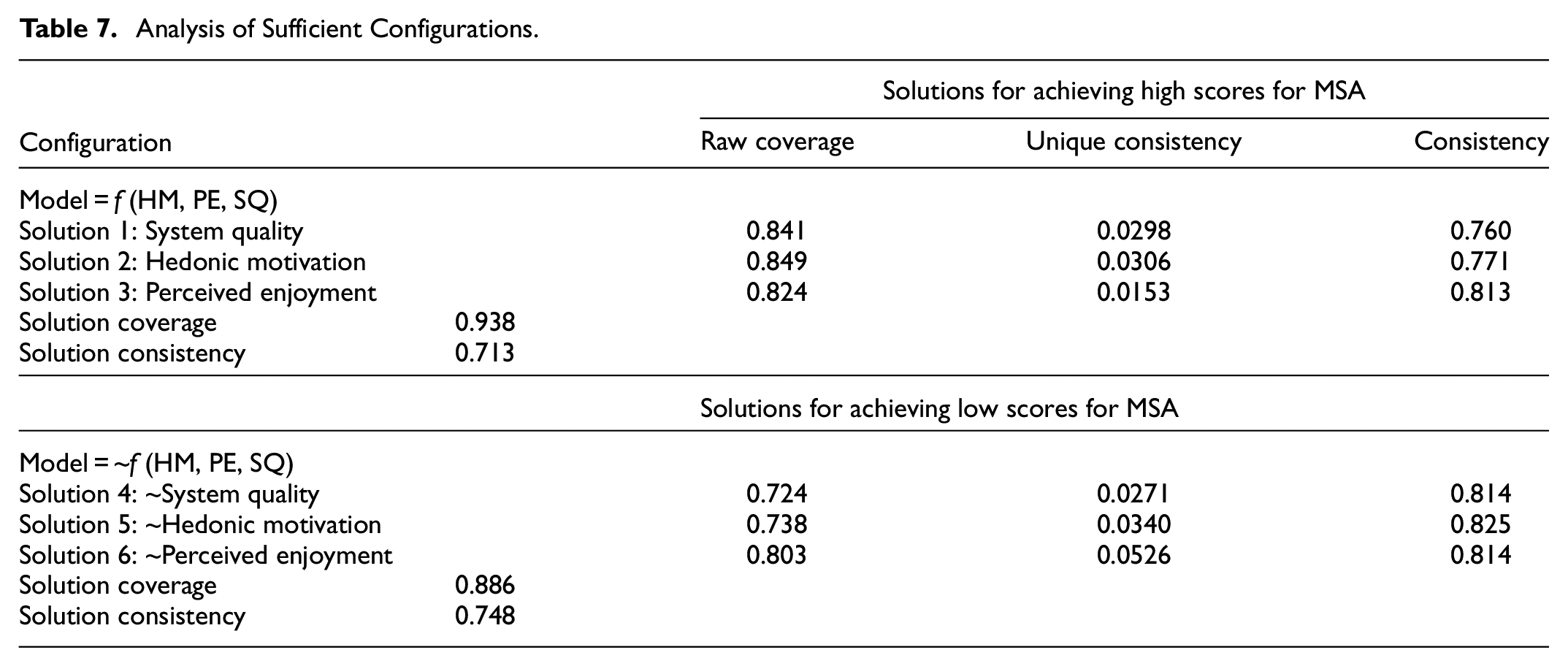
After achieving successful results from the analysis of necessary conditions, we continued to assess the configuration of hedonic motivation, perceived enjoyment, and system quality that are significant for attaining m-shopping adoption. To measure the sufficient configuration, it is necessary to develop, refine, and assess a truth table for finding each outcome (Ragin, 2009). Accordingly, to ascertain the casual configuration of construct conditions for firms to achieve high levels of m-shopping adoption, we followed the cutoff values reported by Skarmeas et al. (2014) for measuring coverage and consistency: 0.27 and 0.74, respectively. Thus, the intermediate solutions were adopted to validate the solutions proposed by Wu et al. (2014). The results from the asymmetrical analysis (fsQCA) obtained multiple configurations that contributed to both high and low levels of MSA. Table 7 showed three casual solutions that emerged (solution consistency = 0.713; solution coverage = 0.938) for high levels of MSA, while three casual solutions (Table 7) formed (solution consistency = 0.748; solution coverage = 0.886) for low levels of MSA (Figure 2).
Analysis of Sufficient Configurations.

Configurational model.
Solutions 1, 2, and 3 provide configurations (Table 7) for high levels of M-shopping adoption. Solution 1 ascertains that 84.1% of the cases propose, which has a consistency scale of 0.760, that enterprises require m-shopping adoption with high levels of system quality. This result indicates that a causal solution to system quality is relevant for achieving m-shopping adoption. Hedonic motivation and perceived enjoyment were not sufficient in this configurational solution.
Regarding solution 2, 84.9% of the cases claim (with a consistency score of 0.771) that high levels of m-shopping adoption are adopted when a causal configuration has high levels of hedonic motivation. This solution implies that high levels of hedonic motivation are significant for adopting m-shopping. The irrelevant constructs in this configuration were system quality and perceived enjoyment. According to this configuration, this solution represented the best configuration for achieving m-shopping adoption because of the highest raw coverage.
According to solution 3, 82.4% of the cases indicate that firms are achieving high levels of m-shopping adoption with high levels of perceived enjoyment. This results also reported with a high consistency score of 0.813. This solution suggest that perceived enjoyment are sufficient for achieving m-shopping adoption. Surprisingly, system quality and hedonic motivation are not sufficient construct in this configuration.
The fsQCA negated the sufficient conditions to represent the configurations for low levels of the outcome construct (m-shopping adoption) in solutions 4, 5, and 6 (Table 7). As shown in solution 4, 72.4% of the cases claim that firms adopted low levels of system quality, which has a consistency score of 0.814, sufficient for predicting low levels of m-shopping adoption. In relation to solution 5, 78.3% of the cases propose that low levels of m-shopping adoption occur among marketing managers with low levels of hedonic motivation. This solution has produced the highest consistency score of 0.825. Consistent with solution 6, 80.3% of the cases ascertain that a low level of m-shopping adoption occurs among marketing professionals with low levels of perceived enjoyment. This solution has a consistency score of 0.814. This solution presented the best configuration for achieving low levels of m-shopping adoption because of the highest raw coverage.
Therefore, the study proposed the six configurations (three for successful m-shopping adoption) and three for unsuccessful m-shopping adoption) are supported based on the threshold proposed by the following authors Ragin (2000) and De Crescenzo et al. (2020).
Conclusions
This study assessed how device system quality has impact on mobile shopping adoption among university students. Appropriately, the variables in the study were empirically examined. The study adopts result from PLS-SEM (symmetric) and increasingly popular fsQCA (asymmetric) analysis simultaneously. PLS-SEM (symmetric) and fsQCA ensures the significant impact of system quality, perceived enjoyment and hedonic motivation on m-shopping adoption among the university students. fsQCA also supported the result with the statistical analysis presented in the earlier section. More precisely, the findings of the study suggested that the system quality, perceived enjoyment and hedonic motivation can significantly affect m-shopping adoption among the university students. As such, this study offered nuanced but technical conceptual model for relevant firms to take better strategic decision where students are key stakeholder.
Theoretical Implications
Theoretically, first, the study assessed the antecedents to investigate how device system quality has impact on mobile shopping adoption among university students (Zhang et al., 2023). Secondly, this study investigate the scenario based on a developing country perspeective. Earlier, the similar research investigated the phenomenon on the developed country or cross cultural perspective (Hu et al., 2023). The research is an extention of earlier studies that combine PLS-SEM (symmetric methods) and fsQCA (asymmetric methods). Likewise, the result generated from PLS-SEM; can be generalized. To strengthen the phenomenon further, fsQCA provide complicated and detailed analysis. Finally, the study contributes to the existing theory by focusing young buyers (university students) who can decide fast and spend more on m-shopping.
Managerial Implications
The findings of this study offer some practical implications for the managers. The antecedents of the study, such as system quality have alternative options that is more favorable to the users due to ease of use, comfort or cost effectiveness reason. Consequently, managers in the relevant business sectors are advised to design the devices or applications according to the ubiquitous need of the users. In addition, hedonic issues and perceived enjoyment factors can be considered as effective aspects for m-shopping adoption. Hence, when IT managers, for example, try to design the website, they should prioritize the ease of use or enjoyment issue in mobile shopping. The result of the study revealed two different combinations where managers can put more attention. The first one is the quality of the system and the second one is enjoyment or hedonic issue to use the system. Overall, the casual recipes in this research aid managers to achieve their strategic objectives in implementing positive m-shopping behavior among the university students.
Limitations and Future Research
Being one of the first efforts to combine PLS-SEM (symmetric methods) and fsQCA (asymmetric methods), this study attempted to collect data on a specific Asian region that may affect the generalizability of the research. The study mainly focused on a specific group of people (university students), hence, this is not applicable for all the mobile shoppers. Future research may investigate the same phenomenon on different levels such as micro-level, macro-level or meso-level with bigger sample size and multiple regions. This study can’t be generalized for the overall e-commerce industry as it only focused on mobile shopping adoption. The respondents of the study are young adults and they could have created inherent bias. The current study is a combination of PLS-SEM and fsQCA. Future research may combine PLS-SEM, fsQCA and NCA to discover the phenomenon further. Finally, the study used self-reported and perceptual responses that may replace with objective measure or big data in the future.
Footnotes
Declaration of Conflicting Interests
The author declared no potential conflicts of interest with respect to the research, authorship, and/or publication of this article.
Funding
The author received no financial support for the research, authorship, and/or publication of this article.

Data Availability Statement
The data will be available on request.