



Abstract
Prosocial behavior is important for personal well-being and social harmony. Based on identity-based motivation theory, this study examined how combinations of condition variables, including socioeconomic status, empathic concern, future self-continuity, and interpersonal trust, lead to high prosocial behavior intention. In this study, fuzzy set qualitative comparative analysis (fsQCA) was used to analyze the 416 questionnaires collected to explore the multiple causal relationships affecting prosocial behavior intention, and necessary condition analysis (NCA) was used to examine the necessary relationship between each condition and the outcome. The results of the NCA found that there is no necessary condition for a single factor to produce high prosocial intention. The fsQCA results showed two configuration paths for high prosocial behavior intention and four configuration paths for low prosocial behavior intention, suggesting that there is no single path for promoting prosocial behavior intention. This study improves understanding of prosocial behavior through the combined use of NCA and fsQCA, and offers implications for enhancing prosocial behavior intention and potential directions for future research.
Plain language summary
Drawing on identity-based motivation theory, this study examines how a combination of factors, including socioeconomic status, empathic concern, future self-continuity, and interpersonal trust, leads to high prosocial behavior intention. No single factor was found to be necessary to produce high prosocial behavior intention. There were two configurational pathways for high prosocial behavior intention and four configurational pathways for low prosocial behavior intention, suggesting that there is no single pathway for promoting prosocial behavior intention.
Introduction
Prosocial behavior is a wide range of behaviors intended to benefit one or more people other than oneself (Pfattheicher et al., 2022). Prosocial behavior is not only beneficial to individuals and society, but also has a positive effect on the development of human society (Y. Yang et al., 2017). If people can be motivated to engage in more prosocial behavior, the whole society may become more friendly, positive, and helpful. For instance, research has shown that individuals’ prosocial behavior during the COVID-19 pandemic not only predicts their personal well-being positively, but also enhances the community’s well-being (Haller et al., 2022). Thus, it is crucial to understand the causes and methods of promoting prosocial behavior. Individuals who engage in prosocial behaviors, particularly charitable donations, often require financial stability, and this has been a topic of significant interest to researchers (Andreoni et al., 2021; Greitemeyer & Sagioglou, 2017). However, this remains controversial, some studies indicated individuals with higher socioeconomic status (SES) display greater prosocial behaviors (Falk et al., 2021; Kosse et al., 2020), while other series of studies draw the opposite conclusion (Piff & Robinson, 2017). In this context, prosocial behavior is a multidimensional and multifaceted construct (motive, situation, and target) that is influenced by various environmental and contextual factors (Carlo et al., 2020). However, if the results of specific subject groups lead to the deduction of a single linear relationship between social class and prosocial behavior, it may cause stigmatization of different social classes and misconceptions about the factors and mechanisms underlying prosocial behavior.
Subjectively, prosocial behavior is commonly the result of self-determination, with an individuals’ choices being closely tied to their identity (Hardy et al., 2015; Peetz & Milyavskaya, 2021). SES can serve as a confirmation and reinforcement of one’s self-identity, while the process of forming expectations is a means of evaluating oneself (Côté et al., 2013; Kraus et al., 2012). If SES is a representation for whether or not an individual has the status or ability to engage in prosocial behavior, the factors that influence the motivational basis for engaging in prosocial behavior are also important to consider. Based on one’s self-identity, there exists a motivational foundation for individuals’ behavior (van der Werff et al., 2013), including empathy and trust. This is an ongoing and mutually reinforcing process that involves intertwined behaviors. Studies have shown that an individuals’ empathic concern (Van der Graaff et al., 2018), future self-continuity (van Gelder et al., 2013), and interpersonal trust (Irwin, 2009) are correlated with willingness and motivation to engage in prosocial behavior. The self-identity and motivation for influencing prosocial behavior intention align with the theoretical framework of Identity-Based Motivation theory (Oyserman & Destin, 2010).
China has experienced tremendous economic growth in recent decades, and while its wealth has grown rapidly, China ranks low in the world in terms of charitable giving (Hasmath & Wei, 2022). According to the World Giving Index (Charities Aid Foundation, 2021), which measures the level of philanthropy among the general population of a country or region, China is ranked 95th out of 114 countries and regions in terms of charitable giving. Therefore, it is important to study how to improve Chinese prosocial behavior. However, previous research on prosocial behavior has mainly relied on structural equation modeling (Lin et al., 2024; Liu et al., 2023; Van der Graaff et al., 2018), which often concentrates on the overall “net effect” of the independent variable on the dependent variable, potentially overlooking the complex causal relationships among various factors. From a configuration perspective, given the potential simultaneous influence of multiple factors on prosocial behavior, it is important to comprehensively analyze how these factors interact and jointly influence prosocial behavior. Traditional structural equation modeling methods do not perform configuration analysis. This study aims to address this key limitation through the use of fuzzy set qualitative comparative analysis (fsQCA). The advantage of utilizing fsQCA lies in its ability to identify how causal conditions combine to create necessary configurations to attain a specific outcome (Cai et al., 2022). The fsQCA concentrates on the combinatorial effects, which can obtain the same result (outcome) in various pathways (Lisboa et al., 2016). In addition, this study utilized necessary condition analysis (NCA) in conjunction with the fsQCA method, and these two methods can offer supplementary perspectives (H. Ding, 2022). This study integrates individuals’ objective and subjective SES, future self-continuity, empathic concern, and interpersonal trust to address the following questions: (1) Which necessary means of activating prosocial behavior intention are most effective (NCA method)? (2) How are these variables configured to enable individuals to have high prosocial behavior intention (fsQCA method)? The findings may enrich the existing literature on prosocial behavior intention, which has previously used structural equation modeling to analyze net effects rather than a configuration perspective (Lin et al., 2024; Liu et al., 2023; Van der Graaff et al., 2018). The practical implications of the study may be instructive for relevant authorities, educators, and practitioners. For example, individuals’ prosocial behavior intention could be promoted by increasing key conditioning variables (e.g., empathic concern).
The article is organized in the following manner. In Section 2, the theoretical background and relevant literature are reviewed and a comprehensive theoretical framework is presented to clarify the multiple effects of individual prosocial behavior intention. Section 3 describes the research methodology. Section 4 provides descriptive statistics and demonstrates the results using fsQCA and NCA method. Section 5 considers the theoretical and practical implications. Finally, Section 6 is a summary of the main conclusions of this study.
Literature Review and Research Framework
Theoretical Background
Identity-Based Motivation (IBM) is a motivational theory that focuses on the cognitive and behavioral processes that promote identity congruence, building on theories of self-concept and identity (Oyserman & Destin, 2010). IBM emphasizes the influence of environmental characteristics on identity and how identity shapes individual motivation and actions (Nurra & Oyserman, 2018). An individuals’ SES or social class is one of the most important factors in determining his or her identity in the social environment (Kraus et al., 2012). Future self-continuity can affect an individuals’ self-identity by providing a bridge between the present self and the future self. Research has shown that individuals with higher SES have more assets and more positive future aspirations (Yoon & Kim, 2018), possibly because individuals in economically advantaged state tend to increase their connection to their future selves due to their own positive state in the present (A. X. Yang & Urminsky, 2015). SES and future self-continuity can both impact an individuals’ self-identity. IBM theory suggests that individuals are motivated by their identities to spend limited time and energy behaving in ways that are consistent with their identities (Oyserman & Destin, 2010). If individuals view their current issue, such as prosocial behavior, as conducive to their self-identity, they will proactively work to resolve their current difficulties in order to achieve the issue (Nurra & Oyserman, 2018). For example, studies have demonstrated that people of higher SES are more trusting, more helpful, and give more to charity than people of lower SES (Korndörfer et al., 2015; Trautmann et al., 2013). This may also be due to the fact that high SES individuals are often born into privileged upper-class societies, where they are often the rule makers, more socially adaptable, and where prosocial behaviors are often encouraged, allowing them to benefit from them (Sherman et al., 2013; Ye et al., 2020).
In addition, IBM theory proposes that there are three main stages in the process of developing and maintaining behavior: dynamic construction, action and procedural-readiness, and difficulty interpretation; these three stages are not a linear process, but dynamically interact with each other (Nurra & Oyserman, 2018). For example, in the case of prosocial behavior, even if the individuals’ SES is high and the individual has the capacity to engage in prosocial behavior, but the individual does not have empathic concern and interpersonal trust in the willingness and motivation to act, the individual may interpret prosocial behavior as unimportant and thus not engage in prosocial behavior. This is partially consistent with a previous study that found individuals with high SES but low levels of empathy also had low levels of prosocial behavior (Durante et al., 2017). The validity of IBM theory has been tested in education (Chishima & Wilson, 2021; J. Shen et al., 2024) and business (Aguirre-Rodriguez et al., 2023) studies. The IBM theory can provide a framework for understanding the level of an individuals’ prosocial behavior intention.
Socioeconomic Status and Prosocial Behavior Intention
Objective SES refers to an individuals’ social position based on income, education, and occupational prestige (Kraus et al., 2012). Early studies suggest that individuals with higher SES display less prosocial behavior (Piff & Robinson, 2017). Recent studies have produced conflicting results, as individuals with higher SES demonstrate greater prosocial behaviors (Falk et al., 2021; Kosse et al., 2020). The relation between SES and prosocial behaviors may become clear by refining the study scenarios and reducing extraneous information distractions (Andreoni et al., 2021). For example, researchers have refined the relevant factors and scenarios, to examine the potential impact of personal relative deprivation on prosocial behavior in relation to social class (Callan et al., 2017). Additionally, it should be noted that subjective SES differs from objective SES, subjective SES refers to an individuals’ perception of their socioeconomic status relative to others (Adler et al., 2000). This definition underscores the subjectivity of SES, prioritizing self-perception of one’s social and economic status over objective indicators such as income (Adler et al., 2000). Compared to objective SES, subjective SES can not only reflect the objective information of the individuals’ own social status, but also possibly predict the individuals’ own physical and mental health and achievement (Destin et al., 2012). Research has shown that both objective and subjective SES are associated with prosocial behavior (Liu et al., 2023; Piff & Robinson, 2017). Previous research has suggested that high SES has the potential to both promote and inhibit prosocial behavior (Falk et al., 2021; Piff & Robinson, 2017). Examining the effects of SES on prosocial behavior from a configuration perspective may provide new insights.
Empathic Concern and Prosocial Behavior Intention
Empathic concern (EC) involves displaying genuine concern for the emotions and well-being of others, accompanied by a proclivity to offer assistance (Decety & Jackson, 2004), and feelings of sadness may motivate individuals to alleviate the suffering of others, potentially leading to prosocial behavior toward others (Batson et al., 1989; Eisenberg & Miller, 1987). Research has shown that individuals with higher levels of empathic concern show a greater degree of concern for the needs and feelings of others, which may promote prosocial behavior (Van der Graaff et al., 2018). In an experimental setting, participants were incentivized with monetary rewards to reduce the number of electric shocks that others experienced, results from fMRI data demonstrated increased activity in brain areas associated with caregiving, suggesting a causal relationship between empathic concern and altruistic behavior (FeldmanHall et al., 2015). In a dictator game study, participants with a greater capacity for emotional empathic concern were more likely to distribute their resources generously (Edele et al., 2013). Social class plays a significant role in an individuals’ level of empathic concern and prosocial behavior. To elucidate the relationship between SES, empathic concern, and prosocial behavior, scholars theorize that wealth may diminish empathic concern, leading to less prosocial behavior, whereas individuals living in poverty may possess higher levels of empathic concern, resulting in more prosocial behavior (Durante et al., 2017). However, there are also studies suggesting that affluent individuals engage in more prosocial behavior (Falk et al., 2021; Kosse et al., 2020). Therefore, it would be beneficial to examine the combined influence of SES and empathic concern from a configuration perspective.
Future Self-Continuity and Prosocial Behavior Intention
Future self-continuity (FSC) is the psychological link between an individuals’ present self and future self, creating a sense of continuity and consistency (Ersner-Hershfield et al., 2009). The more an individual feels connected to their future self, the more likely they are to make decisions with a future time perspective, and future self-continuity can motivate people to act in a way that aligns with their long-term goals (Adelman et al., 2017; Rudolph et al., 2018; J. Shen et al., 2023). Future time perspective has been shown to be a significant predictor of prosocial behavior (Moore et al., 1998). It has been suggested that engaging in prosocial behavior is intended to meet the needs of others, possibly at the cost of the individuals’ current interests; however, individuals who engage in prosocial behavior may also receive long-term benefits (Van Lange et al. 2013). In addition, research has shown that increasing an individuals’ future self-continuity can reduce criminal behavior (van Gelder et al., 2013), possibly due to the increase in an individuals’ capacity for delayed gratification, which was also confirmed in a virtual reality experiment (Y. I. Shen et al., 2022). Thus, a higher level of future self-continuity would factor in more future outcomes that positively correlated with prosocial behavior (Nostrand & Ojanen, 2018; Van der Graaff et al., 2018). Thus, from a configurational perspective, an individuals’ future self-continuity may be a conditioning variable that influences prosocial behavior intention.
Interpersonal Trust and Prosocial Behavior Intention
Interpersonal trust (IT) refers to an individuals’ recognition of the trustworthiness, honesty, and reliability of another person (Rotter, 1967). Interpersonal trust has been demonstrated to have a significant and positive impact on various forms of prosocial behavior (Irwin, 2009), such as cooperation (Taniguchi & Marshall, 2014), and online prosocial behavior (Zeng et al., 2020). Furthermore, interpersonal trust has a significant impact on prosocial behavior, especially when considered in conjunction with SES and empathic concern, for example, studies have proven that people with high level of SES are more trusting, helpful, and give more to charities compared to groups with lower degrees of SES (Korndörfer et al., 2015; Trautmann et al., 2013). A study has shown that economic inequality lowers trust and prosocial behavior toward unfamiliar individuals (Lin et al., 2024). There is a significant correlation between empathetic concern and interpersonal trust (Smith et al., 2014), suggesting that individuals exhibit trusting attitudes and behaviors through empathic concern for others (Y. Yang et al., 2019). Individuals high in empathic concern are better able to understand the needs of others through their emotional responses and they also tend to trust more and display altruistic and prosocial behavior (Krueger et al., 2012). Thus, interpersonal trust may be configured with SES and empathic concern to influence prosocial behavior intention.
Research Framework
Research on the net effect of the aforementioned factors on individual prosocial behavior offers a foundation for comprehending the correlation between various factors and individual prosocial behavior (Nostrand & Ojanen, 2018; Van der Graaff et al., 2018; Y. Yang et al., 2019). However, it is difficult to determine how the configurational effects of various factors influence people’s prosocial behavior intention (Douglas et al., 2020). As noted above, an individuals’ prosocial behavior intention is a complex process involving many factors. The presence or absence of outcome variable can result from complex configuration relationships between condition variables. Thus, different patterns of configurations of objective and subjective SES and future self-continuity, empathic concern, and interpersonal trust may result in high or low levels of prosocial behavior intention. In theory, one variable alone is not sufficient to promote high prosocial behavior intention. This study focuses on two causal relationships: (1) Which condition variables are necessary to achieve high prosocial behavioral intentions (NCA method)? (2) How are these variables configured to enable individuals to have high prosocial behavior intention (fsQCA method)? In this regard, we established a research framework based on IBM theory and used NCA and fsQCA methods to conduct the study (Figure 1).

Conceptual framework.
Methodology
Combination of NCA and fsQCA Methods
There are two types of causality: necessary and sufficient. Necessary conditional causality states that the outcome will not happen if the antecedent is absent, while sufficient condition causality means that the antecedents (in combination) fully generate the outcome (Dul, 2016; Ragin, 2009). Dul (2016) posited that some researchers have conflated necessity and sufficiency due to their frequent utilization of traditional linear regression approach to assess necessary but insufficient explanations. The fsQCA method can identify how causal conditions combine to create the configurations to attain a specific outcome, which can result in the same outcome in a variety of pathways (Cai et al., 2022). The NCA method can test for the necessary causality, and the fsQCA method can highlight the strengths of a sufficient analysis. We utilized NCA and fsQCA to analyze the necessary and sufficient causality of this study.
First, we employ NCA via R 4.3.1 software to test the specific factors that are essential for prosocial behavior intention. Then, we utilize the fsQCA 4.1 software to investigate the intricate causal mechanisms of prosocial behavior (Ragin, 2009). The fsQCA approach aims to investigate the configurations of conditional elements that lead to desired outcomes by applying a holistic perspective to cross-case comparative analysis (Ragin, 2006). It analyzed how combinations of causal conditions lead to increased prosocial behavior, rather than simply examining the net effect of each individual factor.
Participants and Procedure
This study utilized the Chinese online survey platform Wenjuanxing (http://www.wjx.cn) and distributed 500 questionnaires using convenience sampling. This was achieved by the researcher completing the editing of the questionnaire and based on the platform to distribute the questionnaire in the form of links and QR codes via email, WeChat groups, etc., inviting respondents to complete the questionnaire. The study subjects were adults from all over China. Prior to the distribution of the study, the researcher provided a detailed explanation of the precautions for completing the questionnaire and emphasized the anonymity and confidentiality of this study. The questionnaires were only completed by subjects who agreed to participate. The outcome variable in this study was prosocial behavior intention and did not involve actual prosocial behavior. Therefore, it is relatively easy to find adult respondents in China who meet the requirements. Before completing the online survey, all participants selected the consent option. Any incomplete responses or questionnaires with completion times of less than 30 s or more than 10 min were excluded from the dataset. In total, we collected 416 valid questionnaires, resulting in a validity rate of 83.2%. The sample consisted of 163 male and 253 female participants (Mage = 28.14, SD = 8.38). The fsQCA method is less sample demanding and can be applied to smaller sample sizes, even less than 50 (Chenxi & Haijie, 2023; Pappas & Woodside, 2021). In addition, empirical studies generally require sample sizes greater than 10 times the number of items measured (Chin, 1998), so a sample size of 416 was considered sufficient to meet the requirements of this study. According to the backstage IP, the participants originated from 30 regions, including different provinces as well as Hong Kong and Macau.
Instruments and Calibration
To measure objective SES in the context of China, we modified a prior study (Piff & Moskowitz, 2018) and asked participants to indicate their household income category from a choice of 5 options, ranging from 1 (less than CNY 2,000) to 5 (greater than CNY 20,000). This indicator was adopted because income reflects differences in resources that shape class distinctions within a primarily self-oriented system (Côté et al., 2013).
We utilized the MacArthur Scale of Subjective Social Status to assess subjective SES. This is a single-item scale that measures an individuals’ perception of their social class on a 1 to 10 ladder scale (Adler et al., 2000). The highest rung of the ladder, which corresponds to 10 points, represents those with the most wealth and highest-paying professions, while the lowest rung, corresponding to 1 point, represents individuals who are impoverished, uneducated, and unemployed. Higher scores on the ladder are indicative of higher perceived subjective SES.
Future self-continuity was measured using the Future Self-Continuity Scale (Ersner-Hershfield et al., 2009). This is a single-item scale consisting of seven options, each consisting of two circles representing the “current self” and the “future self,” ranging from no overlap to almost complete overlap, with seven scenarios, each scored from 1 to 7, with higher scores indicating greater overlap between the two circles and greater the degree of future self-continuity.
In this study, the empathic concern level of the subjects was measured using the empathic concern subscale of the Chinese version of the Interpersonal Reactivity Index-C (IRI-C). The scale was revised by a Chinese researcher (F. Zhang et al., 2010) based on the Interpersonal Reactivity Index Scale (Davis, 1980). According to the purpose and content of the study, we chose the most appropriate and relevant dimension, the Empathic Concern subscale, as the scale to measure the subjects’ level of empathic concern. The Empathic Concern dimension consists of six items (e.g., I often have tender, concerned feelings for people less fortunate than me.), and the scale is scored on a 5-point scale (1 for complete nonconformity and 5 for complete conformity), The subjects’ mean scores on these six questions were used as a measure of their level of empathic concern, with higher scores representing greater empathic concern. In this study, Cronbach’s α coefficient of the IRI-C was .84.
To measure interpersonal trust, the Interpersonal Trust Scale (ITS; Rotter, 1967),which was revised for the Chinese context (W. Ding & Peng, 2020) was used. It consists of 10 items (e.g., Most salespeople are honest when describing their products.) on a 5-point Likert scale (1 for complete nonconformity and 5 for complete conformity), The subjects’ mean scores on these 10 items were used as a measure of their level of interpersonal trust, with a higher mean score indicating a higher level of interpersonal trust. In this study, Cronbach’s α coefficient of the ITS was .83.
Prosocial behavior intention was measured using a prosocial situation imagery questionnaire modified from previous Chinese research (An, 2015). One valid way to measure prosocial behavior intention is through prosocial situation imagery (Baumsteiger & Siegel, 2019). Subjects were presented with three prosocial behavioral situations and asked to read the situations carefully and, as far as possible, to imagine themselves in these situations and to judge the extent to which they would engage in prosocial behavior (e.g., Purchase goods made or sold by people in economic hardship.). In this vein, respondents answered their intention to engage in prosocial behavior based on the situations. Each question is scored on a scale of 1 to 10 (α = .78), with the average score of the three items. The higher the average score, the greater the subject’s willingness to engage in prosocial behavior.
After assessing the scales mentioned above, we employed calibration to convert the data into fuzzy sets. In order to calibrate, we identified three anchors: full membership, maximum ambiguity, and full non-membership (Ragin, 2009), setting the thresholds at the 95th, 50th, and 5th percentiles correspondingly (Pappas & Woodside, 2021). The calibration for each variable were presented in Table 1.
Fuzzy-set Membership Calibrations.

Results
Descriptive Analysis
Table 2 displays a descriptive analysis of each variable. All variables exhibited positive correlation with the outcome factor.
Descriptive Statistics of Each Variable.

Note. Data in the table were computed with SPSS 27.0. OSES = objective socioeconomic status; SSES = subjective socioeconomic status; FSC = future self-continuity; EC = empathic concern; IT = interpersonal trust; PBI = prosocial behavior intention.
p < .05. **p< .01. ***p< .001.
Necessity Analysis
NCA calculates the effect size of the necessary condition, in addition to determining whether a particular condition is necessary for a certain outcome. In NCA, the bottleneck level, which represents the lowest level of conditions necessary to produce a given outcome, is referred to as the effect size. The effect size ranges from 0 to 1, with a higher value indicating a larger effect. Values below 0.1 indicate an insignificant effect (Dul, 2016). Both continuous and discrete variables can be handled by the NCA method.
Table 3 displays NCA findings, showing the effect size acquired via the Ceiling Region (CR) and Ceiling Envelope (CE) estimation methods. In the NCA approach, two essential conditions must be met: the effect size (d) should not be less than 0.1 (Dul, 2016), and the effect size must be significant (Dul et al., 2020). It can be seen that the effect sizes of the conditioning variables are all less than 0.1, so none of these variables are necessary conditions for prosocial behavior intention. The bottleneck level indicates the bottleneck value of the causal condition needed to achieve a specific outcome predictor level. For instance, as shown in Table 4, to achieve 70% of prosocial behavior intention, there needs to be a 3.2% level of future self-continuity, a 5.2% level of empathic concern, and a 1.0% level of interpersonal trust. Although the effect sizes were <0.1, the effect sizes for empathic care and future self-continuity were relatively high and significant. This suggests that empathic care and future self-continuity may have a broader impact on prosocial behavior intention.
Necessary Condition Analysis (NCA) Result Tables.

Note. 0.0 ≤ d ≤ 0.1: small effect; 0.1 ≤ d < 0.3: medium effect; 0.3 ≤ d < 0.5: large effect. CR = ceiling region; CE = ceiling envelope.
Bottleneck Table.
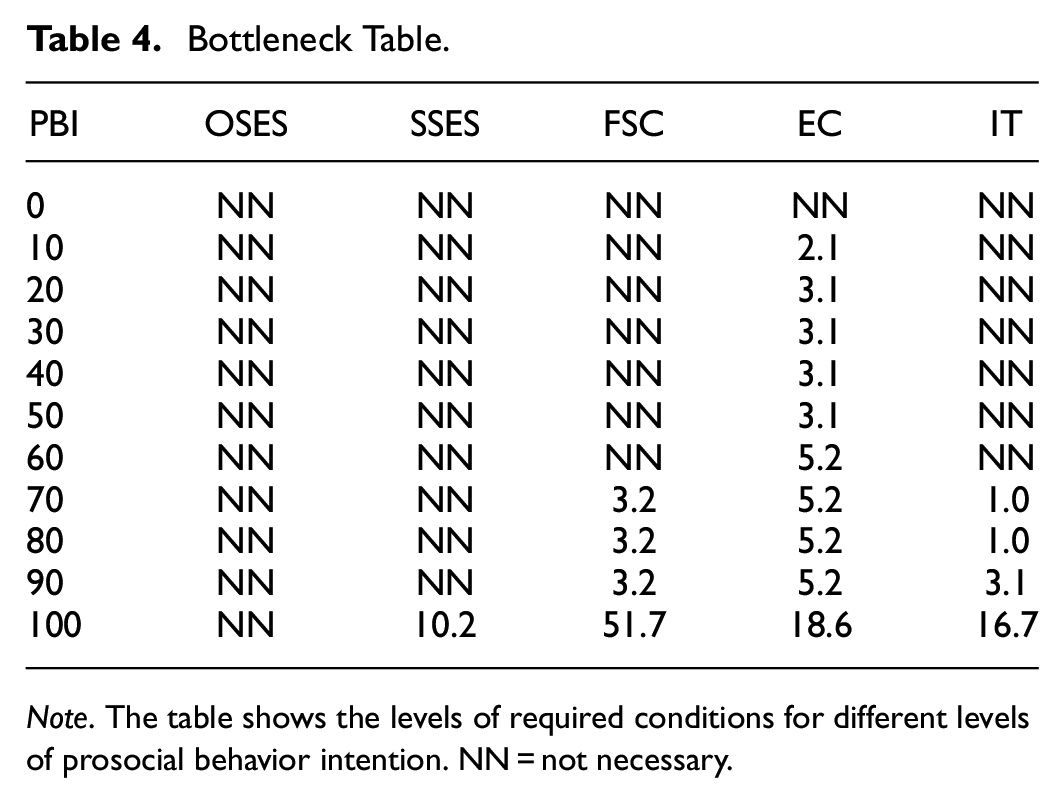
Note. The table shows the levels of required conditions for different levels of prosocial behavior intention. NN = not necessary.
We employed the fsQCA method to examine the necessary conditions. Table 5 presents results for “high prosocial behavior intention” and “not-high prosocial behavior intention.” It has been discovered that the coverage value is less than 1 for all tested conditions, which suggests that objective SES, subjective SES, future self-continuity, empathic concern, and interpersonal trust are all antecedents of prosocial behavior intention. However, none of the consistency factors reach 0.9, thus not providing a necessary condition for prosocial behavior intention (Schneider & Wagemann, 2012). This is consistent with the NCA, which showed that no single necessary condition has an effect on prosocial behavior intention, suggesting to some extent that it is the combination of multiple factors that influence prosocial behavior intention, and therefore a configurational analysis should be conducted.
Necessity Test for a Single Condition.

Note. The symbol ~ notes the absence of the condition.
Sufficiency Analysis
We performed a conditional combination analysis, utilizing a frequency benchmark of ≥2, raw consistency of ≥0.80, and proportional reduction in inconsistency (PRI) cutoff of ≥0.60 (Pappas & Woodside, 2021). The objective of this combination analysis was to investigate whether combinations of distinct antecedent variables demonstrated significant explanatory capacity for the resultant variables. Finally, we retained two paths with high intention of prosocial behavior and three paths with low intention of prosocial behavior.
The fuzzy-set analysis revealed two configurations (S1 and S2) that generate high levels of prosocial behavior intention (Table 6). The consistency indicators for the two configurations were 0.895 and 0.920, respectively, exceeding the recommended full consistency standard of 0.8 (Fiss, 2011). The overall consistency index of the model solutions was 0.895, indicating that both configurations covered the majority of cases and were sufficient for high prosocial behavior. The model solution’s overall coverage was 0.571, suggesting that the two configurations accounted for roughly 60% of high prosocial behavior intention conduct. Each configuration consists of identity formation factors and behavior facilitating factors, and only operates in specific settings. The study findings demonstrate how factors related to identity formation and behavior facilitation work together to promote a high intention of prosocial behavior in diverse situations.
Sufficient Configurations for Prosocial Behavior Intention.

Note. The black circle (•) and crossed circle (⨂) indicate the presence and absence of conditions, respectively. Large and small circles represent core and peripheral conditions, respectively. Blank spaces indicate irrelevant conditions.
Configuration S1 indicated that individuals with high subjective SES, strong future self-continuity and empathic concern are likely to have high prosocial behavior intention, regardless of whether they have strong objective SES and interpersonal trust. Individuals with higher SES desire to maintain their advantageous economic position in the future (A. X. Yang & Urminsky, 2015), and engaging in prosocial behaviors may benefit them (Sherman et al., 2013; Van Lange et al., 2013). Configuration S2 indicated that individuals with high objective SES, strong future self-continuity, interpersonal trust, and empathic concern are likely to have high prosocial behavior intentions, regardless of whether they have high subjective SES, this is consistent with previous findings (Korndörfer et al., 2015; Trautmann et al., 2013). Furthermore, the results reveal that the two configurations with high prosocial behavior intention had high levels of future self-continuity and empathic concern, which is partially consistent with the results of the NCA. This suggests that future self-continuity and empathic concern may have a broader impact on prosocial behavior intention.
According to Table 6, it can be seen that four configurations (S3, S4, S5, and S6) produced lower prosocial behavior intentions. These four configurations’ consistency indices were 0.831, 0.879, 0.885, and 0.886, respectively. The solution’s consistency index was 0.815, and the model solution’s coverage was 0.718, indicating that the four configurations accounted for 71.8% of the causes of low prosocial behavior intention.
Configuration S3 indicated that regardless of whether objective and subjective SES are superior and interpersonal trust is high or not, the absence of future self-continuity and empathic concern will not lead to high prosocial intentions. Configuration S4 showed that the absence of subjective SES, future self-continuity, and interpersonal trust does not lead to high prosocial behavior intentions, regardless of whether objective SES and empathic concern are superior. Configuration S5 indicated that regardless of whether objective SES and future self-continuity are high, the absence of subjective SES, empathic concern, and interpersonal trust does not lead to high prosocial behavior intentions. Configuration S6 showed that regardless of superior future self-continuity, lack of subjective SES, interpersonal trust, and empathic concern does not lead to high prosocial behavior intentions, even when objective SES is superior.
Robustness Test
To verify the robustness of the configuration paths, this study improved the consistency from 0.8 to 0.85. The new model configuration was identical to the original model (Cai et al., 2022; H. Zhang & Long, 2022). Furthermore, the use of calibration anchors has the potential to affect the validity of the fsQCA by influencing parameter settings and leading to significantly different results. In order to address this issue, we recalibrated five variables utilizing the 75th-50th-25th anchor prior to conducting the sufficiency analysis. The results showed a subset relationship between the new and original model configurations (Fiss, 2011), confirming the relatively robust conclusions.
Discussion
The results of this study contribute to the identification of synergistic effects among different factors that influence prosocial behavior intention. Previous research has mainly examined the net effect on prosocial behavior (Y. Yang et al., 2019; Y. Yang et al., 2017), ignoring the configurational effects of multiple factors. To address this gap, we propose a research framework consisting of SES, empathic concern, future self-continuity, and interpersonal trust as interdependent configurations based on IBM theory. By utilizing this framework, we investigate how combinations of multiple factors influence the intention of prosocial behavior. The IBM theory does not emphasize linear processes of environment, identity, and motivated behavior. Instead, it focuses on processes based on multiple dynamic adaptations (Nurra & Oyserman, 2018). For instance, when a person perceives that their current task conflicts with their identity, or they lack the necessary abilities and resources to accomplish it, they may interpret the activity as difficult, leading them to refrain from participation (Oyserman & Dawson, 2021). This partly explains why individuals with high objective SES are sometimes less prosocial in configuration S6 as well as in a previous study (Piff & Robinson, 2017), because they lack other important factors working together. Configurations S3, S4, and S5 also illustrate that the absence of these conditional variables causes individuals to have low prosocial behavior intention. Additionally, the study’s findings offer a reference for future research.
With regard to the two research questions of this study. First, the NCA results indicate that no single factor is a necessary condition for high prosocial behavior intention. This suggests that the configuration of the different variables is of greater importance for high prosocial behavior intention. Second, the configurations S1 and S2 included all the conditional variables in the research questions and were tested. In other words, objective and subjective SES and future self-continuity, empathic concern, and interpersonal trust affect prosocial behavior intention in configuration. In addition, the findings suggest that future self-continuity and empathic concern have a broader influence on prosocial behavior intention and influence other variables, which is in line with previous research (Nostrand & Ojanen, 2018; Van der Graaff et al., 2018).
Theoretical Implications
First, this study analyzed the factors influencing individuals’ intention to engage in prosocial behavior using five important condition variables. This research provides valuable insights into the knowledge of prosocial behavior intention. The study’s findings reveal six pathways that affect an individuals’ intention for prosocial behavior. The results have identified two effective pathways for driving prosocial behavior intention, which can aid in understanding how these factors influence an individuals’ intention to engage in prosocial behavior.
Second, based on IBM theory, this study presents a comprehensive framework for analyzing an individuals’ prosocial behavior intention. The IBM theory is widely employed in the field of education (Chishima & Wilson, 2021; J. Shen et al., 2024) and business (Aguirre-Rodriguez et al., 2023). Our study contributes to the existing body of literature on the IBM theory by extending its application to prosocial behavior intention. The framework explores various factors that influence prosocial behavior intention and improves our theoretical understanding.
Third, the NCA and fsQCA methods were utilized to identify causal asymmetric driving mechanisms in individuals’ prosocial behavior intention. Previous researchers have frequently employed structural equation modeling and experimental approaches to investigate prosocial behavior (Andreoni et al., 2021; Lin et al., 2024; Van der Graaff et al., 2018). Rather than concentrating on the net effects of each factor in isolation, our study examines the conjunction of multiple causal conditions and their influence on high prosocial behavior intention. Our study combined the use of NCA and fsQCA methods to challenge the symmetry assumption for causal effects in linear regression. This allowed for the examination of asymmetric assumptions that could explain the occurrence of outcomes in detail. The NCA results suggest that no single factor is a necessary condition for high prosocial behavior intention, indicating the importance of the configuration of the different variables for high prosocial behavior intention. These results provided a new explanation for the variation in individual prosocial behavior intention and how they are affected under different conditions.
Practical Suggestions
Prosocial behavior is not only beneficial to individuals and society, but also has a positive impact on the development of human society (Y. Yang et al., 2017). The results of this study show that future self-continuity and empathic concern are two broader variables that influence individuals’ prosocial behavior intention. First, from the perspective of enhancing future self-continuity, individuals can be guided to pay more attention to future situations by writing letters to their future selves to enhance future self-continuity (Chishima & Wilson, 2021). Second, in terms of empathic concern, training can be provided to individuals to improve their level of empathic concern, and to create a mutually supportive and friendly social atmosphere, in which the adolescent is the key to influence, and relevant training can be provided at this time (Carlo et al., 2020). Empirical evidence suggests that empathic concern can be enhanced through the implementation of mindfulness (Berry et al., 2018) and ballroom dance training (Wu et al., 2023). Third, social learning theory emphasizes the importance of learning from role models (Tekleab et al., 2021). Relevant authorities can set high prosocial role models and guide others to learn from the models. Finally, research suggests that interpersonal trust can be enhanced by improving perspective-taking skills (Sun et al., 2021). Educators and parents need to emphasize students’ perspective-taking skills.
Limitations of the Study and Future Prospects
While our study presents novel findings regarding prosocial behavior, there are two limitations that should be addressed in future research. First, this study focuses on exploring the factors within individuals that influence their prosocial behavior intention, but it does not consider the factors of the helped party, nor the influence of macro-level factors such as social norms and national cultural differences. Second, not all configurations leading to high prosocial behavior intention are encompassed by the two pathways analyzed in this study. Various theoretical perspectives and conditioning variables may offer alternative explanations for the causal formulation of prosocial behavior intention. Future research could examine other perspectives to gain further insights.
Conclusions
Based on the theoretical framework of IBM Theory, this study explored how various factors combine to generate high prosocial behavior intention. First, the NCA results suggest that no single factor is a necessary condition for high prosocial behavior intention. High levels of future self-continuity and empathic concern are two broader variables that influence individuals’ prosocial behavior intention and other conditioning variables. This demonstrates the strong influence of future self-continuity and empathic concern on individuals’ prosocial behavior intention. Second, the fsQCA results showed that there are two configurations of high prosocial behavior intention and four configurations of low prosocial behavior intention. In summary, this research provides a valuable contribution to the field of prosocial behavior intention.
Footnotes
Declaration of Conflicting Interests
The author(s) declared no potential conflicts of interest with respect to the research, authorship, and/or publication of this article.
Funding
The author(s) disclosed receipt of the following financial support for the research, authorship, and/or publication of this article: This paper was supported by Macao Polytechnic University (RP/FCHS-01/2023).
Ethics Statement
This study followed the Declaration of Helsinki. Before completing the online survey, all participants selected the consent option. The survey was only distributed after obtaining participants’ consent. According to the Measures for the Ethics Review of Life Sciences and Medical Research Involving Humans, released on the website of Chinese authorities ( ), ethical approval may be waived if collected data lacks sensitive personal information or commercial interests, is anonymized, and is not harmful to humans. As our data collection satisfies these requisites, ethical review for this paper was waived.
Data Availability Statement
Data will be made available on request.