



Abstract
Rural governance is the cornerstone of national governance and essential for modernizing grassroots democratic governance. The ongoing development of ICT has reshaped how farmers exchange information and interact socially, fostering innovations in rural governance through new technological means. This paper utilizes survey data on the modernization of rural governance and employs the benchmark regression of the Oprobit model. The regression results indicate that ICT does not significantly enhance rural governance effectiveness, a finding that remains robust after rigorous robustness testing. Mechanistic analysis reveals that while public goods provision, rural public leadership, and rural public trust positively mediate the impact of ICT on rural governance, the direct negative effect of ICT use outweighs these positive indirect effects. Heterogeneity analysis indicates that ICT has a more significant negative impact on villagers with low income, low education, and low social capital. Therefore, future policies should focus more on these groups to strengthen ICT’s role in rural governance, providing technological empowerment for a modern rural governance system that integrates self-governance, ethics, and the rule of law.
Plain Language Summary
Rural governance is the cornerstone of national governance and essential for modernizing grassroots democratic governance. The ongoing development of ICT has reshaped how farmers exchange information and interact socially, fostering innovations in rural governance through new technological means. This paper utilizes survey data on the modernization of rural governance and employs the benchmark regression of the Oprobit model. The regression results indicate that ICT does not significantly enhance rural governance effectiveness, a finding that remains robust when tested with OLS and Ologit regression models. Mechanistic analysis reveals that while public goods provision, rural public leadership, and rural public trust positively mediate the impact of ICT on rural governance, the direct negative effect of ICT use outweighs these positive indirect effects. Heterogeneity analysis indicates that ICT has a more significant negative impact on villagers with low income, low education, and low social capital. Therefore, future policies should focus more on these groups to strengthen ICT’s role in rural governance, providing technological empowerment for a modern rural governance system that integrates self-governance, ethics, and the rule of law
Introduction
Rural governance is the cornerstone of modern national governance and a key driver of modernization in grassroots democratic governance. Villages represent the smallest and most numerous grassroots organizational units in China. According to data from the National Bureau of Statistics of China, by the end of 2020, China had 580,700 administrative villages, covering approximately 97.5% of the country’s land area. China’s 7th National Population Census reports that China’s rural population stood at 509.8 million, as of May 2021, making up 36.11% of the total population. These rural organizations engage directly with a vast number of rural residents, serving as the crucial “last mile” for implementing government policies (Snape, 2019). Consequently, rural governance is fundamental to national governance (Peng et al., 2023; Yu & Gao, 2022). Research indicates that effective rural governance not only boosts rural economic development but also underpins the modernization of the national governance system and contributes to social stability (Huhe et al., 2015; Valentinov & Fritzsch, 2009).
Following the reform and opening up, China’s transition from a planned economy to a market economy brought significant changes to the governance structure of rural grassroots organizations (Ye et al., 2022). Previously, village cadres were appointed by higher levels of government. However, since the reforms, they have been elected by villagers, shifting the political accountability of village cadres from their superiors to the villagers themselves. This shift began to change the political habits of village cadres. In 2018, China implemented the Regulations on the Work of China’s Rural Grassroots Organizations (RGRO), which stipulates that village secretaries, heads of village committees, and heads of village-run enterprises should all bear the “one-shoulder” responsibility. This concentration of power has invigorated village cadres and facilitated their work but has also increased the potential for corruption (Hu & Kee, 2022). During this period, rural grassroots governments in China have gradually transitioned from “management-oriented” to “service-oriented” entities, transforming the relationship between the public and the government into one of “service recipient” and “public service provider.” The service-oriented transformation in rural governance is a positive direction, yet it remains constrained by the path dependence of long-standing management paradigms, leading to contradictions between the intended transition and practical realities. Despite this shift, the actual governance effectiveness of grassroots cadres remains problematic (Ye et al., 2022). Furthermore, industrialization and urbanization have disrupted the traditional “poorly ordered pattern” of rural areas. Many young and middle-aged individuals are now seeking non-farming employment, leading to a significant outflow from rural areas and resulting in aging and hollowed-out villages (Qu et al., 2022; Shen et al., 2023). In the economically developed and highly industrialized eastern coastal areas, a “population inversion” phenomenon has emerged. The traditional governance model of Chinese rural villages struggles to accommodate the needs of these regions, highlighting the bottlenecks in rural governance. Therefore, identifying the factors affecting the effectiveness of rural governance and addressing these constraints is of great theoretical and practical significance.
Rural governance is a multidisciplinary field encompassing economics, geography, demography, ecology, psychology, and other disciplines. Scholars have extensively researched the factors influencing the effectiveness of rural governance, analyzing it from both macro and micro dimensions. From the perspective of China’s central government, national guidelines and policies (Deng et al., 2022; Tian et al., 2011), decentralization of governmental power (Sarvestani & Ingram, 2020), infrastructure development (J. Wang & Li, 2018), and the allocation of financial resources (Xiao et al., 2022) all play significant roles in shaping rural governance efficacy. At the grassroots level, empirical studies have shown that the planning of rural spatial patterns (Ge & Lu, 2021), the structure of governance entities (Yu & Gao, 2022), and the capacity of village cadres (Zhao, 2023) can directly and indirectly influence governance outcomes. Additionally, factors such as the quality of the rural living environment (Y. F. Li et al., 2022), the presence of “differential patterns” (Xiao et al., 2022), the skills of rural elites, and their participation in governance (C. M. Zhang & Fu, 2021) are crucial. Scholars have also examined the underlying causes of governance gaps (Deng et al., 2022). For instance, due to institutional inertia, grassroots governments still prioritize easily quantifiable “management outcomes” over less standardized “service quality” (Tian et al., 2011). Additionally, capacity-building lags, with limited opportunities for service-oriented training and a significant mismatch between training content and actual needs (F. Chen et al., 2023). Meanwhile, insufficient dynamic monitoring of service demands and systematic understanding leads to structural misalignment between service supply and real-world requirements (Ye et al., 2022). Existing research predominantly focuses on institutional design and policy text analysis, lacking quantitative studies on the gap between grassroots service delivery effectiveness and farmers’ actual sense of gain (Qu et al., 2022; Shen et al., 2023). Further in-depth investigation is warranted.
Information and communication technology (ICT) has profoundly impacted rural governance, supported by favorable policies and resource allocation (Tembrevilla, 2020). According to the 50th Statistical Report on China’s Internet Development, the number of rural Internet users reached 293 million by June 2022, accounting for 27.9% of the total Internet user base (J. Wang & Li, 2018). The proliferation of ICT has significantly affected farmers’ production and daily lives. For instance, ICT usage has been shown to enhance environmental awareness, encouraging activities such as waste sorting and straw recycling (F. Chen et al., 2022; F. Chen et al., 2023; J. P. Zhang et al., 2020). For rural migrants, ICT can mitigate the trust barriers inherent in “acquaintance societies,” thereby facilitating social integration (DiMaggio & Bonikowski, 2008).
Technological advances have transformed the superstructure of national governance capacity (Mentzelou, 2017). In rural China, digitalization has notably impacted the effectiveness of rural governance. First, ICT technology enhances rural governance through technical empowerment, utilizing data analysis and model determination for scientific decision-making via big data, cloud computing, and blockchain technology, shifting from empirical decision-making to data-driven methods. Second, digital technology supports the construction of township and village governments, village committees, and collaborations with other social actors, transitioning from government-centric governance to synergistic governance involving multiple stakeholders (Balla, 2014).
Exploring the impact of ICT technology on rural governance effectiveness is crucial for promoting the modernization of national governance capacity and the implementation of the digital village strategy. This paper analyzes the impact of ICT use on rural governance effectiveness using data from 2,632 samples and examines heterogeneity among different population groups to enhance understanding. The paper strives to employ as many research methods as possible to achieve this objective, such as qualitative, quantitative, and text analysis approaches. This study’s innovations include:
Research perspective: Unlike previous studies focusing on public goods supply, trust in township governments, and village elite governance, this study explores rural governance effectiveness from the perspective of digital information technology, aligning with contemporary developments and China’s digital village construction requirements.
Research content: Instead of using traditional financial indicators and the number of permanent residents to measure rural governance performance, this study employs four indicators: recognition of village cadres’ management ability, satisfaction with rural civility, satisfaction with the management of rural collective assets, funds, and resources (“three capitals”), and satisfaction with law and order.
Research methodology: The study uses objective survey data and employs Oprobit, logit, and OLS models for empirical verification, providing objective conclusions and analyzing heterogeneity based on income, education, political profile, and village positions to offer targeted policy recommendations for improving rural governance.
Core Concepts and Theoretical Framework
Current research on ICT use in relation to rural governance efficacy focuses on two primary areas: the evaluation criteria of rural governance effectiveness and the relationship between ICT use and governance outcomes (Rannu & Li, 2021; Tiwari & Saxena, 2022). These are detailed as follows.
Evaluation Criteria of Rural Governance Effectiveness
Previous studies evaluating rural governance effectiveness have predominantly been result-oriented, emphasizing objective indicators and focusing on outcomes rather than processes (Sahu & Kanan, 2021; Tembrevilla, 2020). For example, Tiebout (1956) proposed the “voting with feet” theory, where residents dissatisfied with local governance effectiveness choose to leave, making the number of permanent residents a common indicator of governance success. Fiscal revenue, as the foundation of local governance, is another frequently used measure (Ndou & Papaioannou, 2021). According to public goods theory, effective rural governance should balance the demand and supply of public goods through resource allocation by township governments and village committees, making the level of public goods supply a critical indicator of grassroots governance capacity (Afolayan & Aremu, 2021).
In the 21st century, the government’s role in rural governance has shifted from governance to public goods provision. Consequently, evaluations of rural governance effectiveness have evolved from being result-oriented to goal- and process-oriented (Q. Chen & Huang, 2022; J. Zhang, 2021). Collaborative governance theory suggests that the democratic nature of the governance process is a crucial effectiveness criterion (Q. Chen & Huang, 2022). Farmers, as direct beneficiaries of rural governance, provide the most direct evaluations of its effectiveness. Their assessments depend on the alignment between their post-governance perceptions and pre-governance expectations (Han et al., 2019; Schmidthuber et al., 2021).
Previous scholars have constructed social governance effectiveness evaluation indicators based on dimensions such as human development, social equity, public service, and public security, derived from China’s social management evaluation system (Banerjee & Sahu, 2021; Chen, & Huang, 2022). For instance, Zhou et al. (2023) used farmers’ subjective well-being to evaluate social governance effectiveness in terms of human development. Y. Lee (2021) employed social trust and fairness as indicators in empirical studies, while Y. Wang and Liu (2021) found positive correlations between satisfaction with public security and grassroots government governance.
Based on this foundation, this paper proposes four evaluation indices for rural governance performance: satisfaction with village cadres’ management ability, satisfaction with rural civilization, satisfaction with the management of “three capitals” (collective assets, funds, and resources), and satisfaction with social security (Liu & Yang, 2019; J. Wang & Li, 2018). These indices are refined and considered comprehensively for the following reasons:
Village Cadres’ Management Ability: Village committees are grassroots organizations responsible for self-management, education, and service in rural society (Lin & Wu, 2020). Village cadres, as leaders of these committees, play a crucial role in implementing central policies and modernizing rural governance. Thus, satisfaction with their management ability is a key criterion for evaluating rural governance effectiveness (Lin & Wu, 2020; Rannu & Li, 2021).
Rural Civilization: Effective rural governance should address both political governance and the moral and cultural factors of rural communities. Building rural culture enhances the moral and cultural levels of farmers and is essential for rural revitalization (Mohammed & Boateng, 2021). Therefore, satisfaction with rural civilization is an important indicator of effective governance.
Management of “Three Capitals”: The management of collective assets, funds, and resources (“three capitals”) reflects scientific, institutionalized, and systematic rural governance. Satisfaction with “three capitals” management indicates political trust in township governments and village committees and is crucial for rural reform, development, and the stability of grassroots power (Liu & Yang, 2019; Tembrevilla, 2020; J. Wang & Li, 2018).
Social Security: The security situation is a key indicator of governance maturity. Stable security in rural areas is a primary objective of modern rural governance (Lin & Wu, 2020). Therefore, satisfaction with rural security is also used as an indicator of governance effectiveness.
The Impact of ICT Use on Rural Governance Effectiveness
The continuous development of ICT technology has ushered humanity into the digital age, significantly affecting rural organizational structures and governance systems (Masiero & Arvidsson, 2020). Most scholars agree that ICT technology provides technological empowerment, enhancing rural governance effectiveness. Research on the relationship between ICT use and rural governance often focuses on information sharing mechanisms, cooperation mechanisms, and constraint mechanisms (Mohammed & Boateng, 2021).
ICT use enhances rural governance by establishing effective information-sharing mechanisms. For farmers, the spread of the Internet and the use of smartphones have gradually dismantled traditional information barriers, reducing information asymmetry and ushering in an era of information abundance. Farmers now have easier access to various types of information, including government policies and community activities, which enhances their political participation (Ma & Zheng, 2021). For the government, the timeliness and long-term availability of information on the Internet, along with applications like “For the Village” and “Village Nail,” have increased transparency and allowed farmers to monitor government actions more effectively (J. Lee & Kim, 2022). This transparency improves the governance of township governments and village committees. Additionally, ICT enables real-time monitoring of rural financial, environmental, agricultural, and infrastructure conditions, allowing the government to respond appropriately and improve management accuracy (Lin & Wu, 2020). Zamani et al. (2018) demonstrated that ICT technology can reduce information access costs in Iran’s poultry market, a point also supported by Sheng and Lu (2020).
ICT use also enhances rural governance by facilitating cooperative mechanisms. Given the complexity of rural governance, the public nature of rural resources, and the large rural population, a multi-governance system is necessary (Lin & Wu, 2020). The shift from rural “management” to rural “governance” aligns with the theories of collaborative governance and public goods, which suggest that ICT technology optimizes rural governance systems (Chatfield et al., 2017). ICT provides a fast and convenient communication platform, enabling efficient information sharing, communication, cooperation, task tracking, and feedback among various stakeholders (Balasubramanian & Sawant, 2021). This promotes effective collaboration in rural governance. Moreover, ICT supports decision-making by applying big data and cloud computing for modeling and data analysis, providing objective bases for decisions and reducing subjective biases, thus improving governance efficiency (Heeks & Renken, 2021).
Lastly, ICT use improves rural governance effectiveness through constraint mechanisms, which can be divided into soft and hard constraints. Soft constraints include promoting moral norms and reshaping rural values, which influence farmers’ daily lives and reduce undesirable behaviors (Khatun & Hossain, 2021). ICT offers new channels for social supervision, such as online reporting and public opinion forums, fostering positive social values and enhancing governance (Cernakova, 2015; Ge & Lu, 2021). Hard constraints involve laws and regulations enforced by the government to improve rural security and reduce lawlessness (Quisumbing & Kumar, 2021). ICT enables the government to collect and monitor data more efficiently through sensors, surveillance cameras, and other equipment, allowing timely problem detection and enforcement of penalties for non-compliance (Liu & Yang, 2019; J. Wang & Li, 2018).
Therefore, the impact of ICT technology on rural governance effectiveness is multifaceted, encompassing information sharing, cooperative mechanisms, and constraint mechanisms, which may either promote or inhibit the level of rural governance (Janowski & Estevez, 2021).
Firstly, discrepancies may arise between digital development initiatives and the effectiveness of rural governance. Many regions prioritize the establishment of digital villages and the enhancement of rural governance infrastructure, aiming to establish a comprehensive and sophisticated rural governance system (Chigona & Kankuzi, 2020). While this represents a significant breakthrough, certain challenges persist. Although some digital village projects have shown promising progress, the focus on hardware investment may not align well with the digital needs of rural residents (Oyelaran-Oyeyinka & Lal, 2020). Consequently, the intended improvements in service accessibility and convenience for residents may not materialize fully. This mismatch between digitalization efforts and the actual needs of rural residents impedes the effectiveness of rural governance and hinders its development (J. Zhang, 2021).
Secondly, the evolving demands of rural residents regarding governance requirements pose additional challenges. Digitalization has democratized access to information, yet residents must discern between beneficial and detrimental information based on their own judgment (Chen & Liu, 2022; J. Zhang, 2021). Positive information can bolster residents’ outlook, while negative information may diminish satisfaction levels. For instance, exposure to superior governance models via the Internet may lower residents’ satisfaction with their current situation, fostering a desire for improvement (Kim, 2006; Liu & Yang, 2019). Rural residents aspire to better governance services and an enhanced quality of life, but the reality may fall short of these expectations, resulting in reduced satisfaction levels (Xu et al., 2022).
Thirdly, the internet-driven expansion of rural residents’ social circles may lead to more nuanced expressions of emotions. Exposure to potentially unfavorable information online could influence residents’ behaviors, prompting them to adopt negative attitudes and express grievances online (S. Wang & Feeney, 2016). With fewer constraints and regulations governing online expression, rural residents may find it easier to articulate negative sentiments, thereby altering their needs and diminishing satisfaction levels (Ma & Zheng, 2021). Real-time observations of village cadres’ actions and behaviors by residents may also influence perceptions of governance effectiveness, as negative experiences can impact satisfaction levels (J. Wang & Li, 2018).
In order to optimize rural governance effectiveness, it is imperative to consider both enabling and constraining factors associated with digitization initiatives (Kahn & Burrell, 2021; Sun, 2023). This entails a holistic approach that combines strategies promoting digital utilization with measures addressing the limitations of digitization theory (Kahn & Burrell, 2021). Effective promotion of rural governance development requires a balanced consideration of these contrasting forces (Liu & Yang, 2019; J. Wang & Li, 2018). Thus, assessing the impact of digitization on rural governance effectiveness necessitates an evaluation of both its facilitating and constraining effects, ensuring a comprehensive understanding of the dynamics at play.
Sample Information and Model Design
Data Source
The data utilized in this study were derived from the “Thousand Villages Observation” rural research initiative conducted between April and July 2020 by a University. Prior to the official research phase, the research team meticulously revised the questionnaire to ensure its comprehensiveness and reliability. Additionally, participants underwent rigorous field training to enhance the authenticity of responses. The research encompassed various aspects of rural life, including healthcare, education, elderly care, employment, government services, rural ethics, public amenities, and information services. To ensure diversity, the study selected provinces representing different economic and social development levels across the East, Central, West, Northeast, and other regions. Eleven provinces, including Zhejiang, Beijing, and Xinjiang, were chosen for the investigation. Within each province, a random selection of counties and villages underwent thorough surveys and interviews. After filtering out incomplete and inconsistent data, a dataset comprising 2,632 observations was compiled for analysis.
Model Design
This study examines the factors influencing rural governance effectiveness, with a focus on analyzing the impact of ICT utilization, farmers’ personal characteristics, and village attributes. The dependent variable, rural governance efficacy, is a discrete ordinal variable, lending itself to an ordered probability model. Following the approach outlined by F. Chen et al. (2023), an ordered probit model was constructed for empirical analysis. The specific empirical model is formulated as follows:

In Equation 1,
Variable Selection
The primary dependent variable in this study is Village Governance Efficacy. Drawing from the literature review and research objectives, rural governance efficacy is operationalized by aggregating four variables: satisfaction with village cadre performance, management of collective assets, rural civilization, and social security. Following established methodologies, these dimensions collectively characterize village governance effectiveness. Questions assessing these variables were adapted from previous studies (Kahn & Burrell, 2021; Kim, 2006), and respondents rated their satisfaction levels on a 5-point scale ranging from “totally dissatisfied” to “totally satisfied,” with higher scores indicating greater satisfaction.
The central independent variable, ICT Use, is assessed based on access to information through ICT tools, such as smartphones and computers, as these are prevalent in rural China. Consistent with prior research (Leng et al., 2020; Parmar et al., 2019), respondents indicated their primary information sources, with a value of 1 assigned to the use of smartphones and computers and 0 for other methods.
Control variables are incorporated to mitigate the influence of confounding factors. These variables are categorized into individual characteristics, network attributes, and village characteristics. Individual characteristics include gender, age, education level, political affiliation, and village cadre status, all of which are presumed to impact governance effectiveness. Network attributes, such as cell phone signal strength and home internet connectivity, may constrain ICT use. Village characteristics, including the presence of village WeChat groups, security cameras, and proximity to public junior high schools, may influence residents’ ability to participate in governance and their perceptions thereof.
Given that income, education level, and social capital may exhibit heterogeneous effects on rural governance performance, we have also incorporated them into the scope of heterogeneity analysis.
Descriptive Statistics
Descriptive statistics are presented in Table 1. Farmers’ average ratings for village cadre management ability, rural civilization, management of collective assets, and social security are 3.366, 3.517, 3.166, and 3.647, respectively, indicating a generally satisfactory level overall. Notably, security receives the highest rating, suggesting initial improvements in rural security stemming from initiatives like the “Anti-Blackness and Anti-Devil” campaign and the “Snow Light Project.” Conversely, management of collective assets receives lower ratings, attributed in part to limited financial transparency in some villages and low political trust in village committees.
Descriptive Statistics of the Questionnaire.

Examining the specific sample demographics reveals a predominantly male population, typically aged over 40, with a moderate educational attainment primarily at the middle school and high school levels. Social capital appears limited, with the majority neither affiliated with political parties nor holding village cadre positions. Regarding ICT utilization, a majority of farmers have adopted ICT technology. Geographically, the sample composition is skewed toward the eastern regions, constituting 55.7% of the total sample size.
Empirical Regression Analysis
Benchmark Regression Results
In this study, we initially apply an ordered probit model for the benchmark regression analysis. Although the influence of different variables cannot be directly inferred from the coefficient levels, this model categorizes rural governance effectiveness similarly (very dissatisfied = 1; dissatisfied = 2; average = 3; more satisfied = 4; very satisfied = 5). Therefore, the influence of ICT on rural governance effectiveness can be assessed based on the coefficient sizes. Contrary to the hypotheses proposed, the regression results in Table 2 indicate that ICT use does not significantly improve rural governance effectiveness.
Baseline Regression Results.
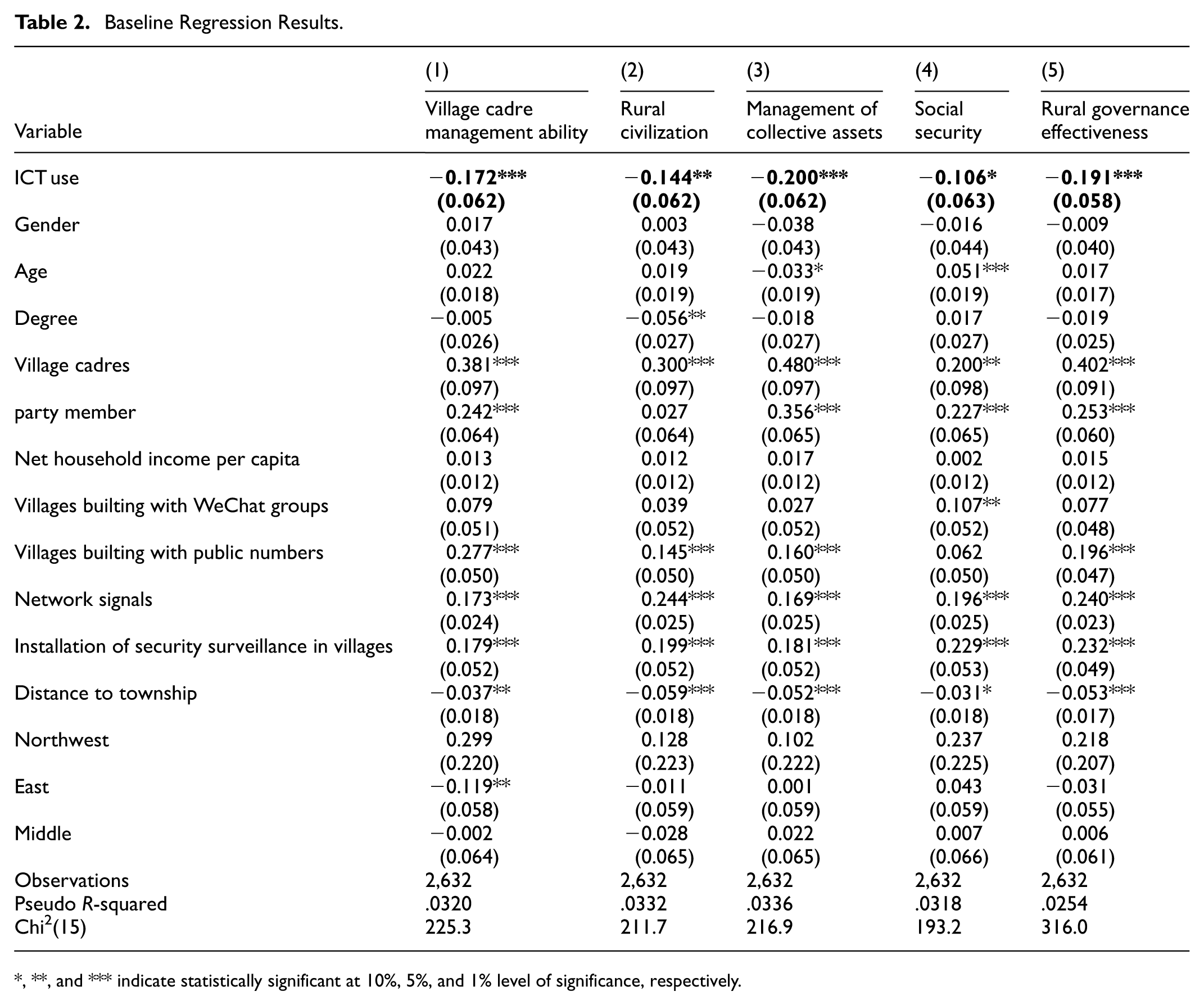
, **, and *** indicate statistically significant at 10%, 5%, and 1% level of significance, respectively.
Analyzing specific sub-indicators reveals the following insights: First, ICT use did not significantly enhance the management ability of village cadres, with an impact coefficient of −0.172. The application of ICT can significantly alter farmers’ perceptions of information exchange and social interaction (Ma & Zheng, 2021). Many village cadres are older, with lower learning abilities and cultural literacy. ICT use necessitates a certain level of technological ability and digital literacy. If village cadres lack the requisite technical knowledge for online government management, this can exacerbate the “digital divide,” rendering them “Internet refugees” and hindering their ability to leverage the Internet for effective management, thereby diminishing their management capabilities.
Second, ICT use does not significantly increase satisfaction with the management of the “three capitals,” reflected by an impact coefficient of −0.200. This could be because ICT provides more information channels, but if farmers do not access authoritative and accurate information, and if governmental financial transparency is insufficient, farmers may distrust government financial management. This information asymmetry can result in lower satisfaction with the management of the “three capitals.” In current rural governance, the cross-departmental coordination of financial management still requires strengthening, necessitating sustained support from specialized human resources (e.g., interdisciplinary professionals with both financial and digital skills; Sun, 2023).
Third, ICT use negatively impacts satisfaction with rural civilization, with an impact coefficient of −0.144. Although ICT reduces information access limitations and enhances cultural literacy to some extent, the traditional rural culture in China may conflict with the modern culture represented by ICT. This cultural discord can affect farmers’ satisfaction with rural civilization.
Lastly, ICT use negatively affects social security in rural areas. The widespread adoption of ICT has potentially increased cyber fraud and cyberbullying in rural regions. With urbanization and industrialization leading to a significant migration of young and middle-aged individuals to cities, the remaining rural population predominantly consists of the elderly and left-behind children. These groups are more vulnerable to cybercrime, which threatens individual and social security and may contribute to the gradual deterioration of the security situation in rural communities.
In terms of control variables, political affiliation, party membership, internet signal strength, surveillance cameras, and proximity to the township government positively and significantly impact village governance effectiveness. Conversely, internet income and the presence of a microblogging area in the village do not show a significant effect on village governance effectiveness.
Robustness Test
To ensure the robustness of the analytical conclusions, this study employs both the Ordered Logit (Ologit) model and the Ordinary Least Squares (OLS) model for regression analysis. The results from the OLS regression, presented in Table 3, show a high degree of consistency with the findings in Table 2, thereby validating the robustness of the initial results. Similarly, the regression analysis using the Ologit model, as shown in Table 4, also demonstrates strong consistency with the results in Tables 2 and 3. Therefore, it can be concluded that the findings are robust. Specifically, the use of ICT at this stage does not significantly enhance the effectiveness of rural governance. Since our data is sourced from the grassroots level and consists of first-hand data from over 400 villages in China, it ensures robust representativeness of the overall population.
Regression Results Using OLS Model.

, **, and *** indicate statistically significant at 10%, 5%, and 1% level of significance, respectively.
Regression Results Using the Ologit Model.

, **, and *** indicate statistically significant at 10%, 5%, and 1% level of significance, respectively.
To further validate the robustness of the findings, this study replaces the core explanatory variables and re-examines the results. Previous studies have indicated that social software such as WeChat and microblogging are among the most significant platforms for ICT use with the development of the Internet (J. P. Zhang et al., 2020). Consequently, the questionnaire included a question on whether respondents used mobile applications like WeChat and microblogging to measure ICT usage. The core explanatory variables were replaced accordingly. The regression results using WeChat and microblogging as core explanatory variables, shown in the subsequent probit model, logit model, and OLS model (Table 5), are consistent with the initial results using ICT for daily information access. This consistency indicates that, at this stage, ICT usage does not significantly improve the effectiveness of rural governance.
Regression Results of Oprobit Model With Replacement Variables.

, **, and *** indicate statistically significant at 10%, 5%, and 1% level of significance, respectively.
Mechanism of Action Test
The empirical analysis confirmed that ICT use does not significantly enhance rural governance effectiveness. However, it is essential to explore the underlying mechanisms through which ICT use impacts village governance effectiveness. Existing studies have typically examined mediating variables such as social capital, village publicity, and collective action capacity (Liu & Yang, 2019; Tembrevilla, 2020; J. Wang & Li, 2018). However, these perspectives may not fully capture the overall village-level orientation required for assessing governance effectiveness. Thus, it is necessary to consider the village public perspective.
To investigate potential mediating mechanisms from a public perspective, this study examines three aspects: rural public goods supply, rural public leadership, and rural public trust. Rural public goods supply and cultural services are pivotal components of public goods. Therefore, we included a variable indicating access to public cultural services, coded as 1 for “yes” and 0 for “no.” Rural public leadership is reflected in the democratic decision-making process for significant village matters, such as road repairs and the use of collective funds. This was measured by whether these decisions are made through villagers’ representative meetings, coded as 1 for “yes” and 0 for “no.” Village public trust was assessed by participation in discussions or voting on important village affairs, also coded as 1 for “yes” and 0 for “no.”
Drawing on existing studies, this research uses the interaction terms of village public goods supply, village public leadership, village public trust, and ICT variables to analyze the impact mechanisms. The results, presented in Table 6, indicate that the ICT variables are significantly negative, suggesting that ICT does not significantly enhance rural governance effectiveness. However, the interaction terms are all significantly positive at the 1% significance level. This indicates that rural public goods provision, public leadership, and public trust positively moderate the impact of ICT on rural governance effectiveness, although they do not change the overall negative effect. These findings suggest that policies should focus on strengthening the supply of rural public goods, promoting public leadership, and enhancing public trust to ultimately improve the effectiveness of rural governance through the use of ICT.
Intermediary Mechanism Test.

, **, and *** indicate statistically significant at 10%, 5%, and 1% level of significance, respectively.
Analysis of Heterogeneity
Given the findings that ICT use does not significantly improve rural governance effectiveness, this section further explores the differential impacts of ICT use across various demographic groups. The analysis considers variations based on income, education levels, party membership, and village cadre status.
Heterogeneity Analysis Based on Different Education Levels
China implements 9-year compulsory education, so high school education serves as the dividing line. In Table 7, columns 1 to 4 represent farmers with less than a high school education, while columns 5 to 8 represent those with a high school education or higher. According to Table 7, ICT use has a significant negative impact on the rural governance evaluation among the lower-education group. Conversely, it shows a positive but insignificant correlation for the higher-education group. This discrepancy might stem from the fact that recent online media trends often favor critical reporting to attract more traffic. Farmers with lower education levels are more susceptible to such media influences, whereas those with higher education are more likely to base their participation on independent thought due to their greater cultural literacy.
Degree Group Differences, Low Degree Group Showing More Significant Differences.

, **, and *** indicate statistically significant at 10%, 5%, and 1% level of significance, respectively.
Heterogeneity Analysis Based on Various Social Capitals
Political visibility and status within the village represent crucial dimensions of social capital (X. Q. Li et al., 2019). In Table 8, columns 1 to 4 delineate farmers devoid of village leadership roles, while columns 5 to 8 represent those occupying such positions. Similarly, Table 8 segregates farmers into non-party members (columns 1–4) and party-affiliated individuals (columns 5–8). Notably, Table 9 reveals a significant negative correlation between ICT utilization and farmers outside the cadre cadre group. Likewise, Table 9 indicates a negative and statistically significant association between ICT use and farmers lacking party affiliation.
Cadre Group Differences, Non-Village Cadres Status Showing More Significant Differences.

, **, and *** indicate statistically significant at 10%, 5%, and 1% level of significance, respectively.
Party Member Group Differences, Non-Party Member Status Shows More Significant Differences.

, **, and *** indicate statistically significant at 10%, 5%, and 1% level of significance, respectively.
This phenomenon may be attributed to the prevalent influence of “elites” in Chinese rural areas, where party members and village cadres wield substantial social capital, thus assuming pivotal roles in rural governance. Conversely, individuals with limited social capital among the rural populace have historically been less involved in governance affairs, thereby lacking a nuanced understanding of rural governance challenges and consequently offering lower evaluations of governance efficacy. Consequently, the imperative arises to restructure rural governance frameworks, facilitating the active participation of ordinary farmers in governance processes and fostering a transition toward a model of collaborative rural governance involving diverse stakeholders.
Conclusions
Enhancing the efficacy of rural governance stands as a pivotal endeavor in advancing the modernization of the socialist governance system. In the contemporary era, digital technology emerges as a critical instrument for innovating governance systems. However, its role in rural governance warrants scrutiny. Drawing upon empirical data from 11 provinces, this study endeavors to shed light on this aspect.
Benchmark regression analysis indicates a significant adverse impact of ICT technology on the evaluation of village cadres’ managerial competence, rural civilization satisfaction, and rural security satisfaction—components reflective of three capital management satisfaction. This suggests a discrepancy between the anticipated enhancement of rural governance efficacy through ICT technology and the observed outcomes. While regional initiatives prioritize the establishment of digital villages and augmenting rural governance infrastructure, the anticipated benefits often fail to materialize in practice. Investments primarily focus on bolstering hardware infrastructure to enhance service accessibility for residents. However, this approach overlooks the nuanced digital needs of rural inhabitants, thereby resulting in a mismatch between digitalization efforts and the efficacy of rural governance. Consequently, existing rural governance effectiveness remains largely unaffected, impeding substantial progress.
Heterogeneity analysis underscores that low-income, low-education, and socially disadvantaged farmers exhibit diminished assessments of rural governance efficacy following ICT technology adoption. This phenomenon likely stems from the widened access to information afforded by ICT advancements. However, the persisting “digital divide” underscores the neglect of internet proficiency cultivation among these demographics. Consequently, rural elites wield disproportionate influence in public governance, exacerbating the disparity in governance efficacy experienced by economically and socially marginalized farmers.
While this study employs farmers’ evaluations of rural governance efficacy as a metric, it acknowledges the dynamic nature of such assessments. However, the reliance on single-point-in-time data sources constrains the depth of analysis. Hence, further research leveraging subsequent and more recent data is warranted to augment the discourse on the impact of ICT technology on rural governance efficacy.
Primarily, prioritizing the digital empowerment of economically disadvantaged, less educated, and socially marginalized farmers is imperative. Efforts should concentrate on narrowing the digital divide through targeted interventions encompassing rural digital governance advocacy and internet literacy training.
Secondly, fostering the proliferation of village public platforms such as village public accounts and WeChat mini-programs is essential. Strengthening the infrastructure of public platforms facilitates broader farmer participation in public affairs, streamlines the operational complexities of digital governance, and invigorates farmer engagement in rural governance, thereby advancing the trajectory toward effective rural self-governance.
Lastly, governmental initiatives should recalibrate digital village construction strategies to align with the imperatives of modernizing rural governance. The overarching goal remains enhancing farmers’ well-being and safety. Thus, initiatives should prioritize responsiveness to farmers’ governance needs through data-driven policymaking, leveraging big data insights to formulate objective and scientifically grounded policies.
Certainly, our study may have some limitations. For instance, the data used are cross-sectional rather than panel data, which leaves room for enrichment and expansion in terms of data richness and analytical depth. Additionally, due to certain methodological perspectives, there may be scope for improvement in both the selection of research indicators and specific analytical approaches. In future research, we will strive to conduct more in-depth explorations to enhance the robustness and comprehensiveness of our findings.
Footnotes

Ethical Considerations
Ethics approval is not required for this study.
Consent to Participate
The researcher sought and got the consent of the participants to participate in the study. All information is anonymized and the submission does not include images that may identify any persons.
Author Contributions
Formal analysis, M. Z.; Resources, S. G., Y. Z.; Writing—original draft, F.C. All authors have read and agreed to the published version of the manuscript.
Funding
The authors disclosed receipt of the following financial support for the research, authorship, and/or publication of this article: This work was supported by the Zhejiang Provincial Philosophy and Social Sciences Planning Project (Grant No. 25NDJC037YBMS), the Fundamental Research Funds for the Provincial Universities of Zhejiang and the Ministry of Science and Technology of China with the National Key Research and Development Program (No: 2025YFE0111301).
Declaration of Conflicting Interests
The authors declared no potential conflicts of interest with respect to the research, authorship, and/or publication of this article.
Data Availability Statement
Data Availability Data will be made available on request.
Code Availability
Code written in Stata 15.1; available upon reasonable request from the corresponding author.