



Abstract
In recent years, the number of international students studying in China has grown steadily. Among them, students from the Association of Southeast Asian Nations (ASEAN) constitute a significant proportion. This trend suggests that research on the acculturation of this group is warranted. Through a questionnaire survey and semi-structured interviews, this study investigated acculturation status (including psychological and sociocultural adaptation), acculturation strategies, and major influencing factors among ASEAN students studying in Guangxi. The study found that participants demonstrated overall smooth adaptation but exhibited relatively poor performance in specific sub-dimensions (e.g., emotional experiences, ecological adaptation, and interpersonal communication) and predominantly adopted an integration strategy. Four primary factors affecting acculturation have been pinpointed: ethnic identity, perceived attitude, social support, and language proficiency. By contrast, future career plans were not found to affect acculturation. The study suggests that universities should implement the following educational support measures: enhancing tailored psychological counseling, organizing diverse international cultural activities, adopting integrated management approaches, offering enhanced language training, and improving faculty communication skills.
Keywords
Introduction
As internationalization advances, more students choose overseas study to expand their perspectives, strengthen their professional skills, and look for more promising job chances. Driven by the “Belt and Road” initiative, China has forged robust bilateral economic and trade links with numerous countries. As a result, the number of international students choosing to study in China has been on the rise, and China became the world’s fourth-largest study destination in 2020 (James, 2022). Among them, international students from the Association of Southeast Asian Nations (ASEAN) constitute a significant portion, for historical and geographical reasons. When international students leave their homeland to study abroad, they need to adapt to changes in daily life in an unfamiliar cultural environment and familiarize themselves with new socio-cultural norms. These challenges often lead to psychological stress and acculturation issues, such as language difficulties, homesickness, loneliness, depression, and increased stress levels (Cao et al., 2024; Lovin et al., 2023; Qu & Dai, 2024). Numerous studies have investigated the acculturation status and influencing factors of students’ overseas study (e.g., O’Reilly et al., 2010; Song & Xia, 2021) and suggested measures to facilitate acculturation (e.g., Krsmanovic, 2020; L. Li & Shao, 2023). While there is a wealth of studies on the acculturation of foreign students in major cities like Beijing and Shanghai, far fewer studies have examined this process among students in less-developed areas. The high level of development and internationalization in big cities can enrich the life experiences of foreign students in China. However, not all international students study in these developed cities and regions (Ding, 2016).
In addition to developed cities and regions, many international students also decide to study in less-developed areas, such as Guangxi, the location of the current study. This paper investigates the acculturation of students from ASEAN in the Guangxi Zhuang Autonomous Region, known as “Guangxi” for short. Guangxi is a less-developed region in China. Its GDP ranks 19th among China’s 31 provinces and regions in 2024 (Hua Jing Industrial Research Institute, 2025). Situated in southern China, Guangxi is adjacent to Vietnam, one of the ASEAN countries. This geographical proximity has historically facilitated close interactions between Guangxi and the ASEAN region. Historically, Guangxi has been a significant gateway for trade and cultural exchanges between China and Southeast Asian Nations. The Maritime Silk Road, which connects China to the broader Southeast Asian region, passed through Guangxi, thereby fostering economic and cultural ties over centuries. This research aims to illuminate the current acculturation status, strategies, and key influencing factors of ASEAN students in Guangxi, thereby providing a deeper look into the lives and studies of international students in less-developed areas of China.
Literature Review
Acculturation
Previous scholars have conceptualized acculturation in a variety of ways. Redfield et al. (1936, p. 149) defined acculturation as “those phenomena which result when groups of individuals having different cultures come into continuous first-hand contact which subsequent changes in the origin cultural patterns of either or both groups.” In the definition, acculturation was proposed as a group phenomenon. Graves (1967) introduced “psychological acculturation” at the individual level. In this context, acculturation refers to the changes that occur in an individual when their cultural group is in the process of acculturation. Although the definition implies changes to both groups, most changes actually occur in the non-dominant group due to the influence of the dominant (society of settlement) group.
Another concept closely related to acculturation is adaptation. According to Ward and Kennedy (1993), acculturation is a phenomenon and process that can lead to two types of outcomes: psychological adaptation and sociocultural adaptation. Psychological adaptation involves feelings of well-being and satisfaction, whereas sociocultural adaptation refers to the ability to “fit in” or effectively navigate the interactive aspects of the host culture. Adaptation, in this context, refers to individual psychological well-being and the ways in which individuals manage sociocultural aspects. It is considered both the strategies used during acculturation and its outcome, which occurs when individuals and groups of different cultural backgrounds meet.
Berry (1980) viewed acculturation as a learning process in which an individual lives and interacts within two distinct cultures. This process involves two main elements: preserving one’s original culture and developing a relationship with the new culture. Based on how individuals relate to their original culture and the host culture, Berry (2005) identified four acculturation strategies: integration, assimilation, separation, and marginalization. Integration occurs when individuals actively maintain their original cultural heritage while also engaging with the host culture. Assimilation happens when individuals abandon their original culture in favor of fully adopting the host culture. Separation is when individuals strive to keep their own cultural identity and minimize contact with the host culture. Ultimately, marginalization occurs when individuals lose their connection to both their original culture and the broader society.
Although acculturation occurs at both the group and individual levels, this paper focuses specifically on the individual level. Moreover, the paper incorporates Ward and Kennedy’s (1993) two-dimensional framework of adaptation and Berry’s categorization of acculturation strategies (integration, assimilation, separation, and marginalization). Specifically, the paper will investigate individuals’ psychological and sociocultural adaptation, as well as the acculturation strategies they employ.
Previous Studies on International Students’ Acculturation
Acculturation is shaped by both individual attributes and socio-cultural conditions. At the individual level, key elements include personality traits, intercultural knowledge, linguistic competence, ethnic self-identification and future orientation. Empirical work shows that an open, novelty-seeking disposition, together with prior intercultural training and experience, facilitates smoother acculturation (Lee et al., 2013; Suanet & Van de Vijver, 2009). Ethnic identity has repeatedly emerged as a significant predictor of psychological and sociocultural adjustment (J. Li & Han, 2021; Phinney, 1992). High proficiency in the host language is widely reported to alleviate adjustment difficulties, exert beneficial effects and accelerate the acculturation process (Mori, 2000). Moreover, future plans—particularly the intention to remain in the host society—have been found to shape the selection of acculturation strategies (Tartakovsky, 2012). At the socio-cultural level, acculturation is conditioned by cultural distance, perceived discrimination and social support. Cultural distance refers to the divergence in social conventions and ecological realities between the heritage and receiving cultures; it moderates both the stress experienced by sojourners and the difficulties they face in adjusting. Empirical evidence suggests that a reduced cultural gap forecasts positive acculturative outcomes (Babiker et al., 1980; Bochner, 1972). In contrast, perceived discrimination has been documented to undermine international students’ sociocultural and psychological adaptation in China (Yang et al., 2023). Social support, meanwhile, is found to facilitate international students’ sociocultural adjustment by granting access to vital resources (Mallinckrodt & Leong, 1992; Taylor et al., 2004).
Previous scholarship has predominantly explored the acculturation process of international students in Western contexts (Tian & Lu, 2018). As China has become a major destination for international students, research on this population has gained increasing attention. Investigations have addressed their study motives (e.g., English et al., 2016), the challenges and stress they confront(e.g., Wu et al., 2025 ), the and the determinants shaping their acculturation trajectories. Nevertheless, most of these inquiries treat international students in China as an undifferentiated whole, seldom concentrating on a particular regional cohort. Given that students from diverse countries and regions embody distinct cultural traditions, social norms and value systems, a focused analysis of a specific subgroup is essential for a nuanced understanding of how cultural distance influences the acculturation process.
The ASEAN is a regional intergovernmental organization comprising 10 Southeast Asian countries: Brunei, Cambodia, Indonesia, Laos, Malaysia, Myanmar, the Philippines, Singapore, Thailand, and Vietnam. China and ASEAN share close geographical ties, with Southeast Asian nations located to the south of China. This proximity has historically facilitated trade, cultural exchanges, and people-to-people interactions. Therefore, international students from this region deserve special attention. While existing research has focused on international students in developed Chinese megacities, the experiences of those in less-developed regions remain markedly understudied. Investigating the unique challenges faced by ASEAN students in these contexts is crucial for developing targeted support systems that can enhance their academic success, psychological well-being, and foster stronger people-to-people bonds within the China-ASEAN community. This study seeks to explore the experiences of ASEAN students in Guangxi, China, by addressing the subsequent research questions:
(1) To what extent do ASEAN students acculturate in Guangxi, China?
(2) Which acculturation strategies do ASEAN students tend to adopt during the acculturation process?
(3) Across the variables investigated, which ones significantly influence the acculturation of ASEAN students in Guangxi, China?
(4) What educational support can Chinese universities implement to facilitate the acculturation of ASEAN students?
Method
Participants
The sample consisted of 235 ASEAN students studying in Guangxi, China. Since the research focuses specifically on university students from ASEAN countries, international students from other regions and non-student participants were excluded. These students were selected via purposive sampling and met the inclusion criteria of being from an ASEAN country and currently enrolled in a diploma, undergraduate, or postgraduate program in Guangxi. Students in primary and secondary education were not included in the research. A total of 284 questionnaires were returned; after data cleaning, 235 valid cases remained.
The sample (N = 235) was predominantly female (74.9%, n = 176), with males comprising 25.1% (n = 59). Nationality distribution covered seven ASEAN countries, dominated by students from Thailand (40.0%, n = 94) and Vietnam (28.5%, n = 67), with smaller representations from Indonesia (11.9%, n = 28), Laos (7.2%, n = 17), Malaysia (5.1%, n = 12), Myanmar (4.7%, n = 11), and Cambodia (2.6%, n = 6). Educationally, undergraduates constituted the largest cohort (49.8%, n = 117), followed by non-degree students (e.g., exchange programs; 22.5%, n = 53), postgraduates (master’s/doctoral candidates; 16.6%, n = 39), and junior college enrollees (11.1%, n = 26). Regarding study duration in China, 36.6% (n = 86) had resided for 6 to 12 months, 31.1% (n = 73) for 1 to 3 years, and 20.0% (n = 47) for >3 years, while only 12.3% (n = 29) reported short-term stays of 1 to 6 months. The cohort skewed toward younger demographics, with 79.1% (n = 186) aged 18 to 23 years, 14.9% (n = 35) aged 24 to 29 years, and 6.0% (n = 14) aged 30 years or older.
Measures
The study employed a mixed-methods design, which enabled the cross-validation of quantitative patterns with qualitative narratives, thereby enhancing the credibility of the findings.
Questionnaires
This online questionnaire elicited data on demographic background (5 items), acculturation status (27 items), acculturation strategies (12 items), and factors influencing acculturation (18 items). Among these items, the acculturation status was divided into psychological adaptation (9 items) and sociocultural adaptation (18 items). All questionnaire items were presented bilingually in English and Chinese. Excluding the demographic items, all measures employed a five-point Likert scale, anchored from 1 (strongly disagree) to 5 (strongly agree).
The Psychological Adaptation Measurement Scale, adapted from Bradley’s (1994) Well-being Questionnaire and Rosenberg’s (1965) Self-esteem Inventory, was used to assess participants’ psychological adaptation in terms of mental health, emotional experiences, and life satisfaction. Items such as “I hold a positive attitude toward overseas study” are designed to assess the respondents’ mental health, “I feel happy and relaxed studying in China” to assess their emotional experiences, and “I still maintain my hobbies and interests” to assess their life satisfaction.
The Sociocultural Adaptation Measurement Scale, adapted from Ward and Kennedy’s (1993) Sociocultural Adaptation Scale, was implemented to measure participants’ sociocultural adaptation in the areas of interpersonal communication, academic adjustment, social participation, and ecological adaptation. Examples of items in sequential order include: “I can interact well at social events with local people,”“I can manage my academic affairs,”“I can collaborate effectively with international students and Chinese students,” and “I can adapt to the climate and weather in Guangxi.”
The Acculturation Strategies Scale was designed to assess ASEAN students’ tendencies toward maintaining their own cultural identity or seeking daily interaction with the mainstream cultures, based on Berry’s categories of adaptation strategies (assimilation, integration, separation, marginalization). “I am very active in organizations or associations of my own ethnic group.” is an example of maintaining their cultural identity, and “I prefer the class format where international students study with Chinese students” is an example of seeking daily interaction with other cultures.
The Influencing Factors Measurement Scale, adapted from Zhang and Zeng (2023)’s Social Adaptation Influencing Factors Questionnaire was used to investigate the different extent of the influence. The five factors (sub scales) include future plans (two items), ethnic identity (four items), perceived attitude (four items), social support (four items), and language proficiency (four items). An example of an item in future plans is “I plan to work in China after graduation.” An example of an ethnic identity item is “I have a lot of pride belonging to my own ethnic group.” An example of a perceived attitude item is “I am treated equally in social situations such as metro, bus, or taxi, as other Chinese people.” An example of a social support item is “The Chinese local community provides me with opportunities to get connected with Chinese people and make Chinese friends.” An example of a language proficiency item is “I can read Chinese in everyday life, such as menus, billboards, train schedules, and signs, etc.”
Data Collection Procedures
Data collection was carried out via the Wenjuanxing, a professional online questionnaire platform widely used in China. The questionnaire link was sent to international student counselors at universities in Guangxi, who shared it with students. Participants were informed about the study’s purpose, confidentiality of responses, and voluntary participation. As a token of appreciation for their involvement, a random digital cash bonus was provided after completing the questionnaire.
Reliability Analysis
As shown in Table 1, all four subscales demonstrated satisfactory reliability, with Cronbach’s alpha coefficients of .858, .915, .845 and .906, respectively—each exceeding the conventional .70 threshold. The overall scale yielded an internal consistency coefficient of .956. Because Cronbach’s alpha values above .70 are typically regarded as acceptable and higher values reflect strong inter-item correlations (Lavrakas, 2008), these results confirm the high reliability of the entire instrument.
Correlations of the Variables.

Semi-Structured Interviews
Semi-structured interviews were conducted to supplement and interpret the questionnaire results. Fifteen participants were purposively sampled from the initial quantitative cohort for in-depth interviews, providing rich, contextual insights into their lived experiences. All participation was voluntary, and a small bonus was offered as compensation. The interviewees represented diverse nationalities, genders, ages, lengths of residence in China, and levels of acculturation. The interviews explored participants’ personal experiences, emotions, challenges in acculturation, and coping strategies. Each session lasted roughly 30 min and, with interviewees’ consent, was recorded and later transcribed. The coding method for interviewees is “nationality + gender + serial number” where ID represents Indonesia, TH represents Thailand, VN represents Vietnam, LA represents Laos, KH represents Cambodia, and MY represents Malaysia. F and M denote female and male, respectively. For example, the code VN-M-9 refers to a male participant from Vietnam.
Results
Quantitative Results
Results of ASEAN Students’ Acculturation Status
Descriptive statistics in Table 2 reveal that ASEAN students’ acculturation status in Guangxi is characterized by moderately high levels of psychological adaptation (M = 3.87) and sociocultural adaptation (M = 3.76). Both means surpass the midpoint benchmark (3.5 on a 5-point scale), suggesting effective adjustment to local academic and sociocultural environments. Among the three sub-dimensions of psychological adaptation, physical and mental health has the highest score, followed by life satisfaction, while emotional experience has the lowest. This indicated that ASEAN students may have unfavorable emotional experience. Among the four sub-dimensions of sociocultural adaptation, academic adaptation (M = 3.88) has the highest score, followed by social participation (M = 3.87), interpersonal communication (M = 3.73), and ecological adaptation (M = 3.64) has the lowest. The mean of interpersonal communication and ecological adaptation are lower than the overall mean of sociocultural adaptation, indicating that ASEAN students in Guangxi have less favorable adaptation in these two areas. Overall, ASEAN students acculturate quite well in Guangxi. However, the mean scores in emotional experience, interpersonal communication, and ecological adaptation are lower than the overall acculturation score, which indicates that more attention should be paid to these sub-dimensions.
Descriptive Statistics of Acculturation Status.
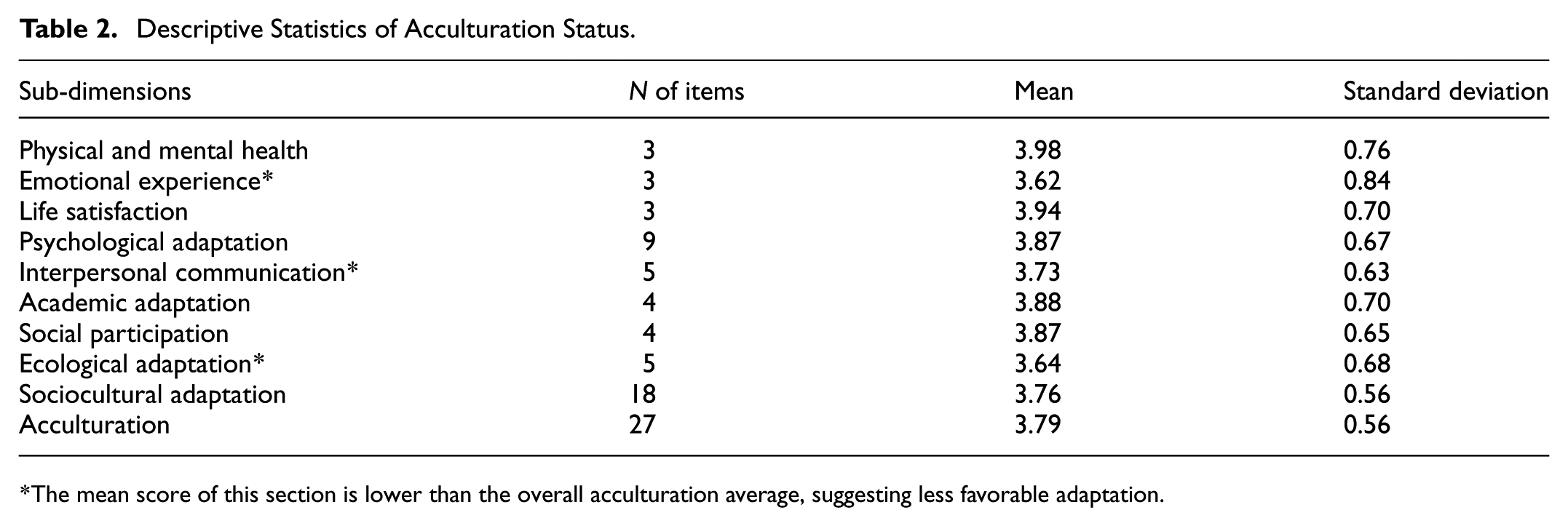
The mean score of this section is lower than the overall acculturation average, suggesting less favorable adaptation.
Results of ASEAN Students’ Acculturation Strategies
Table 3 provides an overview of ASEAN students’ acculturation strategies. The descriptive statistics indicate that the mean score of tendency to retain original culture is 3.82, and the mean score of establishing a relationship with the new culture is 3.76, both of which are above 3.5.
Results of Acculturation Strategies From the Questionnaire.

Consistent with Berry’s (1997) acculturation framework, ASEAN students in Guangxi predominantly exhibit integration strategy, balancing cultural retention with active engagement in the host society’s cultural practices. These results suggest that ASEAN students in Guangxi predominantly implement an integration strategy defined by Berry in which sojourners simultaneously preserve their heritage culture while selectively incorporating elements of Chinese social culture during acculturation. The scores of maintaining original culture is higher than accepting the new culture, indicated that those international students have a deeper attachment to their home country.
Results of Factors Influencing Acculturation
As indicated in Table 4, five influencing factors (ethnic identity, social support, perceived attitude, language proficiency, and future plans) were regressed on acculturation. The r-square of the model is 0.693, indicating that these factors explain 69.3% of the variance in acculturation. The results of the Multicollinearity test (VIF) were less than 5, indicating no collinearity. Multicollinearity diagnostics revealed VIF values below 5, confirming the absence of problematic collinearity, while Durbin-Watson statistics approximated 2, indicating no discernible auto-correlation. Consequently, as presented in Table 4, the regression equation validly depicts the associations between the five focal predictors and acculturative outcomes. The formula obtained in this study is:

Regression Between Acculturation and Influencing Factors.

Note. ***p < 0.001.
The statistical outcomes indicate that ethnic identity (β = .307, p < .01), social support (β = .242, p < .01), perceived attitude (β = .240, p < .01), and language proficiency(β = 0.218, p < .05) exert a substantial positive impact on acculturation whereas future plans (β = .023, p > .05) fail to do so.
Qualitative Results
The semi-structured interviews conducted in the study have two functions: first, to further explain the questionnaire results, thereby exploring the reasons behind the responses; second, to delve into the inner world of ASEAN students, capture their perspectives, and gain a deeper insight into their acculturation in Guangxi. Through this mixed-methods approach, we better understood ASEAN students’ acculturation process, strategies, and influencing factors. Details are discussed in the Results and Discussion section.
Discussion and Educational Support
Discussion of Acculturation Status
The quantitative findings reveal favorable psychological and socio-cultural adaptation outcomes among ASEAN students in Guangxi, which aligns with prior empirical evidence regarding international students in China (e.g., Song & Xia, 2021; Zhang & Zeng, 2023). There may be several reasons for their good acculturation status. Firstly, with the highly developed information and network technology, people from all over the world can connect and communicate with each other, thereby increasing mutual understanding and adaptation. Secondly, Guangxi, located in the southwest of China, is geographically proximate to the ASEAN region and shares borders with some of its countries. The two regions exhibit similarities in weather, climate, customs, and social cultures. These factors shorten the cultural distance between Guangxi and ASEAN countries. According to cultural distance theory (Beugelsdijk & Welzel, 2018) international students from countries with a smaller cultural distance to the host country tend to experience less culture shock and adapt more rapidly.. The smaller cultural distance between Guangxi and ASEAN countries, due to their geographical proximity and historical connections, contributes to the better acculturation of ASEAN students in Guangxi.
In the seven sub-dimensions of acculturation, the mean score of emotional experience is lower than that of psychological adaptation. Additionally, ecological adaptation and interpersonal communication are lower than sociocultural adaptation in mean scores. This indicates that ASEAN students face more acculturation challenges in these three aspects. The ASEAN students’ narratives in the interviews further support and explain the qualitative results.
Regarding emotional experience, emotions represent strong and intense psychological reactions, often triggered by specific events or situations. When individuals relocate to a culturally distinct country, they are likely to encounter various interpersonal and environmental challenges, which may lead to emotional difficulties. The ASEAN students’ answers in the interviews explained their problems in emotional experience. For instance, the interviewee YN-F-7 showed his sense of loneliness: “I feel lonely when I stay alone in the dormitory.” The interviewee YN-F-8 showed his homesickness: “Sometimes, I miss my home and my family when I’m lying in my bed at midnight.” The interviewee MY-F-15 showed his worries and anxiety: “It’s common for me to avoid traveling too far from my school here in China on my own, as I’m concerned there might be no one around to help me if I need assistance..”
As for ecological adaptation, it includes adaptation to population density, noise levels, climate and weather, pace of life, and daily diet in the study. Among these, the adaptation to daily diet (M = 3.57) and population density (M = 3.58) are the lowest two. The respondents’ answers in the interviews further explain their reasons for the acculturation problems. The interviewee YN-M-3 said: “As a Muslim, I find there is no dedicated food service window catering to us, and our main meal choices are minimal..” The interviewee TH-F-5 said: “I don’t like the oily, salty, and spicy Chinese food. It’s too strong; I can’t get used to it.” Besides, China has the largest population in the world, and the population density brings mal-adaptation to some individuals. The interviewee LA-F-12 said: “Once I traveled to Guangzhou with my classmates. Because it was too crowded in the subway, I didn’t get off the subway when my classmates did.”
As for interpersonal communication, the ASEAN students face challenges in understanding non-verbal communication and social norms. The intervieweeID-M-3 said: “People often smile, even to strangers in my country. But I find that Chinese people don’t frequently smile, so I think they are cold to me.” In fact, his feeling is due to a misunderstanding of the Chinese ways of expressing emotions. Affected by the traditional Chinese value of “moderation,” Chinese people are relatively modest, reserved, and introverted. As a result, the natural facial expressions of Chinese people were misinterpreted as “indifferent” by the interviewee.
All in all, ASEAN students have a good acculturation status in Guangxi. However, their performance in three aspects—emotional experience, ecological adaptation, and interpersonal communication—is not satisfactory.
Discussion of the Acculturation Strategies
The integration hypothesis proposes that individuals with integrative attitudes, who prefer to be doubly or multiply engaged in both their heritage cultures and other cultural groups, are more successful in achieving higher levels of psychological and sociocultural adaptation (Park et al., 2023). The questionnaire results show that both their willingness to maintain their original culture (M = 3.79) and their willingness to accept the host culture (M = 3.79) are higher than 3.5. This indicates that this group of students pursues an integration strategy in the acculturation process. When asked “Which kind of class do you prefer, specifically for international students or melting with Chinese students?” Most of they prefer the latter. The interviewee KH-F-14 said: “I like having classes with Chinese students, because I have more chances to communicate with them and get to know more about China and Chinese people.” The interviewee YN-F-1 added “In this way, I can make more Chinese friends.” The interviewee YN-M-9 said: “Having classes with Chinese students gives me more chances to speak Chinese. It’s essential for improving my Chinese.”
Discussion of Factors Influencing Acculturation
Four of the five examined predictors—ethnic identity, social support, perceived attitudes, and language proficiency—emerged as significant determinants of acculturation outcomes in the present study. This result aligns with prior empirical evidence on international students in China(English et al., 2021; English & Zhang, 2020; Mori, 2000).
Regression results indicate that ethnic identity (β = .304, p < .01) exerts the strongest influence on acculturation. International students maintaining their original ethnic culture and identity means that they can maintain a good psychological connection with student groups from their home country and obtain support and help from these groups.
Social support (β = .242, p < .01) is the second most significant factor influencing their acculturation. When the international students leave their families and friends for a new country, they need to establish new social connections and support networks. Good social support helps them relieve pressure and anxiety and enhances their adaptation. When encountering emotional, academic, or social issues, they can receive more support and feel loved, thus making it easier to solve these problems.
Perceived attitude (β = .240, p < .01) is the third most significant factor influencing their acculturation. International students may be subject to subtle threats, such as ethnic discrimination and stereotypes, which are key factors affecting their mental health and interpersonal relationships( English & Zhang, 2020; Poyrazli & Lopez, 2007) . As both ASEAN countries and China are Asian nations and are categorized as developing countries, ASEAN students have a lower possibility of being prejudiced or discriminated against. Besides, as Guangxi is a less-developed region with a low degree of internationalization, the local people may have fewer chances of encountering foreigners. As a result, they may show more concern for international students out of curiosity. Interviewee YN-F-2 described his experience of being nicely treated: “The Chinese people are very friendly. Once, I asked a staff member in the supermarket where the sauces were located. When I told her that I was a foreigner, and she specifically took me to the place where the sauces were kept.”
Language proficiency (β = .218, p < .05) also significantly predicts acculturation outcomes, consistent with the results of previous research (Tian & Lu, 2018). This research found that language proficiency plays a key role in international students’ acculturation. Language barriers are the biggest obstacles to their communication in daily life and academic settings in the host country. The interview results corroborate the survey findings. Interviewee YN-F-9 expressed his distress, saying, “My Chinese is poor. Therefore, I can’t follow what the teachers are saying in class. This really distresses me.” A good command of the language means that international students are able to understand what teachers are saying in the classroom and communicate with people in daily life, which are crucial for successful acculturation.
Our study revealed that future plans (β = .023, p > .05) do not significantly affect acculturation, a result that diverges from prior studies. For instance, Tartakovsky (2012) suggested that individuals who plan to reside in the host country, especially those with an inclination to immigrate, are more likely to pursue either assimilation or integration strategies, which in turn lead to better acculturation. Zhang and Zeng’s (2023) study found that international students’ desires to pursue further study or work in Wuhan, China, have a positive effect on their acculturation . There may be several reasons for the different result. First, compared with first-tier cities or developed regions in China, Guangxi has a relatively lower level of educational openness and economic development. Its capacity to enroll international students for further education and employment is relatively limited. Second, some ASEAN students do not have clear plans for their future and have no expectation of working in China. Some interviewees’ answers confirmed this speculation. Interviewee LA-M-11 said, “I haven’t thought about my future.” Interviewee LA-F-12 said, “I don’t plan to work in China after graduation, because it’s too hard for me.”
Educational Support
ASEAN students in Guangxi are an essential part of international students in China. The study of their acculturation status, strategies, and influencing factors holds vital implications for research on international students in less-developed regions of China. Based on the above results and discussion, universities can adopt the following educational support to help enhance international students’ acculturation.
First, psychological counseling services should be provided for international students. Our survey has found that international students have relatively poor emotional experiences, some of whom exhibit mild psychological issues such as loneliness, homesickness, and anxiety. To support international students’ psychological well-being, institutions should prioritize identifying early signs of psychological distress (such as loneliness or academic pressure), providing access to pre-approved mental health resources (like university counseling hotlines and online support groups), and connecting students with alumni mentors for peer-to-peer advice via video calls. The psychological support systems primarily aim to provide accessible, culturally sensitive mental health services..
Second, diverse international cultural activities should be held to enhance their adaptation. Since previous studies and our study have found that the integration strategy adopted by international students enhances their adaptation, universities could organize additional sociocultural activities to facilitate international students’ smoother integration into Chinese society. These activities can range from cultural exchange festivals that showcase diverse traditions to language-learning workshops where students can interact with peers from various backgrounds, thus promoting mutual understanding and helping students feel more integrated into the campus community. Besides, these activities help to enhance their cultural identity and strengthen their sense of value and respect in China.
Third, universities should adopt integrated management of international and Chinese students. Our study found that international students have a desire to join Chinese student groups and integrate into Chinese communities. However, they are often assigned to live separately from domestic students. This separation hinders in-depth communication and integration between international and Chinese students in terms of life and study. Therefore, educators need to change their management approach and enhance communication and integration between these two groups.
Fourth, more language-focused resilience training should be offered to international students. As identified in the study, language proficiency plays a pivotall role in adaptation, and the language barrier is often the first obstacle that international students face during their overseas study. Therefore, for one thing, universities should implement specific measures to help improve international students’ language abilities. Besides, educators should provide resilience training, such as using case studies to explore language challenges in communicating with professors and in daily life. Explain to them that language problems are normal for most international students. These methods help to alleviate the anxiety and depression related to language use.
Fifth, universities should enhance the intercultural awareness and communication abilities of faculty and staff working with international students. The current study found that social support is an important factor influencing adaptation. The intercultural awareness and communication abilities of faculty working with international students have a direct impact on the adaptation of international students. Universities need to train these faculty and staff members, enhancing their knowledge and abilities in intercultural communication and service. By doing so, international students can receive high-quality academic support, psychological support, and daily life support.
Conclusion
In summary, this study enriches the existing literature on international-student acculturation by explaining the acculturation status, strategies, and influencing factors of ASEAN students in a less developed region of China. The findings offer pedagogical insights to help educators comprehend the adaptation challenges faced by these students in China. The study also provides actionable guidance for universities to develop supportive policies and extracurricular programs that foster the integration of international students into the host culture. Although this study was conducted in Guangxi, its findings may offer valuable implications for other less-developed regions in China that host international students. These regions often share common characteristics, such as fewer international resources, less cosmopolitan environments, and developing university support systems. The identified challenges related to emotional well-being and the need for targeted support are likely relevant in similar socio-educational contexts. However, generalizations should be made cautiously, as local policies and institutional cultures can vary significantly.
Due to limited time, a relatively small size, modest sample size, and the city’s uneven level of internationalization, the findings may not generalize to international students in other Chinese provinces or cities. Future investigations should adopt a nationwide scope to capture the heterogeneity of international students across universities in China. Additionally, this study relied on self-reported data, which may be subject to social desirability and recall bias as potential limitations. Future research should seek to incorporate objective measures, such as accelerometer data for physical activity, to overcome this limitation.
Footnotes
Acknowledgements
The authors sincerely thank the teachers and students from the participating institutions in Guangxi for their assistance in data collection.

Ethical Considerations
This study was approved by the Human Research Ethics Committee of Guangxi Normal University (Approval No: 20250820002). The research was conducted in accordance with the ethical standards of the Declaration of Helsinki.
Consent to Participate
All participants were fully informed about the study's purpose and procedures, and their rights to withdraw and confidentiality. Written informed consent was obtained from all participants.
Funding
The authors disclosed receipt of the following financial support for the research, authorship, and/or publication of this article: This work was supported by the Innovative Project of Guangxi Graduate Education (Grant No. YCBZ2025088) and the Key Project of Guangxi Higher Education Teaching Reform (Grant No. 2024JGZ160).
Declaration of Conflicting Interests
The authors declared no potential conflicts of interest with respect to the research, authorship, and/or publication of this article.
Data Availability Statement
Data sharing not applicable to this article as no datasets were generated or analyzed during the current study.