




Abstract
This study, based on the Stimulus-Organism-Response (SOR) model, examines how technological immersion, cultural novelty, and aesthetic complexity influence Association of Southeast Asian Nations (ASEAN) students’ learning feedback in contemporary Chinese mixed media art courses (specifically rice paper painting) through the mediating roles of cognitive and emotional perception. The results show that cognitive perception significantly mediates the relationships between all stimulus variables and learning feedback, while emotional perception only has a significant effect on technological immersion and aesthetic complexity. This indicates that cognitive engagement plays a critical role in shaping learning outcomes in art education, whereas emotional engagement depends on specific types of stimuli and cultural backgrounds. Theoretically, this study provides a new perspective on cognitive and emotional mechanisms in cross-cultural art education, expanding the understanding of their interaction in the art learning process. Practically, the findings offer guidance for art teaching, curriculum design, and educational internationalization, particularly in enhancing students’ cognitive and emotional engagement through immersive technologies. The study is limited by the sample’s focus on ASEAN students, lacking broader applicability to other cultural backgrounds. Future research should expand the sample to include more diverse groups and adopt longitudinal designs to explore the long-term effects on learning feedback.
Introduction
Association of Southeast Asian Nations (ASEAN) is a regional political and economic organization of 10 Southeast Asian countries that aims to promote regional cooperation, economic growth and stability. ASEAN has an increasingly close cooperative relationship with China due to its geographical advantage. In recent years, there has been a significant increase in the number of ASEAN students pursuing higher education in China. This growth is a reflection of China’s expanding role as a global educational hub, driven by initiatives such as the Belt and Road Initiative (BRI) and various scholarship programmes aimed at fostering closer ties between China and ASEAN countries (Ge (Rochelle) & Ho, 2022). The rising number of international students from Southeast Asia has not only contributed to the internationalization of Chinese universities but also enhanced cultural exchange between these regions (Xiang, 2020).
For many ASEAN students, studying in China provides a unique opportunity to immerse themselves in the rich and diverse heritage of Chinese culture. In various aspects of Chinese culture, the combination of traditional and contemporary art forms is particularly significant (L. Zhang & Yang, 2023). Chinese painting, in particular, represents a longstanding cultural tradition that continues to evolve in the modern era. Students from diverse cultural backgrounds are eager to deepen their understanding of Chinese society. As a result, there is a growing demand for courses and programmes that offer insights into China’s artistic practices, including its unique forms of painting.
Contemporary Chinese mixed media painting, which integrates traditional materials and techniques such as rice paper with modern artistic expressions, has become an important area of interest for international students. The incorporation of modern elements with traditional aesthetics provides a window into the dynamic cultural and artistic transformations occurring in China today (S. Zhao et al., 2018). Among the various elective courses offered at Chinese universities, international students show particular interest in rice paper painting. This course serves as a medium for exploring both historical and contemporary dimensions of Chinese visual culture (Subramonyam et al., 2015).
Art teaching courses have increasingly focused on immersive teaching, widely utilizing modern media technologies such as Virtual Reality (VR), Augmented Reality (AR), and digital interactive platforms. These technologies allow students to experience the details and creative processes of both traditional and contemporary Chinese painting in an immersive environment. This breaks the limitations of traditional teaching methods and provides a more dynamic, interactive learning experience. This innovative teaching approach not only enhances students’ art appreciation skills but also offers them more opportunities to engage in creative practice, further deepening their understanding of Chinese art (H. Li, 2017).
However, despite the innovations and advantages that immersive teaching brings to art education, several issues remain to be addressed. First, the reliance on technology may lead to a diminished focus on the essence of art, with over-dependence on digital media potentially weakening students’ deeper understanding of traditional painting techniques and aesthetics (González-Zamar et al., 2020). Second, the effectiveness of immersive teaching may vary among student groups with different cultural backgrounds, especially for students from ASEAN countries, whose learning needs and cultural perceptions may differ from those of Chinese students (Zhu & Zhu, 2022). Additionally, factors such as the availability of technological facilities and equipment, the design of teaching content, and individual students’ ability to adapt to these technologies may also affect the outcomes of immersive teaching (W. Li et al., 2018).
These issues can be further explored and addressed through the Stimulus-Organism-Response (SOR) framework. By analyzing how technological media (stimulus) influence students’ perceptions and emotional responses (organism), and how these responses further affect their learning behaviour and understanding of art (response), educators can more comprehensively evaluate the application of immersive teaching in art education (J. Wang et al., 2023). This approach will help optimize teaching strategies to better meet the needs of students from diverse cultural backgrounds (H. Li, 2017).
This study aims to examine the perception of ASEAN students toward contemporary Chinese mixed media painting, specifically within the context of rice paper painting courses. By utilizing the SOR model, this research would investigate how ASEAN students’ exposure to this form of art influences their emotional and cognitive responses, as well as their overall understanding of Chinese cultural heritage. In doing so, this study will contribute to a broader understanding of the role that art education plays in facilitating cross-cultural communication and enhancing the international student experience in China (Subramonyam et al., 2015).
Theoretical Background
The SOR model, originating from environmental psychology, provides a comprehensive framework for understanding how external stimuli influence internal psychological states and, subsequently, behaviour (Vieira, 2013). In the context of art education, particularly immersive learning experiences, this model offers a valuable approach to analyzing how technological and cultural elements (stimuli) affect students’ perceptions and emotions (organism) and how these, in turn, shape their learning outcomes (response) (Xia et al., 2024). In this section, we review relevant literature to identify appropriate SOR variables for examining ASEAN students’ perceptions of contemporary Chinese mixed media painting.
Stimulus Variables
In applying the SOR model to art education, particularly in the context of immersive teaching methods, the choice of stimuli is critical to understanding how external factors shape students’ cognitive and emotional responses. Three key variables can be identified from existing literature on educational technology and cross-cultural learning: technological immersion, cultural novelty, and aesthetic complexity.
Technological Immersion
Technological immersion refers to the extent to which students are engaged through immersive technologies such as VR and AR. Studies by H. Li (2017) and Makransky and Petersen (2021) show that immersive environments foster a more interactive and engaging learning experience. These environments allow students to closely observe artistic processes and techniques that are difficult to experience in traditional classroom settings. By offering a “virtual presence” in artistic spaces, these technologies can significantly enhance students’ focus and emotional involvement in art education.
Cultural Novelty
Cultural novelty relates to the unfamiliarity of cultural elements that international students encounter in a new learning environment. Research by J. Zhang and Goodson (2011) highlights that exposure to new cultural contexts, such as Chinese visual art traditions, can elicit both curiosity and anxiety in international students. This novelty serves as a double-edged sword: while it can enhance engagement by offering new learning experiences, it may also challenge students who are less familiar with the cultural nuances, thus influencing their cognitive perceptions of the learning material (Smith & Khawaja, 2011).
Aesthetic Complexity
Aesthetic complexity refers to the intricate and multifaceted nature of artistic works, which require students to engage in higher-order thinking to interpret and appreciate. As noted by Belfi et al. (2019), art forms with rich, layered meanings stimulate deeper cognitive processing and emotional responses, thereby enriching the learning experience. For ASEAN students unfamiliar with traditional Chinese painting techniques, the complexity of mixed media art—combining both traditional and modern elements—can serve as a significant stimulus, encouraging them to explore new artistic and cultural dimensions (Rosser, 2022).
Organism Variables
The organism stage in the SOR model pertains to the internal processes through which students interpret and respond to stimuli (Peng & Kim, 2014). In the context of this study, two main organism variables can be identified: cognitive perception and emotional perception.
Cognitive Perception
Cognitive perception refers to how students mentally process and understand the artistic and cultural content presented to them. Cognitive engagement with art involves not only recognizing visual and technical elements but also interpreting cultural and symbolic meanings (T. Jeong, 2020). For ASEAN students, their ability to understand Chinese mixed media painting, particularly rice paper painting, depends on their prior knowledge, cultural background, and the instructional support provided through immersive technologies (Lin et al., 2024). The integration of modern and traditional elements in Chinese art may challenge their preconceptions, prompting them to re-evaluate their own cultural frameworks (Shadiev et al., 2021).
Emotional Perception
Emotional perception encompasses the feelings and attitudes that students develop in response to the artistic and cultural stimuli they encounter (G. Zhang et al., 2021). Emotional responses can range from curiosity and admiration to confusion or even frustration, depending on how students relate to the content (Goi et al., 2018). Immersive technologies, by offering a closer, more detailed view of artistic processes, can evoke strong emotional reactions, influencing students’ overall engagement with the learning material (Cummings & Bailenson, 2015). In cross-cultural settings, emotional perception is particularly important, as students may experience a mix of positive and negative emotions when exposed to unfamiliar art forms (J. Zhang & Goodson, 2011).
Response Variable
The response variable in the SOR model corresponds to the behavioural outcomes resulting from the interaction between stimuli and internal perceptions (J. Jeong et al., 2022). In the context of this study, learning feedback serves as the primary response variable, encompassing both the students’ understanding of the material and their engagement in creative practice.
Learning Feedback
Learning feedback refers to the students’ demonstrated ability to internalize and apply what they have learned through both cognitive understanding and creative expression (Shadiev et al., 2021). In art education, particularly when using immersive teaching methods, learning feedback is often assessed through students’ ability to integrate new artistic techniques into their own work, as well as their understanding of cultural contexts (Heid, 2005). For ASEAN students, learning feedback may also reflect their capacity to navigate and synthesize different cultural and aesthetic traditions, offering insights into how cross-cultural exposure influences their artistic development.
Research Hypotheses and Quantitative Modelling
This study explores the relationships between stimulus variables, cognitive and emotional responses, and learning feedback. By analyzing how different external stimuli influence students’ cognitive and emotional states, a more comprehensive understanding of the mechanisms behind these variables’ effects on learning outcomes can be gained. Below are the specific hypotheses and the theoretical logic behind them.
External stimuli influence students’ cognitive processing through various channels (Kimiagari & Sharifi, 2021). First, technological immersion provides students with more intuitive and interactive learning experiences via immersive technologies, helping them better understand artistic forms and the cultural meanings behind them (Y. Zhao et al., 2020). Studies have shown that immersive environments, such as virtual reality, enhance cognitive engagement by providing real-time interaction with artistic elements (M. Kim et al., 2020). Second, cultural novelty plays a significant role in cross-cultural education, as exposure to new cultures and artistic forms can spark students’ curiosity and cognitive interest, encouraging them to engage more deeply with the learning content (Garrett et al., 2023). Lastly, aesthetic complexity, due to the intricate structure and diverse visual expression of artworks, prompts students to engage in deeper cognitive processing during the learning process (Parong & Mayer, 2018). Therefore, the following hypotheses are proposed:
H1a: Technological immersion significantly affects cognitive perception.
H1b: Cultural novelty significantly affects cognitive perception.
H1c: Aesthetic complexity significantly affects cognitive perception.
Emotional perception often arises alongside the experience of external stimuli (Ledoux,1989). Technological immersion, by creating highly interactive and immersive learning scenarios, can evoke emotional resonance in students, increasing their motivation and emotional involvement in learning (Duong, 2023). Meanwhile, cultural novelty introduces students to artistic and cultural expressions different from their own backgrounds, potentially eliciting positive emotions such as curiosity and wonder, deepening their emotional engagement with the learning material (Sekoguchi et al., 2019). Aesthetic complexity, by presenting challenging visual and conceptual expressions, further stimulates students’ emotional reactions, prompting deeper emotional engagement in aesthetic experiences (M. H. Li, 2019). Therefore, the following hypotheses are proposed:
H2a: Technological immersion significantly affects emotional perception.
H2b: Cultural novelty significantly affects emotional perception.
H2c: Aesthetic complexity significantly affects emotional perception.
External stimuli not only influence cognition and emotions but may also directly affect students’ learning behaviour. Technological immersion enhances students’ engagement with the learning material through highly interactive experiences, which may directly improve their learning performance (Parong & Mayer, 2018). Cultural novelty provides students with enriching cross-cultural learning opportunities, sparking their interest in learning through exposure to new cultural perspectives, thereby enhancing learning feedback (Goi et al., 2018). Aesthetic complexity pushes students to discover new dimensions of understanding in artworks, resulting in better performance and feedback in artistic practice. Thus, the following hypotheses are proposed:
H3a: Technological immersion significantly affects learning feedback.
H3b: Cultural novelty significantly affects learning feedback.
H3c: Aesthetic complexity significantly affects learning feedback.
Cognitive and emotional perceptions play a crucial role in learning feedback (Rowe, 2017). Cognitive perception reflects students’ depth of understanding of the learning material, and deeper cognition helps students demonstrate higher levels of creativity and understanding in their learning feedback (Dasgupta et al., 2018). Similarly, emotional perception, by mobilizing students’ emotional engagement, can enhance their motivation and active participation in learning, thereby improving learning outcomes (M. H. Li, 2019). Therefore, the following hypotheses are proposed:
H4a: Cognitive perception significantly affects learning feedback.
H4b: Emotional perception significantly affects learning feedback.
Cognitive perception may serve as a key mediator between stimulus and learning feedback (H. Wang et al., 2023). Technological immersion, cultural novelty, and aesthetic complexity enhance students’ cognitive processing, which in turn influences their learning performance (Sclater & Lally, 2018). For example, immersive technology enhances cognitive engagement through more intuitive visual experiences, cultural novelty stimulates cognitive curiosity and improves learning outcomes, and aesthetic complexity encourages deeper cognitive processing, enhancing creative feedback (Schulz et al., 2020). Therefore, the following hypotheses are proposed:
H5a: Cognitive perception significantly mediates the relationship between technological immersion and learning feedback.
H5b: Cognitive perception significantly mediates the relationship between cultural novelty and learning feedback.
H5c: Cognitive perception significantly mediates the relationship between aesthetic complexity and learning feedback.
Emotional perception also plays a key mediating role in the response to external stimuli (J. Kim & Lennon, 2013). Technological immersion can enhance learning feedback by evoking emotional resonance in students; cultural novelty stimulates positive emotional responses, enhancing the effectiveness of cross-cultural learning; and aesthetic complexity, by eliciting emotional experiences, enables students to display better performance in artistic practice (Garrett et al., 2023). Therefore, the following hypotheses are proposed:
H6a: Emotional perception significantly mediates the relationship between technological immersion and learning feedback.
H6b: Emotional perception significantly mediates the relationship between cultural novelty and learning feedback.
H6c: Emotional perception significantly mediates the relationship between aesthetic complexity and learning feedback.
The SOR model provides a structured framework for analyzing how external stimuli—such as technological immersion, cultural novelty, and aesthetic complexity—affect cognitive and emotional perceptions in international students (Duong, 2023). These perceptions subsequently influence learning feedback, emphasizing the critical role of cognitive and emotional engagement in art education. In the context of this study, these variables are applied to explore ASEAN students’ experiences in rice paper painting courses, a key component of contemporary Chinese mixed media painting. By examining these relationships, this study develops a quantitative research framework (Figure 1) that assesses how immersive teaching methods can be tailored to better address the diverse learning needs of ASEAN students, fostering a deeper understanding of both traditional and modern artistic practices in China.

Quantitative research framework.
Research Method
In this study, the questionnaire survey is used as the primary data collection method to gain an in-depth understanding of ASEAN students’ cognitive and emotional responses in contemporary Chinese mixed media art courses. The questionnaire survey has several advantages. First, it allows for a large-scale sample, ensuring the broadness and representativeness of the data. Second, the questionnaire is an effective tool for collecting information about students’ reactions to various aspects of the course, such as technological immersion, cultural novelty, and aesthetic complexity, while ensuring comparability of responses across different students through standardized questions (Cummings & Bailenson, 2015; Grenfell, 2013; J. Zhang & Goodson, 2011). Finally, the questionnaire method facilitates the collection of large amounts of quantitative data, which can be subjected to statistical analysis to examine and infer the relationships between variables and their impact on learning feedback.
By using a questionnaire survey, we are able to systematically measure and analyze the effects of different stimulus variables (such as technological immersion, cultural novelty, and aesthetic complexity) on students’ cognitive and emotional perceptions, and further investigate how these effects influence learning feedback through cognitive and emotional responses. This method not only helps verify the hypotheses of the theoretical framework but also provides data support for optimizing teaching strategies in cross-cultural education.
Each variable dimension in the SOR model, including stimulus, organism, and response variables, is measured through appropriate scales adapted from existing literature (Belfi et al., 2019; Casiraghi & Santolini, 2020; Cummings & Bailenson, 2015; Espasa et al., 2022; Grenfell, 2013; T. Jeong, 2020; Lin et al., 2024; Rosser, 2022; Silvia, 2005; Smith & Khawaja, 2011; J. Zhang & Goodson, 2011). After conducting reliability tests and ensuring the model’s fit, the data are analyzed through SEM to examine the relationships among the variables. Linear regression analysis is also performed to assess the direct effects of the stimuli on cognitive and emotional perceptions, as well as the indirect effects on learning feedback, mediated by cognitive and emotional responses. The results are compared to the proposed hypotheses to determine whether they are supported or refuted.
Questionnaire Design
The primary data for this research were collected using a questionnaire designed to assess the perceptions of ASEAN students regarding contemporary Chinese mixed media painting, particularly rice paper painting. A total of 30 items in the questionnaire dealt with variables, with each of the 6 key variables measured by 5 items. The variables include technological immersion, cultural novelty, aesthetic complexity, cognitive perception, emotional perception, and learning feedback, the questionnaire items from each variable are briefly explained in Table 1. These items were evaluated using a 7-point Likert scale (Likert, 1932), ranging from 1 (“strongly disagree”) to 7 (“strongly agree”), allowing for a finer differentiation in respondents’ levels of agreement or disagreement.
Dimensions Adapted From Relevant Literature.

Using a 7-point Likert scale provides more granularity in responses, which enhances the precision of the collected data and captures the nuances in participants’ perceptions (Likert, 1932) . Moreover, setting each variable to 5 items helps maintain an appropriate balance between model complexity and measurement accuracy. A higher number of items per variable increases the model’s stability by improving the overall degrees of freedom, which ensures that the model can effectively accommodate the complexity of relationships between variables while avoiding overfitting (Casiraghi & Santolini, 2020). Furthermore, the inclusion of multiple items per variable helps in capturing a more comprehensive view of the constructs, thus improving the robustness and reliability of the measurement model (Ion et al., 2018).
The degrees of freedom (df) in SEM are critical for model fit. By including 5 items per variable, we ensure a sufficient number of parameters to calculate without over-complicating the model. A well-structured model with an adequate number of items improves the likelihood of achieving a good model fit, while providing enough data points for robust path analyses (Cummings & Bailenson, 2015). A model with too few degrees of freedom can risk poor fit due to under-identification, while too many degrees of freedom could result in overfitting (Silvia, 2005). Hence, the use of 5 items per variable provides an optimal balance, contributing to both stability and validity. Table 1 outlines the variables, their operational definitions, and corresponding items, adapted from relevant literature to ensure the validity and reliability of the constructs.
The setting of the variable dimensions follows the operational definitions explained below as established in this study:
Technological immersion: Refers to the use of advanced technologies (e.g. VR, AR) to create an interactive and engaging environment for students, allowing them to closely observe artistic processes and techniques that would otherwise be difficult to experience in traditional settings (Cummings & Bailenson, 2015).
Cultural novelty: Reflects the degree of newness or unfamiliarity of the cultural content, particularly the introduction of Chinese art traditions, which may evoke curiosity and engagement or present challenges due to the different cultural perspectives(Smith & Khawaja, 2011).
Aesthetic complexity: Describes the intricate nature of the artworks, especially in contemporary mixed media forms, which require higher-order thinking to interpret, engage with, and appreciate due to their multifaceted layers and combinations of traditional and modern techniques (Belfi et al., 2019).
Cognitive perception: Focuses on the mental processes by which students comprehend and interpret artistic works, their cultural meanings, and the techniques involved in Chinese mixed media painting (T. Jeong, 2020).
Emotional perception: Involves the emotional reactions and feelings students experience when exposed to art through immersive technologies, including enjoyment, admiration, and emotional connection to the art (Silvia, 2005).
Learning feedback: Refers to the students’ ability to apply what they have learned, both in terms of cognitive understanding and creative expression, and their confidence in incorporating new artistic techniques into their own work (Espasa et al., 2022).
Sampling Procedure
The sampling process involved selecting participants from ASEAN students enrolled in Anhui Business Vocational College, Anhui Normal University, and Anhui University of Technology, who have taken rice paper painting art courses. The rationale for choosing these three universities is based on the use of a standardized curriculum in rice paper painting elective courses, which was developed under the “Technical Skills Innovation Service Platform 2021 Applied Research Project” (Project No.: 2021ZDQ26, Project Name: “Research on the Medium of Rice Paper in Contemporary Comprehensive Painting”) by the first author of this study. This consistency in educational content ensures that all participants have a comparable learning experience, thereby reducing variability and enhancing the reliability of the data collected.
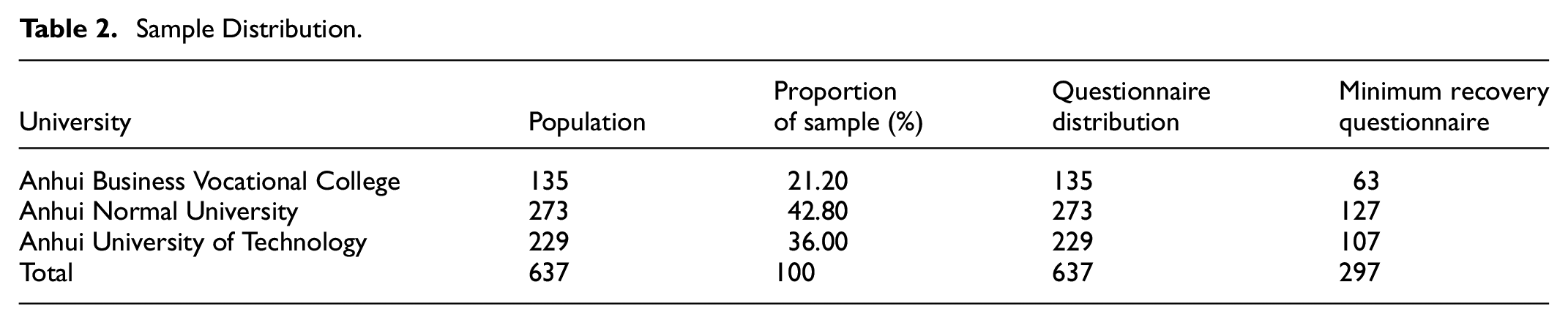
The total number of ASEAN students who participated in these courses across the three universities is 637, distributed as follows: Anhui Business Vocational College has 135 students, Anhui Normal University has 273 students, and Anhui University of Technology has 229 students. Given that the total population is relatively small, the required sample size was determined based on the formula proposed by Krejcie and Morgan (1970), the recommended sample size for a population of 637 is at least 291.
To ensure a sufficient number of valid responses, a cluster sampling method was employed. Given that the researchers can contact the coordinators of the international schools at the three universities, who have access to the list of all ASEAN students having taken the rice paper painting course, cluster sampling is highly feasible in this study. The researchers can directly obtain complete student information through these coordinators, allowing access to the entire target population without relying on random sampling to determine the sample. With a total sample size of 637, which is relatively small and manageable, cluster sampling ensures the representativeness of the sample and the adequacy of the research data. The coordinators’ assistance not only helps increase student participation and response rates but also reduces sampling errors due to improper sample selection. This method of cluster sampling allows all eligible students to be included in the study, eliminating discrepancies between the sample and the population, thereby enhancing the external validity and generalizability of the research results. Therefore, with the support of the coordinators, cluster sampling can achieve comprehensive and accurate data collection while improving the efficiency of questionnaire retrieval.
Considering that the three universities have different lecturers, and in order to ensure that the samples have sufficient statistical significance, the sample sizes of the minimum needs of the three universities were differentiated according to the proportion of the respondent population, as shown in Table 2.
Sample Distribution.
Data Analysis Methods
This study employed using Statistical Package for the Social Sciences (IBM™ SPSS™ Statistics), version 26 for Microsoft Windows™ (IBM Corp., NY, Armonk, USA) and Analysis of Moment Structures (IBM™ Amos™), version 24.0 (IBM Corp., Meadville, PA, USA) as data analysis tools. Using the acronyms of the variables as coding names, the collected data were tested for reliability and validity and correlation analyses were conducted under multiple influencing factors. First, data preprocessing was conducted using SPSS, including checking for missing values and outliers, followed by descriptive statistical analysis to understand the basic distribution characteristics of the data. Subsequently, Cronbach’s Alpha coefficient was used for reliability analysis to verify the internal consistency of each variable (Agbo, 2010). Exploratory factor analysis (EFA) was employed to determine the factor structure of the measurement items, using the Kaiser-Meyer-Olkin (KMO) value and Bartlett’s test of sphericity to assess data suitability, thus extracting key factors and clarifying the factor structure (Noorizan et al., 2016; Watkins, 2018). On the other hand, the study applied SEM for model fit analysis to evaluate the fit of the proposed hypotheses and conducted multiple regression analysis to examine the impact of each independent variable on the dependent variable (Byrne, 2016).
All dimensions of the data were converted into variable means to facilitate regression analysis, enabling an accurate understanding of the interrelationships among the variables. The influence and direction of each variable on learning feedback were determined through standardized regression coefficients (Beta) and significance levels (p-values). Furthermore, the Bootstrap method was used to test the mediating effects of cognitive and emotional perception between stimulus variables and learning feedback, with the significance of the mediating effects assessed by calculating the confidence intervals of the indirect effects. By integrating these methods, the study systematically evaluated the relationships among variables, providing reliable empirical evidence to validate the research hypotheses and uncover the mechanisms underlying ASEAN students’ perceptions of contemporary Chinese mixed media painting.
Findings and Discussion
Starting in March 2024, the research team collected questionnaires in Anhui over a 1-month period using face-to-face distribution. All respondents were allowed to participate in the questionnaire after reading and agreeing to the informed consent form for the study. A total of 596 paper questionnaires were collected, and after excluding 91 questionnaires with missing answers, 505 valid questionnaires were obtained for quantitative analysis. Among the 505 respondents, female participants (50.47%) were nearly equal to male participants (49.53%). The ASEAN students mainly came from Thailand (25.3%), Malaysia (21.4%), and Vietnam (17.5%). The number of questionnaires collected from all three universities greatly exceeded the minimum required: Anhui Business Vocational College (103), Anhui Normal University (221), and Anhui University of Technology (185).
To ensure the validity of the research model and the accuracy of the measurement structure across all variables, EFA was employed. The primary purpose of the EFA was to examine the correlation, variability, and stability among the questionnaire items and extract meaningful factors to validate the structural validity of the model (see Table 3). Principal component analysis (PCA) with oblique rotation was applied to extract the factor loadings for each item. All item factor loadings exceeded the threshold of 0.5, indicating a strong explanatory power for each item within its respective variable (Fabrigar et al., 1999; Nunes et al., 2020). Consequently, no items were excluded from further analysis .
Analysis Results of EFA (N = 505).

Note. EFA = Exploratory factor analysis; TI = Technological immersion; CN = Cultural novelty; AC = Aesthetic complexity; CP = Cognitive perception; EP = Emotional perception; LF = Learning feedback.
To further confirm the appropriateness of the data for factor analysis, the Kaiser-Meyer-Olkin (KMO) test of sampling adequacy and Bartlett’s test of sphericity were conducted (Bartlett, 1950; Kaiser, 1970, 1974). The KMO values for all variables exceeded 0.75, indicating a high level of suitability for factor analysis. Bartlett’s test of sphericity was significant (p < .001), suggesting sufficient correlation among the variables for meaningful factor extraction (Bartlett, 1950; de Barros Ahrens et al., 2020). The successful application of these tests ensures the robustness of the factor analysis and the validity of the measurement model, affirming the appropriateness of the questionnaire for evaluating the constructs in this research.
As shown in Table 4, the KMO values for all variable dimensions range from 0.75 to 0.89, indicating a high degree of sampling adequacy. Bartlett’s test of sphericity for each dimension yields a significance level of p < .001, with degrees of freedom consistently set at 10, which corresponds to the five items per variable. The explained variance for all factors exceeds 50%, demonstrating that the factors account for a substantial portion of the variability among the variables.
Results of Structural Validity Analysis (N = 505).

Note. KMO = Kaiser-Meyer-Olkin.
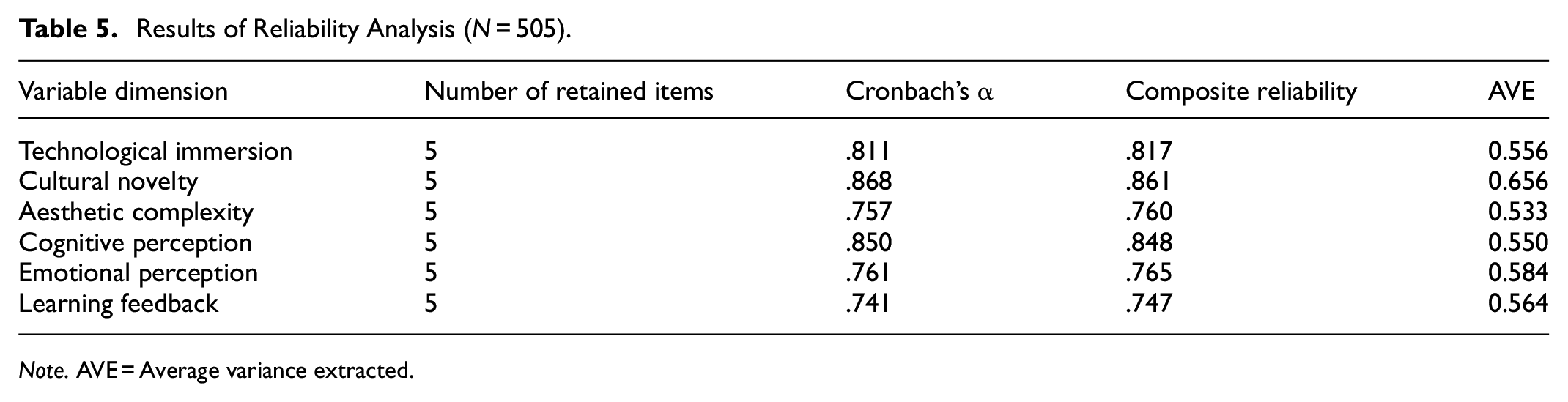
Following the factor loading analysis of the retained items, the next step involves assessing the reliability and validity of each variable by calculating convergent validity (Average Variance Extracted, AVE), basic reliability (Cronbach’s α), and composite reliability (CR). As shown in Table 4, the Cronbach’s α and CR values for each variable surpass the generally accepted minimum threshold of 0.7, which signifies that the internal consistency of the constructs is robust (Cronbach, 1951; Cronbach & Shavelson, 2004). This indicates that the items retained within each dimension reliably capture the underlying latent construct, ensuring stability across the measurements (Kawakami et al., 2020).
Convergent validity, calculated through AVE, provides a measure of how much variance is explained by the items within each dimension relative to the total variance. Hair et al. (2005) suggest that an AVE value greater than 0.5 indicates acceptable convergent validity, ensuring that the items effectively capture the construct they are intended to measure.
As indicated in Table 5, all variables exhibit Cronbach’s α values exceeding .7, which reflects a high level of internal reliability and suggests that the items within each construct consistently measure the intended dimension. Likewise, composite reliability (CR) values surpass .7 for all constructs, further reinforcing their internal consistency. The AVE values, ranging between 0.533 and 0.656, meet the minimum threshold of 0.5, providing solid evidence of convergent validity. These results confirm that the constructs demonstrate both reliability and convergent validity, ensuring that the measurement model is sound and suitable for further analytical procedures.
Results of Reliability Analysis (N = 505).
Note. AVE = Average variance extracted.
This study employed SEM to assess the fit of the six-factor model, encompassing the variables of Technological Immersion, Cultural Novelty, Aesthetic Complexity, Cognitive Perception, Emotional Perception, and Learning Feedback. The model fit indices demonstrated a good fit, with the results as follows: χ2 = 923.47 (df = 550, p < .001), Root Mean Square Error of Approximation (RMSEA) = 0.059, Parsimony Normed Fit Index (PNFI) = 0.82, Relative Noncentrality Index (RNI) = 0.94, and Tucker-Lewis Index (TLI) = 0.93. The RMSEA value below 0.06 indicates that the model’s error is within an acceptable range, while the PNFI, RNI, and TLI values exceeding 0.90 suggest strong explanatory power and internal consistency of the model (Kline, 2016). The relevant data are shown in Table 6.
Results of Model Fit Analysis (N = 505).

Note. RMSEA = Root Mean Square Error of Approximation; PNFI = Parsimony Normed Fit Index; RNI = Relative Noncentrality Index; TLI = Tucker-Lewis Index.
Further analysis of the model fit for each variable showed that all dimensions met the required standards. The RMSEA values for all variables were all below 0.07, and the TLI values were all above 0.90, indicating that each variable performed well within the model. These results confirm that the proposed six-factor model is structurally sound, effectively explaining the relationships among the variables, and providing a solid foundation for further analysis.
Multiple regression analysis (MRA) was conducted to explore the relationships between the independent variables (Technological Immersion, Cultural Novelty, and Aesthetic Complexity) and the dependent variables (Cognitive Perception, Emotional Perception, and Learning Feedback). The results of the relevant analysis are presented in Table 7.
Results of MRA (N = 505).

Note. DV = dependent variable; IV = independent variable; B = unstandardized coefficient; SE = standard error; β = standardized coefficient; t = t-statistic; p = significance; VIF = variance inflation factor; R2 = coefficient of determination.
This analysis helps to determine the extent to which these factors, along with Cognitive and Emotional Perception in the case of Learning Feedback, influence students’ experiences and outcomes in the Rice paper painting course. The results of the analysis provide insights into the significance of each variable’s contribution to students’ cognitive understanding, emotional engagement, and overall learning performance.
For Cognitive Perception (CP), the regression analysis reveals that Technological Immersion (TI), Cultural Novelty (CN), and Aesthetic Complexity (AC) all have significant effects. Specifically, the standardized coefficient for TI is β = .230 (p < .001), indicating that the more students engage with immersive technologies such as VR and AR in the Rice paper painting courses, the greater their cognitive perception of the art. CN also shows a positive effect (β = .215, p < .001), suggesting that ASEAN students, encountering Chinese cultural elements in Rice paper art for the first time, develop heightened interest, which in turn enhances their cognitive understanding. Additionally, AC (β = .190, p < .001) significantly influences cognitive perception, as the multi-layered aesthetic complexity of Rice paper painting stimulates deeper cognitive engagement. Overall, these results highlight that a combination of technological, cultural, and aesthetic factors significantly enhances students’ cognitive perception in an immersive learning environment. Thus, hypothesis H1 (H1a, b, and c) is confirmed.
Regarding Emotional Perception (EP), TI, CN, and AC also exert significant positive effects. TI has a standardized coefficient of β = .175 (p < .001), demonstrating that immersive technologies help students emotionally engage with the art creation process, leading to heightened emotional responses. The novelty of experiencing Chinese cultural elements for the first time also significantly influences emotional perception, as reflected in CN (β = .165, p < .001), where cross-cultural exposure enhances students’ emotional connection to the course content. AC (β = .130, p < .001) plays a role in fostering emotional reactions as well, with the complexity of Rice paper painting’s artistic expressions stimulating curiosity and emotional engagement. These results suggest that emotional perception in this context is driven by a combination of immersive technological experiences, cultural novelty, and artistic complexity. Hypothesis H2 is supported in its entirety for all sub-hypotheses H2a, H2b, and H2c.
For Learning Feedback (LF), the regression results show that in addition to TI, CN, and AC, both Cognitive Perception (CP) and Emotional Perception (EP) significantly influence learning outcomes. TI (β = .120, p < .001), CN (β = .125, p < .001), and AC (β = .105, p < .01) positively impact learning feedback, indicating that immersive technology, new cultural experiences, and aesthetic depth motivate students to actively engage and perform better in the course. Furthermore, CP (β = .185, p < .001) and EP (β = .335, p < .001) are both strong predictors of improved learning feedback, suggesting that as students’ cognitive and emotional engagement increase, their overall learning outcomes improve. The R2 value of .729 indicates that these five variables collectively explain 72.9% of the variance in learning feedback, highlighting the strong influence of both cognitive and emotional engagement in shaping student performance. Hence, hypotheses H3 (H3a, b, and c) and H4 (H4a, H4b) are fully verified.
SEM was employed to investigate how stimulus variables (Technological Immersion, TI; Cultural Novelty, CN; Aesthetic Complexity, AC) impact Learning Feedback (LF) through the mediating roles of Cognitive Perception (CP) and Emotional Perception (EP). Regression analysis and bootstrapping were used to calculate standardized coefficients (β), t-values, and significance levels (p-values), while the model’s explanatory power was assessed using R2 values. The results show that Cognitive Perception significantly mediates the relationships between TI, CN, AC, and LF, with coefficients of β = .185 (p < .001), β = .170 (p < .001), and β = .160 (p < .001), respectively. Emotional Perception also mediates the effects of TI and AC on LF, with significant coefficients of β = .335 (p < .001) and β = .115 (p < .01), but its mediation effect for CN is not significant (β = .025, p > .05). Overall, the findings indicate that Cognitive Perception plays a crucial mediating role in the relationship between all stimulus variables and Learning Feedback, while Emotional Perception shows significant mediation only for Technological Immersion and Aesthetic Complexity. The results of the mediation effect are shown in Table 8.
Results of Mediation Analysis (N = 505).

Note. TI = Technological Immersion; CN = Cultural Novelty; AC = Aesthetic Complexity; CP = Cognitive Perception; EP = Emotional Perception; LF = Learning Feedback; β = Standardized Coefficient; t = regression t-coefficient; p = significance; R2 = explanatory capacity.
The mediation analysis highlights the critical role of Cognitive Perception in enhancing Learning Feedback across all stimulus variables. This finding suggests that immersive technologies (TI), cultural novelty (CN), and aesthetic complexity (AC) not only engage students on a surface level but also prompt deeper cognitive engagement, which, in turn, leads to improved learning outcomes. The strong mediation effect of Cognitive Perception indicates that students’ ability to understand and interpret the artistic and cultural elements in rice paper painting is crucial for their overall learning experience. On the other hand, the mediation role of Emotional Perception was more selective, significantly influencing Learning Feedback through Technological Immersion and Aesthetic Complexity but not Cultural Novelty. This implies that while emotional engagement can be enhanced by immersive experiences and the complexity of the artwork, exposure to unfamiliar cultural elements alone may not evoke a strong enough emotional response to directly impact learning outcomes. This divergence between cognitive and emotional mediation suggests that cognitive engagement plays a more consistent and foundational role in art education, whereas emotional responses may depend more on the nature of the stimuli and how students personally relate to them. Thus, incorporating both cognitive and emotional engagement strategies in immersive teaching methods is essential, but greater emphasis may need to be placed on cognitive tools to ensure more uniform learning improvements.
Further integration of the results of the analyses leads to some observations in the following three aspects:
Integration of Technological Immersion and Cognitive Perception: The significant impact of technological immersion on both cognitive and emotional perception aligns with existing literature on the benefits of immersive technologies in education (H. Li, 2017; Makransky & Petersen, 2021). In this study, the positive effect of VR and AR technologies on cognitive engagement among ASEAN students underscores the growing importance of immersive tools in facilitating the understanding of complex artistic and cultural content. The results are consistent with Y. Zhao et al. (2020), who found that virtual environments enhance students’ interaction with artistic materials, providing a more hands-on and detailed experience than traditional methods. This cognitive enhancement is particularly important in cross-cultural contexts, where students may struggle with unfamiliar cultural symbols and artistic techniques. The integration of technology not only makes the learning experience more interactive but also supports students’ ability to decode the intricate layers of meaning in mixed media art, as emphasized by Belfi et al. (2019). The findings suggest that immersive teaching methods could be pivotal in bridging cultural gaps and fostering a deeper understanding of art, enabling ASEAN students to overcome initial unfamiliarity with Chinese mixed media painting.
Cultural Novelty and Emotional Perception: The significant role of cultural novelty in shaping emotional perceptions aligns with the work of J. Zhang and Goodson (2011), who observed that exposure to new cultural contexts can provoke a range of emotional responses, from curiosity to discomfort. In this study, ASEAN students expressed heightened emotional engagement when encountering Chinese cultural elements, particularly through rice paper painting, which merges traditional Chinese artistry with contemporary practices. The findings support the argument that cultural exposure acts as a powerful stimulus for emotional reactions, contributing to a more enriching learning experience (Sekoguchi et al., 2019; Smith & Khawaja, 2011). However, the lack of significant mediation of emotional perception in the context of cultural novelty (H6b) suggests that while cultural elements undoubtedly provoke curiosity and interest, they may not always evoke strong emotional connections in all students. This discrepancy could be due to varying levels of cultural familiarity or personal engagement with the content, as some students may find it more challenging to emotionally connect with unfamiliar artistic traditions (Goi et al., 2018). This highlights the need for further exploration of how cultural context and personal background influence emotional responses in cross-cultural art education.
Aesthetic Complexity and Learning Feedback: The findings regarding aesthetic complexity support previous studies emphasizing the cognitive and emotional challenges posed by intricate artworks (Parong & Mayer, 2018; Rosser, 2022). The results of this study indicate that aesthetic complexity significantly enhances both cognitive perception and emotional perception, ultimately influencing learning feedback. Students, when exposed to art that combines traditional and modern elements, engage more deeply with the material, fostering both cognitive growth and emotional investment in the learning process. This aligns with the work of M. H. Li (2019), who suggested that complex artworks, by demanding higher levels of interpretation, enhance both the learning experience and the emotional resonance of the content. Moreover, the findings that cognitive perception mediates the relationship between aesthetic complexity and learning feedback reinforce the idea that intellectual engagement with the material is critical for effective learning outcomes (Schulz et al., 2020). These results suggest that aesthetic complexity, when paired with immersive technologies and cultural novelty, creates a rich, multidimensional learning experience that enhances students’ ability to apply new artistic techniques and think critically about cultural contexts. Therefore, educators should consider integrating complex artworks in their curricula to stimulate higher-order thinking and deeper emotional connections, which ultimately lead to improved learning feedback.
From a practical standpoint, this study offers valuable insights for art instruction, curriculum design, and the internationalization efforts of educational institutions. For teachers, the findings suggest that immersive technologies such as VR and AR can effectively enhance students’ cognitive and emotional engagement. In cultural settings with significant differences, educators should focus on integrating technology with traditional art elements, enabling students to achieve better learning outcomes through deeper understanding. For students, the results highlight the critical role of cognitive engagement in improving the art learning experience, emphasizing that students need to not only engage with art on a sensory level but also engage in deeper thought and interpretation to achieve optimal learning outcomes.
For universities, the research reveals how introducing advanced teaching technologies and diverse cultural art courses can improve the learning outcomes of international students. This approach not only enhances the internationalization of schools but also elevates the quality of art education through innovative teaching methods. Regarding rice paper art, the study highlights its potential in modern education, particularly when combined with contemporary technologies. This promotes both the preservation and innovation of this traditional art form, providing new avenues for the dissemination and protection of rice paper art.
Despite its contributions, this study has several limitations. First, it focuses exclusively on ASEAN students, thus not including international students from other cultural backgrounds. As a result, the generalizability of the findings requires further testing. Second, the study employs cross-sectional data, which limits the ability to observe the long-term effects of the stimulus variables on learning feedback. Future research should consider longitudinal designs to explore how students’ responses evolve over time. Additionally, although this study used SEM, the complexity of the model was limited. Future studies could incorporate additional variables to explore more factors influencing student learning feedback, such as cultural adaptation, personal motivation, and more.
Conclusions
This study applied the SOR model to explore how technological immersion, cultural novelty, and aesthetic complexity influence learning feedback through cognitive and emotional perception, particularly in the context of ASEAN students’ experiences in contemporary Chinese mixed media art courses featuring rice paper painting. The findings demonstrate that cognitive perception plays a significant mediating role between all stimulus variables and learning feedback, while emotional perception has a significant effect only on technological immersion and aesthetic complexity. This suggests that cognitive engagement is more crucial to driving learning outcomes in art education, whereas emotional engagement is more dependent on the type of stimuli and the cultural background of the students. This study also provides a new theoretical perspective on the cognitive and emotional mechanisms at play in cross-cultural art education. By applying the SOR model to the teaching of contemporary Chinese mixed media art, the study confirms the complex roles that technology and cultural factors play in student learning. The findings underscore the importance of cognitive perception in art education and expand our understanding of art learning in cross-cultural contexts, particularly when contemporary and traditional art forms are combined. This theoretical framework offers a foundation for future research to explore the learning experiences of students from other cultural backgrounds when exposed to various forms of art.
Future research could expand in several directions. First, it could broaden the sample to include international students from diverse cultural backgrounds, thereby examining the universality and differences of cross-cultural factors on learning feedback. Second, further studies could investigate the combined application of various teaching technologies and their impact on learning outcomes, particularly in different artistic and cultural contexts, to identify the most effective teaching strategies. Moreover, future research could extend to other areas of art education, such as music, drama, or film, to deepen the understanding of cognitive and emotional mechanisms in art learning from an interdisciplinary perspective. These studies would contribute to optimizing art education practices, enhancing international students’ learning experiences, and fostering global cultural and artistic exchange.
Supplemental Material
sj-doc-1-sgo-10.1177_21582440251362741 – Supplemental material for ASEAN Students’ Perceptions of Contemporary Chinese Mixed Media Painting Art via Rice Paper Courses: A SOR Model Analysis
Supplemental material, sj-doc-1-sgo-10.1177_21582440251362741 for ASEAN Students’ Perceptions of Contemporary Chinese Mixed Media Painting Art via Rice Paper Courses: A SOR Model Analysis by Yin Xue Wang, Tian Yang Luo, Ahmad Hisham Zainal Abidin and Hisham Dzakiria in SAGE Open
Footnotes

Funding
The authors received no financial support for the research, authorship, and/or publication of this article.
Declaration of Conflicting Interests
The authors declared no potential conflicts of interest with respect to the research, authorship, and/or publication of this article.
Data Availability Statement
Relevant research data can be obtained by contacting the corresponding author of this article.
Supplemental Material
Supplemental material for this article is available online.
References
Supplementary Material
Please find the following supplemental material available below.
For Open Access articles published under a Creative Commons License, all supplemental material carries the same license as the article it is associated with.
For non-Open Access articles published, all supplemental material carries a non-exclusive license, and permission requests for re-use of supplemental material or any part of supplemental material shall be sent directly to the copyright owner as specified in the copyright notice associated with the article.
