




Abstract
The increased trend of incorporating computer programming in the basic education system across countries requires the training of new educators. However, the current effort to increase the number of teachers teaching programming is through professional development programs for computer science (CS) teachers and from other content areas. Meanwhile, pre-service teachers within the CS teacher preparation program should be prepared for the subject implementation to support the push for programming education. While the CS pre-service teachers statutorily would complete programming courses as part of their program, there is a need to understand their perspectives towards teaching programming in schools. Hence, this study investigated programming education from the perspective of pre-service teachers concerning programming understanding, expectation, and support. We adapted and validated the POPE (perception of programming education) survey which has been utilized to examine various education stakeholders’ attitude-intention-behavior within the theoretical framework of the Theory of Reasoned Action. Our study participants were 294 Information and Communication Technology education pre-service teachers in a public university in Ghana. To analyze the participants’ responses, AMOS software version 26.0 was used to perform Confirmatory Factor Analysis and structural equation modeling. Results confirmed the hypotheses, while the demographic variables have no significant effect on the three programming dimensions. This study concludes by highlighting the study’s implications for policy and practices and suggesting future research agendas.
Keywords
Introduction
Programming has emerged as an essential 21st-century skill (European Commission, 2017). Studies have also established that learning programming assists in developing students’ problem-solving and critical-thinking skills (Bocconi et al., 2016; Refvik & Opsal, 2023). These far-reaching benefits of learning computer programming, which transcend beyond preparing students for STEM (Science, Technology, Engineering, and Mathematics) careers, have prompted many countries worldwide to consider incorporating programming in K-12 education (Campbell et al., 2024; European Commission, 2017; Korhonen et al., 2022). For instance, Refvik and Opsal (2023) reported that programming was introduced as part of mathematics curricula within the first to tenth grade in Norway in 2020. Programming was integrated into Finland’s National Core Curriculum for Basic Education, specifically within mathematics and craft subjects, in 2016 (Korhonen et al., 2022). Some other European countries, such as Portugal, Italy, and Denmark, including Australia, Korea, and the United Kingdom, have also implemented programming in schools through independent subjects (Australian Curriculum Assessment and Reporting Authority, 2015; Bocconi et al., 2018; Department for Education [UK], 2013; Heintz et al., 2017; Lindberg et al., 2019), to achieve the digital competence required by all. With these trends of curriculum revision to incorporate programming continuing across countries, it raises the concern of how prepared the teachers who are to facilitate the subjects in schools are and the kind of qualifications they hold, among other implementation intricacies. While in-service teachers may benefit from professional development programs to promote programming in classrooms, pre-service education provides the best avenue to focus on training teachers to teach the subjects in the future.
While there is an increasing number of countries in the global north including programming education in their curricula, there needs to be more of such reports in the global south, especially in Africa. Even though programming components are included in computing syllabi in a few countries (Koorsse et al., 2015), programming education has yet to attract much attention in schools across Africa. An exception is the recent introduction of coding to Kenyan primary and secondary schools (TIA, 2022), even though the implementation and practicalities remain to be seen. Especially concerning teachers’ qualifications, professional development plans available, among other factors that concern students, resources, and other facilitating conditions. Existing research indicates that limited initiatives exist regarding programming education within teacher education programs and for young learners (Sanusi & Deriba, 2024). As identified earlier, teacher preparation programs are crucial in addressing the concerns of teachers’ qualifications for teaching programming. Given that teacher education programs prepare candidates with theoretical, pedagogical, and practical training to facilitate teaching and learning, it is inevitable to consider whether programming would be incorporated in schools. In order to equip young learners with the programming skills required for the current technological age in Africa, programming should be integrated into school subjects. This integration could be addressed in the teacher preparation program, where future teachers will be trained for such tasks.
Take the case of Ghana, a West African country where programming is being taught as part of Information and Communication Technology (ICT) Education programs in the context of teacher education. This program could be leveraged to churn out professional teachers specialized in programming education for Ghanaian students across the compulsory schooling age, including high school. There is a gap in understanding how pre-service teachers perceive programming education in a developing economy like Ghana. To understand the perceptions of the pre-service educators learning programming to implement the subject in schools, we sampled 294 candidates in Ghana using the POPE (perception of programming education) survey. The POPE survey designed by Kong and Wang (2019) focuses on three dimensions: programming understanding, expectation, and support. In addition to the limited body of works on programming education for young learners in an African context, primarily through the lens of pre-service educators, this study takes heed of the replication crisis (Nosek et al., 2022; Silber et al., 2022) by adapting an existing instrument for another population in a different region. Previous research has highlighted understanding perception as an essential factor influencing the success of programming education implementation (Bergin & Reilly, 2005; Teng et al., 2018). To this end, the primary objective of this study is to explore the perceptions of pre-service teachers regarding programming education, focusing on three key dimensions: programming understanding, programming expectations, and programming support. Specifically, this study aims to: assess the expectations of pre-service teachers regarding the implementation and outcomes of programming education in schools; investigate the support that pre-service teachers perceive to be necessary for effectively teaching programming to students; test the relationships between these dimensions (understanding, expectations, and support) to identify how programming understanding influences expectations and, in turn, how expectations impact support for programming education; and evaluate the influence of demographic variables (age, gender, and education level) on pre-service teachers’ perceptions of programming education.
This study is structured as follows. Having stated the rationale for the study, Section “Research Context” detailed the research context, followed by the theoretical framework and hypotheses in Section “Theoretical Framework and Research Hypotheses.” Section “Research Method” presents the research methodology, which includes participants, data collection method, instrument, and data analysis. Section “Results” highlights the study’s results, including the measurement model, validity and reliability of the study, and structural models. Section “Discussion and Implications” discusses the findings and emphasizes the practical and theoretical implications, including research limitations and future direction.
Research Context
With about 35 million inhabitants, Ghana, situated in the western region of Africa, is the 13th most populated country (Worldometer, 2025). As a developing country, Ghana has made significant strides in its education system, including higher education and ICT education programs. Ghana boasts a diverse higher education landscape, with various colleges and institutes offering undergraduate and graduate programs. The most recent data shows that the nation has more than 194 accredited higher education institutions (GTEC, 2022). These institutions include 16 Public universities, 76 Private universities, 10 Technical Universities, and 19 Colleges of Education (Public and Private). In recent years, there has been a growing emphasis on integrating ICT education into the Ghanaian education system. The government has implemented various initiatives to promote ICT literacy and digital skills among students. One such program is the “Ghana ICT for Accelerated Development Policy,” which aims to harness ICT for national development and economic growth. This policy includes provisions for ICT education and training at all levels of education.
Universities in Ghana, notably the University of Education, Winneba (the country’s first university of education), are actively interested in developing teacher candidates focusing on teaching programming. These prospective teachers receive specialized training to gain the expertise and abilities to teach pupils programming effectively. The emphasis is on providing educators with the technical know-how and pedagogical strategies necessary to deliver classroom programming education. With this, the Department of ICT Education teaches several programming courses and languages. These courses include Introduction to Computer Programming with C++, Object Oriented Programming with Java, Visual Basic, Web Development with ASP.net, HTML, PHP, etc. There is a growing understanding of the value of incorporating computational thinking and programming into the curriculum when teaching programming in Ghanaian schools. Anedoctal evidence shows that programming courses are now being offered in a few primary and secondary schools (as elective subjects). The objective is to enhance students’ creativity, problem-solving, and logical reasoning skills while empowering them with computational thinking and coding capabilities. The aim is to equip students with computational thinking and coding abilities, fostering their creativity, problem-solving, and logical reasoning abilities.
Theoretical Framework and Research Hypotheses
Perception of Programming Education (POPE)
Perception of programming education relates to how relevant stakeholders perceive programming education. These stakeholders may include parents, students, teachers, curriculum developers, and policymakers. Researchers such as Kong and Wang (2019) have previously explored the perception of programming education from the perspective of school principals, students, and parents. Kong and Wang (2019) created a survey to measure programming education perception called POPE. POPE comprises three dimensions: programming understanding, programming expectation, and programming support. Based on the definition provided by Kong and Wang (2021), we define the three dimensions of POPE from the perspective of pre-service educators as follows.
Programming understanding: Pre-service educators’ self-constructed beliefs and existing knowledge regarding the implementation of programming education.
Programming expectation: Pre-service educators’ internal motives to implement programming education to maximize the potential outcomes.
Programming support: Pre-service educators’ emotional and/or behavioral support guided by existing attitudes and motivations for implementing programming education.
Understanding-expectation-support has been mapped to the attitude-intention-behavior component of theory of reasoned action (TRA) (Kong & Wang, 2021). The basis for the mapping is the conceptual similarities they shared since they focus on the psychological factor of pre-service teachers considered in this study. In addition, TRA has been reported to have a substantial predictive value of goals and activities (Al-Suqri & Al-Kharusi, 2015). The Theory of Reasoned Action is a psychological theory developed by Martin Fishbein and Icek Ajzen in the late 1960s (Madden et al., 1992). It seeks to explain and forecast human behavior, especially when making decisions and forming intentions (Hale et al., 2002). The core tenet of TRA is that people’s intentions, which are molded by their attitudes toward the activity, and subjective norms—perceived societal pressures or expectations regarding the action—impact their behavior. The idea contends that individuals are more likely to engage in an activity if they think influential individuals in their social circle expect them to do so and have a positive attitude about it. According to Hagger (2019), the “theory of reasoned action demonstrated effectiveness in predicting variability in people’s behavior across many contexts, populations, and behaviors.”
Research Hypotheses
Drawing on the study of Kong and Wang (2021) that explored school principals’ perceptions, this study focuses on pre-service teachers to validate the hypotheses below in line with the POPE dimensions briefly described in Section “Perception of programming education (POPE)” above.
H1: Programming understanding significantly influences programming support.
H2: Programming expectations significantly influence programming support.
H3: Programming understanding significantly influences programming expectations.
H4: Demographic variables such as education level, age, and gender significantly influence programming understanding.
H5: Programming expectations significantly mediate the relationship between programming understanding and programming support.
Research Method
Participants
As shown in Table 1, the pre-service educators in this study primarily identified as male, representing about 87% of the participants. While the participants were recruited based on their willingness to participate in the research study, the 12.6% of female students represents the gap occurred in information technology and CS education in the country (Boadu, 2024; Liu et al., 2022). Most of the candidates are mostly (72%) between 21 and 30 years and are predominantly year two and three students. All the participants had programming experience. The student teachers reported different programming skills ranging from JavaScript, Python, C++, PHP, HTML, Qbasic, Logo, and R. Most participants (51.6%) reported having JavaScript expertise. Twenty-three percent of the participants have coded in Python. The analysis also indicates that some respondents have coded in a combination of different text-based languages.
Demographic Profile of the Participants.

Instrument
In this study, the Perception of Programming Education (POPE) survey, originally developed by Kong and Wang (2019) was used to gather perceptions about the teaching and learning of programming from various stakeholders, including teachers, principals, and parents. While the POPE survey has been used in multiple studies (Kong et al., 2019; Kong & Wang, 2019; Kong & Wang, 2021), to our knowledge, this scale has yet to be used to gather pre-service teachers’ perceptions in the past. Therefore, the survey was adapted for our target population of pre-service ICT education teachers. Several steps were taken to ensure the validity and reliability of the adapted POPE survey. First, an expert review was conducted with educational technology experts. These experts assessed the content validity of the survey, ensuring that the items were aligned with the study’s objectives and relevant to the pre-service teacher population. Based on their feedback, adjustments were made to the wording of the survey items to enhance clarity and relevance. Following the expert review, a pilot study was conducted with 30 pre-service teachers outside the main study sample to test the usability and reliability of the survey. The pilot study results showed that respondents found the survey easy to understand, and no significant issues with interpreting the items were identified. The adapted version of the POPE survey focused on three key dimensions: programming understanding, programming expectations, and programming support. The survey contained a total of 14 items distributed across these dimensions, with each item measured on a 6-point Likert scale ranging from “1 = strongly agree” to “6 = strongly disagree.”
The programming understanding dimension consisted of four items designed to assess pre-service teachers’ beliefs about the importance of programming education. Example items included statements such as “Promoting programming education in schools is necessary” and “Learning programming improves students’ problem-solving and abstraction skills.” This dimension showed strong reliability, with a Cronbach’s alpha of .93. The programming expectations dimension included five items, which measured teachers’ expectations regarding the implementation and benefits of programming education in schools. These items addressed expectations such as “Schools should provide programming education in the formal curriculum” and “Students’ creativity can be enhanced by programming.” This dimension also showed good reliability, with a Cronbach’s alpha of .88. The programming support dimension comprised five items that captured the level of support pre-service teachers were willing to offer for programming education. Items included statements such as “I encourage students to learn programming” and “I support the introduction of programming education in schools.” This dimension also had high reliability, with a Cronbach’s alpha of .89.
Data Collection
In this study, convenience sampling was employed due to practical constraints, including access to respondents and the specific context of the research. The sample consisted of 294 pre-service ICT education teachers from a single public university in Ghana, selected based on their availability and willingness to participate. While convenience sampling allowed us to quickly gather data, the researchers recognize limitations concerning the representativeness of the sample. Because respondents were drawn from only one institution, the results may not fully represent the views of all pre-service teachers in Ghana or other countries. Factors such as the academic environment and resources available at this particular university could influence respondents’ perceptions, potentially limiting the generalizability of our results to other educational settings. Despite these limitations, it is believed that this sample provides valuable insights into the perceptions of a significant group of pre-service teachers being trained to teach programming in a developing country context. The pre-service teachers’ data was collected through an online survey. The link to the online survey was shared through their platform with the instruction that interested candidates should fill out the survey. The questionnaire does not contain identifying information about the participants, so they were informed to give their perspectives on the subject freely. The instrument was designed such that a participant must consent to participate before proceeding to fill out the survey form. The online form was opened for data collection between February 15 and April 15, 2023, generating 352 responses. At the point of analysis, 58 responses were found not helpful, which resulted in the 294 data used for the analysis. The participants had programming language experience or must have completed a programming course during their program, which makes them qualify to participate in the study.
Data Analysis
AMOS software version 26.0 was utilized to perform Confirmatory Factor Analysis (CFA) and path analysis. The main goal was to verify if the original factor structure of the scale remained consistent in this study. The consistency of our survey instrument was assessed by calculating Cronbach alpha and Composite reliability for each construct. Convergent validity was evaluated based on each construct’s variance extracted (AVE). Before conducting the CFA, the researchers thoroughly checked for assumptions such as normality, multicollinearity, and linearity and addressed any extreme values in the data. The CFA employed the Maximum Likelihood Estimation method, which suited our estimation approach’s normality requirements. Statistics were used to assess how well the model fits the data. These statistics included the relative chi-square test, root mean square error of approximation (RMSEA), standardized root mean square residual (SRMR), Tucker–Lewis Index (TLI), Comparative Fit Index (CFI), Normed Fit Index (NFI), Adjusted Goodness of Fit Index (AGFI), and Goodness of Fit Index (GFI). Other researchers have suggested cutoff values for interpreting chi-square test results and χ2/df ratio. For example, according to Kline (2005), values below 3 suggest a fit, while values between 3 and 5 indicate a fit. Regarding RMSEA and SRMR, Brown (2013) suggests that values ≤0.08 are considered good. Moreover, when fit indices exceed 0.90, it often indicates a level of fit. The researchers thoroughly evaluated the adequacy of the model’s fit by considering statistics and using established threshold values. These procedures greatly enhance the strength and reliability of the study’s findings.
Results
Descriptive Statistics
In Table 2, the descriptive statistics reveal the means, standard deviations, and correlations of the variables under study. According to the findings, programming support received the highest mean score, indicating that it was perceived most positively by the participants. Following this, programming expectation obtained the second-highest mean score, suggesting it was also well-regarded. Lastly, programming understanding received the third-highest mean score, indicating a slightly lower level of perceived understanding than the other two variables. The correlations between the variables shows that programming understanding has a robust positive relationship with programming expectation (r = .761) and programming support (r = .758). The result suggests that a higher level of understanding is associated with increased expectations and programming support. Furthermore, the correlation between programming expectation and support is also positive and notable, with a coefficient of .701. By implications, participants with higher expectations for programming also tended to perceive more incredible support for programming.
Descriptive Statistics and Correlations of the Study Variables.

Note. PU = programming understanding; PE = programming expectation; PS = programming support. *p < 0.05; **p < 0.01.
Assessment of Normality Assumption
The normality tests conducted on the dataset in Table 3 revealed that the Skewness values range from −1.839 to −0.282, while the Kurtosis values range from −0.879 to 3.266. To determine if the dataset follows a normal distribution, established criteria were applied: a dataset is considered normal if its Skewness value is between −2 and +2 (Tabachnick & Fidell, 2013) and its Kurtosis value is between −7 and +7 (Ayanwale et al., 2024; Byrne, 2010). Based on the results and these criteria, it can be concluded that the dataset meets the normality conditions. All the Skewness values fall within the acceptable range of −2 to +2, indicating that the data is relatively symmetrically distributed around its mean. Additionally, all the Kurtosis values also fall within the range of −7 to +7, suggesting that the data has a moderate and appropriate level compared to a normal distribution. The findings indicate that the dataset in Table 3 has a normal distribution, as it displays a relatively symmetrical and bell-shaped pattern in its distribution of values.
Assessment of Normality of the Data.
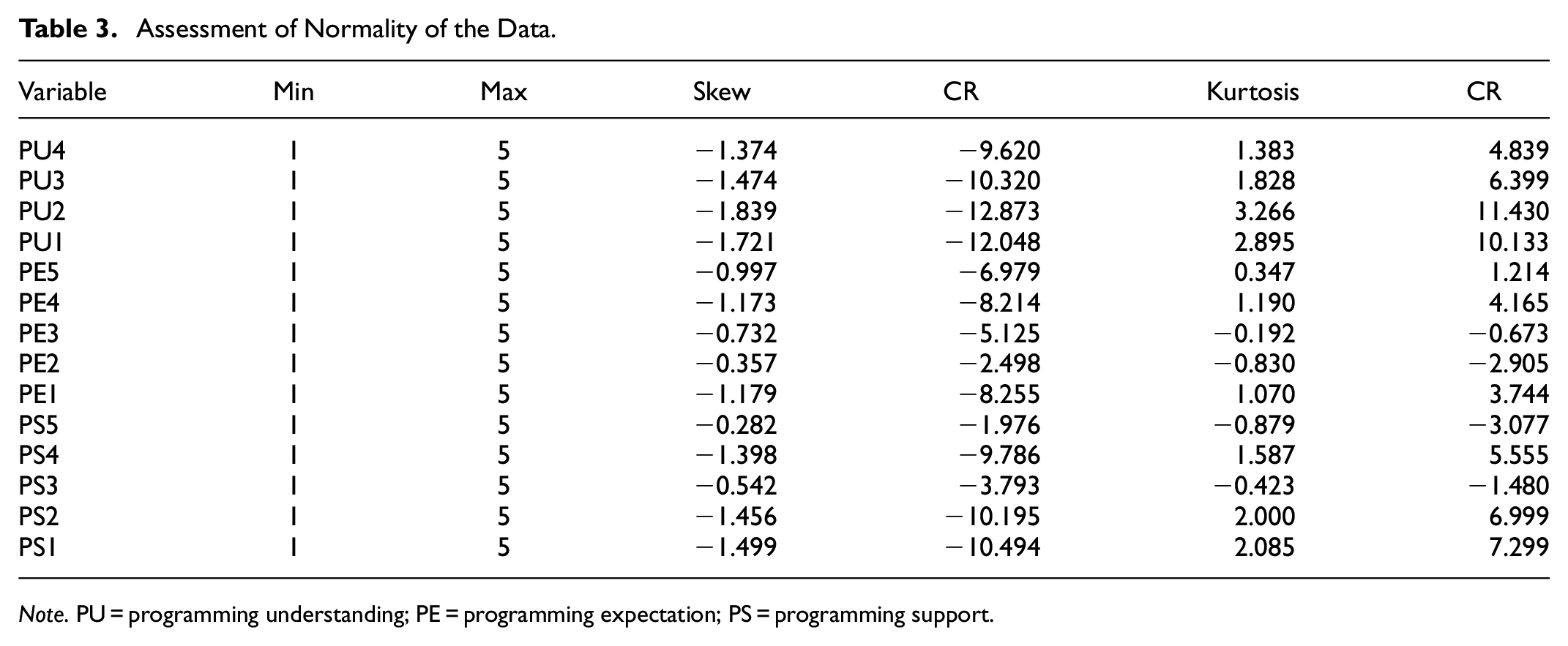
Note. PU = programming understanding; PE = programming expectation; PS = programming support.
Measurement Model
The CFA results supported the structure of the scale (refer to Figure 1). The three-dimensional model proposed showed a good fit with the data we collected, as indicated by fit indices. The chi-square test did not show significance (χ2 (114) = 280.039, p > .05). The ratio of chi-square to degrees of freedom was 2.46, which falls within an acceptable range of less than 3.0, suggesting a reasonable fit for our model. Moreover, the RMSEA was found to be 0.07 (90% CI [0.051, 0.084]), further supporting the adequacy of our model. Additionally, other fit indices, such as the CFI at 0.954, GFI at 0.901, and TLI at 0.945, also provided evidence for a fit in our proposed model. Further analysis was conducted to validate the goodness of fit measures obtained from CFA. For this purpose, a nested model approach was then used to compare the hypothesized second-order factor model with other models. After analyzing the outcomes displayed in Table 4, it is clear that the suggested model, which incorporates components into factors nested within previous models, performs better than the alternative models based on the fit indices. It is worth mentioning that the second-order factor model that was proposed essentially shares a structure with a higher-order factor model.

Measurement model.
Fit Indices of Nested Models’ Analysis.

Construct Reliability and Validity
The standardized coefficients of the measurement model, shown in Table 5, ranged from 0.510 to 0.82. These coefficients exceeded the suggested threshold of 0.40 recommended by Hair et al. (2017), indicating reliable relationships between the underlying factors and the observed variables. This result confirms that the model is valid. Additionally, the AVE values presented in Table 5 were higher than the recommended threshold of 0.50 (Hair et al., 2022), indicating convergent validity for the constructs in the measurement model. Moreover, when analyzing reliability, the researcher found consistency in the instrument. The Cronbach alpha values ranged from .81 to .90, while Composite reliability values ranged from 0.88 to 0.93. All these values surpassed the recommended threshold of 0.70 (Hair et al., 2019), indicating consistency for the instrument.
Reliability and Validity of the CFA.

Discriminant Validity
Additionally, the Fornell–Larcker (1981) criterion was employed to evaluate validity. This criterion involved comparing the root of the AVE for each construct with the correlation coefficients between the two constructs. Discriminant validity determines how distinct a construct is from others (Hair et al., 2019). The findings presented in Table 6 confirm validity as all correlation coefficients were observed to be smaller than the root of AVE (highlighted in bold and on the diagonal). These results indicate that each construct in the model exhibits dissimilarity from others, thus supporting the uniqueness of the underlying factors.
Discriminant Validity—Fornell–Larcker’s method.


Note. All correlation coefficients were observed to be smaller than the root of AVE (highlighted in bold and on the diagonal).
If the √AVE is higher than r values, then the constructs show adequate discriminant validity.
Structural Model
Based on the TRA, a model was used to study the proposed hypothesized relationships and successfully confirmed the assumptions. Out of the eight expected links between factors, five were statistically significant, supporting what was initially anticipated. The results from the analysis using Structural Equation Modeling (SEM) shown in Figure 2 display the coefficients and their corresponding levels of significance. Additionally, the SEM findings indicate that the model fits well with the data as indicated by fit indices: χ2 = 27.240, df = 9, CFI = 0.970, GFI = 0.968, AGFI = 0.926, NFI = 0.956, TLI = 0.949, RMSEA = 0.08, and SRMR = 0.06. These fit indices collectively suggest that the model explains the data effectively and provides insights into how variables are interconnected.

Full structural model.
Direct Effects
SEM was used to investigate the proposed hypothesized relationships between programming understanding, programming expectations, programming support, and demographic factors such as age, gender, and education level among teachers in service. The results of the SEM analysis presented in Table 7 indicated relationships between programming understanding and programming expectations. We discussed each hypothesis as follows:
H1: Programming understanding significantly influences programming support.
To test this hypothesis, the direct relationship was examined between programming understanding and programming support. The standardized path coefficient between programming understanding and programming support was significant (β = .470, SE = 0.072, CR = 6.470, p < .05), indicating that pre-service teachers with higher programming understanding are more likely to provide support for programming education. This supports H1, demonstrating a positive influence of understanding on support.
H2: Programming expectations significantly influence programming support.
The relationship between programming expectations and programming support was also tested using SEM. The path coefficient was significant (β = .484, SE = 0.083, CR = 6.324, p < .05), showing that pre-service teachers with higher programming expectations are more likely to support programming education in schools. Thus, H2 is supported, confirming that positive expectations about programming lead to higher levels of support.
H3: Programming understanding significantly influences programming expectations.
To assess the impact of programming understanding on expectations, the direct path from programming understanding to programming expectations was tested. The results show a significant positive relationship (β = .840, SE = 0.052, CR = 14.606, p < .05). This suggests that pre-service teachers with a greater understanding of programming hold higher expectations regarding its implementation and outcomes. Therefore, H3 is supported.
H4: Demographic variables such as education level, age, and gender significantly influence programming understanding.
The effects of demographic variables (age, gender, and education level) on programming understanding were examined using SEM. The results indicate that none of the demographic variables had a significant effect on programming understanding. Age group (β = .003, SE = 0.100, CR = 0.046, p > .05), gender (β = −.010, SE = 0.169, CR = 0.162, p > .05), and education level (β = .010, SE = 0.066, CR = 0.173, p > .05) all failed to reach significance, suggesting that demographic factors do not influence how pre-service teachers understand programming. Thus, H4 is not supported.
Summary of Direct Effects of the Relationships.

Note. SE = standard error; CR = critical ratio. ***p < 0.001.
Indirect and Total Effects
H5: Programming expectations significantly mediate the relationship between programming understanding and programming support.
In addition, the researcher conducted an analysis using bootstrapping with 1,000 resamples to examine how the understanding of programming among pre-service teachers relates to their expectations and support for programming education. The results showed a relationship (beta weight = .407, CI 95% = [0.240, 0.570], p < .05). Table 8 indicated a mediating effect, suggesting that when pre-service teachers understand programming, it influences their expectations about its implementation, affecting their support for programming education. Furthermore, the beta weight of .877 represents the strength and direction of the total effect. An increase in programming understanding (by one deviation) leads to a positive change in programming support when considering the indirect influence of programming expectations. The confidence interval for the beta weight (95%) suggests that we can be confident (95% level) that the actual population value lies within the range of [0.803, 0.926]. Since the p-value is less than .05, it can be concluded that there is a significant relationship between programming understanding, programming expectation, and programming support. In terms of this, pre-service teachers who grasp programming are likelier to have higher expectations regarding related activities. These optimistic expectations, in turn, result in a level of backing for programming education. This result indicates that understanding programming concepts impacts the support received in their programming pursuits. These findings emphasize the significance of nurturing programming understanding among pre-service teachers, as it can create a positive cascade effect, influencing their expectations about programming and ultimately resulting in more incredible support for their programming efforts. This insight holds implications for approaches that aim to improve programming skills and cultivate an atmosphere for aspiring teachers in computer science education.
Indirect and Total Effects Coefficient and Bootstrap Confidence Interval.

***p < 0.001.
Discussion and Implications
With the current state of the economy globally, which is overwhelmingly driven by technology, the role of computer programming must be addressed. Notably, in a developing economy, there is a technology gap and insufficient technical know-how and expertise in emerging technologies. Children and youths should be trained with 21st-century skills such as computer programming to address the digital competence gap. Since teacher education is essential to implementing programming education in K-12 learning contexts, it is imperative to understand the perspective of pre-service teachers who will implement future teaching practices. This paper attempted to explore programming education from the perspective of pre-service teachers based on the understanding that their attitude-intention-behavior may influence their role in teaching programming in the future. This research draws on prior work on using POPE to examine various education stakeholders’ attitude-intention-behavior within the theoretical framework of TRA (Kong et al., 2019; Kong & Wang, 2019; Kong & Wang, 2021). This study considers 294 pre-service teachers from Ghana in a university dedicated to education programs. CFA and structural equation models were used to analyze the responses, and we could determine the direct, indirect, and total effects of the variables in focus.
This study found that programming understanding significantly influences programming expectations and support positively. Programming expectations also positively influence programming support, while the demographic variables do not significantly affect the three programming dimensions. Furthermore, programming expectation significantly mediates between programming understanding and programming support. These findings are consistent with the results of Kong and Wang (2021), who explored school principals’ perspectives using POPE dimensions. The results highlight that cultivating a solid conceptual understanding of programming is critical to fostering favorable expectations and intentions to support programming initiatives. Given these findings, it is recommended that teacher training programs place a strong emphasis on building foundational programming knowledge and skills among pre-service teachers. Exposure to programming concepts appears more influential than individual traits in shaping positive perspectives. In addition, providing layered support systems for classroom implementation of programming may help translate understanding and expectations into actual supportive behaviors.
Moreover, the finding that programming understanding positively predicts programming expectations and support aligns with previous literature emphasizing the importance of foundational knowledge in shaping attitudes and behaviors. As posited by the TRA, which formed the theoretical framework of this study, an individual’s beliefs and knowledge about a subject influence their expectations regarding it, which in turn drive their intentions and actions (Hale et al., 2002). By revealing these relationships among pre-service teachers, this study provides empirical evidence for the applicability of the reasoned action model in understanding perspectives on programming education. Specifically, the results substantiate that when pre-service teachers possess a greater understanding of programming fundamentals and concepts, they are more likely to hold optimistic expectations about the potential outcomes of implementing programming in schools. These favorable expectations reflect their attitude toward programming education and motivate their intention to support programming initiatives (Kong & Wang, 2021). This intention manifests through supportive behaviors such as encouraging students’ programming learning, promoting programming in the curriculum, and motivating other stakeholders like parents and fellow teachers.
In addition, the study highlights that efforts to cultivate positive perceptions and buy-in for programming education among pre-service teachers should focus intensely on building solid conceptual foundations. In other words, providing exposure to programming itself appears more influential than individual traits in shaping perspectives. Teacher training institutions seeking to develop competencies for teaching programming should emphasize pedagogies that foster a deep understanding of foundational programming ideas and skills (Kong et al., 2020). Curricula and learning experiences, from introductory programming courses through methods courses on teaching programming, must move beyond surface learning to immerse teachers in core concepts. Beyond promoting understanding, it is also vital to nurture optimistic beliefs about the benefits and outcomes of programming education. These beliefs may involve exposing pre-service teachers to how programming aids students’ computational thinking, problem-solving, and 21st-century skills (Aydeniz, 2018). Engaging teacher candidates in designing instructional activities that leverage programming’s advantages can cultivate favorable expectations and intrinsic motivation to adopt programming. Providing pre-service teachers with mentors, communities, and examples of successful school programming implementation may also build affirmative attitudes and self-efficacy.
Meanwhile, this study did not find demographic attributes like age, gender, or education level significantly predicted programming perspectives, unlike some prior research showing demographic variations. This result suggests that these characteristics do not automatically dictate perceptions; developing understanding appears more influential. However, the sample was relatively homogeneous regarding several attributes, which may have reduced the ability to detect demographic effects. Follow-up studies with larger, more diverse samples could further examine potential subgroup differences in attitudes and receptiveness toward programming education (Kong et al., 2019). These studies could reveal target groups that may require tailored priming to cultivate positive perceptions. The lack of demographic effects also raises essential equity implications. It provides optimism that given adequate training in programming itself, pre-service teachers across backgrounds can develop confidence and enthusiasm for teaching programming. This optimism strengthens the case for integrating programming competencies firmly into standard teacher training curricula rather than considering it an optional specialty (Yadav et al., 2022). All teachers should be equipped with programming foundations as a new essential skill set for unlocking students’ learning and participation in the digital economy. Recent research shows that even short programming exposures help shape more favorable attitudes among teachers (Bower et al., 2017). Hence, programming courses must be thoughtfully designed and taught by expert computer science teachers, using active pedagogies tailored for learners with programming curiosity (Bower et al., 2017). Developing quality, scalable programming education modules for teacher training may better facilitate hands-on engagement and personalized support, thus leveraging limited expert instructors.
Finally, the study’s context in Ghana is noteworthy, given limited prior research on programming education in developing Sub-Saharan nations. The economic landscape in Africa is ripe with opportunities in the technology sector but harnessed by a need for a more digitally skilled workforce (Manda & Ben Dhaou, 2019). Thus, integrating programming into primary education could significantly expand youth’s digital literacy to capitalize on technology’s promise. However, school systems face acute shortages of qualified STEM teachers, especially programming instructors (Kafyulilo et al., 2013). This study’s findings thus guide institutions seeking to strengthen pre-service training and certification in computer science and programming. Tailoring interventions to boost conceptual understanding, shape affirmative expectations, and provide layered professional support will ensure teachers deliver engaging and effective programming education.
Implication for Policy and Practice
The results of this study on how pre-service teachers view programming education have important Implications for practice and policy, especially in teacher education and curriculum development. First, effective integration into the curriculum depends on pre-service teachers’ mastery of programming. Therefore, to ensure that pre-service teachers are adequately prepared to teach programming to students, teacher training programs should incorporate thorough and practical training in programming concepts, languages, and pedagogical approaches. Secondly, the study reveals that pre-service teachers’ expectations of programming education play a vital role in their willingness and enthusiasm to incorporate it into their future teaching practice. As such, policy initiatives should focus on fostering positive attitudes toward programming education through supportive policies, incentives, and professional development opportunities. Pre-service teachers’ successful implementation of programming education in classrooms depends on receiving suitable programming support. To assist pre-service teachers in navigating difficulties and gaining confidence in teaching curricula, educational institutions and policymakers must prioritize continuing support mechanisms such as mentoring programs, peer collaborations, and access to resources and technologies. In conclusion, it is crucial to address programming understanding, programming expectations, and programming support through targeted practices and policy interventions to provide pre-service teachers with the skills and confidence they need to successfully incorporate programming education into the curriculum and foster students’ digital literacy and computational thinking abilities.
Limitations and Future Directions
One of the primary limitations of this study is the underrepresentation of female participants, with only 13% of the sample being female. This gender imbalance may have implications for the generalizability of the findings. Given that research has shown gender differences in attitudes toward technology and programming (Beyer, 2014), the perspectives captured in this study may not fully represent the experiences and views of female pre-service teachers. This underrepresentation raises concerns about how gender dynamics may influence pre-service teachers’ perceptions of programming education. Future research should aim to address this limitation by ensuring a more balanced gender representation in the sample. Conducting studies that focus specifically on female pre-service teachers’ perceptions of programming education could provide valuable insights into how gender influences attitudes, expectations, and support for programming education. Moreover, exploring how male and female pre-service teachers might differ in their readiness to teach programming could inform targeted interventions in teacher education programs. Addressing this gap in future studies is crucial for ensuring inclusive educational strategies that promote gender equity in programming education.
Further, we acknowledge the potential inconsistencies in survey interpretation due to the self-reporting nature of the study and the fact that respondents may have varied in their understanding of certain terms and concepts used in the survey. While every effort was made to ensure the clarity and reliability of the POPE survey, including validation and pilot testing, there remains the possibility of some variation in how participants interpreted the items. To mitigate this in future research, this study recommends incorporating additional qualitative methods, such as interviews or focus groups, to complement survey data and provide richer insights into the respondents’ interpretations. Also, the study focused on pre-service rather than in-service teachers, we acknowledge that this limits the scope of our results. Pre-service teachers are future teachers, and their perceptions may differ significantly from those of in-service teachers who have direct classroom experience. Exploring in-service teachers’ perceptions would provide a more comprehensive understanding of the challenges and opportunities in implementing programming education in schools. In-service teachers’ feedback could highlight practical classroom barriers, strategies, and support mechanisms that are not apparent to pre-service teachers. In terms of the broader challenges of programming education in Africa, we agree that conducting cross-national studies would offer important comparative insights. Given that educational systems, resources, and policies vary across African countries, cross-national research would enable a more detailed understanding of the unique and shared challenges faced by different nations in integrating programming education. Such studies could explore variations in teacher training programs, curriculum development, access to resources, and governmental support across countries, offering tailored recommendations for each context. Finally, the use of a convenience sample is a limitation in to this study. The sample was drawn from a single institution in Ghana, which may limit the generalizability of the results to other contexts. It is recommended that future research employ more diverse sampling methods, such as random or stratified sampling, to ensure a more representative sample of pre-service and in-service teachers across different regions and institutions. Additionally, expanding the sample to include participants from multiple institutions, both within and outside of Ghana, would enhance the external validity of the findings and provide a more comprehensive view of programming education across diverse educational settings.
Footnotes
Declaration of Conflicting Interests
The author(s) declared no potential conflicts of interest with respect to the research, authorship, and/or publication of this article.
Funding
The author(s) received no financial support for the research, authorship, and/or publication of this article.

Data Availability Statement
Data sharing not applicable to this article as no datasets were generated or analyzed during the current study.