




Abstract
The epistemological beliefs and democratic values of primary school teachers shape teachers’ curriculum contextualization. This study investigates how teachers’ epistemological beliefs affect curriculum orientations through the mediating role of democratic values; and how these are intertwined in Turkey’s centralized school system through a qualitative component. An explanatory sequential mixed-methods design was conducted to capture the theoretical model and lived experiences. In the quantitative phase with a cross-sectional survey design, survey data were collected from 353 in-service primary school teachers from different schools in seven regions of Turkey, using “The epistemological beliefs scale,”“The democratic values scale,” and “Curriculum design orientations preferences scale.” Structural equation modeling (SEM) confirmed that epistemological beliefs had a direct and an indirect effect on curriculum orientations through democratic values. To further explain this model, the qualitative phase engaged 38 voluntary teachers among those that took part in the quantitative data collection with a phenomenological approach through vignette technique, revealing how beliefs and values shaped pedagogical decision-making. Four teacher profiles emerged from thematic analysis extend the SEM findings. The qualitative data revealed the role of systemic pressures, professional socialization, and cultural norms in teacher profiles. While the SEM indicated that democratic values mediated the relationship between epistemological beliefs and curriculum orientations, vignette analysis revealed that this pathway was most fully realized only among “Transformative” teachers. The study highlights the need to foster professional learning communities that promote reflective dialogue, critical engagement, and democratic pedagogical action in primary education contexts.
Plain Language Summary
This study explores how primary school teachers’ beliefs about knowledge influence their curriculum orientations and how democratic values shape this relationship. While curriculum theory emphasizes the importance of teaching that gives all students access to quality learning, classroom practices may fail to do so due to contextual factors. Using a mixed methods design, the study involved a survey with 353 teachers and follow-up open-ended responses to a hypothetical scenario with 38 participants. The statistical analysis showed that teachers’ beliefs about knowledge affect their curriculum decisions, and this effect is strengthened through the combination of their democratic value orientations. Qualitative analysis also supports this by revealing four distinct teacher profiles (‘Yes-sir’, ‘Conformists’, ‘Gatekeepers’, and ‘Transformative’) according to how teachers interpret and apply curriculum. Teachers may struggle to change their teaching due to pressures from performance evaluations, peer expectations, and school traditions. However, some teachers embrace innovation and collaboration to build a more inclusive and democratic classroom. The findings suggest that strengthening teachers through reflective practice and critical dialogue can lead to more equitable and meaningful curriculum implementation. Supporting professional learning communities that empower teachers to rethink their beliefs and values of knowledge and democracy is essential for curriculum-making in primary schools.
Keywords
Introduction
High-quality education demands a holistic and innovative paradigm that reframes curriculum design and pedagogical practice (Ben-Eliyahu, 2021; Rieckmann, 2017). Drawing upon philosophical, psychological, theological, aesthetic, political, and sociological norms, curriculum theory explores the value-oriented nature of programs and policy decisions (Chiu & Chai, 2020; Pinar, 2019). As an organizing lens, curriculum theory constructs a bridge between teachers’ knowledge and their prioritized aims, thus reflecting in teaching practices. This empowers teachers to formulate their instructional activities such as planning, teaching methods and techniques, student engagement, and evaluation practices (Syomwene, 2020). In the present study, curriculum orientation refers to a composition of beliefs, values, and assumptions that ask what, why and how it should be taught, and how learning should be assessed (Schiro, 2013). The learner-centered, problem-centered, and subject-centered curriculum orientation designs (Button, 2021; Wiles & Bondi, 2019), create epistemological assumptions about knowledge and education in a divergent manner.
The teachers’ role in the curriculum implementation is crucial considering that they are active interpreters of curricular aims (OECD, 2020). This makes it challenging to predict how educational outcomes will be shaped, even if the curriculum seems good quality in design and theory, as it involves teacher judgments and insights that cannot always be prescribed by laws and principles (Ornstein & Hunkins, 2018). While it might be assumed that we have left behind the narrow knowledge transfer tradition, many teachers have not yet cultivated pedagogical cultures that support meaningful learning (Ricci, 2021; Zohar, 2020). Achieving this requires not only methodological adjustments but also profound epistemological shifts. An epistemic framework that makes visible the bond between “knowledge-that” (epistemic knowledge) and “knowledge-how” (procedural knowledge) is therefore fundamental for promoting deep learning (McPhail, 2021). Thus, epistemological beliefs shape how teachers adopt and implement the curriculum.
Epistemological beliefs are preoccupied with the nature of knowledge and its impact on thinking, reasoning, and motivation (Depaepe et al., 2016). Schommer (1990) conceptualized these beliefs as multidimensional, including constancy of knowledge, the structure of knowledge, the control of learning, and the pace of learning. During the curriculum implementation, teachers constantly reflect, decide, and enact policy across classroom (Priestley et al., 2021), guided by their embraced beliefs. For instance, perceiving the knowledge as the fixed and authority-bound makes it challenging for teachers to nurture critical thinking and pluralism (Schommer Aikins & Hutter, 2002; Sleeter, 2009). Conversely, the ones who hold pluralist and relativist stances appreciate multiple perspectives harmonized with constructivist pedagogies and democratic values (DeGlopper et al., 2023; Saidah et al., 2025).
Given education’s wider social mission, which is to nurture future citizens capable of critical thought and democratic engagement, curriculum design requires moving beyond rigid conceptions of knowledge and fostering classrooms where plural perspectives are respected (Collins et al., 2019; Oeschger et al., 2022). Educational philosophy adopted by teachers influence the development of democratic values both of teachers and students in school (Duman, 2010); as a learning community culture is more likely to be sustained by shifting from solidarity toward more inclusivity in a classroom infused with democratic commitments (Colucci Gray et al., 2013). Considering the critical role of the primary school teachers as the agents of socialization particularly in the early years of schooling, epistemological, and democratic value orientations are pivotal regarding the achievement of inclusive curricular goals (Aslan, 2022).
The key obstacle toward cultural change in the education system is the lack of teacher dialogue to form a shared meanings and beliefs in the pursuit of curricular reforms within school and classroom spheres (DeJaeghere et al., 2024), as teacher beliefs and values are not only isolated psychological constructs, but deeply connected to a broader cultural, and systemic structures (Sandoval, 2014). Consistent with this, factors such as peer culture, school resources, and family background influence how educators think about knowledge and learning (Tang, 2025) as well as local histories, languages, and institutional norms (Eppert, 2024). Overall, teachers’ beliefs are shaped by the contextual factors such as environments in which they work and chances they have to modify their assumptions.
In countries like Turkey where the Ministry of National Education (MoNE) coordinates curriculum reforms centrally (Bellibaş & Kılınç, 2023), teacher autonomy is weakened with constrains, and traditional approaches may persist despite innovative efforts (Baş, 2021). As observed in other centralized contexts like Portugal, teacher agency and curricular contextualization often encounter daily restrictions such as high-stakes testing and overloaded work that eventually constitute an incongruence between formal and the enacted curriculum (Leite et al., 2020). Prior research has examined links between epistemological and ontological beliefs with respect to curriculum (Schraw et al., 2010); however, few studies analyze the simultaneous effects of epistemological beliefs and democratic values on teachers’ curriculum practices. Although recent studies have explored how epistemic understandings shape their curriculum practices (Aslan, 2022; Elmersjö et al., 2025), a gap remains in the literature investigating the predictive relationships and an illustrative examination between epistemological beliefs, curriculum orientations, and democratic values, especially among primary school teachers. Addressing this gap, the present study examines how primary school teachers’ epistemological beliefs influence their curriculum orientations, considering the mediating role of democratic values integrating quantitative and qualitative evidence within a mixed-methods design. For the purpose of this design, a model was developed to illustrate the impact of primary school teachers’ epistemological beliefs and democratic values on curriculum orientations and to investigate the mediating role of democratic values in the effect of epistemological beliefs on curriculum orientations. Furthermore, a follow-up qualitative phase with a vignette provided illustrative insight into how epistemological beliefs and democratic values are manifested in day-to-day curriculum decisions.
Literature Review
Teacher Epistemological Beliefs and Democratic Values
Education in democracy is seen as a process of continuous restructuring, reorganization and transformation aiming for growth. Intellectual freedom, which requires the individual to question the existing beliefs critically, is indispensable for the growth of a progressive free society (Dewey, 1916). Within the framework of democratic education, schools do not only function as academic learning environment but also instill the ideals and virtues of democracy like equality, freedom, and justice through the crucial role that teachers play by shaping the curriculum (Subba, 2014). The classroom may be utilized as a perfect simulation of the ideal of democracy and intellectual freedom of the individual as a member of the society.
Democracy and pluralism are reciprocal, therefore, in the domain of curriculum, a pluralistic multicultural approach that incorporates social justice, human rights, and democracy is necessary (Zilliacus et al., 2017). From this point, it can be argued that a multicultural epistemology is foundational in constructing an augmented empowered democratic value-based understanding (Fabiani, 2023). Research reveals a connection between teachers’ epistemological beliefs and attitudes on democratic values, suggesting that teachers with more sophisticated beliefs tend to value inclusion and adopt more learner-centered and interactive teaching methods (Ning et al., 2020). These practices represent hallmarks of a democratic education, often centered on inquiry-based learning, collaborative knowledge construction, and critical reflection within the teaching profession (Chongdarakul, 2003).
As the existing evidence has suggested, teachers’ beliefs about knowledge shape how they position themselves in relation to authority, facilitate interaction, and guide students in engaging with diversity (Del Valle & Guhao, 2024; Subba, 2014). Although, prior research has highlighted the role of teachers in fostering democratic classroom climates through dialogue, respect, and inclusivity; there are fewer studies examining how teachers’ epistemological beliefs shape their democratic values (Koyunlu Ünlü & Dökme, 2017; Ning et al., 2020). Thus, to address this gap the present study proposes
Democratic Values and Curriculum Orientations
Democratic values refer to beliefs about the importance of participatory, equity, and respectful practices in schooling, including student voice, inclusivity, collaboration, tolerance, justice, and shared decision-making process (Kırık, 2024; Larsen & Mathé, 2023). These values guide how students relate to one another and to their teachers, how power and authority are distributed in schools, and how differences of opinion, culture, and background are acknowledged and engaged within classroom practice (Ferguson-Patrick, 2022; Oeschger et al., 2022; Schultz & Oyler, 2006).
While democratic values have often been discussed as a broad educational aim, fewer studies have examined their role in shaping curriculum orientations. Evidence suggests that schools fostering democratic leadership through stakeholder participation, teacher autonomy, and collaboration promote participatory curriculum enactment (Karo et al., 2024). In such contexts, curricula move beyond being symbolic references to democracy and become lived practices of democratic life. Empirical work supports this link: engaging students in shared decision-making process fosters autonomy (Schultz & Oyler, 2006), preservice teachers valuing democracy tend to favor cooperative learning strategies (Kırık, 2024). Also, comparative studies in England and Sweden show that democratic dialogue enhances tolerance and justice (Ferguson-Patrick, 2022) in learning and teaching environments. To relate with this, we propose that
Epistemological Beliefs and Curriculum Orientations
Numerous studies reveal the fact that epistemological beliefs affect teachers’ preferences for curriculum orientations. According to Kelly (2017), teachers’ personal beliefs concerning reality and learners are interlinked with their views of knowledge, epistemology, and diverse pedagogical profiles. The link shows how teachers’ teaching methods connect to their personal beliefs about knowledge (DeGlopper et al., 2023; Saidah et al., 2025). For instance, teachers with relativistic epistemological beliefs tend to adopt more constructivist approaches and prioritize student-centered practices that support the development of individually constructed knowledge (Deng et al., 2014). The choice between traditional and constructivist teaching methods depends on teachers’ personal beliefs; therefore, given the growing emphasis on innovative educational practices, understanding epistemological beliefs has become essential (Letina, 2022).
Teacher beliefs are crucial in shaping curriculum (Aslan, 2020; Atlı & O’Dwyer, 2021; Ricci, 2021). However, little was known about how this inclination reference to epistemological beliefs for especially in-service teachers. Epistemological beliefs are, in fact, the key to broaden pedagogical action (Gumandam & Mangila, 2021) ranging from learner characteristics to contextual factors, directly influencing teachers’ pedagogic visions and how these beliefs translate into classroom (Atlı & O’Dwyer, 2021). Similarly, Aslan (2022) highlights this role by reinforcing the necessity of exploring how epistemological beliefs shape curriculum implementation. While prior research refers to a general link between epistemological beliefs and teaching practices (e.g., Deng et al., 2014), fewer studies have explicitly examined its effect on curriculum orientations, particularly within the primary school context (Aslan, 2022). The current study seeks to respond to this gap by proposing that
Relationships Among Epistemological Beliefs, Curriculum Orientations and Democratic Values
Curriculum theory situates beliefs, values, and pedagogical choices within a common framework that asks what should be taught, why, and how (Deng et al., 2014; Pinar, 2019). This underscores the idea that teaching is not a neutral practice; thus, the type of knowledge the students are allowed to develop reflects a capacity-building curriculum related to the epistemologically powerful knowledge by fostering equitable learning (Carlgren, 2020). In this sense, a harmony among teachers’ epistemological beliefs, their democratic commitments, and curriculum orientations is evident. Research on teacher agency further supports this perspective, showing that teachers negotiate curriculum change through proactive, reactive, or passive forms of agency that are strongly influenced by their beliefs and values (Jenkins, 2020). For example, in centralized systems like Turkey’s, teachers have limited autonomy, and curriculum change efforts often encounter obstacles (Erdem, 2021).
The literature points to an interrelated pathway in which teachers’ epistemological beliefs directly and indirectly affect curriculum orientations through democratic values, conceptualized as a mediating construct that connects teachers’ epistemological beliefs with their curriculum orientations. However, little research has been detected that dwell on the relationship between primary school teachers’ epistemological beliefs, curriculum orientations, and democratic values. We predict that significant contributions will be made to the literature on the role of epistemological beliefs and democratic values, recognized as critical variables in the enhancement of curriculum orientations. Thus, we propose H4: Democratic values mediate the effect of epistemological beliefs on curriculum orientations. The model tested in the first phase of the study, to measure the mediating role of democratic values in the effect of epistemological beliefs on curriculum orientations, is evident in Figure 1.

Hypothesized mediation model.
The Study
The complexity of the teaching profession in general is triggered by external and contextual factors that target changes in the meaning of being a teacher and how patterns of teacher work are reconstructed (Vongalis Macrow, 2007). Therefore, teachers’ pedagogical enactments serve as the crucial site where epistemological beliefs, democratic values, and curriculum orientations converge into actual classroom practice. For teachers enacting the curriculum, a well-built philosophy of education regarding the macro-level goals of education is essential for a teacher agency, through which the formal discourses of curriculum are enriched or challenged (Priestley et al., 2021). Another study by Coker et al. (2023) revealed how teachers use multiple forms of knowledge to “make” the curriculum in ways that reflect their values and beliefs. Meanwhile, Shawer (2017) demonstrates how teacher-led curriculum implementation reveals the way that policy, context, and personal beliefs shape pedagogical choices.
The hectic schedule of day-to-day teaching prevents teachers from reflecting on their knowledge of the profession, their metacognition, and the practical dimension in context. The practice of teachers, grounded in a pedagogical reasoning, might help us to understand the peculiarities of teaching procedures and curriculum enactment in context, which will increase the value of both teaching and professional knowledge they bear (Loughran, 2019). Policy and curriculum meet in the lived experiences of teachers during their daily practice in the classroom, where its realities force teachers to adapt their practice to the realities of their context; therefore, while teachers may only become the deliverer of a tightly prescribed curriculum, in another context they may adopt an identity as curriculum designers or learning architects (La Velle, 2025). Likewise, in a systematic review by Golzar (2020), the development of teacher identity was found to constitute a dynamic and multifarious process, which is continuously influenced by discursive negotiations, pedagogical practices, and socio-cultural determinants.
The literature suggests a model wherein teachers’ epistemological beliefs significantly affect their democratic values (H1); democratic values significantly affect their curriculum orientations (H2), teachers’ epistemological beliefs significantly affect curriculum orientations (H3), and thus implying that democratic values act in a mediating role in the effect of epistemological beliefs on curriculum orientations (H4). To test this model, a mixed- methods design was employed. A key strength of this study is that it combines quantitative modeling (SEM to test predictive and mediating relationships) with a vignette-based qualitative phase that expands how these patterns are manifested in context. In the qualitative phase of this study, we therefore focus on deepening these contextual pedagogical enactments to uncover how beliefs and values are manifested in teacher epistemological, moral and professional identities, through the hypothetical narratives that teachers produced via vignettes.
Overall, current research predominantly emphasizes the significance of epistemological beliefs, democratic values and curriculum orientations of teachers either in solely quantitative perspectives (Aslan, 2022; Del Valle & Guhao, 2024; Deng et al., 2014; Ning et al., 2020; Saidah et al., 2025) or revealing development process of teachers’ epistemological and pedagogical beliefs from a social constructionist framework (Chung, 2022). Oeschger et al. (2022) used a mixed-methods design in a scale development study for value orientations in curriculum. Another study, designed in a mixed-methods framework, found that transnational faculty collaboration promotes professional growth and alters both their teaching beliefs and epistemological beliefs (Wang & Kim, 2023). Bendixen and Klimow’s (2019) mixed methods study inquires in preservice teachers how participatory concept mapping may be used as an integration tool to explore epistemic cognition and teaching orientation.
Studies focusing on the interaction between these variables and those which investigate the manifestations of them in teachers’ pedagogical enactments remain underresearched. To address these gaps, the present study aims to answer the three research questions below:
Methodology
Research Design
Integrating the qualitative and quantitative elements of mixed methods research is crucial for its quality. There are several ways to integrate these elements (Clark, 2019), some of which were used in the study. First, at the level of research design, the two phases were integrated through employing a two-phase explanatory sequential core mixed methods design, adhering to a structured approach where quantitative investigation precedes qualitative inquiry (Creswell & Creswell, 2023). This also allowed the researcher to jointly address the phases in discussion. Second, integration was supported through nested-design in which qualitative data from a subset of the quantitative sample is collected (Lieber, 2009). Accordingly, in the second phase, how these joint interactions are reflected through teachers’ pedagogical actions was investigated in-depth through RQ3. In this qualitative phase, phenomenological design was employed to elicit teachers’ situated beliefs and decision-making, thereby enriching the explanatory power of the mixed methods design by providing context-sensitive insights that complemented the quantitative findings.
The first phase was designed as a cross-sectional survey to examine the relationships between primary school teachers’ epistemological beliefs, curriculum orientations and democratic values. For this purpose, the study tested the model to depict the effect of teachers’ epistemological beliefs and democratic values on their curriculum orientations utilizing structural equation modelling (SEM) through RQ1. The mediating role of democratic values in the effect of epistemological beliefs on curriculum orientations was also investigated through RQ2. The phenomenological design in the subsequent qualitative phase focuses on teachers’ lived experiences, values, and beliefs using asynchronous written vignettes, to elicit situated responses to hypothetical scenarios. A well supported qualitative phase through vignettes aligns with realist evaluation tradition in uncovering the real-world mechanisms that connect beliefs and practices (Aldamman et al., 2024). Within a mixed-methods framework, this qualitative use of vignettes adds hermeneutic richness to the explanatory sequential design by clarifying how the patterns identified in the quantitative phase are experienced and understood by teachers in practice (Wilks, 2004).
Explanatory sequential mixed method designs, as explicated by Fetters (2020) and examplified by Haynes-Brown (2023), facilitate an iterative process of model development-from initial formulation and empirical testing to subsequent refinement and expansion in a comprehensive model. This study undergoes a systematic and integrated process through the following stages:
Initial Model Development
Drawing from existing literature, initial model was developed as epistemological beliefs exert direct impact on curriculum orientations with the mediating effect of democratic values.
Quantitative Testing
The initial model is subjected to quantitative scrutiny analyzing data collected from 353 primary school teachers using SEM. This phase provides empirical evidence regarding the strength of the proposed relationships.
Qualitative Exploration
An exploration of how teachers’ epistemological beliefs and democratic values are manifested in their pedagogical actions and curriculum decisions was followed. From a phenomenological perspective, a written vignette form was used as a data collection technique in the form of written open-ended reflection letters, allowing teachers to articulate how they would interpret hypothetical case scenarios on pedagogical dilemmas.
Model Refinement
The revised model, grounded in both statistical validation and rich qualitative data, provides a more comprehensive understanding of how teachers’ epistemological beliefs and democratic values influence the profiles that emerge.
Study Group
Sampling for SEM
Cluster sampling is a type of probability sampling in which naturally occurring groups of individuals who share common characteristics are selected. A cluster sampling approach was adopted in this study, using the seven geographical regions of Turkey as the primary clusters. Each region was represented by 1 province, selected to best capture the population, socio-economic development and educational quality of that region. From each province, three primary urban schools were selected based on a stratification of school profiles, into high, moderate and low categories according to socio-economic context of schools. This yielded a total of 21 schools nationwide. Both the online survey link and paper formats were transmitted to the schools in each of the 7 selected provinces. Across the selected schools, out of 548 teachers on the official lists 455 responded and completed the survey. Cluster-level response rates ranged from 12% to 30%. To mitigate non-response, two reminder notices were sent to schools. After excluding incomplete or invalid responses, 353 valid responses were included in the final analysis.
Two hundred eighty of the participants (79.3%) were female while 73 were male (20.7%). One hundred ninety-seven participants (55.8%) were in profession for 18 years or more, 32 participants (9.1%) were in profession for only 5 years and the remaining 124 teachers (35.1%) had teaching experience ranging from 6 to 17 years. While two hundred ninety-five participants (83.6%) graduated from university, 58 participants (16.4 %) had a master’s degree. Variables such as gender, teaching experience and graduation level (whether the teachers have a master’s degree or not) are conceptually relevant to the study’s constructs. For example, prior research suggests that both teaching and educational experience shape epistemological beliefs (Atlı & O’Dwyer, 2021), while school culture and regional context influence opportunities for enacting democratic values and curriculum orientations (Larsen & Mathé, 2023). The demographic profile of the sample, composed predominantly of female teachers with long professional experience and without postgraduate qualifications, reflects the typical characteristics of Turkish primary school teachers, a group whose sustained engagement with systemic curriculum structures makes their epistemological beliefs, democratic values, and pedagogical orientations especially critical for understanding how curricula are interpreted and enacted in practice.
Participants for Qualitative Phase
To explore the RQ3, which aimed to enquire how teachers’ epistemological beliefs, democratic values, and curriculum orientations are manifested, the participants of the quantitative phase were subjected to criterion sampling for the qualitative phase, based on whether they are open-minded or closed-minded, depending on scores on the three scales. A criterion sampling strategy was essential because quantitative sample diverges around the whole country in schools with varying contexts, the details of which the researchers would not be completely close to. Next, only opting for voluntary participation among the sample for the qualitative data collection would have restricted the richness of voices of all types of teachers, avoiding the dominance of the participation of a certain group of teachers with similar characteristics. For example, a teacher with a high score of epistemological belief in absolute truth, ability and a subject-centered curriculum orientation, and a low score of democratic value is labelled as closed-minded. Likewise, a teacher with a high score of epistemological belief in effort, a problem-centered curriculum orientation, and democratic value is labelled as open-minded. Thus, based on our criterion, qualitative data group comprised of a total of 88 teachers when the combinations of the scores of each teacher from all scales were considered. This means that 25% (n = 88) of the total of 353 participants met the criterion for being placed into one of the two contrasting categories. Among the teachers classified under these two groupings, 38 participants volunteered to take part in the qualitative data collection. Among these, 28 were in the open-minded grouping, while 10 were in the closed-minded grouping. The characteristics of the participants of this phase were reported in the qualitative findings.
Research Instruments
Quantitative Data Collection Tools
“Teacher trainees” democratic values scale’ developed by Selvi (2007) to investigate classroom teachers’ democratic orientations, consisting of 21 items and three factors as “Right to education, Solidarity, Freedom” was employed. Exploratory factor analysis identified a three-factor solution explaining 48.64% of the variance (factor loadings .43–.82). The factors were: Right to education (8 items; e.g., “Students should be taught ways of accessing knowledge”), Solidarity (7 items; e.g., “Students’ proposals to solve school problems should be discussed in class”), and Freedom (6 items; e.g., “Students’ views should be considered when deciding exam types”). The original internal consistency for the total scale was .85; and for subscales it was .87, .77, and .38 respectively. It has been widely used with teachers (e.g., Palavan & Agboyraz, 2017) and used for SEM study (e.g., Sıvacı & Altaş, 2023). The overall Cronbach’s alpha value of the scale was calculated as .858 for this population. The subscale reliability coefficients were .826 for Freedom, .652 for Right to education and .789 for Solidarity, showing an adequate internal consistency. Furthermore, construct validity measurement values in this study confirm the adequacy of scale in measuring the construct (CMIN/DF = 1.849, RMSEA = .059, CFI = .909, TLI = .894, IFI = .911, GFI = .889, SRMR = .0652). Model fit criteria included CFI value greater than .90, along with SRMR and RMSEA values less than .08 (Kline, 2015).
“The epistemological beliefs scale,” originally developed by Schommer (1990) was shortened by Aydın et al. (2017) from the version adapted into Turkish (Deryakulu & Büyüköztürk, 2002). As for the adaptation procedures, the original scale was first translated into Turkish. Later, both the original and the Turkish versions were reviewed by eight faculty members with expertise in language, content, research methodology, and measurement and evaluation. The scores of the two versions were found to correlate positively and significantly (r = .665, p = .004), indicating equivalence between the original and translated scales (Deryakulu & Büyüköztürk, 2002).
The shortened version consists of 23 items as “Effort (10 items), Ability (8 items), Absolute truth (5 items),” in which three factors explained 45% of total variance. The goodness of fit indices was determined as RMSEA = .05, NFI = .95, GFI = .90, AGFI = .88, and CFI = .96. Reliability analyses showed that item-total correlations were between .394 and .801. The scale was widely used to measure teachers’ epistemological beliefs (e.g., Aytaç et al., 2022). The overall Cronbach’s alpha value of the scale was calculated as .914 for the present study. The subscale reliability coefficients were .820 for Effort, .914 for Ability and .909 for Absolute truth, indicating satisfactory internal consistency. In addition to this, construct validity measurement values in this study confirm the adequacy of scale in measuring the construct (CMIN/DF = 2.211, RMSEA = .071, CFI = .916, TLI = .901, IFI = .917, GFI = .870, SRMR = .0658). Model fit criteria included CFI and TLI values that are greater than .90, along with SRMR and RMSEA values that are less than .08 (Kline, 2015).
“Curriculum design orientations preference scale” was developed by Baş (2013). The scale, originally found reliable with The Spearman-Brown split-half correlation value of .91 and Cronbach’s alpha coefficient as .94, includes 30 items covering three factors as “Learner-centered, Problem-centered, and Subject-centered,” each with 10 items. The variance explained by each factor was 19.978%, 18.324%, and 13.709%, respectively, with a total explained variance of 52.011%. Model fit indices were determined as χ2/df = 1.50; RMR = .056; SRMR = .077; RMSEA = .05; GFI = .83; AGFI = .80. It was previously used for a SEM study (e.g., Börekçi & Uyangör, 2021). The internal consistency coefficient (Cronbach’s alpha) was found .911 for the current study. The subscale reliability coefficients were .867 for Student-centered, .859 for Problem-centered and .896 for Subject-centered, suggesting satisfactory internal consistency. Also, construct validity measurement values in this study confirm the adequacy of scale in measuring the construct (CMIN/DF = 2.165, RMSEA = .069, CFI = .884, TLI = .869, IFI = .885, GFI = .824, SRMR = .0733). Model fit criteria included SRMR and RMSEA values less than .08 (Kline, 2015).
Qualitative Data Collection Tool
Vignettes were employed in the qualitative phase to elicit teachers’ situated interpretations of pedagogical dilemmas. While vignette methods have often been used in positivist traditions to approximate behavior, their use within qualitative inquiry shifts the focus toward meaning-making, values, and interpretive depth (Hughes & Huby, 2004). The openness of vignette design enables participants to reflect on the situation from their perspectives.
First, researchers constructed a real-world scenario draft aiming to understand how teachers’ epistemological beliefs and democratic values are reflected in their curriculum orientations. The scenario was followed by three questions which allowed participants to reveal their own epistemological beliefs, values and orientations as they are evaluating the case of the unreal teacher. The draft vignette was sent to two experts in the field of curriculum and revised after their feedback. Second, the revised vignette was sent to two teachers out of the participant group for piloting and checking clarity. Revisions were made to the original vignette upon piloting. Finally, the actual data collection process initiated as e-mails were sent to the 88 teachers identified in the quantitative phase, including the cover letter and the consent form. Thirty-eight teachers volunteered to take part and gave consent; and they were sent the link for the online form of the vignette including the case and the follow-up questions that they responded by typing the letters online. These volunteering teachers were from varying urban public and private primary schools of the initial sample provinces around Turkey. The researchers had no direct acquaintance nor familiarity to them in person. However, the typical urban primary school context is very familiar to the researchers as it is their research and practicum field. Since participants were in-service teachers with busy schedules, they were allowed 2 weeks to respond to the vignette in the e-mail. By the deadline, the responses were checked whether they were rich enough in length for the phenomenological analysis. The vignette sent to the teachers as an online form presents the case of a novice enthusiastic and idealist teacher who faces challenges due to systemic restrictions and standardizing demands of the authorities (Figure 2).

Vignette used in the qualitative phase.
Data Analysis
IBM SPSS Statistics 26.0 and AMOS 26.0. software were used to analyze quantitative data. Simultaneous estimation of multiple relationships among variables was tested through structural equation modelling, which is suitable for testing the mediation effect of the indirect role of democratic values. The concept of “structural equation modeling” is regarded as belonging to an array of statistical methods, not as a specific statistical tool (Kline, 2015).
Prior to the analyses, SPSS 26.0 was used to confirm that the preliminary statistical assumptions were met such as multivariate normality, linearity and multicollinearity (collinearity and VIF analyses). Confirmatory Factor Analysis (CFA) was conducted to assess each data collection tool separately first, and then the validity of the proposed model, employing AMOS 26.0. Also, the Cronbach’s alpha reliability scores for all scales and the average variance extracted (AVE) for the constructs were calculated. Following these procedures, SEM and a bootstrap mediation test were applied to determine whether democratic values significantly mediated the relationship between epistemological beliefs and curriculum orientations.
Thematic analysis was conducted for qualitative data using Corbin and Strauss’s (2015) coding strategies (open, axial, and selective coding) which implies the individual familiarization of the researchers with the data with repetitive reading and then taking preliminary notes as the first step. Second, codes were given by researchers separately based on researchers’ theoretical and field proximity, which were later compared and discussed one by one by the two researchers for inter-coder reliability. Final codes were put into categories and then themes, which can be seen in Figure 3. Following deductive qualitative analysis for deepened theorizing (Fife & Gossner, 2024) and generating integration, a joint display of meta inferences from both phases (Creswell & Creswell, 2023) is essential. Researchers, thus, supported, refined, and expanded the following theoretical model based on data analysis (Figure 3).
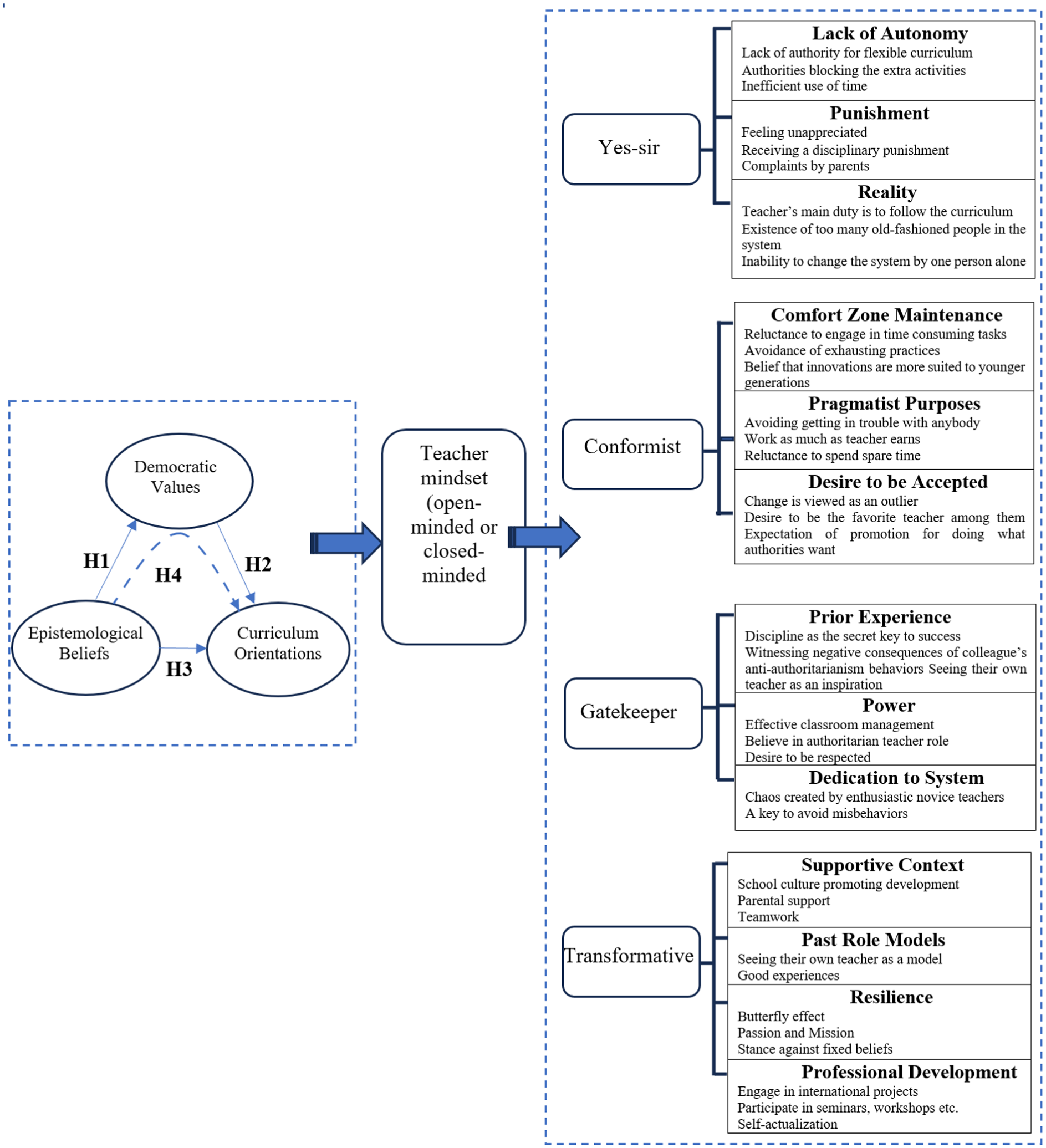
Refined theoretical model based on the findings.
Validity and Reliability Evidence
In the quantitative phase, CFA was conducted utilizing AMOS 26.0 to test the construct validity of both data collection tools and the overall measurement model. Internal consistency reliability was examined through Cronbach’s alpha, and AVE.
In the qualitative phase, mainly three precautions were taken to ensure validity and reliability. First, expert opinion was sought for the vignette and a pilot was conducted. Second, inter-coder reliability was used to assure consistency between coders. Third, for member check, a summary of the findings was presented to five participants who validated the findings as a whole.
Ethical approval was taken from a state University Social and Human Sciences Research and Publication Ethics Committee (approval no. 494266) on 28 March 2023. Also, a cover letter was sent to participants with a brief explanation of the research scope; and participants’ consent was obtained through online forms.
Findings
Consistent with an explanatory sequential mixed methods design, the results are presented in three stages (Haynes-Brown, 2023). First, the quantitative findings that establish the statistical relationships among epistemological beliefs, democratic values, and curriculum orientations were reported. Second, qualitative findings from vignette-analysis were reported. Finally, the two components were integrated to develop meta-inferences regarding the research questions.
Quantitative Findings
Missing data was assessed, outliers were detected, and normality tests were conducted for preprocessing the dataset using SPSS 26.0. Multivariate normality was checked with critical ratio and results demonstrated that Multivariate normality is acceptable (CR = −4.279). Linearity was also checked with scatterplot analysis and found that there are linear relationships among variables. For multi-collinearity assumptions, Collinearity analysis was utilized and found that Tolerance value is above the cutoff score of .200 (T = .901). Variance Inflation Factor (VIF) statistics was also found below the cutoff score of 5 (VIF = 1.109). These results indicate that there are no multicollinearity issues among the variables.
Confirmatory Factor Analysis
CFA was conducted using AMOS 26.0 to assess the validity and reliability of the measurement model. The first data collection tool, “Epistemological beliefs (EB)” consists of three subconstructs, F1 = Effort, F2 = Ability, and F3 = Absolute truth. The second tool, “Democratic values (DV)” consists of three subconstructs, F1 = Right to education, F2 = Solidarity, and F3 = Freedom; and finally, the third tool “Curriculum orientations (CO)” also has three subconstructs: F1 = Learner Centered, F2 = Problem Centered, and F3 = Subject Centered.
The CFA model indicated a good fit with CMIN/DF = 2.944, CFI = .883, TLI = .834, IFI = .886, GFI = .958, RMR = .006, and RMSEA = .074. These fit indices were close to the recommended thresholds, indicating an overall adequate model fit (Hooper et al., 2008) and reaffirming that the proposed model demonstrated satisfactory construct validity. The factor loading of all indicators but one (SUCE) is above the threshold of .30 as recommended by Hair et al. (2018). Thus, the model provides a well representation of the underlying data structure used in this study. Figure 4 shows the model extracted by the CFA with standardized estimate.

The CFA model with standardized estimates.
The model fit indices within the acceptable threshold levels (Hu & Bentler, 1999) are depicted in Table 1. To assess how well the model performed, multiple goodness-of-fit indices were calculated through the CFA model, which illustrate an overall fit within acceptable limits. CMIN to DF ratio was found 2.944 (70.653/24), which is within the acceptable 1 to 5 range. All fit indices (CFI = .883, GFI = .958, TLI = .834) exceed the .80 threshold, indicating an acceptable model fit. Similarly, the IFI value of .886, which is above the recommended threshold of .85, further confirms the robustness of the model and suggest that it is a good representation of the data. The RMR value of .006 falls below the threshold of .08. The RMSEA value is .074, and the SRMR is .053; both are below the .08 threshold, indicating a well-fitting model with a low approximation error. Overall, findings illustrate that the model excellently represents the underlying data structure in this study.
Evaluation of the CFA Model Fit.

Table 2 shows that the reliability coefficients of all scales are above the broadly recognized threshold of .70, and AVE scores are above the minimum threshold of .50 for all constructs, which collectively indicate that the data collection tools exhibit robust reliability. Additionally, the model captures all the constructs through the ensured significant correlations among the variables, and the other constructs in the model do not excessively influence the model.
Reliability and Validity of the CFA Model.

Note. CA = Cronbach’s alpha.
Correlation is significant at .001 level
Path Test of Structural Equation Model
Figure 5 illustrates the model through detailed path coefficients. According to the literature (Bentler, 1995; Schermelleh Engel et al., 2003), the model’s fit indices meet the recommended thresholds (CMIN/DF = 2.394, CFI = .883, IFI = .886, GFI = .914, RMR = .054, SRMR = .053, RMSEA = .074). Overall, the model demonstrates an acceptable fit and aligns well with the theoretical framework, indicating that it is statistically sound.

The SEM with standardized estimates.
First, epistemological beliefs (EB) have a significant and positive effect on democratic values (DV) of teachers (H1). A significant and positive relationship between EB and DV (β = .684, b = .661, t = 4.206, p < .001, R2 = .467) is indicated by the path coefficient, which means higher EB levels are associated with higher DV levels; and that % 46 of the variance is explained with a large effect size.
Secondly, democratic values (DV) have a significant and positive effect on curriculum orientations (CO) of teachers (H2). A significant and positive relationship between DV and CO (β = .150, b = .396, t = 2.435, p < .001, R2 = .022) is indicated by the path coefficient, showing that higher DV levels are associated with higher CO levels, and that % .2 of the variance is explained, with a small effect size.
Thirdly, a structural model with latent variables was tested, where teachers’ epistemological beliefs were the independent variable and curriculum orientations were the dependent variable (H3). A significant and positive relationship between EB and CO (β = .204, b = .521, t = 2.842, p < .001, R2 = .04) is indicated by the path coefficient), depicting that higher EB levels are associated with higher CO levels, and that % .1 of the variance is explained, with a small effect size.
These results demonstrated that the hypotheses H1, H2, and H3 can be supported. As to the effects of epistemological beliefs on curriculum orientations one issue needs to be further explored: whether the mediating effect of democratic values can be established. The covariance matrix was constructed using the Maximum Likelihood method.
Mediation Model Test
Nonparametric percentile Bootstrap estimation method with bias correction was used to test mediation, which are displayed in Table 3. The point estimate of the mediating variable is .259, and the mediation of democratic values is established (Z = 1.81, p < .01, BC 95% CI [−.11, .628] based on the influence of epistemological beliefs on curriculum orientations. The direct effect is significant (Z = 2.62, p < .01, BC 95% CI [.01, 1.044] with mediating variables, which indicates that democratic values mediate the relationship between epistemological beliefs and curriculum orientations.
Bootstrapping Analysis of the Mediating Effects.
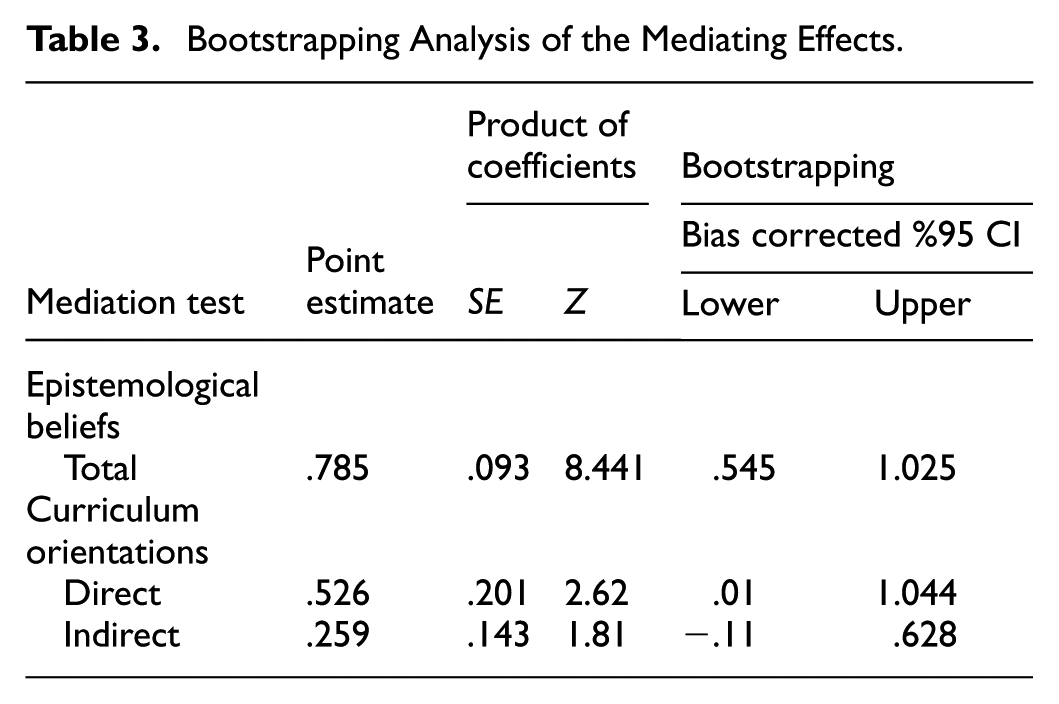
The SEM findings statistically confirmed all three hypotheses: H1, epistemological beliefs significantly affected democratic values (β = .66, p < .001); H2, democratic values significantly affected curriculum orientations (β = .40, p < .001); H3, epistemological beliefs significantly affected curriculum orientations (β = .53, p < .001). Moreover, H4 was confirmed, indicating that democratic values mediated the relationship between teachers’ epistemological beliefs and curriculum orientations partially (indirect effect = .26, p < .01). These findings suggest that teachers’ epistemological beliefs not only shape their curricular decision-making directly but also operate indirectly through their democratic commitments. These results demonstrated that the hypothesis H4 can be supported.
Building on the statistical model established in the first phase, the qualitative analysis was undertaken to elaborate how epistemological beliefs, democratic values, and curriculum orientations materialize in teachers’ day-to-day pedagogical actions. Guided by a phenomenological approach supported by vignette, this phase aimed to capture teachers’ lived experiences and situated decision-making, thereby offering context-specific explanations that complement the quantitative results.
Qualitative Findings
Data from the vignettes were analyzed through content analysis, with the stages including coding, categorizing, and thematizing. Themes revealed four teacher profiles identified as “Yes-sir,”“Conformist,”“Gatekeeper,” and “Transformative.” The demographic characteristics of profiles are presented below.
As seen in Table 4, although all the participants follow the same centralized curriculum, differences arise due to the school culture and personal backgrounds of each group. Four teacher profiles were identified, Yes-sir, Conformist, Gatekeeper, and Transformative, which were characterized by their professional efforts like prioritizing master’s degree, in-service trainings or other professional development activities. In particular, the dominance of profiles reflecting closed-minded groups (Yes-sir, Conformist, Gatekeeper) illustrates a typical pattern among teachers in the Turkish system: educators who, after long years within a centralized and restrictive curriculum structure, have largely abandoned innovative practices despite initial enthusiasm.
Characteristics of Teacher Profiles.

The qualitative findings revealed how teachers both individually and systematically constructed epistemological beliefs and democratic values. These beliefs and value systems collectively determine whether teachers’ curriculum orientations evolve toward subject-centered, problem-centered, or learner-centered. The qualitative findings, thus, reveal variations of the quantitative model, shaped by both contextual and individual dynamics. Expanding the statistical evidence of mediation through teachers’ lived experiences helped us to elaborate on the strength of refined theoretical model in this study. The four teacher profiles reveal a spectrum of pedagogical orientations within a centralized designed educational system. Diverse teacher profiles coexist and collectively sustain in a continuum in this system, as portrayed in Figure 6, which depicts how curriculum enactments shaped by epistemological beliefs and democratic values vary across different contexts.
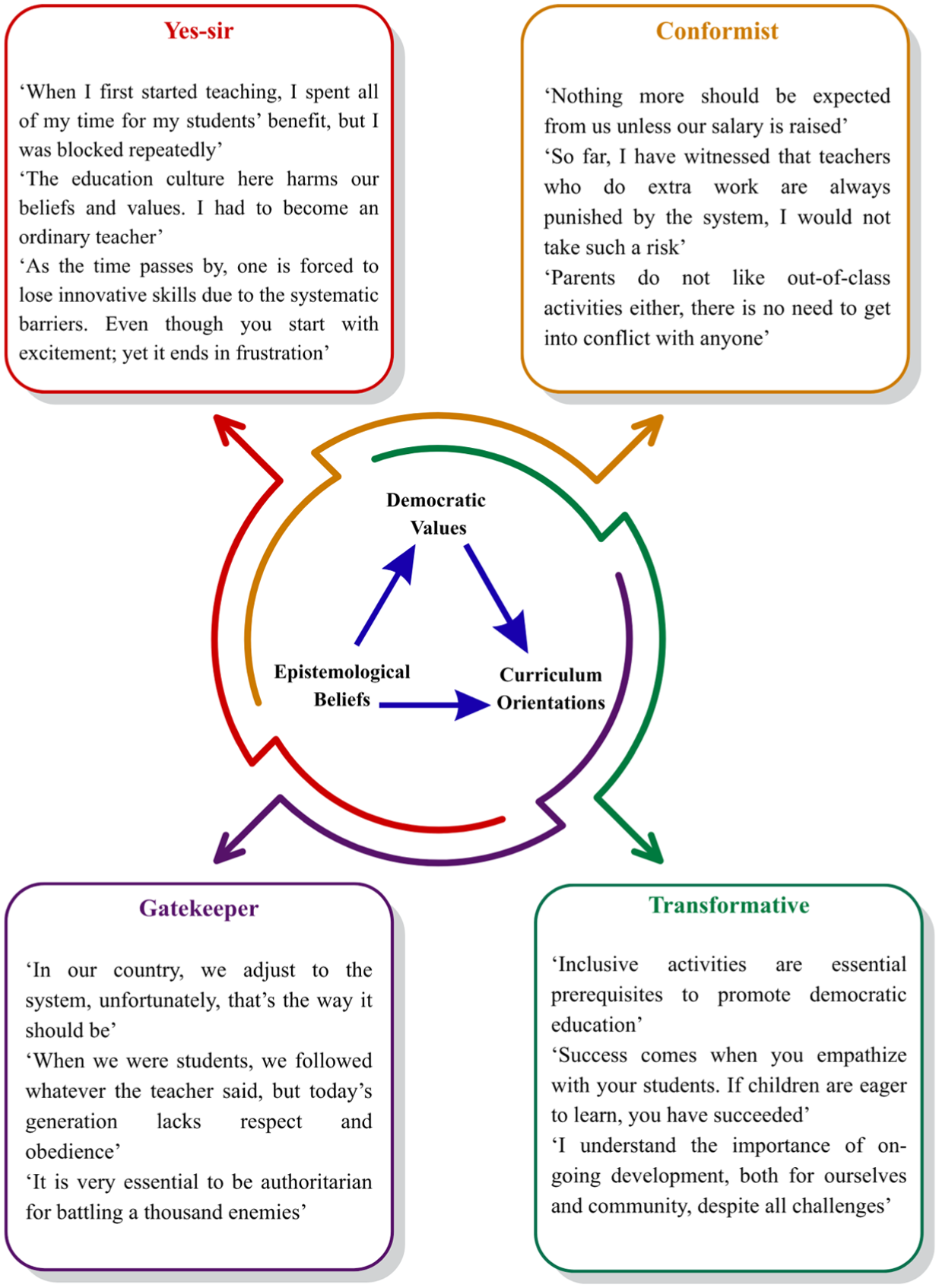
Integration matrix of teacher profiles reflecting the interplay of beliefs, values, and curriculum enactments.
At the core of the matrix lies the structural interaction among epistemological beliefs, democratic values, and curriculum orientations, symbolizing the model tested in the quantitative phase of the study. Surroundings of this core are the four teacher profiles (Yes-sir, Conformist, Gatekeeper, and Transformative), each representing themes emerged from the qualitative phase. These profiles illustrate how teachers’ beliefs and values continuously shape and are reshaped by their classroom practices and contextual realities, which will be scrutinized in the following section.
Yes-Sir
These teachers have reflected themselves as individuals who reproduce the status quo under the pressure of systematic punishments and restrictions. For example, teacher 11 explained this by saying “teaching idealistically and performing extracurricular activities always cause problems. No one likes reformist and innovative educators,” and this shows that innovative approaches and changemakers are often criticized harshly while the traditional approaches are praised. In addition to this, teacher 33 exemplified that situation as following:
“the education culture here harms our beliefs and values. I had to become an ordinary teacher. I quit focusing on creativity; because I was reported to the principle and he didn’t support me at all, and some parents complained about me to the Presidential Citizen Communication System. I got into trouble.”
Teacher 25 added that, “as the time passes by, one is forced to lose innovative skills due to the systematic barriers. Even though you start with excitement; yet it ends in frustration. We just basically beat a dead horse.” These statements show that the education system gradually alters teachers’ beliefs and values and ultimately forces them adhere to a fixed mindset. At the beginning of their profession, these teachers were idealistic, but they lost courage to stand behind the change due to indignity from stakeholders around them. Also, they had some prejudices against improvements due to experiences acquired over time. For instance, teacher 30 emphasized that they lost their belief in the possibility for appraisal of good practices with the quotes “when I first started teaching, I spent all of my time for my students’ benefit, but I was blocked repeatedly,” and teacher 9 expressed that “the education system here cannot be improved, everyone complains about each other and finally we all end up doing similar works.” Overall, this pattern of “Yes-sir” teachers supported what was already demonstrated in the quantitative analysis: The teachers’ epistemological beliefs significantly affected their curriculum orientations. “Yes-sir” teachers, who viewed knowledge as fixed and absolute, aligned themselves with subject-centered curriculum orientation. It can be concluded that this profile prefers to reproduce their pedagogical actions due to systematic punishments and restrictions.
Conformist
Conformist teachers prefer staying in their comfort zone and show unwillingness to oppose authority. Teacher 19 expressed that, “instead of major modifications for curriculum, approaches should fit into the generally approved thoughts and standards… it is better to employ methods conforming to the authority.” This profile discerns inclusiveness or increased student participation to avoid getting into trouble, as teacher 12 emphasized in: “I avoid doing anything that could harm my profession. We need to work without any conflict or objection.” Some of them are reluctant to leave their comfort zones, some wish to be approved by others, and some have other pragmatic reasons. For example, teacher 28 expressed that “nothing more should be expected from us unless our salary is raised,” and teacher 15 emphasized that “after all, I have my own private life. I can’t spend my time and energy for extracurricular activities.” These statements reveal that they just spend the required amount of energy and time for their profession, not more than that. With the statement of teacher 7 “so far, I have witnessed that teachers who do extra work are always punished by the system, I would not take such a risk,” and of teacher 13 “parents do not like out-of-class activities either, there is no need to get into conflict with anyone,” it was concluded that this profile does not want to have trouble with any stakeholder, and they just want to be approved for accomplishing the minimum. The SEM findings suggested that democratic values partially mediated the effect of epistemological beliefs on curriculum orientations. In line with this, “Conformist” theme illustrates how contextual constraints weaken the mediating role of democratic values, leading teachers with a potentially more democratic attitude to reproduce conventional curriculum orientations anyway.
Gatekeeper
Gatekeeper teachers are blindly loyal to the system and value seniority in the profession. They believe that novice teachers are idealistic and have trouble fitting in the system, yet this will be inevitably realized over time. Teacher 1 reported that, “in the beginning, teachers are idealistic, but over time, especially in our country, we adjust to the system… that’s the way it should be.” Also, teacher 5 expressed that “I think it was the lack of experience that made novice teachers misaligned to the system. They will learn how to be a good teacher in time.” This profile reflects a strong influence of experience, a desire for power, and a firm adherence to traditional systems. For instance, teacher 10 remarked, “when we were students, we followed whatever the teacher said, but today’s generation lacks respect and obedience.” Similarly, teacher 26 noted, “if you don’t want to face misbehaviors in your classroom, you need to balance kindness and discipline. When you’re always friendly, students might take advantage of this… it is very essential to be authoritarian for battling a thousand enemies…” Teacher 24’s statement, “as teachers, we want the best for our students, yet they fail to understand that what we teach is ultimately for their benefit,” reflects the belief that adopting traditional teaching methods fits with the values and experiences they strongly hold. From this perspective, they find conventional methods sufficient to meet their standardized goals and thus follow recipes. Seniority for this profile means an orientation towards an epistemological belief valuing absolute truth, and an increased emphasis on discipline, hierarchy and strong adherence to rules and standards. The statistical results confirmed that epistemological beliefs were strongly associated with democratic values. Regarding the quantitative findings, thematic analysis illustrated how this is realized in practice as “Gatekeeper” teachers with epistemological beliefs of absolute truth emphasized obedience and authority, showing little tolerance for student voice and diversity. As a result, this profile demonstrates how professional acculturalization and the systemic conditions reinforce epistemological stances for absolute truth and low demonstration of democratic practices, consolidating subject-based curriculum orientation especially among experienced teachers.
Transformative
Transformative teachers are committed to social reform and place high value on flexibility, diversity, and innovative solutions. They remain committed to their beliefs and show perseverance and adaptability despite of obstacles. For instance, teacher 22 shared following quotation:
“I was trying to do different activities with my students, such as planting and cultivating, and doing something for street animals. One day, the principal warned me and said that instead of spending time for these activities, it would be more beneficial to focus on boosting academic success. I defended myself mentioning that I prepare them for real life, not for exams…”
This demonstrates how transformative teachers face challenges when they prioritize the long-term benefit of the society and nurture their students holistically. Flexible curriculum with practical activities and advocating pluralism are fundamental principles for this group. Teacher 6 confirmed this idea pointing out that “knowledge alone is not enough; practice is also needed.” In addition, teacher 32 reported that “inclusive and sustainable activities are essential prerequisites to promote democratic education and foster differentiation for all learning needs…”
Along with supportive context, resilience in teachers’ belief leads to success. Teacher 36 highlighted this point that by saying “success comes when you empathize with your students. If children are eager to learn, you have succeeded.” Likewise, teacher 29 stated, “disruptive administration negatively affects a teacher’s motivation. I always got the support of my parents and administrators. I was lucky, we worked as a team.” The statement of teacher 35 “I believe that we have the power to shape the future of children, so the smallest contribution we make will lead to great transformations,” and expression by teacher 17 “learning is a long journey and an inner passion of mine” show that development is seen as a lifelong passion and mission for this profile to transform society. Teacher 24 exemplified this finding “I went to England with the Erasmus project and experienced this when interacting with colleagues from different backgrounds and cultures. When I returned, I discovered that my students enjoyed learning with the new methods I had adopted.” Building on this, teacher 38 said that “I attend as many training sessions on effective teaching methods as I can, and I have a master’s degree. I understand the importance of on-going development, both for ourselves and community, despite all challenges…” Considering all, transformative teachers are continuously improving, looking for ways to overcome challenges by drawing on insights gained from other learning communities and adapting them to their own contexts. The SEM results revealed that epistemological beliefs affected curriculum orientations through the indirect effect of democratic values. The “Transformative” teachers’ beliefs are grounded in effort, growth, and knowledge as evolving; they have a strong dedication to inclusion, participation and eclectism; and they reflect this holistic teaching perspective on a learner-centered and problem-based curriculum orientation. Linked to this, they take part in collaborative projects, inclusive activities, and value diversity in the classroom. This profile reflects how these three constructs are combined fully, where effort-bound epistemological beliefs foster democratic values that, in turn, lead to progressive curriculum orientations.
Meta-Inferences
Both quantitative and qualitative results demonstrate that epistemological beliefs affect curriculum orientations through the mediating effect of teachers’ democratic values; however, the contextual and systemic characteristics impact the strength of this relationship. The explanatory sequential mixed methods design made it possible to not only confirm these relationships statistically but also to expand them through teacher profiles that reveal how beliefs, values, and systemic factors interact in everyday practice. Teacher profiles emerged as a result of thematic analysis extend the SEM findings: while the model captured the positive pathways from epistemological beliefs to democratic values and curriculum orientations, the qualitative data revealed how systemic pressures, professional socialization, and cultural norms explain why most teachers clustered in closed-minded profiles (Yes-sir, Conformist, Gatekeeper), with only a smaller group (Transformative). While the SEM indicated that democratic values generally mediated the relationship between epistemological beliefs and curriculum orientations, the vignette analysis revealed that this pathway was most fully realized only among the Transformative teachers.
Discussion
This study examined how teachers’ epistemological beliefs relate to their curriculum orientations through the indirect effect of democratic values in a centralized school system. Three questions guided the research: (1) Is there a positive relationship between teachers’ epistemological beliefs and democratic values, between teachers’ democratic values and curriculum orientations, and between teachers’ epistemological beliefs and curriculum orientations, as tested through structural equation modeling? (2) Do democratic values mediate the relationship between teachers’ epistemological beliefs and curriculum orientations? and (3) How do teachers’ epistemological beliefs and democratic values manifest in and influence their pedagogical actions and curriculum decisions? The study combined structural equation modeling and phenomenological vignette analysis to test these relationships and show how they appear in practice, through an explanatory sequential mixed methods design. The discussion below connects the findings with existing literature and reflects on contextual challenges.
As for the first and the second research questions, the quantitative findings revealed that teachers’ epistemological beliefs have a direct positive effect on curriculum orientations, and that democratic values mediate this relationship. Teachers’ epistemological beliefs and democratic values significantly influence how they implement the curriculum. In other words, teachers’ stance on knowledge acts as a spark that ignites curriculum implementation, evolving into a flame when combined with democratic values. Several studies (Aslan, 2022; DeGlopper et al., 2023; Karo et al., 2024; Kırık, 2024; Letina, 2022; Saidah et al., 2025) confirm these relationships. A curriculum influenced by teacher beliefs and democratic values has a pivotal role in transmitting pedagogic acculturation. Teachers’ underlying mindsets continue to shape distinct educational outcomes as this cycle is reproduced: those with a growth-oriented perspective are more likely to foster pluralism and respect for differences, whereas those with a more stable view tend to reinforce absolute truth and reproduce the status quo. The qualitative findings also confirmed this pattern, revealing that a spectrum of teacher profiles, ranging from Gatekeeper to Transformative, sustains the influence of teacher mindsets on curriculum practices.
Considering the third research question, three of the profiles, “Yes-sir, Conformist, Gatekeeper,” favor authoritarian teaching methods, while only one profile, “Transformative” adopts learner-centered didactics. While DeGlopper et al. (2023) identified that most teachers tend to believe in traditional teaching orientations, Baş (2021) also noted that teachers in Turkey consistently favor a conservative attitude. The teacher profile thematized as “Yes-sir” was found to adopt more conservative orientations due to contextual limits such as punishments and restrictions. DeGlopper et al. (2023) emphasized that epistemologies are assumed to be context-dependent; just like Deng et al. (2014) who stressed that focusing on how contextual variables influence epistemic beliefs of teachers is particularly valuable. The “Conformist” profile, which avoided extracurricular activities due to the risk of peer criticism, exemplifies how contextual pressures can suppress teacher agency. This aligns with Poole’s (2024a) concept of “performative mechanics,” where appraisal systems regulate teacher behaviors. “Gatekeeper” teachers, especially the senior ones, believe in preserving status quo, and perform a rather traditional axis by modelling their own teachers to nurture the acculturation, which makes it harder to change their beliefs (Atlı & O’Dwyer, 2021).
Additionally, “Transformative” teachers are persistent in innovation despite difficulties, participate in collaborative projects, have a master’s degree, work in supportive school communities and have experienced this teacher profile themselves as they were once students of dedicated teachers. Thus, their daily teaching practices are more open to innovation, collaboration and inclusion (Reichert et al., 2021). The difference between teacher profiles highlights their attitude toward challenges. Teachers with a growth mindset view challenges as a chance and a great opportunity to improve themselves, on the other hand, those with a fixed mindset believe that setbacks make them inefficient (Dweck, 2015). The highly engaged teachers are extremely committed to their professional roles, and this vision leads them to see challenges as an opportunity for professional growth (Xue et al., 2024). The importance of sustained professional development was also evident across this profile. For example, participants who pursued in-service training or postgraduate study described how an epistemic belief in effort and appraisal of democratic values supported their willingness to innovate, contrasting with other profiles. For them, professional learning is seen as a source of strength, enabling teachers to balance accountability demands with their broader professional commitments (Poole, 2024b). This strength is the outcome of a growth-oriented “transformative” mindset (Grassmeyer, 2017).
These teacher profiles illustrate personal, systemic, and peripheral forms of teacher agency in curriculum enactment. To be more specific, the “Transformative” teachers were the ones who showed the highest levels of such power, modifying the curricular goals in ways that were in sync with their beliefs regarding knowledge and values of democracy. These are teachers who step out of their comfort zone and engage in sustained collaborative inquiry and experience enriched professional learning in order to enhance epistemic negotiation (Casallas, 2017; Dai, 2023). This, in turn, is linked to their progress-focused resilience (Wilson & Conyers, 2020).
In sum, this study argues that teachers’ epistemological beliefs and democratic values jointly shape how curriculum is enacted, with teacher profiles illustrating the spectrum from compliance to or confronting the pressures of the mainstream. Although most teachers were under systemic pressures conformed to traditional and conservative orientations, a minor group showed that the epistemology based on effort and appraised democratic values can support innovative, inclusive and resilient practices. The results not only underscore the persistent limitations of centralized systems but also the transformative power of teacher agency, thus, making the role of professional development and nurturing school cultures in cultivating growth-oriented mindsets crucial.
Conclusions and Recommendations
The research shows that teachers’ personal beliefs and values determine how they approach curriculum implementation. The research has focused mainly on preservice teachers and specific subject areas but it has neglected to study in-service primary school teachers whose long-term engagement with centralized curricula which makes them key actors for curriculum implementation. The investigation of epistemological beliefs and democratic values in this research helps explain how teachers’ mindsets determine their decisions about curriculum. The hypothesized model was enhanced through qualitative teacher profiling which demonstrates how various factors impact the way beliefs transform into teaching practices. Therefore, the study contributes to the already existing literature by merging the effects of teachers’ epistemological beliefs and democratic values on their curriculum orientations to the mixed methods approach. The study also has practical implications by providing insights to guide educational policy and professional development programs focused on pluralism, resilience, and innovation within the educational systems.
The Turkish context serves as a limitation for generalizability, but it can also be framed as a particular strength. While the gathered context may hinder the transferability of the findings, it still offers an important case study regarding a non-Western education system. Moreover, although diversity was sought, particularly in the qualitative phase, the reliance on voluntary vignette responses may have been enhanced through the triangulation of phenomenological data such as observations, alternate scenario analyses with larger, and more diverse samples. Finally, future studies may broaden the set of variables, boost the model through the student voice, and incorporate longitudinal and action research designs to model further explanatory depth.
Priority should be placed on fostering a growth mindset that combines resilience and multidimensional thinking of teachers imagining their central role in curriculum implementation. Teachers need support to believe in their professional development and well-being through financial assistance and emotional backing and institutional backing and the establishment of collaborative projects and ongoing professional development centers which honor diverse perspectives. Advocacy of professional communities that focus on the neuroscientific understanding of learning and within which the teachers and the stakeholders together take decisions, can contribute to the strengthening of this ecosystem. The establishment of learning communities that encourage teachers to share good practices may also result in a more learner-centered curriculum orientation, and from a broader perspective, a more democratic and pluralist society.
Footnotes

Ethical Considerations
Ethical approval for this study was obtained from Anadolu University Social and Human Sciences Research and Publication Ethics Committee with approval number 494266 on 28 March 2023.
Consent to Participate
Written informed consent was obtained from participants.
Author Contributions
Tuğba Babacan: Conceptualization, methodology, investigation, formal analysis, writing – original draft. Meral Güven: Conceptualization, methodology, investigation, writing – review & editing.
Funding
The authors received no financial support for the research, authorship, and/or publication of this article.
Declaration of Conflicting Interests
The authors declared no potential conflicts of interest with respect to the research, authorship, and/or publication of this article.
Data Availability Statement
The participants of this study did not give written consent for their data to be shared publicly, so due to the sensitive nature of the research supporting data is not available.