




Abstract
This study investigates gender representation in Kazakh school textbooks through a mixed-methods approach that combines statistical analysis and qualitative thematic content analysis. Drawing upon official membership data from the Writers’ Union of Kazakhstan and a comprehensive review of approved Kazakh-language literature textbooks (grades 1–11, 2018–2023), the research identifies significant gender disparities in author representation and thematic focus. Although women constitute nearly one-fifth of registered writers, only 5.7% of textbook authors are female, while the majority of textbook compilers are women. Female authors are predominantly associated with themes of childhood, education, and nature, whereas male authors dominate topics such as history, patriotism, and national identity. The study also finds that both male and female writers inadvertently reinforce traditional gender stereotypes through recurring imagery and narrative tropes. These findings reveal persistent gender asymmetry in the Kazakh literary curriculum, reflecting broader international trends of underrepresentation of women in educational materials. The study underscores the need for curriculum reform to promote equitable gender representation in educational and cultural policy.
Plain Language Summary
During the Soviet Union era, the theory of socialist realism emerged in literature. Artistic works were written in this style to shape public opinion, and they became one of the tools for spreading Soviet ideology. In other words, works created in the socialist realism tradition influenced the formation of public consciousness in countries within the Soviet Union. Although the USSR no longer exists, this trend continues in post-Soviet countries. The purpose of this study is to explore how much this trend persists and to identify the presence of gender stereotypes. In post-Soviet countries, one of the key factors influencing the formation of public consciousness is literary works, while another is the content of educational programs. Therefore, this literary process requires analysis within the framework of new global perspectives. This article focuses on examining works included in school textbooks in Kazakhstan from the perspective of gender theory. Three main topics are explored. First, the gender statistics of authors officially registered with the “Writers’ Union of Kazakhstan” were identified. Second, the study presents the gender statistics of scholar-pedagogues who compiled textbooks such as Primer, Mother Tongue, Literary Reading, and Kazakh Literature, as well as theauthors of the works included in these textbooks. Third, a content analysis of the works included in school textbooks was conducted. Both quantitative and qualitative research methods were used. The results showed that works by both male and female authors could influence the formation of gender stereotypes. The study also took into account Kazakhstan’s unique historical and geographical context, social stereotypes, and national identity. The outcomes of this research could be used in the future development of textbooks.
Introduction
The Soviet regime institutionalized the ideology of socialist realism across the humanities, directly shaping literary production and educational content. The themes and messages of literary works were designed to align with ideological goals, emphasizing collective identity and social duty. In post-Soviet Kazakhstan, literature continues to serve as a formative educational tool and occupies a central place in the national curriculum. Although no separate gender education program exists for schoolchildren, the selection of literary texts and authors reveals implicit messages about gender roles and cultural expectations.
Given the impact of literature on public consciousness and value formation, contemporary Kazakh literature warrants critical examination through the lens of gender theory. While writers in Kazakhstan theoretically enjoy equal opportunities for creative expression, gender disparities persist in publication, recognition, and curricular inclusion. Therefore, it becomes essential to identify the extent of gender-based representation, evaluate literary content through a gender-sensitive framework, and assess the broader socio-cultural implications.
In response to this gap, the present study analyzes the gender distribution of authors officially registered with the Writers’ Union of Kazakhstan, as well as the authors and teacher-scholars involved in the compilation of school textbooks. The analysis employs gender theory as an interpretive framework, situating the findings within Kazakhstan’s unique historical and geographical context while considering the enduring influence of Soviet-era ideology, national identity, and prevailing social norms. This integrated approach enables a deeper understanding of how educational texts reflect and reproduce gendered structures of representation in Kazakh literature and society.
Literature Review
Gender equality has received growing scholarly attention worldwide since the mid-20th century and, more recently, within Kazakhstan over the past two decades. Stoller (1968), an American psychoanalyst, introduced the concept of “gender” into scientific discourse through his seminal work Sex and Gender, in which he asserted that the two notions—biological sex and gender identity—carry distinct meanings. This idea was later expanded by Rubin (1975) in her influential essay The Traffic in Women: Notes on the Political Economy of Sex, which laid the foundation for distinguishing sex as biological and gender as socio-cultural categories (Adrienne, 1979).
Feminism subsequently played a central role in the emergence and institutionalization of gender studies. Since gender initially characterized women’s psychological and social roles in comparison to men, feminist theory arose from the struggle for equal rights and opportunities (Kundakbayeva & Duysebayeva, 2016). The growing involvement of women in academic and public life paved the way for feminist literary critique. Scholars note that “French feminists” such as Julia Kristeva, Luce Irigaray, and Hélène Cixous contributed significantly to literary theory and psychoanalytic feminism (Rivkin & Ryan, 2004). Cixous et al., (1976) essay The Laugh of the Medusa argues that only women writers can authentically and freely portray female experience (Lucy et al., 2003).
In 1990, Judith Butler further transformed the field with her essay Gender Trouble, exploring gender performativity and drawing upon Freudian and post-structuralist theory. Elaine Showalter, another pivotal figure in feminist criticism, coined the term “gynocriticism” to describe the study of women’s writing and its distinct literary traditions (Akhter, 2020). Showalter (1981) evaluated women authors as the intellectual heirs of Virginia Woolf, emphasizing how the 1970s marked the rise of feminist literary critique. Concurrently, Kirilina (2021) observed the emergence of masculinity studies since the 1990s, signaling the diversification of gender studies within the broader humanities.
In the Kazakh context, ethnographic and scientific references to gender roles can be traced back to the mid-19th century in the works of Shokan Ualikhanov and Ibrai Altynsarin. The Alash intellectuals of the late 19th and early 20th centuries further explored social equality and women’s roles in traditional Kazakh life. For example, Ualikhanov (2010) documented gender-specific customs such as “Saka women sew yurts,” or “on men’s graves, a spear is placed; on women’s, a spindle or ladle,” revealing deeply embedded gender symbolism. Similarly, in his ethnographic essays Altynsarin analyzed rituals of courtship, mourning (zhoktau), and marriage, comparing men’s and women’s responsibilities and expressions of grief (Altynsarin, 2008).
Akhmet Baitursynuly’s early 20th-century works also examined poetic genres—zhar-zhar, bata, and lullaby—through a gendered lens, showing how folk literature encoded social expectations of men and women (Baitursynov, 2003).
In modern Kazakhstan, gender theory has become an essential analytical framework for literary and linguistic research. Shokim’s (2012) Fundamentals of Gender Linguistics established a theoretical foundation for studying language and gender in Kazakh linguistics. Building on comparative approaches, Satbayeva (2020) examined masculinity and male identity in 20th-century American and Kazakh literature, while the edited volume “Gender and Kazakh Society” (Ergebekov & Temirbekova, 2022) consolidated recent empirical findings. Other contemporary studies—such as Adayeva (2023) on gender elements in Kazakh literature and Agabekova et al. (2025) on gender education in higher education—demonstrate growing interdisciplinary engagement.
Furthermore, Kuzhabekova et al. (2024) and Kuchumova et al. (2024) explored gender disparities in STEM fields, focusing on women’s employment and early-career experiences in Kazakhstan. Despite this expanding scholarship, there has been no comprehensive investigation into the gender representation of Kazakh writers in school textbooks, marking a significant research gap that this study seeks to address.
At the international level, recent UNESCO (2024, 2025) reports emphasize the urgent need for gender-sensitive approaches in education, particularly regarding authorship and representation in curricula. The report Technology on Her Terms (2024) highlights how gendered barriers in educational materials perpetuate systemic inequities, while the 2025 Gender Report identifies Kazakhstan’s underrepresentation of women writers in school literature as part of a broader structural imbalance shaping students’ perceptions of gender and national identity (UNESCO, 2024, 2025). Together, these insights reinforce the necessity of curricular reform that acknowledges women’s contributions to national literature and promotes equality through educational content.
Materials and Methods
This study employed a mixed-methods design, combining quantitative analysis of author representation with qualitative content analysis of school textbooks. Data were collected from two primary sources: official membership records of the Writers’ Union of Kazakhstan and approved Kazakh-language literature textbooks (grades 1–11) published between 2018 and 2023 by Atamura, School, Almaty Kitap, Arman-PV, and Writer publishing houses.
Quantitative Strand
The quantitative component examined gender representation among registered writers and textbook authors. Statistical data were derived from the Writers’ Union of Kazakhstan—the country’s only national professional association for poets and authors, established in 1934. Membership is granted to writers with at least two published literary works, and as such, the Union serves as an indicator of institutional recognition within the literary field.
In addition, the Center for Expertise of the Content of Scientific and Practical Education, operating under the Ministry of Education of the Republic of Kazakhstan, was consulted as the authoritative source for approved textbooks. This dual institutional framework—the Union for literary inclusion and the Ministry for curricular approval—formed the basis for analyzing how structural and institutional factors shape gender representation in school materials.
Qualitative Strand
A qualitative inductive thematic analysis was employed to investigate how gender roles are portrayed in the literary content of textbooks. Following Braun and Clarke’s (2022) reflexive approach, coding was primarily data-driven but informed by relevant theoretical frameworks and prior scholarship on gendered representation in educational materials. Themes and subthemes were identified through iterative coding, comparison, and refinement, ensuring both analytical depth and interpretive flexibility.
Consistent with Alyaqoub et al. (2024), themes can be derived deductively from theory or inductively from raw data. Our analytic process embraced this flexibility, integrating both perspectives in accordance with established methodological frameworks (Aslam et al., 2023, 2024; Assarroudi et al., 2018; Braun & Clarke, 2022; Hsieh & Shannon, 2005; Kibiswa, 2019; Mayring, 2000, 2014). These sources supported systematic coding, transparent documentation, and methodological rigor.
Coding Process and Categories
Texts written by both male and female authors were coded and categorized to examine how gender roles were represented across literary genres and age levels. The initial coding categories—derived inductively from the data—were:
Education and childhood (e.g., poems and stories about schooling and upbringing),
Nature and animals,
Patriotism and nation-building,
Family and domesticity,
Art and creativity,
Stereotyped gender roles (implicit or explicit depictions of male and female behavior).
These categories were cross-validated against theoretical frameworks to ensure internal consistency and conceptual clarity. Through iterative reading and memoing, overlapping subthemes were merged or refined to maintain analytic coherence.
Reliability, Reflexivity, and Ethical Considerations
To ensure methodological transparency, the study adhered to COREQ and SRQR qualitative research standards. Researcher reflexivity was addressed through memo writing, peer debriefing, and triangulation between textual data and institutional records. The research team critically reflected on how their positionalities as educators and researchers could shape interpretive choices. While complete neutrality is unattainable in qualitative research, these strategies strengthened confirmability and analytic credibility.
Ethical approval was not required for this study because all data sources—textbooks and institutional statistics—were publicly accessible and non-identifiable. Nevertheless, all analyses were conducted with academic integrity, ensuring accurate representation and respect for intellectual property.
Findings and Discussion
Data acquired throughout the study were examined under two main subheadings. First, the gender distribution of writers in modern Kazakh literature was analyzed using quantitative data. Second, attention was given to the proportion of female authors featured in the national school curriculum, along with the titles and thematic scope of their works.
The Gender Distribution of Writers in Modern Kazakh Literature
The quantitative analysis revealed a pronounced gender imbalance among contemporary Kazakh writers. According to official data provided in Letter No. 181 dated February 29, 2024, a total of 1,022 authors were registered, of whom 819 (approximately 80%) were men and 203 (around 20%) were women. These figures illustrate the persistent underrepresentation of women in Kazakhstan’s literary field, echoing trends observed in earlier studies across post-Soviet contexts.
It should be noted that the Writers’ Union of Kazakhstan, which served as the primary data source, includes not only authors of fiction—such as poets, novelists, and playwrights—but also literary scholars, translators, and critics. Therefore, the statistics reflect a broad spectrum of literary professionals rather than purely fiction writers. Moreover, since the Union encompasses authors writing in Kazakh, Russian, and Uyghur, the data provide an approximate indicator of gender dynamics across Kazakhstan’s multilingual literary landscape.
Membership in the Union is not mandatory for publishing literary or academic works; therefore, these proportions are indicative rather than comprehensive, offering a representative snapshot of gender distribution within the country’s institutionalized literary production. Overall, the findings confirm that women remain numerically and institutionally underrepresented, despite the existence of formal equality in creative opportunities.
The Proportion of Female Authors in the School Curriculum and the Titles of Their Works
School textbooks constitute one of the most visible and enduring platforms for authorial representation in Kazakhstan. Accordingly, this section analyzes the proportion of female authors featured in the national school curriculum, spanning Grade 1 (Alphabet and Native Language) to Grade 11 (Kazakh Literature).
In Kazakhstan, school textbooks are prepared and published by five authorized publishing houses—Atamura, School, Almaty Kitap, Arman-PV, and Writer—based on the national curriculum approved by the Center for Expertise of the Content of Scientific and Practical Education under the Ministry of Education of the Republic of Kazakhstan (BMSO, 2025). This centralized approval ensures uniformity in core content, though differences in layout and editorial presentation may exist among publishers.
To determine the gender representation of authors, all textbooks issued by these publishers between 2018 and 2023 were systematically examined. The textbooks were categorized into three educational levels:
Elementary level (Grades 1–4): Alphabet and language textbooks that introduce basic reading skills and early exposure to national literature.
Middle level (Grades 5–7): Literature textbooks that present simplified classical and modern works, including prose and poetry.
Upper level (Grades 8–11): Advanced Kazakh literature textbooks featuring canonical authors, analytical exercises, and historical-literary context.
While the number of female authors varied across grade levels, their overall share remained limited. Textbooks used in elementary grades included a small number of short stories and poems by female writers such as M. Mukhanova, A. Nurshaikhova, and S. Zhienbayeva, often focusing on family, nature, and moral education. In middle and upper grades, however, the curriculum became increasingly dominated by male authors, emphasizing heroic narratives, patriotism, and nation-building, whereas women’s contributions were restricted to lyrical, domestic, or pedagogical themes.
The analysis also revealed that the inclusion of female authors did not proportionally increase with higher grade levels; rather, their visibility tended to decline. This demonstrates a systemic pattern of gender imbalance, where canonical male figures—such as Abai, Mukhtar Auezov, and Gabit Musrepov—continue to dominate the school literary canon.
Consequently, the representation of women writers in the Kazakh curriculum remains both numerically limited and thematically confined. Although recent reforms have diversified textbook design and teaching approaches, the persistence of traditional gender hierarchies in the selection of literary works reinforces existing stereotypes and limits students’ exposure to diverse authorial perspectives.
Elementary Grades (1–4)
The analysis reveals that female authors are more frequently represented in primary school textbooks (Grades 1–4) than in middle or upper grades. Their writings predominantly address educational, cognitive, and nature-related themes, particularly focusing on children, animals, and plants. This emphasis reflects the traditional cultural association of women in Kazakh society with childcare and early education, which naturally extends into their literary contributions.
For instance, a 3-month content analysis of the children’s newspaper Ulan found that female authors published more frequently than male authors (Kydyrbayev, 2022). This trend is similarly observable in early-grade textbooks, where women writers contribute proportionally more often, albeit still as a minority.
At the elementary level, three core textbooks are used for Kazakh-language instruction: Alphabet, Native Language, and Literary Reading. The first grade includes Alphabet and Native Language, while Literary Reading is introduced in Grades 2 to 4. Across these materials, 421 authors are represented—398 men and only 23 women. Compilation of these textbooks involved 24 female and 6 male educators and scholars, reflecting a gender imbalance that reverses between authorship and pedagogy.
For example, Native Language includes one female and twelve male authors, whereas Alphabet contains four women and seventy-eight men. The only female author featured in Alphabet is Fariza Ongarsynova, whose poem “Knowledge is Necessary for Everyone” (Ongarsynova, 2021) underscores the importance of education and science. Similarly, in Native Language, female authors’ contributions are mainly tied to themes of education, animals, and nature (see Table 1).
Works by Female Authors in the First Grade “Native Language” Textbook.

Overall, although female writers appear somewhat more frequently at the elementary level, their creative participation remains limited in scope. Their works tend to reinforce nurturing and moralistic imagery, aligning with stereotypical gender expectations that associate women with early education and emotional guidance. This sets a pattern for later grades, where women’s literary voices gradually diminish in both frequency and thematic diversity.
The Literary Reading textbook for Grade 2 (Atamura Publishing) features 71 male and 4 female writers (see Table 2).
Works by Female Authors included in the textbook “Native Language” of the First Grade.

Notably, the theme of homeland or national identity appears only twice among female authors across all lower-grade textbooks. Kulash Akhmetova’s poem “Astana” (Akhmetova, 2022) exemplifies this rare engagement with patriotic motifs:
For a nation celebrating its 30th anniversary of independence, such themes—homeland, nation, unity—carry high educational value. Yet they remain marginal in women’s literary representation.
Another Literary Reading textbook (Almaty Kitap Publishing) includes 76 male and 10 female authors. Female writers cover a broader range of topics—animals, plants, nature, family, personal identity, education, and patriotism (see Table 3).
Works by Female Authors in the Second Grade “Literary Reading” Textbook.
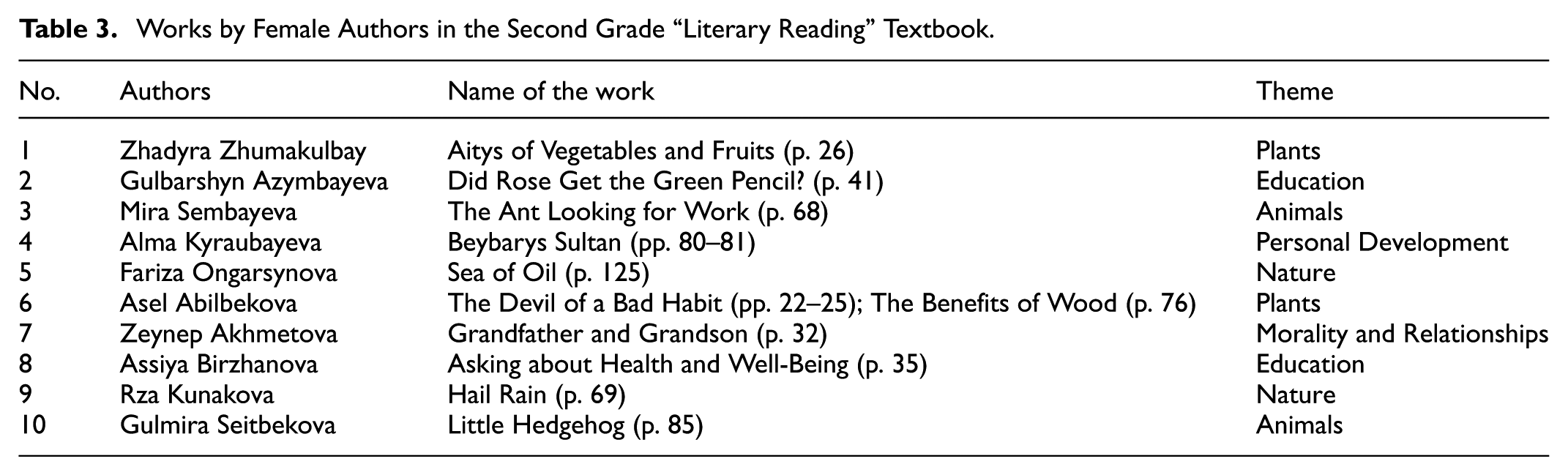
Although Zhadyra Zhumakulbay’s “Aitys of Vegetables and Fruits” centers on plants, it subtly introduces gendered symbolism. The poem extols the virtues of everyday produce—onions, carrots, watermelons, beets, and apples—as vital to human health:
Here, the “apple” is personified as aru, meaning “maiden” or “beautiful girl” in Kazakh (Zhanuzakov, 2008). This gendering of a fruit, contrasted with neutral depictions of carrots or beets, introduces early symbolic associations between femininity and delicacy. Such representations, while subtle, reinforce gender stereotypes for second-grade readers whose socialization processes are still forming (Avdulova, 2009).
Similarly, Zeynep Akhmetova’s “Grandfather and Grandson” explores traditional household roles. The young protagonist describes his mother’s “golden hands” that cook, clean, and sew—tasks contrasted with the grandfather’s inability to perform them. Through this dialogue, the story normalizes domestic labor as inherently feminine, thereby shaping children’s perceptions that kitchen and home work belong exclusively to women. Such early representations may discourage boys from pursuing culinary or domestic professions due to societal stigmatization.
The Literary Reading textbook for Grade 3 includes 64 male and 5 female authors. Among these, Syzdyk (2018) contributes a brief commentary on Akhmet Baitursynuly, and Zhambulova (2018) recalls her grandfather Zhambyl Zhabayev in “Zhakem.” On artistic themes, Ongarsynova’s (2018) poem “Jeweler” and Zhienkulova’s (2018) essay “Kazakh Dance” appear, alongside Ainagul Sadykova’s translation of Marshall (2018) and Ongarsynova’s annotation on Mark Twain (2018). Although these latter cases credit male originals, the female translators are counted as contributing authors.
Additionally, three female heroic figures—Manshuk Mametova, Aliya Moldagulova, and Kulyash Baiseitova—are represented, though their stories are written by men.
In Grade 4, the Literary Reading textbook (Almaty Kitap) lists 3 female and 41 male authors. Women’s works here center on nature, art, science, and education. Fariza Ongarsynova reappears with her poems “Passion” (on science and education) and “Ornaments” (on art). Anar Mustafina’s story “Cosmic Life” and Gulnar Umirzakova’s poem “Color About the Five Grades” also address educational themes.
In total, across Grades 1 to 4, 23 female authors are featured, addressing 9 thematic domains. The proportion of female representation peaks in second-grade textbooks, where both Atamura and Almaty Kitap publications include relatively more women contributors than other levels.
Middle Grades (5–7)
Across Grades 5 to 7, the visibility of female authors sharply declines. The 3 Kazakh Literature textbooks used in these grades collectively feature only 1 female author, compared to 34 male writers. For instance, the textbooks for Grades 5 and 7 contain no works by female authors. In the sixth-grade textbook, published by Arman-PV, Fariza Ongarsynova is mentioned only once—as a reference name in the introductory text, rather than as the author of a full work.
The compilation of these textbooks involved 22 women and 1 male educator-researcher, who contributed to the selection of recommended materials for students. However, their participation was limited to editorial and pedagogical roles, not as featured authors.
The Grade 5 curriculum includes canonical works such as “Kendebai Kerkula,”“Koblandy Batyr,” and “The Legend of Asan Kaygy,” as well as literary profiles of Dulat Babatayuly, Ibray Altynsarin, Akhmet Baitursynuly, Berdibek Sopakbayev, and Marat Kabanbai. Female writers in Kazakh literature are familiar with these figures and often reinterpret them in later periods, as seen in the early 20th century in the works of Sholpan Imanbayeva and Nazipa Kulzhanova.
One of the few sections directly addressing gender-related issues is titled “Family Values.” It includes works by contemporary male authors—T. Nurmagambetov’s “The Boy Who Missed His Mother” and Nurdaulet Akysh’s “Where Is the Real Grandmother?”—both reflecting traditional views of women’s social roles. In Akysh’s story, the “ideal grandmother” is a woman who tells fairy tales, implying disapproval of modern grandmothers who do not. This notion stems from the enduring belief that women, mothers, and grandmothers are inherently responsible for childrearing and moral upbringing. Even when written by men, such stories reproduce a gendered ideology of domesticity—one that continues to inform how femininity is taught in schools. Contemporary Kazakh women writers also frequently explore family values and education, yet their works are largely absent from current middle-grade textbooks.
The Grade 6 curriculum begins with the fairy tale “Ayaz Bi” and progresses through ancient literature, Islamic literary heritage, poetry of the Kazakh Khanate (zhyrau), Abai, 20th-century literature, and independence-era works. Because ancient and zhyrau poetry traditionally emphasizes heroism, epic struggle, and tribal unity, there are no female authors represented in these early periods. From the 20th century onward, women’s participation becomes more visible—though still underrepresented—with figures such as Sara Mynzhasarova and Sharbanu Beisenova; in the independence era, Saule Doszhan, Sagynysh Namazshamova, and Aliya Dauletbaeva contribute notable works.
The Grade 7 curriculum includes Kyz Zhibek zhyr (the Song of Kyz Zhibek), as well as the Orkhon–Yenisey inscriptions, Kültegin poem, bardic and Zar-Zaman literature, and works by Magzhan Zhumabayev, Mukhtar Auezov, Qasym Qaysenov, Sansyzbay Sargaskayev, Mukhtar Shakhanov, Tölen Abdik, and Temirkhan Medetbek. For example, an excerpt from the song “Kyz Zhibek” reveals the portrait of Zhibek (woman’s name). Not only the beauty of Zhibek is sung in it, but also the intelligence:
These lines symbolize a young woman’s intellect and agency, countering one-dimensional ideals of female beauty. Yet, paradoxically, none of the Grade 5 to 7 textbooks include works authored by women, despite such empowering archetypes in the canon. Because all publishing houses adopt nearly identical curricula for Grades 5 to 7, the absence of female-authored works is systemic rather than publisher-specific. Research in educational psychology emphasizes that gender-reflex formation is particularly active between ages 10 and 13 (Agafonova, 2019; Avdulova, 2009). This developmental window coincides with middle school years, when students internalize gender norms and social identities; the near-total exclusion of women writers at this stage represents a missed opportunity to model diversity and broaden representation.
Upper Grades (8–11)
School textbooks for Grades 8 to 11 contained works by four female and eighty-two male writers. The textbooks include author biographies and literary profiles. Forty-one female and fifteen male teacher-scholars collaborated in the preparation of these textbooks, deciding which works would be included.
Four publishers produce the Grade 8 Kazakh Literature textbook: Atamura, School, Arman-PV, and Writer. The complete textbook contains works by twelve male and one female writer. The female author is Roza Mukanova, with the piece “The Image of the Eternal Child” [Mängilik bala beyne]. The story focuses on the nuclear tests in Semipalatinsk (1949–1961) and on the fate of those affected (Mukhanova, 2017). The heroine, Layla, represents a girl who never had a real childhood—innocent, wounded, and uncertain. Through this character, the author mobilizes the archetype “Motherland–Mother / Mother Earth” to convey the suffering and inner conflict of the land and nation where the bomb fell (Bauer et al., 2013).
Fariza Ongarsynova’s poem on art, “Poem, I Will Take Care of You” [Ölen, men seni ayalap ötem], appears in the Grade 9 textbook. The author personifies poetry as a companion to whom she expresses affection. As art is a universal theme, such works can deepen students’ appreciation for the lyrical voice. The tradition of aitys in Kazakh literature also demonstrates women’s capacity to compose and perform poetry.
According to surveys, Kazakhstan has ≈370 aitys poets, with women ≈20% of them (Nuriman, 2023). Sara Tastanbekkyzy is considered the first prominent female aitys poet in Kazakh history; her aitys with Birzhan Qozhagululy is featured in the Grade 9 curriculum. Scholars show that “Birzhan and Sara” took place on the Semirechye steppe in 1871 (Dubuisson, 2021). The textbook also includes Birzhan akyn’s poems that praise Sara’s human qualities and wisdom:
These lines reveal not only beauty but also intelligence and aspiration for freedom, signaling a female figure’s yearning for education and agency.
The Grade 10 curriculum is divided into Social and Humanitarian and Natural and Mathematical directions. The first contains nine male writers but no female author. In the second, there are seven male and one female author—Aigul Kemelbayeva, whose “Khairly” focuses on nation and homeland. The main character, Kenzhebek, a Kipchak man, is exiled during wartime and later returns to Turkmen lands. Taskul, an old man—once brought as a boy with a captive horse—helps him flee home on a swift horse. Taskul had grown into a man and, in the local setting, became known as an “atek”—a eunuch (Zhanuzakov, 2008). Unable to identify with a fully masculine society, Taskul does not want Kenzhebek to face such humiliation. The young man returns home after a year, changed beyond recognition.
The Grade 11 curriculum follows the same two directions. The Social and Humanitarian section features nine male authors, while the Natural and Mathematical one contains seven—again, no female writers appear. The textbook (Atamura, School, Arman-PV, Writer) does not include any female authors. For instance, the anthology includes Yerbolat Abikenovich’s “We Were Looking for an Apartment,” reflecting social problems of independent Kazakhstan. A similar work by Zhadyra Shamuratova—“Builder”—addresses the same issues but was not included.
In general, across Alphabet, Native Language, Literary Reading, and Kazakh Literature, a total of 453 male and 26 female writers are represented. Women constitute 5.7% of all authors, while men account for 94.3%. Altogether, 109 teacher-scholars participated in preparing these textbooks, of whom 80% were women and 20% men. Despite the large number of women educators involved, the works included remain predominantly male-authored.
According to Section II, Article 14(2) of Kazakhstan’s Constitution, “No one may be discriminated against in any way due to origin, social, official, and property status, gender, race, nationality, language, attitude to religion, beliefs, place of residence, or any other circumstances” (President of the Republic of Kazakhstan, 2025). In addition, on December 8, 2009, Law No. 223-IV “On State Guarantees of Equal Rights and Equal Opportunities for Men and Women” was adopted (Institute of Legislation and Legal Information of the Republic of Kazakhstan, 2025).
Despite these legal guarantees, the persistence of gender asymmetry in literary education suggests that social stereotypes and the unequal distribution of family responsibilities continue to affect women’s creative opportunities. This reflects what feminist researchers term the “sticky floor” effect—introduced by Berheide (2013)—referring to how domestic responsibilities keep women “stuck to the floor” of the home, limiting mobility and visibility in public and creative life (Srivastava & Nalawade, 2023). Studies indicate that this phenomenon is particularly widespread in developing or transitional countries.
Kazakh writers have long regarded literary creation as a male domain. This belief is even expressed in poetry. For instance, in his eight-stanza poem about women poets, Esengali Raushanov writes: “Prophecy and poetry—from the head to the man,” adding, “From a woman there is no poet, dancer, or kuishi” (Raushanov, 2006). Considering that Raushanov received the State Prize for Labor and the orders of Parasat and Kurmet, his view reflects how gendered social stereotypes have become embedded in literary consciousness.
Taken together, these findings show that the representation of women writers in Kazakh school textbooks is limited not only by institutional selection practices but also by deeper cultural attitudes that shape what is considered “canonical.” The pattern observed across grades—from the near invisibility of women authors to the persistence of patriarchal metaphors—suggests that gender imbalance in literature education is systemic rather than incidental. Future revisions of the curriculum should therefore balance representation and recognize the contributions of female authors, ensuring that students encounter a literary tradition that reflects the diversity of Kazakh society.
Conclusion
Gender-focused literary studies remain a relatively new field within academic research, yet they address issues of significant cultural and social importance. Accordingly, this study focused on identifying gender disparities in Kazakhstan’s contemporary literary landscape. Although men and women in Kazakhstan are formally granted equal opportunities for creative expression, the representation of female authors in literary institutions and educational materials remains markedly unequal.
Official data from the Writers’ Union of Kazakhstan were used to evaluate gender distribution among professional authors. Consistent with the Results section, membership records indicate that roughly one in five registered authors are women (≈20% women vs. ≈80% men), reflecting a persistent gender imbalance in Kazakhstan’s literary field. (This corrects earlier percentage figures and aligns the Conclusion with the quantitative totals of 1,022 members: 819 men, 203 women.)
The analysis of school textbooks reinforced this conclusion. Among the authors whose works are included in Kazakh-language school curricula, only 5.7% are women, compared to 94.3% men. Interestingly, about 80% of the teacher-scholars who participated in textbook compilation are female (vs. 20% male), highlighting that even where women are the majority within educational roles, their creative voices remain underrepresented in the canon presented to students.
In addition to the quantitative findings, the study applied gender theory to examine the thematic and ideological content of literary works included in school textbooks. The analysis revealed that female authors tend to write extensively about education, nature (flora and fauna), and art, while **their participation in patriotic or nation-centered topics is minimal—only two works across the 11-year curriculum address such themes from a female perspective.
Furthermore, textual analysis demonstrated that social stereotypes deeply rooted in Kazakhstan’s historical and geographical context continue to shape the portrayal of gender roles. These stereotypes are reproduced by both male and female authors (often implicitly), suggesting that symbolic asymmetries are embedded in the broader literary culture, not merely in editorial selection.
In sum, while Kazakhstan’s literary education formally promotes inclusivity, its enacted content still reflects enduring gender hierarchies. Addressing these gaps requires curricular reform (diversifying author selection and themes) and a broader cultural rethinking of gender representation within Kazakh literature and education.
Limitations and Future Recommendations
Like all social research, this study has several limitations that should be acknowledged in light of its design and data sources.
First, the analysis focused exclusively on Kazakh-language literature textbooks officially approved by the Ministry of Education of the Republic of Kazakhstan between 2018 and 2023. While this offers a representative view of the current national curriculum, it excludes alternative, Russian-language, or supplementary teaching materials, as well as non-state school curricula. This limitation narrows the scope to a specific linguistic and institutional domain. Second, the quantitative strand relied on official records from the Writers’ Union of Kazakhstan, where author gender was inferred based on naming conventions and archival documentation. This method may overlook non-binary identities or more nuanced expressions of gender, limiting the analysis to a binary classification framework. Third, the qualitative content analysis was interpretive by nature. While inductive thematic coding was conducted with rigor—using memoing, triangulation, and peer debriefing—researcher positionality and cultural context may still shape interpretation. Although reflexivity strategies were employed, complete neutrality is not achievable. Fourth, the study did not include classroom observation, textbook usage practices, or reader interpretation, which means that the actual impact of gendered narratives on learners’ understanding remains outside the empirical scope.
Despite these limitations, several promising directions for future research emerge: (i) comparative studies across post-Soviet, Central Asian, and global contexts can help determine whether Kazakhstan’s literary gender imbalance is part of broader international patterns, (ii) longitudinal studies could trace how gender representation in textbooks evolves across successive curriculum reforms, (iii) mixed-method classroom research, including interviews and focus groups with teachers, students, and textbook authors, would reveal how gender representations are interpreted, resisted, or reinforced in practice.
Such studies would bridge the gap between policy-level commitments to equality and actual literary exposure in schools, contributing to a more inclusive and critically reflexive curriculum.
Footnotes

Funding
The authors disclosed receipt of the following financial support for the research, authorship, and/or publication of this article: This research has been funded by the Science Committee of the Ministry of Science and Higher Education of the Republic of Kazakhstan (AP26197523 Religion and Literature: Religious Trends in Kazakh Poetry and Prose (1991-2024)).
Declaration of Conflicting Interests
The authors declared no potential conflicts of interest with respect to the research, authorship, and/or publication of this article.
Data Availability Statement
The data used in this study are derived from publicly available sources and institutional documents. The content of school textbooks analyzed in this research is publicly accessible. However, statistical data regarding the gender distribution of members of the Writers, Union of Kazakhstan are not publicly available on the institution's official website. These data were obtained upon formal request by the authors and are presented in the relevant section of the study. Due to copyright and institutional restrictions, the full dataset is not publicly available, but all sources used are cited throughout the article.