



Abstract
Teacher identity reconstruction plays a key role in the successful implementation of educational reforms in the field of second and foreign language teaching. Most of the previous studies have explored this process on the tertiary level and with beginning teachers via the implementation of new teaching approaches, media, and content. However, few studies have examined experienced high school language teachers’ identity reconstruction in educational reforms. Studying experienced teacher growth is crucial to helping tailor professional development programs to meet teachers’ evolving needs. The present study reports language teacher identity reconstruction through a multiple-case study of three experienced Chinese high school English teachers during the use of a new set of English textbooks. The findings show that experienced teachers can reconstruct their identities with different degrees of readiness as a result of their previous identities and varied individual agency exercised through teacher learning, reflection and engagement in practice motivated by understanding of their current identities and positioning of imagined identities. Cognitive and emotional support from colleagues and a mentor were also found to play a significant role in the process. The findings have implications for both teacher development and implementation of educational reforms in the field.
Keywords
Introduction
Teacher identity refers to how “teachers define themselves to themselves and to others” (Lasky, 2005, p. 901). Teacher formation of new identities plays a crucial role in the success of curriculum reforms (Golombek, 2017; Richards, 2017), as teachers learn something in order to “become ‘somebody’” (Benson, 2017, p. 19). The past decades have witnessed numerous curriculum reforms in the field of second and foreign language teaching around the world—involving a change in new textbooks as pivotal to the reform. Compared with an abundant number of studies exploring teacher knowledge, teacher beliefs, and teacher learning during curriculum reforms, research on language teacher identity (LTI) reconstruction resulting from the use of new textbooks via educational reform has attracted little attention in the field. For many contexts in EFL (English as a Foreign Language) or ESL (English as a Second Language), a set of new textbooks often serves as a new teaching platform with new teaching content. Needless to say, the new textbooks provide an opportunity for new learning for the EFL/ESL teachers, particularly for those local teachers who are also EFL or ESL learners (Li et al., 2022). It is for this reason that we consider it necessary to explore the identity reconstruction processes of English teachers learning to use a new set of textbooks.
In addition, most of the previous studies on LTI have focused on university teacher curriculum reform, with most involving either beginner teachers or early career teachers as participants, who have positioned themselves as innovators and are believed to possess the potential for successful implementation of educational innovations (Trent, 2014). Many other educational reforms in second and foreign language teaching have taken place at the primary and secondary levels. English teachers in these institutions have different knowledge sets, skill sets, and teacher education backgrounds from those at the tertiary level and face uniquely different institutional and societal contexts. For example, in countries such as China, English is a school subject and students in their final year of high school must take high-stake tests in order to enter universities. Both teachers and students are under immense pressure to strive for excellence on the tests. Understanding how teachers learn and innovate while dealing with such external pressures is of great value to language teacher education and teacher development in these countries. Moreover, since experienced teachers shoulder most of the teaching load in schools, their identity reconstruction during curriculum reforms further merits our attention, as understanding their growth is crucial to helping tailor professional development programs to meet teachers’ evolving needs. Using a multiple case study analysis, this study aims to (1) illuminate the dynamic and complex nature of teacher identity reconstruction; (2) elucidate the internal and external forces that lead to teacher participation or non-participation in curriculum reforms; and (3) explore the interface between LTI, classroom practice, and context during these processes—all of which hold implications for the professional development of secondary school EFL teachers and the successful implementation of educational reforms. Hence, the research questions posed here are: (1) How do experienced Chinese high school EFL teachers reconstruct their identities via learning to use a new set of textbooks? (2) What factors influence their identity reconstruction during this process?
Literature Review
LTI became a focus of study in the field of language teacher education at the beginning of this century (Y. Liu & Xu, 2011, p. 590). Barkhuizen (2017, p. 3) describes the following features: “Language teacher identities are cognitive, social, emotional, ideological, and historical—they are both inside the teacher and outside in the social, material and technological world. LTIs are being and doing, feeling and imagining, and storying.” The above description demonstrates the multi-faceted nature of LTI, making it a powerful construct for studying teacher development. LTI is cognitive as teachers need to gather new knowledge in the subjects they are teaching, develop new skills of practice, and form new understandings (e.g., of their students—let alone understanding themselves). It is, moreover, historical in that it relates to a teacher’s past learning via past teaching experiences. Its social nature comes from the fact that it is formed via negotiation and interaction with others and from contextual factors. Finally, LTI is dynamic in that it is always changing with context and practice and is formed both based on the internal individual characteristics of the teacher and the external institutional and cultural influences.
LTI has been studied from both behavioral and discursive perspectives (Fairclough, 2003; Wenger, 1998). On the behavioral level, engagement, imagination, and alignment were identified as three key factors (Wenger, 1998). Teacher engagement enables them to negotiate meanings in practice. Imagined identity serves as a goal for which to strive. Alignment refers to the process where a teacher’s self-positioning (Langenhove & Harre, 1999) becomes connected and aligned with the group identity. On the discursive level, teacher identity was examined through one’s commitment in terms of both modality and evaluation. Modality refers to what teachers are committed to with regards to truth, obligation, and necessity; it can be examined via their use of modal verbs and modal adverbs (Fairclough, 2003). Evaluation reflects a teacher’s view on what is desirable or undesirable. In both their behavioral and discursive practice, teachers exercise their agency to arrive at new understandings and form new identities.
A review of the literature revealed several lines of research regarding LTI formation and change. One is the study on the formation of teacher identity by pre-service teachers and novice teachers. It is found that pre-service teachers tended to hold rigid views of teaching and LTI, which might exert negative influences on their professional development (Trent, 2011). Novice teachers were also found to go through a process of identity formation from a cue-based and exemplar-based imagined identity to a rule-based and schema-based practiced identity (H. Xu, 2013), during which their cognitive, emotional and behavioral aspects need to be combined (Golombek & Doran, 2014). The establishment of an initial teacher identity is also found to be crucial to teachers’ future development (Lee, 2013; Friesen & Besley, 2013).
A second line of research on LTI focuses on the identity formation of native English-speaking teachers (NESTs). It was found that NESTs’ self-positioning was challenged by local non-native English-speaking teachers (NNESTs) and school administrators (Trent, 2012, 2016) and was influenced by various contextual factors (Chun, 2014; Jeon, 2009; Lasagabaster & Sierra, 2002). NESTs have multiple and dynamic identities and their personal practice helps them construct favorable identities (Guo et al., 2021).
In recent years, language teacher identity reconstruction in educational reforms has received increasing attention (Gao et al., 2018; Y. Liu & Xu, 2011; Trent, 2014; Tsui, 2007; Y. Xu & Tao, 2020; Yuan & Liu, 2021). A change in teacher identity has often been found to be caused by top-down policy changes on teaching approaches or content, or as a response to new teaching modalities (e.g., online teaching).
The available studies have found that language teachers—when faced with competing pedagogies—have to change their identities in order to adapt to the changes. In this process, it is important to obtain both legitimate access to practice and legitimacy of access to practice (Trent, 2012; Tsui, 2007). In other words, the individual needs to recognize that he or she obtain the competence that the community desires, and he or she need to be given the right to participate in practice. In addition, in the reform, it is essential to provide beginning teachers with sufficient space in order to allow them to negotiate meanings and to recognize their competence (Trent, 2012). If a teacher’s competence in the reform is not recognized by the institution or the community, it can lead to marginal participation, or even to non-participation (Y. Liu & Xu, 2011). Meanwhile, a teacher’s emotional experience during the reform ought to be acknowledged and institutions should express empathy toward a teacher’s puzzlement or doubts toward the reform (Y. Liu & Xu, 2011).
In learning new teaching content such as English for Specific Purposes (ESP), the use of new teaching modalities (online teaching) and new assessment approaches (formative assessment), it is found that the formation of a learner identity and a reflective teacher identity is key to the improvement of teaching performance (Y. Xu & Tao, 2020). Furthermore, a community of practice (CoP) plays a key role in offering teachers both cognitive and emotional support. However, it is also found that in online teaching, for example, the role of the institutions has been insufficient in providing rule-based support to teachers, compelling the teachers to rely on their colleagues for aid instead (Yuan & Liu, 2021). In addition, new identities were found to be established and developed via the negotiation and alignment of a teacher’s professional self and personal self under the influence of both social and historical factors (Y. Xu, 2011). A teacher’s professional identity is also found to directly influence one’s agency and future directions for professional development (Gao et al., 2018).
Methodology
Research Context
With the largest number of EFL learners in the world, China’s English curriculum reforms face a unique and complex situation influenced by a diverse set of factors. English is one of the three main school subjects on the college entrance examination together with Chinese and mathematics, and thus it receives much attention from parents, students, teachers, and school administrators. Over the years, China’s English language teaching has undergone several rounds of reforms, with an increasing focus on promoting communicative competence (D. Liu & Zheng, 2018; Wang, 2009). However, many secondary teachers still implement grammar-translation method in their teaching practices—with the passages in the textbooks being used merely as a carrier of grammatical structures. In 2017, China’s Ministry of Education issued the new High School English Curriculum Standards (ECS; revised in 2020; Ministry of Education, 2020), which focuses on fostering language learners’ core competencies, which include “language ability, cultural awareness, thinking quality and learning ability” and advocates an “activity approach” with the use of formative assessment in classroom teaching. Guided by the new standards, new series of textbooks were compiled, and starting around 2020, many provinces and municipalities in China have begun a new round of curriculum reform via the implementation of the new ECS and the use of the new textbooks. High school English teachers received training on the use of the new textbooks organized by the municipal educational committee and the high schools they work in.
The new textbooks used in the study were compiled under the requirements of the new ECS by making adaptations to a set of textbooks originally published by a British publishing house. The textbooks consisted of seven student books with their respective teacher books and workbooks, and intended for use in Grades 10, 11, and the first semester of Grade 12.
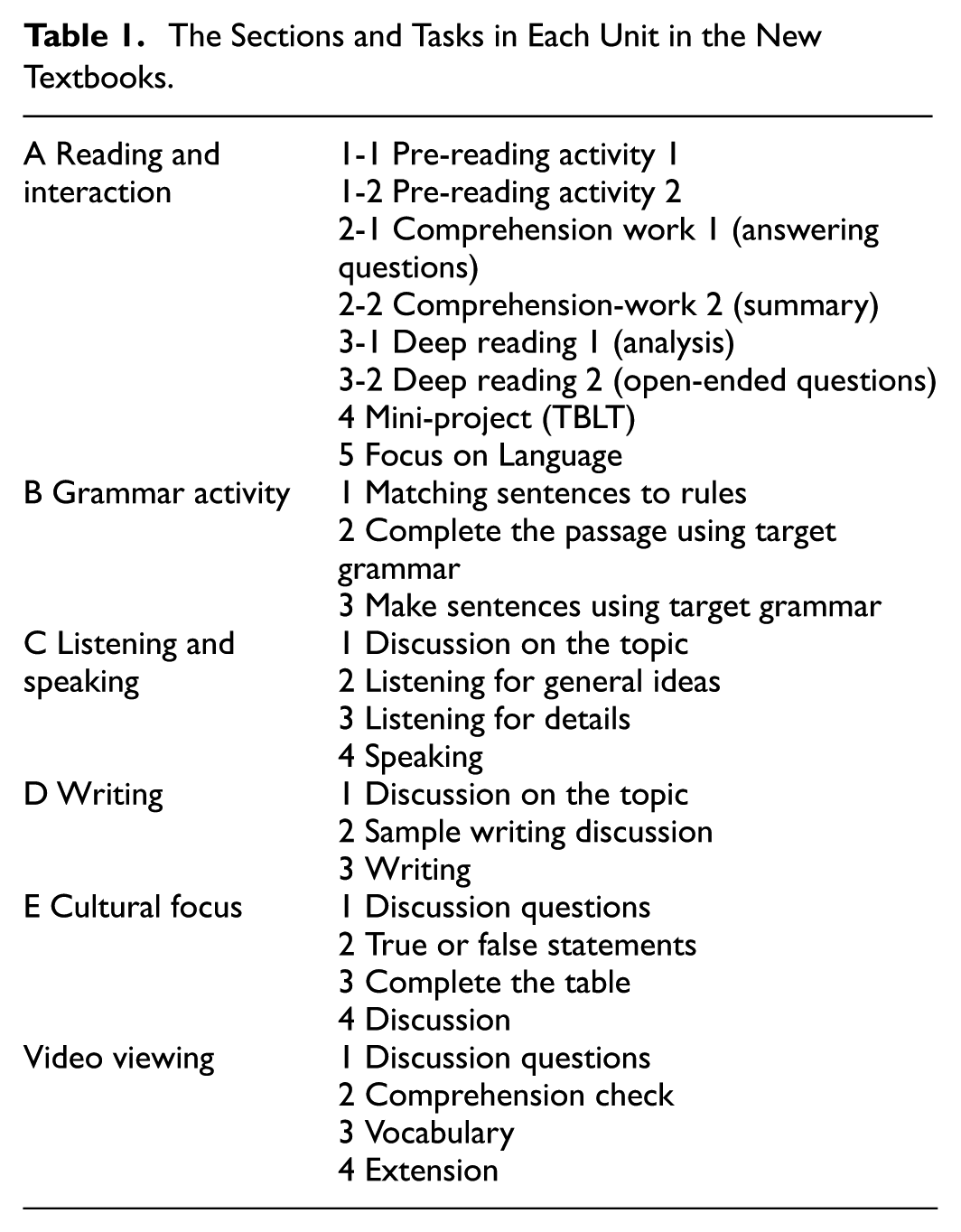
The new textbooks, unlike those previously used ones containing many exercises on linguistic knowledge, emphasize language use and communication. The old textbooks had generally lost appeal among teachers and students as they did not contain many communicative activities. The new textbooks feature new task designs not seen in the old textbooks (see Table 1), such as deep reading, mini-project, and video viewing. The deep reading task asks students to discuss their understandings of key sentences from the reading passage and to extend their understanding to real life. The mini-project asks students to complete a task such as making a poster or writing a letter after finishing the discussion section of the reading passage. The video viewing extends student understanding of the unit topic via the showing of interesting episodes related to the topic.
The Sections and Tasks in Each Unit in the New Textbooks.
Participants and the Program
The participants for the study were recruited from a teacher training program on the use of the new textbooks. Three teachers from the training program pseudo-named Liu, Hu, and Zhu were chosen as cases for the study. All three are experienced teachers with more than 20 years’ English teaching experience and they all actively took part in the training program and were willing to try the tasks in the new textbooks. Table 2 shows participants’ backgrounds in years of teaching and education at the time of research. Liu has worked as a high school English teacher for more than 40 years. Hu and Zhu both have more than 20 years’ teaching experiences and have worked in the same school since their graduation from college.
Participant Profiles.

The participants work at a high-level district high school, whose average admission scores are not as high as that of prominent municipal high schools, but are higher than average-level schools within the district. Students in the school study for 3 years (from grades 10 to 12) before they take college entrance examinations. The school was designated by the Municipal Educational Commission to be an experimental school for the use of new textbooks. Thus, the school administrators including the principal were keen on promoting the successful use of the new textbooks and had allocated sufficient resources to the reform.
The school invited the editor-in-chief (pseudo-named Yang) of the new textbooks to come to the school to help train the teachers on the use of the new textbooks. The training program started in September of 2020 when the 10th-grade students had just started to use the new materials and this process lasted 3 years, thus covering all the material in the textbooks. The teachers in the program took part in workshops and received advice from the training team on how to improve their teaching. The first author of the study was a member on the training team and had established a good rapport with the teachers. Based on class observations and daily interactions with the teachers, the above three participants were chosen as representative cases for the study.
Data Collection
The data were collected via interviews, discussions, meeting minutes, reflective journals and personal communications via social networking apps from September, 2022 to August, 2023. The timing of the data collection was set as such due to the fact that the school started to use the new textbooks in September of 2020 for the new Grade 10 students and by Grade 12 (2022), most of the new textbooks had been used. Hence, the teachers were able to look back on the previous 2 years of teaching and reflect on their own experiences. During these 2 years, the first author met with the teachers and took part in their seminars and workshops pertaining to the use of the new textbooks.
Before data collection, all participants were briefed about the study’s purpose, procedures, confidentiality measures, and their rights, including voluntary participation and withdrawal without penalty. Informed consent was obtained in writing, ensuring that participants agreed to take part with full understanding of what was involved. Interviews were conducted in a respectful, confidential manner to ensure participants felt comfortable sharing their experiences. Sensitive or intrusive questions were avoided to prevent emotional discomfort. All data were anonymized to protect participants’ identities. The risk of harm is minimal and justified in that by gaining a deeper understanding of teachers’ learning experiences, the study can inform more effective professional development programs and educational policies, ultimately improving teaching quality and student outcomes. For participants themselves, reflecting on their learning may offer personal insights and lead to professional growth.
The first interview took place in November of 2022 and the participants were asked about their personal background, general views toward the use of the new textbooks, and difficulties or confusion encountered during the process of textbook use. They were then given a period of 2 months’ time to write a reflective journal in which prompts were provided, and where they reflected more deeply and comprehensively on their attitudes, emotions and coping strategies with the textbook reform. During that time, the Grade 12 students had taken the first round of college entrance examinations [The city allows students in Grade 12 to take the English college entrance examination twice, once in January, and the other in June. The higher score of the two tests will be recorded in the students’ final total score.] in January of 2023. After the examination, the teachers held a meeting and analyzed the test results, reflecting on their teaching over the past 2.5 years. The reflective journals were collected by the middle of February of 2023. After carefully studying the transcripts of the first interview and the reflective journals, the researchers conducted the second interview with the participants in March of 2023 to further probe the reasons behind their identity reconstruction or non-reconstruction. Each participant received 2,000 RMB as an incentive. The editor-in-chief/teacher educator was also interviewed for his comments on the participants’ changes during the reform.
Data Analysis
The interviews and the meetings were recorded with the participants’ consent and then transcribed and sent to the participants for member checking before being put into Atlas.ti software for further analysis together with the word documents of the reflective journals. After reading and rereading the documents, two rounds of coding were conducted using the constant comparison approach (Miles & Huberman, 1994). The first round of coding used was open coding, during which key themes on the participants’ beliefs, actions, strategies, and emotional changes were identified. In the second round, guided by Trent (2014)’s theoretical framework, the researchers further compared and refined the codes into larger categories (see Table 3). For example, the quote “Teachers are restrained by their workload and family matters and do not have much time for reading books on language teaching and other topics” was labeled as “no time for learning” and was then categorized under the theme of “challenges” together with other codes like “large class size” and “immediate feedback.” The theme “challenges” was then grouped with other themes such as “acts of agency” and “external help” to form the category of “identity reconstruction factors.”
Coding Scheme for the Participants’ Identity Reconstruction Process.

To ensure the rigor and reliability of the coding process, two researchers independently coded 30% of the data using a coding scheme developed through an iterative process. Regular discussions were held to align on the operational definitions of the codes and resolve any inconsistencies. The researchers agreed on most coding and in instances where they identified minor discrepancies in code application, the research team engaged in discussions to understand the underlying rationale and reach a consensus.
Findings
This section mainly examines the three participants’ identity reconstruction process by discussing their identities before the reform, the challenges they encountered during the reform, the actions they took and their present identities.
Liu: From a Lone Explorer to Confident Reformer
Liu whole-heartedly welcomed the textbook reforms. To some extent, the textbook reforms helped consolidate his identity as an innovative teacher by providing him with opportunities to learn more methods of teaching English communicatively via teacher training programs and test these methods in class, whereas previously he had mainly explored new ways of more effective teaching all by himself.
Liu is an experienced teacher with an innovative spirit. He reads widely in his spare time, including books on culture, the history of different countries, as well as on the latest developments in the field of language teaching and second language acquisition. In addition, his passion for teaching motivates him to constantly reflect on his own teaching. Hence, he is always looking for better ways to teach certain parts in the textbooks. He remarked that he liked to entertain ideas about teaching in his spare time, and even when he could not sleep at night, he would think about how to improve his teaching.
Liu has a distaste for test-oriented teaching and believes that it is not true language teaching. In his class, he encourages students to appreciate the beauty of language and wishes to help students become “whole persons” by reading inspiring essays and sharing their views with classmates. As he commented,
I firmly believe that “whole person” education is more important than mere exam-oriented teaching. I would rather have students with a sound mind and sound body than just being test machines. The value of education is to produce responsible citizens with an open mind and good competency. (Liu, reflective journal)
In other words, for Liu, English teaching is more a form of humanistic education than merely teaching knowledge and skills. Through discussing various topics in the textbooks, Liu hopes to inspire his students to be better persons.
Besides attending training workshops, Liu also interacted actively with the editor-in-chief of the new textbooks on social networking apps, asking him questions and sharing his doubts during the lesson planning and the teaching process. The professor said he was greatly impressed by Liu’s inquisitive mind, and he was the only one among all the teachers in the school who reached out to him to discuss questions outside of working hours. The professor provided Liu with many relevant studies published in English academic journals, which he would print out and read carefully before asking more questions.
During the process of using the new materials, Liu fully exercised his agency, negotiated his own understanding of the tasks, and creatively adapted them so that they could better suit his students. For example, by trying the task-based language teaching design in the textbooks, he concluded that
Partial TBLT is very important. In the Chinese context, it is impossible to implement complete TBLT. Why? First, we teachers are foreign language learners. Very often we are not able to provide instant feedback on the spot. Second, Asian students are a bit shy, often unwilling to present opinions or thoughts in class. But we can do partially open tasks. (Liu, first interview)
By applying the tasks in class and reflecting on the process, Liu realized that given the unique cultural background and teachers’ competence, it was more feasible to use semi-open tasks in class as they provide opportunities for more scaffolding in order for students to be able to give some oral output.
Liu also found that it was helpful to ask students to write their response to deep reading tasks in the textbooks as it was not enough to only let them give oral responses. He believes that writing their responses down can give the students an opportunity to improve language accuracy and complexity.
In addition, via trial and experimentation, Liu was able to come up with an effective way for the teacher to give feedback via deep reading tasks. He states:
Deep reading is such a good design for the cultivation of students’ values as well as language ability. The cultivation of proper values needs teacher guidance. . . . Students can choose to do paraphrasing or critical commenting based on their common sense, disciplinary knowledge, and language competence, while the teacher should use more critical commentary when doing a summary or giving a demonstration. (Liu, reflective journal)
Thus, with the teaching of deep reading, Liu would often expand on student answers thus helping them achieve new understandings of both language and content. For example, after reading one passage about the film Life in a Day, Liu asked students why the film showed the scene of a poor man. One student answered that “poverty is no shame.” Liu responded “Well said! There is no shame in poverty. And neither is wealth a source for honor.” By recasting and expanding on the student’s answer, Liu introduced new ways of expressing the student’s idea, thus helping the student learn some life lessons, as well.
Liu felt that he found kindred spirits with the guidance of the expert teacher educator and the ideals of the new textbooks while previously he had been kind of a loner who carried out teaching in his own way. His emotional state during the reform changed from uncertainty to confidence and self-assuredness, as was reflected in the journal writings:
The workshops held by Professor Yang influenced my teaching ideals, enriched my understanding of second language teaching and learning. As a result, I go on with my everyday teaching with more confidence and less anxiety… I felt that I finally found kindred spirits. I did not know many people before. Most teachers I came into contact with before all talked about how to do tests. So, when the professor came, I felt relieved. (Liu, first interview)
Hu: From a Dissatisfied Seeker to Patient Practitioner
Like Liu, Hu also welcomed the curriculum reform and the new textbooks as she had always been dissatisfied with test-oriented teaching. Her own experiences as a language learner and novice teacher gave her a sense of what successful and effective language learning looked like. Thus, she actively engaged herself in the reform and established a new identity as a patient teacher who attempts to strike a balance in her teaching.
Hu’s identity as an English teacher has changed over the years. At first, she disagreed with the view that “teachers are the engineers of human souls.” She thought it ridiculous and exaggerated the teacher’s role. “Who has the ability to mold another person’s soul? Teaching is just a job.” She stated that during the first several years of her teaching career she “did not like the job very much, for it strictly consists of mechanical practice or the reading of some boring texts. It’s like the assembly line in a factory. Students and the teacher can’t feel each other’s souls.”
Hu believed that language should be learned through use: that is, learners should express their true thoughts through language. She remarked that her belief of ideal language teaching and learning mainly sprang from her own experience as an English major in college and her early teacher training experiences. In her undergraduate studies, she once had a young teacher who asked the students to act out the texts via role play—and while the texts were old and boring, she and her classmates enjoyed the process immensely. From that experience, she came to believe that language learning was about using the language in order to do things. In addition, in her early years as an English teacher, her school had invited some foreign teachers to help train new teachers. One of the teachers had asked them to do a lot of oral interactions, from which she felt she greatly benefited.
As she gained more experience in teaching, she started to implement some innovations in her own class, such as the use of role-plays:
I asked students to pick an episode of the text and act it out. My original plan was to let students become more familiar with the text. To my surprise, their performance totally exceeded my expectations. What an exciting lesson! They were so imaginative and showed unique understanding of the characters. That day the classroom was the center stage for the students and I retreated to the back. Some students who used to seem slow and bored in class changed into someone I never knew before. Everybody benefited a lot. Both I and the students started to look at the English lesson and each other differently… This lesson opened a new window for me into English language teaching. (Hu, reflective journal)
This critical incident changed her view of her students and of English learning and propelled her to reconsider her way of teaching. Later, she took on the role of homeroom teacher, taking charge of the whole class instead of just being their English teacher. She found that many issues with her students were caused by problematic parenting, and she could do little about it as a teacher. Thus, she disliked being a homeroom teacher. However, after she became a mother herself, she was able to empathize with her students’ parents and tried to further understand her students and their families.
In the reform, Hu’s passion for teaching was reignited via the use of the new textbooks and the guidance from the teacher educator. She said she felt as if she were alive again and started to try more new things in class.
However, during the process, she initially met with many challenges including the students’ existing beliefs about language learning, difficulty to organize group activities in a big class, and the high demands required of the teacher with the new textbooks.
Some of her students, —having gotten used to test-oriented language teaching—challenged her way of teaching after the implementation of the new textbooks. They expected the teacher to teach them “solid stuff,” by which they mean vocabulary, grammar, and language points they could write down in their notebooks.
Also, it was not easy for her to organize student activities in a large class. She stated that after some time, some students would raise doubts about class discussions or group work because many students were not engaged. “Sometimes the speaker spoke in a low voice or was shy, other students could not hear clearly. So, they feel that they can’t learn much. It is a waste of time.” (Hu, first interview)
In addition, the new approach put a high demand on the teachers to provide instant feedback to students. She felt that she did not have that knowledge, thus making her feel very anxious, as she explained:
After the use of the new materials, I no longer need to spoon-feed the students with many language points and explanations. Many speaking opportunities were given to the students. It seems as if I now have fewer tasks in class. Actually, this is harder for the teacher. Why? If you only talk about tests, it is actually not difficult. But when you want to communicate with others, then you need to think, how this person might respond and how you should react. I felt tremendous pressure because I needed to give evaluation and feedback right on the spot to the students’ problems in expression and understanding. (Hu, second interview)
As time went on, she realized that she could learn together with the students. She stopped being anxious and carried on with teaching quite successfully. With the establishment of the “teacher-as-a-learner” identity, the shackles of self-restraint gradually were released and she became a more confident teacher, as she said:
These challenges forced me to improve myself quickly and constantly. I started to liberate myself from the textbooks and enrich myself from other reference books and the Internet. . . . . I feel that my understanding of language teaching has changed. Deep down, I can now accept my role as a learner too. In the English classroom, the teacher is not an authority, but a learner discussing and learning together with the students. Thus, I no longer felt anxious for not holding a dominating role in the class or upset about not covering many exercises. (Hu, reflective journal)
With the guidance of the teacher educator, she kept trying to devise strategies to tackle the difficulties. For example, as there are over 40 students in her class, there is no time for every student to share his or her views in class and she is not able to check all their discussion work. Therefore, she added an assignment to the class discussion asking students to write down their thoughts after class. This further gave her the opportunity to read their work and check their understandings.
More importantly, the multiple roles she took on over the years led to her becoming a fairly patient teacher who tries to strike a “balance” between scores and competence, between parent expectations and her own belief in language learning. She realized that the acquisition of communicative competence requires a long time and a lot of effort to develop, so both the teacher and the students should have the patience and perseverance to stick to it. At the same time, teachers should also help students to achieve high scores. She admitted that she made compromises in her teaching in consideration of student expectations, thus integrating her traditional approach with the new one: for example, emphasizing the fostering of good study habits with memorization and dictation of new words. “Though this is not real language learning, it is necessary,” she commented.
The teacher educator played an important role in facilitating Hu’s identity reconstruction. She stated that she and her colleagues were lucky to have the professor’s guidance. If he were not here, they might not be brave enough to make the changes. She was grateful that the professor helped create an atmosphere conducive to making changes.
Zhu: From a Knowledge Transmitter to a Partial Participant
The identity reconstruction process Zhu undertook over the 3 years showed some change, but with some regression as well. She attempted to engage herself in the reform but then regressed back to the test-driven teaching practice in the second year as a result of external pressures.
Before the reform, Zhu mainly adopted a knowledge-transmission model in teaching. In lesson preparation, she “mainly prepared the language points, underlined the key words in the passages and prepared for explanations on the detailed test points.” In class, she had ready-made PPTs to talk about language points and her students’ tasks were to listen and take notes.
After using the new textbooks, Zhu arrived at some new understandings of language learning and teaching and learned some new approaches via the training workshops and discussions with her colleagues. The biggest change in her teaching is the change from a “teacher-centered” to a “learner-centered” class and a shift from “a focus on knowledge” to “a focus on meaning,” as she herself reflected in her journal:
I focus more on asking students to use English to do things, that is, to design tasks to help students fulfill the learning objectives. We have a lot of individual, pair, and group work activities and I use various techniques like questioning and discussion to provide feedback to students. (Zhu, reflective journal)
From her reflection, we can see that she changed from a lecturer of language knowledge to a facilitator for student learning. Her students liked this way of teaching, as it was more fun. Zhu is happy to see that over the years, her students are more willing to speak out in class and their minds are more open, while before they didn’t have many opportunities to share their views in class.
Zhu also came to new understandings about formative assessment in EFL teaching. Before she had some misunderstandings about the integration of teaching, learning, and assessment. She thought assessment always took place after the lessons. But from the training workshops, she learned that when students did tasks in class, it was a form of assessment too. She also tried to use a self-assessment checklist provided in the textbooks at the end of each unit to carry out formative assessment during and after class. She would check the performance descriptors in the checklist before class and then in class to see if the students were able to complete the relevant tasks. If not, she would ask the students to go to her office and do the tasks again. If the students had difficulties with the language, she would give them face-to-face feedback.
Besides gaining new understandings about EFL teaching, Zhu also learned some specific techniques to deal with the texts in the materials, as she described in the interview:
I learned a technique from the professor called “the big idea” method. That is, do not try to explain every detail of the text. Instead, start with the comprehension questions and see whether the students can answer them or not and then explain the parts that they don’t understand. I do not teach so many points as before, but it is more effective because they are about the parts that students don’t understand. (Zhu, second interview)
Zhu realized that though she was not able to cover all the points in the passages using this approach, the results demonstrated that it was more effective than before because the questions came directly from the students.
Zhu’s identity change was facilitated by the community of practice she formed with her colleagues, as she described:
I often discuss the tasks with the other teachers in the office, so we learn from each other. For example, one teacher might describe how the students got stuck with a certain task and another colleague might say how she solved that problem. I felt as if my horizons were also broadened. Previously, I had never imagined that languages could be taught in this way. (Zhu, second interview)
In addition, Zhu also benefited from the teacher educator’s guidance, as he would provide answers to their conundrums most directly and provide feedback after class observations.
During her trials with the new approach, she also met with difficulties. For example, asking students to do tasks in her office consumes a lot of time, and the students found it quite difficult and were hence reluctant to engage in the activity. Moreover, with 40 students in her class, it was impossible for her to address all the students’ questions within a limited amount of class time. Thus, she felt uncertain about whether students had mastered the teaching content. She also felt great pressure during her use of the new materials, as she believes that
With the use of the new textbooks, many things need to be generated on the spot as it is impossible to predict the students’ responses. The teacher ought to be like an encyclopedia and respond to students in English. There is not much one can prepare beforehand… So, teachers should read more books, but there is no time. (Zhu, second interview)
Although Zhu recognized the importance of continued learning, she acknowledged that she had made no effort to pursue it, citing a lack of time due to “a lot of other work at the school besides teaching, not to mention family matters.” In the second term of Grade 11, she reverted to test-oriented teaching and spent only a small portion of time using the new textbooks as the students would soon enter the last year of their high school life and they needed to start preparing for the college entrance exam. In fact, it is a common practice of many of her colleagues to let their students do more tests in Grade 11 and throughout Grade 12.
When asked about why some teachers are not able to take up the new teaching approaches in class, Zhu commented that it might be caused by teachers’ personalities and age. Young teachers are more willing to try new things. Middle-aged teachers like her have typically settled into established routines that prove effective in improving student test scores, contributing to their resistance to change. Furthermore, these teachers are not convinced with the effectiveness of the new approaches—they are not sure whether the new approaches can truly bring student progress, and thus find it safer to stick to the old ways.
Summary
The three participants, all experienced teachers, showed different and uneven trajectories in their identity reconstruction process during the reform. Their identities were reconstructed in different ways and to different degrees, indicating a formation on a continuum. Liu was more pro-innovation, and his identity was consolidated during the process. Hu attempted to strike a balance between the traditional way and the innovative approach, with her identity reconstructed from a dissatisfied seeker to a patient practitioner. Zhu regressed to the traditional approach after some time, indicating that her identity was only partially reconstructed making her participation in the reform marginal and superficial.
Discussion
The research has explored how three experienced teachers reconstructed their identities during the use of a new set of EFL textbooks at a school in China. This study shows that, contrary to previous findings suggesting that successful reform may only “lie in the hands of beginning or novice teachers” who position themselves as innovators (Trent, 2014, p. 58), experienced teachers are also capable of reconstructing their professional identities during educational reforms—albeit to varying degrees. Contrary to previous studies that “often paint a bleak picture of the adoption of educational innovations within the classroom” (Trent, 2014 p. 56), the present study demonstrates that such innovations can be successfully implemented—even in highly competitive, examination-oriented contexts—when supported by appropriate professional development programs and institutional support structures.
The research is significant in that it bridges a gap in understanding the teacher identity reconstruction process by targeting a unique group of participants—experienced teachers using a new set of teaching materials. This perspective enabled us to see the interaction between teachers’ previous identities and the discursive and participative construction of new identities under the influence of both debilitating and facilitating factors within a school-based professional development program (Figure 1).
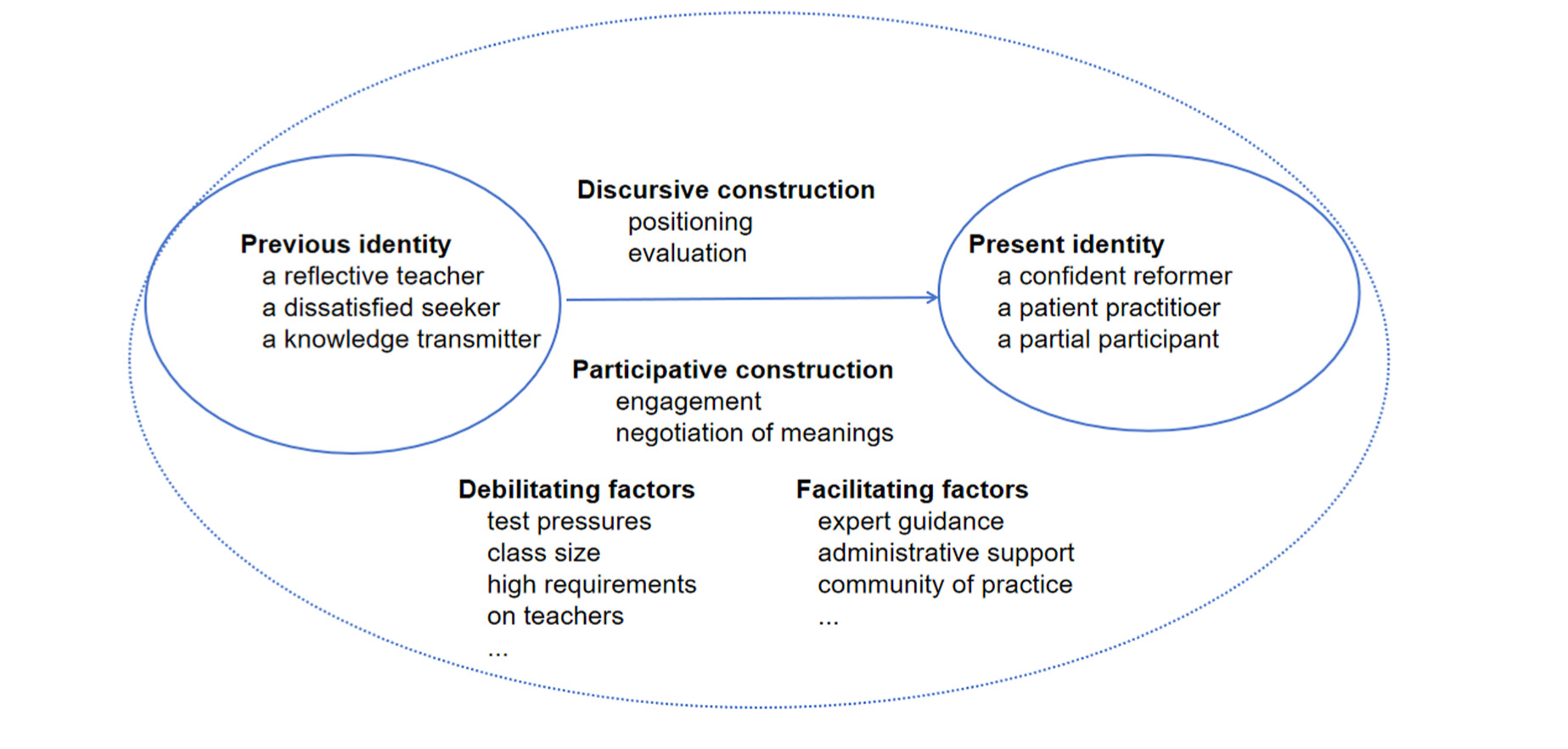
The process of experienced teacher identity reconstruction.
Constructing an Innovative Identity Through Positioning and Evaluation
The study finds that all three participants positioned themselves as particular types of teachers, and this self-positioning played a key role in priming them to engage in the reform process.
Similar to the participants in Y. Xu and Tao’s (2020) study, Liu and Hu have positioned themselves as pro-innovation learners and reflective teachers, thus enabling them to easily accept new textbooks and teaching approaches.
Liu viewed himself as someone who enjoys reading about new ideas and reflecting on diverse teaching approaches. He believes that the purpose of education is “to educate the whole person.” Thus, he gladly welcomed the reform and was committed to carrying out the new strategies. His efforts created a virtuous cycle that further reinforced his commitment.
Hu, mainly based on her own learning and training experiences, had questioned the validity of mechanical practice and believed that language learning should allow students to use language to express their views. The reform reignited her passion for language teaching, and, in the process, she positioned herself as a learner. This shift alleviated her anxiety and accelerated her professional growth.
Zhu, on the other hand, positioned herself as someone who lacked the time for further professional development due to a heavy workload and family responsibilities. Consequently, she eventually reverted to test-oriented teaching, suggesting that she was not yet ready to embrace change.
The study further revealed that the three participants differed in their evaluations of the textbooks as well as of traditional and innovative teaching approaches. Liu and Hu explicitly viewed the new textbooks and pedagogical methods as desirable, while regarding mechanical drills and test-oriented instruction as undesirable. Consequently, they expressed dissatisfaction with traditional teaching and actively sought alternative approaches. In contrast, Zhu did not provide a clear evaluation of the traditional approach and voiced some skepticism about the effectiveness of the new textbooks and methods in improving students’ test performance. These differing evaluations may have contributed to varying levels of engagement in reform practices, ultimately resulting in differing degrees of identity reconstruction.
Constructing an Innovative Identity Through Engagement and Negotiation of Meanings
The three participants in the study also displayed different levels of engagement in the reform. Liu and Hu were very committed to the reform and actively tried the new approaches. During the process, they met with challenges, reflected on them, and came up with their own solutions. In other words, they negotiated their own understanding of the principles of the reform based on their students’ unique needs and backgrounds instead of just applying the new approaches. For example, Liu realized that “partial TBLT” was most suitable for his students because their general English proficiency was not very high. Partial TBLT can provide sufficient scaffolding for the students to complete the tasks. Hu decided to strike a balance between traditional teaching and innovative approaches, as she believed that it was also her obligation to help her students succeed on the tests. This is why she still emphasized memorization and the dictation of new words in her teaching. In contrast to Liu and Hu, what Zhu appeared to lack was a process of negotiating meaning. She experimented with the methods, found them unsatisfactory, and ultimately chose to abandon them.
The Role of Seniority in Experienced Teachers’ Identity Reconstruction
A participant’s seniority appears to play a dual role, in either facilitating identity reconstruction or hindering its development. If one is an experienced teacher, students and parents will generally accept their methods, and this may very well create the space for them to attempt innovation in class and give them the confidence and courage to do so. Their active willingness to participate is what leads to more opportunities to try, err, and succeed. Conversely, seniority may also contribute to a teacher’s resistance to change. As Zhu noted, experienced teachers often rely on routines established via years of practice and may no longer perceive a need to learn new approaches or modify their teaching. Moreover, learning to use new textbooks and adopt innovative approaches demands considerable additional effort, and some teachers are reluctant to step outside their comfort zones.
The Role of School-Based Programs in Teacher Identity Reconstruction
The research indicates that a well-designed school-based teacher professional development program can support successful adaptation among teachers. Despite the broader macro-context of intense accountability pressures, the school cultivated a supportive micro-context that enabled teachers to receive guidance and experiment with new instructional approaches. Central to the program’s success was the role of the teacher educator, who played a crucial part in enabling this process by providing ongoing support and fostering professional dialog, which facilitated “the aligning of teacher identity and activity” (Golombek, 2017, p. 154). His advice was highly valued, the teachers trusted him, and because of this were willing to try new ways of teaching. The teacher educator also shared with them important research findings, which satisfied the teachers’ need to better understand the nature of language learning and teaching. Furthermore, the teacher educator showed the teachers how to implement innovative designs in class and gave them concrete feedback after observing their lessons, which the participants found most helpful.
In addition, by taking part in discussions and workshops, the teachers form a community of learning and thus acquire more pedagogical and emotional support. This points to the importance of adopting an identity-in-activity approach in teacher in-service training, as the traditional transmissive model of language teacher education has been found to lack effectiveness. Teacher identities are negotiated and constructed via interaction with others and within unique teaching contexts (Martel, 2017), and mere changes in “conceptual understanding did not mean a change in instructional practice” (Golombek, 2017, p. 152). Teachers should be given the opportunities and resources to “develop instructional practice congruent with that new identity” (Golombek, 2017, p. 153). In other words, merely attending lectures on the concepts and principles new materials present is not enough. Teachers need to try teaching the new materials using the new approaches and obtain feedback from expert teachers or teacher educators to deepen their understanding and improve their teaching during the process. They should further be given space to reflect on the meaning of the new approaches. In other words, the school or the teacher development programs should provide opportunities for teachers to discuss their teaching with their colleagues and mentors in order to solve their problems of practice and learn from each other.
Conclusion
The study finds that in learning to use new textbooks, compiled under the requirements of the new ECS, in-service teachers are presented with a good opportunity to update their understandings of language, language learning and teaching, and this further motivates them to learn on the job. Experienced teachers are able to consolidate or reconstruct their identities to varying degrees during the educational reform by learning, reflecting on the job, and negotiating their own understanding of the reform based on each unique context. Language educators can facilitate teacher identity reconstruction by fostering a community of learning and by providing emotional, theoretical, and pedagogical support.
The findings point to the need for differentiated professional development approaches that acknowledge diverse identity reconstruction paths, informing more personalized and effective teacher support frameworks. School administrators can design teacher development programs on-site and invite expert teachers or teacher educators to lead the programs and provide specific and targeted suggestions for the teachers. Teacher educators can design tasks that prompt pre-service teachers to reflect on the ultimate purpose of second language teaching and to prepare them for the contextual constraints they may encounter in real school settings. Policy-makers can work on ways to reduce teacher workload and class size to make it easier for teachers to carry out innovative tasks in class. For in-service teacher training, it is also advisable to include a component aimed at enhancing teachers’ language proficiency and subject-matter knowledge.
However, the findings of this study should be interpreted with caution due to limitations related to participant sampling and the specificity of the research context. Consequently, the insights gained may not be generalizable to teachers in other educational settings or working with different student populations. Future research is therefore needed to examine whether similar outcomes can be observed across varied contexts and with more diverse groups of learners. Future studies could also investigate the differing identity formation processes of experienced versus novice teachers, and examine how both groups could be more effectively supported during curriculum reforms. More longitudinal studies would also be valuable in probing teacher identity reconstruction over an extended period of time, especially with a focus on teachers who are relatively slow to reconstruct their identities during and after the teacher development program ends.
Footnotes
Acknowledgements
We extend our thanks to Professor Zou Weicheng at East China Normal University for his valuable advice on the revision of the manuscript. Our gratitude goes to the EFL teachers and the chief editor of the new textbooks who took time out of their busy schedules to take part in the study.

Ethical Considerations
Shanghai University’s ethics committee reviewed the study and waived the requirement for formal ethics approval in accordance with the local legislation and institutional requirements. Nonetheless, all participants were fully informed about the study’s purpose, procedures, and their rights, including the right to withdraw at any time without consequence.
Consent to Participate
All participants were fully informed about the purpose, procedures, and voluntary nature of the study before taking part. They received an information consent sheet explaining their rights, including the right to withdraw at any time without penalty. Written informed consent was obtained from every participant prior to the interviews. Informed consent was obtained from all participants prior to data collection. Participant confidentiality and anonymity were maintained throughout the research by using pseudonyms and securely storing all data.
Author Contributions
JZ involved in the research design, data collection, data analysis, and writing the first draft of the manuscript. WL participated in data analysis. ZS involved in the research design and data analysis. All authors contributed to manuscript revision, read and approved the submitted version.
Funding
The authors disclosed receipt of the following financial support for the research, authorship, and/or publication of this article: This work was partly sponsored by the Shanghai Education Scientific Research Project (Grant No.: C2022292).
Declaration of Conflicting Interests
The authors declared no potential conflicts of interest with respect to the research, authorship, and/or publication of this article.
Data Availability Statement
The data presented in this study are available on request from the first author. The data are not publicly available due to the privacy of research participants.