




Abstract
Mathematical modeling plays an important role in improving students’ interests and attitudes in reasoning, communicating and solving problems. In order to understand modeling in the popular mathematics textbooks for primary schools in China, this study developed a modeling framework for K-12 mathematics textbooks, and used content analysis method to analyze China’s current textbooks of primary mathematics in grades 3 to 6. The results showed that the samples follow a gradual development principle in terms of “content level,”“appearing location,” and “representation mode,” but the scientificity of model content level needs to be enhanced. In the four stages of modeling, the contents for cultivating students’ high-order thinking ability need to be further enriched. It is also suggested that more mathematical background knowledge should be covered in future textbook compilations.
Plain language summary
In order to understand the modeling in the popular mathematics textbooks for primary schools in China, this study developed a modeling framework for K-12 mathematics textbooks, and used content analysis method to analyze China’s current textbooks of primary mathematics (Grades 3–6). The results showed that the samples follow a gradual development principle in terms of content level, appearing location and representation mode, but the scientificity of model content level needs to be enhanced. In the four stages of modeling the contents for cultivating students high-order thinking ability need to be further enriched. It is also suggested that more mathematical background knowledge should be covered in future textbook compilations.
Introduction
Modeling, as the process of constructing and implementing scientific models, helps students acquire scientific knowledge, form scientific ability, and cultivate scientific literacy (Hodson, 1993). The inherent role of models in science development has been recognized as early as the mid-20th century. Mathematics education research has shown that modeling plays a crucial role in shaping students’ interests and attitudes toward computation, reasoning, communication, and problem-solving (Carlson et al., 2003; Kaiser et al., 2011). Therefore, the application of modeling has a positive significance for the development of mathematics.
Mathematical modeling refers to the process of using mathematics models to describe and solve real-life problems (Greefrath & Vorhölter, 2016). Its nature is to seek and comprehensively apply mathematics ideas and methods to analyze and solve practical problems. Mathematical modeling has become a core topic of international mathematics curriculum reform (Schukajlow et al., 2018). Curriculum documents from various countries have put forward requirements for mathematical modeling (Dong & Xu, 2014), which is considered one of the seven mathematics abilities to cultivate students’ understanding of real situations, designing mathematics models, and using and evaluating the attributes and limitations of models. The new round of curriculum standards issued by China in 2022 also clearly emphasizes the importance of cultivating students’ ability of modeling. Modeling has become the core concept of mathematics education since the 20th century. The process of mathematical modeling not only promotes students’ understanding of mathematical concepts, but also enhances their ability to analyze and solve real-life problems (Lesh & Zawojewski, 2007).
In China, textbooks are the core materials for curriculum implementation, the carrier of teaching content, the basis for teaching and learning, the support for the teaching process, and the specific embodiment of the goals for curriculum standards. Textbooks are the essential components of curriculum and important way for classroom teaching. Mathematics is the core curriculum of basic education in China, and mathematics textbooks directly affect the quality of talent cultivation. The 2022 version of Chinese Curriculum Standard for Mathematics Compulsory Education clearly points out that the compilation of teaching materials should consider the model ideas in general, and highlight model establishing and solving. Mathematical modeling is the process of applying mathematical ideas, methods, and knowledge to solve practical problems, and has become an important and fundamental content of mathematics education at different levels. The modeling in mathematics textbooks has a positive effect on cultivating students’ scientific thinking, and modeling assessment is the prerequisite of model implementation in the curriculum (Maaß & Gurlitt, 2011). Some studies have shown that the research on K-12 modeling in China’s mathematics education calls for more empirical research and diversified research methodologies, and the research of modeling in mathematics textbooks is far from being sufficient (Niu et al., 2017). Therefore, research on the modeling in mathematics textbooks of China is of great significance to assess the quality of mathematics teaching.
Literature Review
The Definition of Modeling
Scientific Modeling is a vital component of Science Education (Carlson et al., 2003; Kaiser et al., 2011). However, there was no unified definition (Agassi, 1995; Gilbert & Justi, 2016) or theory of modeling. The so-called modeling in China referred to the process of using mathematical models to describe and solve problems in real context (Greefrath & Vorhölter, 2016). Its nature is to seek for and integrate mathematical ideas and methods to analyze and solve practical problems.
As early as the beginning of the 20th century, researchers began to discuss the integration and application of modeling in mathematics education (Klein, 1907; Kühnel, 1916). In the 21st century, mathematical modeling has also become the key topic of International Mathematics Curriculum Reform (Schukajlow et al., 2018). Curriculum documents issued by various countries have put forward requirements for mathematical modeling (Dong & Xu, 2014). Modeling in China is considered to be one of the seven mathematical abilities, which cultivates students to understand the reality, design mathematical models, apply and evaluate the attributes and limitations of models. China’s latest curriculum standards also clearly state that China should pay attention to cultivate students’ ability to establish models, and modeling has become the core concept of mathematics education since the 20th century. Modeling in mathematics can not only promote students’ understanding of mathematical concepts, but also improve their ability to solve real-life problems (Lesh & Zawojewski, 2007).
Research on Modeling Process
Gilbert (2004) divided modeling into four dimensions: learning usage model, learning modification model, learning reconstruction model, and construction model. He pointed out that modeling teaching in the science curriculum contain the capacities to mentally visualize models, to understand the nature of metaphor and to analyze the core factors of modeling. Schwarz et al. (2009) divided scientific modeling into two parts: the practice and the meta-knowledge that guides and motivates the practice. Those serve as tools for explaining and predicting scientific models. The dimension contains six sub-dimensions of constructing, using, evaluating, revising, and understanding the nature and goal of models, as well as four levels of interpretation and prediction. And the scientificity of this dimension has been proved with classroom teaching examples of students in grades 5 and 6. Based on this model, Nicolaou and Constantinou (2014) deleted the sub-dimension of evaluation and added model comparison and model validation. With the revised framework, the literature review was conducted to analyze the evaluation methods of mathematical and scientific modeling ability. The results showed that a clear and coherent theoretical framework is needed to evaluate the knowledge, practices and processes related to modeling ability, so as to support the promotion of model-based learning in pedagogical practice.
The third stage is the research on the modeling process based on the nature of science. Krell and Hergert (2019) introduced a modeling and analysis method, the Black Box Approach, which advocates using black boxes to represent three different levels of scientific elements and scientific practices in science education. Exploring the three levels of black boxes represents the process of discovering science, reflecting on the essence of science, and solving problems. This method is applicable to other disciplines and to daily life. Researchers have used this method to analyze pre-service teachers’ modeling activities and cultivate middle school students’ modeling abilities, demonstrating its effectiveness in cultivating modeling abilities. The fourth stage is the analysis of the modeling process based on the learning loop. Gilbert and Justi (2016) replenished and systematically discussed the modeling framework and processes. They divided the modeling framework into four steps: creating prototype model, expressing prototype model, testing model, and evaluating model. Each step contains varied constituents, and they also offered thorough descriptions of the skills required for each step. Mahr (2015) conceptualized model hierarchy division, then Belzen et al. (2019) established a modeling capability framework which included five dimensions and three levels, of which the five dimensions are nature of models, multiple models, purpose of models, testing models, and changing models. The three levels are based on the theoretical basis of assessing the appearance of the model object, assessing the process of model constructing, and using the model and assessing its productivity, which show gradual more thorough descriptions of the five dimensions.
Research on Modeling in Textbooks
Kaye and Vincent (2009) analyzed the reasoning modeling of nine Australian eighth grade textbooks and divided them into reasoning models, appearing to authority, qualitative analogy, consistency of a rule with a model, experimental demonstration, and deductive reasoning. It found that most textbooks provide explanations for most topics, but they are not used as a thinking tool. Dong and Xu (2014) compared the functional model section of four mainstream mathematics textbooks in China. They believe that these four editions of textbooks have different representations and detailed treatments of the relevant content on modeling in the curriculum standards. However, from the perspective of the modeling process, there is a lack of research on the key link of establishing a real model for real situations, and there is relatively little research on the mathematical modeling content in the textbooks. Most scholars pay more attention to the application and design of mathematical modeling.
Different representations and detailed treatments have been made to the content related to modeling in the curriculum standards, only from the perspective of the modeling process. Zhao et al. (2018) compared the mathematical modeling content in the B Press version and the P Press version of China’s senior middle school. They believed that the two versions of textbooks were more comprehensive in setting mathematical modeling tasks and provided greater room for improvement, while the People’s Education version was closer to life and easier for students. Nyachwaya and Gillaspie (2016) used the representation in analytical chemistry textbooks based on cognitive load theory, and Han and Roth (2016) and Papageorgiou et al. (2017) also observed the specific modeling relationship between chemistry and the micro and macro world. With a survey and coding analysis through modeling capability framework of Belzen et al. (2019), Crawford and Flanagan (2019) found that science teachers and textbooks lack a comprehensive recognition of modeling, which may directly affect students’ views and acquisition of modeling.
In summary, research on the modeling process is relatively systematic, but mathematical modeling research in textbooks has found that its teaching support is relatively weak, and there are differences in teaching and learning among different countries and versions of textbooks. Given the crucial role of mathematics in cultivating primary school students’ modeling thinking and the unique advantage of mastery based learning in China’s mathematics education, it is necessary to conduct in-depth research on modeling in current primary school mathematics textbooks in China to provide support for the cultivation of students’ core competencies
Conceptual Framework
Analysis Framework Based on Modeling Process
Modeling in mathematics mainly refers to the process of solving practical problems by mathematicizing practical problems in mathematics teaching (Belzen et al., 2019). The modeling framework applied in textbook research should be based on theory and reflect the function of models sufficiently (Belzen et al., 2019). Therefore, this paper comprehensively examines the development characteristics of the four research stages of the modeling process in order to construct a modeling analysis framework for mathematics textbooks. Given the learning cycle paradigm of model process research, Gilbert and Justi (2016) mentioned that the modeling process consists of selection, establishment, validation, analysis, and deployment stages. This study divides modeling in mathematics textbooks into four dimensions: model selection, model establishment, model validation, and model application. Learners should be able to select the most appropriate model, and the established model needs to pass a series of tests before it can be applied for subsequent actual use (Hestenes, 1987). Belzen et al. (2019) and Nicolaou and Constantinou (2014) listed model use as an important factor in the framework of modeling ability. In addition, the use of models is regarded as one of the important abilities of model learning, and students are supposed to be able to apply models to specific situations (Gilbert, 2004). The four secondary indicators of the mathematical modeling process also include four specific dimensions. The design principles of creating a specific dimension of secondary indicators is represented a criterion of “not met,”“partially provided,” and “completely provided,” which is recoded as 0 to 2 degree of mathematical modeling. We selected 18 papers related to mathematical modeling research in textbooks and rated the specific content of their four mathematical modeling processes separately. Each process selected four dimensions to represent the mathematical modeling process. The selection criteria were that if there were six or more articles with a score of 2, they were confirmed as one of the four dimensions. According to this framework, the indicators of mathematical modeling represented in the textbook include four primary indicators with 16 sub-indicators. Model selection specifically includes four dimensions, namely knowledge understanding and extraction, concept transformation and aggregation, theoretical analysis and screening, and scenario mapping and transfer. Model establishment includes observation and inference of appearances, scientific analogy and inference, mental modeling and analysis, visual representation and elaboration. The four specific dimensions of model validation are feature description and judgment, data support and confirmation, explanatory testing and prediction, and scientific argumentation and correction. The four specific dimensions of model application are phenomenon analysis and simulation, condition recognition and classification, data analysis and mining, and method expansion and innovation (Table 1).
Modeling Process Analysis Framework of This Study.

The Structure of the Analysis Framework
Model selection in mathematics textbooks focuses on finding corresponding mathematical knowledge based on the problem context. Its subordinate indicators gradually reveal the process of model selection from knowledge, concepts, theories, to pictures. The first step in developing a modeling learning process is to dismantle the learning objectives and extract the implicit understanding (Schwarz et al., 2009), which means that in the first stage of modeling, the objects, characteristics, and phenomena need to be described, and all variables involved need to be mathematically explained (Gilbert & Justi, 2016). This is knowledge understanding and extraction, which is the first secondary indicator for model selection. Each stage of model development integrates conceptual, empirical, and theoretical dimensions, reflecting the importance of concepts in model selection and their foundational role in the model (Gilbert & Justi, 2016). By participating in modeling practice, learners can transform or aggregate their conceptual models and use these modified models in the future (Schwarz et al., 2009), which is the process of conceptual transformation and aggregation. The constructed model should be consistent with theory and emphasize that theory guides observation and interpretation. Therefore, analyzing and screening suitable theories is particularly important in model selection (Belzen et al., 2019), which is theoretical analysis and screening. The “structural mapping” method is often used to select the source of the model, and after summarization and transfer, a complete picture mapping can be performed (Gentner & Markman, 1997).
The model is established in mathematical textbooks that focus on the construction of mathematical knowledge in specific contexts. The model consists of “elements, relationships, operations, and rules for managing interactions represented by an external symbol system,” which are generated through observation (Lesh & Doerr, 2003). The first level of model construction is to describe the observed phenomenon, while the second level is to explain how the phenomenon occurs and infer whether the model is consistent with the evidence of the observed phenomenon (Schwarz et al., 2009). This is the summary of phenomenon observation and inference. Models are generated and tested on the basis of relationship comparison, and analogies are regarded as the foundation of modeling (Gilbert & Justi, 2016). The core of modeling is to understand the nature of analogies and metaphors, and students must develop reasoning skills based on this foundation (Gilbert, 2004). Applying different types of exploration and reasoning to models and modeling will contribute to scientific education research. This is the dimension of scientific analogy and reasoning. The establishment of psychological models has a positive impact on the understanding of corresponding mathematical models, and the development of mental modeling ability is the most effective way to reflect the degree of cognitive development (Hestenes, 1987). The mental model generated by comparing the source with the target model needs to be distinguished in terms of material, visual, linguistic, or mathematical expression patterns (Justi & Gilbert, 2003). This is the mental modeling and recognition. It is important to express the internal representation stage in external form in modeling (Gilbert & Justi, 2016). Psychological models can communicate the internal and external worlds, and the use of visual representation can fully reflect the material aspects required by the model. This is visual representation and elaboration.
Model validation focuses on analyzing and verifying the constructed mathematical knowledge in mathematical textbooks. Each modeling activity has specific characteristics of scientific thinking that rely on scientific content and problems, and in scientific thinking and exploration practice, the results need to be judged by describing the characteristics (Belzen et al., 2019), which is feature description and judgment. The data obtained from practical exploration is often used to analyze models and serve as evidence to support or oppose the model for testing (Schwarz et al., 2009). If the assumptions derived from the model contradict the data, the model must be optimized (Belzen et al., 2019). This is the summary of data support and confirmation. Models and phenomena exist in a mutual relationship. By analyzing phenomena, potential elements, relationships, and rules in the model can be insightful, and the model can be tested. The model provides explanations for the behavior of phenomena, and after data validation, effective predictions can be made (Schwarz et al., 2009). This is explanatory testing and prediction. To ensure the widespread applicability of the model, it was recognized in the evaluation that modifications should be made to the model when its scope of use is limited (Gilbert & Justi, 2016). It is necessary to evaluate and revise the model based on empirical and theoretical evidence to improve its scientific validity (Schwarz et al., 2009). This is scientific argumentation and correction.
The application of models in mathematical textbooks mainly refers to applying the learned mathematical knowledge to solve more practical problems. One of the purposes of modeling is to use models to represent scientific phenomena that are too complex or difficult to observe directly, as they enable us to analyze and explain natural phenomena (Schwarz et al., 2009). The accuracy of simulating actual phenomena is one of the criteria for judging the effectiveness of a model. This is the dimension of phenomenon analysis and simulation. Organizing and categorizing modeling mechanisms can facilitate the identification and comparison of conditions. This is the generation of conditional recognition and classification. In the action research of practical teaching, teachers guide students to analyze and mine the data obtained from the survey, construct explanations, and build an interactive model (Crawford & Flanagan, 2019). This is data analysis and mining. Modeling requires expanding or even innovating complex models or methods to solve problems (Lesh & Doerr, 2003). This brings about method expansion and innovative extraction.
Methodology
Scoring Methods
This study adopts the content analysis method, which is a method of objectively analyzing the content of the research object and using the obtained quantitative data to describe its current situation or development trend. Therefore, it is necessary to develop a research scale to provide standards for textbook analysis. Based on the mathematical modeling analysis framework, combined with the content characteristics of Chinese textbooks and existing research scoring methods (Ma et al., 2021), this study determined the primary and secondary analysis dimensions and operational definitions of the quality of mathematics textbooks (Table 2), and applied the scale to analyze and code the four processes of mathematical modeling in textbooks. The main analysis dimension “content level” is a four-level quantitative assessment method, which is divided into levels 1 through 4 based on the amount of modeling content in the textbook, including the text length, appearing frequency, and related lessons. Description level represents the complexity of modeling descriptions in the textbook, taking “knowledge understanding and extraction” as an example: Level I only present relevant knowledge, Level II reflects the understanding/extraction process of relevant knowledge, Level III reflects both the understanding and extraction of relevant knowledge, and Level IV logically expresses the understanding of relevant knowledge and subsequent extraction process. The other 15 secondary indicators are consistent with the fourth level quantitative evaluation method of “knowledge understanding and extraction.”
Textbook Content Analysis Dimensions and Operational Definitions in Mathematics Textbooks.

Sample Selection
The eighth round of curriculum reform in China has put forward new requirements for the development of textbooks. In order to stir up education vitality and form a flourishing situation, the construction of textbooks has evolved from “one set of textbooks under one syllabus” to “multiple sets of textbooks under one syllabus.” Under the guidance of Chinese national curriculum standards, relevant institutions, publishing houses and other departments have been actively developing teaching materials, and there have emerged quite a number of textbooks for compulsory education. Currently, the mathematics textbooks published by B Press (referred to B Press Edition) have the largest circulation and usage range in China, the best usage effect, and are authoritative and representative. In the consideration that K-12 school students are in the critical transition period from specific image thinking to abstract logical thinking, this study selected the mathematics textbooks under 3 to 6 grades of primary school, which are the latest B Press version published in December 2014, with a total of eight books.
Coding Case
It selects the section 2—“The Scope of Observation” of unit 3 in primary school mathematics textbook 1 of B Press Version for grade 6 as an example. The eight textbooks selected are all coded and analyzed according to the standards of the case. The vertical dimension of the coding table is the three dimensions of content analysis, namely content level, appearing locations, and representation modes, as well as their 12 indicators. The horizontal dimension is the four dimensions of the modeling process, namely model selection, model estimation, model verification, model application, and their 16 indicators. The specific coding results are shown in Table 3.
Two Dimensional Modeling and Content Analysis Diagram of Coding Cases.
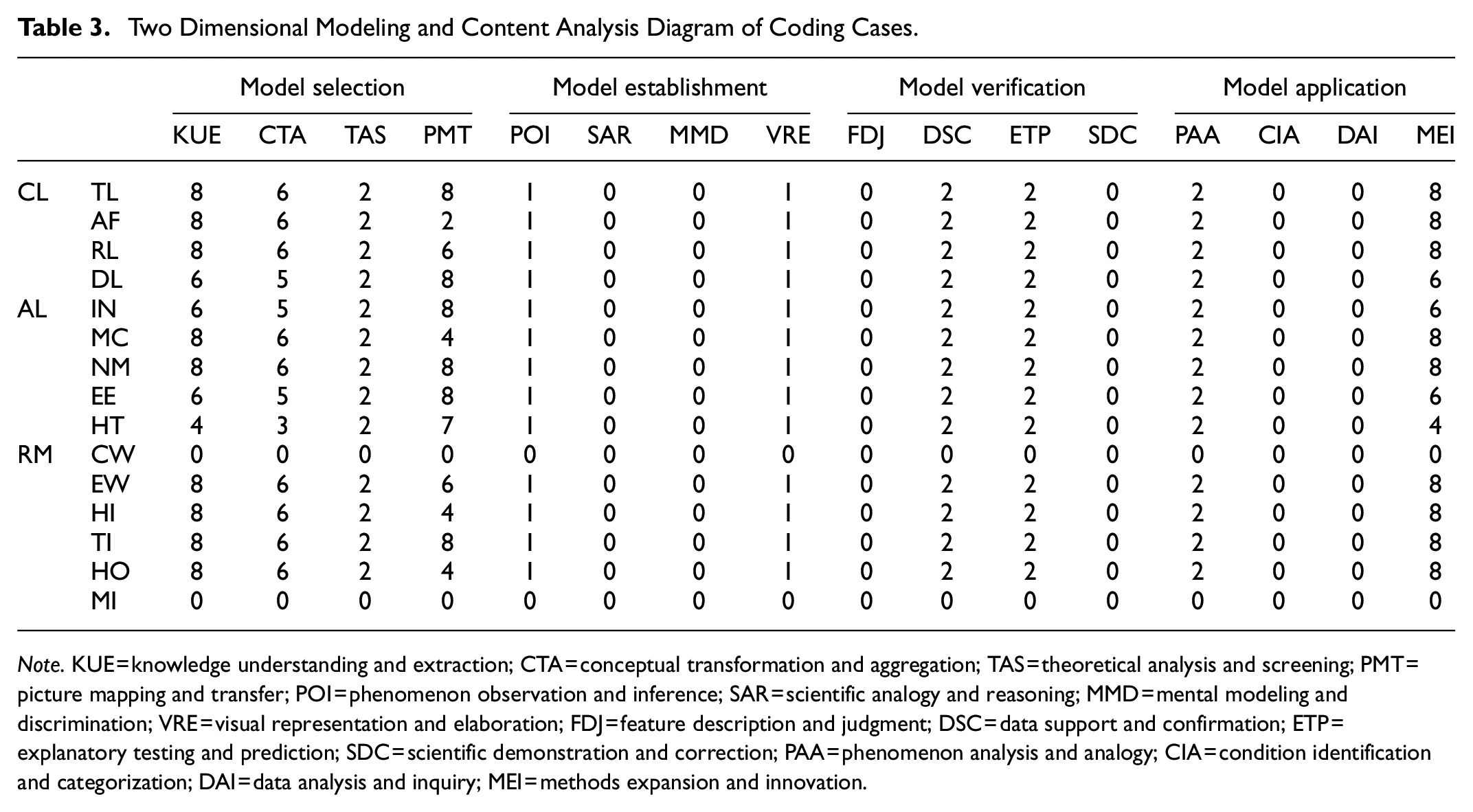
Note. KUE = knowledge understanding and extraction; CTA = conceptual transformation and aggregation; TAS = theoretical analysis and screening; PMT = picture mapping and transfer; POI = phenomenon observation and inference; SAR = scientific analogy and reasoning; MMD = mental modeling and discrimination; VRE = visual representation and elaboration; FDJ = feature description and judgment; DSC = data support and confirmation; ETP = explanatory testing and prediction; SDC = scientific demonstration and correction; PAA = phenomenon analysis and analogy; CIA = condition identification and categorization; DAI = data analysis and inquiry; MEI = methods expansion and innovation.
According to the structural framework of this lesson, it is divided into two analysis units. The main explanation section is the first analysis unit, and the practice section is the second analysis unit. Firstly, the text content is encoded vertically. There are three sets of figures in the main text of this lesson. The first and second sets of figures present situational questions around the scope of observation by the little monkey. This involves 13 subordinate dimensions of the four primary indicators of the modeling process, only data support and confirmation, data analysis and mining, and method expansion and innovation. Therefore, the other 13 dimensions are scored once. The second set of pictures shows the situation where the driver can see Building B at positions 1 and 2, involving 12 dimensions under the four modeling processes, each with a score of 1. However, the four dimensions of feature description and judgment, data support and confirmation, data analysis and mining, and method expansion and innovation are not involved.
Secondly, the content of the text is encoded horizontally. In terms of knowledge understanding and extraction dimensions, the first and second sets of figures belong to the same knowledge section. At the content level, they occupy 232 words and belong to a high level, denoted as 4, and the frequency of occurrence is two times. The relevant class hours are only 1 class, which is the highest level of description, with a rating of 4. In the presentation position, this belongs to the main content. In terms of representation, it is presented in the form of patterns, text, and images, so “concept and laws,”“examples in words,” and “tables and images” are recorded once each. The secondary indicators of the other 15 model construction processes were coded and scored according to this method.
The coding of the exercise was carried out following the method of the text. First, the text content of the textbook is vertically coded to determine the reflected secondary indicators, and then each secondary indicator involved was analyzed from the primary and secondary dimensions according to the operational definition to encode the text content horizontally. Finally, the coded data of the two analysis units were put into the content analysis summary table of this lesson’s mathematical modeling for quantitative statistics.
Results
Textbook Content Dimensions of Modeling Process
Modeling is divided into four stages: model selection, model establishment, model verification, and model application. According to Figure 1, generally speaking, the four stages show different characteristics in content level, appearing location and representation mode. In terms of content level, firstly, the four stages from model selection to model application showed an upward trend as a whole, but the establishment of the model is at the lowest level among the four. Compared with the length and frequency of occurrence, the overall level of the number of related lessons is low. It can be concluded that the coherence and consistency between different lesson contents are not as obvious as the length and frequency of occurrence. Secondly, model selection, verification and application levels are basically the same (between 2.5 and 3), while the description level of model construction is obviously prominent. Furthermore, the model construction is at the lowest level in terms of the length, frequency and number of related lessons, but at the highest level of description.

Primary and secondary indicators in textbook content dimensions of modeling process.
In terms of appearing location, the four stages all appear most often in the main text, followed by exemplary exercises, introduction, home-taken tasks, and least in the margin notes. In textbooks, the main content is often taken as the main part of classroom teaching, and there will be a large amount of content in this part. Specifically, the model construction mostly occurs in the main content, but least in other sections such as home-taken tasks, exemplary exercises and so on. Model establishment is a difficult process and requires complex cognitive input, so it is explained in detail in the text body part, and less involved in textbook extending parts. The exemplary exercise part mainly focused on knowledge application, so it is where model application appears the most.
The variety of representation modes certainly affected the attraction of textbook content to students. In general, these six representation modes were all used in the samples, and more of which are in the form of text examples and illustration tables. The appearing times of concept and law and mental exploration are the least. Except the concept and law, the model application showed the highest level at the other five representation modes, while the model establishment showed the lowest level. Teaching materials can further enrich the application of representation modes such as mental inquiry and historical interpretation.
Grades Comparison of Modeling Content and Description Level
In terms of the grade distribution, the contents of the four stages of mathematical modeling in the textbook increase along with the grades. Among them, the rising trend is the most significant from grade 3 to 4, while it showed a significant decline from grade 5 to 6. As for the content level of model selection, the length, frequency and description level were nearly the same, however, there are significant differences in trends between stages. Grades 3 to 4 increase significantly, while grades 4 to 6 decline continuously, of which grades 5 to 6 decline apparently. The number of related lessons is relatively balanced with the increase of the grades, which might be the result of the lowering requirement in the basic knowledge explanation and students’ mastery. In terms of appearing location, most of them are in the main content with the least annotation content in the margins, and the most main contents are in grade 3, with the least in grade 6; the exemplary exercises are least in grade 3 and the most is in grades 4 and 5. As for the representation modes, most of them are text illustrations, and the number of mental inquiries is the least, and the representation times in grade 4 are the most significant of these three aspects. Grade 3 showed the most representation times in historical interpretations and hands-on operations, while grade 6 showed the least representation times in the conceptual law and grade 5 the most prominent (see Figure 2).

Grades comparison of “model selection” in primary and secondary indicators in textbook content dimensions.
In terms of the content level of the model application, the length, frequency, and description level show the same pattern, that is, grades 3 to 5 continued to rise, while grades 5 to 6 decline somewhat, and the number of related lessons is balanced. Model building is of top priority in mathematical modeling and the key stage to cultivate students’ mathematical thinking and literacy, therefore, the decline of grade 6 needed to pay more attention. In terms of appearing location and representation mode, it showed the same pattern as in model selection (see Figure 3).

“Model construction” grades in primary and secondary indicators in textbook content dimensions.
The content level of model verification is similar to that of model establishment, that is, grades 3 to 5 continued to rise, grades 5 to 6 showed certain decline, and the number of related lessons was balanced. In terms of appearing location, the main content is the most, and the annotations in margins is the least, of which the main content appears most in grade 3, and the content of example exercises and home-taken tasks appears most in grade 5. In terms of representation methods, most of them are text illustrations, the number of mental inquiries is the least, and the representation times in grade 5 are the most significant of these three aspects, and the representation times in grade 3 are the most. It may be that lower grade textbooks prefer to use historical stories and hands-on operations to stimulate students’ interest in mathematics learning, grade 5 has the most prominent representation times in the concept and law (see Figure 4).

“Model verification” grades in primary and secondary indicators in textbook content dimensions.
In terms of the content level of model application, the length, frequency and description level showed the same pattern, that is, grades 3 to 5 continue to rise, grades 5 to 6 decline somewhat, the length and description level rose the most in grades 3 and 4, and the number of related courses is balanced. It showed the same characteristics as the model verification in terms of appearing location and representation mode (see Figure 5).

“Model application” grades in primary and secondary indicators in textbook content dimensions.
Dimension Representation of Mathematical Modeling
Overall, in the four stages of mathematical modeling, the average level of model selection and model establishment was high, and the distribution gap of corresponding secondary indicators is wide. Among the four parts of model selection, the description level of knowledge understanding and extraction is of the highest, followed by picture mapping and transfer, and the description level of concept transformation and aggregation is the lowest. As for grade distribution, there is a most obvious increase from grades 3 to 4, a small decline from grade 4 to 5, and an obvious decline from grade 5 to 6. Among which the decline of picture mapping and transfer is the sharpest, followed by understanding and extraction. In the model selection, picture mapping and transfer demands higher cognitive abilities of the students, but it decreases most obviously in grade 6 textbooks. On the contrary, knowledge understanding and extraction is relatively basic, while its degree of decline in teaching materials is low. In this regard, the rationality of grade 6 textbooks requires being further strengthened and optimized.
In the model establishment, the description level of image observation and inference is the highest, followed by visual representation and elaboration, and the description level of scientific analogy and reasoning is the lowest. From the perspective of grade, except that imagery observation and inference increases most from grade 4 to 5, the other three aspects of the model show obvious increases from grade 3 to 4, while the description level of grade 4 and 5 is relatively balanced. The contents of all four aspects decreased the most in grade 6. Scientific analogy and reasoning are the key stages in model establishment. The low level of description shows that teaching materials are deficient in training students’ high-order thinking ability.
In the model verification, the overall description level of the four aspects is relatively balanced, in which the level of feature description and judgment, data support and confirmation is high, while the description level of interpretation test and prediction, scientific demonstration and correction is low. From the perspective of grade, except the description level of scientific demonstration and correction decreases in grade 5, the contents of the other three aspects show a continuous increase from grade 3 to 5. Of course, grade 6 textbooks showed a significant decline in all the four aspects. Scientific argumentation and revision emphasize argumentative thinking and critical thinking, which is the most important content in model verification, but it shows a significant decline in grade 5. Compared with the other three aspects, the textbooks need to strengthen content construction.
In the model application, the description level of method expansion and innovation was the lowest, and the other three aspects are basically the same. From the perspective of grade, the description level of the four aspects increases continuously from grade 3 to 5, and decreased significantly in grade 6. A different picture is that the rise of data analysis and mining is slight from grade 3 to 4, while the rise is the sharpest from grade 4 to 5, which is different from the other three aspects. More exactly, grade 5 pays more attention to cultivating students’ ability in data analysis and mining. In addition, in terms of method development and innovation, it decreases significantly in grade 6, and is down to half of the description level in grade 5. Method development and innovation had more requirements for students’ creative thinking, but grade 6 showed a significant decline (see Figure 6).

Description level of primary and secondary indicators of modeling.
Discussion and Conclusion
This study provided a new perspective and theoretical framework for the analysis of mathematics textbooks. Combined with previous studies and the characteristics of Chinese textbooks, the mathematical modeling indicators are divided into four parts: model selection, model establishment, model verification, and model application. This is different from the modeling process proposed by Gilbert and Justi (2016), which consisted of selection, establishment, verification, analysis and deployment stages. This is a further summary and refinement of Gilbert’s classification. In addition, this study integrated three different types of models elaborated by some other researchers: psychological model (Crawford & Cullin, 2004), conceptual model (Greca & Moreira, 2000) and scientific model (Nicolaou et al., 2009), and reflected the scientific model many times in the secondary indicators of the research framework, The representation of modeling is more systematic and comprehensive.
In general, this study found that this edition of mathematics textbooks follows the gradual principle in terms of “content level,”“appearing location,” and “representation mode,” which reflects the scientificity of the content arrangement in mathematical modeling. However, there is a need to improve the high-level thinking training in all stages of modeling. Firstly, from the perspective of modeling system, the four steps of modeling are in a sequential process, and the total length of model establishment, model verification and model application presented in the eight textbooks in this study gradually increases with the deepening of the primary indicators of modeling. This is consistent with the idea that systematic use of modeling in teaching will help students gain unified and coherent scientific knowledge (Hestenes, 1987), and also reflected the suggestion of Sunday (2014) on textbook writing, that is, tasks in textbooks should reflect progressive hierarchies.
Secondly, there were less representations in the scientific background such as “historical interpretations” of the main analysis dimension “representation mode,” which is consistent with the result of less distribution of scientific background contents in Chilean textbooks concluded by Pallauta (2018). And this is also in line with the research conclusion of Leite (2002), that is, science history can contribute to students’ understanding of subject essence, but the textbook writers have not paid enough attention to it. Furthermore, this study also found obvious grade differences, that is the content of “historical interpretation” in textbooks gradually decreases with the increase of the grade. Like Valdés et al. (2021), more scientific background information should be covered in textbooks. Diversified representation modes can increase the interest and attractiveness of textbooks. All six representation modes are used in the analysis samples, which is in accordance with the suggestion put forward by Sunday (2014) that textbooks should further show diversity and attractiveness.
In addition, in terms of the arrangement of the contents of the grade 4 textbooks, both the length and the description level are both at a high level, which is similar to the results of American primary school mathematics textbooks, that is, in terms of basic operations, grade 4 textbooks have introduced all relevant contents and problem-solving strategies (Chang & Silalahi, 2017). The content distribution in each modeling stage is uneven, and the content for cultivating students’ high-order thinking is relatively insufficient. This result was similar to the failure in reflecting scientific literacy balance in Indonesian physics textbooks found by Sinaga and Samsudin (2021), and it is also suggested to improve the scientific literacy in the textbooks.
It deserves further explorations as to issues like the evaluation of model construction, mathematical model solution and how to more scientifically reflect model ideas in mathematical textbooks and how to build a more scientific and reasonable modeling analysis framework for mathematics textbooks. The mathematical modeling analysis framework designed in this study provided a new perspective for the analysis of mathematical textbooks. Future research can explore other broader objects such as students’ and/or teachers’ modeling literacy, so as to refresh the modeling research.
Footnotes
Declaration of Conflicting Interests
The author(s) declared no potential conflicts of interest with respect to the research, authorship, and/or publication of this article.
Funding
The author(s) disclosed receipt of the following financial support for the research, authorship, and/or publication of this article: Thank the reviewers and editors for their in-depth and detailed amendments to promote our in-depth study and the support of the general project of Anhui Province’s Philosophy and Social Science Plan for 2022 in China “Theoretical and Practical Research on Triggering the Transformation of Education Methods in Ordinary High Schools through Characteristic Education” (AHSKY2022D162).
Ethical Approval
It is not on animal and human studies.

Data Availability Statement
Data sharing not applicable to this article as no datasets were generated or analyzed during the current study.