




Abstract
This study examined the factors directly influencing purchase intention for vegan cosmetics by applying an extended theory of planned behavior (TPB) model with three additional constructs: environmental concern, trust, and perceived knowledge. Data were collected from 384 consumers who had purchased cosmetics at health & beauty stores in Ho Chi Minh city and Hanoi, the two biggest cities representing cosmetics consumers in Vietnam. The results revealed that all three TPB constructs had a significant positive effect on the respondents’ purchase intention for vegan cosmetics. Furthermore, environmental concern had a significant effect on all TPB constructs, while trust and perceived knowledge were positively related only to attitude and perceived behavioral control. This study provides essential insights to help firms and marketers understand the factors affecting consumers’ purchase intention and choose appropriate strategies in Vietnam’s vegan cosmetics market.
Keywords
Introduction
Environmental pollution, harmful chemical products, and unsafe food are among the problems that threaten human health. Along with population growth and increase in social consumption, Vietnam and many other countries worldwide are facing great challenges in terms of environmental protection and sustainable development. According to Kantar’s Vietnam Insight Ebook (2021), 80% of Vietnamese respondents agree that recycling will reduce pollution & safe natural resources. Moreover, Kantar also showed that manufacturers are expected the most to take action in reducing environment impact. This means Vietnamese people are extremely concerned about environmental pollution and particular about health protection and using products from environmentally friendly companies. Considering the impact of the COVID-19 pandemic in particular, people are now much more concerned about their health, and products made from environmentally friendly materials will be more important for consumers.
Currently, green living is not only reflected in the reuse of plastic bags, limiting the use of single-use plastic items, but also in the beauty industry. In particular, using vegan cosmetics became one of the explosive beauty trends of 2021 across beauty forums, helping users practice self-care as well as protecting the environment. Unlike organic or natural cosmetics, vegan cosmetics are completely free of animal-derived ingredients such as honey, beeswax, and snail secretion filtrate commonly found in beauty products, and have not been tested on animals; therefore, vegan cosmetics have been attracting more consumers, taking the throne in the beauty industry not only in Vietnam but worldwide.
Nowadays, domestic brands Cocoon, Herb n’ Spice, Baresoul, and Naunau are among the most well-known in Vietnam for skincare and as a new phenomenon in the cosmetics industry owing to the Vietnamese spirit embodied in each product. Manufacturers have been continuously launching 100% vegan products, taking advantage of the natural ingredients available in the country, such as squash, Dak Lak coffee, Ben Tre coconut oil, and Cao Bang rose. This has created a vibrant vegan cosmetics market with products on a par with the available foreign brands. Moreover, Statista Research Department (2022) data show that the global vegan cosmetics market has grown from $13.56 billion in 2018 to $16.29 billion in 2021; it is projected to grow further to $20.8 billion by 2025. In other words, more and more people are expected to embrace the trend of veganism—clean living—and green consumption in the future.
There have been many studies and papers on consumer behavior toward green products, but these have mainly focused on the food segment in the US, Europe, Taiwan, India, and Malaysia among other countries, and research on vegan cosmetics is limited. A review of the theories applied for examining green consumption would show that many researchers have applied the theory of planned behavior (TPB) (Ajzen, 1991; Ajzen & Fishbein, 1975) and have examined the motivation for buying green products (Jaiswal & Kant, 2018; Teng & Wang, 2015; Zaremohzzabieh et al., 2021). According to Teng and Wang (2015), the intention to buy organic food includes trust, subjective norms, attitude, revealing information, and perceived knowledge about organic food—their results showed that trust, as an antecedent of attitude, significantly mediated the relationships between revealing information, perceived knowledge about organic food, and purchase intention; however, the effect of knowledge about organic food on attitude was found to be insignificant, which suggests that an increase in knowledge cannot induce a positive attitude toward organic food, and the authors have argued that trust is a prerequisite for a successful business because consumers are often hesitant to make a purchase unless they trust the seller. Trust is essential to organic food buying behavior (Teng & Wang, 2015). Jaiswal & Kant (2018) investigated green purchase behavior in India, finding that green purchase intention was significantly affected and directly driven by attitude toward green products, environment concern while perceived environment knowledge was found to have an insignificant effect on purchase intention. In addition, green purchase intention also impact on Malaysian consumer’s attitude through environment knowledge, concern, awareness and strong influences on the TPB model while environment belief is not impacted (Zaremohzzabieh et al., 2021).
In Vietnam, there are very few studies on green purchase intention in the cosmetics industry. Some have examined organic and natural cosmetics, but there has been no study exploring the factors driving purchase intention for vegan cosmetics. Studies on the intention to buy green products have also been carried out in different contexts—organic food / organic cosmetics…and found factors affecting purchase intention, such as environmental consciousness, health awareness, green awareness, safety value, and subjective norms (Khai & Anh, 2016; Nga & Huynh, 2019). However, these studies are still limited and did not arrive at conclusions about the factors affecting consumers’ intention to buy green products in Vietnam and other localities.
Therefore, this study aimed to fill the gap by examining the factors directly influencing purchase intention and contribute to discover the journey of shopping behavior among consumers of the vegan cosmetics industry in Vietnam. The TPB was extended and applied for understanding consumers’ green purchase intention with a focus on vegan cosmetics. The study considered to find out the additional judgment values which inherited from previous related researches (Environment concern, Trust and Perceived knowledge), TPB model and purchase intention relationship to provide meaning and base knowledge with effective strategies for vegan cosmetics companies to develop this market in Vietnam.
Literature Review
Theoretical Background
The theoretical framework used in the present study is based on the TPB (Ajzen, 1991), which was originally developed as an improvement of the theory of reasoned action (TRA) by Ajzen and Fishbein (1975). Numerous studies in various fields have operated and tested experimentally the relationship between intention and behavior.
The TRA was first developed in 1967 and adjusted extensively over time by Ajzen and Fishbein (1975). Its construct attitude toward the behavior is measured by the perception of product attributes—the consumer pays attention to the attributes that offer the necessary benefits and varying degrees of importance. Based on the weights of those attributes, it is possible to predict nearly the outcome of the consumer’s choice. Subjective norms can be measured through the people important to the consumer (family, friends, colleagues, etc.); these people either like or dislike the things they buy. The level of impact of subjective norms on the consumer’s buying depends on (1) the level of support/opposition to the purchase and (2) the consumer’s motivation for following wishes or demand of the references. The weighting of influence with related people on consumer behavioral trends and the motivation of consumers to follow related people are two basic factors for assessing subjective norm; the stronger the impact of intimacy of the stakeholders with the consumer, the greater the influence on the purchasing decision, and the greater the consumer’s trust in these people, the more the purchasing propensity is affected.
The TPB assumes that a behavior can be predicted or explained by the propensity for it. Behavioral propensity is the level of effort with which people attempt to perform the behavior (Ajzen, 1991). As per the TPB, planned behavioral intentions are influenced by attitude, subjective norms, and perceived behavioral control. Perceived behavioral control is an addition to the TPB model—it is, essentially, an individual’s perception of how easy or difficult a particular behavior will be; it can also indirectly influence behavior, which is what differentiates behavioral intention from the actual behavior. Therefore, the TPB is considered to be a more comprehensive behavior theory compared with the TRA because it incorporates more influential constructs in the model and provides more explanatory power in terms of predicting the adoption of information technology (Mathieson, 1991).
In this research, the purchase intention is created by three factors: attitude, subjective norms, and perceived behavioral control (Ajzen, 2002). In the study by Tirtiroglu and Elbeck (2008), the intention to buy a product was expressed as the potential customer’s willingness to buy it. A company’s business can be based on a market survey of consumers’ purchase intentions. In the present study, vegan cosmetics mean green products—beauty products completely free of animal-derived ingredients and not tested on animals. Therefore, purchase intention for vegan cosmetics can be considered as a green behavior, which is less harmful to the environment and society.
Research Model and Hypothesis Development
Constructs of the TPB
The TPB has three main constructs. These have been described in detail below.
Subjective Norms
According to Ajzen (2002), subjective norms refer to an individual’s perception of how to behave in accordance with social norms. Subjective norms are determined by the beliefs that influencers think they should do, and the motivations for the consumer to perform that behavior. If consumers believe that their influencers consider using vegan cosmetics as a good idea, their intention to buy such cosmetics will be higher. Subjective norms is also one of the factors with the strongest effect on buying behavior of environmentally friendly products (besides environmental considerations and price) (Griskevicius et al., 2010). There have also been many studies showing that subjective norms have a significant effect on green purchase intention—organic food (Teng & Wang, 2015) and organic cosmetics (Al-Swidi et al., 2014; Chia-Lin et al., 2017; H. Y. Kim & Chung, 2011; Smith & Paladino, 2010). Therefore, considering the present study’s focus on vegan cosmetics, the following hypothesis is proposed:
H1: Subjective norms is positively related to purchase intention for vegan cosmetics.
Attitude
Attitude is an engagement of specific objective with its summary evaluation (Fazio, 1995). It can show the results of the consumer’s evaluation with products they care. According to Ajzen (1991), “attitude leads to behavior” refers to an individual’s assessment of the results obtained from performing a behavior—it is the level to which the manifestation of that behavior is perceived as either positive or negative by the individual him/herself. Consumers’ attitudes influence their intentions (Ajzen & Fishbein, 1975). Based on this, Chaniotakis et al. (2010) showed that attitude leads to behavior is an individual’s assessment that performing a behavior is worth the money spent. Previously, with her research, Giner-Sorolla (1999) built a scale for the attitudinal factor leading to behavior, including the individual’s intention to perform the behavior that has targeted that good/service since before and think that if you do the behavior, it will be very good for you. De Matos et al. (2007) also mentioned that attitude leads to behavior because the consumer thinks that using the product will bring a lot of benefits and, therefore, that is the best choice for them. All the abovementioned studies have shown that there is a relationship between attitude and behavioral intention—the more positive the attitude, the more likely the customer will generate intention. Therefore, the following hypothesis is proposed:
H2: Attitude is positively related to purchase intention for vegan cosmetics.
Perceived Behavioral Control
Ajzen (1985) added the perceived behavioral control construct to adjust the TRA. It is defined as an individual’s self-assessment of the difficulty or ease of performing a behavior—the more resources and opportunities they think, the fewer the constraints and the greater the perceived control over behavior. According to Ajzen (1991), this construct originates from the confidence of the individual who intends to perform the behavior and from the easy, favorable conditions for performing it. Taylor and Todd (1995) have argued that the individual intending to perform the behavior has all the information necessary for making the decision, and the assertiveness of the individual who intends to perform the behavior is the customer’s perceived behavioral control. These studies have shown that perceived behavioral control has a positive effect on behavioral intention. Therefore, the following hypothesis is proposed:
H3: Perceived behavioral control is positively related to purchase intention for vegan cosmetics.
Additional Constructs
In this study, three constructs were added to extend the TPB to assess purchase intention for vegan cosmetics. These have been explained in detail below.
Environmental Concern
Environmental concern refers to an individual’s concern for the environment and related problems (Y. Kim & Choi, 2005). Subjective norm is affected by the enhance in environmental concerns which cut down the difficulty’s awareness in terms of time, resources and other factors (Paul et al., 2016). Therefore, environmental concern is influenced by family pressure and/or acquaintances who like or dislike the green purchase behavior. Bamberg (2003) showed that subjective norms had a strong effect on environmental concern, indicating that the highly environmentally concerned students has received a stronger influences from important references, such as family/ acquaintances / environmental group…than low concerned students—consequently, the students focused and cared about collecting information from green electricity products’ brochures more; moreover, they also have intention to use these brochures for their practical demand in green behavior. Accordingly, considering the present study’s focus on vegan cosmetics and aim of examining the additional constructs’ effect on purchase intention through the TPB constructs, the following hypothesis is proposed:
H4: Environmental concern is positively related to subjective norms.
Environmental concerns are meaningful with environmental attitudes research (Yadav & Pathak, 2016). Bamberg (2003) defines environmental concern as a drastic attitude in environmental protection action. Zaremohzzabieh et al. (2021) found that environmental concern was found to be significant and positive impact on consumers’ attitudes in Malaysia. Furthermore, Jaiswal & Singh (2018) showed that environmental concern is one of the strongest factors impact on attitudes toward green products among Indian consumers. Mostafa (2007) and Hanson (2013) too showed that environmental concern had a positive effect on attitude toward green consumers. In addition, Hartmann and Apaolaza-Ibáñez (2012) attempted to find out the advantage/disadvantage induce on environmental concern and figure out that environmental concern really influence on attitude and purchase intention toward green products. Thus, the following hypothesis is proposed:
H5: Environmental concern is positively related to attitude.
Bamberg (2003) has indicated that environmental concern can foresee perceived behavioral control in energy conservation behaviors. Chen and Tung (2014) showed that the intention to visit green hotels was indirectly influenced by environmental concern through attitude, subjective norms, and perceived behavioral control. Moreover, few studies have reported the connection with environmental concern and positive influences for attitude, subjective norm and perceived behavioral control (Paul et al., 2016), all of which influence purchase intention. Accordingly, the following hypothesis is proposed:
H6: Environmental concern is positively related to perceived behavioral control.
Trust
Trust is seen as a state of vulnerability or perceived risk stemming from individual uncertainty regarding the motives, intentions, and potential actions of influencers on whom consumers depend (Kramer, 1999). In many cases, trust is based on prior experience, which is seen as a common mechanism for reducing the risk in perception of taking actions by increasing expectations of a positive outcome and certainty in the perception of behavioral intention (Gefen, 2004). Hart and Saunders (1997) have pointed out that trust is one of the most effective ways to reduce consumer uncertainty. Therefore, the importance of trust in organic food consumption, trust in organic foods, as well as their suppliers and certifications greatly influence subjective norms, consumer attitudes, perceived behavioral control, and intentions behavior. According to Teng and Wang (2015), “Trust, serving as the antecedent of attitudes, significantly mediates the relationships between revealing information, perceived knowledge, and organic purchase intentions.” Accordingly, the following hypotheses are proposed:
H7: Trust is positively related to subjective norms.
H8: Trust is positively related to attitude.
H9: Trust is positively related to perceived behavioral control.
Perceived Knowledge
In recent years, there are few studies on green product purchase intentions in the cosmetic industry but with topic about organic foods mentioned about the effective of perceived knowledge. According to Anh (2014), perceived knowledge is defined the ways identify the consumer’s understanding of the structure and nature of products. Gracia and de Magistris (2008) found that organic knowledge could increase not only the attitude toward and ability of buying organic food but also existing consumers’ spending threshold. Furthermore, perceived knowledge about organic food has been recognized as an important premise of consumer confidence in organic food (O’Fallon et al., 2007). Demeritt (2002) has pointed out that insufficient knowledge and awareness related to organic food is considered an important barrier to the decision to buy it. Accordingly, the following hypotheses are proposed:
H10: Perceived knowledge is positively related to subjective norms.
H11: Perceived knowledge is positively related to attitude.
H12: Perceived knowledge is positively related to perceived behavioral control.
Methodology
Measurement
The theoretical constructs used in this study were measured using validated items from previous studies. The questionnaire designed for this study was initially developed in English. The items were first translated by two independent marketing researchers fluent in both English and Vietnamese and familiar with the constructs. Subsequently, the translators prepared a combined translation of their independent measures and resolved translation discrepancies through discussion. Eight constructs were used in the study. All items were measured using a five-point Likert scale ranging from 1 (strongly disagree) to 5 (strongly agree). The questionnaire was presented to five academics and five consumers to evaluate their perceptions of the study topic and assess the questionnaire’s measurability and context. The questionnaire was also pre-tested by collecting responses from consumers to check the questions’ wording, sequence, and completeness; based on their feedback, the sequence was modified, ambiguous questions were deleted, and some of the wording was changed. Thus, the feedback improved the questionnaire’s clarity, relevance, and consistency.
Sampling and Data Collection
A survey was conducted among consumers who had purchased cosmetics products at health & beauty stores—Guardian, Hasaki, Watson, and Pharmacity—in Ho Chi Minh city and Hanoi, two big cities representing consumers of the cosmetics industry in Vietnam, and a convenience sample (nonprobability sampling) was drawn. Along with instructions on completion, an interviewer distributed the questionnaire among the consumers. To minimize possible response bias, the instructions emphasized that the study focused solely on the respondent’s personal opinions; in other words, there were no correct or incorrect answers. Respondents were informed that they would receive a small gift in lieu of their participation. Furthermore, a cover letter was provided to explain the study aim and purpose, and respondents were guaranteed confidentiality and anonymity. To avoid potential bias stemming from “similarity” among consumers, trained interviewers were instructed not to interview more than five consumers from the same store. Respondents were given approximately 15 min to complete the self-administered questionnaire on-site.
In all, the questionnaire was distributed to 400 consumers between February and March 2022. After eliminating responses of consumers not residing in Ho Chi Minh city and Hanoi, 384 remained, which were analyzed. The majority of respondents were female (80.5%), 50.5% earned $600 to 900 a month, 65.1% were aged under 30, and 74.5% had graduated college/university. Table 1 provides the details of the respondents’ demographic characteristics.
Demographic Characteristics.

Results
Validity and Reliability of the Measures
To evaluate structural validity and reliability, confirmatory factor analysis was performed with maximum likelihood estimation (MLE) (Anderson & Gerbing, 1988). Cronbach’s alpha (CA) and composite reliability (CR) were used to assess the internal consistency of the latent constructs and check construct reliability (Hair et al., 2010). As the values in Table 2 show, the scales were reliable. Construct reliability was measured using the CR method. The value range was 0.760 to 0.871, higher than the recommended 0.6 (Hair et al., 2010). The internal consistency of the items of each construct was measured using CA; the value range was 0.759 to 0.841, higher than the recommended 0.6 (Hair et al., 2010).
Constructs With Items and Reliability and Validity.

Note. SFL = standardize factor loading; CA = Cronbach’s alpha; CR = composite reliability; AVE = average variance extracted.
Convergent validity was evaluated through the average variance extracted (AVE) with a recommended value higher than 0.50. As Table 2 shows, all factor loadings were above 0.50 (Hair et al., 2010), and the AVE values of all constructs were higher than the recommended value of 0.50 (Fornell & Larcker, 1981), providing sufficient convergent validity. In particular, the standardized factor loading of all items ranged from 0.590 to 0.797. Moreover, the AVE value ranged from 0.513 to 0.583.
Furthermore, the square root of the squared root of AVE for each construct exceeded any correlation between that construct and the other latent constructs in the model, verifying discriminant validity (Fornell & Larcker, 1981); Table 3 presents the details.
Results of Test for Discriminant Validity.
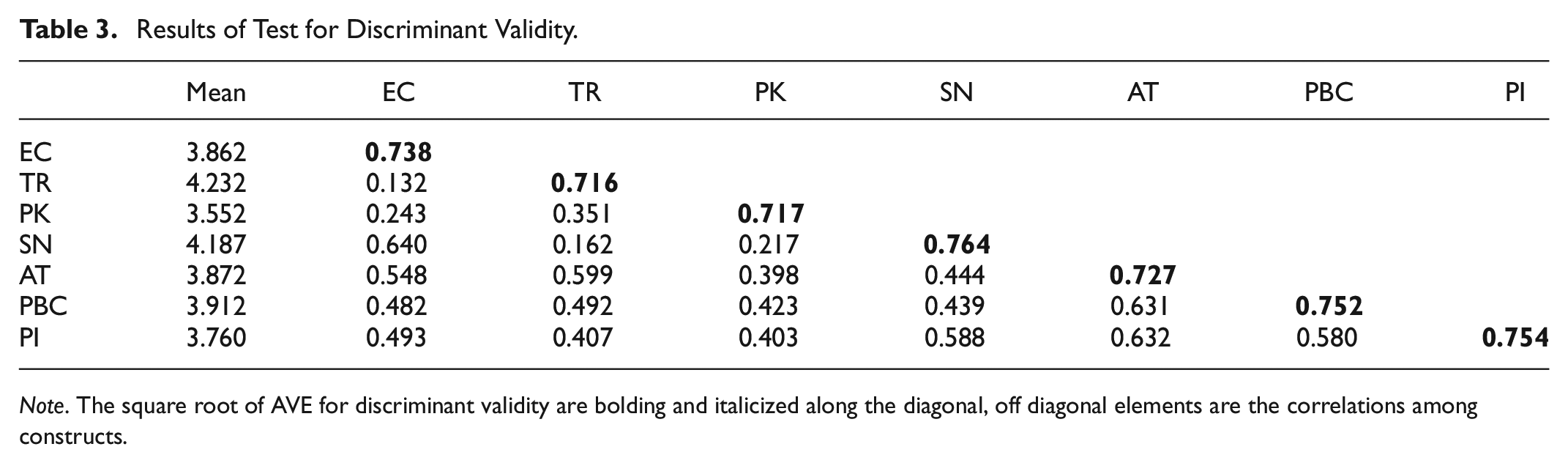
Note. The square root of AVE for discriminant validity are bolding and italicized along the diagonal, off diagonal elements are the correlations among constructs.
In addition, Harman’s single-factor test was conducted to check for common method bias (Podsakoff et al., 2003). The first unrotated factor captured only 28.61% of the variance in the data, indicating that common method bias was not a concern in this study.
Structural Model and Hypothesis Test
Owing to the model’s complexity and the need to test the relationships between the constructs simultaneously, structural equation modeling was employed by applying the MLE. Figure 1 shows the results of the testing model with Cmin/df = 1.070, goodness of fit index (GFI) =0.940 (>0.9), comparative fit index (CFI) =0.995 (>0.9), Tucker–Lewis fit index (TLI) =0.994 (>0.9), and root mean square error of approximation (RMSEA) =0.040 (<0.07) (Hair et al., 2010). Therefore, it was concluded that the hypothesized model offered an acceptable fit to the data.

Results of model testing.
Regarding the structural equations, presented in Table 4, the results showed that H1, H2, and H3 were supported, indicating that the TPB constructs (subjective norms: β = .337, p = .000; attitude: β = .349, p = .000; perceived behavioral control: β = .235, p = .000) had a significant effect on the purchase intention for vegan cosmetics.
Results of the Hypothesis.

With the additional constructs, the results showed that environmental concern had a positive effect on the three TPB constructs (subjective norms: β = .627, p = .000; attitude: β = .468, p = .000; perceived behavioral control: β = .408, p = .000), thus supporting H4, H5, and H6.
It was also found that trust was primarily predicted by the respondents’ attitude (β = .520, p = .000) and perceived behavioral control (β = .405, p = .000). Moreover, perceived knowledge also has influenced with attitude (β = .113, p = .029) and perceived behavioral control (β = .194, p = .001). Thus, H8, H9, H11, and H12 were supported.
However, the results, presented in Table 4, also showed that trust and perceived knowledge were not related to subjective norms. Therefore, H7 and H10 were not supported.
Discussion
Managerial Implications
This study explored an extended framework of the TPB, with environmental concern, trust, and perceived knowledge as three additional constructs affecting subjective norms, attitude (toward the product), and perceived behavioral control. The purpose was to identify the factors affecting consumers’ intention to purchase vegan cosmetics in the Vietnamese context.
The results showed that subjective norms had a strong effect on purchase intention for vegan cosmetics (this finding is supported by Berki-Kiss & Menrad, 2022; Li et al., 2021, and Sreen et al., 2018); however, the study by Patel et al. (2020) does not support this construct in the context of green consumption. In addition, subjective norms show that the references of people important to consumers have a strong influence on the latter’s intention to buy vegan cosmetics. Therefore, firms must focus on product advertising strategies in the media and mass media to increase brand awareness, popularize and use key opinion leaders to propagate green living as well as showing people the benefits of vegan cosmetics; this is a good way to create trends of using vegan cosmetics for Vietnamese consumers.
The results also showed that purchase intention for vegan cosmetics was influenced by the respondents’ attitudes toward such cosmetics (this finding is supported by Jaiswal & Singh, 2018; Teng & Wang, 2015; Yadav & Pathak, 2016, and Zaremohzzabieh et al., 2021). In addition, the present study also showed that the respondents’ attitudes toward vegan cosmetics had the highest effect, followed by subjective norms and perceived behavioral control. Therefore, vegan cosmetics companies must implement advertising strategies that focus on content on the safety and quality of such cosmetics compared with conventional ones; however, because consumers consider vegan cosmetics to be more expensive, companies must keep pricing in mind when running ads, and offer enticing deals—for example, buy 1 get 1 free—on special occasions to attract consumers in Vietnam.
The results also showed that perceived behavioral control affected the respondents’ intention to purchase vegan cosmetics (this finding is supported by Carfora et al., 2021; Sreen et al., 2018], and Zaremohzzabieh et al., 2021). Furthermore, the respondents reported a very high level of trust in the labels of vegan cosmetics. Therefore, vegan cosmetics companies must ensure that the information provided on product labels is clear and accurate, to facilitate purchase intention for such products, especially for those who are fastidious or allergic to harmful chemicals in conventional cosmetics.
Regarding the additional constructs, environmental concern positively affected subjective norms, attitude, and perceived behavioral control. This is an interesting finding, different from previous studies that considered additional constructs affecting the TPB’s—Kumar (2021): environmental concern supported only perceived behavioral control; Yadav and Pathak (2016) and Emekci (2019): environmental concern affected only attitude toward green product purchase intention. Moreover, the results of the present study in the Vietnamese context also showed that environmental concern had the most influence on subjective norms and then on attitude and perceived behavioral control. That shows us, those who are interested in protecting the quality of the environment will greatly influence on individual’s perception of vegan cosmetics through the reference of relatives and acquaintances. Therefore, vegan cosmetics companies must come up with compelling strategies that incorporate sustainable development through online and offline communication, to create a reference effect from acquaintances and friends; this will be the premise affecting consumers’ intention to purchase vegan cosmetics.
In addition, trust in vegan cosmetics had a positive and strong effect on the respondents’ attitudes and perceived behavioral control, but it did not have a significant effect on subjective norms. This is quite similar to the results of Carfora et al. (2021) and Teng and Wang (2015), when attitudes are strongly supported by consumers’ trust in green products and not affected by subjective norms of society. The results indicate that consumer trust is highly dependent on quality certifications and packaging/labeling of vegan cosmetics. Therefore, the government should implement regulations on licensing of vegan cosmetics and packaging or logo design so that consumers can identify and trust certified vegan cosmetics as quality products. In addition, vegan cosmetics companies can promote their images and production processes to create a good impression among consumers, and as a way to promote a green, healthy lifestyle and environment protection ideas.
Teng and Wang (2015) showed that perceived knowledge affected only consumer trust, while Hoque et al. (2018) showed that perceived knowledge supported only consumers’ attitudes toward green products. However, the results of the present study showed that perceived knowledge about vegan cosmetics had a positive effect on the respondents’ attitudes and perceived behavioral control but did not have a significant effect on subjective norms. In addition, the respondents’ perceived knowledge about vegan cosmetics was normal, not too high, especially in identifying packaging, labels, and distinguishing vegan cosmetics from conventional ones. Therefore, vegan cosmetics companies should conduct promotional programs and provide accurate and reliable information about their products through social networking sites, television, magazines, websites, and other media. They must also provide information on packaging or logo identification of vegan cosmetics and vegan certifications, thereby helping consumers understand and have better attitudes and perceived behavioral control with respect to vegan cosmetics, thus increasing their purchase intention.
It can be said that vegan cosmetics are becoming a sustainable trend in the health & beauty industry. Along with the development of technology, people are becoming more aware of the threats facing the planet they live on and are more conscious of responsible consumption. According to the Kantar Worldpanel Beauty Trends in Asia report (2019), Asians consider health to be the top priority, regarding it almost twice as important to their happiness as having money. In particular, amid the ongoing COVID-19 pandemic, we have tended to make efforts to live healthier, pay more attention to our health, and prefer healthy, green products with less impact on the environment. Therefore, vegan cosmetics is a sustainable development trend, and not a fad. The results of this study can help firms and marketers understand the factors affecting consumers’ purchase intention and provide a basis for choosing appropriate development strategies in the market in Vietnam.
Contribution to Literature
This study makes a significant contribution to the literature. First, the study contribute the application of a model by extended classic TPB. Some re-studies in Vietnam (Nga & Huynh, 2019) or other countries (Li et al., 2021; Sreen et al., 2018; Teng & Wang, 2015; Zaremohzzabieh et al., 2021) has not mention all the relationship about environment concern, trust, perceived knowledge to factors in TPB. This helps researchers have more documents for reference and application for future research.
Second, the extended TPB model was applied to explain Vietnamese consumers’ intention to buy vegan cosmetics, which has not been investigated before. The results showed that purchase intention for vegan cosmetics was directly influenced by the TPB constructs through environmental concern, trust, and perceived knowledge. This is helpful for vegan cosmetics companies in understanding the buying behavior of consumers to come up with appropriate development strategies in the Vietnamese market.
Limitations and Directions for Further Research
While this study contributes to the understanding of and purchase intention for vegan cosmetics, it has certain limitations. These are as follows: A small number of factors affecting the purchase intention for vegan cosmetics were tested; there are other factors that have not been covered in this study. Due to limited time and resources, the survey sample size may not be considered large enough and was geographically limited. Future studies can apply this research model to other areas and consider other factors affecting the intention to buy vegan cosmetics; they can also further explore the relationship between the intention to buy vegan cosmetics and the actual buying behavior of consumers.
Footnotes
Declaration of Conflicting Interests
The author(s) declared no potential conflicts of interest with respect to the research, authorship, and/or publication of this article.
Funding
The author(s) disclosed receipt of the following financial support for the research, authorship, and/or publication of this article: This research is funded by University of Economics Ho Chi Minh City, Vietnam.

Data Availability Statement
The data sets analyzed during the current study are available from the corresponding author upon reasonable request.