




Abstract
This article analyzes researchers’ adoption of an institutional central fund (or faculty publication fund) for open-access (OA) article-processing charges (APCs) to contribute to a wider understanding of take-up of OA journal publishing (“Gold” OA). Quantitative data, recording central fund usage at the University of Nottingham from 2006 to 2014, are analyzed alongside qualitative data from institutional documentation. The importance of the settings of U.K. national policy developments and international OA adoption trends are considered. Innovation Diffusion Theory (IDT) is used as an explanatory framework. It is shown that use of the central fund grew during the period from covering less than 1% of the University’s outputs to more than 12%. Health and Life Sciences disciplines made greatest use of the fund. Although highly variable, average APC prices rose during the period, with fully OA publishers setting lower average APCs. APCs were paid largely from internal funds, but external funding became increasingly important. Key factors in adoption are identified to be increasing awareness and changing perceptions of OA, communication, disciplinary differences, and adoption mandates. The study provides a detailed longitudinal analysis of one of the earliest central funds to be established globally with a theoretically informed explanatory model to inform future work on managing central funds and developing institutional and national OA policies.
Introduction
One of the major challenges facing higher education institutions in the current scholarly communication environment is how to fund and manage the payment of article-processing charges (APCs) for open-access (OA) research articles. APCs are now commonly charged by fully OA journals (which publish only OA content) and also by “hybrid” subscription/OA journals (subscription journals that also allow specific articles to be made OA on payment of an APC). APCs, normally paid by authors (or their institution or funders) in advance of publication in the journal, are increasingly seen as the basis of a viable business model to support so-called “Gold” OA—OA publishing of journal articles (Björk, 2012; Björk & Solomon, 2012; Laakso & Björk, 2012; Suber, 2012). The market in APCs is, however, still immature, and there remains uncertainty about what shape it will ultimately take (Björk, 2012; Pinfield, 2013a). Björk and Solomon (Björk & Solomon, 2014; Solomon & Björk, 2012) draw attention to the dysfunctionalities of the hybrid journal market in particular, where evidence suggests that high prices are discouraging take-up among researchers. At the same time, business processes to manage APCs in both universities and publishers are still not fully established.
One response made to these challenges at institutional level is to manage funding and administration of APCs as part of an institution-wide APC “central fund” or “faculty publication fund” (Fernandez & Nariani, 2011; Monson, Highby, & Rathe, 2014; Pinfield, 2010; Pinfield & Middleton, 2012; Scholarly Publishing and Academic Resources Coalition [SPARC], n.d.). Central funds are normally designed to encourage wider adoption of APC-funded OA publishing among researchers, while enabling the institution to monitor take-up and achieve administrative efficiencies through economies of scale. Building up a picture of the use of central funds therefore provides an interesting insight into the extent of the penetration of OA into researchers’ scholarly communication priorities and workflows and how this in turn relates to institutional policies and processes. Recently, in a number of countries, most notably the United Kingdom, a large number of institutions have set up central funds as a means of managing block grants received from research funders, which are paid centrally to institutions in proportion to their research project income. Such block grants, paid by government-sponsored agencies such as Research Councils UK (RCUK) and private funders such as the Wellcome Trust, are designed to pay for APCs and other OA activities in institutions (RCUK, 2013; Wellcome Trust, 2014). As a result, interest in the issues associated with managing this approach to OA publishing and dissemination has become more acute among a wide range of stakeholders with an involvement in the scholarly communication process.
This article provides a detailed analysis of one of the earliest central funds to be established globally, at the University of Nottingham in the United Kingdom and covers the period from 2006 to 2014. It begins by reviewing the available research and practitioner literature on central funds, setting it within the wider context of scholarly communication change and research policy development. It then goes on to analyze adoption of the Nottingham central fund over the 9-year period of its existence. The empirical data are then discussed using Innovation Diffusion Theory (IDT) as a lens through which to understand the developments described. The intention is to provide an analytical framework for understanding such developments to inform future work by both practitioners and researchers on the implementation of central funds in particular and Gold OA in general.
Research Context
In their 2009 report on the funding of OA publishing, the Research Information Network and Universities UK (RIN; 2009) recommended that higher education institutions “establish dedicated budgets to which researchers can apply for funds to meet the costs of publication fees.” These budgets could be comprised of funds from various sources derived from research income or from block grants provided by research funders. Such an approach was supported by Shieber (2009) who regarded central funds as an important way in which an institution could create a “level playing field” for both OA and subscription publishing. As the latter is provided through organization-level subscriptions for all its members, the former should also be funded at organization level with the university committing to “underwrite reasonable processing fees for articles.” Shieber was involved in founding the Compact for Open-Access Publishing Equity (COPE; n.d.), which encourages the setting up of central funds and lists 34 “COPE-compatible” institutional funds on its website, mostly from the United States.
Such funds have not been without their detractors, however. Writing in 2010, Harnad (2010) stated his opposition to “plans by universities and research funders to pay the costs of Open Access Publishing (‘Gold OA’),” characterizing them as “premature.” In his arguments, Harnad strongly favored the so-called “Green” route to OA (the depositing of versions of research articles in repositories) as preferable to Gold OA for the foreseeable future. He pointed out that APCs were still high and, therefore, unaffordable at current levels, particularly at any scale. In an interview with Richard Poynder in 2010, he added the argument that academic staff would not like to see money for research diverted to pay for APCs. A similar argument has also surfaced among librarians in relation to the library budget. There is evidence in the literature of nervousness that already hard-pressed library budgets would be diverted to pay for APCs (Palmer, Dill, & Christie, 2009; Schmidt, Sennyey, & Carstens, 2005). This fear appeared to be borne out in the survey of Canadian libraries reported by Fernandez and Nariani (2011), who found that the library budget was the most common source of funding for APCs among their respondents. More recently, librarians in particular have raised concerns about additional administrative costs associated with managing central funds (Harris, 2013), and this has led to a focus on the potential role of intermediaries in this space taking on a similar role to subscription agents (RIN, 2012).
A particular area of controversy relating to the affordability question is the issue of eligibility criteria for both staff and journals. Where central funds are comprised of block grants from funders, as is the case in many U.K. institutions currently, it is common for only those authors who are grant holders from particular funders to be eligible to make use of the fund. Shieber (2009) observes that this does not create the “equity” necessary for OA publishing to exist alongside subscription publishing and argues strongly for all authors within an institution to be funded regardless of research grants received. Although not limited to particular groups of academic staff, Shieber does, however, argue funding should be limited to particular sorts of journals: fully OA titles only, excluding hybrid journals. He suggests that hybrid journals already receive income from subscriptions and therefore should not be supported in receiving additional income from APCs—a practice that has become commonly labeled as “double dipping” (Prosser, 2015). Central funds vary in their approach to this, with some accepting claims for hybrid journal APCs and others not (Fernandez & Nariani, 2011). Further concerns have also been raised in the area of rationing of funds. In particular, questions of how decisions are made about which APCs to fund and who makes them in the case of limited funds have been raised as challenges (Pinfield & Middleton, 2012).
Regardless of their precise eligibility criteria, the argument has been made that central funds encourage artificially high APCs (and potentially double dipping) by making funds readily available for payment of APCs without sufficient price sensitivity built into the system—researchers wanting to pay APCs are less likely to be price sensitive if APCs are being paid centrally on their behalf (Eckman & Weil, 2010). This particularly appears to be the case for APC pre-payment schemes where authors may hardly be aware that an APC is being paid at all (Pinfield, 2013a).
Despite these concerns, a number of libraries worldwide have set up central funds. Useful case studies of the strategic thinking behind the moves and experiences of the process have been published (e.g., for University of California [UC], Berkeley; Eckman & Weil, 2010). Although it is careful not to advocate central funds, Scholarly Publishing and Academic Resources Coalition (SPARC) has also produced a useful “how-to” guide for practitioners (Tananbaum, 2010). It emphasizes important points such as the need for effective communication within the institution about OA in general and the fund in particular.
The Nottingham Central Fund was launched in March 2006 and has been described in a number of publications (Cockerill, 2009; Pinfield, 2010; Pinfield & Middleton, 2012). The Fund was established under the auspices of the University research committee and was funded using University research strategy funding allocations. It was initiated by the library as part of an overall OA strategy, which also included support of an institutional repository, enabling Green OA, complementing its approach to Gold OA. The fund was managed by the research support office, which also supported publicity about the fund to academic schools in the University.
The immediate context of the setting up of the Central Fund, evident from University of Nottingham’s internal documentation dating from 2006, was the introduction by the Wellcome Trust of block grants supporting OA and of both Wellcome and RCUK policies encouraging OA publication and dissemination. The argument was made in the formal proposal adopted by the institutional research committee that a central fund should be used to create a “level playing field” in the institution (interestingly pre-empting Shieber’s, 2009, use of the term) allowing those without Wellcome funding also to apply for funding to pay for APCs. It was envisaged that this would be funded through Wellcome block grants (for Wellcome-funded researchers) and indirect funding allocations from other research sponsors (covering overheads and other similar costs to support research). The funding was made available to all academic staff whether or not funded by Wellcome or any other funder. During the period covered by this study, payments from the Fund were not rationed in any way. The analogy was drawn between payment of APCs and funding of library subscriptions by the University, which are also paid for with funding allocated from indirect income and are made available universally to all members of the institution rather than to just recipients of particular grants (once again, pre-empting arguments made by Shieber, 2009). Since 2012, RCUK block grants have been administered as part of an overall Central Fund and directed to the payment of RCUK grant holders.
Most of the studies of central funds (including ones of the Nottingham Fund) have to date been written by practitioners providing overviews of the strategic thinking or lessons learned in implementations. However, there has been little theoretically informed discussion in the research literature specifically on central funds. Other aspects of OA have been discussed in the research literature informed by relevant theoretical frameworks. For example, several studies have been produced on different aspects of OA using the Unified Theory of Acceptance and Use of Technology (UTAUT) focusing in particular on individual user adoption decisions (Dulle & Minishi-Majanja, 2011; Mann, von Walter, Hess, & Wigand, 2009; Singeh, 2013; Singeh, Abrizah, & Karim, 2013). Ostrom and Hess (2007) have studied OA institutional repository development using Commons Theory, and Kennan (2011) has applied Actor Network Theory to the same topic, both studies attempting to take account of organizational cultures and working practices to understand developments. There have also been several studies of different aspects of OA using IDT including a broad-based study covering both Green and Gold OA at global level (Xia, 2012) and a study of the growth, globally, of OA repositories (Pinfield et al., 2014). The latter study illustrates the efficacy of IDT at different levels—individual, organizational, national, and global—to explain developments. Recently, Hampson (2014) has used IDT as a framework to analyze the introduction of OA central funds at a national level by Canadian higher education libraries. Her work looks at the number of funds set up by universities based on secondary data analysis of surveys from 2008 to 2012. It does not, however, address the use of those funds within each institution, the main focus of this current study. The current study, therefore, complements Hampson’s approach by deploying IDT as a means of understanding use of an OA central fund within an institutional context.
Codified and popularized by Everett Rogers (1962, 2003), IDT may be used to explain adoption of a wide set of innovations, where “innovation” is defined as “an idea, practice, or object that is perceived as new by an individual or other unit of adoption” (Rogers, 2003, p. 11). This does not necessarily mean technological innovation, although innovations may often in practice have a technological component. “Diffusion” is defined by Rogers (2003) as “the process by which an innovation is communicated through certain channels over time among members of a social system” (p. 10, emphasis in original). Therefore, the “main elements are the innovation, communication channels, time and the social system” (Rogers, 2003, p. 10). IDT provides detailed models for all of these elements and how they influence adoption, including the main characteristics of the innovation as perceived by (potential) adopters, the ways in which information about and experience of innovations are communicated, the processes of adoption over time, and influences of social groupings in adoption. A large number of studies have deployed, tested, and refined IDT since its development in the late 1950s, including some recent studies relating to innovation adoption in organizations in general (Damanpour & Schneider, 2006) and non-profit organizations in particular (Jaskyte, 2011). Studies focusing on university organizations have included those on organizational sub-units, such as libraries (Jantz, 2011; Oguz, 2015), and on technology-enabled processes, such as technology-enhanced learning (Bennett & Bennett, 2003; Singh & Hardaker, 2014). These studies provide ostensible indications of the relevance of IDT in considering OA central funds within institutions. IDT can help to explain the specific results reported in this case study and do so in a way that it is translatable to the circumstances of a wide range of research institutions. Valuable insights on institutional responses to the developing OA market, changing funder policy interventions, and evolving scholarly communication practices are also provided through application of the theory to this empirical evidence base.
Method
This study reviews data collected during the entire period of the operation of the Nottingham Central Fund from its launch in March 2006 to July 2014. The data consist of records of payments of APCs claimed by authors for particular journal articles published in either fully OA or hybrid journals. Apart from individual payments, the data also include bulk payments made to publishers as part of APC pre-payment schemes. Most of the data analyzed are recorded in Excel spreadsheets administered by research support staff at Nottingham. The dataset analyzed comprises date of payment request, author name, academic department and faculty, article title, journal title, publisher, funder, and APC charge. These data elements facilitate analyses of publishing patterns by individual, by subject discipline, and by publisher. They also support an investigation of trends in APC costs over the 9 years of the study.
To carry out an analysis of these records, comparisons were also made with the central University financial system and publications database. The data are grouped into financial years running from August 1 to July 31. The data are in U.K. pounds (£) and figures are presented rounded to the nearest pound, with U.S. dollar ($) conversions provided at a current conversion rate of 1.5.
Apart from analysis of data collected on the usage of the fund itself, research carried out for this study included a review of key documentary evidence associated with the Nottingham Fund, comprising internal administrative documentation (minutes of relevant meetings, briefing papers, etc.), internal advocacy outputs (newsletters, PowerPoint presentations, etc.), plus external conference presentations (Pinfield, 2007, 2008a, 2008b) and publications (Cockerill, 2009; Pinfield, 2010; Pinfield & Middleton, 2012). These qualitative data have been used to help contextualize the quantitative analysis of central fund usage and in particular to suggest explanatory hypotheses discussed below.
Nottingham is a large research-led university carrying out research and teaching in a wide range of disciplines—the broad subject range usefully allows comparisons across different disciplinary areas. It comprises five Faculties: Arts, Social Sciences (including Business and Law Schools), Engineering (including Architecture), Science, and Medicine and Health Sciences (including a Veterinary School as well as Schools of Medicine and Nursing). In the autumn of 2014, the University had a total of 3,384 teaching and research staff; 343 in the Faculty of Arts, 576 in Social Sciences, 548 in Engineering, 792 in Science, and 1,124 in Medicine and Health Sciences. It is estimated that Nottingham produces approximately 4,000 published outputs per year, an estimate derived from combined analysis of the results of a Scopus affiliation search and the institution’s own publications database records, neither of which are exhaustive but between them provide sufficient data to estimate the size of the University’s annual output.
Results
APC Payments Patterns
Between the beginning of the financial year 2006-2007 and the end of 2013-2014, there were a total of 1,648 APC payments made from the Nottingham Central Fund. Figure 1 illustrates the growth of the numbers of APC payments over that time. The data show a rise in the number of APC payments from 28 in 2006-2007 to 481 in 2013-2014. With an estimated 4,000 publications per year, APCs therefore may be seen to have applied to less than 1% of the published outputs of the University in 2006-2007, growing to about 12% in 2013-2014.

Number of APC payments by financial year.
The growth trend in payments is clear, but it is noticeable that the data do not show an entirely consistent growth pattern. The financial year 2011-2012 in fact saw a decline in the number of payments. There are a number of possible reasons for this. Among important reasons are likely to be institutional factors, such as communication and advocacy activities about the Fund. Available documentary evidence (including records of meetings and advocacy materials) suggests that advocacy activities were not as intense during 2011-2012 at an institutional level, and this may have contributed to a decline in the profile of the fund and a temporary decline in uptake. Nevertheless, despite this apparently temporary reversal, there was a marked rise in APC payments from 2012-2013 onwards, a rise that continued in 2013-2014.
The rise in overall activity is made clear in Figure 2, which shows the number of APC payments made on a monthly basis between August 2006 and August 2014. It shows higher levels of activity than previously experienced during the calendar year of 2013 in particular. There was, however, still considerable variation across months but no discernible pattern corresponding, for example, to the annual academic cycle. It would be interesting in future to see if activity settles into any kind of annual pattern or whether it continues as at present.

Number of APC payments per month.
Different levels of APC payments were made across different disciplines represented in the University. Table 1 shows the APC payments made by Faculty (further illustrated in Figure 3). The data demonstrate greater use of the Central Fund by the Faculty of Medicine and Health Sciences than other Faculties. In 2013-2014, the number of APCs paid for the Faculty (222) was nearly double that of the next Faculty, Science (128). In some of the previous years, the proportion of the total was even greater. Other Faculties made comparatively little use of the Central Fund, although there was some growth (albeit still at low levels) from 2012-2013. This ostensible disproportionate uptake of the Fund by staff from the Faculty of Medicine and Health Sciences may be tested against overall publications data available for the institution, as well as staff data. Robust data recording all outputs published by Nottingham authors are available covering the period from January 2013 to July 2014 from the institutional publications database. Although this dataset represents items at the publication stage rather than at the APC payment stage, it nevertheless substantially overlaps with the 2013-2014 financial year for APCs. Before that, publications data available at Nottingham are not believed to be comprehensive. Total publications from the Faculty of Medicine and Health Sciences for 2013-2014 (1,250 items) constituted 29% of the institutional total of 4,315, and staff from the Faculty were 33% of the staff total. At the same time, APCs paid from the Central Fund to Faculty were 46% of the total number of centrally funded APCs, indicating that the use of the Central Fund by Medicine and Health Sciences was disproportionately high. In contrast, both the Arts and Social Sciences Faculties made a disproportionately low usage of the Fund: 5% of the total for Arts and 10% for Social Sciences, when they represented 16% of the total outputs and 10% of staff (Arts) and 21% of the outputs and 17% of staff (Social Sciences). Science and Engineering were nearer proportionate levels, with Science accounting for 27% of the usage of the Central Fund, 22% of published items and 23% of staff; and Engineering 13% of usage, 12% of publications and 16% of staff.
Number of APC Payments by Faculty.
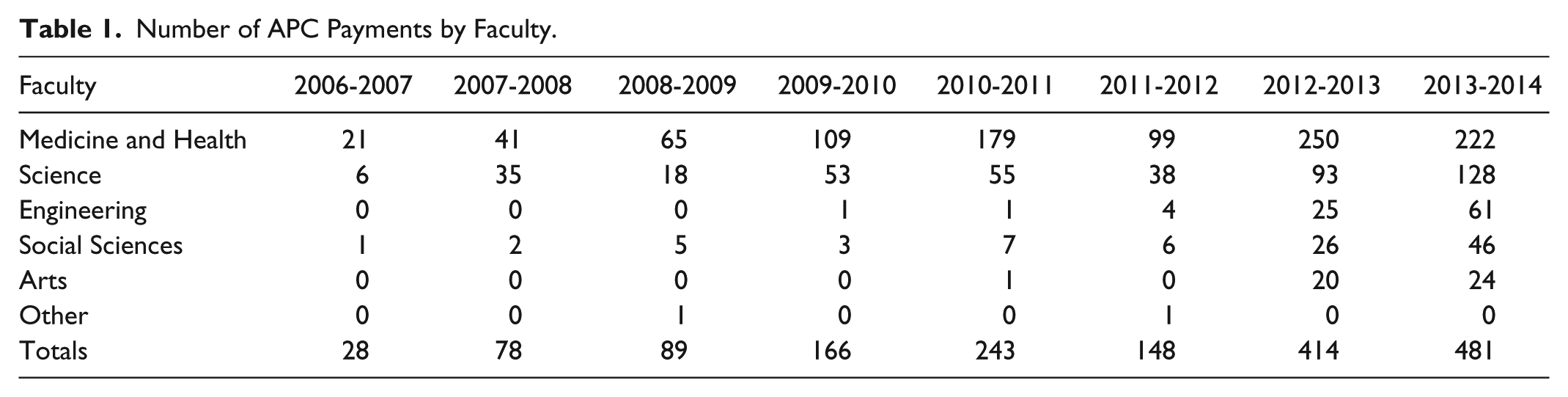

Number of APC payments by Faculty groupings.
Use of Fund within the Faculty of Science was highest in the Life Sciences area. The Schools of Psychology and Biosciences made most use of the Central Fund throughout the period 2006-2007 to 2013-2014, with a total of 113 and 105 APCs, respectively. Two other Schools within the Faculty made comparatively moderate use of the Fund: Mathematical Sciences (69 APCs) and Pharmacy (67). However, three Schools, all in the Physical Sciences area, made relatively little use of the Fund: Chemistry (34), Physics and Astronomy (24), and Computer Science (14).
Nottingham data therefore show a disproportionate use of the Central Fund by researchers from the Health and Life Sciences disciplinary area. This is consistent with findings elsewhere, which show a greater acceptance of Gold OA within those areas (Kurata, Morioka, Yokoi, & Matsubayashi, 2013) compared with other disciplines, such as Physics and Computer Science, where there is greater uptake of Green OA (Björk, Welling, Laakso, & Majlender, 2010), or Chemistry, where neither form of OA seems to have gained traction (Gargouri, Lariviere, Gingras, Carr, & Harnad, 2012).
During the period, there were a total of 852 unique users of the Fund. Most were lead or corresponding authors, although in fact no limitations were placed on who could apply to the Fund as long as they were a member of the University named as an author on the article. Most of the recorded users (522 or 61%) were first-time users, but there were 330 (39%) repeat users (those who used the fund 2 times or more). Of them, 101 individuals made more than four requests during the period, seven of whom made more than 10 requests (with the highest number of requests made by a single user being 22). Analysis of the repeat users shows clearly that they were predominantly from the Faculty of Medicine and Health Sciences. Of the 101 users with more than four requests, 61 (60%) were from the Faculty and 31 (31%) from the Faculty of Science. Once again, members of the Faculty of Science working in the Life Sciences area (Biosciences, Pharmacy, and Psychology) made most use of the Fund within that Faculty as repeat users. Of the smaller number of 47 who were repeat users before marked rise in take-up in 2012-2013, an even higher proportion, 70% (33 users), were from the Medical Faculty, with 26% (12) from Science. This pattern of usage serves to emphasize the picture of early adopters of the Fund being highest among Health and Life Sciences users.
An analysis of unique author Fund usage patterns (Figure 4) shows that there was a sharp decline in numbers of new first-time author requests in 2011-2012, which was far more marked than the slight drop in numbers of requests in the same year from previous requesters. The rate of increase in repeat requests follows a smoother incline than that for first-time requests. This shows a relative “loyalty” on the part of repeat users familiar with the service compared with new users who have a “first-use barrier” to overcome. The number of first-time users, however, shows a marked increase from 2012-2013 onwards, consistent with the overall usage rise.

Number of first-time and repeat users of the Central Fund.
APC Prices
Figure 5 illustrates the growth in total amount of APC payments via the Nottingham Central Fund over the period. As might be expected, the spend follows a similar pattern to the number of APC payments, with a dip in expenditure in the 2011-2012 financial year. The total of central APC payments rose from £24,048 ($36,072) to £722,972 ($1,084,458) in 2013-2014.

Total central spend on APC payments.
The mean average APC payment rose steadily over the period covered by this study: from £1,235 ($1,853) in 2007-2008 to £1,506 ($2,259) in 2013-2014. One interesting feature of the data, however, is the wide variation of APC prices paid. Figure 6 shows this variation in the form of a “box plot,” with the extensions from the boxes representing the full range of minimum and maximum values for each financial year. The lowest APC paid during the period was £73 ($110), in 2010-2011, and the maximum was £4,080 ($6,120), in 2012-2013. Nevertheless, there was also a clustering of prices paid in the interquartile range, represented by the boxes themselves. The median (represented by the horizontal line in each box) rose from £850 ($1,275) in 2006-2007 to £1,500 ($2,250) in 2013-2014, and there was a year-on-year rise in the median price during the whole period covered apart from 2012-2013.
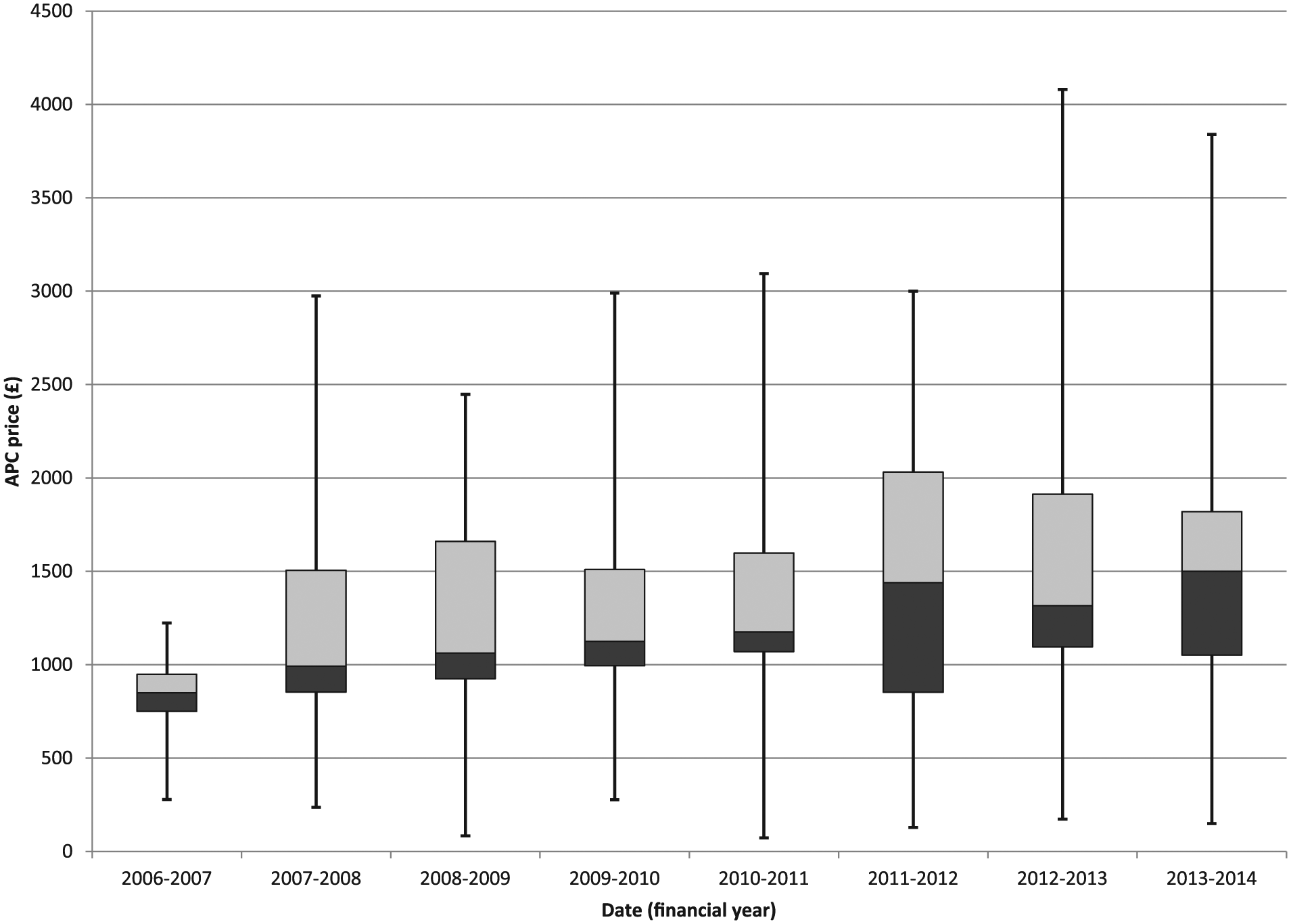
Range of APC prices paid.
However, the mean levels of APC prices paid by Nottingham are somewhat lower than those reported by Pinfield, Salter, and Bath (2015) from a sample of 23 U.K. institutions. For example, in 2013 (calendar year), the mean average APC for the 23 institutions was £1,676 ($2,514), compared with Nottingham’s £1,506 ($2,259) in 2013-2014. Previous years at Nottingham were even further below the mean of the 23 institutions, which remained relatively stable from 2010 onwards. One probable explanation of Nottingham’s lower mean APC price is the comparatively large number of APCs paid to BioMed Central (BMC) in Nottingham, with BMC’s lower than average APC prices (see below). Nottingham’s lower averages over time compared with the 23 institutions are also likely to be partly attributable to Nottingham having a policy from an early period to take out pre-payment packages wherever possible, leading to APC discounts.
Payments over the entire period of Nottingham’s Central Fund were made to a total of 125 publishers. Of these, only 23 received payments of 10 or more APCs during the period studied (Figure 7), and between them they received 85% (1,396) of all the APCs paid. BMC received considerably more payments than any other publisher: 457, 28% of all the payments made, mostly paid through a pre-payment deal. Other publishers who received more than 100 payments included Wiley (142), Elsevier (135), and Public Library of Science (PLOS; 121). “Traditional” publishers figure prominently in the organizations to which APC payments were made, with only four of the 23 publishers to which were made 10 or more payments being fully OA publishers (BMC, PLOS, Frontiers, and Molecular Diversity Preservation International [MDPI]).

Publishers to which more than 10 APC payments were made.
There was, however, a marked difference between APCs charged by different publishers, with fully OA publishers, such as BMC and PLOS, charging a mean average APC of £1,268 ($1,902) and other publishers charging £1,485 ($2,228) on average. This finding supports that of previous studies, which have found prices of journals produced by fully OA publishers to be less than those of others (Björk & Solomon, 2014; Pinfield et al., 2015). Hybrid journals published by “traditional” publishers are in particular seen in previous studies to charge markedly higher APCs (Björk, 2012; Pinfield et al., 2015). Although the data presented in this study do not allow the disaggregation of different journal types produced by traditional publishers (hybrid and fully OA), as hybrid journals are the vast majority of those published by traditional publishers (with fully OA journals making up a small and new minority), the Nottingham data are consistent with these previous findings, pointing in particular to lower APC prices charged by fully OA publishers.
Funding of APC Payments
The Nottingham Central Fund was set up in 2006 when the Wellcome Trust was the only funder providing an institutional block grant for payment of APCs centrally. The management of this block grant was incorporated into the Central Fund. All other centrally managed APC payments, however, were made from internal Nottingham funds until 2012 when RCUK introduced block grants. Figure 8 illustrates the sources of funding making up payments from the Central Fund during the period covered. Internal Nottingham funds form the majority of funds each year. Wellcome funds were used from 2007-2008 and RCUK funds from 2012-2013, both managed as part of the overall Central Fund.

Funding sources for the Nottingham Central Fund.
Although the Central Fund has been established at Nottingham since 2006, there is evidence that payments of APCs have been made outside the Fund during that time. These payments were spread throughout the University, coming from various budgets, and are, therefore, difficult to track. However, to generate indicative evidence of the scale of such transactions, reports from the University financial system were produced covering all payments of £5,000 or less made to a sample of publishers between the 2006-2007 and 2013-2014 financial years: BMJ, Elsevier, Oxford University Press (OUP), Nature, Taylor & Francis, Springer, and Wiley. This showed a total of 844 transactions, most of which were not APC payments, such as page or color charges, subscriptions, and book purchases. Although not always easy to identify APC payments conclusively (because of inconsistent coding and descriptions in the financial system), 122 of the transactions were identified with reasonable confidence as APC payments made outside the Central Fund to these publishers during the 9 years of the Central Fund’s existence. During that same time, a total of 602 payments were made to the same publishers from the Central Fund. Payments from outside the Fund for these publishers reached their height in 2011-2012, when there were 34 payments, but then declined to 15 in 2012-2013 and only four in 2013-2014. At the same time, payments from within the Central Fund for these publishers rose from 57 in 2010-2011 to 241 in 2013-2014. This shows non-Central Fund payments to be a diminishing proportion of the overall payments made by the institution. Interestingly, during this time, the majority of the non-Central Fund payments to these publishers made over the entire period (64%) were from the Faculty of Medicine and Health Sciences, showing a consistent pattern of disciplinary-specific adoption of Gold OA but only equivocal adoption of the Central Fund. Also, it is notable that payments were at their height in 2011-2012, which is consistent with the decline in Central Fund payments during that year already observed.
The APC payments made from the Central Fund, therefore, underrepresent total payments made by the institution. It is, however, very difficult to estimate the extent of this shortfall in relation to the entire Central Fund. For the above publishers, payments from the Central Fund were 83% of all the APCs paid between 2006-2007 and 2013-2014, with the remaining 17% being made outside the Central Fund. However, the balance between the Central Fund and non-Central Fund payments varied considerably from year to year. Payments for these publishers from outside the Central Fund were as high as 36% of the total in 2011-2012, whereas in 2013-2014 they were as low as 2%—a marked shift in favor of the Central Fund. However, in any given year, the proportions from these publishers cannot necessarily be extrapolated to the entire Central Fund. In particular, where publishers, such as BMC, were covered by pre-payment schemes (that would mean Nottingham authors have their APC covered automatically), it would have been far more difficult for authors to make payments outside the Central Fund and is therefore highly unlikely that proportions applying to Wiley, Elsevier, and so on (83:17) could apply to BMC over the period covered by the study. Furthermore, as the number and nature of the pre-payment deals have changed during the period covered by this study, it is, therefore, difficult to define exactly the size of the non-Central Fund payments over this time for all publishers. However, it can be surmised with reasonable confidence that the level of payments made to the above publishers are likely to represent an upper limit for proportions of payments made outside the Central Fund to similar (hybrid) publishers, with payments to many other publishers being considerably lower. However, it is possible that payments made to fully OA publishers for which pre-payment deals were not in place may have followed different patterns (Jubb et al., 2015). This needs further investigation.
Discussion
The adoption of the Central Fund by University of Nottingham researchers as a means of publishing OA articles funded by APCs can be explained by a complex set of interrelated factors. IDT provides a useful explanatory framework for these developments, enabling the identification of major causes of (and barriers to) innovation adoption. The main elements explaining adoption of an innovation as identified by Rogers (“the innovation, communication channels, time and the social system,” Rogers, 2003, p. 11) are therefore used below as a lens through which to examine developments.
In this research, the innovation studied has two main components: first, APC-funded OA publishing, enabled by, second, an institutional central fund. The second (the fund) is, of course, contingent on the first (OA publishing). It is clear, of course, OA publishing can happen without a central fund; a central fund is a particular institutional approach to the implementation of OA publishing. However, it is evident at Nottingham that even where a fund was in place (effectively making OA publication “free” for authors in the institution), some APCs were paid outside the Fund. It is interesting to consider why this should be the case. A study of the innovation of APC-funded OA publishing enabled by a central fund needs to take into account any “leakage” of payments outside the institutionally agreed approach to managing such payments. Doing so casts light not only on uptake of OA in general and APC-funded Gold OA in particular but also on a number of wider issues around adoption of innovations in large devolved organizations, such as universities—issues including cross-institutional communication and organizational coherence, discussed below.
Rogers (2003) proposed a particular process of innovation depicted in the innovation S-curve. The data analyzed in this study follow a pattern corresponding to early stages of the S-curve and is illustrated in Figure 9 with the addition of an exponential trend line on the Nottingham curve. This might reasonably be interpreted as being at or near the “take off” point, a point ostensibly demonstrated by the fact that during the period covered by the study, the innovation went from applying to less than 1% of outputs (28 in 2006-2007) to more than 12% (481 in 2013-2014). Although IDT is not necessarily designed as a predictive tool, it will be informative to see whether ongoing use of the Nottingham fund (and similar funds) continues to follow the S-curve trajectory. Regardless of this, IDT suggests some important concepts that may be useful in providing a framework for understanding the developments presented in this study.

Comparison of the adoption trend at Nottingham with the IDT S-curve for adoption.
Of the main elements explaining adoption of innovations, the first main element is the innovation itself or, more accurately, the characteristics of the innovation “as perceived by members of a social system” (Rogers, 2003, p. 36). Rogers (2003, pp. 15-16) identified five key characteristics: Relative advantage: the degree to which an innovation is seen as beneficial for its adopters Compatibility: the degree to which “an innovation is perceived as being consistent with the existing values, past experiences, and needs of potential adopters” Complexity: the degree to which an innovation is perceived as being easy to understand and use Trialability: the extent to which an innovation “may be experimented with on a limited basis” Observability: the extent to which results of the innovation are visible.
Rogers (2003) stated, “innovations that are perceived by individuals as having greater relative advantage, compatibility, trialability, observability, and less complexity will be adopted more rapidly than other innovations” (p. 16).
It may be observed that the development in question in this study ostensibly fulfills many of the characteristics of a successful innovation. Gold OA creates a number of advantages that accrue for both individual authors and their institutions, including visibility and impact advantages that are well-documented (Hitchcock, 2013; Suber, 2012). A central fund in turn provides an advantageous way of adopting Gold OA publishing in a given institutional context. The innovation might therefore be assumed to have a sufficiently high relative advantage to encourage adoption. The adoption of Gold OA is also compatible with existing needs and values within the academic community delivering potentially wider dissemination of research results in a way that achieves greater recognition for the author (high compatibility). Furthermore, using the Central Fund as a means of adopting Gold OA was designed to be as easy as possible for Nottingham authors (low complexity). It also can be used on a limited basis (high trialability), and its results are to a certain extent identifiable (high observability). However, despite these potential benefits, the rate of adoption was initially slow, only recently accelerating—a pattern that requires explanation.
One important factor here is likely to be imperfect information in the academic community in general about OA. Data from 2013 (Nicholas et al., 2014) show that considerable “distrust and misunderstandings” about OA remains among U.K. and U.S. researchers. Attitudes of this sort may reasonably be assumed to have affected the perceptions of potential users of the Central Fund at Nottingham meaning that the perceived relative benefits of OA may not have been high enough to motivate many researchers to publish in an OA journal or even make an article OA in the hybrid journal, and therefore, adoption of the Central Fund was initially low. Even though the Central Fund made payment of APCs effectively “free” for individual authors, many may still have seen APCs as expensive (even if not directly borne by them) without there being sufficient demonstrable benefit. This may be especially true of hybrid journals, where the main aim of the author (of having an article accepted in an established journal) had already been achieved and where payment of an APC might, therefore, be seen as unnecessary. Moreover, results of publishing OA and using the OA Central Fund may not necessarily be observable in such a way as to clearly demonstrate the benefits of adoption. It may take time, for example, for any benefits, such as citation advantage, to emerge and require effort on the part of the researcher to discover them. This lack of perceived benefits may have been compounded by perceived complexity and effort expectancy on the part of the users. Many busy academics may have seen having to go through the trouble of navigating a new business process of claiming an APC from Central Fund as a barrier to use—a point that may also be important in partially explaining “leakage” of payments outside the Central Fund. It is likely to have been perceived as easier to get an APC paid locally rather than applying to the center to do so. These observations help to explain the slow adoption rates in the early stages of the Central Fund’s life (although separate explanations are therefore required for the accelerated rise of adoption from 2013 onwards and are suggested below).
User perceptions that led to relatively slow initial adoption obviously relate to a certain extent to the effectiveness of communication, Rogers’s second main element of diffusion. At the University of Nottingham, communication channels about the Central Fund included “one-to-many” channels (called “mass media” by Rogers), including circulation of policy details via email, articles in the library newsletter, and presentations to various groups. However, the effectiveness of such channels is often limited if not accompanied by “interpersonal channels,” as shown by Oguz’s (2015) work on digital libraries, where peers exchange information in a trusted environment. One major weakness observable in the communication at Nottingham is that it appears often to have been confined to “mass media” channels with messages commonly delivered by support staff (library and research support professionals) to academic staff. This highly “heterophilus” nature of the communication might reasonably be assumed to have limited its effectiveness. Although Rogers observes “heterophily” is a common characteristic of innovation adoption communication, the relatively high level of heterophily in the case of Nottingham might be a significant factor at least in terms of slowing down the rate of adoption. Researchers are more likely to change their behavior if recommended to do so by an academic colleague from their own academic department rather than a member of support staff from a central services department.
Time is the third main element of the innovation process identified in IDT. Rogers posited several stages in an “innovation decision process”: “(a) knowledge, (b) persuasion, (c) decision, (d) implementation, and (e) confirmation” (Rogers, 2003, p. 20). All these are relevant in this study. The first, “knowledge,” is particularly relevant insofar as it creates a contingency for the remaining steps: Users have to know about an innovation in the first place. There is evidence that a lack of knowledge (or partial knowledge) of OA may often be an ongoing barrier to take up. At Nottingham, this is likely to have acted as a barrier to potential users of the Central Fund, who, internal documents suggest, often did not know about it at all or may not have fully understood its relevance to them despite regular attempts to communicate its existence and purpose. Although this clearly will have reduced over time, it is reasonable to hypothesize it to be a significant factor in limiting initial adoption. It also helps to further explain payment of APCs outside of the Central Fund and the fact that those payments seem to have reduced over time is consistent with the idea of awareness of the Central Fund gradually diffusing through the organization.
Furthermore, it may be equally reasonably hypothesized that there were problems at the “persuasion” stage. Rogers observes that although “mass media” channels broadcasting information may be sufficient to make potential adopters aware of the existence of an innovation, at the persuasion stage, individuals seek further “evaluative information” about the innovation in which interpersonal relationships, often conveying subjective or experiential information about the innovation, are likely to be important. It is already been observed that these may have been somewhat limited at Nottingham except in particular areas, slowing progress in the innovation take-up decision processes.
IDT is well-known to identify several “adopter categories” described in widely used terminology such as “early adopters.” The categories are “(a) innovators, (b) early adopters, (c) early majority, (d) late majority, and (e) laggards” (Rogers, 2003, p. 22). Innovators in the community under investigation are early users of Gold OA channels plus those involved in setting up the Central Fund and its associated business processes. The latter group was able to act relatively autonomously in setting up the Fund. Although approval was sought on the introduction of the Central Fund from the University research committee, the decision to set up a fund was made by a relatively small number of people familiar with the potential benefits of OA. Although this was sufficient to allow the setting up of the Fund, it meant that diffusion of the uptake of the development was likely to have taken time associated with the factors already discussed. There was evidence of a relatively small group of early adopters, some of whom were repeat users of the Fund. It is interesting that when there was a temporary decline in usage of the Fund, the numbers of repeat users did not decline as sharply as new users, indicating an established “loyalty” of use, less influenced by contingent factors such as advocacy and communication activity.
Explanation of take-up of the innovation has focused so far in this account largely on individual adoption decisions. However, such decisions are normally made in a particular social context (the final main element of IDT), and it is important to understand the contextual factors in this case. There are several parts to the social system that are relevant in this study. The institutional context is, of course, relevant, as the Central Fund is an institution-wide service. However, professional groupings are also relevant, with particular emphasis on the divide between academic staff and support staff. Also highly relevant are discipline-specific groups within the academic community. Disciplinary communities have defining norms that distinguish them from other groups, not least in the area of scholarly communication practices (Becher & Trowler, 2001; Fry & Talja, 2007; Whitley, 2000). Adoption of the Nottingham Central Fund was markedly higher among some disciplinary groups, notably Health and Life Sciences, compared with others. In an essentially voluntary adoption scenario that characterized much of the period covered by this study, evidence suggests disciplinary differences were a crucial factor in determining adoption. The presence of “opinion leaders” (emphasized by Rogers as important) may reasonably be hypothesized to be concentrated in particular subject communities (Health and Life Sciences in particular), evidenced by repeat users of the Fund being concentrated in these areas. “Change agents,” those actively advocating change, are also likely to have concentrated in those disciplines and, to a certain extent, support services, thus limiting their influence in the institution as a whole.
It is important to observe that subject communities in institutions are often influenced by disciplinary peers in different institutions more than by colleagues from other disciplines in the institution (Becher & Trowler, 2001). Particular subject communities internationally, including Health and Life Sciences, have taken up OA in general and Gold OA in particular more readily than others (Björk, Welling, Laakso, Majlender, et al., 2010; Jubb et al., 2015). In contrast, in other disciplines, particularly the Arts and Humanities, there is well-documented skepticism of or resistance to OA partly because of different conventions on scholarly communication, notably the continued importance of the monograph rather than the journal article in scholarly communication and relatively low levels of research funding (Eve, 2014; Osborne, 2015). These developing community norms around scholarly communication themselves have influenced and been influenced by funder policies. Research funders in the Health and Life Sciences, such as National Institutes of Health (NIH) in the United States and Wellcome in the United Kingdom, pioneered OA in general and Gold OA in particular (Pinfield, 2013b). These same agencies introduced policies encouraging or requiring their grant holders to adopt OA and provided funding streams to enable this. In the case of Wellcome, it provided block grants, which at Nottingham were managed as part of the Central Fund. A great deal of publicity and guidance information about the approach was communicated to grant holders about these mandates. This will have contributed to the overall “mass media” messages reaching these particular subject groups more than others creating a more informed community of potential adopters with a clear set of incentives to adopt the innovation.
What is particularly important about the period since 2012, however, is that this policy position previously taken most strongly by specific research funders has in the United Kingdom been adopted more widely, affecting more disciplinary areas. This had the effect of beginning to change adoption of OA from being an essentially voluntary decision made by individuals (albeit within a social context) to, in some cases what Rogers calls, an “authority innovation decision.” The rapid increase in adoption of the Nottingham Central Fund, including rising usage by new users, correlates with wider national developments in which the major publicly funded research funders covering all disciplines (RCUK) significantly changed their policies, introducing clear requirements for their grant holders from 2012 onwards to make their outputs OA and expressing a clear preference for Gold OA (RCUK, 2013). The allocation of block grants for institutions based on their funded research activity has provided the resources for such activity. At Nottingham, these grants have been managed as part of the overall Central Fund. It is reasonable to assume that these developments and the national debate associated with them have increased knowledge about OA and influenced individuals in their decisions to adopt the innovation. The “mandating” of the innovation (to use Rogers’s terminology) in these areas combined with the provision of funding to support activity can reasonably be assumed to have been important factors in causing a rapid rise in adoption seen in this study from 2012 onwards. The fact the University of Nottingham already had infrastructure to manage these developments is likely to have helped facilitate adoption, although the pre-existence of a central fund is likely to have meant that the rate of increase in APC payments was likely to have been less marked than those who only set up funds in response to RCUK developments (Pinfield et al., 2015).
The introduction and strengthening of mandates, however, are likely to have a profound effect on the sector in the foreseeable future. In the United Kingdom, the impact of the RCUK and Wellcome policies that favor adoption of Gold OA are evidenced in this study and are likely to continue with expected increased compliance levels specified by the funders to rise in future years. RCUK in particular has specified required levels of compliance from institutions rising over a 5-year period. However, the more recent policy adopted by the Higher Education Funding Council for England (HEFCE), which places emphasis on Green OA, is also likely to affect the sector over the same period. The precise balance between Gold and Green OA adoption rates, therefore, remains to be seen. Similar uncertainty is evident in other countries now also adopting OA mandates.
Conclusion
The ways in which Gold OA in general and its funding through an institutional central fund in particular have diffused through the organization at Nottingham provide some useful perspectives on the acceptance of OA in the scholarly community. The payment of APCs rose from 28 in 2006-2007 to 481 in 2013-2014: from representing less than 1% of the published outputs of the institution to more than 12%. There was a rise of expenditure on APCs from about £24,000 ($36,000) in 2006-2007 to nearly £723,000 ($1,084,500) in 2013-2014. This is evidence of greater knowledge and understanding of the importance of Gold OA and the institutional Central Fund diffusing through the organization, via a range of communication channels, leading to greater adoption. The ongoing importance of ongoing communication in take-up is illustrated by this study.
However, during the time covered by the study, adoption was not evenly distributed. Users from Health and Life Sciences disciplines made consistently higher use of the Fund than other disciplines, with evidence suggesting they were influenced by a combination of discipline-wide community norms (characterized by a greater acceptance of Gold OA) and institution-level factors (the presence of early adopters among immediate colleagues). Other disciplines, however, did experience accelerated adoption patterns from 2012-2013 onwards, albeit at lower levels. This seems to have been largely due to the changing policy in environment and associated funding streams in the United Kingdom aimed at encouraging the adoption of Gold OA in particular. This shift from an essentially voluntary adoption environment to an increasingly mandated one (at least for outputs funded by specific research funders) shows signs of being a major change in terms of adoption patterns and may be crucial in prompting a “take off” in adoption.
The Gold OA market is still, however, immature, and this research has provided useful insights into institutional experience of the market. The mean average APC price paid by Nottingham has risen from £1,235 ($1,853) in 2007-2008 to £1,506 ($2,259) in 2013-2014, and throughout this period there was a wide variation in the APC prices paid. In particular, there was a marked difference between the average APC charged by fully OA publishers, £1,268 ($1,902), and “traditional” publishers, £1,485 ($2,228), the latter publishing mostly hybrid titles. This is consistent with evidence presented elsewhere of the hybrid market not working optimally. Publishers predominantly working in hybrid area are, however, very important in the profile of Nottingham’s APC payments. Twenty-three of the 125 publishers who received payments from Nottingham received 10 or more APCs (those payments representing 85% of the overall payments), but only four of the 23 were fully OA publishers.
Although it is clear that adoption of OA in general is rising in the United Kingdom and international academic community, the precise character of adoption patterns is likely to vary across different disciplines, different institutions, and different national boundaries, influenced by factors discussed in this study, for the foreseeable future. Ongoing research is needed to track and explain these developments to inform future policy development and service implementation at institutional, disciplinary, and national levels.
Footnotes
Acknowledgements
Thanks to Richard Astle, Dr. Lauren Gough, Dr. Richard Masterman, and Chris Mullen for their help in producing the data and interpreting their significance for this study.
Authors’ Note
The opinions expressed remain those of the authors.
Declaration of Conflicting Interests
The author(s) declared no potential conflicts of interest with respect to the research, authorship, and/or publication of this article.
Funding
The author(s) received no financial support for the research and/or authorship of this article.