



Abstract
While the significant impact of faculty feedback on student learning is well recognized, the intricate link between the quality of faculty feedback and students’ deep approaches to learning, especially in the context of general education, has yet to be clarified. Employing a mixed-methods approach, this study examined the relationship between students’ perceived of quality feedback and their deep learning in general education courses. A total of 1,241 participants from a public research university took part in the survey, with follow-up interviews conducted with 20 students to validate the survey findings. The analysis indicates that encouraging, constructive, and diverse feedback significantly contributes to students’ deep approaches to learning. In contrast, timely feedback does not demonstrate a significant effect, and specific feedback is found to negatively impact deep learning. Furthermore, the study reveals variations in these effects across gender and academic disciplines. The qualitative findings corroborate the quantitative results, enhancing our comprehension of the ways faculty feedback can either facilitate or impede deep learning. These findings offer valuable directions for improving feedback practices in general education contexts.
Introduction
Within educational discourse, deep approaches to learning—also known as deep learning, which encompasses specific learning strategies and approaches such as integration, synthesis, and reflection—have attracted significant attention (Nelson Laird et al., 2008; Xie et al., 2023; Yağan & Parlar, 2023). General education, an educational philosophy and curriculum design, utilizes foundational courses in college education to equip students with essential skills such as integrative thinking, effective communication, and critical analysis. These competencies, indispensable for lifelong learning, are intrinsically linked to a deep learning approach; thus, it is crucial to understand the factors that contribute to students’ deep approaches to learning in general education classes (Mayhew et al., 2012; Nelson Laird et al., 2014).
Deep learning thrives not in isolation but through the nurturing influence of educators. Research highlights the crucial role that faculty-led instructional activities play in fostering students' deep learning engagement (Nelson Laird et al., 2008; Nelson Laird & Garver, 2010). In the realm of higher education, feedback is widely regarded as a cornerstone for effective learning, primarily because assessment practices significantly influence learning behaviors, with feedback serving as a powerful catalyst for this process (Sadler, 2010). Faculty feedback refers to the dialogue and activities through which faculty support and inform students about their current tasks (Carless et al., 2011). Faculty feedback stands as a foundational pillar in fostering student learning, with its significance well-documented across educational research (Hattie & Timperley, 2007; Lim, 2024; Lynch et al., 2012; Sadler, 2010). However, the simple act of providing feedback does not guarantee student improvement—a reality acknowledged across the educational spectrum, including in higher education (Crisp, 2007). The debate over what constitutes effective feedback has been thoroughly explored from the perspectives of both students and educators (Dawson et al., 2019; Ferguson, 2011; Henderson et al., 2019; Poulos & Mahony, 2008). However, a significant gap persists in understanding how the quality of faculty feedback contributes to students' deep approaches to learning, particularly within the context of general education classes.
To bridge this gap, our research investigates the quality of feedback and its impact on students’ deep learning experiences in general education courses at a prestigious public research university in eastern China. This study aims to identify the essential attributes of faculty feedback that create a supportive environment for students’ deep approaches to learning, offering valuable contributions to the development of pedagogical strategies in general education.
Literature Review
This study delves into two domains: faculty feedback and students’ deep approaches to learning. In the literature review, initially, we explore the attributes of effective, high-quality faculty feedback and its role in fostering student learning and development. Subsequently, we examine the notion of deep learning, along with the factors that facilitate its realization.
Quality of Effective Faculty Feedback
Effective feedback plays a pivotal role in enhancing learning and development, serving as a bridge between students’ current understanding and their potential mastery of subject matter. High-quality feedback, characterized by its relevance, timeliness, and alignment with learners’ needs, is essential for fostering a deeper understanding and encouraging improvement (Hattie & Timperley, 2007).
Research has extensively explored the dimensions of feedback quality, including its delivery modes, content/structure, and timing (Dawson et al., 2019; Ferguson, 2011; Henderson et al., 2019; Sadler, 2010). Effective feedback is distinguished by its appropriateness and timeliness, tailored to meet the situational needs of the learner (Mory, 2004; Ramsden, 2003), and is inherently linked to the learning intentions of a course, thereby reinforcing the coherence of student learning experiences (Knight & Yorke, 2003).
Ferguson (2011) conducted an in-depth investigation into undergraduate and graduate students’ perceptions of effective, high-quality feedback at an Australian university, employing a “form-content-timing” framework. This study revealed diverse preferences regarding the form of feedback delivery. Students appreciated various methods, including centralized collection points, direct individual collection from tutors outside of class, and in-class returns, with the latter emerging as the favored approach. In terms of feedback content, there was a clear preference for comments that addressed the overall structure and main points of assignments rather than overly detailed critiques. Students expressed a need for supportive feedback, cautioning that excessively critical comments could be discouraging and counterproductive. Regarding the timing of feedback, there was a consensus that a 2 to 3-week turnaround was ideal. However, students also communicated a willingness to wait longer if it meant receiving more comprehensive and high-quality feedback.
Studies also indicate that the effectiveness of feedback extends beyond the mere mode of delivery or its timeliness to encompass the credibility and constructiveness of the source providing the feedback (Poulos & Mahony, 2008). A critical insight is the recognition that the specificity of feedback, while valuable, should not overshadow the emphasis on strategies for improvement, lest it detracts from the feedback’s developmental potential (Knight & Yorke, 2003). The developmental function of feedback is widely acknowledged among educational stakeholders, though its interpretation as merely a grade justification can limit its broader educational impact (Price et al., 2010; Winstone & Boud, 2022). Feedback's capacity to build confidence and encourage learners has been highlighted as a crucial aspect of its quality. Negative or overly critical feedback can undermine students’ confidence, leading some to disengage from the learning process entirely (Ferguson, 2011; Poulos & Mahony, 2008 ). In Australia, researchers conducted surveys among college students to gauge their perceptions and emotional responses to written feedback from teachers. They discovered that the emotional response of students played a crucial role in shaping their perceptions of feedback. Negative feedback, in particular, could provoke adverse emotional reactions due to the gap between students’ self-assessments and the evaluations received from instructors, diminishing the feedback’s effectiveness and, consequently, students’ comprehension of it (Dowden et al., 2013). Further research has examined feedback’s role in student learning more broadly, identifying timely and constructive feedback as key drivers of positive learning outcomes (Higgins et al., 2002; Quinton & Smallbone, 2010). For example, medical students have expressed a preference for teacher-provided assessments and feedback post-internships, valuing the professional insights and guidance that can enhance their knowledge, skills, and employability (Billett et al., 2018).
Despite the consensus on feedback’s importance, the nuanced effects of different feedback qualities on aspects such as integration, synthesis, and reflection in deep learning remain underexplored. While students may identify certain feedback attributes as effective, the actual impact of these perceived qualities on deep learning—a critical aspect of higher-level learning—warrants further investigation. This gap in the literature points to the need for continued research into how feedback can be optimized to support not just superficial learning gains but the development of deep, transformative learning experiences.
Deep Approaches to Learning
Marton and Säljö’s seminal work in 1976 introduced the concept of “deep learning” to delineate the varied approaches students employ in responding to learning tasks (Marton & Säljö, 1976). They advocate for a deep learning approach, highlighting its emphasis on understanding the essence of material rather than merely engaging with surface-level information. This approach is characterized by its focus on students’ comprehensive grasp of content, integrating new insights with prior knowledge to master problem-solving and knowledge application in diverse contexts (Entwistle & Waterston, 1988). Deep learning is typically examined through the dual perspectives of process and outcome. The process-oriented view accentuates the importance of students’ material comprehension and the integration of new information with existing knowledge bases (Nelson Laird et al., 2008). On the outcome front, deep learning is credited with equipping students with essential competencies crucial for success in both professional and personal realms. These competencies include a solid foundation in academic knowledge, advanced critical thinking, problem-solving skills, teamwork, effective communication, learning agility, and perseverance (Esteban-Guitart & Gee, 2020).
In the context of general education, deep learning is particularly valued as a strategy that prepares individuals to navigate the complexities of modern life amidst rapid societal changes (Fullan et al., 2018; Kovač et al., 2023). Consequently, extensive research has been dedicated to uncovering the determinants of students’ deep learning approaches. Warburton (2003) identifies the learning environment, course content, and individual student characteristics as pivotal elements influencing deep learning among engineering students.
Besides, students in disciplines with a wide array of content and diverse methods of inquiry, commonly known as “soft fields,” tend to adopt deep learning approaches more frequently than those in “hard fields,” which have a more unified agreement on content and methodologies (Nelson Laird & Garver, 2010). The interplay between students and faculty is crucial in the collegiate learning process, with numerous studies exploring how instructional strategies and faculty interactions foster a deep learning orientation. Teaching methodologies that promote knowledge synthesis and application, alongside activities that stimulate intrinsic learning motivation, enhance teaching effectiveness, and involve students in assessment processes, have been shown to significantly support students’ deep approaches to learning (Chotitham et al., 2014; Torshizi & Bahraman, 2019).
Despite these insights, research examining the impact of faculty feedback quality on deep learning, particularly within the general education context, remains relatively scarce. This gap points to the need for further investigation into how faculty feedback can be optimized to support deep approach to learning, ensuring students are well-equipped to tackle the challenges of their academic and future professional lives.
Thus, this study is structured around two research questions designed to unravel the impact of faculty feedback quality on students’ deep learning in general education context:
How do qualities of faculty feedback (i.e., diversity, specificity, constructiveness, encouragement, and timeliness) influence college students’ deep learning?
To what extent do the relationships between faculty feedback quality and students’ deep learning vary among gender groups or disciplinary background?
Methods
This study employs an explanatory sequential mixed-methods design to explore the impact of feedback quality on students’ deep learning within the context of general education courses (Fan, 2023; Ivankova et al., 2006; Sequeira et al., 2024). Initially, quantitative data were collected via surveys to assess the potential predictive power of feedback quality on deep learning. Subsequently, qualitative data were gathered through semi-structured interviews to delve into the reasons why certain qualities of feedback emerged as significant or insignificant predictors in the quantitative phase.
Participants in both phases of the study were drawn from N University, located in eastern China. N University is distinguished by its selective admissions, research orientation, and a longstanding commitment to general education. These individuals were students enrolled in general education courses during the spring semester of 2022.
Quantitative Phase of Research
Instrument
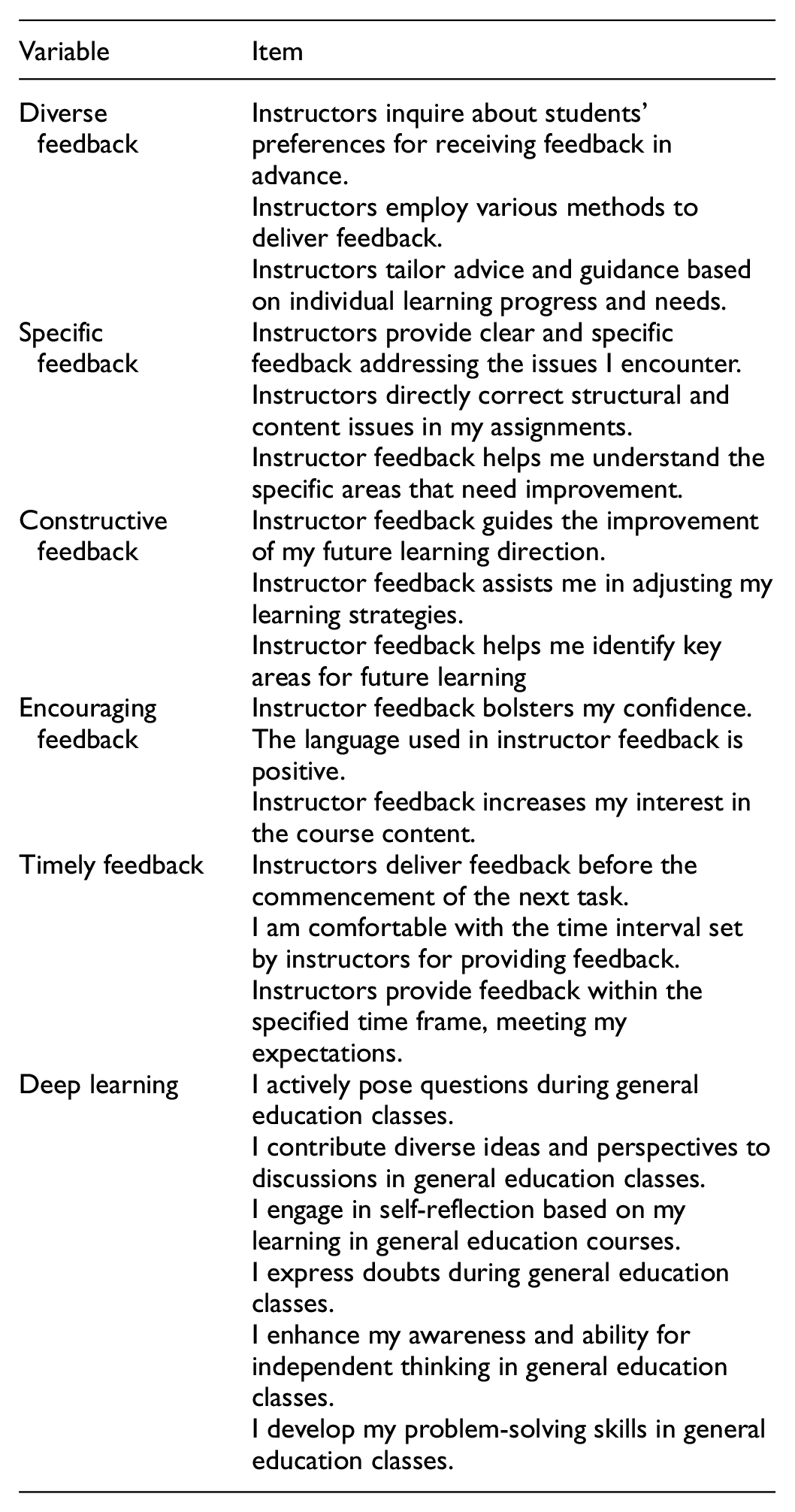
In the quantitative phase of our study, we distributed a self-administered online survey to students participating in general education courses, asking them to share their perceptions of the quality of faculty feedback within these courses. Guided by Ferguson’s (2011)“form-content-timing” framework, our investigation centered on five key attributes/qualities of effective feedback: form (diversity of feedback delivery), content (specificity, constructiveness, and encouragement), and timing (timeliness). Specifically, Diverse Feedback adapts to the individual needs of students and particular situations; Specific Feedback offers precise, issue-focused comments on students’ work; Constructive Feedback is designed to help students refine their learning strategies and directions; Encouraging Feedback motivates students through positive reinforcement; and Timely Feedback ensures that responses are immediate, aiding students in promptly correcting and comprehending the material. Each quality of feedback is essential to boost student engagement and improve learning outcomes. To assess students’ perceptions of feedback qualities, we employed a set of 15 statements specifically designed to capture their experiences with the feedback received in general education courses. Participants were instructed to indicate their level of agreement with each feedback quality statement using a 5-point Likert scale in a self-reported format, ranging from 1 (“strongly disagree”) to 5 (“strongly agree”). The reliability and validity of the questionnaire were satisfactory. The KMO test yielded a value of 0.747, with the factors explaining 57.33% of the total variance. Additionally, the Cronbach’s alpha coefficients for all factors were above .8.
Regarding the assessment of students’ deep learning, we primarily focused on students’ integration of knowledge and reflection on learning during the learning process. Sample items included statements like “I engage in self-reflection based on my learning in general education courses.” Participants were instructed to express their agreement with each statement through a self-reported 5-point Likert scale, ranging from 1 (“strongly disagree”) to 5 (“strongly agree”). The Cronbach’s alpha (α) for the deep learning scale is .90, indicating a high degree of reliability. Please refer to the Appendix for the complete list of scale items.
Data Collection
The quantitative phase of this research was facilitated through a collaborative effort involving the research team, the university’s Office of Academic Affairs, and faculty teaching general education courses during the spring semester of 2022. We chose to distribute the survey after the conclusion of the spring semester courses to comprehensively evaluate the teaching and learning outcomes throughout the semester. Following the end of the courses, the research team provided the finalized questionnaire to staff members from the Office of Academic Affairs, who then coordinated with course instructors from various courses. With the instructors’ approval, the staff members distributed the survey link in course group chats, inviting students to participate. An anonymous survey design was employed, and neutral language was used in the questionnaire to ensure participants felt free to express their personal opinions without being influenced by external expectations. This approach ensured a comprehensive and effective data collection process, yielding a total of 1,241 valid responses from the student body. The demographic breakdown of the respondents revealed a gender distribution of 448 male students (36.1%) and 793 female students (63.9%), closely mirroring the campus-wide gender ratio of approximately 3:7. This distribution underscores the representativeness of the sample in terms of gender demographics. In terms of academic standing, the sample comprised 588 freshmen (47.4%), 496 sophomores (40.0%), 134 juniors (10.8%), and 23 seniors (or above), accounting for 1.9% of the sample. The disciplinary composition of the sample included 298 students from the humanities (24.0%), 347 students from the social sciences (28.0%), and 596 students from science and engineering fields (48.0%).
Qualitative Phase of Research
In the qualitative phase of this study, semi-structured interviews were conducted with 20 college students who had previously participated in the survey phase. During the initial survey, students were given the option to volunteer for a subsequent interview, from which participants were chosen based on their willingness to engage further, ensuring a balanced representation of gender and academic disciplines within the interview cohort. The participants came from different academic backgrounds and grade levels to ensure that a diverse range of perspectives and experiences from students of various backgrounds were captured. Specifically, the sample included 10 males and 10 females; eight participants were first-year students, seven were second-year students, three were third-year students, and 2 were fourth-year students. In terms of academic disciplines, nine participants were from science and engineering, six were from social sciences, and five were from humanities.
Data Collection
The interviews primarily employed open-ended questions and were structured around two main themes: first, the students’ perceptions and evaluations of faculty feedback within general education classes; and second, their personal experiences and viewpoints on how such feedback influences their learning, either by facilitating or impeding it. Prior to conducting the formal interviews, a pilot session was carried out with one student to refine the interview protocol. This preliminary step ensured the questions were clearly articulated and capable of eliciting comprehensive responses for detailed analysis. Each interview was scheduled for approximately 30 min, during which conversations were audio-recorded with the consent of the participants to ensure no critical information was lost. Throughout the interview process, strict adherence to ethical guidelines was maintained to protect the privacy and rights of all participants. To minimize bias, all interviewers underwent comprehensive training to maintain neutrality during questioning and strictly followed the semi-structured interview protocol. The questions were carefully articulated, and clarifying prompts, such as “Could you provide more details about this experience?” were employed when participants’ responses lacked clarity. This qualitative inquiry aims to deepen the understanding of faculty feedback’s impact on student learning, supplementing the quantitative data with rich, contextual insights.
Data Analysis and Integration
In the analysis phase, a multiple regression technique was employed to scrutinize the relationship between various qualities of faculty feedback and the level of deep learning among college students. This quantitative analysis was further nuanced by comparing the multiple regression models across different gender groups and disciplinary background, allowing for a more detailed examination of how feedback influences learning outcomes within these subgroups.
Following the quantitative analysis, a thematic analysis was conducted on the interview data. This qualitative approach enabled the identification of recurring themes, which were instrumental in elucidating the “why” and “how” behind the statistical findings observed in the regression analysis. By integrating the qualitative themes with the quantitative results, we aimed to provide a comprehensive understanding of the nexus of faculty feedback quality and students’ deep learning.
Findings
Quantitative Results
Descriptive and Correlation Analysis
The results, detailed in Table 1, unveils association between college students’ perceptions of faculty feedback and deep learning within general education courses, as measured by Pearson correlation analysis.
Results of Descriptive Statistics and Correlation Analysis.

Notes. Using Pearson’s correlation to calculate the correlation coefficient.
p < .05. **p < .01. ***p < .001.
Students rated the specificity (4.40) and timeliness (4.27) of feedback highly. Conversely, feedback was perceived to be less diverse (3.99), constructive (4.08), and encouraging (4.07). Notably, correlation analyses underscore a nuanced landscape where specific and timely feedback share a less robust association with deep learning (correlations below 0.60), in stark contrast to the stronger correlations (above 0.70) observed for diverse, constructive, and encouraging feedback.
The Relationship Between Faculty Feedback Quality and Students’ Deep Learning
Table 2 extends our exploration through multiple regression analyses, incorporating controls for gender and academic discipline, to dissect the relationships between quality feedback and deep learning.
Regression Coefficients Examining the Relationship Between Faculty Feedback and Deep Learning Among Students in General Education Courses.
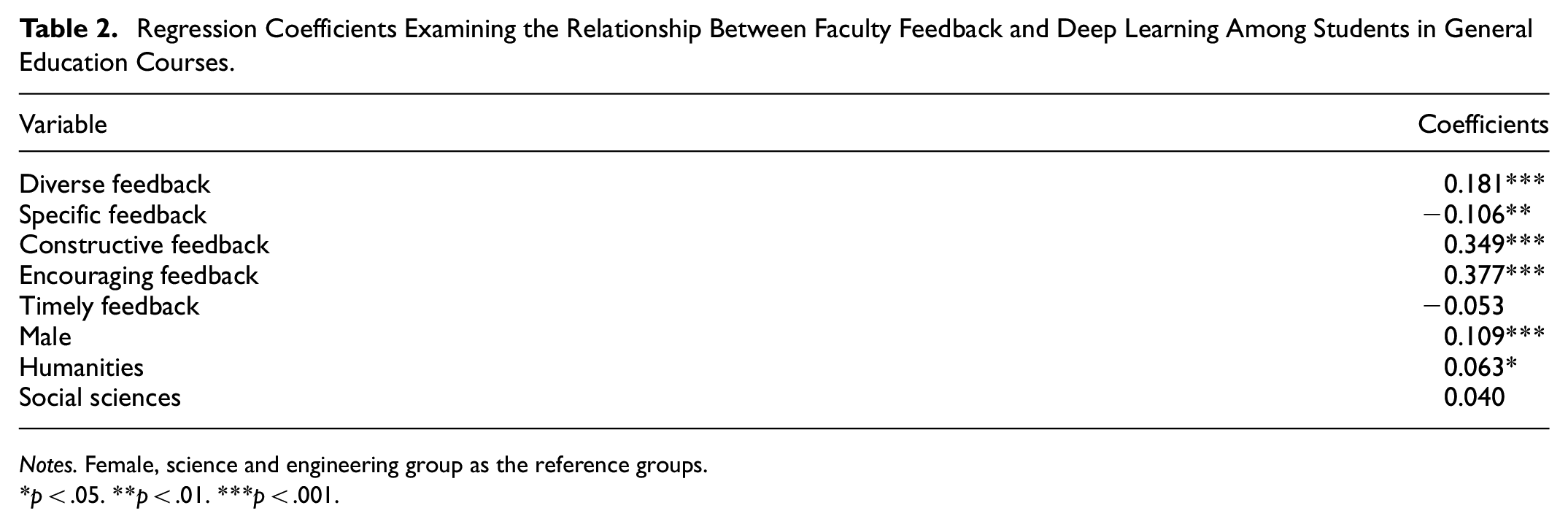
Notes. Female, science and engineering group as the reference groups.
p < .05. **p < .01. ***p < .001.
This analysis reveals that diverse, constructive, and encouraging feedback have positive correlations with deep learning among college students. Notably, encouraging and constructive feedback exhibit a more pronounced positive effect on deep learning than diverse feedback. Contrastingly, timely feedback did not show a significant relationship with deep learning. Moreover, specific feedback was found to be negatively associated with students’ engagement in deep learning within general education courses.
Gender and Disciplinary Differences in the Relationship Between Faculty Feedback and Deep Learning
Further nuanced by an investigation into gender and disciplinary differences (Tables 3 and 4), our study reveals that the beneficial effects of encouraging, constructive, and diverse feedback are broadly consistent across gender and field of study. However, specific feedback negatively influenced deep learning predominantly among female students. Additionally, timely feedback exhibited a significantly negative effect on the deep learning of social science students.
Regression Coefficients across Gender Groups.

Notes. Science and engineering as the reference group.
p < .05. **p < .01. ***p < .001.
Regression Coefficients Across Disciplinary Groups.
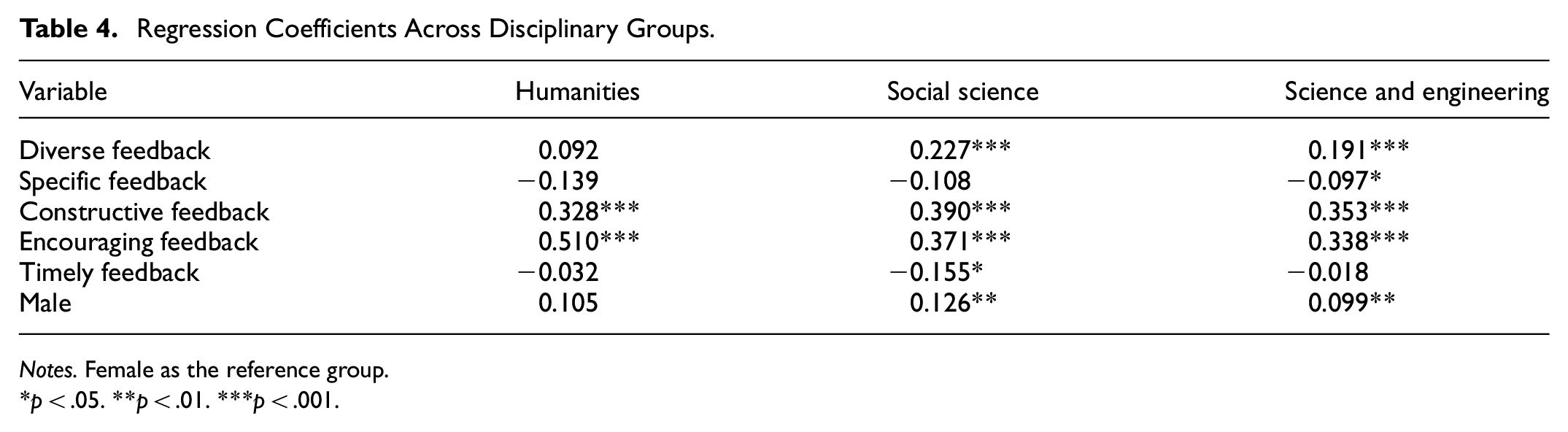
Notes. Female as the reference group.
p < .05. **p < .01. ***p < .001.
Qualitative Results
The qualitative component of our study shed light on the nuanced experiences of students with faculty feedback in general education courses. Through semi-structured interviews with 20 college students, we delved into their perceptions and the impact of such feedback on their deep learning experiences.
Encouraging Feedback Serves as a Catalyst for Deeper Approach of Learning
The quantitative results show that encouraging feedback promotes deep learning among college students, while the qualitative results provide a detailed explanation of how the feedback helps students achieve deep learning.
Interviewees highlighted the pivotal role of encouraging feedback in bolstering their self-confidence and intrinsic motivation, thereby facilitating deeper engagement with the learning material. A student majoring in computer engineering shared how positive acknowledgment from instructors, even in areas outside his primary field of study, significantly heightened his confidence and spurred a deeper exploration of subjects beyond the conventional curriculum.
The teacher’s commendation in class, even for subjects outside my major, significantly boosted my confidence and motivated me to delve deeper into the material beyond the coursework requirements. (Male, Computer Engineering)
This narrative was echoed by a student majoring in Chinese language and literature, who described how encouraging remarks on her assignments propelled her toward further intellectual inquiry and expression, especially in creative and analytical discussions of literary and cultural phenomena.
Whenever my teacher provides positive comments on my assignments, I feel incredibly empowered. This type of encouraging feedback not only acknowledges my efforts but also sparks my desire to further explore the topic and deepen my thinking. Especially when discussing literary works or cultural phenomena, such encouragement boosts my confidence in expressing my views. (Female, Chinese Language and Literature)
Constructive Feedback Drives Creative Application and Promotes Deep Learning
The quantitative results show that constructive feedback fosters deep learning among college students, and the interview data further supports this, providing specific examples of how constructive feedback helps students creatively apply knowledge from their major and engage deeply with their coursework in general education courses.
The interviews revealed that constructive feedback was essential for enabling students to apply knowledge from their major creatively and deeply engage with their coursework in general education courses. A student in an Introduction to Artificial Intelligence course remarked, I combined artificial intelligence with my major—psychology, and worked on a robot project that could participate in psychotherapy. The teacher always gave me a lot of feedback, helping me to optimize my ideas and learning strategies, and to innovate better in the project practice. (Female, Psychology)
This student’s experience highlights the pivotal role of faculty feedback in this process. This feedback did not merely point out areas for improvement but provided actionable advice that guided her through the iterative process of project development. It encouraged her to think critically about her work, challenge her assumptions, and explore new possibilities. This interaction not only helped her to optimize her project but also inspired her to push the boundaries of her knowledge and skills. Through this process, she was able to contribute novel insights to both fields and develop a project that had the potential to make a significant impact in the realm of psychotherapy.
Diverse Feedback Enhances Deep Learning by Increasing Accessibility and Comprehension
The quantitative results demonstrate that diverse feedback enhances students’ learning experience, and the interview data further supports this, illustrating how customized feedback, tailored to students’ learning styles and preferences, along with flexible feedback delivery methods, facilitates deeper understanding and application of the feedback.
The qualitative findings from our study underscore the significance of diverse feedback in enhancing the educational experience, especially when it is customized to match the unique learning styles and preferences of each student. This adaptability in feedback delivery methods is crucial for deepening students’ comprehension and facilitating the practical application of the insights gained from faculty feedback. A compelling illustration of this point comes from a student majoring in Electronic Information Science and Technology, who shared his experience with the feedback process for a final assignment: For our final assignment, the teacher sent us the electronic version after grading, allowing us to review it first. We could choose to communicate via email or meet in person afterward. I prefer face-to-face communication, so I scheduled a time to meet with her. This offline communication allowed me to understand the faculty’s feedback more efficiently and helped me better construct knowledge. (Male, Electronic Information Science and Technology)
The face-to-face dialogue facilitated a clearer, more nuanced comprehension of the feedback’s intent and content, enabling him to ask questions, seek clarifications, and engage in a constructive conversation about his work. This personalized interaction did not merely make the feedback more accessible; it transformed it into a dynamic learning tool, empowering him to integrate the feedback more effectively into his knowledge base and apply it to improve his work. By adopting a flexible approach to feedback delivery, educator ensured that feedback is not just communicated but truly heard and understood. This tailored approach fosters a more engaging and effective learning environment, where feedback becomes a catalyst for knowledge construction and deep learning.
Prioritizing the Quality of Feedback Over Timeliness Enhances Deep Learning
The quantitative data shows that timely feedback has no significant impact on students' deep learning, and the qualitative results support this, indicating that students value meaningful guidance more than the immediacy of feedback. Furthermore, in the social sciences, timely feedback even hinders students’ deep learning.
Students valued the quality of feedback over its immediacy, expressing a preference for detailed and constructive feedback that supports their learning, even if it requires a longer waiting period. This preference highlights a critical insight: students are seeking feedback that not only acknowledges their work promptly but also provides meaningful guidance and insight that can drive their learning forward. A student said, Sometimes it feels like the teacher hasn’t really gone through my assignment carefully and just tells me it’s good. I find that absolutely unhelpful. I would much prefer if the teacher would take some time to carefully review it and then provide me with some genuinely useful feedback. (Female, Education)
Her experience reflects a broader sentiment among students that superficial or generic feedback, even if delivered quickly, does not meet their educational needs or help them progress academically.
This preference is particularly pronounced among social sciences students, for whom deep analysis and critical thinking about complex concepts and theories are crucial, necessitating enough time for comprehension. This, to some extent, explains the quantitative result that “timely feedback shows a significant negative impact on deep learning only among social science students.” A Law student articulated her disappointment with timely feedback that, while expedient, often missed the mark in facilitating a deeper engagement with the material: I do appreciate receiving feedback on my case analysis assignments promptly, but often, it seems that the feedback only scratches the surface, like pointing out my insufficient understanding of a legal principle, while overlooking deeper aspects, such as how to apply these legal principles to complex legal situations to enhance my ability to solve real-world problems. (Female, Law)
Specific Feedback is Beneficial yet Potentially Restrictive in Facilitating Deep Learning
The quantitative results show that specific feedback can limit students’ deep learning, and the interview data further elaborates on this, particularly highlighting that female students tend to experience anxiety and stress when receiving feedback that focuses heavily on errors, which affects their engagement with the feedback content.
The nuanced nature of specific feedback emerged as a significant theme in our study, revealing a complex balance between its benefits and potential constraints on students’ learning processes. Specific feedback, characterized by detailed comments on particular aspects of students' work, plays an essential role in highlighting immediate areas for improvement. However, our findings suggest that while such feedback can be gratifying and helpful in the short term, it may also inadvertently limit opportunities for deeper learning and critical engagement with the material. A student majoring in education said, The teacher marked and corrected the errors in my paper, which made me happy. I just accepted all the revisions in Word. But I didn’t really think about why I made those mistakes or why they needed to be corrected this way. (Male, Audiology and Speech-Language Pathology)
Additionally, our analysis indicates variations in how different gender groups respond to specific feedback that emphasizes errors, underscoring the heterogeneity of faculty feedback’s impact on deep learning among college students. Female students, in particular, reported feeling stressed and anxious when receiving feedback focused heavily on errors, impacting their engagement with the feedback content. A female student said, When I see my assignment full of corrections made by the teacher, my first reaction is wondering how I could have written it so poorly, which leads to some stress and anxiety. (Female, Philosophy)
These qualitative insights complement the quantitative findings, offering a deeper understanding of how different qualities of faculty feedback influence students’ deep learning. Encouraging and constructive feedback emerged as significant enhancers of deep learning, highlighting the importance of feedback that affirms students’ efforts and guides them toward higher-level thinking and problem-solving. The diversity in feedback modalities and the emphasis on feedback quality over immediacy further underscore the complex dynamics of effective feedback in promoting deep learning.
Discussion
In the discussion of this study, we delve into the relationship of faculty feedback and students’ deep learning in general education. This involves not only focusing on how faculty feedback affects the depth of students’ learning but also exploring the nuances and complexities of this relationship, including how the quality of feedback can either facilitate or hinder students’ deep learning. This encourages instructors of general education courses to reevaluate their feedback strategies, particularly focusing on how feedback is structured to foster deep learning.
Beyond Grades: the Transformative Power of Encouraging, Constructive, and Diverse Feedback in Fostering Deep Learning
In the dialogue surrounding educational feedback, Winstone and Boud (2022) contend that its essence lies not in the justification of grades but in providing forward-looking insights that facilitate students’ developmental progress, emphasizing the necessity to cultivate strategies that preserve feedback’s educational utility. This should be particularly the case for feedback in general education courses. General education places greater emphasis on cultivating students’ lifelong competencies, including critical thinking, problem-solving abilities, cross-cultural understanding, ethical judgment, and a commitment to lifelong learning. These skills are indispensable for navigating both professional careers and personal lives successfully. To fulfill these objectives, faculty feedback must evolve beyond simple grade assessments, focusing instead on bolstering student competency development and fostering an enduring pursuit of knowledge.
Addressing our primary research question, our results affirm the instrumental role of encouraging, constructive, and diverse feedback in promoting deep learning, resonating with Price et al. (2010) who initially underscored feedback’s developmental capacity beyond mere grade clarification. Henderson et al. (2019) remarked on the motivational power of positive feedback over brief critiques, challenging the view held by some scholars, like Hattie and Timperley (2007), who question the utility of praise in feedback due to its limited directive content for improvement. Nonetheless, our findings illuminate the motivational significance of positive feedback in prompting students to engage more deeply in general education courses. Students electing general education courses often come from disciplines outside the course’s focus, and they may feel unfamiliar or unconfident with the content of general education courses. Encouraging feedback, which validates students’ efforts and accomplishments, can ignite their curiosity in novel subjects, thereby motivating them to delve deeper and engage in learning.
The connection between constructive feedback and deep learning, as highlighted in our study, aligns with the findings of Alvarez et al. (2012), who observed that teachers’ clear guidance and actionable suggestions significantly boost students’ ability to generate ideas and engage in deeper discussions. Echoing Hattie and Timperley (2007) and Henderson et al. (2019), it's evident that students benefit from receiving feedback that not only critiques but also constructively guides improvement for future tasks. Our research further corroborates the value of constructive feedback in fostering intellectual engagement and providing a structure for creative problem-solving and learning enhancement. For students electing general education courses, constructive feedback can help them integrate classroom knowledge with their major-specific knowledge, thereby fostering interdisciplinary thinking and the development of innovative capabilities.
Furthermore, our research highlights the critical importance of feedback diversity, specifically tailored to meet the unique learning styles and preferences of each student, in significantly enhancing their comprehension and practical application of feedback. This discovery underscores the necessity for employing a spectrum of feedback format to address the diverse requirements of the student population effectively. The concept of diverse feedback, as outlined by Sequeira et al. (2024), and its crucial role in making feedback more understandable, thereby deepening the learning experience, is consistent with our findings. This approach not only aids in the clearer transmission of feedback but also enriches the overall deep learning process.
Optimizing Timeliness and Specificity in Feedback Practices to Enhance Deep Learning
Contrary to existing research that champions the effectiveness of timely feedback, such as the findings of Bienstock et al. (2007), our study uncovers that timely feedback does not significantly influence deep learning within general education contexts. General education aims to develop students’ broad abilities, not just the mastery of specific disciplinary knowledge. Overly timely feedback may lead students to focus excessively on short-term grades rather than long-term development. Echoing Ferguson’s (2011) insights, while students appreciate timely feedback, they exhibit a readiness to wait for more comprehensive and constructive feedback, underscoring the superiority of feedback quality over speed, particularly in environments aiming to foster deep learning. Timely feedback often emphasizes quick task completion, which may not align well with the goals of general education, where deep learning is prioritized. Deep learning requires critical thinking, sustained reflection, and the integration of knowledge over time. In the context of general education, rapid feedback can limit the time students need to engage deeply with complex, interdisciplinary problems, leading them to focus more on immediate corrections rather than long-term developmental goals. In contrast, constructive and delayed feedback allows students more time to reflect, absorb the material, and connect it to broader learning objectives. This approach better supports the goals of general education, fostering the internalization of knowledge and promoting long-term academic growth.
Our study also delves into the nuanced effects of overly specific feedback on students' engagement in deep learning, affirming Mahfoodh’s (2017) caution against the exhaustive identification of errors in early drafts to prevent negative emotional impacts. A study indicates that while a segment of students found tailored feedback to be highly beneficial, enhancing their learning experience, others derived value from more generalized comments (Dawson et al., 2019). This emphasis on detail may inadvertently shift focus away from broader improvement strategies, potentially stifling the developmental aspect of feedback (Knight & Yorke, 2003). This insight underscores the need for a balanced feedback approach that prioritizes structural and general guidance in initial feedback phases. Such an approach allows for a focus on overarching issues that can significantly impact learning outcomes. Detailed critiques can then be progressively introduced in later drafts, reducing the likelihood of overwhelming students and fostering more meaningful engagement with the feedback process. General education courses are structured to enhance students’ overarching abilities rather than concentrating on the specialized knowledge or intricacies of a specific discipline. Thus, applying this approach within general education courses serves to alleviate potential negative emotional responses while simultaneously encouraging a deeper and effective engagement with learning.
Considering Gender and Disciplinary Context
For our second research question, the study also highlights gender and disciplinary differences in feedback reception and its impact on deep learning. Drawing parallels with Dowden et al. (2013), we observe that emotional reactions to specific feedback, influenced by gender differences, impact feedback perception and effectiveness in deep learning. This insight underlines the importance of considering emotional responses in feedback strategies to enhance their effectiveness for female students. Female students tend to be more sensitive to specific feedback, particularly critical feedback, which may be perceived as a challenge to their abilities (Ocampo et al., 2023). This interpretation can trigger anxiety and a decline in self-efficacy, thereby hindering deep learning. Additionally, female students often have higher expectations of their teachers and societal norms, and the focus on areas for improvement in specific feedback may amplify their negative self-perceptions, further diminishing their motivation to learn. These gender differences highlight the importance of tailoring feedback strategies to gender, ensuring that all students derive maximum benefit from feedback, especially in promoting deep learning and enhancing motivation.
Our findings reveal that timely feedback has a significant negative impact on deep learning among social science students, while no such effect is observed for students in the humanities or STEM disciplines. This difference can be attributed to the distinct characteristics and learning needs of these disciplines. Social science courses emphasize critical thinking, multi-perspective analysis, and extended reflection—processes that require substantial time for students to synthesize information and form nuanced insights. Timely feedback, which is often task-focused, may interrupt this reflective process by shifting students’ attention to immediate task completion, thereby hindering deep learning. In contrast, humanities students often prioritize creative expression and subjective interpretation, viewing feedback as supplementary rather than directive. Consequently, timely feedback neither significantly enhances nor detracts from their deep learning process. For STEM students, timely feedback aligns more naturally with the skills-based nature of their disciplines, facilitating error correction and improving problem-solving efficiency. However, this type of feedback primarily supports task completion rather than promoting the reflective processes associated with deep learning.
Conclusion and Implications
In this research, we delved into the relationship between the quality of faculty feedback and college students’ deep approach to learning, especially within the realm of general education. Our results reveal that encouraging, constructive, and diverse feedback significantly bolsters deep learning. This stands in contrast to the neutral impact of timely feedback and the negative effect of overly specific feedback. Additionally, our analysis includes variations across different genders and academic disciplines. This study augments our comprehension of the crucial role that faculty feedback plays in facilitating college students’ deep approaches to learning. By underscoring the efficacy of varied feedback qualities, this research provides invaluable guidance for educators seeking to enhance their feedback practices in general education settings. Concurrently, there is a clear need for improving faculty feedback literacy, ensuring that instructors are not only equipped to offer effective feedback but also possess a profound understanding of the learning processes unique to each student. This, in turn, is essential for fostering students’ deep approaches to learning.
Curriculum designers should integrate structured feedback mechanisms within general education curricula to foster deep learning, customizing feedback to meet diverse student needs and considering elements such as delivery modes and timeliness to maximize effectiveness. First, instructors should prioritize and utilize encouraging feedback. When students provide partially incorrect answers in class, instructors can begin by acknowledging their effort and thought process, then gently point out the issues and offer suggestions for improvement. This type of encouraging feedback allows students to feel recognized, helping them maintain a positive attitude and motivation toward learning, ultimately fostering deep learning. Second, instructors should provide constructive feedback more frequently. By delving into students’ classroom responses and performance, instructors can offer additional resources or insights, guiding students to think more deeply and analyze problems more thoroughly. This approach helps students broaden their knowledge base and develop critical thinking skills. Third, instructors should adopt diverse feedback methods. Innovating feedback formats through various channels—such as combining online and offline feedback, in-class and out-of-class feedback, as well as one-on-one and group feedback—can provide personalized guidance tailored to individual learning needs. This variety ensures students' diverse preferences are addressed, thereby enhancing their academic performance. Fourth, instructors should use specific feedback judiciously. When suggesting revisions, instructors can provide directional rather than exhaustive recommendations. It is crucial to leave room for students to reflect, encouraging cognitive conflict and guiding them to discover answers independently. This process not only promotes self-directed learning but also strengthens deep learning.
Educational institutions must invest in ongoing professional development programs focused on enhancing faculty feedback literacy, and cultivate a culture that prioritizes high-quality feedback as a critical component of teaching excellence. Universities are encouraged to organize regular faculty training sessions. Through case-based teaching, these sessions can help educators understand how gender and disciplinary differences influence the reception of feedback. At the start of the semester, instructors can use surveys or classroom discussions to understand students’ feedback preferences and adjust the format and content of their feedback accordingly to meet the diverse needs of students. For example, to tailor faculty feedback strategies for different gender groups, feedback should be personalized according to their emotional and motivational needs. Considering the emotional fluctuations of female students, efforts should be made to minimize the feedback pressure on them.
Limitations and Future Directions
This study has several limitations. First, the sample was drawn from a public research university in eastern China, and the specific cultural context of Chinese education may have shaped students’ perceptions and responses to faculty feedback. For example, the strong emphasis on authority in Chinese educational culture may lead students to be more receptive to positive and constructive feedback, while making them more sensitive to overly detailed or critical feedback, which could be perceived as undermining their self-esteem or authority. Consequently, the findings of this study are likely most applicable to educational systems and cultural contexts similar to that of China. The generalizability of these results to other cultural settings, however, requires further validation. Second, the study relied on self-reported data, which is inherently subject to memory bias and subjectivity. This limitation may hinder a comprehensive representation of the objective effects of faculty feedback on students’ actual learning behaviors and outcomes.
Future research should aim to broaden the scope of the sample by including students from diverse regions, cultural backgrounds, and educational systems. This would help determine whether the influence of faculty feedback on deep learning approaches is universally applicable. Moreover, cross-cultural comparative studies are recommended to explore how cultural factors shape students’ perceptions and utilization of feedback. Combining self-reported data with objective measures, such as academic performance and classroom participation records, would also enhance the comprehensiveness of evaluations regarding the impact of faculty feedback. Additionally, longitudinal studies could provide valuable insights by tracking the long-term effects of feedback on students’ learning behaviors and attitudes, offering more robust evidence for the effectiveness of faculty feedback.
Footnotes
Appendix
| Variable | Item |
|---|---|
| Diverse feedback | Instructors inquire about students’ preferences for receiving feedback in advance. |
| Instructors employ various methods to deliver feedback. | |
| Instructors tailor advice and guidance based on individual learning progress and needs. | |
| Specific feedback | Instructors provide clear and specific feedback addressing the issues I encounter. |
| Instructors directly correct structural and content issues in my assignments. | |
| Instructor feedback helps me understand the specific areas that need improvement. | |
| Constructive feedback | Instructor feedback guides the improvement of my future learning direction. |
| Instructor feedback assists me in adjusting my learning strategies. | |
| Instructor feedback helps me identify key areas for future learning | |
| Encouraging feedback | Instructor feedback bolsters my confidence. |
| The language used in instructor feedback is positive. | |
| Instructor feedback increases my interest in the course content. | |
| Timely feedback | Instructors deliver feedback before the commencement of the next task. |
| I am comfortable with the time interval set by instructors for providing feedback. | |
| Instructors provide feedback within the specified time frame, meeting my expectations. | |
| Deep learning | I actively pose questions during general education classes. |
| I contribute diverse ideas and perspectives to discussions in general education classes. | |
| I engage in self-reflection based on my learning in general education courses. | |
| I express doubts during general education classes. | |
| I enhance my awareness and ability for independent thinking in general education classes. | |
| I develop my problem-solving skills in general education classes. |

Funding
The author(s) disclosed receipt of the following financial support for the research, authorship, and/or publication of this article: This research is supported by the Fundamental Research Funds for the Central Universities (Project ID: 1243100016).
Declaration of Conflicting Interests
The author(s) declared no potential conflicts of interest with respect to the research, authorship, and/or publication of this article.
Data Availability Statement
Data sharing not applicable to this article as no datasets were generated or analyzed during the current study.