



Abstract
Introduction: Higher quality relationships are vital to promoting safe behavior in the workplace. However, research on how workplace bullying affects safe behavior remains scarce. To explore this relationship, the concepts of team psychological safety and benevolent leadership were introduced. Method: Drawing on the self-regulatory resource theory, this study explores the relationships among workplace bullying, safety compliance, and safety participation, and further examines the mediating role of team psychological safety and the moderating influence of benevolent leadership. This research involved 800 employees from petroleum enterprises, with data collected via a two-stage random sampling method. Results: The results showed that: (a) Workplace bullying had significantly negative correlations with employees’ safety behavior. (b) Team psychological safety played a mediating role between workplace bullying and employees’ safety behavior. (c) Benevolent leadership could play a moderating role in the second half of the mediating effect between workplace bullying and safety behavior. Conclusions: Workplace bullying is a negative form of interpersonal interaction that reduces employees’ safety behavior by diminishing team psychological safety. Benevolent leadership has a significant impact on safe behavior, and should be a key factor in promoting safe behavior. Practical Applications: This study is an extension of research on employee safety behavior from a self-regulatory resource theory perspective. Moreover, it offers practical guidance on how to promote employees’ safety behavior, namely resisting workplace bullying, selecting and nurturing benevolent leaders, and actively fostering team psychological safety.
Plain Language Summary
(1) The study reveals the negative relationship between workplace bullying and safety behaviors. (2) Research on the antecedents of safety behavior is extended, with a particular focus on the mediating effect of team psychological safety. (3) The study shows that benevolent leadership is capable of moderating the indirect effect of team psychological safety on safety behavior.
Keywords
Key points
What is already known about this topic:
Workplace bullying negatively affects job engagement, job satisfaction, and organizational citizenship behavior.
There are many antecedents that influence employee safety behaviors, such as leadership style, leadership behaviors.
Employees with high psychological safety are able to demonstrate more organizational citizenship behavior.
What this topic adds:
The study reveals the negative relationship between workplace bullying and safety behaviors.
Research on the antecedents of safety behavior is extended, with a particular focus on the mediating effect of team psychological safety.
The study shows that benevolent leadership is capable of moderating the indirect effect of team psychological safety on safety behavior.
Introduction
In recent years, a growing number of firms have recognized the significance of human capital and the safety and well-being of their employees. Although economic and technological advances over the past few decades have greatly improved safety standards in the workplace (Guo et al., 2016; Hallowell et al., 2013), safety incidents still occur in high-risk industries such as petrochemical companies. Due to the special characteristics of these industries, the consequences of such accidents can be particularly severe, leading to incalculable losses (X. L. Zhang, 2019). Based on the latest statistics from the Ministry of Emergency Management of the People’s Republic of China, in 2021, there were 34,600 industrial accidents nationwide, which results in more than 26,300 deaths. The statistical table of safety production casualty accidents in the petroleum industry indicates that, among the 30 casualty accidents occurring in the petroleum sector from 2008 to 2017, unsafe behaviors of employees were the primary cause of these incidents. Considering that these figures highlight the urgent need to reduce industrial accidents and their significant impact on businesses and employees, it is essential to improve employees’ safety behaviors and overall safety performance. This study seeks to investigate the factors influencing employees’ safety behavior and the underlying mechanisms that govern these behaviors. By providing a deeper understanding of the dynamics at play, the research seeks to offer a scientific foundation for developing strategies that can improve employees’ safety behavior, lower the rate of job-related injuries, and ultimately achieve better safety results. Such insights are vital for informing the creation of more effective safety policies and practices within high-risk industries.
Indeed, it had been argued that numerous antecedents could influence employees’ safety behaviors, including organizational, personal, technological, environmental, and social factors, of which interpersonal relationships are an important component (Walumbwa & Schaubroeck, 2009; D. Wang et al., 2021; D. Wang et al., 2022; D. Wang, Mao et al., 2023). Specifically, workplace bullying refers to a negative form of interpersonal interaction that is prevalent in contemporary businesses, with an incidence of nearly 23% (Gilbert et al., 2022), and broad detrimental consequences, such as insomnia and depression (Rossiter et al., 2018; Vedaa et al., 2016). Workplace bullying is characterized by repeated and sustained hostile behaviors, including insults, intimidation, threats, or punishment, which are perceived by employees and usually involve an imbalance of power and status (S. Einarsen et al., 2009). Studies have shown that workplace bullying adversely affects job engagement, job satisfaction, employees’ well-being, employees’ vocal behavior, physical health, and organizational citizenship behavior (Hayat & Afshari, 2021; Liang, 2021; Mercado, 2023; Park & Ono, 2017; Vukelic et al., 2019). In the petroleum industry, the team-based work mode requires a high degree of collaboration among members, and bullying behaviors can destroy team trust, lead to poor information communication, and thereby increase the risk of accidents (Du et al., 2017). Therefore, the relationship between workplace bullying and safety behavior is explored in this study.
In this study, the authors introduce team psychological safety, to elucidate the relationship between workplace bullying and safety compliance and participation. Team psychological safety is defined as the shared belief that team members can express their true selves and ideas freely within the organization without fear of negative consequences to their personal status, image, or career development (Edmondson, 1999). Employees who experience high levels of psychological safety tend to possess more adequate psychological resources, which are crucial for coping with various events, including safety incidents, and for adhering to safety rules and regulations (Hobfoll & Freedy, 2017). Research has indicated that workplace bullying can diminish psychological safety, particularly among nurses (Mercado, 2023), leading employees to become less willing to comply with organizational safety regulations and engage in safe practices. Therefore, this study aims to explore the mediating role of team psychological safety in the relationship between workplace bullying and employees’ safety behaviors.
Apart from focusing on the psychological safety of the team, this study also explored the moderated role of benevolent leadership. Benevolent leadership is characterized by the attention of leader on the individual, holistic, and long-term and personal well-being of employees (Farh & Cheng, 2000). This leadership style can not only offer a safe psychological environment, but also be helpful to additional task resources, and support, which leads to improved job performance (Bedi 2020), organizational commitment, innovative behavior (R. P. Zhang et al., 2013), and safety behavior (D. Wang, Sun et al., 2023). Studies available have shown that employees who perceive their leaders as kind and caring are more likely to adopt a positive and tolerant evaluation of low team psychological safety, thereby reducing its negative impact. In this context, benevolent leadership can offset part of the adverse effects of low team psychological safety on safety compliance and participation (X. Y. Li & Shen, 2019). Based on this, this study examines the moderating effect of benevolent leadership. In a word, the purposes of this study are: Firstly, to explore the relationship between workplace bullying and employees’ safety behavior. Secondly, to examine whether and how team psychological safety mediates between workplace bullying and safety behavior. Lastly, to discuss the moderating effect of benevolent leadership.
The main research questions of the study are as follows:
Firstly, what relationship exists between workplace bullying and employees’ safety behaviors?
Secondly, what role does team psychological safety play in the relationship between workplace bullying and safety behaviors?
Thirdly, how does benevolent leadership moderate the impact of workplace bullying on safety behaviors?
Theory and Hypothesis
Workplace Bullying and Safety Behaviors
Safety behavior encompasses employees’ adherence to safety operating procedures, their involvement in various safety activities, and their proactive efforts to enhance safety production. This concept comprises two key components: safety compliance and safety participation (Neal & Griffin, 2006). Safety compliance refers to employees complying with organization’s safety policies and procedures. Safety participation means that employees can spontaneously take some behaviors conducive to the safety of the enterprise at work, including helping colleagues, participating in safety meetings, and taking the initiative to improve safety in the workplace. These two components represent distinct organizational safety goals (Pilbeam et al., 2016). While safety compliance ensures that employees adhere to the organization’s safety standards, safety participation reflects a deeper commitment to fostering a safe working environment (D. Wang, Mao et al., 2023). High-risk sectors like petrochemicals, manufacturing, healthcare, and aviation emphasize safety compliance to prevent severe accidents involving casualties, property loss, or environmental harm (Asante & Novak, 2024; Kvalheim & Dahl, 2016). In contrast, service industries depend on human judgment and adaptability, prioritizing safety participation to respond effectively to dynamic and unexpected situations (Wei et al., 2016; N. Zhang et al., 2021).
As a critical factor influencing social and economic development and the long-term sustainability of enterprises, employees’ safety behavior is significantly affected by interpersonal relationships, including group cohesion and group pressure (Liu et al., 2022). High-quality interpersonal relationships are essential for enhancing safety, whereas poor interpersonal relationships can diminish employees’ willingness to comply with corporate safety regulations (Walumbwa & Schaubroeck, 2009). As a negative interpersonal relationship in the workplace, it is widely believed that workplace bullying is a negative phenomenon that damages the physical and mental health of employees and hinders the healthy development of enterprises (Hoel & Cooper, 2000).
Based on the self-regulation resource theory, individuals use self-regulation resources to manage and control their behaviors (Baumeister et al., 1998). In the absence of these resources, individuals struggle to regulate their behaviors effectively, making it even more challenging to perform actions expected by the organization (Kao et al., 2016). However, workplace bullying is a powerful source of negative stress for employees. The negative emotions and feelings could threaten the resources employees are trying to protect and compel them to consume their cognitive resources to resist this threat (Hobfoll, 1989). The psychological pressure resulting from workplace bullying can deplete employees’ self-regulation resources. With depleted resources, employees find it difficult to navigate the complex external environment and handle dangerous events in the workplace, leading to a reduction in their compliance with safety norms (F. Li et al., 2013). Additionally, the lack of resources can diminish employees’ initiative to create a safe working environment, thereby reducing their safety participation behaviors (Cohen & Abedallah, 2015). Based on this, the following hypotheses are proposed:
The Mediating Role of Team Psychological Safety
In organizations, mutual respect and trust among team members positively influence psychological safety, while poor interpersonal relationships can diminish employees’ sense of psychological safety (Edmondson, 1999; Walumbwa & Schaubroeck, 2009). Previous research has shown that workplace bullying can reduce nurses’ psychological safety (Mercado, 2023). Therefore, workplace bullying may reduce team psychological safety. When employees experience bullying, they may become unwilling to express their authentic selves in order to protect themselves. Additionally, according to social identity theory, individuals form their self-concept by categorizing themselves into a group and identifying with the characteristics of that group (Tajfel & Turner, 1986). When employees experience or witness workplace bullying, their sense of value and belonging decreases, leading to negative perceptions of their role and status within the team. In turn, undermines their trust and support for the team, resulting in lower team psychological safety (Tajfel & Turner, 1986).
Team psychological safety reflects employees’ experiences of organizational support, role clarity, and the freedom to express opinions, representing their subjective perceptions of the organizational environment (Brown & Leigh, 1996). During organizational change, psychological safety can alleviate employees’ concerns and doubts, fostering positive perceptions (Schein & Bennis, 1965), and it has a positive effect on employees’ innovative and voice behaviors (Rong et al., 2022). High psychological safety indicates that team members possess abundant psychological resources, which are crucial when employees face various challenges (Hobfoll & Freedy, 2017). Based on the theory of self-regulatory resources, employees in teams with high psychological safety have a higher ceiling for self-regulatory resources, allowing them to have surplus resources to address safety issues in the workplace and maintain adherence to safety regulations to some extent (Leroy et al., 2012). Moreover, high psychological safety encourages employees to actively contribute to creating a safer work environment (Liu et al., 2020). In contrast, low team psychological safety leads to a lack of self-regulatory resources, resulting in negative attitudes toward compliance with safety regulations and participation in safety behaviors (Chen et al., 2013). Hence, we propose Hypotheses 2 and 3:
The Moderating Role of Benevolent Leadership
Based on the Leader-Member Exchange (LMX) theory, leadership styles could affect the qualities of exchange relationships, thereby exerting distinct influences on individual behavior (Dulebohn et al., 2012). Specifically, with the presence of positive leadership types, such as benevolent leadership, the negative impact of low team psychological safety on safety behavior may be buffered. Benevolent leaders not only focus on work-related interactions with employees but also demonstrate lasting concern for their lives, thus could extend their care for employees beyond the workplace and treating them as family members. These behaviors foster loyalty among employees and meet their expectations of leaders (Farh & Cheng, 2000). Indeed, research shows that benevolent leadership can enhance subordinates’ job satisfaction, increase their trust in leaders, and subsequently elevate their organizational commitment and identification (Ötken & Cenkci, 2012). Out of recognition or gratitude toward the leader, employees will enhance their behaviors conducive to the workplace or maintain these behaviors despite other influencing factors, thus mitigating the negative impact of low team psychological safety on safety behavior (T. Wang et al., 2017). Furthermore, based on cognitive appraisal Theory, individuals adjust their self-cognition and behavior by interpreting the external environment to ultimately achieve consistency with it (Bandura, 1986). Employees can influence their evaluation of events by assessing their importance and shaping their understanding of them, and this evaluation determines the impact of the events on the employees (Lazarus & Folkman, 1984). Benevolent leaders, characterized by kindness, and tolerance, shorten the distance between themselves and employees (Y. Xu et al., 2017). Employees not only experience the leader’s care but also perceive good interpersonal relationships. Under the influence of such leadership, employees adopt a more tolerant and positive attitude toward the setbacks they encounter, viewing difficulties as surmountable (Lin et al., 2017). Therefore, with the care of benevolent leaders, employees confront low levels of team psychological safety with a relatively positive attitude, weakening its negative effects (Lin et al., 2017). Meanwhile, in communicating with employees, benevolent leaders establish emotional bonds with them (Colquitt et al., 2007), enhancing employees’ organizational identification and loyalty. This identification and loyalty are not only exhibited toward the leader but also the organization’s rules and regulations (Colquitt et al., 2007). With greater recognition of regulations, employees will go to great lengths to abide by them, thereby reducing the influence of low team psychological safety on safety compliance. Additionally, after perceiving the leader’s benevolence and care, employees develop a sense of gratitude, which aligns with the norm of reciprocity proposed in benevolent leadership (Farh & Cheng, 2000). The gratitude motive prompts employees to engage in organization-benefiting behaviors, such as organizational citizenship behavior, voice behavior, and safety behavior (T. Wang et al., 2017). Therefore, when team psychological safety is low, the gratitude induced by benevolent leadership may prevent employees from reducing their contributions to the creation of a safe work environment. Conversely, in the absence of leadership care, employees under low benevolent leadership experience more negative impacts stemming from low team psychological safety (Lazarus & Folkman, 1984).
To sum up, Hypothesis 4 is proposed. The theoretical model is shown in Figure 1.
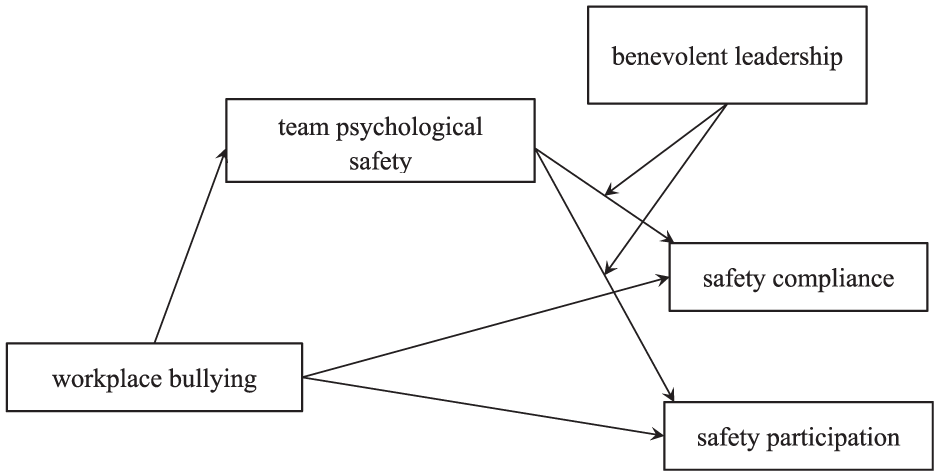
Theoretical model.
Methods
Participants
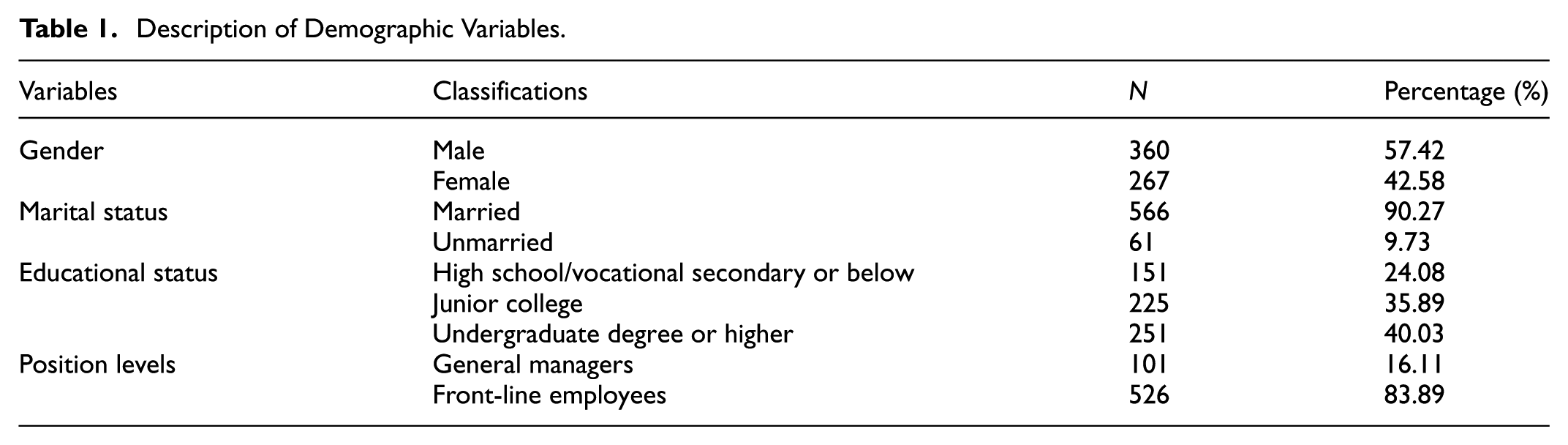
Using convenient sampling, questionnaires were distributed to an oil and petrochemical company in Shandong Province, with a total of 800 employees participating in the survey. After exclusion of invalid surveys due to short completion time and duplicate responses from participants, we received 627 valid surveys, representing a 78.36% response rate. The average age of the 627 employees was 37.36 years (SD = 7.48), with an average work tenure of 14.76 years (SD = 8.26). The average department size was 29.67 individuals (SD = 16.49), ranging from 1 to 59 people per department. In this study, employees were required to meet the following criteria: belonging to a specific department or team; having a direct supervisor within the same team or department; and having a unified work location for the team or department, with stable communication among members. Additional detailed information was presented in Table 1.
Description of Demographic Variables.
Experimental Procedure
Data collection was conducted online via the Credamo platform at two different time points. Information on workplace bullying and benevolent leadership was gathered in May 2024, while data on safety behavior and team psychological safety were collected 1 month later, in June 2024. The questionnaires were distributed by the experimenter to department heads (who had undergone training by professional psychological personnel). The department heads assigned unique identifiers to the questionnaires before distributing them to members within their departments. After completion, the questionnaires were collected by the department heads. One month later, participants filled out a second set of questionnaires using their unique identifiers to ensure data matching and anonymity. Upon completion of all questionnaires, they were submitted by the department heads to the experimenter. All procedures adhered to the ethical standards of the Academic Committee of Shandong Normal University, and the Helsinki Declaration of 1964. Before the administration of the questionnaires, informed consent was obtained from both leaders and employees. The confidentiality of all subject data was maintained with the utmost rigor, and participants were at liberty to withdraw at any time.
Measures
The Negative Acts Questionnaire-Revised (NAQ-R)
The 22 items developed by S. Einarsen et al. (2009) and translated by Xun et al. (2012) measure workplace bullying, with three dimensions: personal-related bullying, work-related bullying, and physical threats and intimidation, such as “You are ignored, excluded, or isolated by others.” A 5-point Likert scale was used for all items, ranging from 1 (never) to 5 (every day). Higher scores indicate higher levels of perceived workplace bullying by employees. The scale demonstrated a high level of reliability (e.g., α coefficient of .964).
Safety Behavior Scale
The 11 items developed by Neal and Griffin (2006) and revised by Ye et al. (2014) measure safety behavior, which is divided into two dimensions: safety compliance and safety participation, such as “I strictly abide by safety regulations and rules at work.” For all items, a 7-point Likert scale was utilized, ranging from 1 (strongly disagree) to 7 (strongly agree). The higher the score, the more safety behaviors employees have performed. The scales assessing safety behavior, safety compliance, and safety participation demonstrated internal consistency, with Cronbach’s alpha values of .957, .966, and .928 respectively.
Benevolent Leadership Scale
The five items developed by X. Fu et al. (2012) were used to measure benevolent leadership, such as “His/her care for me extends to my family.” The 5-point Likert scale, ranging from 1 for “strongly disagree” to 5 for “strongly agree,” was used for all items. As the scores increased, so did the level of benevolent leadership perceived by the employees. The reliability of the scale, which was measured by Cronbach’s alpha, was .962.
Team Psychological Safety Scale
The seven items developed by Edmondson (1999) and translated by Yang and Zhang (2012) measure the team psychological safety, such as “It is safe to take risks in this team.” Each item was scored on a 5-point Likert scale, which varied from 1 (strongly disagree) to 5 (strongly agree). Employees perceived a higher level of team psychological safety as the score rose. The Cronbach’s α was .866.
Data Analysis
In this study, SPSS was used in conjunction with Mplus to analyze the data collected.
Prior to testing the hypotheses, we examined the assumptions for regression analysis. Multicollinearity was assessed by calculating the Variance Inflation Factor (VIF) values for all predictor variables. The maximum VIF was 1.345, well below the common threshold of 5 (House, 1985), indicating that multicollinearity was not a concern.
Results
Common Method Deviation
The Harman single-factor test result showed that seven common factors had eigenvalues greater than 1, and the variance explained by the first factor was 35.44%. Given that the explanatory power fell below the 40% critical threshold (Xiong et al., 2012), our findings suggested the absence of significant common method bias in the study.
Confirmatory Factor Analysis
We conducted confirmatory factor analysis using Mplus 8.3 to assess whether good discriminant validity existed among the variables. The results were shown in Table 2. The five-factor model assumed in this study demonstrated good fit validity (χ2/df = 6.29, p < .001, RMSEA = 0.09, CFI = 0.83, TLI = 0.82, SRMR = 0.06), indicating good discriminant validity among the variables studied.
Results of Confirmatory Factor Analysis for Discriminant Validity of Variables.

Note. A = Workplace Bullying; B = Benevolent Leadership; C = Team Psychological Safety; D = Safety Compliance; E = Safety Participation.
Correlation Analysis
The results were shown in Table 3. A significant negative correlation was identified between workplace bullying and benevolent leadership (r = −.19, p < .01), team psychological safety (r = −.36, p < .01), safety compliance (r = −.29, p < .01), and safety participation (r = −.22, p < .01). Hypotheses 1a and 1b were supported. Team psychological safety is significantly and positively associated with benevolent leadership (r = .42, p < .01). Furthermore, team psychological safety was positively correlated with safety compliance (r = .44, p < .01) and safety participation (r = .38, p < .01). Benevolent leadership also showed significant positive correlations with safety compliance (r = .32, p < .01) and safety participation (r = .33, p < .01), partially confirming Hypotheses 2 and 3.
Descriptive Statistics and Correlation Analysis.

Note. *p < .05. **p < .01.
Hypothesis Testing
With the help of bootstrap method proposed by Hayes (2013), we conducted a moderated mediation analysis, with employees’ safety behavior as the dependent variable, workplace bullying as the independent variable, team psychological safety as the mediator, benevolent leadership as the moderator, and age and position as control variables. The results were shown in Tables 4 to 7.
Mediation Effect Test of Team Psychological Safety Between Workplace Bullying and Safety Compliance.

Note. *p < .05. **p < .01. ***p < .001.
Mediation Effect Test of Team Psychological Safety Between Workplace Bullying and Safety Participation.
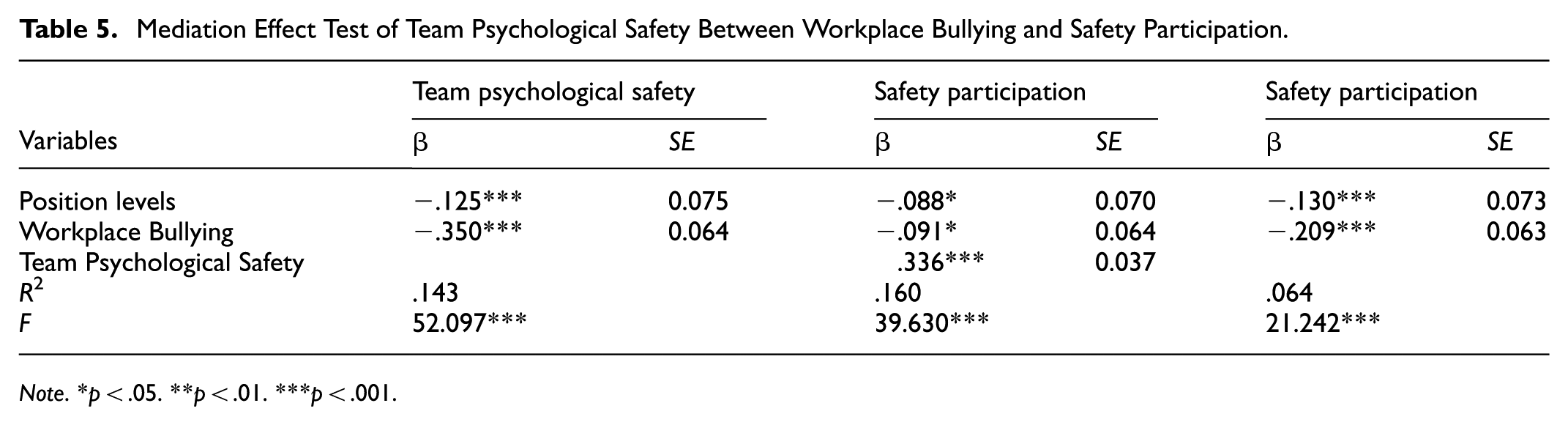
Note. *p < .05. **p < .01. ***p < .001.
Results of Total, Direct, and Indirect Effects of Workplace Bullying on Employee Safety Compliance.

Analysis Results of Total, Direct, and Indirect Effects of Workplace Bullying on Employee Safety Participation.

After controlling for age and position, workplace bullying had a significant negative predictive effect on employees’ safety compliance, supporting Hypothesis 1a. After controlling for position, workplace bullying significantly and negatively predicted employees’ safety participation, confirming Hypothesis 1b. The confidence interval for the mediating role of team psychological safety, at the 95% confidence level, was [−0.239, −0.121], excluding zero. This finding suggested that team psychological safety was a significant mediator between workplace bullying and safety compliance (β = −.175, SE = 0.030, 95% CI = [−0.239, −0.121]) (see Tables 4 and 6). The overall effect (0.345) was comprised of a direct effect (0.170), accounting for 49.275%, and a mediation effect (0.175), contributing 50.725%, which confirmed Hypothesis 2 (see Table 6). Regarding the impact of workplace bullying on employees’ safety participation, the 95% confidence interval for the mediation effect of team psychological safety was [−0.269, −0.131], which did not include zero, indicating that team psychological safety significantly mediated the relationship between workplace bullying and safety participation (β = −.191, SE = 0.035, 95% CI = [−0.269, −0.131]; see Tables 5 and 7). The total effect (0.339) consisted of a direct effect (0.148) of 43.658% and a mediation effect (0.191) of 56.342%, confirming Hypothesis 3 (see Table 7).
The results were shown in Table 8. There was a significant negative effect of the interaction term between team psychological safety and benevolent leadership on safety compliance. (β = −.150, p < .001). To further analyze this interaction, a simple effect analysis was conducted. In this study, we added and subtracted one standard deviation from the mean of benevolent leadership to represent “low benevolent leadership” and “high benevolent leadership.” A simple effect analysis plot was then generated, with the results presented in Figure 2.
Test of Moderated Mediation Effect.
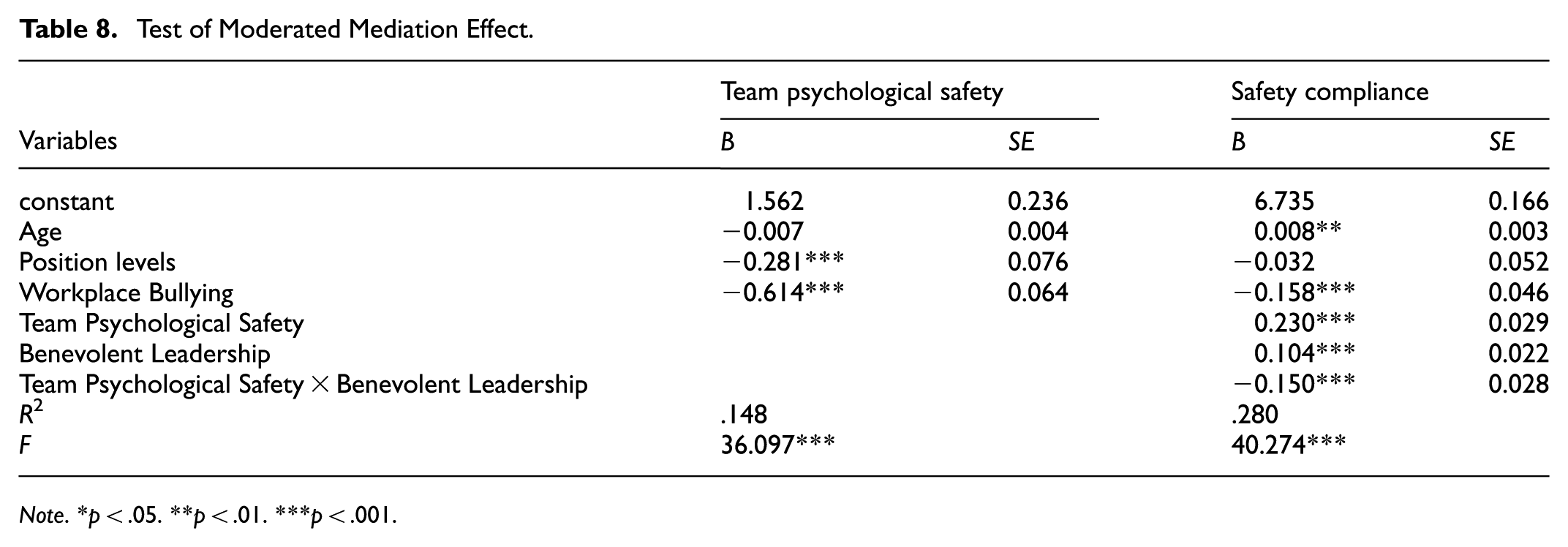
Note. *p < .05. **p < .01. ***p < .001.

The moderating effect of benevolent leadership on the relationship between workplace bullying and safety compliance.
The results demonstrated that benevolent leadership significantly moderated the relationship between team psychological safety and safety compliance (βlow = −.226, SE = 0.043, 95% CI = [−0.321, −0.154]; βhigh = −.056, SE = 0.023, 95% CI = [−0.103, −0.013]). The moderated mediation effect was significant (Index = 0.092, SE = 0.025, 95% CI = [0.052, 0.148]). Furthermore, a statistical discrepancy in the indirect effects of the high and low benevolent leadership groups was identified (β = .170, SE = 0.046, 95% CI = [0.096, 0.273]), confirming Hypothesis 4.
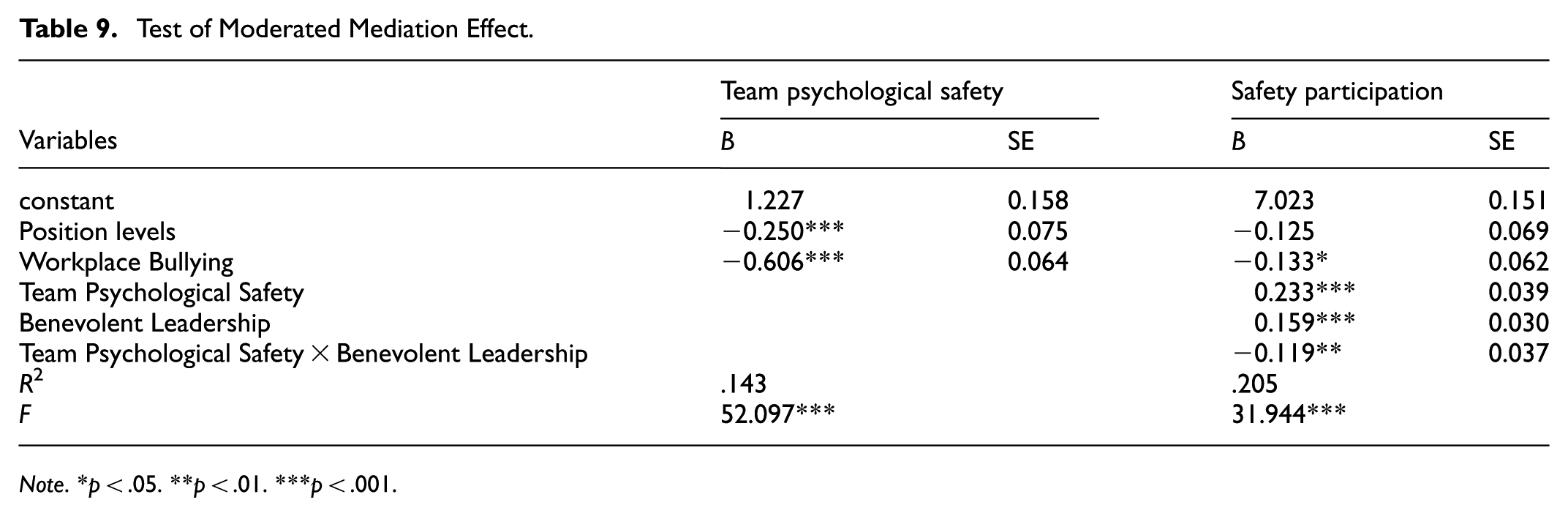
The results were shown in Table 9. The interaction term between team psychological safety and benevolent leadership had a significant negative impact on safety participation (β = −.119, p < .001). To delve deeper into this interaction, a simple effect analysis was conducted. The mean of benevolent leadership was subtracted and added to 1 standard deviation in order to represent the concept of “low benevolent leadership” and “high benevolent leadership” respectively. A simple effect analysis plot was then generated, with the results depicted in Figure 3.
Test of Moderated Mediation Effect.
Note. *p < .05. **p < .01. ***p < .001.

Moderating effect of benevolent leadership on the relationship between workplace bullying and safety participation.
The results indicated that a substantial moderating influence was demonstrated by benevolent leadership on the relationship between team psychological safety and safety behavior (βlow = −.208, SE = 0.045, 95% CI = [−0.309, −0.130]; βhigh = −.074, SE = 0.030, 95% CI = [−0.138, −0.018]). The moderated mediation effect was significant (Index = 0.072, SE = 0.027, 95% CI = [0.026, 0.132]). Furthermore, a statistical discrepancy in the indirect effects of the high and low benevolent leadership groups was identified (β = .133, SE = 0.050, 95% CI = [0.049, 0.244]), confirming Hypothesis 4.
Discussion
Theoretical Implications
First, the relationship between workplace bullying and safety behavior among petroleum enterprises’ employees was examined. The findings indicate that workplace bullying has a detrimental effect on employees’ safety behavior. Specifically, workplace bullying could negatively influence safety compliance and participation, thus supporting Hypothesis 1a and 1b. This finding is consistent with previous research showing that employees who suffer from workplace bullying exhibit reduced organizational beneficial behaviors (Cohen & Abedallah, 2015). From the perspective of self-regulation resource theory, this study provides evidence for the negative effects of workplace bullying on employees’ safety behaviors. Workplace bullying is a powerful negative stressor. Employees who experience workplace bullying will have negative emotions (e.g., depression and anxiety) and greater pressure (Bambi et al., 2014; Presti et al., 2019). Under the circumstances, more self-regulation resources need to be expended by employees to regulate their negative emotions and cognition. As employees experience more prolonged and severe workplace bullying, their self-regulation resources are depleted more quickly (Hewett et al., 2018). Therefore, the lack of self-regulation resources will make it difficult for employees to cope with the complex environment and dangerous events in the workplace, resulting in wrong safety concepts and attitudes (Pousette et al., 2008). At the same time, employees may exhibit more unsafe behaviors (Hobfoll & Shirom, 2001), such as reducing compliance with safety norms (F. Li et al., 2013) and behaviors to maintain workplace safety (Cohen & Abedallah, 2015). Our findings supplement the existing research literature on the impact of workplace bullying on employees’ safety behavior and provide new empirical support for self-regulation resource theory.
Second, this study found team psychological safety could play a mediating role in the process of workplace bullying influencing employees’ safety compliance and safety participation, thus supporting Hypotheses 2 and 3. This finding is consistent with previous research showing that high-quality team members’ relationships can positively influence team psychological safety (Edmondson, 1999). This study is consistent with social identity theory, which posits that individuals form self-concepts by categorizing themselves and identifying with group characteristics (Tajfel & Turner, 1986). On the one hand, employees who suffer from workplace bullying view themselves as replaceable and worthless, which makes them more likely to experience emotional alienation from their teams and organizations (Caputo, 2018). On the other hand, they believe that they are in an inferior position in the team, weakening their internal status perception (J. T. Fu & Wang, 2019) and reducing their sense of team identity and belonging. Therefore, employees who suffer from workplace bullying worry about their jobs and career development, which reduces team psychological safety. Meanwhile, this finding is consistent with previous research that psychological safety can positively influence employees’ innovative and voice behavior. When employees have low team psychological safety, there is a lack of mutual respect and trust among team members, and employees are unwilling to freely express their ideas in the team for fear of being punished by the team (Edmondson, 1999). In such circumstances, employees are unable to perceive the favorable organizational climate that pervades the team (Brown & Leigh, 1996), as well as the numerous supportive resources provided by the organization, colleagues, and so forth. Consequently, employees who experience lower levels of team psychological safety display reduced psychological resources (Hobfoll & Freedy, 2017) and engage in fewer behaviors that are beneficial to the organization. For instance, they are less able to cope with safety issues in the work environment, less inclined to comply with company rules and regulations, and less likely to engage in safety behavior on their initiative. Our findings not only enhance and complement the behavioral consequences of workplace bullying but also expand the research on antecedent variables of safety behavior and bridge the gap between previous studies.
Third, benevolent leadership could moderate the latter part of the mediation effect between workplace bullying and safety behavior, thus supporting Hypothesis 4. This study also supports cognitive appraisal theory, which states that individuals continuously evaluate events around them based on the likelihood of events’ potential impact on them. This assessment leads to the individual’s emotional and behavioral tendencies in response to events (Oreg et al., 2018). Benevolent leadership can take care of employees and keep their face up (Farh & Cheng, 2000). When there is highly benevolent leadership in the team, this kind of leadership can help employees in life and work, such as providing resources (Q. Xu et al., 2018), giving tolerance and trust (Y. Xu et al., 2017; Zhou et al., 2020), giving respect and encouragement (Luu, 2019), which can create a kind of caring and trusting organizational culture. Employees with low team psychological safety perceive team members, leaders, and so on as trustworthy. Therefore, they tend to view various frustrating events as challenges and perceive them as less threatening to themselves. In this case, employees are more likely to regard themselves as part of the organization, and employees’ sense of belonging and identity with the organization increases. They are more likely to engage in behaviors that benefit the organization, such as voice behavior, safety behavior, and so on. Empirical studies have demonstrated that benevolent leadership promotes psychological safety (J. Y. Duan, 2012), which contributes to more organizational citizenship behaviors, such as safety behavior (T. Wang et al., 2017). Furthermore, by selecting benevolent leadership as a moderating variable, this study clarifies the boundary conditions under which workplace bullying affects safety behavior and provides a new perspective for future research on benevolent leadership. At the same time, the concept of “benevolence” of benevolent leadership is closely related to Chinese Confucian culture. It is of unique cultural value to explore the impact of this concept on employee behavior in a Chinese organizational environment that has long been imbued with Confucian culture.
Practical Implications
First, workplace bullying was negatively correlated with employees’ safety behavior. Therefore, preventing and reducing workplace bullying will be an effective means of improving employees’ safety behavior. This study offers practical guidance for organizations to prevent and reduce workplace bullying. Organizations can increase employees’ awareness and perception of workplace bullying by offering anti-bullying lectures and conflict prevention and management courses (Mikkelsen et al., 2011), thereby improving their proactive coping abilities and self-regulation skills when confronting workplace bullying. Organizations can develop incentive policies that encourage witnesses to promptly report workplace bullying they observe to supervisors, as well as to perform specific helping behaviors (K. Einarsen et al., 2020).
Second, team psychological safety could serve as a mediating factor between workplace bullying and employees’ safety behavior. This finding reminds organizations that in addition to preventing and reducing workplace bullying in the ways described above, it is important to focus on the positive effects of team psychological safety. Team leaders can show employees enough respect, care, and trust, encouraging them to communicate directly and speak freely when issues arise. This not only resolves problems promptly but also fosters harmonious interpersonal relationships. Organizations can increase team-building activities and conduct regular team games (Parker & du Plooy, 2021) to enhance intimacy and mutual understanding among team members, thereby fostering a positive organizational climate.
Lastly, organizations can incorporate the well-established Benevolent Leadership Scale into their selection criteria when selecting leaders, and select managers with benevolent leadership styles. At the same time, organizations should integrate the cultivation of benevolent leadership into their development plans. Specifically, training on basic leadership skills and competencies can be strengthened through relevant courses, such as those on empathy and individualized care. These courses educate leaders on how to provide appropriate and timely care for employees and enhance their empathy (Y. Xu, 2015). Consequently, employees perceive the care, attention, and assistance provided by their leaders in their professional lives, which in turn encourages them to engage in safer behavior.
Limitations and Future Direction
First, data for the study were gathered at two different time points, thus preventing a comprehensive elucidation of causal relationships. To improve the causal explanation of variables, future research could use longitudinal studies or experience sampling.
Second, the data utilized in the study were derived exclusively from state-owned petrochemical enterprises, which is a high-risk industry. The insufficient representativeness of the sample may compromise the external validity of the findings. Future research could expand the scope of sample sources to enhance the external validity of the study.
Finally, the mediating role of team psychological safety and the moderating role of benevolent leadership, in particular, were examined in this study as boundary conditions influencing the relationship between workplace bullying and safe behavior. Team psychological safety in this study emphasizes individuals’ perceptions of the team safety climate. Future research could consider team psychological safety as a team-level variable, focusing on team members’ shared perceptions of team safety climate. Further research is needed to verify whether there are additional potential mediating mechanisms and moderating variables in the pathway from workplace bullying to safe behavior.
Conclusions
This study found that workplace bullying was negatively correlated with employees’ safety behavior; team psychological safety could play a mediating role between workplace bullying and employees’ safety behavior; benevolent leadership could play a moderating role in the second half of the mediating effect between workplace bullying and safety behavior.
Footnotes

Ethical Considerations
The study was approved by the ethics standards of the Academic Board of Shandong Normal University and the Declaration of Helsinki in 1964.
Consent to Participate
Informed consent was obtained from both leaders and employees. The confidentiality of all subject data was maintained with the utmost rigor, and participants were at liberty to withdraw at any time.
Funding
The authors disclosed receipt of the following financial support for the research, authorship, and/or publication of this article: This study was supported by General Project of Shandong Provincial Natural Science Fund of China: The effects of implicit emotion regulation on decision-making and its neural mechanisms (grant no. ZR2022MC037).
Declaration of Conflicting Interests
The authors declared no potential conflicts of interest with respect to the research, authorship, and/or publication of this article.
Data Availability Statement
The data that support the findings of this study are available from the corresponding author upon reasonable request.