




Abstract
This study aimed to identify the factors influencing the occupational retention of nurses in their 20s and 30s in South Korea. This descriptive cross-sectional study was conducted using data from the fifth Korean Working Conditions Survey (KWCS) conducted in 2017. Participants comprised 485 registered nurses in their 20s and 30s. Descriptive analysis and logistic regression analyses were conducted. Nurses’ occupational retention rate was low when working long hours, working quickly, standing for long periods, and if exposed to physical and verbal abuse. Nurses’ occupational retention rate was high when education or interventions in work-related health and safety were provided. To increase occupational retention, optimal work hours should be assigned, working speed should be adjusted, physical and verbal abuse should be prevented, and various forms of health and safety education should be provided. Regulations and intervention programs that improve nurses’ work environments should also be provided.
Introduction
The healthcare environment is experiencing rapid changes due to advancements in medical technology and devices, as well as the diversification of diseases and medical demands. These stressors are universal including in South Korea. Environmental changes require specialized nursing care, which certainly demands a stable supply and retention of nursing personnel. However, the working environment for nurses in South Korea, entailing long work hours without paid overtime and a hierarchical organizational culture, has resulted in high turnover and resignation rates amongst nurses (Seo et al., 2020).
Nurse turnover can be defined as leaving the profession and/or leaving the organization (Yamaguchi et al., 2016). The average turnover rate of South Korean nurses was 15.2% in 2020 (Ministry of Health and Welfare, 2022a), which was higher than that of the US (14.0%), Japan (10.9%), and the UK (8.2%; Takase et al., 2016). High turnover and resignation rates among nurses result in financial losses, lowered employee morale, weakened team performance, and poor management skills. Price and Mueller (1981) found that there are personal and working environmental factors as determinants of turnover. Therefore, in this study, the factors influencing nurses’ occupational retention were identified as personal characteristics and working environment characteristics.
Long work hours are typical of working conditions in Korea, but are not unique to this country. Demands for change have been increasing as labor productivity and individual work–life balance have become increasingly important. Hence, since July 2018, amendments to the Labor Standards Act have reduced legal working hours from 68 to 52 hours per week (Labor Standards Act, 2019). Applying the new 52-hour legislation to hospital nurses first requires sufficient nursing staff, but it is difficult to reduce nurses’ working hours due to the burden of labor costs and the difficulty in establishing a pool of skilled nurses due to the large number of unemployed nurses and rapid changes in the medical environment. Shift work has also been reported to have a significant impact on the turnover of nurses; part-time work is being implemented as an option in other countries. In the Germany, part-time nurses constitute 40% of the total workforce (Hwang & Kim, 2014). Japan also has a flexible work system that requires nurses to work 6 hours per day until their children are 3 years old (Ministry of Employment and Labor, 2013).
Nurses must work under high pressure without making errors, but overworked nurses tend to become distracted even during important tasks, leading to mistakes or misjudgments. This, in addition to physical and psychological stress and exhaustion, are the most common reasons for resignation among nurses (Cao et al., 2021). Moreover, nurses not only have to communicate and cooperate within a team, but also with diverse multidisciplinary teams to provide integrated medical services and nursing care. However, nurses often encounter obstacles during such processes, which ultimately affects their occupational retention rate. Nurses have the highest level of stress among healthcare professionals (Vizheh et al., 2020). Additionally, an increasing number of healthcare professionals are vulnerable to verbal and physical violence from patients and families, while nurses are particularly vulnerable to verbal abuse amongst themselves. According to a study of nurses in the South Korea, 74.3% had experienced verbal abuse (Chang et al., 2019). Taking care of health and stress relief are therefore crucial, but overworking and long work hours make it difficult for nurses to take care of themselves.
Nurses’ occupational retention is maintained when they stop looking for other jobs or wish to remain in the same job, and occupational satisfaction tends to increase with increased occupational retention (Sellers et al., 2019). Poor working conditions and various other obstacles reduce nurses’ job satisfaction and cause them to leave. Although the number of nursing graduates in South Korea in 2019 was 40.5 per 100,000 population, higher than the OECD average of 31.9, the number of working clinical nurses in 2020 was 7.9 per 1,000 population, an OECD average of 9.4, which is significantly lower than Germany (13.9), Australia (12.2), Japan (11.8), and the UK (8.; Ministry of Health and Welfare, 2022b). In a survey on the status of hospital nursing staff placement, the nurse turnover rate in 2019 was 15.2% on average; in particular, the resignation rate of newly graduated nurses was 44.5% (Hospital Nurses Association, 2020). The turnover rate of nurses in their 20s and 30s was 1.56 and 1.22 times higher, respectively, than that of nurses in their 40s (Lee et al., 2022).
High turnover or resignation rates among nurses in their 20s and 30s in South Korea negatively affect the stable supply of nursing staff, quality of nursing care, and patients’ satisfaction with nursing care, which may lower the long-term occupational value of nursing (Seo et al., 2020). Therefore, increasing nurses’ occupational retention rate will positively influence nurses and patients and the medical environment. Previous research on nurse turnover in South Korea lacked studies that included the overall working environment characteristics and various individual characteristics of nurses (Lee & Kang, 2018; Seo et al., 2020). In addition, there are few studies that have confirmed the influencing factors targeting nurses in their 20s and 30s who have the highest turnover rate. To fill this gap, we used the working conditions survey that targets the working population of various ages in diverse regions countrywide. This study aims to analyze the working conditions of nurses in their 20s and 30s in South Korea and to examine related factors so as to provide basic materials that may contribute to improving nurses’ working environments.
The study aims are as follows:
Identifying subjects’ personal characteristics and working environment characteristics;
Identifying differences in occupational retention according to personal characteristics and working environment characteristics; and
Identifying factors influencing occupational retention.
Materials and Methods
Study Design and Setting
Korean nurses must graduate from a department of nursing science at colleges or universities and acquire a nursing license through the national nursing examination. The number of licensed nurses in South Korea is 391,493 in 2020, of which 106,396 are inactive nurses, accounting for 27.2% of all nurses. The number of acting nurse per 1,000 population is 7.9, and they care an average of 96.6 outpatients and 22.6 inpatients per day, and the average working hours per week is 37.0 hours (Korean Nurses Association, 2022). This descriptive cross-sectional study aims to identify the factors influencing the occupational retention of nurses in their 20s and 30s in South Korea by performing a secondary analysis of raw data obtained from the fifth Korean Working Conditions Survey (KWCS) of 2017.
Sampling and Data Collection
This study was based on data obtained from the fifth Korean Working Conditions Survey (Korea Occupational Safety and Health Agency, 2018). The KWCS is a national survey project started in 2006 by the Korea Occupational Safety and Health Agency. It was designed to investigate the working environments of employed people across the country to determine the level of exposure to risk factors by occupation and employment type. It was developed by benchmarking the European Working Conditions Surveys and Labor Force Surveys. It was reported that it has the strength to understand workers’ personal factors and working environment factors in detail, and has high reliability and validity (Kim, 2016).
The fifth KWCS is nationally approved statistics by the Statistics Korea (approval number 38002), and a professional interviewer visited the sample households and conducted a 1:1 individual interview. About 130 items such as employee characteristics, labor intensity, stress, emotional labor, violence/discrimination, health status, and exposure to risk factors were surveyed for each occupational category. The survey was conducted from July 11 to November 17, 2017. As of July 1, 2017, the 50,000 employed (including workers, business owners, and self-employed) aged 15 years or over living in South Korea were targeted, with respondents selected by extracting through stratified two-stage cluster sampling in a complex sample design (Korea Occupational Safety and Health Agency, 2018).
Among the total of 50,205 participants who responded to the fifth KWCS, 494 were nurses. Among the 494 nurses, 3 participants over the age of 40 years and 6 participants who are employers with different working conditions from employees, the self-employed, and those on temporary leave were excluded, resulting in 485 nurses aged 20 to 39 years who were selected as the final sample.
Ethical Considerations
The study was approved by the Institutional Review Board (IRB no. 2019-0095) of the researchers’ university. Ethical issues, including plagiarism, misconduct, data fabrication and/or falsification, double publication and/or submission, and redundancy, have been monitored by the authors. Although this study’s data were de-identified through secondary data analysis, it was reviewed by the IRB.
Instruments
Personal Characteristics
Subjects’ personal characteristics included gender, age, educational level, co-residence with a spouse, and perceived health status. For perceived health status, “How is your overall health?” was used. Subjects who answered “Very bad” or “Bad” were classified as in poor health, while those who answered “Average,”“Good,” or “Very good” were classified as in good health.
Working Environment Characteristics
Working environment characteristics were divided into working conditions and working environment risk factors. For working conditions, weekly work hours and working speed were included. Work hours, excluding meal breaks, were classified into “40 hours or less per week,” or “more than 41 hours per week” based on the Labor Standards Act. The legal work hours in South Korea are 8 hours per day and 40 hours per week (Labor Standards Act, 2019). Hence, working more than the legal number of hours is considered overtime work by the operational definition. For working speed, “To what extent do you work very fast?” was used. Subjects who answered “Not at all,”“Seldom,” and “1/4 of work hours” were classified as “Not fast,” and those who answered “1/2 of work hours,”“3/4 of work hours,”“Most of work hours,” and “All the time” were classified as “Fast.”
For the risk factors of the working environment, the degree of physical and psychological risk, provision of health and safety information, and experience of physical and verbal abuse were included. For physical risk, “For how long do you have to stand during your work hours?” was used. Answers were rated on a Likert scale from 1 = “Not at all” to 7 = “During the entire work hours,” and classified into more or less than half of the work hours.
For psychological risk, “To what extent do you have to deal with angry clients during your work hours?” was used. Answers were rated on a Likert scale from 1 = “Not at all” to 7 = “During the entire work hours,” and classified into more or less than half of the work hours. Furthermore, “How well are you provided with information on health and safety risks related to your work?” was used. Answers were classified into “Not well” if respondents answered “Not well at all” or “Not well,” and into “Well” if they answered “Fairly well” or “Very well.” For physical and verbal abuse, “Have you been abused in the past month while working?” was used. The choices were binary “Yes/No” answers.
Occupational Retention
Occupational Job retention was measured by “Do you think you will be in the same job or a similar job at the age of 60?”. This question did not ask subjects if they were willing to stay in the same job, but rather if they thought that they would have the physical and psychological capabilities to stay in the same job or whether external factors might hinder them from retaining the same job. The choices were binary “Yes/No” answers.
Data Analysis
The data were analyzed using IBM© SPSS© Statistics version 25 (IBM© Corp., Armonk, NY, USA). Subjects’ general and working environment characteristics were analyzed using descriptive statistics. A logistic regression analysis was performed, and odds ratio and 95% confidence interval were calculated to identify the factors influencing occupational retention. The sample design of the working condition survey was conducted in two steps, where the surveyed district was stratified for primary data extraction, and the household or household members were extracted secondarily in a stratified two-stage cluster sampling method. Weighted values were applied when analyzing the raw data since this method is commonly used to increase the accuracy of sampling survey results (Korea Occupational Safety and Health Agency, 2018).
Results
Subjects’ General Characteristics
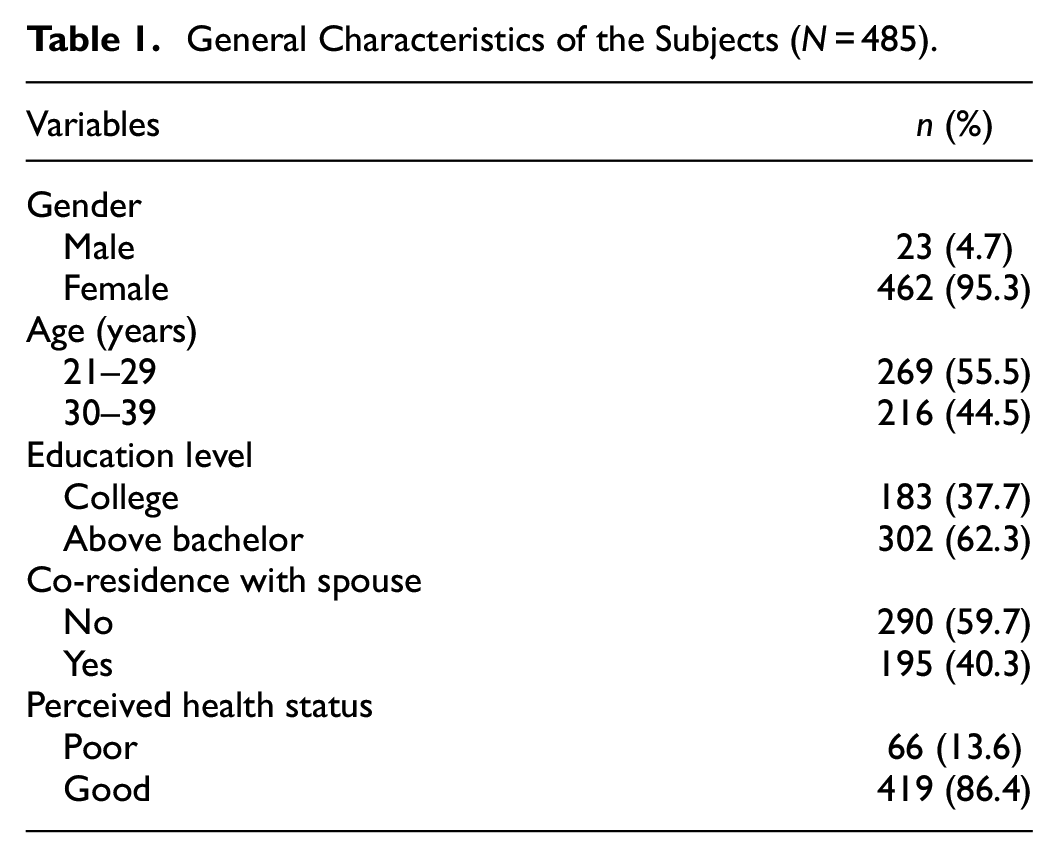
For general characteristics, 95.3% of the subjects were female and 55.5% were aged between 21 and 29 years. For education level, most (62.3%) had a bachelor’s degree. For marital or residence status, 59.7% were either single or did not live with a spouse. Finally, 86.4% had good perceived health status (Table 1).
General Characteristics of the Subjects (N = 485).
Subjects’ Working Environment Characteristics
Regarding working environment characteristics, 50.5% worked more than 41 hours per week. Regarding working speed, 45.8% were “Not fast,” while 54.2% were “Fast.” For working environment risk factors, 73.2% reported standing for more than half of their work hours (a physical risk), while 23.0% reported being exposed to angry customers for more than half of their work hours (a psychological risk). A total of 85.8% said that they have received health and safety information, while 8.2% experienced physical and verbal abuse (Table 2).
Working Environment Characteristics of the Subjects (N = 485).

Factors Influencing Occupational Retention
A multivariate logistic regression analysis was conducted to identify factors influencing occupational retention (Table 3). Variables with statistical significance comprised weekly work hours, working speed, standing position with physical risk, provision of health and safety information, and physical and verbal abuse. The subjects who worked more than 41 hours per week had 55.4% lower odds of occupational retention than those who worked 40 hours or less (adjusted OR = 0.446, 95% CI [0.298, 0.667], p < .001). The subjects with a fast working speed had 50.9% lower odds of occupational retention than those who did not (adjusted OR = 0.491, 95% CI [0.329, 0.731], p < .001). The subjects who stood for more than half of their work hours had 37.1% lower odds of occupational retention than those who did not (adjusted OR = 0.629, 95% CI [0.402, 0.982], p = .042). The subjects who received health and safety information had 2.168 times higher odds of occupational retention than those who did not (adjusted OR = 2.168, 95% CI [1.236, 3.802], p = .007). The subjects who experienced physical and verbal abuse had 83.5% lower odds of occupational retention than those who did not (adjusted OR = 0.165, 95% CI [0.070, 0.385], p < .001). No other variables were shown to be significant influencing factors during regression analysis.
Factors Influencing Occupational Retention (N = 485).

Discussion
This study examined the working environment of nurses in their 20s and 30s in South Korea to identify factors influencing their occupational retention. The results demonstrated that personal characteristics, including gender, age, educational level, co-residence with a spouse, and perceived health status, made no significant difference in occupational retention. However, a previous study (Jackson et al., 2007) reported that other personal characteristics, such as psychological resilience and stress management, affect nurses’ occupational retention; hence, future studies should examine psychological characteristics and desires rather than socioeconomic characteristics.
Working environment is closely related to nurses’ discontinuation of work, thus affecting patient safety (Wei et al., 2018). Subjects who worked more than 41 hours per week were more unlikely to continue working in the same job than those who worked less than 40 hours per week. Moreover, occupational retention decreased as working speed increased. More intensive nursing care is required for patients with severe diseases or patients whose conditions worsen, which causes nurses to work excessively to meet high pressure demands (Holland et al., 2018). Long work hours and heavy workloads cause nurses to lose concentration, leading to errors in administration or other tasks, which is considered the most significant reason for nurses leaving their jobs (Cao et al., 2021). In South Korea, there are 8.4 nurses per 1,000 people, which is considerably less than the OECD average of 9.7 per 1,000 people (Ministry of Health and Welfare, 2022b). Excessive workload and pressure are bound to decrease occupational retention. Therefore, it is necessary to supplement nursing staff to maintain the proper work hours and working speed.
The subjects who had experienced physical and verbal abuse during work hours negatively assessed occupational retention as they are susceptible to abuse arising from excessive workloads or negative relationships with patients, families, and colleagues. Approximately 63% of Chinese nurses and 74.3% of South Korean nurses reported having experienced verbal abuse (Chang et al., 2019; Liu et al., 2022), thereby decreasing occupational retention. The American Nurses Association and the Joint Commission have denounced verbal and physical violence and workplace bullying (American Nurses Association, 2019; The Joint Commission, 2019). Moreover, after recent suicides among nurses in South Korea primarily incited by workplace bullying, in July 2019, the Labor Standards Act was amended to prohibit and punish any acts causing physical or psychological pain to other employees, using one’s position or relational superiority. Workplaces should adopt a zero-tolerance policy for bullying among nursing staff. Furthermore, sufficient pools of nursing professionals and improved working environments and organizational culture should be prioritized.
Finally, the subjects were more likely to remain in their current or similar jobs if they had received sufficient health and safety information. This implies that nurses need to be consistently educated about changes in medical technology to improve nursing quality. These results corroborate another study’s findings that periodic education or training increase occupational satisfaction (Marufu et al., 2021). Furthermore, mentoring and educational support from managers had a positive effect on occupational retention. Such programs should be customized to nurses’ needs, with needs varying by department or ward, and even more so for inexperienced or specialist nurses (Ikematsu et al., 2019).
The limitation of this study is that the causality between variables could not be verified as it was a cross-sectional study that analyzed secondary data. Therefore, a longitudinal study should be conducted in the future. Second, variables measured only with the single questions of the KWCS limited detailed analysis. To improve validity, qualitative study and tool verification for major variables such as occupational retention rate should be conducted.
Conclusion
This study discovered that the working environment of nurses, who are the most important patient care providers, is crucial to increase occupational retention. With respect to working environment, work hours, working speed, standing position with physical risk, exposure to physical and verbal abuse, and provision of information on health and safety are closely related to nurses’ occupational retention. Therefore, various interventions should be developed and applied using these diverse factors.
Footnotes
Declaration of Conflicting Interests
The author(s) declared no potential conflicts of interest with respect to the research, authorship, and/or publication of this article.
Funding
The author(s) received no financial support for the research, authorship, and/or publication of this article.
Ethical Approval
The study was approved by the Institutional Review Board (IRB no. KNU-2019-0095) of the researchers’ university. This work conforms to the provisions of the Declaration of Helsinki.
