




Abstract
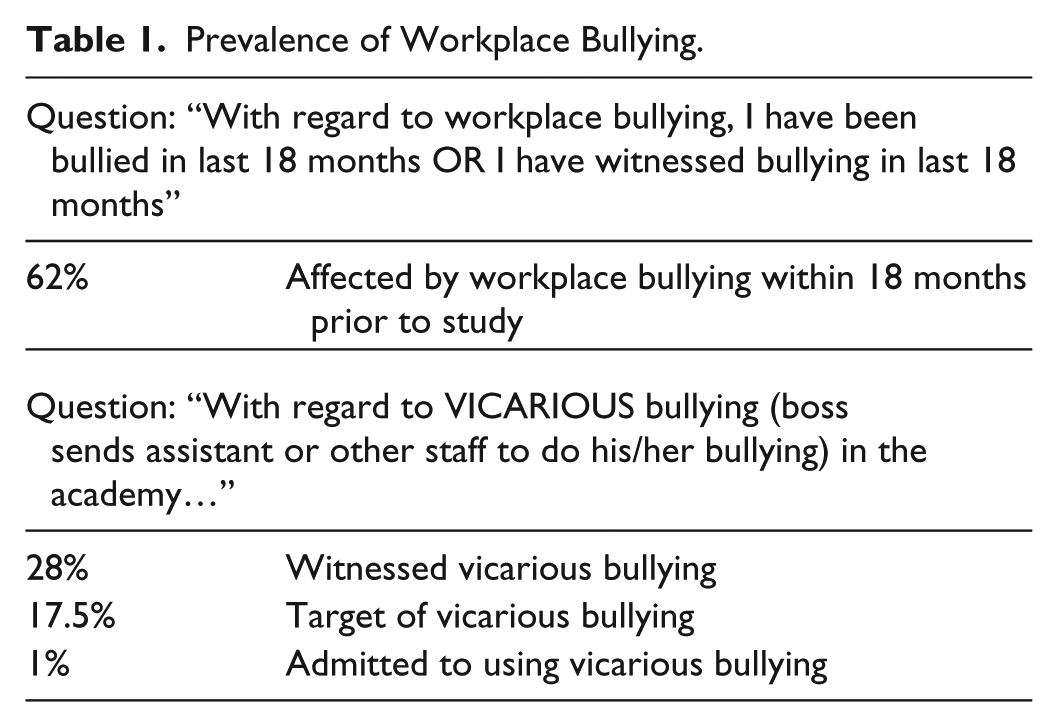
Workplace bullying has a detrimental effect on employees, yet few studies have examined its impact on personnel in American higher education administration. Therefore, two central research questions guided this study: (a) What is the extent of workplace bullying in higher education administration? and (b) What is the cost of workplace bullying specifically to higher education administration? Participants from 175 four-year colleges and universities were surveyed to reveal that 62% of higher education administrators had experienced or witnessed workplace bullying in the 18 months prior to the study. Race and gender were not parameters considered in the sample. A total of 401 (n = 401) higher education respondents completed the instrument from various departments on a campus: academic affairs, student affairs, athletics, development/advancement, admissions/financial aid, information technology, arts faculty, sciences faculty, and executives. Employment disengagement served as the theoretical lens to analyze the financial cost to higher education when employees mentally disengage from organizational missions and objectives. With this lens, the study examined staff hours lost through employee disengagement and the associated costs.
Introduction
Monday can be the worst day of the workweek. Beleaguered employees can dread the return to high stress, vague directions, and restrained budgets on the job. Medical studies report that stress can be linked to heart failure and other stress-related illnesses (Fisher, 2013; Martin, 2013; Nordqvist, 2012). In the midst of the recession, even the previously secure higher education sector became stressful and endured the added instability of surprise layoffs, spontaneous furloughs, dwindling resources, and a potentially jaded boss. During the recession, entire university departments were eliminated to balance unprecedented budget cuts.
To this environment, add a bully boss. The boss or leader who barks orders, insults staff, or makes abrupt changes to directives or deliverables adds to the anxiety many administrators felt during financially challenging times. As one respondent to this study reported in an open-ended comment, “I’m sorry to say this, but I’m glad she [the bully] is gone for her sister’s funeral. I am ashamed to admit it. Glad she is gone; I can hear myself think.”
Workplace bullying is like a petty thief, pilfering the resources of the organization. While the customary petty thief takes cash, the bully steals the productivity of the organization by causing employee disengagement. In an environment that can ill afford wasted resources, higher education would benefit from a critical look at the cost of workplace bullying and resulting employee disengagement.
Purpose Statement
Several studies have examined the proliferation of workplace bullying (Björkqvist, Österman, & Hjelt-Bäck, 1994; Branch, Ramsay, & Barker, 2013; Cowan, 2012; Duffy & Sperry, 2007; Fritz, 2014; Harvey, Heames, Richey, & Leonard, 2006; Leifooghe & Mackenzie, 2010; Matthiesen & Einarsen, 2007; Yamada, 2000; Zabrodska & Kveton, 2013). Other studies have examined the corporate sector, European trends, and the impact on health and wellness for staff facing workplace bullying (Constanti & Gibbs, 2004; Djurkovic, McCormack, & Casimir, 2008; Query & Hanely, 2010; Thomas, 2005). Unlike the aforementioned studies, this examination specifically considered the different departments of higher education including athletics, academic affairs, student affairs, human resources, development, admissions/financial aid, information technology, and executive ranks.
American higher education, like many organizations, experienced a slow recovery after the recession of 2007-2008. At least 43 states faced major budget cuts to higher education funding (Johnson, Oliff, & Williams, 2011). Louisiana and Arizona, for example, lost about a third of their state funding; Colorado and Pennsylvania faced an 18% cut (Rivard, 2014). As a result, financial shortfalls were passed on to students. Between 2008 and 2010, the average cost of 4-year tuition increased by 11% in many states such as Georgia, Arizona, California, and Pennsylvania (Weissmann, 2012). With these budget problems, higher education cannot afford to lose valuable productivity to staff turnover and disengagement (Bradley, 2011).
Within this context, universities strive to cut costs and preserve resources. However, the Gallup Organization (2013) reported that U.S. organizations lost almost US$355 billion because of the unengaged employee. Nonetheless, the impact of workplace bullying on potentially disengaged university administration specifically has not been analyzed.
In the midst of shifting fiscal landscapes affecting funding to higher education, this study’s findings may be helpful to higher education leaders who reflect on how a work environment has an impact on staff productivity. For the purpose of this study and within the instrument presented to respondents, the following definition of bullying was used: Harassing, offending, socially excluding someone, or negatively affecting someone’s work tasks. This behavior occurs repeatedly and regularly over a period of time about six months. With the escalating process, the person confronted ends up in an inferior position and becomes the target of systematic negative social acts. (Einarsen, Hoel, Zapf, & Cooper, 2003, p. 22)
The preceding fiscal threats to American higher education and the lack of information on the direct impact of workplace bullying on administration inspired this study. Therefore, the purpose of this study was to discover the extent of workplace bullying in American higher education and determine an associated cost for resulting employee engagement and turnover. Accordingly, higher education leaders may use these findings to curtail costs related to staff disengagement by cultivating a healthy workplace in higher education.
Literature Review
Bullying emerged as a workplace topic in the late 1990s, receiving increasing attention in the private and corporate sectors. Quine (1999) remarked that qualitative approaches tend to be individualistic, focusing on the personal pain a target feels on the receiving end of bullying. Other studies quantified the organizational risk involved in harboring a bully. Once personal pain and disengagement have been considered in relation to salary and sick time, one can calculate the cost of incivility (Bliss, 2012; Namie & Namie, 2009; Pearson, 1999; Wiedmer, 2010). Regardless of the research method for various studies, the findings typically reported a demoralized target and subsequent financial loss for the organization or compromised health for the target.
Various studies found that the cost of workplace bullying was twofold. Some of the following studies reported the fiscal cost while other studies focused on the emotional and wellness cost to the target. A British survey involving 5,000 employees claimed that over one million workdays were lost because 1 in 10 workers had stress stemming from workplace bullying (Keelan, 2000). Supporting the point regarding cost, Namie and Namie (2009) reported that workplace bullying cost American institutions US$64 billion annually due to turnover costs and employee disengagement. The European Agency for Safety and Health at Work (EU-OSHA; 2002) reported that close to €20 billion was lost annually because of workplace bullying. Such costs are related to turnover cost, recruiting and advertisement cost, and productivity lost to retraining. The toll on remaining staff is uncalculated, yet related to prolonged hours, overloaded assignments, and stress associated with tasks originally assigned to the open staff position.
Workplace bullying targets also suffered health issues such as weight gain and elevated stress. Posttraumatic stress and hypertension occurred for those who suffered under a workplace bully. Unison, the second largest trade union in the United Kingdom found that 75.6% of employees who reported being bullied experienced negative health effects (1997). Furthermore, 73% of those who witnessed bullying also endured health problems. Many lost their self-esteem; sleep problems developed along with depression, lack of concentration, stomach problems, moodiness, and anxiety (Thomas, 2005). Whether a study focused on the fiscal challenges documented in turnover or the emotional challenges faced by targets, either scenario left all involved losing valuable time and money to deal with or heal from the prevailing bully.
In addition to studies on costs, a few studies addressed workplace bullying in European higher education (Björkqvist et al., 1994; Constanti & Gibbs, 2004; Keashly & Neuman, 2010; Zabrodska & Kveton, 2013). However, none of these studies addressed workplace bullying in American higher education administration. As Keashly and Neuman (2010) indicated, “Although much research has been done on workplace aggression and bullying over the last two decades, academics have paid relatively little attention to bullying in their own institutions” (p. 48).
A U.K. study was one of the few that examined workplace bullying in the context of any higher education context. Thomson (2010) reported that 34% of respondents in higher education had been bullied in the 6 months previous to the study, compared with 11% of respondents in all occupations. Thomas reported that bullying included “unreasonable or impossible deadlines, being given an unmanageable workload, and being subject to excessive monitoring of work” (para. 6).
American researchers Namie and Namie (2009) have conducted extensive research on the impact of workplace bullying on the general population. They defined workplace bullying as a “silent epidemic,” with 37% of American workers facing this abuse on the job. Additional findings were that 49% of workers were affected by workplace bullying, 24% had been bullied at some time, 12% witnessed bullying, and 13% were enduring bullying at the time of the study.
The same Namie and Namie (2009) study on the general population revealed that women were targeted disproportionately, with 71% of women reporting having been bullied by women and 46% of women reporting having been bullied by a man. Overall, in seeking relief from bullying, 40% of the targets resigned and 24% targets were fired. Moreover, 44% of the time the organization did nothing to provide relief for the targets. In 18% of the cases, the situation intensified for the target once bullying was reported (Namie & Namie, 2009).
The aforementioned studies offer a diversity of information regarding cost, venue, and targets of bullying. The same diversity of findings occurs with regard to the duration of bullying. A European study (Einarsen et al., 2003) documented that 65% of those who took the Negative Acts Survey were affected by workplace bullying. A study of Norwegian shipyard workers revealed that 88% of respondents experienced workplace bullying. The duration of bullying was often at least 6 months, yet the mean duration was approximately 18 months. Participants in an Irish study reported that bullying lasted over 3 years (O’Moore, 2000). A Canadian study proposed an extended period of time for bullying and revealed that 78% of respondents felt that incivility on the job intensified over a 10-year period (Pearson, 1999). A common theme was the imbalance of power between bully and target, which often left the target defenseless.
The targets in the preceding studies reported different periods for which targets endure bullying. One could argue that the time span is irrelevant; 6 months does not have to persist for a target to realize that a bully has compromised the work environment. While some of these findings on duration report extensive exposure to workplace bullying, other personal elements for the target might be compelling factors that are not reported in these studies. A target’s perceived job security or the market conditions at the time of the study could limit the target’s mobility and subsequent ability to leave the job. Family responsibilities or illness can hamper one’s mobility.
Theoretical Frame
As previously stated, American higher education, like most organizations, must maximize resources, including human resources, to successfully rebound in a slow economic recovery after the 2007 recession. As higher education is often a service organization with the mission of serving students and the community, higher education requires an engaged staff to successfully accomplish its goals. Within this context, employee disengagement hurts not only the organizational mission but also the students who rely on university administration for education and service.
A range of studies on employee disengagement highlighted the challenge organizations face when employees’ organizational commitment was on the wane (Kahn, 1990; Maslach & Leiter, 1997; Ployhart, 2008; Schaufeli et al., 2002). Cost was often associated with employee disengagement along with the loss of productivity and compromised organizational objectives. However, beyond costs, Byrne (2015) considered engagement as having a transforming quality where the employee not only embraces the work but also finds “meaningful accomplishment” (p. 17).
The engaged workplace included support and care from the boss and a sense of safety in the environment to make mistakes and potentially create innovation. Trust “fosters a collaborative culture which enhances the creativity of the team” (Barczak, Lassk, & Mulki, 2010, p. 341). Without trust, teams and individuals will not engage in the risk required for innovation. They will not feel safe to offer what Anderson (2011) defined as the “Eureka moment,” the idea that develops processes and cuts costs.
A leader who inspired employees to create trust through civility, honest communication, and concern created a healthy workplace. Furthermore, the leader gave autonomy, thereby showing trust and support. Qualities such as fairness and approachability in leadership created a safe workplace for employees, a place in which they could engage (Byrne, 2015).
In contrast, disengagement is the “uncoupling of selves from work roles; in disengagement, people withdraw and defend” (Kahn, 1990, p. 694). The disengaged employee was simply going through the motions. They were physically present, but mentally drifting to other ideas while potentially delegating tasks to other colleagues. In this withdrawn state, “ideas are kept to the self and creativity is diminished” (Byrne, 2015, p. 77).
The operative words of “withdraw and defend” in the context of workplace bullying formed the theoretical frame for this study. Employees who must fend off harassment and bullying behavior at work will make defending self the priority over organizational objectives. The leadership that allows hostile or abusive environments created disengagement. Leadership in these organizations often lack care or concern; in turn, professionalism is eroded along with mutual trust. Negative politics prevailed in unhealthy organizations, which suppressed opinions and creativity. Unfair job assignments and poor communication emerged as the norm (Byrne, 2015). In short, the workplace evolved into a battlefield for the target and witnesses of bullying. Instead of engaging in the organizational mission, battle-worn employees disengaged and took up a defensive stance. They spent time developing strategies to protect the self instead of spending time working for the institution.
Workplace bullying established a hostile work environment by utilizing these tactics of abrupt unfairness that yielded disengagement. In response, the target and witnesses ignored the abusive boss, the harassing colleague, or any other personality who created a threat. Isolation and “detachment from identification with the organization” emerge as the employees’ strategy to survive a hostile workplace (Kahn, 1990).
The Study
Research Method
In an effort to examine workplace bullying dynamics in higher education administration, a 35-question survey was developed. The institutions surveyed included liberal arts colleges, Research-I institutions, Ivy League universities, historically Black colleges and universities, state universities, and large private universities. The commonality in this cross-section of colleges and universities was the tradition of conferring the baccalaureate degree.
During 2012, more than 3,200 participants were asked to complete the survey. The population comprised staff of 4-year colleges and universities. Survey Μονκεψ™ was used to host the 35-question instrument and collect incoming data. A total of 175 colleges or universities received 18 invitations to staff to participate in the study. Two participants were selected from each of the following departments: athletics, student affairs, information technology, human resources, executive level, admissions/financial aid, academic faculty (science), academic faculty (arts), and external affairs/development.
Research Questions
To examine the effect of workplace bullying in American higher education administration, two central research questions were developed. The research questions were developed to understand not only the prevalence of workplace bullying but also the cost related to workplace bullying and potential solutions.
Data Collection
Potential survey participants received emails inviting them to complete the instrument via the web link provided. Over a 5-week period, participants received four additional reminders to the sample to encourage participation and remind them of the opportunity to participate in a raffle for a US$100 American Express gift card. The fifth and final reminder offered a last chance for participants to include their voice in this study.
Through the 5-week data collection period via email, 14% of the population (448) was unreachable as email invitations were undeliverable due to protections on university and college servers. Another 5% of the population opted out of the study (161). Of the remaining 2,592 in the sample, 15.5% (n = 401) completed the informed consent process and subsequent survey. As the aforementioned data collection was described, survey design and administration adhered to Cozby’s recommendations regarding ethical standards visual appearance recommended by (2009).
Limitations
The survey was distributed to potential participants online. However, colleges and universities had developed firewalls and Internet security, which prevented delivery of email from unknown senders. Also, the survey was sent to a variety of administrators, ranging from entry-level coordinators through to provosts and vice presidents. Those who self-selected to answer the study tended to be entry-level and middle management employees (student service coordinators, assistant directors, directors, assistant deans, and associate deans).
Delimitations
Administrators from 175 colleges in the eastern time zone were recruited for the study. Collecting the 3,200 individual emails represented a sizable task; therefore, the east coast parameters reduced the numbers of possible participants. To strengthen validity, the study focused on one type of higher education organization: the traditional 4-year baccalaureate degree granting colleges and universities.
Validity and reliability
As no other survey existed to specifically examine workplace bullying in American higher education administration, a new instrument was created. With regard to the internal validity of the survey instrument, the instrument was beta tested by seven higher education professionals, including an equal employment opportunity (EEO) officer, a faculty member, a dean, and a vice president. Their perspectives were included in revisions such as adding vicarious bullying. Furthermore, their insight included adding questions about time lost managing a bully. Those who contributed their expertise to constructing an instrument had at least 15 years in higher education administration experience. As noted by Creswell (2009), such beta testing ensured clarity of questions. Furthermore, the maturity of those reviewing the instrument strengthened validity, as well as the researcher’s previous studies that included instrument design (Creswell, 2009).
With regard to reliability, the researcher was a 23-year veteran of higher education. Having served in athletics, student affairs, and academic affairs, the researcher had firsthand knowledge about traditional higher education. Such experiences, when incorporated with the expertise of those in the beta test, guided the development of the original instrument.
Results
Results Regarding Extent of Bullying
Sixty-two percent of respondents confirmed that they had been bullied or had witnessed bullying in their higher education positions within 18 months prior to the study. Also, over half of the respondents sent the link to the survey to a remote location to avoid responding on campus. Participants’ attempts to complete the survey off-campus were confirmed when participants offered private emails for the raffle. Participants also explicitly commented in the open-ended segment that they had forwarded the email invitation to their private accounts so that they could answer at off-campus without the college or university tracking their responses.
For the purpose of this study, the term vicarious bullying was introduced to describe leaders and managers who sent or authorized subordinates or junior staff members to wield their executive power. A leader could have used this tactic to continue intimidation in his or her absence, or used it in an attempt to preserve a façade of kindness while using subversive tactics to control staff. Twenty-five percent had witnessed vicarious bullying while 17.5% had been the target of vicarious bullying. One percent admitted to using vicarious bullying (see Table 1).
Prevalence of Workplace Bullying.
Respondents were asked about the duration of bullying in higher education. A majority of respondents faced bullying for more than 2 years, with 27% of respondents saying that they had been bullied for more than 3 calendar years. Twenty-six percent stated that they had been bullied for 2 to 3 calendar years. In open-ended questions, many commented that bullying occurred for much longer than the 3-year window offered in the survey (see Table 2).
Duration of Workplace Bullying.

To the question inquiring how much time targets spent avoiding a bully, 23% of respondents reported that they spent an hour a week avoiding the bully. Twenty-two percent reported they spent 8 hr avoiding the bully. Sixteen percent reported that they spent 2 hr a week avoiding the bully. When the range of responses is calculated into a mean answer, 3.9 hr were spent weekly trying to avoid the bully (see Table 3).
Time Wasted Defending Workplace Bullying.

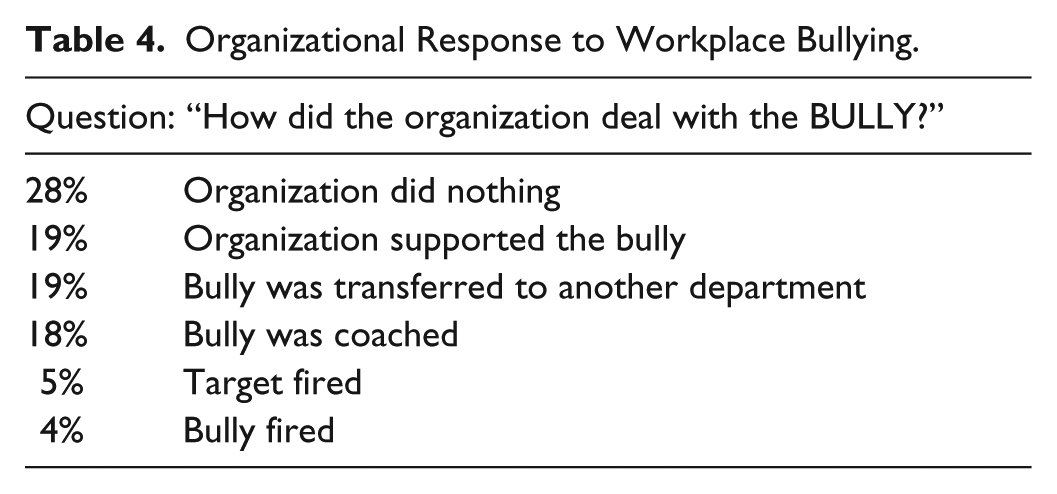
Twenty-eight percent of respondents stated that the organization was apathetic in dealing with the bully. Nineteen percent reported that the organization supported the bully. Nineteen percent of respondents said the bully was transferred to another department. Eighteen percent said the bully was coached. Five percent said that the target was fired, and 4% said the bully was fired (see Table 4).
Organizational Response to Workplace Bullying.
Workplace bullying also had a direct impact on turnover, with 20% reporting that they had already left a previous institution due to bullying and 15% claimed they were planning on leaving because of current bullying. Respondents claimed that the tenured faculty, directors, and deans were most frequently the bullies (see Tables 5 and 6).
Turnover.

Who Is the Bully.

Note. VP = vice president.
Results Regarding Cost
The fiscal cost of workplace bullying in higher education can potentially compromise the institution’s commitment to meeting its objectives. Through this study, the cost of workplace bullying was confirmed by calculating the amount of time wasted and the salary cost per hour. The enormous cost of turnover was associated with the background checks, advertisements, lost productivity, the cost of a search, rehiring, and retraining procedures. Furthermore, the employees who leave are often the high performing ones and hence highly sought after talent in the field (O’Connell & Kung, 2007). The specialization of an employee and market conditions also have an impact on employee replacement costs. Accordingly, replacement of some employees can cost as much as 250% of the departing employee’s salary (Hester, 2013). This study used Hensen’s (1997) report that “the average cost for replacing an employee is 150% of the departing employee’s pay” (p. 17), which is also supported by other human resources practitioners (Ruyle, 2012; Seaver, 2015).
Given this figure of 150% of the departing employee’s salary for replacement costs, if an employee on a salary of US$50,000 left the organization (the median salary of the participants in this study), the organization spent US$75,000 to replace that person (Bliss, 2012; Jurnak, 2010). The mean salary for higher education personnel nationally was US$67,000; therefore, the average cost of turnover per employee was US$100,500.
If 62% of higher education staff was affected by bullying, and as a result this staff disengaged for 3.9 hr each week, then, for example, a college with 1,900 people on staff was potentially losing more than US$8 million by allowing workplace bullying. A large university with 22,000 on the staff was potentially losing more than US$93 million. A medium-sized school with 1,100 on the staff was potentially losing more than US$4.6 million annually because staff were disengaging from work to strategize or worry about the tactics of a bully.
A total of 381 participants answered the question about salary. Of these, 15 made more than US$150,000. As a salary range cannot be determined for those 15, they were removed from the discussion on cost and salary. The remaining 366 had a mean salary of US$67,636, or US$5,636 per month, resulting in an hourly rate of US$35.22. While these numbers overrepresent salary for entry level and assistant director levels, the median salary establishes a working data point to consider the cost of workplace bullying. As stated earlier, 23% of respondents reported that they spent an hour each week avoiding the bully. Twenty-two percent reported that a full day a week (8 hr) was spent avoiding the bully. When all responses were considered, the mean time was 3.9 hr spent weekly to deal with a workplace bully (see Table 7).
Hours Spent Avoiding Workplace Bullying.

50 weeks was used to account for 2 weeks of professional holidays.
Recall that 62% of respondents stated that they had been the target of workplace bullying or had witnessed workplace bullying in the last 18 months. Consider the information in Table 8 that is loosely related to staffing at respective colleges and universities. Note again that US$6,869.50 is lost per person annually (see Table 8).
Potential Annual Loss Due to Workplace Bullying.

The broad strokes regarding cost consider salaries ranging from US$15,000 to US$150,000 annually. Certain assumptions were made to derive the calculations in Table 8. A 40-hr workweek with 50 working weeks was used, assuming 2 weeks off for vacation. A more specific analysis follows with the salary ranges divided into four groups to consider.
The following calculations offer a more specific analysis of cost related to workplace bullying; with regard to staff making US$15,000 to US$35,000 annually, n = 13 with an average annual salary of US$25,000. This group represented coordinators, assistant directors, and directors, and were primarily trained to the master’s level. In this range, the monthly rate was US$2,083 and the hourly rate US$13.02. This group reported a mean of 4.30 hr a week wasted strategizing about or avoiding a bully, which means that US$56.10 was spent per week. When this cost is lost over 50 weeks, US$2,805 is lost annually per person, equaling more than 5.3 weeks lost due to workplace bullying.
This second salary range provided the greatest cross-section of respondents, representing coordinators, assistant directors, directors, associate deans, and faculty; this represented the largest group in the study, n = 100. Also, this group had the greatest cross-section of training, with bachelor’s trained, master’s trained, or doctoral trained staff. The salary range for this group was US$35,000 to US$65,000. With the average salary in this range being US$50,000, the monthly salary was US$4,166.67, or US$26.04 per hour. This second group reported a mean of 3.48 hr spent per week dealing with a bully, slightly less than entry-level staff. This meant that US$90.62 was lost per week. When 90.62 hr a week is lost over 50 weeks, annually US$4,530 is lost per person, just over a month of work time, or 4.34 weeks lost.
This third group, n = 61, was primarily split between directors and tenured faculty. The educational level was also split between master’s trained and doctoral trained staff (n = 61). The average salary in this group was US$80,000, equating to US$6,667 per month or an hourly rate of US$41.66 per hour. This group spent more time than those in the previous salary range strategizing about or avoiding a bully. Directors and faculty of this group reported a mean of 4.24 hr per week lost dealing with a bully, resulting in US$176.68 lost per week for respondents in this salary range. The amount lost over 50 weeks is an annual loss of US$8,834 per person, or 5.3 work weeks lost.
Upper management, with a majority representing directors, vice presidents, provosts, and department chairs, were primarily doctoral trained staff. This salary range was from US$95,000 to US$150,000 (n = 38), with an average salary of US$122,800. This group had a monthly salary of US$10,233, or US$63.95 per hour. This group reported spending 3.95 hr per week strategizing about or avoiding a bully. This resulted in US$252.60 lost weekly, or US$12,630 annually lost per person, resulting in 4.93 weeks lost to workplace bullying (see Table 9).
Cost of Workplace Bullying per Salary Range (per Person).

Note: Table 9 reports findings, not order of calcuation
Sample Responses From Open-Ended Segment of Survey
Below are several open-ended responses from the 35-question instrument identifying disengagement and leadership as key elements. An additional 119 comments were collected. Six respondents reported they had never experienced a healthy workplace during their careers in higher education. The respondents’ remarks mirror the elements that contribute to employee disengagement.
Theme 1: Disengagement and workplace bullying in higher education.
[This is] a chronic, pervasive problem that undermines the effectiveness and integrity of higher education.
Sometimes it feels like you are being discriminated against because you offer an element of professionalism and expertise in specific areas. Jealousy is part of the problem. Not wanting to see anyone excel beyond their current status. It is extremely frustrating. Causes severe anxiety. I have taken it for many years. Much too long.
I left my previous institution in part because they permitted an athletic coach to bully everyone. It created an awful work environment yet everyone from HR to the president of the university felt it did not reach harassment status so there was nothing to be done about it. This was allowed to continue until the man finally retired.
The open-ended comments in Theme 1 indicated that employees felt “undermined” or “frustrated.” They disengaged from job tasks and choose to focus on self-care. This reaction is consistent with aforementioned theories on employee disengagement. The disengaged employee will isolate himself or herself. Furthermore, disengaged employees will leave to seek a safer environment (Kahn, 1990).
It seems to me that the president of the institution has a great deal of power. He, himself, is a bully and those individuals whom he favors are also bullies.
I think bullying trickles down from the top starting with executives working its way to building and maintenance staff. If the administration threatens job loss, write-ups and reduces pay, then the intermediate-level chairs and supervisors will do the same.
It comes from the top, the president and his/her cabinet.
Consistent with the discussion on employee engagement, the leader is responsible for setting the tone and culture. Leaders who were supportive and caring invoked an engaged staff. Disrespectful, hurtful, and intimidating leadership created a hostile work environment (Byrne, 2015). Leadership is the architect of the academy.
It’s been so destructive and depressing . . . in two of my jobs . . . in both cases from [faculty] chairperson and faculty and in one case the union.
A stressful and competitive atmosphere encouraged bullying between faculty members.
No one should be immune from repercussions. Faculty is often given carte blanche. I guess that’s academic freedom.
The comments from Theme 3 highlight the impact that faculty had in creating a hostile environment. In this case, those who had earned the right to a lifetime appointment also had the propensity to abuse that power in dealing with junior faculty or staff without tenure. While the tenure structure had been a cherished and needed element to protect academic freedom, when a tenured colleague misused this right, the results created a workplace environment more susceptible to bullying.
Discussion
Throughout the organizational strata of higher education, leadership was a common thread either as the actor or the enabler of bullying behavior on campus. When leadership allowed bullying to flourish, employees disengaged from the work tasks, spending hours regrouping from hostile interaction. A target looked to leadership for relief after facing a bully. Human resources followed leadership in response to a bully. Furthermore, the bully was often from the ranks of leadership with extensive organizational or expert power. Findings confirmed that leadership can set the tone in cultivating an environment that sustains or eradicates bullying behavior. With budget cuts and challenges, higher education cannot afford to lose valuable productivity to staff turnover and employee disengagement. Theoretically speaking, turnover related to workplace bullying reflected the number of staff who may be distracted and disengaged while serving staff and students.
Leadership can galvanize an organization, or lead it simply to mediocrity and stagnation. To rise above mediocrity, transformation and innovation are critical elements for any organization, but neither can exist without a trustworthy leader with integrity. “Integrity is a fundamental consistency between one’s values, goals, and actions. At the simplest level, it means standing for something, having a significant commitment, and exemplifying this commitment in your behavior” (Evans, 2000, p. 289).
The findings of this and previous studies reported that targets of workplace bullying and witnesses of bullying were motivated to seek relief from the aggression they experienced; in the absence of a supportive leader, employees withdrew and remained distracted. Consistent with other studies, this study corroborated previous findings that workplace bullying often comes from leadership and that human resources seldom advocated for the target, leaving the target toiling in isolation, disengaging from organizational objectives, or leaving the organization (Lutgen-Sandvik & Arsht, 2014; Namie & Namie, 2009). Consequently, targets and witnesses of workplace bullying disengaged from the job. They withheld their creativity and retreated from the established hostile environment. In a fiscally challenging environment, higher education can ill afford to have employees languishing in abusive environments instead of considering the stated mission of higher education.
Recommendations for Administration
Given the prevalence of workplace bullying in American higher education, the common solution is that executive leadership cannot tolerate bullying at any level, even from their closest colleagues. An executive leader needs to be visible and accessible, walk around on occasion, and answer his or her own emails. The staff needs to know that leadership will intervene in the presence of destructive behavior, which would show the support needed for staff to engage. Simultaneously, the leader would not undermine middle management’s authority, but find ways to handle complaints quietly and discreetly. Such transparency from the upper echelons of leadership should not undercut the managers or supervisors, but as one of the participants stated, “self-policing is sometimes the best policing.”
Solutions could also include an annual 360 Evaluation of managers, supervisors, and cabinet-level staff. The president can establish a minimum score regarding civility from the leader’s consistent commitment to and alignment with institutional values. Executive leadership’s civility dissolves the staff’s propensity to disengage. If someone consistently falls short, this leader would be coached to improvement. If the leader still exhibits aggressive behavior that stifles the organization, that leader would be removed, regardless of successes in other areas. As one participant stated, “civility would not be compromised for a million dollar grant.” While this might sound unreasonable given the economic times, the cost to higher education in relation to bullying behavior is unsustainable.
In addition to a transparent and accessible executive leadership and the 360 Evaluations, leaders with healthy work environments often have workplace satisfaction surveys, which they should take seriously. Gathering information and complaints in the name of a healthy workplace, then acting with apathy once results are tallied, will communicate to staff that leadership does not have a true commitment to a healthy workplace. Leadership’s apathy with regard to workplace bullying erodes trust and productivity, which is often difficult to reestablish. Other signs of trouble in a workplace include student complaints, high turnover, and the consistent lack of internal transfers to a specific department when an otherwise attractive position opens.
Recommendations for Future Research
The White House has charged higher education with achieving a national degree completion rate of 60% by the year 2020 (Department of Education, 2011). Furthermore, the average cost of attending a 4-year state school in 2013 is about 23,000, roughly a 54% increase in tuition since 2003 (Digest of Educational Statistics, 2014). Students are taking on costs that once were assumed by their respective states. With these changing fiscal demands, higher education can ill afford the cost of harboring a bully who precipitates staff disengagement.
One topic for future research would consider higher education respondents’ comments on stress and health-related issues. Many studies confirm that the target can accrue extensive health problems when facing a bullying at work (Duffy & Sperry, 2007; Kivimaki, Elovainio, & Vahtera, 2000; Lovell & Lee, 2011). More research into the health issues faced by targets of workplace bullying would be warranted.
With more nontraditional students attending 2-year community colleges, a recommendation for future study would be to examine the frequency of workplace bullying specifically in community colleges. With online education growing, cyber-harassment in higher education also warrants an in-depth study. Colleges and universities in all sectors offer classes online; the potential facelessness of this behavior can invite ruthless cyber behavior.
This study also raises an opportunity for future research. These findings emerged from the east coast as a delimitation. In turn, surveying 4-year colleges across all four time zones would be fruitful and a more comprehensive representation of shifting demographics in higher education. An expanded study would be inclusive of the “minority majority” states where people of color would potentially be a larger portion of the sample.
Conclusion
These findings have an underpinning of urgency. Colleges and universities cannot afford the extent of bullying reported in these data as such behavior compromises the mission to educate a majority of American citizens. The reported duration of workplace bullying in American higher education exacerbates the costs, a cost which is prohibitive, leaving bullied staff toiling through disengagement or leaving the college or university altogether.
Higher education staff provides a service to students and internal colleagues. An engaged staff can foster the engagement many student development theorists consider a requirement for student success (Astin, 1999; Tinto, 1988). However, when leadership is the ringleader of bullying or ignores bullying behavior, employees suffer along with the organizational mission. When bullying prevails, higher education administrators endure the worst days of their work lives, to give students the best days of their lives.
Footnotes
Declaration of Conflicting Interests
The author(s) declared no potential conflicts of interest with respect to the research, authorship, and/or publication of this article.
Funding
The author(s) received no financial support for the research and/or authorship of this article.
