



Abstract
This study examined the effect of paternalistic leadership on follower fake behavior and compared the effect of authoritarian leadership with that of benevolent leadership and moral leadership on the facades of conformity. The study suggested that leader authoritarianism resulted in high levels of employee facades of conformity, whereas both leader benevolence and leader morality produced low levels of employee facades of conformity. This study used 253 participants from a large Taiwanese company. The findings of the study showed a positive effect of authoritarian leadership on facades of conformity, whereas there was a negative relationship between benevolent leadership and facades of conformity and a negative relationship between moral leadership and facades of conformity. Psychological strain mediated the relationship between the three types of paternalistic leadership and facades of conformity. Implications and directions for future study are discussed.
Introduction
Prior studies have focused on the increasing prevalence of paternalistic leadership over the past two decades (Cheng et al., 2000, 2004; Pellegrini & Scandura, 2008; Schaubroeck et al., 2017; A. Y. Zhang et al., 2011; Y. Zhang et al., 2015). Compared with leadership literatures in Western context, leadership studies from the Chinese context reflect that paternalistic leaders provide care, support, and protection to their followers (Pellegrini & Scandura, 2008) and the followers develop a social harmony relationship with their leaders (Schaubroeck et al., 2017). The traditional Chinese culture highlights social context and traditional culture values, which Chinese employees are more likely to perform following behaviors (Farh et al., 1997) and may embrace organizational worth for hierarchical conformity (He et al., 2019). For instance, participants of prior studies from non-Western cultures (e.g., China, India, and Japan) have showed an Eastern relationship in which employees mostly display harmonious relationships with their organizations (Leung et al., 2002; Y. Zhang et al., 2015). Following this stream of research, this study argues whether the Chinese employees are likely to suppress their own values and pretend to embrace organizational values for harmonious employment relationships when they experience paternalistic leadership.
Paternalistic leadership is defined by three leadership styles: authoritarianism, benevolence, and morality. These three styles of leadership are considered opposing and distinct constructs (X. P. Chen et al., 2014). Leader benevolence is a leader’s holistic concern for followers’ well-being (Cheng et al., 2000), leader morality is a leader’s reliance on his or her moral character and honesty, and leader authoritarianism is a leader’s assertion of strong authority and obedience (X. P. Chen et al., 2014). The majority of the study on paternalistic leadership has demonstrated followers’ positive behaviors, such as job performance (e.g., Schaubroeck et al., 2017; Wang et al., 2018), voice behavior (Li & Sun, 2015), and group cohesion (Harms et al., 2018). According to social exchange theory (SET; Blau, 1964), individuals are inclined to return beneficial treatment they accept positive behaviors (e.g., paternalistic leadership and the level of leader-member exchange relationship; Y. Zhang et al., 2015) and are inclined to return detrimental treatment they accept negative behaviors (e.g., compulsory citizenship behavior; Vigoda-Gadot, 2006). Therefore, this study argues whether followers may attempt to perform an inauthentic behavior based on leader authoritarianism, morality, and benevolence. Particularly, this study argues that whether leader authoritarianism may generate followers’ inauthentic behavior for a harmonious relationship in Chinese culture, whereas leader benevolence and leader morality may reduce followers’ inauthentic behavior, which is defined as facades of conformity (Hewlin, 2009).
In addition, this study applies affective events theory (AET; Weiss & Cropanzano, 1996) to confirm whether authoritarian leadership, benevolent leadership, and moral leadership produce psychological strain over time and lead employees to engage in fake behavior toward their leaders. Consistent with the results of prior research (Maslach et al., 2001), workplace events are likely to produce psychological strain and result in employees’ negative consequences. Researchers have found that authoritarian leadership produces negative emotions in followers (Pellegrini & Scandura, 2008). For instance, authoritarianism in paternalistic leadership requires followers to submit to demands and control from and be obedient of leaders (Farh & Cheng, 2000). Therefore, followers may feel psychological strain because of a leader’s strong authority and control over them. In contrast, both benevolence and morality in paternalistic leadership involve leader behavior that establishes holistic and personalized concern for followers’ well-being (Farh & Cheng, 2000; Schaubroeck et al., 2017). Thus, followers should experience low psychological strain when they face benevolent leadership and moral leadership. These three styles of paternalistic leadership cause different psychological reactions for among followers. More specifically, authoritarian leadership may be related to followers’ high psychological strain, whereas benevolent leadership and moral leadership may be related to followers’ low psychological strain.
Psychological strain is likely to be a critical relationship between the three styles of paternalistic leadership and facades of conformity. Prior studies have reported that paternalistic leadership styles, including authoritarianism, benevolence, and morality have significant effects on followers’ psychological reactions to their leaders, influencing job performance and intention to stay (Cheng et al., 2004; Schaubroeck et al., 2017). Authoritarian leaders expect followers to complete tasks by producing controlled motivation among followers. As a result of this approach, followers may feel forced to engage in conforming to the leader’s values. In contrast, both leader benevolence and leader morality involve supporting followers in accomplishing their career advancement and treating them as family members, such as providing suggestions to deal with their work stress. Therefore, this study attempts to assess psychological strain as a mediating role between paternalistic leadership and inauthentic behavior, that is, facades of conformity.
This study provides the following contributions. First, prior studies of paternalistic leadership have ignored the impact of authoritarianism on followers’ fake behavior. Some leaders display authoritarianism rather than benevolent leadership and moral leadership, so it is important to examine whether authoritarian leadership leads to followers’ fake behavior in the Chinese culture. Therefore, this study offers important insight into the behavior of followers who set aside their personal values and falsely embrace the values of the leader. Second, this study suggests that the potential mediation between paternalistic leadership and employees’ facades of conformity is supposed to be examined. This study uses AET (Weiss & Cropanzano, 1996) to explicate psychological strain as a mediating role in the relationship between three styles of paternalistic leadership and fake behaviors. Finally, this study is based on a self-report survey of subordinates conducted to elicit their true responses. The findings of this study are inconsistent with prior study (Wang et al., 2018) showing that different styles of paternalistic leadership may result in positive consequences for subordinates. This study displays the effects of paternalistic leadership on an employee’s inauthentic behavior.
Theoretical Background and Hypotheses
Three-Dimensional Model of Paternalistic Leadership
Prior studies have examined paternalistic leadership constructs separately and have used authoritarianism, benevolence, and morality to measure followers’ different attitudes and behaviors (e.g., Wang et al., 2018). This study attempts to investigate whether these three styles of paternalistic leadership, leader authoritarianism, benevolence, and morality, lead to followers’ fake behavior in this study. Authoritarian leadership refers to absolute power and control over followers’ motivations and behaviors and demands of complete obedience from them (Farh & Cheng, 2000; Farh et al., 2006). Leader authoritarianism often involves controlling behaviors that attempt to be more task-oriented discipline (Wang et al., 2018). Followers report low leader-member exchange with authoritarian leaders (Y. Zhang et al., 2015). In contrast, leader benevolence involves a leader showing full concerns for employees’ person-oriented behavior (Wang et al., 2013), and benevolent leadership is related to high levels of affective trust (X. P. Chen et al., 2014) and produces high-quality leader-member exchange (LMX; Chan & Mak, 2012). Additionally, moral leaders possess high moral standards and treat subordinates with respect and honesty (Y. Zhang et al., 2015), and leader morality displays honesty and concerns with personal well-being (Farh & Cheng, 2000). In general, paternalistic leaders demonstrate strong authority and personal concern for their followers’ lives in exchange for obedience and loyalty.
Relationship of Paternalistic Leadership With Followers’ Inauthentic Behavior
Most prior studies relating paternalistic leadership to followers’ outcomes have concentrated on positive behaviors and responses, such as well-being (Farh & Cheng, 2000; Harms et al., 2018), group creativity (A. Y. Zhang et al., 2011), voice behavior (Y. Zhang et al., 2015), job performance (Wang et al., 2018), and group cohesion (Harms et al., 2018). According to SET (Blau, 1964), it implies the reciprocity norms, which individuals are likely to reciprocate with beneficial treatment in their exchanges with others. SET is based on the exchange of social and material resource, which is a primary form of human interaction (Emerson, 1976). Therefore, this study attempts to examine followers’ inauthentic behavior of suppressing their personal values and pretending to embrace organizational core worth for harmonious relationships when they experience leader authoritarianism. Contrary to the effect of authoritarianism on the followers’ inauthentic behavior, benevolent and moral leaders who show long-term social exchanges with subordinates, and treat subordinates fairly may reduce subordinates’ inauthentic behavior. Such behavior has the potential to cause leaders to consistently engage in thoughts and actions regarding followers that may result in dysfunctional outcomes (Hewlin et al., 2016).
Hewlin (2009) defines this inauthentic behavior as facades of conformity. This behavior that generates employees’ negative behaviors, such as turnover intention and low work engagement (Hewlin et al., 2017), has been explained as creating facades of conformity (Hewlin, 2009). Inauthenticity can result in detriments for organizations and employees, including low work engagement (Hewlin et al., 2017) and decreased psychological well-being (Hewlin, 2009). For instance, followers’ creating facades of conformity to convey the appearance of embracing ideas and values that are dissimilar to their own is likely to high levels of turnover intention among followers (Hewlin, 2009), inauthentic self-presentation, and low organizational learning (Hewlin et al., 2017). Therefore, examining facades of conformity is necessary because behaving falsely can hinder organizational development, increase finical crisis in organization (Milliken et al., 2003), and diminish employee job performance (Hewlin et al., 2016).
As noted above, highly authoritarian leaders favor demanding and controlling behaviors to accomplish tasks. Highly authoritarian leadership involves little communication and information sharing with followers (Schaubroeck et al., 2017). Followers are asked to achieve goals but are instead forced to obey the leader’s authority, even though followers may not conform and embrace the leader’s values. Such an approach results in followers potentially suppressing their personal values, pretending to hold the leader’s values and obeying for their own job security and a social relationship with their leaders. When followers perceive that their worth and ideas are not respected, they begin responding by engaging in fake behavior to obey their leaders (Hewlin et al., 2017). Therefore, this study proposes the following:
Hypothesis 1a: Authoritarian leadership is positively related to facades of conformity.
In contrast, previous studies focusing on the outcomes of paternalistic leadership have addressed the influence of leadership only on followers’ behaviors rather than on their personal values, which truly conformed to those of leaders (e.g., Hewlin, 2009). For example, benevolent leadership shows highly person-oriented concerns and interactions with followers (Wang et al., 2013). As a result, benevolent leaders generate high degrees of employee trust (X. P. Chen et al., 2014). Therefore, followers tend to interpret leader benevolence as a sign of high-quality mutual relationships and to experience high levels of trust with benevolent leaders based on reciprocity and mutuality (Farh & Cheng, 2000). Followers of benevolent leaders are willing to put substantial effort into relationships with benevolent leaders and show affective trust in them (Cheng et al., 2004; Wang et al., 2013). Thus, followers of benevolent leaders may not suppress their personal values and pretend to agree with the leader’s values. This study posits the following:
Hypothesis 1b: Benevolent leadership is negatively related to facades of conformity.
Moral leaders who demonstrate integrity and concern with the collective welfare rather than self-interests are self-disciplined and seen as best leaders by Chinese employees (Y. Zhang et al., 2015). These leaders generate high level of trust (from subordinates (Farh & Cheng, 2000) and loyalty (X. P. Chen et al., 2014). Because moral leaders treat followers with sympathy and respect, subordinates are willing to develop high level of exchange relationship with them (C. C. Chen & Farh, 2009). Since trust, loyalty, and high-quality exchange relationship are developed by followers, this study expects that followers of leader morality may not perform fake behavior. Based on the above discussion, this study proposes the following:
Hypothesis 1c: Moral leadership is negatively related to facades of conformity.
Paternalistic Leadership and Psychological Strain
Caplan et al. (1980) defined psychological strain as the frequency that individuals experience undesirable psychological conditions, such as sadness and anger. Prior studies have reported that psychological strain is caused by workplace events as well as coworkers or supervisors (Bolger et al., 1989; Ferguson, 2012; Liu et al., 2005). Paternalistic leadership, which employees in organizations commonly experience, involves the provision of information, protection, support, and care for followers (Pellegrini & Scandura, 2008; Redding et al., 1994). Paternalistic leadership is also important for followers’ psychological connections to their organizations and their motivations for their behaviors because it can determine followers’ potential to understand that they contribute substantially to their organizations. Followers may experience psychological strain if they are subject to hierarchical power, which induces follower obedience behavior. Drawing from AET, Weiss and Cropanzano (1996) proposed that relevant events in an organization generate psychological and emotional reactions in people. In this study, therefore, the influence of paternalistic leadership on followers’ psychological strain, that is, their levels of sadness and anger, is investigated. In addition, this study suggests that these three styles of paternalistic leadership—authoritarianism, benevolence, and morality—induce psychological strain differently.
Prior studies on leader authoritarianism have revealed that authoritarianism generates negative psychological reactions such as anger and fear in followers (X. P. Chen et al., 2014; Farh et al., 2006). Leader authoritarianism emphasizes followers’ obedience to conform to the leader’s preferred goals and plan, which may increase followers’ psychological strain. This style of leadership emphasizes the leader’s authority and control over followers, including behaviors such as controlling followers’ actions, making one-sided decisions, and threatening punishment for noncompliance (Aryee et al., 2007). Under such situations, followers have no options and must embrace the leader’s decisions, resulting in psychological strain. Thus, this study posits the following:
Hypothesis 2a: Authoritarian leadership is positively related to psychological strain.
Benevolent and moral leaders display concern for followers’ work and nonwork domains (Farh & Cheng, 2000; Wang et al., 2013). In an organization, benevolent leaders allow followers to express their opinions, mentor followers, and help followers to achieve their career development. In the nonwork domain, benevolent leaders show supportive benevolence through providing comprehensive and individualized care, helping followers deal with private emergencies, treating followers as family members, and strengthening their relationships with followers (Farh & Cheng, 2000; Y. Zhang et al., 2015). Similarly, moral leaders produce followers’ positive emotions, which produce psychological well-being (Cheng et al., 2004). When moral leaders care about followers’ needs as part of the collective welfare, followers initiate trustworthy (Y. Zhang et al., 2015). Such considerations in the work and nonwork domains show that the leader cares about having long-term relationships with followers. Both benevolent and moral leaders are supportive, generous, and kind in the treatment of their followers. According to AET (Weiss & Cropanzano, 1996), when individuals experience these positive treatments from others, their affective status produces less strain. Based on the leader’s form of benevolence and morality, therefore, their psychological status becomes less of strain in nature. In contrast, leader authoritarianism may lead to more psychological strain. Regarding psychological processes, followers may feel mentally at ease and experience no psychological strain when they follow benevolent leaders and moral leaders in an organization. Therefore, this study proposes the following:
Hypothesis 2b: Benevolent leadership is negatively related to psychological strain.
Hypothesis 2c: Moral leadership is negatively related to psychological strain.
Mediating Role of Psychological Strain in the Relationship Between Paternalistic Leadership and Facades of Conformity
This study proposes the links between the three styles of paternalistic leadership and facades of conformity, and the author suggests this study may lack important attention to a mediating role of psychological reactions in these relationships. Prior studies have shown that paternalistic leadership is important to followers’ psychological links to their organizations because such leadership can limit the potential for followers to perceive their full engagement as members (e.g., Wang et al., 2018). Psychological strain is likely to be an important process that can affect an employee’s psychological (e.g., anxiety and anger; Barnett & Brennan, 1995) and behavioral responses (e.g., turnover and increased absenteeism; Lee & Ashforth, 1996). Compared with the emotional reactions related to the creation of facades in an organization, psychological strain captures the experience of facades of conformity as a behavior that employees participate in to navigate their work lives essentially (Hewlin, 2003). This study argues that followers’ psychological strain may mediate the relationship between paternalistic leadership and the inauthentic behavior (i.e., facades of conformity).
Authoritarian leaders who employ their authority and high pressure at work may produce high psychological strain for their followers that may impede followers’ efforts to communicate effectively. Indeed, authoritarian leaders can enforce individual authority over their employees in organizations (Y. Zhang et al., 2015) and are inclined to decide what tasks are completed first, promise rewards for obedience, and threaten penalty for noncompliance (Aryee et al., 2007). Prior study supports the notion that leaders’ authoritarian actions that are inconsistent with followers’ feelings are likely to lead to work stress (Hewlin, 2009). Therefore, followers may pretend to embrace authoritarian leaders’ control and values to protect their job security and diminish punishment. This study proposes the following:
Hypothesis 3a: Psychological strain mediates the relationship between authoritarian leadership and facades of conformity.
On the other hand, benevolent and moral leaders show holistic concern for followers’ work and nonwork lives and are highly integrated and generous with their followers. Because these leaders engage in actions of mutual reciprocity with their followers, followers experience positive psychological states through their interactions with leaders and therefore conform to their values. As a result, followers of both benevolence and morality are willing to express affective trust, which is guided by positive psychological reactions (X. P. Chen et al., 2014; Y. Zhang et al., 2015). Thus, this study argues that followers may reduce psychological strain because both leader benevolence and morality display positive mutual reciprocity with them. In addition, these followers tend to take the leaders’ values into consideration and obey the leaders’ benevolent and moral behaviors without engaging in fake behavior. This study therefore posits the following:
Hypothesis 3b: Psychological strain mediates the relationship between benevolent leadership and facades of conformity.
Hypothesis 3c: Psychological strain mediates the relationship between benevolent leadership and facades of conformity.
Methods
Before asking the participants of this study to complete the survey packets, a research ethics sanction was granted by the Human Research Ethics Committee at an institute in Taiwan. The survey packets of this study included questions on paternalistic leadership, psychological strain, facades of conformity, and control variables, that is, participants’ age, gender, number of children living at home, education, and work hours per week. All participants of this study voluntarily joined this study, and their responses were kept confidential.
Participants and Procedure
The sample of this study included 550 employees who worked at a large retail, distribution, and logistics subsidiary corporation in Taiwan. The participants were all full-time employees. Through personal connections, the author contacted the senior directors of the human resources departments in these organizations and requested the participation of the company in the study. This study involved two-wave measurements to duplicate the mediating effects of psychological strain in the relationship between three styles of paternalistic leadership and facades of conformity. The author asked the participants to complete measures of paternalistic leadership and psychological strain at Time 1. One month after Time 1, the participants were asked to complete a survey on facades of conformity at Time 2. Therefore, the author took steps to avoid common method variance (CMV; Lange et al., 2011; Ng et al., 2010).
All participants of this study were asked to offer their personal information, for example, ID and date of birth, to match responses at the end of each questionnaire in this study. A total of 428 usable surveys for employees in this study were returned for Time 1 (a return rate of 78%). One month after Time 1, the author sent the second survey packets to 352 employees and requested that they complete it. At Time 2, 303 employees returned usable questionnaires, for a return rate of 86%. Unavailable and missing data were excluded, and the final surveys (n = 253) included surveys from 41 (17%) female employees, whose average age was 43.7 years and 212 (83%) male employees, whose average age was 47 years. The participants worked an average of 43 hr per week (SD = 5.46). These participants had a minimum of zero children and the maximum of four children.
Measures
This study used the Mandarin version of the survey translated by the English version of the survey with native English-speaking researchers before the participants were asked to complete the surveys. The participants of this study were asked to fill in the Mandarin version of the survey. All survey items used a 5-point Likert scale from 1 (strongly disagree) to 5 (strongly agree).
Paternalistic Leadership
This study used the paternalistic leadership scale of Cheng et al. (2004) to assess follower-rated leader authoritarianism, benevolence, and morality. The 26-item paternalistic scale included a 9-item authoritarianism subscale, an 11-item benevolence subscale, and a 6-item morality subscale. An example from the authoritarianism scale is, “My leader is very strict with his/her followers,” an example from the benevolence scale is, “My leader often shows his/her concern about me,” and “My leader employs people according to their virtues and does not envy others’ abilities and virtues.” The internal consistency estimates were 0.89 for authoritarianism, 0.95 for benevolence, and 0.85 for morality.
Psychological Strain
This study used a 13-item scale (α = .80) from Caplan et al.’s (1980) measure to assess psychological strain. Employees were asked to assess the extent to which they felt negative mental states (such as nervous and annoyed). Sample items include, “I feel unhappy” and “I feel nervous.”
Facades of Conformity
A 6-subscale (α = .83) from Hewlin’s (2009) facades of conformity survey were used to assess whether employees tended to pretend to embrace organizational values and suppress personal values. Sample items include “I suppress personal values that are different from those of the organization” and “I withhold personal values that conflict with organizational values.”
Control Variables
Based on psychological strain studies (Bolger et al., 1989; Liu et al., 2005), the variables of participant gender, age, work hours per week, and numbers of children were controlled to reduce false results because of the potential effects of demographic characteristics. Gender and age were as control variables in the statistical analyses because these two variables are more likely to relate to the styles of paternalistic leadership (Jackman, 1994). Work hours and number of children were included as control variables because these variables are frequently used as control variables and predicts of paternalistic leadership (Wang et al., 2018). The participants responded the items of age and number of children by using open approach.
Analysis
According to the results of the structural equation model (SEM), the theoretical model of this study revealed three partial mediations. This study analyzed the matched responses of participants by using SEM approaches with LISREL 8.8 software (Jöreskog & Sörbom, 2006). Before testing the hypotheses of this theoretical model, the author conducted confirmatory factor analyses (CFAs) to evaluate the distinctiveness of the constructs. The several model fit indicators, the chi-square, the root mean square error of approximation (RMSEA), the comparative fit index (CFI), and the parsimony goodness of fit index (PGFI), have recommended and used to assess distinctiveness of the constructs and confirm a model fit (Bentler & Bonett, 1980; Hu & Bentler, 1998).
Results
Confirmatory Factor Analysis
To test the theoretical model, fit indices such as RMSEA, CFI, and PGFI were suggested to list in the Tables (Bentler & Bonett, 1980; Jöreskog & Sörbom, 2006). The author used means of the bootstrapping approach to examine the hypothesized mediation model in Tables of this study (Preacher & Hayes, 2008). Jöreskog and Sörbom (2006) suggested that the discriminant and convergent validity of the variables was tested with CFAs. In addition, this study examined the measurement models in Table 1. All data of this study were assessed at the individual level with authoritarian leadership, benevolent leadership, moral leadership, psychological strain, and facades of conformity. As shown in Table 1, the results of this study demonstrated that the five-factor baseline model produced a better model fit (chi-square [χ2] = 871.84; df = 395; RMSEA = 0.05; CFI = 0.96; and PGFI = 0.67) than alternative model 1, alternative model 2, and alternative model 3. Based on the evaluation of factor loading and factor covariance, all factor loadings in the baseline model were normalized loadings ranging from 0.61 to 0.90 and were significant, providing support for convergent validity. According to these results of this study, therefore, the measures show adequate validity and values.
Comparison of Measurement Models.

Baseline model was compared with alternative models 1 to 3, respectively.
p < .05. **p < .01.
Hypothesis Testing
In Table 2, the findings of this study showed the descriptive statistics and correlation coefficients between all variables. Hypothesis 1a predicted the effect of authoritarian leadership on facades of conformity. The results of this study indicated that authoritarian leadership was positively associated with facades of conformity (r = .54, p < .01) and was positively associated with psychological strain (r = .64, p < .01; see Table 2). Hypothesis 1b predicted a negative relationship between benevolent leadership and facades of conformity. Table 2 shows that benevolent leadership was negatively associated with facades of conformity (r = −.42, p < .01) and was negatively associated with psychological strain (r = −.44, p < .01). Hypothesis 1c predicted a negative relationship between moral leadership and facades of conformity. The results of this study show that moral leadership was negatively associated with facades of conformity (r = −.14, p < .05) and was negatively associated with psychological strain (r = −.16, p < .05).
Means, Standard Deviations, Cronbach’s Alpha, and Intercorrelations Among Study.
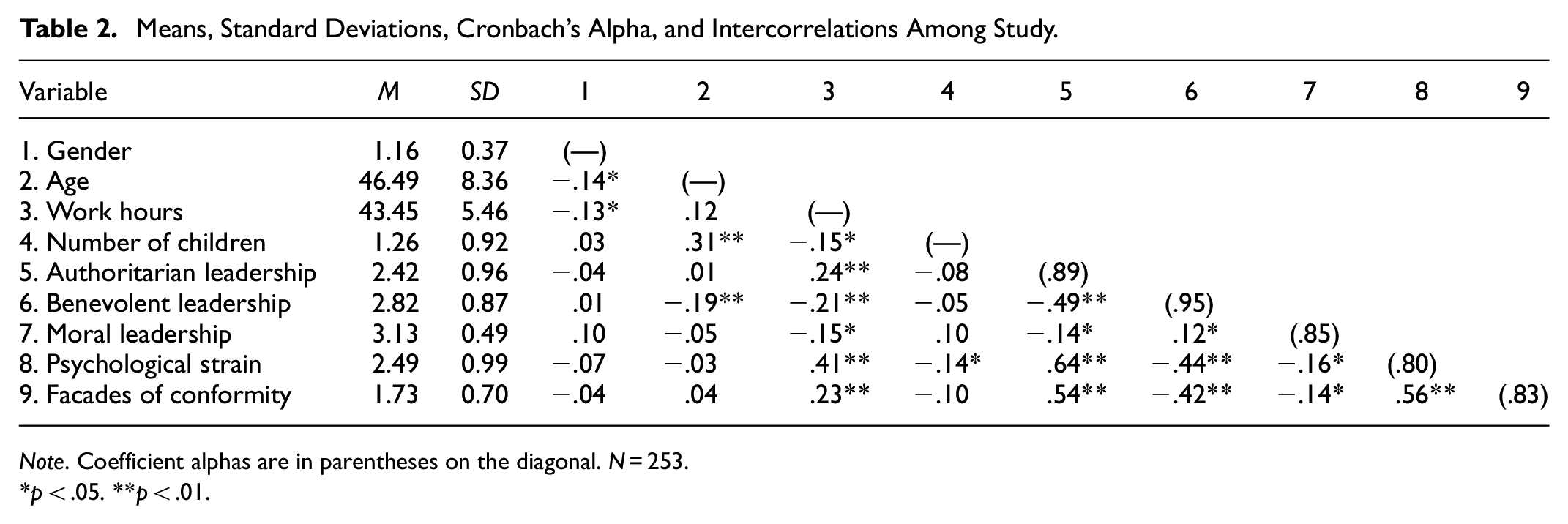
Note. Coefficient alphas are in parentheses on the diagonal. N = 253.
*p < .05. **p < .01.
This study employed weighted least square estimators to evaluate the theoretical model. Table 3 shows that the results of the comparison of the theoretical model (i.e., three partial mediation models) with three alternative mediation models and a full mediation model. The study predicted three paths by which psychological strain mediated the relationship between leader authoritarianism and facades of conformity, psychological strain mediated the relationship between leader benevolence and facades of conformity, and psychological strain mediated the relationship between leader morality and facades of conformity. Compared with the alternative models 1 to 4 in Table 3, under the principle of model parsimony, the theoretical model showed a perfect fit and was the best model.
Comparison of Structural Equation Models for Alternative Models of Paternalistic Leadership and Its Outcomes.
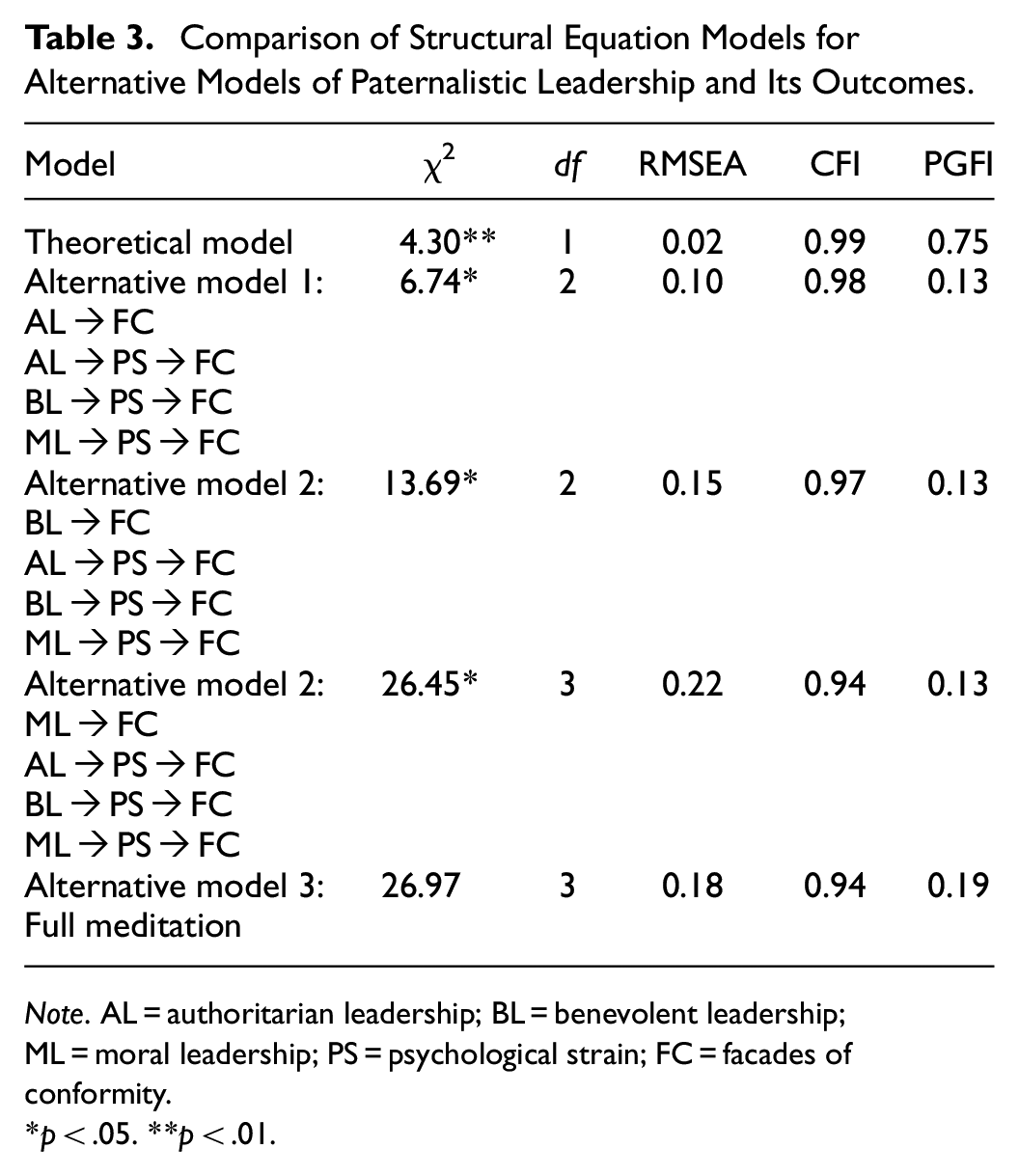
Note. AL = authoritarian leadership; BL = benevolent leadership; ML = moral leadership; PS = psychological strain; FC = facades of conformity.
*p < .05. **p < .01.
Hypothesis 1a was supported that the direct effect of authoritarian leadership on facades of conformity was significant (β = .19; p < .01; see Figure 1). Hypothesis 1b was supported that benevolent leadership was negatively associated with facades of conformity (β = −.12; p < .01). Hypothesis 1c was supported that moral leadership was negatively associated with facades of conformity (β = −.10; p < .01). In addition, the results of this study reported that Hypothesis 2a was supported that leader authoritarianism was positively associated with psychological strain (β = .57; p < .01), Hypothesis 2b was supported that leader benevolence was negatively related to psychological strain (β = −.19; p < .01), Hypothesis 2c was supported that leader morality was negatively related to psychological strain (β = −.16; p < .01). This study also employed the bootstrapping approach to examine the indirect effect of leader authoritarianism on facades of conformity through psychological strain, which was significant (z = 5.15, p < .01, with a 99% bootstrap confidence interval ranging from 0.08 to 0.26), supporting Hypothesis 3a. The psychological strain significantly mediated the relationship between benevolent leadership and facades of conformity (z = −5.65, p < .01, with a 99% bootstrap confidence interval ranging from −0.26 to −0.09), supporting Hypothesis 3b. Lastly, the psychological strain significantly mediated the relationship between moral leadership and facades of conformity (z = −4.76, p < .01, with a 99% bootstrap confidence interval ranging from −0.21 to −0.06), supporting Hypothesis 3c.

Results of structural equation modeling on the theoretical model.
Discussion
The results of this study are interesting and intriguing. The author found that different dimensions of paternalistic leadership produced dissimilar effects on facades of conformity. Authoritarian leadership is highly related to employees’ creation of facades of conformity, while both benevolence and morality are associated with lower degrees of facades of conformity. A reasonable explanation concerning the different effects of authoritarian leadership, benevolent leadership, and moral leadership may be followers’ preferences for leaders’ expressions of authoritarianism, benevolence, or morality. As Chinese followers’ ideologies are supported through holistic and individualized concern from benevolent leaders and moral leaders (Farh et al., 1997), it is likely that followers of benevolent leaders and moral leaders will experience interactive harmony with their leaders and will honestly conform to their leaders’ values. In contrast to these leaders, authoritarian leaders display high authority and control followers’ motivations and behaviors (Wang et al., 2018). Therefore, it is expected that followers may suppress their personal values and pretend to conform to authoritarian leaders’ values.
In addition, X. P. Chen et al. (2014) suggested that one reasonable explanation for the nonsignificant relationship between authoritarianism and employee performance may be the lack of a psychological mechanism as an important mediator. This study found that the critical mechanism of psychological strain mediated the relationship between paternalistic leadership and facades of conformity. The results of this study indicate that authoritarian leaders produce psychological strain among employees, which then results in the creation of facades of conformity, whereas both benevolent leaders and moral leaders create less psychological strain among subordinates, leading to followers honestly facing and accepting leaders’ values. Subordinates who experience high degrees of authoritarian leadership have high levels of psychological strain, whereas subordinates who experience high degrees of benevolence and morality have low degrees of psychological strain and perform low levels of fake behaviors toward benevolent leaders. These results of this study are consistent with prior studies that have shown that in the Chinese culture, authoritarian leadership is related to negative behaviors (i.e., followers’ aggression; Harms et al., 2018) and produces high levels of anger (Wu et al., 2002) and negative emotions among followers (Pellegrini & Scandura, 2008). Subordinates who face high levels of benevolent leadership display gratitude and repayment behaviors toward the leader (Cheng et al., 2004). The results of this study reveal the research limitation in X. P. Chen et al. (2014), indicating that the anger and fear generated by authoritarian leaders may reduce employee performance because high pressure reduces employees’ inherent motivation to work.
Theoretical and Practical Implications
This study offers three theoretical contributions. First, this study provides a complete understanding of the distinct effects of authoritarian, benevolent, and moral leadership on facades of conformity through which employees suppress their personal values and pretend to embrace leaders’ values by drawing on SET. Inauthentic behavior, or facades of conformity, plays a particularly essential role in affecting organizational and individual performances (Hewlin, 2009). As the results of this study show, authoritarian leadership is more likely to result in followers’ creating facades of conformity than are both benevolent leadership and moral leadership. Authoritarian leadership often involves authority and control over followers’ motivation, resulting in followers suppressing their values and thoughts and pretending to embrace leaders’ values and beliefs. Particularly, the Chinese subordinates may suppress their personal values and pretend to support organizational values for surface harmonious relationships when they face leader authoritarianism. Contrary to the effect of authoritarianism on the followers’ fake behavior, benevolent and moral leaders who develop long-term social exchanges with subordinates, and treat subordinates fairly may reduce subordinates’ inauthentic behavior.
Second, this study emphasizes the importance of a mediating role between these three styles of paternalistic leadership and facades of conformity. It explores whether psychological strain is an important explanatory mechanism for the relationship between these three styles of paternalistic leadership and facades of conformity. In particular, this study highlights the importance of psychological strain in the leadership process when followers experience different styles of leadership. Obviously, authoritarian leaders may generate higher strain than benevolent leaders and moral leaders among their followers.
Finally, this study extends paternalistic leadership research by presenting that authoritarian leaders could produce subordinates not only a fake behavior, but also by influencing how they generate facades of conformity by psychological strain. Prior studies have suggested that authoritarian leaders influence subordinates’ voice (Y. Zhang et al., 2015), organizational citizenship behavior (X. P. Chen et al., 2014), and followers’ well-being (Harms et al., 2018). However, research on paternalistic leadership has consistently assumed a social exchange perspective, neglecting paternalistic leaders’ potential to produce subordinates’ negative psychological status and negative behavior (i.e., facades of conformity). This study provides another perspective to understand the effects of paternalistic leadership on subordinates’ emotion and behavior by drawing on AET.
In terms of practical implications, the results of this study give rise to three suggestions. First, this study shows that followers with facades of conformity refer to followers experiencing leadership styles that cause them to conform to the leaders. Followers in organizations who set aside their own values and falsely accept their leaders’ values may not accept the style of authoritarian leadership. Therefore, it is suggested that authoritarian leaders in organizations should provide suitable support when followers need help. Second, leaders should consider investing more resources and endeavor to shown concern for followers’ well-being. Regardless of which style of paternalistic leadership is used, employees are an important resource and human resource in organizations. Therefore, when followers gain a sense of accomplishment in their work, leaders may provide appropriate person-oriented reciprocity (e.g., high-quality leader-follower relationships) rather than task-oriented rewards (e.g., bonuses). To date, some researchers have consistently reported that the relationship quality between a leader and his/her followers is related to valuable consequences for followers and their organizations, such as interactive behaviors and performance (Martin et al., 2018; Yu et al., 2018). Finally, when followers perceive that their ideas are similar to those of the majority, they may be more confident in expressing their thoughts due to authoritarianism. Therefore, if leaders support the suggestions proposed by their followers and express individualized concern to prevent followers from engaging in fake behaviors, followers may have greater abilities and confidence in contributing their efforts that have beneficial effects for the organization.
Limitations and Suggestions
Despite the theoretical and practical contributions, this study has some limitations. First, the CMV existed in this study. Although this study distributed surveys at two time points to one sample (i.e., employees), the data were collected from the same source through the use of self-report questionnaires for employees. It is recommended that future researchers collect data from various participants, such as leaders who could assess their leadership styles. Second, prior studies relating to paternalistic leadership research have paid attention to cultural factors (X. P. Chen et al., 2014; Pellegrini & Scandura, 2008). The participants of this study were from Taiwan, which raises the question of generalizability due to the different cultures in organizations. Employees in Asia may bear higher levels of authoritarian leadership from their employers than other populations to protect reputation. However, the findings of this study show that leader authoritarianism is positively associated with facades of conformity, whereas both leader benevolence and leader morality are negatively associated with facades of conformity. Therefore, this study suggests that future studies could test various cultural samples to diminish generalizability issues. Finally, even though data were collected from employees of a large retail, distribution, and logistics subsidiary corporation, this study might not be applicable to general issues at organizational level (i.e., paternalistic leadership) for leaders because of practical constraints; in the future, leaders could be asked to complete paternalistic leadership surveys to avoid CMV.
Footnotes
Declaration of Conflicting Interests
The author declared no potential conflicts of interest with respect to the research, authorship, and/or publication of this article.
Funding
The author received no financial support for the research, authorship, and/or publication of this article.

Data Availability Statement
Data sharing not applicable to this article as no datasets were generated or analyzed during the current study.