



Abstract
Trust in science has become a major factor in combating the COVID-19-caused crisis. This study aimed to investigate the underlying mechanism between public engagement with science (PES) and trust in science during the pandemic. A large-scale survey (N = 9,490) was conducted in China. First, the distinction between general trust in science and specific trust in science regarding the pandemic was examined. Second, the association between PES and trust in science concerning the pandemic was examined. Third, a structural equation model was applied to investigate the relationship between PES and trust in science. The results showed that both types of trust were associated with PES, and the perceived prominence of scientists during the pandemic mediated the effect of PES on trust in science. These findings demonstrated that scientists’ performance and participation in the public sphere are vital for promoting confidence in science during the pandemic.
Plain Language Summary
This study aimed to investigate the association between public engagement with science (PES) and trust in science during the pandemic. A large-scale survey (N = 9490) was conducted in China and a structural equation model was applied to investigate the relationship between PES and trust in science. This study showed that the perceived prominence of scientists during the pandemic mediated the effect of PES on trust in science. This finding demonstrated that scientists’ performance and participation in the public sphere are vital for promoting confidence in science during the pandemic. The main limitation of this study is that the participants were primarily university students which was not representative of the entire population of China.
Keywords
Introduction
Trust in science was critical during the COVID-19 pandemic, as it facilitated public compliance with scientifically informed government mandates such as lockdowns, wearing facemasks, social distancing, and mass vaccination (Bicchieri et al., 2021; Eichengreen et al., 2021; Plohl & Musil, 2021). However, the question of how to safeguard or rebuild trust in science remains a significant challenge during and even after the pandemic.
This study’s theoretical foundation rests on the principles of Public Engagement with Science (PES). In the field of science communication, PES has emerged as a key paradigm for building and maintaining public trust in science, marking a shift away from the traditional “deficit model” which assumed public skepticism stemmed from a lack of knowledge. Instead, PES posits that trust is fostered through a multi-directional dialogue between scientists, policymakers, and the public (Irwin, 2006). By promoting transparency and a “public-spirited” approach to addressing controversies, PES serves as a crucial mechanism in scientific governance for repairing trust deficits (Goñi, 2024). The COVID-19 pandemic provided a natural social experiment to test the relationship between PES and trust in science. We therefore empirically examined the relationship between PES and trust in science during the COVID-19 pandemic in China through a structural equation model. Our analysis revealed that, despite a significant divergence between general trust in science and specific trust in science regarding the pandemic, both were promoted by PES. Moreover, in this study, the underlying mechanism between PES and trust in science was investigated from the perspective of perceived prominence of scientists. The results provide insights into the associations between PES and trust and the mechanism underlying them, as well as underscoring the importance of scientists’ research and engagement in the public sphere for overcoming the confidence crisis during the pandemic.
Next, we conduct a literature review and, based on that, propose the hypotheses of our research model. Section “Method” details the method employed. Section “Results” presents the results of this study. Section “Discussion”and “Conclusion”are discussion and conclusion respectively.
Trust in Science During the Pandemic
Trust in science is an intangible safeguard for freedom of inquiry in modern societies and a primary resource in a changing historical context (Bauer et al., 2000). Trust is also essential for effective science communication because it influences beliefs in scientific findings, support for science-related decisions, and attention to guidance from scientific experts (National Academies of Sciences & Medicine, 2017). Presently, a hostile public can seriously constrain or veto a contentious research program or science-related project today (Sturgis & Allum, 2004); consequently, the imperative for trust in science is more pressing than ever before. The increasing perception of risks stemming from either malicious uses or inadvertent side-effects of science are also noteworthy (Sztompka, 2007).
When the COVID-19 pandemic broke out, prevention measures were only effective if they garnered general public acceptance (Siegrist & Bearth, 2021). A lot of studies assert that trust in science is associated with better adherence to prevention measures. For instance, trust in science is negatively correlated with hesitancy of COVID-19 vaccine (Carrieri et al., 2023). Another study also found that higher national levels of trust in science correlate with increased public confidence in vaccination (Sturgis et al., 2021). Furthermore, trust in science mediates the relationship between political ideology and approval of the measures (Sulik et al., 2021). Trust in science and scientists has been identified as the dominant predictor when it comes to predicting “obedient behavior,” especially for citizen’s compliance with nonpharmaceutical interventions over longer periods (Algan et al., 2021; Jiménez-Loaisa et al., 2024). Therefore, cultivating and sustaining public trust has been an urgent necessity for effective epidemic control and science communication.
Given the multidimensionality of trust in science, two types of trust are typically differentiated: general trust and specific trust regarding the pandemic. General trust is defined as trust without reference to any specific risk or hazard (Sjöberg, 2001). Conversely, hazard-specific trust metrics must be developed, as generalized scientific trust demonstrates limited explanatory power for context-bound risks (Sjöberg, 2001). Public Understanding of Science (PUS) studies have demonstrated that scientific knowledge positively correlates only with “general” attitudes toward science, but not with domain-specific evaluations of technologies such as biotechnology, nuclear energy, or stem cells (Allum et al., 2008; G. Evans & Durant, 1995). It is perhaps because the public beliefs on specific scientific topics differ from their general ideas on science (Myers et al., 2017). Therefore, a general trust in science should be distinguished from a specific trust in science during the COVID-19 pandemic concerning its risk.
Although individuals may respond to the pandemic with suspicion, skepticism, and conspiracy theorizing (Bolsen et al., 2020; Linden et al., 2020; Majid et al., 2020), a shared external threat and perceived risk induced by the pandemic may also serve to increase trust in science (Van Bavel et al., 2020). Consequently, trust in science varies in different countries. Trust in science remained stable in the US following the first few months of COVID-19 (Agley, 2020). Some evidence demonstrates that trust in science and scientists can increase during a pandemic. A study conducted during the COVID-19 outbreak in Italy indicated that while a new threat is experienced, reliance on scientists and experts initially increases, but the duration of this increase may be short (Battiston et al., 2020). Another study indicates that trust in science among Germans increased substantially following the onset of the pandemic, with a slight decline observed in subsequent months (Bromme et al., 2022). A similar study shows that trust in scientists initially rose in the US, Germany, and South Africa at the pandemic’s start, but then fell due to increasing politicization (Weingart et al., 2022). Public trust in physicians in China increased during the pandemic, a change likely attributable to the physicians’ willingness to treat COVID patients at a high risk of exposure (Li et al., 2023). Another study also finds no distinct decrease toward trust in physicians during the pandemic (Liu et al., 2023). Nevertheless, the investigation into the public trust in science in China is limited. Based on our discussion, we proposed the first hypothesis:
PES and Trust in Science
Multiple studies have modeled the association among trust in science, reliance on social media, political ideologies, level of religiosity, belief in conspiracy theories, pandemic awareness, and virus anxiety (Alkış Küçükaydın et al., 2023; Lăzăroiu et al., 2020). However, studies on the interactions between trust in science during the pandemic and PES are limited.
The science communication field has undergone a paradigm shift—from the “deficit model” of public understanding of science (PUS) to “public engagement with science” (PES) (Holden, 2002) as the “dialogue model” (Davies & Horst, 2016). Deficit model emphasizes that the more individuals know about science, the more favorable their attitudes toward it will be (Sturgis & Allum, 2004). While empirical studies indicated a relationship between scientific literacy and public trust in science (Allum et al., 2008; Gauchat, 2008), this relationship remains weak and fails to adequately account for public attitudes toward specific areas of science.
In contrast, PES promotes the two-way dialogue and public participation through a fair, open, and transparent process. This approach can improve the legitimacy of a decision and diminish controversy around science in the public sphere (National Academies of Sciences & Medicine, 2017). Therefore, public deliberation and participation have been the new “royal road” to rebuild public trust (Bauer et al., 2007). As the UK House of Lords Report (House of Lords, 2000) stated, face-to-face communication with the public should “move from being an optional add-on to science-based policy making” and instead become “a normal and integral part of the process.”
Furthermore, relative to the UK, the US, and the EU, empirical studies of PES and trust in science are limited in China. On the one hand, because public protests against certain science and technology issues have occurred across China, suggesting that avoiding debates and participation could increase social tensions and public distrust (Jia & Liu, 2014). On the other hand, public engagement contributes positively to public acceptance of specific controversies such as nuclear energy in China (Wang et al., 2019). The COVID-19 outbreak and its accompanying risks offer a natural research context for investigating the relationship between PES and trust. The influence of PES on general trust in science and specific trust in science regarding the COVID-19 pandemic in China should be explored. Therefore, the second hypothesis is proposed:
Perceived Prominence of Scientists During the Pandemic
The relationship between PES and trust is the foundation of PES research. However, the underlying mechanism by which PES influences trust in science remains ambiguous. If enhanced engagement alone cannot be presented as an antidote for public distrust (Irwin, 2006), then which factors motivate an engaged public to trust in scientists and scientific understandings in science-related controversies? Beyond demographic variables such as social class, ethnicity, gender, and religiosity, several variables are potential to explain the mechanism of the relationship between PES and trust in science. For instance, political ideology was a robust indicator for trust in science in the United States, indicating a growing political polarization of science (Gauchat, 2012). However, the political institution and culture of China differ from those of, for example, the United States; thus, we cannot categorize Chinese political ideology as conservative and liberal, let alone employ it as an indicator.
Another key indicator is the public’s perceived image of scientists. To address the problem of scientific misinformation especially during the pandemic, “who speaks for science?” has become a core question instead of “why trust science?” (Allchin, 2022) This involves several specific aspects, such as scientists’ engagement, motivation, position, or role, which collectively affect their performance to speak for science. For instance, a scientist’s professional attributes, such as their field and institution, are more critical to public trust than their personal demographics like race or gender (Sonmez et al., 2023). Moreover, public trust tends to be placed in respected and familiar scientists whose advice was perceived as free from political, financial, or reputational interests (Machado et al., 2024). Seyd et al. demonstrated that public trust in scientists depends not only on their perceived competence but also on their benevolence and integrity (Seyd et al., 2025). Given that PES is often assumed to be an “open and honest dialogue between scientists and the public” (Haerlin & Parr, 1999), scientists’ public engagement is crucial for the efficacy of PES (Bauer & Jensen, 2011). Gauchat argued that attitudes toward science-related polices are influenced more by the public’s perceptions of where credible experts are socially positioned and what attributes they are perceived to embody (Gauchat, 2011). For instance, trust in partisan scientists may have declined after the Bovine Spongiform Encephalopathy crisis in the UK, whereas independent academic scientists and those affiliated with non-commercial advocacy sectors (e.g., consumer or environmental groups) consistently demonstrate higher trustworthiness (Millstone & Van Zwanenberg, 2000). Furthermore, the literature has shown that public trust in stem cell scientists is significantly influenced by perceptions of researchers’ motivations and the intended beneficiaries of such research (Critchley, 2008). Horst concluded that scientists should adopt the roles of experts and guardians of science, rather than research managers, if they want to establish legitimacy as spokespeople for scientific knowledge and the science institution (Horst, 2013).
To conceptualize the disparate aspects of perceptions of scientists, we developed a comprehensive concept, “perceived prominence of scientists during the pandemic” (PPSP). The prominence of scientists’ research and their voice in the public sphere during the pandemic is an overarching framework of PPSP, which explicitly captures the most important aspects of the role and performance of scientists.
Previous research argued that scientists are deeply engaged in socially relevant issues (Shapin, 2012). Moreover, the public role of scientists has evolved from primarily engaging policy-makers to encompassing direct engagement with diverse public constituencies (Myers et al., 2017), which is consistent with the PES idea. When it comes to the COVID-19 pandemic, on the one hand, the public is more likely to acknowledge scientists’ understanding of COVID-19 than to endorse the value framework guiding scientists’ pandemic responses (J. H. Evans & Hargittai, 2020). On the other hand, the medical community devoted enormous resources to vaccine development but insufficient effort to conveying their vaccine trust to the public (Bartoš et al., 2022). During the COVID-19 pandemic, the “good doctor” image established by social and mainstream media may have improved patients’ trust in physicians in China (Li et al., 2023). In other words, PPSP is a promising bridge between PES and trust. Accordingly, PPSP might mediate the effects of PES on trust in science in general and in specific. Based on our discussion, the third hypothesis is proposed:
H1 to H3, on the relationship between PES, PPSP, and trust, are displayed in our proposed theoretical framework (Figure 1).

Hypothesized model of this study.
Method
Participants and Sampling
This study is a cross-sectional design. It was conducted from September to November 2020 in China. The participants were recruited by cluster sampling from two universities which were located in Xiamen (south of China) and Beijing (north of China), respectively. University students from the two universities were invited to complete an online survey by clicking an online questionnaire link distributed by their class teachers. The link was produced by the “Wenjuanxing” platform, a data-collection platform in China. Before participating in this study, all participants were informed of its purpose and procedure and their right to withdraw at any time. Online informed consent was provided for all participants before beginning the survey.
A total of 9,854 participants filled out the questionnaire. To ensure the quality of participants, we applied the following selection criteria: (a) Only participants between 16 and 40 years old were included, as participants outside this range might not be students or have provided wrong information. (b) Participants who provided the same response to all the items were excluded (e.g., select 1 for all items). (c) Only participants who spent more than 10 min completing the questionnaire were included, given that respondents who completed the questionnaire within 10 min were highly unlikely to have read the questions carefully. Regarding (c), all results were robust when we adjusted this criterion to 11 min, 12 min, and so forth. These criteria excluded 364 participants, leaving a final sample of 9,490 qualified participants.
Measures
Demographic Measures
The following demographic characteristics were included in the present study: age, gender, ethnic group, religious faith, education background, type of residence, family economic status, subjective social class, and media preference. Social class was self-evaluated through an 11-step ladder scale, ranging from step 0 (lowest) to step 10 (highest), where participants indicated their current perceived position. Media preference was operationalized via one question: “In terms of information acquisition, do you rely more on traditional media such as TV and newspaper or new media such as the internet?” Responses were on a 5-point scale from 1 (totally rely on traditional media) to 5 (totally rely on new media).
Public Engagement with Science
The measurement of public engagement with science (PES) was adapted from established scales developed by previous studies (Dijkstra et al., 2012; Gu & Feng, 2022), comprising a total of seven items. These items captured both PES activities and attitudes. Participants were asked indicate their level of agreement on a 5-point scale from 1 (strongly disagree/not at all) to 5 (strongly agree or extremely). Sample items included: “Even as a layperson, I am willing to have dialogues with scientists on scientific issues,” and “Do you ever participate in any science-related social activities, such as expressing your opinion for or against genetically modified food?” A composite PES score was calculated by summing all seven items (Cronbach’s α = .68), with higher scores representing higher levels of PES.
Trust in Science
We developed a five-item trust-in-science questionnaire based on previous literatures (Gauchat, 2008, 2011, 2012). Since the original description of general trust items were not applicable in this study (e.g., “Science and technology change life too fast.”), we transposed the specific attitudes regarding stem cells and global warming to the COVID-19 pandemic context. Participants were asked to evaluate their levels of agreement with each statement on a five-point scale (1 = strongly disagree; 5 = strongly agree). Aligned with the purpose of the present study, we developed two subscales for this questionnaire: general trust in science and specific trust in science regarding the pandemic. For instance, “In general, science has more benefits than disadvantages,” and “Science is the best way to fight the COVID-19 pandemic.” We calculated the total scores for the “general trust” scale (Cronbach’s α = .71) and the “specific trust” scale (Cronbach’s α = .64), with higher scores indicating higher general and specific trust, respectively.
Perceived Prominence of Scientists
Two items were adopted to measure PPSP (i.e., “It is not important for me to know about scientists’ research on the COVID-19 pandemic” and “I rarely saw scientists’ comments on important issues during the COVID-19 pandemic”). The items were based on the study regarding the salience of scientific research (Miller, 2004), which adapted on the basis of the theory framework discussed above. Responses were rated on a 5-point scale, from 1 (totally disagree) to 5 (totally agree). We reversed coded the two items and added them together to generate a composite score of PPSP (Cronbach’s α = .61).
Statistical Analysis
First, descriptive statistics were performed using sociodemographic characteristics. Second, we split the sample into two parts according to different locations of data collection. An exploratory factor analysis (EFA) using one part of the sample (from one university), and a confirmatory factor analysis (CFA) using the other part of the sample (from another university) were conducted to determine the construct of the PES and trust-in-science questionnaires. Principal Component Analysis and Direct Oblimin Rotation was used in EFA, and Maximum Likelihood Estimation (MLE) was used in CFA. Third, Pearson correlation analysis was conducted to explore the bivariate relationship between independent, mediating, and dependent variables. Fourth, a paired t test was performed to compare the difference between general trust and specific trust in science. Finally, structural equation modeling was established to investigate the hypothesized mediation model through two steps: MLE and bias-corrected bootstrapping. The first step was used to verify the direct effects from PES to two types of trust; the second step was used to examine the indirect effects of PES to trust through the mediation of PPSP.
All variables in the models were performed as latent variables to obtain robust results. Model fitness was evaluated by the chi-squared–degree of freedom ratio (χ2/df), root mean square error of approximation (RMSEA), comparative fit index (CFI), Tucker-Lewis index (TLI), and standardized root mean residual (SRMR) (Hu & Bentler, 1998). The acceptable criteria for the model were defined as RMSEA < 0.08, CFI > 0.90, TLI > 0.90, and SRMR < 0.08 (Zhonglin et al., 2004). All statistical analyses were performed using IBM SPSS 23.0, Mplus 8.3, and data visualization using R 4.0.2. The statistical significance level was set at two-tailed 0.05.
Results
Demographic Characteristics
The demographic characteristics of the final 9,490 participants were shown in Table 1. Age of participants ranged from 16 to 40 years (Mage = 20.80, SD = 3.61). Of the total sample, 5,519 (58.2%) participants were females, and 5,070 (53.4%) were undergraduates. Most participants were Han ethnic (89.6%), from urban areas and towns (85.1%), with no religious faith (97.0%), had moderate family economic status (74.9%), were in a moderate perceived social class (77.9%), and preferred over other methods of using new media and the internet to obtain information.
Descriptive Statistics of the Sample (N = 9,490).

Construct Validity and Reliability
The total score of PES (7 items) ranged from 7 to 35 (0.0% scored 7 and 0.1% scored 35, both less than 15%). Thus, the PES questionnaire did not demonstrate ceiling or floor effects (Lim et al., 2015). Results of Kaiser-Meyer-Oklin (KMO) test and the Bartlett test of Sphericity showed that the data was suited for factor analysis (KMO = 0.70; χ2 = 4989.00, df = 21, p < .001). Two factors (i.e., PES activities and PES attitudes) were extracted by CPA with the criterion of eigenvalue >1, accounting for 52.9% of the total variance. Table 2 shows the results of EFA and factor loadings under Direct Oblimin Rotation for each item. The results of CFA showed that the construct validity was acceptable (χ2/df = 29.524, RMSEA = 0.077, CFI = 0.942, TLI = 0.907, SRMR = 0.039).
Factor Loadings of the PES Questionnaire (N = 4,652).

Note. PES = public engagement with science. Factor 1: PES activities; Factor 2: PES attitudes.
The construct of the trust-in-science questionnaire was also verified. The total score of trust in science (5 items) ranged from 5 to 25 (0.1% scored 5 and 5.2% scored 25, both less than 15%). Thus, there were no ceiling or floor effects in this questionnaire (Lim et al. 2015). Results of the KMO and Bartlett test of sphericity showed that the data was appropriate for factor analysis (KMO = 0.68; χ2 = 3981.85, df = 10, p < .001). As Table 3 shows, two fixed factors (i.e., general trust in science and specific trust in science regarding the pandemic) were extracted, accounting for 64.9% of the total variance. The CFA results showed that the construct validity of this scale was good (χ2/df = 12.803, RMSEA = 0.049, CFI = 0.991, TLI = 0.977, SRMR = 0.014).
Factor Loadings of the Trust in Science Questionnaire (N = 4,652).

Note. Factor 1: general trust in science; Factor 2: specific trust in science regarding the pandemic.
Differences between general trust and specific trust in science
The results of the paired t test supported H1. The specific trust in science regarding the pandemic (M = 4.14, SD = 0.51) was significantly higher than the general trust in science (M = 3.96, SD = 0.65) among Chinese participants, t (9489) = 27.86, p < .001, d = 0.26, 95% CI [0.23, 0.28].
Correlations Between Interested Variables
Pearson correlation analyses were conducted to examine the bivariate relationship between focal variables (Figure 2a). The results of the correlation indicated that general trust was positively correlated with PES, especially the PES attitudes (r = 0.34, p < .01). Specific trust was also positively correlated with PES, especially the PES attitudes (r = 0.29, p < .01). General and specific trust were positively correlated with PPSP (rgeneral = .18, p < .01; rspecific = 0.29, p < .01). In addition, all correlations between trust and demographic variables were low (r < .10), indicating that there was no strong association between sociodemographic characteristics and general trust or between sociodemographic characteristics and specific trust (Figure 2b).

Bivariate correlations regarding main variables and demographic variables. A. Correlations among main variables; B. Correlations between main variables and demographic variables.
Mediating Effects of the Hypothetical Model
A model of direct effects of PES on general and specific trust in science was established, which showed acceptable fit (χ2/df = 30.401, RMSEA = 0.053, CFI = 0.931, TLI = 0.909, SRMR = 0.039). The direct effects of PES on general trust (β = .47, 95% CI = [0.44, 0.50], p < .001) and specific trust (β = .41, 95% CI = [0.38, 0.45], p < .001) were significant. It explained 22.4% of the variance in predicting general trust in science and 17.1% of the variance in predicting specific trust regarding the pandemic. Thus, the results of direct effects supported H2.
Another model of indirect effects of PES on general and specific trust in science was constructed by adding the mediator of PPSP (Figure 3). This model showed an acceptable fit (χ2/df = 27.42, RMSEA = 0.052, CFI = 0.944, TLI = 0.925, SRMR = 0.037). It explained 26.8% of the variance in predicting general trust in science and 34.3% of the variance in predicting specific trust during the pandemic.
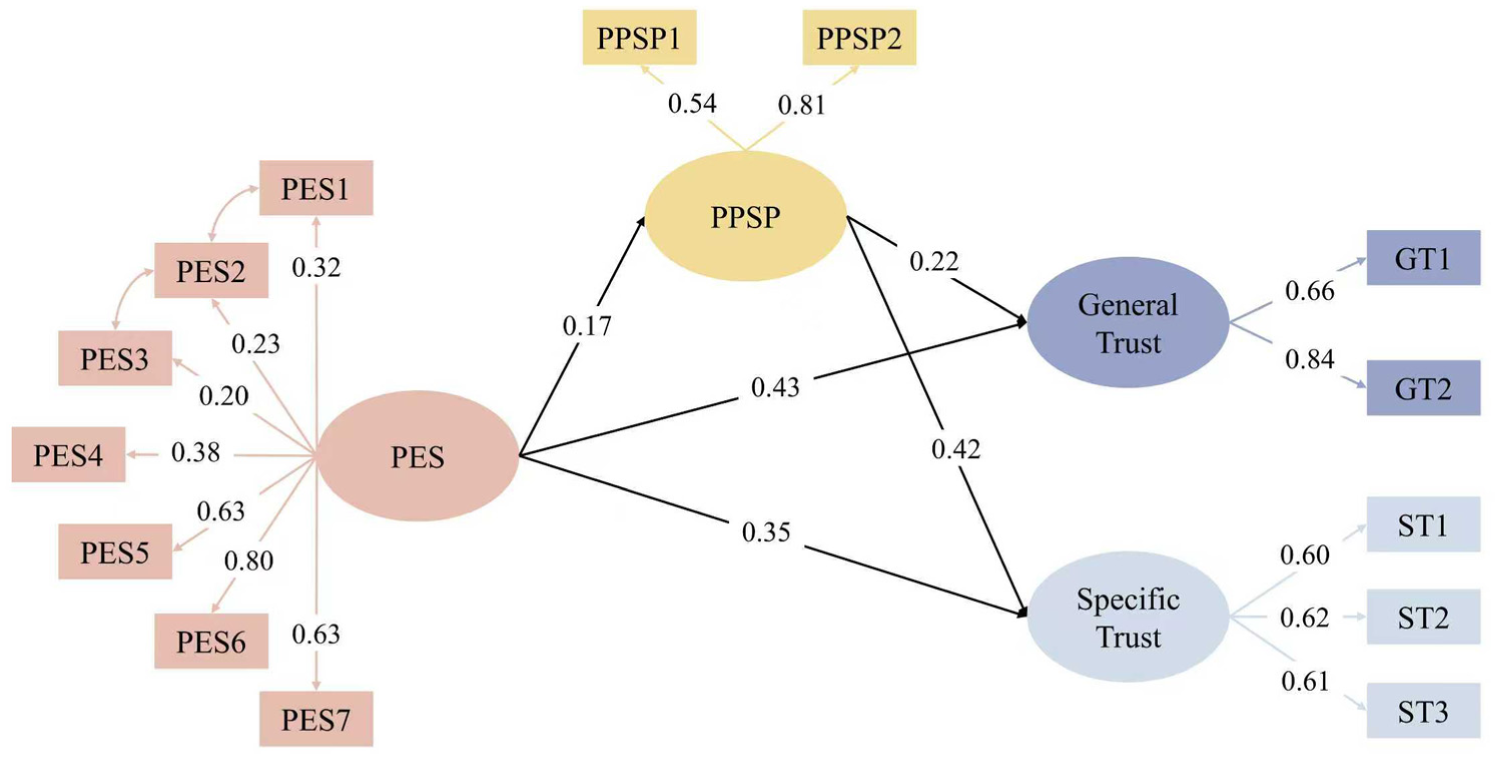
Final structural equation model.
As Table 4 shows, the results of indirect effects showed that PPSP mediated the effects of PES on general trust (β = .04, 95% CI = [0.03, 0.05], p < .001) and on specific trust (β = .07, 95% CI = [0.05, 0.09], p < .001) significantly, supporting H3. Moreover, the mediating effect of PSSP on specific trust (β = .07) was stronger than on general trust (β = .04), whereas the direct effects of PES on specific trust (β = .41) was weaker than on general trust (β = .47).
Standardized Direct and Indirect Effects for the Mediation Model.

Note. LLCI = lower level of 95% confidence interval; ULCI: upper level of 95% confidence interval. GT = general trust in science; ST = specific trust in science regarding the pandemic. All estimates generated from 5,000 bootstrapped resamples.
Discussion
The goal of this study was to advance understanding of the complex interactions between PES and trust in science, especially during the COVID-19 pandemic in China. While the previous literature in this area has explored this relationship, it has not fully examined the impact of PES on both general and specific trust in science, nor the underlying mechanism between them. On the basis of theoretical and conceptual perspectives on PES and trust in science, we established a structural equation model in which PPSP mediated the effects of PES on general trust and specific trust. A minor finding was that demographic characteristics were not strongly related to trust (both general trust and specific trust) in science, a result likely attributable to the homogeneity of our participants sample (college students) in terms of education and age.
Our model uncovers three valuable findings. First, the specific trust in science regarding the pandemic was significantly higher than the general trust in science. This finding is consistent with the argument that general attitudes toward science and attitudes toward science in a specific context necessitate separate empirical assessment (Allum et al., 2008; G. Evans & Durant, 1995). Moreover, this result seems reasonable because the Chinese government claimed that it exploited the pioneering role of science and technology and fully applied these innovations to support virus control, which contributed to the success in cutting all channels for the transmission of the virus (“Fighting COVID-19: China in Action,”2020). Given China’s practical success in largely halting virus transmission, it is no surprising that public trust in science concerning risk of the pandemic is higher than general trust in science.
Second, PES positively predicted trust in science. In other words, fostering public enthusiasm for scientific engagement and expanding participatory opportunities in science-related activities strengthens public trust in science. More importantly, this study provides the first rigorous empirical evidence demonstrating that PES positively influences trust in science concerning the specific risk of the COVID-19 pandemic. Thus, PES should be an effective approach to maintain or facilitate public trust in science during the pandemic. Accordingly, for high-stakes science policy issues such as COVID-19 vaccination, scaling up PES activities—including scientific consensus conferences, public science fora, and online deliberations—is critical for effective pandemic mitigation. The classic conceptualization of PES focuses on the political dimension which highlights the public’s right in policymaking and public participation in constructive dialogue for policymaking. This form of PES has not yet fully materialized in China. Nevertheless, China exhibits continual development of PES, advancing toward more engaging and inclusive science communication. The public should be increasingly “engaged” by diversified scientific content through progressively interactive platforms (Jia, 2022).
Third, our results showed that the effects of PES on trust in science were partially mediated by PPSP, which was confirmed an important, unique contributor to trust in science and a novel mediator between PES and trust in science. This result indicates that perceived scientists’ image and performance are crucial for trust in science. This finding is consistent with the assertion that individuals’ perceived image of science may exert a greater influence on trust formation than their factual knowledge of scientific methods or findings (Bauer et al., 2000). It also coincides with the conclusion that public trust in physicians in China improved since the pandemic, attributable to the positive image of physicians (Li et al., 2023). Therefore, encouraging scientists’ participation in major public issues and highlighting prominent scientific achievements about COVID-19 would mitigate the crisis of public mistrust induced by the pandemic. This notion coincides with the essence of PES, which emphasizes mutual communication between scientists and the public, especially the mobilization of scientists (Bauer & Jensen, 2011). Transparency and openness of PES were assumed to win back members of the public who had grown skeptical of governmental risk-handling (Irwin, 2006). In contrast, our study demonstrated a novel linkage. Furthermore, the mediating effect of PPSP on specific trust regarding the pandemic was stronger than that on general trust. The possible explanation for this finding is that the influence of PPSP on general trust in science may take longer to emerge.
Conclusion
Addressing declining confidence in science solely by increasing trust is insufficient. Instead, the scientific community should enhance their efforts in science communication to earn public confidence (Lupia et al., 2024). This study provides critical theoretical and practical implications. In theory, our study showed a novel pathway from PES to trust in science. Our final model explained 34.3% of the variance in predicting specific trust during the pandemic, which consolidated PPSP’s role in the indirect effects of PES on trust. This mediation model has at least partially elucidated and deepened the understanding of the complex mechanism between PES and trust in science, especially during the pandemic.
In practice, this study entailed increased attention to promoting PES intentions and activities and an increased focus on enhancing PPSP. As an emerging public issue beyond the scientific community concerning the pandemic, PPSP has become a bridge between science and society. This finding is consistent with previous studies that revealed the importance of messenger or Messaging by elites in scientific communication (Hamilton & Safford, 2021; Hatton et al., 2022). The significance of PPSP indicates China’s alternative approach which encourages “engagement with science communication” rather than “participation in policymaking”. Scientists should not only talk about their findings regarding the pandemic, but also provide information about their roles and strive to enhance their public image (Bromme et al., 2022). Despite facing challenges like time constraints, personal attacks, and the politicization of their advice, scientists should remain committed to open communication to build public trust, including better science communication training, clearer boundaries between scientific advice and political decisions, and fostering collaborative research networks (Lorenzoni et al., 2025).
Although this study represents a pioneering investigation of PES and trust in science with China’s pandemic context, several limitations warrant acknowledgment. First, the participant pool consisted primarily of university students, resulting in a non-representative sample of China's broader population. Further research should therefore validate and extend these findings by sampling diverse demographic groups beyond academic settings. Second, mediation models are meant to imply causality. However, the cross-sectional design without manipulating the PES variables in this study was purely correlational and limited in causal inference. Consequently, methodological diversification—particularly laboratory-based behavioral experiments and longitudinal studies—is essential to establish causal pathways within the proposed mediation model. Third, PPSP partially meditated the effects of PES on trust in science, suggesting that there are other relevant mediators, especially political and psychological factors. Additionally, we hypothesize that some factors might moderate the mediating effects of PPSP (e.g., deference to scientific authority); thus, further research could explore additional related mediating and moderating variables. Finally, this study was distinctly rooted in the Chinese cultural background. For instance, the high level of trust in science, especially during the pandemic, may significantly differ from the situation of the United States. Therefore, in further research, comparative studies investigating Western contexts with different political and scientific cultures could be conducted.
Footnotes
Acknowledgements
We thank Helin Zou and Tuozhen Liu for data visualization and all the participants for their participation.

Ethical Considerations
The ethics committee of Central University of Finance and Economics approved this study.
Author Contributions
CG conceptualized the framework. YF collected and analyzed the data. CG and YF drafted and revised the manuscript. All authors read and approved the final manuscript.
Declaration of Conflicting Interests
The authors declared no potential conflicts of interest with respect to the research, authorship, and/or publication of this article.
Funding
The authors disclosed receipt of the following financial support for the research, authorship, and/or publication of this article: This work was supported by Noncommunicable Chronic Diseases-National Science and Technology Major Project (2023ZD0509601).
Data Availability Statement
The data of this study are available from the corresponding author on reasonable request. The data are not publicly available due to privacy and ethical restrictions.