




Abstract
Previous research on climate-relevant knowledge distinguishes between two types: belief-linked (facts which can be guessed based on general climate beliefs) and belief-neutral (facts which require specific knowledge). To better understand these differences, we used data from nationwide US 2016 and 2021 surveys to develop composite indicators of the two types of knowledge. We analyzed demographic predictors of each type, as well as their effect on climate change belief. Further, we examined the issue of trust in science. The findings point to some novel insights. One, not all knowledge is equal; specific, belief-neutral knowledge in particular is less necessary for climate change belief. And two, trust in science is more relevant for fostering climate change belief than either knowledge type. Although this poses certain challenges, given the ideological divide when it comes to scientific trust, it is also useful information for policymakers and science communicators about where to direct energy and resources when engaging with the public.
Plain Language Summary
This study uses US survey data from 2016 and 2021 to examine different types of knowledge people have about the environment and climate change. One type is belief-linked; these are answers that people guess according to preexisting environmental beliefs. The other type is belief-neutral; this requires specific information, and it cannot be guided or guessed based on beliefs. We find that belief-neutral knowledge is not particularly impactful in whether or not people believe in human-caused climate change. Further, having trust in scientific agencies is more important than either knowledge types. Although our measures provide only a snapshot of knowledge and trust, the findings have important implications about how to best engage with the public on issues related to climate change. Increasing trust in science through exposure to scientific practices is likely more useful than just providing the public with more information about the environment.
Introduction
Belief in both climate change and its human causes has been increasing (Leiserowitz et al., 2018), yet there is an ongoing need to consider ways to engage and educate the public on climate-related issues. Various theories posit that laypeople require more information (information-deficit model, e.g., Bord et al., 2000; Potter & Oster, 2008), guidance from leaders (elite cues model, e.g., Carmichael & Brulle, 2017; Darmofal, 2005), or feedback from social groups to which they are tied (cultural cognition, e.g., D. M. Kahan et al., 2011). Given these hypotheses and the rich literature investigating them, this study poses the questions: When it comes to belief in human-caused climate change, what kinds of knowledge are most important? And is it more impactful for people to have knowledge about the climate, or just to trust those who do?
Trust in scientific authorities has received greater attention in recent years due to the COVID-19 pandemic. Because of the rapidly changing information about the virus and the need for public health guidance, laypeople have had a greater-than-normal exposure to and interaction with scientific agencies such as the Centers for Disease Control and Prevention (CDC). But this is not the only instance of the public-science interface. For many years now, there has been a clear ideological divide in awareness of the scientific consensus on anthropogenic climate change (e.g., Ding et al., 2011; Hamilton, 2016a; McCright et al., 2013). Distrust appears to have less to do with the science itself, and more to do with the filtering processes through which people perceive it.
Along with divisions on trust, the public also displays a wide range of knowledge about climate-related issues. Some of this knowledge has clear ideological alignments, essentially deriving from preexisting beliefs. Other knowledge has no clear alignment, in that answers to factual questions cannot be guessed, rightly or wrongly, on the basis of partisan beliefs (Hamilton, 2018). However, it is not clear how important such belief-neutral knowledge is in shaping public perceptions of climate change. Drawing on 2016 and 2021 US survey data, we address that issue here. First, we examine how respondent characteristics predict belief-linked versus belief-neutral knowledge. Next, we consider how respondent characteristics, knowledge of both types, and general trust in scientific agencies relate to belief in human-caused climate change. This research bridges relevant literatures about the underlying forces that drive environmental attitudes.
Several important findings emerge in this study. For one, it reveals new instances of education × ideology interaction effects, as well as insight into where this effect is absent. This effect has been replicated in multiple studies about environmental knowledge and attitudes. It appears in this study, as well, but not in all models. Notably, the influence of education and ideology differ for environmental knowledge and trust in science. Further, while previous studies have examined the predictors of belief-linked and belief-neutral knowledge, we use this distinction to better understand their role as predictors of climate change belief. This extends the existing body of research by considering real and policy-relevant impacts of knowledge questions. Finally, by incorporating trust of science into the analysis, we provide a fuller picture of both the informational and cultural factors influencing climate attitudes. It is often thought that trust in science contributes to broader science literacy and knowledge. However, our results suggest that trust itself also directly affects climate-change beliefs. Overall, these findings have implications regarding pathways for engaging the public on climate change and related environmental issues.
Literature Review
Climate Change Perceptions
Research on the predictors of perceptions about human-caused climate change is a well-saturated field of study with widely replicated results. Reports suggest that the number of Americans who believe climate change is happening and caused by human activities is growing. In the 2018 Climate Change in the American Mind national survey, nearly three-quarters of people believe climate change is happening, and 62% attribute it to mostly human causes (Leiserowitz et al., 2018; for many other surveys with similar results see Hamilton, 2021a).
Across countless studies, political identity proves to be a key predictor of perceptions regarding climate change (Shwom et al., 2015). While both moderate and strong liberals have closely aligned climate beliefs, strong conservatives are somewhat alienated from their more moderate party affiliates when it comes to their disbelief in climate change. And yet, while partisan divides have been growing, there is also evidence that things may be changing with younger generations. Millennial and Generation Z Republicans are more likely to accept the reality of human-caused climate change and express concern about it, compared to earlier generations (Ballew et al., 2019; Funk & Tyson, 2020; Hamilton, 2021a).
Education plays an important role too. An education × ideology interaction—which we also test here—has been replicated in multiple studies in the US, showing that environmental concern increases with education among liberals but has a neutral if not negative effect on the most conservative (Hamilton, 2008; McCright & Dunlap, 2011a; Shao et al., 2014). Many also find education to have an independent effect, although this may be muted if interactions are not controlled.
Of course, information-sharing has also shifted in significant ways in recent years through the advent of digital technologies and social media. For example, Falkenberg et al. (2022) find that climate change discourse on Twitter has a polarizing effect, driven especially by far-right activity on the platform. Others find that using social media for news can help reduce climate skepticism, but this comes with a major caveat: the relationship is moderated by conservative ideology and low trust in science (Diehl et al., 2021). This is also true offline; politically biased news sources have independent effects on climate change attitudes, but they also mediate the relationship between those attitudes and political and educational predictors (Bolin & Hamilton, 2018). And so, despite the important changes playing out in the media landscape, education remains an important factor in the ways people seek out and interpret information.
There are also gendered differences in climate change belief. McCright and Dunlap (2011b, p.1171) find a “conservative white male effect on climate change denialism,” while Benegal and Holman (2021) find a consistent relationship between sexism and climate denial. In this latter study, the authors suggest that investments in both the capitalist system and the gender hierarchy promote maintenance of the status quo. Even so, gender differences in climate change belief occur primarily among Republicans, whereas Democrats hold a fairly strong consensus. Republican women are significantly more likely than their male counterparts to prioritize renewable energies and say that the US government is not doing enough to combat the effects of climate change (Funk & Hefferon, 2019). Given what is already known about these demographic predictors, it is important to consider the more nuanced ways in which people come to accept or reject climate science.
There are several other factors that research highlights as impacting climate beliefs. These include value systems (Heath & Gifford, 2006; Hornsey et al., 2016; Stern et al., 1995), social networks (Goldberg et al., 2020; Leombruni, 2015), and occupation or industry (Campbell et al., 2019; Morton et al., 2011; Prokopy et al., 2015). Others, such as people’s direct experience with climatic changes or events (Brulle et al., 2012; Deryugina, 2013; Marquart-Pyatt et al., 2014; Zanocco et al., 2018) or geographic location (Howe et al., 2015; Milfont et al., 2014) have more mixed results. While these will not be explicitly addressed in the current study, they provide important context for interpreting these results and understanding the bigger picture of climate change belief.
Another non-demographic predictor that has gained attention recently is the role of knowledge. In a meta-analysis of climate change belief studies, Hornsey et al. (2016) conclude that knowledge is closely tied to belief in climate change, especially when using objective measures instead of subjective self-appraisals. In their analysis, trust in science had an even greater effect. These points will be addressed in the following two sections.
Types of Knowledge
Various surveys have been employed in recent years to measure the extent of climate knowledge among laypeople, and from these, two types of knowledge have been identified (Hamilton, 2021b). On the one hand, there is belief-linked knowledge. Here, “belief” refers to ideas about the climate that develop from and align with one’s sociopolitical identity. This is reflected by “factual questions [that] seem to be interpreted by many respondents as if they had been asked their personal beliefs about climate change” instead of evidence-based realities (Hamilton, 2021b, p. 106). Examples include asking whether CO2 concentrations in the atmosphere have increased in recent decades, or if Arctic sea ice has declined. Although these are basic factual observations and well known among scientists, the general public’s recognition of such facts exhibits strong political gradients. The relationship between the correctness of responses and confidence in one’s knowledge also varies by political identity, as actual and self-assessed knowledge appear mostly unrelated among Republicans (Hamilton, 2018; Hamilton & Fogg, 2019). Identity-related wrong answers to such questions may be guided by a number of factors, including one’s preference for trusting scientists versus partisan elites.
Belief-neutral knowledge, on the other hand, cannot readily be derived from identity-linked beliefs. This makes it less circular for testing relationships between factual knowledge and beliefs. Climate-relevant facts about the Earth’s polar regions provide one subset of belief-neutral knowledge that has been closely studied. Although the geography is distant for most people, the topic has importance given the region’s position at the front lines of climate change and connections to sea level rise. Surveys of people in the Arctic suggest that they are more likely to believe climate change is happening and worry about its consequences. Interestingly, though, they are no more likely than their southern counterparts to believe that it is driven by human causes, suggesting that there are limits to the kinds of knowledge people can draw from local manifestations of climate change (Anisimov & Orttung, 2019; Hamilton et al., 2017; Minor et al., 2019, 2023).
Since questions assessing climate-relevant knowledge about polar regions first appeared on the 2006 and 2010 General Social Surveys (Hamilton, 2008; Hamilton et al., 2012; Smith et al., 2019), researchers have attempted to clarify and refine them to better represent actual and specific knowledge. Knowledge questions subsequently appeared in the National Community and Environment and Rural America (NCERA) Survey (Hamilton, 2012), Polar Environment and Science (POLES 2016) Survey (Hamilton, 2018), and the Granite State Poll in New Hampshire (Hamilton & Fogg, 2019).
Research employing belief-linked knowledge indicators tends to find such indicators are strongly related to climate change beliefs and pro-environmental behavioral intentions (Bord et al., 2000), perceptions of climate-linked disasters, and views on environmental decision-making (Hoogendoorn et al., 2020). Such findings suggest that knowledge is a central component of broader environmental beliefs, but this information-deficit model also has significant limitations (D. Kahan, 2010; D. M. Kahan et al., 2012). In a study by Brulle et al. (2012), they found that increased public access to scientific information between 2002 and 2010 had a minimal effect on environmental concern. Rather, elite cues were a much stronger predictor. Additionally, there is evidence that polarization on climate change can increase with science literacy, perhaps because science-literate respondents are more attuned to such cues, whether directing them toward ideological or science-based information (Drummond & Fischhoff, 2017; Zummo et al., 2021). This highlights the need to look beyond individuals’ knowledge to the various sources from which they accept or reject information, and why.
Trust in Science
Although trust is often thought of in terms of individual relationships, it is in fact a social phenomenon that plays out across a variety of levels, including individual, organizational, institutional, and societal (Lacey et al., 2018). When it comes to the interface between scientific agencies and the public, distrust might occur due to issues with scientific methods or findings, cognitive or behavioral factors, social or cultural influences, or elite cues—or any combination thereof (Hamilton & Safford, 2021; Sarathchandra & Haltinner, 2021). Trust depends on much more than the information itself.
Despite widespread belief in climate change, there is some discrepancy when it comes to understanding of the scientific consensus: although more than half of Americans understand that most scientists believe climate change is happening, only 20% believe that there is broad scientific consensus about its human causes (Leiserowitz et al., 2018). There is some disagreement, however, about the value of scientific agreement in shaping public debate. The gateway belief model provides experimental evidence that awareness of scientific consensus increases people’s belief that human-caused climate change is occurring and having negative effects. In turn, this leads to increased support for mitigation efforts (van der Linden et al., 2015). Yet it is also possible that an emphasis on scientific unanimity may bypass important debates about climate change and enable a belief in manufactured consensus. Indeed, if people already possess some distrust about scientists’ integrity, an emphasis on their consensus may not be a convincing argument (Intemann, 2017).
Challenging scientists’ objectivity has been a key strategy among political and media elites who seek to promote climate skepticism (Cook et al., 2017; Dunlap & McCright, 2015). Safford et al. (2020) found that a belief that scientists adjust their findings to align with their own values is related to a broader distrust of scientific agencies when it comes to climate change; both these measures influence people’s belief in human-caused climate change. This relationship has both ideological and educational dimensions, as conservatives have lower trust and this decreases even more with education (compared to liberals, for whom education increases trust). Similar results have been replicated elsewhere with other measures of climate change acceptance and environmental concern, indicating that education increases people’s exposure and attention to partisan elite cues (Ehret et al., 2017). It is generally true that conservatives express greater science skepticism for a range of issues, including climate change and vaccines, as well as trust in scientific agencies more broadly (Hamilton, Hartter, & Saito, 2015; Hamilton, Hartter, Lemcke-Stampone, et al., 2015; Hamilton & Safford, 2021).
Modest gender differences in institutional trust have also been noted in previous studies, with women sometimes expressing less trust due to power imbalances and disproportionate male representation (Davidson & Freudenburg, 1996; Gustafson, 1998). The institutional trust hypothesis suggested that this may have been responsible for women’s increased concern about the environment, although research since seems to indicate that gender is now a less significant predictor of trust (Hamilton & Safford, 2021; Safford et al., 2020). Xiao and McCright (2015) found only minimal differences in institutional trust between men and women, and this did not appear to impact feelings of environmental concern.
The suggestion is not that unfettered trust is ideal. Some findings indicate that confidence in scientists on the issue of climate change may be linked to less environmental concern and less feelings of personal responsibility—a belief that scientists will handle the issue (Kellstedt et al., 2008). Too much trust can also lead to complacency or “capture,” whereby one-dimensional approaches become normalized for multi-dimensional problems. As such, transparency and accountability are necessary in both the science-policy and science-public interfaces (Intemann, 2017; Lacey et al., 2018).
Research Hypotheses
Existing literature thus paints a complicated picture of the intersection of knowledge and trust when it comes to climate change beliefs, and this paper seeks to clarify these relationships. Given what we know from previous research, we propose the following hypotheses:
H1a–d: Belief-neutral knowledge will be (a) negatively associated with age (b) higher among women (c) positively associated with education, and (d) higher among liberals.
H2a–d: Belief-linked knowledge will (a) be lower among conservatives. Because of the suspected strong effect of political ideology, we expect effects from (b) age (c) gender, and (d) education to be weak or nonsignificant when this factor is controlled.
H3a–d: Trust in scientific agencies will be (a) negatively associated with age (b) higher among women (c) positively associated with education, and (d) higher among liberals.
H4a–d: (a) Belief-neutral knowledge (b) belief-linked knowledge, and (c) trust in scientific authorities will all be positively and significantly correlated to a belief in human-caused climate change. Of these, we expect (d) belief-linked knowledge to have the strongest correlation, given the known partisan gradients regarding climate change belief.
Methods
Data
This study employs data from two iterations of Polar, Environment, and Science surveys. The first iteration (POLES 2016, n = 1,411) was approved by the ANONYMIZED Institutional Review Board (6513) and conducted via telephone interviews in late summer and fall 2016. Interviewers were trained personnel at the ANONYMIZED Survey Center, calling randomly selected landline and cell telephone numbers. Verbal informed consent was provided by participants prior to the start of the survey. Post-stratification weights based on comparisons between sample and population characteristic (e.g., census tables) were subsequently calculated, and have been applied to all analyses in this paper. Weighting aims to make the sample more representative; in practice, relatively modest adjustments were needed, and the impact of weighting is comparatively minor.
The second iteration of this survey, POLES 2021 (ANONYMIZED IRB-FY2021-38), reflects post-COVID realities as it was conducted (and written informed consent collected) online rather than by telephone. The online questionnaire was distributed in two stages: June/July and September/October 2021. After quality screening, we obtained 1,134 valid completions. In design, the sample selection was nationally representative with regard to five criteria: age, gender, race, education, and political party. Probability weights based on three-way age/race/gender tables from the 2020 US Census, four levels of education from the 2019 Current Population survey, and political party inferred from July 2020 Gallup polls allowed further refinements toward representative results, but in practice made little difference because the sample met basic criteria already. For consistency and slight improvements, weights are applied in all analyses below.
Variables
Both POLES iterations carried similar questions assessing respondents’ knowledge of science and climate issues, beliefs about climate change, and their trust in scientific authorities. They also asked a common set of background demographic and ideology items. Weighted summary statistics of background characteristics, as well as questions measuring trust in science agencies and belief in human-caused climate change, are included in Table 1.
Regression Codes and Weighted Summary Statistics of Background Characteristics, Trust Variable, and Climate Change Variable.

Two knowledge types are considered in this analysis. The first is belief-neutral, involving basic climate-relevant facts that cannot be simply deduced from beliefs about the reality of climate change. This concept is operationalized by our variable (poleknow), the count of factually correct answers to five questions about locations of the North and South poles, geographic potential for sea level rise, definition of the greenhouse effect, and whether the US has lands or population north of the Arctic Circle. The second knowledge type is belief-linked, operationalized through three other climate-relevant questions that also are basic and factual, but involve answers that many people will guess (rightly or wrongly) based on what they believe about climate change. The variable (warmknow) is the number of accurate responses to questions about potential weather consequences of arctic warming, observed changes in sea ice cover, and the concentration of CO2 in Earth’s atmosphere. Question wording and basic response summaries for the knowledge types are provided in Table 2.
Summary of Knowledge Type Questions and Summary Statistics of Responses.
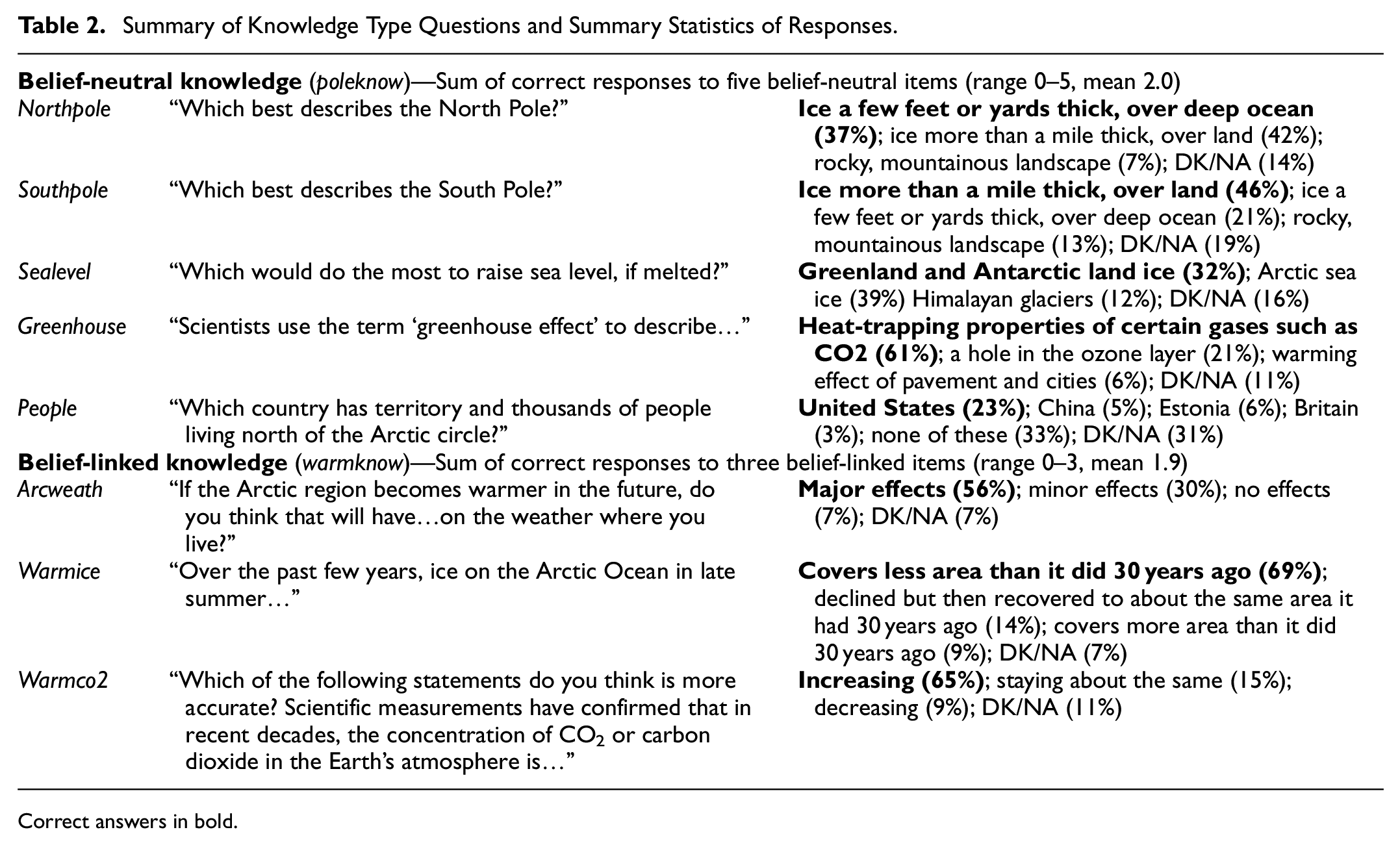
Correct answers in bold.
Earlier papers analyzed the logic and response patterns for these two knowledge types in more detail (Hamilton, 2016b, 2018; for an Australian replication see Tranter, 2020). Here we apply a large, combined dataset to test their demographic predictors and how knowledge of both types, as well as more general attitudes toward science, predict views on climate change.
Trust in scientific agencies who study climate change is assessed by the variable trustnasa (for analysis of this variable using other datasets, or in comparison to science trust regarding COVID-19, see Safford et al., 2020, 2021a). Climate-change indicator warmop has been employed on dozens of surveys, tracking public-opinion changes in the US since 2011 (e.g., Hamilton, Hartter, Lemcke-Stampone, et al., 2015). As coded here, warmop indicates agreement with the scientific consensus: that climate change is happening now, caused mainly by human activities. Five demographic variables are used in this analysis, including standard measures of age, gender, education, and ideology. Year is also included (differentiating between the 2016 and 2021 surveys). The two versions of the surveys had unavoidably different mediums. The year indicator thus serves as a statistical control, adjusting for differences in level that might equally well reflect secular change or methodological artifacts.
Models
This study seeks to understand the demographic and ideological predictors of belief-linked and belief-neutral knowledge; of trust in scientific authority; and how all three of these (along with demographics and ideology) relate to recognition of anthropogenic climate change. To answer these questions, we conducted a series of logistic and linear regressions: knowledge questions on demographic characteristics (Table 3), knowledge types and trust on demographic characteristics (Table 4), and belief in human-caused climate change on knowledge types, trust, and demographic characteristics (Table 5).
Weighted Logit Regression of Accurate Responses to Individual Knowledge Items, on Respondent Demographic Characteristics and Year of Survey (n = 2,345).

t-Test results: *p < .05; **p < .01; ***p < .001.
Weighted Regression of Composite Belief-neutral and Warming Knowledge Scores, and Trust in Scientific Agencies, on Respondent Demographic Characteristics and Survey Year (n = 2,345).

t-Test results: *p < .05; **p < .01; ***p < .001.
Weighted Logit Regression: Recognition of Human-caused Climate Change Predicted From Knowledge Scores, Trust in Scientific Agencies, and Respondent Characteristics (n = 2,345).

t-Test results: *p < .05; **p < .01; ***p < .001.
Results
Predictors of Knowledge
This paper examines the predictors of two environmental knowledge types: belief-neutral (poleknow) and belief-linked (warmknow). In addition to demographic and ideological predictors, several models test effects for education × ideology interactions, which previous studies often found to be important regarding climate change and related environmental concerns. The common form of this interaction is that belief in the reality or threat of climate change rises with education among liberals and moderates, but it does not rise and may even decline with education among the most conservative (e.g., Brown & Hamilton, 2021; Hamilton, 2011; Hamilton, Hartter, Lemcke-Stampone, et al., 2015; McCright & Dunlap, 2011a; Shao et al., 2014; Tranter, 2020).
Logit regressions predicting accurate responses to individual knowledge items (Table 3) find that correct answers on the belief-neutral questions are more common among younger respondents, men, college graduates, and liberals. On the individual belief-linked knowledge questions, correct responses also are more common among college graduates and liberals. Age and gender, however, appear to have little effect on belief-linked knowledge responses. Overall, education has a stronger effect on belief-neutral knowledge, but ideology—as one might expect—has a much stronger effect on belief-linked knowledge.
Table 4 shows the predictors of belief-neutral and belief-linked knowledge scores, overall indicators representing the number of correct responses to each type of question. Again, accuracy on both of these composite indicators is higher among better-educated and liberal respondents. Age and gender affect belief-neutral knowledge (higher among men and younger respondents), but do not predict belief-linked knowledge scores. Education has a stronger effect on belief-neutral knowledge, whereas ideology has a much stronger effect on belief-linked knowledge. There is a slightly negative and significant effect from the education × ideology interaction on belief-linked knowledge, indicating that such knowledge improves more steeply with education among liberals than it does among conservatives—thematically consistent with other interaction studies cited earlier.
Predictors of Trust in Science
Looking at trust in scientific authorities, the same predictors appear relevant. Again, younger respondents, men, those with more education, and liberals are more likely to trust NASA and other scientific agencies for information about the climate. Education and ideology have a much larger effect on trust than they do on either knowledge type, although the education × ideology interaction has a near-zero effect.
Predictors of Climate Change Belief
What do these findings mean when it comes to people’s belief in anthropogenic climate change (Table 5)? Belief-linked knowledge (warmknow) and trust in science agencies such as NASA (trustnasa) both have significant positive effects on respondents’ belief in human-caused climate change. Belief-neutral knowledge (poleknow), on the other hand, does not have a significant effect. The implication is that individual physical-world knowledge matters less than trust in science, when it comes to accepting the reality of anthropogenic climate change. Belief-linked knowledge does predict climate beliefs, as expected, but this is somewhat tautological. Even so, the impact of belief-linked knowledge appears weaker than the impact of trust in science. In effect, it is not what you know, but whether you trust the people who do. This poses serious challenges, given the steep educational and ideological (as well as age and gender) divides when it comes to trusting scientists for information about the climate.
Discussion
Gender
These findings confirm some hypotheses but not others. All the demographic variables have significant effects in the expected direction, except for gender—which has an unexpectedly negative effect. Belief-neutral knowledge and trust in scientific authorities are both lower among women. Despite this tendency, women were no less likely than their male counterparts to believe in the reality of human-caused climate change.
This finding lends support to work by Xiao and McCright (2015) suggesting that women express greater environmental concern than men despite similar levels of institutional trust. Indeed, there is evidence that the gender gap in institutional trust has been closing (Hamilton & Safford, 2021; Safford et al., 2020), perhaps as women gain greater access to and representation among scientists (Davidson & Freudenburg, 1996; Gustafson, 1998). Although we did not find a gender gap in climate change belief, others have found women to be more likely than men to express concern about climate change using a variety of measurements (Funk & Hefferon, 2019; McCright, 2010; Xiao & McCright, 2015). The mechanisms by which this gender gap persists are unclear.
Researchers should look toward other factors, such as value systems or social networks, to explain women’s greater acceptance of and concern for climate change, as it seems that their belief in human-caused climate change is not necessarily driven by greater environmental information. In other words, women’s lower levels of trust and belief-neutral knowledge do not translate to climate change denial or skepticism. As a group, they highlight the importance of appealing to underlying beliefs and values rather than just presuming an information gap.
Education and Ideology
Although ideology is related to belief-linked knowledge, as expected, education has a comparatively weaker effect. Previous research has noticed a divergence among more educated partisans, where conservatives’ environmental concern is negatively associated with education—likely due to their increased exposure to elite cues that reinforce partisan messaging (Drummond & Fischhoff, 2017; Ehret et al., 2017; Hamilton, 2008; Tranter, 2020; Zummo et al., 2021). This finding is also supported here, where the same education × ideology interaction effect is significant regarding belief-linked knowledge. Although some people may rely on ideological underpinnings to respond to the questions included in warmknow, these questions can also still represent actual knowledge for some respondents. Consequently, they should not be thought of as merely ideological markers.
Education and ideology also have especially strong independent effects on trust in scientific agencies, even more so than on each of the knowledge types. This indicates that the question of trust, while understood as politically divisive (Hamilton, Hartter, & Saito, 2015; Hamilton & Safford, 2021), can also be reconciled somewhat beyond the political domain. After all, it is notable that the education × ideology interaction does not have a significant effect on trust in science agencies, given the political divisiveness of institutional trust in recent years amplified by elite cues in media and politics. It may be that exposure to science and familiarity with its methods can help to demystify and de-politicize its findings.
In recent years, challenging the trustworthiness of science agencies has been a political strategy among far-right conservatives (Cook et al., 2017; Dunlap & McCright, 2015). While there is much promise for the potential of education to combat such campaigns and address some partisan divisions, it does little to address differences along the class divide. This may be especially true given the current media landscape. People without a college education arguably have access to more information than ever before—through sources like social media, talk radio, and 24-h cable news channels—but this is filtered through political pundits and other non-scientific commentators (Falkenberg et al., 2022). It may be that education improves trust by expanding the informational resources available to people, or that it alters the ways they receive and interpret that information (Bolin & Hamilton, 2018).
Previous work has found contrasting evidence that an education × ideology interaction effect exists regarding trust in science (Safford et al., 2020). This remains an area where further research is needed. For one, it may be useful to consider trust as a structural, rather than just individual, phenomenon (Lacey et al., 2018). While demographic predictors are certainly important, other contextual factors such as the political climate, public interface with scientific agencies, and broader measures of prosperity or decline can be important too. The COVID-19 pandemic is the most vivid example of this in recent years, as researchers have examined its effect on attitudes toward the CDC and similar agencies (e.g., Hamilton & Safford, 2021; Safford et al., 2021a, 2021b). There are also likely multiple components of trust that are not encapsulated in the single variable used here. Attitudes toward scientists themselves, particular findings, and scientific methods (Safford et al., 2020) could clarify other dimensions of institutional trust.
Belief in Human-Caused Climate Change
Finally, both belief-linked knowledge and trust in scientific agencies are significantly and positively correlated to a belief in human-caused climate change, and the effect of trust is especially strong. Belief-neutral knowledge has a negative although not statistically significant effect. This extends previous work, including the meta-analysis by Hornsey et al. (2016) which suggested objective knowledge was an important predictor of climate change belief. However, they acknowledge that ideological factors play an important role in shaping what knowledge is acquired or retained. We see this here too: conservatism is associated with lower levels of both types of knowledge, lower trust in science agencies, and lower acceptance of human-caused climate change.
Given its weak effect, it is worth considering then what the value of belief-neutral knowledge is when it comes to garnering public support for climate change efforts. Ultimately, people can know specific information about polar regions without calling into question their more ideological beliefs about the non-existence of human-caused climate change. The reverse is also true, that people can accept anthropogenic climate change without having specific, belief-neutral knowledge. This finding adds to the literature challenging the information-deficit model, as increasing belief-neutral knowledge among the public is not likely to shift climate change attitudes (Brulle et al., 2012; D. Kahan, 2010; D. M. Kahan et al., 2012).
Increasing public trust in scientific institutions would be a more useful endeavor. Of course, this poses problems for science communicators and policymakers because, as these results show, trust in science is itself a deeply divided partisan issue. Others have also suggested that increased trust in scientists is associated with lower levels of concern and personal responsibility regarding the climate (Kellstedt et al., 2008). So, it is true that clear and targeted messaging must walk a fine line between gaining trust and fueling complacency. But as previously discussed, education’s strong effect on trust, and trust’s strong effect on climate change acceptance, suggest that exposure to science and non-partisan communication shows some promise as a solution.
Conclusion
Although this study makes strides in the study of climate change knowledge and beliefs, there are some limitations. The composite variables used for the two knowledge types only provide a glimpse into the potential range of information respondents may possess about the climate. They are meant to provide an opening for future discussion, rather than a definitive determination of knowledge. Other variables might show stronger effects than those observed here. For example, we use a single variable to measure trust (referring to trust in scientific agencies), but trust of scientists themselves, scientific methods, and particular findings may produce other insights. Finally, as previously mentioned, there are likely important contextual factors—such as people’s engagement with particular media, or the political climate at the time—which impact these findings and cannot be wholly captured in this study. Ultimately, we believe that our findings provide a strong foundation of the knowledge-trust-belief interface upon which others can continue to build.
Climate change is a somewhat unique case when it comes to the public discourse, as the science is central to both sides’ arguments—much more so than with other social and political debates, at least until the advent of COVID-19. Conservative elites challenge scientists’ objectivity as a means of discounting scientific claims about climate change, while liberal activists have adopted mottos such as “Listen to Science” in their efforts. Despite these debates, it seems likely that perspectives on climate change are more closely tied to underlying beliefs and values than to scientific knowledge.
By differentiating between the two types of knowledge, we can better understand what types of information best support belief in climate change. Examples of specific, objective knowledge do not seem to have much effect on overall beliefs. Rather, information that is supported by both physical reality and individual values is most impactful. This is further highlighted by our novel findings related to gender: women possess similar levels of climate change belief compared to men, despite lower levels of belief-neutral knowledge and trust in science. Understanding the values underlying belief in climate change, apart from knowledge, is an important and ongoing task for social scientists.
Beyond that, these findings do also suggest that trust in science is more closely tied to belief in climate change than either type of knowledge. Of course, trust in science has strong ideological gradients, but it also is correlated with education across all political groups. Indeed, the absence of the education × ideology interaction effect in regard to trust in science suggests that exposure to scientific methods may be somewhat effective in overcoming some partisan divides. This may be a more useful role for education in fostering climate change belief, as compared to just providing more information, which gets filtered and distorted through recipients’ own ideological biases. This study has both scientific and policy-relevant implications, suggesting that those interested in engaging the public on climate issues may consider taking a more values-based approach similar to a range of other social and political issues, as it is increasingly apparent that more neutral, scientific knowledge is not sufficient to persuade climate doubters.
Footnotes
Acknowledgements
None.
Declaration of Conflicting Interests
The author(s) declared no potential conflicts of interest with respect to the research, authorship, and/or publication of this article.
Funding
The author(s) disclosed receipt of the following financial support for the research, authorship, and/or publication of this article: The collection of data used in this study was funded through a grant from the US National Academy of Sciences, Opp-1748325.
Ethics Statement
The 2016 survey was approved by the Institutional Review Board for the Protection of Human Subjects in Research at the University of New Hampshire (#6513). Research protocols for the 2021 survey were approved by the Institutional Review Board for the Protection of Human Subjects in Research at the University of New Hampshire (IRB-FY2021-38).

Data Availability Statement
Data available upon request.