



Abstract
Grounded in “Thirdspace” theory, this study develops a theoretical framework to explain how tea culture spaces influence tourists’ aesthetic experience, focusing on the underlying mechanisms. Employing structural equation modeling (SEM), we empirically examine the direct effects of tea culture space perception on aesthetic experience, alongside the mediating roles of aesthetic association and aesthetic comprehension. Data were collected from 591 tourists visiting Wuyishan, a UNESCO World Heritage Site in China renowned for its natural and cultural heritage. We used SPSS 24.0 to test direct effects and the PROCESS macro to examine mediating effects of the model. The results show that tourists’ tea culture space perception has positive effects on their aesthetic association, aesthetic comprehension, and aesthetic experience. Further analysis indicates that the tea culture space perception enhances tourists’ aesthetic experience by positively influencing their aesthetic association and also strengthens tourists’ aesthetic experience through positive impacts on their aesthetic comprehension. This study expands the application of the “Thirdspace” theory in tourism research through quantitative methods, reveals the internal mechanisms of how cultural spaces influence tourists’ aesthetic experience in greater detail, provides new insights for the study of cultural aesthetic experience at tourist destinations from a spatial perspective, and offers managerial implications for the reproduction of cultural spaces at tourist destinations and the improvement of the quality of tourists’ cultural experiences
Keywords
Introduction
Tourism, as one of the aesthetic practices, has increasingly become an indispensable part of contemporary life. The pursuit of aesthetic experience in tourism contexts is an intrinsic rather than extrinsic motivation for tourists (Wu & He, 2022). The tourism experience is inherently an aesthetic and psychological process (Pan, 2012), with perception, imagination, and emotion playing key roles (Xing, 2002). From the perspective of aesthetic psychology, tourism is intricately linked to aesthetics and represents a comprehensive aesthetic pursuit (Cao, 2008). In recent years, as aesthetic activities have become integral to people’s production, exchange, and consumption systems, tourism—as an important comprehensive aesthetic practice that integrates natural beauty, artistic beauty, and social life beauty—has been endowed with deeper connotations and higher expectations in cultivating social aesthetic sensibility, driven by the growing integration of aesthetics into daily life (Wu & He, 2022).
However, despite its recognized importance, the aesthetic experience dimension remains underexplored and understudied in tourism research (Kirillova et al., 2014). Moreover, tourism is intrinsically linked to spatial dynamics, and the notion of space plays a crucial role in shaping the aesthetic framework of tourism (Hu, 2013). The fusion of aesthetic theory and spatial theory has given rise to a pragmatic branch within spatial aesthetics (Pei, 2014)—one that bridges abstract aesthetic principles with tangible tourism contexts. Thus, investigating the correlation between cultural manifestations in tourist destinations and tourists’ aesthetic experience from a spatial standpoint holds both theoretical and practical significance for enhancing the quality of cultural space and tourists’ cultural encounters.
From a spatial perspective, cultural spaces in urban environments are intricately linked to human behavior, spatial prototypes, and surrounding features, and are distinguished by their physical, spatial, social, and cognitive dimensions (Wu & Zhang, 2016). Some scholars even regard cultural spaces as public venues for cultural activities within urban areas, and perceive them as a dynamic form of continuity in which cultural practices and social spaces interact (Kou & Zhou, 2014)—one that fulfills the functions of documenting, disseminating, generating, and consuming culture. This study defines tourist destination cultural spaces as a collection of physical and performative venues that employ static or dynamic methods to showcase and interpret diverse cultures, aiming to enhance their attractiveness and offer visitors opportunities to engage with, comprehend, and appreciate cultural knowledge, significance, and value (Yang, 2021). Currently, the field of tourism research is concentrating on the spatial structure of tourist destinations and the intricate relationship between space and tourists’ experiences. Regarding spatial structures, scholars have frequently examined tourists’ spatial perception from the tourists’ perspective, for instance, Kevin (2001) has set the precedent for spatial perception research by categorizing spatial perception into structural and elemental components. Baker (1986) classified the service environment from a consumer perspective into environmental, design, and social dimensions. Bitner (1992) categorized the service scenario space into background features, layout functions, and symbolic representations (Bitner, 1992). Bonn et al. (2007) classified heritage/cultural site spaces based on spatial design layout, spatial ambiance, and social spaces. The relationship between the spatial characteristics of tourist destinations and tourists’ experiences has been a focal point in recent tourism research, as research suggests that various spatial elements influence tourists’ sensory experiences (Kirillova et al., 2014; Shen, 2018), emotional experience (Bonn et al., 2007), affective experiences (Deng, 2020; Pine & Gilmore, 1998), and spiritual experiences (X. Y. Yang & Li, 2019). This is because cultural spaces, as urban areas associated with people’s behavioral activities, spatial prototypes, and surrounding features, are distinguished by their physicality, spatiality, sociality, and cognitive aspects (Wu & Zhang, 2016). Within the framework of cultural and tourism integration, tourist destinations manifest their culture in a spatial configuration, providing tourists with diverse experiential opportunities. The study of tourists’ cultural experiences in tourist destinations begins with their initial perception of cultural spaces. While existing literature has explored the structure of tourists’ spatial perception and its relationship with overall experiences, research on tea culture spaces—a typical carrier of traditional Chinese culture—remains limited. Specifically, few studies have unpacked how the unique attributes of tea culture spaces (e.g., natural-tea-cultural integration) shape tourists’ aesthetic experience.
This study addresses three key research gaps. (a) Research object gap: Most existing studies on cultural space and tourist aesthetic experience focus on general urban cultural spaces (e.g., bookstores, museums) or heritage sites (Bonn et al., 2007; Xie et al., 2014), while ignoring tea culture spaces that integrate natural landscapes, traditional tea rituals, and daily life. There is a lack of targeted exploration of tourists’ aesthetic experience mechanisms in tea culture-specific scenarios. (b) Theoretical application gap: Although Hu (2013) proposed that “Thirdspace” theory (where “Firstspace” refers to physical space, “Secondspace” denotes subjective and imagined space, and “Thirdspace” integrates the two to form an integrated aesthetic experience) holds important implications for understanding tourism aesthetic mechanisms, few studies have applied this theory to the context of tea culture. Specifically, there is a lack of empirical validation for the specific operational pathway of Thirdspace (i.e., how Firstspace evolves into Thirdspace through Secondspace) in tea culture spaces. (c) Methodological gap: Existing studies on tea culture and tourist experience are mostly qualitative (e.g., case descriptions, interview analyses; Guo and Zheng, 2016; Yao, 2018), with a scarcity of quantitative research that constructs structural models to systematically explore the causal relationships between tea culture space perception, psychological mediating variables (e.g., aesthetic association, aesthetic comprehension) and aesthetic experience.
To fill the above gaps, this study takes tea culture spaces in Wuyishan as the research object and addresses two core research questions: (a) Within the theoretical framework of “Thirdspace” (Soja, 1996), what are the intrinsic mechanisms through which tourists’ perceptions of tea culture spaces influence their aesthetic experience? Specifically, do aesthetic association and aesthetic comprehension play mediating roles in this influence process? (b) What are the direct effects of tourists’ tea culture space perception on aesthetic association, aesthetic comprehension, and aesthetic experience? And what are the indirect effects of tea culture space perception on aesthetic experience through the two mediating variables?
From an aesthetic perspective, tourism can be regarded as an aesthetic activity (Cao, 2008), in which individuals engage with the scenery, and a two-way interactive relationship exists between the aesthetic subject and object (Pan & Fu, 2005). Scholars argue that, from the perspective of aesthetic psychology, the core significance of tourism experience lies in aesthetics—characterized by immersion, subjectivity, and interactivity (Pan, 2012) and have defined aesthetic experience differently, focusing on its formation process and inherent characteristics. For example, Xie (1999) argued that tourism aesthetic experience operates at two levels: external (spatial characteristics of objects) and internal (subjective psychological processing). Tourists initially perceive physical attributes of external environments, then progressively engage their inner psychological space through a dynamic interaction between the external (spatial stimuli) and internal (cognitive-emotional appraisal). This bidirectional recursion fosters isomorphism — a congruence between perceptual inputs and subjective interpretation—which culminates in affective pleasure. Julia (2003) defined tourism aesthetics as the aesthetic experience encountered during travel, wherein perceived beauty evokes dual-layered rewards: immediate sensorimotor pleasure (tactile/visual stimuli) and secondary affective resonance (emotional positivity). These elements collectively shape tourism aesthetics as a holistic phenomenon spanning perceptual, cognitive, and emotional domains. Pan (2012) proposed that tourism aesthetic experience is the inner feeling of tourists pursuing aesthetic existence and life creation through continuous interaction with the tourism context. From scholars’ definitions of aesthetic experience, it is evident that the components of aesthetic experience encompass both the aesthetic subject (the tourist) and the aesthetic object (the tourism context and external spatial elements). Aesthetics encompasses both the objective appreciation and reflection of the aesthetic object and the subjective perception and experience that emerge from the interaction between the aesthetic subject and object. This process reflects the aesthetician’s subjective psychological states, including emotions and willpower (Wang, 2016)—states that bridge their internal cognition with the external aesthetic context. Therefore, the tourism aesthetic experience underscores the aesthetic agency of the visitor’s inner self in harmony with the external world. The visitor is not merely a recipient of aesthetic experience but also an active creator (Pan, 2012). Upon reviewing previous research, this study believes that the aesthetic experience obtained during travel is the embodied pleasant feeling that travelers obtain when stimulated by the surface forms of the aesthetic object and context, which then activates their internal psychological activities. It includes sensory perceptions, aesthetic emotions, cultural identity recognition, and spiritual encounters (Julia, 2003; Pan, 2012).
Association or imagination is one of the key aesthetic psychological elements, a distinctive human cognitive process that involves the romanticized subjective construction and recreation of unknown phenomena or memories (Qu, 2020). By linking the aesthetic object to the subject’s self, it activates intellectual and emotional responses, refines aesthetic perception, and enriches emotional engagement. This interconnected process forms a vital internal mechanism that sustains aesthetic experience (X. Y. Yang & Li, 2019). Gaston (2009) interpreted aesthetic imagination from a memory perspective. Specifically, he argued that bodily memory and associative ability facilitate the interconnection between perception and memory. Memory deepens individuals’ engagement with spatial experiences. To elaborate, when individuals are stimulated by the spatial environment, their current experiences interact with their memories, thereby forming imagination. This conscious human behavior promotes dialogue between the aesthetic subject and object, and further triggers emotional resonance. X. Y. Yang and Li (2019) further noted that such associations elicit emotional resonance by linking current spatial perceptions to past experiences.
Therefore, the role of spatial association and imagination in aesthetics is to connect individuals with the aesthetic object. This process involves creative behavior through active psychological activities following sensory and perceptual experiences, ultimately leading to understanding and emotional responses (Lu, 2019). This study focuses on the aesthetic associations generated by tourists in tea culture spaces at tourist destinations. It posits that aesthetic associations arise from the sensory perception of the aesthetic subject in response to the elements constituting the current space, and are triggered by related associations with past experiences or similar spaces and images. These associations are grounded in past experiences and memories and serve as a dynamic mechanism for strengthening emotional connections and deepening aesthetic experience between the aesthetic subject and the aesthetic object.
Aesthetic comprehension is another crucial concept in the process of aesthetic experience. Aesthetic comprehension originates from perceptual engagement: while it shares with ordinary comprehension the capacity to grasp the essence of phenomena, it is uniquely suffused with emotional depth (Li, 2019). Aesthetic comprehension refers to individuals’ ability to discern, apprehend, and appreciate the essence, structure, and related associations of an aesthetic object during aesthetic engagement (Wang, 1981). Hence, aesthetic comprehension underscores a form of perceptual insight that transcends the objective understanding of phenomena and encompasses a profound appreciation intertwined with the subject’s emotional response. This study defines aesthetic comprehension as the recognition, grasp, and comprehension of the content, form, and relevant connections and laws of an aesthetic object, while also being imbued with the individual’s unique emotions.
Contemporary research underscores the pivotal role of space in shaping tourists’ aesthetic experience. First, the cultural environments embedded within tourist destination spaces exert both direct and indirect influences on aesthetic experience. For instance, scholars have proposed that the physical spatial settings and constituent elements of cultural spaces directly stimulate tourists, activating their physiological senses and thereby generating diverse sensory experiences (Shen, 2018), rekindling participants’ affective responses and fostering other forms of aesthetic engagement (X. Y. Yang & Li, 2019). Some scholars also contend that the gallery space serves as an emotional environment, wherein the spatial arrangement of environmental elements, exhibits, lighting, scent, positioning, and ambiance can evoke visitors’ emotions and psychology, elicit tourists’ recollections, experiences, and imagination, thus shaping their spiritual and aesthetic encounters (X. Y. Yang & Li, 2019). Secondly, the interaction between tourists’ embodied experiences and the cultural context of the space also influences their aesthetic experience. As Chen and Li (2019) noted, museum space is not only a physical space but also a new domain. Tourists are immersed in this “scenographic” domain and engage in interactions such as touching relics and wearing period costumes. These interactive and immersive experiences can influence tourists’ dwell time, pleasure, and satisfaction. Additionally, tourists’ internal associations and understanding of tourist attractions also significantly impact their aesthetic experience in cultural spaces. Zhang and Xu (2020) argued that tourists who can deepen their understanding of natural scenery through associations with literary works are more likely to achieve a positive aesthetic experience, thereby enhancing their loyalty. The ability to make such associations is closely tied to tourists’ accumulation of literary knowledge. Consequently, it is evident that the physical composition of space, environmental atmosphere, interactive behaviors within the space, and tourists’ internal psychological frameworks all significantly influence tourists’ experiences in cultural spaces. As Hu (2013) contended from a philosophical and aesthetic perspective, based on the concept of “Thirdspace,” tourism has significant aesthetic implications. He proposed that tourism is a spatial activity, and space is a fundamental element in the aesthetic composition of tourism. If the optimal aesthetic realm of tourism is one where the tourist interacts with the tourism space, achieving a state of host-guest fusion and entering the realm of freedom, then we can assert that the pursuit of tourism aesthetics aligns with Soja’s concept of the “Thirdspace.” For tourists, the highest aesthetic realm of tourism involves transitioning from the material “Firstspace” into the “Secondspace” characterized by vivid sensations and rich imagination, and ultimately ascending to the symbolic height of freedom represented by the “Thirdspace.” In the context of cultural and tourism integration, the culture of tourist destinations is presented to visitors in spatial forms, offering diverse tourism experiences. Studying the relationship between the display of tourist destination culture and visitors’ cultural experiences from a spatial perspective is crucial for enhancing both the quality of cultural displays and the depth of visitors’ cultural experiences. However, there remains a dearth of quantitative research on the relationship between tourist destination cultural spaces and tourists’ cultural aesthetic experience. Existing existing studies that integrate the spatial triad (i.e., Firstspace, Secondspace, Thirdspace) from Soja’s Thirdspace theory to examine cultural displays at tourist destinations remain fragmented, and research on tourists’ aesthetic experience in tourist destinations based on the “Thirdspace” theory remains virtually non-existent.
This study focuses on tourists’ tea culture space perception and their aesthetic experience in tourist destinations, aiming to analyze tourists’ experiences of tourist destination culture from spatial and aesthetic perspectives. The theoretical contributions of this study are as follows: Based on the “Thirdspace” theory, it systematically uncovers the pathways through which cultural spaces in tourist destinations influence tourists’ aesthetic experience—encompassing both the direct effects of tea culture spaces and their indirect effects mediated by shaping tourists’ aesthetic associations and aesthetic comprehension. This finding provides novel empirical evidence for refining the theoretical framework of cultural aesthetic experience. The research findings offer both theoretical foundations and practical implications for enhancing the quality of cultural space experiences in tourist destinations and elevating the caliber of tourists’ cultural experiences.
Theoretical Background: Soja’s Thirdspace Theory and Its Operationalization in This Study
In Thirdspace: Journeys to Los Angeles and Other Real-and-Imagined Places, Soja (1996) advanced Henri Lefebvre’s theory of the production of space by transcending the binary oppositions that pervade traditional spatial analysis. He introduced the concept of “Thirdspace” and noted at the book’s opening: “This book aims to encourage a new way of thinking about space—one centered on ‘Thirdspace’, which breaks from the dualistic constraints of conventional spatial theory.” At the core of this theoretical framework, Soja divides space into three interconnected dimensions. To facilitate understanding, each dimension is illustrated through specific examples from Wuyishan’s tea culture spaces—the practical research context of this study.
Firstspace: Tangible, physical tea culture space. Soja’s “Firstspace” refers to the tangible, physical environment that tourists can directly perceive (Moles, 2008). For Wuyishan’s tea culture spaces, Firstspace encompasses three core tangible elements: (a) spatial design (e.g., the layout and stylistic features of tea houses), (b) spatial atmosphere (e.g., the environmental and cultural ambiance of the space), and (c) spatial activities (e.g., tourists’ participation in tea-picking). These material spatial elements constitute the “material spatial foundation” for the formation of tourists’ aesthetic experience, and they directly correspond to the core independent variable in this study—“tea culture space perception.”
Secondspace: Subjective psychological processing of tea culture. Soja’s “Secondspace” denotes the subjective, imagined, or cognitive space constructed by tourists when interacting with Firstspace. It emerges from tourists’ existing knowledge, memories, and emotional responses—and aligns with the study’s two mediating variables (aesthetic association and aesthetic comprehension). Aesthetic association refers to the associations with people, events, and objects that tourists generate when in Wuyishan’s tea culture spaces. Such associations connect the material space of tea culture to the tourists’ inner emotional world. Aesthetic comprehension, by contrast, refers to the deeper understanding of tea culture’s knowledge connotations that tourists develop after engaging with tea culture, which further strengthens their cognitive connection to tea culture spaces.
Thirdspace: The integrated aesthetic experience of tea culture spaces. Soja’s Thirdspace transcends the dichotomy between Firstspace (material dimension) and Secondspace (subjective dimension); it is a holistic, integrated realm where reality and imagination, object and subject converge (Moles, 2008). As proposed by Soja (1996), Thirdspace is an integrative realm that transcends the binary opposition of “physical space (Firstspace)” and “subjective imaginary space (Secondspace).” It emphasizes the realization of “fusion between objective environment and subjective experience” through the process of “perception → psychological processing,” and serves as the core theoretical logic for this study to explain “how tea culture spaces enhance aesthetic experience.” Within the context of Wuyishan’s tea culture, Thirdspace manifests as the comprehensive aesthetic experience that tourists ultimately attain (i.e., the study’s dependent variable), illustrated through the following typical scenario. Sitting in a pavilion amidst tea mountains (Firstspace: the panoramic view of green tea plantations, the feel of cool breeze, the faint aroma of tea, and the pleasant humidity in the air, along with the sound of wind heard with eyes closed), tourists may think of a “land of idyllic beauty” (aesthetic association), at the same time, they may also perceive how “tea-tasting helps people stay focused and free from restlessness” (aesthetic comprehension). The interplay of these elements gives rise to a feeling of “unity with nature”—this is Thirdspace.
Extending Soja’s Thirdspace theory to the field of tourism, Hu (2013) argued that the “highest aesthetic realm of tourism” emerges when tourists move from Firstspace (material perception) to Secondspace (psychological processing), and ultimately arrive at Thirdspace (integrated experience). Building on this framework, this study adopts the concept of “Thirdspace” and operationalizes it into an empirically testable theoretical model applicable to tea culture spaces, which is used to investigate how tea culture spaces at tourist destinations influence tourists’ aesthetic experience. This operationalization addresses the theoretical gap identified earlier—namely, the lack of empirical operationalization of Thirdspace in tea culture contexts—by transforming Soja’s abstract “Firstspace → Secondspace → Thirdspace” framework into a concrete sequence: “perception → psychological processing → experience.”
Literature Review and Hypothesis Development
Scholars have identified the structural dimensions of spatial perception from the tourist perspective. Baker (1986), Baker et al. (1994) categorized the service environment into three dimensions: ambiance, design, and social factors. Bitner (1992) further proposed that service spaces be divided into background characteristics, layout functionality, and symbolic representations. Bonn et al. (2007) refined the perception of heritage spaces into spatial design, spatial ambiance, and social space. In recent years, the relationship between tourist destinations’ spatial characteristics and tourists’ experiences has emerged as a focal topic in tourism research. Among these studies, Liu (2019) found that both tourists’ physical perception of destinations’ real environments and their virtual perception of reconstructed environments positively influence their aesthetic experience—though the current study focuses on physical tea culture spaces, this finding underscores the broader role of perception in shaping aesthetics. Specifically, various spatial elements influence tourists’ sensory experience (Wang, 2009), emotional experiences (X. Y. Yang & Li, 2019), cultural identity (Xie et al., 2014), as well as self-expression and self-actualization (Gorman-Murray, 2008). However, few studies have applied these theoretical frameworks to tea culture spaces, resulting in insufficient exploration of the “tea culture space perception → aesthetic experience” mechanism. Based on these findings, this study formulates the following research hypothesis:
Tourists’ perception of cultural space elements can stimulate associations with their past experience. For instance, Wang (2017) found that museum visitors’ multi-sensory perceptions (e.g., visual and olfactory) could evoke memories of historical scenes; Liu et al. (2016) noted that ethnic symbols (e.g., Tibetan music, Tibetan incense) in a restaurant in Lhasa could inspire tourists’ imagination of the local culture. Jiang and Xu (2017) further proposed that aesthetic perception can trigger tourists’ imagination and associations related to characters, past events, and storylines. In tea culture spaces, spatial perception (e.g., the aroma of tea, tea-picking scenes) similarly activates tourists’ associations linked to their life experiences (e.g., childhood memories of drinking tea). These associations bridge the materiality of tea culture spaces (Firstspace) and tourists’ subjective emotional worlds (Secondspace)—a key step in Thirdspace formation. Based on this logic, the study proposes:
Aesthetic comprehension—defined as the ability to understand the cultural essence of aesthetic objects (Wang, 1981)—relies on spatial perception to decode symbolic meanings within the space (Wang, 2017). Liu and Chen (2016) argued that consumers’ perception of nostalgic spaces facilitates their interpretation and understanding of history. Jiang and Xu (2017) further noted that aesthetic perception of literary tourism landscapes influences tourists’ aesthetic comprehension of landscapes, characters, environments, and underlying meanings. N. D. Yang and Yang (2014) posited that when tourists enter a culturally constructed space created by performers and interact with Tibetan and Qiang cultural performers, they enter a “liminal” state physically and mentally—a state that deepens their understanding of the other’s culture and their own identity. In tea culture spaces, therefore, perception of elements such as “Yanyun” (rock rhythm) and Danxia landforms helps tourists understand the symbiotic relationship between nature and tea culture. Participation in tea production and tea-tasting activities also contributes to understanding the connotations of tea culture. Based on the above, this study proposes the following hypothesis:
Aesthetic association (or creative aesthetic imagination) functions as an internal dynamic that bridges the aesthetic object and the aesthetic subject, eliciting psychological, intellectual, and emotional responses—and in turn intensifying the aesthetic experience. When travelers perceive different spatial elements, they associate these elements with similar items, spaces, people, or images from their past experiences. Additionally, spatial perception can evoke creative imaginations, leading to emotional resonance and enhancing the aesthetic imagery (X. Y. Yang & Li, 2019). Liu et al. (2016) noted that the spatial elements of Makye Ame Restaurant in Lhasa—including color, layout, decoration, and environmental ambiance—can stimulate tourists’ imagination, thereby influencing their spatial and consumption experiences. Regarding art galleries, tourists’ perceptions of physical elements and the overall environmental ambiance evoke memories of past similar spaces and experiences, triggering emotional resonance and the accumulation of emotional energy. This process elevates the experience into one that is more emotionally rich (X. Y. Yang & Li, 2019).
On the other hand, research indicates that spatial elements can deepen consumers’ understanding of cultural significance by showcasing cultural symbols, thereby influencing their experience of cultural spaces to varying degrees. For instance, the creation of a nostalgic spatial atmosphere immerses tourists in nostalgic imaginings of the past, enhancing their understanding of the overall historical and cultural ambiance and thereby influencing their experiences across sensory, emotional, affective, and identity dimensions (Liu & Chen, 2016). When studying cultural production and consumption in tourism, Ma (2020) proposed that exploring the stories and cultural meanings behind landscapes is essential to establishing deeper connections between tourists and their surroundings, fostering a more profound understanding and experience of the place, and ultimately cultivating cultural and place identity as well as emotional attachment. Zuo et al. (2019) argued in their study that the cultivation of a cultural atmosphere in bookstores is interpreted by consumers through the display and sale of goods, a process that strengthens consumers’ cultural identity. Jiang et al. (2021) evaluated the effectiveness of tourism-driven spatial aesthetic restoration in the cultural industry, noting that tourists’ perceptions of Dafen Oil Painting Village guide their aesthetic comprehension, which in turn enhances aesthetic emotions.
In tea culture spaces, spatial perception similarly enhances tourists’ aesthetic experience at various levels by deepening their understanding of tea culture and stimulating relevant associations. Based on these findings, the study formulates the following research hypotheses:
The Study Model
The conceptual model illustrating how tourists’ tea culture space perception in the destination relates to their aesthetic association, aesthetic comprehension, and aesthetic experience is presented in Figure 1. Drawing on “Thirdspace” theory and relevant literature, this study conceptualizes tourists’ tea culture space perception as the independent variable, their aesthetic experience within the tea culture space as the dependent variable, and aesthetic association and aesthetic comprehension as mediating variables.

Research conceptual framework.
Methodology
To validate the research hypothesis model outlined above, we conducted the following research, as shown in the research flowchart (Figure 2).

The flowchart of the analysis process in this study.
Case Site Selection Explanation
Located in northern Fujian Province, China, Wuyishan boasts a long history and abundant natural and cultural resources. This study selected Wuyishan as the research site based on two primary reasons: First, as a UNESCO World Heritage Site recognized for both its natural and cultural values, it exhibits high representativeness and typicality for exploring the interactive relationship between cultural spaces and tourist experiences (Guo & Zheng, 2016). Second, tea culture—Wuyishan’s core and distinctive tourism resource, aligns closely with the study’s focus on “tea culture spaces,” further enhancing its suitability as a research setting. Wuyishan possesses rich tea culture-related resources spanning both natural and cultural dimensions. In terms of natural resources, it has a tea-planting history of several hundred years; the tea industry serves as an economic pillar for local communities and plays a crucial role in balancing and coordinating community development and nature conservation (Wang et al., 2022). Since the late 20th century, Wuyishan has dedicated efforts to developing a tea culture tourism route that integrates ecological protection and local characteristics: it has deeply explored tea-related cultural elements (e.g., cliff carvings, stone carvings, stele inscriptions) and features natural landscapes such as imperial tea gardens and tea mountains, with the renowned “Da Hongpao” (Big Red Robe) tea as the core carrier (Yao, 2018). These elements collectively form the unique Wuyi rock tea culture (Zhang, 2011). In terms of cultural resources, Wuyishan’s tea culture encompasses tea ceremony performances, the immersive live show Impression Da Hongpao, folk tea-tasting competitions, the “Hanshan Tea Festival” (a ritual to worship tea), and the craftsmanship of Wuyi rock tea production. Among these, Impression Da Hongpao combines Wuyishan’s natural scenery with stage lighting art to artistically present the history and production process of tea, achieving the effect of “narrating through tea to tell stories of landscapes, culture, and life” (Zhang, 2021). These diverse cultural programs have transformed tea culture into a popular experiential tourism product, successfully attracting tourists and delivering pleasant travel experiences (Guo & Zheng, 2016).
Notably, although Wuyishan—with its status as a dual World Heritage Site and mature tea tourism system—is well-suited for exploring the “Thirdspace” mechanism (Soja, 1996), its unique regional context may limit the direct generalizability of the study’s findings, specifically in the following aspects. Geographical uniqueness: The symbiotic relationship between Danxia landforms and Wuyi rock tea creates the irreproducible “Yanyun” (rock rhythm) flavor and terroir conditions—a feature rarely seen in plain tea gardens (e.g., Hangzhou) or plateau tea mountains (e.g., Yunnan). Cultural integration: Wuyishan’s tea culture integrates imperial tea traditions, literati elegance, and folk rituals, forming a multi-layered cultural complex that is difficult to replicate in other regions. Development maturity: With established well-known brands such as Impression Da Hongpao, its tea tourism presentation forms are more standardized than those of emerging destinations, and tourist experiences are more structured—differing from less developed tourism locations.
Questionnaire Design and Measurement Development
The research survey comprised two components. The first part evaluated tourists’ tea culture space perception, aesthetic association, aesthetic comprehension, and tourists’ aesthetic experience; the second component addressed sociodemographic variables, including gender, age, and educational attainment. All scales were derived from existing literature and were validated in previous research, as shown in the following table.
The measurement of tea culture space perception was adopted from Baker et al. (1994), Kim and Moon (2009) and Turley and Milliman (2000). We drew on the measurement scale of aesthetic association from Jiang and Xu (2017) and Zhang and Xu (2020). The measurement scale of aesthetic comprehension was from Jiang and Xu (2017) and Stamatopoulou (2004). The measurement of tourists’ aesthetic experience was adopted from Chen and Lin (2018), Leder et al. (2004), Turley and Milliman (2000), Zhang and Xu (2020), and Waterman et al. (2010). Following consultations with experts, relevant scholars, tour guides, and the conduction of pilot surveys, the questionnaire items were revised to ensure alignment with the research context. Ultimately, 35 items were selected to capture tourists’ perceptions of tea culture spaces, aesthetic associations, aesthetic comprehension, and aesthetic experience. All measurement items are listed in the table (see Supplemental Appendix for details). Specifically, these items were evaluated in this study using a 7-point Likert scale, which ranges from 1 (strongly disagree) to 7 (strongly agree).
Data Collection
We collected primary data via structured questionnaires distributed to Wuyishan visitors aged 18 and over between August and October 2023, with trained research assistants assisting in data collection. We employed both on-site paper-based and online electronic questionnaire distribution methods. Paper-based questionnaires were distributed at tea culture-related sites and homestays within Wuyishan, inviting visitors to complete them on-site. Electronic questionnaires were disseminated through social platforms such as WeChat and QQ using a snowball sampling approach, inviting visitors who had experienced Wuyishan’s tea culture within the past year to fill out the questionnaires based on their recollections and impressions. We adopted snowball sampling for online questionnaires because recruiting other tourists via the social networks of those who had visited Wuyishan significantly increases the likelihood of accessing the target group in the population (Becker, 1957). To ensure the validity of the sample, this study implemented the following measures: Firstly, we consulted tour guides to understand the itineraries of tourists visiting tea-related sites in Wuyishan. According to the tour guides, group tourists typically watch tea cultural performances (Impression of Da Hongpao) on the first or second evening, visit the Da Hongpao scenic spot on the second day, and tour tea factories on the third or fourth day. Throughout their stay, they have opportunities to drink tea and interact with locals in tea shops, inns, and teahouses. Therefore, we selected research sites at the Da Hongpao scenic spot, tea shops, inns, and tea factories. This ensured that respondents had experienced Wuyishan’s tea culture across various tea-related spaces, while allowing us to invite tourists to complete questionnaires without disrupting their travel plans. Secondly, during the questionnaire distribution process, we clearly identified ourselves and explained the research purpose, which was to enhance the quality of tea culture spaces and improve tourists’ experience. We provided objective and neutral explanations for each item in the questionnaire, ensuring that tourists understood they should fill out the questionnaire based on their own experiences and perceptions. Furthermore, we ensured the privacy and anonymity of all participants.
Sample size was determined following the guidelines of (Hair & Tatham, 2010), who recommend a minimum of 10 respondents per measurement item and 5 per research variable. This study comprises a total of 35 items. Following the acquisition of consent from participants, we distributed 966 anonymous survey questionnaires both online and on-site. A total of 946 tourists completed the surveys, with 591 valid responses, resulting in a valid response rate of 62.5%.
To control potential biases arising from the use of both online and offline data collection methods, the following measures were implemented: First, in terms of survey timing, the online survey was conducted from September to October 2023, while the offline survey ran from August to October 2023, with a 2-month overlap period. This overlap was designed to avoid experience discrepancies caused by seasonal variations (e.g., tourism peak/off-peak seasons, schedules of tea culture events). The offline survey was launched 2 weeks earlier to facilitate pre-survey validation and refine questionnaire wording, ensuring consistency between the online and offline versions. Second, targeted screening of survey scenarios was conducted. Offline questionnaires were distributed exclusively at core tea culture-related sites, including the Da Hongpao scenic area, tea factories, and homestays, to ensure respondents’ immediate experiences were directly relevant to the research context. For the online survey, non-target groups were excluded through screening questions (e.g., “Have you visited tea gardens or tea enterprises in Wuyishan within the past year?”). Additionally, online respondents were instructed to focus on their “most profound tea culture experience scenarios” (e.g., tea-picking activities, tea ceremonies) to reduce recall ambiguity. Third, the content of the questionnaire was entirely consistent: both online and offline versions contained 35 measurement items, ensuring complete uniformity in the measurement dimensions and wording of core variables. Regarding terminology explanations: trained research assistants provided standardized verbal explanations for relevant terms during offline surveys; identical explanations for such terms were also included in the online survey. For the response environment, offline questionnaires were distributed in quiet tea house lounges or homestay lobbies to minimize distractions; online questionnaires included an opening prompt instructing respondents to “complete the survey in an undisturbed environment and refer to real experiences when recalling,” thereby reducing the impact of environmental noise on response quality.
Results
Respondents’ Demographic Characteristics
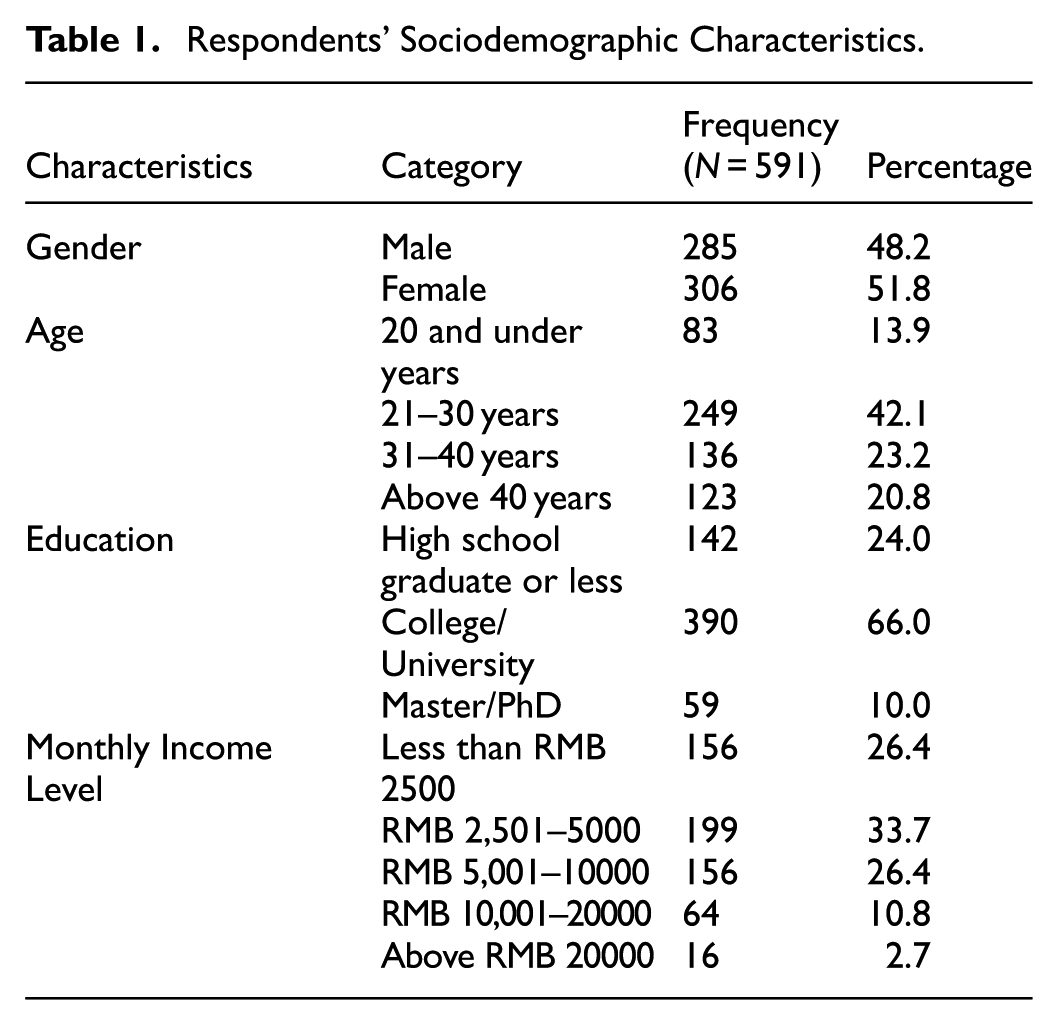
The demographic information of the tourist sample involved in the study is presented in Table 1. Among the 591 respondents, 48.2% were male, and 51.8% were female. Respondents under the age of 40 comprised 79.2% of the sample, and 76% held a college degree. Additionally, 39.9% reported an income of 5,000 yuan or more. In addition, from the occupational composition, students and corporate employees constitute the largest proportions of the sample, accounting for 20.5% (n = 121) and 19.5% (n = 115), respectively. Following these groups are government workers, educational and research personnel, individuals in other occupations, and self-employed individuals, comprising 14.9% (n = 88), 11.7% (n = 69), 10.6% (n = 63), and 10.3% (n = 61) of the total sample size, respectively.
Respondents’ Sociodemographic Characteristics.
Common Method Bias
We employed Harman’s single-factor test to assess common method variance, incorporating all observed variables in the exploratory factor analysis. The first principal component, obtained without rotation, accounted for 47.1%, which is below the critical threshold of 50%. This indicates that there is no significant common method bias in the sample data and suggests that the data exhibit good reliability.
Reliability and Validity Assessments, Confirmatory Factor Analysis, and Correlation Analysis
We utilized SPSS 24.0 to evaluate the reliability and validity of the survey items, as well as to conduct a mediating effects test. In the reliability analysis, we employed Cronbach’s alpha (>.70) as the evaluation criterion, while for the validity assessment, we utilized the Kaiser–Meyer–Olkin (KMO) value (>0.70) and factor loading coefficient (>0.50) as the evaluation indices (Wu, 2010). Reliability tests (see Supplemental Appendix) showed Cronbach’s alpha values for all variables ranged from .82 to .94, all exceeding the .70 threshold, indicating good internal consistency. The results of the validity assessment indicate that the KMO values were as follows: tea culture space perception = 0.94, tourists’ aesthetic association = 0.90, tourists’ aesthetic comprehension = 0.92, tourists’ aesthetic experience = 0.94. The factor loadings of the observed variables in each dimension exceeded 0.50, indicating that the survey demonstrated satisfactory convergent validity (see Supplemental Appendix).
We utilized Amos 24.0 to conduct a confirmatory factor analysis of the survey items. The results (see Supplemental Appendix) indicate that the average variance extracted (AVE) for all constructs exceeded 0.50, thereby confirming satisfactory structural validity for the survey variables. Furthermore, as presented in Supplemental Appendix, the Cronbach’s alpha values for each construct were highly consistent with their respective composite reliability (CR) values, indicating good internal consistency.
Furthermore, we confirmed that the dimensional structure of the baseline model had acceptable discriminant validity by verifying that the square root of the average variance extracted (AVE) for each construct exceeded its correlations with other constructs and by comparing it with a competing model. According to the results presented in Table 2, the square root of the AVE exceeded the correlation coefficients among variables; thus, each variable demonstrated satisfactory discriminant validity. To further assess the discriminant validity of the model, this study employed the Fornell-Larcker criterion and the Heterotrait-Monotrait Ratio (HTMT) as reference indicators. As shown in Table 3, the square root of the average variance extracted (AVE) for each construct exceeds its correlation coefficients with all other constructs. Additionally, all HTMT values are below the threshold of 0.9 (Henseler, 2015), confirming that the research model exhibits satisfactory discriminant validity.
Discriminant Validity of the Measurement Model.

Note. The diagonal shows the square root of average variance extracted (AVE; bolded) and exceeds the off-diagonal correlation coefficients, indicating satisfactory discriminant validity.
p < .01.
HTMT Analysis.

Before conducting the model hypothesis test, this section presents the results of the model fit assessment performed using Amos 24.0, with findings detailed in Table 4.
Test Results of the Overall Fitness Index of the Measurement Model.
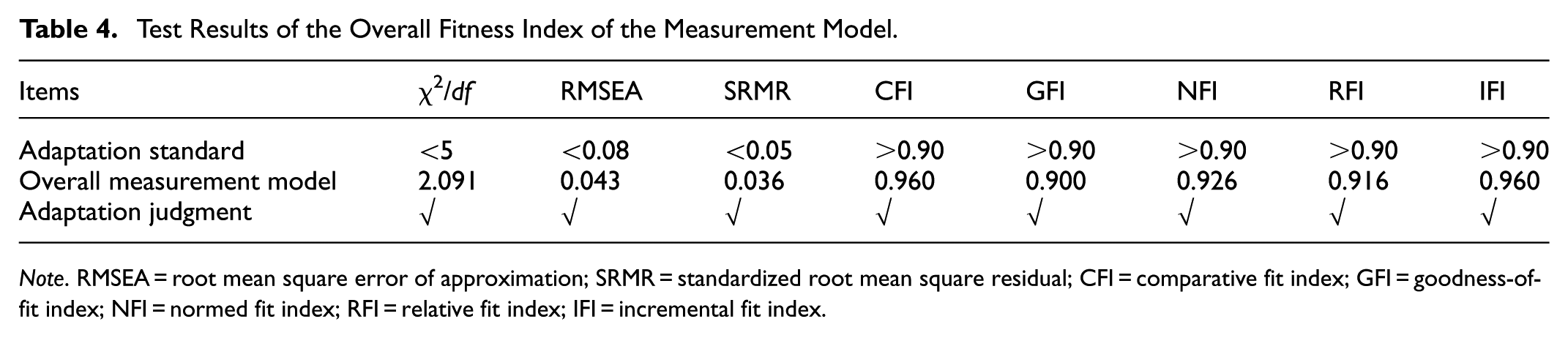
Note. RMSEA = root mean square error of approximation; SRMR = standardized root mean square residual; CFI = comparative fit index; GFI = goodness-of-fit index; NFI = normed fit index; RFI = relative fit index; IFI = incremental fit index.
This study employs χ2/df, CFI, GFI, RMSEA, and SRMR as key indices for evaluating model goodness-of-fit. The threshold criteria for these indices were primarily derived from Wen et al. (2004) and supplemented by conventional standards outlined in Zheng and Wu (2014):
χ2/df: Acceptable range = 2.0–5.0,
CFI, GFI, NFI, RFI, IFI: Threshold ≥ 0.90,
RMSEA: Goodness-of-fit criterion ≤ 0.08,
SRMR: Acceptable threshold ≤ 0.05.
The results of the aforementioned analysis indicate that the overall measurement model’s χ2/df value of 2.091 reflects an acceptable parsimonious fit index, as it is below 3.The RMSEA, an absolute fit index, is 0.043, and the SRMR (standardized root mean square residual) is 0.036. Both values satisfy the criteria for acceptable fit. The incremental fit indices reveal the following values: the Comparative Fit Index (CFI) is 0.960, the Goodness-of-Fit Index (GFI) is 0.900, the Normed Fit Index (NFI) is 0.926, the Relative Fit Index (RFI) is 0.916, and the Incremental Fit Index (IFI) attains a value of 0.960.all of which exceed the threshold of 0.9. These findings collectively suggest that the model developed in this study demonstrates strong overall fitness.
Direct Effects Test
We used SPSS 24.0 to analyze the impact of tea culture spaces on tourists’ aesthetic experience. Table 5 shows all direct paths were supported. Specifically, tea culture space perception had a significantly positive direct effect on aesthetic experience (β = .49, p < .001), supporting H1. The direct effect of tea culture space perception on aesthetic association is also significant (β = .67, p < .001), thereby supporting Hypothesis 2 (H2). Furthermore, tea culture space perception has a significantly positive effect on aesthetic comprehension (β = .89, p < .001), thus supporting Hypothesis 3 (H3).
Results of Direct Effect Regression Analysis.

Mediating Effects Test
Based on the Bootstrap mediation effect test method proposed by (Zhang & Kang, 2016), this section employs the PROCESS 2.16 macro in SPSS 24.0 to examine the mediating effects of aesthetic association and aesthetic comprehension between tourists’ tea culture space perception and their aesthetic experience. The mediation analysis was conducted using the Bootstrap method with 5,000 resamples and a 95% bias-corrected confidence interval. MacKinnon et al. (2004) found through extensive experiments that the bias-correction method in non-parametric Bootstrap procedures is optimal. Therefore, this study reports only the bias-corrected confidence intervals. Table 6 describes the results of the mediating effects. The finding that tea culture space perception is positively related to aesthetic experience through aesthetic association supports Hypothesis 4 (H4; indirect effect = 0.05, Bootstrap LLCI = 0.02, Bootstrap ULCI = 0.09). Thus, the influence of tourists’ tea culture space perception on their aesthetic experience is mediated by aesthetic association. Further, the finding that tea culture space perception is positively related to aesthetic experience through aesthetic comprehension supports Hypothesis 5 (H5; indirect effect = 0.26, Bootstrap LLCI = 0.20, Bootstrap ULCI = 0.32). Therefore, the influence of tourists’ tea culture space perception on their aesthetic experience is mediated by aesthetic comprehension.
Results of the Bootstrapping Analysis for the Mediation Model.

Note. CI = confidence interval; LL = lower limit; UL = upper limit.
Conclusion and Discussion
This study explores the internal mechanism through which tea culture spaces influence tourists’ aesthetic experience by taking Wuyishan’s tea culture spaces as the research object and applying Soja’s Thirdspace theory. The key findings are as follows: First, tourists’ tea culture space perception has a significant direct positive impact on their aesthetic experience (β = .49, p < .001). Second, aesthetic association and aesthetic comprehension play significant mediating roles in the relationship between tea culture space perception and aesthetic experience, with the mediating effect of aesthetic comprehension (β = .26, 95% CI [0.20, 0.32]) being significantly stronger than that of aesthetic association (β = .05 [0.02, 0.09]). Third, the influence path of tea culture space perception on aesthetic experience follows the logical chain of “physical space perception → psychological processing (aesthetic association/aesthetic comprehension) → integrated aesthetic experience,” which verifies the applicability of Thirdspace theory in the context of Chinese tea culture tourism. The theoretical implications and practical implications of this study are specified as follows:
Theoretical Implications
First, the core mechanism of tea culture spaces influencing tourists’ aesthetic experience. (a) Tea culture space perception had a direct and significant impact on tourists’ aesthetic experience. This finding aligns with the results of a study by Liu (2019), which found that tourists’ physical perception of the real environment and virtual perception of the reproducible environment had an impact on their aesthetic experience. (b) Spatial perception can interact with tourists’ internal experiential frameworks (including knowledge, life experiences, and travel history), and enhance aesthetic experience through the chain of “perception → aesthetic association → experience enhancement.” (c) Spatial perception can deepen tourists’ understanding of cultural connotations and positively influence aesthetic experience through the path of “perception → aesthetic comprehension → experience enhancement.” When tourists perceive tangible or intangible symbolic elements in a tourist space, they can establish connections between these elements and their own internal experiential frameworks. Such connections may trigger their associations (Liu et al., 2016) or strengthen the understanding of symbolic meanings by activating relevant memories (Jiang & Xu, 2017; Liu & Chen, 2016), thereby influencing different types of experiences they have in the space.
Second, three key advancements in Thirdspace Theory. (a) For the first time, through structural equation modeling, Soja’s philosophical speculation on “Firstspace → Secondspace → Thirdspace” is transformed into a verifiable logical chain of “physical space perception → psychological processing experience generation.” This provides quantitative support for Thirdspace Theory in the tourism context and proposes a new paradigm for the micro-mechanism of spatial production. (b) Refining the measurement system for the Secondspace: A dual measurement system of “aesthetic association + aesthetic comprehension” was developed, overcoming the vague treatment of the psychological dimension in the original theory. Mediation effect analysis revealed that the mediating effect of aesthetic comprehension (β = .26) is significantly stronger than that of aesthetic association (β = .05), indicating that cognitive decoding plays a more prominent role in experience sublimation within the tea culture context. This stronger mediating effect is not accidental but stems from the inherent logic of Thirdspace Theory and the contextual specificity of Wuyi Mountain’s tea culture. From the perspective of Thirdspace Theory, aesthetic association, as a memory-driven psychological process, remains at the level of “subjective imagination” and rarely involves in-depth decoding of the cultural connotations of physical space (Firstspace). In contrast, aesthetic comprehension—defined as the cognition of the essence of aesthetic objects and cultural laws (Wang, 1981)—enables tourists to connect tangible elements of tea culture spaces with intangible cultural meanings. This “connection between the physical and the cultural” directly meets the core requirement of Thirdspace regarding the “integration of subject and object,” thereby making aesthetic comprehension a more critical bridge linking Firstspace perception and Thirdspace experience. In terms of contextual adaptability, Wuyi Mountain’s tea culture relies on “cognitive decoding” to evoke deep aesthetic experience. A defining characteristic of Wuyi Mountain’s tea culture is its strong natural and cultural symbolism, which demands that tourists do not merely linger at the level of simple sensory associations. Instead, they must engage in in-depth cognitive processing: only by understanding its symbolic meanings and arousing emotional resonance can they achieve aesthetic sublimation.
Third, Expanding the cross-cultural theoretical boundaries. Taking Chinese tea culture spaces as a case study, this research verifies the uniqueness of “Thirdspace” in non-Western contexts—its comprehensive experience not only involves the integration of “materiality and imagination” but also emphasizes the symbiosis of “nature-culture-life” (e.g., tourists’ perception of the connection between “Yanyun” [rock rhythm] and Danxia landforms). This provides new empirical evidence for the cross-cultural application of the theory.
Finally, the interaction between “perceivable symbols” in cultural spaces (such as physical spaces and spatial activities) and tourists’“internal experiential frameworks” (such as life experiences and cultural cognition) is the key to triggering deep aesthetic experience. This offers a new theoretical basis for understanding the mechanism of experience generation in cultural tourism destinations.
Practical Implications
The study findings provide actionable recommendations for optimizing tourism cultural spaces and enhancing the quality of tourists’ cultural experiences at destinations, which can be specifically implemented through the following core strategies.
First, optimizing the “symbol perception system” of tea culture spaces. Given the significant direct positive impact of tea culture space perception on aesthetic experience (β = .49, p < .001), practitioners should prioritize the following three aspects to strengthen this key driving factor: (a) Developing culturally authentic spatial design: Avoid excessive luxury or homogenization, and align with the core connotations of Wuyi Mountain’s tea culture (e.g., the “simplicity, harmony, and tranquility” embodied in The Classic of Tea). Utilize wooden furniture, natural lighting, and borrowed scenery techniques (integrating tea fields and Danxia landforms into the view) to restore the ambiance of “tea coexisting with nature.” These elements not only directly stimulate tourists’ senses and influence their aesthetic experience at multiple levels but also carry cultural connotations that align with cultural meanings, thereby generating a synergistic enhancing effect on tourists’ aesthetic experience. (b) Creating a multi-sensory immersive environment: Organically integrate auditory (e.g., tea-picking ballads, guqin music), olfactory (tea aroma), and tactile (smooth tea sets) elements to enhance tourists’ sense of immersion. For instance, play recordings of local tea farmers’ work in tea ceremony experience areas while diffusing the roasted aroma of Wuyi rock tea. (c) Designing experience-oriented activities: Develop highly participatory activities (e.g., the “follow-the-tea-farmer” program for tea picking and processing) and life-like interactions (e.g., “neighborhood tea chats” with local residents to share daily tea-related matters) to enhance the authentic life texture of activities, replacing the single passive viewing model.
Second, activating aesthetic association through “memory-triggering” displays. While the mediating effect of aesthetic association is significant yet relatively weak (β = .05, 95% CI [0.02, 0.09]), targeted display approaches can still enhance its role. (a) Embed universal memory symbols in spatial decor and exhibits: Decorate tea rooms with ink paintings depicting ancient literati enjoying tea (evoking associations of “traditional Chinese elegant life”) or place bamboo-woven tea sets (triggering cross-cultural shared memories of tea rituals). (b) Enhance scene immersion via dynamic performances: shift cultural performances from “knowledge indoctrination” to “scene restoration”—incorporate segments of tea farmers’ daily lives (e.g., dialogues during early-morning tea picking) to evoke tourists’ own labor experiences or tea-related memories. (c) Set up “memory anchor” interactive installations: create interactive areas such as a “tea story wall,” where tourists post their personal tea memories (e.g., “the tea brewed by grandpa”). This fosters an associative chain of “space → others’ memorie → one’s own memories” among tourists.
Third, deepening aesthetic comprehension through a “cultural decoding” system. As the core mediating variable (β = .26, 95% CI [0.20, 0.32]), aesthetic comprehension requires focused efforts to convert “superficial perception” into “cultural understanding”: (a) Stratified decoding tools: for general tourists, use narrative animations or performances to explain “Yanyun” (rock rhythm) and Danxia landforms, simplifying complex cultural connotations so that tourists can grasp the connection between “nature and tea” without professional knowledge. For tea culture enthusiasts, offer “Tea Ceremony Philosophy Workshops” to explore the concept of “harmony between humans and nature” through hands-on tea brewing, guiding them to understand the link between tea culture and traditional life wisdom. (b) Embedding cultural cues in Firstspace: place QR codes in tea pavilions (linking to videos where tea farmers explain sustainable planting) or integrate tea culture knowledge into tea-picking experiences (e.g., tea farmers sharing picking ethics) to stimulate aesthetic comprehension. This enables tourists to connect their visual experience in tea pavilions (Firstspace) with cultural knowledge (aesthetic comprehension) in real time, thereby strengthening the mediating role of aesthetic comprehension.
Fourth, creating an integrated “Body-Mind-Space” experience. Tourists’ aesthetic experience in tea culture spaces encompass a four-level framework: sensory aesthetic experience (beauty and pleasure at the visual, auditory, olfactory, and gustatory levels), emotional aesthetic experience (inner relaxation, tranquility, and pleasant mood), and spiritual aesthetic experience (identification with cultural spaces and self-actualization).To promote the progression of tourists’ aesthetic experience from the “sensory level” to the “emotional level” and “spiritual level,” the following specific measures can be implemented: (a) Design body-participatory pathways: break down the barrier between spectators and space—for example, create trails among tea bushes (requiring tourists to walk sideways like tea farmers). Tea room seats can be arranged in a “firepit-surrounding style,” where tourists must personally add charcoal and pour water (these physical actions evoke a “sense of ritual in tea affairs”). (b) Strengthen embodied transformation from “sensory” to “spiritual”: set up a “mindful tea-tasting area” in the mountain-top tea house, guiding tourists to put down their mobile phones, listen to the wind and savor the tea aroma, and record their inner feelings—thus elevating material experiences into spiritual-level “self-actualization.”
Fifth, integrating regional micro-spaces. Tourism practitioners should break the limitation of “scenic spot boundaries” and integrate cultural spaces into the overall environment to form a synergistic aesthetic experience that combines “nature, culture, and life.” Specific measures include: construct “outdoor tea-viewing pavilions” by lotus ponds, unify visual symbols (e.g., bamboo signs, tea-colored decorations), and invite local residents to lead daily tea-related activities—allowing tourists to perceive tea as a “life element” rather than a mere performance.
Limitations
This study has three key limitations that should be acknowledged, along with directions for future research to address them.
First, limitations in the representativeness of a single case. The core findings of this study are rooted in the unique research context of Mount Wuyi, and three factors may limit their generalizability: (a) Wuyi Mountain’s tea culture spaces are characterized by “integration of nature and landscape” (e.g., tea pavilions with views of Danxia landforms). In contrast, for tea culture spaces lacking natural landscapes, tourists’ perceptions of “spatial design” and “ambiance” may rely more on artificial elements than natural scenery—our model does not account for variations in the weight of different dimensions of spatial perception across contexts. (b) Tourists’ comprehension of Wuyi Mountain’s tea culture is largely shaped by “Yanyun” (rock rhythm) and its association with local geological conditions. In regions without such geo-cultural connections, the pathway of “spatial perception → aesthetic comprehension → aesthetic experience” may be triggered by different cultural symbols. (c) Wuyi Mountain provides “comprehensive aesthetic input” through the integration of multiple scenarios (natural tea gardens + cultural performances + hands-on experience activities). For smaller destinations with limited activity types, the composition and formation mechanism of tourists’ aesthetic experience may differ from those in this study. Thus, the theoretical model proposed in this study has context-specific boundaries tied to Wuyi Mountain’s characteristics. The synergistic effect of “nature-culture-life” in Thirdspace may be more prominent in destinations where natural and cultural heritages are highly integrated. For destinations dominated by a single attribute (e.g., urban tea spaces without natural landscapes, plain tea gardens lacking complex cultural rituals), the relative importance of the three subdimensions of tea culture space perception (spatial design, ambiance, activities) may change. Future research should adjust the weights of variables in this model according to destination types. Additionally, the mediating effect of aesthetic comprehension observed in this study may be weaker in destinations with weaker cultural-symbolic connections, as Wuyi Mountain’s tea culture has clear historical and geological connotations that facilitate tourists’ cognitive decoding.
Second, constraints of specific cultural contexts. This study focuses on tourist experiences within the context of Chinese tea culture, whereas tea cultures in different countries and regions (e.g., Japanese tea ceremony, British afternoon tea) have distinctly different symbolic connotations and practical forms. For instance, East Asian tea cultures share certain philosophical foundations (e.g., Zen influence), which may foster similar aesthetic pathways; in contrast, Western tea consumption contexts often lack such a shared symbolic system. For tourists with greater cultural distance, understanding concepts like rock rhyme may require different mediating strategies. In addition, for Japanese tea culture, which emphasizes “wabi-sabi” aesthetics (it centers on the advocacy of simplicity, imperfection, and natural authenticity—a concept that highly aligns with the emphasis in Japanese tea culture on “pursuing inner tranquility through a sense of ritual.”) and rigorous rituals, “spatial perception” focuses more on minimalist design and ritualized movements (e.g., tea-making gestures). This may strengthen the mediating effect of aesthetic comprehension, as tourists need to decode the emotional connotations behind the rituals (e.g., “achieving tranquility through simplicity”). In contrast, British afternoon tea culture—centered on social interaction and material enjoyment—directs “spatial perception” more toward social spaces. Here, the mediating effect of aesthetic comprehension may weaken, due to the lack of deep symbolic connections between “space and cultural essence” in British tea culture. These cultural differences may alter the functioning of core mechanisms (e.g., aesthetic association, aesthetic comprehension). Future studies should adopt a multi-case comparative approach (e.g., Pu’er tea mountains in Yunnan, urban tea spaces in Chengdu) to clarify the applicable scope of the current model. Additionally, cross-national comparative research (e.g., contrasting East Asian and Western tea culture contexts) is needed to explore how cultural distance moderates the “tea culture space perception → aesthetic experience” pathway.
Furthermore, Limitation in construct operationalization. This study treats “tourists’ tea culture space perception” and “aesthetic experience” as holistic variables. While this approach effectively captures overall effects, it obscures nuanced differences within these constructs. The specific limitations are as follows: (a) This treatment fails to examine the differential impacts of specific spatial subdimensions (e.g., lighting, layout) on distinct dimensions of aesthetic experience (sensory, emotional, spiritual). For instance, we cannot determine whether sensory aesthetic experience depends more on spatial design or environmental ambiance, nor can we identify which type of social interaction best facilitates aesthetic comprehension. (b) This approach simplifies mediating and moderating mechanisms, overlooking variables at the subdimension level. For example, it does not explore whether participation in tea-related activities influences overall aesthetic evaluation primarily through emotional experience. Future research should decompose core constructs into subdimensions and employ multi-group structural equation modeling to test differences in specific pathways (e.g., the differential impact of “spatial ambiance perception” on “emotional aesthetic experience”). It should also examine the heterogeneity of mediating mechanisms across subdimensions (e.g., whether aesthetic comprehension exerts a stronger mediating role in the pathway of “spatial activity perception → cultural identity-based aesthetic experience”) and introduce additional mediating or moderating variables to enrich the explanation of underlying mechanisms.
Finally, this study has a notable limitation in its sample structure, which may limit the generalizability of the findings. Specifically, tourists under 40 years of age accounted for 79.2% of the sample, and respondents with a college degree or higher represented 76%. This sample structure—characterized by the over-representation of younger and highly educated groups—may skew the research conclusions toward the cognitive and experiential perspectives of these specific demographics, thereby failing to fully capture the genuine perceptions and experiences of tourists across different age groups and educational backgrounds. For instance, younger tourists tend to prioritize experiential and social interactions within tea culture spaces, whereas middle-aged and elderly tourists may place greater emphasis on the historical inheritance and traditional ritualistic nature of tea culture. Meanwhile, tourists with higher educational attainment typically demonstrate stronger ability to associate spatial elements with cultural connotations, while those with lower education levels may rely more on intuitive sensory experiences. The unbalanced sample structure in this study may have overestimated the mediating effect of “aesthetic comprehension.” To address the aforementioned limitations, future research may adopt the following specific strategies to enhance the generalizability of the conclusions and their implications for practical application: (a) Adopt stratified sampling to construct a diversified sample structure. Future studies may use the stratified sampling method to determine the sample size of each demographic group. (b) Introduce “age” and “educational background” as moderating variables based on the existing model, which will help examine their moderating effects on both the main path of “tea culture space perception—aesthetic experience” and each mediating path.
Supplemental Material
sj-docx-1-sgo-10.1177_21582440251408553 – Supplemental material for Influence of Tea Culture Space on Tourists’ Aesthetic Experience
Supplemental material, sj-docx-1-sgo-10.1177_21582440251408553 for Influence of Tea Culture Space on Tourists’ Aesthetic Experience by Feifei Yang, Xiaoyan Yang and Ziyan Yin in SAGE Open
Footnotes

Ethical Considerations
No potential conflict of ethics. The respondents in this study are all over 18 years old. This study was conducted in compliance with ethical research practices. The survey was distributed anonymously, and no personally identifiable information—including names, contact details, or any other sensitive data—was collected. Participants’ responses were anonymized during data processing, and their voluntary participation was confirmed through an introductory statement. Ethical approval was deemed unnecessary as the study posed no risk to participants and adhered to journal guidelines and the principles of the Declaration of Helsinki.
Funding
The authors disclosed receipt of the following financial support for the research, authorship, and/or publication of this article: This work was supported by the Fujian Natural Science Foundation project (2022J05266), the Social Science Program of the Education Department of Fujian Province, China (JAS22166) and Scientific Research Startup Project for Introduced Talents of Wuyi University (YJ202411).
Declaration of Conflicting Interests
The authors declared no potential conflicts of interest with respect to the research, authorship, and/or publication of this article.
Data Availability Statement
Data sharing not applicable to this article as no datasets were generated or analyzed during the current study.
Supplemental Material
Supplemental material for this article is available online.
References
Supplementary Material
Please find the following supplemental material available below.
For Open Access articles published under a Creative Commons License, all supplemental material carries the same license as the article it is associated with.
For non-Open Access articles published, all supplemental material carries a non-exclusive license, and permission requests for re-use of supplemental material or any part of supplemental material shall be sent directly to the copyright owner as specified in the copyright notice associated with the article.
