




Abstract
In stage models of personality development, advancing development is understood as an increased interaction with the surrounding world. In the aesthetics of structures that can be found in the surrounding world, for example, in architecture or landscape design, it is this interaction between humans and the environment that is crucial. In order to investigate the connection between personality development and the aesthetics of abstract structures, especially their characteristics in terms of size and order, and how they change over the course of development, the present study combined Loevinger’s Washington University Sentence Completion Test (WUSCT) with a task of laying aesthetically pleasing structures that were composed of individual building blocks. The results show that further development is linked to an increased preference for larger, ordered structures, and therefore suggest that development as a process of change in the relationship to the environment is also reflected in aesthetic production and appreciation.
Keywords
Introduction
Loevinger’s Ego-Development Model outlines a comprehensive framework for understanding the stages of personality and cognitive development, also pertaining to the development of aesthetic appreciation. According to Loevinger, individuals progress through a series of ego stages, each characterized by increasingly complex ways of perceiving and interacting with the world (Hy & Loevinger, 2014; Loevinger, 1976). She developed the Washington University Sentence Completion Test (WUSCT), which has been extensively investigated with regard to homogeneity, reliability and validity (e.g., Hauser, 1976; Loevinger, 1966, 1979; 1998, chap. 5; Loevinger & Wessler, 1970), to measure the stages of ego development. Her development model is related to the general view of development as a process characterized by a change in the reference to the surrounding world and in which development is understood as a progression towards greater complexity, integration and self-actualization (e.g., see: Graves, 1970; Helson & Roberts, 1994; Kegan, 1982; Maslow, 1968). Michael Parsons has worked on the connection between personality development and aesthetic experience (Parsons, 1979, 1987, 1991, 1999, 2002). Though his findings are based on experiences as an art educator and not from psychometric studies, parallels can be found in the dynamics of personality development and the development of art production and reception. These common dynamics should also be reflected in equivalent changes in the frame of reference, as we will explain further below with regard to our research question. In the following the two models are described in detail.
Michael Parsons’ Model of Aesthetic Development and Jane Loevinger’s Model of Ego-Development
Parsons’ Model of Aesthetic Development outlines a stage-based theory of how individuals’ understanding and appreciation of art evolve. His model includes five stages. Stage 1 is characterized by a preference for art based on personal likes or dislikes, often influenced by an attraction to color (Parsons, 1979, 1987). Stage 2 is marked by a concern for subject matter and a strong preference for realism. Stage 3 is dominated by recognizing the emotional and expressive content of art, understanding that art can convey feelings and moods. Stage 4 is characterized by appreciating the formal qualities of art, including style, technique, and composition, and understanding the artist’s intentions. At Stage 5 viewing art in a broader cultural, historical, and theoretical context, recognizing multiple interpretations and the deeper meaning of art becomes dominant (Chen, 1997; Pariser, 1988; Parsons, 1979, 1982, 1987, 1991, 1994, 1999, 2002; Rocha et al., 2020).
Jane Loevinger’s Ego-Development Model describes the development of the self through stages of increasing complexity and integration. The stages build on the previous ones and integrate them, which means that with progress in chronological age, also the developmental stages progress, whereby the stage development can progress at different speeds and to different extents (Hy & Loevinger, 2014, pp. 3–4; Young-Eisendrath, 1982, p. 325). The first stage is pre-social and pre-verbal and since the WUSCT is a language based test, this stage is not measurable with her test. At the second Impulsive Stage (E2) Behavior is driven by impulses and immediate gratification. The Self-Protective Stage (E3) is characterized by an awareness of rules and consequences, but actions are still self-centered. The Conformist Stage E4 is dominated by seeking approval from others and adhering to social norms. At the next stage, the Self-Aware Stage (E5) greater self-awareness and recognition of individuality is developed. At the Conscientious Stage (E6): Internalized standards for behavior are complete and standards are now self-chosen. Things are looked at from a broader social context and the self can be perceived apart from the group (Hy & Loevinger, 2014, pp. 5–6). At the Individualistic Stage (E7) individuality and the complexity of people and situations is appreciated. The Autonomous Stage (E8) is then characterized by “the recognition of other people’s need for autonomy” (Hy & Loevinger, 2014, p. 6). Loevinger’s highest stage, the Integrated Stage (E9) is a very rare stage and characterized by a fully developed and integrated sense of self (Hy & Loevinger, 2014, p. 7).
Both Parsons and Loevinger emphasize development through stages, where each stage represents a more complex and sophisticated level of understanding. In Parsons’ model, individuals move from basic, concrete preferences in art to a nuanced appreciation of its deeper meaning and context. Similarly, Loevinger’s model describes a journey from impulsive, self-centered behavior to a highly integrated and autonomous sense of self. Integrating these models, one can see that as individuals develop a more complex ego structure (as per Loevinger), their capacity for aesthetic appreciation also evolves (as per Parsons). Higher stages of ego development, characterized by greater self-awareness, empathy, and cognitive complexity, can enhance one’s ability to appreciate the deeper meanings, context, and emotional expressiveness in art. Thus, the development of the ego and aesthetic appreciation are interconnected, with psychological growth fostering a more sophisticated engagement with art (Hy & Loevinger, 2014; Loevinger, 1976; Parsons, 1987).
The Aesthetics of Structures and their Connection to Development
Regarding aesthetic appreciation, we now consider in particular the aesthetics of structures, which, encompassing both architectural and natural forms, plays a crucial role in human experience and environmental interaction (Kaplan, 1992; Kaplan et al., 1998; Kellert et al., 2011; Knoll et al., 2024; Pallasmaa, 2024). Aesthetic appreciation of structures is influenced by various factors, including symmetry, proportion, scale, texture, and color, which collectively contribute to a sense of harmony and visual pleasure, although it has also been observed that symmetry is not a general characteristic of beauty (Höfel & Jacobsen, 2007; Leder et al., 2019). The perception of beauty in structures is not only a sensory experience but also involves cognitive and emotional responses that are shaped by cultural, historical, and personal contexts (Alexander, 1977; Arnheim, 1954; Berlyne, 1971; Csikszentmihalyi & Robinson, 1990; Gardner & Gardner, 2008; Kaplan et al., 1998; Kellert et al., 2011; Leonhardt, 1996; Nasar, 1988; Pallasmaa, 2024). Research in environmental psychology and architectural theory suggests that aesthetically pleasing environments can enhance well-being (Altomonte et al., 2020; Mastandrea et al., 2019; Ulrich, 1979, 1984), stimulate creativity, and foster a sense of place and identity (Lengen & Kistemann, 2012; Manzo & Devine-Wright, 2013; Nassauer, 1995; Relph, 1976; Tuan, 1977). For instance, research has shown that people tend to prefer environments that strike a balance between complexity and order (Geller, 1980; Lavdas & Schirpke, 2020; Van Geert & Wagemans, 2020, 2021). This supports theories that combine biophilia and gestalt principles in design, linking ordered complexity with natural characteristics and promoting sustainable and biophilic design approaches in modern architecture to create spaces that are visually appealing, environmentally responsible, and supportive of human health and productivity (Berto et al., 2023; Kellert et al., 2011; Söderlund, 2019a, 2019b; Toub, 2013–2014).
Ego-development is described as change in the frame of reference (Hy & Loevinger, 2014, pp. 3–4), and it influences the perception and appreciation of aesthetics in general, as illustrated by Parsons’ description of the developmental stages of aesthetic experience. However, it remains unclear—or has not yet been sufficiently tested—to what extent the two models under consideration, namely general development and aesthetic development, are interconnected or whether aesthetic development may instead be regarded as relatively independent of general development. Further extensive studies linking the two models are necessary to investigate this connection, but still, parallels can be found as described above. Therefore, the question arises as to how this change in the frame of reference affects the aesthetic perception of structures. As individuals progress through stages of ego development, their perspective broadens and becomes more inclusive of diverse viewpoints, complex relationships, and abstract concepts. This process is characterized by several key aspects. At higher stages of ego development, individuals develop a greater awareness of the interconnectedness of their actions and the broader social, cultural, and environmental contexts. They move from an egocentric perspective, where their own needs and desires are central, to a more sociocentric and even world-centric view (Erikson, 1968; Kegan, 1982; Loevinger, 1983; Loevinger & Knoll, 1983; Maslow & Lewis, 1987). At higher stages, individuals can integrate diverse viewpoints, reflect on their values and beliefs, and develop a more cohesive and nuanced sense of identity. Advanced ego development involves the ability to integrate multiple perspectives and appreciate the validity of different viewpoints (Hy & Loevinger, 2014, pp. 6–7; Loevinger, 1966). As ego development progresses, individuals’ thinking becomes more abstract and systemic. They are capable of understanding and manipulating abstract concepts, recognizing patterns and systems, and thinking in terms of principles and values rather than concrete rules (Cook-Greuter, 1985, 2000; Graves, 1970; Mezirow, 1991; Torbert, 2000). Theories by Susanne Cook-Greuter (Cook-Greuter, 2000) and Charles Alexander (Alexander & Langer, 1990; Alexander et al., 1987) also emphasize the evolving nature of personality and worldviews, suggesting a connection between the stages of ego development and an increase in the frame of reference regarding meaning-making and the focus in life with respect to a certain world concept, which in Parsons’ model also applies to the further development of aesthetic perception and judgment of art objects (Parsons, 1979, 1987, 1991, 1994, 1999, 2002).
Research Question and Hypotheses
Although the study regarding a connection between increasing ego maturity, which manifests itself in an expanded frame of reference, and an analogous expansion of spatial or physical dimensions in the perception or production of artworks is very new, there is some research evidence that points to this very connection and justifies our research question. For example, Lowenfeld describes stages of development in children’s creativity and aesthetic awareness and how spatial representations change (e.g., overlapping objects, suggestive perspective) (Lowenfeld & Brittain, 1964, chap. 6–8). Children begin with very small, focused drawings (e.g., figures centered on the page), but as they develop, they develop increasingly complex and expansive compositions, including scale (Lowenfeld & Brittain, 1964, pp. 118–120). The aesthetic development also includes the development of some sense of order in the compositions, which is visible in the role of a base line in land scape representations, but also as part of general space representations (Lowenfeld & Brittain, 1964, pp. 146–159). Studies on children’s drawing development show that with increasing cognitive maturity, children use not only more complex forms but also larger and more multidimensional representations (Freeman, 1972; Kellogg, 1959, 1969). Another study empirically examined how structural features (composition, dimension, meaning) develop in children’s drawings from 5 to 13 years of age (Leeds et al., 1983). For these reasons, a connection must be assumed not only in personality development and aesthetic development, but also in a concrete connection between an enlarged frame of reference of development and larger spatial dimensions of art awareness and art production.
In summary, existing evidence shows that individuals with increasing development are capable of understanding and manipulating abstract concepts, recognizing patterns and systems and aesthetic development includes a sense of order, complexity and expansion in dimension. Based on this rationale, our research question was whether developmental progression is accompanied by an increase in the spatial diameter of structures perceived as aesthetically pleasing, and whether a compositional order—such as symmetry—played a role in their construction. Our hypotheses corresponded to the assumption that with increasing development, both the radius in the created structure and the number of those who preferred an order in their laid structure increased. For this purpose, we combined Loevinger’s sentence completion test with a task to create a structure that was perceived as aesthetically pleasing from individual building blocks as an operationalization of human-made structures in an input field. The study thus provides important empirical results on the question of how the aesthetic perception of structures changes over development.
Materials and Methods
Participants
The participants of our study were recruited via the email distribution lists of HSU Hamburg (Helmut Schmidt University / University of the Federal Armed Forces Hamburg), resulting in a sample of 110 individuals in an age range of 18 to 67 (mean: 28.85, sd: 13.75; gender: 34 male, 76 female), that consisted of non-professionals regarding aesthetic education, due to this academic environment. A power analysis for the sample size with a targeted average effect size of 0.4 and a power of 0.8 resulted in a sample size of 60 participants. The maximum size of our sample group was set at approximately 100 participants to ensure that the complex qualitative analysis was kept manageable. Socio-demographic information, including age, gender, and cultural background, was gathered without revealing individual identities. Though some participants had diverse cultural backgrounds, all were raised in Germany and fluent in the German language, which made it possible to conduct the study in German.
Ethics Statement and Testing Procedure
The data collection of our study was carried out using the online survey software unipark. The software was provided and the study was implemented by HSU Hamburg. Before data collection began, the study received approval from the university’s ethics committee (Ethics Committee of psychology at the Faculty of Humanities and Social Sciences - Vote-HSU-HH-29/11/17). Participants were informed about the study’s purpose, data protection measures, and their informed consent was obtained. All data were collected anonymously. After collecting sociodemographic data, participants answered the questions of our study. In addition to the two parts presented here, additional data on personal life focus and world concept (in preparation) and visual perception and other aesthetic preferences were collected and reported elsewhere (Mühlenbeck, 2025). All parts were presented in a randomized order. The relevant parts regarding this study included the sentence stems of the WUSCT (Part 1) developed by Jane Loevinger, translated into German, with four sentence stems replaced (13, 14, 29, 33 of the original WUSCT, see Appendix) to better suit our questions. The original sentences addressed participants’ attitudes towards sex, an important part of psychosexual development. However, these sentences could have been perceived as inappropriate in the professional and student context of our survey group. Therefore, we replaced them with sentences more suitable for the professional and student context, as also described and carried out by (Binder, 2015, p. 265). For the replacements we chose the same sentences as Binder did, since we also had a professional context here and the sentences had already been carried out without any problems in his study. According to Hy and Loevinger’s evaluation manual (Hy & Loevinger, 2014, pp. 26; 32), the exchange of some sentence stems is permissible, as the remaining sentence stems still provide sufficient opportunity to adequately measure the development stage, and the new sentence stems can also be evaluated using the manual’s general coding rules. The presented sentence stems from Part 1 can be found in detail in the appendix. The instructions for the Loevinger Sentence Completion Test were: “Please complete the following sentences. There are no right or wrong answers. Use the words in italics (in some sentences) if you are a woman.” In Part 2 of our study, the participants were asked to create a figure or structure that corresponded to their sense of beauty by moving 10 building blocks in a triangular shape in a presented field. Triangles were used because, due to their geometrically uniform structure, they can be used as the basic building blocks of composite figures. In the starting position, the triangles were lined up at the top of the field and could then be moved. The instructions were as follows: “The triangles below can be moved with the mouse. Use the pieces to create a figure or structure that suits your sense of beauty. When your figure is finished, click the Next button! The figure is saved by clicking the Next button. Please note that you can only create this figure once.” The order of this sequence was determined by the survey software because it was not possible to overwrite an entry once it had been saved in the overall storage process. For this reason, the back-button should not be used. This would have been marked by the software as an incorrect data set. After data collection, in an initial review, the data was examined for missing data points. Participants who did not complete the questionnaire of the WUSCT or did not create a structure were excluded from the data export and counted as not tested, leading to the exclusion of 11 participants. This left 99 participants in the same age range for further analysis. The created structures are included as jpeg-files in the Supplemental Material.
Data Analysis
The rating of the WUSCT and the rating regarding symmetry/order were evaluated qualitatively by two independent raters, whereby one coder was one of the authors and the second coder came from the academic background and was instructed by the first coder in relation to the research question. The evaluation of the sentence completions was conducted using the manual that was written by Hy and Loevinger (2014) and intended to enable the coders to conduct the evaluation independently. The WUSCT evaluation is a qualitative evaluation, for which all main categories (the developmental stages) and finer subcategories are specified in the evaluation manual, and the sentence completions are then classified into these categories (for a large number of example sentences, see: Hy & Loevinger, 2014, Part II, pp. 88–267, and regarding the general coding guide: Part I, pp. 3–87). For each participant, the two raters coded the developmental stage (E) corresponding to the sentence completions and the percentage agreement between the two raters was calculated. The created structures from Part 2 were evaluated in two steps. First, with the data analysis software R (package grid: Murrell, 2002; package jsonlite: Ooms, 2014; package geometry: Roussel et al., 2019; package png: Urbanek, 2013) we created the minimum enclosing circle around the created structures, using the Welzl’s Algorithm (Welzl, 2005) and the pixels from the center of the triangles as calculation points. The algorithm randomly and uniformly selects one point p from an initial input set P of points and recursively finds the smallest circle that contains P without p, that is, all the points in P except for p. If the resulting circle also encloses p, it is the minimal circle for the entire set P and is returned. The diameter of the circle for each created structure was then calculated, whereby it was standardized in relation to the available area of the input field, since the participants had the opportunity to complete the online questionnaire on different devices (mobile phone, PC, tablet). The recalibration of the device-dependent input fields to a uniform scale in a square canvas was already included in the unipark survey software. The formula for standardization was: radius in absolute pixels divided by width of the drawing area/canvas in pixels (since it was a square canvas), and multiplied by 2 (for receiving the diameter and not the radius).The calculated diameter was rounded to 2 decimal places. After examining the distributions of the relative frequencies in the obtained developmental groups (for an overview see Figure 1), a critical range of values was identified, in which the majority of the data of all obtained groups was located. This resulted in a critical value range of a diameter of 0.14 to 0.36, which was used for further analysis and for this purpose was divided into two parts (0.14–0.25 and >0.25–0.36) in order to compare these two parts (two diameter categories) to investigate whether and how exactly the frequency distributions changed in the three groups. Examples of these structures with minimum enclosing circle are presented in Figure 2. After that, the frequency distribution of the two diameter categories in the obtained developmental stages was determined. In the second step, the two raters coded whether the structures contained a kind of symmetry or another clear order and the percentage agreement between the two raters was calculated. Symmetry was defined as the property of an object or system to remain unchanged under certain transformations such as reflection, rotation or translation. Other kinds of order were for example a fractal structure (which is characterized by the fact that a larger sub-structure can be reflected in a smaller one and vice versa) or a coherent object-like figure. In the instruction for coding the type of order was left open. Coding was only based on a general presence of order, not on specific forms. If there was a discrepancy in the coding, this object was discussed, as is usual in qualitative evaluation, and a joint decision was made. Also in this step, the frequency distribution of the two categories with and without symmetry/order in the obtained developmental stages was determined to receive information about the change in frequency distribution, and in addition, the frequency distribution of the accordance between the larger diameter (second category) and symmetry/order of the structures was calculated. To obtain inferential statistical results, a χ2 independence test was calculated for the variables developmental stages and diameter, symmetry/order and accordance between larger diameter plus symmetry/order respectively. The statistical analyses were also carried out with the software R (stats-package: R-Core-Team, 2013). We chose the χ2 independence test because it is a parsimonious hypothesis test for examining distributions across groups and testing for relations or differences between them. As a non-parametric test, the χ2 independence test places few demands on the distributions of the data and, unlike parametric tests (such as logistic regression), does not require complex model assumptions.

The relative frequency distributions of all diameter values in the three obtained developmental stages E4, E5, E6.
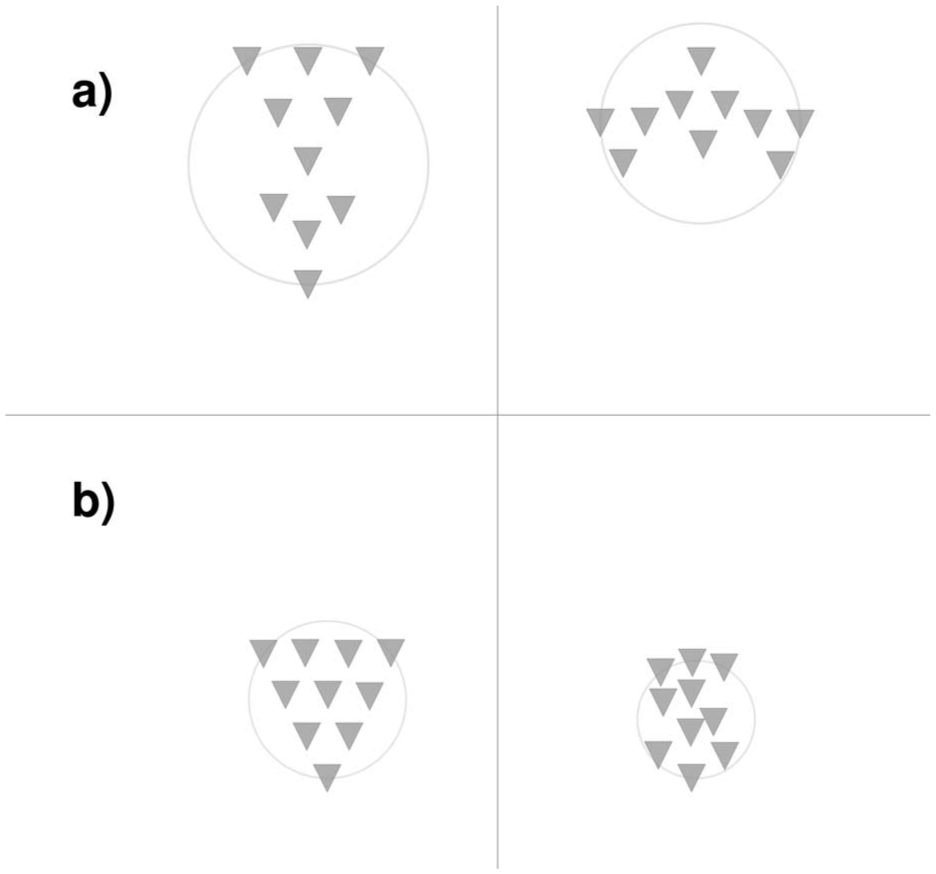
Examples of the created structures: (a) two structures with a diameter within the range of >0.25 to 0.36 and minimum enclosing circle and (b) two structures with a diameter within the range of 0.14 to 0.25 and minimum enclosing circle. The right one under (b) is one example of a non-ordered/asymmetric structure. All examples are represented in their original laid position within the input field.
Results
Our coding of the WUSCT (TPR (total protocol rating)) resulted in the following distribution of development stages (see also Table 1): stage E4: 24 participants (0.24%); stage E5: 52 participants (0.53%); stage E6: 22 participants (0.22%), stage E7: 1 participants (0.01%). The percentage of agreement between the two ratings of the development stages (TPR) was: number of participants: 99, percentage agreement: 0.92. Since the number of participants in stage E7 was too small for further evaluation, the participant was excluded from further analysis. As described in the introduction, individuals develop to the next stages at different rates as they age. However, a general relationship between age and developmental stage can be assumed. To describe the contingency between chronological age and developmental stages, that is, to test whether a monotonic relationship exists, we calculated post hoc Spearman’s rank correlation, which yielded a value of −0.014 (calculated with R, package tidyverse: Wickham et al., 2019).
Overview of the Results from the Ratings of the Development Stages, the Number of Structures with a Diameter between 0.14–0.25 and >0.25–0.36, the Number of Structures That had Symmetry or Other Unique Order and the Number of Structures That had a Larger Diameter within the Range of >0.25-0.36 and Symmetry/Order.
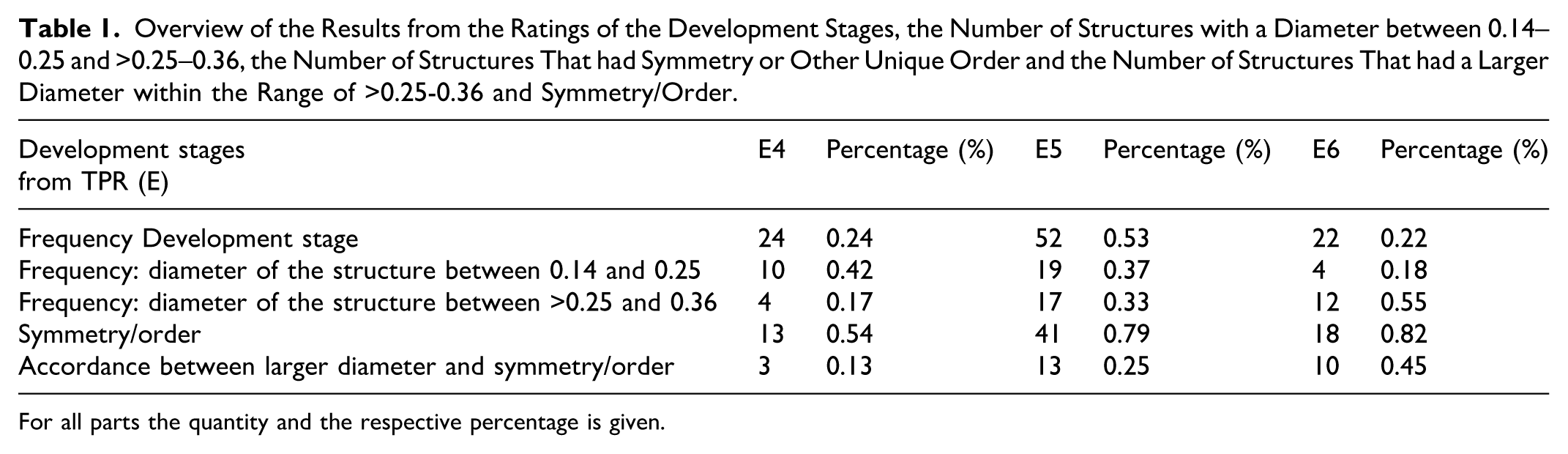
For all parts the quantity and the respective percentage is given.
The calculation of the diameter of the created structures resulted in the following distribution for the three obtained development stages: diameter in the range between 0.14 and 0.25: E4: 10 participants with a percentage of 0.42, E5: 19 participants with a percentage of 0.37 and E6: four participants with a percentage of 0.18. For a diameter in the range between >0.25 and 0.36 the calculation resulted in E4: four participants with a percentage of 0.17, E5: 17 participants with a percentage of 0.33 and E6: 12 participants with a percentage of 0.55.
The coding regarding symmetry or other type of clear ordered structure revealed for E4: 13 participants with a percentage of 0.54, E5: 41 participants with a percentage of 0.79 and E6: 18 participants with a percentage of 0.82. The percentage of agreement between the two raters was: 0.96.
The results regarding the χ2 independence tests between (a) developmental stages and diameter of the structures, between (b) developmental stages and symmetry/order of the structures and between (c) developmental stages and accordance between larger diameter plus symmetry/order were the following: (a) the χ2-value was 5.991 with 2 df and α = .05. The χ2 statistic was 6.68 with a p-value of .035. For (b) we received for the χ2-value of 5.991 with 2 df and α = .05 the χ2 statistic of 6.15 with a p-value of .046. For (c) we received for the χ2-value of 5.991 with 2 df and α = .05 the χ2 statistic of 6.53 with a p-value of .038.
Discussion
Since the aim of our study was to determine whether the advancement of development is accompanied by an increase in the diameter of abstract structures considered aesthetically pleasing, and whether these structures exhibit some form of symmetry or other kind of order, we designed our methodology accordingly. To explore this, we combined Loevinger’s WUSCT with a task in which participants were asked to create an aesthetically pleasing structure using individual building blocks. Our results show that nearly all adults were rated in stages E4 to E6, which fits well with Cook-Greuter’s observation that approximately 80% of adults fall within these stages (Cook-Greuter, 2000, p. 229) and Hy and Loevinger’s description that higher stages are rare (Hy & Loevinger, 2014, pp. 6–7), whereby it has to be mentioned that Cook-Greuter’s data were drawn from a large and diverse sample of several thousand participants, whereas our study involved a relatively small sample of 99 individuals from an academic setting. Regarding our research questions, we found, on the one hand, that in the three obtained development stages, the descriptive results regarding the created structures showed an increase in those structures that had a diameter between >0.25 and 0.36, namely in the percentage from 0.17 (E4) to 0.33 (E5) to 0.55 (E6), whereby also the results of the inferential statistical analysis showed a significant dependency between the variables development stage and diameter of the structures, visible in the p-value of .035. Likewise, the descriptive results regarding symmetry (or other type of order) showed that here, too, there was an increase in the three developmental stages in the number of those structures that exhibited this kind of order, namely in the percentage from 0.54 (E4) to 0.79 (E5) to 0.82 (E6). Again, the results of the inferential statistical analysis showed a significant dependency between the variables development stage and symmetry/order, visible in the p-value of .046. In addition, our results regarding the accordance between the larger diameter plus symmetry/order showed that, first, on the descriptive level, there was, likewise, an increase in the three developmental stages in the number of structures that had both a diameter within the range of >0.25–0.36 and symmetry/order, namely from 0.13 (E4) to 0.25 (E5) to 0.45 (E6). Second, there was again a significant dependency between the two variables development stage and accordance between larger diameter plus symmetry/order, reflected in the p-value of .038. Hence, our research question was confirmed in that there was a connection between further development and the increase in the diameter of self-created, aesthetically pleasing structures, both in terms of the size of the diameter or symmetry/order alone, and also in terms of a combination of both. This aligns with the indirect assumptions of the stage models described above, both in regard to Loevinger’s model of personality development and Parsons’ development model of aesthetic experience, in which increasing development is accompanied by an enlarged frame of reference, but also by an increased sense of complex or abstract relationships (Cook-Greuter, 1999, 2000; Kegan, 1982; Loevinger, 1966, 1969, 1976, 1983; Loevinger & Knoll, 1983; Parsons, 1979, 1987, 1991, 1999, 2002). When we combine the two models by Loevinger and Parsons and interpret them in relation to our results, we see that at E4, where, according to Loevinger (Hy & Loevinger, 2014, p. 5), the reference frame primarily consists of the identification with social groups and the perception of the self is rather self-centered, we saw less of the larger structures and less of the symmetrically ordered ones than in stage E5. In accordance, Parsons’ Stage 3, which fits the approximate age range of Loevinger’s stage E4, is described as an appreciation of emotions and content, which could explain the weaker focus on larger abstract ordered structures. In stage E5, the frame of reference is shifted further outwards and a stronger awareness of interpersonal relationships is developed (Hy & Loevinger, 2014, p. 5), which is also reflected in Parsons’ Stage 4 of his developmental model of aesthetic experience, in which the evaluation of artworks is more dominated by medium and form (Parsons, 1987, 1999, 2002). In accordance, we find in our results an increase in structurally ordered, larger figures. Stage E6 is then characterized by a conscious relationship to one’s own culture and social aspects (Hy & Loevinger, 2014, pp. 5–6), which is also reflected in Parsons’ Stage 5, in which artistic traditions are understood and overcome and the evaluation of artworks is characterized by personal judgment (Parsons, 1982, 1987, 1991, 2002). Of the three presented here, this level has the strongest awareness of one’s own self (Hy & Loevinger, 2014; Loevinger, 1976, 1983; Loevinger & Knoll, 1983).
Since our results suggest a stronger focus on larger, abstractly ordered structures as development progresses, the connection between personality development and the increase in a preference for larger, ordered structures can be discussed in a general framework. As individuals mature and develop their personalities, their preferences for certain types of structures and aesthetics can evolve. As they progress through stages of cognitive development, their ability to appreciate complexity and order in structures increases. Jean Piaget’s theory of cognitive development, for example, posits that individuals move from concrete operational thinking to formal operational thinking, where they can understand and appreciate abstract concepts and relationships (Piaget, 1964, 2013). In Loevinger’s description of the progression from the impulsive, self-centered stages to more integrated and autonomous stages, individuals at higher stages of ego development are more aware of the interconnectedness and abstract complexity in the relation between the self and its surrounding world (Loevinger, 1966, 1976; Loevinger & Knoll, 1983). This awareness should also have implications for their ability to see beyond immediate, tangible aspects and consider broader, more abstract elements of design and structure. Individuals vary in their need for aesthetics, where some may focus on concrete and immediate visual aspects of structures, such as simplicity and unity. In contrast, others are capable of appreciating more abstract and complex attributes, such as the harmony within a structure and the relation to its environment, historical context, and symbolic meaning (Tetzlaff et al., 2024). To date, only few studies have investigated whether these differences in aesthetic awareness and aesthetic needs in adulthood can also be attributed to different stages of development. These differences mirror the cognitive and emotional process, where a more integrated and nuanced understanding of beauty and design emerges, and can also be interpreted in relation to developmental differences. Consequently, the interplay between ego development and aesthetic perception underscores the dynamic nature of how humans experience and value structural forms, reflecting broader developmental trajectories in human consciousness and identity formation. Also aspects regarding attention processes and mindfulness play a role in aesthetic perception (Weigand & Jacobsen, 2023), which in turn are also influenced by personal development as we have seen in the description of Loevinger’s stages.
Conclusions and Limitations
As a conclusion, we can summarize that personality development, as the various stages of cognitive, emotional, and social growth, is linked to an increased preference for larger, ordered structures. Or in other words, we can say that the expansion of the frame of reference of individual development is also reflected in the frame of reference of aesthetic perception/appreciation. Our results provide an important empirical contribution to the connection between personality development and aesthetic preference for abstract structures, as well as the change in the radius of aesthetic perception, which can confirm the increase in complexity and radius as development progresses. Therefore, in connection with the above described theories of cognitive and ego development, self-actualization, and aesthetic appreciation, our results strengthen the assumption that cognitive development, which is also associated with the development of further emotional skills and social awareness of the surrounding, is related to aesthetic appreciation.
Possible limitations regarding the conclusions include, for example, the question of the cultural transferability of the results. The WUSCT has been administered and further validated in various cultures and languages (Loevinger, 1998, chap. 8). However, since there is little research on the relationship between development and aesthetics concerning structures and proportions, as examined in our study, it is unclear how our observed relationship might be influenced by cultural aspects. Future studies should therefore focus on the relationship between development and aesthetics in cross-cultural comparisons. It would also be beneficial to expand the sample size so that the relationship between development and structural aesthetics could also be investigated in the rarely occurring stages. In addition, the specific relationships between the development of the cognitive ability to appreciate complexity and order, the emotional capacity to find fulfillment in abstract beauty, and the social awareness to value interconnected systems should be further highlighted, since the aesthetic awareness of structures, as described in the introduction, plays a role in the perception of the direct environment and the well-being in it.
Supplemental Material
sj-7z-1-sgo-10.1177_21582440251387164 – Supplemental material for Ego-Development and the Aesthetics of Structures
Supplemental material, sj-7z-1-sgo-10.1177_21582440251387164 for Ego-Development and the Aesthetics of Structures by Cordelia Mühlenbeck and Thomas Jacobsen in SAGE Open
Footnotes
Appendix
Acknowledgements
We thank the second rater, Albrecht Stark, for his support in the evaluation and Karl Haller for his additional overall support in this study.

Ethical Considerations
The study was approved by the Ethics Committee of the university.
Consent to Participate
Informed consent was obtained before conducting the study.
Funding
The authors received no financial support for the research, authorship, and/or publication of this article.
Declaration of Conflicting Interests
The authors declared no potential conflicts of interest with respect to the research, authorship, and/or publication of this article.
Data Availability Statement
The created structures are included as jpeg files in the Supplemental Material. Due to the large amount of qualitative data and today’s possibilities of identity reconstruction through AI, the remaining data are available upon request.
Supplemental Material
Supplemental material for this article is available online.
References
Supplementary Material
Please find the following supplemental material available below.
For Open Access articles published under a Creative Commons License, all supplemental material carries the same license as the article it is associated with.
For non-Open Access articles published, all supplemental material carries a non-exclusive license, and permission requests for re-use of supplemental material or any part of supplemental material shall be sent directly to the copyright owner as specified in the copyright notice associated with the article.
