




Abstract
Analyzing the efficiency of public libraries is an important prerequisite for realizing the rational allocation of public library resources and balanced regional development. Based on the four-stage Super-SBM DEA model, this study takes 31 provincial public libraries in China from 2006 to 2022 as samples, considers the impact of external influence factors on the efficiency measurement of public libraries, and analyzes the impact of information construction on the efficiency. The results show that the overall efficiency of public libraries in China presents a trend of “high in the east and low in the west.” The urbanization and cultural literacy are the main factors affecting the redundancy of investment in China’s public libraries. Meanwhile, the information construction can effectively promote the improvement of the efficiency in China’s public libraries. Besides, the structure of professional technical personnel and activity level in public libraries, and the information construction all significantly influence the efficiency of public libraries.
Introduction
Public libraries are an important component of the public cultural service system, and play a significant role in promoting social progress and improving the quality of the nation’s citizens. Ministry of Culture and Tourism of China released the “14th Five-Year Plan for the Construction of Public Cultural Service System,” which explicitly required “striving to provide higher quality, more efficient, fairer, and more sustainable public cultural services” and “improving allocation efficiency to form an open and diversified public cultural service supply system” (Xiao & Zhang, 2025). Public libraries are typically funded by public resources, and improving efficiency ensures that these resources are utilized optimally, avoiding waste and delivering greater value to the public. By improving efficiency, libraries can serve more people, including those in remote areas or disadvantaged groups, without incurring additional costs, thereby promoting social equity. Besides, the evaluation in the efficiency of public libraries is an urgent topic, especially in times of long-term severe budget deficits in public finance (Sharma et al., 1999).
As essential platforms for securing information resources for the community, public libraries have a special function of disseminating public social information. With the advancement of information technology, public libraries need to efficiently manage digital resources and provide online services to meet the demands of the digital era. During the “13th Five-Year Plan” period, the Anhui provincial library proposed to promote the integration of information infrastructure and digital resources. The use of public libraries enables individuals to access information freely, which contributes to social inclusion (Sung & Bamkin, 2023). Therefore, the role of information development in enhancing library efficiency should be comprehensively studied.
The efficiency evaluation and influencing factors of public libraries still need further improvement. Therefore, the following three questions urgently need to be answered. (a) What is the trend of efficiency of Chinese public libraries under homogeneous external environment? (b) How do external environmental factors affect input redundancy, thereby affecting the efficiency of public libraries? (c) How does the information construction of public libraries affect their efficiency?
Regarding the above questions, a four-stage Super SBM DEA model is used to objectively evaluate the efficiency of 31 provincial public libraries in China from 2006 to 2022 in this study. Considering the financial allocations, urbanization, cultural literacy, and scientific research level as external environmental factors, their impact on redundancy of input s is analyzed. Based on the internal main driving factor of information construction, its impact on the efficiency of public libraries is analyzed.
The main contributions of this study are as follows. (a) This study reveals the impact of external environmental factors on input redundancy. It also reveals the trend of efficiency changes under the same external environment in Chinese public libraries. (b) This paper reveals the mechanism by which information construction of public libraries enhances its efficiency. (c) This paper improves the research on the influencing factors of public libraries, and the findings are instructive for non-Western countries.
The remainder of the study is structured as follows. Section 2 provides a review of the previous literature. Section 3 describes the methods and data. Section 4 presents the empirical results. Section 5 discusses the empirical results accordingly. Section 6 provides some management suggestions.
Literature Review
In recent years, the empirical research in the field of libraries has been gradually enriched. The literature review summarizes three aspects, namely the comprehensive evaluation of libraries, calculation of library efficiency, and factors affecting library efficiency.
Comprehensive Evaluation of Libraries
University libraries must invest in capacity building through targeted training programs, improve information technology infrastructure and foster a culture of cooperation and knowledge sharing within the library community (Ahammad et al., 2024). Accurately identifying and analyzing the key factors that affect the service output of public libraries can provide an important theoretical basis for the rational planning of library resource allocation (Ding et al., 2024). There are significant regional differences in the development of physical infrastructure in the construction of public libraries in China (Shou & Zhou, 2025). The coordinated development between the public library construction and human capital investment efficiency is showing a steady upward trend, and that means a public library is still one of the best places for people to accumulate the human capital investment in today’s society (Gao et al., 2024). Integrating social media into libraries is beneficial and can increase user engagement (Yadukrishnan et al., 2025). Haider et al. (2023) evaluated public libraries in Pakistan concerning their information technology resources, services and use of various information technology tools in service delivery. Singh et al. (2022) found that the academic libraries in Indian have yet to catch up with those in developed countries in adopting research data management services.
To sum up, the methods used in the above evaluation research are subjective. Compared with other mainstream evaluation methods, DEA is a non-parametric method that does not require the specific form of a production function to be set in advance. It can consider multiple inputs and multiple outputs simultaneously and provide a comprehensive efficiency value. This efficiency value is relative to the best-practice units in the sample. When calculating efficiency, it automatically selects the most favorable weights through an optimization process to maximize the efficiency value. This avoids the bias caused by subjectively setting weights.
Calculation of Library Efficiency
Chen (1997) is one of the earliest scholars to propose the evaluation of efficiency in university libraries. Using the DEA method to evaluating the efficiency of libraries can provide useful information for their continuous improvement (Najafi et al. 2020). Reichman and Sommersuter-Reichmann (2006) proposed a data envelopment analysis (DEA) framework for the international efficiency assessment of 118 university libraries (including Australia, Austria, Canada, Germany, Switzerland, and the United States). Meanwhile, the efficiency of university libraries is increased through the redistribution of resources (Bernardo et al., 2020). Besides, S. T. Liu and Chuang (2009) calculated the efficiency of 24 university libraries by developing a fuzzy DEA/assurance region method.
Based on the network two-stage DEA, Guaccio et al. (2018) found that the overall efficiency of Italian public state libraries is low. L. G. Liu et al. (2023) explored the efficiency issue of 1,600 public libraries in the United States by applying a well-established cost function with multiple output measures. Vrabkova (2019) suggested that it is necessary to pay attention to the possibilities of increasing the efficiency of public libraries in the optimization of the public library network in the Czech Republic. Kim et al. (2020) found that the public libraries established by local governments are more efficient than those established by the central government in South Korea. Guajardo (2020) found that the majority of the nonprofit public libraries are technically inefficient in United States.
In summary, the efficiency evaluation of libraries has attracted the attention of scholars in many countries, and the DEA model has become one of the main methods for evaluating library efficiency. However, research on the driving factors of library efficiency improvement and its enhancement pathways has not yet received widespread attention.
Influencing Factors of Library Efficiency
De witte and Geys (2011) suggest that the ideological stance of local governments, wealth and density of the local population and sources of library funding have a significant impact on the production efficiency of Flemish public libraries. However, Del Barrio-Tellado and Reyes-Gutierrez (2025) showed that level of education, accessibility and poverty rates act as drivers of library efficiency in Peru. Neto and Hall (2019) found that the revenue from local sources associated with reduced efficiency of public libraries in United States. Suchecki (2020) found that the main reason for the low efficiency of most Polish libraries is the insufficient financial support from local governments, coupled with the lack of self-financing opportunities for such cultural institution. Del Barrio-Tellado et al. (2021) considered that factors such as education level, population density, youthfulness, and safety have a positive impact on the efficiency of libraries in the city of Medellin (Colombia). Holý (2022) found that the dependency for the efficiency of public municipal libraries on the population and town distance in Czech Republic.
Although the above-mentioned research has analyzed the impact of some factors on library efficiency, these influencing factors have not been further distinguished into external environmental factors and internal factors. Specifically, previous research has overlooked the role of external environmental factors in input slack. The impact mechanism of library’s information construction on its efficiency has not been revealed.
Methods and Data
Overall, the efficiency of libraries refers to the ability of the library to transform its resources in products and services (Tavares et al., 2018). The advantage of DEA model is that it can evaluate the production or operational efficiency of decision-making units with multiple inputs and multiple outputs, which is well-suited to the characteristics of the library industry, which has various forms of inputs and multiple types of outputs. DEA model is a popular efficiency evaluation technique that can be applied to many situations and environments. According to previous studies, the DEA model has been widely used in the evaluation of library efficiency and is fully applicable to the efficiency evaluation of libraries. Based on this literature (Li et al., 2022), this study adopts Four-stage Super-SBM DEA model to analyze the efficiency of public libraries in China and explore its influencing factors.
Four-Stage Super-SBM DEA Model
In the first stage, the Super-SBM DEA model was selected as the foundational model (Lee, 2021). Using the original input and output variables of public libraries, the super-efficiency of 31 provincial public libraries is measured. The specific form of the model is as follows:
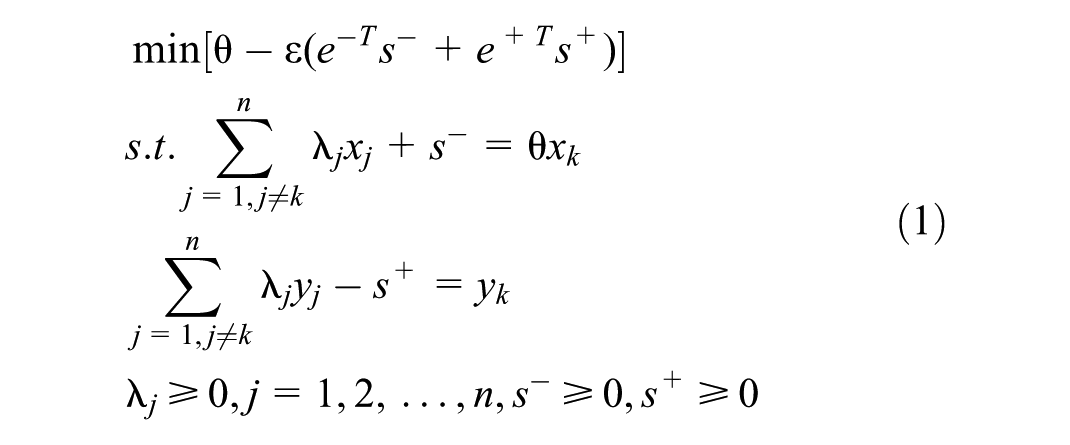
In Equation 1,
In the second stage, a stochastic frontier analysis (SFA) regression model was established (Hammond, 2002; Lamb & Tee, 2024). To minimize the influence of external environmental factors and random disturbances on the efficiency measurement of public libraries, the model is constructed as follows:

In Equation 2, Smn represents the slack value of the m-th input for decision unit n.
The purpose of conducting SFA regression analysis is to eliminate the influence of environmental variables and random disturbances on the efficiency values of public libraries, placing them in a homogeneous external environment. The adjusted formula is:

In Equation 3,
In the third stage, the adjusted Super-SBM DEA model is used. The adjusted (after eliminating external environmental factors and random error factors) input variables of public libraries and the original output variables are reintroduced into the Super-SBM DEA model to recalculate the true efficiency of public libraries.
In the fourth stage, this study examines the impact of information construction (INFOC) on the efficiency of public libraries (EPL) and constructs a two-way fixed-effects regression model (Wang & Wang, 2023). Information construction is the basis for increasing in the efficiency of public libraries. The specific form of the model is as follows:

In Equation 4, i and t denote province and year, respectively.
Variable Measures
Input and Output Variables
Based on an extensive literature review, an analysis of existing studies (Gao et al., 2024; Qin, 2023; Xiao & Zhang, 2025), and consideration of data availability, this study develops a new input–output indicator system for public libraries that incorporates their unique characteristics. Based on the first three stage of super-SBM DEA, the efficiency of public libraries are measured, and they are explained variables in Equation 4.
External Environmental Variables
First, public libraries have typical public goods attributes. Therefore, the active involvement of government authorities is particularly important. When public libraries receive support from the government authorities, they will have funds to create new job positions, purchase various types of periodicals resources, and improve hardware facilities (Hu & Du, 2023). Therefore, financial allocation (FIA) is one of the external environmental factors that affect the efficiency of public libraries.
Second, a larger population helps to spread the fixed costs and improve the efficiency of public libraries. Therefore, the population density is seen to positively affect the efficiency of public libraries (Del Barrio-Tellado et al., 2021). But, the areas with higher population densities have lower accessibility to public libraries (Takyi et al., 2023). To sum up, there is a debate over the impact of urbanization (UR) on the efficiency of public libraries.
Third, people with higher education tend to utilize public library resources more effectively. Public libraries have seen a decline in attendance numbers in recent years, especially among visitors with lower levels of education (Mathysen & Glorieux, 2024). The users of public libraries are mainly individuals with higher education, and individuals with lower level of education may not have the habit of visiting libraries (Tang et al., 2025). Therefore, cultural literacy (CUL) is one of the external environmental factors that affect the efficiency of public libraries.
Fourth, in the regions with higher level of scientific research, the pressure of public libraries from the modernization, specialization, and intelligent transformation is greater. However, the public libraries are also more likely to obtain development resources and become stronger. The public libraries in regions with weak scientific research may remain stuck in traditional models, widening the gap with those in the regions with higher level of scientific research. Therefore, Scientific Research level (SRL) is one of the external environmental factors that affect the efficiency of public libraries.
Internal Factor Variables
First, libraries provide a wide range of facilities designed to meet the specific information needs of their users (Cakmak & Ugurlu, 2025). With the reliance of libraries on electronic information, public libraries generally meet basic information delivery standards (Campbell-Meier & Velasquez, 2025). Meanwhile, it is crucial to integrate digital resources, enhance information quality in public mobile libraries (Y. Z. Liu et al., 2024). Therefore, information construction (INFOC) of public libraries is one of major internal factor for increasing its efficiency.
Second, the growth of the professional technical talent team helps to significantly improve the efficiency of public libraries, but the talent structure to some extent hinders the improvement of library efficiency (Li & Ping, 2020). At the same time, most public libraries face a low proportion of young professional technical personnel, which leads to outdated technology updates and makes it difficult to support the construction of informationalized libraries. Structure of professional and technical talents (SPTT) can jointly affect the efficiency of public libraries together with information construction.
Third, for the development of public libraries in recent years, it is created a new situation of public library’s service for readers by innovating reader activities (Zhang, 2022). However, carrying out regular, branded, and diversified reader activities can enhance the activity of public libraries, thereby improving their efficiency. Therefore, the activity level of public libraries (APL) and the two internal factors mentioned above jointly impact the efficiency of public libraries.
Control Variables
After comprehensive consideration and data availability, this study adopts the balance between income and expenditure (BIE), average income of employees (AIE) and proportion of seats in Children’s reading room (PSCRR) as control variables.
Data Descriptions
This study uses balanced panel data for 31 provinces in China over the period 2006 to 2022. The data sources are from China Statistical Yearbook, China Library Yearbook, and China Cultural, Relics and Tourism Statistical Yearbook. In this study, various variables are summarized in Tables 1 and 2 shows the descriptive statistics of the variables.
The Indictors Used in the Empirical Model.

The Descriptive Statistics of Variables.

Empirical Results
Impact of External Environmental Factors on Efficiency in Public Libraries
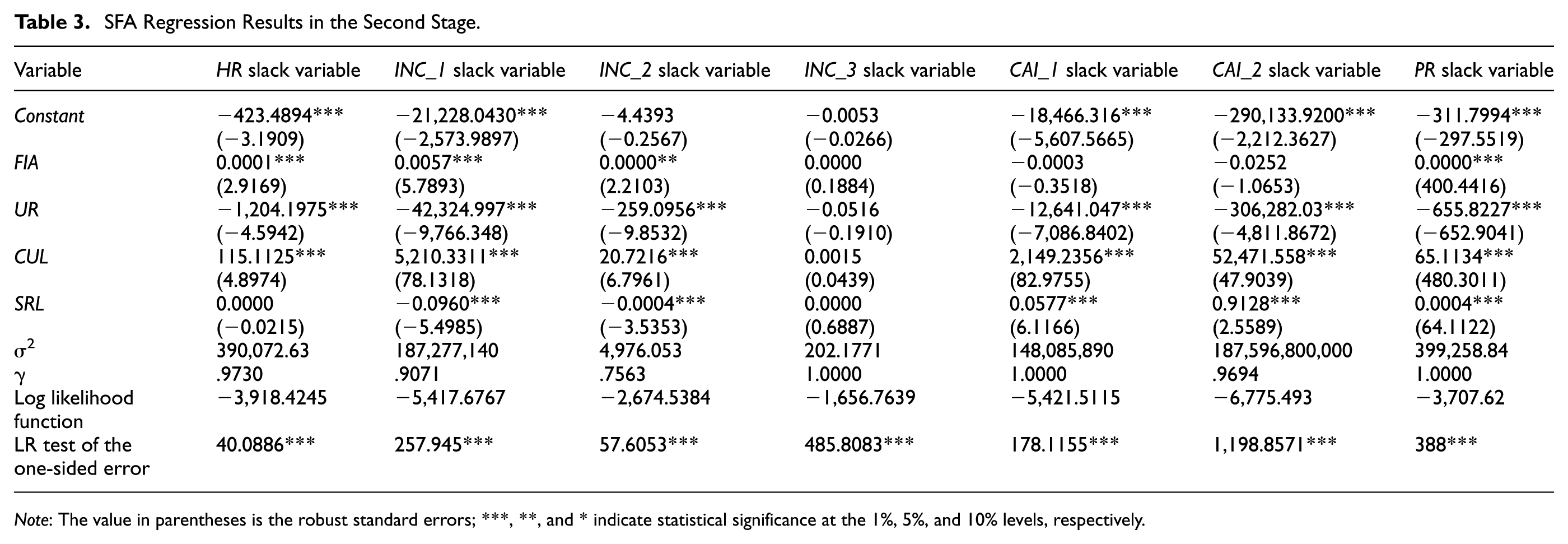
As can be seen from the Table 3, the likelihood ratio of one-sided error in each slack variable passed the 1% significance test, indicating that it is necessary and feasible to employ SFA for separating the environmental and random factors from every investment variable of public libraries. γ value approached 1, suggesting that, compared to random factors, environmental factors are the dominant factors impacting the public library efficiency. Meanwhile, when each regression coefficient in the table is negative, the increase in environmental variables would reduce the investment redundancy. Therefore, it is beneficial for improving library efficiency, vice versa.
SFA Regression Results in the Second Stage.
Note: The value in parentheses is the robust standard errors; ***, **, and * indicate statistical significance at the 1%, 5%, and 10% levels, respectively.
Financial Allocations
The financial allocations had a significant positive correlation with the investment of HR and PR, but showed an insignificant negative correlation with CAI. In addition, from the infrastructure construction aspect, the financial allocations had positive correlations with INC_1, INC_2 and INC_3, but not significantly with INC_3. This indicates that increasing financial allocations can significantly raise redundancy of inputs including human resources, periodical resources, the number of seats in reading rooms, and the number of institutions, but only with a small impact. In the meantime, it suggests that governmental financial allocations exert a low level of crowding-out effect.
Urbanization
The urbanization had a significant negative correlation with HR, PR and CAI. But, from the infrastructure construction aspect, the urbanization was negatively correlated with INC_1, INC_2 and INC_3, and not significant with INC_3. This indicates that the higher the level of urbanization, the less redundancy in human resources, periodical resources, capital investment, the number of seats in reading room and number of institutions for public libraries. That is to say, increasing the urban population to some extent can improve the efficiency of public libraries. This is similar to the findings of Del Barrio-Tellado et al. (2021).
Cultural Literacy
The cultural literacy significantly and positively correlated with HR, PR and CAI. But, from the infrastructure construction aspect, the financial allocations had positive correlations with INC_1, INC_2 and INC_3, but not significantly with INC_3. This indicates that provinces with higher levels of cultural literacy may lead to the investment of human resources, periodicals resources, capital, the number of seats in reading room and the number of institutions for public libraries. This suggests insufficient utilization of cultural literacy.
Scientific Research Level
The scientific research level is positively correlated with the HR, PR and CAI, but is insignificant with HR. Meanwhile, the scientific research level significantly and negatively correlated with INC_1 and INC_2, but presented a non-significant positive correlation with INC_3, regarding the infrastructure construction aspect. This indicates a possibility that provinces with higher levels of scientific research may lead to the investment redundancy in periodical resources and capital investment, but lessen the investment redundancy of the number of seats in reading rooms and institutions. Furthermore, this means that public libraries’ infrastructure construction mismatch with periodical resources and capital investment among provinces with higher levels of scientific research. In conclusion, the impact of the four external environmental variables on the investment slack variables was inconsistent. If external environmental factors are not further controlled, it will cause deviation in the results of public library efficiency estimation. Through adjusting the input variables in the third stage, the influence of external environmental factors is eliminated, so that 31 provinces and regions are in the same external environment, and the accuracy of the efficiency estimation results of public libraries is improved.
The Trend of Efficiency Changes in Public Libraries Excluding External Factors
As can be seen from Figure 1, under the same external environment, the regional differences in the efficiency of public libraries in China are demonstrated as the eastern region > the central region > the western region. This result is consistent with the findings of Gao et al. (2024), which indicates that regional differences are still the key reason for the variation in public library efficiency. Meanwhile, the public library efficiency in the eastern region is higher than the national average; the western region is lower than the national average; and the central region fluctuates around the national average. In terms of period, from 2006 to 2010 (“11th Five-Year Plan” period), the efficiency of public libraries showed an “N”-shaped trend; from 2011 to 2015 (“12th Five-Year Plan” period), the efficiency of China’s public libraries also showed an N-shaped trend. During 2011-2015 (“12th Five-Year Plan” period), the efficiency of China’s public libraries showed a linear decline; during 2016 to 2020 (“13th Five-Year Plan” period), it showed an inverted “U”-shaped trend. Overall, the efficiency of China’s public libraries displayed a fluctuating decline.
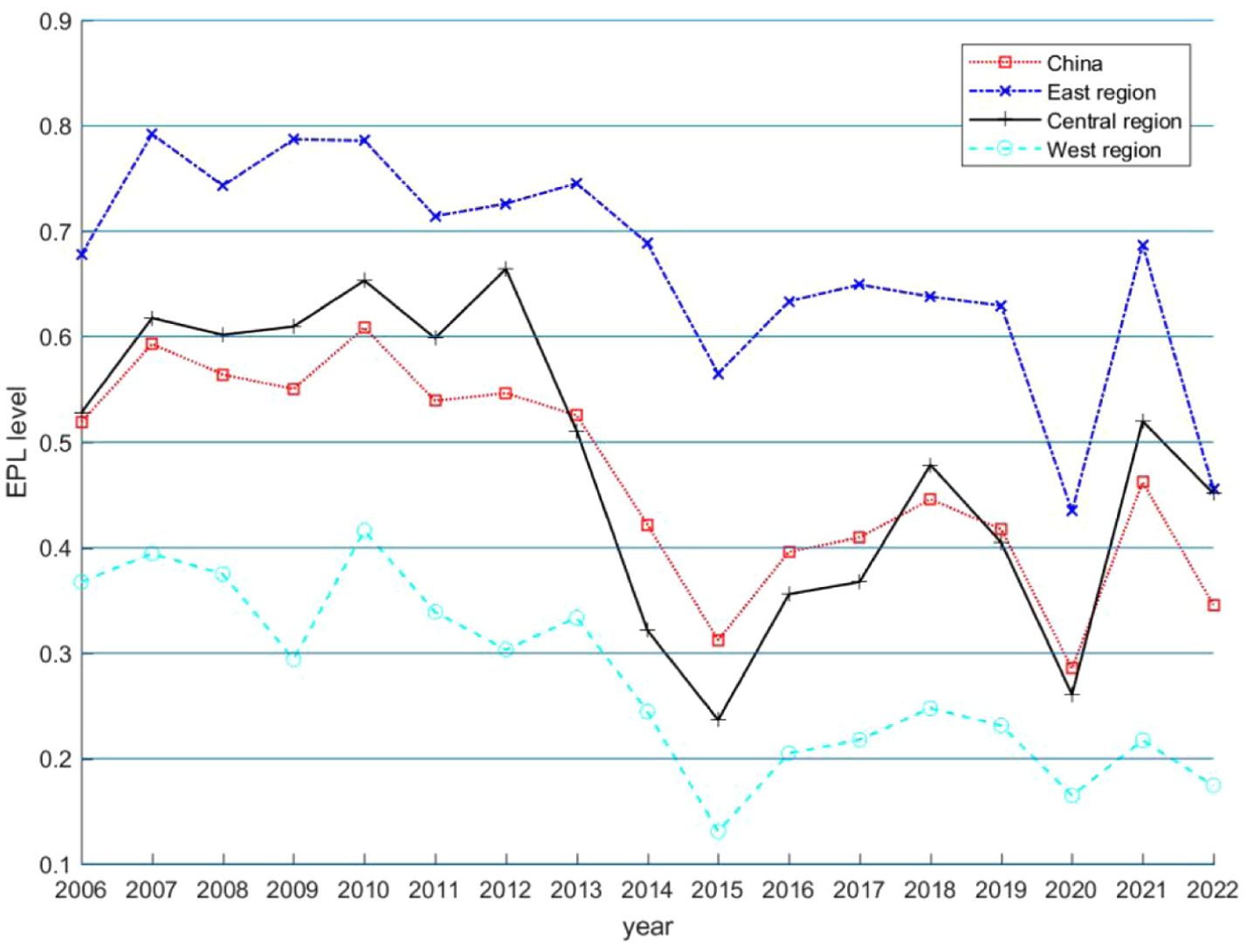
The trend of efficiency changes of public libraries from 2006 to 2022 in third stage.
The Impact of Information Construction on Efficiency of Public Libraries
As can be seen from columns (1) and (2) in Table 4, information construction of public libraries presented a significantly positive impact on their efficiency. Therefore, the information construction can enhance the efficiency of public libraries.
The Effect of Information Construction on EPL.

Note: The value in parentheses is the robust standard errors; ***, **, and * indicate statistical significance at the 1%, 5%, and 10% levels, respectively.
To ensure the reliability of these research results, this study conducts the robustness tests regarding the following aspects. (a) this study uses the number of computers to measure the level of information construction in public libraries (lnINFC_R), and the impact of information construction on EPL is reexamined. Column (3) of Table 4 shows that the result is still robust. (b) To avoid the impact of the COVID-19 pandemic, the regression is reconducted after the samples from 2020 to 2022 are excluded. The results, as shown in column (4), are consistent with the benchmark regression results above.
Heterogeneity Analysis
The Regional Differences
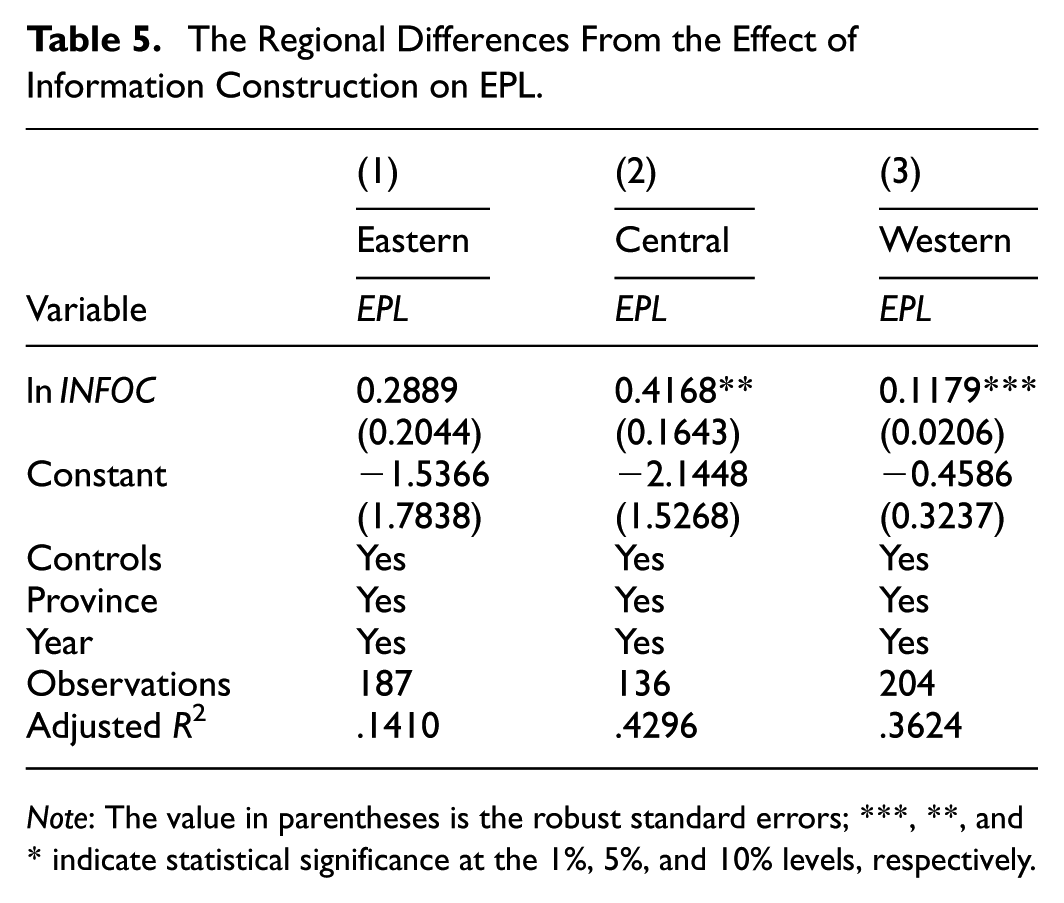
China has a vast territory, and the socio-economic development of different regions is bound to be different. Therefore, in order to evaluate the regional differences in the impact of public libraries’ information construction on their efficiency, this paper analyzes the regional differences in the impact from three regions of east, middle and west China (Zhang & Du, 2025). As shown in Table 5, the coefficients of In INFOC from columns (1) to (3) are all positive, but the coefficient in the eastern region is not significant. This indicates that the efficiency of public libraries is relatively low in the central and western regions, where the effect of information construction on the efficiency of public libraries is more significant. In addition, information construction of public libraries in the central region improves their efficiency to a greater extent than that in the western region.
The Regional Differences From the Effect of Information Construction on EPL.
Note: The value in parentheses is the robust standard errors; ***, **, and * indicate statistical significance at the 1%, 5%, and 10% levels, respectively.
The Joint Impacts of Information Construction
For exploring more internal factors affecting the efficiency of public libraries, this paper adds two explanatory variables, the structure of professional and technical talents and activity level of public libraries, to Equation 4, and analyzes their joint impact with information construction on the efficiency of public libraries. As indicated in Table 6, the SPTP coefficients are significantly negative, while the In QTL coefficients are significantly positive. This demonstrates that increasing the number of senior professional title personnel in public libraries will reduce their efficiency, but increasing the activity of public libraries can improve their efficiency. The research findings are similar to those of Li and Ping (2020).
The Joint Impact of SPTT and APL on EPL.

Note: The value in parentheses is the robust standard errors; ***, **, and * indicate statistical significance at the 1 %, 5 %, and 10 % levels, respectively.
Discussion
This section mainly discusses the empirical results mentioned above. It attempts to find the underlying reasons for the results. This is conducive to public libraries in various regions improving their efficiency in a location-specific manner.
The Impact of External Environmental Factors
Financial Allocations
After the increase in financial allocations, public libraries gaining more sufficient funding may increase investment in human resources, periodical resources, the number of seats in reading rooms, and add more institutions. If the position setting is misplaced, it is likely to be “overstaffing.” Moreover, if newly added seats are located in branch libraries with inconvenient locations, inadequate publicity, or inappropriate opening hours, they may stay vacant for a long time. Some problems may be generated if the collection construction of public libraries is out of scope with readers’ needs and development policies in library.
Urbanization
Densely populated urban areas have a large readership base. This significantly increases the number of readers that each librarian can serve, but the seats of reading room become scarce. In areas with a high level of urbanization, public libraries usually adopt the main library plus branch library model. This model avoids the duplicated construction of “small yet complete” branch libraries, and greatly reduces the operating cost and management redundancy of a single venue. The urban library system can carry out bulk procurement, centralized cataloging, and unified data platform management, reducing the procurement and processing costs of individual books and periodicals. The centralized procurement and maintenance of fixed assets also have more bargaining advantages.
Cultural Literacy
When the cultural literacy of readers is generally improved, the consulting questions they inquire about will be more professional and complex. If the knowledge structure and professional skills of librarians are not improved simultaneously, the services they provide will be “ineffective” or “inefficient,” resulting in skill redundancy of human resources. As readers become more adept at using digital resources, they may become less reliant on libraries as self-study spaces, leading to lower usage of seats in reading rooms. Readers are more willing to travel long distances to access specific resources or participate in specific activities and are less loyal to small community-level libraries. Suppose libraries continue to invest on the purchase of popular novels, bestsellers, and other paper books whose circulation rate will decline, and fail to increase investment in electronic journals, academic monographs and professional databases in a timely manner. In that case, the new paperbacks will become a structural redundancy in the collection.
Scientific Research Level
Researchers often have their own laboratories at universities, research institutes, or companies, which are much more convenient and professional than ordinary reading rooms in public libraries. As a result, their demand for public libraries decreases. Besides, researchers visit libraries purposefully, so they don’t mind going to farther libraries with more resources, such as the central library or main library. Information access for the forefront of scientific research mainly relies on real-time, efficient electronic journals and databases. If public libraries continue to purchase large quantities of paper books and past issues of scientific research, these resources will quickly become structural redundancy. To attract and serve the research community, libraries may invest heavily in purchasing these underutilized professional collections, building special collections, or upgrading related hardware assets. However, if these investments ultimately fail to attract target users effectively, then asset-oriented redundancy is formed.
The Trend of Efficiency Changes in the Third Stage
The level of economic development determines the financial support of local governments to public libraries. The eastern region took the lead in completing the target of one per capita library collection proposed in the “Cultural Development and Reform Plan for the 13th Five-Year Plan of the Ministry of Culture,” whereas the development of public libraries in the central and western regions needs to be further improved. As residents’ strong willingness to pay for new types of services such as digital resources, parent-child reading and maker spaces increasing, this in turn push libraries to improve their services. Besides, a large population of young adults migrating from western regions, the left-behind groups are mainly the elderly and children. Hence, the demand for traditional borrowing has shrunk, and the perception of “input-output” in libraries is low.
In addition, during the “11th Five-Year Plan” period, the efficiency of China’s public libraries showed an “N”-shaped trend, which may be the necessary result of overlaying the implementation of two major policies in the first and final stage (i.e., the “County-level Libraries Repair Project” in 2006 and the “Public Libraries Construction Standard” in 2008), policy window and fiscal tightening in the middle stage. During the “12th Five-Year Plan” period, the Ministry of Culture and Tourism of China and the Ministry of Finance on the “Opinions on Promoting the Free Opening of National Art Galleries, Public Libraries and Cultural Centers (Stations)” require all first-level and second-level libraries to be open to the public free of charge by the end of 2011, and the central Ministry of Finance will provide annual operating subsidies per library. Besides, the “Digital Library Promotion Project” requires public libraries at the provincial, municipal and county levels to build their own computer rooms, self-built platforms and local mirrors. But from 2013 to 2015, the central government subsidized 1.87 billion yuan, which could lead to a sharp decline in the flexibility of “input-output” of public libraries. During the “13th Five-Year Plan” period, the “13th Five-Year Plan for the Development of National Public Libraries” was issued in 2017, and the central government subsidized 4.5 billion yuan to support the “Public Culture Cloud” and “Digital Library Promotion Project.” However, the drawback of the “three-level self-built platform” of the “Digital Library Promotion Project” emerged (i.e., duplicate procurement of resources, non-interoperability of reader accounts, and a decline of click rate on digital resources per capita).
The Impact of Information Construction
The number of terminals in electronic reading room is the key touch-point for readers in the entire library information ecosystem. The more terminals there are, the stronger the library’s digital service capabilities. This can provide more readers with efficient, convenient and rich modern knowledge services, thereby fundamentally improving the overall operational and service efficiency of the library.
Further Discussion
The Discussion of Regional Differences
The information construction has extended the limits of physical collections in public libraries in the central and western regions. In addition, the information construction allows residents in remote areas to share the digital resources of provincial and municipal libraries. The extension of this service network increases the potential service population and resource coverage of public libraries. Therefore, the information construction is the core factor for restricting the efficiency of public libraries in the central and western regions.
The Discussion in Joint Impacts
With the total budget remaining unchanged, an excessively high proportion of senior professional title personnel will crowd out the investment for front-line service and technical positions, resulting in public libraries with strong strategic planning capabilities but weak execution. Senior professional title personnel tend to undertake more non-frontline work, such as management and research. However, the efficiency of public libraries ultimately depends on the speed, quality and range of services for patrons, and the weakening of front-line services directly leads to a decline in efficiency. Public libraries organize a variety of events (i.e., lectures, exhibitions, and training) that can attract readers into the library, prompting frequent utilization of library space and resources, and reducing unit service costs. Besides, these activities can attract potential readers with cultural, social and educational needs, expanding the boundaries of library services. In addition, a high level of activity of public libraries would enhance public awareness toward and reputation of libraries, thus improving all efficiency indicators thoroughly.
Conclusion and Suggestion
This study provides a comprehensive evaluation of the efficiency of 31 provincial-level public libraries in China from 2006 to 2022, based on the four-stage Super-SBM DEA model. It also analyzes the impact of information construction on the efficiency of public libraries from three perspectives, namely the regional differences, the influence of per capita expenditure in public libraries and the joint impacts. Based on this, the following conclusions are drawn.
First, in terms of the external environment of public libraries, urbanization and cultural literacy are the main influencing factors of redundancy of inputs in Chinese public libraries. Specifically, expanding urbanization can reduce the redundancy of inputs in public libraries, thereby enhancing their efficiency. Conversely, an increasing the cultural literacy may lead to increase in the redundancy of inputs in public libraries, thereby reducing their efficiency.
Second, in terms of the internal factors of public libraries, the information construction can effectively promote the improvement of efficiency in Chinese public libraries. Specifically, in the central and western regions with low efficiency levels, the effect of this improvement is significant. However, in the eastern region with high efficiency levels, the effect of this improvement is not significant.
Third, the structure of professional and technical personnel in public libraries, activity level of public libraries, and information construction all significantly affect the efficiency of public libraries. Furthermore, increasing the activity level of public libraries can promote the improvement of their efficiency, while an increase in the number of senior professional individuals significantly reduces the efficiency of public libraries.
Based on these conclusions, this study also puts forward the following management suggestions. First, in the process of expanding urbanization, public libraries should be included as a “standard configuration” in the comprehensive development of counties and districts, and the construction scale should be accurately determined based on population density and service radius. At the same time, the location selection of public libraries should be integrated with public spaces such as urban green spaces and transportation hubs in a unified plan, in order to share external traffic flow and vitality. Public libraries need to actively promote service transformation, namely the shifting from traditional lending services to knowledge services, space services, and community cultural services.
Second, regions in the central and western parts of the country, as well as areas with low per capita expenditure on public libraries, should be listed as key investment targets for the national digital library special program. Establish a dynamic assessment with threshold of information to ensure that additional fiscal funds flow only to regions with the high marginal returns on information.
Third, new employed persons should in principle be hired on a project basis (including event planners, data operation specialists, and reading promotion specialists), and a dual-indicator assessment based on the number of activities and the number of visitors to the library should be implemented. The personnel with senior professional titles are required to annually complete quantifiable services such as thematic lectures for the public, document development and reference consultation. The effectiveness of these services (reader satisfaction and participation in activities) should be the primary factor in the renewal of their titles and performance allocation. This will encourage these personnel to pay attention to front-line work.
It should be noted that owing to data limits, this study did not measure the efficiency of public libraries in cities level, nor did it explore the factors that affect their efficiency. This study did not the dynamic efficiency of public libraries through the dynamic DEA model. In the future research, the impact of a certain policy on the efficiency of public libraries will be revealed. Besides, in heterogeneity analysis, the analysis of efficiency differences in public libraries will proceed from some aspects (mission, vision, goal and governance).
Footnotes

Funding
The authors disclosed receipt of the following financial support for the research, authorship, and/or publication of this article: We gratefully acknowledge the financial support from the National Natural Science Foundation of China (nos. 72364003; 72363005; 72462008).
Declaration of Conflicting Interests
The authors declared no potential conflicts of interest with respect to the research, authorship, and/or publication of this article.
Data Availability Statement
The authors confirm that the data supporting the findings of this paper are available within the article.