



Abstract
Digital health has received increasing attention over the past decade, a trend accelerated by the Covid-19 health crisis. However, the digitalization of Tunisia’s pharmaceutical sector remains in its embryonic stage and has yet to be thoroughly examined in management science research. This study addresses this gap by exploring the factors influencing digitalization in Tunisian community pharmacies, a critical yet underexplored sector. The research adopts the Technology-Organization-Environment (TOE) framework, with the organization as the unit of analysis, which reflects the lack of prior studies on this topic. Data were mainly collected through semi-structured interviews with pharmacists from 15 community pharmacies and analyzed using NVivo 12 and thematic analysis. The results reveal a strong presence of the factors “government actions” and “cost” in the cases examined. Furthermore, this research demonstrates the complexity of technology adoption in community pharmacies and highlights the variability of factors’ influence depending on the technology considered. This study extends the TOE framework to community pharmacies in an emerging economy, highlighting how the relative influence of technological, organizational, and environmental factors varies with different types of digital tools. It pinpoints the factors that policymakers, pharmacists, and digital tools providers can focus on to support digital transformation, offering insights relevant to similar contexts in other emerging economies.
Introduction
At the end of 2019, the whole world experienced a particular pandemic context, caused by the outbreak of the coronavirus which has been the cause of an economic shock. Business production, trade and household consumption have all been significantly impacted by the sudden halt in economic activity caused by the worldwide lockdown. The world has seen a powerful rise in digital technology, which presents a new configuration of the organization (Brasseur & Biaz, 2018) without time or space constraints (Autissier & Metais-Wiersch, 2018). The health crisis has confirmed the importance of digitalization in businesses (Zaoui et al., 2021). The issues surrounding this phenomenon affect all areas (Ribeiro-Navarrete et al., 2021): tourism, ready-to-wear, agri-food and in particular the health sector (Bhambere et al., 2021). These upheavals caused by the pandemic have accentuated the integration of digital technology within the health system, giving rise to connected health or e-health (Tebeje & Klein, 2021). Indeed, new technologies have been endorsed in daily life (Delforge et al., 2015), especially in what is most precious to Man, namely health (Park et al., 2022). Among the different actors in the healthcare system, pharmacies occupy a strategic position, as they are in direct and daily contact with patients. Thus, the use of digital technologies by pharmacies to develop new products and new services for patients seems possible (Levrat, 2018, p. 101) in some countries like France, Canada, Germany, China, USA, India, and so on. The implementation of this digital strategy is not merely a trend, but it is also a new generation of responses to current and future demands focused on patient-centered care. (Binsar et al., 2025).
Tunisia’s health indicators rank among the best in Africa and the MENA region, surpassing those of countries with similar income levels (Kahna & Kourda, 2021). The country is also ranked 52nd out of 191 for overall healthcare system performance (World Health Organization, 2003). Despite these achievements, its health sector is still lagging behind other economic sectors in implementing a digital strategy (Akrout et al., 2022). Technology adoption in Tunisia remains limited and faces multiple challenges (Nouira & Souayeh, 2024). In particular, the community pharmacy sector has been slow to embrace digital transformation compared to other economic sectors. This lag is attributed to the pharmaceutical industry’s traditional nature and, above all, to strict legislation (Third Forum of the Pharmacy, 2019). This paper aims to study the factors that can influence digitalization in the context of a particular type of organization operating in the pharmaceutical sector in Tunisia, namely community pharmacies. The research question of this study is: What are the factors that influence digitalization in community pharmacies?
Two key reasons have compelled to work on this topic. Firstly, in recent years the phenomenon of digitalization has become omnipresent in all organizations (Alekseieva et al., 2021; Lamssarbi & Bouaziz, 2022) as shown by scientific publications. Secondly, when compared with other countries, digitalization in Tunisian pharmacies is lagging far behind (Third Forum of the Pharmacy, 2019).
This research highlights the absence of studies addressing the level of digitalization in the healthcare sector in Tunisia, and more specifically in pharmacies. Although the Technology-Organization-Environment (TOE) framework is widely applied to study technology adoption, its use in this sector-specific context remains limited, leaving unanswered questions about how technological, organizational, and environmental factors interact in community pharmacies. This study addresses this gap by applying the TOE framework to Tunisian community pharmacies, providing both empirical evidence and theoretical insights. It aims to achieve two objectives. Theoretically, it seeks to extend the TOE framework to private pharmacies. Using a qualitative, exploratory approach, the study highlights important nuances in technology adoption and provides a deeper understanding of the factors involved. Data were collected through semi-structured interviews with 15 pharmacies and analyzed using NVIVO 12 and thematic analysis. Empirically, it intends to identify and analyze the factors influencing digitalization in community pharmacies. It emphasizes key factors that policymakers, pharmacists, and developers of digital technologies can use to support digital transformation.
To achieve these objectives, this research is structured as follows. The first part consists of a literature review. The second part is devoted to the methodological framework which this study is based on. The third part addresses the results and their discussion. Finally, the conclusion focuses on the contributions, the limitations of the study and the main directions for future research.
Literature Review
Digitalisation in Community Pharmacies
Digital solutions in the healthcare field have great potential to promote better collaboration between different professionals related to patients service and to promote the integration of healthcare system (Pharmaceutical Group of the European Union, 2021). According to the International Pharmaceutical Federation (2021), digital health has become a common practice in many pharmacies. The introduction of digital in pharmacies has improved their service by offering faster and more accurate consultations (Mori, 2023), by strengthening patient safety and improving access to medicines (Tuula et al., 2022). Ordre des pharmaciens du Québec (2021), mentions that digital technologies can be used, for example, to prepare a large number of prescriptions or for the providing of pharmaceutical services remotely (e-pharmacy). As a result, some tools facilitate the execution of front office and/or back office tasks.
The front office deals with operational tasks related to sales and the counter (Gregory, 2013). The digitalization of the front office is related to means of interaction of the pharmacy with its patients by improving its online services, while keeping intact the processes, organization, culture and infrastructure of the pharmacy (Mäkinen et al., 2005). The digitalization of the front office is reflected in the use of technological equipment within the pharmacy to improve customer service (Ordre des pharmaciens du Québec, 2021).
The back office designates functions behind counters, not visible to the public (Licoppe, 2002). This encompasses all internal processes of the pharmacy, including logistics, inventory management, accounting, and human resources (Gregory, 2013). The digitalization of the back office allows the automation of some functions related to the preparation and management of medications (Ordre des pharmaciens du Québec, 2021). The table below illustrates the uses, impacts, and disadvantages of selected digital tools in pharmacies.
This table summarizes the wide range of digital tools used in pharmacies, their impacts, and limitations. For example, robots and pharmacy management software with barcode readers improve back-office efficiency. They help streamline inventory management, reduce errors, and speed up operations. However, tools like e-commerce platforms and AI applications support some patient-oriented tasks but are not always well integrated into pharmacy processes. This means they might not fully improve patient-centered care. Technologies such as Big Data and blockchain provide significant benefits for data management and traceability, but they need careful handling and adjustments within the organization. Based on the overview in Table 1, the next section focuses on the factors influencing digitalization in community pharmacies.
Digital Tools in Pharmacies.

Note. The symbol “*” indicates a cross, meaning that the technology is relevant to the back office, the front office, or both.
Factors Influencing Digitalization in Pharmacies
Consultation of the literature shows that the theories and models, most frequently used to study the factors influencing the digitalization of community pharmacies, are Davis’s (1986) Technology Acceptance Theory (TAM) (Al-Gasawneh et al., 2020; Alsadoun et al., 2020), theory unified acceptance and use of technology (UTAUT) by Venkatesh et al. (2003) (Sabbir et al., 2021) and UTAUT-2 by Venkatesh et al. (2012) (Alsadoun et al., 2020; Al Sideiri et al., 2021). These theories introduce different factors to understand their effect on user’s adoption of technology (Regragui, 2020). TAM and UTAUT are used to study the adoption of digital tools by the pharmacist as an “individual” unit of analysis. In contrast, this study focuses on the pharmacy as “organization” unit of analysis. Given the limited research on the adoption of digital tools by community pharmacies and the overall lack of studies in the pharmaceutical sector, the lack of work on the adoption of digital tools by dispensing pharmacies and the paucity of work on adoption in the pharmaceutical sector at an organizational level, this research has been extended to reach the health sector in order to identify the determinants influencing digitalization. Consequently, the documents in this study are searched by examining the Google Scholar database using keywords focusing on the factors influencing pharmacy digitalization for example” digitalization,”“factors,”“pharmacies,”“adoption,”“health sector,”“determinants,”“digital tools,”“social networks,”“robots,”“pharmacy software,” using Boolean operators like AND, OR. The reference selection process is shown in the figure below (Figure 1).

Selection process of the analyzed articles.
This process led to the selection of 12 studies, which are analyzed in Table A1, Appendix 1, highlighting points of convergence and divergence, particularly regarding the theories and models used, the phenomena studied, and the research methods. Based on these studies, the most widely used model for analyzing the factors influencing the adoption of digital tools is Tornatzky and Fleischer’s (1990) TOE framework, applied in 9 out of 12 articles. The TOE model identifies three dimensions that shape adoption decisions (Al-Ashmori et al., 2023). The technological context captures how technology characteristics and organizational readiness affect adoption (Tornatzky & Fleischer, 1990). The organizational context refers to internal features such as structure, processes, resources, and managerial culture, which can either enhance or hinder adoption (Junior et al., 2019). The environmental context encompasses external factors, including industry characteristics, competitive pressure, government regulations, supporting infrastructure, and relationships with partners and clients (Tornatzky & Fleischer, 1990). This framework is therefore chosen for the present research, as it is widely recognized in the literature, offers a comprehensive perspective by integrating technological, organizational, and environmental dimensions, and is particularly suitable for analyzing technology adoption at the organizational level, including in community pharmacies.
The determinants selected for this research are categorized according to the three dimensions of the TOE model. The technological factors identified in the articles include “relative advantage,”“complexity,” and “compatibility” (see Table A2, Appendix 1). The organizational factors consist of “financial resources,”“skills,” and “Top management support.” Factors such as IT experience, training, human resources, education, and knowledge will be grouped under “skills” (see Table A3, Appendix 1). Among the environmental variables, “regulatory environment” and “government support” emerge as dominant, which will be combined into the “government actions” factor. Competitive pressure ranks second (see Table A4, Appendix 1). The figure below displays the conceptual model of this study (Figure 2).

The research model for explaining digitalization by pharmacies.
Methodology
A qualitative approach is selected for this study to allow an in-depth exploration of the factors that influence digitalization in community pharmacies. This choice is further supported by the scarcity of empirical research in the pharmaceutical sector, as shown in Table A1, Appendix 1, where only three studies specifically address the adoption of digital tools. This methodological direction has also been suggested as a future research avenue by Abdekhoda et al. (2019), Ghaleb et al. (2021), and Shahbaz et al. (2021). This supports the choice of a qualitative approach in the present study. The article employs a qualitative analysis through multiple case studies. This selection is based on the study’s nature, the methodological choices, and the specific research context. This method is appropriate for the research objective, as the identification of factors influencing the digitalization of pharmacies has not been extensively researched.
The multiple case study is more relevant to the context of this work, as it allows us to compare the realities of the different studied companies (Gagnon, 2012, p. 47). A case is assimilated to a company (Wacheux, 1996, p. 89), which is the unit of analysis in this thesis.
This section presents an overview of the pharmaceutical sector, followed by the data collection techniques and the data analysis approach used.
Overview of the Research Field: The Tunisian Pharmaceutical Sector
The development of the Tunisian pharmaceutical sector has been driven by the state since the early 1960s (World Health Organization, 2003). The private sector comprises a network of pharmacies that serve as the primary channel for supplying medicines (World Health Organization, 2003). In fact, 75% of all medicine sales in Tunisia are generated by the private sector (PBR Rating, 2019). This sector plays a major role in the distribution of medicines, with approximately 1,500 pharmacies across Tunisia supplied by around 60 wholesalers (PBR Rating, 2019). Although these pharmacies operate within the private sector, they remain key players in the pharmaceutical landscape, which is regulated by the state through the Ministry of Health. The medication circuit is shown in the following diagram (Figure 3).

The Drug Distribution Network of community pharmacies in Tunisia.
Pharmaceutical products are sourced both from local manufacturers and through imports (BIAT Sector Study, 2017; PBR Rating, 2019). All imports are exclusively managed by the Central Pharmacy (CP), which handles every type of medication (BIAT Sector Study, 2017). On the local market, the supply of medicines is also supported by wholesalers (PBR Rating, 2019).
The pharmaceutical sector in Tunisia is subject to strict regulations that hinder its digitalization (PBR Rating, 2019). The State prohibits the online sale and advertising of pharmaceutical products, whether prescription or over-the-counter, by pharmacies (Articles 30 and 43, Law No. 73-55 of August 3, 1973). Additionally, pharmacies are prohibited from operating as commercial entities (Decree No. 75-835 of November 14, 1975, under the pharmaceutical code of ethics). Even the delivery of medications is strictly forbidden. According to Article 30 of Law No. 73-55 of August 3, 1973, “Any sale, display, or distribution of medicines is prohibited on public roads, in markets, at home, or in any store not designated as a retail pharmacy, regardless of whether the person holds a pharmacist’s diploma or not.”
In fact, the only website related to pharmacies in Tunisia is that of the National Council of the Order of Pharmacists Conseil national de l Ordre des pharmaciens de Tunisie (CNOPT, n.d.). This site provides information about the Tunisian pharmaceutical sector, including a directory of all pharmacies in the country. However, it is an internal platform accessible only to pharmacists through the “pharmacist space” interface, offering no direct benefit to patients. Furthermore, the only significant digitalization initiative impacting both the pharmaceutical and health sectors is the launch of the digital health card “LABES” on April 22, 2019 (Official website of the National Health Insurance Fund, Caisse nationale d'assurance maladie (CNAM, n.d.)). This project is a collaboration between the Ministry of Health and the Ministry of Social Affairs. The card facilitates the electronic exchange of data between CNAM (n.d.), healthcare providers in both public and private sectors, and patients (Official website of CNAM (n.d.)).
Data Collection
This study was conducted among 15 private pharmacies in an urban area, with 8 located in Mahdia town and 7 in Monastir town. The sample was selected based on geographical proximity. Data collection took place during April 2023. Data were primarily collected through semi-structured interviews, complemented by direct observation in selected pharmacies to record real-time practices, interactions, and factors influencing digital tool adoption. A total of 15 interviews were deemed sufficient to reach the saturation point. Data saturation was reached after 12 interviews, as the subsequent 3 interviews yielded no new themes. The stopping criterion was applied after each successive interview (i.e., 13th, 14th, and 15th) until three consecutive interviews produced no new material. This approach follows the procedure described by Francis et al. (2010).
The target population for this study was community pharmacies in Tunisia. The respondents were primarily the pharmacy owners, except in two cases where pharmacists were interviewed due to the owners’ lack of availability. Each interviewee represents one visited pharmacy. To preserve the anonymity of the respondents, their names were replaced with identifiers such as “Pharmacist 1,”“Pharmacist 2,” and so on (see Table A5, Appendix 1).
Data were collected through individual semi-structured face-to-face interviews conducted in the pharmacies. In Tunisia, a pharmacy is legally defined as a unit managed by a licensed pharmacist (Law No. 99-30, 1999; Order of Pharmacists of Tunisia). Therefore, pharmacists are the primary source of information on digitalization. The pharmacist legally manages the pharmacy’s operations, so their perspectives reflect organizational-level factors. These interviews aimed to capture the pharmacists’ perspectives on the digitalization of their community pharmacies. The discussions are guided by an interview framework based on identified variables in the theoretical section. Data were collected using a semi-structured interview guide addressing four main themes: digitalization, technological variables (compatibility, relative advantage, complexity), organizational variables (management support, skills, financial resources), and environmental variables (government actions, competitive pressure). This guide was revised after a pilot interview, as some questions required adjustment. Each interview lasted approximately one hour. The semi-structured interview guide provided orientation to keep focus on the research themes, while preserving the flexibility of respondents’ answers. The interviews were recorded in audio format, which was crucial to store important information. Prior to each interview, informed consent was obtained from all participants. The recordings were then transcribed verbatim. While some data were immediately useful, other information may become relevant later, and some may remain entirely irrelevant.
The study was conducted in accordance with established ethical guidelines. This research was based on qualitative interviews with participants who were fully informed about the aims of the study and the voluntary nature of their involvement. Participants were assured that they could withdraw at any time without any negative consequences. Informed consent was obtained verbally before each interview. No personally identifying details were collected, and all transcripts were anonymized during data processing to protect participants’ confidentiality.
Data Analysis
The analysis of the collected data aimed to understand the relationship between each of the planned explanatory variables and the digitalization of pharmacies, as well as to assess the level of digital development in the studied pharmacies. The analysis process employs a coding technique to break down themes into codes (nodes) using NVIVO 12 software. This coding operation is designed to classify, organize, and facilitate data search (Descheneaux et al., 2005, p. 10). A preparatory phase involves creating a dictionary of themes that corresponds to the list of codes. An initial thematic dictionary was constructed based on the main dimensions and variables of the TOE framework. Data coding was then performed according to the pre-established grid. As the analysis progressed, additional codes emerged from the interviewees’ accounts, including aspects not initially anticipated, such as the different types of digital tools used in community pharmacies. This process resulted in a final thematic dictionary, encompassing both main codes and corresponding sub-codes (see Table A6, Appendix 1).
The second phase involves selecting relevant data to create a dataset for coding. This step is crucial because the researcher’s choices significantly impact the quality and relevance of the coding process (Descheneaux et al., 2005). The collected data is analysis thematically to summarize and process the corpus, categorized under what we refer to as themes (Paillé & Mucchielli, 2012). This thematic analysis focuses on identifying the determinants associated with the adoption of digital tools by pharmacies. The use of a condensed matrix in NVIVO 12 facilitates data analysis by presenting all respondents and their answers related to specific variables on the same sheet. The columns represent the associated variables, while the rows represent the respondents. Interpretation can be understood as the process of deriving meaning from the analysis data (Dany, 2016).
This analysis yields the following results.
Results and Discussion
The interviews conducted with 15 pharmacies reveal that the only technology used by the surveyed pharmacies is LGO software, which is linked to a barcode reader. Examples of such software include AVICENNE, EASY-PHARMA, PHARMA-TEC, PHARMA-PLUS, and OFFICINE (see Table A5, Appendix 1). Additionally, field visits indicate a significant lack of adoption of other technologies, such as Big Data, robotics, and e-health platforms, in the pharmacies.
The back office is primarily represented by LGO software, which manages stock, invoicing, and staff timekeeping. Additionally, there is a common website between pharmacies and the wholesaler, SOPROPHA, created to facilitate product exchanges. However, digitalization in the front office is completely missing in those pharmacies, which do not utilize scanned prescriptions, websites, or social media pages. There is no digital access for patients to exchange information with pharmacies, thus they have to go there in person to inquire about availability and pricing of pharmaceutical products. Interactions between pharmacies and patients are conducted using paper prescriptions.
Technological Context
Compatibility
The interviewees clearly expressed the strong compatibility with the LGO software by adopting it. Interviewee 10 states: “Our current software is compatible with our needs, I replaced it with two others in order to improve operations in my pharmacy, but I concluded that my old software is the best on the market, it especially manages stock well and is easy to use.” Compatibility appears to facilitate the adoption of LGO software with the barcode reader across all visited pharmacies. Conversely, compatibility does not seem to support the adoption of other digital tools, such as e-commerce and robots. While few regulatory restrictions exist for some tools, those deemed compatible (like software) can be adopted, however, the law prohibits others. Interviewee 15 explains: “E-commerce would make our work much easier, but it is banned by the state.”
High compatibility alone cannot guarantee the adoption of technology, as seen in the case of e- commerce. The relationship is more complex, as this reasoning does not explain why technologies like robotics, which are not subject to regulatory restrictions, are still not adopted by pharmacies despite being considered compatible. Interviewee 10 states: “I believe all tools could be adopted by pharmacies if the cost is reasonable.” It appears that compatibility is insufficient when a tool is perceived as expensive.
It has been theoretically assumed that compatibility influences the digital development of pharmacies (Alharthi et al., 2020; Shahbaz et al., 2021) and health organizations (Abdekhoda et al., 2019; Ghaleb et al., 2021; Sadoughi et al., 2020). The results are consistent with the literature only for the LGO software. Indeed, the compatibility of the LGO software with the needs and values of pharmacies positively influences its adoption. Conversely, the compatibility of other digital tools with the needs and/or values of the pharmacy does not influence their adoption. This controversy explained by the relationship between the compatibility variable and government actions in the adoption of e-commerce. Additionally, the cost variable becomes significant when considering the compatibility of Big Data and robotics.
Relative Advantage
Despite the multiple benefits cited by respondents, this study demonstrates the adoption of LGO software with a barcode reader and the absence of other technologies in all the visited pharmacies. The relative advantages offered by a tool do not always guarantee its adoption, as seen with e-commerce. Interviewee 11 states: “E-commerce is strictly prohibited by law.” When Legislation forbids the use of some tools, even though they are considered advantageous, they cannot be adopted under any circumstances. Cost also influences the relationship between relative advantage and digitalization. Interviewee 1 expresses: “I ‘adopt any tool that brings me advantages, provided its cost is acceptable.” It appears that the relative advantages of a tool are insufficient when the tool is considered as costly (e.g., robotics, Big Data). This variable seems to support the adoption of pharmacy management software but does not seem to favor the adoption of other tools.
These results align with theoretical recommendations regarding the adoption of LGO software but diverge from the theoretical findings related to other tools. The relative advantage positively influences the adoption of pharmacy software which is consistent with the results of Alharthi et al. (2020) and Shahbaz et al. (2021) in pharmacies, as well as Abdekhoda et al. (2019), Alfarisi and Dachyar (2021), and Sadoughi et al. (2020) in the healthcare sector. In contrast, the relative advantage does not appear to influence the adoption of other digital tools, such as e-commerce and Big Data, particularly in light of the intervening factors of government actions and cost.
Complexity
All the visited pharmacies have adopted the LGO software, even though most pharmacists perceive its complexity as high. Interviewee 2 explains: “If there is good training regarding such a tool, the problem of complexity will disappear. We will get used to using technology through training.” When adequate training is available, tools considered complex can be adopted. Competence seems to moderate the relationship between complexity and digitalization. Conversely, while the complexity of other digital tools may be perceived as low in some cases, pharmacists still do not adopt them. Pharmacist 8 states: “I don’t believe that complexity can hinder the adoption of a tool provided that its cost is reasonable.” Respondent 13 adds: “Using social media wouldn’t require much effort but it is completely prohibited by law.” Regulatory restrictions and cost seem to help explain the relationship between the complexity of certain tools and their digitalization.
It is theoretically assumed that complexity negatively influences technology adoption. The results provide further insight into the relationship noted in the literature (Abdekhoda et al., 2019; Alharthi et al., 2020; Sadoughi et al., 2020; Shahbaz et al., 2021). Despite the high complexity of the LGO software with the barcode reader perceived by pharmacists, its adoption was not avoided, likely due to the influence of the skills variable. Notably, all surveyed pharmacists have undergone training on the LGO software. The training role will be discussed in more details in the section on skills within the organizational variables. This finding aligns with Chang et al. (2007) which indicate that that hospitals perceive the complexity of a technology as low when their staff receive adequate training. In contrast, the low complexity of other digital tools does not appear to facilitate their adoption, particularly in the light of government actions regarding e-commerce (Limthongchai & Speece, 2003) and the high cost associated with other tools (e.g., robotics, Big Data).
Organizational Context
Top Management Support
Strong management support doesn’t seem to be translated into technology adoption. Interviewee 1 explains: “I am not against adopting a digital tool, provided that its cost is reasonable.” Respondent 13 states: “I do not have enough liquidity to purchase another technology.” The results indicate that while management support plays a significant role in promoting the adoption of LGO software across all pharmacies, it does not similarly facilitate the adoption of other tools. The influence of management support is moderated by other factors, such as cost and financial resources. Thus, strong management support alone does not guarantee technology adoption, especially when faced with high costs or limited financial resources within pharmacies.
It is theoretically assumed that management support influences digitalization. The results are consistent with the theoretical recommendations of Abdekhoda et al. (2019), Alharthi et al. (2020), Sadoughi et al. (2020), da Silva and de Mattos (2019), Cresswell et al. (2020), Shahbaz et al. (2021) regarding the adoption of LGO software with barcode reader. The results show that management support positively influences the adoption of this software. As noted by Abdekhoda et al. (2019), “The implementation of a technology should be considered as an imperative change for the top management and must be fully supported by them.” However, contrary to existing literature, management support does not influence the adoption of other tools, such as e-commerce, as demonstrated by Hussein et al. (2019). In fact, management support for those other tools is significantly affected by cost and financial resource variables.
Skills
All pharmacists have received initial training on the software. Interviewee 14 states: “I did an internship with a colleague before installing the software.” Pharmacist 6 states: “I have only received training on the software by its programmer.” Competence in the LGO software with the barcode reader was acquired after the adoption decision. Interviewee 15 adds: “If my colleagues were to adopt another technology, I would do an internship with them.” This suggests that pharmacists may follow their peers in adopting a tool (software), even though they lack the necessary skills. It appears that the imitation effect moderates the relationship between the competence variable and the adoption of both LGO software and other technologies, such as Big Data and cloud solutions. In the case of e-commerce, competence may be relevant, but it does not lead to adoption due to legal prohibitions. Interviewee 9 explains: “I would like to create my own website, but I am afraid of being penalized by the State.” Thus, the government actions variable seems to intervene in the relationship between skills and e-commerce adoption.
These results opposed with the literature (Alharthi et al., 2020; Damali et al., 2021; Sadoughi et al., 2020) regarding the adoption of all digital tools. The findings suggest that this variable does not influence digitalization, which aligns with the work of Abdekhoda et al. (2019). As noted by Thi and Eam (2011) “Initial technology competence does not influence its adoption because staff learn through use frequency.” The variables government actions and competitive pressure provide insights into the relationship between competence and digitalization.
Financial Resources
All studied pharmacies have low financial capacity for technology adoption or maintenance. Pharmacist 3 states: “I do not have the financial resources to adopt new technology.” Notably, the adoption of LGO software occurred before their turnover began to decline. Interviewee 6 explains: “Frankly, our turnover has decreased because of the shortage of drugs. So I don’t think I’ll invest in technology.” Pharmacist 8 adds: “Even our software has gaps, but I don’t have enough cash to change it.” Furthermore, respondent 5 says: “Our turnover has decreased because of the drop in sales of parapharmaceutical products.” Prior to the decline in pharmacy turnover, the availability of financial resources would have facilitated software adoption. However, following the downturn, limited financial resources hinder the adoption of other digital tools. This decline is attributed to both the shortage of medicines and the dominance of parapharmacies in the online sale of hygiene and care products.
It is theoretically assumed that the financial resources of the pharmacy would influence its digitalization. The results are consistent with previous studies (Ghaleb et al., 2021; Pookkaman & Samanchuen, 2022), indicating that this variable significantly affects the adoption of digital tools. The shortage of medicines and the dominance of parapharmacies in the sale of care and beauty products have caused a drop in pharmacy turnover, which in turn reduces financial resources. Indeed, the availability of these resources positively influences the adoption of LGO software, while their scarcity negatively impacts the adoption of other digital tools, such as e- commerce and Big Data.
Environmental Context
Government Actions
All interviewees consider government actions to be restrictive for all digital tools. On one hand, government support is very weak due to insufficient financial resources and limited technical assistance provided by the state. Interviewee 5 states: “I have not found any financial or technological means.” Respondent 4 adds: “The technical infrastructure in the country is very vulnerable, sometimes the internet connection fails, and when it is working, it is often slow. So, I have to place orders by phone with the wholesaler.” On the other hand, existing laws and regulations do not encourage the digitalization of pharmacies. All respondents note that Tunisian laws prohibit online sales and advertising on websites or social networks. According to the interviewees, these regulations prevent digital development, either by prohibiting e- commerce or by lacking legislative texts that protect the use of other technologies. Pharmacist 5 states: “Online sales and advertising are completely prohibited by Tunisian law, that is why I don’t take the risk of creating a Facebook page.” Respondent 8 adds: “The State must protect the confidentiality and security of information ( . . . ) and it must organize the use of Cloud Computing.” On the other hand, government actions do not hinder the adoption of LGO software, as it is an internal tool that does not require a server or an internet connection to function.
Government actions influence the adoption of digital tools, consistent with previous research (Ghaleb et al., 2021; Pookkaman & Samanchuen, 2022; Sadoughi et al., 2020; Yusif et al., 2020) except for the adoption of LGO software. This variable negatively influences the digital development of Tunisian community pharmacies except for pharmacy software. First, government regulations prevent the adoption of digital tools by prohibiting e-commerce and absence of laws that govern the use of digital technologies such as Big Data. The absence of a legal framework regarding cloud technology in developing countries poses a significant barrier to its adoption (Sadoughi et al., 2020). Second, government support negatively influences the adoption of other technologies in pharmacies due to a lack of financial resources and inadequate technical means provided to pharmacists. For instance, the Ministry of Health launched the digital card project “LABES” which was intended to be operational by the end of 2019, however, until April 2024 the card hasn’t been used yet. Conversely, government actions do not influence the adoption of LGO software with a barcode reader, as it is an internal tool that does not require state intervention.
Competitive Pressure
According to the interviewees, competition can be divided into two components: direct competition among pharmacies and indirect competition between pharmacies and parapharmacies. Firstly, the interviewees noted that the adoption of LGO software with a barcode reader is largely driven by competitive pressure between pharmacies. Interviewee 2 explains: “We are forced to install the software because the other pharmacies have become computerized.” This direct competition has fostered an imitation behavior, the pharmacies to adopt the LGO software. However, despite the competitive environment, none of those visited pharmacies have adopted other digital tools, such as robots. Interviewee 4 states: “If one pharmacy introduces a new, sophisticated technology, the others will follow.” Thus, the tendency to imitate is clearly evident. Secondly, all the interviewees highlight the dominance of online sales by parapharmacies through websites and social media. Pharmacist 1 states: “We are dominated by competition from parapharmacies because they can sell online and are not subject to state control.” This situation arises because pharmacies are regulated by the Ministry of Health, while parapharmacies fall under the Ministry of Commerce. Consequently, the Tunisian state prohibits pharmacies from engaging in online sales and advertising of pharmaceutical products, as well as from operating like commercial traders.
The result of this research aligns with the findings of Abdekhoda et al. (2019), Alfarisi and Dachyar (2021), Damali et al. (2021), and Sadoughi et al. (2020) regarding the influence of competitive pressure on the adoption of digital tools, with the exception of e-commerce. The competitive advantage associated with e-commerce does not influence its adoption due to the intervening effects of government actions. This finding is consistent with Shahzad et al. (2020), who demonstrate that competitive pressure does not influence e-commerce adoption in the health sector. Conversely, the imitation effect influences the adoption of LGO software and other digital tools, such as Big Data. Moreover, the dominance of parapharmacies in online sales via websites and social media places pharmacies at a disadvantage, compounded by restrictive laws. These dynamics highlight the role of government actions in the relationship between competitive pressure and digitalization. This idea is supported by Lip-Sam and Hock-Eam (2011), who highlight the relationship between competitive pressure and government actions in the context of e-commerce adoption in SMEs.
Conclusion
The objective of this research is to identify the factors influencing digitalization in pharmacies. The literature review focuses on recognizing digital tools in pharmacies and establishing the appropriate TOE conceptual model for the research topic. An exploratory qualitative study was conducted involving a sample of 15 pharmacies.
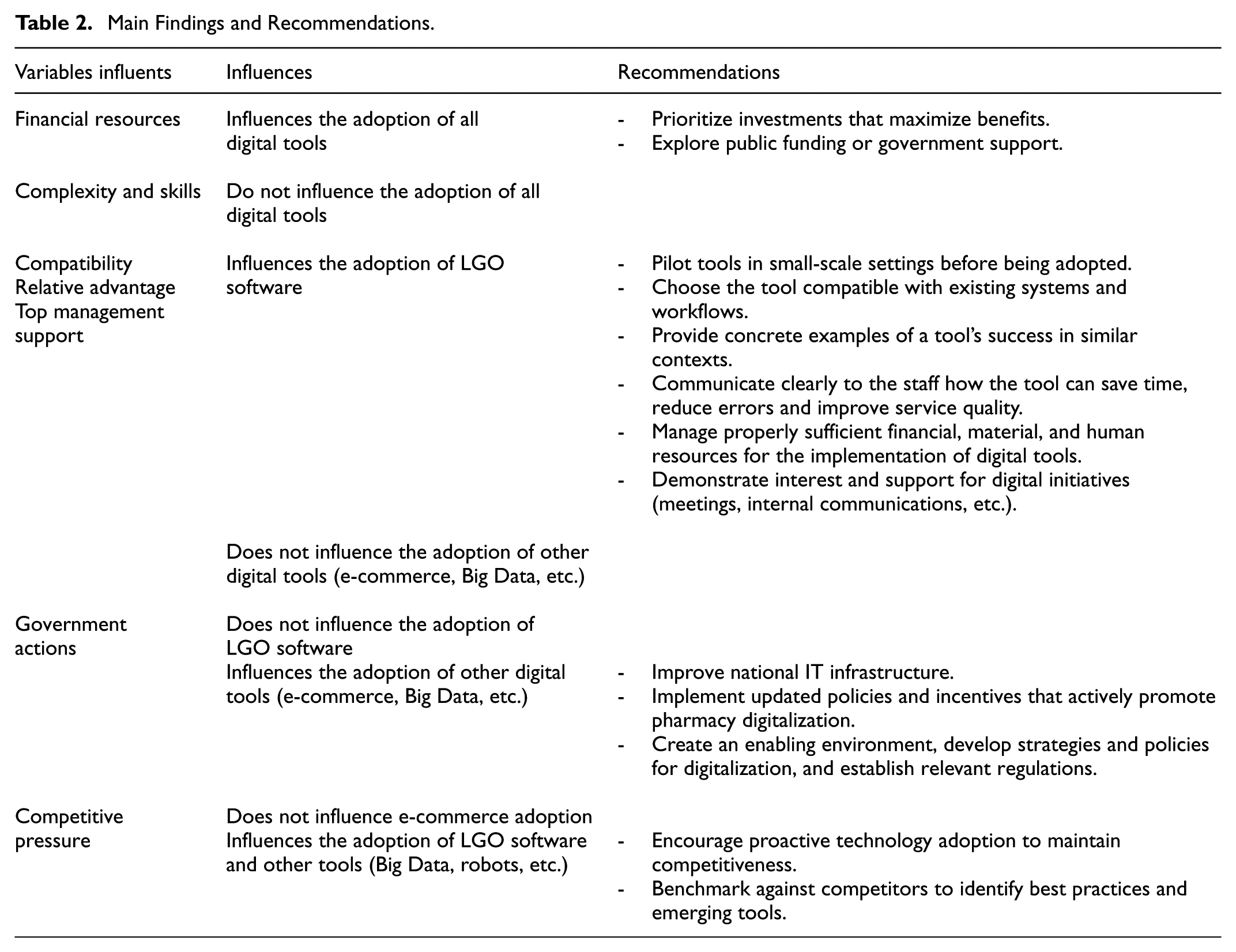
The results of this study reveal a significant presence of the factors “government actions” and “cost” in the cases examined (see Table A7, Appendix 1). This predominance can be attributed to the stringent laws and regulations governing online sales for pharmacies, as well as the high costs associated with imported technologies such as robots, Big Data, and Blockchain. These main findings are summarized in the following table, along with practical recommendations, which are presented at two levels: organizational, addressing factors within pharmacies and their competitive environment, and governmental, focusing on policies and infrastructure to support digitalization (Table 2).
Main Findings and Recommendations.
The principal findings are consolidated in the diagram below, which provides a comprehensive overview of the variables shaping the adoption of digital tools (Figure 4).

Qualitative results diagram.
This research offers both theoretical and managerial contributions. From a theoretical perspective, it contributes to identifying the factors influencing the digitalization of pharmacies, focusing on the “organization” as the unit of analysis, whereas most prior studies have emphasized the “individual” as the unit of analysis. The findings extend the TOE framework highlighting how the relative influence of technological, organizational, and environmental factors varies with different types of digital tools. Moreover, this research is the first in Tunisia to address digitalization in the pharmaceutical sector, providing new insights into an underexplored context and revealing the level of digital development in pharmacies. From a managerial perspective, the research provides two key elements. First, it helps pharmacists understand the factors that affect the digitalization of their pharmacies, enabling them to reach the desired level of digital development. Second, it offers programmers and designers of digital tools a clear understanding of the digital development needs of their clients, allowing them to propose technological solutions that are compatible with the specific context of Tunisian community pharmacies.
The limitations of this research can serve as a basis for further research. First, from a conceptual point of view, the study focuses on the factors influencing digitalization in pharmacies and not the adoption behavior of pharmacists. The choice of the unit of analysis “organization” shows the lack of previous studies on this subject. This research is based on variables from the health sector in general. As a result, addressing this topic reveals a gap in the literature regarding the digitalization of Tunisian pharmacies, making it challenging to directly compare with empirical results. From a methodological perspective, the survey is primarily limited by the sample size, which consists of only 15 pharmacies. Although this sample generated interesting insights, the findings of this study cannot be generalized. As for future research directions, it would be beneficial to conduct mixed-method research by combining qualitative and quantitative approaches to enrich the findings. In addition, engaging with other participants, such as members of the National Council of the Order of Pharmacists of Tunisia or officials from the Ministry of Health, could provide a more comprehensive understanding of the topic.
Footnotes
Appendix 1
Summary Table of Results.

| Digital tools | Variables | Results | Intervening variables |
|---|---|---|---|
| LGO Software | Compatibility | Positively influences the adoption of LGO software | |
| Relative advantage | Positively influences the adoption of LGO software | ||
| Complexity | Does not influence the adoption of LGO software | Skills | |
| Top management support | Positively influences the adoption of LGO software | ||
| Skills | Does not influence the adoption of LGO software | Competitive pressure | |
| Financial resources | Positively influences the adoption of LGO software | ||
| Government actions | Does not influence the adoption of LGO software | ||
| Competitive pressure | Positively influences the adoption of LGO software | ||
| E-commerce | Compatibility | Does not influence e-commerce adoption | Government actions |
| Relative advantage | Does not influence e-commerce adoption | Government actions | |
| Complexity | Does not influence e-commerce adoption | Government actions | |
| Top management support | Does not influence e-commerce adoption | Cost/financial resources | |
| Skills | Does not influence e-commerce adoption | Government actions | |
| Financial resources | Negatively influences the adoption of e-commerce | ||
| Government actions | Negatively influences the adoption of e-commerce | ||
| Competitive pressure | Does not influence e-commerce adoption | Government actions | |
| Other digital toolsRobot, Big Data, so on | Compatibility | Does not influence the adoption of other digital tools | Cost |
| Relative advantage | Does not influence the adoption of other digital tools | Cost | |
| Complexity | Does not influence the adoption of other digital tools | Cost | |
| Top management support | Does not influence the adoption of other digital tools | Cost/financial resources | |
| Skills | Does not influence the adoption of other digital tools | Competitive pressure | |
| Financial resources | Negatively influences the adoption of other digital tools | ||
| Government actions | Negatively influences the adoption of other digital tools | ||
| Competitive pressure | Negatively influences the adoption of other digital tools |

Consent to Participate
Informed consent was obtained from all participants prior to the interviews. Before each interview, participants were informed about the purpose of the study, the voluntary nature of their participation, and the assurance that their personal information would remain confidential.
Funding
The authors received no financial support for the research, authorship, and/or publication of this article.
Declaration of Conflicting Interests
The authors declared no potential conflicts of interest with respect to the research, authorship, and/or publication of this article.
Data Availability Statement
The data supporting the findings of this study are available from the corresponding author upon request.