




Abstract
The research evaluated public libraries in Pakistan concerning their ICT resources, services and use of various ICT tools in service delivery. The research was quantitative and relied on a survey to collect the necessary data. The study’s population was all the public libraries in the country that were run by any department or directorate. A census-based survey was done to get information from the whole population. The data was collected from the heads of the libraries through questionnaire, and then it was analyzed with the help of SPSS version 23. The public libraries were governed by various bodies, and variations were also found in the nomenclature of the libraries’ heads. Most libraries’ heads were LIS professionals; however, many were operated by non-professional employees. Most libraries offered services like circulation, reference, orientation, open shelf and photocopying facilities. It was also identified that most libraries did not offer some common services such as document reservation services, OPAC, indexing and abstracting services, interlibrary loans, SDI and audiovisual services, scanning and CD/DVD writing facilities. Since this is the first study of its kind, its findings could prove useful to the government of Pakistan in improving public library services. In addition, it will fill a gap in the literature and direct researchers to investigate other facets of public libraries.
Keywords
Introduction
A public library is a place where people of all ages can access information resources, services, and recreational opportunities (Akanwa, 2013). The primary goal of public libraries is to promote the user’s literacy skills and act as information hubs in the modern world (Smith, 2020). Public libraries and information centers play the role of catalysts for effective information dissemination in society. These knowledge hubs could make the public aware of health issues and provide services and resources to users and scholars (Joel & Camble, 2023).
Public libraries are places where information is kept and shared, awareness is raised, communities are helped, As stated by Koontz and Gubbin (2010), the primary purpose of a public library is to give people and groups access to resources and services for learning, getting information and having fun. Trombetta (2017) shows how important public libraries are by saying that they are more than just places to store documents; they are also hubs for learning, professional development, and health care. He also said that libraries are more important than ever because they offer free educational resources to everyone, are safe places for the poor and underserved, help the local economy, are a key part of learning English, make communities healthier, keep histories alive and bring people together. UK Essays (2018) summarized that the public library is an essential informational, educational, cultural, and social institution. It imparts education by providing books and other materials, leading to self-improvement, developing literacy skills, and supporting non-formal education. These help businesses and the economy by giving business communities useful business services, resources and programs to help people learn about business. These can also implement democratic culture through free and fair elections, citizens’ participation in decision-making, human rights and information access.
Public Library Services in the Era of Technology
Information Technology (ICT) has revolutionized libraries and information centers, empowering them to offer electronic resources and services to their users (Rafi et al., 2016). Libraries have embraced digital resources such as e-books, e-journals, and online databases, expanding the accessibility of information beyond physical collections (M. Hussain & Nayab, 2021). ICT has also transformed library operations by introducing digital catalogs and integrated management systems, improving efficiency and user experience. Libraries use digital platforms for communication and outreach, engaging with their communities and promoting their services (Choukhande, 2003). Additionally, IT enables libraries to bridge the digital divide by providing technology access and offering training programs to enhance digital literacy. While ICT has brought significant changes, libraries remain committed to their core principles of organizing, preserving, and disseminating information. Overall, libraries continue to evolve and adapt, leveraging ICT to meet the changing needs of users in the digital age (Ameen, 2017).
Libraries continue to evolve and adapt to meet the changing information needs of their users while embracing emerging technology and novel techniques to improve access to knowledge and promote lifelong learning. Some of the services offered by public libraries in the era of technology are mentioned below.
1. They aim to raise awareness among individuals about the abundant resources and services offered by the library. 2. These events seek to foster a vibrant reading culture by promoting engagement with literature and intellectual discourse. 3. Conferences, seminars, and lectures provide a platform for professionals and researchers to share their experiences, insights and research findings, facilitating knowledge exchange and collaboration. 4. Such gatherings often include specialized training sessions, enabling participants to enhance their skills and expertise in various domains.
Historical Perspective of Public Libraries in Pakistan
Pakistan is a country in South Asia whose official name is the “Islamic Republic of Pakistan.” It is the 33rd largest country in terms of land area, covering 796,096 km2. Pakistan consists of four provinces (Punjab, Sindh, Balochistan, and Khyber Pakhtunkhwa), two autonomous regions (Azad Jammu and Kashmir and Gilgit Baltistan) and the federal territory of Islamabad (Government of Pakistan., 2021). According to the Census 2017, the population of Pakistan is 207.68 million and is the world’s fifth-most populous country (Pakistan Bureau of Statistics, 2021).
Mahmood (2008) reported that the government of British India established public libraries in the subcontinent in 19th century. Those libraries were set up in some states’ provincial and district offices, municipalities, and capital cities. Some of these libraries are mentioned in Table 1.
Public Libraries.

Khurshid (1990) found that in 1970 there were 191 public libraries; in 1974, there were 78 libraries; in 1984, there were 162 libraries; and in 1989 there were 284 public libraries. The decline in 1974 was due to the closure of reading rooms built after 1959. According to the research conducted by N. Warraich et al. (2018), there are 176 public libraries in Punjab, Pakistan; out of these, 137 were functional, and the remaining 39 were non-functional. The data revealed that these were working under the supervision of various administrative bodies such as the Tehsil and Municipal Administration (TMA), district government, welfare organizations, and the education department. Baqi (2016) said that the province of Balochistan had 17 public libraries. All of these libraries were built after independence. M. Hussain (2014) explored 21 public libraries in the province of Khyber Pakhtunkhwa: 10 out of 21 libraries worked under the supervision of the directorate of archives and 11 were under the administrative control of local governments.
There needs to be accurate data about the number of public libraries in Pakistan. Mahmood (2008), on the other hand, said that the country has more than 300 public libraries. Since there is no nationwide library system, public library administration varies widely across the country. Public libraries in Islamabad are managed by the department of libraries, whereas those in the remaining four provinces are maintained by local, municipal, and district governments, as well as the directorate. Khubaib and Demani (1996) stated that 302 public libraries in the country were maintained by municipal corporations, cantonment boards, town committees, or district councils.
According to Bashir et al. (2018) and Jalaluddin Haider (1998), there is no legislation in the country that governs the establishment and growth of public libraries. Haider (2001) said that in Pakistan, there are no public libraries in the strict sense of the word. Therefore, according to Ahmed and Sheikh (2015), Pakistan’s government should implement mandatory legislation for public libraries and public library systems to establish library and information systems at the national and provincial levels under constitutional provisions. Ansari (2007) emphasized the importance of standards for public libraries, stating that despite Pakistan’s 60-year history, no standards for public libraries have been developed. As a result, the government and library organizations must collaborate to set standards for measuring the various parameters of the library.
Statement of the Problem
It is widely acknowledged that public libraries have transformed into user-centered institutions, wherein their operations are dedicated to satisfying users’ needs, fostering awareness among users, and understanding their diverse requirements and expectations. It is unknown whether the public libraries in Pakistan are doing such activities. Hence, it is very important to conduct a study that inspects the status of conducting such activities and services and uses ICT tools to deliver library services.
The researchers explored the fact that significantly fewer research studies have been done on public libraries in Pakistan. Most of those studies have been conducted at the tehsil and district levels, while some research has been carried out at the provincial level. However, some researchers conducted case studies of some of the major public libraries in the country. All those studies largely investigated some of the elements of public libraries, such as planning and development, legislation, users’ satisfaction with the resources and services, physical infrastructure, and issues and challenges facing public libraries. Therefore, keeping this in mind, the researchers felt that the work on public libraries is a timely call to fill this literature gap by conducting the first study on public libraries across Pakistan. It will fill a gap in literature, bring public libraries into research circles and serve as a foundation for future researchers to evaluate other aspects of public libraries.
Objective of the Study
The study aimed to investigate the services offered by Pakistan’s public libraries. Specifically, the study sought to:
evaluate the ICT resources available in public libraries.
find the services offered by the public libraries in Pakistan.
examine if there is any significant association between the qualifications of library heads and library services.
check whether there is any significant association between the groups that run public libraries and library services.
inquire about the integration of ICT into library service provision.
Literature Review
Public libraries serve as community hubs, connecting people to essential resources and information (Sasi, 2016; Scott, 2011). These institutions gather and disseminate information, increase public awareness, and aid in learning for people of all ages, genders, races, and socioeconomic backgrounds (Ikenwe & Adegbilero-Iwari, 2014). According to Perumal and Baskaran (2010), the public library is a democratic institution that plays an important role in today’s society.
Information and Communication Technologies (ICT) in Libraries
ICT is the combination of “computers” and “information technology” used in librarianship to bring innovation and standards in library operations (Thanuskodi & Ravi, 2011). It has replaced the terms like “technology learning” and “informational technology” (Finger et al., 2007). Tayade and Bhadange (2017) and Ebijuwa (2005) said that it is an umbrella term for technologies used to collect, process, organize, store and share information in different ways. In the opinion of Thanuskodi and Ravi (2011) and Jibril (2013), information and communication technology has revolutionized every facet of library work. According to IFLA, public libraries should have facilities such as “workstations, printers, CD/DVD drives, copiers, scanners, webcams, microfilm/fiche readers” (Koontz & Gubbin, 2010).
Das and Barman (2020) said that public libraries in Meghalaya, India, had the basic ICT infrastructure, however, no library had electronic and digital collections. Most libraries did not have CCTV and RFID technologies. Ghalavand and Karimi (2020) reported poor ICT infrastructure in Iranian public libraries. It was suggested that there should be a formalized ICT policy, adequate funding for acquiring ICT equipment and librarians should receive appropriate training. Rana and Bhatti (2020) asserted that public libraries in Punjab, Pakistan, require more IT personnel and better ICT resources. Power outages and lack of funding hampered ICT implementation in libraries.
The hotspot loan program of the New York and Brooklyn public libraries was studied by Strover (2019), who found that library users could borrow these gadgets with internet packages to access the internet. They used these devices at home, in public places and while traveling. These devices were used for gaming, email, schoolwork, watching videos and looking up local information. According to Lediga and Fombad (2018), in the public library of Kempton Park, South Africa, authorities should ensure that all public libraries in the country have ICT facilities and high-speed internet so that everyone has equal access to these resources. Baqi (2016) proposed the development of ICT infrastructure to address the issues confronting Balochistan’s public libraries.
Anna (2018) discovered that 55% of the public libraries in Indonesia did not have websites. According to Chandrasekar (2013), the lack of ICT equipment is the biggest problem facing Jaffna’s public libraries in Sri Lanka. It was advised that steps be taken to use contemporary technology to improve user access to electronic resources and streamline library operations. Ansari and Munshi (2018) investigated the public libraries in West Bengal, India, and said that ICT infrastructure should be built to automate library operations. Al-Qallaf and Al-Azmi (2002) probed the state of ICT in public libraries in Kuwait. They found that most libraries did not have any IT-related technology, which showed that IT development was still in its early stages. Insufficient planning, finance, personnel, and infrastructure impeded IT progress.
Services of the Public Libraries
The public library is a cultural institution with the goal of meeting the information needs of its patrons (Zhong, 2007). In order to meet the needs of the patron, public libraries should develop high-quality services (Chang & Hsieh, 1996). The services of the library are the “activities and operations of a library that bring the staff into regular direct contact with its users” (Reitz, 2014). According to Harrod’s Librarians’ Glossary the library services are “the facilities provided by a library for the use of books, electronic, and other materials and dissemination of information” (Harrod, 2005). According to IFLA, public libraries provide different services to the community. Some of the services are the loan of books and other materials, reference services, to consult the books and other materials within the library, CAS and SDI services, information services using print and electronic media, reader’s advisory services, reservation services, user education services, extension services, community information services, and services to increase literacy by organizing programs and events (Koontz & Gubbin, 2010).
A study was conducted by Kasimani and Rajendran (2019) to gage the resources and services of central public library Tamil Nadu, India. The library offered services like circulation, internet, reference, photocopying, and assistance in the use of the library. Idhalama (2019) viewed that the library should provide services to all classes of users irrespective of age, sex, color, and disability. It was ascertained how public libraries could satisfy the information needs of physically challenged users, solve their challenges and guide them to benefit from the library services. The majority of public libraries in Punjab, Pakistan, as mentioned by Waheed et al. (2017), offered traditional libraries services, including reference services (79.3%), current awareness services (55.2%), photocopying services (51.7%), and internet services (55.2%). However, most of these did not offer services such as SDI (65.5%), document delivery services (72.4%), and digitizing services (75.9%). Nawaz (2016) gave an overview of the Liaqat Memorial Library in Karachi, Pakistan. He said that the library served society by putting together different kinds of information and helping researchers, kids, women, and the general public. Rizvi (2016) talked about the services and materials available at the Punjab Public library Lahore. The library offered various services, including circulation, reference services, internet access, photocopying, scanning, digital services, SDI, CAS, and OPAC access.
N. F. Warraich et al. (2016) revealed that most of the public libraries in Rawalpindi, Pakistan, still needed to offer basic services to their users. The authors suggested that these services be upgraded and expanded to other libraries. Bhatti et al. (2015) presented an overview of the services offered by the central public library Bahawalpur. They opined that being an important social institution, public libraries must build effective information services to satisfy their users’ educational and informational needs. Ameen (2015) examined public relations and publicity in public libraries. Although public libraries may not have used this novel concept, they hosted literary events, book exhibitions, and lectures. It was suggested that PRP plans and policies be developed and carried out in collaboration with higher authorities.
N. Warraich et al. (2018) identified 137 public libraries in the Punjab province administered by various bodies. The study highlighted the resources and services of the surveyed libraries. The authors proposed that library staff be trained and that libraries create websites to promote library services to the general public. Soroya et al. (2014) found a strong link between the country’s public libraries and economic growth. They mentioned some public services that could significantly contribute to the country’s economic development. These services included the creation of regional business directories and information guides, job information for the community, a compilation of business-related bibliographies, and workshops and seminars for the business community.
Ping et al. (2013) inspected the public library services for vulnerable groups, including senior citizens, youth and children, disabled individuals, low-income citizens, migrant workers, and prisoners. The libraries offered special services and reading room facilities and organized activities like painting, calligraphy, photography, singing and dancing competitions, and other group training sessions. Clarke et al. (2013) investigated Hangzhou, China’s public library facilities and services. The library offered OPAC services and services for renewing and reserving books, getting information about upcoming events, reading digital magazines, and watching videos. One can find 6,000 educational and science videos and 2,000 digitized magazines and other publications on the library’s website. The mobile app could be accessed through a WAP website that kept people up to date on programs and events that had just happened, were still happening, or were going to happen.
Paola Picco (2008) presented an overview of the services offered by the public libraries for immigrants in Montreal, Canada, in light of the IFLA guidelines for multicultural communities. The immigrants benefited from the services, which helped them integrate into society and build cultural ties to their home countries and languages. Bandyopadhyay and Goswami (2007) highlighted the health-related services of public libraries in West Bengal, India. Besides the traditional services, they delivered services to children and women to promote their reading habits, career and extension programs and current awareness sessions to inform them about vital issues. Mahmood (2008) said that public libraries offered circulation, reference, reading rooms, copying services, and a seminar hall where people could do different things. He went on to say that internet access could significantly improve public libraries’ service quality and reputation. Mainka et al. (2013) assessed public libraries’ services in the northeastern states of Nigeria. Basic services like bibliographic services, abstracting and indexing services, and adult and continuing education services were needed by most libraries.
Islam and Mezbah-ul-Islam (2010) evaluated the community information services (CIS) delivered by public libraries in Bangladesh. They also identified problems in providing services and proposed a comprehensive plan to improve CIS. Similarly, Ebiwolate (2010) found that rural libraries in Nigeria needed help to meet the needs of their communities. These issues in providing library services include lack of infrastructure, ICT facilities, insufficient funds, inadequate human resources, illiteracy, poverty, and language barriers. Fourie (2013) identified some barriers faced by the library staff in delivering services, which were due to various internal and external factors. Internal factors were the limited resources, fewer collections, lack of facilities, and staff shortage, while external factors were the educational, economic, and cultural environments. Some recommendations were also given to provide better services to the youth.
Research Methodology
The study adopted a quantitative research approach and employed a survey methodology to address the stated research objectives effectively. This research strategy is widely recognized and employed by numerous scholars in their respective investigations (M. Hussain & Idrees, 2021; Kumar & Kumar, 2010; Rehman et al., 2011). Furthermore, this approach was chosen since the study’s objectives could be easily accomplished. The study population was the county’s public libraries that worked under any department or directorate. These libraries were selected because they had some physical infrastructure and resources and offered some services to the community, whereas libraries that worked under the control of other bodies (i.e., local government) were reading rooms and did not provide other services to the people. One hundred twenty-four (124) libraries were identified that worked under any department or directorate; hence, a census-based survey was carried out and data was gathered from the entire population. Gay et al. (2015) say that the survey is either a census or a sample. The goals of a census survey differ from those of a sample survey, which tries to get information from in a subset of the population that is representative of the whole. Also, it is important to note that the information regarding these libraries was obtained from their respective governing bodies.
After conducting a thorough review of the literature, the questionnaire was drafted. Most of the questions were derived from questionnaires and studies used in previous research (Ahmed & Rehman, 2016; Baqi, 2016; M. Hussain, 2014; Mirza, 2010). The study relied on a questionnaire because (a) the population was spread out over a large area and (b) the research goals could easily be accomplished with this tool. The questionnaire aims to gather information from widely scattered sources (Nehru & Suryanarayana, 2012). Moreover, it was chosen because it is cost-effective, anonymous, saves time and removes the respondent’s bias (Busha & Harter, 1980; Powell & Connaway, 2004).
The structured questionnaires were sent to the librarians or incharge of the 124 public libraries through their postal/email addresses in 2021. The researchers received 119 completed questionnaires in 2 months, with a 95.96% response rate. The data was analyzed with descriptive and inferential statistics using SPSS 23 (Statistical Package for the Social Sciences).
Data Analysis and Interpretations
The data was analyzed in light of the study’s objectives, and the findings are presented in tables and graphs alongside a discussion of the findings.
Demographic Information
Table 2 indicates five variant groups of respondents regarding their designation, such as “chief librarians/directors; deputy chief librarians /additional directors; senior librarians/deputy directors; and librarians/assistant directors.” It is apparent from the data given in Table 2 that most of the libraries were managed by LIS professional staff. However, some libraries were administered by junior librarians while others were managed by “other categories” of staff, such as catalogers, library assistants, clerks, or other non-professional workers. Furthermore, the data show that most (91) library heads had a library science background, while the remaining 27 had master’s or bachelor’s degrees in other fields. Moreover, the study participants were divided into groups based on the length of their experience. According to Table 2, most respondents (71.5%) had up to 10 years of experience, while 21% had 11 to 20 years of experience.
Demographic Information of Respondents.

Administrative Bodies of Public Libraries
Pakistan does not have a national library system, so each province runs its public library system. During data collection, it was noticed that every province and the federal territory had heterogeneous administrative setups. The detail of the population and their supervisory bodies are given in Table 3.
Administrative Bodies of Public Libraries.

Status of ICT Resources
The heads of libraries were asked to give details about the ICT resources available to their employees and users.
ICT Resources for Staff
It was shocking to learn that the surveyed libraries either had no or very poor ICT infrastructure. The numbers in Table 4 show that a significant proportion of libraries did not have any computers (32.3%), laptops (68.1%), printing facilities (42%), photocopier machines (42.9%), scanning facilities (42.9%), UPS equipment (51.3%), TV sets (58.8%), multimedia projectors (59.7%), external hard drives (92.4%), and the digital cameras (88.2%).
ICT Facilities for Staff and Users.

ICT Resources for Users
Table 4 shows that 73.1% of libraries offered Wi-Fi and Internet access to their patrons, 59.7% had scanners, 53.8% had photocopiers, and 72.3% had computers. Amazingly, most libraries did not have basic ICT equipment for employees and patrons. The empirical statistics show that a substantial number of libraries still needed to have a single computer for library employees. Furthermore, many libraries need essential ICT equipment and facilities for staff and users, including printers, scanners, photocopiers, storage devices, internet and Wi-Fi access, and digital cameras.
Services Offered by Libraries
The fundamental aim of a public library is to meet the requirements of its patrons by providing high-quality services. Karur and Walia Paramjeet (2015) say that public libraries should keep materials and offer services that let people know about new trends and developments in different fields.
Heads of public libraries were asked 18 dichotomous questions (yes or no) about the availability of services in their libraries. Descriptive statistics were used to know what kinds of services are being offered and what is missing in the libraries. The type of services and the number of libraries associated with the services concerned are listed in Table 5.
Service Provision in Public Libraries.

The analysis of data in Table 5 shows that most libraries offered services, including open shelf system (85.7%), circulation services (79.8%), reference services (77.3%), photocopying facilities (54.6), and orientation services (53.8%).
The results show that most libraries did not offer certain services. Out of 119 libraries, discussion rooms facility was available in just 51 (42.9%) libraries, 46 (38.7%) libraries rendered scanning facilities, SDI facility was in 35 (29.4%) libraries, audiovisual and CD/DVD writing facilities were found in 29 (24.4%) and 23 (19.3%) libraries, respectively.
It was identified that very few libraries offered some common user services, 20 (16.8%) offered document reservation services, 13 (10.9%) had OPAC of their resources, 9 (7.6%) offered abstracting services, 8 (6.7%) provided indexing services, 3 (2.5%) had interlibrary loans, while book banks and translation services were not available in any of the libraries.
Relationship Between Library Services and Qualifications of Library Heads
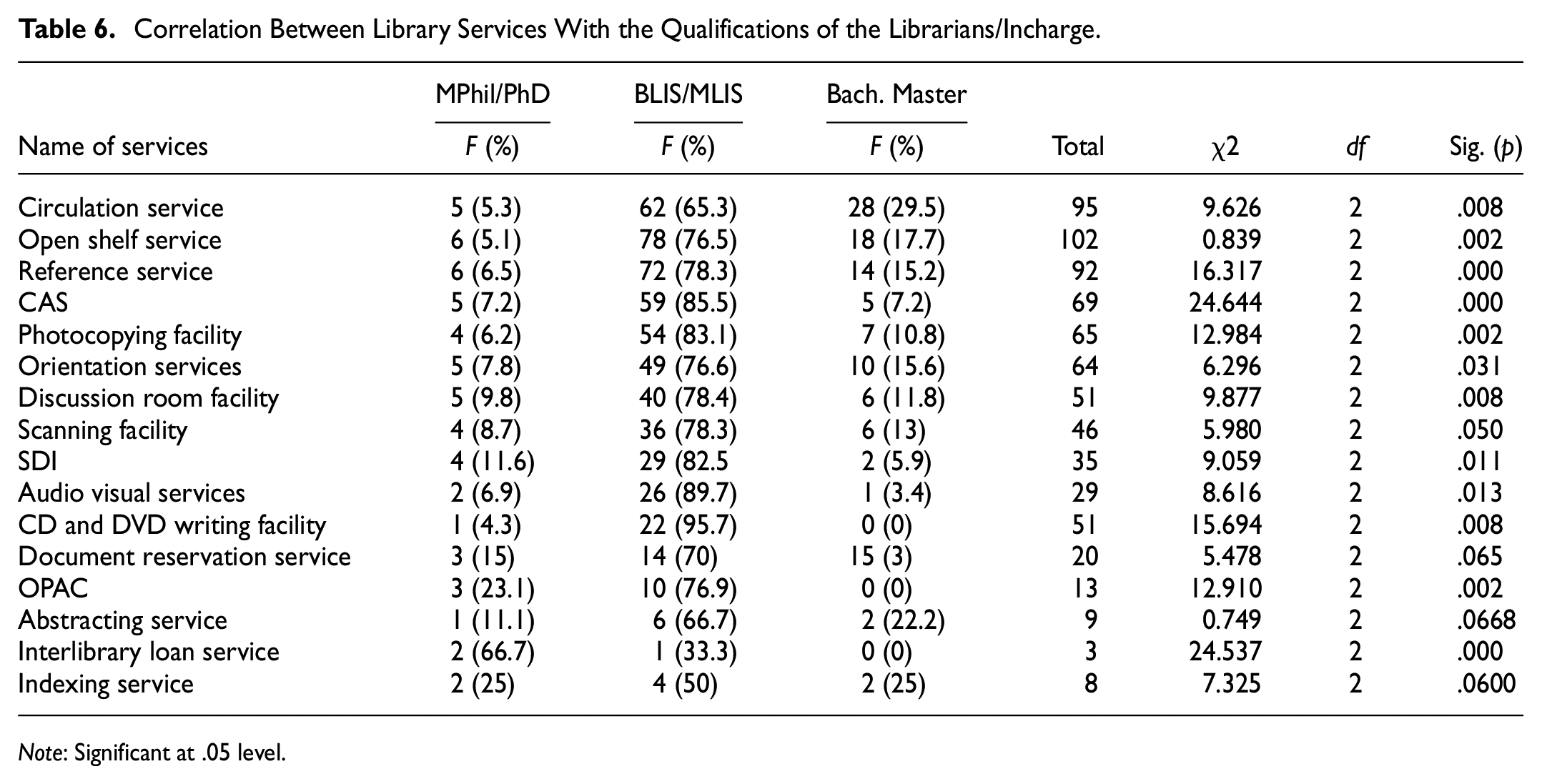
Pearson’s chi-square statistics were employed to examine the association between library services and the academic qualifications of the library heads. Table 6 presents information about the name of service, frequencies, and percentages of respondents who offered the service, and the number of library heads offering the specific service; the chi-square value (χ2), “df” (degrees of freedom), and “Sig. (p)” (significance level) are also provided.
Correlation Between Library Services With the Qualifications of the Librarians/Incharge.
Note: Significant at .05 level.
The data in Table 6 indicates a significant association between respondents’ academic qualifications and the services they offered to the community. This is evident from the p-values, which are less than 0.05 for various services, including circulation (p = .008), open shelf services (p = .002), reference service (p = .000), CAS (p = .000), orientation services (p = .031), discussion room facility (p = .008) SDI (p = .011) scanning facility (p = .011), and others.
Analysis and significant values (p) suggest that library heads with educational qualifications in library and information science are more likely to provide a broader range of services to their patrons than those without such qualifications. However, the data also reveals that abstracting services (p = .078) and indexing services (p = .078) do not show a significant relationship with the qualifications of the respondents. This implies that regardless of the higher and relevant qualifications of the library heads, most libraries did not offer these services.
Thus, it can be concluded from the above discussion that academic qualifications in library and information science determine the range of services offered by library heads, with some services being more closely associated with higher and relevant qualifications while two services show no significant relationship.
Relationship Between Library Services and Categories of Libraries
Pearson’s Chi-Square tests were conducted to explore the relationship between library services and public libraries’ administrative bodies. The surveyed libraries were supervised by six different bodies: Directorate of Archives & Libraries, Khyber Pakhtunkhwa (A), Directorate of Public Libraries Punjab (B), Culture, Tourism, Antiquities & Archives Department, Sindh (C), Culture, Tourism and Archives Department, Balochistan (D), Department of Libraries, Islamabad (E), and Punjab Information Technology Board and Youth Affairs, Sports, Archeology & Tourism Department (F).
The analysis in Table 7 revealed that most library services are significantly associated with their respective supervisory bodies, as indicated by p-values below .05. However, there was an insignificant relationship between abstracting services (p = .364) and the administrative bodies of public libraries, suggesting that this service was not frequently offered by any group of libraries regardless of their supervisory bodies.
Correlation Between Library Services With the Categories of Libraries.

Note: Significant at .05 level.
Among the different supervisory bodies, libraries operating under the Directorate of Archives & Libraries, Khyber Pakhtunkhwa (A), Directorate of Public Libraries Punjab (B), and Culture, Tourism, Antiquities & Archives Department, Sindh (C) offered circulation service (p = .000), open shelf services (p = .003), and reference services (p = .000) more frequently compared to libraries under other supervisory bodies (D, E, and F).
Similarly, CAS (p = .000), orientation services (p = .000), and discussion room facilities (p = .001) were more frequently provided by libraries supervised by the Directorate of Archives & Libraries, Khyber Pakhtunkhwa (A) and Punjab Information Technology Board (F) compared to those under other bodies (D, E, and F).
Scanning facilities (p = .017) were more commonly offered by libraries supervised by the Culture, Tourism, Antiquities & Archives Department, Sindh (C), while libraries under the Directorate of Archives & Libraries, Khyber Pakhtunkhwa (A) and Punjab Information Technology Board (F) offered it less frequently. SDI (p = .000) and OPAC (p = .000) services were more frequently provided by libraries under the Directorate of Archives & Libraries, Khyber Pakhtunkhwa (A), while audiovisual services (p = .000) and CD/DVD writing facilities (p = .000) were more commonly offered by libraries under the Punjab Information Technology Board (F).
In conclusion, the study found a significant association between most library services and their supervisory bodies. Libraries under specific administrative bodies offered certain services more frequently, while others were less commonly provided regardless of the supervisory body. These findings highlight the influence of administrative bodies on the availability of library services and the need for tailored strategies to enhance the provision of services across different public libraries.
ICT Tools and Library Services
Massive amounts of data are created and transmitted from every corner of the globe. The libraries have trouble meeting the users’ needs and wants in a short time. Libraries worldwide are increasingly relying on ICT products and services to adapt to challenging environments and continue serving their patrons effectively. As a result, information was gathered from public libraries all over Pakistan to determine the degree to which they have incorporated contemporary forms of communication into the delivery of their services. Figure 1 demonstrates that libraries have adopted the use of certain ICT tools and applications, including personal email (85), Facebook (85), and WhatsApp (68). The use of Twitter and websites for library services was limited to 12 libraries. There were no libraries that offered their services through LinkedIn, Flickr, or RSS.

ICT used for library services.
Discussion
According to Abdulahi et al. (2020), the public library serves as a “people’s university,” welcoming people of all ages and backgrounds. It was seen that different titles were used for the heads/incharge of public libraries in Pakistan. The provinces of Punjab, Khyber Pakhtunkhwa and Balochistan used the titles of “chief librarians/additional librarians/deputy librarians/assistant librarians” for the heads/incharge of public libraries. In contrast, the libraries in the province of Sindh and the Capital territory of Islamabad used directors/additional director/deputy directors/assistant directors for library heads.
There were five categories of respondents based on their position: directors/chief librarians, additional directors/deputy chief librarians, deputy directors/senior librarians and assistant directors/librarians. Some libraries were run by junior librarians, while others by catalogers, library assistants, clerks, or other non-professionals. There was only 1 library director with a PhD, 5 with an MPhil, 82 with a “Master of Library and Information Science” (MLIS), and 3 with a “Bachelor of Library and Information Science” (BLIS). Additionally, it was noted that 27 library heads/incharge were non-professionals with master and undergraduate degrees in other disciplines. M. Hussain (2014) and M. Hussain and Nayab (2021) reported that MLIS was the highest qualification of the library heads in public libraries in Khyber Pakhtunkhwa, and Hashmi’s (2019) research on the public libraries of Islamabad supported these findings. However, IFLA advocates that public libraries be headed by librarians who have earned a master’s degree or higher from an accredited library or information science program (Koontz & Gubbin, 2010). The standards and guidelines for Australian public libraries stipulate that the head of a public library must have a background in library and information science and be qualified, capable, and motivated to carry out library operations (Australian Public Library Alliance and Australian Library and Information Association, 2021). The American Library Association (ALA, 2016) advocates that LIS personnel be proficient in management and administration, information organization, technology, and lifelong learning.
Since the country lacks a centralized library system, the organizations responsible for managing public libraries are not uniform. Each province and territory have its unique administrative structure. In Pakistan, administrative bodies of public libraries vary from location to location, as indicated by previous research (Jalaluddin Haider, 1998; Mahmood, 2008; N. Warraich et al., 2018).
It was discovered that most libraries had either poor or no IT infrastructure. Mahmood (2008) and Rana and Bhatti (2020) also pointed out that public libraries did not have enough ICT equipment. Research conducted by Singh (2012) and Chandrasekar (2013) provides additional evidence supporting these findings. Ghalavand and Karimi (2020) discovered that public libraries in Iranian cultural centers lacked adequate IT infrastructure.
The purpose of the public library is to meet the informational and recreational needs of the community. Public libraries aim to provide high-quality services to their patrons and community. Most libraries provide services such as circulation, reference open shelf services, photocopying, and orientation. Surprisingly, most libraries did not offer services like discussion rooms and scanning, SDI, indexing and abstracting, multimedia and CD/DVD writing facilities, document reservation, OPAC, and interlibrary loans. The guidelines and standards of international associations and libraries advocate that public libraries must offer a wide range of services to their patrons. According to Illinois Library Association (2020), all basic services, such as circulation, reference, reader’s advisory, and computer and internet access, should be available at the library. Furthermore, the library should provide interlibrary loans and resource sharing, renewal and reservation of materials and services to meet the information needs of people with disabilities, language, and literacy challenges. According to IFLA, the library should offer services such as the “loan of books and other media, provision of books and other materials for use in the library, information services using print and electronic media, readers’ advisory services, reservation, translation, and community information services.” The library should offer services to children, young adults, adults, community groups, and special customer groups. These groups include housebound people, prisoners and patients, staff of the companies and factories, immigrants, and hearing and visually inspired people. (Koontz & Gubbin, 2010). In accordance with Ontario Public Library Guidelines Monitoring and Accreditation Council (2013), the library offers lending and circulation services, collection holding, reference, and information services and accepts requests via phone, fax, and online, chat, email, and other electronic means. It also offers reader advisory services, information guidance and assistance, and services for children and young adults and linguistic, cultural, and newcomer groups.
The study found that several services that are based on modern technology and applications did not exist in the arena. Nonetheless, a moderately appreciable service portfolio exists, despite the fact that libraries did not have sufficient trained human resources or enough financial resources. The library heads need to be responsive to the challenges and look for customer care and design services that do not need additional finances.
The findings reveal that no library was identified that utilized ICT tools effectively for library services. However, only a few libraries used some tools to deliver services, including personal email, Facebook, and WhatsApp. Public libraries in Alberta are required by law to maintain a library website, and patrons should be able to access the library’s materials at any time of day or night. Technology is a tool used to assist in providing public library services. This can include providing users access to the library’s collections, making materials available on the internet, creating collections to aid discovery, checking loans in and out, and connecting with users, service providers, and other vendors (Government of Alberta, 2018). The library should use technology to enable effective circulation, patron management, reporting, cataloging, acquisition activities and accurate collection management (State Library of Queensland, 2020).
Recommendations
The public library is regarded as a “people’s university” and works to meet the needs of both individuals and different community groups. The following recommendations are made to improve the state of public libraries in Pakistan in light of the study’s findings.
All public libraries should work under a single administrative body to ensure equal or proportionate resource distribution and consistent operation.
Baluchistan’s public libraries managed by the Departments of Culture, Tourism, and Archives are in deplorable condition and require extensive maintenance. These libraries need to build proper buildings and get proper furniture and fixtures.
The heads of every library should be LIS professionals; additional staff should also be recruited to provide quality-based services to the community.
The libraries’ authorities should ensure services like document reservation, OPAC, indexing & abstracting services, and interlibrary loan facilities, as most libraries do not offer these services. Moreover, the existing services should also be extended to other public libraries.
The library should provide e-services to its clientele and adopt modern gadgets to provide library services. Additionally, it is important to employ ICT technologies and social networking applications to offer speedy services to library users.
To make the best use of their resources, all libraries should ideally be open 24 hr a day, 7 days a week, or longer.
Implications
The public library is a democratic and important social institution. Its main objective is to provide resources and services to meet the educational, informative, and recreational needs of individuals and groups in various media. It is part of our society’s current social structure, and people also consider it a social force that can greatly influence the society being served.
The outcomes of this study could be applied by library management and government representatives to create legislation and standards for public libraries. The study results could be considered and used to fix problems faced by public libraries across the country. This study information will be useful for planning and developing human resources, physical layout, and ICT and modern technology systems in public libraries for policymakers and decision makers. The results could assist senior administration officials in creating better services and boosting the country’s public library system. The social impact of the research will create awareness in the public and among the researchers regarding the current scenario of public libraries, services and facilities available in these libraries.
Conclusion
Public libraries are revered in every community as a center of social activity for promoting cultural development and information literacy. The study found that several services based on modern technology and applications do not exist in the arena. Nonetheless, a moderately appreciable service portfolio exists, even though libraries need more trained human and financial resources. The library heads need to be responsive to the challenges and look for customer care and design services free of additional finances.
The findings reveal that no library was identified that utilized ICT tools effectively for library services. However, only a few libraries were using some tools to deliver services, including personal email, Facebook, and WhatsApp. Public libraries in Alberta are required by law to maintain a library website, and patrons should be able to access the library’s materials at any time of day or night. Technology is a tool used to assist in providing public library services.
The numbers showed that, with a few notable exceptions, most public libraries in the country were in bad shape. The primary issues facing libraries included lack of trained employees, a limited budget, deteriorating library structures, and a lack of modern IT tools. It has also been noted that there needs to be more government management and senior administration interest in extending and improving the public library service.
Footnotes
Declaration of Conflicting Interests
The author(s) declared no potential conflicts of interest with respect to the research, authorship, and/or publication of this article.
Funding
The author(s) received no financial support for the research, authorship, and/or publication of this article.
