




Abstract
Social factors, including social ties (the extent to which students form social ties with other students in the course) and social capital (the resources which are accessed through our social networks), have been acknowledged as important predictors of learning outcomes. Furthermore, they may be particularly important in online distance learning environments, in which social presence and interaction may be compromised. Nonetheless, there is a paucity of research on the value of having strong social ties (bonding capital) versus the value of having weak social ties (bridging capital) in terms of online learning satisfaction. The analysis aims to contribute to the scarce literature on this issue by examining the association between the formation of social ties with other students, online bridging and bonding social capital, and online course satisfaction through a study on students’ experiences of online distance learning. The sample included 583 students in the higher education system who had studied online during the preceding semester and responded to two online surveys, administered 2 months apart. Findings indicated a significant positive correlation between bridging social capital and course satisfaction, but no significant correlation between bonding social capital and course satisfaction. These findings highlight the value of interaction with weak ties and strangers (as opposed to the lack of effect of having stronger ties) in online courses for a satisfying online distance learning experience. The analysis also highlighted that, as predicted, the formation of social ties with other students was associated with a higher level of online course satisfaction These findings are discussed in relation to previous research and recommendations are made for future research and online distance learning design.
Keywords
Introduction
The use of online learning platforms has become highly prominent in education settings (Capranos & Magda, 2022; Coursera, 2021), leading to research on the factors associated with positive outcomes in distance online learning. Previous studies acknowledge the importance of social factors, such as social interaction (i.e., people’s behavior and communication when interacting with other people), the quality of social relationships, social belonging (i.e., the subjective sense of being deeply connected with the surrounding social environment), and social capital (i.e., the resources accessed through one’s social network), in learning processes (e.g., Alonso et al., 2015; Behtoui & Neergaard, 2016; Edwards et al., 2021; Hayat et al., 2023; Hurst et al., 2013). However, online learning tends to have lower levels of social presence (i.e., the subjective perception that one is communicating with “real” people who are psychologically present in the conversation; Oh et al., 2018) and social interaction than face-to-face learning environments (Mays, 2016), potentially leading to poorer learning outcomes. Hence, online social capital, referring to the resources potentially accessed through one’s online social network (Putnam, 2000), is an important research framework to consider in the context of online learning (Diep et al., 2016; Gašević et al., 2013; Lu et al., 2013; Oztok et al., 2015). Nonetheless, there is a paucity of research regarding online social capital and online learning outcomes, specifically with respect to the value of two central aspects of social capital to the experience of online distance learning. The first is the value of strong connections such as friends and acquaintances, namely bonding capital, to online learning, and the second is the value of interactions with strangers and weak ties, namely bridging capital, to online learning (Putnam, 2000). This study is one of the first to assess the impact of bonding and bridging social capital on online learning satisfaction in synchronous online distance learning courses. In addition, the analysis examines the association between the formation of social ties with other students and online course satisfaction to better understanding the overall value of social ties in the online distance learning experience.
Social Capital and Academic Benefits
Social capital is defined as “the aggregate of the actual or potential resources which are linked to possession of a durable network of more or less institutionalized relationships of mutual acquaintance or recognition” (Bourdieu, 1986, p. 248). Given the widespread use of online learning platforms in education today, the potential benefits of online social capital in relation to online distance learning outcomes has become an important research focus. Previous studies have shown that social capital is beneficial to online distance learning, and is associated with increased online learning participation (Diep et al., 2016) and engagement (Deepak et al., 2016), higher academic achievement (Gašević et al., 2013), and higher online learning satisfaction (Lu et al., 2013).
Conceptualizations of social capital distinguish between two types of social capital: (1) bridging social capital, referring to resources, such as exposure to diverse knowledge and information, that can be obtained from weak and far-reaching connections with others, and (2) bonding social capital, referring to resources, such as significant help and emotional support, that can be obtained from strong close relationships (Spottswood & Wohn, 2020). Previous literature has indicated that social capital from peers, both in the form of bridging and bonding social capital, is significantly associated with positive learning outcomes among university students engaged in face-to-face learning (Behtoui & Neergaard, 2016; Mishra, 2020; Oranye et al., 2017). Venter (2019) also found that interactions between students in informal settings, such as social network platforms, which led to both bonding and bridging social capital, contributed to students’ online learning experience.
Other studies have indicated that the association between online social capital and online learning outcomes may depend on the type of social capital examined, with bridging capital playing a more determinant role than bonding capital in terms of online course satisfaction. Specifically, while overall bridging online social capital was found to be significantly positively associated with subjective online learning performance (Salimi et al., 2022) and social presence (Oztok et al., 2015), this was not the case for overall bonding social capital. Nonetheless, further research is needed to examine these associations further, as well as the possible role of the formation of social ties in the association between online social capital and online learning satisfaction.
Social Ties and Academic Benefits
Studies have shown that the formation of social ties (Wentzel et al., 2018) and social network stability (Lessard & Juvonen, 2018, 2022) have various academic benefits. The formation of social ties may be particularly important in online learning environments, in which social presence and interaction may be compromised (Wut & Xu, 2021). Indeed, Ahmed et al. (2020) found that interactions with peers was associated with higher academic achievement and higher levels of social capital among students studying online. Pulgar et al. (2021) found that online collaborative work was associated with higher academic performance in online learning among students with strong social ties. Huang (2021) found that the strength, frequency, and intensity of online social ties were associated with students’ intention to continue using the online learning platform. These findings provide evidence of the importance of social ties in online learning outcomes.
To add to the sparse literature on the association between online social capital and online distance learning outcomes, the current study examines the levels of bridging and bonding online social capital and online distance learning satisfaction. Specifically, the current study examines the following research questions: (1) What is the association between bridging and bonding online social capital and online course satisfaction? The first hypothesis is that bridging online social capital will be positively associated with online course satisfaction, whereas bonding online social capital will not be significantly associated with online course satisfaction. This is based on previous findings that while bridging online social capital was found to be significantly positively associated with subjective online learning performance (Salimi et al., 2022) and social presence (Oztok et al., 2015), this was not the case for overall bonding social capital. (2) What is the association between the formation of social ties in online courses and online course satisfaction? The second hypothesis is that a higher number of social ties within online courses will be associated with higher levels of online course satisfaction, in accordance with previous studies (Hayat et al., 2023; Huang, 2021; Wentzel et al., 2018). (3) Given the importance of social ties in online learning (Hayat et al., 2023; Huang, 2021; Wentzel et al., 2018) and the possibility that students may be able to implement the resources gained through online social capital when they manage to form social ties in online courses, leading to increased learning satisfaction, the third research question was, do social ties with students in the course mediate the association between overall bridging and bonding online social capital and online course satisfaction?
Methods
Sample and Procedure
Participants were recruited to complete two online surveys, administered 2 months apart. Respondents received monetary compensation for their participation in the study, and were recruited through an online polling service which specializes in internet-based research. An email was sent to random members of the panel, with a link inviting them to participate in the survey. The sample consist of 583 respondents who completed both surveys. All of the participants were students in the Israeli higher education system, who had studied during the preceding semester and answered the questionnaires in relation to at least one distance learning course that was taught online via synchronous online learning platforms.
Most of the respondents were women (n = 396, 67.9%) and the average age was 25.60 (SD = 4.03, range: 20–57). Most of the participants were studying for a bachelor’s degree (n = 444, 76.2%), and the rest were studying for a master’s degree (n = 65, 11.1%) or other degrees that were not specified (n = 74, 12.7%). About half of the participants studied in universities (n = 323, 55.4%) and the rest in colleges (n = 260, 44.6%). Almost all of the participants were Jewish (98.5%) and defined their socio-economic status as better than average (n = 341, 58.4%).
Instruments
The research questionnaires included multiple-choice questions. The following variables were examined in the questionnaire:
(1) Background variables: To ensure an analysis that controls for the influence of intervening variables, information was collected about the participants’ gender, age (in years), academic degree (bachelor’s, master’s, or other), educational institution (university or college), religion (Jewish or other), and socio-economic status (on a 10-point scale, ranging from very low to very high).
(2) Course satisfaction: Participants were asked to rate their satisfaction with the quality of the online course that they took. The questionnaire has 13 items which participants rate on a 6-point Likert scale, ranging from “strongly disagree” to “strongly agree.” The general score was calculated by averaging the participants’ scores on the questionnaire items. A high index score reflects a higher level of satisfaction with the course’s materials and the lecturer (Cronbach’s alpha = .91).
(3) The formation of social ties within the course was measured through 7 items, assessing the extent to which the student managed to form social ties with other students learning in the course, rated on a 7-point Likert scale, ranging from “strongly disagree” to “strongly agree” (Cronbach’s alpha = .93).
(4) Online social capital was measured through the ‘Social Capital Questionnaire for Adolescent Students’ (SCQ-AS; Paiva et al., 2014). Participants were asked to evaluate their level of bridging and bonding online social capital through 20 items rated on a 5-point Likert scale, ranging from “strongly disagree” to “strongly agree.” The scores were calculated by averaging the participants’ scores on the questionnaire items. A high index score reflects a high level of social capital. 10 items were used to evaluate the level of bridging online social capital (Cronbach’s alpha = .91), and 10 items were used to evaluate the level of bonding online social capital (Cronbach’s alpha = .85).
Results
Table 1 shows the means, standard deviations, and Pearson correlations between the research variables. A significant positive correlation was found between bridging social capital and course satisfaction, whereas no significant correlation was found between bonding social capital and course satisfaction, in accordance with the first research hypothesis. In support of the second hypothesis, social ties were found to be positively associated with online course satisfaction.
Means, Standard Deviations, and Pearson Correlations Between the Research Variables (n = 583)

*p < .05. **p < .01. ***p < .001.
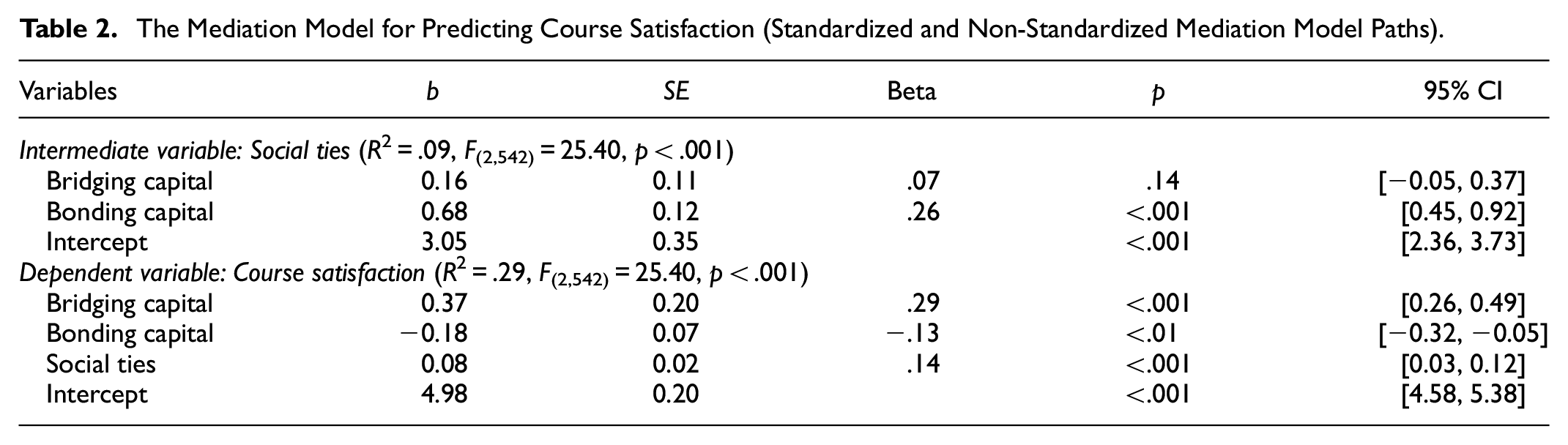
To examine the third research question regarding the role of social ties as a mediator in the relationship between bridging and bonding online social capital and course satisfaction, a mediation model was calculated (while controlling for the background variables: gender, age, academic degree, educational institution, religion, and socio-economic status). The model findings are shown in Table 2 and Figure 1. An examination of the model’s findings shows that the following direct paths were found: higher levels of bridging social capital (when controlling for bonding social capital) and lower levels of bonding social capital (when controlling for bridging social capital) were significantly associated with higher levels of course satisfaction (significant c paths). A calculation of the significance of indirect mediation pathways using the bootstrapping method showed that social ties mediate the relationship between bonding capital and course satisfaction (b = 0.05, SE = 0.02, 95% CI [0.01, 0.10]), with higher levels of bonding online social capital leading to stronger social ties, which in turn lead to higher levels of course satisfaction. However, the indirect pathway between bridging capital and course satisfaction was not found to be significant (b = 0.01, SE = 0.01, 95% CI [0.00, 0.04]) Hence, social ties do not mediate the relationship between bridging capital and course satisfaction.
The Mediation Model for Predicting Course Satisfaction (Standardized and Non-Standardized Mediation Model Paths).

The mediation model predicting course satisfaction.
The datasets generated during and/or analyzed during the current study are available from the corresponding author on reasonable request.
Discussion
The current study examined the associations between bridging and bonding online social capital, the formation of social ties, and learning satisfaction in online distance learning courses. The study found that bridging social capital significantly increased course satisfaction. In contrast, no significant correlation was found between bonding social capital and course satisfaction, These findings are in line with previous findings indicating that while bridging social capital was significantly and positively associated with subjective online learning performance (Salimi et al., 2022) and perceived social presence (Oztok et al., 2015), bonding social capital was not. A possible explanation for the finding is that the insights and resources gained from interactions with strangers and weak ties during online distance learning courses, in the form of bridging social capital, may be more beneficial and may add more value to course satisfaction than interactions with closer friends and acquaintances whose opinions are already known to the student. Further research is needed to examine the reasons behind these associations further, comparing the effects of online social capital and the formation of social ties on online distance learning outcomes in different online learning platforms (e.g., fully online learning vs. blended learning environments of different types). Furthermore, the sample in the current study included a majority of Jewish participants (98.5%). Future studies should aim to include more diverse samples to explore potential differences in the influence of online social capital on learning outcomes across different ethnic and religious groups. This would provide a more comprehensive understanding of how cultural and religious backgrounds might moderate the associations between the variables.
The second research question dealt with the association between the formation of social ties with students in the course and online course satisfaction. In accordance with the hypothesis, findings indicated that formation of a higher number of social ties was associated with a higher level of online course satisfaction. These findings are in accordance with previous findings which have emphasized the importance of social ties and interaction in learning outcomes (Ahmed et al., 2020; Lessard & Juvonen, 2018, 2022; Pulgar et al., 2021; Wentzel et al., 2018).
The third research question examined whether higher levels of online social capital would be associated with higher levels of online course satisfaction through the mediating role of social ties. The findings indicated that bridging social capital was positively associated with online course satisfaction directly, and this association was not mediated by the formation of social ties. Thus, it seems that the development of friendship ties in the course is not the mechanism through which online bridging social capital is associated with higher online course satisfaction. This would indicate that there may be other factors which explain this association that were not examined in the current study, such as general levels of knowledge and information, the types of information communicated between people, academic motivation, social identity and the sense of belonging provided by a students’ social network outside of the course, which may be associated with higher levels of course satisfaction. Further research is needed to examine these variables as possible mechanisms through which bridging social capital is associated with online distance learning course satisfaction.
In addition, the findings indicated that although bonding social capital was directly negatively associated with course satisfaction, it was found to be positively associated with course satisfaction through the mediating role of the formation of social ties. These findings seem to indicate that individuals who are high in bonding online social capital tend to have higher levels of course satisfaction when they manage to form social ties with other students in the course, and lower levels of course satisfaction when they are unable to form social ties with other students in the course. A possible explanation for this finding could be that people with high levels of bonding social capital may be people who have a strong need for close interpersonal relationships. Such students may tend to have lower levels of online course satisfaction (as evident by the negative direct association between bonding social capital and online course satisfaction), given that online learning platforms may be characterized by lower levels of social presence and interaction, making it potentially more difficult to form friendships with other students.
It is important to note that the participants’ demographic characteristics (gender, age, academic degree, educational institution, religion, and socio-economic status) were controlled for in the mediation analysis. Future research could explore the interactions between sociodemographic variables and online social capital in greater detail to understand any potential moderating effects of demographic factors on the relationship between online social capital and learning outcomes.
This study’s findings have important practical implications, emphasizing the critical importance of the formation of social ties as a predictor of online distance learning satisfaction, especially among individuals with high levels of online bonding social capital. Thus, online courses should include components which foster social interaction and the formation of social ties between students, such as classroom discussions and group learning activities and assignments. Such components may be of utmost importance as predictors of online distance learning outcomes, and thus should be considered central and explicit goals of online learning processes. Furthermore, findings indicate that having bridging online social capital is associated with higher levels of online course satisfaction. These findings may signify the importance of providing students with university-wide online social networks which can encourage and enable the development of bridging social capital between students from different courses and departments, potentially providing students with important resources such as academic motivation, belonging, advice, information, and knowledge (Mo et al., 2015). Such social capital can in turn improve students’ satisfaction with online distance learning experiences.
Footnotes
Declaration of Conflicting Interests
The author(s) declared no potential conflicts of interest with respect to the research, authorship, and/or publication of this article.
Funding
The author(s) disclosed receipt of the following financial support for the research, authorship, and/or publication of this article: This work was supported by the Edmond de Rothschild Foundation (IL).

Data Availability Statement
Data sharing not applicable to this article as no datasets were generated or analyzed during the current study.