



Abstract
Technology transfer (TT) remains a persistent challenge for industrial SMEs in developing economies, where limited resources and weak institutional environments constrain performance. This study examines the effectiveness of TT on the performance of industrial SMEs in Laos, using Barry Bozeman’s Contingent Effectiveness Model as its theoretical foundation. It extends this framework to a developing-country context and explores how contextual contingencies shape TT outcomes. A sample of 160 enterprises was analyzed through Structural Equation Modeling (SEM) to test proposed hypotheses and was validated in AMOS for model fit, while Fuzzy-Set Qualitative Comparative Analysis (fsQCA) was used to identify configurational outcomes. Methodologically, the study introduces a hybrid analytical approach that integrates SEM and fsQCA to capture both linear and non-linear causal patterns. The SEM results indicate that transfer providers, mechanisms, resource availability, and the external demand environment significantly influence firm performance, while recipient absorptive capacity does not show a statistically significant effect. The fsQCA results further reveal six sufficient configurations linked to high performance and two configurations associated with low performance outcomes. Theoretically, this study advances TT research by clarifying the boundary conditions under which traditional TT drivers operate. Practically, it provides insights for policymakers and development stakeholders in the China–Laos Economic Corridor (CLEC) by identifying key conditions such as provider capability, resource sufficiency, and contextual demand that should be prioritized to enhance TT effectiveness and promote sustainable SME growth.
Plain Language Summary
This study looks at how well technology transfer (TT) works to improve the performance of small and medium-sized industrial businesses (SMEs) in Laos. It uses a well-known model (Bozeman’s Contingent Effectiveness Model) to guide the research. Data from 160 companies were analyzed using two methods: Structural Equation Modeling (SEM) and Fuzzy-Set Qualitative Comparative Analysis (fsQCA). The SEM results showed that support from transfer providers, good transfer methods, available resources, and strong market demand help improve firm performance. However, a company’s own ability to absorb new knowledge (absorptive capacity) did not have a significant effect. The fsQCA method found six different combinations of factors that lead to high performance and two that lead to low performance. Overall, this research helps us better understand how technology transfer affects SMEs, especially in cross-border regions like the China–Laos Economic Corridor. It also gives practical advice to policymakers and development leaders about which conditions to focus on for supporting SME growth.
Introduction
Technology transfer (TT) plays a crucial role in enhancing industrial competitiveness, strengthening innovation capacity, and promoting sustainable economic growth, particularly in developing economies. In today’s era of globalization and digital transformation, TT has become a strategic tool for reducing technological dependency and fostering local innovation ecosystems (Ahmed et al., 2025; Chege & Wang, 2020b). It enables firms and nations to acquire external knowledge, adapt it to local needs, and improve productivity and technological capability. As such, TT serves as a vital mechanism for narrowing the technological gap between developed and developing countries, contributing directly to industrial upgrading and inclusive economic progress (Pinto et al., 2025).
In the context of emerging economies, TT effectiveness depends not only on the availability of technology but also on the absorptive capacity, institutional frameworks, and market environments that facilitate its diffusion (Roy, 2024). Recent research emphasizes that small and medium-sized enterprises (SMEs) in regions such as Southeast Asia face unique challenges including limited resources, weak innovation infrastructure, and managerial constraints that hinder successful technology adoption (Nikam & Melati, 2024). Similar institutional and structural barriers have also been observed in rural digital transformation contexts, where weak infrastructure and governance gaps limit technological adoption (Lugo-Morin, 2025). Therefore, understanding how TT mechanisms operate within complex environments such as the China–Laos Economic Corridor (CLEC) is essential for identifying the conditions that enable SMEs to leverage external technologies for sustainable growth.
The study explores several dimensions of TT, including the transfer agent, transfer medium, transfer object, recipient characteristics, and environmental demand in Laos industrial SMEs. The industrial sector serves as a central pillar of economic progress and is anticipated to play a leading role in advancing SME performance (Vixathep & Phonvisay, 2020). Technology adoption also contributes to broader social outcomes; for example, improved agricultural technologies have been linked to better child nutrition and reduced malnutrition in rural Africa (Lloyd, 2025). In this process, new techniques and methods are introduced to support improvements in efficiency and productivity. SMEs depend on TT to acquire new knowledge and implement strategies that enhance production capacity and maintain a competitive advantage (Alegre et al., 2013). Accordingly, scholars and practitioners have highlighted the importance of TT in bridging the knowledge gap between developed and developing countries (Gera, 2012).
The government has acknowledged the industrial sector as a foundation for Laos’ economic progress and job creation, driving the shift from conventional methods toward modern, business-oriented enterprises that can improve competitiveness and performance (Chantanakome, 2024). This sector makes a notable contribution to Laos’ GDP (30.53%) and accounts for 7.8% of formal employment, supported by a large number of small and mid-sized enterprises (SMEs) involved in industrial production, thereby advancing national economic growth (Statista, 2023).
The CLEC has played a significant role in enhancing bilateral economic cooperation, with the Chinese government actively contributing to TT to Laos (Rana et al., 2020). This collaboration is aimed at supporting Laos’ industrial growth by introducing advanced technologies, new machinery, and fostering innovation in key sectors such as manufacturing and infrastructure. Through the CLEC, China has provided Laos with access to modern industrial practices, technical expertise, and a substantial $118.32 million investment in the industrial sector (China Briefing, 2025). This transfer of technology and machinery is expected to bolster industrial capacity, drive economic development, and create more sustainable business practices in Laos, contributing to the country’s long-term economic growth (Vorapeth, 2018).
Although there is strong government backing, a noticeable disparity remains in the implementation of technology and the expansion of industrial SMEs, with limited studies exploring the root causes of this issue. (Günsel, 2015) for instance, identify multiple barriers that obstruct the integration of new technologies, especially in less developed nations, largely because of insufficient technological infrastructure and the slow uptake of modern production systems (Rasiah, 2009; Sayavong, 2022). Xiong (2024) reports that only 3% of small businesses are utilizing technology to their advantage. Before the start of the CLEC, the growth of industrial production in Laos had been inconsistent over the years, fluctuating from around 5% in the early 2000s to 2% in more recent years. Before the start of the CLEC, the growth of industrial production in Laos had been inconsistent over the years, with a growth rate of 11.99% in 2016, followed by a decline to 3.96% in 2020 (Trading Economics, 2025). The decline has been linked to a reliance on outdated industrial systems, along with slow technology adoption, poor infrastructure, restricted financial access, and a shortage of skilled workers, as well as difficulties in expanding small and medium-sized enterprises (SMEs; Kongmanila, 2023; Xiong, 2024). Enhancing productivity in small and medium-sized firms (SMEs) in Laos continues to pose a considerable challenge (Kyophilavong et al., 2007; Xiong, 2024).
Researchers have explored why industrial SMEs in Laos struggle to effectively implement TT and make full use of its advantages (Xiong, 2024). A significant portion of the literature has primarily addressed the structural linkage between TT and its implications within broader socio-economic frameworks. For instance, (Chantanakome, 2024) emphasized the importance of both regional and international collaboration in fostering innovative TT mechanisms tailored for the Lao PDR context. (Oraboune, 2019) investigated the influence of foreign-sourced technology and its commercialization on driving productivity improvements in the agricultural sector. Similarly, (Shin et al., 2019) analyzed the deployment of context-appropriate technologies to support grassroots-level innovation across developing economies, with a dedicated focus on advancing sustainable development initiatives in Laos.
Existing research on TT provides valuable insights, but most studies focus on general applications rather than addressing the specific needs of Laos’ industrial sector. The socio-economic context of Laos presents unique challenges, including low productivity and high unemployment, largely due to insufficient technical skills and innovation capabilities (Sayavong, 2022; Vixathep & Phonvisay, 2020). TT is widely recognized as a critical driver of economic growth, with both short-term and long-term benefits. As (Günsel, 2015) emphasizes, successful TT significantly improves firm performance by fostering innovation and strengthening the link between technology providers and recipients. However, despite its importance, empirical research on TT frameworks tailored to Laos’ industrial SMEs remains limited, though recent studies have begun to address this gap (Xiong, 2024).
This study evaluates the effectiveness of TT and its impact on industrial SME performance in Laos. Focusing on two central research questions, it investigates: (a) the measurable influence of TT on Laotian SMEs’ operational outcomes, and (b) the systemic challenges impeding successful TT implementation. Based on earlier studies, this research contends that sustainable industrial growth in Laos depends on diverse, context-specific approaches, particularly effective TT, which is crucial for addressing the immediate challenges faced by SMEs in a sustainable way. The study further posits that a multidimensional analysis of TT processes can enhance SME understanding of transfer mechanisms, reveal underlying theoretical paradigms, and generate actionable insights for both practitioners and researchers.
Literature Review and Hypothesis Development
Overview of Technology Transfer Literature
TT encompasses the entire journey of an innovation, from its creation to its adoption and utilization within industries or regions (Barbosa et al., 2024). TT refers to the systematic exchange of technical knowledge, innovative processes, manufactured products, and organizational practices between institutions, companies, or nations. This multidirectional flow of capabilities serves as a catalyst for innovation diffusion and sustainable development (de Andrade et al., 2025). The core objective of TT lies in fostering public understanding of emerging technologies, thereby strengthening industrial competitiveness and productivity (B. W. Lin, 2003). When effectively executed, TT offers extensive advantages, with its potential benefits spanning across sectors (Bozeman, 2000). In the industrial context, TT encompasses the systematic transfer of skills, knowledge, practices, and values from the source of innovation to the point of implementation and use (Alkhazaleh et al., 2022).
The advancement of industrial technology in developing countries is essential for promoting economic development and human dignity (Sabas & Negassi, 2023). Adopting new industrial technologies can accelerate the development of industrial SMEs, which is essential for achieving the goals outlined in Vision 2025 for the growth of the industrial sector (Anshari & Almunawar, 2022). TT aims to strengthen local technological capacity while simultaneously supporting the attainment of wider socio-economic development goals (Chakona et al., 2024). This aligns with evidence showing that integrated natural resource management and sustainable livelihood frameworks contribute to long-term socio-economic resilience (Bera & Nag, 2025). The technological gap in Laos’ industrial sector is primarily driven by a low rate of technology adoption, which limits innovation and industrial competitiveness (Alexander et al., 2020). Therefore, analyzing the factors influencing technology adoption is essential for developing effective poverty-reduction policies and recommendations (Fonseca et al., 2024). The production and marketing within industrial sectors are expanding rapidly, driven by technological innovations that enhance efficiency and competitiveness.
Industrial production is a critical sector in the Lao economy, contributing significantly to national revenue through advancements in technology and production practices (Sayavong, 2022). Small and medium-sized enterprises within the industrial sector have become key players, contributing 30.53% to the country’s GDP and creating job opportunities for 7.18% of the workforce (International Labour Organization, 2022; Oraboune, 2012). These enterprises contribute to the manufacturing and processing of goods, fostering both domestic markets and exports. The industrial sector also plays a significant role in developing the country’s technological capabilities and improving infrastructure. Additionally, the growth of industrial activities generates numerous employment opportunities, not only in production but also in logistics, marketing, and maintenance services, creating around 110,000 jobs per year for approximately 1.1 million people, further driving economic development in Laos (International Labour Organization, 2022).
Industrial SMEs in China and Their Role in Technology Transfer
China’s industrial SMEs have become critical actors in regional innovation systems and cross-border technology exchange. Supported by national policies such as Made in China 2025 and the Belt and Road Initiative (BRI), these enterprises possess strong technological and managerial capabilities that enable them to serve as technology providers in the China–Laos Economic Corridor (CLEC). Chinese SMEs frequently engage in joint ventures, supplier linkages, and training partnerships with Lao enterprises, facilitating both horizontal and vertical technology flows. Their active participation in CLEC projects not only enhances industrial capacity in Laos but also promotes knowledge diffusion and skill development across the border. Understanding the technological readiness and transfer behavior of Chinese SMEs is therefore essential for assessing the dynamics and effectiveness of technology transfer within this regional framework.
Researchers characterize industrial business as a network of enterprises operating along the industrial value chain (Straková et al., 2020). This encompasses producers, service providers, and intermediaries. The value chain is conceptualized as a human-centered process aimed at enhancing knowledge, skills, and behaviors through training, education, and TT, alongside other support mechanisms for industrial SMEs to promote development. Small-scale manufacturing and processing dominate industrial activity in rural areas and represent a critical foundation of many Asian economies, significantly contributing to industrial sector advancement. However, inadequate access to modern technology poses barriers to business scalability and value creation. As shown in Figure 1, the SMEs value chain highlights the key stages and challenges that industrial SMEs face, including limited technological access and weak support infrastructure.

SMEs value chain and challenges.
Theoretical Framework
Research on TT has investigated several key factors that impact the effectiveness of the TT process (Waroonkun & Stewart, 2008). Worrell et al. (2001) investigated the perceived effectiveness of TT methods, highlighting the essential role of TT in boosting productivity. Günsel (2015) studied the effectiveness of TT from a knowledge-based perspective, focusing on how knowledge flows and impacts the transfer process. Lee et al. (2018) studied the determinants of the TT process and identified the main barriers to its success. Osano and Koine (2016) examined the influence of foreign direct investment (FDI) on TT and economic growth, concluding that FDI contributes positively to the developmental progression of less-developed economies. TT is a dynamic, multi-stage process shaped not only by technical aspects but also by the provider’s capacity to convey knowledge and the recipient’s ability to absorb and apply it (Levin, 1993).
The assessment of TT projects is shaped by a complex interplay of environmental, marketing, social, financial, and economic variables, all of which collectively influence project outcomes (Blohmke, 2014; Kingsley et al., 1996). Government interventions, for instance, play a role in strengthening the capacity of industrial SMEs, nurturing a knowledge-sharing culture and promoting research and innovation. Moreover, the diffusion of novel ideas to end-users can be significantly shaped by creative channels and collaborative networks, which affect the overall speed and direction of the TT process (Huenteler et al., 2016). In light of this, the study employs the Contingent Effectiveness Model of TT proposed by (Bozeman, 2000). This framework outlines five critical components: the profile of the transfer providers, the mechanisms used, resource accessibility, the contextual demand, and the recipient’s capacity to integrate new technologies (Choi, 2009). This model is considered suitable for the present study due to its specific focus on technology flows from Chinese providers to Laos’ industrial sector, as shown in Figure 2.
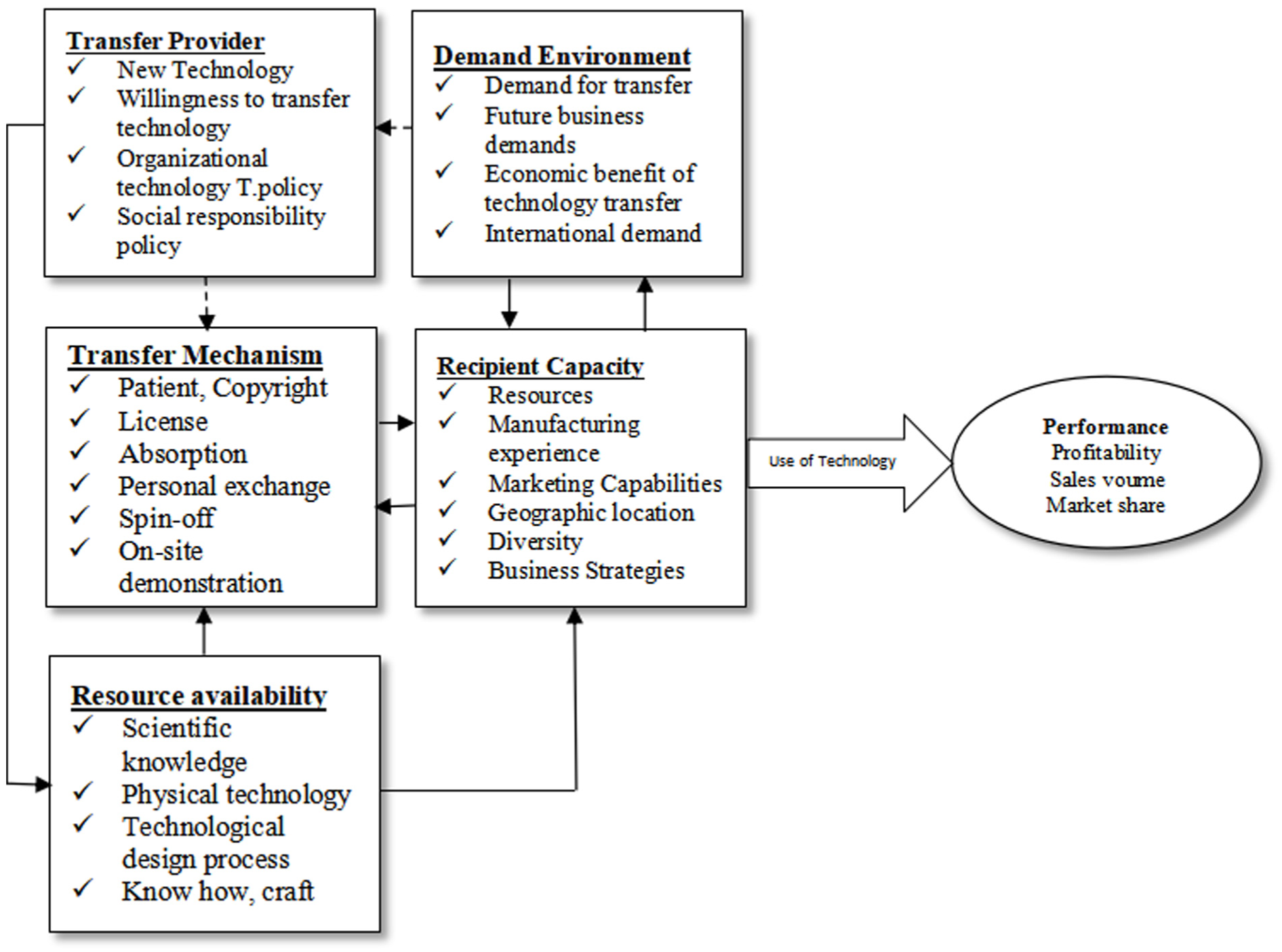
Contingent effectiveness model of technology transfer.
While prior studies consistently emphasize the role of providers, mechanisms, resources, and recipient capacity in TT, most have remained largely descriptive and fail to explain how these determinants interact under different institutional and market conditions. Limited attention has also been given to how multiple TT factors combine configurationally to shape performance outcomes in developing-country SMEs. This study addresses these gaps by applying Bozeman’s Contingent Effectiveness Model within the China–Laos context, integrating Structural Equation Modeling (SEM) and Fuzzy-Set Qualitative Comparative Analysis (fsQCA) to capture both linear and non-linear causal patterns of TT effectiveness.
In alignment with the study’s objectives, Bozeman’s framework provides the conceptual foundation for identifying and analyzing the five key determinants of TT effectiveness transfer provider, mechanism, resource availability, demand environment, and absorptive capacity tested through SEM. Moreover, its emphasis on contextual contingencies supports the use of fsQCA to uncover combinational pathways leading to high or low firm performance. Hence, the theoretical framework directly guides variable selection, hypothesis formulation, and the mixed-method analytical approach adopted in this study.
Factors Affecting Technology Transfer
Transfer Providers
The TT process generally entails a provider responsible for delivering the technology and a recipient that must possess the capability to absorb the transferred knowledge/technology effectively (Bozeman, 2000). While TT may appear straightforward, it involves numerous layers of complexity (Choi, 2009). Due to its complex nature, this study emphasizes the conceptual basis and examines the mechanisms involved in the TT process, including challenges related to the provider, recipient capabilities, and the demand environment (B.-W. Lin & Berg, 2001). TT agents disseminate scientific expertise and share innovations and recent discoveries. The success of TT depends largely on the nature of the interaction between the provider and the receiving entity (Bozeman et al., 2015). Providers may include government departments, CBOs, NGOs, universities, and research institutions from developed countries, which often contribute by delivering relevant findings to appropriate beneficiaries (Bozeman, 2000).Recent studies (Benhayoun et al., 2021; Kamila et al., 2025; Soomro et al., 2024) reaffirm that the quality of interaction and continuous engagement between providers and recipients enhances SMEs’ innovation capability and performance.
Transfer Mechanism
TT represents an intentional, flexible, and collaborative process designed to facilitate the movement of technological knowledge between organizations to improve capabilities (Battistella et al., 2016). Transfer mechanisms constitute formalized interactions between social entities that enable this exchange of technology. Scholars commonly categorize TT into two distinct types: horizontal and vertical transfers (Han & Lee, 2013; Noh & Lee, 2019). Horizontal TT occurs when technology is shared either within the same organizational level or between comparable stages of technological innovation across different organizations. In contrast, vertical TT involves the movement of technology between different phases of the innovation process. Recent literature suggests that effective transfer mechanisms—such as training, co-development, and collaborative learning—improve knowledge retention and firm adaptability (Chege & Wang, 2020a; Kamila et al., 2025). Based on this theoretical framework, the study proposes the following hypothesis:
Demand Environment
The demand environment plays a pivotal role in fostering innovation and accelerating TT through the introduction of novel ideas that stimulate business growth (Bozeman, 2000). According to (Louis & Felice, 2009), technology demand may be driven by either supply-oriented or demand-driven mechanisms. In key economic sectors, policy directions on TT are shaped by how the demand context influences technological progress, which reflects differing perspectives on recipient capacity and willingness to adopt innovation (Bozeman, 2000). A favorable demand environment can enhance innovation, supporting higher levels of technological development (Ashford & Hall, 2011). In the case of industrial SMEs located in rural Laos, there are persistent obstacles such as unstable market environments, restricted market connectivity, weak value-added infrastructure, shortages in skilled labor, and insufficient physical infrastructure (Uchikawa & Keola, 2008). More recent studies (Agyapong et al., 2024; Chen et al., 2025) indicate that market dynamism and policy incentives can moderate TT effectiveness by stimulating firm responsiveness to innovation. Based on prior research, the study proposes the following:
Resource Availability
Organizational resources encompass both tangible assets (technology, physical infrastructure) and intangible elements (knowledge, managerial expertise, and market positioning) that enable innovation and TT activities (Turulja & Bajgoric, 2018). Firms must strategically allocate these finite resources—including human capital, technological know-how, and intellectual assets—to align TT initiatives with organizational objectives (Lubis, 2022). The resource-based view (RBV) emphasizes that such assets form the foundation for competitive advantage and sustainable growth when managed effectively. However, TT implementation often faces hurdles when firms lack reproducible resources (e.g., specialized equipment or skilled personnel) that are costly or time-intensive to develop (Keller & Chinta, 1990). While financial capital is critical, business success in industrial sectors also depends on overcoming innovation-capability gaps and prioritizing survival strategies amid high failure rates. Notably, TT has been linked to improved enterprise resilience and performance. Empirical work (Chege & Wang, 2020a; Jiang & Vannasathid, 2023) confirms that adequate financial and human resources enhance TT absorption, innovation capability, and SME performance. Evidence from seed systems in Nigeria also shows that production and distribution constraints reduce farmers’ adaptive capacity and limit the successful scaling of new technologies (Oladele & Ojogu, 2025). Based on this framework, the study proposes:
Recipient Absorptive Capacity
Absorptive capacity is defined as an organization’s capability to identify, acquire, interpret, and implement externally sourced technologies (Choi, 2009). To enable successful TT, recipients must have technical proficiency to evaluate appropriate technologies and embed them within internal processes. Numerous studies emphasize that the recipient’s absorptive capacity is a critical factor influencing the success of TT (Abdul Wahab et al., 2009). Prior investigations have explored how absorptive capacity correlates with TT effectiveness at the organizational level (C. Lin et al., 2004). It generally entails the ability to assimilate and utilize new technological inputs introduced from external origins (Cohen & Levinthal, 1990). Recent findings (Ismail, 2023; Kustiningsih et al., 2022) suggest that SMEs with higher absorptive capacity are more capable of converting transferred technologies into performance gains, especially when supported by skilled management and continuous learning. Based on the literature, the study proposes the following:
Although absorptive capacity has been repeatedly highlighted as a central success factor in TT research, empirical evidence from SMEs in developing contexts is scarce. Moreover, much of the literature continues to privilege supply-side variables such as provider expertise and transfer mechanisms, while factors like demand environment remain underexplored. By explicitly comparing the effects of absorptive capacity, demand environment, and other TT drivers on SME performance, this study contributes to clarifying the boundary conditions of TT theory and offers insights that extend beyond the descriptive accounts common in earlier research.
Taken together, the literature highlights the need for research that moves beyond confirming established TT factors and instead interrogates their contextual relevance. This study contributes in three specific ways: (a) it extends TT theory to the setting of industrial SMEs in Laos, a less-studied and resource-constrained context; (b) it integrates demand environment as a critical but underexplored determinant of TT effectiveness; and (c) it provides empirical evidence that recipient absorptive capacity, contrary to much prior theorizing, may not significantly enhance performance in this context. These contributions enrich theoretical debates on TT by clarifying the contingencies under which certain drivers gain or lose importance.
Methodology
Respondents Data
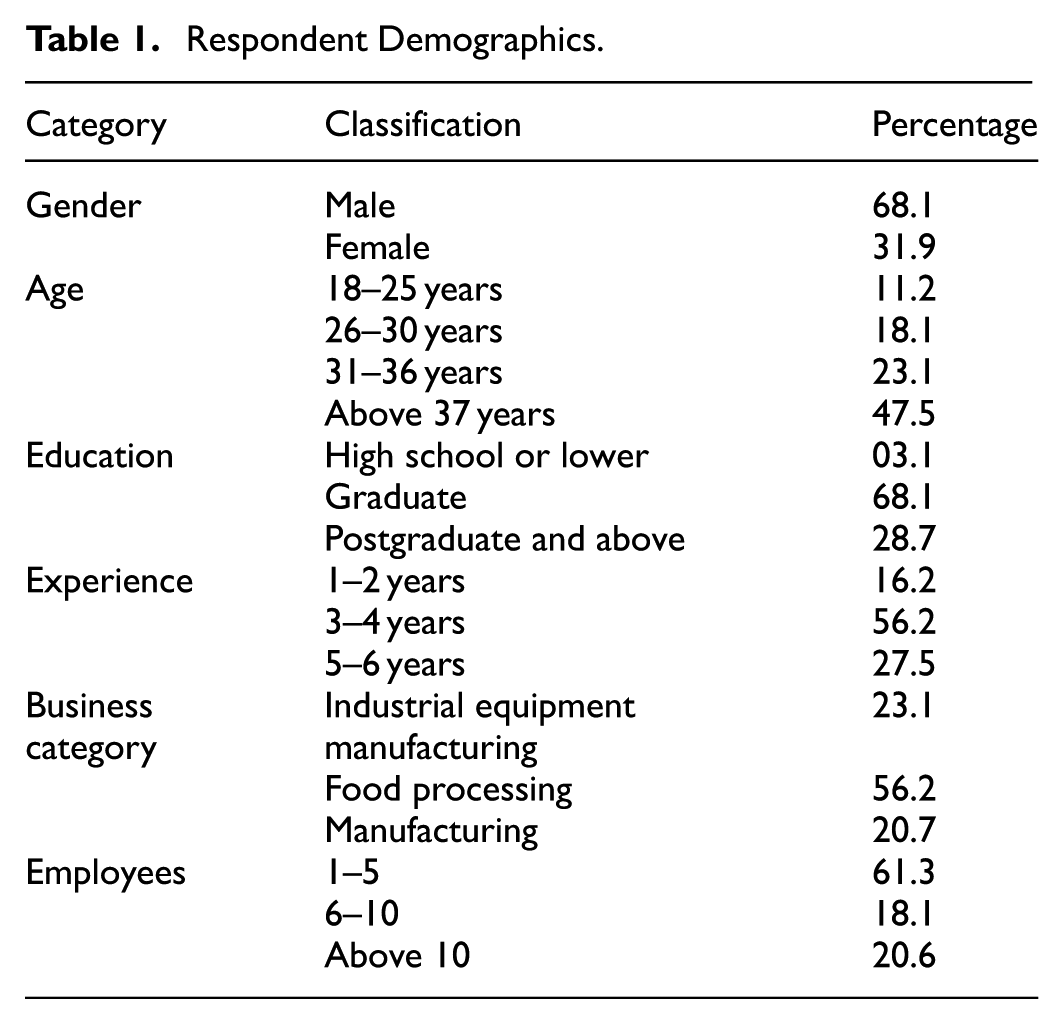
This study adopted a quantitative approach using a structured questionnaire developed from the theoretical framework of Chege and Wang (2020b). The instrument consisted mainly of 5-point Likert-scale items designed for quantitative analysis, along with a few optional open-ended questions to capture contextual insights (Chege & Wang, 2020b). According to the China–Laos Economic Corridor Finance Office in Luang Prabang, Laos, a total of 310 industrial SMEs are officially registered within the corridor. This registered population was used as the basis for determining the study’s sample. Using (Chege & Wang, 2020a; Israel, 1992) formula for population sampling, the required sample size was determined to be 175 SMEs, ensuring adequate representation of the SME sector in the CLEC context. This sample size is considered statistically adequate for quantitative analysis and aligns with the minimum requirements for SEM-based studies (Hair Jr et al., 2021). Data were collected through a combination of self-administered and researcher-assisted questionnaires. Questionnaires were distributed both in person and via email to SME owners and managers, with follow-up visits conducted to encourage participation and ensure completeness of responses. After validation, the finalized questionnaire was distributed to respondents within the CLEC industrial SMEs. The survey was conducted between January and February 2025. A total of 175 questionnaires were distributed, and 163 responses were received, resulting in an 93% response rate. After validating the responses, 160 questionnaires were deemed valid for analysis, yielding a final response rate of 91%. According to (Jankowski, 2010) 75% which is adequate for the study. Table 1 presents the demographic details of the respondents: The study’s respondents consisted of 68.1% males and 31.9% females. In terms of age, 11.2% were aged 18 to 25, 18.1% were between 26 and 30, 23.1% were between 31 and 36, and 47.5% were over 37 years old. Regarding educational qualifications, 3.1% had high school or below, 68.1% were graduates, and 28.7% had postgraduate degrees or higher. Experience-wise, 16.2% had 1 to 2 years, 56.2% had 3 to 4 years, and 27.5% had 5 to 6 years. Business categories included 23.1% in industrial equipment manufacturing, 56.2% in food processing, and 20.7% in manufacturing. Employee size was distributed as 61.3% with 1 to 5 employees, 18.1% with 6 to 10, and 20.6% with more than 10 employees. These sample characteristics provide valuable insight into the population surveyed and demonstrate the sample’s alignment with the objectives of the research. While the sample reflects a wide range of firm sizes, sectors, and ownership types, minor sampling bias may exist due to voluntary participation and geographic concentration within the corridor. However, the high response rate (91%) and demographic diversity ensure that the sample is sufficiently representative of industrial SMEs operating in the China–Laos Economic Corridor. Of the 163 responses received, three were removed due to incomplete data, leaving 160 valid cases. A comparison of early and late responses showed no significant difference (p > .05), indicating minimal nonresponse bias.
Respondent Demographics.
Methods of Technology Transfer
The methods of industrial TT identified by survey respondents are summarized in Table 2. These findings affirm earlier observations (Chege & Wang, 2020b). TT practices, such as Foreign Direct Investment (FDI), training programs, and supply chain integration, foster knowledge exchange, enhancing business performance in industrial SMEs within the China-Laos Economic Corridor.
Methods of TT in CLEC From China to Laos.

Measures
To assess the research variables, the investigator utilized measurement items that were adopted from established literature and adjusted to align with the study’s context. Before data collection, the questionnaire underwent face and content validity assessment by academic experts and industry practitioners to ensure clarity and construct alignment. Each construct was briefly described to clarify its origin, justification, and a representative sample item.
The transfer providers construct was sourced from (Battistella et al., 2016; Chege & Wang, 2020b) capturing provider expertise and collaboration for example, The providers possess sufficient resources for technology transfer. The transfer mechanism items were adapted from (Bozeman, 2000; Chege & Wang, 2020b; Han & Lee, 2013), measuring formal TT channels for example, Technology transfer occurs through training and coaching. The resource availability construct was taken from (Almarri & Gardiner, 2014; Chege & Wang, 2020b) to assess resource sufficiency for exmple, Limited funds restrict technology transfer and weaken firm performance. The recipient absorptive capacity items were based on (Buratti & Penco, 2001; Chege & Wang, 2020a), reflecting firms’ ability to absorb new technology for example, Our business is competitively equipped to adopt new technology. The demand environment indicators followed (Chege & Wang, 2020a; Omato & Kithinji, 2013; Ramanathan, 1988), capturing market and policy conditions for example, Governmental strategies support technology transfer initiatives. Finally, firm performance was assessed using scales adapted from (Chege & Wang, 2020a; Mohd Sam & Hoshino, 2013), focusing on profitability and growth for example, Technology transfer has increased the firm’s profitability. A 5-point Likert scale ranging from “strongly disagree” to “strongly agree” was used to collect responses across all constructs. Table 3 provides a summary of the measurement scales, their items, and corresponding sources.
Measurement Scale Items.

Analytical Approach
This study utilized both Partial Least Squares SEM (PLS-SEM) using SmartPLS 4 and fsQCA to interpret the dataset. SEM served to evaluate the hypotheses related to how independent variables influence the dependent construct. In parallel, fsQCA was employed to perform an in-depth exploration of how different combinations of causal attributes contribute to the observed outcome. While SEM identifies the net effects of individual TT factors on firm performance, it assumes linear and symmetric relationships. By contrast, fsQCA is grounded in set-theoretic logic and enables the identification of causal configurations and equifinality. This means it can reveal how different combinations of TT drivers jointly produce high performance, even if individual factors (such as RAC) do not appear significant in isolation. In this way, fsQCA is not merely supplementary to SEM but extends theory by uncovering the boundary conditions and conjunctural causation that net-effect models overlook. This method also incorporates Necessary Condition Analysis (NCA) to determine the essential factors that must be present to impact the outcome. The use of fsQCA in this study provided a complementary perspective to the SEM findings (Rahman et al., 2022).
Analysis and Results
The analytical process followed a structured three-phase approach based on the model outlined by Anderson and Gerbing (1988). Initially, Confirmatory Factor Analysis (CFA) was conducted to assess the measurement model’s reliability and validity. Subsequently, Structural Equation Modeling (SEM) was applied to evaluate hypothesized variable relationships. In the final stage, (fsQCA) was used to explore intricate causal configurations.
Model Assessment
The first phase of the analysis focused on evaluating the internal consistency of the measurement instruments by examining both convergent and discriminant validity. Construct validity was assessed using the Kaiser-Meyer-Olkin (KMO) test and Bartlett’s Test of Sphericity, which determine the appropriateness of the data for factor analysis. As noted by Özdamar (2002), the KMO value exceeded the recommended threshold of 0.6, confirming the data’s suitability for factor analysis. The results of these tests (see Table 4) demonstrated sampling adequacy, reinforcing the validity of the dataset for subsequent analytical procedures.
Results of KMO and Bartlett’s Test for Sampling Adequacy.

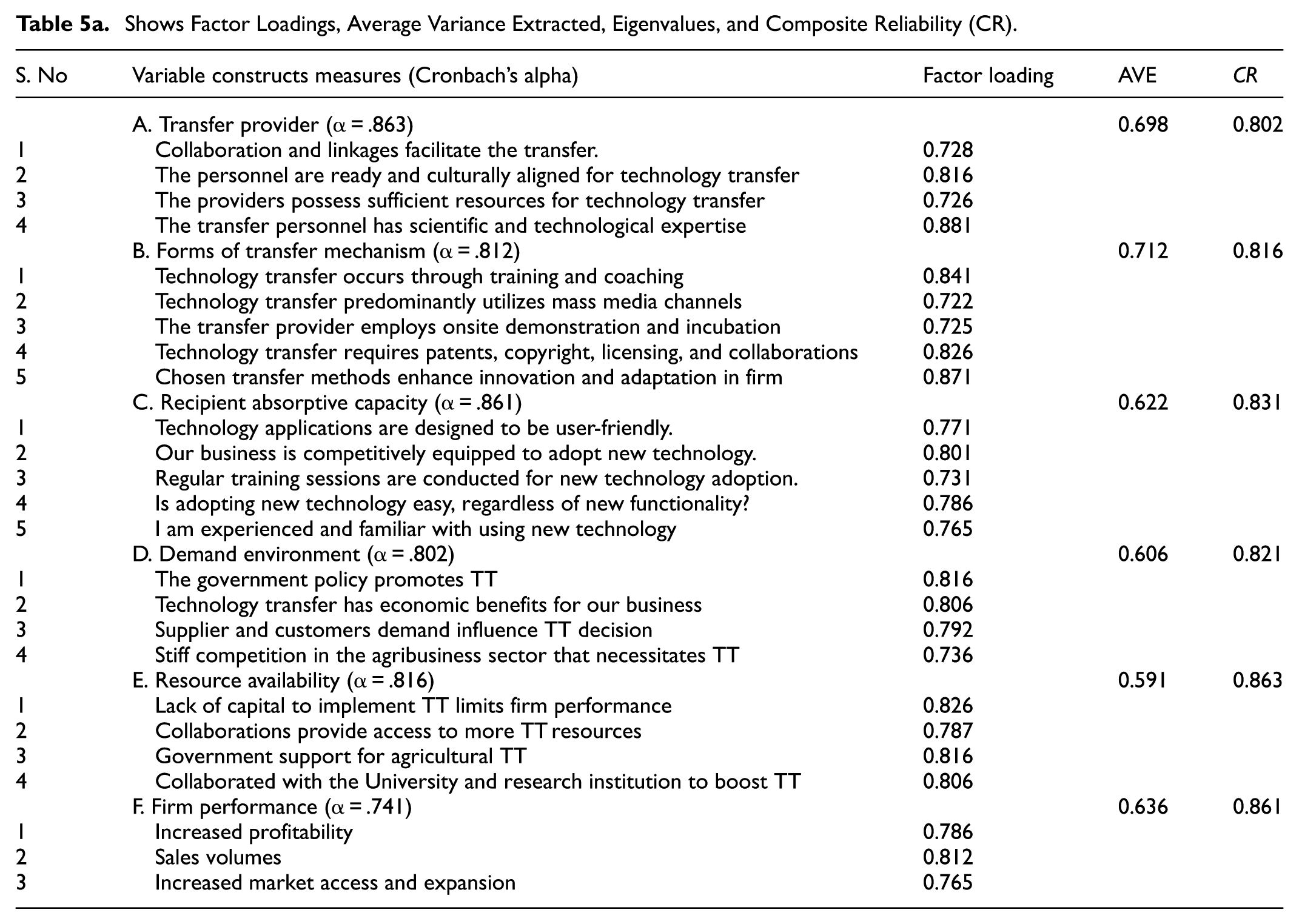
The analysis revealed a cumulative explained variance of 64.13%, exceeding the widely accepted threshold of 60% (Özdamar, 2002), thereby meeting the criteria for robust dimensionality and factor retention. Bartlett’s Test of Sphericity produced a statistically significant result (chi-square = 4,103.812, p < .05), indicating that the variables exhibit substantial intercorrelations, thus validating their suitability for further multivariate analysis. The factor loadings for all items of each scale exceeded the minimum threshold of 0.5, as recommended by Hair et al. (1998). Furthermore, all factors had loadings greater than 0.6, thereby confirming the convergent validity of the constructs. The data analysis indicates that the measurements demonstrated satisfactory convergent validity.
All constructs in this study were modeled as reflective measurement constructs, where the observed indicators represent manifestations of the underlying latent variables. Each item was designed to reflect the theoretical concept being measured, and all indicators were expected to covary. Accordingly, the measurement model was evaluated using factor loadings, Cronbach’s alpha, composite reliability (CR), average variance extracted (AVE), and discriminant validity through the HTMT criterion Table 5b. According to Fornell and Larcker (1981), the composite reliability of the measurements should be at least 0.6. The results showed that all latent variables achieved composite reliability values ranging from 0.802 to 0.863, thereby meeting or surpassing the required threshold. Additionally, the internal reliability of the measurement scales was assessed using Cronbach’s alpha (α), which evaluates the consistency of the constructs. The results from the Cronbach’s alpha test indicated reliability scores ranging from .741 to .863 (see Table 5a), surpassing the minimum acceptable threshold of .7 as recommended by (Bujang et al., 2024). A Cronbach’s alpha value of .7 or higher is typically considered indicative of a reliable scale, as noted by (Adeniran, 2025). The alpha values for the six constructs further confirm that all constructs exhibited robust reliability. Additionally, convergent and discriminant validity were assessed by calculating the average variance extracted (AVE). According to Bagozzi and Yi (1988), the minimum recommended threshold for AVE is 0.5. In this study, the AVE values for all measurements ranged from 0.591 to 0.712, surpassing the recommended threshold. This confirms that the study achieved satisfactory levels of both convergent and discriminant validity.
Shows Factor Loadings, Average Variance Extracted, Eigenvalues, and Composite Reliability (CR).
Discriminant Validity (HTMT Criterion).
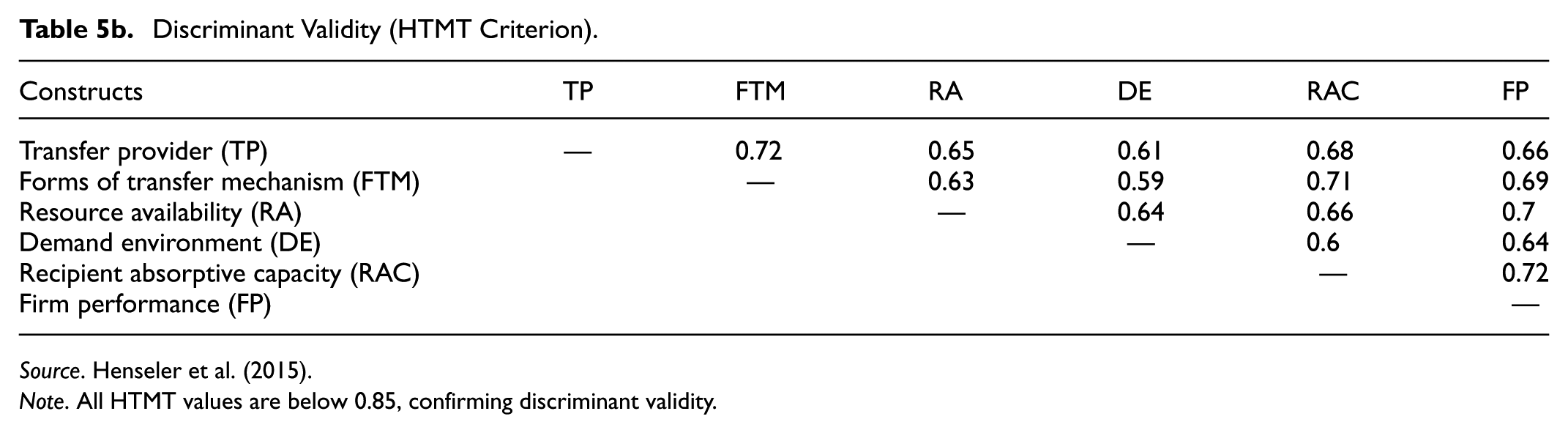
Source. Henseler et al. (2015).
Note. All HTMT values are below 0.85, confirming discriminant validity.
Hypothesis Test With SEM
The study applied Structural Equation Modeling (SEM) to evaluate the proposed relationships. Smart PLS and AMOS was used to assess the model fit, incorporating multiple goodness-of-fit indices. SmartPLS was selected as the primary tool for hypothesis testing because it is appropriate for relatively small samples and complex models with multiple latent constructs. AMOS was employed in parallel to validate the overall model fit indices, ensuring robustness of the findings. Both tools produced consistent results, confirming that the hypothesized relationships and model adequacy were not dependent on the choice of software. The model showed acceptable fit, with results as follows: χ2/df = 1.141, CFI = 0.934, TLI = 0.941, IFI = 0.912, GFI = 0.923, RMSEA = 0.020, and SRMR = 0.042 (see Table 6). These metrics confirm the model’s robustness. As noted by (Sathyanarayana & Mohanasundaram, 2024), indices like RMSEA, TLI, and CFI are critical for evaluating model adequacy. Following this, five structural paths were tested. The structural model was tested using PLS-SEM (SmartPLS 4) with 5,000 bootstrap resamples (two-tailed). The critical ratio was calculated as CR = β/SE, and two-tailed p-values were derived from the standard normal distribution.
Model Fit.

Figure 3 presents the results of the SEM analysis, illustrating the relationships between the factors influencing industrial business performance. The arrows in the model represent the connections between these variables, with path coefficients indicating the strength of these relationships. This model helps to elucidate how various factors either facilitate or hinder the effective impact of TT on the outcomes of industrial SMEs. The results indicated that all hypothesized paths were statistically significant (p < .05), with the exception of H5 (Recipent absorptive capacity → Firm Performance), which did not show a significant relationship. The SEM model reveals that key factors such as Transfer Provider (TP), Form of Transfer Mechanisms (FTM), Resource Availability (RA), and Demand Environment (DE) all directly and positively influence firm performance, while Recipient Absorptive Capacity (RAC) did not demonstrate a significant effect. All paths in the model were found to be statistically significant at p < .05. Transfer Providers (TPs) were shown to have a direct and positive influence on the performance of industrial SMEs. The statistical analysis indicates that TPs significantly enhance the performance of industrial SMEs by facilitating the transfer of technical knowledge and expertise. Consequently, Hypothesis 1 (H1), which posits that TPs positively affect firm performance, is supported at a significance level of p < .05. The effectiveness of TT is strongly dependent on the capabilities of the technology provider and the appropriate dissemination of knowledge through effective transfer mechanisms. The study reveals that transfer mechanisms significantly contribute to the performance of industrial SMEs. The findings suggest that Transfer Mechanisms (TM) play a pivotal role in facilitating the smooth flow of technology and resources, which, in turn, enhances the performance of industrial SMEs. Statistical analysis supports Hypothesis H2, with a significant result at p < .05.

Extent of the relationship between variables.
The Demand Environment (DE) was found to promote innovation and accelerate TT by offering insights that foster business development and growth. Technology demand can be classified into two categories: market-push and market-pull, both of which influence decisions related to TT within industrial sectors. The statistical results confirm that a favorable DE positively impacts TT, subsequently improving the performance of industrial SMEs. As such, Hypothesis H3 is accepted at p < .05.
Moreover, the study underscores the importance of organizational resources—such as physical assets, technology, and human capital—in supporting innovative activities and facilitating effective TT. The results demonstrate that adequate resource availability significantly contributes to the successful implementation of TT, which in turn enhances the performance of industrial SMEs. Therefore, Hypothesis H4 is validated at p < .05.
However, while Recipient Absorptive Capacity (RAC)—which involves the ability to recognize, acquire, assimilate, and apply transferred technology—is essential for successful TT, the statistical analysis reveals that RAC does not have a statistically significant positive effect on industrial SMEs’ performance (p > .05). As a result, Hypothesis H5 is not supported. The findings indicate that Transfer Providers (TP), Transfer Mechanisms (TM), Resource Availability (RA), and Demand Environment (DE) have a direct and positive impact on the performance of industrial SMEs. These factors significantly enhance TT processes and overall operational efficiency. The standard path estimates and p-values of the SEM model are presented in Table 7. To further assess the explanatory and predictive strength of the model, the R2, Q2, and f2 values were examined. The PLS model explains a substantial share of variance in firm performance (R2 = .62), indicating good explanatory power. Blindfolding results confirm the model’s predictive relevance (Q2 = 0.39 > 0). Effect-size analysis shows that Resource Availability (f2 = 0.32) and Demand Environment (f2 = 0.16) exert strong influences on firm performance, representing large and medium effects, respectively. Transfer Provider (f2 = 0.07) and Transfer Mechanism (f2 = 0.05) have small effects, while Recipient Absorptive Capacity (f2 = 0.01) has a negligible impact, consistent with its non-significant path coefficient. These results confirm that the model possesses adequate explanatory and predictive strength.
Standard Estimation of the Main Model.

Note. Significance level of p < .05.
FsQCA Analysis
Following model estimation, this study applied (fsQCA) to explore patterns in the data and determine which variable configurations contribute to high performance among industrial SMEs, as well as those linked to low performance. Results from SEM revealed connections between variables, offering insight into how TT affects performance. Nonetheless, multiple elements can influence outcomes, and no individual factor can fully explain the success of industrial TT (Adomako & Nguyen, 2024). Hence, fsQCA was used to identify effective combinations of conditions for achieving high performance. Key steps in fsQCA involve calibrating the data and evaluating causal links (Ragin, 2009).
Data Calibration
Calibration translates continuous variables into fuzzy sets. In this research, 5-point Likert scale scores were rescaled, ranging from full exclusion (0) to full inclusion (1), with 0.5 as the crossover point indicating maximum ambiguity (Ragin, 2009). Suggested thresholds for calibration include 0.95 for full membership, 0.05 for non-membership, and 0.5 for crossover (Mendel & Korjani, 2018). Quartile-based results from this process are shown in Table 8.
Quartiles Results for Concepts of Calibration.

Analysis of Necessary Conditions
Following data calibration, the study proceeded to evaluate necessary conditions for firm performance within the Structural Equation Modeling (SEM) framework (see Figure 3). Five predictor variables were analyzed for their potential influence on performance outcomes. Consistent with Ragin’s (2009) methodological standards, a condition is deemed necessary only when demonstrating a consistency score of 0.90 or higher. The results presented in Table 9 indicate that none of the examined predictors satisfied this necessity criterion, as all consistency values remained below the 0.90 threshold.
Analysis of Necessary Conditions for Firm Performance.

Analysis of Sufficient Conditions
FsQCA’s sufficient condition analysis began with truth table generation, enumerating all 2^k possible combinations of the k causal conditions, where each row represented a logically possible configuration of presence/absence of factors. Cases were assigned to specific configurations according to their membership values. To evaluate sufficiency, the truth table was constructed based on predefined thresholds for frequency and consistency. In alignment with established procedures (Abbasi et al., 2024), the analysis applied a frequency threshold of 1, a consistency criterion of 0.8, and a PRI consistency standard of 0.75 (de Diego Ruiz et al., 2023). The fsQCA procedure generated three types of solutions: complex, intermediate, and parsimonious. This research utilized the intermediate solutions, which combine elements from both complex and parsimonious models while maintaining theoretical relevance and analytical simplicity. To ensure robustness, we evaluated necessity and sufficiency using established thresholds (consistency ≥ 0.80; PRI ≥ 0.75) and compared intermediate, complex, and parsimonious solutions. All reported solutions exceeded accepted consistency benchmarks (see Table 10), confirming the stability of the results.
Intermediate Solutions for Firm Performance.

Note. • = The presence of a condition; ⊗ = the negation of a condition; blank cells = the condition’s irrelevance to the outcome.
Table 10 presents the intermediate solution of (fsQCA). The sufficiency level of each condition reflects how strongly it is associated with the outcome variable. The analysis identified six distinct causal pathways, each influencing different levels of firm performance. Consistency scores above 0.74 confirm the robustness and interpretive value of the integrated model. This study presents a robust model, as evidenced by the consistency scores for all configurations and the overall solution, which are above the 0.74 threshold (Geng et al., 2024). The interpretation of the result decoding is structured through symbolic indicators—• signifies an active causal factor, ⊗ reflects its negation, and empty cells denote neutrality in relation to the outcome (refer to Table 10). Table 10 also displays raw consistency values for each solution, which are conceptually similar to correlation coefficients commonly applied in regression analysis (Xu et al., 2024). It further displays the unique coverage scores for each potential solution and condition. These interpretations provide insights into the proportion of cases that can be explained by a single condition (unique coverage) or by the overall raw coverage solution (Elbaz et al., 2018). The overall solution consistency reflects how the identified dimensions predict firm performance. According to Table 10, no single predictor is sufficient to determine firm performance; rather, multiple combinations of conditions contribute to the outcome. Solutions 3 through 6 identify configurations that lead to high performance, while Solutions 1 and 2 correspond to configurations that result in the absence of high performance, that is, low performance. Notably, the three most significant solutions, each with a consistency score greater than 0.95, have been identified as key configurations for achieving high firm performance. These condition combinations—Solutions 4, 5, and 6—are the most significant, as they exhibit the highest consistency and raw coverage values. Solution 4 exhibited the highest level of consistency (0.978) and explained a substantial number of cases (raw coverage: 0.352), thus representing the best possible solution for enhancing high firm performance. It showed that the presence of high Transfer Provider, Transfer Mechanism, Demand Environment, and Resource Availability, and the absence of Recipient Absorptive Capacity, would lead to high firm performance. Solution 6 was identified as the next highest consistent solution (0.972) with substantial coverage (0.225). The findings suggest that the desired outcome could be achieved through the presence of Transfer Provider, Transfer Mechanism, Resource Availability, and Recipient Absorptive Capacity, along with a low Demand Environment. Furthermore, Solution 5 demonstrated that the presence of Transfer Provider, Transfer Mechanism, Demand Environment, and Recipient Absorptive Capacity would lead to high firm performance, as indicated by the high consistency (0.969) and substantial coverage (0.361). Solution 3, with high consistency (0.942) and significant coverage (0.311), demonstrated that the presence of Transfer Provider, Transfer Mechanism, and Recipient Absorptive Capacity, combined with the absence of Demand Environment and Resource Availability, leads to high firm performance.
Low firm performance outcomes were also examined. Configurations in Solution 1 and Solution 2 illustrate the conditions that lead to low firm performance. Solution 1, with consistency (0.861) and coverage (0.467), demonstrated that the absence of Transfer Provider, Demand Environment, Resource Availability, and Recipient Absorptive Capacity leads to low firm performance. Finally, Solution 2, with a consistency score of 0.864 and coverage of 0.344, indicated that the absence of Transfer Provider, Transfer Mechanism, Demand Environment, and Recipient Absorptive Capacity resulted in low firm performance. The XY plots in Figure 4 to 6 illustrate the asymmetric relationships among the three most effective solutions.

XY plot of Solution 4 and firm performance.

XY plot of Solution 5 and firm performance.

XY plot of Solution 6 and firm performance.
Discussion
TT plays a significant role in promoting technological advancement and stimulating economic development within the industrial sector, but its success depends on several critical factors. These include the quality of the technology being transferred, the strength of existing infrastructure, and institutional support for innovation (Bozeman, 2000; Chege & Wang, 2020a). This research investigates how TT processes influence the performance of small and medium-sized enterprises in Laos’s industrial sector. It applies a model incorporating key factors such as DE (demand environment), RA (resource access), RC (resource capacity), and TP (technology providers). The findings underscore the positive effects of TT on industrial SMEs business performance, with statistically significant results indicating that effective transfer mechanisms and competent providers are essential. These results are consistent with previous studies (Battistella et al., 2016; Chege & Wang, 2020a), confirming that effective TT systems and strong provider engagement enhance SME competitiveness.
The findings of this research offer compelling empirical support for identifying key determinants of industrial SME success. Using Structural Equation Modeling (SEM), it was established that factors such as TP, TM (TT mechanisms), RA, and DE have significant positive impacts on firm performance. However, RAC (absorptive capacity) did not show a statistically significant correlation with firm performance (p > .05), suggesting that its influence may be context dependent. This divergence from prior studies (Buratti & Penco, 2001; Chege & Wang, 2020a), which generally find RAC significant, may be explained by contextual limitations of Laotian SMEs—such as weaker managerial skills and limited training—which restrict their ability to internalize transferred knowledge. These findings highlight the critical role of effective TT in improving the operational efficiency of industrial SMEs.
While this study focuses on small and medium-sized industrial businesses, it is essential to recognize that there may be differences in the impact of TT when comparing small businesses to larger enterprises. Large businesses, with more resources and established infrastructures, might experience different dynamics regarding TT. These businesses may have in-house R&D capabilities, reducing their reliance on external TT providers or mechanisms. Additionally, medium and large enterprises may possess higher absorptive capacity, which could lead to more successful technology adoption. Nevertheless, this study is centered on small and medium-sized enterprises, and further research is necessary to explore these potential differences in more depth.
Technology providers (TPs) significantly enhance industrial SMEs’ performance by transferring technical knowledge through demonstrations and training, supporting Hypothesis (H1; p < .05). This finding aligns with previous research (Chege & Wang, 2020a), which emphasized that active provider engagement and expertise improve technology adoption and firm productivity. The relatively stronger effect found here may reflect Laotian SMEs’ high dependence on external technology sources. TT mechanisms (TM) are also essential, supporting Hypothesis (H2; p < .05). Efficient mechanisms are crucial for successful technology implementation, consistent with prior research (Chege & Wang, 2020a; Karsh, 2004). The demand environment (DE) drives technology adoption and firm growth, supporting Hypothesis (H3; p < .05), in agreement with (Chege & Wang, 2020a; Lestari et al., 2024), who observed that market and policy factors shape firms’ technology decisions. Minor differences in magnitude may stem from weaker institutional support within the Laotian context. Access to resources (RA) is critical for successful TT, supporting Hypothesis (H4; p < .05), consistent with (Adomako & Tran, 2024; Chege & Wang, 2020a). However, resource constraints and limited financial systems in Laos may moderate this relationship. Absorptive capacity (RAC) did not significantly impact firm performance (p > .05), contradicting prior studies that highlight its importance (Chege & Wang, 2020a). This inconsistency may arise because many Laotian SMEs lack sufficient training and technical expertise, reducing their ability to apply new technologies effectively.
These findings also reflect the broader institutional and infrastructural constraints facing Laos. Weak governance structures, limited investment in education and training, and underdeveloped infrastructure restrict the ability of SMEs to fully absorb and apply transferred technologies. For example, shortages of skilled labor reduce the capacity to internalize technical knowledge, while unreliable infrastructure limits the scaling of innovations. Thus, while the direction of most relationships aligns with prior research, the contextual differences observed in Laos explain the variations in strength and significance. Such barriers highlight that TT effectiveness in the CLEC is shaped not only by firm-level factors but also by systemic institutional conditions that policymakers must address. Similar findings appear in studies of climate adaptation in the Sahel, where local vulnerabilities and governance structures strongly shape the success of technology-related interventions (Vounba et al., 2025).
The results of the asymmetric analysis revealed six unique combinations of factors that can explain both high and low performance in industrial SMEs. This suggests that relying on any single factor is insufficient for attaining high performance in these firms. This aligns with the equifinality concept (Ragin, 2009) noted in prior fsQCA studies, which assert that multiple causal pathways can lead to similar outcomes. Industrial SMEs in Laos have distinct perceptions and needs, and the significance of factors influencing high business performance through TT also varies (Xiong, 2024). Interestingly, while symmetrical analysis identifies Transfer Provider, Transfer Mechanism, and Resource Availability as essential factors for improving firm performance, the asymmetrical analysis found that no single factor alone is necessary. Instead, priority should be given to combinations of factors, including Transfer Provider, Transfer Mechanism, Demand Environment, and Recipient Absorptive Capacity.
The use of fsQCA extends TT theory beyond traditional net-effect models by showing that TT success is contingent on particular combinations of conditions. For instance, while SEM results indicated that RAC alone was not significant, fsQCA revealed that RAC can still play a critical role when combined with strong transfer mechanisms and a favorable demand environment. This configurational insight highlights the principle of equifinality—that there are multiple pathways to achieving the same outcome—and demonstrates causal asymmetry, since conditions that are sufficient in one configuration may be irrelevant in another. In this way, fsQCA does not merely complement SEM but provides unique theoretical insights into the conjunctural and context-dependent nature of TT success.
The contrast between the symmetric and asymmetric findings underscores the intricate nature of firm performance and reveals the limitations of relying solely on symmetric models. This apparent inconsistency, particularly regarding absorptive capacity, reflects the contextual realities of Laotian SMEs. The SEM results suggest that RAC alone does not significantly predict firm performance, likely due to constraints such as limited managerial skills, small firm size, and resource scarcity. However, the fsQCA findings show that RAC becomes relevant when combined with strong transfer mechanisms and a favorable demand environment. This indicates that RAC is not universally impactful but is contingent on supportive conditions, thereby underscoring its role as a conditional rather than independent success factor in TT theory. These insights collectively strengthen the study’s contribution by situating its results within both theoretical and empirical precedents, highlighting areas of alignment and divergence with prior TT research. This is consistent with evidence from agro-industry sectors where circular bio-economy innovations demonstrate how upgraded technologies can promote sustainable and low-waste production models (Tang et al., 2025).
Conclusion, Implications and Future Recommendations
Conclusion
Ensuring high performance among industrial SMEs through effective TT remains vital for sustained development. This study introduced an integrative framework to examine both linear (symmetric) and configurational (asymmetric) relationships between TT determinants and firm performance, anchored in Bozeman’s Contingent Effectiveness Model of TT.
The symmetric analysis revealed that transfer providers, transfer mechanisms, resource availability, and the external demand environment significantly enhance firm performance. In contrast, recipient absorptive capacity showed no notable effect. These findings underscore the relevance of these factors in facilitating effective technology diffusion and operational success within industrial SMEs.
Through fsQCA, the study also uncovered six unique combinations of conditions associated with either high or low performance outcomes, indicating that various pathways can lead to success. This reinforces the notion that no single factor alone guarantees enhanced performance, but rather, it is the interplay among multiple conditions that shapes organizational outcomes.
Overall, the findings offer both theoretical enrichment and actionable implications. They extend existing literature on TT and provide practical guidance for stakeholders seeking to optimize transfer effectiveness. The insights gained can help firms formulate targeted strategies that enhance performance, expand market reach, and foster a more competitive presence in the industrial SME landscape.
Theoretical Contribution
This study makes meaningful contributions to academic literature in several ways. First one, despite the growing importance of TT in industrial SMEs, few studies have explored its role in the context of SMEs operating in developing economies like Laos. This research fills this gap by examining key factors such as Transfer Provider, Transfer Mechanism, Demand Environment, and Resource Availability in the TT process. Second, the impact of these factors on firm performance is still underexplored, and a comprehensive framework is lacking. This study is one of the first to propose a robust framework that connects TT dimensions with improved performance outcomes in industrial SMEs, thus enhancing both the service experience and industrial SME literature. Third, this research adds value to existing literature by applying Bozeman’s Model to explain the proposed framework, broadening its applicability to industrial SMEs in Laos.
Finally, this study employs a hybrid methodology combining quantitative (SEM) and qualitative (fsQCA) approaches to analyze firm performance. The use of both methods highlights various combinations of factors that contribute to firm performance, offering novel insights into how these factors interact to enhance outcomes. These complex interactions and combinations have not received significant academic attention before. Overall, the findings of this research provide new perspectives on how different dimensions of TT interact and contribute to the success of industrial SMEs in developing economies, thereby advancing our understanding of TT processes in this context.
Managerial Implications
This research provides meaningful contributions for industrial SMEs and TT service providers aiming to enhance performance and competitiveness. The findings highlight critical factors such as Transfer Provider, Transfer Mechanism, Demand Environment, and Resource Availability, which are essential for optimizing TT and improving firm performance.
Service providers should prioritize the development of effective Transfer Mechanisms, ensuring smooth and efficient technology adoption processes. This includes providing thorough support, clear instructions, and relevant resources. Additionally, focusing on Resource Availability, such as infrastructure, skilled labor, and financial resources, will enhance the firm’s capacity to implement new technologies successfully.
The research underscores the necessity of cultivating a demand-driven environment to stimulate innovation and facilitate the adoption of new technologies. At the same time, policymakers in Laos and CLEC stakeholders must address structural barriers—such as governance challenges, weak institutional support, limited education systems, and inadequate infrastructure—that directly constrain TT effectiveness. For policymakers in Laos, the findings highlight the urgent need to strengthen SMEs’ absorptive capacity through targeted training and upskilling initiatives. Investments in vocational education, technical workshops, and managerial development programs can help SMEs acquire and apply new technologies more effectively. Infrastructure improvements—particularly in digital connectivity and industrial facilities—are also essential to reduce barriers to adoption. Strengthening institutional frameworks for TT, such as clear governance structures and supportive regulations within the CLEC, would further enhance trust and efficiency in technology exchanges. These actions, tailored to the Laotian context, ensure that TT initiatives deliver sustainable benefits to SMEs and align with national development priorities.
In terms of Transfer Providers, their ability to deliver comprehensive technical support and expertise is crucial. By engaging qualified and experienced providers, SMEs can increase their chances of successful technology adoption, ultimately boosting firm performance.
The results of this study will guide managers and decision-makers in identifying key areas to focus on to achieve high performance. By understanding the critical factors that influence TT, service providers can design more effective strategies to drive growth and establish a competitive advantage in the industrial SME sector. These findings also help to identify areas where resources may be less critical, enabling firms to focus on what truly drives success.
Limitations and Future Recommendations
This research is subject to certain limitations, which open potential directions for further investigation. Primarily, the study was confined to industrial SMEs operating in the Laotian context. Future research could explore the same model in different countries, and comparing findings across regions would help identify contextual factors that influence the effectiveness of TT. Second, the proposed framework could be expanded by introducing additional moderators and mediators to better understand how these factors influence the relationship between TT dimensions and firm performance. Third, this study focused on industrial SMEs. Future research could examine specific sectors within the SME category (e.g., manufacturing, services, or agriculture) to provide more detailed insights into the drivers of performance in different types of SMEs. Fourth, the model could be tested in other sectors, such as agriculture, manufacturing, or retail, to assess its generalizability across different industries. Fifth, this study relied on cross-sectional data due to resource and time limitations. Future studies employing longitudinal data may offer enhanced insights into the evolving perceptions and impacts of TT over time.
Footnotes

Ethical Considerations
Ethical approval for this study was obtained from the Ethics Committee of Kunming University of Science and Technology, according to ethical standards of the 1964 Helsinki Declaration.
Consent to Participate
Informed consent was obtained from all individual participants included in the study.
Author Contributions
Ying Xong Thanongsack: Conceptualization, Methodology, Data Analysis, Writing—Original Draft. Muhammad Kamil: Investigation, Data Collection, Writing—Review & Editing. Souvanhxay Paovangsa: Data Curation, Formal Analysis, Visualization. Ke Xing (Corresponding Author): Supervision, Writing—Review & Editing, Project Administration.
Funding
The authors disclosed receipt of the following financial support for the research, authorship, and/or publication of this article: This work was funded and supported by: Office of Philosophy and Social Sciences of Yunnan Province Project Number: YB202596.
Declaration of Conflicting Interests
The authors declared no potential conflicts of interest with respect to the research, authorship, and/or publication of this article.
Data Availability Statement
Data sharing not applicable to this article as no datasets were generated or analyzed during the current study.