



Abstract
This study mainly seeks to answer three research questions. First, we’ll look at how farmers perceive climate change (CC). Second, we’ll examine how farmers adapt their practices in response to perceived in climatic changes and finally we examine the factors that influence the farmers’ willingness to use adaptive strategies to tackle climate change threat in the Tunisian semi-arid region. Secondary and primary data collected from the governorate of Zaghouan and parametric, non-parametric methods and econometric models were used for the analysis. The findings showed that farm households were mostly worried about the environmental, social, and risk of food insecurity effects caused by the phenomenon of climate change, such as soil degradation, water scarcity, a decline in crop yields, the outbreak of pests and diseases, a decline in social life and stress from extreme events. Results also showed that education level, extension service, market access and climate change awareness were the most significant factors affecting the farmers’ perception and beliefs about climate threat. Furthermore the most common on-farm autonomous adaptation strategies used by farmers in the study region are the changing varieties and crops diversification, the increased use of water, farming calendar adjustment and income diversification. The results of the Logistic regression model showed that farmers’ intention to adapt was affected mostly by farming experience, family size, education, belonging to cooperative, market access, irrigated area and main activity. The findings of the study point to the need for increased funding for farmer training and an improved institutional framework for CC adaptation in order to improve farmers’ well-being.
Plain Language Summary
This study mainly seeks to answer three research questions. First, we’ll look at how farmers perceive climate change (CC). Second, we’ll examine how farmers adapt their practices in response to perceived in climatic changes and finally we examine the factors that influence the farmers’ willingness to use adaptive strategies to tackle climate change threat in the Tunisian semi-arid region. Secondary and primary data collected from the governorate of Zaghouan and parametric, non-parametric methods and econometric models were used for the analysis. The findings showed that farm households were mostly worried about the environmental, social, and risk of food insecurity effects caused by the phenomenon of climate change, such as soil degradation, water scarcity, a decline in crop yields, the outbreak of pests and diseases, a decline in social life and stress from extreme events. Results also showed that education level, extension service, market access and climate change awareness were the most significant factors affecting the farmers’ perception and beliefs about climate threat. Furthermore the most common on-farm autonomous adaptation strategies used by farmers in the study region are the changing varieties and crops diversification, the increased use of water, farming calendar adjustment and income diversification. The results of the Logistic regression model showed that farmers’ intention to adapt was affected mostly by farming experience, family size, education, belonging to cooperative, market access, irrigated area and main activity. The findings of the study point to the need for increased funding for farmer training and an improved institutional framework for CC adaptation in order to improve farmers’ well-being.
Introduction
Agriculture, one of the main economic sectors in the Middle East and North Africa (MENA) region, is the most vulnerable activity to climate change (CC) (Govind, 2022; Naeem, 2012). Recently, CC has negatively impacted crop production and yield in important agricultural regions of the world. In fact, given established crop management practices, crop yields are expected to be declined (Asseng et al., 2015; Bassu et al., 2014). As a result, it has an impact on soils, availability of water, pests, and diseases, which has a considerable impact on agricultural and livestock output. CC not only generates uncertainty and natural disasters, but also has specific consequences on the daily way of life in different regions. Due to its geographical characteristics, Tunisia is one of the most exposed countries in the region to the risk of CC, as it has a climate marked by remarkable seasonality and an “unpredictable” probability of the frequency of intense events that can regularly reach catastrophic magnitude. In Tunisia, the agricultural sector plays an important role in creating jobs, restoring the balance of payments through exports, and ensuring the country’s food security. It is estimated that today, one Tunisian out of six works in agriculture. This sector represents more than 10% of the gross domestic product. Food exports contribute to up 11% of goods exports (Ben Nasr et al., 2021). Tunisian agrosystems include rain-fed and irrigated crops, oasis crops and livestock. In order to lessen susceptibility and increase its capacity to respond to the effects of CC on agricultural productivity, the Tunisian government has increased its efforts MENA nations, like Tunisia, are already dealing with CC and an increase in climate-related hazards including droughts and floods, which have had a significant impact in many areas. Therefore, climate risk and the need for agricultural adaptation are perceived as obvious by farmers. The sensitivity of agriculture to climate extremes will depend on biophysical consequences related to production adaptation potentials (Marshall et al., 2015).
Therefore, predicting the potential impacts of CC on agricultural production and ensuring that farmers adopt appropriate farming techniques to mitigate these impacts is critical for the future. Due of the effects of CC on agricultural production, there is an immense incidence of poverty and food insecurity worldwide (Ben Nasr et al., 2021). In Tunisia, many empirical researches have measured the consequences of CC on agriculture and the solutions to be taken to mitigate its negative impacts (Ben Nasr et al., 2021; Jeder et al., 2021; Mahdhi et al., 2019;, Soltani & Mellah, 2023). The main findings mention a decrease in the productivity of agricultural products and an increase in prices as a consequence of CC. However, these results can be improved by implementing appropriate policies, strategies, plans and programs. For policymakers and researchers, developing an effective risk management system for farmers is difficult due to a lack of information on farmers’ risk perceptions and attitudes toward risk. Designing more effective and complex risk management tools and techniques that enable farmers to overcome losses due to various sources of risk requires a deeper understanding of farmers’ risk perceptions and risk attitudes (Ullah et al., 2015). Some of the recommendations can reduce the climatic threatens. For example, resilience to CC reduces its impacts, protects the livelihoods of the poorest farmers, and improves potential benefits (Gandure et al., 2013). Therefore, it is crucial to develop effective adaptation techniques in order to foresee the nature of anticipated changes and comprehend how farmers perceive, experience, and react to CC and its associated hazards. Socioeconomic elements, which have been researched in various nations, can influence farmers’ adaptation, behavior, and decision-making in the face of CC (Abid et al., 2015; Arunrat et al., 2017; Jeder et al., 2021; Komba & Muchapondwa, 2015; Wang et al., 2015). “Adaptation seeks to reduce adverse consequences and exploit any beneficial opportunities arising from CC” (Fezzi et al., 2015). Agricultural resilience depends on farmers’ perception of CC (Bryant et al., 2000; Panda, 2016; Simelton et al., 2013). In fact, in addition to the actual climatic trend, farmers’ perceptions of climate fluctuation and change play a significant role in their decision to adapt to environmental factors. Institutional, cultural, and economical contexts have an impact on farmers’ dynamic decision-making process regarding the use of strategies for adaptation (Amaru & Chhetri, 2013). Farmers resilience to CC adversities entails adjustments in “crop control practices,”“land use and management,” and “livelihood” (Bryan et al., 2013; Rjili & Jaouad, 2021). There has been extensive global research on the elements that affect farmers’ intentions to adopt (Abid et al., 2015; Arunrat et al., 2017; Jeder et al., 2021). Deressa et al. (2009) had mentioned age, gender, education level and wealth, access to extension and credit, climate information, social capital, agro-ecological parameters and temperature as the factors influencing farmers’ adaptation decision. Arunrat et al. (2017) found that farmers’ probability of adaptation increased with farm income, farming experience, training, social capital and CC information Rjili and Jaouad (2021) found that for livestock farmers in southern Tunisia, age, herd size, agricultural area, association membership, subsidies and well ownership were the factors that most significantly influenced their CC adaptation choices. Jeder et al. (2021) point out that the most common adaptation strategies among farm households in the oasis of south-eastern Tunisia are: crop diversification, change in production system, increase in water conservation practices, livestock adjustment and management, abundance of cat breeding for the benefit of oasis agriculture and increased use of irrigation technology through access to credit. Additionally, farmers undertake a variety of autonomous and planned adaptive measures, including as altering planting dates, moving to drought-tolerant crops and altering crop kinds, based on how they perceive CC. However, Tunisian farmers still only partially comprehend the significance of CC adaptation to their livelihoods. The northern region of Tunisia becomes very vulnerable to extreme weather events such as floods and drought. The frequency of these events is a challenge for agricultural production. Understanding the factors that affect farmers’ choices of which adaptive practices to implement among the available ones can serve as a strong foundation for developing policy suggestions that are tailored to CC (Trinh et al., 2018). However, despite the high occurrence of climate-induced agricultural risks, studies are generally silent about the factors affecting farmers’ perception of CC in the Tunisian context.
This study mainly seeks to answer three research questions. First, we’ll look at how farmers perceive climate change (CC). Second, we’ll examine how farmers adapt their practices in response to perceived in climatic changes and finally we examine the factors that influence the farmers’ willingness to use adaptive strategies to tackle climate change threat. An econometric approach was used to analyze the collected data.
Methodology
The Study Site and Method of Data Collection
This study was conducted in the governorate of Zaghouan, north of Tunisia. The governorate is located in the semi arid climate stage which is strongly affected by CC (Ben Nasr et al., 2021; Sansa et al., 2018; Zaidi et al., 2023). The total area of the governorate of Zaghouan is 282,000 ha and its population is 187,000, 63% of which is rural. This is a large proportion regarding the national average level which is 35%. The number of farms in the governorate of zaghouan amounts to 12,140. The governorate falls under the Mediterranean climate with two bioclimatic sub-stages: the lower sub-humid stage in the North and North-East and the lower semi-arid, in the South and South-West. The average temperature ranges from 10°C recorded on January and 36°C recorded on August. The average rainfall in the governorate ranges from 350 to 550 mm/year (Abdelhafidh & Bachta, 2016). It is characterized by a large special and inter-annual variability.
In accordance to the time-series variation of rainfall for the city of Zaghouan, maximum rainfall is recorded in November, December, January and March, and minimum rainfall is recorded in June, July and August. In this data series, the winter months see the most rainfall, while the summer months see the least. This climatic pattern is one of the fundamental features of the arid/semi-arid climatic stage, when 50% of the annual precipitation occurs during the cold season (winter). The summer is the hottest season, and it is characterized by high temperatures and scant precipitation (Weslati et al., 2023).
Furthermore, the agricultural sector contributes significantly to regional economic growth, especially since it occupies about 32% of jobs, thanks to the abundance of production factors such as agricultural area covering two-thirds of Governorate territory and water resources mobilized by two large dams and 19 small lakes on irrigation of about 13,300 hectares. Agricultural activities are focused on cereals, arboriculture and extensive breeding sheep and a recent and encouraging expansion of organic crops.
Data Collection
Both of secondary and primary data were used in this study. Secondary data were obtained from the annual reports of the Zaghouan Regional Agency for Agricultural Development, while the primary data were collected from the surveys carried out in the governorate of Zaghouan specifically in the subdivision of Nadhour, Fahs, Zaghouan and Oued Sbayhia. A cross-sectional survey method was used in this study during the period of December 2021 to February 2022.
The four subdivisions include 8,330 farms (CDRA (Regional commission for agricultural development) of Zaghouan, 2021) and it was decided to survey a proportion of 1% distributed in proportion to the number of farms per subdivision. The data were collected from 83 randomly selected farmers. Hence, stratified randomization method of sampling was used. A structured questionnaire was used to collect data. This questionnaire consisted of two parts. The first section consisted of information on socio-economic characteristics of farmers and the second was a list of 12 items designed to assess the farmers’ CC perceptions. The preparation of these items is based on previous research on CC (Akhtar et al., 2018; Hayran et al., 2021; Lane et al., 2018). The reliability of the CC perception scale was estimated by calculating Cronbach’s alpha coefficient (Cronbach, 1951).
Analytical Methods
In this study, descriptive statistics such as the mean and standard deviation were used in order to delineate farmers’ socio-economical characteristics. To analyze the time series trends change of climate parameters on a seasonal basis, a trend analysis based on the Mann-Kendall test, the standardized precipitation index (SPI) and the Sen’s Slope Estimate were used. Thereafter, Factor analysis (PCA) was applied to the CC perception scale. Using factors scores from PCA as dependent variable, ordinary least square regressions analysis were used in order to determine the effect of some socioeconomics variables on the farmers’ CC perceptions (Gujarati, 2009; Hayran et al., 2021). Finally, in order to address the factors that determine how farmers modify their practices to CC vulnerability, the binary logistic regression model was used as an analytical tool.
Study of Climate Variability
Agricultural activities depend on climatic conditions and are threatened by CC (Porter et al., 2014); we would therefore expect that farmers have a long-term vision of the climate because of its direct effect on their well-being (Niles & Mueller, 2016). However, no recognizable study has analyzed the perception of farmers of CC in Tunisia and by following the observed CCs. For this purpose, an analysis of trends in the study area of climatic parameters on a seasonal basis was applied. To show rainfall variability, several studies have used the study of central tendency parameters, dispersion and the standardized precipitation index as means of processing climate data obtained from the National Institute of Meteorology. These data cover the period from 1981 to 2020. Over a series of 40 years, the arithmetic mean
The Standardized Precipitation Index (SPI)
The Standardized Precipitation Index (SPI) is a widely accepted index for the quantification of drought. In fact, the SPI was recommended through the Lincoln Declaration on Drought as the internationally preferred index for meteorological drought (Hayes et al., 2011). The SPI addresses the severity of meteorological drought, or shortfall of precipitation.

Where X = precipitation,
σX = standard deviation of precipitation.
The standardized precipitation index was used to determine the indicators of rainfall variations and specifically the years marked by a rainfall surplus or deficit in the study region (Table 1).
Classifications of SPI.

Source. Hayes et al. (2011).
Mann-Kendall Test
The Mann-Kendall (MK) non-parametric test has been widely used to assess the significance of trends in meteorological time series (Hayran et al., 2021; Sarwary et al., 2022). This approach requires some assumptions on the data to be carried out, in particular with regard to their dissemination. The Mann-Kendall test is based on the null hypothesis that each data point in a sample is independent and unrelated to the others, that is, there is no trend or serial correlation between the data points. The alternative hypothesis is that a trend exists in the data. The data series xi is subjected to the trend test after being ranked from i = 1,…, n − 1, and xj is ranked from j = i + 1,…, n. Each data point xi is compared to all other data points xj using that data point as a reference. The Mann Kendall trend test, S statistic is calculated by using the below equation:

Where Xj and Xi are the sequential data value and j > i, n is the length of the data set.

The statistic S, when n ≥ 8, is approximately normally distributed with the mean and the variance given by:


where ti is the number of data points in the ith tied group and p is the number of tied groups in the data set. The summing term in Equation 5 is only used when there are tied data values in the series. The standardized MK statistic Z is computed by:

The positive Z value indicates an increasing trend and the negative Z value indicates a decreasing trend (Eric & Heinz, 2007).
Sen’s Slope Estimate
There are several tests that can be used to detect and/or quantify amplitude trends. According to the time series of data, if a linear trend is detected, a simple nonparametric method by Sen (1968) can be used to estimate the exact slope. In many cases, Sen’s slope estimator inclines more toward the trend determination in a robust way and confirms the trend sign and magnitude estimates by applying the robust parametric methods (Hayran et al., 2021; Muhlbauer et al., 2009). The Sen’s slope estimator is determined by computing the slope of the line using all pairs of data values as follows:

If there are n xj values in the time series, we get up to N = n(n − 1)/2 Qi slope estimates. Sen’s slope estimator is the median of these N values of Qi. The N values of Qi are ordered from smallest to largest and Sen’s estimator is:

Binary Logit Model
Since the 1960s, the binary logit model has been frequently used due to its analytic advantages for handling discrete binary outcomes (Cramer, 2003). It enables investigation into the adoption of an adaptation strategy based on the binary choice of adapting or not.
The underlying premise of this study is that farmers who have already made adaptations experience a reduction in crop production risk or anticipate an increase in net farm benefits. According to our hypothesis, the farmer is unable to adjust because of limitations based on personal behavior. Therefore, each farmer’s decision in this study is represented by a binary variable (Yi) consisting of two codes as follows:

The probability of the adapting farmer is defined as:
P = Pr (y = 1), while the probability of the non-adapting farmer is (1 − P) = Pr(y = 0)
The general form of a binary logit model is as follows (Cramer, 2003; Greene, 2003):

Where Pi is the probability of the occurrence of one event (Yi = 1: eventoccur; Yi = 0: event does not occur). β is vector of parameters, and X is vector of the factors affecting the dependent variable.
Results and Discussion
Socio-Economic Characteristics of the Respondents
The analysis of the surveys carried out with the farmers enabled us to obtain an important base of variables characterizing the surveyed farmers in addition to the structure of the farms and their management of irrigation water. Some descriptive statistics of the main variables collected are presented in this section. The farmers’ ages ranged from 24 to 78 years and the average age was 50 years. The educational level of farmers is generally low. Indeed, 66.3% are illiterate, 15.5% have a primary level of education, 9.6% have a secondary level and 8.4% of farmers have reached university. This may explain well a rather weak cognitive capacity to assimilate the best strategy to face the harmful effects of CC. The survey reveals that agriculture is the main activity of the respondents. As a matter of fact, 90.4% of farmers devote their time only to their farms and agriculture represents their only source of income. The survey also shows that 84.3% of farmers live on their farms. Residence on the farm reflects the level of monitoring and permanent control, which helps the farmer to intervene at the appropriate time to solve the problems of his farm and reduce the risk of losses due to fairly intense and uncertain climatic variability. Farm size ranged from 0.5 to 11 hectares, and the average farm size was 2.94 hectares in the area under research. We noticed that 82% of farms are less than 5 hectares. The average household size has been recorded as 4.5 members. The mean farming experience of the respondents is 24.6 years.
Climate Trend and Variability
Evolution of the SPI in the Governorate of Zaghouan
The SPI index was designed to quantify the precipitation deficit at different time scales. These time scales reflect the impacts of drought on the availability of different types of water resources, which was the primary intention of the scientists who designed the index. In the study area, the calculation of the SPI on a time scale of 40 years shows that it varies between −1.72 and −1.83, which confirms that this area was marked by a fairly severe drought.
Mann Kendall’s Trend Analysis
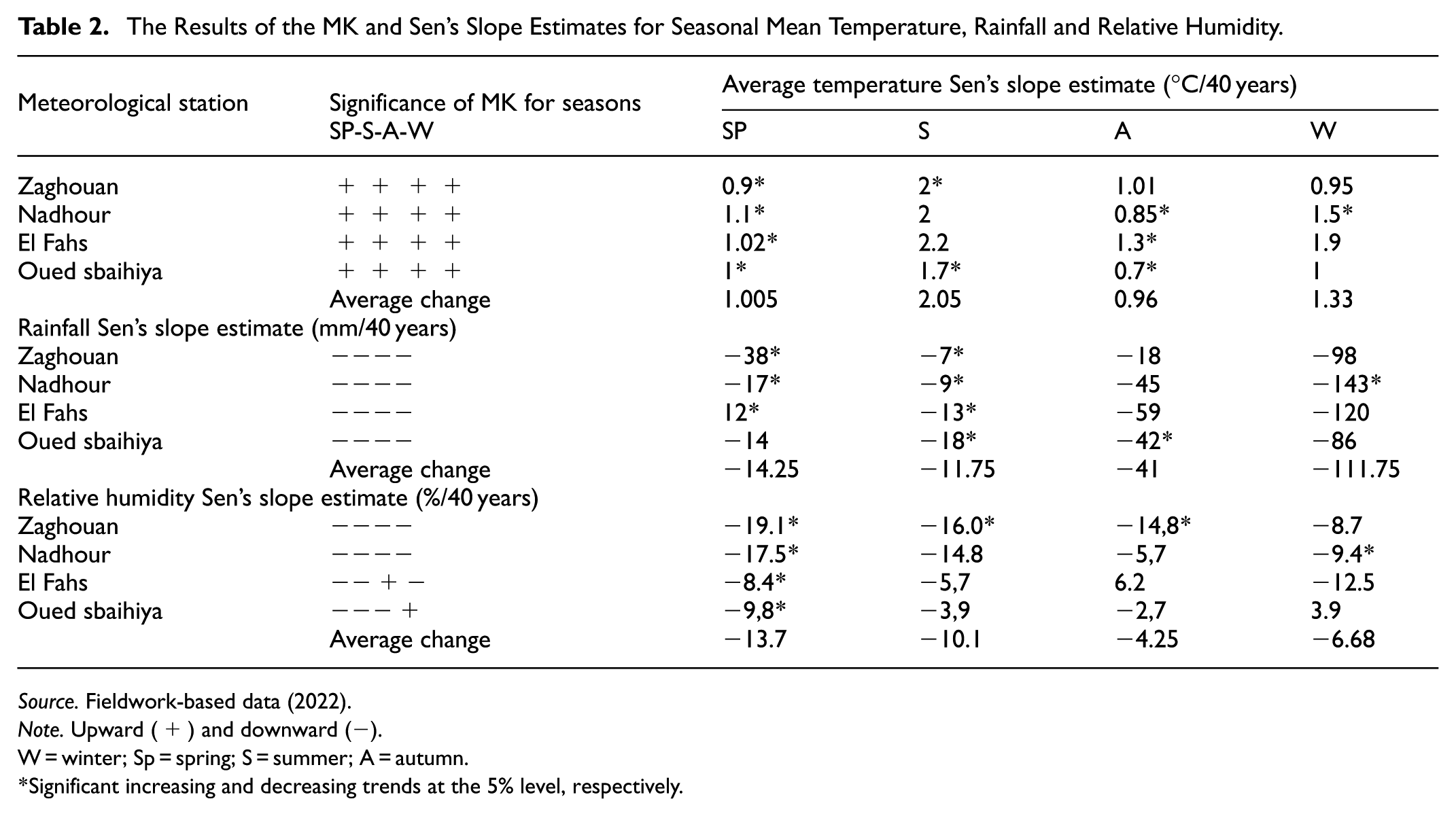
The results of the evaluation of the trends of the climatic parameters of the four meteorological stations (Nadhour, Fahs, Zaghouan and Ouedsbaihya), which were calculated by the non-parametric method of Sen over a series of 40 years, are presented in Table 2.
The Results of the MK and Sen’s Slope Estimates for Seasonal Mean Temperature, Rainfall and Relative Humidity.
Source. Fieldwork-based data (2022).
Note. Upward (+) and downward (−).
W = winter; Sp = spring; S = summer; A = autumn.
Significant increasing and decreasing trends at the 5% level, respectively.
Over the period from 1981 to 2020, the Mann-Kendall test confirmed the signs of global warming trends for all stations. Significant (10 times) and non-significant (six times) increasing temperature trends were obtained for each of the stations’ seasonal data. The highest average warming 2.2°C was found in the delegation of Fahsfor over 40 years. In the range 1.7 with 2.2°C over 40 years in the summer season and the lowest in autumn (0.96°C/40 years) whereas the rise of the mean temperatures in winter and spring tended to be lower than in summer. These changes could be the consequence of the radiative forcing of the climate system, which continued to increase during the 2000s, because it was linked to the increase in greenhouse gases (Intergovernmental Panel on Climate Change [IPCC], 2014) and therefore global warming increased at the surface (Hayran et al., 2021). In addition Projections of average annual temperatures show an expected increase by 2050 and 2100. This increase varies between 1°C and 1.8°C by 2050, and between 2°C and 3°C at the end of the century (ME, 2020). Thus, surveying is needed in regions like governorate of Zaghouan to determine the perceptions of farmers on CC. Precipitation shows a downward trend, nine times significant and seven times non-significant. The highest downward trends were obtained in winter (−111.75) followed by autumn, spring and summer.
Significant decreasing (eight times) and non-significant decreasing (five times) trends as well as non-significant increasing (three times) trends were obtained in each season and station reflecting the dominant decreasing of relative humidity trends of the study area. The highest decreasing trends were obtained for spring (13.7%) followed by summer (13.1%), winter (6.68%) and autumn (4.25%) which indicates that there has been a definite decrease in the relative humidity.
Farmers’ Climate Change Perceptions
Farmers’ Perception of the Trend of Climatic Parameters
Based on a survey of farmers in the Zaghouan governorate, the respondents were questioned about their perceptions of temperature, precipitation, humidity, the frequency of extreme occurrences and the number of hot nights and days. The results indicated that 43.4% and 56.6% noticed respectively a great and extreme decrease of precipitation. Regarding the temperature increase, only 2.4% noticed a moderate change while 48.2% and 49.4% noticed great and extreme increase respectively of temperature. It’s also marked that 73.5% of farmers declared a great decrease of Humidity levels. Regarding the extreme events occurrence, 43.4% of farmers noticed that there was a great increase while 56.6% declared that there was an extreme increase. Most of farmers, also noticed a great and extreme increase of number of hot nights and days (Figure 1). This showed that although the perspective of the farmers was consistent with short-term climate variability, it was challenging to reflect the perception over the long run.
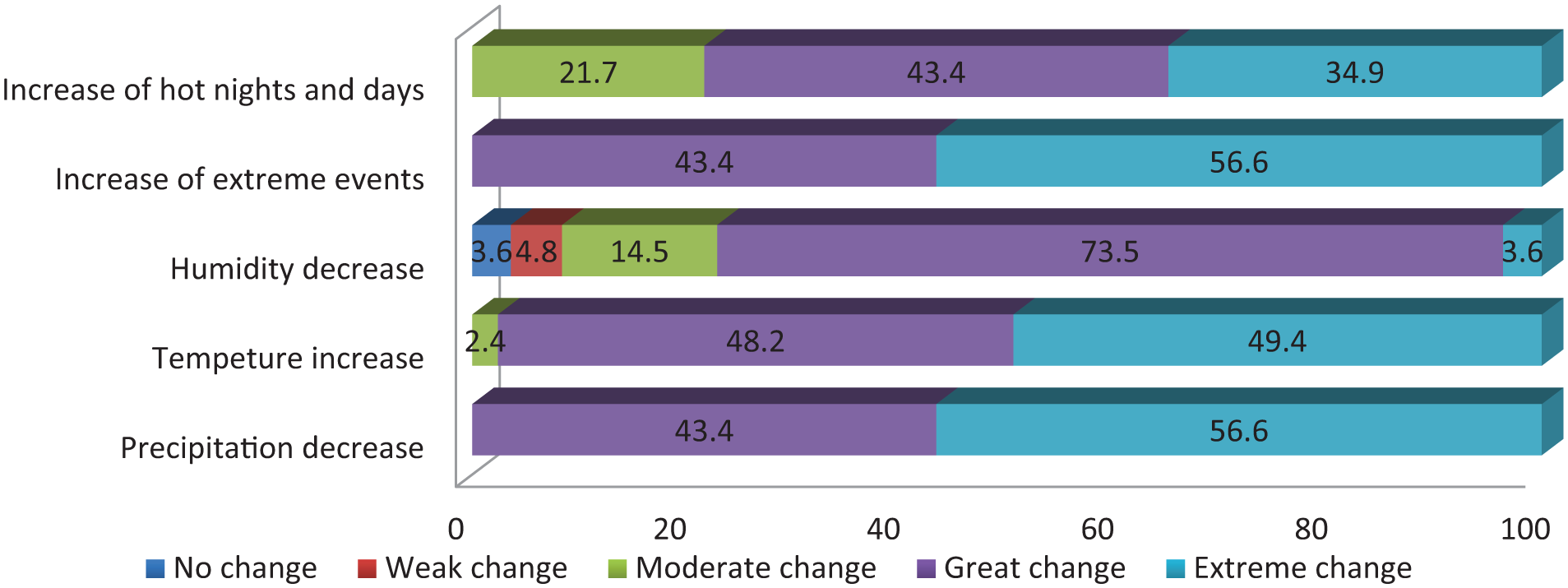
Farm householders’ perception about climatic parameters change.
PCA Results
Farmers’ CC perception investigated using a scale consisted of 12 items. The average score given by the farmers to the items on the scale of CC perception was 4.028 which affirms a fairly strong perception of CC. In addition, the standard deviation of all the items introduced is less than 1.00, which highlights the existence of a general consensus of the perception of CC impacts by farmers in the study area.
The alpha coefficient for the items is 0.72, suggesting that the items have relatively acceptable internal consistency. Factor analysis was used to reduce the items in a smaller number of common factors. The KMO index of 0.724 can be qualified as good or meritorious. It demonstrates the high quality of the correlations between the various items. Then, the result of Bartlett’s sphericity test is significant (p < .0005). Thus, the null hypothesis that our data originate from a population for whom the matrix is an identity matrix can be rejected. As a result, not all correlations are equal to zero. So we can continue the analysis. The PCA analysis extracted three components with Eigen values greater than 1. Pooled together, the three factors explain 79.24% of the variance. The first factor alone explains 36.40% of the total variance of the 12 variables in the analysis; the second explains 22.74% and the third 21.10%. In order to obtain a simpler factorial representation, we make a VARIMAX rotation. This type of rotation preserves the orthogonality (independence) between the factors (Table 3). The PCA results show that the first component is linked to the environmental and economic impacts, (Cronbach’s alpha = .913) the second are linked to socio-economic impacts (Cronbach’s alpha = .829) and the third is linked to the risky and insecurity impacts (Cronbach’s alpha = .6). According to the farmers’ perception, the most important issues are explained by environmental and economic impacts of CC as showed by the first factor. Farmers argued that climatic change leads to a decrease of precipitation and an increase of temperature which lead also to water scarcity and water quality degradation. This may affect the vegetables yields and result in an increase in the agricultural production costs. This finding confirmed the finding of Hayran (2021) and Ndamani and Watanabe (2017). In fact, due to CC, it is predicted that the yield of agricultural products will decrease, and consequently the cost of agricultural production will increase especially in regions with a temperate and semi-arid climate stage. The present study pointed out a correlation between CC and social impacts. This is shown by the second construct of the PCA. The analysis highlighted the correlation between CC and the retrogradation of the social life, namely the pest and disease outbreak. Farmers also believe that CC causes labor scarcity due to rural exodus and migration of young people abroad, given that agriculture is no longer an attractive activity for young people.
Climate Change Perception Scale’s Items and the Result of Factor Analysis.

Source. Fieldwork-based data (2022).
1: Strongly Disagree, 2: Disagree, 3: Moderately Agree, 4: Agree, 5: Strongly Agree.
Further, it was found that CC is at the origin of numerous risks linked to extreme events such as droughts, floods, and storms together with the expansion of food insecurity and the degradation of natural resources, in particular soil resources as it is shown by the third component. According to several scientific studies, any change in the climate might affect the frequency, severity, spatial extent, length, and timing of extreme events, and can lead to extreme high-risk weather events (Hayran et al., 2021). In this context food security will be adversely affected by CC (Ben Nasr et al., 2021; FAO, 2008). Especially, water scarcity will negatively affect agricultural production. Due to that decline in agricultural production, the availability and accessibility of food will be threatened.
Factors Affecting Farmers’ Perceptions of Climate Change
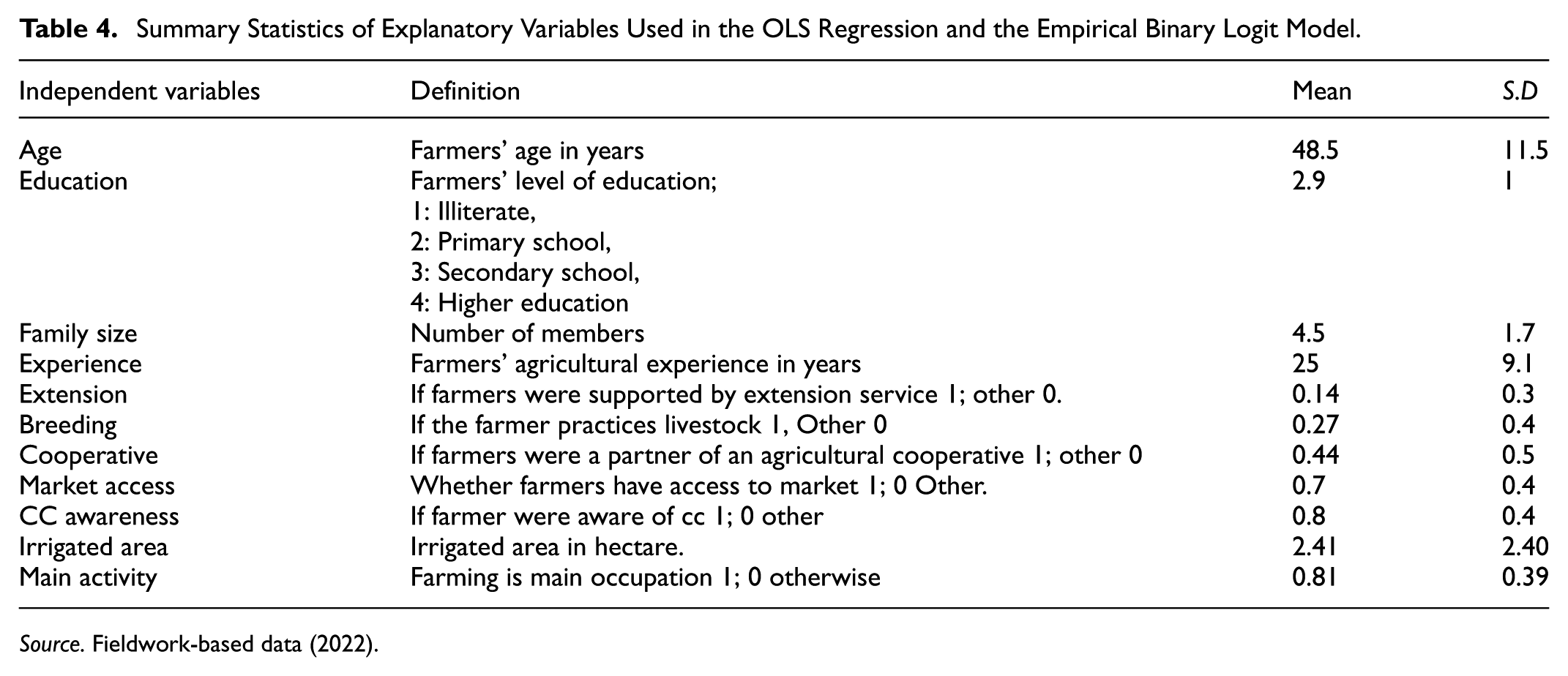
In this section, we conduct a regression analysis to identify the variables influencing farmers’ perceptions of the CC. Independent variables of the regression models were presented in Table 4.
Summary Statistics of Explanatory Variables Used in the OLS Regression and the Empirical Binary Logit Model.
Source. Fieldwork-based data (2022).
With an average age of 48.5 years, the majority of responders were in the middle age range. Most responders, in terms of their level of education, were illiterates or with primary school level (65%) and only 14% of farmers have a higher education level. the average family size is 4.5 which is considered low. The average agricultural experience amounts to 25 years which is considered a medium level. The results of the OLS analysis are presented in Table 5. The study findings revealed that three models are significant thus the F statistics were significant at p level of .01 and R square were .43, .8 and .76 respectively to the first, the second and the third model.
The Results of the OLS Regression Analysis.

Source. Fieldwork-based data (2022).
Note. Variables and models significant at *p < .10, **p < .05, ***p < .01.
Results indicated that the age variable is negative with the three components, indicating that older farming households perceived less the CC risks. The first component is positively and significantly impacted by the education variable. This implies that more educated farmers have the ability to better forecast and understand possible changes for the future compared to the no educated ones.
The education variable has a positive influence on the second component and negative effect on the third but these effects are not significant. The negative effect may be the consequence of the prediction of more educated farmers that the harmful effects of CC can be mitigated by developing technology and by improving production and consumption systems in accordance with nature (Hayran et al., 2021). Furthermore, the family size variable has a positive effect on the farmer’s climate impacts perceptions meaning that the larger the family is the larger the perceptions. This can be explained by the fact that household members pay more attention to the impacts of the effects of CC and related risks. Findings showed that the experience variable is positively linked to the farmers’ climate risks perceptions meaning the more experienced farmers are more aware of the CC impacts. Additionally, the results revealed that the extension variable is positively correlated with the three components, showing that farmers who received extension services were more conscious of the dangers associated with the climate and that extension services are crucial to enhancing farmers’ perceptions of CC.
The relationships between the breeding variable on the one hand and the perceived impacts of CC on the other appear negative. This may imply that farmers adopting integrated system of production are less affected by CC impacts and are less vulnerable.
According to the results of the third model, the variables of farmers’ cooperative partnership had significant effects on the perceptions of farmers on CC risks. Farmers, who are cooperative partners in the region under research, have higher perceptions about the undesirable impacts of the climate. Public and private cooperation can play a significant role in providing farmers with the necessary information, education and technologies (Hayran et al., 2021; Rondhi et al., 2019). This stated that farmers who were cooperative partners perceived more important CC indicators related to all the components. Market access and CC awareness were recorded having statistically significant effect on the second and the third components. These findings mean that market access and CC Awarness increase farmers’ ability to perceive the effects of CCs.
Farmers’ Adaptation Strategies
“Adaptation includes actions and adjustments undertaken to maintain the capacity to deal with stresses induced as a result of current and future external changes” (Banerjee et al., 2013). We also asked farmers who had encountered and understood CC to describe the farm-level adaptation actions they had implemented in response to CC. The study’s findings showed that farm households used a variety of adaptive strategies in this situation. Figure 2 presents a summary of the results and their adaptation strategies.
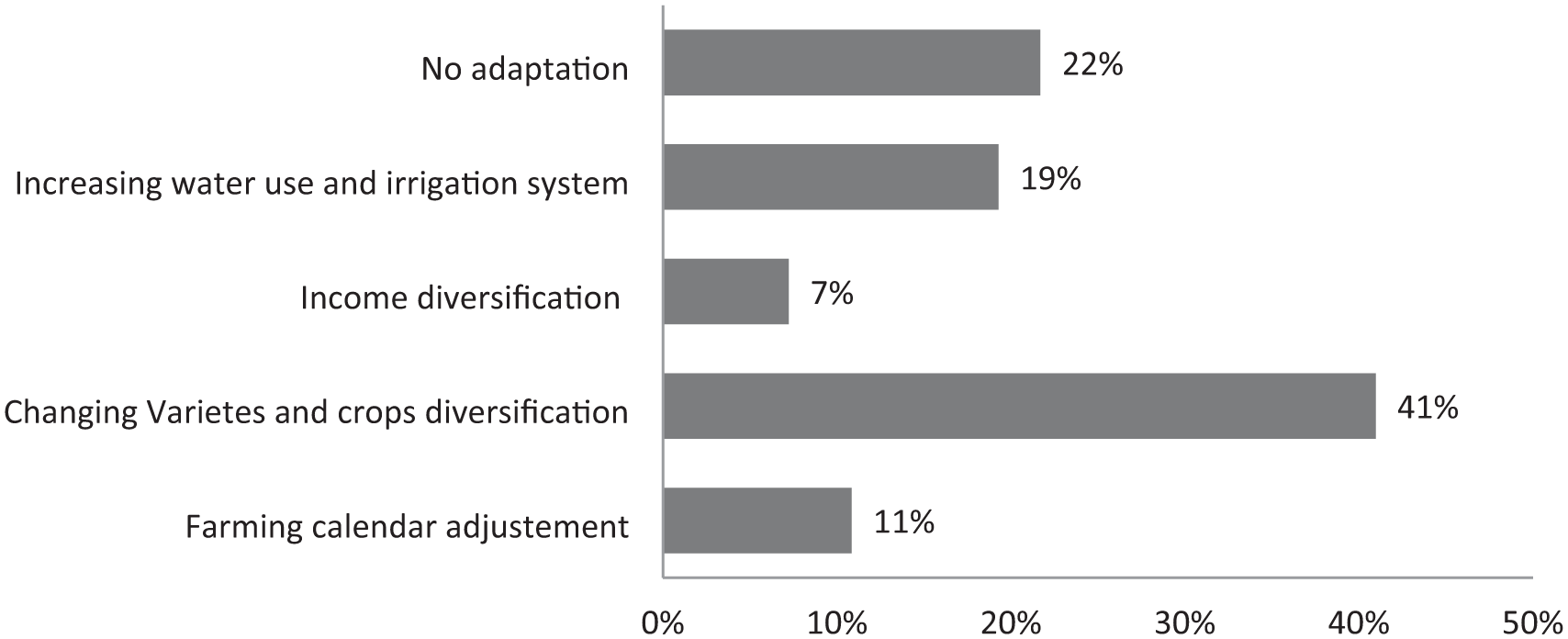
Major adaptation strategies taken by the farmers.
Crop diversification and variety changes made up 41% of all adaptation measures, with groundwater storage investments and increased irrigation system and water source use accounting for the remaining 19% of all adaptation options. The third option was changing the farming calendar (11%), which involved planting or harvesting earlier or later depending on when the rainy season starts to prevent yield damage and thus lower the cost of water management for planting. About 7% of farmers in the study area also use temporary out-migration as a key strategy for income diversification. A lack of understanding about the effects of CC and a lack of experience with adaptation tactics were cited as the main reasons why 22% of respondents would continue planting in the same manner as previously.
Factors Affecting Farmers’ Decision on Adaptation to CC in Agricultural Production
The factors influencing farmers’ decisions to adapt to extreme either occurrences in agricultural productivity were examined using the binary logit model. Farmers’ decisions result in a discrete value of (1, 0). Farmers who adapted to CC are represented by one (1), while those that did not are represented by zero (0). Farmers’ decisions to adjust in order to deal with the perceived CC are the result of various explanatory factors. Table 6 provides the parameter estimates for the binary logistic regression model used to measure the effect of explanatory variables on farmers’ adaption strategies. The determined model was significant, according to the likelihood ratio test (p = .000), which was supported by high values for the pseudo-R2 (85.9%) and the high proportion of sampled instances (92.5%). The findings of the binary logistic model revealed that farming experience (at 1% level), family size, (at 5% level) and education, belonging to cooperative, market access, irrigated area and main activity (at 10% level) were significantly influencing the farmers willing to tackle CC. According to agricultural experience, farmers are more aware about agriculture and their environment. Therefore, the more farming experience individuals have, the more likely they are to think about and use adaptive strategies. Families with more members have a higher likelihood of adjusting to CC than families with fewer members. This is a result of the availability of greater labor resources for farming tasks. This positive relationship between family size and more active adaptation is revealed by Croppenstedt et al. (2003), Deressa et al. (2009) and Arunrat et al. (2017). According to our findings, a farmer’s education level was positively correlated with all adaptation strategies because they had more exposure to cutting-edge information and tools. The importance of belonging to cooperatives as a substitute for social capital was emphasized, and this considerably increased the likelihood of adaption. The findings show that all social capital engagement possibilities can improve farmer experience sharing and give them more confidence to adopt new technologies. Market access could be a way to communicate with farmers and other service providers and exchange information. In this study, the coefficient is positive, indicating that farmers with better market access than those with poor access have a higher likelihood of adapting to CC. Additionally important variables of CC adaptation include farm size and ownership of irrigated land, which raises the chance of adaption. The decision of farmers in the study area to adapt is mostly influenced by the increase in farm size and land ownership as well as the availability of irrigation water for agriculture.
Parameter Estimates of Binary Logistic Regression Model of Adaptation Decision of Farmers.

Source. Fieldwork-based data (2022).
Farm households that keep livestock are less receptive to agricultural adaptation techniques designed to counter the threat of CC. As a result, the breeding variable significantly affects the strategies for adaption negatively. The likelihood of farmer adaptability was also observed to diminish with age.
Conclusion and Recommendations
This study provides understanding of Tunisian farmers’ perception of climatic change, and the factors affecting it. In particular, the perception of farmers is crucial for the support of the political decision to develop proactive precautions within the framework of coping with CC. Our findings also indicated a favorable correlation between farmers’ views and their perception of the risk posed by climatic concerns. Farmers’ impressions were in line with the short-term weather data, which showed a rise in temperature and a more pronounced decline in precipitation. The PCA revealed that farmers’ perception was represented by three construct explaining 79.24% of the total variance. The first component was linked to the environmental impacts, the second to the social impacts and the third was related to the risky insecurity impacts. The scores of these components were regressed by explanatory variables to identify the determinants of farmers’ CC perception. Results showed that education level, extension service, market access and CC awareness were the most significant factors affecting the farmers’ perception. Social capital and information were found determinants of farmers’ CC perception. These Findings indicate that farm households have strong attitudes toward CC adaptation strategies. The perception of weather-related risk is a significant factor in farm households’ desire for incorporating weather-related decisions. Further, the study’s farmers’ primary on-farm autonomous adaptation strategies include agricultural diversification through new types and crops, increased use of irrigation systems and water resources, calendar adjustments for farming, and income diversification. It should also be noted that there is still a part of the farmers who think that CC is the support of the government in the implementation of adaptation measures for farmers. The results demonstrated that farmers’ intention to adapt was affected mostly by farming experience, family size and education, belonging to cooperative, market access, irrigated area and main activity. Effective strategies that aim to enhance farmers’ perception and capacity for adaptation might thereby promote both actual and intended adaptation on the part of farmers. Multiple actors from all pertinent sectors must take part in adaptation methods while interacting with farmers and local populations. Additionally, emphasis must be placed on enhancing agricultural diversification, implementing crop rotation and improving irrigation efficiency.
Although this study provides valuable insights into the perceptions and adaptation strategies of farmers to climate change in the semi-arid region of Zaghouan, it has some limitations. Firstly, despite its proportional determination, the sample size of 83 farmers is rather small and does not fully reflect the heterogeneity of the hole population of farms in the governorate of Zaghouan. Secondly, farmers’ perceptions are based on subjective statements, which may affect the recall bias or subjective interpretation of climate variability. Lastly, the study focuses on socio-economic and institutional factors mainly, while other potential influencing variables, such as cultural aspects, attitude toward risk and technologiacal constraints, have not been integrated into the models. These limitations should be considered when interpreting the results and drawing policy recommendations. Addressing these gaps will strengthen the robustness of empirical evidence and support more effective climate-resilient agricultural policies.
Footnotes

Ethical Considerations
This is not applicable.
Author Contributions
Arfa Lamia and Abdelhafidh Hassen contributed to the study conception, methodology organization, data analysis, preparation of the initial draft of the paper and subsequent modifications re-structure and revision of the paper to make its fnal form and supervision of the entire research work. Ines Harzli contributed to the study conception, methodology organization, field survey and data analysis.
Funding
The authors received no financial support for the research, authorship, and/or publication of this article.
Declaration of Conflicting Interests
The authors declared no potential conflicts of interest with respect to the research, authorship, and/or publication of this article.
Data Availability Statement
Data sharing not applicable to this article as no datasets were generated or analyzed during the current study.