




Abstract
This systematic review investigates how sustainability campaigns influence consumer and market responses by integrating the Theory–Context–Characteristics–Methodology (TCCM) framework with keyword co-occurrence and temporal overlay analyses. Following PRISMA, 94 peer-reviewed studies from Scopus and Web of Science were synthesized. Behavioral theories, notably the Theory of Planned Behavior, remain dominant yet context-dependent, with predictive validity conditioned by credibility cues and relational dynamics captured by social-psychological and marketing perspectives. Research is concentrated in China and the United States, and campaign formats include corporate environmental initiatives, corporate social responsibility programs, green advertising, and digital engagement. Environmental concern and responsibility reliably predict intention, while price sensitivity, trust, and perceived authenticity govern behavior and help explain the intention–behavior gap; post-purchase outcomes such as loyalty and continued use remain underexplored. Quantitative, cross-sectional designs dominate, while longitudinal and configurational approaches are rare. The review develops a campaign-centered synthesis that clarifies how credibility, reciprocity, and digital affordances transform consumer intention into sustained engagement, advancing five agendas: theoretical integration, broader contextual diversity, deeper behavioral scope, stronger methodological rigor, and standardized sustainability terminology. Practically, the findings highlight the importance of credible disclosure, culturally adaptive narratives, and continuous, digitally supported engagement for fostering enduring behavioral change.
Plain Language Summary
This study reviews how sustainability campaigns—such as eco-labeling, corporate responsibility programs, and digital engagement initiatives—shape consumer behavior and market outcomes. By examining 94 academic studies, it identifies what drives people to act sustainably and why intentions often fail to translate into real behavior. Environmental concern and responsibility motivate consumers, but trust, price sensitivity, and authenticity determine whether they follow through. The review also shows that research has focused mainly on a few countries, with limited understanding of long-term or cross-cultural effects. Bringing together evidence across disciplines, this study proposes a campaign-centered view explaining how credible communication, social trust, and digital tools can turn awareness into sustained action. The findings guide businesses and policymakers in designing transparent, culturally relevant, and engaging sustainability initiatives that genuinely inspire lasting consumer change.
Keywords
Introduction
Amid escalating environmental pressures and rising consumer expectations, companies are increasingly turning to targeted sustainability campaigns—strategic, time-bound initiatives aimed at achieving measurable environmental or social outcomes. Unlike broad sustainability commitments, these campaigns focus on driving behavioral and market-level changes through communication, public engagement, and innovation. Across industries, such efforts take diverse forms: carbon reduction in energy, eco-labeling in food and fashion, digital gamification in apps like Ant Forest, and incentive-based schemes such as subsidies or plastic bans (Ahmad et al., 2023; Ashfaq et al., 2022; Chen et al., 2019; Tan et al., 2025b). These campaigns shape not only firm behavior but also consumer responses—including eco-conscious choices, recycling, reduced packaging use, and engagement in circular economy practices (Tan, Hashim, et al., 2025; Tan et al., 2025a).
In this review, market response is defined as the measurable reactions of consumers and markets to sustainability campaigns. These responses include both individual-level behaviors (e.g., purchase decisions, usage patterns) and broader market trends (e.g., demand shifts, attitudinal change; Tan et al., 2025a). Responses are influenced by multiple factors, such as environmental awareness, perceived responsibility, and trust in corporate actions—yet their effectiveness varies greatly across industries, cultures, and economic contexts (Balasubramanian & Sheykhmaleki, 2024; Hayat et al., 2023; Tan, Hashim, et al., 2025). Despite the rise of sustainability campaigns, research on how they influence market response remains fragmented. Which theories have been applied? Which consumer drivers have been examined? Which industries or regions remain understudied? And what methodological approaches dominate this field?
To address these questions, this study conducts a systematic review of 94 peer-reviewed articles using the TCCM framework (Theory–Context–Characteristics–Methodology; Paul & Rosado-Serrano, 2019). The review synthesizes existing research across theoretical foundations, empirical settings, and methodological strategies, with particular emphasis on key characteristics such as sustainability-related antecedents and consumer decision outcomes (e.g., green purchase intentions). A complementary keyword co-occurrence analysis identifies thematic clusters and emerging directions (Zheng et al., 2025a, 2025b), offering a visual map of how research on sustainability campaigns has evolved.
While prior reviews have advanced understanding in adjacent areas, they remain largely confined to specific themes rather than examining sustainability campaigns as integrative, cross-sector interventions. For instance, studies on sustainability labeling in food focus on consumer comprehension and trust in public authority (Cook et al., 2023), while research on visual label effects explores perceptual and contextual moderators within product categories (Majer et al., 2022). Reviews of packaging analyze discrepancies between consumer perception and environmental performance in isolated material domains (Otto et al., 2021). Other works examine the unintended negative effects of sustainability practices on consumers’ emotions and cognition (Acuti et al., 2022) or aggregate insights into brand-level social sustainability outcomes (Alwani & Bhukya, 2025). Together, these studies provide valuable but fragmented perspectives that stop short of connecting communication formats, behavioral mechanisms, and market outcomes across industries.
Building on these foundations, this review distinguishes itself by adopting a campaign-centered perspective that unites evidence across sectors and contexts to analyze how sustainability initiatives function as coordinated, time-bound interventions designed to influence consumer and market responses. By synthesizing findings from marketing communication, consumer psychology, and behavioral sustainability, the study offers a broader conceptual map of how awareness-building, trust formation, and behavioral activation interact within campaign settings. In doing so, the review (i) integrates dispersed insights into how campaign signals are framed and received across domains, (ii) combines TCCM with keyword co-occurrence and overlay visualization to reveal theoretical blind spots, underexplored contexts, and underutilized methods, and (iii) derives practice-oriented implications for campaign design and policy, laying a grounded basis for a more actionable research agenda.
Methodology
Guided by the TCCM framework (Paul & Rosado-Serrano, 2019), this study systematically reviews research on sustainability campaigns and consumer behavior. The framework structures the analysis around four dimensions—Theory, Context, Characteristics, and Methodology—allowing for a clear classification of key concepts, empirical settings, studied variables, and methods. This approach supports the identification of dominant patterns, theoretical gaps, and opportunities for future research.
This study strictly follows the Preferred Reporting Items for Systematic Reviews and Meta-Analyses (PRISMA) guideline (Page et al., 2021). Articles were selected without restrictions on publication date, language, or disciplinary focus. The databases used were Scopus and Web of Science (WoS), recognized for their extensive and authoritative repositories. The search was performed on October 7, 2024, targeting titles, abstracts, and keywords to capture a wide range of relevant studies. The example searching string used in Scopus is as follows: (( TITLE-ABS-KEY ( “sustaina* campaign” OR “sustaina* activit*” OR “sustaina* strateg*” OR “sustaina* effort*” OR “sustaina* polic*” OR “green campaign” OR “green activit*” OR “green strateg*” OR “green effort*” OR “green polic*” OR “eco-friendly campaign” OR “eco-friendly activit*” OR “eco-friendly strateg*” OR “eco-friendly effort*” OR “eco-friendly polic*” ) AND TITLE-ABS-KEY ( “market re*” OR “market feedback” OR “consumer re*” OR “consumer behavi*” OR “purchas*” ) )
A total of 890 records were initially retrieved from Scopus and Web of Science. After removing duplicates using EndNote, 590 unique articles remained. To ensure consistency and minimize bias, the research team collaboratively defined and applied a unified set of inclusion and exclusion criteria throughout all screening and eligibility stages. Discrepancies were resolved through discussion. Following Rust and Cooil’s (1994) reliability framework, bias was further mitigated procedurally by standardizing coding rules and employing consensus-based decisions, thereby reducing rater-specific variance even without calculating a formal coefficient. Title and abstract screening excluded 490 articles: 329 unrelated to business-focused sustainability research (e.g., medicine, chemistry, physics, or engineering), 86 non-empirical (books, chapters, letters, or reviews), and 75 published in non–SCI/SSCI-indexed journals or with an impact factor below 1 (Paul et al., 2024). Full-text assessment excluded six additional articles that addressed only one of the two core topics—sustainability campaigns or market responses—without linking them.
Ultimately, 94 articles met the criteria and were included in the final synthesis. At this stage, a structured content analysis was conducted. The TCCM framework guided data extraction, covering publication details, theoretical foundation, empirical context, methodological approaches, influencing factors, and decision-making variables. These data provided the analytical basis for the review presented in the following sections. The complete literature selection process is illustrated in Figure 1.

Flow diagram of article selection using PRISMA protocol.
TCCM-based Review
This study adopts the TCCM framework, proposed by Paul and Rosado-Serrano (2019), to systematically analyze sustainability campaigns and market responses across theory, context, characteristics, and methodology. A conceptual model summarizing the TCCM results, inspired by Buitrago R and Camargo (2021), is presented in Figure 2 for a visual representation of key findings.

Overview of TCCM-based review, adapted from Buitrago R and Camargo (2021).
Review of Theories
Behavioral theories dominate the literature, with the Theory of Planned Behavior (TPB, 22 studies) and the Theory of Reasoned Action (TRA, 5) most frequently applied to explain green consumption and sustainable purchasing. These frameworks provide a robust basis for understanding how attitudes, subjective norms, and perceived behavioral control influence consumer intentions and behaviors. For instance, Ahmad et al. (2023) applied TPB to examine the link between corporate social responsibility (CSR) and green purchasing intentions, while Al-Swidi and Saleh (2021) used TRA to analyze green behaviors among young consumers. A closer reading of the corpus indicates two recurrent tensions: first, the intention–behavior gap documented in field or quasi-field contexts (e.g., Grimmer & Miles, 2017; Grimmer et al., 2016), where stated intentions fail to materialize under situational constraints; second, variability in the weight of TPB components across contexts, with subjective norms dominating in collectivist or high-trust settings (Fang et al., 2021) and perceived behavioral control becoming salient when adoption barriers are technological or infrastructural (Shehawy et al., 2024). These patterns imply that TPB/TRA operate under context-dependent boundary conditions rather than offering uniform predictions.
Social psychological theories—such as Social Exchange Theory (three studies), Signaling Theory (2), Impression Formation Theory (2), and Balance Theory (1)—offer complementary perspectives by focusing on consumer identity, trust, and attribution processes. These frameworks enrich the behavioral lens by addressing how social and relational cues from brand sustainability efforts shape consumer attitudes. For example, Ghazali et al. (2018) examined the role of religious values in green purchasing using Social Exchange Theory, while Gidaković et al. (2022) drew on Signaling and Impression Formation Theories to assess the impact of brand sustainability on purchase intentions. Evidence across studies suggests that trust is not only a mediator (Social Exchange) but also a signal-validation outcome shaped by credibility cues and persuasion-knowledge activation (Signaling; Y. Kim & Oh, 2020; Nichols et al., 2023). Where credibility is contested (e.g., greenwashing cues), identity-consistent reciprocity assumptions embedded in Social Exchange weaken, and cue-diagnosticity effects dominate—leading to attenuated intentions despite favorable priors. This asymmetry clarifies why relational goodwill does not reliably offset credibility deficits in campaign communication.
Green marketing and sustainability theories—especially the CSR framework (14 studies) and Green Consumer Behavior Theory (4)—are also frequently used to explain sustainable consumption. The CSR framework, in particular, connects firm-level sustainability initiatives with consumer-level responses, highlighting how socially responsible practices foster favorable attitudes and purchase behaviors. Liu et al. (2023), for instance, found a positive link between CSR practices and Generation Z’s green purchasing in China. Yet cross-context comparisons reveal heterogeneous effects: CSR–intention links strengthen where institutional trust and perceived fit are high (Hayat et al., 2023; Liu et al., 2023), but weaken in markets where skepticism or spillovers from unethical brand behavior are salient (Neumann et al., 2021; Nichols et al., 2023). Studies using discrete-choice or segmentation approaches (Owusu-Sekyere et al., 2019) further indicate latent classes that value CSR credence attributes differently, suggesting that market maturity and credibility infrastructure (e.g., third-party assurance) condition CSR efficacy.
Innovation and technology adoption theories—such as the Expectation Confirmation Model (ECM, two studies) and the Task-Technology Fit Model (TTFM, 1)—represent an emerging strand addressing digital enablers of sustainable behavior. These models capture how consumers engage with technological innovations, such as digital platforms like Ant Forest, to facilitate environmentally responsible actions. Ashfaq et al. (2023) illustrate this through their analysis of technology-enabled green engagement, while Ashfaq et al. (2022) draw on U&G/flow to explain continuance. Across studies, technology-centric models explain short-run engagement (satisfaction, fit, flow) but seldom account for persistence or spillover to offline behavior. Evidence from large-scale field contexts (Rosenfeld et al., 2022) and social media diffusion research (Knight et al., 2022; Reyes-Menendez et al., 2020) suggests that design features (choice architecture, social proof) and network dynamics can either convert or dissipate initial motivation, pointing to the need for models that integrate adoption (ECM/TTFM) with behavior-change architectures (e.g., COM-B; Halabi et al., 2024; Hoang et al., 2023).
In sum, the literature demonstrates that no single theoretical lens sufficiently explains how sustainability campaigns shape consumer responses. Behavioral frameworks clarify motivational antecedents, but their predictive validity depends on contextual and credibility factors captured more effectively by social psychological and marketing-based theories. Emerging technology adoption perspectives further extend this understanding by situating sustainable actions within digital ecosystems. This theoretical heterogeneity points to the value of integrative, context-sensitive models rather than additive applications of established theories.
Review of Contexts
The review of contexts reveals substantial geographical and thematic diversity in sustainable consumption research, with China, the United States, South Korea, the United Kingdom, and Australia emerging as key focal regions (Figure 3). China leads with 28 studies, reflecting the country’s rapid adoption of sustainability policies and market-based environmental reforms. These studies primarily examine how CSR initiatives influence green purchasing behaviors (Ahmad et al., 2023; Cui et al., 2024; Hayat et al., 2023). They also highlight the role of digital platforms (e.g., Ant Forest) and policy instruments in mobilizing participation, suggesting that institutional incentives and gamified affordances jointly shape low-carbon engagement (Ashfaq et al., 2022, 2023). The United States (15 studies) emphasizes psychological drivers of consumer awareness, focusing on corporate sustainability strategies and green product labeling (Chen et al., 2019; Fuller & Grebitus, 2023). U.S. studies frequently use experimental or quasi-experimental designs to test message framing (e.g., awe, guilt) and credibility effects in apparel, sports, and hospitality settings, indicating that perceived authenticity rather than environmental concern alone drives responses (S. Kim et al., 2023; McCullough et al., 2022; Nichols et al., 2023; Trail & McCullough, 2020; Yu et al., 2017).

Main publishing countries.
South Korean research (eight studies) spans foodservice, fashion, sportswear, and dining, showing that aesthetic consistency, brand reputation, and clarity of claims shape ethical evaluations and loyalty; skepticism and perceived ambiguity weaken these effects when credibility is uncertain (Ju & Chang, 2016; Jung et al., 2020; Y. Kim & Oh, 2020; E. J. Kim et al., 2024). In the United Kingdom, work on food and retail indicates that animal welfare, health, and moral identity frequently outweigh ecological motives in consumption choices, while source credibility and message relevance drive social-media engagement with sustainability communication (Clonan et al., 2015; Gordon-Wilson et al., 2022; Knight et al., 2022). Australian studies, though fewer, document the intention–behavior gap under situational constraints and motivational moderators, underscoring the conditions under which pro-environmental attitudes translate into realized behavior (Grimmer & Miles, 2017; Grimmer et al., 2016).
In terms of campaign typologies, corporate-led environmental initiatives dominate, especially in China and the United Kingdom, where firms focus on carbon reduction and eco-friendly product innovation (Ahmad et al., 2023). CSR-oriented campaigns are more common in emerging markets, where corporate social involvement reinforces brand loyalty and consumer engagement (Ghazali et al., 2018). In contrast, green advertising and reputation management prevail in developed economies as tools to build trust and promote green consumption (S. Kim et al., 2023). Cross-sectoral themes such as sustainable supply chain management and green procurement are increasingly emphasized, particularly in apparel and food industries where transparency and environmental credentials shape consumer preferences (Asadi et al., 2022; Balasubramanian & Sheykhmaleki, 2024). Although less frequently studied, cultural and social campaigns—especially in Southeast Asia—highlight the influence of religious values and habitual green practices on pro-environmental purchasing, underscoring the importance of cultural alignment in sustainability efforts (Ghazali et al., 2018). Taken together, the pattern is context-contingent rather than uniform: institutional incentives and digital affordances are central where policy activism and platforms are salient (e.g., China), credibility-sensitive framing matters where marketplace skepticism is high (e.g., U.S./UK), and value-congruent appeals are effective where religious or collective norms are pronounced (e.g., Southeast Asia). These contingencies specify when similar campaign stimuli are likely to succeed or attenuate across regions and sectors.
Review of Characteristics
The review of characteristics identifies three interrelated dimensions: sustainability-related antecedents, other influencing factors, and consumer decision outcomes. Sustainability-related antecedents are especially prominent, reflecting continued scholarly emphasis on the psychological and contextual drivers of green consumption. Environmental concern, featured in 35 studies, is the most commonly examined factor and a key predictor of green purchase intentions (Ahmad et al., 2023; Asadi et al., 2022). Closely related constructs such as environmental responsibility (28 studies) and sustainability awareness (26) also receive sustained attention for their role in shaping pro-environmental decisions (Al-Swidi & Saleh, 2021; Calderon-Monge et al., 2020). Across studies, these antecedents tend to operate through identifiable mechanisms and constraints: moral obligation frequently mediates the effects of knowledge/concern on behavior (Cui et al., 2024); infrastructural and policy factors (e.g., charging networks, subsidies) condition the salience of concern in high-friction categories such as EV adoption (Asadi et al., 2022; He & Chen, 2021); information design matters, as specific and credible label cues outperform generic claims (Cho et al., 2024), and carbon disclosures in conjoint tasks shift attribute trade-offs (Alfaro & Chankov, 2022); social-media exposure amplifies awareness where crisis salience and platform engagement are high (Sun et al., 2022). Additional variables—including concern about carbon emissions (19), eco-label awareness (17), habitual green consumption (15), and policy influence (12)—further illustrate the multifaceted nature of sustainability engagement (Alfaro & Chankov, 2022; Cho et al., 2024; Sun et al., 2022).
Beyond sustainability-specific constructs, a range of other antecedents inform consumer responses. Price sensitivity, addressed in 32 studies, is frequently identified as a major inhibitor, with consumers often weighing environmental benefits against perceived financial costs (Bernard et al., 2013; Grimmer & Miles, 2017). Price effects, however, vary with transparency and segment: clear disclosure of upcycling processes and cost attribution increases choice likelihood even at premiums (Peschel & Aschemann-Witzel, 2020), and willingness-to-pay differs across latent classes and contexts (Fuller & Grebitus, 2023; Owusu-Sekyere et al., 2019). Personal values (29 studies), social norms (22), brand reputation (21), consumer trust (20), and family-related considerations (16) are consistently associated with motivational and normative influences on sustainable behavior (Ashfaq et al., 2023; Gidaković et al., 2024; Knight et al., 2022). Identity- and relationship-based processes—store identification and perceived legitimacy (Hofenk et al., 2019) or warm glow (Mahasuweerachai & Suttikun, 2022)—strengthen pro-sustainability choices, whereas persuasion-knowledge activation in response to ambiguity or prior greenwashing dampens intentions (Guerreiro & Pacheco, 2021; Y. Kim & Oh, 2020); source credibility and message relevance are decisive for eWOM and sharing in social platforms (Choi et al., 2019; Knight et al., 2022). Additionally, advertising and promotional strategies, cited in 15 studies, underscore the role of mediated communication in shaping consumer attitudes toward green products (Kyu Kim et al., 2021; Ross & Milne, 2021).
Decision-related outcomes are most often captured through intention-based measures. Green purchase intention—examined in 40 studies—is the dominant dependent variable, reflecting widespread interest in motivational antecedents of sustainable consumption (Dagher & Itani, 2014; Hosseini-Motlagh et al., 2024). By contrast, realized behavior is less frequently measured; where observed, situational constraints and implementation intentions help explain intention–behavior gaps (Grimmer & Miles, 2017; Grimmer et al., 2016), and field evidence shows that simple choice-architecture interventions can shift actual purchases (Rosenfeld et al., 2022). In digital settings, continuance intention is commonly used as a proxy for sustained engagement (Ashfaq et al., 2022, 2023), yet links to offline behaviors remain underexamined. Related constructs include purchase preferences (28 studies), repeat purchase behavior (19), and consumer loyalty (18), which extend the focus toward behavioral reinforcement and long-term brand engagement (Alfaro & Chankov, 2022l; Neumann et al., 2021). Evidence from retail and service contexts indicates that loyalty and repeat behavior depend on credibility fit and perceived authenticity, implying that attitudinal reinforcement is contingent on the stability of trust signals over time (Jung et al., 2020; Neumann et al., 2021). Other variables such as decision-making processes (17) and green product selection (14) indicate an increasing effort to link cognitive evaluation with concrete purchasing actions (Ashfaq et al., 2023; Castellari et al., 2019; Chang, 2011).
Review of Methodology
The methodological review of the selected studies covers four core dimensions: research design, data collection, sample size, and analytical techniques. Quantitative designs predominate, featured in 60 studies, reflecting a field-wide emphasis on structured, statistically grounded approaches to examining sustainability-related consumer behavior. Mixed-methods designs appear in 22 studies, facilitating the integration of statistical rigor with contextual interpretation, while 13 studies adopt qualitative designs—typically case-based or exploratory—used to investigate cultural, psychological, or industry-specific nuances. Within the quantitative stream, experiments appear alongside cross-sectional surveys, with notable implementations ranging from large-scale field tests (Rosenfeld et al., 2022; n = 167,637) to stated-choice experiments analyzed via logit models (Alfaro & Chankov, 2022; Fuller & Grebitus, 2023). Mixed designs frequently pair surveys with experiments (e.g., Edinger-Schons et al., 2018; Hofenk et al., 2019), while a smaller subset employs simulation/theoretical modeling to capture dynamic or strategic interactions (He & Chen, 2021; Hosseini-Motlagh et al., 2024; W. Zhang et al., 2023).
Data collection is overwhelmingly survey-based, with 72 studies employing self-administered questionnaires to capture consumer attitudes and behavioral intentions. This reliance on primary survey data highlights the field’s preference for scalable, respondent-centered designs. Complementary sources are present but limited—platform/review data (TripAdvisor) with automated sentiment and correspondence analyses (Gil-Soto et al., 2019), panel surveys enabling configurational analysis (Knight et al., 2022), and sensory/lab protocols (Yang et al., 2020). Experimental implementations span lab/online settings (e.g., Nichols et al., 2023; Peschel & Aschemann-Witzel, 2020) and conjoint tasks (Alfaro & Chankov, 2022), whereas real-world purchase data are rare outside a few field contexts (Rosenfeld et al., 2022). To mitigate common-method concerns, some studies report validity and bias checks—for example, CFA and CLF models (Ahmad et al., 2023; Sun et al., 2022)—but multi-source or longitudinal designs remain uncommon. Secondary data analysis and literature-based reviews are also evident, particularly in conceptual or theory-building studies, where empirical generalizability is not the primary goal.
Sample sizes are generally moderate: 38 studies involve 100 to 300 participants, while only 14 studies exceed 500. This distribution suggests a trade-off between practical feasibility and external validity, with larger samples remaining relatively uncommon due to logistical constraints. The corpus spans extremes—from expert-elicited samples (DEMATEL; Asadi et al., 2022; n = 22) to very large community samples (Fang et al., 2021; n = 5,091)—yet most studies (≈200–800 respondents) are calibrated for multivariate models. Sampling frames (students, consumer panels, platform users) vary but are often underreported in terms of representativeness, constraining cross-study comparability and transportability of effect sizes. Nonetheless, most samples are sufficiently powered for multivariate analyses, reflecting an acceptable standard for behavioral consumer research.
Analytical techniques are led by structural equation modeling (SEM), applied in 30 studies for its capacity to test complex, multivariate relationships among latent constructs. Regression analysis is employed in 20 studies, valued for its flexibility in modeling linear associations and predicting behavioral outcomes. Multivariate techniques such as factor analysis and cluster analysis (15 studies), along with descriptive or frequency-based methods (10 studies), round out the analytical toolkit, enabling researchers to explore both structure and distribution in consumer response patterns. Beyond these, PLS-SEM is common in technology/engagement contexts (Ashfaq et al., 2022; Elshaer et al., 2024; Neumann et al., 2021); fsQCA captures configurational sufficiency (Knight et al., 2022); conjoint/logit models estimate preferences (Alfaro & Chankov, 2022; Fuller & Grebitus, 2023); PROCESS-based mediation/moderation and ANN hybrids appear in several studies (e.g., Ashfaq et al., 2023). Overall, causal identification relies on the subset of experimental and field designs; otherwise, evidence is predominantly correlational and cross-sectional, limiting inferences about behavioral change and durability over time.
Keyword Co-occurrence Analysis
In addition to the TCCM analysis, a keyword co-occurrence analysis of the 94 reviewed articles was conducted using VOSviewer (Zheng et al., 2025a, 2025b). The analysis employed author keywords with a frequency threshold of 2 and a minimum cluster size of 8 to ensure conceptual robustness while avoiding fragmentation of infrequent terms. The resulting network, presented in Figure 4, reveals five color-coded clusters that delineate complementary research streams in sustainability campaigns and consumer response.
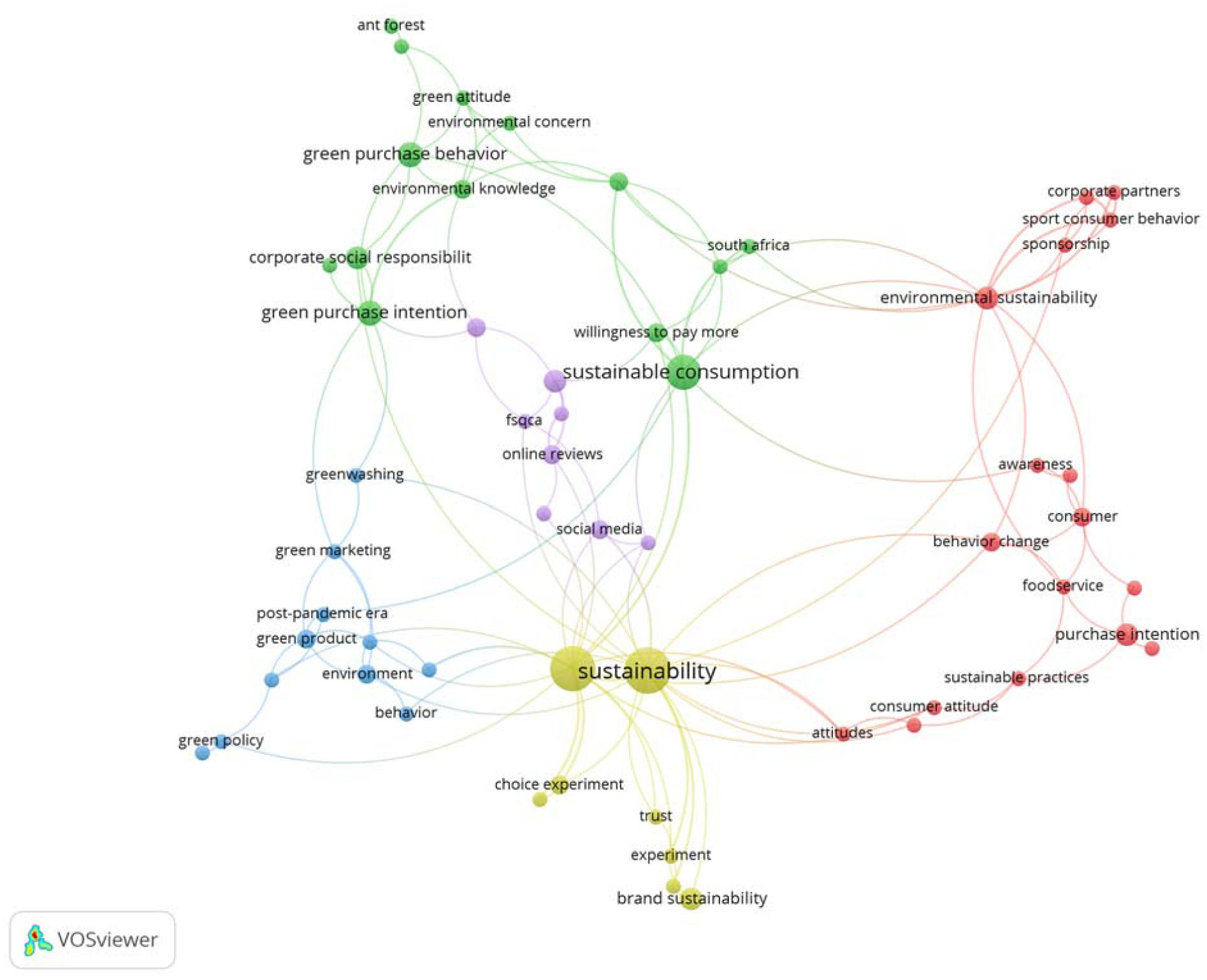
Co-occurrence of author keywords.
The red cluster comprises studies emphasizing environmental sustainability, behavioral change, purchase intention, and consumer attitude. These works investigate how sustainability awareness generated through campaigns evolves into attitudinal commitment and behavioral intention. Often situated in specific sectors such as sport sponsorship and food services, they highlight credibility and contextual relevance as critical antecedents of persuasive effectiveness. Yet, this body of research also exposes the persistent attitude–behavior gap, showing that attitudinal endorsement does not consistently translate into sustained behavioral engagement.
The blue cluster captures literature on marketing communication, signaling credibility, and message framing. Keywords such as green marketing, greenwashing, and social marketing indicate a focus on sustainability communication as a strategic signaling process. Studies within this stream analyze how authenticity, diagnosticity, and verifiability shape consumer trust and message acceptance. The recurring theme of greenwashing underscores the problem of information asymmetry, suggesting that communicative design alone is insufficient unless supported by transparent evidence and third-party verification.
The green cluster extends attention to pro-environmental purchasing, environmental knowledge, and corporate social responsibility (CSR). It links individual-level cognition and affect—knowledge, concern, responsibility—with organizational-level commitments to sustainability. Frequent references to South Africa and other regional contexts demonstrate a growing engagement with Global South perspectives, where institutional trust, affordability, and cultural norms condition behavioral intentions. This cluster conceptualizes sustainable consumption as an interactional outcome shaped by personal efficacy beliefs and the perceived integrity of corporate actors.
The yellow cluster reflects a psychological and decision-analytic orientation, uniting studies that use experimental or choice-based designs to examine trade-offs among sustainability, price, and quality attributes. Keywords such as trust, brand sustainability, and choice experiment mark the increasing precision with which researchers quantify willingness to pay for sustainable options. Trust emerges as a pivotal construct that transforms sustainability information from a peripheral cue into a central determinant of preference formation. These studies collectively advance behavioral models that articulate how credibility and perceived fairness operate within bounded rationality and moral reasoning.
The purple cluster represents an emergent stream examining digital and industry-specific contexts. Terms including social media, online reviews, e-WOM, apparel, food service, and green hotels indicate that consumer response is increasingly mediated through platforms where visibility, peer influence, and algorithmic exposure co-construct perceptions of sustainability. The use of configurational methods such as fsQCA reflects a shift toward multi-causal reasoning, recognizing that combinations of message credibility, social proof, and normative pressure can produce comparable levels of engagement. This stream reframes consumer response as a relational and platform-dependent process shaped by both corporate communication and collective validation in digital environments.
To complement the thematic clustering, an overlay visualization was generated using the same author keywords to trace the temporal evolution of research foci from 2018 to 2023 (Figure 5). The VOSviewer time-based color gradient (cooler hues for earlier years; warmer tones for recent publications) reveals a gradual progression in both thematic orientation and methodological sophistication. Between 2018 and 2020, the literature concentrated on conceptual and attitudinal foundations, with frequent keywords such as green marketing, environmental concern, and green purchase behavior. These early studies established the cognitive and motivational underpinnings of sustainable consumption, often grounded in established behavioral theories and survey-based approaches. From 2021 onward, the appearance of trust, brand sustainability, and experiment indicates a move toward empirical testing and causal inference, signaling an effort to validate theoretical propositions through experimental and quasi-experimental designs. Concurrently, the emergence of social media, online reviews, and fsQCA reflects the growing integration of digital platforms and configurational analytics into sustainability research. This methodological diversification parallels the field’s substantive shift—from explaining why consumers endorse sustainability in principle to examining how digital and relational mechanisms shape their responses in practice. Overall, the temporal overlay suggests a maturing research landscape in which conceptual, empirical, and technological dimensions are increasingly intertwined to capture the dynamics of sustainability communication and consumer engagement.

Overlay visualization-keywords.
Future Research Directions
Theoretical Directions
Behavioral theories, particularly TPB and TRA, dominate the sustainability campaign literature, yet the findings reveal clear contextual dependencies. The reviewed studies show that the predictive power of TPB components varies by setting—subjective norms dominate in collectivist or high-trust cultures, whereas perceived behavioral control becomes decisive when structural or technological barriers exist. This suggests that behavioral theories alone insufficiently capture how contextual credibility and relational cues influence sustainable actions. Future theoretical development should therefore integrate behavioral frameworks with social psychological theories (e.g., Signaling Theory, Social Exchange Theory) to explain how message credibility, reciprocity, and trust validation moderate the intention–behavior link. Moreover, emerging evidence on technology-enabled engagement (e.g., Ant Forest) calls for connecting adoption models such as ECM and TTFM with behavioral theories to examine how satisfaction, flow, and confirmation processes sustain eco-behaviors within digital ecosystems. Example research questions:
(i) Under what conditions do credibility and reciprocity jointly strengthen or weaken the TPB-based attitude–intention pathway?
(ii) How do satisfaction and confirmation processes in digital platforms sustain or erode long-term pro-environmental actions?
(iii) Can integrated models combining TPB, Social Exchange, and ECM predict both online engagement and offline behavioral spillovers?
Contextual Directions
The contextual review indicates geographical concentration in China and the U.S., with underrepresentation of Southeast Asia, the Middle East, and Latin America. These omissions limit theoretical generalizability and obscure the influence of cultural, institutional, and policy environments. Findings from China emphasize institutional incentives and digital affordances (e.g., gamified participation), whereas studies from the U.S. and Europe highlight credibility-sensitive framing and authenticity concerns. Future research should therefore use harmonized experimental or quasi-natural designs across countries to test how institutional trust, cultural norms, and policy instruments jointly shape campaign effectiveness. Moreover, macro-level policy frameworks—such as green subsidies, environmental certifications, and public information campaigns—should be analyzed alongside cultural and institutional trust factors to reveal how regulatory credibility interacts with social norms in shaping sustainable behaviors. Such comparative evidence would clarify how similar communication stimuli—like eco-labels or CSR messages—produce divergent responses depending on institutional credibility and normative alignment. Example research questions:
(i) How do religious or collectivist norms moderate the effects of credibility cues and incentives on sustained participation in sustainability campaigns?
(ii) What role do institutional trust and regulatory transparency play in amplifying or attenuating message effectiveness across emerging and mature markets?
(iii) Can cross-country field experiments using standardized campaign formats reveal universal versus culturally contingent pathways to sustainable behavior?
Characteristic Directions
The results show that research remains heavily centered on intention-based outcomes, while post-purchase and long-term behaviors—such as loyalty, continued usage, and advocacy—are rarely examined. Moreover, credibility fit, disclosure granularity, and moral identity emerged as key but underexplored determinants of behavioral persistence. Future studies should shift focus toward full consumer journeys, tracing how initial motivation translates into repeated, identity-consistent behavior. Longitudinal and experimental designs could test how repeated exposure, feedback, or public recognition mechanisms maintain engagement beyond initial purchase. Example research questions:
(i) Which combinations of credible communication, value congruence, and behavioral feedback (e.g., app notifications, social sharing) enhance post-purchase loyalty?
(ii) How does information specificity (e.g., item-level carbon disclosure) reduce post-purchase dissonance compared to generic sustainability claims?
(iii) To what extent do recognition-based incentives (e.g., public badges) outperform monetary rewards in sustaining long-term eco-friendly behaviors?
Methodological Directions
Methodologically, the field remains dominated by cross-sectional surveys and intention-focused experiments, which constrain causal interpretation and temporal validity. The corpus shows limited use of longitudinal tracking, field trials, and configurational modeling, despite increasing reliance on complex constructs such as trust, authenticity, and digital influence. Future research should employ multi-source, pre-registered, and longitudinal designs to identify behavioral change over time. Moreover, combining PLS-SEM, fsQCA, and big data analytics would allow the detection of both symmetric and configurational effects, improving generalizability. In parallel, improving transparency in study reporting—particularly in measurement validity, sampling strategy, and temporal specification—would enhance replicability and allow for cumulative meta-analytic assessment. Example research questions:
(i) How do message frequency and disclosure depth causally affect behavioral persistence when tested through pre-registered field interventions?
(ii) Can configurations identified via fsQCA (e.g., credibility × social proof × incentive structure) be validated using prospective experimental designs?
(iii) How can behavioral tracking data and social media analytics complement self-reported measures to capture long-term engagement patterns?
Thematic Directions
The keyword co-occurrence and overlay analyses reveal two intertwined trajectories in recent sustainability communication research: the rise of digital mediation and the growing need for terminological standardization. Earlier studies (2018–2020) concentrated on attitudinal constructs such as environmental concern and intention, whereas later work (2021–2023) increasingly emphasized trust formation, digital engagement, and analytical sophistication (e.g., fsQCA, social media data). This transition suggests that digital mechanisms—such as platform visibility, peer endorsement, and algorithmic transparency—are now structural drivers of consumer engagement rather than contextual moderators.
At the same time, terminological inconsistency remains a persistent obstacle to theoretical accumulation. Terms like green purchase behavior, sustainable consumption, and environmental consumption intention are often used interchangeably, obscuring conceptual distinctions and complicating meta-analytic synthesis. Similarly, sustainability labels (e.g., organic, eco-friendly, carbon-neutral) vary across regulatory systems, further reducing comparability and cross-study coherence. Future research should therefore pursue dual priorities: first, integrating digital trust and engagement mechanisms into communication models; and second, developing a standardized glossary and metadata schema for campaign typologies and behavioral constructs to facilitate cross-disciplinary integration. Example research questions:
(i) How do platform transparency, peer endorsement, and claim verification interact to shape consumer trust and message acceptance in digital sustainability campaigns?
(ii) Which combinations of authenticity cues and algorithmic visibility optimize sustained engagement across online ecosystems?
(iii) How can the development and adoption of standardized sustainability terminologies and metadata improve the comparability and cumulative validity of empirical findings?
Implications and Conclusion
This systematic literature review provides a comprehensive synthesis of how sustainability campaigns influence consumer responses across theoretical, contextual, characteristic, and methodological dimensions. The findings reveal the dominance of behavioral frameworks, particularly TPB and TRA, in explaining green consumption, alongside regional and thematic asymmetries in the literature and a prevailing focus on purchase intention over post-purchase behavior. Quantitative and cross-sectional methods continue to dominate, with limited use of longitudinal or mixed designs. The keyword co-occurrence and overlay analyses further highlight two central dynamics: the expanding role of digital mediation in shaping consumer engagement and the ongoing inconsistency in sustainability-related terminology that hinders theoretical accumulation and empirical comparability. Theoretically, this review advances the understanding of sustainable consumer behavior by integrating behavioral, social-psychological, and technological perspectives, illustrating how credibility cues, reciprocity norms, and digital affordances jointly shape the transition from intention to sustained engagement. This synthesis clarifies multi-level linkages between individual attitudes, collective norms, and institutional trust, extending traditional behavioral theories beyond static, individual-level explanations to account for cultural and technological contingencies.
Practically, the findings offer concrete guidance for marketers, organizations, and regulators seeking to translate sustainability communication into behavioral impact. For businesses, the results underscore the importance of embedding credibility-enhancing mechanisms—such as third-party certifications, blockchain-based traceability, and verifiable eco-labeling—into sustainability campaigns to counteract consumer skepticism. Digital storytelling tools (e.g., AR or VR product demonstrations) can increase emotional resonance and comprehension, while gamified feedback platforms that visualize environmental benefits (such as cumulative carbon savings) can strengthen consumer efficacy and loyalty. Firms should also move beyond one-time message exposure by designing continuous engagement systems that reward repeated sustainable behaviors, such as point-based incentives or personalized progress dashboards. Cross-cultural marketing teams are encouraged to localize sustainability narratives—emphasizing communal reciprocity and collective well-being in collectivist contexts, and authenticity, transparency, and personal moral satisfaction in more individualistic settings.
For policymakers and regulators, the findings point to the need for standardizing sustainability disclosure frameworks and label definitions to reduce terminological inconsistency and information asymmetry. Establishing unified taxonomies for green labels, mandatory reporting standards for verified ESG performance, and interoperable databases accessible to consumers can strengthen institutional trust. Regulators can also incentivize firms to adopt transparent communication technologies by linking compliance performance with reputational or fiscal benefits. Furthermore, promoting cross-sector partnerships among government agencies, digital platforms, and consumer associations can facilitate the co-design of public education campaigns and monitoring systems that ensure ongoing consumer engagement and accountability.
Although this review offers a systematic synthesis of sustainability campaign research, several methodological refinements remain possible. Future studies could broaden database coverage beyond Scopus and Web of Science to include discipline- and language-specific repositories, thereby capturing emerging scholarship from non-English and developing-country contexts. Expanding searches to regional databases such as CNKI or SciELO would enhance global representativeness. Moreover, applying meta-analytic techniques could quantitatively assess the effects of sustainability campaigns on consumer engagement, providing a stronger empirical foundation for theory building and policy design.
Footnotes
Acknowledgements
We sincerely thank the reviewers and participants of the AMSWMC2025 conference for their valuable feedback and constructive suggestions during the review process. Their insights have contributed meaningfully to the refinement of this research.

Ethical Considerations
This research did not collect empirical data so ethical approval was not required.
Author Contributions
All authors contributed to the study conception and design, literature search, data extraction, and data analysis. The drafting of the original manuscript was primarily undertaken by Qin Lingda Tan, while Sharizal Hashim and Zhangwei Zheng provided critical review and editing. All authors read and approved the final manuscript.
Funding
The authors disclosed receipt of the following financial support for the research, authorship, and/or publication of this article: This research was supported by Universiti Kebangsaan Malaysia (UKM) under Grant GGPM-2024-079.
Declaration of Conflicting Interests
The authors declared no potential conflicts of interest with respect to the research, authorship, and/or publication of this article.
Data Availability Statement
Data sharing not applicable to this article as no datasets were generated or analyzed during the current study.