




Abstract
This study presents a comprehensive bibliometric analysis to map the landscape of Retinopathy of Prematurity (ROP) screening research and identify emerging research themes. We searched the Web of Science Core Collection for English-language articles published up to December 31, 2022. Bibliometrix, VOSviewer, and CiteSpace were used to analyze publication trends, journal distributions, authorship patterns, geographic contributions, institutional affiliations, collaborative networks, keyword frequencies, citation networks, and emerging trends in ROP screening research. A total of 733 articles were included in the analysis. The number of publications on ROP screening has shown a significant upward trend over the years. The British Journal of Ophthalmology and the Journal of the American Association for Pediatric Ophthalmology and Strabismus were the most prolific journals. The USA led in research output (196 publications), followed by India and China. The University of Pennsylvania was the most productive institution, and Chiang, Michael F., was the most influential author. Keyword analysis highlighted “telemedicine” and “risk factors” as primary research focuses, while “artificial intelligence” emerged as a rapidly growing topic, reflecting evolving screening technologies. This bibliometric analysis reveals evolving global efforts in ROP screening research, marked by sustained leadership from high-income countries alongside growing engagement from low- and middle-income regions. The field increasingly prioritizes telemedicine and AI-driven innovations, demonstrating their potential to enhance early detection and care accessibility. These insights underscore the imperative for technology-integrated, equity-focused strategies to address global disparities in neonatal vision preservation.
Introduction
Retinopathy of prematurity (ROP) is a disorder of retinal vascular development in low-birth-weight preterm infants and a leading cause of childhood blindness. In full-term infants, retinal vasculature is complete, whereas in preterm infants, incomplete development increases the risk of ROP (Fierson et al., 2018). ROP severity correlates with gestational age and, in advanced cases, may cause retinal detachment and permanent vision loss (Sabri et al., 2022).
ROP prevalence varies worldwide, reflecting differences in neonatal care and screening (Hellström et al., 2013). For example, while approximately 7.8% to 10.7% of preterm infants diagnosed with ROP in the United States require treatment (Bashinsky, 2017), the rate is 6.7% in Turkey (Bas et al., 2018) and much higher in Sweden, where 35% of infants born before 27 weeks develop severe ROP (Hellström et al., 2013). Despite relatively low treatment rates, systematic screening plays a crucial role in preventing blindness, with early detection significantly improving outcomes (Mgharbil et al., 2020). The World Health Organization (WHO) recognizes ROP screening as an crucial intervention to mitigate the risk of vision impairment (World Health Organization, 2019).
With advances in neonatal care, screening protocols must be refined for factors like gestational age and healthcare infrastructure. Modern strategies now incorporate predictive models (e.g., WINROP) and telemedicine (Luo et al., 2022; Piermarocchi et al., 2017), yet a systematic global analysis of research evolution is lacking. A comprehensive bibliometric study is therefore essential to evaluate trends and map future directions in ROP screening.
Literature Review
Research on ROP screening has evolved alongside advances in neonatal care. Early studies focused on establishing screening criteria based on gestational age and birth weight (Lang et al., 2005; Mutlu et al., 2008), while later work emphasized risk stratification through predictive models (Owen et al., 2017; Piermarocchi et al., 2017). The integration of telemedicine marked a paradigm shift, facilitating remote diagnosis in resource-limited settings (Greenwald et al., 2020; Luo et al., 2022). Concurrently, technological innovations like wide-field retinal imaging (Fierson et al., 2018) and AI-based diagnostic systems (Brown et al., 2018) have reshaped screening practices.
Despite these advances, significant disparities persist in global research contributions. High-income countries lead in methodological innovation, whereas low- and middle-income regions—facing a growing ROP burden due to improved neonatal survival—often adapt existing protocols to local contexts (Nair et al., 2022). This underscores the need to better understand the global research landscape through bibliometrics, which can reveal knowledge dissemination gaps and highlight underrepresented regions.
Bibliometric analysis quantitatively assesses scholarly output, knowledge structures, and intellectual trends within a field (Zupic & Čater, 2015). Such analyses are increasingly applied across disciplines to identify research hotspots and knowledge gaps. For instance, Guo et al. examined the development of artificial intelligence in healthcare and highlighted the need to bridge the gap between technical research and clinical practice (Guo et al., 2020). In the ophthalmology domain, Peng et al. used bibliometrics to map global trends in ocular drug delivery, identifying inflammation and posterior segment diseases as key areas of focus (Peng et al., 2022).
Yet, no comprehensive bibliometric analysis exists for ROP screening. This study fills that gap by analyzing English-language articles from the Web of Science Core Collection up to December 31, 2022. By exploring publication trends, collaborative networks, and thematic developments, the study provides a high-level overview of the research dynamics in the field and offers insights to guide future scholarly and clinical efforts
Methods
Search Strategy
We conducted our article search in the Web of Science (WoS) Core Collection, renowned as one of the most comprehensive international databases of scientific literature, encompassing over 12,000 research journals. WoS provides various bibliometric indicators, including titles, institutions, country/region, publication years, categories, and keywords (Wu et al., 2021), spanning multiple disciplines. Compared to other databases like Scopus and PubMed, WoS is widely regarded as the most comprehensive and reliable database for bibliometric analysis (Adriaanse & Rensleigh, 2011; Zavadskas et al., 2014). The WOS database search was conducted on July 7, 2023.The search strategy was based on the following query: TS = (“retinopathy of prematurity” OR “ROP” OR “prematurity retinopathy” OR “retrolental fibroplasia” OR “fibroplasia retrolental”) AND (“screen*” OR “detect*”). Here, “TS” denotes “Topic,” covering the title, abstract, and keywords of the studies. The search was restricted to the documents published in English before December 31, 2022, and included only articles and reviews. Subsequently, two ophthalmologists validated the search strategy by manually reviewing the titles and abstracts of all retrieved articles. Relevant studies were selected, and any disagreements were resolved through discussion with a third ophthalmologist. Finally, all retrieved articles were saved in TXT and BIB formats for further analysis.
Screening the Publications
In this study, all articles related to ROP screening research underwent an initial screening. To ensure a more focused bibliometric analysis, we applied specific inclusion criteria: ROP screening had to be one of the research topics in all included articles.
Data Analysis
Bibliometric analysis, initially proposed by Mulchenko, involves the quantitative evaluation of scientific research, providing measurable and reproducible insights relevant to policy management (Mooghali et al., 2011). It offers a comprehensive overview of a knowledge domain, aiding in the identification of research gaps, future investigation topics, and the methods authors use to achieve their objectives (Zupic & Čater, 2015). Visualizing the entire field of ROP screening enables readers to gain a comprehensive understanding of research patterns and trends. This study utilized three bibliometric tools: Bibliometrix, VOSviewer, and CiteSpace.
The publication output and growth trends, along with the top 10 prolific countries, journals, institutions, and authors, were analyzed. The frequency and categories of each journal were recorded. Additionally, the frequency, percentage, and corresponding author ratios for single- and multiple-country publications were calculated for each country. For institutions and authors, both publication frequency and citation rates were assessed. The research impact rankings of countries, journals, institutions, and authors were determined based on the number of publications. Furthermore, the top co-occurrence keywords and burst keywords were identified to highlight emerging research trends.
Results
Publication Output
The electronic database search yielded 1,376 articles. After screening the titles and abstracts, 643 articles were excluded, leaving 733 articles for the final bibliometric analysis.
Figure 1 shows the growth of publications on ROP screening from 1978 to 2022. After an initial publication in 1978, a decade-long gap (1979–1989) followed until research resumed in 1990. Publication numbers gradually increased despite some fluctuations, rising notably to 21 articles in 2008 and peaking at 79 in 2022. These results reflect consistent growth in ROP screening research over time.

Yearly distribution of ROP screening publications.
Leading Journals in ROP Screening Research
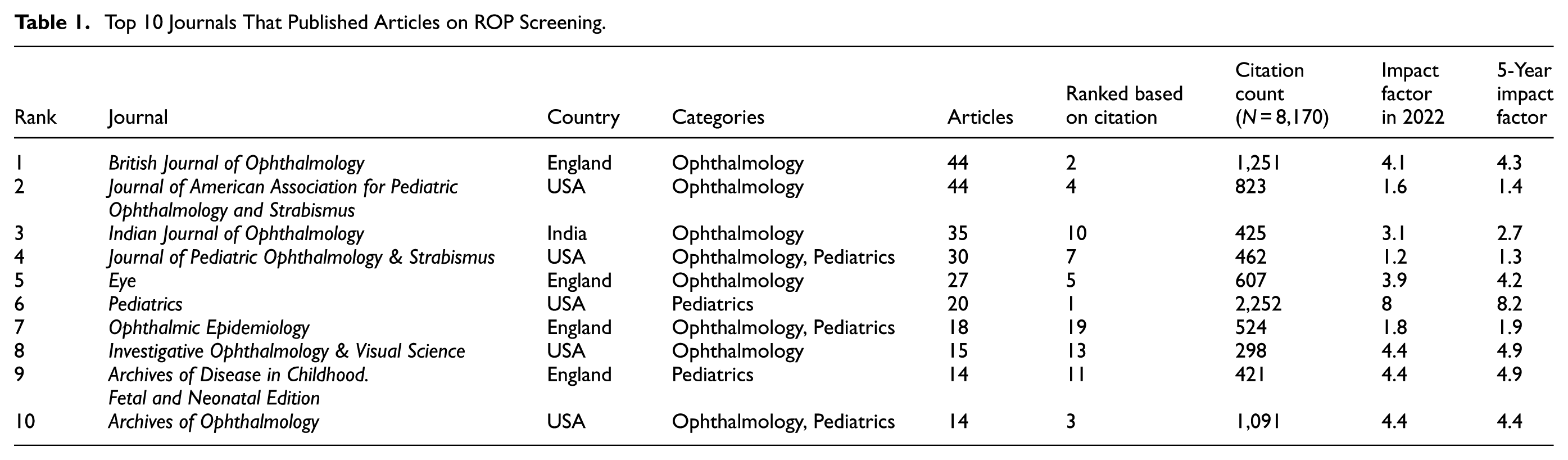
The 733 articles were published in 270 international peer-reviewed journals. As shown in Table 1, the British Journal of Ophthalmology and the Journal of the American Association for Pediatric Ophthalmology and Strabismus were the leading journals, each publishing 44 articles. These were followed by the Indian Journal of Ophthalmology, with 35 articles, and the Journal of Pediatric Ophthalmology & Strabismus, with 30 articles.
Top 10 Journals That Published Articles on ROP Screening.
Geographical Distribution of Publications
A total of 733 articles originated from 74 countries/regions. Table 2 presents the top 10 countries contributing to ROP screening research. The United States led with 196 publications, followed by India (87) and China (69). Sweden had the highest multiple-country publications (MCP) ratio, with 15 out of 24 publications (0.63), followed by Australia (7 out of 19, 0.37) and Canada (7 out of 20, 0.35).
Top 10 Countries That Published Articles on ROP Screening.

Note. The countries were identified by the affiliations of the listed authors. Freq. = Frequency; SCP = single country publication; MCP = multiple country publication.
Most Productive Research Institutions
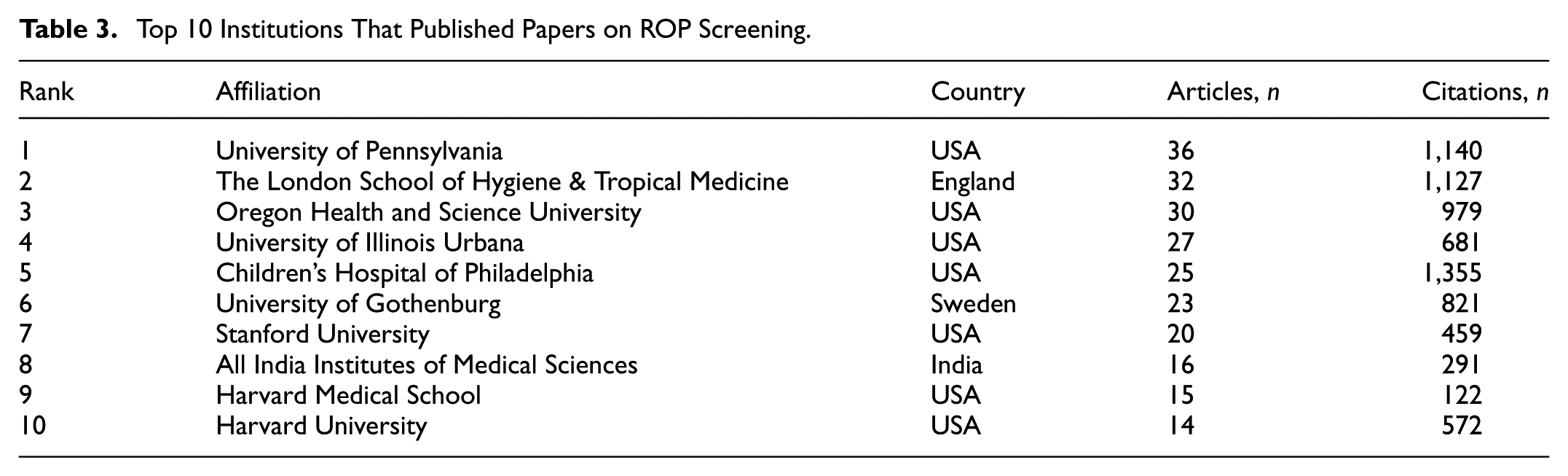
A total of 1,076 research institutions contributed to ROP screening research. The top 10 most productive institutions are listed in Table 3. The University of Pennsylvania led with 36 articles, followed by the London School of Hygiene & Tropical Medicine (32) and Oregon Health & Science University (30).
Top 10 Institutions That Published Papers on ROP Screening.
Using VOSviewer, a co-authorship analysis was conducted to map institutional collaborations. Among the 97 institutions that published at least 4 articles, 5 collaborative clusters were identified based on co-authored publications (Figure 2).
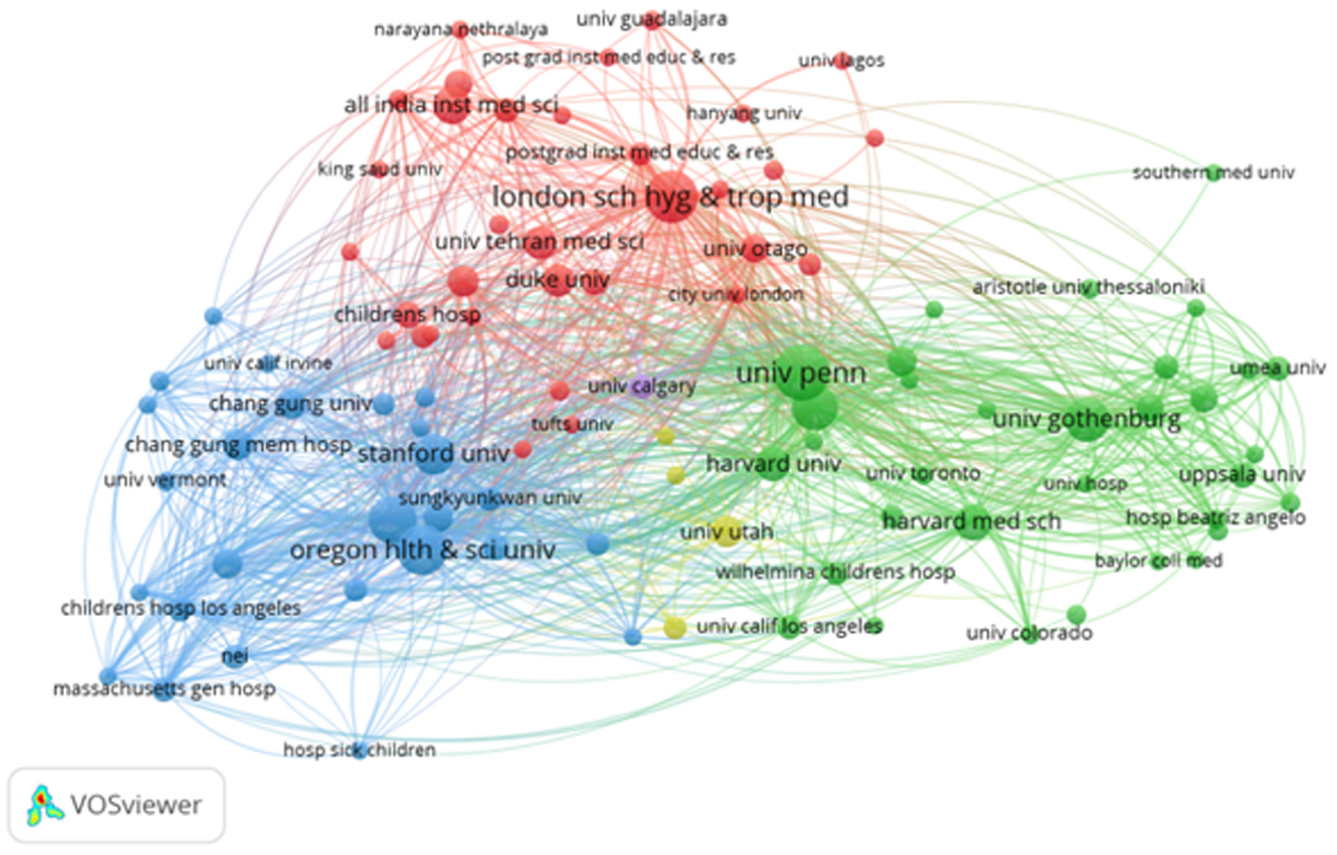
The co-authorship network of institutes that contributed to screening related research in ROP.
Most Influential Authors in ROP Screening Research
Three thousand one hundred twenty-two researchers authored a total of 733 ROP screening articles. Table 4 highlights the top 10 most productive authors in the field, with Ting D. leading with 34 articles, followed by Wong T. (28) and Tan G. (17).
Top 10 Authors Who Published Papers on ROP Screening.
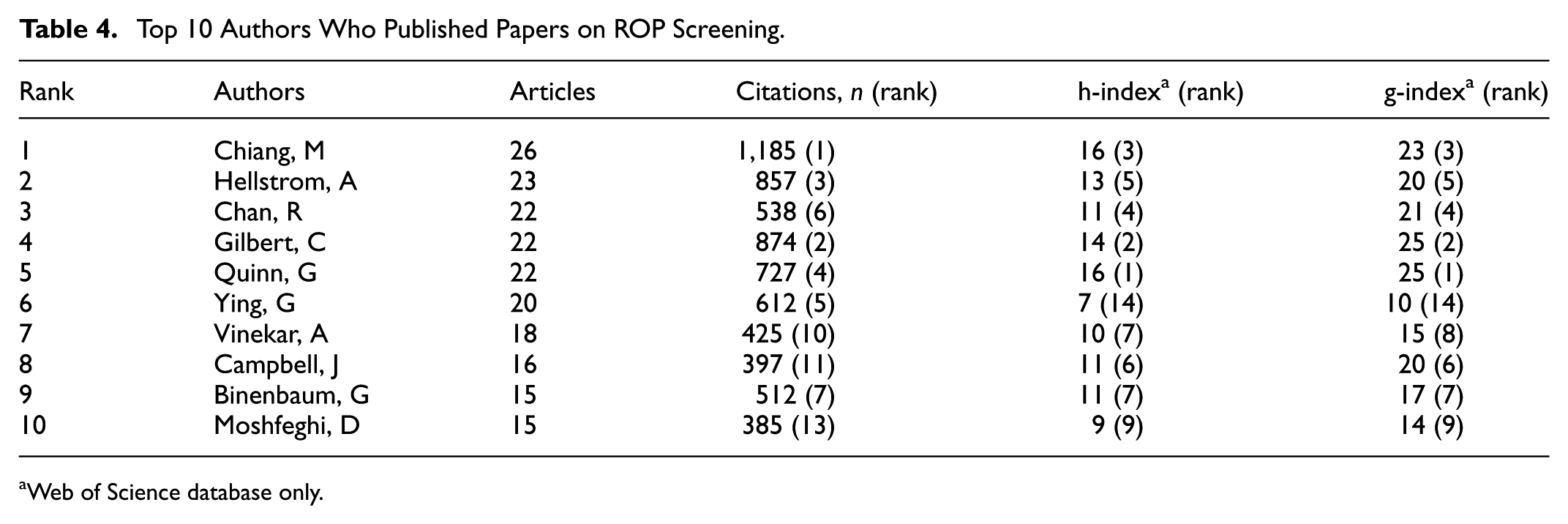
Web of Science database only.
In the co-authorship analysis, 98 of 3,122 authors published at least 4 papers. The largest cluster comprised 30 authors, organized into 4 distinct groups (Figure 3). Nodes represent authors, with size proportional to their number of publications. Links indicate co-authorship, and line thickness corresponds to the number of shared publications.
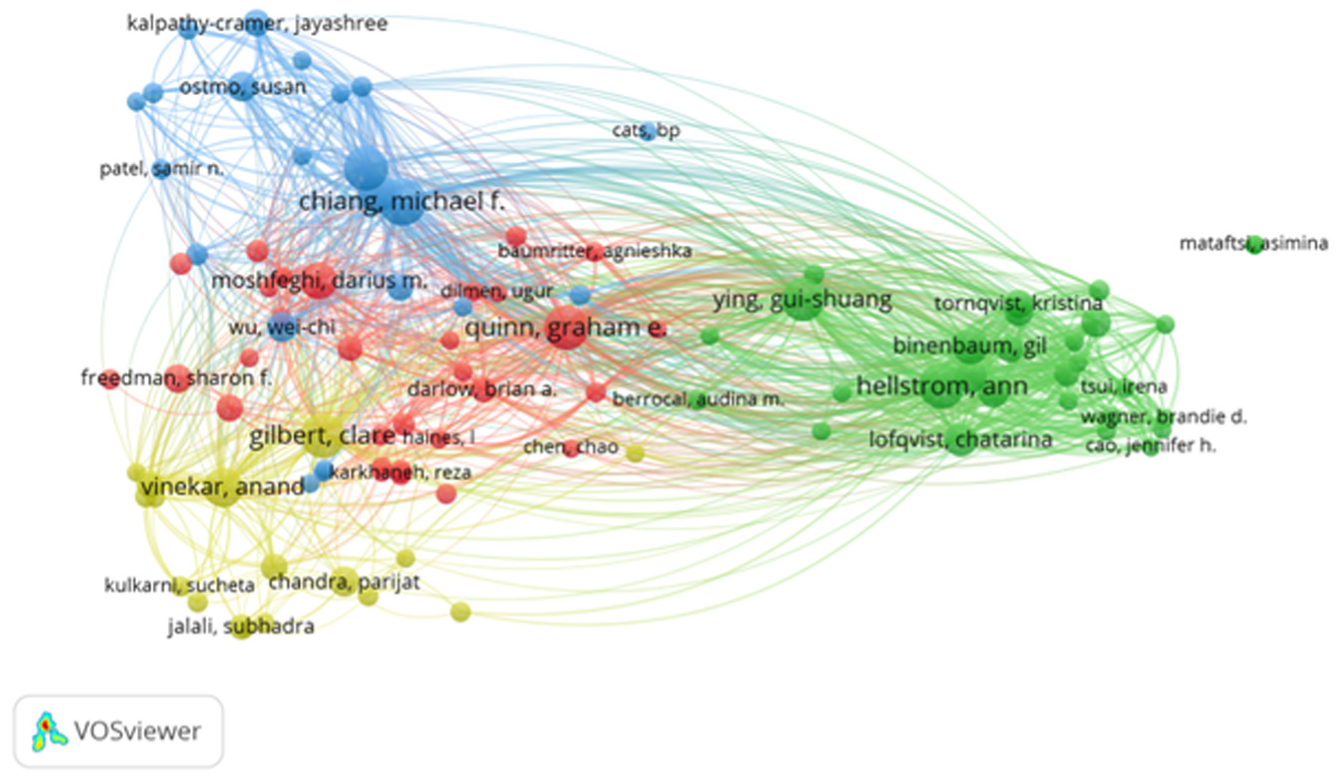
Co-authorship network of authors in ROP screening research.
Co-Occurrence Analysis of the Top 100 Keywords
A total of 1,486 keywords were identified from 733 articles. Table 5 lists the top 20 most frequent author keywords. Beyond expected terms such as “retinopathy of prematurity,”“ROP,”“infants,” and “preterm infants,” significant keywords like “risk factors” and “telemedicine” also emerged.
Top 20 Author Keywords for Screening Related Research in ROP.

Figure 4 displays a keyword co-occurrence network generated with VOSviewer, based on the top 100 keywords, which grouped into 5 thematic clusters. Keywords are grouped into five distinct clusters, each representing key research themes. Cluster 1 (Red) focuses on core concepts and epidemiology, including terms such as “retinopathy of prematurity,”“ROP,”“childhood blindness,”“risk factors,” and “screening,” highlighting disease prevalence, risk factors, and neonatal characteristics. Cluster 2 (Green) represents screening technologies and diagnostic approaches, featuring “telemedicine,”“artificial intelligence,”“deep learning,” and “optical coherence tomography,” with an emphasis on advancements in ROP detection. Cluster 3 (Blue) covers risk prediction and growth-related factors, with keywords like “preterm infants,”“birth weight,”“gestational age,” and “postnatal weight gain,” reflecting predictive models such as WINROP used for ROP risk assessment. Cluster 4 (Yellow) focuses on treatment strategies and disease progression, containing terms such as “threshold retinopathy,”“laser photocoagulation,”“intravitreal bevacizumab,” and “cryotherapy,” which represent therapeutic interventions and disease severity classifications. Cluster 5 (Dark Violet) highlights clinical management and screening procedures, including “eye examinations,”“pain,”“sucrose,” and “efficacy,” addressing infant care during ROP screening and pain management strategies. Node size corresponds to keyword frequency, and link thickness indicates the strength of co-occurrence between terms.
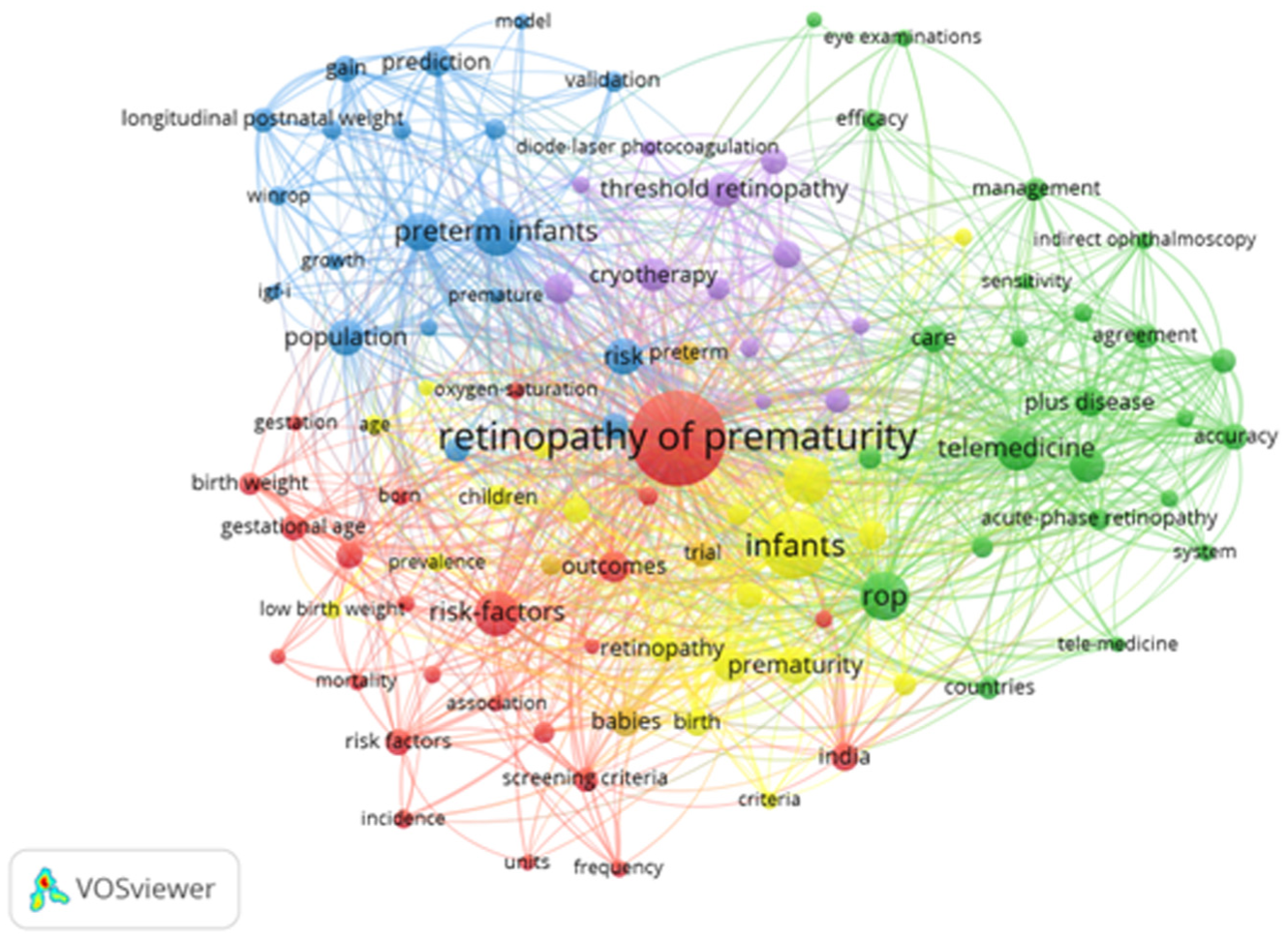
Co-occurrence network of the top 100 keywords in ROP screening research.
Reference Co-Citation Analysis
We analyzed the knowledge base of ROP screening research through 733 articles, which garnered 15,428 total citations—averaging 21.05 per article. As shown in Table 6, the top-cited publication was Gilbert, C. et al.’s “Characteristics of infants with severe retinopathy of prematurity in countries with low, moderate, and high levels of development: implications for screening programs” (Pediatrics, 2005), with 495 citations as of July 31, 2023.
Top 10 High Cited Articles in ROP Screening.

We then analyzed the 144 articles cited at least 30 times and generated a co-citation network using VOSviewer. Figure 5 displays the resulting map with 18 distinct clusters, each marked by a unique color.

The co-citation network of publications in screening-related research for ROP.
Analysis of Keywords with Citation Burst
Figure 6 shows the top 20 keywords with the strongest citation bursts, all lasting at least 3 years, as identified by CiteSpace. Long-standing keywords such as “retrolental fibroplasia” (1978–2009), “birth weights” (1993–2010), “threshold retinopathy” (2000–2011), and “cryotherapy” (1993–2014) maintained long-term influence. In contrast, newer keywords like “leading cause” (2018–2022), “positive predictive value” (2014–2022), and “artificial intelligence” (2020–2022) have emerged more recently, indicating growing research interest and likely future research priorities.

The leading 20 keywords exhibiting robust and sustained citation bursts lasting at least 3 years.
Discussion
This study presents a bibliometric analysis of ROP screening research, highlighting its growth, major contributors, and key trends. The publication output has risen markedly over the last two decades, reflecting advances in screening technologies and global interest in early detection strategies. Most articles appeared in high-impact ophthalmology and pediatrics journals, with citations correlating with journal prestige and collaboration extent.
The USA leads in research output, supported by robust healthcare infrastructure and funding (Statista Research Department, 2021). Contributions from developing countries—especially India and China—are increasing, driven by higher preterm birth rates and improved neonatal survival. Preterm birth rates can reach 25% in developing regions compared to about 5% in developed nations (Steer, 2005). While advances in neonatal care have improved survival, they have also increased the burden of ROP (Athikarisamy et al., 2015; L. Li et al., 2022). Many neonatal intensive care units (NICUs) in resource-limited settings face staffing and infrastructure shortages, worsening disease severity (Bowe et al., 2019). In response, multiple countries have developed context-adapted screening and management strategies (I. S. Ahmed & Badeeb, 2019; Akman et al., 2010; Gilbert et al., 2005).
Keyword analysis identified telemedicine and risk factors as primary research focuses in ROP screening. Telemedicine addresses specialist shortages through remote imaging (Brady et al., 2020), improving access and standardization (Fijalkowski et al., 2014). With advances in imaging and AI, its role continues to expand (Brady et al., 2020; Haleem et al., 2021). Risk factor identification remains essential for optimizing screening guidelines (Nair et al., 2022). Gestational age and birth weight are widely used, but criteria vary by region due to population-specific neonatal characteristics and practices (Fierson et al., 2018; Hellström et al., 2013; International Committee for the Classification of Retinopathy of Prematurity, 2005; Lang et al., 2005). Refining protocols to target high-risk infants is essential, given the discomfort and resource burden of repeated exams (Kleberg et al., 2008).
Burst keyword detection revealed a sharp rise in academic fields. Highly cited articles or keywords indicate their active discussion and utilization during specific timeframes (Feng et al., 2023). Burst keyword detection analysis revealed a surge in research interest in AI for ROP screening since 2020. AI aids objectivity by automating classification and providing real-time feedback (Campbell et al., 2021). AI algorithms have demonstrated high accuracy in assessing ROP vessel severity, thereby contributing to early detection and informed clinical decision-making (Greenwald et al., 2020; J. Li et al., 2022).
Additionally, AI also has the potential to alleviate workforce shortages, especially in regions lacking specialists (Barrero-Castillero et al., 2020). However, integration into existing systems—such as RetCam and cloud platforms—requires further development. Implementation will depend on collaboration among researchers, clinicians, and technology developers, with emphasis on large-scale validation and telemedicine infrastructure (I. Ahmed et al., 2023; Gensure et al., 2020; Ramanathan et al., 2022).
Keyword analysis reflects the evolving landscape of ROP screening research, highlighting the growing roles of telemedicine, AI, and risk factor assessment in shaping screening strategies. These advances can significantly improve access, accuracy, and efficiency. Future research should focus on validating AI-based screening tools, expanding telemedicine infrastructure, and refining risk-based screening guidelines to improve early detection and treatment outcomes.
Limitations
This bibliometric analysis provides a comprehensive overview of ROP screening research, integrating rigorous search strategies and systematic screening processes. However, certain limitations should be acknowledged. First, this study included only English-language publications, which may have excluded relevant non-English research. Second, reliance on Web of Science alone, though common for bibliometrics, means other databases such as Scopus and PubMed were not consulted. Future research should expand its scope to include databases such as Scopus and PubMed to capture a broader and more diverse range of studies.
Conclusion
This study provides a comprehensive bibliometric analysis of ROP screening research, identifying global trends, key contributors, and emerging themes across 733 articles. The findings underscore the growing role of telemedicine and AI-driven technologies, marking a shift toward automated and accessible screening methods. Although developed nations lead in research output, contributions from low- and middle-income countries are increasing, highlighting the global relevance of ROP screening. Future efforts should prioritize clinical validation of AI tools, expansion of telemedicine infrastructure, and refinement of screening protocols. Clinicians, researchers, and policymakers must collaborate to translate technological advances into effective, standardized, and equitable screening programs that improve outcomes for preterm infants worldwide.
Footnotes

Funding
The authors received no financial support for the research, authorship, and/or publication of this article.
Declaration of Conflicting Interests
The authors declared no potential conflicts of interest with respect to the research, authorship, and/or publication of this article.
Data Availability Statement
The data that support the findings of this study are available on request from the corresponding author, Yao Xu, upon reasonable request.