




Abstract
With the data from the Web of Science Core Collection-Citation database for the period (1970–2020), we conducted a dynamic visual systematic review of the literature on academic publishing with the help of bibliometric software, CiteSpace, and VOSviewer. The main purpose is to reveal the internal structures and hidden inferences, including the diversified discipline, top-ranked journals, most widely occurring topics, most cited and leading articles, highly productive and outstanding scholars, and most contributing institutions and countries. The co-citation, co-occurrence, cluster detection, and strong citation burstness were employed to show the intellectual base, evolutionary stages, and dynamics of transitions of academic publishing. The study defines the whole profile of international academic publishing, presenting its diachronic evolution, identifying research front, detecting emerging trends and abrupt changes. It expands the previous paradigm that ignored the large data corpus, aiming to provide certain reference value for future research of academic publishing.
Introduction
Publication is the mechanism both for knowledge construction and identity recognition. Scholars from all disciplines around the world have become increasingly inclined to publish research articles in international journals, especially in English to ensure their academic promotion, establish academic reputation or reap the monetary rewards. Academic publishing has now been a massive industry, with 3,500 publishers across the globe and over 1.8 million peer-reviewed articles produced each year in around 27,000 journals (Campbell et al., 2012, p. 6). The enormous commercial industry, academic publishing, employs (directly) an estimated 110,000 people globally (Ware & Mabe, 2015, p. 6), and generated $25.2 billion in 2013 (Outsell Report in 2014), predicting to grow at about 4% annually through 2017 (Ware & Mabe, 2015, p. 23). As Hyland (2015, p. 2) has stated, “academic publishing has, essentially, evolved as a means of funding, constructing, and evaluating knowledge, gradually extending its reach to become a global enterprise, increasing its outlets and profits, and tightening its grip on higher education and research.” Therefore, as the scientific resource of problem-solving research and the theoretical support of the development of academic publishing, it is important to explore and summarize the characteristics of diachronic development of academic publishing and to put forward some further suggestions and implications for future research.
During the last 50 years, academic publishing has increasingly expanded and diversified into different disciplines. In the existing literature, it has been mainly addressed in the following disciplines: Arts and Humanities-other topics (Coleman, 1977; Goodrum et al., 2001; Kling & McKim, 1999; Nnaji, 2018; Park, 2009; Tenopir & King, 1997; Xia et al., 2015), Computer Science and Information System (Horowitz & Curtis, 1982; Solomon & Björk, 2012), Business and Economics (Ellison, 2002; Laakso et al., 2017; Migheli & Ramello, 2014; Richard et al., 2015; Williams & Plouffe, 2007), Management and Policy (Beverungen et al., 2012; Gulbrandsen & Smeby, 2005; Svensson et al., 2008;), Language and Linguistics (Bocanegra-Valle, 2014; Flowerdew & Li, 2009; Fuentes & Gómez Soler, 2018; Hyland, 2016; Lee, 2014; Maniati et al., 2015), and interdisciplinary applications (Perlin et al., 2018; Ping & Bornmann, 2015; Stockemer & Wigginton, 2019). The increasingly growing number of publications from different disciplines makes it difficult to have an overall profile of academic publishing. Meanwhile, the overwhelming number of scientific literature available in a specific discipline makes a great challenge for researchers to obtain a structured overview of the literature on a particular subject (Nunen et al., 2018, p. 248; Rodrigues et al., 2014, p.1). The researchers need take some specific technics to push forward the research to meet the requirements of the overall investigation of academic publishing.
Technologically, the bibliometrics could be used to reveal and evaluate the performance of disciplines, journals, authors, institutions and countries, and also be used to assess the patterns of author co-authorship, institution co-authorship, and country or region co-authorship. It would be useful to help the scholars and researchers know the variety of research themes, the latest advances, the leading themes and the research hotspots in a specific field, both content-wise and geographically. By this way, we analyze the quantity and quality of 2,217 pieces of research on academic publishing from the database of the Web of Science Core Collection-Citation (1970–2020) from a bibliometric perspective, observing that the number of publications on academic writing changes over time. The information analyzed in the study presents a clear profile of research evolution, development and trend of academic publishing, which is of significance to help researchers identify the intellectual bases from disciplines, journals, references, research topics, institutions, and countries, as well as detect emerging trends and identify the research fronts. To map the knowledge structure of academic publishing research from a diachronic perspective, the study strives to answer the following questions:
(1) What are the major research themes and topics in academic publishing research in the articles cited in the WOS between 1970-2020?
(2) What are the research hotspots in the land of academic publishing?
(3) What articles have been most highly-cited as well as which authors, institutions, and countries have contributed the most in academic publishing?
(4) What are the general trends in the research field of academic publishing?
Following the brief introduction, Section 2 describes the database selection criteria, data collection, and method of the study. Section 3 discusses the discipline distribution, top-ranked journals, most widely occurring topics, the highly cited papers, the most leading and productive authors, and the cooperation of institutions and countries. Finally, the conclusion is drawn in Section 4, and followed by the references and Supplemental Appendix in this study.
Research Methodology
Database Selection Criteria
Many databases offer social sciences citation indexing service; some are internationally known, such as the WOS (Web of Science), Scopus, Google Scholar, Eon Lit, and CSA Illumina. Norris and Oppenheim (2007) states that “the Web of Science has the general, cited reference and advanced search features, with an extensive range of tools with which to manipulate search results” (p. 163) and claims that “the Scopus and WOS have a greater advantage over CSA Illumina and Google Scholar”(p.161). The WOS was selected as the search engine for its database is internationally recognized for owning the highest quality standards (Merigó, Gil-Lafuente, & Yager, 2015, p. 2647; Gaviria-Marin et al., 2019, p. 196), and most widely accepted and used for scientific publication analysis. WOS Core Collection-Citation database offers “a unique feature of citation counts, which allows the relative importance of articles out of a large pool to be qualified through the use of an objective measure of influence” (Dzikowski, 2018, p. 283). The WOS has been widely utilized by bibliometric researchers (e.g., C. Chen, 2017; Dzikowski, 2018; Ellegaard & Wallin, 2015; Gaviria-Marin et al., 2019; Janmaijaya et al., 2018; Nunen et al., 2018; Shonhe, 2020; Su et al., 2019; Zhou & Kwon, 2020) to explore the scientific change in a certain field. Furthermore, one of the tools adopted in the study is CiteSpace, which is originally designed for the WOS database literature visualization. Therefore, to be neutral and informative with the research information, the study chose WOS Core Collection database (See https://webofknowledge.com).
Data Collection
The databases selected are SCI-EXPANDED (1970-present), SSCI (1970-present), A & HCI (1975-present), CPCI-S (1990-present), CPCI-SSH, (1990-present), BKCI-S (2008-present), BKCI-SSH (2008-present) and ESCI (2015-present) provided by the University of Southampton. The most common retrieval means in various databases are mainly “full text,” “topic,” “title,” and “abstract,” among which “topic” is recommended to utilize for the data analyzed by CiteSpace (Li & Chen, 2016, p. 15). Following previous studies (e.g., Shonhe, 2020; Su et al., 2019), the parameters were set as follows: Database = WOS Core Collection, Search Topic = (“academic publishing” or “scholarly publishing” or “academic publication” or “scholarly publication”), Document Type = article, Language = English, Time Span from 1970 to 2020. A total of 2,217 documents were yielded for content analysis on January 23rd, 2021 (the data up to January 21st, 2021). The database was created including all bibliographic information (author, titles, abstract, source, volume, page, publication year, and cited reference) of all publications from 1970 to 2020. The criteria of inclusion and exclusion of documents have been considered, such as the retrieval means and the parameters, search topic, document type, language, time span, and bibliographic information. Meanwhile, some documents are excluded; those are mainly involved in book review, correction, biographical items.
Method
Bibliometric analysis is applied in this study, aiming to conduct an objective and scientific study of the academic publishing based on published researches by adopting the statistical results from the WOS database. Bibliometric analysis studies bibliographic material objectively and quantitatively (Merigó, Gil-Lafuente, & Yager, 2015, p. 2645), proving useful for classifying information based on different variables in a specific thematic field (Albort-Morant & Ribeiro-Soriano, 2016, p. 1776; Merigó et al., 2015, p. 420). The bibliometric method could be adopted to explore, classify, and analyze a large number of historical data, to trace back academic citations, and to evaluate the knowledge development of a specific topic, and even potentially to forecast the future (Daim et al., 2006, p. 983). The basic bibliometric studies employ a citation analysis of the academic publishing. From different perspectives, the academic publishing could be analyzed on the certain unit of analysis. The most common units consist of journals, authors, cited references, documents, institutions, and countries (Dzikowski, 2018).
Meanwhile, science mapping is used in this study and involved in the construction of bibliometric maps that show the dynamic and structural aspects of specific scientific research disciplines (Cobo et al., 2011, p.1382). It is mostly directed at monitoring the interaction within the scientific discipline and individual sub-disciplines to identify its main actors, its evolution and (cognitive) structure (Cobo et al., 2011, p. 1383; Noyons et al., 1999, p.592). As C. Chen (2017) describes, “a science mapping study typically consists of several components, notably a body of scientific literature, a set of scientometrics and visual analytic tools, metrics, indicators that can highlight potentially significant patterns and trends, and theories of scientific change that guide the exploration and interpretation of visualized intellectual structures and dynamic patterns”(p. 3).
CiteSpace is multivariate, time-sharing, dynamic and Java-based citation visualization analysis software, developed by Professor Chen Chaomei from the College of Computing and Informatics at Drexel University, USA (C. Chen, 2017). It has the dual properties and features of “graph” and “spectrum,” showing many implicit complex interrelationships between knowledge units or knowledge groups, such as network, structure, interaction, intersection, evolution or derivation (Li & Chen, 2016, p. 3). CiteSpace displays scientific mapping through clustering view, timeline view, timezone view and other functions (Y. Chen et al., 2015, p. 248). The metrics employed in the study are modularity, silhouette, betweenness centrality, sigma, and citation burstness (C. Chen, 2006, p. 363). Modularity and silhouette values are utilized to assess the quality of the network, and the mean silhouette value from the clusters suggests the homogeneity of the whole knowledge network. Betweenness centrality is “used to highlight potential pivotal points of paradigm shift over time” and citation burstness detection algorithm is “used to identify emerge research-front event” within a short period (C. Chen, 2006, p. 359). Sigma metric, with the betweenness centrality and citation burstness, is to identify the most active research fields, the millstone documents with new and influential ideas (C. Chen, 2017). Cluster view and timeline view are two complementary visualization functions adopted in the study. We also employed heterogeneous network to offer a more comprehensive representation of dynamics in a specialty.
VOSviewer has also been used to build knowledge networks of scientific publications, keywords, terms, references, journals, authors, institutions, and countries through all types of nodes. VOSviewer is a mapping and clustering analysis software developed by Van Eck and Waltman based at University of Leiden, Netherlands. It has been designed primarily for the analysis and visualization of bibliometric networks (van Eck & Waltman, 2010, p. 524). VOSviewer is available for free at https://www.vosviewer.com, and enables the creation of terms knowledge mapping. Compared with CiteSpace, VOSviewer focuses on the cluster relationship between deconstructed nodes of density and distance, supporting the powerful intuitive visualization function, such as label view, density view, and scatter view (van Eck & Waltman, 2010).
CiteSpace and VOSviewer are professional scientometrics and visual analytic software designed for determining emerging trends and potential changes in scientific research through visualizing and analyzing the bibliometric networks. Therefore, following the studies of Janmaijaya et al. (2018) and Lei et al. (2019), we utilized both CiteSpace and VOSviewer in the study to better visualize the scientific change in academic publishing.
Results and Discussion
A total of 2,217 documents were published and indexed in the WOS from 1970 to 2020. During the year from 2011 to 2020, a considerably upward growth of publication has been observed. The high number of citations from 578 to 2,816 (2011–2020) could be attributed to the fact that a great amount of articles have received significant attention and been recognized by the academic community. Some reasons could be drawn from the accumulative effect. First, the topic is attracting much more attention of researchers and scholars, and receiving support from more institutions worldwide. Second, a great number of interdisciplinary studies have emerged, including but not limited to, linguistics, literature, cultural studies, and educational research. This study makes the scientometric analysis based on the 2,217 documents, clarifies the basic situation, characteristics, and regularity of academic publishing research, and explores clearly the knowledge structure and research fronts in the specific field.
Discipline Distribution and Journals Citation
The discipline distribution indicates a particular field of research. Nodes with high betweenness centrality identify boundary spanning potentials that may lead to transformative discovered (C. Chen, 2017, p. 9). For frequency and centrality, the top-ranked disciplines are Information Science & Library Science, Computer Science and Interdisciplinary Applications, Education and Educational Research, Arts and Humanities-other topics, Social Sciences-other topics, Language and Linguistics, Business and Economics, Communication, and Social Sciences-other topics. In addition, Engineering, Environmental Sciences and Ecology, Psychology, Biochemistry and Molecular Biology also have a good centrality (C-value > 0.1) (Statistics from CiteSpace). All these disciplines provide a research foundation for the development of academic publishing.
The Sigma value reflects the structural and temporal significance of a cited reference. The top-ranked items by Sigma are Engineering, Environmental Sciences & Ecology, Science and Technology-other topics, Computer Science, Psychology, Biochemistry and Molecular Biology, Education and Educational Research, Neurosciences and Neurology, Social Sciences-other topics, Business and Economics. Humanities and Multidisciplinary has the strongest citation burstness of 24.0 from 1970 to 2001. The others with the strongest citation burstness are Management (2005–2011), Computer Science and Library (2000-2006), Language and Linguistics (2013–2015), Medicine, General and Internal (2018-2020). The six categories have got significant attention in different periods.
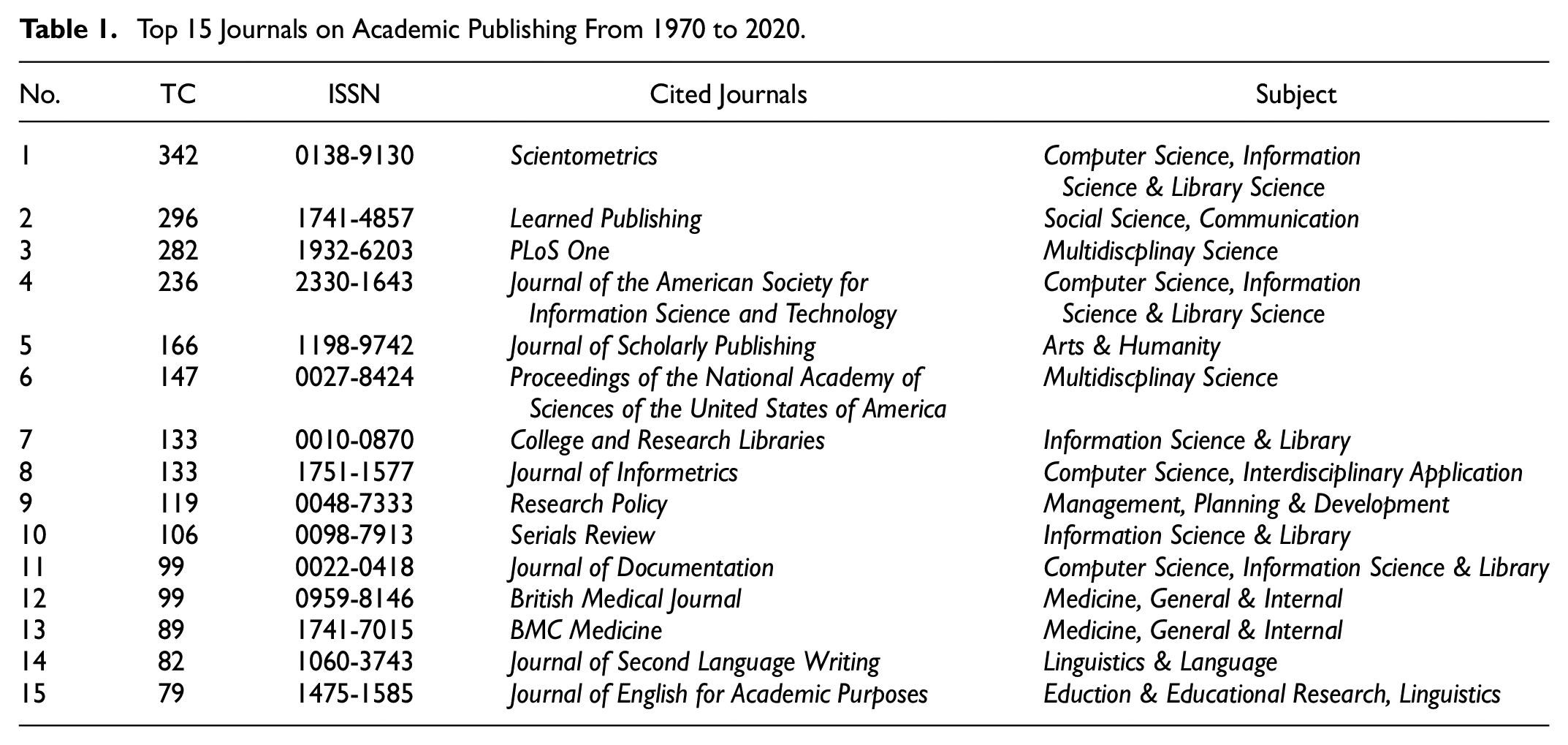
Journal co-citation reveals the cross-relationships between related journals, but also the status of journals in the discipline, providing a basis for document collection and management, and important guidance for scholars (Xiang, 2015, p. 42). Table 1 lists the top 15 cited journals by times cited (TC), all of which are the main citation objects and dissemination vehicles of academic publishing. Particularly, Scientometrics ranks No.1 (TC) and has the most important impact on academic publishing. Through the Burstness View function, it could be observed that some journals have the strongest citation Burstness, such as Journal of Scholarly Publishing (1975–2005), College and Research Libraries (1990–2003), Journal of Documentation (2001–2006), Learned Publishing (2011–2013), Journal of the Association for Information Science and Technology (2017–2020). Those journals are the main sources for scholars’ document collection of academic publishing during those five periods respectively.
Top 15 Journals on Academic Publishing From 1970 to 2020.
Keywords Co-occurrence
On the VOSviewer interface, “Type of Analysis” is set as “Co-occurrence,” “Unit of Analysis” as “Author Keywords,” “Counting Methods” as “Full Counting,” a total number of 3,671 keywords were identified and 155 keywords met the threshold of 5 for further analysis (See Figure 1), with links of 1,272 and the total link strength of 2,284.

Keyword co-occurrence network.
Keywords reveal the core information reflecting the main content of the articles. The circle and label in the knowledge graph represent the occurrence of a keyword, its size represents the level of importance, and each color represents a category. The distance between keywords shows the degree of their relationship, and different colors are adopted to show the different clusters. The more the number of nodes in the graph, the greater the weight in the field. Figure 1 gives a knowledge mapping of keywords co-occurrence network of H-frequency (N > 5), with a cluster distribution.
The top 60 keywords on academic publishing are listed by citation counts (See Table 2). Betweenness centrality is an index to measure the importance of the literature. The higher betweenness centrality (C-value) of the literature, the more importance the position in the network structure. Keywords with high centrality are “science,” “academic publishing,” “scholarly publishing,” “citation,” “journal,” “publication,” “open access,” “articles,” “scholarly communication,” “impact,” bibliometrics”, “quality,” “peer review,” “authorship,” “knowledge,” “English,” “author(ship),” “academic publication,” “communication,” “reliability,” “pattern,” “model,” “library,” “future,” etc. It is suggested that the topics closely associated with academic publishing covering different themes. For instance, the keywords (“science,” “social science,” “knowledge,” “language” and “university”) indicate the study on publishing contexts, and keywords (“students,” “gender,” “editors” “multilingual scholar” and “author”) reveal study on personal characteristics, keywords (“performance,” “peer review,” “predatory journal,” “predatory publishing,” “quality,” “model,” etc.) on assessment or evaluation. All of the keywords reflect the research focuses and hotspots in the field of academic publishing. “Academic publishing” is the research hotspot, “open access” breaks the traditional sources and becomes the important and influential means of publishing and the “impact” of some open access journals are enhanced for their openness and convenience, “predatory journal” has been criticized by authors, the measure of ensuring publishing “quality” and “scholarly communication” is to employ the “peer review” which is now the most popular method in most of the influential journals.
Top 60 Keywords on Academic Publishing.

The emergence of a new field may indicate the development direction of the theme. The results obtained by the burstness algorithm identify the trend of the theme on academic publishing over time. Through the Burstness View of Citespace, the results display the keywords with the strongest citation Bursts (See Figure 2). “Communication” (2000–2010) has the strongest citation burst (N = 6.07), the keyword “predatory journal” (2016–2017) followed. All the words with the strongest citation bursts reveal the tendency of the subject or theme on academic publishing in different periods.

Keywords with the strongest citation bursts.
Through the overlay visualization of VOSviewer, we observe that the keywords are research hotspots of academic publishing in the last 5 years, including “scholarly communication,” “internationalization,” “digital scholarship,” “digital humanities,” “altmetrics,” “bibliometrics,” “strategies,” “digital humanities,” “grey literature,” “public policy,” “open access journals,” “China,” “Scopus,” “web of science,” “research assessment,” “perception,” “attitude,” “bias,” “women” and “digital publishing,” “ multilingual scholars,” “academic writing,” “English,” “academics,” “open science,” “predatory publishing,” “predatory publishers,” “predatory journals,” “predatory publishing,” “blockchain,” “reproducibility,” “co-authorship,” “licensing,” “scientific writing” and “journal quality.” The finding indicates the research on academic publishing enters into diversified themes, such as “predatory publishing,” “alternative way,” “special education journal,” “global sociology,” “linguistic injustice,” “scholarly publishing,” “predatory publishing practice” and “evolving strategies.” “Predatory publishing practice” shows its negative impact on publishing fees even it is convenient and fast in publishing, harms the quality of the articles and friendly development of the journals at last.
Reference Co-citation
The scientific knowledge mapping of reference co-citation networks explores the citation base of documents by citation counts. The nodes are tagged with the first authors and the publication year. The larger the node, the more citation counts. The Modularity Q (0.9166) and the Silhouette (0.9484) in Figure 3 indicate that the network community structure is of high significance and network homogeneity is higher.
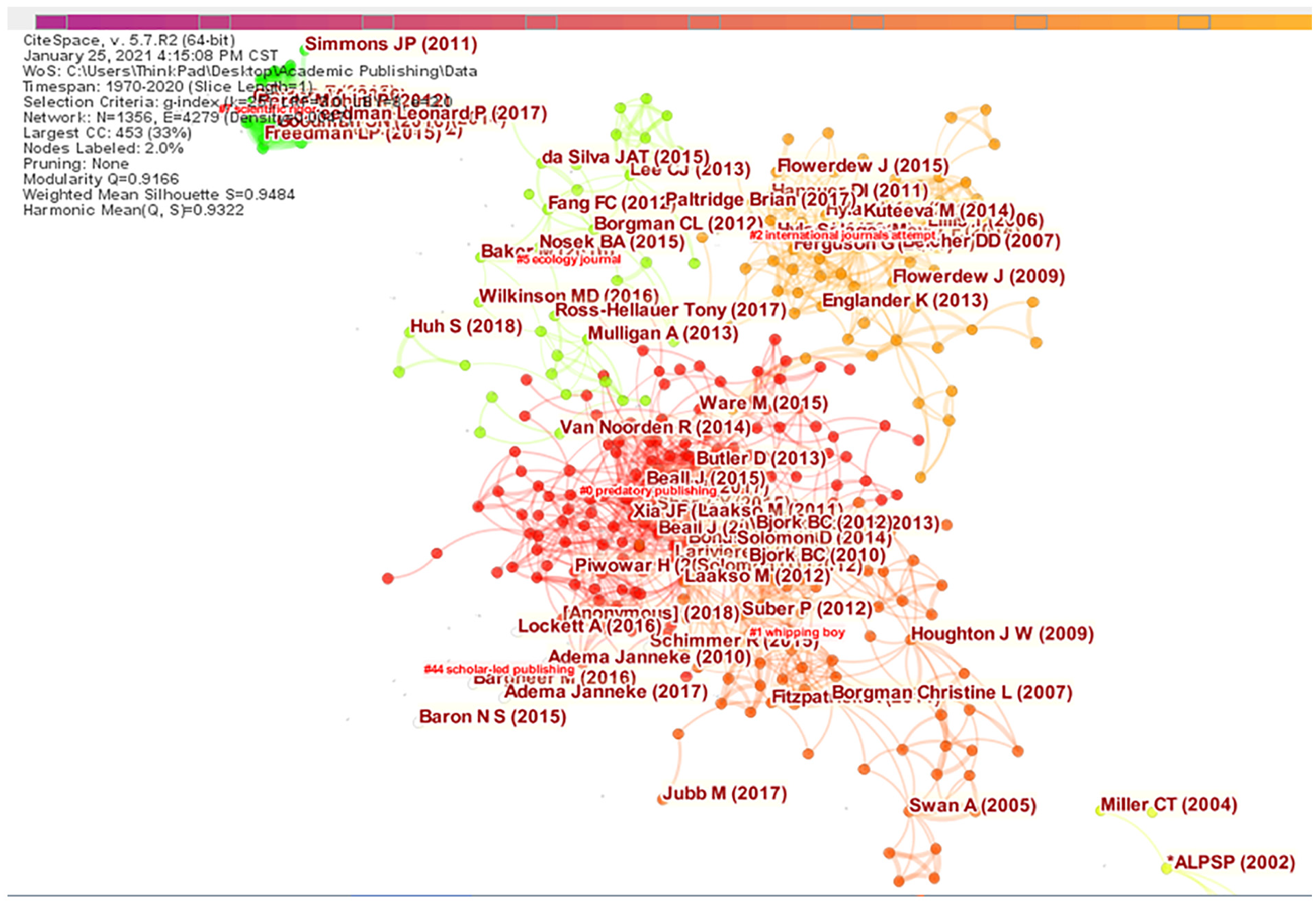
Knowledge mapping of reference co-citation network.
Through cluster detection, the reference network is segmented into nine co-citation clusters, labeled by indexing terms from their own citers. Supplemental Appendix 1 summarized the largest three clusters. The largest cluster (#0) has 155 members and an S-value (Silhouette) of 0.903. It is labeled as “predatory publishing” by LLR (Log-likelihood rate) and TFIDF (Term frequency-inverse document frequency), and as “editors opinion” (4.96), “scientific productivity” (4.96), “research policies” (4.96) et al. by MI (Mutual information) (See Supplemental Appendix 1). Many research focus on the influential factors of academic publishing quality. The positive factors include the editors’ opinions and research policies to ensure the quality of publishing. However, the negative factors of the large amount of emergence of predatory publishing have a bad impact on academic publishing for the money-oriented purpose and low requirements of review. The most active citer to the cluster is Siler (2020) Demarcating spectrums of predatory publishing: economic and institutional sources of academic legitimacy.
The second largest cluster (#1) has 85 members and an S-value of 0.951. It is labeled as “whipping boy” by LLR, open access by TFIDF and as “library literature” (0.67), “scientific productivity” (0.67), and “scientific rigor” (0.67) et al. by MI (See Supplemental Appendix 1). Open access aims at creating free and open research situations for researchers all over the world. It challenges the traditional payment-oriented publishing agencies and meets with too much opposition. Generally, open access enhances the spread and influence of academic publishing. The most active citer to the cluster is Kingsley and Kennan (2015a) Open access: the whipping boy for problems in scholarly publishing.
The third largest cluster (#2) has 72 members and an S-value of 0.969. It is tagged as “international journals”attempt by LLR, academic publishing by TFIDF, “Vietnamese scholar” (0.67), “journal ranking” (0.66), ‘research assessment exercise” (0.66) et al. by MI (See Supplemental Appendix 1). The impact factor of journal represents its quality and influence and is the author’s primary consideration of selecting important journal. Researchers have made lots of studies on journal ranking and done too much research assessment exercise. The most active citer to the cluster is Curry and Lillis (2010) Academic research networks: accessing resources for english-medium publishing. References with the strongest citation bursts are illustrated in Figure 4.
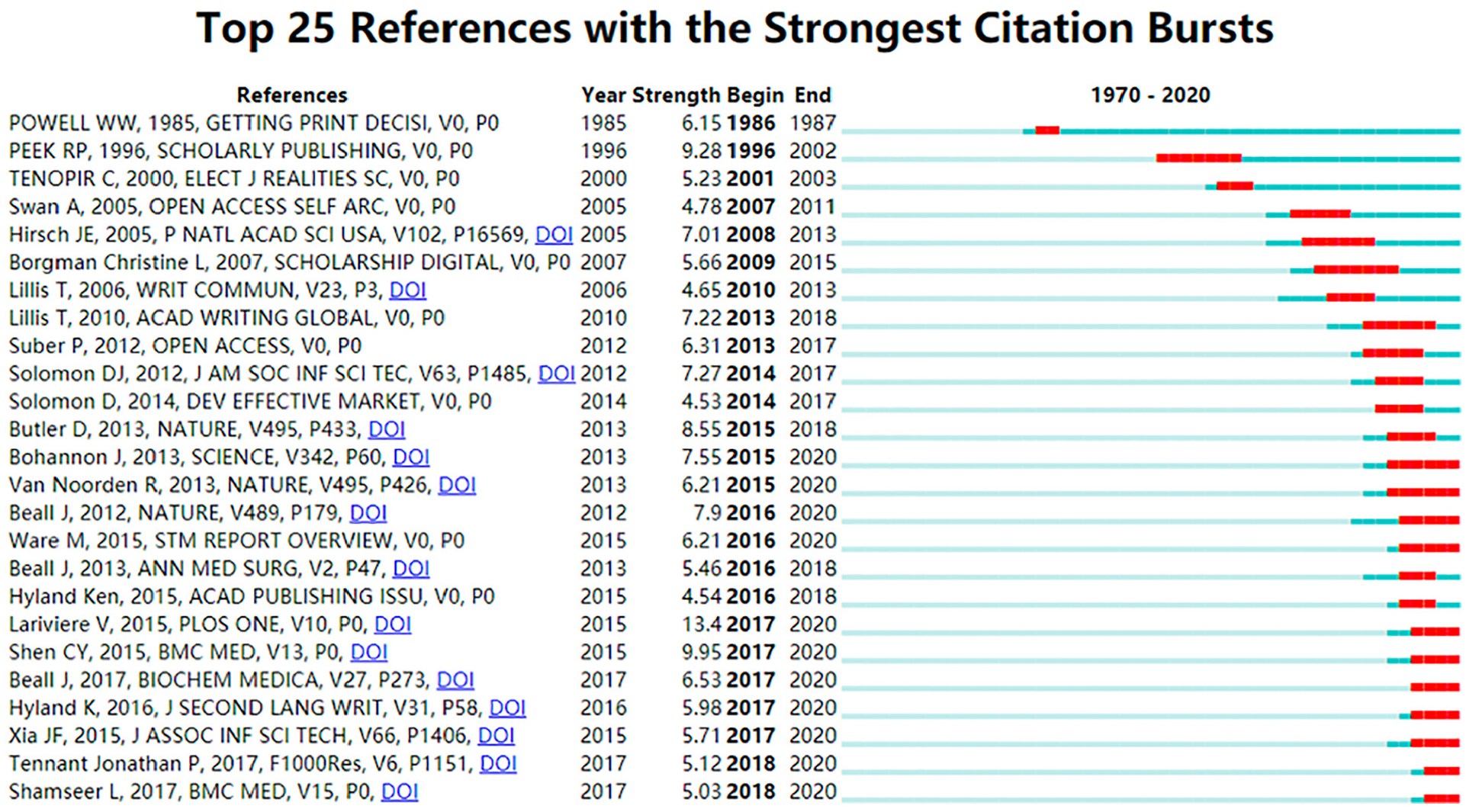
References with strongest citation bursts.
Table 3 lists the most influential articles on academic publishing by TC on WOS. Of the 20 articles, the references with “
Top 20 Ranked Reference on Academic Publishing.

Note. Reference with “*” is the highly cited paper in the field. TC = times cited.
Agha et al. (2017) is the highly cited reference, receiving enough citations to set in the top 1% of the academic field of Surgery. It presented the STROCSS (Strengthening the Reporting of Cohort Studies in Surgery) Guideline to the international surgical and academic community, applicable for cross-sectional studies and case control studies. Dinh et al. (2014) is the most highly cited paper, placing in the top 1% of the academic field of Management. The study provided an overview of the research trends in leadership theory remaining at the forefront since 2000, and gives a thorough description of a process-oriented organizing framework as a way to integrate diverse leadership theories. The most highly cited article is by Gulbrandsen and Smeby (2005), which proposes there is neither a positive nor negative relationship between academic publishing of university professors and industry funding based on a questionnaire study in Norway. Cronin (2001) investigated the deviant publishing practices in biomedicine with high hyperauthorship and evaluates the extent the present trends in biomedicine academic communication be a predictor in other discipline development.
Larivière et al. (2015) is one of the highly cited papers, placing the top 1% in the field of multidisciplinary sciences. They carried out a bibliometric analysis of 45 million documents indexed in the WOS (1973–2013), and examined the effect of the publishers’ transformative change on citation impact. The findings showed that the academic publishers (Springer, Elsevier, Blackwell, Taylor & Francis) in NMS (natural and medical sciences) and SSH (social sciences and humanities) dramatically increased the output of scientific literature publication since the mid-1990s. The study also explored the effect of publisher change on the citation impact. Lillis and Curry (2006) conducted a longitudinal text-directed ethnographic study of scholars working in psychology outside of English-speaking countries, tracking texts from local peripheral research and writing contexts to English-medium publications. Focusing on three text histories, the study illustrated the extent and nature of literacy brokering in English-medium publications, and exemplify literacy brokers’ orientations with different categories.
Xia et al. (2015), among the top 1% in Information Science and Library Science, examines the author profiles for the predatory journals and the more well-recognized OA (Open Access) journals, finding that most of the authors are young and inexperienced, from developing countries, in support with the study of Bohannon (2013). The results proved that the academic standards of OA journals are reflected by author profiles and different groups of authors are attracted by different OA publications. Shamseer et al. (2017), the top 1% in Medicine General Internal, made a cross-sectional comparison study of 93 potential predatory journals, 99 legitimate OA journals, and 100 subscription-based journals. Thirteen evidence-based characteristics were identified to distinguish the potential predatory journals from presumed legitimate journals.
Hyland (2016) made a critical examination of the evidence for linguistic injustice, declaring that framing publication problems as Native and Non-native groups services to dispirit EAL (English as an Additional Language) writers and marginalize the writing difficulties experienced by novice academics of any first language. He has stated that the “disadvantage orthodoxy” positions “does a serious disservice to both native and non-native English speaking writers” (p. 66), and calls for a more balanced and inclusive view. Hyland (2003) took a different stance that self-citation is of great use in wider context and investigated the use of self-citation and authorial mention in research articles in eight disciplines. With text analysis and interview, he showed the ways and to what extent self-mention is employed, providing insights into the promotional strategies of individuals, epistemological and social preferences in the disciplines.
Duff (2010) discussed the issues with race, gender, culture and academic discourse socialization, and interpreted how social positioning affects participants’ engagement and performance in learning communities. Holman et al. (2018), the highly cited in biology, investigated the gender of 36 million authors from more than 100 countries in about 6,000 journals, concluding that gender gap across STEMM (Science, Technology, Engineering, Mathematics, and Medicine) disciplines appears likely to remain for generations in specific fields, and the number of male authors invited by journals to submitting is about twice than female authors. Huang et al. (2020), among the top 1% in multidisciplinary science, conducted a longitudinal comparison of gender differences in the performance of scientific careers in four disciplines. They revealed that female and male have a comparable annual rate of performance and have equivalent citation impact for the same size of work. They also demonstrate that their differences in performance and impact are due to the gender-specific sustainability over the whole academic career. Köhler et al. (2020), the highly cited paper in psychology applied, provided a competency framework for peer review, and the ways and suggestions for improving and fostering high-quality peer reviewing.
The top ranked references in Table 3 have shown that the academic publishing is understood in a deeper and more comprehensive way with a different perspectives and focuses. The research fronts are inspired and raised from the common intellectual base. Through the function of cluster exploration of CiteSpace, the research fronts could be drawn, including predatory publishing (Perlin et al., 2018), academic publishing (Lillis et al., 2010), global sociology (Sorokin, 2018), behavioral disorders (Cook, 2016), whipping boys (Hess & Hoerndlein, 2015; Kingsley & Kennan, 2015a, 2015b), academic librarians (Baro & Eze, 2017; Bosah et al., 2017), linguistic injustice (Hyland, 2016), and open access publishing (Weckowska et al., 2017; Zhu, 2017).
Author Co-citation
Author co-citation analysis reveals the influential researchers in a specific discipline. Co-citation network and cluster analysis display the research themes and discipline distribution of the similar authors. The top 10 authors ranked by betweenness centrality are Garfield, E. (0.29), Harnad, S. (0.13), Altbach (0.11), Bjork, B. C. (0.08), Bourdieu, P. (0.08), Cole, K. (0.07), Suber, P. (0.06), Tenopir, C. (0.06), and Ware, M. (0.06). The top 10 authors ranked by TC are Bjork, B. C., Harnad, S., Suber, P., Lariviere, V., Garfield, E., Tenopir, C., Flowerdew, J., Ware, M., Van Noorden, R., and Lillis, T. Harnard, S. had the strongest citation burst with the strength (S) of 19.66 from 1998 to 2011. The other top 24 cited authors with the strongest citation bursts are such as Lariviere, V. (S = 11.98; Year = 2017–2020), Beall, J. (S = 11.67; Y = 2016–2018), Peek, R. P. (S = 10.23; Y = 1996–2002), Lawrence, S. (S = 9.52; Y = 2001–2009), Tenopir, C. (S = 7.67; Y = 1998–2012), and Van Noorden, R. (S = 7.43; Y = 2015–2018) (See Figure 5).

Authors with strongest citation bursts.
Timeline visualization in CiteSpace depicts clusters along horizontal timelines (C. Chen, 2017, p. 15). The clusters are showed from left to right, arranging vertically in the descending order of the size. The colored curves represent co-citation links added in the year of the corresponding color. Figure 6 visualizes the timeline network of the author co-citation of the largest clusters, showing the sequence of features of each cluster with citation patterns.

Timeline visualization of the author co-citations.
The Modularity Q-value (0.7746) and the S-value (0.8922) in the cluster labeling (See Figure 6) suggest that timeline view of the clusters of author co-citation network is of great significance, and small clusters also exist in the network mapping. In addition, there were a series of milestones research from 1990 to 2019. In the largest cluster #0 (1990–2020), the most influential authors are Tenopir, C., Harnad, S., Anderson, M. R., Lariviere, V., Swan, A., Suber, P., Barjak, Willinsky, J., Hicks, D., and Lessig, L., who carried out the studies related with the keywords (e.g., open access, journals, whipping, psychological, problems, publishing, view scholarly et al.) In Cluster #1 (1991–2020), the signals of tree ring history are not obvious, only some authors conducted on this theme, including Peek, R. P., Ginsparg, P., Lawrence, S., and Kling, R. For cluster #2 (1990–2020), scholars with important contributions are Garfield, E., Cronin, B., Glanzel, W., Hirsch, J. E., and Bornmann, L., doing the researches with the theme keywords (e.g., gender, review, peer, outcome). Cluster #3 (1991–2020) focused on academic writing, the influential scholars are Bourdieu, P., Pennycook, A., Canagarajah, A. S., Hyland, K., Ivanic, R., and Blommaert, J. In Cluster #4 (1996–2020), the contributors are Butler, D., Bourdieu, P., Anderson, M. R., Shen, C-Y., and Berger, M. In Cluster #7 (1993–2020), the most influential scholars are Smith, R., Shamseer, L., Tennant, J. P., and Gargouri, Y.
Cooperation of Institutions and Countries
The cooperation network represents the degree of refinement of a specific research field: the more frequent the cooperation, the deeper the development of the discipline. The size of the node in the cooperative knowledge mapping shows the number of articles published by institutions and countries, and the links reflect their cooperative relationship (Li & Chen, 2016). Through cluster detection analysis of CiteSpace, the study analyzes the scientific cooperation network of international academic publishing from different co-authorship levels, including co-institution and co-country cooperation. The Modularity Q-value (0.6926) and the S-value (0.9466) labeled in the cluster (See Figure 7) suggest that the network community structure is highly significant and network homogeneity is relatively high.

Co-authorship network of institutions and countries.
The top 10 countries are the USA, England, Australia, Canada, the People’s Republic of China, Germany, Spain, South Africa, Italy, and the Netherlands. The top ranked country is the USA with TC of 690. The second is England with TC of 287. The following are Australia (152), Canada (120), the People’s Republic of China (90), Germany (83), Spain (66), South Africa (54), Italy (43), and Netherlands (41). The top ranked item by citation bursts is India with strength of 7.46 (2018–2020). And the others with the strong burstness are Russia (Strength = 7.21; Year = 2017–2020), Australia (S = 7.01; Year = 2009–2015), Iran (S = 4.70; Y = 2015–2018), South Korea (S = 4.29; Y = 2018–2020), Taiwan (S = 4.25; Y = 2009–2015), Switzerland (S = 4.07; Y = 2018–2020). The results demonstrate that the scholars in these countries have realized the importance of scholarly publication. The study also observed the three largest cooperation clusters: USA-centered, England-centered, and Australia-centered network. The cluster around the USA mainly includes India, Ireland, Iran, Japan, and Italy. The English-centered network consists of Netherland, South Africa, Russia, and Malaysia. The cluster around Australia mainly contains Singapore, New Zealand, and the People’s Republic of China.
The 10 top-ranked institutions by TC are University of Illinois, Hanken School of Economics, University of Toronto, Indiana University, University of California Berkeley, University of Oxford, Harvard University, University of Sydney, and University College London. The five top-ranked items by centrality are University of California (Los Angeles), Stanford University, Columbia University, University of Pennsylvania, and University of California (San Diego). The first largest cluster mainly has Harvard University, Indiana University, University of Melbourne, University of Michigan, and University of Washington. The second largest cluster network consists of Stanford University, University of Cambridge, University of Toronto, and Duke University.
Conclusion
Through the bibliometric analysis of the documents on academic publishing cited by WOS Core Collection database, the study identified various types of information about academic publishing, including the disciplines distribution in the past 50 years, top-ranked journals, the evolving trends, the most cited and influencing articles, the outstanding and highly productive scholars, and the institutions, countries or regions contributing to the academic publishing research. Co-citation network, co-occurrence network, cluster analysis, citation bursts and centrality computing help show a whole profile of international academic publishing, including intellectual base, evolutionary stages, research front, and emerging trends in the field of academic publishing. In view of the extensive documents, we present the main conclusions:
(1) The amounts of publications and the number of citations on academic publishing have been upwarding, especially in last 10 years, which indicates scholars’ increasing interest in this discipline. (2) The discipline has been expanded into diverse categories. Humanities & multidisciplinary has the highest citation for a long time for approximately 30 years. During the last 20 years, academic publishing has got strongest citations in the field of computer science & library, management, linguistics, and medicine. (3) The top three journals by TC are Scientometrics, Learned Publishing, and PLoS One. Journals with the strongest citations are Journal of Scholarly Publishing, College and Research Libraries, Journal of Documentation, Learned Publishing, Journal of the Association for Information Science and Technology, indicating that new topics in academic publishing research have been emerging and the subject areas have been diversified. (4) Through the keywords co-citation and references co-citation, we discovered that the emerging topics are related with publishing context, personal characteristics, research evaluation or assessment, and publishing education and so on. (5) Research fronts are peer review, open access, bibliometrics, communication, predatory practice, digital library, scientific writing, scientific productivity, scientific rigor, research assessment, gender, attitude, journal quality, blockchain, English, strategy, authorship, linguistic injustice, multilingual scholars, academic writing, policy, education, gray literature and so on. (6) The most influential and outstanding authors are such as Harnad, S., Lariviere, V., Tenopir, C., Van Noorden, R., Beall, J., and Hyland, K. (7) The most productive and influential institutions are Harvard University and Stanford University. The cooperation network shows that other institutions, such as Indiana University, University of Melbourne, University of Michigan, University of Cambridge, University of Toronto and Duke University are linked to the two institutions. The USA, England, and Australia are the top ranked countries in publication of academic publishing. These findings are very important and convenient for the novices to make literature review and start with their routes of relevant research with the help of the knowledge mapping, which can save lots of researchers’ efforts and time and quicken the productivity of academic publishing. With the fast development of internet, AI, information process and big data technology, academic publishing has been balancing the relationship between the fast spreading by open access, digital publishing, predatory publishing and the quality ensurance by peer review and journal ranking, which is also the research hotspots.
Generally, the study has given a global bibliometric overview of academic publishing. but the cooperation among authors, institutions and countries needs enhancing to unite excellent strength and enrich the research productivity, the category of different disciplines needs systematizing to form a scientific model and study the diversified routes of research hotspots, the disadvantage of academic publishing needs overcoming to make full use of modern information and technology and push forward the sustainable and friendly development in the future.
One thing to be noted is the limitations of the study. The study, with its focus on the WOS database, has been unable to cover all the references in academic publishing. It falls upon future studies to include more databases such as Scopus as complementary ones to provide a more comprehensive grasp of academic publishing research. However, as stated in Section 2.1, the data quality in WOS is tremendous and is an internationally acknowledged source of almost all scientometric research. Thus, the study reveals the current status of academic publishing publications by utilizing the WOS database. Furthermore, given more space, we could have examined more institution co-citations and country co-citations, as well as more leading references. These limitations notwithstanding, we believe that our dynamic systematic overview is a useful resource for novice researchers and research-oriented practitioners in academic publishing.
Supplemental Material
sj-docx-1-sgo-10.1177_21582440231158562 – Supplemental material for Mapping the Literature on Academic Publishing: A Bibliometric Analysis on WOS
Supplemental material, sj-docx-1-sgo-10.1177_21582440231158562 for Mapping the Literature on Academic Publishing: A Bibliometric Analysis on WOS by Li Yan and Wang Zhiping in SAGE Open
Footnotes
Declaration of Conflicting Interests
The author(s) declared no potential conflicts of interest with respect to the research, authorship, and/or publication of this article.
Funding
The author(s) disclosed receipt of the following financial support for the research, authorship, and/or publication of this article: The study was partly financed by Xi’an International Studies University, through the key project of the Doctoral Scientific Research Fund Project (BSYJS201802) and Shaanxi Social Science Research Fund Project (2020K028).

Supplemental Material
Supplemental material for this article is available online.
References
Supplementary Material
Please find the following supplemental material available below.
For Open Access articles published under a Creative Commons License, all supplemental material carries the same license as the article it is associated with.
For non-Open Access articles published, all supplemental material carries a non-exclusive license, and permission requests for re-use of supplemental material or any part of supplemental material shall be sent directly to the copyright owner as specified in the copyright notice associated with the article.
