




Abstract
The friendship quality is defined by the strength of social relations with friends, who provide support and assistance, and the amount of time spent engaged in shared activities. The general purpose of this study is to examine the effect of friendship skills training programs based on cinematherapy and bibliotherapy on the friendship quality of gifted students. The study was conducted via an explanatory sequential mixed research method. In the first phase of the study, a pretest-posttest control group design was used. Quantitative data were collected on the effectiveness of the therapies program from two different experimental groups (cinematherapy and bibliotherapy) and one control group. Than, in the qualitative phase, data were collected from the experimental groups using interviews and reflective diaries in order to obtain in-depth information. The study demonstrated that the friendship qualities of gifted students improved significantly as a result of the therapies type. However, therapy type was not found to significantly difference in the FQ scores. Qualitative data indicated notable improvements in specific friendship skills including conflict resolution, approval and support, so on. These results suggest that both bibliotherapy and cinematherapy may serve as effective interventions for enhancing the quality of friendship among gifted children.
Plain Language Summary
Introduction: Friendship relationship may differ depending on intelligence or socio-emotional development. Gifted students may have a different pattern of friendships from their peers in terms of secrets/ self-disclosure, confidence, etc. Having a high level of friendship skills supports development in many ways. One of the tools that can be used to improve friendship relationships is cinematherapy or bibliotherapy intervention programs. Aim: The general purpose of this study is to examine the effect of friendship skills intervention programme developed based on cinematherapy and bibliotherapy on the friendship quality of gifted students. Method: This study was conducted via an explanatory sequential mixed research method. In the first phase of the study, cinematherapy and bibliotherapy intervention programs were applied to two different experimental groups to improve the friendship quality and the results were compared with the control group. From the analysis of quantitative data, it was determined that the intervention program was effective. In the second phase of the study, qualitative data were collected from the participants in order to obtain detailed information about the emerging effect and in-depth insight into the development of friendship relationship. Results: The analysis revealed that there were significant differences between the experimental groups (cinematherapy and bibliotherapy) and the control groups in favor of the experimental groups. When the scores of the experimental groups were compared, there was no significant difference between the two groups. These results indicate that both interventions were effective. Qualitative data indicate that the participants developed some friendship skills such as sharing secrets/self-disclosure, confidence, conflict and betrayal.
Introduction
Aristotle (ca. 350 B.C.E./1985) mentioned that friendship is the only thing that makes life worthwhile and bearable (Aristóteles, 1985). Friendship plays an important role in life in many ways. Children learn more effectively from people with whom they feel acquainted and emotionally linked such as friends (Berkovitz & Bier, 2014). Sullivan (1955) was one of the first theorists who analysed social relationships from a developmental perspective, advocating the psychodynamic approach. According to the him, trust-based relationships in friendship begin to be established between the ages of 9 and 12. The theory is implied, in the 11 to 12 age period, the need for sincere friendship based on mutual understanding, trust and support in interpersonal relationships, and the development of empathy, which can shape the child’s later life, intensifies (Erdley et al., 2001). The individual’s feelings about the friend quality (FQ) are important because individual communication with peers increases, and they want to be socially accepted in the group (Ozturk & Kutlu, 2017b).
At around ages 11 to 12, friendships are focused on initiating interaction and managing conflicts. Sharing is maintained through the activities performed. In this study, Parker and Asher’s (1993) conceptual framework was take into consideration. Their conceptualization of the FQ—rooted in Psychodynamic theory—encompasses a range of interpersonal dynamics such as sharing secrets/ self-disclosure, confidence, conflict and betrayal, help and guidance, friendship and companionship, and approval and support.
This study will be focus on gifted children. The other words, the study conducted with individuals with highly intelligence. Two of the main variables that predicting FQ are intelligence and socio-emotional characteristics (Neihart et al., 2002). According to Vantassel-Baska (1998), the children with an intelligence level between 0 and +2 standard deviations (SD) lead the group under normal conditions and establish releation with their friends, whereas those with an intelligence level of +2 SD ≥ are not in harmony with the group because their thoughts and behaviours are too abstract and complex to be understood by the group. Hollingworth’s optimum intelligence theory (1942) states that gifted individuals with intelligence score of +3 SD ≥ experience social maladjustment (Hollingworth, 1942). The studies examining the relationship between intellectual level and peer interaction, there are results that support or contradict these theoretical views (e.g. Boazman & Sayler, 2011). Besides, there is a large body of literature empirically examining socio-emotional characteristics such as asynchronous development, or hypersensitivity in gifted individuals. The findings revealed that asynchronous development and hypersensitivity are among the prominent characteristic that affect peer interaction. The phenomenon of asynchronous development might affect the children’s choice of friends and interactions (Rinn & Majority, 2018). Hypersensitivity, another factor, may be discussed in two different theoretical lens. The hyperbrain—hyperbody theory suggests that superior intellectual structure increases hypersensitivity and that hypersensitivity might bring some difficulties to the individual’s relationships (Karpinski et al., 2018). Dabrowski’s (1964)“Theory of Positive Disintegration” draws attention to overexcitability in gifted individuals, too. For example, in Winkler and Voight’s (2016) meta-analysis study, it was determined that gifted individuals had differentiated responses in the dimensions of imaginational, emotional and sensual from Dabrowski’s over-excitabilities. Terman’s longitudinal study also indicate that emotional intensity in gifted students is relatively higher than their peers (Terman & Oden, 1976).
Considering these empirical research findings and theoretical perspectives highlighting differences in peer interactions, Neihart et al. (2002) discussed the effect of socio-emotional characteristics on FQ in two viewpoint. The first is the resilience approach, where being gifted provides an advantage for friendship relations. In a pioneering study, it was founded that gifted students show social behaviours 2 years more mature than their peers, exhibit social maladjustment behaviours less (Burks et al., 1930), and exhibit friendship skills such as conflict management, sharing secrets, and gaining approval in much earlier years than their friends with similar calendar age. From another point of view, called the risk approach, being labelled as gifted is a risk factor (Neihart, 2016). In two different longitudinal studies, it was found that social exclusion, which negatively affected the FQ, increased after being labelled as gifted (Peterson et al., 2009) and gifted children felt more sad, not understood and lonely (Vialle et al., 2007). FQ can be developed. Bibliotherapy and cinematherapy are two of the instruments that enable it.
Bibliotherapy—Friendship
 (The healing place of the soul)” is written at the entrance of a library in ancient Egypt (Tekel & Akgul, 2024). This inscription is an important indication that the awareness of the healing power of books was recognised as early as antiquity (Moore, 1943). Bibliotherapy was a type of projective indirect intervention in which selected thematic reading materials were used to help children cope with changes, and emotional, or social problems such as friendship (Lucas & Soares, 2013). Since the reader’s gains are based on his/her interaction with the cognitive and affective experiences in the text he/she reads (by reading), it is accepted that its origins are based on psychodynamic theory (Jack & Ronan, 2008).
In the literature, it is emphasised that bibliotherapy produces more effective results in individuals with enhanced reading skills and high reading motivation (Tekel & Akgul, 2024). Reis et al. (2004) found that gifted children enjoy reading, have advanced comprehension and advanced language skills that facilitate the acquisition of reading skills, learn to read at an early age and usually on their own, and have reading skills at least 2 years ahead of their peers on average. For these reasons, according to Hebert (1991), bibliotherapy is one of the effective instrument for gifted to cope with their dilemmas and gain insight into their difficulties.
Although various studies have investigated the social or pyschological development of gifted students, no study has been identified that directly explores the effect of bibliotherapy on the improvement of friendship skills with gifted population. The therapy has been used in a limited number of qualitative and experimental studies. In qualitative studies, suggestions for using bibliotherapy for a problem situation are presented (e.g. Hebert et al., 2001; Schlichter & Burke, 1994). For example, in Hebert’s (1991) case study, bibliotherapy was employed to meet the socio-emotional needs of gifted boys such as image management, self-inflicted pressure and being labelled. In studies conducted using quantitative designs, it was focused on topics such as perfectionism (Ilter et al., 2018), and self-esteem (Leana-Taşçılar, 2017). Tekel and Akgul (2024) reported that an 8-week programme applied to gifted students in the 11- to 12 year-old significantly increased their socio-emotional learning skills.
Cinematheraphy—Friendship
The history of interest in the therapeutic dimension of art is quite old. Aristotle emphasised that theatre helps people cope with aspects of their lives that they cannot rationally reconcile and calms the mind (Poltrum & Leitner, 2009, cit. Correia & Barbosa, 2018). Cinematherapy is an approach rooted in bibliotherapy and follows similar stages of identification, catharsis, insight, and universalisation. Viewed through the lens of Sullivan’s (1955) Interpersonal Relations Theory, cinematherapy can be considered as one of the therapies that can help the individual to have emotional and cognitive experiences and to understand the individual’s personal relationships and social environment. It is easy to implement due to the duration of viewing the materials and the high impressiveness of the visuals presented in the movie (Dermer & Hutchings, 2000).
Bandura (1977, p. 22) argued that “most human behaviour is learned observationally through modelling. From observing others, one forms an idea of how new behaviours are performed, and on later occasions, this coded information serves as a guide for action.” Accordingly, it can be suggested that in cinematherapy, the viewer observes the intellectual, social and emotional reactions of the protagonist in the film, performs the observed behaviour later or codes it into his/her repertoire for future performance. Vague or difficult-to-understand emotions in real life might be easily reflected in films with metaphors (Schulenberg, 2003). Movies aim to establish an emotional bond with the audience. Through the emotional expressions contained in the films they watch, the audience gains skills on how to express their feelings to those who have difficulty understanding or expressing them (Dermer & Hutchings, 2000). Thus, it can be assumed that cinematherapy would contribute to the development of peer relationships and the FQ. In the literature, the effectiveness of this therapy method was examined in a limited number of experimental studies such as correction of a personality psychological defense (Pilyugina & Suleymanov, 2024), substance use in psychiatric groups (Correia, & Barbosa, 2018), relationship problems such as dissatisfaction, sexual problems (Egeci & Gencoz, 2017), or recovery of social skills for people with autism spectrum disorder (Lepage & Courey, 2011). In gifted groups, cinematherapy was discussed in reviews by Hebert et al. (2001), and Nugent and Shaunessy (2003). However, no experimental study focused on friendship has been found.
Problem Statement
Gifted individuals differ from their peers with their intellectual, and socio-emotional characteristics. In seminal research conducted with gifted individuals, behaviours such as tending to establish more mature friendships than their peers (Burks et al., 1930), having high expectations from friendship, and valuing the quality and depth of friendship might affect the quality of peer relationships. In addition, they might experience some handicaps that may negatively affect peer relationships such as hypersensitivity (Dabrowski, 1964; Karpinski et al., 2018; Terman & Oden, 1976), high perfectionism, asynchronous development (Kaya 2021). According to social learning theory, decreased association with peers or low-quality friendships can lead to further deterioration of the friendship relationship in the long term as a vicious circle (Bandura, 1977).
Having a high level of friendship skills is a prerequisite for establishing FQ and it is a learnable skill (Akgul & Kaya, 2023; Tekel & Akgul, 2024). When a gifted child has a high level of friendship skills, he/she can more easily cope with possible social handicaps brought by the giftedness label such as loneliness and perceiving oneself as different (Peterson et al., 2009). In addition, gifted children can discover their differences and similarities more easily when they establish social relationships appropriate to their level, and they can easily form new friendship bonds (Schultz & Delisle, 2003). Therefore, an intervention program aimed at improving the friendship skills of gifted children will support them in many ways in their future life.
Although cinematherapy and bibliotherapy differ each other in terms of implementation form and materials diversity, their orgins and implementation stages are quite similar. Both consist of the stages of identification, catharsis, insight and generalisation, sequentially, and they can be applied in small groups in repetitive sessions (Mitchell-Kamalie, 2002). The most noticeable feature is cinematherapy uses visual moving materials such as movies instead of reading texts as in bibliotherapy. Reading or watching may serve as guide for learning if the materials focus educational goals (Monroy-Fraustro et al., 2021). However, no study comparing the effects of both therapies was found. According to the Television Viewing Measurement Yearbook (2021), young adults worldwide watched television for 1 hr and 49 min, while those in Turkiye where this study was conducted, watched television for 4 hr and 14 min. According to Global English Editing (2021), the most-read country in the world is India (92 min per day), whereas in Turkiye it is 51 min per day. These data reveal that both activities are an important part of the daily routine; however, watching films is preferred is more than reading books. Natural teaching method principles is also strongly emphasised that the use of daily routines for educational purposes leads to effective results. From this perspective, it can be interpreted that structuring TV-watching and book-reading routines within the scope of educational goals includes an important opportunity to gain friendship skills. On the other hand, the number of empirical studies examining the effect of therapies on FQ is quite limited.
This mixed-design study aims to explore the effect of these therapies on the FQ in gifted individuals in depth. Determining the effectiveness of both therapies and comparing their effectiveness will contribute to the creation of evidence-based practices used for gifted individuals. The general aim of this study is to examine the effect of bibliotherapy and cinematherapy on the FQ of gifted students. Answers to the following questions are sought in the study:
Q1. Are FQ scores of the bibliotherapy, cinematherapy and control group significantly different pre- and post-intervention?
Q2. Is there a significant difference in the improvement of students’ FQ in the experimental groups as a result of the intervention?
Q3. To what extent do the therapies contribute to the improvement of FQ?
Method
Research Model
This study was conducted using a mixed design, explanatory sequential mixed research method in which a qualitative core study was used to follow up the quantitative study. In this methodological approach, researchers employ a dual-pronged strategy of qualitative and quantitative data collection and analysis within an ecological framework. This strategy is employed to elucidate the impact of a specific intervention and to obtain participants’ interpretations of that intervention (J. W. Creswell & J. D. Creswell, 2018). This approach is capable of broadening, improving and explicating the general picture of quantitative data by means of qualitative ones (Creswell, 2012).
The initial phase of the study employed a the quantitative approach. This phase was conducted according to the pretest-posttest model with two experimental—one control group in experimental design. The independent variable of the study was the bibliotherapy and cinematherapy intervention programs, and the dependent variable was the friendship qualities of the students. They prepared by the researchers were applied as experimental materials. In the experimental process, pre-test and post-test data were collected using the Friendship Quality Scale (FQS) for the experimental and control groups to determine the effect of the intervention program.
The second phase of the research is the qualitative phase. At this stage, the study was conducted in accordance with the phenomenological design. Phenomenological studies are used to understand the experiences of people who experience a certain phenomenon in depth (Creswell, 2012). This design was used after the intervention to determine the comments of gifted students about the FQ. At this stage, the researcher’s diary and interview form were used. In other words, in the initial phase of this study involved collecting quantitative data on FQ improvement in gifted children to evaluate the effectiveness of bibliotherapy and cinematherapy programs. This was followed by a qualitative phase where in-dept insights into FQ’s enhancement were obtained through the students views and the researcher diaries. Using both phases sequentially provided a more comprehensive understanding of how the interventions influence FQ enhancement.
Participants
The study was conducted with a total of 36 students enrolled in a Science and Art Center (SAC) affiliated with the Ministry of National Education (MoNE) in a district in western Turkiye. SACs are institutions that serve as afterschool programs for gifted students. This group consisted of students who were officially identified by MoNE as gifted (score 130≥ on the Anatolian Sak Intelligence Scale; +2SD≥) and were attending fifth or sixth grade. In the quantitative phase of the study, criterion-based selection, which is one of the purposeful sampling methods, was utilised for participant selection (Yıldırım & Şimşek, 2011). The criteria were; not having any diagnosed socio-emotional or psychological illness and not having a secondary identity (twice exceptional) that may require differentiation in friendship relationship or intervention program content. Student health records were confirmed from SAC guidance service.
While determining those who would take part in the study group, the students who received education at SAC and attended 5 or 6 grades in core curriculum were informed about the intervention program, and those who volunteered for the study were selected. After obtaining consent from the families of the students who met the criteria among the volunteers, the experimental and control groups were formed. Data were collected from all groups in the quantitative phase of the study and from the experimental groups in the qualitative phase. There were 12 students in the bibliotherapy experimental group (Age range = 11.58, SD = .52, 7 female and 5 male; five grade 5 and seven grade 6), 12 students in the cinematherapy experimental group (Age range = 11.42, SD = .52, 6 female and 6 male; seven grade 5 and five grade 6), and 12 students in the control group (Age range = 11.42, SD = .52, 6 female and 6 male; seven grade 5 and five grade 6).
Data Collection Tools
Friendship Quality Scale
In the quantitative phase of the study, the Friendship Quality Scale (FQS), developed by Parker and Asher (1993) and adapted into Turkish by Ozturk and Kutlu (2017a), was utilised to determine the friendship qualities of children aged 9 to 12 years. The original and Turkish versions of the scale have similar dimensions called “Friendship and companionship, approval and support, assistance and guidance, sharing secrets/self-disclosure, confidence, conflict and betrayal.” The items asked children to indicate how true a particular quality is of their relationship with a specific friend (e.g., “My friend tells me that I am good at some things.”). The fit index (x2/df = 2.42, RMSEA = .042, GFI = .92, AGFI = .90, CFI = .92, NNFI = .91, SRMR = .04, RMR = .069, PGFI = .78, PNFI = .78) and total Cronbach’s alpha were .89 and test-retest reliability values were .92. The internal reliability of the study’s dataset was calculated with a Cronbach’s Alpha value of .57, and the Composite Reliability (CR) for construct measurement was .88. While the Alpha value indicates weak internal consistency, the CR result suggests that the latent variable is being measured at a good level of reliability. This finding indicates that the current study will yield reliable results (Fornell & Larcker, 1981). The scale consists of 33 items and is scored on a 5-point Likert scale. A high score on the FQS indicates a high level of FQ.
Interview Form
The qualitative data of the study were collected with the help of open-ended interview questions developed by the researchers. The open-ended questions were prepared based on the concept of FQ proposed by Parker and Asher (1993). Their thematic areas are similar FQ sub-scales (Friendship and companionship…). It was finalized after receiving the opinions of three experts, and then it was applied. The interviews were used to obtain in-depth information about the effects of bibliotherapy and cinema therapy practices on the development of friendship relationships in the experimental group.
Researcher’s Diary
Diaries are tools that provide information on the internal and external validity, reliability and confirmativity of research data (J. W. Creswell & J. D. Creswell, 2018). In this study, it was used to obtain in-depth and multidimensional information about FQ. While preparing the diaries, notes were taken by the practitioner for the words, behaviours, actions, and situations of the experimental group students during the activities in each session. The diaries were kept by the practitioner for each session in order to diversify the qualitative data and support the interview data. In the diaries kept for both therapies, it was aimed to ensure standardization between observations by keeping notes under the headings of “general evaluation of the session, observations, difficulties/ obstacles experienced, results and suggestions.”
Knowledge Form
It was created and used by the researchers to collect data on the age, gender, and grade level of the participants in the experimental and control groups of the study.
Preparation of the Intervention Programme
The content of the bibliotherapy and psychotherapy programme was prepared in based on the Sullivan’s (1955) psychodynamic theory. The friendship skills in the programme were limited with the conceptual framework proposed by Parker and Asher (1993) (building friendship and companionship, sharing secrets/self-disclosure, approval and support, assistance and guidance, confidence, conflict and betrayal). Moreover, the therapies development process was carried out according to the stages of the TABA model (Oliva, 2009). In the first stage, a needs analysis was conducted based on the literature review (e.g., Leana-Taşçılar, 2017; Parker & Asher, 1993). Then, these were accepted as sub-themes of the cinematherapy and bibliotherapy sessions, and the content were decided.
While developing the content, first of all, separate pools of books and films suitable for the developmental levels of 5 and 6-grade children were created. The materials were selected among the books recommended by Leana-Taşçılar (2017), and the films adviced by Hesley and Hesley (2001). Than, seven books and seven films were chosen from the pool so that at least one book/ film was matched to each objectives. In the decision process, expert opinion was taken in two stages. Firstly, the materials were independently rated by two psychological counsellors experienced in gifted children according to predetermined criteria such as developmental level and suitability to the programme objectives. The scoring was specific to each therapy, and extra bonus were given to materials that included more than one theme in both programmes. Each of material was rated on a point from 2 to 0 (meets criterion for them, meets only one criterion, no meet). Inter-rater reliability was then calculated using the formula “Reliability = consensus/ consensus + divergenceX 100.” A reliability level of .70 and over indicates that the research data is reliable (Yıldırım & Şimşek, 2011). Reliability was calculated as .88 and .82 for bibliotherapy and cinema therapy, respectively. In the second stage of expert opinion, the seven books and films were finalised (Detailed in the Appendix) after the opinion of a third expert working in the field of Turkish language education.
Implementation Process and Environment
The intervention was carried out in the SAC. Before the implementation, the participants were informed about the it. Implementation was started after the pre-test data were collected. The implementer of both therapies was the second researcher in this study, who has been working as a guidance and psychological counselling teacher in the same institution for 4 years and has experience in bibliotherapy and cinematherapy.
The intervention was carried out in group work (n = 12). The therapies lasted for a total of 7 weeks between March and June 2024, 1 day a week and 90 min (45’+45’), except for data collection. According to Cook et al. (2006), the environment setting and the duration of the intervention is necessary to ensure participants feel secure during the implementation. These were followed while delivering the therapies. In the cinematherapy sessions, to ensure standardization in the duration of the intervention, some films were watched in the classroom in their entirety and some in the relevant part. In bibliotherapy sessions, short and illustrated books were read by the practitioner in the classroom and simultaneously projected on the smart board in PDF format. For books that were too long to be completed in one session, an average reading period of at least 3 weeks was planned.
The classroom environment in which the sessions were held was decorated with “Quotes,” pictures or posters related to the theme of that week before the session in order to keep the participant motivation high. The sessions were started by discussing these visuals. Another starting activity was to show the picture on the cover of the book/ poster of the movie and ask the students to make predictions about the topic. Then, discussion questions were asked and these questions were given to the students in writing and they were given enough time to answer them. Questions such as “Did you feel like one of the heroes in the story?,” or “Like Matilda, did you have difficulties in your friendships?” were asked to ensure identification. In the next stage, it was aimed to provide catharsis with questions such as “Have you experienced a similar event?,” then, to insight, “What do you think the reasons that led your friend to behave like this could be?.” In the generalisation phase, the ideas reflected in the movie or book were evaluated together and how they could be used in students’ lives was discussed.
Data Collection and Analysis
Quantitative Data Analysis
Data were collected using FQS and were analysed with non-parametric techniques, as the sample size for each sub-group was less than 30 to answer Q1-2. To address Q1, we used the Kruskal-Wallis H test to assess between-group differences in pre- and post-intervention scores from the bibliotherapy, cinematherapy, and control groups. To investigate the significant difference, the Mann–Whitney U test was performed for pairwise comparisons. To find the Q2, the difference in within-group scores due to the intervention was analysed with the Wilcoxon Signed Rank Test (pre-test - post-test). Than, the effect size was calculated using the formula
Qualitative Data Analysis
In the study, to address Q3, face-to-face interviews were conducted with the students in the experimental groups to determine the effect of intervention programmes. Collecting data in an environment that the participants perceive as safe facilitates more in-depth data collection (J. W. Creswell & J. D. Creswell, 2018). Before data collection, the participants were informed that the data collection process was voluntary, that they could withdraw whenever they wanted, and that the confidentiality of the collected data would be ensured. The data were collected under the supervision of the researcher who conducted the experimental intervention, after the its ended, face-to-face, in the school where the intervention took place, with no time limit when responding. After each interview, the responses were read to the participants, it was stated that the participants could correct their answers if they wanted to revise what they wrote, and the data forms were finalised after the participant feedback. In this way, it was ensured that the research validity was kept high (Creswell, 2012). The responses to the researcher’s diary were analysed through content analysis.
Qualitative data analysis was carried out deductively, in which the content analysis of the codes was produced from the answers given according to the predetermined sub-themes (J. W. Creswell & J. D. Creswell, 2018). In this study, based on Parker and Asher’s (1993) concept of FQ, each of the skills -which are also sub-dimensions of the FQS- was considered as a sub-theme.
Reliability between the coders was examined for the codes created by both researchers independently of each other. According to the formula suggested by Yıldırım and Şimşek (2011), the reliability was found to be .84 and .90 for cinematherapy and bibliotherapy, respectively. In order to protect the confidentiality of the participants, the participants were codified in the pseudonyms of BS1, BS2, BS3 … BS12 and CS1, CS2, CS3 … CS12.
Results
The Effect of Practices on the Development of FQ
In the quantitative section of the study, answers to the Q1 and Q2 were sought. Within the scope of the Q1, the scores of the study groups before and after the intervention were compared. Table 1 presents the analyses below.
Kruskal-Wallis Test Scores of FQ Prior to the Implementation.
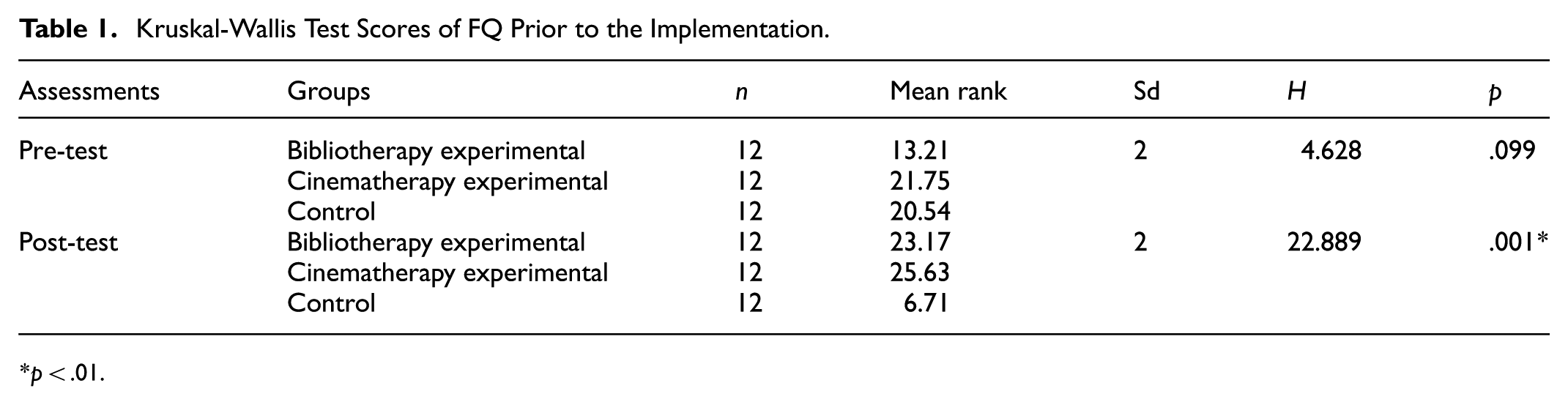
p < .01.
When the FQ scores were compared before the intervention, it was found that there was no significant difference between the groups (H = 4.628, SD = 2, p = .099). After the therapies, the group scores differed significantly (H = 22.889, SD = 2, p = .001). In order to reveal the difference between the subgroups, the groups were analysed with the Mann–Whitney U Test (Table 2).
Mann–Whitney U Test Results Comparing the Students’ Scores After the Implementation.

p < .01.
When the scores of experimental groups were compared with the control group, a significant difference was found in favour of both of them. When the effect size of the difference was calculated, it was determined that a large level effect occurred (U = 1.500, and 1.000, z = −4.072, and −4.101, p = .001, r = .68, .68). However, the scores of both intervention groups were compared, no significant difference was found between the groups (U = 57.50, p = .402). Within the scope of the Q2, it was examined whether the scores differed depending on the intervention (Table 3).
Wilcoxon Signed Rank Test FQ Scores of the Groups.

p < .01.
A comparison of pre-test and post-test scores within the experimental groups revealed a statistically significant improvement in favor of the post-test scores (z = −3.059 and −3.062, p = .002, r = .51 for both groups). On the contrary, the control group showed no statistically significant change between pre-test and post-test scores (z = −0.039, p = .969). These results indicate that the therapies are effective in improving the FQ and have a moderate effect.
Teachers’ and Students’ Views on Bibliotherapy and Cinematherapy Therapies
In the qualitative phase of the study, teacher and students’ views regarding the increase in FQ as a result of therapies were investigated in relation to Q3. Furthermore, practitioner notes were systematically recorded in the research diary for each therapy. It was reported that the overall participation in all sessions was high and there was a strong interaction environment.
Bibliotherapy: Student Opinions
The views of the participants in the bibliotherapy group on “Building friendship and being a companion” were that their awareness increased, that they learnt lessons and that they would be more attentive to the longevity of their existing or new friendships. BS4’s views were striking: “In the book Bear and Rat, a good friendship relationship (…) was described very clearly. I attach great importance to these things in my own relationships and I want to see them from the other person as well.” In the responses related to “Confidence,” it was contributed to recognising prejudices and feeling trust in others. It was perceived as a supportive factor in establishing warm and qualified connection in the friendship relationship, and that one should be cautious in order to prevent potential disappointment. Participant’s responses regarding “Sharing secrets or self-disclosure” highlighted the participants realised the need to make more effort to do so, that sharing secrets were critical in the development of friendship, and that it might lead to possible risks. The fourth question was about receiving “Approval and support.” Participants emphasised that they had increased their awareness of the importance of listening, approving, empathizing and supporting their friends. BS2’s response stood out: “Even buying a small gift for a friend strengthens the bonds and such behaviours have positive effects.” From the answers given to the question about “Helping and guiding,” it was understood that the participants were positively affected by the books they read and that helping and guiding were important in friendship relations. The other question was on “Conflict and betrayal.” BS11’s response was quite striking in this regard: “We were having fun together (…) Then something happens and we got apart, sometimes we argued for no reason. I saw that there were others with him, then I got bored, of course he forgot me immediately and turned his back on friendship, I didn’t like these things (…) (against this problem) I prefered not to talk, I sulked. Maybe he didn’t realise it. But they were needed to solve the problem” (BS11)
Bibliotherapy: Teacher Diaries
In the book Bear and Rat, students deeply felt that friendship means being together even in difficult times. BS11 associated his own experience with the character in the story and commented: “Sometimes we could guide our friends and could prevent them from making mistakes.” After reading The Rabbit Listened, it was observed that students started to discuss that the concept of trust could be formed over time. In the session in which Le Petit Prince was read, BS5’s sceptical point of view that “When we shared our feelings with someone, we didn’t know whether they would really understand us or not” was noteworthy. After reading Matilda, it was observed that the students better understood the importance of supportive relationships and discussed the positive effect of affirmation on self-confidence. BS1 emphasized the importance of emotional support for herself with the following statement: “Sometimes just knowing that someone understands us could be enough to keep going.” After reading the book Big Panda and Tiny Dragon, the importance of companionship in friendship and its effect on strengthening trust were discussed intensively by the group, and it was observed that the importance of this issue were better understood by the group. After reading the book Momo, the negative effects of sharing secrets and betrayal on friendship relationships came to the agenda of the group, and the participants shared their negative experiences with each other. While one group of students questioned whether forgiveness were possible, others expressed their views that betrayal always ended relationships.
Cinematherapy: Student Views
From the answers given by the participants to the question about “Building friendship and companionship,” it was understood that the importance of the subject were realised and that they would reflect these concepts in their lives. The investigation of individual responses demonstrated that the films perceived as influential varied across participants, reflecting diverse cinematic preferences and interpretive frameworks. For example, CS6 emphasised Raya and the Last Dragon and Big Hero 6, CS9 the October Sky, and CS10 the Toy Story 2. When the participant responses related to trust were analysed, it came to the fore that the films contained the theme of trust and that trust was an important concept in friendship. While CS4 stated that trust could be developed in long-term friendships, CS1 mentioned that he had difficulty trusting others by emphasising his past negative experiences. CS12 expressed his views with the following statement: “I found it difficult to share things about myself because I thought I didn’t trust (others). My friends didn’t tell me much either, I didn’t think it is very important, but my opinion changed here (due to therapy). It was important in friendship relationships, I would pay more attention (…) Sometimes it could be dangerous, but you couldn’t tell (a secret to others) without trusting them.(…) In the Harry Potter film, three friends trusted each other, helped each other and shared their secrets.” (CS12)
Participant’s response regarding “Sharing secrets and self-disclosure” highligted that the importance of sharing secrets was recognised, confidence was a prerequisite for sharing secrets and the participants considered themselves as trustworthy. CS12 stated that it was difficult for him to establish intimacy and that he made an effort in this regard. The most striking response to the question about “Approval and support” was given by CS9. CS9 stated that he observed supportive friendships in October Sky and wanted to treat his friends in this way. In the answers given to the question “Helping and guiding,” statements about benefiting and helping and guiding friends were emphasised. One of the participants (CS 10) stated that he didn’t consider himself sufficient in this regard. Responses to the “Conflict and betrayal” revealed emphasis on the characters’ tendency to engage in thoughtful decision—making when faced with conflict, suggesting that reflective judgment was perceived as a central narrative element.
Cinematherapy: Teacher Diaries
On the importance of “Building friendship and companionship,” after watching the films The Boy, the Mole, the Fox and the Horse, it was observed that the viewers reacted with sadness to the fact that the heroes of the film left alone. Following the viewing Toy Story 2, participants gave examples from their own experiences. After watching Harry Potter and Sorcerer’s Stone, CS7 stated that the friendship relationship in real life was different from the ones in the film: “Whatever Harry decided, his friends did not stop supporting him. I think this is not always the case in reality.”
As a result of watching the film Raya and the Last Dragon, discussions within the scope of confidence highlighted that Raya, the protagonist in the film, tended to trust others quickly and subsequently experienced the disappointments as a consequence of this tendency. CS3 emphasised that certain events had undermine trust in peer relationships, expressing with the words “…friendship is like this, sometimes disappointment happens… .” Within the scope of “Sharing secrets and self-disclosure,” in the film October Sky, it was observed that the main character made considerable efforts to achieve success; however, his father’s negative approach to his suggestions led to disappointed among viewers. Influenced by this, the participants proposed ways in which emotional sharing could have supported the main character.
While watching the film Star Wars a New Hop, the comments of CS1—which could be associated with “Approval and support”—“A true friend was someone who might support you no matter what.” and CS8 “(referring to the protagonist) became more confident with the help of his friends and finally succeeded…” were remarkable. In the films The Boy, the Mole, the Fox and the Horse and Star Wars a New Hop, it was observed that the heroes of the films guiding each other were perceived positively by the viewers. Following the watching the film Raya and the Last Dragon, the participants stated that misunderstandings and loss of trust might occur in friendship, and a discussion was continued through the film heroes in order to overcome these problems (Conflict and betrayal).
Discussion
In this mixed design study, the effect of the intervention focused on cinema and bibliotherapy on the development of FQ of gifted students were examined quantitatively, and then the significant effects were investigated in depth with qualitative evidence in the context of a cause-effect relationship. The results of this study are unique in that more than one type of data was used consecutively and triangulation of the data through a mixed-method research design enabled a more detailed understanding of the effect of the intervention, and, it contains findings on the effectiveness of two different therapies.
No statistically significant difference was observed between the FQ scores of the control and experimental groups before intervention. The fact that the scores of both groups are not significant is crucial for experimental research (J. W. Creswell & J. D. Creswell, 2018). As a result of the therapies, the FQ scores of the experimental groups were significantly greater than the control group. These results align with those reported by Tekel and Akgul (2024), following their implementation of a social-emotional learning intervention for gifted students, and by Ozturk and Kutlu (2017b), who utilized psychotherapy to foster FQ. The study’s qualitative data were examined within the scope of the concept of friendship proposed by Parker and Asher (1993), grounded in Sullivan’s (1955) psychodynamic theory. Qualitative findings support to results of the quantitative analysis. The subsequent sections of the study will first present the findings derived from the bibliotherapy intervention, followed by those obtained through cinematherapy.
It revealed that participant awareness of establishing friendship and trust increase. It can be mentioned theoretically that trust is a cognitive phenomenon that can be learned and is a generalised expectation that other individuals will keep their promises (Rotter, 1954). The children with high levels of trust had more friends than their peers with lower levels of trust (Betts et al., 2009). There is a positive relationship between children’s belief that their peers will keep their promises and their level of fulfilling their own promises (Rottenberg et al., 2013). Accordingly, increased awareness of friendship and confidence will positively affect the FQ of the participants. The study also revealed that sharing secrets is important in the development of friendship. The children who shared their secrets sincerely were characterised as warmer, trustworthy and friendly by others (Collins & Miller, 1994) . According to Altman and Taylor’s Social Penetration Theory (Altman & Taylor, 1973), self-discloser is limited to sharing information on superficial issues the first time in the friendship relationship, but over time it evolves towards a special friendship mode in which private and deeper issues are shared, depending on the trust established. The theoretical comment and result of Collins and Miller (1994) are consistent with the finding of this study. Sharing secrets can be considered as a factor that improves FQ. Our study unveils that peer approval contributed to the increase in self-confidence. This study findings are consistent with the literature. For example, Sandstrom and Cillessen (2006) underlined that social skills have a mediating effect between peer acceptance and self-confidence. Zimmer-Gembeck and Pronk (2012) indicated that positive peer support increased self-confidence. Also, the study points out that help and guidance had a reinforcing effect on friendship. Supportive interaction between individuals is a supportive factor in establishing a bond of friendship and turning it into a long-term relationship (Bukowski & Sippola, 2005). The importance of communication in conflict resolution was also emphasised in the study. The results of Bukowski and Sippola’s (2005) are parallel this study. We conclude that it is possible to maintain the bond of friendship in a conflict situation, to understand the problem correctly and to develop solutions to the problem only through open communication. Friendships are not an unfamiliar concept to the participants. The findings of this study suggest an increased awareness of certain variables that influence the development of friendships. These results align with Monroy-Fraustro’s (2021) research, which found that bibliotherapy can help participants re-attribute meaning to their own relations.
When the qualitative data collected for the cinematherapy are analysed, the first finding is that loneliness is an undesirable phenomenon and the importance of establishing friendship or companionship. There is a negative relationship between loneliness and friendship skills (Rottenberg et al., 2013) and loneliness may decrease as friendship skills improve (Ozturk & Kutlu, 2017b). The finding is in line with these study. It was also emphasised that time is needed for the emergence of a sense of trust in the friendship relationship and the importance of trust and emotional sharing in self-disclosure and sharing secrets. The results of Li et al. (2021) are consistent with the findings of this study. In the longitudinal study conducted with children aged 7 to 13 years, the researchers determined that a certain period of interaction is required for trust formation, the trusted person’s (counterparty’s) reputation for trustworthiness and the relationship closeness of the trust giver (individual) with the counterparty are effective in the development of trust judgement. Another remarkable result of the study is that peer support is seen as a prerequisite for success. These results are consistent with the findings of King (2015). He reported that strong peer relationships support academic success. Another finding is that participants believe that there may be conflict or betrayal in friendships, but that problems can be solved. Rusbult et al. (2005) emphasised that forgiveness in friendships has an important role in them. Fehr et al. (2010) reported that forgiveness in a conflict or betrayal situation depends on individual and situational factors and has an important role in maintaining relationships. The results of Rusbult et al. (2005), and Fehr, Gelfand, and Nag (2010) are consistent with this study finding. From a different perspective, in the studies explaining the peer relations of gifted children, it is emphasized that gifted childer tend to solve problems with a more mature and positive ways than their peers (Rinn & Majority, 2018; Schultz, & Delisle, 2003). Considering the finding reported in the cited literature, the results related to conflict and betrayal, which refletcs the positive insight of the participants, may be interpreted as expected results.
In this study, the effects of the therapies is also analysed comparatively. No significant difference emerged depending on the type of therapy. No empirical study could be found in which the effectiveness of the two therapies is directly compared in the literature. The result may be discussed indirectly from two different theoretically perspectives in terms of the effect of stimulus delivery on learning. According to Dual-Coding Theory (Paivio, 1990), verbal and visual systems work separately in learning. The effect of learning increases when both stimuli are given synchronously. Under this assumption, cinematherapy would be expected to be more effective. On the other hand, in Sweller’s (1988)“Cognitive Load Theory,” the increase in cognitive load (extraneous) caused by the presentation and design of the learning material negatively affects the ability to focus on the intended message, to maintain the focus for a long time, and the cognitive processes related to the process of processing and making sense of the information that constitutes the essence of learning (germane). Therefore, even if it is assumed that germane remains constant due to the high cognitive potential of gifted children while watching movies, the extraneous cognitive load is higher. Under these conditions, bibliotherapy is expected to have a more significant effect than cinematherapy. It may be considered that both therapies have their own advantages and limitations. Dermer and Hutchings (2000) claimed that films have some advantages such as the simultaneous presentation of visual and auditory stimuli, modelling of characters and the ability to create a wide range of emotional reactions in the audience, but the effect of films is short-term and superficial. Heath et al. (2005), on the other hand, emphasised that bibliotherapy provides an opportunity for in-depth understanding by providing the reader with the opportunity to return to the reading material when he/she is distracted. In studies comparatively examining the effects of stimulus types in learning, individual preferences (Kalyuga, 2007) or spatial ability (Hoffler & Leutner, 2011) were found to have a significant effect on the learning process. In this study, the fact that the effects of the therapies did not differ significantly may have arisen due to independent, moderator or mediator variables that were not measured in this study, or the specific advantages and limitations of both methods may have balanced the observed effect.
Conclusion
In this study, the programmes of the therapies, which were prepared based on a strong theoretical framework and comprehensive research results and implemented meticulously, showed significant results in improving the FQ of gifted students. In other words, it was concluded that cinematherapy and bibliotherapy were effective in the development of FQ of gifted students. However, depending on the intervention types, the development of FQ did not differ significantly. When the development in FQ was analysed deductively, the results of this study consistent with the characteristics of friendship development exhibited by 11 to 12 age group children in psychodynamic theory were obtained. The qualitative data provided an increase in the knowledge of the conceptual framework of Parker and Asher (1993) as confidence, etc. related to FQ. The findings from the bibliotherapy sessions highlight several key insights regarding the development of FQ. The findings suggest that for gifted children, the development of confidence is linked to the ability to recognize personal prejudices and feelings of trust. Trust itself was found to be a process that requires time and should be supported by a warm, qualified connection. Furthermore, a supportive relationship within friendships positively influences self-confidence, with key behaviors including listening, supporting, and empathizing. While revealing that companionship during challenging times helps strengthen trust, it also found that directly confronting conflict and betrayal may have a detrimental effect on the friendship itself.
Cinema therapy sessions provide also valuable insights into development of FQ. The results indicate that the intervention helped students recognize the importance of building friendship and companionship in their lives. The study confirms that trust is critical for developing friendships, but it is a process that requires time and can be damaged by negative past experiences. A close relationship was identified between trusting and sharing secrets, with confidence serving as a prerequisite for the latter. Furthermore, the data suggest that consistent friendship support and the reciprocal acts of benefiting from and helping a friend positively influence the friendship relationship. The findings also highlight that common problems like misunderstanding and loss of trust can arise but can be effectively overcome through open communication. Considering the quantitative and qualitative data together, the results of this study were parallel to the results of the research in the literature on the effectiveness of therapy. It was found that both therapies were effective in improving FQ, and there was no significant difference between them when the therapies were compared.
The findings on the therapies contribute to the growing body of evidence supporting their effectiveness, particulary in adressing the social-emotional needs on friendship of gifted students as a specific population. Based on these results, it can be concluded that educators working with gifted children may consider integrating these therapies into general education or extracurricalar activities to support the enhancement of FQ as an alternative to each other, taking into account specific conditions such as individual preferences and characteristics of the educational environment. Furthermore, National Association for Gifted Children (2021) recommends preventive guidance activities in order to optimise the social and emotional development of gifted and to increase their awareness of possible risks. In this study, a cinematherapy and bibliotherapy were also applied to the control group after the research in order to provide equal opportunity.
Limitations and Considerations for Future Research
The study provides that cinematherapy is effective as an innovative intervention in improving the FQ in gifted. The effectiveness of it was analysed according to the change in pre-test and post-test scores. Follow-up data were not collected in this study. Some researchers have criticized that the impact of films is short-term and superficial (Dermer & Hutchings, 2000). In this case, the possibility of forgetting what has been learnt is high. J. W. Creswell and J. D. Creswell (2018) suggest a follow-up evaluation to better understand the effect of the intervention in cases where the effect may change rapidly over time. The collection of follow-up data in another study would support more precise conclusions about the effectiveness of the intervention in question.
Readers are exposed to visual stimuli in bibliotherapy and viewers are exposed to visual and auditory stimuli simultaneously in cinematotherapy. Since this study was designed in an experimental design, participants were randomly assigned to the study groups. In other words, no evaluation was made regarding the individual preferences or spatial ability levels of the participants while forming the groups. However, it is reported that both variables have an effect on intervention programmes. If researchers examine the effectiveness of therapies by controlling both variables in another study, the possible masking effect related to these variables might be eliminated.
The participants of this research group are gifted described as highly intelligence children. The effect of the intervention programmes in this study is limited to gifted children. Also, considering theoretical approaches of Hyper Brain–Hyperbody Theory, which posits that gifted students exhibit high levels of neurological arousal and sensitivity, and Theory of Positive Disintegration, which suggests that overexcitability states may vary across different domains of sensitivity, the findings of this study should be interpreted as specific to gifted population (highly intelligence), not general population. The researchers interested in the topic conduct a research investigating the effects of the therapies on general population and gifted and talented in the arts. Another limitation is that the gifted students scores were investigated without categorization by intelligence level. Yet, gifted children’s social development, and consequently their FQs, might also differ within themselves due to their intelligence level. In another study, investigating the effect of each therapy on the development of FQ by categorizing gifted children within themselves with respect to intelligence level or comparing gifted and normal children will help us to understand the differences that may arise in the FQ due to the nature of giftedness more comprehensively.
The students included in this study were selected from a population without socio-emotional or psychological problems. Future research could investigate the effectiveness of these therapeutic interventions and the development of FQ more deeply by focusing on groups that are more likely to experience difficulties in peer relationships, such as those who are shy, introverted, or socially isolated. A significant limitation of this study was the small sample size, with each group comprising only 12 participants. This limited number of participants is a major obstacle to the generalizability of the findings. The therapies developed could be tested in a future study with larger participant groups and a broader age range to obtain more generalizable results.
This study was conducted in an extracurricular setting where students participated on a voluntary basis. While participant motivation was not explicitly measured, researcher believe it was strongly possible high. However, participant motivation might differ in other contexts, such as a general education classroom or when integrated into a core curriculum subject like values education. Differences in participant motivation could influence the outcomes of the therapies. Future research should therefore investigate the impact of these contextual differences.
The most important problem in bibliotherapy or cinematherapy is the availability of high-quality materials that match the educational objectives. Making a film or writing a book for educational purposes are costly. As a cost-effective approach, the materials available in the literature were determined by the researcher and used after expert opinion. Of course, the primary purpose of the producers of the materials is not to be used to improve the FQ within the scope of therapies. In addition, the messages given explicitly or implicitly in books or films may be perceived differently according to the reader/viewer (Tekel & Akgul, 2024). Despite these limitations, the materials were used with the idea that they would provide effective results in therapies. The effect found in this study is limited to the effect of the materials used. In another study on FQ, a different effect might be found when different materials (books/films) are used on the same subject. The systematic classification of each new publication or film by experts by considering the intelligence, socio-emotional development level, age, gender, cultural background and subject headings of the student will help them to facilitate its use in future therapies.
In this study, quantitative findings related to FQ were analysed as a single composite construct over the score calculated from the total scale. This is one of the important limitations of this study. Due to this limitation, the possible masking effect of the scores of the scale sub-dimensions on the total score of FQ might unknown. In another study, within the scope of Parker and Asher’s (1993) concept of FQ, the subcomponents of FQS might be discussed as separate topics. The relationship between these sub-dimensions might be examined with a structural equation model, or the mediating role of intelligence in FQ might be tested by creating a regression model, or whether FQ differs depending on the change in age group might be examined. This study was discussed to enhance the FQ in gifted students and the effects of the therapies were compared. However, the findings of this study were obtained by analysing the data collected from a limited number of gifted participants who participated in the study groups. In order to reach more generalizable results, there is a need to conduct studies with more participants, including participants from different age ranges, intelligence level, intervention duration, and context, or cultural backgrounds.
Footnotes
Appendix
Bibliotherapy and Cinematherapy Sessions Contents.
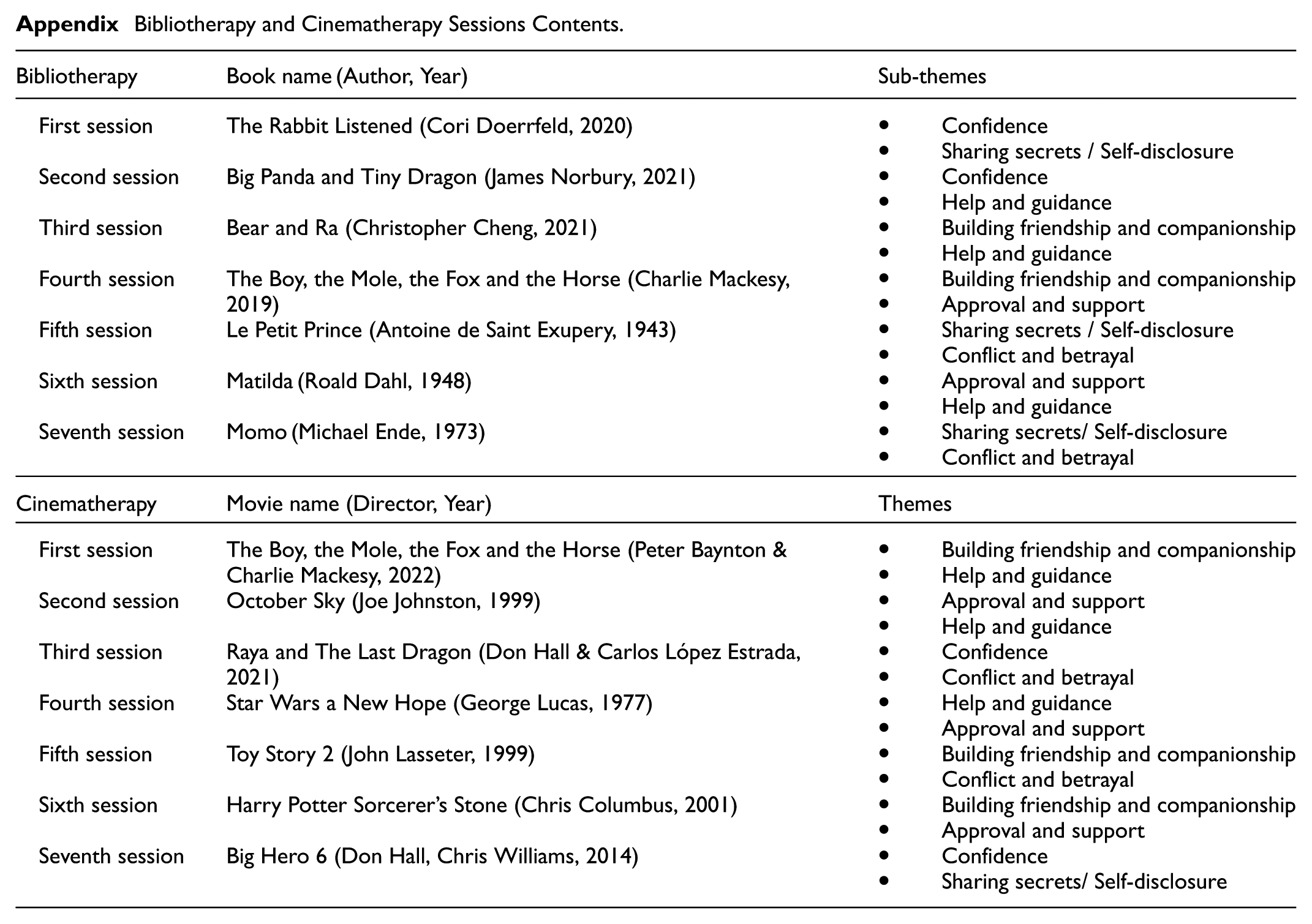
| Bibliotherapy | Book name (Author, Year) | Sub-themes |
|---|---|---|
| First session | The Rabbit Listened (Cori Doerrfeld, 2020) | • Confidence • Sharing secrets / Self-disclosure |
| Second session | Big Panda and Tiny Dragon (James Norbury, 2021) | • Confidence • Help and guidance |
| Third session | Bear and Ra (Christopher Cheng, 2021) | • Building friendship and companionship • Help and guidance |
| Fourth session | The Boy, the Mole, the Fox and the Horse (Charlie Mackesy, 2019) | • Building friendship and companionship • Approval and support |
| Fifth session | Le Petit Prince (Antoine de Saint Exupery, 1943) | • Sharing secrets / Self-disclosure • Conflict and betrayal |
| Sixth session | Matilda (Roald Dahl, 1948) | • Approval and support • Help and guidance |
| Seventh session | Momo (Michael Ende, 1973) | • Sharing secrets/ Self-disclosure • Conflict and betrayal |
| Cinematherapy | Movie name (Director, Year) | Themes |
| First session | The Boy, the Mole, the Fox and the Horse (Peter Baynton & Charlie Mackesy, 2022) | • Building friendship and companionship • Help and guidance |
| Second session | October Sky (Joe Johnston, 1999) | • Approval and support • Help and guidance |
| Third session | Raya and The Last Dragon (Don Hall & Carlos López Estrada, 2021) | • Confidence • Conflict and betrayal |
| Fourth session | Star Wars a New Hope (George Lucas, 1977) | • Help and guidance • Approval and support |
| Fifth session | Toy Story 2 (John Lasseter, 1999) | • Building friendship and companionship • Conflict and betrayal |
| Sixth session | Harry Potter Sorcerer’s Stone (Chris Columbus, 2001) | • Building friendship and companionship • Approval and support |
| Seventh session | Big Hero 6 (Don Hall, Chris Williams, 2014) | • Confidence • Sharing secrets/ Self-disclosure |
Acknowledgements
I would like to express my gratitude to all students who participated in this study spontaneously and voluntarily.

Ethical Considerations
Ethical approval for all procedures involving human participants was obtained from the University’s Research Ethics Board (2024/47), and the study was conducted in line with the Declaration of Helsinki (1975). The data collection process and use of it in this study followed the Personal Information Protection Law of the People’s Republic of Turkiye. written consent has been obtained from the participants' parents and from the participants themselves.
Author Contributions
The development of the experimental materials in this study, their implementation with gifted students and the measurement of the results of the practice were prepared under the supervision of the first researcher and within the scope of the second researcher’s master’s thesis. Also, data analysis review & editing is done by first author.
Funding
The authors received no financial support for the research, authorship, and/or publication of this article.
Declaration of Conflicting Interests
The authors declared the following potential conflicts of interest with respect to the research, authorship, and/or publication of this article: This article is derived from the master’s thesis of the second author, conducted under the supervision of the first author.
Data Availability Statement
Upon reasonable request, the raw data supporting the conclusions of this article can be accessed from the corresponding authors, without undue reservation.